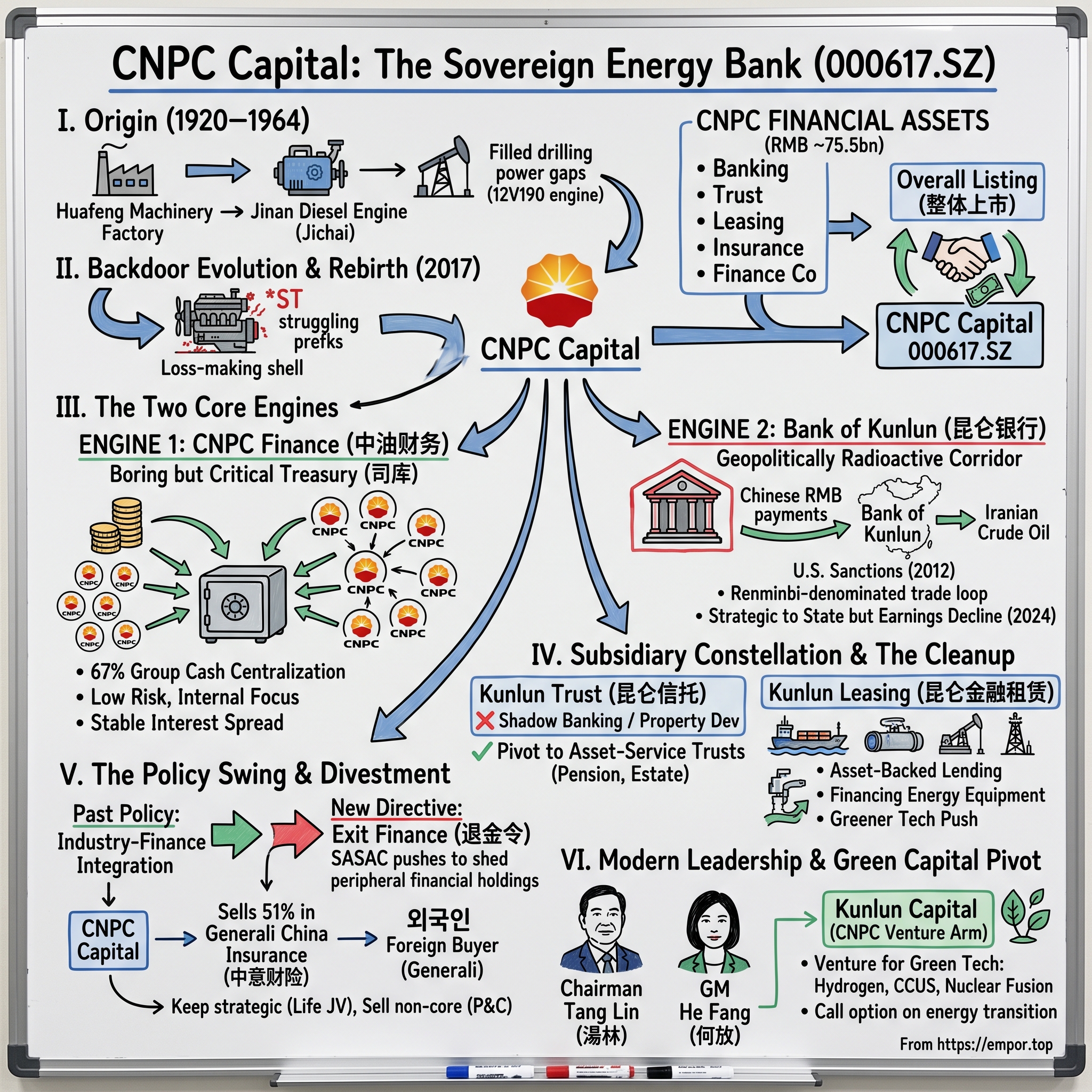
CNPC Capital: The Sovereign Energy Bank
I. Episode Introduction & The Sovereign Energy Bank
Picture the trading floor of the Shenzhen Stock Exchange on the morning of February 10, 2017. Executives from one of the largest state-owned enterprises on earth gathered for a ceremony that, on paper, made no sense. A company whose stock ticker had for decades been attached to a diesel-engine works in Jinan — a maker of the heavy internal-combustion engines that powered China's oil derricks — was being reborn. The nameplate changed from Jinan Diesel Engine to CNPC Capital, and in a single stroke the listed shell absorbed roughly RMB 75.5 billion of banking, trust, leasing, insurance and finance-company assets belonging to its parent, 中国石油天然气集团有限公司 China National Petroleum Corporation (CNPC).23 A factory that built engines had become a bank holding company for the nation's largest oil enterprise.
That is the backdoor paradox at the heart of this story. To understand CNPC Capital, you have to abandon the instinct to read it as a normal financial institution competing for deposits and loans. It is something stranger and more specifically Chinese: the captive treasury and financial-services arm of a sovereign energy champion, engineered to keep the group's cash inside the family and to finance the machinery of Chinese oil.
Nowhere is that "inside the family" logic more vivid than in its most notorious asset, 昆仑银行 Bank of Kunlun. Kunlun is a commercial bank headquartered not in Beijing or Shanghai but in Karamay, an oil city in the deserts of Xinjiang.[^6] In 2012 the U.S. Treasury cut it off from the dollar-clearing system for processing payments on behalf of designated Iranian banks.6 Rather than collapse, Kunlun was repurposed into a specialized, largely renminbi-denominated corridor for trade that other Chinese banks would not touch. It is a bank built, in part, to operate where the SWIFT-and-dollar plumbing of global finance deliberately does not reach.
Layered on top of the operating story is a policy story with two opposing forces. For years the Chinese state encouraged 产融结合 industry-finance integration — the idea that big industrial groups should own their own financial licenses to fund themselves cheaply and keep profits in-house.4 Then, in 2024, the pendulum swung hard the other way. The 国资委 State-owned Assets Supervision and Administration Commission (SASAC) began pushing central enterprises to shed peripheral financial holdings in what the market nicknamed the 退金令 Exit Finance Directive.10 CNPC Capital exists precisely at the friction point between those two doctrines: a financial conglomerate assembled under one policy regime, now asked to justify itself under another.
Here is the roadmap. First, how an obscure century-old engine maker became a listed shell and swallowed a financial empire. Second, the two engines that actually generate the money — 中油财务 CNPC Finance and Bank of Kunlun — and why one is boring by design and the other is geopolitically radioactive. Third, the constellation of smaller subsidiaries: trust, leasing, and the insurance joint ventures. Fourth, the divestment purge and what it reveals. Fifth, the leadership under Chairman 汤林 Tang Lin, re-elected to a fresh board term in July 2026, and General Manager 何放 He Fang.12 And finally, the investment spine: whether the 中特估 Chinese Characteristics Valuation System re-rating thesis is real, or whether a business trading below its own book value is telling you something true about the economics underneath.
Let us start where the engines were built.
 Subscribe on LinkedIn
II. Jichai Power & The Backdoor Evolution (1920–2017)
Every empire has an origin story, and this one begins in a machine shop. In 1920, in the Shandong city of Weixian, an industrialist named 滕虎忱 Teng Huchen founded the Huafeng Machinery Factory — one of the earliest diesel-engine makers in China.1 By the early 1930s it was turning out small engines of around fifteen horsepower; the enterprise took the Jinan Diesel Engine name in the 1950s, and in 1964 it was folded into the Ministry of Petroleum Industry.1 That transfer was the hinge on which the whole later story turns. A general machinery maker became a petroleum machinery maker.
The proof of that new identity arrived fast. In 1965, engineers at the plant developed the high-power 12V190 diesel engine, reportedly in a frantic sprint of under three months, and in doing so filled a gap in domestically produced drilling power.1 For a generation of Chinese oilfields, "Jichai" — the contraction of Jinan Diesel — was the literal heart of the rig, the block of iron that spun the drill string down into the Daqing and Karamay reservoirs. This is not incidental color. It is why, decades later, CNPC would look at this particular listed company when it needed a shell: Jichai was already inside the family. It was CNPC's own engine works, carrying a stock-market listing that most of the group's crown-jewel businesses lacked.
By the mid-2010s, though, the engine business was the problem, not the asset. The listed entity carried the "*ST" prefix that Chinese markets attach to financially distressed firms, and its industrial assets were valued at a rounding error — roughly RMB 462 million — against what was about to be poured in.3 Meanwhile the parent group had accumulated a sprawling collection of high-performing financial licenses: a finance company, a commercial bank, a trust, a leasing company, insurance ventures, securities stakes. They sat scattered across holding structures, unlisted, illiquid, and impossible for outside investors to value.
So CNPC ran the classic reverse-merger play, at a scale rarely seen. In the transaction announced on the evening of September 5, 2016, the tiny industrial husk of Jinan Diesel Engine swapped its manufacturing assets back to the parent's engine unit, and in exchange the listed company issued new shares — priced at RMB 9.88 each — to absorb 100% of CNPC's financial holding arm, an injection valued at roughly RMB 75.5 billion.32 Why do it this way rather than a clean IPO of the financial business? Because a backdoor listing sidestepped the queue and the uncertainty of China's tightly rationed IPO pipeline, let CNPC control the timing and the valuation, and delivered what the group actually wanted: an "overall listing" (整体上市) of its finance segment in one move, using a shell it already controlled.
When the renaming ceremony took place at the Shenzhen exchange in February 2017, CNPC had converted a loss-making engine maker into one of the largest financial-asset injections in the history of the A-share market.2 What the deal really signaled was a philosophy: that an industrial group of CNPC's size should run its own bank. The point was never to build a consumer-finance champion. It was to create a single, listed platform — an 产业金控 industrial-financial holding company — that could centralize the group's capital, fund its industrial core cheaply, and be governed under the banner of industry-finance integration.4 The parent kept its grip tight: to this day CNPC holds roughly 77.35% of the shares, leaving a slim public float for everyone else.4
That concentrated ownership is the bridge to the next question. If the parent owns three-quarters of the company and is also its biggest customer, where does the money actually come from? To answer that, we have to open up the two engines.
III. The Core Engine: CNPC Finance & Bank of Kunlun
Strip away the corporate diagram and CNPC Capital is really two very different machines bolted together. One is a quiet, low-risk internal utility that most investors have never heard of. The other is a bank that has appeared in U.S. Treasury press releases. Together they generate the bulk of the group's financial profit, and understanding why they are so different is the key to the whole company.
The treasury: CNPC Finance
Start with the boring one, because boring is the entire point. 中油财务 CNPC Finance Company Limited is a finance company in the specific Chinese regulatory sense: a licensed non-bank institution whose customers are all members of one industrial group. Think of it as the internal bank — the 司库 sīkù, or treasury — of the entire CNPC empire.5 Thousands of subsidiaries, oilfields, refineries, pipeline units and contractors sweep their idle cash into it, and it lends that pooled money back out inside the group. In 2024 CNPC's cash-concentration ratio — the share of group cash physically centralized on this platform — reached a reported 67%, described as a record high.5
The economics of that arrangement are genuinely unusual. A normal bank spends heavily to acquire customers and worries constantly about whether borrowers will repay. CNPC Finance has no customer-acquisition problem — its depositors are its owner's own subsidiaries — and its credit risk is dominated by lending to entities inside a sovereign-backed oil group. It reportedly earned a net profit in the region of RMB 6.0 billion in 2024, on total assets of roughly RMB 515 billion.5 Those are the numbers of a business that captures a stable interest spread on very high-quality internal assets, with almost none of the marketing or bad-debt drag that defines retail banking.
Two honest caveats belong here, because the promotional version of this story oversells it. First, CNPC Capital owns only 28% of CNPC Finance directly; the parent group holds 40% and PetroChina another 32%.5 That matters: the listed company is a large minority partner in the treasury, not its sole owner, so a meaningful slice of that RMB 6 billion accrues to others, and whether it is fully consolidated or equity-accounted is a genuine question an investor should verify in the financial statements rather than assume. Second, "near-zero credit risk" is a description of design, not a law of nature — a finance company concentrated entirely inside a single oil group is, by construction, undiversified. Its safety depends on the parent's health. In good years that is a moat. In a severe energy downturn it is a concentration.
The corridor: Bank of Kunlun
Now the interesting one. 昆仑银行 Bank of Kunlun began life as Karamay City Commercial Bank, a small lender in Xinjiang's oil country established in 2005. In 2009, CNPC injected billions of renminbi to take control and rebranded it Kunlun, giving the group a genuine commercial-banking license anchored in the oilfields of the northwest.[^6] Today CNPC Capital owns 77.09% of it, and it functions as the group's principal retail-and-commercial banking arm, with roughly RMB 8.43 billion of operating revenue in 2024.[^6]
Then came the event that made Kunlun famous. On July 31, 2012, the U.S. Treasury invoked the Comprehensive Iran Sanctions, Accountability, and Divestment Act and found that Bank of Kunlun had knowingly provided significant financial services to Iranian banks that Washington had designated over Iran's weapons programs and support for terrorism.6 The practical effect was surgical: U.S. financial institutions were barred from maintaining correspondent accounts for Kunlun, severing its direct access to dollar clearing.6 For most banks that would be a death sentence, because the dollar is the water the global banking system swims in.
Kunlun did not die. Instead it became the designated conduit through which China could keep buying Iranian crude while insulating its larger banks from Western secondary sanctions. The mechanism, as reported by Reuters and others, was a closed loop: Chinese buyers paid for Iranian oil in renminbi into accounts at Kunlun, and Iran drew on those balances to buy Chinese goods and equipment, so the money never had to touch the dollar system or leave the bilateral circuit.7 It was, in effect, a barter arrangement dressed as banking — a way to trade oil for manufactured goods using a bank as the ledger.
This is where an independent read has to depart from the romantic one. The corridor is real and strategically valuable to the Chinese state, but the idea that it is a permanently gushing profit engine deserves skepticism on the evidence. As renewed U.S. sanctions loomed in late 2018, Kunlun reportedly moved to stop receiving Iran-related payments — hardly the behavior of a bank enjoying a risk-free monopoly.7 And the reported financials point the same way: Kunlun's net profit fell to roughly RMB 1.71 billion in 2024, down sharply from about RMB 2.53 billion a year earlier — a decline of nearly a third.[^6] Whatever the "sovereign corridor" is worth in strategic terms to Beijing, in earnings terms Kunlun in 2024 looked like an ordinary regional Chinese bank feeling the squeeze of falling interest rates, not a sanctions-arbitrage cash machine. That gap — between the geopolitical mystique and the P&L — is one every prospective owner of this stock should sit with.
One more precision worth flagging: the popular telling ties Kunlun to the Tarim Basin, but the bank's own disclosures anchor its mission and branch network to Karamay, Urumqi and the wider Xinjiang oil complex rather than to Tarim specifically.[^6] The distinction matters less for the thesis than as a reminder that the folklore around this bank runs ahead of what the filings actually say. Between them, the treasury and the corridor explain most of what CNPC Capital is. But the group also owns a scatter of smaller licenses, and that is where some of the real problems — and some of the cleanup — live.
IV. The Subsidiary Constellation: Trusts, Leasing, & Joint Ventures
If CNPC Finance and Bank of Kunlun are the two engines, the rest of the portfolio is the constellation of smaller craft flying in formation around them — each with its own license, its own regulator, and in one case its own decade-long hangover. This is the part of the story where the "collect every financial license" logic of the 2010s shows both its ambition and its cost.
The most instructive case is 昆仑信托 Kunlun Trust, 87.18% owned, a trust company that traces back to 1986.8 Trust companies were, for years, the beating heart of Chinese shadow banking — vehicles that packaged high-yield "financing trusts" for property developers and local-government financing platforms. When China's real-estate boom turned to bust and local-government debt became a national anxiety, that model became a trap. Kunlun Trust spent the early 2020s working through the consequences, and management responded by retreating from the danger zones: it exited real-estate-related business back in 2021 and, in mid-2023, halted government-platform financing and channel business altogether.8
The pivot management now describes is from "financing trusts" — essentially disguised lending — toward "asset-service trusts," the lower-risk, fee-earning business of administering pensions, estates, bankruptcies and collateral.8 That is the regulator-approved direction of travel for the whole Chinese trust industry, and on paper it is prudent. The independent question is how much value is left after the cleanup. Asset-service trusts earn thin service fees rather than fat credit spreads, so a trust that successfully de-risks also, by definition, becomes a smaller and less profitable business. Kunlun Trust is less a growth story than a demonstration that a state group with a captive balance sheet can afford to shrink a troubled unit slowly rather than blow it up — a luxury that some private trust peers did not enjoy.
昆仑金融租赁 Kunlun Financial Leasing, 60% owned, is a cleaner fit with the group's DNA.9 Founded in 2010 as the first financial-leasing company backed by an industrial group under the old banking regulator, it does exactly what you would expect CNPC's leasing arm to do: it finances oil-and-gas equipment, vessels, and pipeline and energy assets, and has pushed into greener territory such as electric fracturing equipment and new-energy transport.9 Leasing has a structural advantage its banking cousins lack: because the lessor holds title to the physical asset — the rig, the ship, the pipeline segment — a default is cushioned by ownership of something real and repossessable, rather than an unsecured claim. It is asset-backed lending in the most literal sense, which makes it a more defensive place to sit than the trust.
Then there is insurance, and specifically 中意人寿 Generali China Life, a 50/50 joint venture with Italy's Generali that dates to 2002 — the first Sino-foreign joint-venture life insurer approved after China joined the WTO.[^11] The strategic logic is distribution: CNPC's workforce and its web of affiliated employees number in the millions, a captive base into which life and pension products can be sold with minimal acquisition cost. A long-lived 50/50 venture with a sophisticated European partner is also, quietly, the most globally credible asset in the portfolio — which, as the next section shows, is exactly why the group chose to keep it while shedding its sister company.
Because the same year Kunlun Trust was retreating from property risk, a directive came down from Beijing that would force CNPC Capital to prove it could subtract as deliberately as it had once added.
V. The Divestment Directive: SASAC's "Exit Finance" Purge
For most of the past decade, the prevailing wind in Beijing blew in CNPC Capital's favor. Industrial groups were encouraged to own financial licenses; integration was a virtue. Then the wind reversed. In May 2024 the Politburo reviewed new rules on accountability for financial-risk prevention, and on June 3, 2024, SASAC's Party committee held an expanded meeting that told central enterprises, in effect, to stop collecting financial institutions — in principle not to newly establish, acquire, or take fresh stakes in them, and to divest holdings that served the main business poorly while carrying high risk.10 The market promptly nicknamed the whole thrust the 退金令 Exit Finance Directive.10
For a company whose entire existence is the ownership of financial licenses by an industrial parent, this was not background noise. It was a direct question: which of these licenses actually earns its keep by serving the energy business, and which are just diversification for its own sake? The state was, in the language of activist investors everywhere, demanding an end to "diworsification" — except the activist here was the controlling shareholder's own regulator.
CNPC Capital's answer came through the disposal of 中意财险 Generali China Insurance, the property-and-casualty sibling of the life venture. In late 2023 the company placed its 51% stake on the China Beijing Equity Exchange through a mandatory public auction, with a floor price of roughly RMB 774 million.11 The buyer was Generali itself, which agreed in January 2024 to acquire the stake for about €99 million and take the property-and-casualty insurer to full ownership — completion subject to regulatory approvals.11 It was a notable transaction in its own right: a foreign insurer gaining outright control of a Chinese property-and-casualty business, bought out of a single state seller through a public exchange rather than a private deal.
Read the two insurance decisions together and a coherent capital-allocation logic emerges. CNPC Capital sold the property-and-casualty joint venture — a competitive, capital-hungry, lower-margin line where it had no particular edge — and kept the life-and-pension joint venture, where its captive employee base gives it a genuine distribution advantage. That is the divestiture playbook the Exit Finance era rewards: keep what is strategic and cash-generative, sell what is peripheral, and be seen to comply. As a template it is encouraging, because it suggests the group can distinguish a core asset from a hobby.
The skeptical footnote is that one clean disposal does not settle the larger question. The trust, the leasing arm, the securities stakes and the finance-company minority interest all still sit inside the structure, and the directive's logic — that an oil group has no business running a diversified financial conglomerate — points, if taken to its conclusion, toward a much more radical simplification than a single insurance sale. Whether the state ultimately wants CNPC Capital streamlined or dismantled is the unresolved regulatory overhang hanging over every valuation of this company. That tension is now the inheritance of a new management team.
VI. Modern Leadership & The Green Capital Pivot
Leadership at a central state-owned enterprise is not chosen the way it is at a founder-led company, and reading the résumés of the people put in charge tells you what the state wants the business to become. On July 16, 2026, CNPC Capital's board was reconstituted for a new term, with 汤林 Tang Lin re-elected chairman and 何放 He Fang confirmed as vice-chairman and general manager.12 The two men embody the company's split personality — one an oilman turned venture capitalist, the other a career banker of the sanctions-era corridor.
Tang Lin's background is upstream, not financial. He spent years at the Jidong Oilfield, one of CNPC's exploration-and-production units, rising to executive director and party secretary there before moving into capital roles.13 What makes his appointment a signal rather than a routine reshuffle is his other seat: he had served as chairman of 中国石油集团昆仑资本有限公司 CNPC Kunlun Capital, the group's green-technology venture-capital arm, before taking the CNPC Capital chair in April 2025.13 Putting an oilfield engineer with a venture-capital portfolio at the head of the finance platform is a deliberate bet that the future of industry-finance integration is financing the energy transition, not just clearing the group's cash.
Kunlun Capital is where that bet is placed, and CNPC Capital owns 20% of it.15 The fund, launched in 2021 and based in Hainan, concentrates on the technologies CNPC believes will matter in a decarbonizing world — microgrids, hydrogen, carbon capture, and advanced materials — and it made headlines in mid-2025 by taking a 20% stake in a controllable-nuclear-fusion venture, 中国聚变能源 China Fusion Energy.15 This is the optionality the bulls point to: a listed financial holding company with a side pocket of exposure to frontier clean-energy science. The honest caveat is proportion. A 20% stake in a venture arm is a small line on a balance sheet north of a trillion renminbi in assets, and fusion is a multi-decade scientific gamble, not a near-term earnings driver. It is a call option, not a thesis — and some of the "green mandate" language, such as geothermal, describes CNPC's broader activities more than Kunlun Capital's specific portfolio.
He Fang, by contrast, is the operator who actually knows how the money moves. His career runs straight through the two engines described earlier: international business at CNPC Finance and a long rise through Bank of Kunlun, where he became president in 2021 and later chairman, before stepping up to run CNPC Capital in 2025.14 He is the executive who has lived inside the cross-border payment corridors and the compliance tightrope they require. If Tang Lin represents where the state wants the balance sheet to go, He Fang represents the machinery that has to keep running while it gets there.
The credibility test for any state-owned management team is whether incentives are aligned with minority shareholders or only with policy. Here there is a concrete, if modest, mechanism: under the market-value-management commitments the company adopted, valuation and market-value metrics are to be written into management's annual performance assessments, alongside the SASAC-wide push often summarized as 质量回报双提升 Quality and Return Double Boost.18 Whether that genuinely changes behavior — or simply adds a line to a KPI sheet at a company whose controlling shareholder owns three-quarters of the stock and sets strategy from above — is something to judge by results over several years, not by the existence of the policy. The place those results show up is the valuation, which is where the investment argument finally has to be made.
VII. The Investment Story Spine: Bull vs. Bear
Every business eventually has to answer one question: why does it win, and what would break the case? For CNPC Capital that question is unusually sharp, because the market has rendered a blunt verdict — the stock has spent long stretches trading below its own book value, recently in the region of 0.8 times, with a return on equity of roughly 4%.19 A financial holding company worth less than the accounting value of its net assets is either a mispriced bargain or a fair judgment on the returns those assets produce. Both cases can be argued, and both should be.
Run the business first through Hamilton Helmer's 7 Powers. The strongest genuine power here is a cornered resource: exclusive access to CNPC's internal cash-clearing infrastructure. No outside bank can compete for the right to be the treasury of the CNPC group, because that right is granted by ownership, not won in a market. The treasury model also delivers real scale economies — pooling the cash of thousands of subsidiaries produces banking-scale efficiency without a branch network or a marketing budget. And there are meaningful switching costs: once thousands of suppliers and units are plumbed into the group's supply-chain finance and settlement systems, they do not casually leave. These are real advantages, and they explain the stable, low-risk profit of the finance company.
But notice what these powers are not. They are powers over a captive counterparty, and a captive counterparty is also a captor. Turn to Porter's five forces and the picture darkens. The threat of new entrants is low, protected by licenses — good for incumbency. But the bargaining power of buyers is extreme, because the dominant buyer of the company's services is the parent that owns 77% of it and can dictate terms, pricing and dividends. A moat that keeps competitors out also keeps the company dependent on a single, all-powerful customer-owner. Competitive rivalry is muted among the handful of central-SOE financial platforms — peers like 英大集团 State Grid Yingda and 五矿资本 Minmetals Capital operate parallel captive models — but ferocious in the open retail-banking market where Bank of Kunlun must actually compete for ordinary deposits and loans.20
The peer comparison is clarifying. Minmetals Capital saw its 2024 profit collapse — driven by its trust unit's first-ever annual loss — a reminder that the captive-finance model offers no immunity when the trust and credit cycle turns.20 The lesson for CNPC Capital is that its own troubled trust is not a quirk but an industry pattern, and that outcomes across these lookalike platforms diverge sharply based on portfolio mix and asset quality. CNPC Capital sits toward the larger, more diversified end of the group, but it carries the same structural vulnerabilities.
The bull case (why win). The affirmative argument rests on defensiveness and re-rating. The dividend is real: the company has committed to paying at least 30% of net profit every year since listing, distributed its first-ever interim dividend in 2024, and has cumulatively returned over RMB 15 billion to shareholders.17 At a depressed, below-book price, even a modest payout translates into a respectable yield, which is the crux of the 中特估 Chinese Characteristics Valuation System (Zhongtegu) thesis — the policy-driven idea that state enterprises trading at deep discounts should be re-rated upward as they lift dividends and manage their valuations. The captive treasury genuinely does insulate profits from consumer recessions, and the green-capital optionality provides a call on the energy transition. If Beijing's re-rating campaign has teeth, a below-book stock with a 30%-plus payout is where it would show up.
The bear case (why not). The falsifying evidence is in the trend. This is not a growing business: net profit attributable to shareholders fell in both 2024 and 2025, to roughly RMB 4.65 billion and then RMB 4.30 billion, and 2025 revenue dropped more than 13%.1619 The mechanism is structural net-interest-margin compression — as China's loan prime rate grinds lower, the spread that both the bank and the finance company earn narrows, and there is little either can do about it. The "high dividend payout ratio" of the bull case is, on the actual disclosed numbers, closer to 30% than to the lavish ratios the Zhongtegu story implies, which caps how much yield support the price really gets.17 There is a geopolitical cliff: the cross-border corridor is a compliance liability as much as an asset, and its earnings have already proven cyclical and sanction-sensitive rather than reliably rich. And there is the conglomerate discount itself — a complex holding structure, a 28% minority stake in its own treasury, a troubled trust in run-off, and no independent retail brand — all of which give the market real reasons, not just sentiment, to mark the whole below the sum of its parts.
An activist would press hardest on exactly that structure: why should minority holders own a diversified financial conglomerate, assembled under an old policy and now partly disavowed by a new one, rather than a clean, single-license entity that returns its cash? The most honest answer is that CNPC Capital was never built to maximize minority-shareholder returns — it was built to serve the parent's strategic needs. The investment question is whether the Zhongtegu re-rating and dividend discipline can, at the margin, make those two goals rhyme. That is a question best answered by watching a small number of specific numbers.
VIII. Current Risk Radar & Key KPIs to Watch
The risks that matter for this company are not the generic macro checklist; they are the specific pressure points where its unusual structure could either hold or crack. Three stand out, and each maps to something an investor can actually monitor.
The first is interest-rate and margin risk, and it is the dominant near-term story. As the People's Bank of China eases, lending rates fall faster than the company can reprice its funding, squeezing the spread on both the bank and the finance company. The twist unique to this business is stickiness on the liability side: the parent group's deposits are captive and slow to move, which cushions funding costs somewhat, but it does not offset the broader compression already visible in two straight years of declining profit.19 This is the mechanism most likely to keep return on equity stuck near 4%.
The second is asset quality during the trust transition. Kunlun Trust's retreat from property and local-government exposure is the right move, but a run-off book is only as clean as its worst remaining loans, and the pace at which legacy assets are resolved without fresh write-downs is the swing factor. The Minmetals precedent — a peer trust dragging its parent to a profit collapse — is the cautionary tale that makes this worth watching closely rather than assuming away.20
The third is the compliance tightrope on cross-border settlement. Bank of Kunlun's corridor is valuable to the state precisely because it operates where sanctions bite, which means the bank lives one policy shift away from either expanded exposure or forced retreat, as its 2018 pullback from Iran payments demonstrated.7 This is a binary, hard-to-model risk that no amount of domestic performance can fully hedge.
Against that radar, three KPIs cut through the noise. First, the net interest margin of Bank of Kunlun — the single cleanest gauge of whether rate compression is stabilizing or still eating into the core banking engine. Second, the non-performing-loan ratio across the commercial-banking and leasing arms — the early-warning light for whether the trust cleanup and the broader credit cycle are contained or spreading. Third, the dividend payout ratio — the direct test of whether the Zhongtegu and Quality-and-Return commitments translate into real cash returns above the 30% floor, or stay parked at the minimum.1718 Watch those three and you are watching the actual thesis, not the narrative around it.
IX. Epilogue & Lessons for Investors
The arc of this story runs from a machine shop in Weixian in 1920 to a nuclear-fusion venture stake in 2025 — from building the iron heart of an oil rig to sitting at the center of the cash flows, and occasionally the sanctions politics, of the world's largest national oil enterprise. It is a genuinely remarkable transformation, and it would be a mistake to read it as an accident. The through-line is that CNPC needed a listed platform to hold its financial licenses, and it built one out of the pieces it already owned.
The lesson for investors is to see the model clearly for what it is, and not for what a promotional telling would make it. The industrial-financial holding structure was never designed for speculative retail expansion or empire-building returns. It exists to secure the parent's liquidity, fund the energy business cheaply, and manage sovereign risks that ordinary banks cannot touch. Judged by that mandate, it works. Judged by the metric a minority shareholder cares about — the return on the equity they own — it produces roughly 4%, and the market has priced that reality into a sub-book valuation with clear eyes.
That is the tension every prospective owner has to hold. In the era of the Exit Finance Directive and the Chinese Characteristics Valuation System, the state has told companies like this one that success is now measured in optimization, dividends and capital returns rather than aggressive asset accumulation. CNPC Capital's insurance disposal shows it can subtract on cue, and its dividend commitments show it can return cash on schedule. Whether that discipline, applied to a slowly compressing set of captive businesses, is enough to close the gap between the company's book value and its market value is the open question — and it is one the numbers, not the narrative, will ultimately answer.
References
-
济柴百年:从华丰机器厂到石油钻采动力 (Jichai's century: from Huafeng Machinery to oil-drilling power) — Sina Finance, 2025-03-27 ↩↩↩
-
济南柴油机股份有限公司重大资产重组暨更名中油资本 (Jinan Diesel Engine major asset reorganization and renaming to CNPC Capital) — Shenzhen Stock Exchange, 2017-02-10 ↩↩↩
-
中油资本借壳济柴:755亿元A股史上最大金融资产注入 (CNPC Capital's RMB 75.5bn backdoor listing via Jichai) — National Business Daily, 2016-09-06 ↩↩↩
-
中国石油集团资本股份有限公司 2025年年度报告 (CNPC Capital 2025 Annual Report) — Shenzhen Stock Exchange, 2026-04-27 ↩↩↩
-
中油资本2024年年度报告摘要:产融结合与司库运营 (CNPC Capital 2024 Annual Report summary: industry-finance integration and treasury operations) — China Securities Journal (cnstock), 2025-04-03 ↩↩↩↩
-
Treasury Sanctions Kunlun Bank in China and Elaf Islamic Bank in Iraq for Business with Designated Iranian Banks — U.S. Department of the Treasury, 2012-07-31 ↩↩↩
-
Exclusive: As U.S. sanctions loom, China's Bank of Kunlun to stop receiving Iran payments — Reuters (via Business Standard), 2018-10-23 ↩↩↩
-
昆仑信托谈信托转型:退出房地产与政信业务 (Kunlun Trust on its transition: exiting real estate and government-platform business) — 21st Century Business Herald, 2025-01-09 ↩↩↩
-
昆仑金融租赁有限责任公司信用评级报告 (Kunlun Financial Leasing credit rating report — ownership and business scope) — Lianhe Ratings, 2025 ↩↩
-
国资委"退金令":央企原则上不得新设、收购、新参股金融机构 (SASAC's "Exit Finance" directive on central enterprises and financial institutions) — Sina Finance, 2024-08-28 ↩↩↩
-
Generali to become 100% shareholder of its Chinese P&C insurance business — Generali Group, 2024-01-10 ↩↩
-
中油资本第十一届董事会换届:汤林任董事长,何放任副董事长兼总经理 (CNPC Capital 11th board reelection: Tang Lin chairman, He Fang vice-chairman and general manager) — China Finance Information (cfi.net.cn), 2026-07-17 ↩↩
-
汤林 高管简历 (Tang Lin executive biography, incl. Jidong Oilfield and Kunlun Capital roles) — askci Stock Executives ↩↩
-
中油资本聘任何放为总经理:昆仑银行、中油财务老将 (CNPC Capital appoints He Fang as general manager, a Bank of Kunlun and CNPC Finance veteran) — Sina Finance, 2025-04-11 ↩
-
昆仑资本入股中国聚变能源:持股20%,聚焦氢能、CCUS、新材料 (CNPC Kunlun Capital takes 20% of China Fusion Energy; focus on hydrogen, CCUS, new materials) — Cailianshe (cls.cn), 2025-07-29 ↩↩
-
中油资本2024年营收390.24亿元、总资产超1.08万亿元 (CNPC Capital 2024 revenue RMB 39.02bn, total assets over RMB 1.08trn) — Securities Times (stcn), 2025-04 ↩
-
中油资本2024年度利润分配:每10股派1.17元,分红比例31.80% (CNPC Capital 2024 dividend: RMB 1.17 per 10 shares, 31.80% payout) — China Securities Journal (cnstock), 2025-04-03 ↩↩↩
-
中油资本"质量回报双提升"行动方案公告 (CNPC Capital "Quality and Return Double Boost" action plan announcement) — CNPC Capital / 9fzt, 2025-04-30 ↩↩
-
中油资本2025年归母净利43.00亿元、同比降7.57%,ROE 4.11% (CNPC Capital FY2025 net profit RMB 4.30bn, down 7.57%, ROE 4.11%) — Sina Finance, 2026-04-27 ↩↩↩
-
五矿资本2024年年度报告摘要 (Minmetals Capital 2024 Annual Report summary — peer comparison) — cninfo, 2025-04-25 ↩↩↩
 LinkedIn
 WhatsApp
 Reddit
 Hacker News
 Email
Email Kindle
 RSS Feed
 Spotify
 Apple Podcasts
 Amazon Music
 Audible
 YouTube