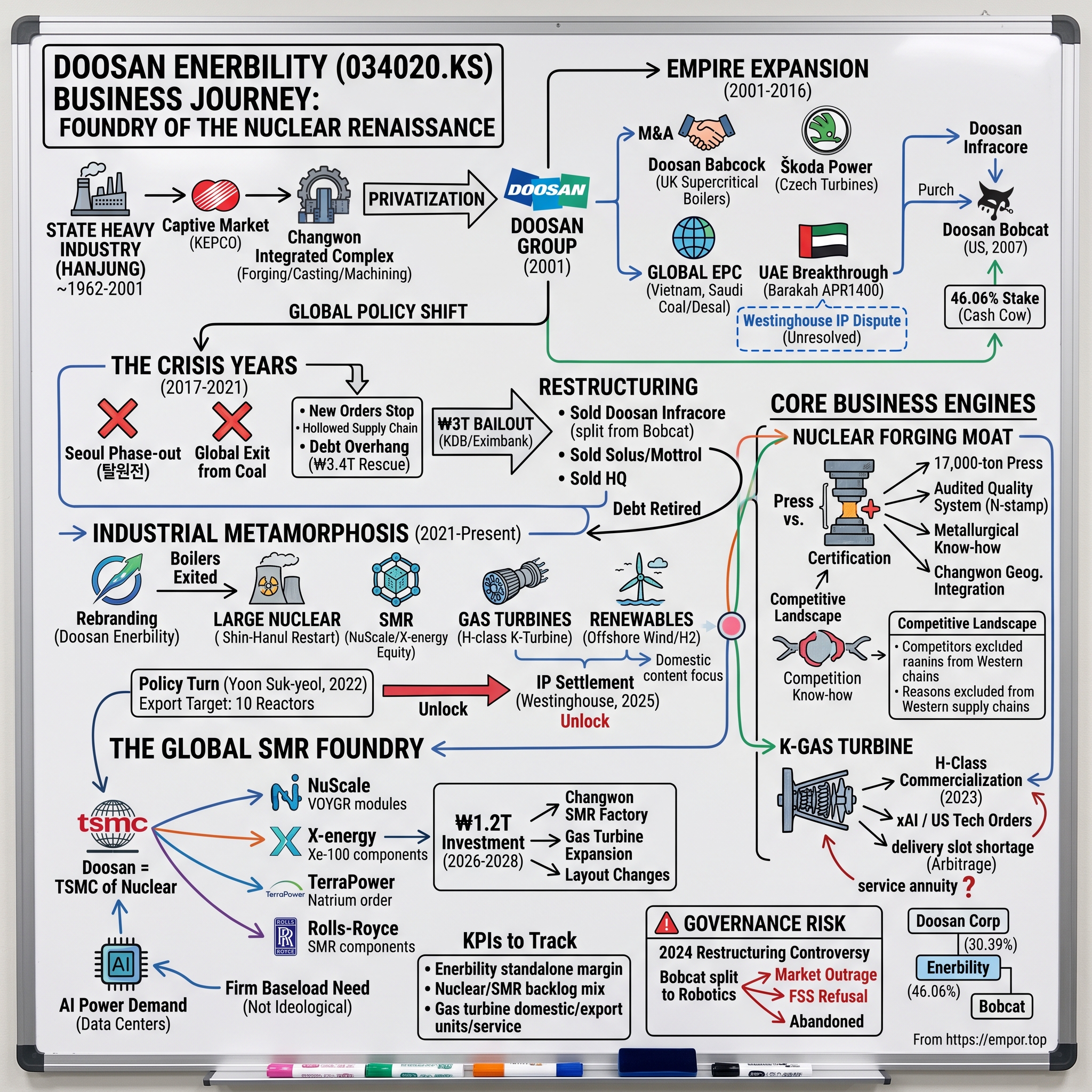
Doosan Enerbility: The Heavy Forging Foundry of the Global Nuclear Renaissance
I. Introduction & Episode Roadmap
Ninety-five feet tall and thirty feet wide, the machine sits in a shed in Changwon on the southern coast of South Korea, and when it closes on a glowing steel ingot the size of a shipping container, the floor moves. The press is rated at 17,000 tons of force. It can swallow ingots weighing up to 540 metric tonnes — roughly three hundred pickup trucks of hot metal — and squeeze them into a single seamless cylinder with no weld seam running around its circumference. It turns out perhaps four reactor pressure vessels a year.1
There is no machine like it in North America. The largest American forging press capable of similar work, at Allegheny Technologies, is rated at 15,000 tons but accepts ingots of only about 175 tonnes — nowhere near the 500-tonne class needed for a modern large reactor vessel. The United States operated 8,000-ton presses in the 1970s and then, as nuclear orders evaporated, simply stopped upgrading. Britain's Sheffield Forgemasters will not begin installing its replacement 13,000-ton press until July 2027.1
Which produces one of the more remarkable facts in global industrial capitalism in 2026: when the United States government decided in June 2026 to conditionally commit $17.5 billion in low-interest loans to buy the long-lead equipment for as many as ten Westinghouse AP1000 reactors, what it was really buying was a place in the queue at a factory 6,600 miles away in Changwon.12 Doosan Enerbility Co., Ltd. — 두산에너빌리티 Doosan Enerbility, ticker 034020.KS — has supplied both the reactor vessel and the steam generators for all six AP1000 units operating anywhere in the world. It is the only firm to have delivered both.2
Six years earlier, this company was days from insolvency. In 2020 the state-owned Korea Development Bank and the Export-Import Bank of Korea assembled a rescue package that ultimately ran to roughly ₩3 trillion, and the company — then called Doosan Heavy Industries & Construction, 두산중공업 — spent two years selling off the family silver under creditor supervision.3 It was a coal-boiler manufacturer whose end market had been legislated out of existence at home and financed out of existence abroad.
The recovery is not in dispute. In the first half of 2026 the company booked ₩7.1 trillion of new orders and ended June with a record order backlog of ₩26.4 trillion.4 What is in dispute is almost everything else: how much of that backlog converts to profit, whether the SMR foundry story is a business or a brochure, and — most persistently — whether minority shareholders of this particular listed entity get to keep the value the machines create.
There is also a live question about what kind of company this now is. For most of its history Doosan Enerbility sold into a policy market: utilities buying capacity because a government plan told them to. In 2026 a growing share of its order book comes from technology companies buying electricity generation as an input to compute — which is a fundamentally different customer, with different urgency, different price sensitivity and no obligation to wait for a regulator's five-year plan.
Because Doosan Enerbility is two companies wearing one ticker. There is the power-equipment manufacturer: nuclear forgings, steam generators, homegrown gas turbines, offshore wind nacelles. And there is a 46.06% controlling stake in Doosan Bobcat (두산밥캣 Doosan Bobcat), the North Dakota-born skid-steer maker that throws off far more cash than the parent's own factories do.5 Doosan Corporation ((주)두산 Doosan Corp), the family holding company, sits above it all with 30.39% of Enerbility's 640.6 million shares.6 In 2024 the group tried to move the Bobcat stake out of Enerbility and into a loss-making robotics affiliate at an exchange ratio that outraged the market, and had to abandon the attempt twice.
So the episode ahead runs on four themes.
First, the hardware moat: why the ability to forge a mono-block reactor vessel is one of the genuinely narrow bottlenecks in the physical economy, why that bottleneck is made of certification history rather than steel, and where the moat is thinner than the bull case admits.
Second, the political pendulum: how a company was nearly killed by Seoul's nuclear phase-out (탈원전 policy), revived by its reversal, and is now being pulled in a third direction by artificial-intelligence electricity demand — a demand source that does not care about anyone's manifesto.
Third, the governance discount, which is not an abstraction here but a documented sequence of registration statements sent back by the 금융감독원 Financial Supervisory Service, and the reason a company with a scarce industrial asset has spent two years arguing about who owns its cash flows.
And fourth, the export unlock — the January 2025 intellectual-property settlement with Westinghouse Electric Company that finally let Team Korea build in Europe, and whose terms remain confidential.7
Start where the machines came from: a state factory that nobody wanted.
 Subscribe on LinkedIn
II. State Heavy Industry Champion to Chaebol Privatization (1962–2001)
The origin story of Korea's nuclear forging monopoly begins, unglamorously, with a construction-materials trading firm. In 1962 a business called Hyundai Yanghaeng was set up in Seoul; over the following decade it grew into Hyundai International, an ambitious heavy-machinery venture built during President 박정희 Park Chung-hee's forced march into steel, ships, chemicals and machines.8 The bet was enormous and mistimed. By 1980, in the wake of the second oil shock and Park's assassination, the government swept up the wreckage in an industrial rationalisation programme, nationalised the company, and renamed it Korea Heavy Industries & Construction — 한국중공업, universally shortened to HANJUNG.8
For twenty years HANJUNG occupied a very specific slot in the Korean developmental state: it was the designated domestic supplier of power-generation equipment. When Korea Electric Power Corporation (한국전력공사 KEPCO) built a coal plant, HANJUNG cast the parts. When Korea began localising nuclear technology in the 1980s and 1990s — first building Westinghouse and Combustion Engineering designs under licence, then progressively indigenising them into what became the OPR1000 and eventually the APR1400 — HANJUNG got the forgings, the vessels, the turbine sets.15
This was not a market position won in competition. It was an assignment. And the assignment came with something rarer than a contract: the obligation to learn. Korea's nuclear localisation programme was explicitly designed to transfer manufacturing know-how, which meant HANJUNG's shop floor spent two decades being taught, audited and corrected by American and French licensors on components where failure is not survivable.
Assignments have consequences, and the good one was capital. A state monopoly supplier does not have to justify a hydraulic press against a hurdle rate. Korea poured concrete and steel into a single integrated site at Changwon (창원 Changwon), on the south coast near Busan — steelmaking, casting, forging, heat treatment, precision machining and final assembly on one campus, with a quay deep enough to load a reactor vessel onto a ship.
Almost nowhere else in the world was that whole chain built in one place, in one generation, with a captive order book to amortise it. The Western equivalents were assembled piecemeal over a century and then partly dismantled when nuclear orders stopped. Sixty years later, that geography is the company's most durable asset — and it exists because a developmental state was willing to fund an integrated complex that no return-seeking board would have approved.
The bad consequence was culture. By the late 1990s HANJUNG was, by most accounts, a bloated and loss-making state enterprise with militant unions and no commercial instinct — the standard pathology of a firm whose customer is also its owner and regulator. Then came the 1997 Asian financial crisis, the IMF programme, and a Korean government suddenly desperate to prove it would shrink the state.
HANJUNG went onto the privatisation block, and in December 2000 the winning bidder was a surprise: Doosan Group (두산그룹 Doosan Group), which paid roughly ₩305.7 billion for a 36% controlling stake.8 In 2001 the company was renamed Doosan Heavy Industries & Construction.9
To understand why that was strange, you have to know what Doosan was. Founded in 1896 as a dry-goods shop, it was Korea's oldest continuously operating business and, to most Koreans, a consumer company — OB Beer, soft drinks, food, publishing. The 1997 crisis had nearly broken it, and the Park family's response was one of the more radical pivots in Korean corporate history: sell the beer business, sell the consumer brands, and use the proceeds to buy heavy industry at post-crisis prices. As Forbes later put it, Doosan Heavy was assembled out of the takeover of "a deeply troubled giant that the government had acquired 20 years earlier and wanted to dump."10
The strategic logic was defensible and the timing was excellent. Consumer businesses in a country of fifty million people have a ceiling; capital goods sold into global infrastructure cycles do not. Buying a national champion at a distressed price, with the state anxious to see the deal close, is the sort of trade that only appears once. What the family also bought, though few appreciated it at the time, was a permanent political entanglement — a company whose order book would forever be a function of who occupied the Blue House and what they believed about atoms.
For the first fifteen years, none of that mattered, because the world wanted to build power plants and Doosan Heavy wanted to sell them.
III. Empire Expansion, Global M&A, & The UAE Nuclear Breakthrough (2001–2016)
The 2000s were the last great global buildout of thermal power, and Doosan Heavy rode it with the enthusiasm of a company that had just discovered it was allowed to leave home. Coal-fired plants across Southeast Asia. Seawater desalination for the Gulf, where Doosan became the world's largest supplier of thermal desalination plants — a business that is, in engineering terms, the same skill set as a boiler: very large pressure vessels, heat exchange, corrosion-resistant alloys, and the ability to deliver them to a desert coastline on schedule. Engineering, procurement and construction contracts stretching from Vietnam to Saudi Arabia. Forbes noted in 2012 that the Middle East had become the company's prime hunting ground.10
There is a strategic subtlety worth naming here, because it recurs throughout the story. Doosan had two possible identities: component maker or project contractor. The component maker sells scarce metal at a good margin and takes little schedule risk. The project contractor books far larger revenue and absorbs cost overruns, currency moves and client disputes for a decade. Through the 2000s Doosan chose to be both, because EPC filled the factory. That choice looked like scale in 2010 and looked like a balance-sheet vulnerability by 2018 — and the strategic pivot of the 2020s is essentially a decision to become the component maker again.
Management's stated view at the time was that owning technology, not just fabrication capacity, was the way to escape the low-margin subcontractor trap. So it went shopping.
In 2006 it bought Mitsui Babcock in the United Kingdom, renamed it Doosan Babcock, and acquired a genuine world-class capability in supercritical boilers — the pressure vessels at the heart of a coal plant, and the technology that lets a plant run hotter and therefore cleaner per unit of output. In 2009 it acquired Škoda Power in Plzeň, Czech Republic, adding a century-old steam-turbine house to the portfolio and, incidentally, planting a Korean flag in Central Europe fifteen years before anyone imagined that would matter.9
Combined with Changwon's forging, the company could now credibly claim to supply a complete power island: boiler, turbine, generator, condenser. In an industry where utilities prefer single-source accountability for the parts that spin, that integration was a genuine commercial advantage — and it is the reason Doosan can today offer a full nuclear power island rather than just the vessel.
And then there was Bobcat. In 2007 Doosan Group paid $4.9 billion for Ingersoll Rand's compact-equipment business — skid-steer loaders, mini excavators, attachments — the largest overseas acquisition by a Korean company to that point.11 It is worth being precise about the structure, because it explains a governance fight seventeen years later: the buyer was Doosan Infracore (두산인프라코어), the construction-machinery arm, not Doosan Heavy. The deal was heavily debt-financed and closed roughly twelve months before the global financial crisis destroyed North American housing starts, which is to say it closed at the worst conceivable moment for a company selling equipment to small contractors.
The M&A verdict, with the benefit of two decades, splits cleanly. Bobcat was a superb asset bought at a terrible price and financed recklessly; it took most of a decade for the interest burden to stop threatening the group, and the debt incurred was a direct contributor to the 2020 crisis. But the asset itself compounded — a genuine brand with dealer distribution across North America, which is the hardest thing to replicate in equipment. Doosan Babcock and Škoda Power were cheaper, more sensible, and bought into an end market (coal) that would be regulated out of the OECD within fifteen years. The lesson is uncomfortable for anyone who prefers disciplined acquirers: the wildly overpriced deal aged better than the prudent ones, because it was in the right industry.
The signature win of the era, though, was atomic. In December 2009 a KEPCO-led consortium beat Areva and Westinghouse to a $20.4 billion contract to build four APR1400 reactors at Barakah in the United Arab Emirates — the first export sale of a Korean reactor design and a genuine shock to the Western nuclear establishment.12 Doosan Heavy's role was the metal. Under a contract worth roughly $3.9 billion signed in 2010, it supplied the nuclear steam supply system components: reactor pressure vessels, steam generators, pressurisers and the main turbomachinery.13 The steam generators alone — stainless-steel assemblies that the Emirati operator described as about as long as a tennis court — took four years each to manufacture.14
Barakah did two things. It proved that Korean heavy manufacturing could deliver nuclear-grade components to schedule for a foreign regulator, which is the only qualification that matters in this industry. And it created the intellectual-property problem that would haunt Korea for the next fifteen years, because Westinghouse maintained that the APR1400 design descended from technology it had licensed to Korea in the 1980s.
Underneath the momentum, the balance sheet was rotting. The company was carrying debt from the Bobcat deal, running a low-margin EPC book with long-dated cost risk, and — worst of all — repeatedly injecting capital into Doosan Construction & Engineering (두산건설 Doosan Construction), a property developer that had been badly wounded by Korea's housing slump. A manufacturer with a genuine technological moat was being used as an ATM for a real-estate affiliate. That is a governance fact, not a market fact, and it is the same category of problem the company was still arguing about in 2024.
By 2016 the group had a global franchise, a world-class factory, and a capital structure with no margin for error. It needed the next decade to be normal. Instead, Korea held an election.
IV. The Crisis Years: Policy U-Turns, Debt Overhang, & The ₩3T Bailout (2017–2021)
In the spring of 2017, after the impeachment of President 박근혜 Park Geun-hye, Korea elected 문재인 Moon Jae-in on a platform that included the phased abandonment of nuclear power. The policy — 탈원전, literally "de-nuclearisation" — was not an aspiration. Construction preparation on Shin-Hanul Units 3 and 4 was halted, plans for new sites including the Cheonji project in Yeongdeok were scrapped, and the domestic pipeline of nuclear main-equipment orders that had sustained the Changwon complex for three decades simply stopped.15
For a company whose nuclear division existed because the state had assigned it that role, this was closer to a nationalisation-in-reverse than to a business cycle. Nuclear forging capacity cannot be repurposed. You cannot idle a 17,000-ton press for five years and expect the welders, metallurgists and ASME-certified inspectors to still be there when policy turns. What happened instead was the quiet erosion of a supply chain — hundreds of Changwon-area subcontractors, the SME tier that machines and inspects the small parts, went out of business or moved on.
The second blow landed at the same time and from the opposite direction. Global capital exited coal. Development banks, export credit agencies, insurers and commercial lenders adopted coal-financing exclusions in rapid succession between 2016 and 2019, and Doosan's legacy EPC pipeline in Vietnam, Indonesia and India — precisely the projects that were meant to bridge the nuclear gap — became unfinanceable.
It is worth being precise about the mechanism, because it is instructive about how ESG capital flows actually bite. Nobody banned coal plants in Southeast Asia. What happened was narrower and more lethal: the export credit agencies and multilateral lenders that provide the twenty-year debt for a $2 billion power plant in a frontier market stopped underwriting coal. Without that debt, the project sponsor cannot reach financial close, so the plant is never ordered, so the boiler is never built. Doosan's order book did not shrink because customers changed their minds. It shrank because its customers' lenders did.
The company had two large end markets, and both were closed by policy rather than by competition. There is no operational response to that. A management team can cut costs, refinance, and sell assets — all of which Doosan eventually did — but it cannot manufacture demand for a product that has become unbankable.
By early 2020 the arithmetic had become brutal. Doosan Heavy faced maturing short-term obligations measured in trillions of won into a capital market that COVID-19 had frozen solid, while continuing to absorb losses from Doosan Construction. Contagion ran upward: a default at Doosan Heavy would have taken the holding company and the family's control of the group with it. In March and April 2020, KDB and the Export-Import Bank of Korea began extending emergency credit, and by mid-2020 the committed support had reached roughly ₩3 trillion — with total taxpayer exposure reported at as much as ₩3.4 trillion once additional facilities were counted.316 Environmental groups pointed out, accurately, that a government committed to green finance was writing a multi-billion-dollar cheque to a coal-boiler manufacturer.17
The price of rescue was a creditor-mandated restructuring, and this is the part of the story that deserves more credit than it usually gets. Doosan did not litigate, stall, or negotiate the targets down. It sold assets, fast, and mostly for reasonable prices in a terrible market:
Doosan Infracore, the construction-machinery business and the group's second industrial pillar, went to Hyundai Heavy Industries Group for ₩850 billion — but with a crucial carve-out. Before the sale, Infracore was split, and the entity holding the Bobcat shareholding was retained by the group and lodged with Doosan Heavy; only the operating machinery business went to Hyundai, which later rebranded it HD Hyundai Infracore.18 That is how a power-equipment manufacturer came to own a controlling stake in an American compact-equipment brand. It was not strategy. It was a financing residue from a fire sale — and it is the origin of the entire Bobcat governance saga.
Alongside it went Doosan Solus (두산솔루스), the copper-foil and battery-materials business — an asset with arguably the best growth profile in the whole group, sold to private-equity firm Skylake Investment precisely because creditors wanted cash rather than optionality. Also gone: the hydraulics arm Doosan Mottrol (두산모트롤), golf courses, and the group's Doosan Tower headquarters in Dongdaemun. The Park family pledged personal shareholdings in Doosan Corporation as security, and the company executed rights issues that raised well over a trillion won. Between asset sales and equity, roughly ₩3 trillion of debt was retired.19
The pattern in that list deserves a moment. A distressed seller does not get to choose; it sells what buyers want, which means it sells its best assets. Doosan gave up a battery-materials business at the beginning of the electric-vehicle boom and a construction-machinery franchise at the beginning of an infrastructure cycle, and kept the coal-boiler maker nobody would buy. That is the real cost of a leveraged balance sheet — not the interest expense, but the loss of the right to decide what your company will be.
For investors, the crisis years are the single best evidence available about this management team, and the evidence cuts both ways. On execution under duress, the record is strong: the restructuring programme, originally expected to run three years, was terminated by KDB and Eximbank in February 2022 after twenty-three months, ahead of schedule.19 Debt-to-equity, which had exceeded 330%, fell dramatically over the following five years.20 On the question of how they got there, the record is damning: the near-death was caused by a debt-funded acquisition at a cycle peak, sustained subsidy of a failing affiliate, and an unhedged concentration in two politically exposed end markets. Both facts are true. The useful conclusion is that this is a management team that performs well when someone is holding it accountable — which is exactly why the events of 2024 matter so much.
The company that emerged in 2022 needed a new identity, and it went looking for one in a dictionary.
V. Industrial Metamorphosis & Rebranding (2021–2023)
Corporate renamings are usually a tell. A company that changes its name during a strategic crisis is often relabelling rather than reforming, and "Doosan Enerbility" — a portmanteau of energy and ability, announced at the March 2022 annual meeting — arrived with all the hallmarks of a consultancy exercise.9 The scepticism was fair. What makes this case unusual is that the underlying portfolio genuinely changed, and it is now possible to check.
The clearest evidence is subtractive. Boilers — the supercritical coal boiler business acquired with Mitsui Babcock, once the company's largest revenue line — have been wound down rather than harvested. By 2026 Doosan had removed the boiler business unit from its segment reporting altogether, citing portfolio conversion, workforce redeployment and the outsourcing of processes.21 Companies talk constantly about pivoting away from legacy products; very few delete the reporting line, because doing so removes the option of quietly milking it. That is a real commitment, and it also removes a revenue cushion.
What replaced it was a four-engine portfolio, and it is worth being honest that in 2022 three of the four were promises rather than businesses.
Large-scale nuclear was the one with a track record — APR1400 main components for domestic units and export consortia, plus the AP1000 heritage from Vogtle and V.C. Summer.
Small modular reactors were an idea supported by early equity positions rather than a business: $44 million into NuScale Power in 2019 and a further $60 million in 2021, for a total of $104 million, buying a seat at the table of the first SMR design to reach US regulatory approval.22 In December 2022, a Korean consortium of Doosan Enerbility and DL E&C committed $130 million to X-energy, developer of the Xe-100 high-temperature gas-cooled reactor.[^23] Note the mechanism: Doosan was buying customers, not returns. An equity cheque into a design house purchases the manufacturing relationship — a strategy that only works if at least some of the designs get built.
Gas turbines were the audacious one, discussed in detail below.
And renewables — 8MW and later 10MW direct-drive offshore wind turbines, green hydrogen, ammonia cracking, plus the separately listed Doosan Fuel Cell — was the engine most dependent on subsidy regimes and, through 2025, the least profitable. Offshore wind in particular has destroyed capital for nearly every manufacturer that entered it, and Doosan's position is sub-scale against Vestas, Siemens Gamesa and Chinese turbine makers. It is best understood as a domestic-content play on Korean offshore auctions rather than a global business, and investors should not pay much for it.
Then policy turned again. 윤석열 Yoon Suk-yeol won the March 2022 presidential election and, within months, declared that Korea needed to rebuild its nuclear industry "fast," setting a national target of exporting ten reactors by 2030.23 The domestic pipeline reopened. In March 2023, Korea Hydro & Nuclear Power (한국수력원자력 KHNP) and Doosan Enerbility signed a ₩2.9 trillion contract — roughly $2.2 billion, running ten years — for the reactors, steam generators and turbine generators for Shin-Hanul Units 3 and 4, the very units Moon had suspended.[^25]24
A useful investor question here is what that whipsaw teaches. Two things, neither comfortable. First, this is a business whose revenue visibility is set by electoral cycles in a handful of countries, and no amount of technological excellence changes that. Second, the asymmetry runs against the company: a phase-out destroys the supply chain in three years, while a restart takes a decade to rebuild it. Doosan spent 2023–2026 hiring and re-qualifying welders and inspectors it had lost — a cost the order-book headlines never show.
There is a second-layer detail worth noting from this period, and it is the sort of thing that only shows up if you read successive years of disclosure side by side. In June 2023, Doosan Enerbility sold a 4.99% slice of Doosan Bobcat for about $213.6 million, taking its stake to 46.06% while retaining control, and said the proceeds would fund new growth businesses.5 Management stated at the time that no further divestment was planned.
Thirteen months later, the group proposed removing the entire remaining stake. Consistency of narrative across filings and public statements is a legitimate analytical input — arguably the most reliable one available to an outside investor, since it costs nothing to check and cannot be spun — and that sequence is a mark against it. The charitable reading is that circumstances changed. The uncharitable reading is that the 2023 statement was made because saying otherwise would have hurt the share price. An investor cannot distinguish between them from outside, which is itself the cost of the episode.
Before that fight, though, the core question: what exactly is it that Doosan makes that others cannot?
VI. Core Business Engine: Industry Structure, Heavy Forging Moats, & K-Gas Turbines
Read Doosan Enerbility's consolidated income statement and you will misunderstand the company. In 2025 group revenue was ₩17.06 trillion, up 5.1%, with operating profit of ₩762.7 billion — down 25.0% — and net income of ₩205.1 billion, down 48%.25 Those numbers describe a mediocre year at a machinery conglomerate. They are dominated by Doosan Bobcat, which posted 2025 revenue of $6.18 billion and operating profit of $482 million at a 7.8% margin, down 1.4% and 24.5% respectively as North American compact-equipment demand softened.[^28] The consolidated line is, to a first approximation, a North American construction-cycle bet with a nuclear business attached.
The company management actually runs is the "managed consolidated" Enerbility segment — the power business including its own subsidiaries, excluding Bobcat. For 2026 it guided to revenue of ₩7.38 trillion, operating profit of ₩395.9 billion, and new orders of ₩13.32 trillion.25 That is roughly a 5% operating margin on the equipment business, against a stated medium-term ambition of about 9% by 2030, with 2026–2030 compound growth targets of 16% in orders, 13% in revenue and 20% in operating profit, taking the backlog to about ₩47.7 trillion.26
Hold that gap in mind — 5% now, 9% promised — because it is the whole investment argument. A company with a genuine monopoly on a critical component does not earn 5%. Either the mix shift to nuclear and turbines delivers the margin, or the moat is less economically valuable than the engineering suggests.
There are three honest explanations for why the margin is currently thin, and investors should decide which they believe. One: the backlog is still weighted toward legacy and balance-of-plant work booked in the lean years at lean prices, and the high-margin nuclear and turbine contracts signed since 2023 have not yet reached the revenue-recognition stage — percentage-of-completion accounting means a contract signed in 2026 for 2029 delivery contributes almost nothing to today's profit. Two: the company is absorbing ramp-up costs — hiring, re-qualification, new production lines — ahead of the revenue. Three: the scarcity is real but the pricing power is not, because Doosan sells to a handful of sophisticated buyers who know their supplier's cost structure and, in KHNP's case, effectively set the price.
The first two explanations are temporary and testable within about three years. The third would be permanent. The evidence so far leans toward the first two, because the margin trajectory has begun improving in 2026 — but it is not yet conclusive, and any investor who treats a 9% target as achieved is front-running the data.
Why the press is the moat
Start with the physics, in plain terms. A pressurised-water reactor's core sits inside a steel pot roughly forty feet tall with walls eight inches thick, holding water at 150 times atmospheric pressure and 300°C for sixty years, while being continuously bombarded by neutrons that make steel progressively more brittle. Every weld in that pot is a potential failure point and a permanent inspection liability. So the industry's preference is overwhelming: forge the shell courses as seamless rings — ideally as few, large pieces as possible — rather than rolling plate and welding it into a cylinder.
To do that you need a very large ingot poured to extraordinary cleanliness. Trapped gas, slag inclusions or segregated alloying elements become micro-voids that a regulator will reject, and there is no repairing the inside of a 300-tonne forging. Then you need enough force to work that ingot all the way through its centre — not just deform the surface — while it is at temperature, over multiple heating cycles that can run for weeks. That is what the 17,000-ton press bought in 2017 to replace Changwon's legacy 10,000-ton machine does.1
The reason this constitutes a moat is not the press. Presses can be bought; China builds them. The moat is the combination: an ultra-clean steelmaking and ingot-pouring shop, the press, heat-treatment furnaces large enough for the resulting object, machining centres accurate to fractions of a millimetre over forty feet, an ASME N-stamp quality system with decades of audited traceability, a workforce that knows the difference between an acceptable ultrasonic indication and a scrapped ingot, and a quay to ship the result. That bundle exists in perhaps four places on earth, took sixty years and a sovereign sponsor to assemble at Changwon, and — crucially — cannot be assembled quickly even with unlimited money, because the certification history itself takes years.
The competitive map, honestly drawn, is narrower than the marketing but wider than the bull case:
Japan Steel Works (日本製鋼所 Japan Steel Works) is the historical aristocrat of nuclear forging, with the Muroran works that supplied much of the world's reactor steel. Its capacity is limited and its capital investment has been conservative through the long nuclear winter; it remains a competitor in premium forgings but not a volume rival.
Framatome, part of Électricité de France, serves the European programme from Le Creusot. Its constraint is credibility as well as capacity: the 2016 discovery of falsified quality records at Le Creusot, and later carbon-segregation findings, forced a wholesale review that consumed years — a useful reminder that in this industry the binding constraint is documentation as much as tonnage.
China First Heavy Industries (中国一重 China First Heavy Industries) and 上海电气 Shanghai Electric have built the largest heavy-forging capacity in the world and can supply China's own build-out at a pace nobody else approaches. They are, for reasons of export control and geopolitics, effectively excluded from Western nuclear supply chains. This exclusion is the single largest contributor to Doosan's pricing position, and it is a political fact, not an industrial one. It could change.
GE Vernova and Westinghouse Electric Company are designers and systems integrators. They own the reactor intellectual property and the customer relationship; they do not own presses at Changwon's scale. This is precisely why Doosan is Westinghouse's principal supplier of AP1000 heavy forged equipment rather than its competitor.2
That last point defines the strategic position and its limit. Doosan sits one layer below the design owners, in the layer where physical scarcity lives. It is a very good place to be when demand exceeds capacity. It is a much worse place to be when it doesn't, because the design owner controls the customer.
The K-gas turbine: the harder achievement
If nuclear forging is Doosan's inheritance, the gas turbine is the thing it built from nothing, and it is arguably the more impressive engineering story.
A large industrial gas turbine is often described as the most difficult mass-produced machine in the world. Air is compressed roughly twenty-four to one, mixed with fuel, and burned at temperatures above 1,500°C — hotter than the melting point of the nickel superalloys the blades are made from. The blades survive because they are single-crystal castings with internal cooling passages and ceramic coatings, spinning at 3,600 rpm inches from a flame that would liquefy them. Getting one to run is hard. Getting one to run for 30,000 hours between overhauls, at a guaranteed efficiency, is why only a handful of organisations on earth make them: GE Vernova, Siemens Energy, and 三菱重工業 Mitsubishi Heavy Industries, with Ansaldo Energia holding licensed technology.
Doosan set out in the 2010s, with Korean government support, to become the next entrant. It completed the first domestic manufacture of a 270MW-class machine — the DGT6-300H S1 — in 2019, and installed it at the Gimpo combined heat and power plant.2728 Then came the part that separates a prototype from a product: an 8,000-hour grid-connected demonstration run, followed by a 240-hour continuous acceptance test, before the unit was declared commercially operational on natural gas in July 2023.29 The turbine drives a roughly 500MW combined-cycle block at over 60% efficiency.28 A larger 380MW H-class machine followed.
For years the sceptical view was that this was industrial policy dressed as commerce: a turbine that only Korean state-affiliated utilities would ever buy, sustained by localisation mandates. That view has become harder to hold, because American technology companies started buying them.
The sequence, as disclosed, runs like this. In October 2025 Doosan confirmed its first overseas gas-turbine order — two 380MW units for delivery by the end of 2026. In December 2025 it announced three more 380MW machines for what it described as a leading US technology company; Elon Musk subsequently confirmed that xAI had purchased five 380MW turbines, matching the pair plus the trio.3031 On 6 March 2026 came a much larger order: seven 380MW turbines with matching generators, with deliveries beginning in May 2029 at a cadence of one turbine and one generator per month.32 In May 2026 Doosan added four 370MW steam turbines for a Texas data centre campus, deliverable through 2029, and by April 2026 its cumulative US gas-turbine tally had reached twelve units.33
What that evidence supports, and what it does not, is worth stating carefully. It supports the conclusion that Doosan's H-class machine has cleared a commercial credibility threshold with buyers who have alternatives and are not subject to Korean procurement rules — which is a meaningful validation, because a data-centre operator choosing a fourth-tier turbine vendor is accepting real technical risk to get earlier delivery.
The honest reading of why Doosan won this business, though, is delivery slots rather than technology. The incumbent triopoly's order books filled up as AI power demand hit, pushing quoted delivery dates years out. A buyer racing to energise a compute campus will accept the fifth-best vendor if the fifth-best vendor can deliver eighteen months sooner. That is a real and valuable position — scarcity is scarcity — but it is a cyclical advantage, not a structural one. If GE Vernova, Siemens Energy and Mitsubishi add capacity, the delivery-slot arbitrage narrows.
And it does not yet demonstrate that Doosan can match the incumbents on fleet reliability, long-term service agreements, or the aftermarket parts-and-service annuity that is where GE, Siemens and Mitsubishi actually make their money. This is the most underappreciated point in the gas-turbine story. Selling a turbine is roughly a break-even-to-modest-margin event; the profit comes from decades of hot-gas-path parts, scheduled overhauls and performance guarantees, sold at high margin to a captive installed base. The service business is built on installed-base hours, and Doosan's installed base is measured in low double-digit units and tens of thousands of hours against incumbents' thousands of units and hundreds of millions of hours. The order book is real; the annuity is not there yet, and until it is, Doosan is selling machines rather than building a franchise.
The hydrogen roadmap — 50% hydrogen co-firing by around 2027 and a 100%-hydrogen 400MW machine targeted for December 2027 — should be read as an option, not a plan. It matters because a gas turbine sold in 2029 has a thirty-year life and buyers want a decarbonisation path. But hydrogen combustion changes flame speed and NOx chemistry fundamentally, no vendor has demonstrated a large 100%-hydrogen machine in commercial service, and hydrogen supply at power-plant scale does not exist. Treat announced dates in this area as intentions.
Which brings us to the business Doosan most wants to be valued on, and where evidence is thinnest.
VII. The SMR Foundry & The Global Nuclear Renaissance (2023–Present)
In the spring of 2026, executives from a British reactor developer, an American gas-cooled reactor startup, a Bill Gates-backed sodium fast reactor company and a Nasdaq-listed light-water SMR designer were all, in one form or another, negotiating for slots in the same building in Changwon. None of them competes with Doosan. All of them compete with each other. That is the position Doosan has spent five years engineering.
The pitch is elegant enough that it has a nickname inside Korean brokerages: Doosan wants to be the TSMC of nuclear power.
Here is the observation behind it. A generation of small modular reactor developers — NuScale Power, X-energy, TerraPower, Rolls-Royce SMR, Westinghouse with its AP300 — are, in industrial terms, design houses. They employ physicists, licensing engineers and software teams. They do not own foundries, presses, or N-stamp fabrication shops, and building one would consume their entire capitalisation.
Meanwhile the entire premise of an SMR is factory production. A conventional reactor is a construction project: tens of thousands of people pouring concrete and welding pipe on a muddy site for a decade, where every hour of delay costs interest on billions of borrowed dollars. An SMR is meant to be a product — smaller reactor modules built repeatedly on an assembly line, shipped by rail or barge, and bolted together on site. The whole cost argument rests on the learning curve: the tenth unit should be far cheaper than the first, the way the tenth aircraft off a Boeing line is. That only works if someone owns a factory that builds the tenth unit.
Doosan's argument is that it should be a neutral, multi-customer foundry serving all of them — exactly the fabless/foundry split that reorganised semiconductors, where design and manufacturing separated because the capital intensity of fabrication became impossible for design houses to carry.
The commercial evidence is genuinely accumulating, and it is more than memoranda. Doosan converted its NuScale equity position into manufacturing work, beginning with long-lead forging materials and then equipment supply for NuScale's VOYGR modules, with reported values running into the billions of dollars as NuScale's data-centre-linked projects advanced.[^37][^38] With X-energy, the relationship progressed from design-for-manufacture collaboration and equity investment to a binding reservation agreement in December 2025 covering steel components for sixteen Xe-100 reactors — alongside Doosan's commitment to build a dedicated SMR fabrication facility.34 It won an SMR component order from TerraPower, developer of the sodium-cooled Natrium design, in the first quarter of 2026.33 And in May 2026 Rolls-Royce SMR named Doosan Enerbility and Czech forger Škoda JS as its two strategic suppliers for core nuclear island components, including the reactor pressure vessel body, for deployment at Wylfa in Wales and Temelín in the Czech Republic.3536
Four separate reactor developers, using four different reactor physics — light water, high-temperature gas, sodium fast, and a UK pressurised-water design — all routing their heaviest steel through the same Korean shop. That is the foundry thesis working in practice, and it is the strongest single piece of evidence in the bull case.
The capital commitment behind it is also real, which matters because talk is free. Doosan has committed to invest about ₩1.2 trillion in plant construction, expansion and reconfiguration across 2026–2028, of which roughly ₩806.8 billion is going into the Changwon site for a dedicated SMR factory, gas-turbine capacity expansion and layout changes.2137 The company's stated engineering goal for that line is striking: reduce module manufacturing time from about seventeen months to three.2 If achieved, that is the learning curve the entire SMR industry has promised and never demonstrated.
Now the falsification tests, because this is where a neutral reading has to push back.
First, order backlog is not revenue and reservation agreements are not orders. A reservation secures queue position and long-lead material; it converts to revenue only when a developer reaches financial close on an actual plant. As of mid-2026 the number of SMRs under construction in the Western world remains very small, and the number generating electricity is zero. Every SMR developer named above depends on regulatory approvals, first-of-a-kind cost overruns, and utility or hyperscaler willingness to underwrite a technology with no operating cost history. NuScale's original flagship project, the Carbon Free Power Project in Utah, was cancelled in late 2023 when subscribing utilities balked at rising costs — the single most important cautionary data point in this sector, and a reminder that Doosan's SMR revenue is a derivative of other companies' financing.
Second, the customer-concentration structure cuts both ways. Being the neutral foundry to everyone is powerful while capacity is scarce. But Doosan does not own the reactor designs, so it captures the fabrication margin, not the licensing economics. In semiconductors, TSMC's position rests on a process-node lead that its customers cannot replicate at any price. Doosan's rests on a capacity shortage that a decade of Western capital expenditure could partially close — Sheffield Forgemasters' new press, ATI's potential upgrades, Framatome's expansion, and Japan Steel Works' latent capacity all sit on the other side of the ledger.
Third, the policy leg has moved again, and in a direction that reveals how contingent all of this is. 이재명 Lee Jae-myung, elected in June 2025 after Yoon's impeachment, had campaigned arguing that nuclear power is inherently dangerous and that Korea's atom-heavy generation mix deserved re-examination. In office, confronted with the electricity demands of semiconductor fabs and AI data centres, the administration reversed: in January 2026 it confirmed it would proceed with two new large reactors from the 11th Basic Power Plan, and in June 2026 Yeongdeok County in North Gyeongsang was selected as the site — reviving the Cheonji project that had been cancelled nine years earlier — with commercial operation targeted for 2037 and 2038, and Korea's first commercial SMR sited at Gijang in Busan for 2035.3839[^45] The presidential policy chief has openly signalled a pro-nuclear shift to power AI expansion.
Read that sequence as an investor and the conclusion is uncomfortable but clear: Korean nuclear policy is not ideological, it is arithmetic. Whichever party holds power, if the grid needs firm baseload for chip fabs and data centres, reactors get built. That is a more durable support for Doosan than any president's manifesto — and it is why the AI power story, not the ESG story, has become the company's real macro tailwind.
The final unlock was legal. In October 2022 Westinghouse sued in US federal court asserting that KEPCO and KHNP could not export the APR1400 without its consent, because the design incorporated Westinghouse-origin technology subject to US export control. Korea's position was that its licence permitted export without permission or royalty. Unresolved, the dispute made every Korean reactor export contingent on American acquiescence. On 16 January 2025, Westinghouse, KEPCO and KHNP announced a global settlement, dismissing the legal actions and establishing a framework for future cooperation on new projects worldwide.740[^47] The terms were not disclosed — an accounting and disclosure judgment worth flagging, since neither royalty economics nor procurement obligations to Westinghouse are visible to Korean minority shareholders.
The settlement's value showed up immediately in Central Europe. Team Korea had been selected in July 2024 as preferred bidder for the Czech Republic's Dukovany expansion, beating EDF.41 With the IP overhang cleared, Elektrárna Dukovany II signed the engineering, procurement and construction contract with KHNP in June 2025 for two APR1000 units at CZK 407 billion, about $18.6 billion, including the initial fuel load and five reloads.42 Doosan's share is the power island: in February 2026, Doosan Enerbility signed a contract worth roughly ₩320 billion with its own Czech subsidiary Doosan Škoda Power for the steam turbine and turbine control system for Dukovany 5 and 6, at a ceremony in Prague attended by both countries' industry ministers.43 The 2009 Škoda Power acquisition, made to sell steam turbines into a coal boom, turned out to be the local-content asset that made a Korean bid politically acceptable in Bohemia sixteen years later. Some acquisitions age strangely well.
Doosan Enerbility's chairman has been explicit in framing this as validation, telling audiences in April 2026 that Team Korea's model had been proven in the UAE and the Czech Republic.44 The company is now pursuing the same playbook in Vietnam, where it signed cooperation agreements with Petrovietnam subsidiaries PTSC and PetroCons around the Ninh Thuận 2 project during a Korean state visit.45
So the machines are busy, the backlog is at a record, and the export path is open. Which makes the next section the one that determines whether shareholders get any of it.
VIII. Governance, Capital Allocation, & The 2024 Restructuring Controversy
Korean retail investors have a name for the moment when a chaebol announces a corporate reorganisation on a Thursday evening: they call it reading the fine print. On 11 July 2024, Doosan Group announced a restructuring designed to reorganise itself around three pillars — clean energy, smart machines and advanced materials. The press release was the language of portfolio simplification. Within hours, message boards had reduced it to a single sentence: they are taking Bobcat out of Enerbility and giving us Robotics shares.[^53]
The mechanics: Doosan Enerbility would be split, with its 46.06% Bobcat stake and about ₩1.2 trillion of associated net debt hived into a new investment company. That investment company would then merge into Doosan Robotics (두산로보틱스 Doosan Robotics) — a collaborative-robot maker that had listed in October 2023, traded at a spectacular multiple, and had never made a profit. Doosan Robotics would end up owning Bobcat outright, and Bobcat would be delisted. Enerbility shareholders would receive Robotics shares.
Management's rationale had a defensible surface. Enerbility would shed the debt attached to the holding structure, become a pure-play energy manufacturer easier for global investors to value, and free up over a trillion won of investment capacity for nuclear, SMR and gas-turbine expansion at exactly the moment demand was inflecting. Doosan Bobcat, the argument went, would sit better alongside Robotics, sharing dealer channels and automation technology.
The market did not buy it, and the reason was the exchange ratio. Korean statutory merger ratios for listed companies were determined by reference to market prices rather than intrinsic value or fairness opinions. Doosan Bobcat, generating hundreds of millions of dollars of annual operating profit, traded at a low multiple; Doosan Robotics, generating losses, traded at a high one. Applying market prices produced a ratio under which roughly one Bobcat share converted into 0.63 Robotics shares — handing the owner of a cash machine paper in a company whose earnings did not exist.
For Doosan Enerbility's own shareholders the objection was sharper still. Bobcat's dividends were flowing up to Enerbility — Bobcat set a 2025 total dividend of ₩1,700 per share and a 40.4% shareholder-return ratio, its highest ever, which on a 46.06% stake represents a material cash stream to the parent.[^28] Enerbility holders were being asked to surrender that, plus the equity value of a controlling stake in a $6 billion-revenue global brand, in exchange for shares in a robotics venture. Meanwhile Doosan Corporation, the family holding company, held a much larger direct stake in Doosan Robotics than in Bobcat — so the transaction moved a cash-generating asset closer to the controlling family's economic interest while diluting the minority holders below it. Whatever the intent, that is the structure, and it is the textbook shape of what Korean investors mean by the 코리아 디스카운트 Korea discount.
The response was unusually forceful. The Financial Supervisory Service refused to let the registration statements stand, repeatedly demanding revisions on the grounds that disclosure of shareholder-value considerations was inadequate.[^54][^55] Domestic retail investors organised. Foreign institutions objected publicly. Activist fund Align Partners campaigned on Bobcat's valuation and shareholder returns.[^56] Politicians cited the deal by name while pushing commercial-law reform, and the episode was widely invoked in support of legislation that critics nicknamed the Bobcat prevention act.46
Doosan revised the terms in late August 2024, dropping the swap that would have exchanged Bobcat shares for Robotics shares while keeping the Enerbility split.47 By 11 September the group had scrapped the Robotics–Bobcat merger element altogether.48 Then, in December 2024, the restructuring failed a second time from an unexpected direction: after President Yoon's abortive martial-law declaration crashed Korean markets, Enerbility and Robotics shares fell below the appraisal prices at which dissenting shareholders could demand repurchase, exercise requests surged past the group's cash ceiling, and the transaction was abandoned.[^60]
The outcome, as of mid-2026, is that Doosan Enerbility still holds 46.06% of Doosan Bobcat and Doosan Corporation still holds 30.39% of Doosan Enerbility. Nothing moved. But something changed around them: in July 2025 Korea's National Assembly amended the Commercial Act to extend directors' duty of loyalty explicitly to shareholders — not merely to "the company" — requiring fair and equal treatment of all shareholders, with a further August 2025 package adding cumulative voting and expanded audit-committee independence.49[^62] The Doosan episode is cited in the legal literature as a proximate cause. A transaction structured that way would face a materially different legal test today.
An activist's stress test on this company writes itself, and a fair-minded investor should run it. The portfolio is a conglomerate discount by construction: a nuclear forging monopoly, a US compact-equipment brand, a listed fuel-cell affiliate and an offshore-wind unit inside one ticker, with the Bobcat stake sitting there for reasons of 2020 financing expediency rather than strategy. Capital allocation history includes a peak-cycle debt-funded acquisition, years of subsidising a failing construction affiliate, and a 2023 statement that no further Bobcat divestment was planned followed within thirteen months by a proposal to remove the whole stake. Disclosure on the economics of the Westinghouse settlement — a settlement that governs the company's most important export channel — is not public. Leverage remains meaningful: about ₩1.88 trillion of short-term borrowings, a domestic BBB+ credit rating, and a liability-to-equity ratio that rose to roughly 140% on a managed consolidated basis in 2025 as working capital expanded to fund the growing backlog.2126
Against that, the same investor has to concede the operating record. The restructuring was completed early. Boilers were exited rather than milked. The gas turbine was developed and commercialised. The Škoda Power stake was monetised intelligently: rather than sell the business, Doosan floated 33% of Doosan Škoda Power on the Prague Stock Exchange on 6 February 2025 at CZK 240 per share — the first power-equipment listing in Prague — valuing it at CZK 7.66 billion, roughly $316 million, raising about ₩109.8 billion for Doosan Enerbility from existing shares plus ₩41.8 billion of new money for the subsidiary's own facilities and R&D, while keeping majority control and a Czech public-company identity in the country where it was about to build reactors.5051[^65] That is a well-designed transaction on every dimension: capital raised, control retained, local legitimacy purchased.
Leadership is worth placing precisely, since it is often muddled in coverage of this company.
박정원 Park Jeong-won chairs Doosan Group and leads the holding company. He is a fourth-generation member of the founding family and became group chairman in 2016, which means he inherited the Bobcat debt, presided over the near-collapse, and has spent the decade since rebuilding — a leader whose defining professional experience was watching a 120-year-old family business come within weeks of losing itself. His public framing has consistently been that the group's future is energy for the AI era: SMRs, gas turbines and hydrogen fuel cells.52 That message has been notably stable across years, which is more than can be said for the group's messaging on Bobcat.
박지원 Park Ji-won, his younger brother, serves as chairman of Doosan Enerbility and fronts its international nuclear diplomacy — the family member who spent his career inside the heavy-industrial arm and who now personally works the sovereign relationships in Prague, Abu Dhabi and Hanoi.45 In an industry where reactor sales are decided by heads of state, having a principal rather than a salesperson in the room is a real, if unquantifiable, asset.
Day-to-day management sits with CEO 박상현 Park Sang-hyun, appointed in 2022 — a career Doosan finance executive rather than an engineer, which is telling about what the board thought the company needed after the bailout. He ran the post-bailout turnaround and was elected chairman of the Korea Association of Machinery Industry in February 2026, an indicator of standing within Korean manufacturing.53 The pattern across the leadership trio is worth noting: family principals handle politics and capital, a financial operator handles the factory's economics. It is an arrangement that has produced good execution and contested capital allocation, which is precisely the split verdict the record shows.
The credibility verdict is therefore split rather than uniform, and investors should hold both halves. Operational execution: strong, evidenced, repeatedly delivered under scrutiny. Group-level capital allocation toward minority shareholders: unresolved, with a documented instance of a proposal that regulators judged inadequately disclosed. The bull case requires only the first. The valuation depends on the second.
IX. Playbook: Strategy, Helmer's 7 Powers, & Porter's 5 Forces
Here is a useful way to war-game this business. Imagine a rival with unlimited capital who has decided to take Doosan's nuclear forging position away, and ask what they would have to do and how long it would take. Buy or build a 17,000-ton press: three to five years and several hundred million dollars, and it is for sale — nobody has a patent on hydraulics. Build the clean-steel melt shop and heat treatment to match: add a couple of years. Hire the metallurgists: expensive but possible. Then obtain ASME Section III certification, qualify the welding procedures, and — the killer — persuade a nuclear regulator and a utility's insurers to accept a first-of-a-kind vessel from a supplier with no reference plants. That last step is not a capital problem. It is a decade of demonstrated non-failure.
That thought experiment is the whole competitive analysis, and it explains why a shortage that everyone can see has persisted for fifteen years. Now the frameworks, applied honestly rather than generously.
Strip away the narrative and ask the structural question: where, precisely, does Doosan Enerbility's advantage come from, and how durable is each source?
Cornered Resource — the primary power, and genuinely rare. Hamilton Helmer's cornered resource describes preferential access to a coveted asset that independently enhances value. The Changwon complex qualifies about as cleanly as any industrial asset in public markets: ultra-large clean-steel pouring, the 17,000-ton press, matched heat-treatment and forty-foot-precision machining, deep-water loading, and — the part that cannot be bought — an audited ASME nuclear certification history. The proof is behavioural rather than theoretical: the US Department of Energy's willingness to underwrite $17.5 billion of long-lead equipment purchasing that routes through a Korean factory is an admission by the world's largest economy that it cannot make these parts domestically at scale before 2030.12 The honest caveat is that this resource is cornered by a shortage, not by a secret. It is contestable on a ten-year horizon by Western capital and on a shorter horizon by Chinese capacity if geopolitics shifts.
Process Power — real but hard to verify from outside. The tacit metallurgical knowledge to forge thick-walled vessels without rejectable inclusions is the classic case of know-how that resists documentation. Framatome's Le Creusot quality scandal illustrates the downside of the same variable: process power in this industry is a record of not having failed, and it is only ever one falsified inspection report away from destruction. Investors should treat quality-system integrity as the single largest idiosyncratic risk here — it is unhedgeable and would be company-ending.
Scale Economies — moderate, and mix-dependent. Fixed costs at a heavy-forging complex are enormous, so throughput matters intensely. But the company disclosed facility utilisation around 62–63% while simultaneously committing over a trillion won to expansion — a combination that only makes sense if the constrained capacity is specific (SMR module lines, gas-turbine assembly) rather than general.21 Investors should be alert to the possibility that this is capacity added ahead of contracted demand.
Switching Costs — high, and structurally underappreciated. Once a reactor design's safety case is licensed around a specific vessel geometry, material specification and supplier's qualification package, changing forgemasters means re-qualification with the regulator. For an SMR developer that has already spent hundreds of millions on licensing, a supplier switch costs years. This is the mechanism most likely to keep Rolls-Royce SMR, X-energy and TerraPower with Doosan even if Western capacity eventually arrives.
Counter-Positioning, Branding, Network Economies — largely absent. No incumbent is prevented from copying Doosan's model by a business-model conflict; Westinghouse and GE Vernova simply chose asset-light design ownership, and could reverse. There is no consumer brand and no network effect. Anyone claiming seven powers here is selling.
On Porter's framework, the industry structure is unusually favourable in one segment and ordinary in the others.
Threat of new entrants: very low in nuclear forging. The barrier is not the capital, though it is billions; it is the decade of certification and the reference plants. In gas turbines the barrier is comparably brutal — Doosan needed roughly fifteen years and state support to become the fifth entrant — which cuts both ways, since it also means Doosan's own turbine position, once established, is defensible.
Supplier power: moderate. Ultra-clean steel ingots and nickel superalloys are specialised inputs, partly offset by Doosan's internal steelmaking and casting. The genuine fragility is the SME tier around Changwon that was hollowed out during the phase-out years, and a global superalloy market where aerospace demand competes for the same metallurgical capacity.
Buyer power: shifting, and this is the most important change in the story. For thirty years there was one buyer — KHNP — with monopsony power over a supplier built to serve it. Today the customer set includes KHNP, Westinghouse, four SMR developers, European utilities via Dukovany, and American hyperscalers buying turbines. That diversification, not the press, is what could plausibly take the equipment margin from 5% toward 9%.
Threat of substitutes: low for firm capacity, but not zero. Renewables plus storage genuinely substitute for gas and nuclear in some markets, and grid batteries are getting cheaper faster than reactors are. The specific demand Doosan is selling into — twenty-four-hour, high-density, contractually firm power for data centres and chip fabs — is the hardest case for intermittent supply, which is why gas and nuclear are winning it. If long-duration storage economics break through, that argument weakens.
Rivalry: low in Western nuclear forging, brutal everywhere else. In vessel forging there is little price competition because there is little spare capacity. In gas turbines Doosan faces three incumbents with vastly larger service fleets. In offshore wind it faces Vestas, Siemens Gamesa and Chinese manufacturers in a market that has destroyed capital for everyone. In compact equipment, Bobcat competes with Caterpillar, Deere, Kubota and CNH.
The synthesis: Doosan Enerbility owns one genuinely excellent competitive position surrounded by several ordinary ones, inside a holding structure that has not consistently maximised minority value. Whether that adds up depends on which parts grow.
X. Investment Story Spine: Bull vs. Bear Case & Key KPIs
By mid-2026 the operating momentum was not seriously contested. First-quarter consolidated revenue reached ₩4.26 trillion, up 13.7%, with operating profit up 63.9% to ₩233.5 billion, helped by nuclear equipment and gas turbine deliveries as well as recovering results at Bobcat and Doosan Fuel Cell; the Enerbility division booked ₩2.79 trillion of orders, up 61.9%.54 The second quarter delivered consolidated operating profit of ₩314.3 billion, above consensus, with the record ₩26.4 trillion backlog.4 The Enerbility segment's 2025 order intake had already more than doubled to ₩14.7 trillion.53
And yet in late July 2026 brokerages were cutting target prices while keeping buy ratings — Eugene Investment reduced its target by roughly a quarter, explicitly to reflect valuation compression among global peers rather than any deterioration at Doosan, while Meritz trimmed its target while raising its order forecast.4 That combination is the whole situation in miniature: the operating story is intact and the multiple is the argument. The stock had more than tripled during 2025 on nuclear and AI-power enthusiasm, which means a great deal of the foundry thesis is already in the price.
Why this company wins from here. The case rests on three mechanisms that are evidenced rather than asserted. Physical scarcity: no Western alternative can forge large reactor vessels at volume before roughly 2030, and the DOE's financing structure is an official acknowledgment of that. Customer diversification: the buyer set has gone from one monopsonist to a dozen counterparties across three continents, which is the mechanical route to better pricing and the stated path to a 9% equipment margin. And demand that is no longer ideological: AI and semiconductor electricity load has converted nuclear power from a partisan issue into an infrastructure requirement in Korea, the US and Europe simultaneously, which is why a president elected on nuclear scepticism approved two new reactors and Korea's first commercial SMR within eighteen months of taking office.
What breaks the case. Four things, in rough order of probability.
Margin, not orders. The bear case does not require the backlog to disappear; it requires the backlog to convert at 5% rather than 9%. Long-cycle heavy equipment contracts signed today are delivered in 2029–2033, exposing the company to steel, nickel, labour and energy inflation across a half-decade, and Doosan is expanding capacity aggressively while running around 62% utilisation. If the mix shift to nuclear and turbines fails to lift margin, the equity is a mid-single-digit-margin capital goods company priced as a monopoly.
SMR timing. Reservation agreements and component orders are real cash today but small; the large revenue assumes multiple developers reach construction. NuScale's cancelled Utah project is the template for how this goes wrong, and every SMR programme depends on regulatory approval and someone else's balance sheet.
The data-centre demand question. A meaningful and growing share of the gas-turbine and steam-turbine book now rests on hyperscaler and AI-lab capital expenditure, with delivery slots running to 2029. That is a customer base whose spending plans have been revised upward repeatedly — but it is also a customer base with no history of multi-decade power procurement, and turbines ordered for a compute buildout that gets deferred are turbines built against a cancelled slot. Doosan does not disclose the cancellation and progress-payment terms on these contracts, which is exactly the disclosure an investor would want. Watch for whether order announcements are accompanied by advance payments, because in heavy equipment the down payment is the only part of a contract that is truly committed.
Governance recurrence. The 2024 attempt failed twice, but it was attempted. The Bobcat stake remains inside Enerbility, the family's economic interest remains concentrated in the holding company, and the structural incentive to move value upward has not changed — only the law has. Whether the amended Commercial Act actually binds is a 2026–2028 empirical question.
Political and counterparty risk abroad. Dukovany is an $18.6 billion project in a country where the losing bidder litigated and where governments change. Vietnam's programme is aspirational. The Westinghouse settlement terms are undisclosed, so the royalty and procurement economics of every future export are opaque to outside shareholders.
There is also a myth worth checking. The consensus story is that Doosan Enerbility is a nuclear pure play. It is not. Roughly three-fifths of consolidated revenue comes from Doosan Bobcat, whose earnings are a function of US small-contractor and agricultural demand, and whose 2025 operating profit fell a quarter. An investor buying this ticker for nuclear scarcity is also, whether intentionally or not, buying a leveraged bet on the North American compact-equipment cycle — and the group's own 2024 attempt to separate the two failed. The second myth is that the 17,000-ton press is unique. It is the largest and best-integrated, but Japan Steel Works, Framatome and Chinese forgers all make heavy nuclear components; Doosan's advantage is capacity, integration and Western political acceptability, not sole physical capability.
The KPIs that actually matter. Ignore consolidated revenue; Bobcat drowns the signal. Track three things.
First, Enerbility standalone operating margin — the managed-consolidated equipment business, not the group. This is the direct test of whether a scarce asset translates into pricing power. Management has guided from roughly 5% toward 9% by 2030; the trajectory quarter by quarter is the single most informative number the company publishes.
Second, the nuclear and SMR share of order intake and backlog, rather than the headline backlog figure. A ₩26.4 trillion backlog composed of high-margin main equipment is a different company from the same number composed of low-margin EPC and balance-of-plant. Watch the mix disclosed alongside the annual order plan.
Third, gas turbine units contracted per year, split domestic versus export, and service agreements attached. Unit count is the cleanest read on whether the fifth entrant into the world's hardest machine market is becoming a real competitor or remains a delivery-schedule arbitrage — and the presence or absence of long-term service agreements will reveal whether the profitable aftermarket annuity is forming.
XI. Earnings Calls & Primary Evidence Guidance for Writers
There is a reason the primary documents matter more than usual with this company. Doosan Enerbility reports on two bases — full consolidated, which is dominated by an American equipment brand, and "managed consolidated," which is the power business management actually operates. Almost every misleading headline about this company comes from someone quoting one number while describing the other. The only defence is reading the decks.
Anyone testing this thesis against primary sources should work from the company's own investor materials rather than the press cycle, and read them in a specific order.
Start with the emergency period. The 2020 restructuring briefings and quarterly disclosures around the KDB and Eximbank facilities establish the baseline promises: debt reduction targets, asset divestiture commitments, and the timetable creditors imposed.3 Read them against the February 2022 termination of the programme to see which commitments were met early and which quietly slipped.19 This is the cleanest available test of whether this management team delivers what it says under supervision.
Then the annual results-and-plan presentations, which Doosan publishes alongside its results and hosts on its investor relations portal and integrated reports.[^69][^70] The 2025 performance and 2026 business plan package is the essential document: it contains the segment split between consolidated and managed-consolidated reporting, the 2026 order and profit guidance, the medium-term margin and backlog targets to 2030, and the leverage and net-debt disclosures.26 Comparing successive years of that deck is the most efficient way to see whether medium-term targets are being rolled forward unchanged — a common way for capital-goods managements to avoid admitting a miss.
The July 2024 investor briefing on the group restructuring deserves particular attention, and specifically the analyst question-and-answer section rather than the prepared remarks. The prepared case was portfolio simplification and de-leveraging; the questions were about the exchange ratio and why Enerbility shareholders should accept it. How management answered — whether with specifics on valuation methodology or with appeals to strategic logic — is the most direct evidence available on its posture toward minority shareholders.[^53]
Finally, the post-settlement and recent quarters. The 2025 calls following the Westinghouse agreement and the Dukovany EPC signature reveal how much the company is willing to say about royalty and procurement economics — and how much it is not. The 2026 quarterly calls are where the AI-power pivot is being made explicit, and where management's language about the SMR foundry and US manufacturing investment should be checked for escalation without corresponding contracts.544
Across all of it, three questions repay attention: what capital expenditure guidance is attached to SMR forging lines and whether it moves with contracted demand or ahead of it; what the company says about dividends and cash retention at Enerbility versus the holding company's needs, given that Doosan Corporation's own funding requirements run through this subsidiary; and whether the description of Doosan Bobcat's long-term place in the group is consistent with what was said in June 2023, in July 2024, and today. Narrative drift on that last question would be the earliest available signal that the governance chapter is not finished.
References
-
South Korea's 17,000-ton press and the forging bottleneck for America's next reactors — Autonocion, 2026 ↩↩↩↩↩
-
Will Korea reap the benefits as Trump powers up $17.5B nuclear energy plans? — Korea JoongAng Daily, 2026-07-08 ↩↩↩↩↩
-
Doosan Heavy Industries secures 3 trillion won support from state lenders KDB and Eximbank — Reuters, 2020-04-27 ↩↩↩
-
Brokerages cut Doosan Enerbility targets, cite intact nuclear-SMR momentum — Seoul Economic Daily, 2026-07-28 ↩↩↩↩
-
Doosan Enerbility sells 5% of Bobcat Co. ownership — Rural Lifestyle Dealer, 2023-06-21 ↩↩
-
Stocks & Shareholders — Doosan Enerbility Governance disclosure, 2026-03-31 ↩
-
Westinghouse, KEPCO and KHNP settle nuclear technology dispute — Reuters, 2025-01-16 ↩↩
-
Arabia-Asia: The Mideast Is Prime Territory for Korea's Doosan Heavy — Forbes Asia, 2012-10-11 ↩↩
-
Doosan acquires Bobcat for $4.9 billion — Rental Equipment Register, 2007 ↩
-
Heavy Manufacturing of Power Plants — World Nuclear Association ↩
-
Steam generators installed at Barakah 2 — World Nuclear News ↩
-
Creditors to offer additional W1 tril. for Doosan — The Korea Times, 2020-06 ↩
-
South Korean government backs $2 billion bailout to coal company, despite green finance pledge — Climate Home News, 2020-05-06 ↩
-
HHI acquires Doosan Infracore after Chinese arm dispute resolution — The Korea Herald ↩
-
South Korea's Doosan Heavy graduates from 2-year creditor-led restructuring — Yonhap News Agency, 2022-02-27 ↩↩↩
-
Doosan Enerbility statistics and valuation metrics — Stock Analysis ↩
-
두산에너빌리티, 보일러 빼고 원전·터빈 키운다…1.2조 투자로 생산축 재편 — 뉴스퀘스트 NewsQuest, 2026 ↩↩↩↩
-
South Korea's Yoon says country needs to rebuild nuclear industry fast — Reuters, 2022-06-22 ↩
-
Contract for Shin Hanul 3 and 4 major components signed — World Nuclear News, 2023-03 ↩
-
두산에너빌리티, 2025년 외형 성장에도 수익성 후퇴…2026년 반등 가이던스 제시 — CBC뉴스 CBC News, 2026 ↩↩
-
Doosan Enerbility: 2025 Performance and 2026 Business Plan — MarketScreener, 2026 ↩↩↩
-
Doosan Enerbility completes development of homegrown large gas turbine for power generation — Korea IT Times, 2019-09-19 ↩
-
Doosan 270MW gas turbine to power 500MW combined cycle rated at over 60% efficiency — Gas Turbine World ↩↩
-
South Korea's first 'K-Gas Turbine' begins commercial operation — POWER Magazine, 2023-07 ↩
-
Doosan Enerbility expands into the US market — Gas Turbine World ↩
-
Elon Musk confirms xAI's purchase of five 380 MW natural gas turbines — Teslarati, 2026-01 ↩
-
Doosan Enerbility secures another large-scale turbine order with U.S. client — Turbomachinery International, 2026-03 ↩
-
Doosan Enerbility wins Rolls-Royce SMR work; Q1 orders jump 62% amid data center push — Tech Times, 2026-05-31 ↩↩
-
X-energy, Doosan lock in 16-unit Xe-100 component reservation as Doosan commits to new SMR factory — POWER Magazine, 2025-12 ↩
-
Škoda JS, Doosan Enerbility get key Rolls-Royce SMR work — World Nuclear News, 2026-05 ↩
-
Rolls-Royce SMR partners with leading global suppliers of key nuclear island components — Rolls-Royce SMR, 2026-05 ↩
-
'대형 원전·SMR' 부지 확정…두산에너빌리티, '8000억 공장 투자' 기회 되나 — 뉴시스 Newsis, 2026-06-18 ↩
-
South Korea announces plans for two new large-scale nuclear plants — NucNet, 2026-01 ↩
-
Yeongdeok wins nuclear plants after second try; first SMR goes to Busan's Gijang — Seoul Economic Daily, 2026-06-18 ↩
-
Westinghouse announces global settlement agreement with KEPCO and KHNP — Westinghouse Electric Company, 2025-01-16 ↩
-
Czechs pick South Korea's KHNP for $18 billion nuclear plant — Bloomberg, 2024-07-17 ↩
-
KHNP sets out plans for USD18.6bn Czech nuclear project — World Nuclear News ↩
-
Doosan Enerbility signs steam turbine supply contract for Dukovany Units 5 and 6 — Doosan Enerbility News, 2026-02 ↩
-
Doosan Enerbility chairman: Team Korea proven in UAE, Czech nuclear deals — Seoul Economic Daily, 2026-04-23 ↩
-
Doosan Enerbility chief leads Vietnam push for nuclear project — The Korea Herald, 2026 ↩↩
-
South Korea's FSS urges corporate governance reform amid Doosan restructuring controversy — The Korea Times, 2024-08-08 ↩
-
Doosan alters Bobcat merger plan under pressure from regulators, investors — Yonhap News Agency, 2024-08-29 ↩
-
Doosan scraps controversial Robotics-Bobcat merger plan — The Korea Herald, 2024-09 ↩
-
Client alert: the Korean Commercial Code approved by the National Assembly — key implications — Legal 500, 2025-07 ↩
-
Doosan Škoda Power IPOs on Prague Stock Exchange — A&O Shearman, 2025-02 ↩
-
Doosan sells unit stake in rare Czech IPO at mid-range price — Bloomberg, 2025-02-06 ↩
-
Chairman Park Jungwon of Doosan: "Leading the AI-Era Energy Market with Customized Energy Solutions" — Asia Economic Daily, 2026-01-08 ↩
-
Korea Association of Machinery Industry appoints Doosan Enerbility CEO Park Sanghyun as new chairman — Asia Economic Daily, 2026-02-25 ↩↩
-
Doosan Enerbility Q1 operating profit jumps 64% on strong orders — Seoul Economic Daily, 2026-04-29 ↩↩
 LinkedIn
 WhatsApp
 Reddit
 Hacker News
 Email
Email Kindle
 RSS Feed
 Spotify
 Apple Podcasts
 Amazon Music
 Audible
 YouTube