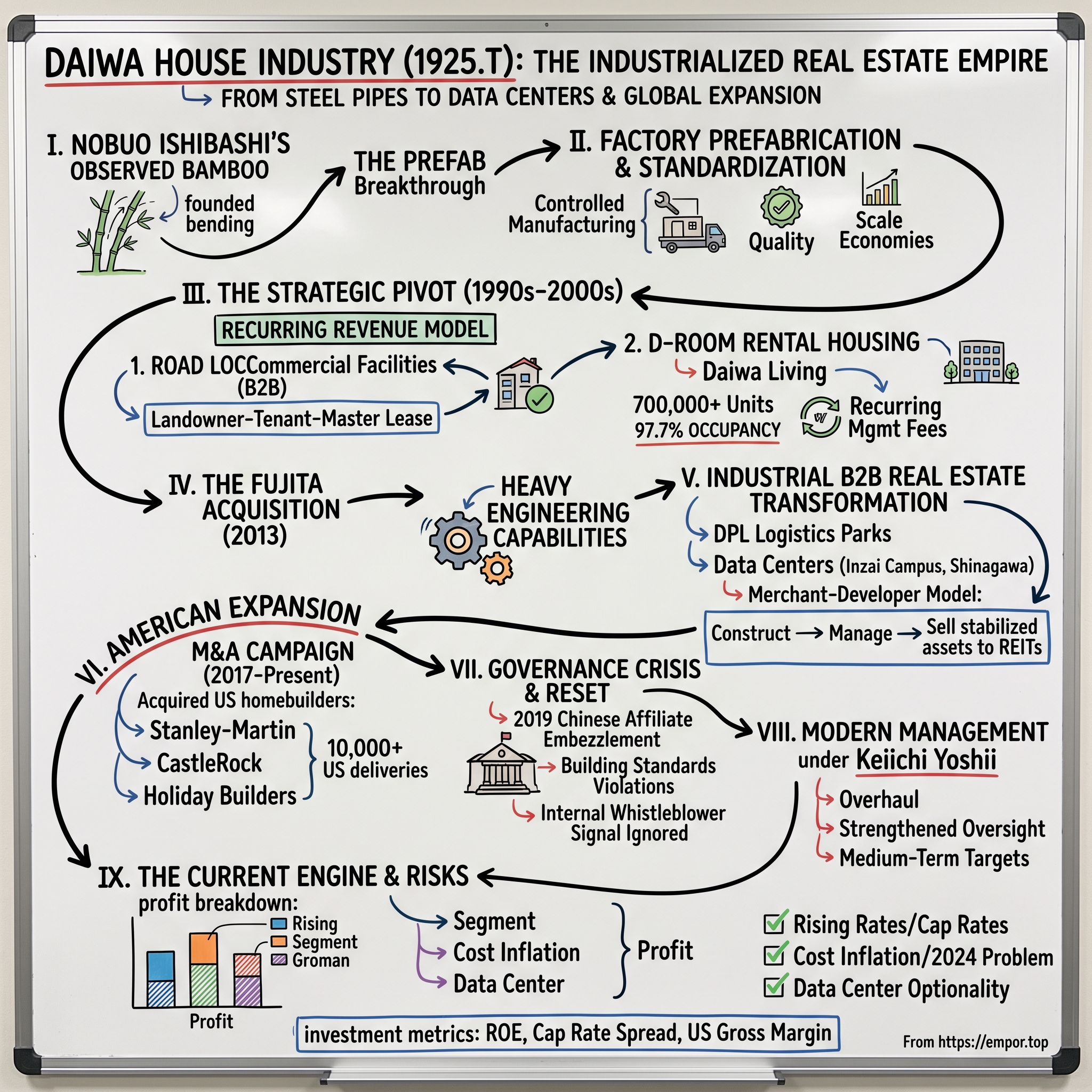
Daiwa House Industry: The Industrialized Real Estate Empire
I. Introduction & Episode Roadmap (0:00 - 0:15)
Forty minutes east of Tokyo, past the last commuter rail stop where suburbs yield to rice paddies, lies Inzai in Chiba Prefecture. There, on a site of roughly 270,000 square metres, 大和ハウス工業 Daiwa House Industry Co., Ltd. has assembled a campus of fourteen data centre buildings wired to an adjacent substation engineered to deliver around 600 megawatts of power.1 That volume of electricity could power a mid-sized Japanese city; here, it feeds server racks.
The company building it was founded in 1955 to sell steel pipe sheds to farmers.
That gap between agricultural origins and current industrial scale makes Daiwa House worthy of close examination. Most investors who encounter the ticker 1925.T on the 東京証券取引所 Tokyo Stock Exchange Prime Market classify it as a "Japanese homebuilder"—a sector associated with long-term demographic decline. That classification is outdated, and has mischaracterized the business for nearly two decades.
Consider the scale. For the fiscal year ended March 31, 2026—a period Daiwa House labels FY2025, anchored here to calendar years for clarity—the company reported consolidated net sales of ¥5,576.8 billion, up 2.6% to achieve a fifth consecutive record, with operating profit of ¥614.8 billion and net profit attributable to owners of ¥350.6 billion.2 At roughly ¥150 to the US dollar, that represents a $37 billion revenue enterprise generating over $4 billion in operating profit.
However, that operating profit figure requires careful interpretation. Embedded within the ¥614.8 billion was a ¥115.6 billion one-time actuarial gain arising from a change in the discount rate applied to retirement benefit obligations—an accounting consequence of rising Japanese interest rates rather than operational performance in leasing warehouses or selling homes.3 Excluding this gain, underlying operating profit stood at ¥499.2 billion. Management subsequently guided operating profit for the fiscal year ending March 2027 to ¥400.0 billion, representing a 34.9% decline from the reported headline figure.3 Record headline results alongside guided earnings contraction highlight the central tension in the business today.
The core thesis to test: Daiwa House is not merely a homebuilder that diversified. It is a land-assembly and industrial-construction engine that originated in housing and now derives the majority of its profit from leasing, developing, and recycling commercial and logistics real estate—while concurrently expanding through acquisitions to become one of the largest homebuilders in the United States. The central question is whether this model possesses a durable competitive advantage, or whether it reflects a well-managed conglomerate benefiting from a decade of cheap capital, compressed cap rates, and a depreciated yen.
The analysis follows six key themes:
The post-war spark. 石橋信夫 Nobuo Ishibashi, a returned prisoner of war who observed bamboo bending in a typhoon and envisioned a structural system, driving the industrialization of Japanese housing.
The major pivot. Identifying Japan's demographic shift decades early and pivoting toward roadside commercial developments, "D-Room" rental housing tailored for landowners facing inheritance taxes, and eventually mega-scale logistics parks.
The inorganic catalyst. The acquisition of general contractor 株式会社フジタ Fujita Corporation from a Goldman Sachs affiliate, providing the heavy-engineering capabilities Daiwa House could not build organically.
The American expansion. A nine-year acquisition campaign across US regional homebuilders, and how its execution compares with major investments by 積水ハウス Sekisui House and 住友林業 Sumitomo Forestry.
The governance reckoning. The 2019 dual crisis involving alleged embezzlement at a Chinese affiliate and domestic building-compliance violations withheld from the public for eighteen months, evaluating what the management response reveals about corporate governance.
The current engine. Asset recycling into REIT vehicles, a data centre expansion backed by the largest acquisition in company history, a balance sheet operating at roughly 1.6 times target leverage, and a medium-term management plan that executives chose to postpone rather than publish.
The story begins where Ishibashi did: in a wrecked village in Nara.
 Subscribe on LinkedIn
II. Post-War Genesis: Pipe Houses & The Prefabrication Breakthrough (1955–1980s) (0:15 - 0:35)
Nobuo Ishibashi was born in 1921 in the Yoshino district of Nara Prefecture, a region of steep forested valleys where families had harvested cedar and cypress for centuries. After serving in World War II and suffering severe injuries, he spent the war's aftermath interned in a Siberian prison camp.4
He returned to a country facing widespread destruction and a home region stripped of its hillsides. In 1950, Typhoon Jane struck Japan, destroying nearly 20,000 homes and damaging another 120,000.4 Walking through the debris of traditional timber-frame structures, Ishibashi made an observation that formed the foundation of his future company: while wooden posts snapped, rice stalks and bamboo remained standing. They bent in strong winds and sprung back because a hollow cylinder distributes stress uniformly in every direction, whereas a solid rectangular post is constrained by its weakest axis.
The underlying structural intuition was simple: a hollow cylinder offers remarkable structural strength relative to its material weight. Ishibashi realized that durable shelters could be constructed using tubular steel framework.
From observation to product
Commercializing that concept required five years. In April 1955, Daiwa House Industry was founded and launched its initial product, the パイプハウス Pipe House—a standardized temporary structure built on a steel-pipe framework.5 The initial customer base comprised farmers and small manufacturers requiring storage facilities, prioritizing low cost and rapid assembly.
That early commercial focus shaped the company's operating model. Daiwa House developed its foundational capabilities in business-to-business sales before expanding into consumer markets, establishing a discipline focused on utilitarian value rather than consumer design appeal.
The consumer breakthrough occurred in 1959 with the ミジェットハウス Midget House—a small prefabricated study room for children, widely recognized as the origin of Japan's prefabricated housing industry. Priced at ¥118,000, it could be erected in approximately three hours.6 While traditional timber construction required months of skilled carpentry, Daiwa House delivered prefabricated structures that a small crew could assemble in half a day.
Why the factory was the actual invention
While early products established the brand, the company's critical strategic development during the 1960s and 1970s was its centralized manufacturing model.
During Japan's 高度経済成長期 High-Speed Economic Growth era, rapid urbanization drew millions of residents into the industrial corridors surrounding Tokyo, Nagoya, and Osaka. Housing demand outpaced the capacity of traditional on-site construction methods. Daiwa House addressed this bottleneck by shifting the construction process off-site into controlled manufacturing plants—fabricating standardized steel-frame panels to precise tolerances indoors before shipping them to job sites for assembly.7
This industrial approach fundamentally altered construction economics. On-site building remains subject to variable weather, site-specific constraints, and inconsistent labor quality. Factory prefabrication converted artisanal building into a standardized manufacturing process, lowering unit costs, improving quality control, and reducing reliance on scarce skilled labor. It also shifted the cost structure from variable to fixed overhead, creating economies of scale that rewarded market leaders with high volume.
This manufacturing framework provided an early example of operational process power, generating a durable competitive advantage during the post-war expansion. Whether this industrial model maintains a comparable advantage today is an issue examined later in this analysis.
The DNA that mattered most
Beyond manufacturing technology, the founding era established a key strategic orientation: contract homebuilding alone—constructing a house, transferring title, and seeking the next buyer—creates a capital-intensive, highly cyclical business that resets its revenue base annually.
To mitigate this volatility, Daiwa House began securing recurring revenue streams long before asset management became its central focus. The company expanded into land development, acquired positions in commercial real estate, and structured long-term partnerships with landowners.
When Japan's asset bubble burst in the early 1990s and ushered in a structural decline in residential construction, this asset-centric model served as the foundation for the company's subsequent strategic pivot.
III. The Strategic Pivot: Commercial Development & The "D-Room" Rental Housing Boom (1990s–2000s) (0:35 - 1:00)
Consider a Daiwa House sales representative in the late 1990s, sitting in the front room of a farmhouse in the outer ring of Osaka Prefecture. Across a low table sits a landowner in his seventies who owns four hectares of agricultural land held by his family for generations. On paper, the parcel is worth a fortune, but it generates almost no cash flow. Upon his death, his heirs will face a steep 相続税 inheritance tax liability they cannot satisfy without liquidating the property.
The sales representative does not offer to purchase the land or construct a single-family home. Instead, he proposes an asset-structuring solution: build a multi-family rental apartment complex on the plot. Under Japanese tax regulations, land encumbered by rental housing receives a discounted valuation compared to unencumbered land, while construction costs are debt-financed. Daiwa House provides an end-to-end service—designing, constructing, leasing, managing, and guaranteeing the rental income.
This sales model, repeated across rural and suburban Japan, served as a primary operational catalyst for the modern enterprise.
Reading the demographic wall
Japan's 少子高齢化 declining birth rate and aging population appeared in demographic data long before its full impact reached the housing market. Management recognized early that domestic single-family housing starts faced a permanent structural contraction rather than a temporary cyclical downturn.
The strategic response focused on two initiatives designed to convert one-off construction contracts into long-term recurring revenue.
Prong one: roadside commercial facilities
The first initiative targeted 店舗・商業施設 retail and commercial facilities—low-rise commercial buildings, roadside storefronts, clinics, and restaurants along suburban arterial roads. Daiwa House acted as an intermediary connecting three separate market participants.
On one side were landowners with underutilized roadside acreage. On the other were national retail chains, restaurant operators, and medical providers expanding store networks without tying up capital in real estate assets. In between, Daiwa House identified suitable sites, matched owners with corporate tenants, constructed facilities to tenant specifications, and structured long-term master leases.
This model captured three distinct cash flows from a single customer relationship: construction fees, ongoing leasing and property management fees, and development margins—all while committing limited balance-sheet capital, as landowners retained title to the underlying land.
Prong two: D-Room and the rental housing machine
The second initiative scaled this framework into multi-family residential development. Daiwa House packaged its inheritance-tax advisory services into a standardized rental housing product under the "D-Room" brand, establishing a dedicated property management and subleasing subsidiary—Daiwa Living—to operate the properties.
Daiwa Living subsequently grew into one of the largest residential property managers globally, overseeing roughly 700,000 rental units while maintaining portfolio occupancy in the mid-to-high 97% range.8 For the fiscal year ended March 31, 2026, D-Room occupancy stood at 97.7%.3
For investors, sustained high occupancy across 700,000 units during a period of national population decline indicates that the portfolio remains concentrated in regions with positive household formation—typically near transit hubs and urban employment centers. It also means that the master-lease rental guarantees written to landowners remain comfortably covered by collected tenant rents. Because Daiwa House commits to fixed rental distributions regardless of occupancy, elevated vacancy rates would directly compress operating margins.
Why the management fee stream changed the company
While property management fee margins are modest, the stability of the revenue stream fundamentally altered the company's financial profile. Construction revenue is cyclical and contracts during economic downturns. By contrast, management fees from 700,000 units generate stable monthly cash flow regardless of broader construction volume.
This recurring cash flow provided balance-sheet stability through the global financial crisis and domestic economic slowdowns, allowing Daiwa House to maintain land acquisition and capital deployment while competitors faced liquidity constraints.
The risk hiding inside the guarantee
The sublease structure carries specific operational and regulatory risks. Under a typical master-lease arrangement, a landowner incurs bank debt to finance construction. Daiwa House, through Daiwa Living, signs a long-term master lease—often spanning thirty years—promising fixed monthly rent regardless of occupancy. The landowner receives a predictable income stream suitable for bank financing, while Daiwa Living retains the spread between tenant collections and guaranteed owner distributions.
However, standard contracts allow the operator to adjust guaranteed rent levels during periodic contract reviews. If market rents decline, the operator may reduce payments to landowners—a practice consistently upheld by Japanese courts. These rent adjustments have periodically generated disputes, drawing regulatory oversight and media scrutiny across the Japanese sublease sector.
For shareholders, this contractual structure provides downside margin protection, limiting long-term exposure to falling rental demand. Conversely, it creates reputational exposure within a business segment generating roughly a quarter of group operating profit, as profitability depends partly on exercising contractual rights to lower payments to individual property owners. Elevated occupancy mitigates this risk by maintaining rental income above guaranteed distribution thresholds, but contract revision clauses represent an ongoing structural exposure.
The overseas dress rehearsal
During this period, Daiwa House initiated its initial international projects, including residential developments in China. These included a joint venture in Dalian established in July 2005, in which Daiwa House held an 83.65% stake alongside a local partner.9 These early overseas ventures remained modest in scale and produced mixed operational results.
Nevertheless, they provided initial experience in managing cross-border operations and oversight mechanisms outside Japan—lessons that became directly relevant during the company's later governance challenges in 2019.
Before addressing those governance issues, however, Daiwa House pursued an acquisition to expand its heavy-engineering and civil-construction capabilities.
IV. The Fujita Acquisition & Industrial B2B Real Estate Transformation (2010–2016) (1:00 - 1:25)
In August 2012, Daiwa House announced it would pay approximately ¥50 billion to acquire all outstanding shares of Fujita Corporation from a Goldman Sachs-affiliated investment vehicle.10 The deal completed that December, and Fujita formally joined the Daiwa House Group in January 2013.11
Evaluating this transaction requires examining what Fujita represented and how it came to be sold—a decision that became one of the most consequential capital allocation moves in Daiwa House's history.
Buying a wounded champion
Fujita was founded in 1910—forty-five years before its acquirer.12 It operated as a major ゼネコン general contractor, the tier of Japanese construction firm capable of building dams, tunnels, subway stations, and large-scale urban redevelopments, alongside international operations across Asia. However, burdened by a post-bubble balance sheet, Fujita underwent corporate restructuring before Goldman Sachs' principal investment arm acquired it in 2009 and ultimately sold it to Daiwa House.
Industry analysts initially expressed skepticism. Japanese general contracting is traditionally a low-margin, competitive-bid sector. Acquiring a distressed contractor for ¥50 billion seemed counterintuitive for a company earning solid margins in prefabricated housing.
However, Daiwa House was not purchasing an isolated earnings stream. It was acquiring specialized engineering capabilities and the institutional credentials required to enter a rapidly expanding market.
The capability gap
While Daiwa House excelled at fabricating steel-framed structures at industrial scale, it lacked an institutional track record, specialized engineering talent, and client credentials in heavy civil engineering, complex foundation work, and urban redevelopment. Major corporate clients and public entities typically require contractors to hold a general contractor license and a decades-long record of completed projects.
Developing those capabilities organically or through key hires would have taken decades. By 2012, management recognized that acquiring an established contractor offered the only viable path to enter modern industrial construction.
The logistics thesis
The market driving this strategic shift was modern logistics real estate.
For decades in post-war Japan, warehousing consisted largely of low-ceilinged, single-tenant sheds near ports and rail yards. The rapid growth of e-commerce, driven by operators like Amazon Japan and 楽天 Rakuten, generated demand for a new class of facility: multi-tenant logistics centers featuring high-bay clearance, reinforced floors for automated systems, spiral ramps for upper-floor truck access, and high-capacity electrical infrastructure for robotic picking operations.
These modern logistics hubs require heavy structural and civil engineering, built on large, consolidated parcels near major highway interchanges. They demanded the precise civil construction capabilities Fujita possessed, paired with the land-sourcing networks Daiwa House had spent decades cultivating.
Daiwa House branded these multi-tenant logistics assets under the "DPL" banner and established a nationwide portfolio, including specialized facilities such as the cold-storage hub DPL Osaka Nanko I.13
The flywheel, explained simply
This development model became a primary profit driver for the enterprise through a merchant-developer framework.
Consider a warehouse built for ¥10 billion that generates ¥600 million in annual net rental income, representing a 6% development yield on cost.
Institutional investors, such as pension funds or real estate investment trusts (REITs), seek fully leased, creditworthy logistics assets and accept lower returns in exchange for stability—for example, a 4% capitalization rate. At a 4% cap rate, an asset generating ¥600 million in net rent is valued at ¥15 billion.
By assuming early-stage development risk and subsequently selling the stabilized asset, the developer captures a ¥5 billion spread as 開発益 development gain, recycles the capital, and repeats the cycle.
Daiwa House systematically scaled this process by cultivating captive buyers, most notably 大和ハウスリート投資法人 Daiwa House REIT Investment Corporation, listed in Tokyo, along with private funds and a separately listed Singapore vehicle holding Japanese logistics assets.14 Recent transactions demonstrate available exit valuations, with Daiwa House REIT acquiring DPL assets at cap rates around 3.5%.15
Furthermore, when Daiwa House sells a completed facility, it typically retains the property management contract—monetizing the asset while securing an ongoing fee stream.
The uncomfortable question
This model introduces a structural conflict of interest. Selling developments to an affiliated REIT constitutes a related-party transaction: Daiwa House controls the asset manager, while the buyer is a publicly listed vehicle with external unitholders. Although transaction pricing is disclosed and supported by independent appraisals, a portion of Daiwa House's development gains is realized from transactions with an entity under its influence.
The quality of these earnings depends heavily on corporate governance. Should capitalization rates widen across commercial real estate, a captive REIT cannot continuously absorb inventory without diluting unitholder value or overleveraging its balance sheet.
This tension underlined a broader strategic reality: as domestic opportunities matured, Daiwa House increasingly looked overseas, setting the stage for a major expansion into the United States residential market.
V. The American Blitzkrieg: M&A in US Homebuilding (2017–Present) (1:25 - 1:55)
On February 14, 2017, Daiwa House USA completed the acquisition of 82% of the member interests in Stanley-Martin Communities, LLC, a homebuilder operating in Virginia, Maryland, and the Washington, D.C. corridor. For the twelve months ended September 30, 2016, Stanley Martin had generated roughly $500 million in revenue.16
At the time, this appeared to be a modest entry into the market. In hindsight, it represented the initial move in the company's most aggressive geographic reallocation—and a precursor to a broader expansion by Japanese homebuilders into the United States.
The logic, stated plainly
The strategic rationale was straightforward. Facing domestic population decline and a contracting market for new Japanese single-family homes, major Japanese housing companies sought growth abroad. The United States offered population growth, steady household formation, a long-term housing deficit, and a fragmented homebuilding sector where regional operators faced limited national dominance.
For a Japanese acquirer, this fragmentation created an opportunity to acquire regional homebuilders at reasonable valuations, fund them using lower-cost Japanese capital, and expand market share.
The campaign
Daiwa House expanded its US presence through sequential acquisitions. It acquired West Coast builder Trumark Homes in 2020, followed by Houston-based CastleRock Communities in September 2021, acquiring an 80% stake for approximately $400 million.1718
In 2026, the pace accelerated. In February, Stanley Martin agreed to acquire publicly listed United Homes Group in an all-cash transaction valued at an enterprise value of approximately $221 million, or $1.18 per share, taking the Carolinas-focused builder private in a deal that closed in the second quarter.1920 That spring, Trumark acquired Seattle-area builder JK Monarch.18 On July 16, 2026, Stanley Martin announced the acquisition of Holiday Builders, a Florida operator that closed 1,050 homes in 2025 and brought roughly 10,600 controlled lots across more than forty existing communities in Florida.21
Combining 2025 closings across these entities—Stanley Martin at 5,320, CastleRock at 1,465, United Homes at 1,192, Holiday Builders at 1,050, Trumark at 991, and JK Monarch at 59—brings Daiwa House's US platform total to 10,077 homes, achieving its target of 10,000 annual deliveries by 2026.21
Reaching this milestone primarily through acquisitions rather than organic growth highlights a strategy reliant on dealmaking. While effective for meeting volume targets, acquisition-driven scale differs from organic market share gains and requires distinct evaluation.
Benchmarking: Daiwa House is not the biggest bidder
Daiwa House's peers pursued even larger acquisitions.
In April 2024, Sekisui House acquired M.D.C. Holdings—parent of Richmond American Homes—for $4.9 billion, building on prior acquisitions of Woodside Homes, Chesmar Homes, Holt Homes, and Hubble Homes since 2017 to establish the eighth-largest US homebuilding platform.18 Sumitomo Forestry, majority owner of DRB Group, agreed in February 2026 to acquire Tri Pointe Homes for $4.5 billion, aiming for 23,000 annual US deliveries by 2030.21 Meanwhile, Iida Group acquired a majority stake in Utah-based Wright Homes Group in March 2026.18
Upon closing pending transactions, the three largest Japanese competitors will collectively control approximately 5.5% of US single-family home construction.18
This competitive landscape offers two perspectives. From a capital discipline standpoint, Daiwa House entered early in 2017 and expanded incrementally with smaller deal sizes, avoiding the larger single-transaction balance-sheet risks taken by Sekisui House and Sumitomo Forestry.
Conversely, Daiwa House now operates the smallest of the three primary Japanese US platforms. In an industry where scale dictates land access, subcontractor pricing, and material procurement, smaller relative scale may constrain operating advantages, making recent acquisitions appear reactive to peer expansion.
Does the operating model actually transfer?
The strategic justification for these acquisitions often cites the export of Japanese industrialized construction practices—such as prefabrication, panelization, and off-site truss manufacturing—to compress US build cycles and reduce labor dependency.
However, US production homebuilding already utilizes panelized walls and factory-built roof trusses. The primary technological differentiator for Japanese homebuilders—heavy steel-frame residential systems designed for Japanese seismic standards—holds limited commercial application in a US market dominated by lower-cost wood-frame construction. Without disclosed, quantified cost or cycle-time savings from technology transfer, the benefit of industrial synergy remains unproven.
The clearest advantage lies in capital cost. Daiwa House's US subsidiaries retain local branding and management while gaining access to cheaper Japanese parent-level financing. In a capital-intensive industry where securing land inventory years ahead of revenue is a key bottleneck, lower funding costs provide a tangible competitive benefit.
The currency question nobody wants to discuss
Currency fluctuations have also influenced reported performance.
Purchasing US assets with a weakened yen increases acquisition costs in yen terms but inflates translated US dollar earnings when converted back into yen.
Consequently, a portion of Daiwa House's overseas revenue growth reflects exchange-rate translation rather than underlying operational expansion. Should the Japanese yen appreciate—a potential outcome of monetary policy normalization by the Bank of Japan—translated overseas earnings would decline in yen terms.
Moreover, rising domestic interest rates in Japan could simultaneously strengthen the yen and expand domestic real estate capitalization rates, compressing development margins. These combined factors represent an interconnected risk across both domestic and international operations.
The single-family segment's spectacular, misleading year
These dynamics were evident in the fiscal year ended March 31, 2026. Operating profit in the Single-Family Houses segment rose 123% to ¥155.7 billion on net sales of ¥1,342.3 billion.2 Overseas operations within the segment contributed ¥816.7 billion in revenue and ¥149.8 billion in operating profit, pushing total group overseas sales past ¥1 trillion and exceeding the target set in the 7th Medium-Term Management Plan.322
However, segment earnings were heavily influenced by a single large US land sale rather than volume growth in home deliveries.3 Management guided the segment's operating profit for the fiscal year ending March 2027 down to ¥49.0 billion—a projected decrease of ¥106.6 billion.3
While Daiwa House's US expansion has established a substantial geographic presence, reported segment results for the latest fiscal year were flattered by one-off transactions. Evaluating the ongoing health of the US platform will depend on underlying home delivery trends, gross margins per unit, and order cancellation rates.
VI. Governance Crisis, Compliance Shock, & The Modern Management Reset under Keiichi Yoshii (2019–Present) (1:55 - 2:20)
In early 2019, an employee in the accounting department of Dalian Daiwa Zhongsheng Real Estate — the Chinese joint venture Daiwa House had established in 2005 — noticed something that should not have been possible. The company's bank deposits did not match its books.
The gap was not small. A subsequent audit conducted with the bank confirmed that cash had been improperly withdrawn through a series of online banking transactions dating back to 2015. Police in Dalian opened an investigation into the alleged embezzlement of roughly 1.42 billion yuan — approximately $212 million.9 Daiwa House requested criminal charges against three individuals: two of them members of the joint venture's board, the third a member of the accounting department.923
Read that again. Two board members of the local entity. This was not a rogue clerk. It was a failure of control at the governance level of a subsidiary that Daiwa House majority-owned and had operated for fourteen years, and it ran undetected for at least four.
The domestic shock, and the part that was worse
Almost simultaneously, a second crisis broke at home. On April 12, 2019, Daiwa House disclosed that approximately 2,000 single-family and rental properties across Japan were likely in violation of the Building Standards Law.[^24] The defects included missing fire-resistant coatings on columns in 73 structures and improperly executed foundations in 1,878 others, in buildings constructed between 2001 and 2010.[^24] The company issued corrections to the affected-property count in the following months and received the final report of an external investigative committee in June 2019.24
The construction defects were serious. The governance failure was worse. A whistleblower had reported the issues internally in December 2016. Daiwa House did not act until July 2018 — roughly eighteen months of institutional silence.[^24] The company was subsequently hit with a business suspension order connected to a separate licensing scandal.25
For an investor, this is the single most revealing episode in the modern history of the company, and it cuts in a specific direction. The problem was not that a large decentralised organisation had failures — all of them do. The problem was that the organisation's internal reporting channels worked, produced a signal, and the signal was ignored for a year and a half. That is a cultural finding, not a procedural one, and cultural findings take far longer to fix than control matrices.
Yoshii's response, and how to grade it
芳井敬一 Keiichi Yoshii had been appointed President and Representative Director on November 1, 2017 — barely a year before both crises surfaced.26 He therefore inherited problems that had been incubating for a decade, which is worth stating fairly.
What followed was a governance overhaul: an external investigative committee whose findings were published, disclosed causes and recurrence-prevention measures, strengthened board oversight, and centralised financial control over subsidiaries.24
Now the harder assessment. On behaviour over time — which is the only credible way to evaluate management — Yoshii's record has two clearly positive features and one that remains genuinely open.
Positive one: he did not hide. The investigative committee's report was published, the property counts were corrected publicly and repeatedly even when each correction was its own embarrassing news cycle, and disclosure continued rather than tapering.
Positive two: the operating record improved and the targets were met. Under the 7th Medium-Term Management Plan covering April 2022 through March 2026, the company targeted ¥5.5 trillion of net sales and ¥500 billion of operating profit, and hit both a year ahead of schedule.2227 Overseas sales passed the ¥1 trillion goal.22 Meeting a medium-term plan early is not the norm in corporate Japan, and it is legitimate evidence of guidance discipline.
The open question: the ROE target. The 7th plan set ROE of 13% or higher, alongside a D/E ratio of approximately 0.6 times.22 Reported ROE for the year ended March 2026 was 12.7% — close, but achieved with the assistance of a ¥115.6 billion non-operating accounting gain, and the equity ratio slipped to 34.4% with D/E at 0.98 times, comfortably above the target.23 Two of three capital targets came in soft, and the one that was nearly met was flattered.
The succession that surprised the building
Then, on February 13, 2025, Daiwa House announced a change nobody outside the boardroom saw coming. Effective April 1, 2025, 大友浩嗣 Hirotsugu Otomo, then a Director and Senior Managing Executive Officer, would become President and Chief Operating Officer. Yoshii, aged 66 and seven years into the presidency, would become Representative Director and Chairperson while retaining the CEO title and taking direct charge as Head of the Overseas Division.2829
The abruptness was noted internally — one executive told Toyo Keizai they had learned of the change the morning before the announcement and were "flabbergasted."30 The stated rationale was to accelerate domestic and overseas expansion ahead of the next medium-term plan, with Otomo — credited internally as an architect of the overseas build-out — running the domestic business and group operations while Yoshii concentrated on international growth.3132
There are two ways to read a structure where the outgoing president keeps the CEO title. The generous reading: it is a deliberate division of labour that puts the company's most experienced overseas operator in charge of its fastest-growing region at exactly the moment US M&A accelerated — and the 2026 acquisition spree is consistent with that. The sceptical reading: split CEO/COO structures where the chairman retains executive authority can blur accountability, and mid-plan succession is unusual enough that investors are entitled to ask what prompted it. The record so far supports the generous reading on execution. It does not resolve the accountability question.
With the governance and leadership picture established, let us open up the engine and see where the money actually comes from.
VII. Segment Deep Dive: Revenue, Profits, & Economic Drivers (2:20 - 2:50)
Summarized in a single sentence, Daiwa House's business model generates revenue three separate times on the same parcel of land: first to construct the facility, second to manage it, and third to sell the stabilized asset to investors seeking cash flow.
The segment disclosures for the fiscal year ended March 31, 2026, demonstrate how this multi-stage monetization operates in practice.
Where the profit lives
Commercial Facilities served as the primary profit engine, generating ¥162.5 billion in operating profit on ¥1,290.2 billion in net sales—an 11.4% profit increase supported by strong urban hotel performance.23 Single-Family Houses ranked second with ¥155.7 billion in operating profit, though as noted earlier, this result was elevated by a major US land disposal. Rental Housing generated ¥141.1 billion in operating profit on ¥1,429.3 billion in net sales, an 8.6% increase driven by 97.7% portfolio occupancy and contractual rent adjustments. Business Facilities—comprising logistics, corporate, and industrial facilities—produced ¥127.6 billion in operating profit on ¥1,189.8 billion in net sales, down 20.0%. Condominiums earned ¥6.0 billion on ¥279.6 billion, down 45.1%. Meanwhile, Environment & Energy contributed ¥13.8 billion in operating profit on ¥133.1 billion in net sales, up 11.4%.2
Excluding the one-off US land sale in the single-family segment, the core earnings structure becomes clear: commercial facilities, rental housing, and business facilities collectively generated roughly ¥431 billion in segment operating profit—representing the vast majority of the group's ongoing earning power. Daiwa House operates fundamentally as a commercial and industrial real estate enterprise with an attached housing unit, rather than a homebuilder that dabbles in commercial real estate.
The Business Facilities decline is the number to interrogate
The 20% operating profit decline in the Business Facilities segment represents the critical metric in the full-year disclosures, providing deeper insight into structural trends than headline profit totals.
Management attributed the contraction to lower merchant-development property sales and a strategic deferral of Fujita real estate disposals.3 In real estate development, a strategic deferral can reflect two distinct scenarios. On one hand, it may indicate disciplined capital allocation: management determined that buyer offers yielded unattractive capitalization rates and chose to hold assets rather than accept lower valuations. This approach aligns with standard merchant-developer risk management.
On the other hand, it may signal weak demand at targeted pricing. Following the Bank of Japan's decision in December 2025 to raise its benchmark rate to the highest level in three decades—pushing 10-year Japanese Government Bond yields above 2%—the risk-free benchmark governing commercial property valuations shifted substantially.33 Because capitalization rates benchmark against risk-free yields, a business model relying on asset sales at 3.5% capitalization rates faces compressed yield spreads when government bonds offer 2%.
Current corporate disclosures do not provide sufficient detail to determine whether the sales deferral reflects prudent capital discipline or softening institutional demand. This lack of transparency obscures a central driver of group profitability, highlighting the need for detailed reporting on inventory holding periods and realized exit capitalization rates across property vintages.
The condominium problem
The 45.1% drop in condominium operating profit on virtually flat revenue provides a clear signal regarding profitability. The contraction reflects margin compression rather than falling sales volume, as units built on higher land and material costs are delivered at set market prices. While urban condominium development remains challenging across Japan, management guided segment operating profit to rebound to ¥18.0 billion for the fiscal year ending March 2027.3 Given recent performance, that target represents an optimistic assumption requiring operational confirmation.
Myth versus reality
Three common market assumptions regarding Daiwa House warrant critical evaluation, as each misrepresents the company's financial profile.
Myth: Daiwa House is primarily a domestic homebuilder vulnerable to Japan's demographic decline. Reality: domestic single-family homebuilding represents the smallest recurring contributor to segment operating profit. The company's primary earnings stream derives from commercial facilities and rental housing, while capital deployment focuses on logistics parks, data centers, and US residential construction. Demographic aging presents a headwind to one division within a diversified group that has systematically built alternative revenue drivers over three decades.
Myth: record headline financial results reflect strong operational momentum. Reality: reported operating profit included a ¥115.6 billion non-operating actuarial gain from revised discount rates on retirement obligations, while single-family profit was boosted by an isolated US land sale. While core operations performed moderately well, underlying growth was far lower than headline figures suggested—a reality reflected in management's lower profit guidance for the subsequent fiscal year.
Myth: guided 34.9% operating profit contraction indicates underlying operational failure. Reality: much of the projected decline stems from accounting mechanics, specifically the non-recurrence of the retirement gain and the US land sale. The primary operational risks are more focused: rising material and labor costs, potential construction delays, and slower asset rotation in commercial properties. Separating one-time accounting effects from operational trends provides a clearer assessment of ongoing earning power.
The data centre pivot — and the biggest cheque in company history
The company's most significant strategic pivot targets data center development. Daiwa House has applied its logistics development framework—aggregating suburban land, constructing specialized facilities, securing corporate tenants, and recycling capital—to data infrastructure under the "DPDC" brand.1 Alongside the large-scale Inzai campus, the company has built urban projects such as DPDC Shinagawa Konan in Tokyo.34 In January 2026, it introduced "Module DPDC," a standardized, factory-built modular data center designed for delivery within approximately one year from contract signing.1
This product line extends the founder's original prefabrication model into modern digital infrastructure. Where early products standardized post-war residential housing, Module DPDC applies off-site manufacturing to capital-intensive, schedule-sensitive facilities. While commercial adoption remains in early stages, the concept aligns directly with the company's historic manufacturing model.
To support this expansion, Daiwa House acquired specialized electrical and facilities engineering capabilities. On October 30, 2025, the company launched a tender offer for 住友電設 Sumitomo Densetsu Co., Ltd., an electrical engineering contractor majority-owned by 住友電気工業 Sumitomo Electric Industries, Ltd., at ¥9,760 per share.3536 The transaction initially covered a 49.34% stake for approximately ¥170 billion. By December 22, 2025, Daiwa House had secured 14,389,928 shares, and following a subsequent share consolidation, acquired 100% of voting rights on March 24, 2026, taking the firm private and delisting it from the Tokyo Stock Exchange.353738 Total transaction consideration reached approximately ¥292 billion, marking the largest acquisition in Daiwa House's history.1
The acquisition secures internal expertise in electrical, cooling, and power-distribution engineering—critical technical capabilities required to deliver data centers and industrial facilities on schedule.35 Direct control over these specialized engineering resources provides operational advantages in a market constrained by specialized labor shortages.
However, funding the acquisition expanded the balance sheet. Total assets rose 19.3% to ¥8.41 trillion, while the net debt-to-equity ratio reached 0.98 times, exceeding management's target of approximately 0.6 times.322 Daiwa House has committed substantial debt-financed capital to capitalize on growing demand for Japanese data infrastructure. If data center demand meets management projections, the investment secures a high-margin growth engine; if market growth slows, the company will carry significant leverage and expanded engineering overhead into an environment of rising interest rates.
VIII. Playbook: Business, Strategy, & Capital Allocation Lessons (2:50 - 3:15)
Stripping away seven decades of corporate history reveals four transferable business lessons, each accompanied by a distinct strategic trade-off.
Lesson 1: Own the origination, rent the balance sheet
The merchant-developer model functions only when a firm can source projects that competitors cannot. While any capitalized entity can purchase a stabilized warehouse at a 3.5% capitalization rate, development margin is generated at origination.
Daiwa House established its advantage by becoming the primary counterparty for Japanese landowners over five decades. Once an asset stabilizes, however, Daiwa House seeks to recycle its capital rather than hold the asset long term. Captive REITs and private fund structures convert a capital-intensive development model into a recurring fee business with development upside.
The corresponding trade-off is a structural dependence on functioning capital markets and a favorable spread between development yields and exit capitalization rates—macroeconomic variables outside management's control. In a widening cap-rate environment, a merchant developer risks holding illiquid inventory, as demonstrated by the deferral of Fujita real estate sales during the fiscal year ended March 2026.
Lesson 2: Relationships as a proprietary deal funnel
The company's land-assembly network represents its most distinct competitive advantage.
While institutional investors can retain brokers to bid on public land offerings, they cannot easily replicate decades of relationship building. When a Daiwa House sales representative spends twenty years working with a landowning family on inheritance-tax planning, the company gains early access when that family chooses to monetize adjacent acreage near a major transit corridor.
This access functions as a proprietary deal funnel built on decades of relationship capital. However, this advantage is gradually diminishing as landowning families urbanize, generational transitions occur, and property owners increasingly engage financial advisors who conduct competitive bidding processes. While the relationship network remains active, its long-term durability is less certain.
Lesson 3: Buy operators, not assets, in fragmented markets
The US strategy of acquiring regional homebuilders, preserving local brand identities and management teams, and providing parent-level capital addresses a structural reality of American housing: homebuilding relies heavily on localized relationships with land sellers, municipal regulators, and trade contractors.
The trade-off of this decentralized model is limited operational integration. Operating a collection of autonomous regional builders creates a holding company portfolio rather than a unified operational platform. Furthermore, the transfer of Japanese industrialized construction techniques—a potential source of structural cost efficiency—has yet to yield measurable margin improvements in disclosed financial results.
Lesson 4: Capital allocation — the discipline claim under strain
Capital allocation strategy represents a key focal point for investors evaluating the business.
Daiwa House's stated shareholder return policy targets a dividend payout ratio of 35% or higher.39 The company declared ¥175 per share for the fiscal year ended March 31, 2026, including a ¥10 commemorative dividend marking its 70th anniversary, and forecast ¥176 for the following year—a seventeenth consecutive annual dividend increase since listing in 1992, representing a payout ratio of approximately 48% against reduced profit guidance.23 A 2-for-1 share split takes effect October 1, 2026.40
While the dividend growth record demonstrates capital return commitment, recent strategic actions present a complex operational picture. During the fiscal year ended March 2026, Daiwa House deployed approximately ¥292 billion for the Sumitomo Densetsu acquisition, allowed leverage to reach 0.98 times net debt-to-equity—roughly 1.6 times its 0.6 times target—guided operating profit down 34.9%, expanded the dividend payout ratio toward 48%, and postponed the release of its 8th Medium-Term Management Plan.
Management attributed the plan's postponement to heightened geopolitical uncertainty—specifically in the Middle East—stating that market conditions required careful evaluation before establishing new multi-year targets, while reiterating that capital investment and real estate development would continue.3
This combination of decisions can be interpreted in two ways. Skeptics may note that a firm achieving its previous medium-term plan ahead of schedule while expanding capital deployment should maintain sufficient visibility to publish forward targets, suggesting a disconnect between aggressive capital commitments and financial forecasting confidence. Conversely, supporters would argue that deferring targets amid macroeconomic volatility reflects prudent governance, supported by management's track record of meeting previous operational goals early. As a result, the publication of the 8th Medium-Term Management Plan represents a critical upcoming disclosure for evaluating management's strategic discipline.
IX. Competitive Benchmarking, 7 Powers & Skeptical Investor Stress Test (3:15 - 3:35)
Evaluating Daiwa House against its industry peers reveals an enterprise that rarely holds the top spot in any single market segment, yet occupies a distinct competitive position precisely because of its multi-sector breadth.
The Japanese field
Against Sekisui House (1928.T): Sekisui House represents the closer direct competitor in residential housing and has pursued larger US acquisitions, with its purchase of M.D.C. Holdings alone exceeding Daiwa House's total US transaction spending combined.18 While Sekisui House remains concentrated in single-family residential and high-end custom homes, Daiwa House is far more diversified across commercial and industrial development. During a housing downturn, Daiwa House benefits from broader earnings shelter; during a residential expansion, Sekisui House offers greater operating leverage.
Against Sumitomo Forestry (1911.T): Sumitomo Forestry relies on timber and supply-chain integration, while its acquisition of Tri Pointe Homes and its target of 23,000 annual US home deliveries by 2030 mark the most aggressive commitment to the American residential market among major Japanese peers.21 By contrast, Daiwa House's key differentiator—for better or worse—remains its multi-sector diversification.
Against pure logistics developers — Prologis, GLP, and Mitsui Fudosan (三井不動産): This domain represents Daiwa House's most defensible competitive stance. While global logistics platforms bring capital, tenant relationships, and standardized designs, they lack an integrated general contractor and a half-century network of individual Japanese landowners. For domestic developments, that combination gives Daiwa House structural advantages in land sourcing and construction cost control.
The 7 Powers audit — honestly scored
Process Power—the industrialized construction system—functions as a baseline requirement rather than a relative advantage. Every major Japanese housing manufacturer operates factory-based production, making it table stakes domestically, while its benefits do not readily transfer to US wood-frame construction. It contributes to cost efficiency rather than a defensible moat.
Scale Economies generate procurement efficiencies across steel, fixtures, and appliances, alongside fixed-cost absorption across domestic factories. However, major Japanese competitors enjoy similar scale, while in the United States, Daiwa House operates the smallest platform among its primary Japanese peers. Consequently, scale advantages remain largely confined to Japan.
Cornered Resource—the proprietary Japanese landowner network—represents the company's strongest asset. However, because its value cannot be precisely measured, investors risk overestimating its long-term durability as generational land transfers progress.
Switching Costs provide meaningful stability: managing roughly 700,000 rental units and overseeing long-term master leases across thousands of commercial properties create high-friction customer relationships. Property owners rarely replace established property managers or break master-lease structures.
Conversely, Daiwa House lacks significant Branding power—as no pricing premium attaches to its corporate name—as well as Network Economies and Counter-Positioning. The enterprise operates on scale, execution, and long-standing relationships rather than structural, unassailable moats.
Porter's five forces, applied
Rivalry remains intense across all segments. Japanese housing, general contracting, and logistics development are crowded markets, with logistics increasingly attracting global institutional capital over the past two decades.
Buyer power is bifurcated. Individual homebuyers and small landowners exercise limited leverage, whereas large logistics tenants and institutional asset buyers hold substantial power that continues to grow as competing supply reaches the market.
Supplier power has escalated sharply, representing a critical industry constraint. Domestic construction labor faces acute shortages—the jobs-to-applicants ratio for construction workers stood at 5.89 in July 2023, compared to 0.32 for clerical positions41—while the revised Labor Standards Act capped annual construction overtime at 720 hours beginning April 1, 2024, creating the industry's "2024 problem" (2024年問題).42 Capping hours in an already labor-starved trade creates a permanent structural cost increase. In this context, acquiring Sumitomo Densetsu serves to internalize an increasingly scarce and costly engineering capability.
Threat of substitutes remains modest in the near term but holds long-term relevance: home renovations and existing-home transactions serve as substitutes for new construction, supported by Japan's aging housing stock.
Barriers to entry are high in Japanese commercial and industrial development—reflecting land access, general contractor licensing, and regulatory relationships—and low in US homebuilding, where capital rather than technical capability forms the primary barrier. That asymmetry explains why Japanese housing companies can acquire US builders but cannot buy into one another's domestic landowner networks.
Second-layer diligence: the things that do not show up in the segment tables
Several subtle operational and financial signals warrant closer scrutiny.
On accounting judgment, the pension discount rate adjustment requires careful tracking. While a legitimate, auditable consequence of higher Japanese interest rates under Japanese GAAP, it introduced a rate-sensitive, non-cash component into reported operating profit that can reverse if interest rates decline.
On credit and leverage, the net debt-to-equity ratio rose from a target near 0.6 times to 0.98 times, with the equity ratio slipping to 34.4%, driven by the largest acquisition in company history within a single fiscal year.322 For a developer funding inventory with debt, the cost and availability of capital in a rising-rate environment in Japan become primary operating variables.
On key personnel, the mid-plan presidential transition assigned the executive most closely associated with overseas expansion to direct international operations, while the incoming president assumed responsibility for the domestic business. The continued execution of the US acquisition strategy through 2026 suggests the leadership division is functioning as intended.
On portfolio pruning, the company has demonstrated a willingness to exit non-core assets, best illustrated by its major hotel portfolio disposal. This willingness to sell provides a counterweight to conglomerate expansion risks.
On related-party exposure, transactions with the affiliated REIT represent an ongoing governance consideration. While no operational issues have been disclosed, the mechanism has not been tested in a market where the REIT cannot raise equity accretively.
The bear case
One: compression of the capitalization-rate spread. With the Bank of Japan raising benchmark rates to three-decade highs and 10-year Japanese Government Bond yields exceeding 2%,33 ongoing monetary normalization narrows the spread between development costs and buyer exit yields. The deferral of Fujita property sales offers early evidence of this dynamic. If exit capitalization rates widen by 50 basis points, development gains compress non-linearly, as profit depends on the margin between two closely aligned figures.
Two: cyclical exposure in rate-sensitive US housing. Daiwa House expanded its US delivery capacity substantially through 2026, scaling into a market where mortgage affordability limits buyer volume. The company has not disclosed the proportion of optioned versus owned lots across its US platform—the specific metric required to evaluate inventory-impairment risk during a housing downturn.
Three: cost inflation and project backlogs. Management cited supply delays and cost increases for materials and equipment linked to energy market disruptions, basing financial guidance on the assumption that supply conditions would stabilize to some extent by around September 2026.3 This explicit, dated assumption provides a clear benchmark for assessing management execution.
Four: corporate complexity and valuation discounts. Operating six business segments alongside a general contractor, an electrical engineering subsidiary, an affiliated REIT, a Singapore-listed logistics trust, a property management arm with 700,000 units, and six US homebuilders creates substantial operational complexity. Reflecting this conglomerate discount, the stock traded below book value at approximately 0.93 times in June 2026.43
The bull case
One: pricing power in a supply-constrained market. As construction costs rise across the sector, owning scarce inputs—landowner relationships, general contracting capacity, and specialized electrical engineering—positions Daiwa House to pass cost increases into contract rents and property prices. The 8.6% profit growth in rental housing alongside progress on contract rent revisions provides initial supporting evidence.23
Two: optionality in capital recycling. A merchant developer holding unencumbered, cash-flowing assets can choose to retain properties during unfavorable market conditions. The deferred asset sales reflect this flexibility—accepting short-term reductions in reported profit to protect underlying asset value, provided the balance sheet can support the inventory.
Three: unpriced data center assets. Daiwa House possessed key prerequisites for Japanese data center development—large suburban land parcels near power infrastructure and heavy civil construction capacity—before AI demand expanded asset valuations. The Sumitomo Densetsu acquisition completed the technical capability set, offering growth potential that is not fully reflected in current equity valuations.
Four: balance sheet optimization through non-core sales. The company has demonstrated a capacity to monetize non-core assets, highlighted by the July 2023 sale of a 27-hotel Japanese resort portfolio to a consortium including SC Capital Partners, Goldman Sachs Asset Management, and the Abu Dhabi Investment Authority for $900 million.44 Continued divestments of non-core real estate and cross-shareholdings provide a non-dilutive source of capital to fund shareholder returns.
A balanced evaluation indicates that the bull case rests on tangible assets Daiwa House verifiably controls, while the bear case depends on macroeconomic variables outside management's control. Both perspectives reflect valid aspects of the enterprise today.
X. Epilogue & Key Investment Metrics to Watch (3:35 - 3:45)
Seventy-one years after its 1955 founding—inspired by Nobuo Ishibashi observing bamboo bend in a typhoon—Daiwa House is capitalised at roughly ¥2.9 trillion, trading around ¥4,678 per share against a 52-week range of ¥4,081 to ¥5,805, meaningfully below its February 2026 peak.4543 Equity markets are clearly pricing the guided profit contraction rather than the preceding record year.
The narrative returns to its initial question regarding corporate identity. Daiwa House built its foundational product on the observation that a hollow steel cylinder absorbs structural stresses that fracture solid timber. Over seven decades, management applied that structural principle to corporate architecture—building a business with enough distinct operational load paths that no single shock can break the enterprise. Residential construction contracts, logistics development expands. Domestic demand slows, American homebuilding grows. Development margins compress, recurring property management fees continue.
Whether this structural redundancy warrants a valuation premium or explains its persistent conglomerate discount remains the central investment debate. What is clear is that the enterprise now faces a simultaneous stress test across its model: a rising domestic cost of capital, an American residential platform assembled near a cyclical peak, a record debt-financed expansion into data centres, and a postponed medium-term management plan.
Three core operational metrics will clarify this trajectory:
One: the development cap-rate spread. The margin between Daiwa House's realized yield on cost for domestic commercial and logistics developments and the exit capitalization rates achieved on asset sales. This spread represents the core driver of development gains and is the variable most directly exposed to monetary policy normalization by the Bank of Japan. Tracking both the spread and total transaction volume is essential; a stable yield spread accompanied by declining transaction volume signals market illiquidity rather than operational strength.
Two: US net deliveries and gross margin per home, excluding land sales. With six acquired builders delivering roughly 10,000 homes annually, evaluation shifts from acquisition scale to operational execution. Key performance indicators include net deliveries, gross margins per unit, cancellation rates, and—if disclosed—the optioned-versus-owned lot ratio. Because single-family segment profit in the latest fiscal year was elevated by an isolated land sale, underlying homebuilding operations require ongoing verification.
Three: ROE relative to underlying operational leverage. Reported ROE of 12.7% was accompanied by a net debt-to-equity ratio of 0.98 times—substantially above management's target of approximately 0.6 times—and supported by a non-recurring accounting gain. The relevant metric is whether operations can sustain target returns at leverage levels consistent with stated policy. When published, the 8th Medium-Term Management Plan will indicate whether return targets reflect core earning power or balance-sheet expansion.
Daiwa House Industry is no longer a traditional Japanese prefabricated homebuilder, having spent two decades evolving into an integrated developer, manufacturer, general contractor, asset manager, and infrastructure operator. Its business model operates across e-commerce logistics, American housing demand, digital power infrastructure, and capital-efficient asset recycling. While the overall strategy remains coherent and the execution record solid, the macroeconomic conditions underpinning its expansion face their most significant shift in a decade.
That is the investment thesis, and those are the operational variables that will test it.
References
-
大和ハウス、住宅から「データセンター開発」へ舵切り──住友電設買収で"設備を内製化" — note, 2026 ↩↩↩↩
-
Daiwa House 1925.T FY2026 (Ending March 2026) Financial Results, Japanese GAAP (Consolidated) — BigGo Finance / JPX TDnet, 2026-05-12 ↩↩↩↩↩↩↩
-
Daiwa House Industry FY2026 Full-Year Earnings Call: Net Profit Hits Record ¥350.5 Billion, but Operating Profit Seen Plunging 34.9% Next Fiscal Year — BigGo Finance, 2026-05-13 ↩↩↩↩↩↩↩↩↩↩↩↩↩↩↩↩
-
A Profile of Nobuo Ishibashi — Daiwa House Industry Co., Ltd. ↩↩
-
The Pipe House – our first product — Daiwa House Industry Co., Ltd. ↩
-
The Origin of Japan's Prefabricated House Industry: The Midget House — Daiwa House Industry Co., Ltd. ↩
-
US$212 million missing at Chinese affiliate of Japan's Daiwa House — South China Morning Post, 2019-03 ↩↩↩
-
Daiwa House completes Osaka cold-storage hub DPL Osaka Nanko I — IBTimes Japan ↩
-
Daiwa House REIT Investment Corporation — Daiwa House Asset Management ↩
-
Daiwa House Selling Chiba Warehouse to J-REIT for $200M — Mingtiandi ↩
-
Daiwa House USA, Inc. Completes Acquisition of Stanley Martin Communities — PR Newswire, 2017-02 ↩
-
Daiwa House Dials In Texas: $400M For 80% Of CastleRock — The Builder's Daily ↩
-
Japanese firms' buying spree of U.S. homebuilders keeps heating up — ResiClub Analytics, 2026 ↩↩↩↩↩↩
-
Stanley Martin Homes to Acquire United Homes Group for $221 Million — Builder Magazine, 2026-02 ↩
-
Stanley Martin Homes Completes Acquisition of United Homes Group — Business Wire, 2026-05-03 ↩
-
Japanese builders are quickly acquiring U.S. homebuilders—now Daiwa House's Stanley Martin is buying Holiday Builders — ResiClub Analytics, 2026-07-16 ↩↩↩↩
-
7th Medium-Term Management Plan — Daiwa House Industry Co., Ltd. ↩↩↩↩↩↩
-
Daiwa House suspects massive embezzlement at Chinese joint venture — Japan Today, 2019 ↩
-
Breaking News (IR news) FY2019 — Daiwa House Industry Co., Ltd. ↩↩
-
Top Japan homebuilder hit with stoppage over licensing scandal — Nikkei Asia ↩
-
大和ハウス工業社長に大友浩嗣・取締役専務執行役員 芳井敬一氏は会長に — 日本経済新聞 Nikkei, 2025-02-13 ↩
-
Daiwa House Industry Co., Ltd. Announces Change of Representative Directors — MarketScreener, 2025 ↩
-
Bank of Japan raises benchmark rates to highest in 30 years, lifting 10-year JGB yield past 2% — CNBC, 2025-12-19 ↩↩
-
Japanese firms steer USD1.9bn construction sector stake buy — Law.asia, 2025 ↩↩↩
-
Press Release, October 30, 2025 — Daiwa House Industry Co., Ltd. ↩
-
Notice regarding the Results of the Tender Offer and the Formation of Sumitomo Densetsu Co., Ltd. as a Wholly Owned Subsidiary of Daiwa House Industry — Sumitomo Electric Industries, 2025-12 ↩
-
Daiwa House Industry Acquires 14,389,928 Shares of Sumitomo Densetsu and Completes Full Ownership — Japan IR, 2026-03-24 ↩
-
Shareholder Return Policy and Dividends — Daiwa House Group ↩
-
Daiwa House Industry to split each common share 2-for-1 as of Sept 30, 2026 — MarketScreener, 2026 ↩
-
Outlook on the 2024 Problem: Seizing the chance to change the low-pricing model — RIETI ↩
-
Money and Labor Shortages: Changes Affecting People's Lives in Japan from April 2024 — Nippon.com ↩
-
大和ハウス工業(1925):中期経営計画1年前倒しで最高益達成も「今期減益予想」の実態を検証 — note, 2026-06 ↩↩
-
SC, Goldman and ADIA Buy Daiwa House Japan Hotels — Mingtiandi, 2023-07-19 ↩
 LinkedIn
 WhatsApp
 Reddit
 Hacker News
 Email
Email Kindle
 RSS Feed
 Spotify
 Apple Podcasts
 Amazon Music
 Audible
 YouTube