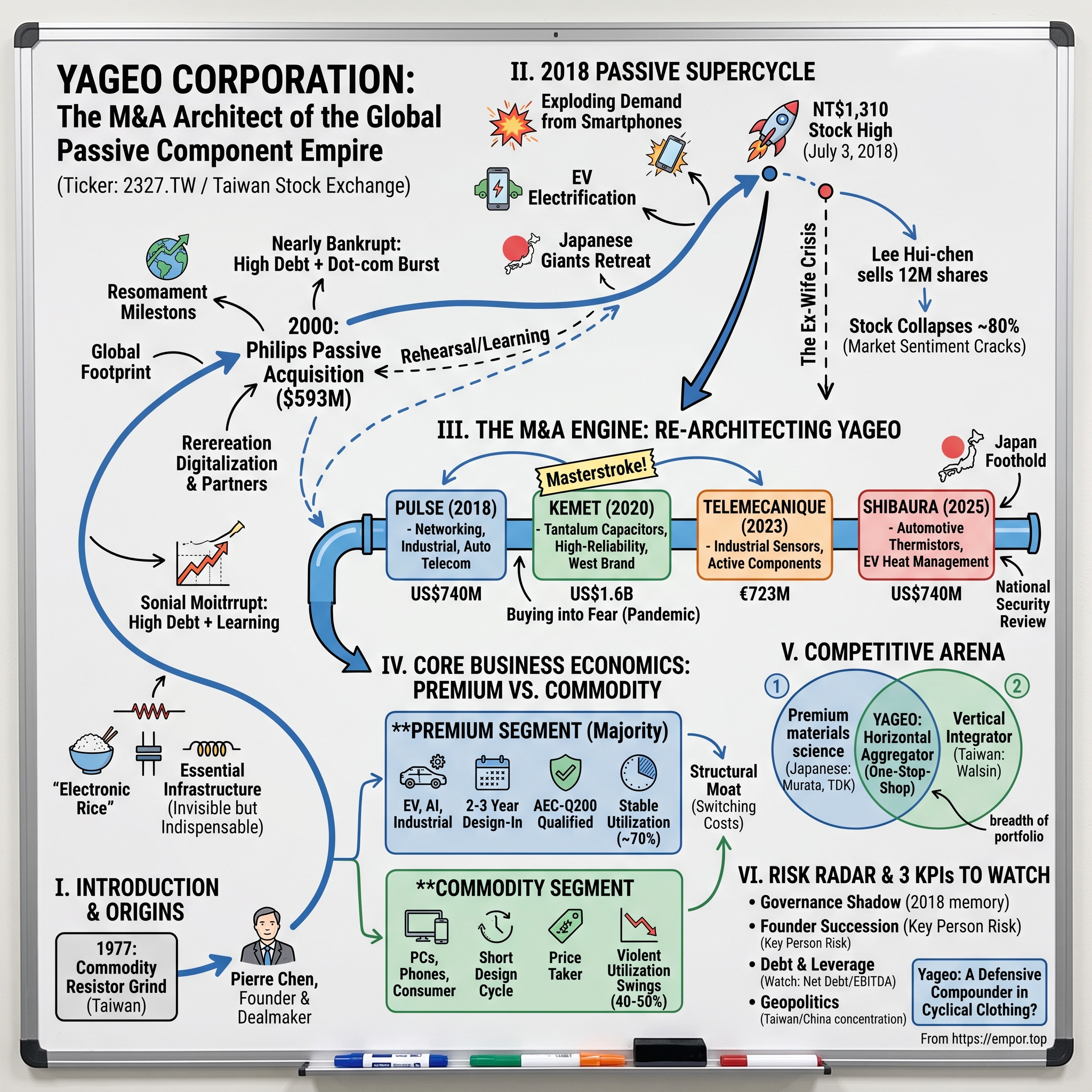
Yageo Corporation: The M&A Architect of the Global Passive Component Empire
I. Introduction: The "One-Stop-Shop" King of Passives
Open up any object that thinks. A smartphone. The battery-management brain of an electric vehicle. An Nvidia-powered AI server humming in a Texas data center. A guidance module in an aerospace platform. Crack the housing, lift the shielding, and you will find the silicon everyone talks about — the Nvidia GPU, the TSMC-fabricated logic — surrounded by a swarm of tiny, anonymous rectangles. Thousands of them. Chip resistors smaller than a grain of sand. Multilayer ceramic capacitors stacked like microscopic decks of cards. Inductors coiled to manage magnetic fields. Each one costs a fraction of a cent. None of them can be left out. A modern AI accelerator will not power up without the low-value passives that condition its voltage, filter its noise, and store the split-second bursts of energy its transistors demand.
There is a useful mental model here. Think of a modern electronic system as a city. The semiconductors are the skyscrapers — tall, expensive, the thing everyone photographs. But a city of skyscrapers with no plumbing, no wiring, no drainage, and no traffic lights is uninhabitable. Passive components are that unglamorous municipal infrastructure: individually cheap, collectively indispensable, and invisible right up until one fails and the whole block goes dark. The companies that build the skyscrapers get the magazine covers. The companies that lay the pipes get something arguably more durable — a position in every building that will ever be built.
This is the strange asymmetry at the heart of the electronics industry. The world lavishes attention on the expensive, glamorous parts and ignores the cheap, essential ones. And in that ignored corner, a Taiwanese company most consumers have never heard of has built something close to indispensable scale. 國巨 Yageo Corporation — ticker 2327.TW, listed on the 臺灣證券交易所 Taiwan Stock Exchange — is the world's largest maker of chip resistors and, after a decade of acquisitions, one of the three companies that matter in nearly every passive-component category on earth.
Here is the paradox worth sitting with. Yageo began in 1977 making basic, commodity resistors in Taiwan — the lowest-margin, most price-eroded, most brutally cyclical products in electronics. By fiscal 2025 it booked a record NT$132.93 billion in revenue, roughly US$4.1 billion, at a 36.2% gross margin and a 22.4% operating margin — the kind of profitability you would expect from a specialty chemicals company or a branded industrial, not a commodity-parts maker.12 How does a company escape the race to the bottom that defines its own industry?
The answer is not organic engineering. It is a playbook — an aggressive, disciplined, horizontal roll-up strategy executed over two decades by one of Asia's most enigmatic capital allocators: 陳泰銘 Pierre Chen, a founder who is as famous in the auction rooms of Sotheby's for his Rothkos and his Burgundy cellar as he is in Taiwan's boardrooms for his cold-eyed dealmaking.10 Yageo's story is a story of financial engineering as competitive strategy — of using cash generated in violent up-cycles to buy structural, non-cyclical moats.
This is the roadmap. We start in the commodity grind of the early years, where survival was the only strategy. We move to the wild passive-component supercycle of 2018 — the speculative squeeze that sent Yageo's stock from under NT$100 to NT$1,310, and the trust-shattering "ex-wife share liquidation" that happened days after the peak. We examine the acquisition engine that re-architected the company: Pulse, KEMET, Telemecanique, Shibaura. We dissect the economics that now split Yageo into a defensive premium business and a cyclical commodity one. We war-game the competitive arena against Japanese titans like 村田製作所 Murata Manufacturing and domestic rival 華新科 Walsin Technology. And we stress-test the whole thing — bull, bear, and the governance shadow that still hangs over the name. Let us begin where every commodity story begins: at the bottom.
 Subscribe on LinkedIn
II. Origins & The Commodity Resistor Grind
Picture Taiwan in 1977. The island is not yet the semiconductor superpower it will become. It is a low-cost assembly floor for the world's electronics brands — a place where cheap labor solders together components designed and owned elsewhere. Into this environment, a young Pierre Chen co-founded Yageo, initially oriented around precision resistors and basic components. There was no grand vision of a global empire. There was a simpler proposition: make a physical thing the world needed in enormous volume, and make it a little cheaper than the next factory.
It helps to understand the man making that proposition, because Yageo is unusually a founder's company. Pierre Chen was not a laboratory engineer who stumbled into business; he was, from the beginning, a dealmaker and a merchant with an instinct for value — the qualities that would later make him both a formidable acquirer of companies and a legendary collector of art and wine. Where the Japanese passive giants were run by materials scientists obsessed with the physics of ceramics, Yageo from its earliest days was run by a man obsessed with the arithmetic of scale, cost, and market position. That difference in temperament — engineer versus trader — is not a footnote. It shaped every strategic choice the company would make for the next fifty years, and it explains why Yageo's edge was never going to come from inventing a better capacitor, but from assembling a bigger, broader, more efficient machine than anyone else was willing to build.
Through the 1990s, Chen followed that instinct with a string of smaller acquisitions that most observers barely noticed at the time — picking up Germany's Vitrohm, Taiwan's Teapo, and stakes in Chinese ferrite operations — quietly stitching together a base of technology and geographic reach across Asia and Europe. Each deal, individually, was modest. Cumulatively, they were rehearsals. Chen was teaching himself and his organization how to buy a company, absorb its capabilities, and fold it into a larger whole — the core competency that would eventually define Yageo far more than any single product line. By the late 1990s, the rehearsals were over, and Chen was ready to attempt something an order of magnitude larger.
To understand why that was such a difficult way to make a living, you need to understand what passives actually do — and why, for decades, they were treated as electronic rice: a bulk staple bought by the sack. A resistor does exactly what its name says: it resists, restricting the flow of electrical current so that the delicate parts downstream receive exactly what they can handle. A capacitor is a tiny reservoir; it stores electrical charge and releases it in a controlled burst, smoothing out the ripples in a power supply. An inductor manages magnetic fields, resisting sudden changes in current. These three — resistor, capacitor, inductor — are the "passive" components, so called because, unlike a transistor, they do not amplify or switch a signal. They condition it. They are the plumbing and the shock absorbers of every circuit.
Why "electronic rice"? Because for decades these parts had two commodity-defining traits: they were largely interchangeable across suppliers, and they were bought in staggering volume — a single circuit board might carry hundreds or thousands of them, each costing a fraction of a cent. When a product is interchangeable and cheap, the buyer has no reason to be loyal and every reason to squeeze; the only way a supplier competes is on price and availability. That is the trap that swallows most commodity manufacturers, and it is worth naming precisely because Yageo's entire strategic arc has been an escape attempt from it.
For most of the 1980s and 1990s, these parts were pure commodities, and the economics were merciless. Every product generation, prices fell 5% to 10% simply because that is what commodity prices do when a dozen Asian factories are racing each other down the cost curve. To stand still, you had to run: cut costs, expand volume, automate, repeat. A company that failed to gain scale did not merely earn less — it disappeared. This is the crucial context for everything Pierre Chen did next. He learned, in the most direct way a manager can, that in a commodity you either consolidate the market to win pricing power, or you climb the value ladder into products that customers cannot casually swap out. Chen decided Yageo would eventually do both — but first it had to get big, and it had to get big faster than organic factory-building would allow.
That instinct produced Yageo's first defining gamble. Around the turn of the millennium, the Dutch electronics giant Philips decided to shed its unglamorous passive-components and ceramics operations. In 2000, Yageo agreed to buy the discrete-ceramics and ferrite-ceramics businesses — the "Phycomp" and "Ferroxcube" brands — in a cash deal reported at roughly US$593 million, a staggering sum for a company Yageo's size at the time.13 Overnight, the acquisition transformed a Taiwanese resistor maker into a global player: Yageo's share of ferrite ceramics leapt from around 3% to 26%, its MLCC share from 2% to 9%, and its chip-resistor share climbed into the mid-twenties.13 It was the first proof of the thesis that would define the company — that you could buy scale off a Western incumbent that no longer wanted a low-margin business.
There was strategic logic beyond the raw numbers. Philips' ferrite operation in Poland had natural synergy with the Chinese ferrite business Yageo was building, and the combination with Yageo's existing German and Taiwanese holdings gave the company, almost overnight, a genuinely global manufacturing and technology footprint that would have taken a generation to construct from scratch. Chen had grasped a pattern that would become the foundation of his entire career: that the great Western conglomerates, under pressure to focus on higher-margin businesses and to please their own shareholders, would periodically decide that low-margin passives were beneath them — and that when they did, a disciplined Asian buyer could acquire decades of accumulated capability, plants, and brands at a fraction of what it would cost to build. It was a form of arbitrage, and Chen would run it again and again.
It was also very nearly the end of the company. The Philips deal was heavily leveraged, and its timing was catastrophic. Within months the dot-com bubble burst, electronics demand collapsed, and Yageo found itself carrying a mountain of debt against a business whose prices were falling off a cliff. For years afterward the company labored under the weight of that acquisition, a near-death experience that taught Chen the other half of his education: scale bought with too much leverage at the wrong point in the cycle can bury you. Consolidation was the right idea. Doing it recklessly was how you died. That tension — between the courage to make transformative bets and the discipline to survive them — would define the far more famous drama that engulfed Yageo eighteen years later.
III. The 2018 Passive Supercycle & The Ex-Wife Trust Crisis
Every so often, a boring industry throws a party. In 2017 and 2018, the passive-component sector threw the wildest one in its history — and Yageo was standing in the middle of the dance floor.
The setup was a textbook supply shock. Three forces converged. First, demand exploded: smartphone builds were near their peak, and every new model crammed in more MLCCs. Second, automotive electrification began drawing serious volumes of components into cars. And third — the accelerant — the Japanese giants deliberately stepped back. 村田製作所 Murata and TDK, the premium leaders, made a strategic decision to abandon the low-end, legacy MLCC business and redirect their most advanced capacity toward ultra-high-reliability automotive parts, where margins were fatter and competition thinner. In effect, the highest-quality suppliers walked away from the mass market at the exact moment mass-market demand was surging.
That left a vacuum. And into vacuums rush the companies with capacity — which meant Yageo, sitting on dominant share in chip resistors and meaningful volume in commodity MLCCs. What happened next was a genuine mania. With demand overwhelming supply, Yageo pushed through round after round of price increases. Lead times — the wait between placing an order and receiving parts — stretched past six months, a terrifying signal for any manufacturer whose assembly line stops without them. Distributors and speculators began hoarding inventory, betting prices would climb further, which of course made the shortage worse. A component that had been a rounding error on a bill of materials became, briefly, a scarce and precious thing.17
For Yageo's income statement, the effect was intoxicating. Revenue and margins ballooned as commodity parts sold at prices no one had seen before. And Taiwan's retail investors, who follow local champions with fervor, piled in. Yageo's stock — which had traded under NT$100 not long before — became the hottest ticker on the island. On July 3, 2018, it printed an all-time high of NT$1,310, a valuation that implied the supercycle would last forever.12 It would not. Commodity manias never do. The only question was who would ring the bell at the top — and here the Yageo story takes a turn that no amount of operational excellence could have scripted.
Just one week after the peak, on July 10, 2018, a massive block of Yageo shares hit the market. The seller was 李慧真 Lee Hui-chen, Pierre Chen's ex-wife. According to Taiwanese financial press, she registered and executed the disposal of roughly 12,000 lots — about 12 million shares — at a price near NT$1,045, harvesting proceeds well in excess of NT$10 billion, on the order of US$400 million.1112 The market read it as the ultimate insider signal. If someone that close to the founder was cashing out billions within days of the top, what did that say about how much room was left? Retail confidence cracked, then shattered. The stock that had rocketed above NT$1,300 began a long, grinding collapse, ultimately falling roughly 80% to bottom near NT$200 by the middle of 2019.
It is worth being precise about why this single transaction did such disproportionate damage, because the mechanism matters for understanding the discount Yageo still carries. In a commodity supercycle, the entire edifice rests on belief — belief that the shortage will persist, that prices will hold, that the boom is not about to end. That belief is fragile precisely because everyone participating knows, at some level, that it is a boom. What the market craves in such a moment is a signal from someone who knows more than the crowd. An insider sale days after an all-time high is the most powerful bearish signal imaginable, and it does not matter whether the seller intended it as a market call. The information content — "someone close to the top of this company is converting paper into a very large amount of cash, right now" — is unmistakable, and in a crowd primed for exactly that cue, it was enough to reverse the psychology entirely. The stock did not fall because Yageo's business deteriorated overnight; it fell because the story that had inflated it lost its last believers.
Chen's defense, offered at investor forums, was that the sale had been arranged by an investment bank and placed with long-term institutional investors, and that it reflected neither his personal view of the company nor privileged information — his ex-wife's holdings were her own to manage. Whether or not one accepts that explanation, the episode did lasting damage that no press release could repair. To a generation of Taiwanese retail and institutional investors, the timing was too perfect to be innocent, and the memory calcified into a durable narrative: that Yageo's controlling family were brilliant, opportunistic financial operators who understood the cycle better than anyone — and who could not always be assumed to be on the same side of a trade as minority shareholders. There is a second, quieter lesson in the crash that is easy to miss beneath the drama. The 80% collapse was not, in the end, a story about fraud or mismanagement — Yageo's factories kept running, its market share held, and the underlying business survived intact. It was a story about the difference between a commodity company's earnings and its earnings power. In the boom, Yageo reported spectacular profits, but those profits were a gift of the shortage, not a reflection of any durable advantage; when the shortage passed, so did the profits, and the market violently re-rated the stock back toward what a cyclical commodity business is actually worth. The most important realization inside Yageo after 2018 was almost certainly this: that a company whose peak earnings can evaporate in eighteen months will always be valued as a gamble, no matter how large it becomes. The only escape was to build earnings that would not evaporate — and the cash from the very boom that had exposed the problem was the means to buy the cure.
That perception, fair or not, became a valuation ceiling that Yageo has been arguing against ever since. It is also, paradoxically, the pivot on which the company's reinvention turned — because the same instinct for cyclical timing that unnerved investors was about to be pointed at something far more constructive.
IV. The M&A Engine: Re-Architecting Yageo
Here is the decision that separates Yageo from every commodity manufacturer that got rich in a shortage and then gave it all back in the bust. Most companies, handed a once-in-a-decade windfall, do the obvious thing: they build more capacity to chase the high prices. Then the cycle turns, the new plants sit half-idle, and the returns evaporate. Pierre Chen did almost the opposite. He looked at the mountain of cash the 2018 mania had thrown off and concluded that the smartest thing to do with cyclical money was to buy his way out of the cycle entirely.
The logic was cold and clear. Yageo's problem was not that it lacked scale in commodities — it had plenty. Its problem was that commodity scale was a curse: it chained the company to the violent whims of PC and smartphone inventory swings. What Yageo needed was the opposite kind of business — parts that were designed into products years in advance, protected by certifications, sold to customers who could not switch on a whim. Those businesses existed, but they were owned by others, often Western and Japanese incumbents who, like Philips two decades earlier, no longer wanted them. So Chen went shopping.
The first move came even as the supercycle raged. In May 2018, Yageo agreed to acquire Pulse Electronics — a maker of magnetics, transformers, antennas, and wireless components — for US$740 million, buying it out of the hands of the private-equity firm Oaktree Capital Management.[^9] Pulse pushed Yageo into high-end networking, industrial, and automotive telecom systems, the sort of applications where a component's reliability matters more than its price. It was a strategic premium, not a bargain, and it signaled the direction of travel: away from the commodity core, toward engineered products with stickier customers.
Then came the masterstroke. In late 2019, Yageo agreed to acquire the American capacitor maker KEMET Corporation, and in June 2020 the deal closed: US$27.20 per share in cash, an equity value of roughly US$1.6 billion.7[^8] What Yageo got was extraordinary. KEMET was the world's number-one maker of tantalum capacitors — a specialized, high-reliability category with deep, decades-old design-ins across the automotive, defense, and industrial worlds. It brought polymer and film technologies, Tier-1 automotive relationships, and a Western brand with genuine equity. And Yageo bought it cheaply. The purchase price worked out to roughly six times KEMET's adjusted EBITDA — a modest multiple that looked, in hindsight, like a steal, because it instantly and durably shifted Yageo's product mix toward the defensive premium end. Where the Philips deal had been a leveraged near-death bet at the wrong point in the cycle, KEMET was its disciplined mirror image: a high-quality asset bought at a reasonable price, using cash the cycle had provided. Chen had learned the lesson of 2000 and applied it with interest.
It is worth dwelling on why tantalum, of all things, mattered so much. Tantalum capacitors are not the parts you find by the thousand in a cheap phone; they are specialized components prized for packing a lot of capacitance into a small, stable, reliable package, which is exactly why they show up in the places where failure is not an option — medical implants, aerospace avionics, military hardware, industrial controllers, and increasingly the power systems of servers and cars. The supply base is narrow, the qualification hurdles are severe, and the customer relationships stretch back decades. KEMET was not just a capacitor maker; it was a passport into a set of customers and applications that a Taiwanese commodity house could never have penetrated on its own, no matter how many resistors it sold. In one stroke, Yageo acquired not only technology but credibility — the standing to sit across the table from a Tier-1 automotive supplier or a defense contractor as a qualified, trusted source rather than a low-cost interloper. That intangible — the right to be considered at all — was arguably worth more than the tantalum patents themselves.
The timing was its own lesson. KEMET agreed to sell in late 2019 and the deal closed in June 2020 — in the teeth of the pandemic shock, when markets were terrified and asset prices had cratered. Where the young Yageo had bought Philips at the top and nearly drowned, the mature Yageo closed on KEMET into the fear, when a disciplined buyer with cash and conviction faced the least competition. This is the through-line of Chen's career that the numbers alone miss: the same contrarian temperament that made him a great collector — buying when others are selling — is what turned a near-fatal early habit into a genuine competitive advantage two decades later.
The re-architecting continued. In October 2023, Yageo completed the acquisition of Telemecanique Sensors from France's Schneider Electric for €723 million — roughly US$780 million.89 This was a different kind of leap: out of passives altogether and into active industrial sensing — the electromechanical and electronic sensors that factories, machines, and automation systems rely on, a business with about 70% of its revenue in the high-margin markets of North America and Europe. It diversified Yageo away from pure commodity cyclicality into industrial automation, a slower but stickier world.
And the campaign ran right up to the present. In 2025, Yageo waged a hard-fought battle to acquire 芝浦電子 Shibaura Electronics, a Japanese specialist in NTC thermistors — the temperature sensors that are critical to managing heat in EV batteries and power electronics. It was not easy. Yageo had to raise its bid to ¥7,130 per share to fend off a competing offer from Japan's MinebeaMitsumi, and it had to clear a seven-month national-security review under Japan's Foreign Exchange and Foreign Trade Act, because thermistor sensor technology fell into a "core" security category.56 By October 2025 the tender offer succeeded with an acceptance rate of 87.3%, a roughly US$740 million deal that handed Yageo a coveted foothold in Japan and a leading position in automotive temperature sensing.4 Notably, the Shibaura contest showed the strategy maturing — and, arguably, getting harder. Yageo now had to outbid a determined rival and clear a foreign national-security review, a sign that the era of buying unwanted Western castoffs on the cheap was giving way to competitive, fully-priced auctions. The KEMET-style bargain, bought at six times EBITDA from a motivated seller into a market panic, may prove to have been a product of a particular moment rather than a repeatable formula. As the targets get scarcer and the auctions get more crowded, the discipline that defined the early deals will be tested precisely when it is hardest to maintain — the moment when a proud acquirer, having built a machine that needs to keep feeding, faces the temptation to overpay to keep it running. Whether Yageo pays up or walks away from the next Shibaura will say more about the durability of its strategy than any completed deal has.
Threaded through all four acquisitions is a financing story the balance sheet quietly tells. Each deal — Pulse, KEMET, Telemecanique, Shibaura — was funded substantially with debt, layered onto a company that also carries the working-capital swings of a manufacturer. That is manageable in an upcycle throwing off mid-NT$40-billion EBITDA and while interest income on Yageo's own cash partly offsets the interest expense on its borrowings. But it is precisely the kind of structure that looks conservative in good times and aggressive in bad ones, and it is the reason the leverage ratio belongs on any serious watchlist for this company — a point we return to at the end.
Across all of it, one integration principle held, and it deserves attention because integration is where most roll-ups quietly fail. The graveyard of corporate history is full of acquirers who bought good companies and then destroyed them by imposing the parent's culture, gutting the acquired management, and chasing "synergies" that turned out to be the very people and relationships that made the target valuable. Chen took the opposite approach. He did not try to bolt Taiwanese corporate culture onto proud Western and Japanese subsidiaries. KEMET's and Pulse's management teams were largely left in place, their brands preserved, their engineering cultures intact — while Yageo plugged them into its global sales machine and cross-sold their products to its vast mass-market customer base. The insight was that Yageo and its targets were good at different things: the targets brought technology, certifications, and blue-chip relationships; Yageo brought scale, cost discipline, Asian manufacturing muscle, and an enormous distribution reach. Force them into one culture and you destroy both. Keep them distinct and connect them commercially, and each does what it does best.
There is a harder-nosed way to read the same facts, and a careful investor should hold both. Leaving acquired managements autonomous preserves value, but it also means the "synergies" that justify an acquisition price are largely revenue synergies — cross-selling — which are notoriously slower and less certain to materialize than the cost synergies of a full integration. Yageo's model asks the market to trust that a KEMET part will genuinely sell better under the Yageo umbrella than it did alone, and that trust has to be re-earned deal after deal. So far the financial results suggest the model is working; but "so far" is doing real work in that sentence, and the proof lives in the segment economics. The acquisitions were the raw material; the next question is what kind of business they actually built.
V. Core Business Economics: Premium vs. Commodity
Strip away the drama and the dealmaking, and what does Yageo actually earn its money doing today? The honest answer is that it now runs two very different companies under one roof, and understanding the difference is the whole investment case.
Start with the topline. In fiscal 2024, Yageo generated NT$121.7 billion in revenue at a 34.4% gross margin, producing net income of roughly NT$19.4 billion and earnings per share of NT$9.53 on its enlarged, post-acquisition share base of about 2.06 billion shares.3 In fiscal 2025, the picture stepped up meaningfully: revenue climbed 9.3% to the record NT$132.93 billion, gross margin expanded 1.8 points to 36.2%, operating margin jumped 3.2 points to 22.4%, and net income rose 22.1% to NT$23.63 billion, the second-highest in company history, with EPS of NT$11.51.12 The board proposed a cash dividend of NT$6 per share, a payout ratio above 50% — a signal, in itself, that management wanted to reassure the market it was not simply hoarding cash for the next deal.2 Trailing EBITDA now runs in the mid-NT$40 billion range, throwing off the free cash flow that funds both the dividend and continued debt paydown.
One number in that progression deserves a moment: the operating margin's jump of more than three full points in a single year, to 22.4%.2 Margin expansion of that magnitude in a hardware business does not come from selling more of the same thing; it comes from mix and from operating leverage. As higher-priced premium and AI-related parts became a larger share of the pie, and as fixed factory costs were spread across rising volume, more of each incremental sales dollar dropped to the operating line. That is exactly the financial signature the acquisition strategy was designed to produce — evidence, not merely assertion, that the mix shift toward premium is showing up where it counts. The skeptic's caution is that a single strong year, buoyed by an AI upcycle, is not yet a proven new baseline; margins that expanded on favorable mix and demand can compress again when the cycle cools.
But the aggregate numbers hide the real story, which lives in the split between two segments with almost opposite economics.
The premium segment — now the majority of revenue — is where Yageo wants you to look. These are the specialized, high-reliability parts: tantalum and polymer capacitors from KEMET, high-voltage automotive MLCCs, Telemecanique's industrial sensors, Shibaura's thermistors, Pulse's magnetics. The economics here are structurally attractive for reasons that have nothing to do with the commodity cycle. A high-reliability automotive component goes through a design-in process that can take two to three years, during which it is engineered into a specific module and qualified against punishing standards — AEC-Q200 for passive component reliability, IATF 16949 for automotive quality systems. Once a part is designed into a car platform or a battery-management system, ripping it out to save a few cents is unthinkable; re-qualification would cost far more than the savings and introduce risk into a safety-critical system. That is why these parts command meaningful pricing premiums over their commercial equivalents and why their factory utilization stays relatively stable through the cycle, in the neighborhood of 70%. This is not commodity economics. It is closer to the razor-and-blades stickiness of an installed base.
There is a subtle but important point buried in that utilization figure. A premium plant that runs at a steady 70% is, counterintuitively, often more profitable and more valuable than a commodity plant that runs at 90% in a boom, because the premium plant's revenue and pricing do not collapse when demand softens. Stability of utilization, not its absolute peak, is what lets a manufacturer plan, invest, and defend margin through a cycle. The premium segment's real gift to Yageo is not that it earns more in any given quarter — it is that it earns predictably, which is the quality the market has always paid a premium multiple for and always punished its absence.
The commodity segment is the old Yageo — standard chip resistors and commercial-grade MLCCs sold into PCs, smartphones, and consumer gadgets. Here the economics are exactly what they have always been: short design cycles, price-taker dynamics, and utilization that swings violently between roughly 40% and 50% in a downturn as customers burn through inventory before reordering. When the consumer electronics cycle rolls over, this is the part of Yageo that bleeds. The strategic point of the entire acquisition campaign was to shrink this segment's share of the whole — to convert Yageo from a company that was mostly commodity into one that is mostly premium, so that the defensive, sticky business could absorb the shocks that the commodity business still transmits.
There is one more engine worth naming, because it is where the growth narrative and the margin narrative finally converge: artificial intelligence. AI accelerators and the servers around them are astonishingly hungry for exactly the kind of high-performance passives Yageo has spent a decade acquiring the ability to make — ultra-low-resistance power inductors to feed enormous current into power-hungry GPUs, and high-temperature polymer capacitors that survive the thermal brutality of a densely packed server board. Management has said AI-related revenue reached about 13% of sales in the fourth quarter of 2025, and it credited AI demand, along with a better product mix and strong Western markets, as the primary driver of the record year, and pointed to AI orders and Shibaura's contribution behind record monthly sales late in 2025.1216 That is the optimistic read. The skeptical read is that AI is still a modest slice of the whole, and that the majority of Yageo's volume remains tethered to the same consumer cycles that have always whipsawed it. Both can be true at once — which is precisely why the competitive and moat analysis matters so much.
VI. Competitive Arena: The Global Passive Duels
To understand where Yageo can win and where it cannot, you have to see the battlefield as its customers do — because in passives, the map is drawn category by category, and Yageo's position looks completely different depending on which square you are standing on.
Start with the scoreboard. In chip resistors, the humblest and highest-volume passive of all, Yageo is the undisputed global number one — the position it has held and defended for years, the foundation of its scale. In tantalum capacitors, thanks to KEMET, Yageo is again the global leader, sitting atop a specialized, high-barrier niche. But in the two largest and most technically demanding categories, the picture flips. In MLCCs — the single biggest passive market by value — Yageo ranks roughly third globally, trailing Murata and 삼성전기 Samsung Electro-Mechanics. And in inductors, Yageo is again around third, behind TDK and Murata. So Yageo is simultaneously a dominant leader and a perennial challenger, depending on the aisle. That duality is the key to reading its strategy.
Now meet the archetypes, because the passive-component industry is really a three-way contest between fundamentally different philosophies of how to win.
The first archetype is the premium materials-science champion, and it is Japanese. Murata, TDK, and 太陽誘電 Taiyo Yuden compete on the physics itself. Their edge is the ability to do things with ceramic and dielectric materials that no one else can — shaving the insulating layers inside an MLCC down to sub-micron thinness so they can pack more capacitance into a smaller volume, a feat of manufacturing precision built up over decades and guarded jealously. This is why the Japanese lead in the most demanding applications: the ultra-compact, ultra-dense passives inside flagship smartphones and EV powertrains, where every cubic millimeter and every degree of thermal tolerance is fought over. You do not out-acquire Murata's materials science; you have to invent your way to it, slowly.
The second archetype is Yageo itself — the horizontal aggregator. Yageo's bet is not that it will beat Murata at dielectric physics. Its bet is on breadth. Picture a procurement officer at Tesla or Bosch staring at a bill of materials with thousands of passive line items — resistors, capacitors of every chemistry, inductors, sensors. Sourcing those from a dozen specialist vendors is a logistical headache: a dozen contracts, a dozen quality audits, a dozen points of supply risk. Yageo's pitch is that a single account manager can supply nearly the entire passive BOM from one relationship — Yageo resistors, KEMET tantalum, Telemecanique sensors, Shibaura thermistors, Pulse magnetics. That is a distribution and cross-selling advantage, not a physics advantage, and it is the direct commercial payoff of the acquisition strategy. The question a skeptic should ask — and we will return to it — is how much a customer will actually pay for one-stop convenience when the underlying parts are available elsewhere.
It is worth being clear-eyed about what Yageo's number-three ranking in MLCCs actually means, because MLCCs are the crown jewel of the passive world — the largest category by value and the one with the steepest technology curve. The reason Murata and Samsung Electro-Mechanics sit above Yageo is not marketing; it is that they can reliably manufacture the smallest, highest-capacitance, most thermally demanding MLCCs at scale, and those are the parts that go into the tightest, most valuable designs. Yageo competes hard in the mainstream and mid-tier of MLCCs, and its acquisitions have strengthened its hand in the specialty automotive grades — but at the bleeding edge of miniaturization, it is a follower, not a leader. That is not a fatal weakness; a great deal of money is made in the mainstream. But it is a real ceiling, and it is the clearest evidence that Yageo's moat is built on breadth and scale rather than on being the best in the world at the hardest thing. An investor who confuses "biggest in resistors" with "best in every passive" is misreading the company.
The AI story sharpens the same point in Yageo's favor. The passives that AI accelerators need most desperately — ultra-low-resistance power inductors that can shove enormous current into a GPU without wasting it as heat, and polymer capacitors that hold up under relentless thermal stress — happen to sit right where Yageo's acquired capabilities are strongest, in the inductor and polymer-capacitor domains it built up through Pulse and KEMET rather than in the razor-thin MLCCs where the Japanese dominate. In other words, the AI wave is playing to the parts of Yageo's portfolio that its roll-up strategy actually deepened. Whether that translates into durable share against TDK and Murata, who are pouring their own resources into the same opportunity, is the live competitive question — but for once, Yageo is contesting the growth market from a position of genuine strength rather than as the challenger looking up.
The third archetype is the vertical integrator, and it is Yageo's Taiwanese neighbor, 華新科 Walsin Technology. Walsin, the island's second-largest passives player, competes on cost and agility by owning its raw materials — most notably producing its own dielectric ceramic powder rather than buying it. Controlling the material lets Walsin move fast and defend margins in commodity MLCCs, but it lacks Yageo's global horizontal scale and, crucially, its premium brand tier: Walsin has no KEMET, no Western Tier-1 automotive pedigree. In the domestic duel, Yageo is the consolidator with the international portfolio; Walsin is the nimble cost operator. Both survive; neither is going away. And that stable, oligopolistic standoff — a handful of scaled players who understand they gain nothing from suicidal price wars in the specialty tiers — is exactly the kind of industry structure that lets us ask the harder question: how deep is Yageo's moat, really?
VII. Porter's 5 Forces & Hamilton Helmer's 7 Powers Moat Test
Let us put Yageo on the examination table and run the two classic frameworks over it — not to award a grade, but to see clearly where the business is genuinely protected and where it is exposed. Because the honest conclusion is that Yageo's moat is real in some segments and thin in others, and the whole investment debate lives in that gap.
Porter's Five Forces, applied to Yageo, produces a split verdict that mirrors its two-business structure.
Bargaining power of buyers is the sharpest dividing line. In the premium segment, buyers are relatively weak: an automotive OEM that has spent two years qualifying a KEMET tantalum capacitor into a safety-critical system is, in a real sense, captured, because the cost and risk of switching dwarf any price concession they might extract. In the commodity segment, buyers hold the whip. A contract manufacturer buying standard chip resistors will play suppliers against each other for a fraction of a cent, and Yageo has no choice but to meet the market.
Bargaining power of suppliers is moderate. Yageo depends on raw materials — palladium and nickel for electrodes, tantalum powder, and specialized ceramic powders — whose prices it does not control. But its sheer purchasing volume gives it bulk-buying leverage that smaller rivals lack, and the vertical-integration model that Walsin uses shows there are ways to blunt supplier power over time.
Threat of new entrants is very low, and this is a genuine structural protection. Building a modern MLCC or tantalum plant requires hundreds of millions of dollars of capital, years of process optimization to hit acceptable yields, and — for the parts that matter most — the same multi-year qualification gauntlet that protects incumbents. Capital plus time plus certification is a formidable wall.
Threat of substitutes is close to nonexistent, and it is worth pausing on why. There is no alternative technology to a passive component. You cannot run active silicon without something to condition its power and filter its signals; a capacitor's job cannot be done by software. As long as electronics exist, passives must exist. This is perhaps the single most attractive feature of the entire industry — the demand is not going to be disrupted away.
Competitive rivalry is, again, a tale of two segments: brutal and price-driven in standard MLCCs, but consolidated into a comfortable oligopoly in the specialty tiers where only a few players can meet the spec.
Put the five forces together and a clear shape emerges. The industry Yageo operates in is fundamentally attractive — no substitutes, high entry barriers, demand that grows with all of electronics — but Yageo's own position within it is uneven, strong at the specialty end and exposed at the commodity end. The company is, in effect, trying to migrate itself from the ugly quadrant of a beautiful industry toward the beautiful quadrant, one acquisition at a time.
Now Hamilton Helmer's 7 Powers, which asks the more demanding question: which of these advantages actually persists and generates excess returns?
Switching costs are Yageo's strongest power — but only in the premium division. The qualification lock-in on a designed-in automotive or aerospace part is a textbook switching-cost moat, and it is the single best reason to believe the premium segment's margins are durable rather than cyclical. The commodity division, by contrast, has essentially no switching costs, which is why it will always be a price-taker.
Scale economies are Yageo's second real power. Its enormous volume in chip resistors and standard MLCCs lets it spread fixed factory costs across more units than smaller rivals can, giving it a cost-absorption edge that is hard to attack from below. This is the power that made Yageo dominant in resistors in the first place.
Cornered resource is present but moderate, and mostly acquired rather than built: KEMET's tantalum-processing know-how and patents, Telemecanique's sensor IP, Shibaura's thermistor expertise. These are valuable, but they were purchased in the open market — which means, in principle, a rival with enough capital could have bought them too. Yageo's edge is that it moved first and paid disciplined prices, not that these resources are uniquely and permanently cornered.
Counter-positioning — the power that comes from a business model incumbents cannot copy without damaging themselves — is essentially absent, and it is important to say so plainly. Yageo is the incumbent. Its strategy is consolidation, not disruption. It is not doing something structurally novel that Murata or TDK are unable to imitate; it is executing a roll-up better and more aggressively than they choose to. That is a real skill, but it is not a structural power in Helmer's sense, and it means the moat depends heavily on continued execution rather than on an unassailable position. Which brings us to the lessons this whole campaign holds for investors and operators.
VIII. Playbook: Key Lessons for Investors & Founders
Step back from Yageo the company and look at Yageo the case study, because the strategy it ran is teachable, repeatable, and quietly radical for a hardware business. Three lessons stand out.
The first is what we might call the anti-organic growth model. Conventional wisdom in engineering-driven industries says you build your moat in the lab — years of R&D, patient capacity expansion, the slow compounding of internal capability. Yageo's history argues that in a mature, capital-intensive, cyclical hardware sector, that path can be too slow and too expensive to change your structural economics in any reasonable timeframe. Chen's alternative was to let other companies spend the decades building the capability — KEMET's tantalum expertise, Telemecanique's sensor IP, Shibaura's thermistor leadership — and then buy the finished result when the seller's strategic priorities shifted and the price was right. Buying KEMET at roughly six times EBITDA did more to transform Yageo's margin profile than any plausible internal project could have in the same window. The lesson is not "acquisitions are good." It is that in the right industry structure, disciplined M&A can re-engineer a company's DNA faster than organic effort — provided you have the balance sheet and the timing to do it without the leverage killing you, which is exactly the mistake the young Yageo nearly made with Philips.
The second lesson is the platform moat — the observation that a comprehensive portfolio is itself a distribution advantage, independent of any single product's quality. Customers do not just buy parts; they manage supplier relationships, and every additional vendor is overhead, risk, and friction. The willingness of a large OEM to consolidate its passive spend with a single "one-stop-shop" partner, and to pay a modest premium for the convenience, is a real and underappreciated source of pricing power. But the skeptic's caveat belongs here too: a distribution moat is softer than a technology moat. It erodes if a rival assembles a comparable portfolio, and it commands a smaller premium than genuine product differentiation. Yageo's platform is an advantage; it is not an impregnable one.
There is a fourth lesson hiding inside the first three, and it is a caution rather than a prescription: the roll-up playbook only works under specific conditions, and it is dangerous to generalize. Yageo's strategy succeeded because it operated in an industry with three rare features — motivated sellers (Western incumbents shedding low-margin units), acquirable capability (technology and certifications that could be bought rather than only built), and a genuine distribution synergy (one salesforce that could carry many products). Remove any one of those and the same aggression becomes value-destruction: a roll-up in an industry without real synergies is just financial engineering that adds leverage without adding worth, and the history of conglomerates is largely a history of exactly that failure. The instructive thing about Yageo is not that it acquired a lot; plenty of companies acquire a lot and destroy themselves. It is that it acquired into a structure where consolidation genuinely created value, and it had the discipline — most of the time — to pay prices that left room for error. The lesson for an operator is to interrogate the structure before admiring the ambition.
The third lesson is the most contrarian, and it is about capital allocation across the cycle. The intuitive time to invest is when business is good and confidence is high — which is to say, near the top. Yageo's most important strategic moves went the other way. It used the speculative, almost certainly unrepeatable windfall cash from the 2018 shortage — money the market assumed would evaporate in the bust — to fund permanent, defensive, non-cyclical assets. Cyclical cash bought counter-cyclical moats. That is a genuinely sophisticated piece of capital allocation, and it is the strongest argument in Yageo's favor as a management team. It is worth holding onto that point, because the very same aggressiveness that makes the strategy work is also what the bears point to as the risk. The playbook and the danger are two faces of the same coin, and it is time to turn it over.
IX. Bull vs. Bear: The Activist Stress Test & Risk Radar
Before the two cases, it is worth puncturing a couple of the consensus narratives that cling to this name, because a good part of the investment debate is really an argument about which story is out of date.
The first myth is that Yageo is a commodity chip-resistor company. That was true in 2010; it is materially less true now. The center of gravity has shifted decisively toward premium, engineered products bought through a decade of acquisitions, and the FY2025 margin structure — a gross margin above 36% and an operating margin above 22% — is simply not achievable by a pure commodity-parts maker.2 The reality is a hybrid whose defensive half is larger than its reputation.
The second myth cuts the other way — the bullish overstatement that Yageo has escaped the cycle. It has not. A meaningful share of revenue still rides on consumer electronics inventory swings, and even the premium book is not immune to a deep industrial recession. Diversification blunts the cycle; it does not abolish it. The truthful position sits between the two myths, and the two cases below are really an argument about how far the pendulum has actually swung.
So here is the debate an investor actually has to resolve, argued from both sides as honestly as we can.
The bull case begins with a claim about mispricing: that the market still files Yageo under "PC and smartphone component cyclical," a label that describes the company it was in 2018, not the one it is now. If the majority of revenue is genuinely premium — sticky, certified, designed-in, and stable through the cycle — then Yageo deserves to trade more like a diversified industrial than a commodity-parts maker, and the gap between those two multiples is the opportunity. The secular tailwinds reinforce the story. Electrification is a content-per-car explosion: an internal-combustion vehicle might use on the order of a thousand MLCCs, while a modern EV can use several thousand to as many as ten thousand, plus a suite of high-value temperature and current sensors — exactly the parts Yageo bought Shibaura and Telemecanique to supply. AI server demand is a second, higher-margin runway, already visible in the FY2025 results. And underpinning it all is a proven M&A machine generating enough free cash flow to service debt, pay a rising dividend, and fund the next deal. The bull says: this is a defensive compounder wearing a cyclical's clothing.
The mechanism the bull is really betting on is a re-rating. Two companies earning identical profits can trade at very different valuations if the market believes one set of earnings is durable and the other is fragile. For years Yageo has been priced closer to the fragile end — a cyclical multiple applied to a business the bull argues is now substantially defensive. If Yageo can demonstrate, through a full cycle, that its premium earnings hold up when consumer demand falls, the market's mental category for the stock could shift, and the same profits could command a higher multiple. That re-rating, not just earnings growth, is where the bull sees the asymmetric payoff. It is also, notably, a thesis that can only be proven by time and by a downturn — you cannot demonstrate resilience in a boom — which is why even sympathetic investors treat it as a claim awaiting evidence rather than a settled fact.
The bear case does not dispute the assets — it disputes the trust, the balance sheet, and the succession. Start with governance, because it is the oldest wound. The memory of the 2018 insider liquidation at the exact cycle peak has not faded in Taiwan, and it functions as a permanent discount on the multiple: a subset of investors will simply never fully trust a controlling family they watched cash out billions days after the top. That is not a number on a spreadsheet, but it is a real and persistent drag on valuation.
Then there is the succession question, which the company's own actions have pushed to the fore. In recent years Pierre Chen restructured his personal ownership, moving his direct stake into family-controlled holding vehicles — reported in the Taiwanese financial press as entities in the mold of a "Chen family" holding company and a "Taiming heritage" vehicle — a structure that hardens the family's control against any hostile takeover.14 In May 2025, Yageo elected Chen's eldest daughter, Joy Chen, to the board, a move widely read as the opening of a succession process.15 An activist would frame this pointedly: consolidating control into family vehicles and elevating a family heir stabilizes ownership, but it also signals a governance model built around dynasty rather than a clear, professional, non-family succession plan — and it can entrench a control premium for insiders at the expense of minority-shareholder influence. Whether that is prudent long-term stewardship or defensive entrenchment is exactly the kind of question a skeptical investor should keep open rather than resolved.
The deeper worry embedded in the succession question is key-person risk, and it is unusually acute here. Yageo's defining advantage — the disciplined, contrarian dealmaking that turned a resistor maker into a diversified premium supplier — is inseparable from one man's judgment about price, timing, and value. That is a wonderful thing to have and a terrifying thing to depend on, because it does not obviously transfer. The next generation may inherit the shares and the board seats, but the instinct that closed on KEMET into a pandemic and walked away from overpaying elsewhere is not written into an org chart. An activist would press exactly here: what is the institutional process that outlives the founder, and is the company building a capital-allocation discipline that survives him, or simply hoping the gift is hereditary? The honest answer today is that it is unproven, and a strategy that lives or dies on one person's temperament carries a discount for good reason.
The third bear pillar is leverage and acquisition appetite. Yageo's transformation was debt-funded, deal after deal — Pulse, KEMET, Telemecanique, Shibaura — and each acquisition, however strategically sound, added obligations to the balance sheet. The risk is a timing mismatch: if a global industrial downturn coincides with a period of elevated interest rates, a company carrying acquisition debt and still exposed, through its commodity segment, to cyclical demand could find itself squeezed on both cash flow and refinancing at once. The proposed 50%-plus dividend payout is partly a signal of confidence in the cash flows, but it also means less cash retained to de-lever if conditions turn. A management team that has promised discipline and then kept buying — even buying well — has to keep proving that the discipline is real and not just a story told between deals.
The risk radar rounds it out. The single biggest external exposure is geopolitical. Yageo has worked hard to diversify its manufacturing footprint — a growing hub in Malaysia, the Shibaura operations in Japan, KEMET and Telemecanique plants across Europe — precisely to reduce concentration risk. But a meaningful share of its commodity capacity still sits in China and Taiwan, which leaves the company squarely exposed to any escalation of cross-strait tension, a tail risk that no amount of operational excellence can hedge away. Secondary risks include raw-material price shocks in palladium and tantalum, and the ever-present danger that the commodity segment's next downturn is deeper or longer than the premium segment can offset. None of these breaks the thesis on its own; together they explain why the market demands a discount even for a business this essential. Which leaves the final question: if you owned this stock, what would you actually watch?
X. Epilogue & The 3 Ultimate KPIs to Watch
There is something fitting about the fact that Pierre Chen is as renowned for his art and wine as for his balance sheet. He has assembled one of the world's great private collections of postwar art and one of its legendary wine cellars, and the temperament that produces such collections — patient, opportunistic, willing to wait years and then move decisively when the right lot appears at the right price — is unmistakably the same temperament that ran the Yageo playbook.10[^13] He looked at a brutal, commoditized corner of Taiwanese electronics and, through two decades of disciplined consolidation, forced it into a higher-barrier global oligopoly, buying his company out of the race to the bottom with cash the race itself threw off. Whether that makes him a great steward or a cold financial engineer is, as we have seen, still contested — and the truth is probably that he is both, and that the two are inseparable.
For the long-term investor trying to judge how the story unfolds from here, three metrics cut through the noise better than any headline. They are the instruments on the dashboard; the reader can track them over time.
First, premium-segment utilization. The entire bull thesis rests on the claim that Yageo has become a structurally premium business insulated from the consumer cycle. The cleanest test of that claim is whether the utilization of its premium, automotive-and-industrial capacity holds up — ideally staying at or above roughly 70% even when the commodity side is running cold. If premium utilization stays firm through a consumer downturn, the "defensive compounder" story is real. If it sags in sympathy with the cheap stuff, the diversification was more cosmetic than structural.
Second, gross margin. Margin is where pricing power, mix, and integration success all show up in a single number. A gross margin sustained comfortably above the mid-30s — Yageo printed 36.2% in FY2025 — is the evidence that the premium acquisitions are actually earning their keep and that the company is capturing a real premium for its one-stop-shop breadth.2 A slide back toward the low-30s would suggest the commodity gravity is reasserting itself and the moat is thinner than advertised.
Third, net debt to EBITDA. This is the discipline gauge — the single best measure of whether the acquisition machine is being run prudently or recklessly. Because Yageo's transformation was debt-financed and its ambitions clearly are not exhausted, watching leverage tells you whether each new deal is being digested from a position of strength or piled on from a position of strain. A steadily de-levering balance sheet between deals is the sign of a management team keeping its promise of discipline; a ratcheting-up one, especially into a downturn, is the flashing light the bears are waiting for.
A final thought on how to hold this company in the mind. Yageo is neither the heroic compounder its promoters describe nor the untrustworthy commodity cyclical its detractors remember; it is a genuinely unusual thing — a commodity manufacturer that used the tools of finance to renovate its own economics, run by a founder whose greatest skill is knowing what something is worth and when to buy it. The strategy is real and the results so far support it. But the case has not yet met its true test, which is a serious downturn arriving while the balance sheet still carries acquisition debt and the founder's own succession is only half-resolved. When that test comes, the three KPIs above will tell you, quarter by quarter, whether the renovation was structural or cosmetic.
Track those three — premium utilization, gross margin, and leverage — and you are watching the exact seams where Yageo's ambitious story will either hold together or come apart.
XI. Outro & Links
Yageo's transformation from a commodity resistor maker into the horizontal architect of the global passive-component industry is one of the more instructive capital-allocation stories in modern electronics — a case where financial engineering, not laboratory breakthrough, redrew a company's competitive position. Readers who want to go to the primary record can start with Yageo's own investor materials and the deal and market documentation referenced throughout, listed below.
References
-
Strong AI Demand Boosts Yageo's 2025 Revenue to Record High of NT$132.9 Billion — BigGo Finance, 2026 ↩↩↩
-
Strong AI Demand Boosts Yageo's 2025 Profit to Second-Highest on Record; Company Proposes NT$6 Dividend Per Share — BigGo Finance, 2026 ↩↩↩↩↩↩↩
-
Yageo (TPE:2327) Stock Price & Overview — StockAnalysis.com ↩
-
Yageo completes tender offer for Japanese firm Shibaura Electronics — Focus Taiwan, 2025-10-21 ↩
-
Yageo succeeds in $740 million tender offer for Shibaura Electronics, filing shows — KFGO/Reuters, 2025-10-03 ↩
-
Yageo confident of Shibaura acquisition approval after METI discussions — DIGITIMES, 2025-08-28 ↩
-
KEMET and Yageo Complete Merger — Passive Components European Portal, 2020-06-15 ↩
-
Yageo purchases Schneider Electric's sensor business for 723 million euros — Taipei Times, 2023-11-23 ↩
-
Schneider Electric agrees to sell Telemecanique Sensors to Yageo — Schneider Electric IR, 2022-10-27 ↩
-
Billionaire Profile: Pierre Chen Net Worth & Assets — Forbes ↩↩
-
國巨股價高峰與申報轉讓分析:前妻高點套現百億經典案 — China Times Taiwan, 2018-07-15 ↩↩
-
Philips sells passive components unit to Yageo — Telecompaper, 2000 ↩↩
-
陳泰銘股權移轉家族控股 國巨長期傳承規劃解析 — Wealth Magazine Taiwan, 2024-10-18 ↩
-
Yageo taps chair's eldest daughter as director amid succession speculation — DIGITIMES, 2025-05-27 ↩
-
Yageo posts record November revenue on strong AI demand, Shibaura acquisition gains — DIGITIMES, 2025-12-09 ↩
-
Global Passive Component Shortage & Industry Dynamics Analysis — J2 Sourcing Market Report, 2018-09-10 ↩
 LinkedIn
 WhatsApp
 Reddit
 Hacker News
 Email
Email Kindle
 RSS Feed
 Spotify
 Apple Podcasts
 Amazon Music
 Audible
 YouTube