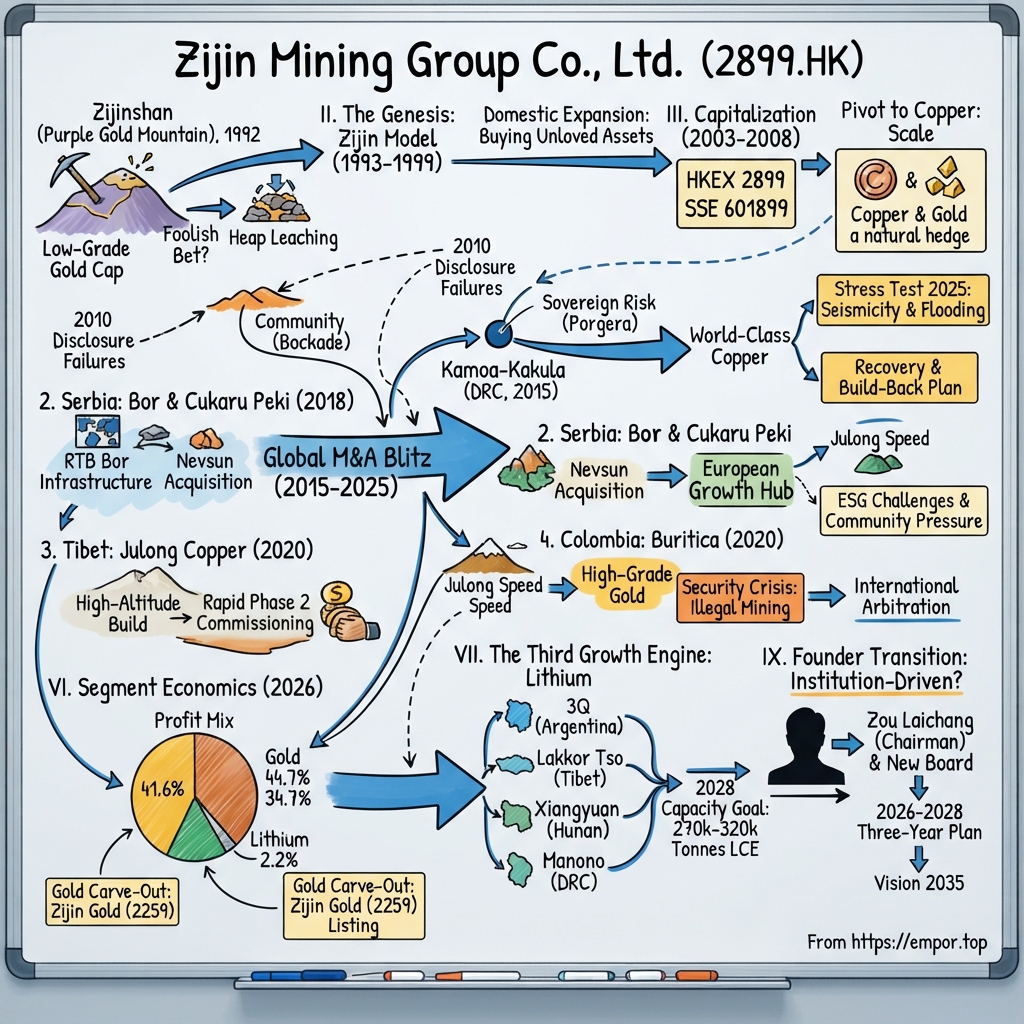
Zijin Mining Group: The Alchemists of Purple Gold Mountain
I. Introduction & Episode Roadmap
In the winter of 1992, a 35-year-old geologist stood on a scrubby hill in the subtropical hills of western Fujian and made a bet that almost every credentialed expert in Chinese mining thought was foolish. The hill was called 紫金山 Zijinshan — Purple Gold Mountain — and it did contain gold. The problem was that it contained almost no gold per tonne of rock. The average grade in the oxidized cap was well under a gram per tonne, a number that, by the conventional arithmetic of the era, meant the deposit was a geological curiosity rather than a business.
Thirty-three years later, the company that grew out of that hill reported revenue of RMB 349.079 billion and net profit attributable to shareholders of RMB 51.777 billion for 2025 — roughly US$49.7 billion and US$7.4 billion respectively.12 It mined 1.09 million tonnes of copper and 90 tonnes of gold in that year, the copper figure placing it within touching distance of BHP, Codelco, Freeport-McMoRan and Glencore, and the gold figure making it one of the fastest-growing large gold producers on earth.1
That is the story worth telling: not that a Chinese miner got big — plenty did — but that a county-level enterprise with no tier-one orebody, no international capital, and no Western engineering pedigree ended up owning stakes in some of the best copper and gold deposits on the planet, and did it largely by buying assets that other people had given up on.
It is also worth telling because the story is now being stress-tested in real time. The single asset that defines Zijin's legend — the Kamoa-Kakula complex in the Democratic Republic of Congo — suffered a catastrophic seismic and flooding event in May 2025 that has forced three successive downgrades to its production outlook.345 The founder who made every one of the big calls, 陈景河 Chen Jinghe, stepped down from the chairmanship on December 31, 2025, after 32 years.67 And in Colombia, the company is fighting a criminal organisation for physical control of the tunnels beneath its highest-grade gold mine, an argument it has taken to international arbitration.8
The scale is worth pausing on, because it is easy to read "Chinese miner" and picture a regional operator. In its February 2026 three-year planning announcement, the company noted that its market capitalisation had peaked above RMB 1.1 trillion in January of that year.9 Zijin is not an emerging challenger to the global majors. On market value it is one of them, and it got there in roughly three decades from a starting point of a county government's balance sheet.
So the roadmap. First, the origin: how Chen turned a "worthless" hill into a cash engine by refusing the standard playbook, and what the 2010 environmental disasters revealed about the cost of that speed. Second, the pivot from gold to copper and the capital markets that funded it. Third, Kamoa — the deal that made the company's reputation, and the 2025-26 events that are testing it. Fourth, the M&A blitz across Serbia, Tibet and Colombia, and what each acquisition actually earned. Fifth, the segment economics as they stand in 2026, including the gold subsidiary that was carved out and floated separately. Sixth, the strategy question: is there a durable advantage here, or a very good run in a rising commodity market? Seventh, the lithium bet, sized honestly. Eighth, the governance and management-credibility question now that the founder is an honorary chairman rather than an operating one. Then risk, playbook, and the bull and bear cases.
A word on posture before we start. Zijin's own materials are unusually confident — the 2025 results release led with "total social contribution" of US$16 billion alongside the profit number.1 This piece treats management's claims as claims. Where the company's record supports them, we will say so. Where the record cuts against them, that evidence appears next to the claim, not filed away in a risk appendix.
 Subscribe on LinkedIn
II. Purple Gold Mountain: The Genesis of the "Zijin Model" (1980s–1999)
Shanghang County (上杭县 Shanghang County) in the 1980s was not a place that produced multinationals. It sat in the poor, hilly interior of western Fujian — a region better known for Hakka roundhouses and revolutionary history than for industry. The local government's asset base was thin. Its geological department was thinner.
Chen Jinghe had been assigned to the Minxi Geological Party after studying geology, and Zijinshan was his project. The mountain had been prospected on and off since the 1960s. State geologists had documented a large copper-gold porphyry system with an oxidised gold cap — but the numbers were discouraging. In the orthodoxy of the time, an underground gold operation needed grades of several grams per tonne to justify the shafts, the mills and the cyanide circuit. Zijinshan's cap was a fraction of that. The official verdict was that it did not pay.
Chen's counterargument was not that the geologists were wrong about the grade. It was that they were wrong about the method. If you cannot afford to move rock expensively, do not move it expensively. Instead of sinking shafts and building a conventional plant, he proposed stripping the hill from the top in an open pit and running the crushed ore through heap leaching (堆浸) — piling ore on lined pads, trickling a leach solution over it, and collecting the metal-bearing liquid at the base. Heap leaching is closer to brewing tea than to metallurgy: you accept a lower recovery rate in exchange for an enormous reduction in capital cost. On a big, low-grade, near-surface deposit, the tradeoff can invert the economics entirely. Southern China's humidity and rainfall were considered an obstacle to the technique; Chen's team engineered around the water rather than fighting it.
In 1993 he left the state geological system to run the small enterprise that had been formed to work the mountain. This is the hinge of the whole story, and it is worth being precise about why. He was not a promoter raising money on a dream. He was the person who had mapped the orebody, and he was betting that his own read of the rock was better than the institutional read. That combination — technical conviction plus operating control — is rare, and it recurs at every major decision Zijin made afterwards.
The pit worked. Zijinshan became, for a period, the largest single gold-producing mine in China, and it did so with capital intensity far below what a conventional design would have required. The cash it threw off funded everything that followed.
Out of that period came what is often called the "Zijin model," and it has three components worth separating because they are frequently conflated.
The first is metallurgical opportunism: a willingness to buy deposits that are low-grade, refractory, remote or otherwise unloved, on the theory that the processing problem is solvable and the acquisition price reflects the market's assumption that it is not. This is a genuine capability, institutionalised today in a national laboratory for the comprehensive utilisation of low-grade and refractory gold resources, of which the current chairman is deputy director.6
The second is speed: designing in-house, building with directly managed contractors, and compressing the interval between acquisition and first metal. Every year of construction avoided is a year of interest and inflation avoided.
The third is the ownership structure. The controlling shareholder is 闽西兴杭国有资产投资经营有限公司 Minxi Xinghang State-owned Assets Investment Co., Ltd., an investment vehicle of the Shanghang County finance bureau, which holds roughly 22.88% of the shares.10 This is unusual: Zijin's state shareholder is a county, not a ministry. It gave the company political cover and land access without subjecting it to the appointment cycles and mandate constraints of a central SOE. Management ran it commercially; the county collected the dividends and the tax base.
The obvious question is whether the speed came free. It did not, and the record is explicit. On July 3, 2010, roughly 9,100 cubic metres of acidic, copper-bearing wastewater escaped from the Zijinshan operation into the Ting River, killing well over 1,000 tonnes of fish and contaminating water supplies downstream. The company did not disclose the incident for nine days.11 Ten weeks later, on September 21, 2010, a tailings dam at the Xinyi Yinyan tin mine — operated by a Zijin subsidiary in Guangdong — failed after Typhoon Fanapi, and at least 22 people were killed; the company subsequently pledged RMB 50 million to victims.[^12] Executives were detained, local officials were removed, and Chinese regulators publicly criticised the company's disclosure conduct.[^12]
Those two events are the single most important piece of disconfirming evidence against the "build it fast and cheap" thesis, and they belong here rather than in a risk section. The honest reading is not that speed is fake — the construction record since is real — but that the early version of it was subsidised by under-investment in containment and by a disclosure culture that treated bad news as a problem to be managed rather than reported. Whether that has been fixed is an empirical question, and we will return to it when we look at Serbia and at the company's 2026 disclosure record.
What the 1990s established, in any case, was that Zijin could make money from rock nobody else wanted. The next question was what to do with the money.
III. Capitalization and the Pivot to Copper (2000–2014)
By the turn of the century Zijin had a problem that most Chinese county enterprises would have envied: it was generating more cash than a single Fujian mountain could absorb.
Restructuring into a joint-stock company and listing was the mechanical answer. The H shares came to Hong Kong in 2003 under the ticker 2899, and the A shares followed on the Shanghai Stock Exchange in 2008 as 601899. The dual listing mattered for reasons beyond the proceeds. Hong Kong gave Zijin a currency and a disclosure discipline that most of its domestic peers lacked, and — critically — a platform from which to bid for assets owned by Canadian and Australian juniors, whose boards and regulators would look at an HKEX-listed acquirer very differently from an unlisted county firm.
The strategic pivot in this period was from gold to copper, and it deserves more explanation than it usually gets, because the two metals do fundamentally different jobs on a balance sheet.
Gold is a financial asset that happens to be mined. Its price is driven by real interest rates, currency debasement fears and central bank demand; it is largely uncorrelated with industrial activity, which makes gold cash flow a hedge — it tends to be strongest exactly when industrial metals are weakest. Copper is the opposite: it is a bet on physical construction, electrification and grid investment. Its price falls when factories idle.
A miner that owns both is running a natural internal hedge. In a copper downturn, gold funds the copper capex; in a copper boom, copper funds the gold acquisitions. Zijin has run precisely this loop, and the 2026 numbers show it plainly: in the first half of 2026, gold contributed about 41% of both revenue and profit while copper contributed roughly 34% of profit — a mix that would have looked very different two years earlier.12
The deeper reason for copper, though, was scale. Gold deposits are small in tonnage terms. Copper porphyries are enormous — hundreds of millions to billions of tonnes of ore — and a single one can absorb a decade of capital and produce for forty years. If the ambition was to become a global mining company rather than a large Chinese gold miner, copper was the only route.
Through the 2000s Zijin did two things in parallel. Domestically, it replicated the Zijinshan approach: buying complex, deep, low-grade or partially developed Chinese deposits that state groups had shelved, and applying its own metallurgy and construction. Internationally, it took cautious minority and controlling positions in second-tier jurisdictions — Russia's Tuva republic, Tajikistan, and small Australian gold operations — deliberately choosing places where the assets were cheap and the learning could be done without a company-threatening cheque.
It is fashionable to describe this as a masterplan. A fairer description is that it was a decade-long apprenticeship, and the record includes one still-unresolved failure that deserves far more attention than it usually gets.
In Australia, Zijin moved on Norton Gold Fields in 2012, offering a premium of roughly 46% to the target's undisturbed price and agreeing to pay about A$180 million for the shares it did not already own, before mopping up the remainder in a subsequent 2015 offer.13 Norton was a modest Western Australian gold producer, and the point of it was never the ounces — it was the experience of running a listed asset inside an OECD regulatory regime, with a foreign investment review board looking over the acquirer's shoulder.
Peru was the harder lesson, and it is the one that bears most directly on how investors should read Zijin's appetite for difficult jurisdictions today. A Chinese consortium headed by Zijin took roughly 90% of Monterrico Metals, owner of the Río Blanco copper-molybdenum deposit in the cloud forests of Piura in northern Peru.14 What followed was a case study in how community opposition — not geology, not metal prices — kills a project. Thirty-three members of a local peasant community sued Monterrico in the UK High Court over alleged torture by Peruvian police following an August 2005 protest at the site; the claims were settled in July 2011 for an undisclosed sum, without admission of liability, after the court had earlier frozen £5 million of the company's assets.1514 Peru's government fined Zijin US$100,000 in 2008 for environmental non-compliance during exploration, and a 2007 local referendum registered overwhelming opposition to the mine.14
Nearly two decades on, Río Blanco has still not been built. Zijin holds 51% of the project, and its own website describes the deposit as ranking among the ten largest undeveloped copper mines in the world.16 That is the longest-running test available of the proposition that Zijin can operate where Western capital will not, and on its own terms it has failed — not because the company mispriced the orebody, but because it never obtained a social licence and could not manufacture one with capital or patience. Anyone underwriting the current high-risk portfolio should hold Río Blanco in mind alongside Kamoa, because it is the same strategy producing the opposite outcome over a longer horizon.
What the apprenticeship did produce, despite that, was an organisation that had learned to move Chinese engineering teams, procurement chains and construction methods across borders and get them to function. That capability, not any single asset from the period, was the real output.
Two structural facts about the copper industry made the timing consequential. First, the global pipeline of undeveloped tier-one copper deposits is short and getting shorter; the average discovery is deeper, lower grade and further from infrastructure than it was thirty years ago. Second, the Western majors that controlled most of those deposits were about to enter a period of severe balance-sheet stress. Zijin, having spent a decade learning to operate abroad and having built a gold cash engine at home, was about to walk into a buyer's market.
IV. The Deal of the Century: Kamoa-Kakula and the Bottom of the Cycle (2015)
Picture the mining industry in 2015. Copper had fallen from above US$4 a pound to below US$2.50. Iron ore was in freefall. The world's largest diversified miners were cutting dividends, selling assets and firing the people who had approved the growth projects. Glencore suspended its dividend and raised equity. Anglo American announced it would shrink to a fraction of its former asset base. Capital expenditure had become, in the language of every earnings call that year, "discipline."
Into this walked Robert Friedland, the most theatrical promoter in the resources business, holding what he insisted was one of the great copper discoveries of the century — the Kamoa deposit in the Democratic Republic of Congo — and almost no money with which to build it. Ivanhoe Mines had the geology. It did not have a partner willing to write a cheque into the DRC at the bottom of a commodity cycle.
Chen Jinghe was.
In 2015 Zijin agreed to acquire 49.5% of Kamoa Holding Limited, the Ivanhoe subsidiary holding the project, for total consideration of US$412 million.17 The transaction completed on December 8, 2015, with US$206 million paid up front and the balance in five equal instalments of US$41.2 million.18 The structure is worth noticing: Zijin paid half at closing and staged the rest, which limited its exposure if the DRC political situation deteriorated before development began.
The Western reaction ranged from bemusement to derision. The DRC was, in the standard framing of the time, an uninvestable jurisdiction — a country with a history of contract renegotiation, artisanal mining conflict and infrastructure that barely existed. Buying half of an undeveloped orebody there, at the bottom of the cycle, using cash generated by Chinese gold mines, looked to many analysts like the sort of thing that ends in a write-off.
Then the drill results from Kakula came in.
Kakula, discovered adjacent to the original Kamoa resource, turned out to be a copper deposit of a kind that essentially does not exist in the modern industry: a thick, flat-lying, shallow zone grading multiples of the global average. To translate: the world's large copper mines typically process ore containing less than 1% copper, meaning more than 99 tonnes of every 100 mined is waste. Kakula's core grades several times that. Every tonne through the mill produces far more metal, which collapses the unit cost of production and means a smaller, cheaper plant delivers the same output. Combined, the Kamoa-Kakula complex hosts a resource base that ranks among the largest copper deposits in the world.19
By any reasonable measure, US$412 million for half of that is one of the great asymmetric outcomes in resource investing over the past two decades. Kamoa-Kakula alone has at times accounted for a meaningful share of Zijin's attributable copper, and the equity value of the stake is a large multiple of the entry price.
Which is exactly why the events of 2025 matter so much, and why they belong in this section rather than a later one.
On May 18, 2025, seismic activity in the Kakula underground mine caused water inflow that overwhelmed the dewatering infrastructure and forced a shutdown.3 Mining restarted on the western side of Kakula in June 2025, but the damage to the production profile was severe: 2025 guidance for the complex was cut by roughly 28%, from 520,000–580,000 tonnes to 370,000–420,000 tonnes, and the 2026 target of around 600,000 tonnes was withdrawn entirely pending review.3 Ivanhoe's chief executive publicly acknowledged that the geotechnical assumptions underlying the mine design had probably been miscalculated.20
The revisions did not stop there. In December 2025, with dewatering roughly 70% complete on the western side and 60% on the eastern side, Ivanhoe set 2026 guidance at 380,000–420,000 tonnes and 2027 at 500,000–540,000 tonnes.4 Four months later, in April 2026, both were cut again — 2026 to 290,000–330,000 tonnes and 2027 to 380,000–420,000 tonnes — with the company citing the need for extensive underground development and rehabilitation that would constrain ore delivery for another 18 to 24 months.5 The July 2026 update maintained those reduced numbers.5
Sit with the arithmetic for a moment. The complex was expected to produce roughly 600,000 tonnes in 2026. It is now guided to a midpoint near 310,000 tonnes. That is close to half the copper, from the asset that anchors the growth story, deferred by years.
What does this actually tell us? Three things, and they are in tension.
First, the acquisition was still extraordinary. A flood does not un-discover an orebody; the resource is intact and the mine is being rebuilt. The 2015 decision remains the best capital allocation call in the company's history by a wide margin.
Second, the specific claim that Zijin's edge is "getting tier-one assets into production faster than anyone else" is materially weakened by Kakula. This was a mine already in production, and the problem was not permitting or construction speed — it was mine design and geotechnical risk management in an underground operation. Speed is a virtue when the constraint is bureaucracy. It is a liability when the constraint is rock mechanics.
Third — and this is the part most easily lost — Zijin is a 49.5% partner in Kamoa Holding, not the operator. Ivanhoe manages the complex. Zijin's exposure to the outcome is enormous; its control over the engineering that produced it is not. Any thesis that credits Zijin's operating capability for Kamoa's success must also acknowledge that Zijin did not build or run the mine that flooded.
The company's own framing at the March 2026 results briefing was that dewatering and restart were being accelerated and that Phase 3 planning continued toward a potential 600,000-tonne configuration.2 That is a plan, not a result. The KPI that settles it is simple and public: quarterly copper output from Kamoa-Kakula against the 290,000–330,000 tonne band for 2026 and the >500,000 tonne target flagged for 2028.
If Kamoa was the deal that proved Zijin could see value where Western capital could not, the next three years proved something different — that it could also pay full price.
V. The Global M&A Blitz: Serbia, Tibet, and Colombia (2018–2020)
Between 2018 and 2020, Zijin spent something on the order of five billion US dollars acquiring assets on three continents. It is the densest period of capital deployment in the company's history, and the results are genuinely mixed — which makes it the most useful window into how management actually behaves when the cycle turns up.
The European Beachhead
Bor, in eastern Serbia, is a copper town in the most literal sense: mined since Roman times, industrialised under Tito, and by 2018 an environmental and financial ruin. The state-owned RTB Bor complex was losing money, carrying enormous debt, and operating smelters and pits that had gone decades without proper capital.
In 2018 Zijin won the tender to become its strategic partner, taking a 63% stake in exchange for a commitment to invest — figures reported at the time put the acquisition and investment commitment at roughly US$1.26 billion to US$1.46 billion.21 Almost simultaneously, it agreed to acquire Nevsun Resources for approximately C$1.86 billion, around US$1.41 billion in cash, outbidding Lundin Mining and paying a substantial premium to Nevsun's undisturbed price.2223 The prize inside Nevsun was Čukaru Peki, a high-grade copper-gold deposit sitting essentially next door to Bor.
The strategic logic was tight. Bor came with smelters, permits, power, rail and a workforce; Čukaru Peki came with grade but no infrastructure. Owned together, the high-grade ore could be processed through the existing complex, which is why Zijin could justify a price that a standalone bidder could not. The Upper Zone of Čukaru Peki reached production in 2021, and by 2024 the combined Serbian operations were producing roughly 292,900 tonnes of copper and around 8 tonnes of gold.24
On the numbers, that is a good outcome: Serbia became one of Zijin's largest copper-producing regions within six years of entry, and the "overpaid for Nevsun" criticism has not aged well.
On everything else, Serbia has become the company's most persistent reputational problem in Europe. Air pollution around Bor intensified after the takeover, with residents and local academics documenting particulate and arsenic exposure.25 In February 2024, villagers in Krivelj blockaded access roads and forced Zijin to suspend production at the Novo Cerovo pit — a community shutting down a mine, not a regulator.26 Complaints have continued into 2025 and 2026 over dust, water contamination and land acquisition.25
This is not an ESG footnote; it is an operating risk with a mechanism. Serbia is Zijin's designated European growth hub, with further expansion planned at Čukaru Peki. Expansion requires permits, and permits in a European Union accession candidate are granted by governments that answer to voters who live in Bor. The company's own history at Zijinshan and Xinyi is directly relevant here: the pattern of prioritising throughput and disclosing environmental problems late is precisely what the Serbian record alleges is happening again. The claim that Zijin's environmental practice has been fully reformed since 2010 is, on the available evidence, unproven — and the falsification test is public and specific: whether the Čukaru Peki Lower Zone expansion is permitted and commissioned on schedule without further community shutdowns.
The High-Altitude Turnaround
If Serbia was about buying infrastructure, Tibet was about buying altitude.
The Qulong copper deposit in Maizhokunggar County, Tibet, is one of China's largest — and it sits above 5,000 metres, where the air holds roughly half the oxygen of sea level, diesel engines lose power, concrete cures unpredictably, and the construction season is short. Previous owners had struggled to develop it. In June 2020, Zijin acquired a 50.1% controlling interest in 巨龙铜业 Julong Copper for approximately US$548 million.2728 In January 2025 it added a 24.82% interest in Zangge Mining, lifting its effective interest in Julong to 58.16%.28
Phase 1 was built and commissioned quickly. Phase 2 received official approval in February 2024 for an expansion to roughly 350,000 tonnes per year of copper, and was formally commissioned on January 23, 2026 — a slip from the original end-2025 target, but a remarkably short build for the scale involved: throughput capacity rose from 150,000 to 350,000 tonnes of ore per day, with copper output guided to around 300,000 tonnes in 2026 and molybdenum rising from about 8,000 tonnes in 2025 toward roughly 13,000 tonnes.2930
Julong is the cleanest available evidence for the "Zijin speed" claim, precisely because Zijin controls and operates it. It is domestic, so political risk is minimal; it is a scale expansion of a plant the company designed; and it was delivered within a few weeks of a publicly stated date at an elevation where Western contractors would have priced in enormous contingency. If you want to test whether the construction capability is real rather than rhetorical, Julong is the exhibit — and it holds up better than Kamoa does.
The Geopolitical Trial
Colombia was supposed to be the gold offset to all this copper. On March 4, 2020, Zijin completed the acquisition of Continental Gold for C$5.50 per share in cash, approximately C$1.4 billion, taking control of the Buriticá mine in Antioquia — a narrow-vein deposit of exceptional grade.31
What Zijin bought, it turned out, was a mine it does not fully control underground.
Illegal miners, operating with the protection and organisation of the Clan del Golfo, drove their own tunnel network into the Buriticá orebody. In a single reported year, more than 3.2 tonnes of gold — roughly US$200 million at the prices of the time — was extracted illegally, equivalent to around 38% of the mine's output.32 Zijin has escalated to international arbitration, filing a claim against the Republic of Colombia at ICSID in June 2024 (Case No. ARB/24/25) alleging failures of protection and security, with reported damages sought in the region of US$430 million.833
The analytical point is uncomfortable but important. Zijin's stated edge is its willingness to operate where Western miners will not, and to price political risk from the ground up. Buriticá is the case where that pricing was wrong. The risk was not sovereign expropriation, which is what mining companies model; it was the state's inability to project force into a specific valley, which is much harder to underwrite and much harder to fix with a relationship. An arbitration award, even if won, is a claim against a government — it does not restore the ore.
Serbia, Tibet and Colombia together give us three clean data points: one asset where Zijin paid up and made it work through integration, one where it executed on its own account and delivered, and one where it bought a world-class orebody and could not secure it. That is a more textured record than either the bull or bear caricature allows.
VI. Segment Deep Dive: The Engines of Profit (Copper & Gold)
Here is the simplest way to understand Zijin's profit and loss in 2026: it is a copper company being carried, at this moment, by gold.
In the first half of 2026, revenue reached RMB 194.18 billion, up about 16%, and net profit attributable to shareholders reached RMB 39.17 billion, up roughly 68% — with operating cash flow of RMB 55.47 billion, up 92%.1234 Gold accounted for approximately 41% of revenue and 42% of profit; copper contributed about 34% of profit.12 Mined gold output rose about 13% to 46.7 tonnes while mined copper reached 534,400 tonnes; excluding the diminished Kamoa contribution, copper from the rest of the portfolio grew about 5%.3534
That last clause is the whole story of the half. Zijin's non-Kamoa copper business is growing modestly and steadily. The headline profit explosion came from price — gold and copper both traded at levels that would have seemed implausible three years earlier — and from a 23% surge in gold volumes in 2025 driven by acquisitions.1
An investor should be precise about what that means: the great majority of the 2025–26 earnings growth is a commodity price event, not an operating one. Management does not really dispute this. Volume growth is the part they control, which is why the three-year plan is framed almost entirely in tonnes rather than in margins.
The gold roll-up
Zijin's gold expansion since 2024 has been an acquisition programme executed at speed against a rising gold price.
It bought the Akyem mine in Ghana from Newmont for up to US$1 billion — US$900 million at closing plus US$100 million contingent on a mining lease ratification or the passage of five years — in a deal announced on October 9, 2024 and completed shortly after.3637 Newmont was selling non-core assets to pay down debt after its Newcrest acquisition; Zijin was the buyer with cash and no portfolio-simplification narrative to satisfy.
It acquired La Arena in Peru from Pan American Silver for US$245 million in cash, plus a 1.5% life-of-mine net smelter return royalty on the La Arena II project and a further US$50 million payable on commercial production there — a structure that pushed a chunk of the consideration into the future and made it contingent on development actually happening.38
And in 2025 it agreed to buy 100% of the Raygorodok gold mine in Kazakhstan for US$1.2 billion, closing on October 10, 2025. Raygorodok generated US$473 million of revenue and US$202 million of net profit in 2024, which on the headline numbers implies a mid-single-digit multiple of trailing earnings for a producing asset — before considering that gold prices rose substantially between the 2024 reference year and closing.3940
The pattern across all three is consistent and worth naming: Zijin buys producing or near-producing assets from sellers who are constrained — by leverage, by portfolio strategy, or by a strategic decision to exit a jurisdiction — and it pays cash quickly. It is a buyer of last resort that charges for the service by paying a discount to what a competitive auction would produce. That is a real, repeatable edge, and unlike "speed," it is visible in the entry multiples.
The gold carve-out
In September 2025 Zijin did something structurally new: it separately listed its overseas gold assets. Zijin Gold International began trading on the Hong Kong main board on September 30, 2025 under the code 2259, pricing about 349 million shares at HK$71.59 to raise roughly HK$25 billion — up to about HK$28.7 billion with the over-allotment — in what the company described as the largest gold mining IPO globally. Twenty-six cornerstone investors, including GIC, BlackRock and Fidelity, took approximately US$1.6 billion. The shares rose more than 60% on debut, valuing the vehicle above HK$300 billion.41
The subsidiary holds eight overseas gold mines across Central Asia, South America, Oceania and Africa — including Buriticá, Porgera, Rosebel, Akyem and Raygorodok — and part of the proceeds funded the Raygorodok purchase.41
Two readings of this transaction are available, and both are partly right. The bullish reading is that Zijin crystallised a valuation for assets the market was not separately pricing inside a copper-dominated conglomerate, and created a dedicated currency for further gold M&A. The skeptical reading is that a parent selling equity in its best-performing division at the top of a gold price cycle is a form of high-priced financing — and that a spectacular first-day pop suggests the deal was priced generously to get it away. Either way, the structural consequence is real: Zijin now has minority shareholders sitting between it and a large chunk of its gold cash flow, which adds a layer of governance complexity to a group that already has plenty.
Where Zijin sits in the copper hierarchy
Global copper producer rankings are genuinely contested, because companies report on different bases — attributable versus managed, concentrate versus cathode — and the top five are bunched. On 2025 figures, BHP has been credited with around 1.47 million tonnes and Codelco with around 1.44 million tonnes on an attributable basis, with Freeport-McMoRan, Glencore and Zijin clustered nearby depending on the methodology used.42 Zijin's 1.09 million tonnes places it firmly in the top handful. Its stated ambition is top three in both copper and gold by 2028, on the back of 1.5–1.6 million tonnes of copper and 130–140 tonnes of gold.92
Whether that is achievable is not a question of ambition. It is a question of whether Kamoa recovers on the revised schedule, whether Julong Phase 2 ramps to its nameplate, and whether the Čukaru Peki expansion clears its permitting and community obstacles. All three are observable.
Cost position
Zijin has historically positioned itself in the lower half of the global cost curve, and the mechanism it claims is not cheap labour — Chinese mining wages are no longer low relative to Latin America or Africa — but lower capital intensity per tonne of installed capacity and higher metallurgical recovery from difficult ores. The mechanism is credible in principle: capital charges and depreciation are a large share of unit costs in modern mining, so building a plant for meaningfully less than a Western EPCM-managed equivalent permanently lowers the cost per tonne.
But investors should treat the specific magnitude of that advantage as unproven from public disclosure. Zijin does not report costs on the same standardised all-in sustaining cost basis that Newmont, Barrick or Freeport use, which makes clean like-for-like comparison difficult. The gross margin trend is disclosed — ore-segment gross margin was reported around 69% in the first half of 2026, up sharply year on year — but in a period when gold rose more than 50% and copper nearly 40%, a rising margin tells you about prices, not about cost discipline.12 The falsifying test is what happens to that margin in a down-cycle, and the company has not yet been through one at its current scale.
VII. The Strategic "Why": Hamilton Helmer's 7 Powers and Porter's 5 Forces
Mining is a brutal industry for strategy frameworks, because the product is a commodity in the strictest sense: a tonne of copper cathode is a tonne of copper cathode, and no customer has ever paid a premium for the brand on the ingot. There is no pricing power. There is no customer lock-in. There are no network effects. Whatever advantage exists must come from the asset base or from the cost of turning rock into metal.
With that constraint, three of Hamilton Helmer's seven powers are worth taking seriously here, and four are not.
Cornered resource. This is the strongest and most defensible claim. Kamoa-Kakula, Julong, Čukaru Peki and Buriticá are not replicable — there is no second Kakula available at any price, and the pipeline of undiscovered, permittable, tier-one copper deposits is thin. A company that owns a handful of them holds something genuinely scarce. The qualification is ownership quality: Zijin's single best resource is a 49.5% non-operated interest, and its highest-grade gold asset is partly occupied by an armed group. Owning the rock is necessary but not sufficient.
Scale economies. Real but ordinary. Long-life orebodies amortise fixed infrastructure over decades, and Zijin's scale gives it purchasing leverage and access to cheaper capital than a junior. Every major has this. It is not differentiating.
Process power. This is the claim Zijin makes loudest and the one most worth interrogating. The assertion is that in-house design, direct construction management and a bench of experienced Chinese mine builders let Zijin deliver capacity faster and cheaper than peers who outsource to engineering contractors. The Julong Phase 2 record supports it: a 200,000 tonne-per-day expansion above 5,000 metres, commissioned within weeks of the stated date.29 The metallurgical heritage — extracting economics from low-grade and refractory ore — is a genuine, institutionalised capability going back to Zijinshan.
But process power in Helmer's sense requires that the advantage be hard to copy and persistent. Two pieces of evidence cut against the strongest version. The 2010 spill and dam failure showed what happens when the same speed culture meets containment engineering.11[^12] And Kakula demonstrated that fast development into complex ground carries geotechnical risk that no amount of construction efficiency offsets.20 The defensible version of the claim is narrower: Zijin has a durable advantage in building processing capacity at scale and in treating difficult ore, and no demonstrated advantage in underground mine design or in environmental and community risk management. That narrower claim is still valuable. It is just not the one in the investor deck.
Counter-positioning and systemic advantage. Zijin's most distinctive structural feature is that it operates under a different constraint set than its Western peers. Public mining majors face activist shareholders demanding buybacks over growth, ESG screens that exclude certain jurisdictions, litigation exposure in home courts, and boards that will not approve a DRC development at the bottom of a cycle. Zijin faces none of those with the same force, and it has access to Chinese policy-bank financing and the diplomatic weight that comes with being a strategic supplier of critical minerals to the world's largest metals consumer.
This is a real advantage, and it is the actual explanation for most of the deals in this story. But it is not a moat in the durable sense, for two reasons. First, it is available to every large Chinese resource company — 洛阳钼业 CMOC, 江西铜业 Jiangxi Copper and others are pursuing the same arbitrage, which means the discount on "hard" jurisdictions is being competed away. Second, the advantage is symmetrical with a risk: the same identity that opens doors in Belgrade and Kinshasa closes them elsewhere. Canadian review of the Neo Lithium transaction drew significant political attention, and asset sales to Chinese buyers in North America and Australia now face routine national-security screening.43 Zijin's addressable deal universe is bounded by geopolitics in a way that BHP's is not.
Brand, switching costs, network economies. Absent. Ignore anyone who claims otherwise about a copper producer.
Running Porter's framework produces a similarly asymmetric picture. Barriers to entry are extreme — capital, permitting timelines measured in decades, and the simple scarcity of orebodies. Buyer power is low in the sense that metals are exchange-traded and fungible, though smelter treatment charges and concentrate market dynamics can squeeze miners at the margin. Supplier power is moderate and rising: host governments are the true suppliers of the input, and resource nationalism is their pricing mechanism, as Papua New Guinea demonstrated. Substitution is a slow, real threat — aluminium substitutes for copper in some electrical applications when the price spread widens far enough, and thrifting in wiring and motors is a persistent drag on demand elasticity. Rivalry is intense but fought on cost position and on the ability to acquire scarce deposits, not on price.
Myth vs reality
Three claims about Zijin circulate so widely — in Western press coverage, in broker notes, and in the company's own telling — that they function as consensus. Each is partly wrong in a way that changes the analysis.
Myth: Zijin is a Chinese state-owned enterprise. It is routinely described that way in international coverage, and the shorthand implies a central government balance sheet standing behind every deal. The reality is narrower and stranger. The controlling shareholder is an investment company owned by the finance bureau of a single county, holding about 22.88% — a stake large enough to control the board in practice but far from a ministry-level mandate, with Hong Kong custodian accounts holding a comparable proportion of the register.10 The practical implication cuts both ways: Zijin is more commercially driven and faster-moving than a true central SOE, which is why it can close deals in weeks; but it also lacks the implicit sovereign backstop that foreign regulators assume it has when they screen its acquisitions, and it gets penalised for a state affiliation that is thinner than advertised.
Myth: Zijin found and built the world's best new copper mine. Kamoa is the centrepiece of the legend, and Zijin's contribution was decisive — it wrote the cheque nobody else would. But the Kakula high-grade zone was delineated under Ivanhoe's operatorship after Zijin bought in, Ivanhoe manages the complex, and the mine design assumptions that failed in 2025 were not Zijin's to make.181920 Zijin's genius at Kamoa was in underwriting, not engineering. That distinction matters because underwriting skill and operating skill get valued differently: one is a function of judgment and balance sheet, the other of institutional capability, and only the second compounds reliably across a portfolio.
Myth: Chinese miners win on cheap labour. This is the laziest explanation on offer, and it is largely obsolete. Chinese mining wages are no longer low relative to Peru, Serbia or the DRC, and Zijin's overseas operations employ predominantly local workforces. The mechanism that actually produces the cost advantage is capital: designing in-house, building with directly managed contractors, and compressing the construction schedule so that less interest accrues and less inflation is absorbed before first metal. Julong Phase 2 is the demonstration.29 The corollary is uncomfortable for the bull case — an advantage rooted in capital intensity and schedule is copyable by any competent builder with the same supply chain, and Chinese peers are already copying it.
The synthesis: Zijin's advantage is best described as access — access to deposits Western capital will not touch, access to state-adjacent financing, and access to a construction machine that can turn a deposit into a plant quickly. Access is a real edge and it has produced real returns. It is also more cyclical and more contestable than a genuine moat, and it depends on a permissive geopolitical environment that is visibly narrowing.
That framing matters most when evaluating the newest leg of the story, where Zijin is deploying capital into a commodity it has never mined at scale.
VIII. The Third Pillar: Lithium & New Energy Metals
In July 2026, Zijin's own release put it plainly: lithium had become the company's "third growth engine."34 The number behind the phrase was arresting — first-half lithium carbonate equivalent output of about 43,600 tonnes, up roughly 496% year on year.1235
Before anyone extrapolates, look at the profit contribution: lithium generated approximately 2.2% of first-half revenue and 3.4% of profit.12 Growing from a base near zero produces spectacular percentages and small absolute numbers. Lithium is currently a rounding error in Zijin's earnings, and it will remain small relative to copper and gold for years even if everything goes to plan.
That said, the portfolio is substantial and it is now real rather than notional. Zijin describes it as two salars and two hard-rock mines, holding resources exceeding 18 million tonnes of lithium carbonate equivalent.44
Tres Quebradas (3Q) in Catamarca, Argentina, came from the acquisition of Neo Lithium, agreed in October 2021 at C$6.50 per share for approximately C$960 million and completed in January 2022.4546 Phase 1 contemplates 20,000 tonnes per year of LCE and has entered production.47
Lakkor Tso (拉果错 Lakkor Tso) is a high-altitude brine project in Tibet, acquired in 2021, with Phase 1 in operation and a 40,000-tonne Phase 2 targeted for completion and commissioning by the end of 2027, taking total capacity toward 60,000 tonnes of lithium salts per year.48
Xiangyuan (湘源 Xiangyuan) in Hunan is a hard-rock operation extracting lithium from lepidolite — a mica-hosted source that is metallurgically harder and typically higher-cost than the spodumene concentrate that dominates Australian supply. It is, in other words, exactly the kind of awkward orebody Zijin has historically specialised in.
Manono Northeast in the DRC is the fourth asset, sitting on the margins of one of the world's premier hard-rock lithium districts, with commissioning targeted in 2026 and planned annual output of about 30,000 tonnes LCE.4449
Management's stated target is 120,000 tonnes of LCE in 2026 and 270,000–320,000 tonnes of capacity by 2028, with President Lin Hongfu telling the March 2026 results briefing that "the lithium price reversal trend is starting" and projecting global demand above three million tonnes by 2030 on the back of electric vehicles, stationary storage and data-centre power infrastructure.12
Now the honest assessment, because this is where an outline can drift into cheerleading.
The Neo Lithium purchase was made in October 2021, near the beginning of the most violent lithium price spike in the commodity's history — and lithium prices subsequently collapsed by roughly 80% from their 2022 peak, wiping out a generation of projects sanctioned at cycle-top assumptions. Zijin bought this asset in a hot market, which is the mirror image of the Kamoa story and directly contradicts the tidy narrative that management only deploys counter-cyclically. The 2018 Nevsun premium points the same way. The defensible version of the capital allocation claim is: Zijin will move counter-cyclically when the opportunity exists, and will also pay strategic prices in hot markets when it believes it needs an asset. That is a normal industrial acquirer, not an unusually disciplined one.
The bull retort — that it took four years and the trough to build the asset, so the entry timing mattered less than the resource quality — has some force. But it should be tested rather than assumed, and the test is the unit cost of lithium carbonate from these operations relative to Chilean and Australian supply once ramped. A high-altitude Argentine brine, a Tibetan brine at extreme elevation, a lepidolite operation and a greenfield DRC mine is not obviously a low-cost portfolio; brine operations in particular have a long industry history of taking far longer to ramp to nameplate than their sponsors project, because evaporation ponds behave differently at commercial scale than in pilots.
There is also a structural point about the industry that the volume targets obscure. Lithium is not copper. Copper's supply constraint is geological — there are only so many porphyries, and the good ones are found, permitted and built over decades. Lithium's constraint is largely industrial: brine ponds and conversion plants can be added far faster than a copper mine, which is precisely why the 2021–22 price spike was followed by a collapse rather than a plateau. In a business where supply responds quickly to price, being big is worth much less than being cheap, and the winners over a full cycle are the assets at the bottom of the cost curve, not the ones with the largest nameplate.
That reframes what Zijin's 2028 ambition actually requires. A target of 270,000–320,000 tonnes of LCE capacity would place the company among the largest lithium producers in the world, reached from effectively a standing start in roughly six years — a trajectory with few precedents in the commodity's history.2 Achieving it is a construction problem, and construction is Zijin's strength. Making money from it through the next price trough is a cost-position problem, and on that the evidence is not yet in. The company has not disclosed unit cash costs for its lithium operations on a basis comparable to Chilean brine or Australian spodumene producers, which means the most important variable in the entire lithium thesis is currently unobservable from outside.
The framing that fits the evidence: lithium is genuine optionality bought at a mediocre entry price, now scaling into a market that management believes is turning. It is not yet a profit pillar, and calling it a "third engine" is a forward-looking claim rather than a description of the current income statement. The falsification test is not output growth — output will grow, the plants exist. It is whether lithium's contribution to group gross profit climbs into double-digit percentages at a positive margin through a full price cycle. If lithium is still contributing low single digits of profit in 2028 after RMB tens of billions of capex, the optionality thesis will have failed on its own terms.
IX. Management Credibility & The Activist Stress Test
On December 31, 2025, at the first meeting of Zijin's ninth board, Chen Jinghe ceased to be chairman. He had declined nomination as a director, citing age and family reasons, and the board appointed him Lifetime Honorary Chairman and Senior Advisor — a role written into the company's articles of association.67 He was 68 and had run the company for 32 years.50
His own framing of the transition was the most revealing thing he said on the way out: that an enterprise built for endurance must move from being "founder-driven" to "institution-driven."7 It is a graceful line. It is also, for investors, the central open question of the next five years.
The founder
Chen's profile is unusual among global mining CEOs in that he is not a financier. He is the geologist who mapped the company's first orebody and never really stopped being one. The pattern across his career is consistent: form an independent technical view of an asset, back it with concentrated capital, and move before consensus arrives. Kamoa is the exemplar; Julong and the Zijinshan heap-leach decision are the same instinct applied at different scales.
His economic alignment was significant but not dominant. He held 85.1 million shares directly, and 2024 disclosures showed cash compensation of roughly RMB 7.5 million with total pay-plus-dividend income near RMB 32 million.51 That is meaningful skin in the game by Chinese SOE-adjacent standards and modest by Western mining CEO standards. It is not a control block; the controlling shareholder remains the Shanghang county vehicle.
The successors
邹来昌 Zou Laichang, 57, became chairman. He is not an outsider: he joined Zijin in March 1996, served as chief engineer from 2003 to 2006, has been a director since 2006, and was vice chairman and president from December 2022. He is a professor-level senior engineer specialising in mining and metallurgy.6 林泓富 Lin Hongfu was appointed vice chairman and president and fronted the March 2026 results briefing.62
The continuity is deliberate and, on the evidence, sensible: Zijin promoted the technical bench rather than importing a financial manager. Zou's first-year output has been a straightforward extension of the founder's programme — the February 2026 three-year plan targeting 1.5–1.6 million tonnes of copper and 130–140 tonnes of gold by 2028, continued M&A, and Phase 3 planning at Kamoa.92 Under his first quarter, net profit rose about 98% to RMB 20.1 billion.52
What has not yet been tested is the thing that mattered most about Chen: the willingness to make a large, contrarian, career-risking capital allocation decision against consensus. A new chairman inheriting a company at a record share price, with the founder installed as lifetime honorary chairman and senior advisor with a formal role in "major strategic decisions," faces obvious incentives toward continuity.6 Whether that structure produces stability or ambiguity about who actually decides is unresolved, and it is a legitimate governance question rather than a rhetorical one.
The skeptic's case
A genuinely adversarial investor would press on five points, and each has evidence behind it.
Guidance credibility on the flagship asset. Kamoa-Kakula's outlook has been reduced three times in twelve months.345 Zijin does not operate the mine, but it consolidated the growth narrative around it, and its own three-year plan depends on the asset recovering. The plan was published in February 2026, weeks before the April 2026 downgrade.95 Investors should watch whether the 2028 copper target is reaffirmed or quietly rebased.
The acquisition treadmill and balance sheet. Zijin has bought something large nearly every year for a decade. The counter-evidence to the "over-leverage" worry is genuinely good: the gearing ratio fell to 49.55% at mid-2026, below 50% for the first time since 2012, and operating cash flow nearly doubled.12 Deleveraging while spending heavily is only possible because metal prices are extraordinary. The question is not whether the balance sheet is sound today — it plainly is — but what it looks like if copper and gold both retrace while a RMB 45 billion annual capital programme is in flight.
Accounting conservatism, or profit smoothing. In the first half of 2026, Zijin recorded combined asset and credit impairment losses of roughly RMB 223 million, versus about RMB 63 million a year earlier — a roughly 250% increase in a half-year when gold rose about 53%, copper about 38.5% and lithium carbonate about 132%. Chinese commentators noted that companies typically reverse impairments in such conditions, and characterised the provisioning as a smoothing mechanism that banks reserves in good years. The same analysis flagged a sharp expansion in derivative hedging positions, with hedging liabilities up about 142%, raising the question of whether hedging capped upside during the rally.53 The amounts are immaterial to a RMB 39 billion profit. The signal — a deliberate conservatism in reported earnings quality — is worth monitoring rather than dismissing.
Disclosure discipline. On September 5, 2026, Zijin issued a correction notice acknowledging multiple textual errors in its first interim report under the new chairman — garbled entity names, including one that rendered a county government as a "renminbi government" — and apologised, stating the errors did not affect financial data or operating indicators and committing to strengthen internal controls.54 Taken alone this is trivia. Taken alongside the 2010 disclosure failure and the scale of the enterprise, it is a data point on reporting rigour at a company that now has minority shareholders in two listed vehicles and operations on five continents.
The state-shareholder question. With a county government vehicle holding 22.88% and the company designated a strategic supplier of critical minerals, minority investors carry the risk that capital gets directed toward objectives — domestic supply security, regional employment, 共同富裕 common prosperity commitments — that are not strictly return-maximising.10 In fairness, the evidence to date runs the other way: the dividend framework for 2026–2028 commits to distributing no less than 35% of cumulative distributable profits, up from the prior 30% baseline, and the company paid a RMB 10.1 billion final dividend for 2025 followed by an RMB 11.1 billion interim dividend declared in July 2026 — earlier in the year than had been customary.551235 A company redirecting minority capital to policy ends does not usually raise its payout ratio. The risk is structural and latent, not currently observable in behaviour.
The overall verdict on management credibility: the record supports a strong claim on technical judgment and deal sourcing, a narrower claim on construction execution, and a weaker claim on guidance precision, environmental and social risk management, and disclosure polish. That is a good management team with identifiable blind spots — which is a more useful conclusion than either "legendary" or "opaque."
X. Risk Radar: Geopolitical Friction, Security, and ESG
Every mining company's risk section lists commodity prices and permitting. Zijin's actual risks are more specific, and they share a common mechanism: the company's growth strategy deliberately concentrates value in places where the state is weak, contested, or newly assertive.
The Porgera lesson
In April 2020, the government of Papua New Guinea declined to extend the special mining lease for the Porgera gold mine, jointly held by Barrick Gold and Zijin. The mine — a large, long-life operation — went into care and maintenance. It stayed there for more than three years.
The resolution, when it came, redefined the economics. Production resumed in December 2023 under New Porgera Limited, with PNG stakeholders including landowners and the Enga provincial government holding 51%, and Barrick Niugini — the Barrick/Zijin joint venture — holding 49%. Barrick's and Zijin's economic interests each fell to roughly 24.5%.5657
Read that as a case study rather than a headline. Zijin did not lose the mine. It lost half of it, plus three years of production, without any allegation of wrongdoing — simply because a sovereign decided the original split was unacceptable and had the legal authority to say so at lease renewal. That is the structural risk in resource nationalism: it does not arrive as expropriation, it arrives as a renegotiation at a contractual pinch point, and the miner's leverage at that moment is close to zero because the asset cannot be moved.
Zijin's portfolio has multiple such pinch points ahead: DRC mining code and tax arrangements, Serbian permitting under EU accession scrutiny, Peruvian and Colombian community consultation, and Kazakh and Tajik licence terms. Porgera should be treated as the base rate for what happens when a host government decides to reprice.
The tunnel war
Buriticá remains the most acute operational security problem in the portfolio, and it has no clean resolution path. The illegal network is not a handful of artisanal miners; it is an organised, armed, financed operation that has taken physical control of a large share of the underground workings and has proved resistant to state intervention.32 The ICSID claim may eventually produce compensation, but arbitration takes years and the counterparty is a government with limited fiscal capacity.833
The broader lesson for the investment case is about the boundary of the "high-risk arbitrage" strategy. Buying assets in difficult jurisdictions works when the difficulty is bureaucratic, political or reputational — things that can be managed with relationships, patience and capital. It fails when the difficulty is the absence of a monopoly on violence, because there is nothing to negotiate with and nothing to buy.
The Serbian backlash
The environmental conflict around Bor has already produced production stoppages, and it operates through a mechanism that gets underestimated: the blockade.26 Serbia is an EU accession candidate, and environmental compliance is an accession chapter. That creates an external ratchet — Serbian regulators face pressure from Brussels independent of domestic politics — which means the compliance cost curve for Zijin's European assets points up regardless of local relationships.
The concentration problem
Step back and look at where Zijin's incremental value actually sits: the DRC, Serbia, Tibet, Colombia, Papua New Guinea, Kazakhstan, Peru and Ghana. Only Tibet is domestic. The geographic diversification is genuine — no single country dominates — but the type of risk is highly correlated. Almost every major asset sits in a jurisdiction where the fiscal terms, the environmental permits or the physical security could deteriorate for reasons unrelated to Zijin's own conduct. A broad shift in the global posture toward Chinese resource ownership — export screening, licence reviews, sanctions spillover — would hit many of these assets simultaneously.
Second-layer items worth tracking
Three quieter exposures deserve a mention. Chinese policy-bank and state-linked financing has been a cost-of-capital advantage; any tightening of that channel, or a credit reassessment as the group's offshore obligations grow, would show up in interest expense before it showed up anywhere else. The separate listing of the gold subsidiary introduces related-party and minority-interest complexity — intra-group asset transfers between a parent and a partly-owned listed subsidiary are exactly the transactions where minority investors need close disclosure. And the derivative book flagged in the first-half 2026 analysis is now large enough that its mark-to-market can move reported earnings independently of operations.53
None of these is a thesis-breaker on its own. Together they describe a company whose risk profile is genuinely different from a Freeport or a Newmont — not necessarily worse, but concentrated in political and social variables rather than in geology and price.
XI. Playbook: Business & Investing Lessons
Three lessons come out of this history, and each holds only with a qualification that the company's own record supplies.
Lesson 1: The scarcest resource in a commodity business is the willingness to buy when nobody else will. The Kamoa transaction is the purest expression of this idea in modern mining. Zijin committed capital to an undeveloped orebody in the DRC in 2015, when every Western board was selling assets to appease shareholders demanding restraint, and paid US$412 million for a stake now worth many multiples of that.1718 The structural reason this opportunity existed is that public miners are constrained by their own shareholders precisely when assets are cheapest — the discipline demanded at the bottom of a cycle is exactly the wrong policy at the bottom of a cycle.
The qualification, which matters: Zijin has also paid strategic prices in hot markets — Nevsun at a large premium in 2018, Neo Lithium near the beginning of the lithium spike in 2021.2245 The company is a counter-cyclical buyer when the opportunity presents itself, and an opportunistic buyer the rest of the time. Investors should not underwrite a discipline that the record does not fully support.
Lesson 2: Keep the geologists at the table — but do not confuse geological insight with operating competence. Zijin's distinguishing feature has been technical leadership: people who can look at an orebody, understand why the previous owner failed, and price the problem from the rock upward. That produced Zijinshan, Kamoa and the low-grade metallurgy franchise. It is a genuine and unusual advantage in an industry increasingly run by financial managers.
The qualification is that geological and metallurgical insight does not automatically extend to mine geotechnics, tailings integrity, community relations or disclosure — and Zijin's record in those areas is materially weaker. The 2010 Ting River spill and the Xinyi dam collapse, the Krivelj blockades, and the Kakula design assumptions are all failures of a different discipline than the one the company excels at.11[^12]2620
Lesson 3: High-risk arbitrage pays until it doesn't, and the failure mode is specific. Operating where others will not is a real source of return, and Zijin has extracted it repeatedly. But the three clearest failures in this story — Río Blanco, Porgera and Buriticá — were not commodity price failures or engineering failures. One was a community that never granted consent and never had to; one was a sovereign repricing the deal at a contractual renewal; one was a state unable to control territory.165632 None of the three can be diversified away by owning more assets in similar jurisdictions, because the correlation between them is high, and none was fixable with the tools Zijin is genuinely excellent at — capital, metallurgy and construction speed.
The practical version of this lesson for an investor: when a company's returns come from accepting risks others reject, the appropriate question is not "has it worked?" but "what is the fee being charged, and has anything been retained against the tail?" Zijin's answer, so far, has been to keep buying — which raises returns in good years and increases exposure in the bad one.
XII. Analysis & Bear vs. Bull Case
Why this wins from here
The bull case does not rest on Zijin being cleverer than its peers. It rests on three concrete things.
The volume growth profile is genuinely unusual. Almost every major copper producer is fighting declining grades and depleting mines; growth in the industry is scarce and expensive. Zijin has a defined pipeline — Julong Phase 2 already commissioned, Čukaru Peki expansion, Kamoa Phase 3 planning, Xiongcun in Tibet — supporting a target of 1.5–1.6 million tonnes of copper by 2028 from 1.09 million tonnes in 2025.9229 Even a partial delivery against that plan represents growth few peers can match.
Gold provides a structural cash shield. The gold division's contribution — roughly 42% of first-half 2026 profit — is not a distraction from the copper story; it is what makes the copper story financeable through a downturn.12 Very few copper-weighted miners have a gold business of this scale, and the acquisitions of Akyem, Raygorodok and La Arena were made at entry multiples that look reasonable against subsequent gold prices.373938
Capital return is improving from a defensible balance sheet. Gearing below 50% for the first time since 2012, operating cash flow up 92%, an interim dividend brought forward, and a 2026–2028 commitment to distribute at least 35% of cumulative distributable profits.125535 This is not a company starving shareholders to fund growth.
What could break it
Kamoa is the single largest identifiable risk to the plan. Three guidance reductions in a year, an admission that mine design assumptions were probably wrong, and 18–24 months of rehabilitation ahead.34520 Zijin does not control the fix. If Kamoa's recovery slips again, the 2028 copper target becomes arithmetically difficult.
The earnings are riding an exceptional price environment. Gold above US$3,000 an ounce and copper above US$10,000 a tonne in early 2025, with both substantially higher through the first half of 2026, explain most of the profit growth.12 Zijin has never operated at this asset scale through a sustained bear market in both metals simultaneously. The cost position claim is untested in exactly the conditions that would test it.
Political and security risk is concentrated by type, not by geography. Porgera showed how a sovereign reprices; Buriticá showed what happens when a state cannot secure a valley; Serbia shows how communities can halt production.563226 These are not independent draws.
Lithium could be the diworsification case. Roughly 3% of profit today, bought partly at cycle-top prices, in a commodity with brutal cost-curve competition and a history of ramp-up disappointment.1245 Management calls it the third engine; the income statement calls it a rounding error. Both are currently true.
Governance complexity is increasing. A partly-listed gold subsidiary, a county-government controlling shareholder, a founder installed as lifetime honorary chairman with a formal advisory role in major strategic decisions, and a first interim report under the new chairman that required a correction notice.4110654 None is disqualifying; collectively they raise the diligence burden.
The competitive frame
Against BHP and Rio Tinto, Zijin is smaller, faster-growing, and far more willing to take political risk; those companies will not build in the DRC on Zijin's terms and their shareholders would not let them. Against Freeport-McMoRan, Zijin has more growth and less jurisdictional concentration but weaker disclosure standardisation. Against Newmont and Barrick, Zijin has been the buyer of what they were selling — which means its gold portfolio consists substantially of assets that better-capitalised operators chose to exit, a fact that cuts both ways depending on whether you think Newmont was disposing of problems or raising cash. Against domestic peers like CMOC and Jiangxi Copper, Zijin's advantage is a longer track record of international operatorship and a deeper technical bench — but the arbitrage those companies are all pursuing is the same one, and competition among Chinese bidders has already compressed the discount available on "difficult" assets.
The three KPIs that matter
Everything above reduces to a small number of observable metrics. Three are enough.
1. Attributable mined copper production, tracked against the 1.2 million tonne 2026 guide and the 1.5–1.6 million tonne 2028 target — with Kamoa-Kakula's contribution broken out separately.19 This is the growth thesis in a single number, and separating Kamoa distinguishes what Zijin controls from what it does not.
2. Unit cost of mine-produced copper and gold, measured across a full price cycle. In a rising market, margins expand for everyone; the cost-position claim can only be validated when prices fall. Watch the direction of unit costs, not the level of margin.
3. Net gearing alongside annual capital expenditure. The company is running a roughly RMB 45 billion capital programme while deleveraging on the strength of exceptional prices. The relationship between those two lines is where a commodity downturn would show up first, and it is where the discipline of the post-founder management team will actually be revealed.
Everything else in this story — the geology, the deals, the speed, the politics — eventually expresses itself through those three.
References
-
Zijin Announces Net Profit of US$7.4 Billion for 2025; Total Social Contribution Reaches US$16 Billion — Zijin Mining Group, 2026 ↩↩↩↩↩↩
-
Ivanhoe slashes 2025 copper guidance by 28% following DRC mine restart — MINING.COM, 2025-06 ↩↩↩↩↩
-
Ivanhoe Mines Announces Kamoa-Kakula Copper Production Guidance for 2026 and 2027 as Recovery Plan Advances — Ivanhoe Mines, 2025-12-03 ↩↩↩↩
-
Kamoa-Kakula output guidance for 2026, 2027 lowered; output to reach above 500 000 t from 2028 — Mining Weekly, 2026-04-01 ↩↩↩↩↩↩
-
Zijin Completes Board and Management Transition, Zou Laichang Elected New Chairman — Zijin Mining Group, 2025-12-31 ↩↩↩↩↩↩↩
-
Farewell Message from Zijin's Founder Chen Jinghe — Zijin Mining Group, 2025-12 ↩↩↩
-
Continental Gold Inc. v Republic of Colombia — ICSID Case No. ARB/24/25, Request for Arbitration, 2024-06-28 ↩↩↩
-
Announcement in relation to the Three-Year (2026-2028) Production Plan for Major Mineral Products and the 2035 Vision Outline — Zijin Mining Group, 2026-02-09 ↩↩↩↩↩↩
-
Toxic spill from China copper mine spreads — Phys.org, 2010-07 ↩↩↩
-
财报速递|紫金矿业上半年营收利润再创新高 金铜锂"三驾马车"齐发力 — 财闻网, 2026-08 ↩↩↩↩↩↩↩↩↩↩↩↩
-
Norton Gold Fields receives A$212 million offer from Zijin Mining Group — MINING.COM, 2012 ↩
-
Monterrico Metals lawsuit (re Peru) — Business & Human Rights Resource Centre ↩
-
Zijin Mining acquires 49.5% of Ivanhoe's Kamoa Copper Project stake for total aggregate consideration of US$412 million — Fasken, 2015 ↩↩
-
Ivanhoe Mines and Zijin Mining Group complete deal for Zijin's US$412 million investment in the Kamoa Copper Project — Ivanhoe Mines, 2015-12-08 ↩↩↩
-
Kamoa-Kakula 2026 Mineral Reserve & Mineral Resource Update — Ivanhoe Mines, 2026-03-31 ↩↩
-
"Probably miscalculated" assumptions at Kakula mine force Ivanhoe to overhaul entire Kamoa-Kakula complex: CEO — Fastmarkets, 2025 ↩↩↩↩↩
-
Serbia Economy briefing: Chinese Zijin has won the tender for RTB Bor — China-CEE Institute, 2018-10-03 ↩
-
China's Zijin Mining to buy Canada's Nevsun for approximately C$1.86 billion — Fasken, 2018-09 ↩↩
-
Zijin copper mine in Serbia, environmental impacts of Cukaru Peki — Serbia Energy Mining News ↩
-
Fertile Land And Clean Air At Risk: Chinese Mining Alarms Villagers In Serbia And Tajikistan — RFE/RL, 2025-06 ↩↩
-
Protesting Villagers Halt Chinese Mining Company's Production in Serbia — Balkan Insight, 2024-02-14 ↩↩↩↩
-
Huge Chinese mining deal as Zijin buys 50.1% of Tibet Julong Copper for $550 million — International Mining, 2020-06-08 ↩
-
Zijin Mining completed the acquisition of 50.1% equity interest in Tibet Julong Copper — Zijin Mining Group ↩↩
-
Zijin officially puts Julong Copper Mine Phase 2 into production — International Mining, 2026-01-25 ↩↩↩↩
-
Zijin receives official approval for Phase 2 expansion of Julong copper mine to 350,000 t/y — International Mining, 2024-02-26 ↩
-
Zijin Completes Acquisition of Continental Gold — Continental Gold, 2020-03-05 ↩
-
Zijin reports illegal mining at Buritica gold mine, losses being assessed — MINING.COM ↩↩↩↩
-
Scandal Erupts Over China's Zijin Continental Gold's Half-Billion Dollar Lawsuit Against Colombia's Government — Finance Colombia ↩↩
-
Zijin Forecasts H1 Net Profit at RMB 39.1 Billion as Lithium Emerges as Third Growth Engine — Zijin Mining Group, 2026-07-09 ↩↩↩
-
Zijin's Core Metal Output Grows in H1, Value Creation Capability Strengthens — Zijin Mining Group, 2026-08 ↩↩↩↩
-
Newmont Announces Definitive Agreement to Divest Akyem for up to $1 Billion — Newmont Corporation, 2024-10-09 ↩
-
Zijin Mining Completes Acquisition of the Akyem Gold Mine in Ghana, Strengthening Its Gold Portfolio — Zijin Mining Group ↩↩
-
Zijin Mining to Acquire La Arena Copper-Gold Mine in Peru — Zijin Mining Group, 2024 ↩↩
-
Zijin Mining to Acquire Major Producing Gold Mine in Kazakhstan for US$1.2 Billion — Zijin Mining Group, 2025 ↩↩
-
Zijin Gold International Completes Acquisition of Raygorodok Gold Mine in Kazakhstan — Zijin Mining Group, 2025-10-10 ↩
-
Zijin Gold International Debuts on Hong Kong Stock Exchange in World's Largest Gold Mining IPO — Zijin Mining Group, 2025-09-30 ↩↩↩
-
Top 10 Copper-producing Companies — Investing News Network, 2026 ↩
-
China's Zijin Mining acquisition of Neo Lithium will likely trigger full national security review, expert predicts — The Globe and Mail, 2021 ↩
-
Zijin Mining makes C$960m all-cash offer for Neo Lithium Corp — Mining Weekly, 2021-10-10 ↩↩↩
-
Zijin Mining completes acquisition of Neo Lithium — Torys LLP, 2022-01 ↩
-
FLASH: Zijin Mining targets June 2026 commissioning for Manono Lithium project in DRC — Mysteel ↩
-
Zijin founder who built the $100 billion Chinese miner retires — MINING.COM, 2025-12 ↩
-
Zijin's Q1 Net Profit Soars 98% to RMB 20.1 Billion under New Chairman — Zijin Mining Group, 2026-04 ↩
-
Zijin Mining Sets 2026–2028 Dividend Framework With 35% Payout Target — TipRanks, 2026 ↩↩
-
Porgera Gold Mine in PNG Set to Restart Production on Dec 22 — Zijin Mining Group, 2023-12 ↩↩↩
-
A new Porgera? — Devpolicy Blog, Development Policy Centre, 2024-01-24 ↩
 LinkedIn
 WhatsApp
 Reddit
 Hacker News
 Email
 Kindle
 RSS Feed
 Spotify
 Apple Podcasts
 Amazon Music
 Audible
 YouTube