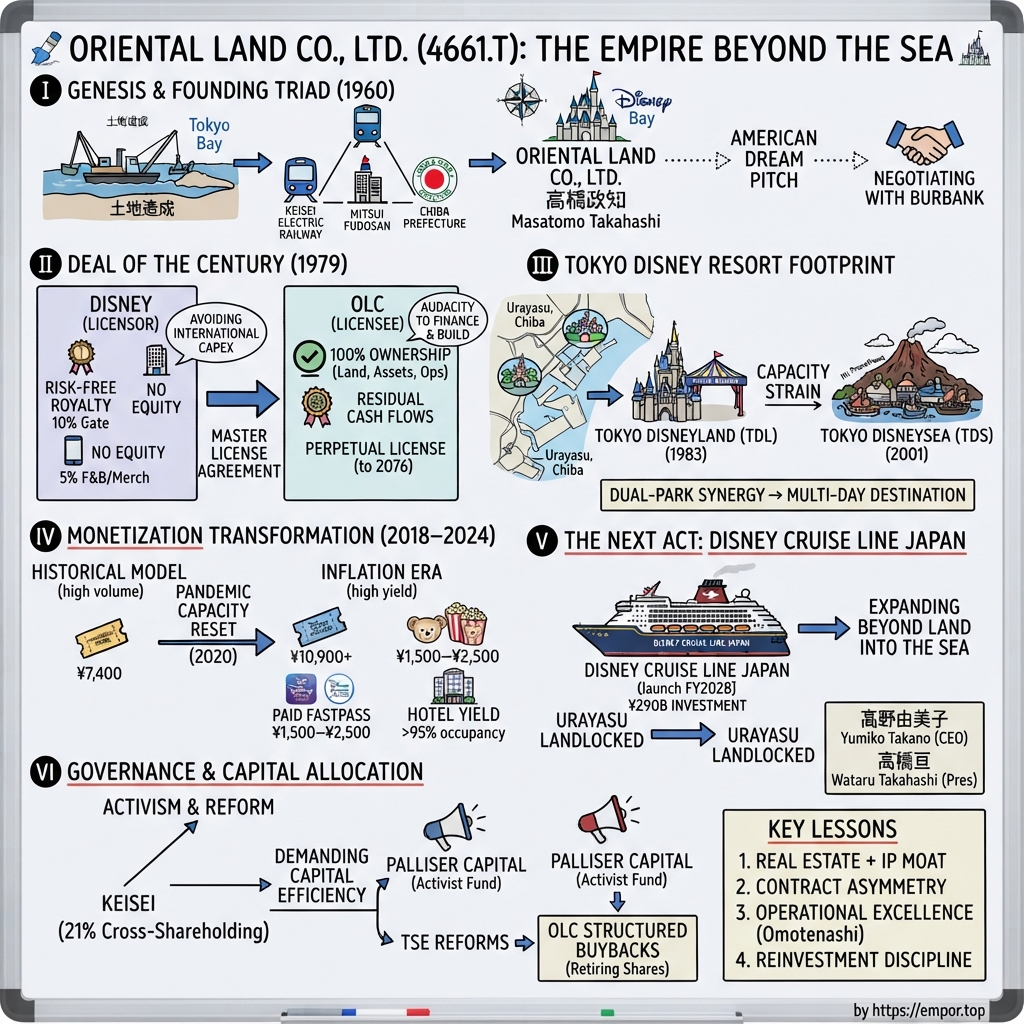
Oriental Land Co., Ltd. (4661.T): The Empire Beyond the Sea
I. Introduction & Episode Roadmap (10 min)
On a humid morning in June 2024, a queue formed outside a set of gates in Urayasu, Chiba Prefecture, that had not existed the day before. Behind them sat an artificial river, a glacier-blue Arendelle castle, and a mountain range built from sprayed concrete over a steel skeleton — the eighth themed "port" of a park that had already been called the finest piece of location-based entertainment design on the planet. The project had cost ¥320 billion. The company that paid for every yen of it does not own a single frame of Frozen, has no rights to Rapunzel, and cannot draw Mickey Mouse without permission.
That company is 株式会社オリエンタルランド Oriental Land Co., Ltd., ticker 4661.T on the 東京証券取引所 Tokyo Stock Exchange Prime Market. It is the strangest and, for four decades, one of the most lucrative arrangements in the global entertainment business: The Walt Disney Company designs the magic, collects a royalty, and owns nothing. Oriental Land owns the land, the buildings, the hotels, the monorail, the employment contracts of tens of thousands of cast members, and — critically — every yen of residual cash flow after the royalty is paid.
The scale is real. In the fiscal year ended March 2026, OLC reported net sales of ¥704.5 billion, the highest in its history, on 27.53 million park guests. Operating profit was ¥168.4 billion.2 That is roughly a 24% operating margin on a business whose principal asset is a piece of reclaimed tidal flat twenty minutes by train from Tokyo Station. Its market value has at times exceeded ¥8 trillion, larger than most of the European industrial names it is casually compared with.
And yet the interesting thing about Oriental Land in September 2026 is not the triumph. It is the crack running through it.
Operating profit fell 2.1% in the year to March 2026 — the first decline in the post-pandemic recovery — even as revenue hit a record.2 Management then guided the year to March 2027 down again, to ¥160.7 billion, a second consecutive decline.2 The theme park segment's operating profit has already slipped from ¥140.4 billion to ¥130.4 billion.15 The number of guests under the age of eighteen has fallen roughly 30% in six years.15 And the stock, which peaked in January 2024, fell about 55–60% to a multi-year low in early 2026 before recovering part of that ground.15
This is the tension worth spending three hours on. Oriental Land is simultaneously the best evidence in public markets that a licensee can out-earn its licensor, and a live case study in what happens when a company monetises a fixed physical asset harder and harder until the customer mix starts to change underneath it.
To size the swing: at its March 2024 balance date OLC carried a market value of roughly ¥8.0 trillion; two years later, at March 2026, that had fallen to about ¥4.4 trillion, before a partial recovery through mid-2026.1 Very little about the physical asset changed in those two years. What changed was the market's belief about how much profit that asset could be made to produce.
The master structure. Two parks — 東京ディズニーランド Tokyo Disneyland, opened April 1983, and 東京ディズニーシー Tokyo DisneySea, opened September 2001 — sit inside 東京ディズニーリゾート Tokyo Disney Resort in 浦安 Urayasu, alongside Disney-branded hotels, a retail complex, and a monorail loop.6 OLC financed and owns all of it. The licences from Disney, originally running to 2046, were extended in 2018 and can now run to 2076.24 Disney supplies intellectual property, Imagineering design and operating know-how; OLC supplies the balance sheet.
Ownership adds the final layer of strangeness. The company's largest shareholder is not an index fund or a founding family but Keisei Electric Railway, one of the three parties that dredged the site in the first place, which has spent the past three years under sustained pressure from a London hedge fund to sell down a position it has held since the Kennedy administration.4 Very few listed companies carry their own founding history on the share register sixty-six years later.
Where this goes. First, the founding: a land-reclamation joint venture between 京成電鉄 Keisei Electric Railway, 三井不動産 Mitsui Fudosan and 千葉県 Chiba Prefecture, and the man who spent a decade persuading fishermen and then Burbank. Then the 1979 contract that made everything else possible, and the 1983 opening that vindicated it. Then DisneySea, the most expensive theme park ever built at the time. Then the machinery: how a single guest visit actually converts into revenue and profit, and what changed after 2018 when OLC stopped chasing attendance and started chasing yield. Then the pandemic, Fantasy Springs, and the moment the yield strategy started producing record revenue and shrinking profit at the same time. Then governance — the Palliser Capital campaign against Keisei that has become a reference case for the unwinding of Japanese cross-shareholdings. Then the cruise ship, a ¥330 billion bet on a business OLC has never operated. Then the frameworks, the bull and bear cases, and the two or three numbers that actually matter from here.
The counterweight arrived in the summer of 2026. In the June quarter, with Tokyo DisneySea running a 25th-anniversary programme, revenue rose 10.4% and operating profit 23.1%, and the operating margin snapped back to 26.4% from 23.7% a year earlier.1213 One quarter proves nothing about a decade. But it does establish the mechanism cleanly: when OLC has something new to sell, the asset still converts demand into profit at rates almost no consumer business achieves. The bear case is not that the machine is broken. It is that the machine now requires a steady supply of expensive new content to run in place.
One more framing device before the history, because it governs everything that follows. Oriental Land is not really a theme park company in the way Disney is a theme park company. Disney's parks division is a distribution channel for intellectual property the company owns; the parks make the films more valuable and vice versa. OLC has no such flywheel. It is a single-site, capital-intensive, labour-intensive operator of physical infrastructure that rents its emotional content from someone else. Judged as an entertainment business, it looks like a licensee with limited control. Judged as what it actually is — an infrastructure asset with monopoly access to the most valuable consumer IP in the world, in the third-largest consumer market on earth — it looks like something closer to a toll road with a very good gift shop.
That distinction is not semantics. It determines which risks matter. A toll road does not get disrupted by a competitor building a better road; it gets hurt by the cost of maintaining the road rising faster than the toll. That is precisely what has been happening to Oriental Land since 2024, and it is why a company with an unbreakable competitive position has been one of the weaker large-cap performers on the Tokyo market.
Start where the company started: with mud.
 Subscribe on LinkedIn
II. Land Reclamation & The Founding Coalition (1960–1979) (15 min)
In 1961, a former army interpreter named 高橋政知 Masatomo Takahashi began showing up, repeatedly, at meetings of two fishermen's cooperatives on the shore of Tokyo Bay. He was forty-seven, a Tokyo Imperial University law graduate who had spent the war translating in Shanghai and New Guinea and the post-war years running a building-materials company.3 He had just joined a two-year-old real estate venture as senior executive managing director, and his assignment was blunt: persuade the men who harvested seaweed and clams off Urayasu to surrender the water they had fished for generations.
This was not a negotiation with an abstraction. Urayasu in the early 1960s was a fishing town, poor and slightly notorious, whose economy floated on the tidal flats. Reclamation meant the flats would be gone. Takahashi's method was simply to keep coming back — face to face, over and over — until the cooperatives believed the compensation and believed him. The talks were expected to run for years; partial agreement came within about six months, in 1962, with fishing rights fully relinquished by 1971.3
That single sequence explains more about Oriental Land than any strategy document. The company's founding asset was not land, or capital, or a brand. It was the ability to grind through a socially impossible negotiation in a country where such negotiations usually stall for a decade.
There is a second reason the fishing-rights episode matters. It set the template for how OLC would operate for the next six decades: patient, relationship-driven, willing to absorb years of friction in exchange for a permanent position. That is a very different corporate metabolism from the one that produced Disney, and it explains why the two companies ended up in the roles they did.
The founding triad. Oriental Land was established in 1960 as a joint venture with a very Japanese logic to it.25 Keisei Electric Railway wanted destination traffic for its rail network — a railway's economics improve dramatically if you build something at the end of the line that people want to reach. Mitsui Fudosan brought master-planning capability and the balance sheet of Japan's premier developer. Chiba Prefecture provided the public-sector authority without which no one dredges Tokyo Bay. The original purpose was industrial and commercial reclamation: factories, warehouses, housing, the standard post-war Japanese growth playbook.
The pivot away from that playbook is the second founding decision. Heavy industry on the bay would have produced steady rents and destroyed the site's amenity value forever. Leisure — specifically, an American-style theme park — would do the opposite: create a permanent traffic generator for Keisei's trains, a permanent uplift in surrounding land values for Mitsui, and a tax base for Chiba. Takahashi, who became president in August 1978, drove it.3
The scale of what was being contemplated is easy to skip past. Reclaiming millions of square metres from Tokyo Bay is not landscaping; it is manufacturing a peninsula. Sand and fill had to be dredged and placed, the ground had to be allowed to consolidate for years before anything heavy could sit on it, and the resulting parcels had to be serviced with roads, water, drainage and eventually rail. The company that emerged from that process owned something no competitor could ever assemble again in metropolitan Tokyo: contiguous, purpose-built, single-owner land minutes from the capital.
It is worth pausing on how strange this looked at the time. Japan in the 1970s had amusement parks, but nothing resembling Anaheim. The proposal was to import a wholly American cultural product, at enormous cost, onto reclaimed mud, in a country whose consumers had no demonstrated willingness to pay for it.
Consider what each founder was actually buying. Keisei was buying demand for a railway — a park at the end of the line converts fixed track infrastructure into a permanent annuity of fares. Mitsui Fudosan was buying an anchor tenant for a land bank; nothing lifts surrounding property values like a destination that draws tens of millions of visitors a year. Chiba Prefecture was buying employment and a tax base for a coastal district that had very little of either. None of the three was primarily buying a theme park. They were each buying the externalities a theme park would generate, which is why the entity that ended up owning the park was a separate company none of them fully controlled.
Burbank was not enthusiastic. Walt Disney had died in 1966. The company that remained was consumed by Walt Disney World in Florida, run conservatively, and deeply sceptical that its parks would translate abroad. Takahashi and a younger executive named 加賀見俊夫 Toshio Kagami — who had joined Keisei at twenty-two and moved to OLC's real estate division as deputy director in 1972 — spent years making the trip to California.3 Kagami became director of that division in 1976, six years before Tokyo Disneyland opened; he would go on to run the company from 1995 until 2023.
The pitch Takahashi eventually won on is instructive, because it was the opposite of what Disney expected. Disney assumed a Japanese park would need Japanese adaptation. Takahashi argued that Japanese audiences wanted the authentic American article — that the appeal was precisely the foreignness, and that diluting it would destroy the product.3 He was arguing for less localisation, not more, and he was arguing it to a licensor who would have preferred to hedge.
It is also worth noting who Kagami was, because he becomes the central figure of the modern company. He was not a showman. He joined a railway at twenty-two, moved into real estate development, and spent his early career on land and property questions rather than entertainment.3 The executive who would later overrule Disney on the design of a park and commit ¥320 billion to an expansion was, by formation, a property man. Oriental Land has always been run by people who think in terms of assets and their utilisation rather than in terms of stories, and that shows up in every capital decision the company has made.
For investors, the founding period establishes two things that still hold. First, Oriental Land's original competence was assembling scarce, politically complex physical rights — a capability that is not transferable to a cruise ship or an overseas park, and one that has never been retested. Second, the company was born as an instrument of other people's strategies: Keisei's traffic, Mitsui's land, Chiba's development. That birthright would sit dormant for four decades and then explode into the single largest governance fight in modern corporate Japan.
Contracts were finalised in April 1979.3 What they contained is the reason this story is interesting at all.
III. The Deal of the Century & Opening Tokyo Disneyland (1979–1997) (25 min)
Picture the negotiation from Burbank's side of the table in 1978. Card Walker is running Walt Disney Productions. The founder is twelve years dead. The domestic parks are the profit engine and the film studio is adrift. A group of Japanese executives is proposing that Disney put its most valuable asset — its characters and its park designs — into a country most of the board has never visited, on land that does not yet exist, financed by people they have just met.
Walker's answer was the most consequential "no" in the company's history: no Disney equity, no Disney capital, no Disney construction risk. Disney would license.
What OLC agreed to carry. Oriental Land took 100% of the financing, 100% of the construction risk, 100% of the operating risk, and 100% of the ownership. In exchange it secured exclusive rights to develop and operate Disney theme parks in Japan — a genuinely exclusive territorial franchise. The original 1979 economics were a royalty on revenue rather than a profit share: broadly, a percentage of admissions and a smaller percentage of food and merchandise. OLC does not break the royalty out as a separate line in its published segment disclosure, so the current effective rate is not disclosed; what is disclosed is the term. The core Disney licences, which had been due to run to 2046, were extended in 2018 with an outside date of 2076.24
Read that again, because it is the whole business. A revenue royalty means Disney's take is senior, predictable and indifferent to OLC's cost base. It also means that every yen of margin OLC creates above the royalty — through pricing, through hotels, through operating leverage — belongs to OLC. Disney captured certainty. OLC captured the option.
The counterfactual that proves the point. Fifteen years later Disney did the opposite in Europe. It took a large equity stake in Euro Disney, put its own capital and reputation into the project, and spent the 1990s and 2000s working through restructurings and recapitalisations as attendance and per-guest spending disappointed. The Japanese structure — capital-light for Disney, capital-heavy for the licensee — turned out to be the better deal for Disney's shareholders in downside scenarios and the better deal for OLC's shareholders in upside scenarios. Both sides were right, which is rare.
But the asymmetry cuts the other way too, and this is where the popular telling of the story goes soft. A revenue royalty is a fixed toll on the top line. When OLC's costs inflate — as they have sharply since 2023 — the royalty does not flex down. When OLC raises prices, Disney's payment rises automatically without Disney deploying a yen. And the exclusive licence, however long, is still a licence: OLC's most important supplier is also the only supplier of the thing that makes the asset special, and there is no second source for Mickey Mouse. That is a structural dependency, not a moat, and any honest framing has to hold both ideas at once.
There is a subtler point buried in the exclusivity. OLC did not merely buy the right to build a park; it bought the right to be the only Disney park operator in Japan, which simultaneously removed Disney as a potential competitor in its home market. In 1979 that concession looked cheap to Burbank — Disney had no intention of building in Japan with its own money. In hindsight it was the most valuable clause in the document, because it meant that when Japan turned out to be the best theme park market in the world outside the United States, Disney could not participate in the equity value except through the royalty.
Financing and building it. Construction was funded through Japanese bank debt at a scale that would have been reckless for a firm with no operating history in the category. The design work forced a series of departures from the Anaheim template, of which the most visible is the World Bazaar: rather than an open-air Main Street, OLC and Disney's designers roofed the entrance boulevard in a steel-and-glass canopy so that a rainy Tokyo winter would not shut down the highest-margin retail corridor in the park.6 It is a small decision that reveals the operating philosophy — the park was engineered around throughput and spending resilience, not just around romance.
The financing itself deserves a note, because it explains the risk that was actually taken. This was a highly leveraged, single-asset project undertaken by a company with no operating history in the category, in an economy where the syndicated bank market was the only realistic source of that much capital. Had attendance disappointed, the equity would have been wiped out and the story would have ended in 1985. The reason the 1979 structure looks brilliant in retrospect is partly that the underlying bet paid; a symmetric analysis has to acknowledge that OLC's shareholders were, at that moment, taking concentrated, unhedged, levered exposure to an unproven cultural import.
April 15, 1983. Takahashi and Card Walker cut the tape together, with Mickey Mouse standing between them.3 The park worked immediately, and it kept working: attendance climbed past 17 million a year during Takahashi's tenure.3 For context, that made a single park on reclaimed Japanese mud one of the most visited attractions on earth within a decade of opening.
Why did it work so well? Three reasons, in descending order of how often they get credited.
The first is demographics and geography. Roughly thirty million people live within an hour's train ride. No other Disney park in the world has ever had that catchment. This is a locational accident that no amount of management skill can replicate, and it deserves more weight than it usually gets.
The second is that Japanese consumer culture proved unusually receptive to character merchandise and to repeat visitation. A Tokyo guest does not come once in a lifetime; they come several times a year, in costume, with a shopping list.
The third — and the one OLC itself emphasises — is operational execution. Cast-member training, cleanliness standards, queue management, and the hospitality tradition OLC brands as おもてなし omotenashi. The claim that Tokyo's parks are operated better than the American originals is widely held and hard to falsify with public data, because guest-satisfaction scores are not published on a comparable basis across operators. What can be said with evidence is narrower and still meaningful: OLC has sustained industry-leading attendance density on a small footprint for four decades without the periodic quality collapses that have hit other operators.
By the mid-1990s the problem had inverted. The park was not underperforming; it was full. And a full park with no room to grow is a company with no growth. That constraint produced the next chapter.
IV. Tokyo DisneySea: The $3.3 Billion Masterpiece (1998–2010) (20 min)
The pitch from Burbank in the mid-1990s was sensible, cheap, and completely wrong for the customer.
Disney proposed a studio-backlot park — the model it had already built in Florida and would later build in Paris. Backlot parks are attractive to licensors and accountants because they are inexpensive: soundstages, façades, a tram tour, minimal terrain work. The cost per gate is a fraction of a fully themed park.
Kagami, by then OLC's president, said no. His reasoning was that Japanese guests would not accept a park that felt like a discount version of the original, and that the site — a waterfront on Tokyo Bay — argued for a maritime concept rather than a Hollywood one. This was a licensee overruling its licensor on creative direction, which is not how licensing normally works, and it was backed by the only leverage OLC had: it was writing the cheque.
What OLC built instead. Tokyo DisneySea opened on September 4, 2001 at a construction cost of approximately ¥335 billion, the most expensive theme park ever built at the time.6 It is organised as seven nautical "ports of call" around an artificial volcano, Mount Prometheus, that vents flame on a timed cycle. The park serves alcohol, which Tokyo Disneyland did not, and its food and beverage offer was pitched deliberately upmarket. In other words, DisneySea was designed from day one for an older, higher-spending guest — a decision whose consequences would not fully show up in the numbers for another twenty years.
Opening on the same day, physically embedded in the park's Mediterranean Harbor, was the 東京ディズニーシー・ホテルミラコスタ Tokyo DisneySea Hotel MiraCosta — 502 rooms, and the only hotel in the world built inside a Disney theme park.6
Why the hotel mattered more than the rides. This is the strategic core of the DisneySea decision and it is routinely under-explained.
A single-park operator sells a day. A resort operator sells a trip. The difference is not incremental; it changes the unit economics entirely. A guest who stays overnight buys two park tickets instead of one, eats four or five meals on property instead of two, buys merchandise on both days, and pays a room rate that carries a far higher incremental margin than a ticket does, because the marginal cost of selling an already-built hotel room is close to nothing.
DisneySea therefore did two things at once. It roughly doubled physical capacity, taking combined attendance past 25 million a year by the mid-2000s.25 And it converted a day-trip park into a multi-day destination, which is what made an owned hotel portfolio viable at all. Everything OLC has done since — Fantasy Springs Hotel, Premier Access, variable pricing — is a variation on the same theme: extract more value per guest-day, and add guest-days per guest.
DisneySea also seeded something that would only become visible twenty years later. By designing a park with alcohol service, an upmarket food offer and a romantic rather than childlike register, OLC created an asset optimised for adults — and the resort's guest mix has drifted steadily in that direction ever since, to the point where over-forties now account for roughly 40% of attendance.16 That drift has been commercially excellent in the short run, because adults spend more per visit and complain less about queue length. Whether a resort whose second park was built for grown-ups can keep replenishing the childhood memories that create those grown-ups is the question the company has not yet had to answer.
There is a quieter design decision embedded in MiraCosta that has become the template for everything since. By placing rooms physically inside the park, OLC created a product that cannot be competed with on price, because it cannot be competed with at all — there is no substitute for a window overlooking Mediterranean Harbor at night. That is the purest expression of the company's actual strategy: manufacture scarcity inside an asset you own outright, then sell access to it. Fantasy Springs Hotel, twenty-three years later, is the same idea executed at higher price points.
The falsification test. The natural conclusion is that OLC's mega-project capability is a durable competence — that it can reliably convert enormous capital outlays into enduring returns. The DisneySea record supports a version of that: the park has operated for a quarter-century, still drives attendance, and hosted a 25th-anniversary programme from April 2026 that lifted first-quarter results.12 But the record over the full period is not uniformly clean, and the failures cluster in exactly the place you would expect — adjacent ventures rather than the core park.
The clearest example is Cirque du Soleil Theatre Tokyo. OLC built a permanent theatre on the resort and opened the resident show ZED on October 1, 2008. It performed over a thousand times and hit its millionth guest faster than any other show in Japan. Then, on July 26, 2011, OLC and Cirque du Soleil announced they had mutually agreed to close it, with the final performance on December 31, 2011 — citing an environment that had "changed greatly" after the Great East Japan Earthquake and a review of expected results and long-term viability.17 OLC did not disclose the write-off.
Three years from opening to closure, on a purpose-built permanent facility, is not a great outcome, and the earthquake explanation covers the timing better than it covers the decision. The honest reading is that OLC's project competence is demonstrated inside the park gates, where the Disney brand does the demand generation, and materially less demonstrated outside them. Keep that distinction in mind when the cruise ship arrives later in this story.
The other thing 2011 established was physical: the resort sits on reclaimed land, and the March 11 earthquake produced liquefaction in the parking areas, with the parks closed for about five weeks — at the time the longest closure in OLC's history. The main park areas, built on deep reinforced foundations, came through structurally intact. That is a genuine risk that was tested once and survived once, which is not the same as being immune.
The March 2011 response also produced the episode that most Japanese consumers remember about the company. With the rail network shut down, roughly 20,000 guests spent the night inside the parks; cast members distributed stock from the merchandise shops as blankets and cushions, and the resort served breakfast the following morning. Reputationally, it was worth more than any marketing campaign OLC has ever run. Financially, it is a reminder that the operating culture the company monetises is real, expensive, and staffed by people whose wages are now rising quickly.
By the 2010s OLC had two world-class parks, a hotel portfolio, and a problem it had not yet named: the parks were full again, and the country's population had started to shrink. What came next was less a construction story than an accounting one.
V. Segment Breakdown, Unit-Level Economics, & Monetization Engine (25 min)
Stand at the exit turnstile of Tokyo Disneyland on a Saturday evening and watch what people are carrying. Almost everyone has a bag. A large fraction are wearing something they did not arrive in — headband ears, a coordinated outfit, a plush ダッフィー Duffy strapped to a shoulder bag. Some are carrying a popcorn bucket moulded into a character shape that costs more than the popcorn inside it by a factor of ten.
That image is the business model. Oriental Land does not primarily sell admission. It sells a day-long environment inside which a guest makes twenty or thirty discretionary purchase decisions, each one framed by scarcity, seasonality and emotion.
How the money is actually organised. OLC reports three segments. In the year ended March 2026, the Theme Park segment produced ¥568.3 billion of sales and ¥130.4 billion of operating profit; the Hotel Business segment produced ¥119.0 billion of sales and ¥36.8 billion of operating profit; the Other segment — the イクスピアリ Ikspiari retail complex, the ディズニーリゾートライン Disney Resort Line monorail, and related activities — is small enough that it contributed roughly ¥4.0 billion of sales in the June 2026 quarter.213
The proportions tell you where to look. Theme parks are about four-fifths of revenue and roughly three-quarters of profit. Hotels are around one-sixth of revenue but generate an operating margin in the neighbourhood of 30%, well above the park segment's — which is why hotel capacity, not park capacity, has been the swing factor in OLC's profit mix for the past two years.
The unit economics of one guest. OLC discloses a metric almost no Western operator gives you with the same clarity: net sales per guest, split three ways. For the year ended March 2026 it reached a record ¥18,403, up 3.2%, composed of roughly ¥9,608 from attractions and shows (essentially the ticket plus paid in-park experiences), ¥5,227 from merchandise, and ¥3,569 from food and beverage.2
Two features of that split matter. First, the ticket is barely more than half the take — merchandise alone is nearly 30%. Second, the merchandise and food lines have been growing faster than the ticket line. In the June 2026 quarter, park merchandise revenue rose 21.0% and food and beverage rose 11.3%, against 7.5% for attractions and shows.13 That is not a pricing story about tickets; it is a story about how much stuff a guest buys once inside.
What changed after 2018. For most of its history OLC ran a volume model. A single-day adult ticket was deliberately cheap by international standards, on the theory that mass domestic accessibility was the point and that throughput would do the rest. That produced the peak: 32.56 million guests in the year ended March 2019.15 It also produced three-hour queues, deteriorating guest experience, and a hard physical ceiling.
The pivot was to stop selling volume and start selling yield, through three levers.
Variable pricing. OLC moved from a single ticket price to demand-based tiers. The ceiling has ratcheted steadily upward: the top adult one-day passport reached ¥10,900, and for dates in October 2026 a new peak tier of ¥12,400 appeared on the resort's ticket calendar — a ¥1,500 increase on the prior maximum.14 For a company that spent thirty-five years treating price as a social contract, this is the single biggest strategic change in its history.
Paid priority access. The free FastPass system was retired and replaced by Disney Premier Access, sold per attraction. Prices in 2026 have ranged from roughly ¥1,000–2,000 for rides and ¥2,500–3,500 for parade seating.14 The economics here are unusually clean: the ride runs anyway, the parade happens anyway, and the marginal cost of moving a guest to the front of a queue is close to zero. Management has confirmed it will expand the offering and introduce pre-purchase options.10
Merchandise scarcity engineering. Seasonal plush, limited-run popcorn buckets, collaboration menus, and character franchises like Duffy and Friends that exist largely for the Tokyo market. These work because a meaningful share of OLC's guests are repeat visitors for whom the merchandise is the product.
Myth vs. reality: does OLC have unlimited pricing power?
The consensus narrative is that Tokyo Disney Resort has enormous headroom because its ticket prices remain well below Anaheim and Orlando, and that OLC can therefore raise price for years without demand consequences. The first half of that is true. The second half is where the evidence has started to argue back.
Net sales per guest rose from ¥11,815 in the year ended March 2019 to ¥18,403 in the year ended March 2026 — roughly 1.5x in seven years.15 Over the same period, attendance did not recover to the prior peak: it has settled around 27.5 million versus 32.56 million.15 Management frames the gap as deliberate capacity management, and there is truth in that — deliberately capping crowding was a stated strategy. But a second fact is harder to frame away. Guests under eighteen fell from over nine million to 6.72 million, a decline of roughly 30%, while the maximum junior (12–17) ticket price rose from ¥6,400 in 2019 to ¥9,000.15 Visitors aged forty and over now make up about 40% of attendance.16
So: has pricing power been falsified? No — but it has been narrowed, and the narrowing is specific. OLC has demonstrated pricing power over its core customer, who skews adult and female, roughly 70% of the gate.15 It has not demonstrated pricing power over families with children and student groups, and the evidence suggests it has priced a meaningful slice of them out. The economist Shin Yamaguchi has argued publicly that the company's own flywheel — childhood visits creating adult customers — is being damaged, and that OLC should consider lower pricing for families and students on a ten-year view.15
That is the correct frame. The bull case is not "OLC can raise prices indefinitely." It is "OLC can raise prices on adults for some further period, at a cost to its future customer pipeline that will not show up in reported results for a decade." Whether that trade is being made consciously is a legitimate question for management, and the KPI that adjudicates it is the under-18 guest count, which OLC does publish.
The other constraint is on the cost side, and it is immediate rather than generational. That is where the last three years get uncomfortable.
VI. The Inflection Era: COVID Shock, Yield Pivot, & Fantasy Springs (2020–2024) (25 min)
On February 29, 2020, Tokyo Disney Resort closed. It did not fully reopen for roughly four months — longer than the 2011 earthquake shutdown, and the most severe operational interruption in the company's history.
The numbers were brutal in a way that is easy to underestimate for a business with a 25% margin. In the year ended March 2021, revenue collapsed to ¥170.6 billion from ¥464.5 billion, the company posted an operating loss of ¥46.0 billion and a net loss of ¥54.2 billion — its first annual loss as a listed company — and operating cash flow went negative by roughly ¥24 billion.7 Attendance fell to about 7.56 million.25
What management actually did, and what it did not do. The frequently repeated claim is that OLC funded the shutdown without touching shareholders. On the equity side, that holds up: OLC's share count was essentially unchanged through the period, moving only fractionally on option exercises, and there was no rescue equity issue.7 What OLC did instead was borrow. In the year ended March 2021 it raised nearly ¥99 billion of net long-term debt while simultaneously spending over ¥110 billion on capital expenditure — because it kept building Fantasy Springs straight through the closure.7
That is the decision worth crediting, and it is a genuinely aggressive one. Most operators cut capex to survive. OLC levered up to keep a ¥320 billion project on track during a period when it had no revenue and no visibility on reopening. It also carried its permanent workforce. The result was that OLC emerged from the pandemic with its expansion pipeline intact rather than two years behind.
But "fortress balance sheet, no dilution" is a cleaner story than the record supports. The company took on debt at the trough, and it entered the recovery with a materially larger asset base to depreciate — which is precisely the mechanism that is compressing profit today.
The yield pivot in numbers. Attendance came back to roughly 27.5 million and stopped there, well short of the pre-pandemic peak, while per-guest spending went up by half. For two years this worked spectacularly: revenue recovered past pre-COVID levels on 15% fewer guests, and the year ended March 2025 delivered records across the board — net sales of ¥679.4 billion and operating profit of ¥172.1 billion.7
And then it stopped working, which is the part of the story that has not been fully absorbed.
Fantasy Springs and the depreciation problem. ファンタジースプリングス Fantasy Springs opened on June 6, 2024 — three themed areas drawn from Frozen, Tangled and Peter Pan, plus the Tokyo DisneySea Fantasy Springs Hotel, whose two wings comprise 56 luxury rooms in the Grand Chateau starting around ¥300,000 a night and 419 deluxe rooms in the Fantasy Chateau starting around ¥63,500.6 Hotel guests get a private entrance into the land — a mechanism that converts park scarcity directly into room rate.
The project also failed its own original budget by a wide margin. When OLC announced it in 2019 the investment was around ¥250 billion with a fiscal 2023 opening. On October 27, 2022 the company revised both: ¥320 billion and spring 2024.9 That is a 28% cost increase and roughly a year's delay, attributed to materials and personnel inflation, additional design and procedural work, and a weaker yen.
This matters beyond the headline because the capital did not disappear — it turned into depreciation. In the year ended March 2026, with Fantasy Springs contributing a full year for the first time, OLC posted record revenue of ¥704.5 billion and lower operating profit of ¥168.4 billion, down 2.1%.25 Theme park segment profit fell 7.1%.2 Depreciation, higher maintenance on the new land, IT replacement cycles and personnel costs together overwhelmed the revenue gain. Part-time wages have gone from roughly ¥1,000 an hour in 2019 to around ¥1,500, and personnel expense rose about ¥11.2 billion in a single year with a similar increase in maintenance and systems overhead.15
The juxtaposition that the bull case has to survive. On the year-end call in April 2026, management did not describe a temporary blip and then guide up. It guided the year to March 2027 to net sales of ¥724.3 billion and operating profit of ¥160.7 billion — revenue up 2.8%, profit down 4.5%, a second consecutive decline — with about ¥16.5 billion of additional miscellaneous costs, of which management attributed roughly ¥4 billion to external factors it expects to persist.211 Hotel segment operating profit was guided down 16.6%, because guest-room renovations were expected to reduce hotel sales by ¥3.2 billion and operating profit by ¥6.1 billion.211
So when anyone describes OLC's hotel-led margin mix shift as structural, the company's own guidance is the counter-evidence, and it belongs in the same sentence: the highest-margin segment was guided into a double-digit profit decline the year immediately after its best result. The implied consolidated operating margin for the year to March 2027 is about 22%, against 26.7% three years earlier, with an estimated break-even around ¥450 billion of sales.16
Management's answer is price. On the same call executives said they were "prepared to pass on value to pricing," flagged park ticket revisions during the year, and said they would consider raising the ceiling of the variable-pricing band.11 The October 2026 ¥12,400 tier is that policy showing up in the calendar.14
Guidance behaviour. OLC's recent pattern is consistent and worth naming, because it cuts both ways. Through the year to March 2026 the company repeatedly held forecasts even when nine-month results were running ahead, citing cost-recognition timing and weather risk.10 Then the full-year print missed consensus badly — earnings roughly 16% below expectations, revenue about 3.6% short — and the shares fell more than 8% after hours.11 In the June 2026 quarter it beat its own plan comfortably, with revenue up 10.4% to ¥180.7 billion and operating profit up 23.1% to ¥47.7 billion on the DisneySea 25th-anniversary programme,8 and again declined to raise the full-year number, citing weather.12
Conservatism is defensible. But a company that holds guidance through beats and then misses on the print is not being conservative in a way that helps investors calibrate — and the market has repriced accordingly. From its January 2024 high the stock fell roughly 55–60% to a multi-year low in early 2026, trading below its March 2020 pandemic trough even as the Nikkei sat near records, before recovering a substantial part of that decline through mid-2026.1526
Inbound tourism: smaller than the story suggests. The weak-yen narrative holds that foreign visitors have become a major structural offset to Japanese demographic decline. The data does not currently support the strong version. International guests recovered to roughly 10–12% of attendance as of 2025, led by Taiwan, South Korea, mainland China and the United States, with the Kanto region alone still supplying around 60% of guests.25 Inbound is a real tailwind and a real diversifier. It is not yet a demographic hedge, and treating it as one overstates the case by a factor of roughly two against the 15–20% figure that circulates.
That combination — record revenue, falling profit, a repriced stock, and a founding shareholder sitting on a fifth of the equity — is what turned OLC's ownership structure from a historical footnote into a live battleground.
VII. Governance, Activist Drama, & Capital Allocation (2020–2026) (20 min)
For sixty years, the oddest fact about Oriental Land was that its largest shareholder was a regional railway whose entire market value was smaller than the stake it owned.
Keisei Electric Railway (9009.T) is a perfectly respectable commuter and airport-access operator running trains between Tokyo, Narita and Chiba. It also held roughly 21% of Oriental Land — a position worth billions of dollars, acquired in the 1960s for what amounted to seed money, sitting on a balance sheet that reported it at cost. Keisei's own return on equity ran below 5%. Its equity was, in effect, a leveraged wrapper around a stake in a theme park operator, wrapped again inside a railway.
Enter Palliser. The London-based activist fund Palliser Capital began engaging Keisei privately in 2021 and escalated publicly from 2023.20 The argument was simple and hard to rebut: Keisei should reduce the OLC position, use the proceeds to repurchase its own undervalued shares and invest in its rail network, and publish a coherent capital allocation plan. Palliser's formal proposal asked Keisei to bring the OLC holding below 15% within roughly two years, arguing the resulting value unlock was on the order of US$3 billion.20
This was not a fringe campaign. At Keisei's 2024 annual meeting, Palliser's shareholder proposal drew close to a third of votes — a striking result in a market where such proposals historically drew single digits. By June 2025 both major proxy advisers had turned. ISS recommended shareholders vote against six company nominees including president Toshiya Kobayashi, stating that Palliser had "made a compelling case that a governance overhaul at Keisei is necessary to restore trust in management"; Glass Lewis recommended against two directors including Kobayashi.19 Palliser, by then holding over 4.5%, sought to shrink the board from fifteen to nine.19 Takao Amano subsequently became Keisei's chief executive in June 2025.21
What actually happened to the stake. Keisei has moved, but slowly and in increments. It sold a first tranche in March 2024, then on November 26, 2024 sold 18 million OLC shares for approximately ¥61.8 billion, taking its holding from 21.0% to 20.2% and saying it would use proceeds for growth investment and debt reduction.18 By May 2024 OLC was publicly characterising Keisei as holding 20.10% of voting rights and stating that the Keisei group "exerts no influence over Oriental Land's management decisions or business activities," while disclosing that several outside directors and auditors had previously worked at Keisei.4
Note the arithmetic. Palliser asked for below 15%. Two years of the most prominent activist campaign in Japan produced a move from roughly 22% to roughly 20%. The cross-shareholding unwind is real, but it is being executed at a pace that leaves the structural distortion substantially intact — and any investor treating a full unwind as a near-term catalyst is extrapolating well beyond the observed rate of change.
OLC's side of the trade. The ¥61.8 billion that Keisei received in November 2024 corresponds closely to OLC's own treasury share repurchase in the year ended March 2025 — the company bought back approximately ¥61.8 billion of stock in that year, having repurchased essentially nothing in the prior two.7 In other words, OLC was the buyer. The buyback was structured as an off-hours cross, which conveniently kept Keisei above the 20% threshold at which equity-method accounting consequences bite.
That is worth stating plainly, because it changes how the buyback should be read. It was not primarily a valuation-driven return of capital; it was the mechanism by which a founding shareholder's sell-down was absorbed without disturbing the market or Keisei's accounting. Useful, yes. A signal about management's view of intrinsic value, considerably less so. And in the following year, to March 2026, OLC repurchased no shares at all.7
It is also worth being precise about what the Palliser campaign did and did not change at Oriental Land itself. Palliser's target was Keisei, not OLC; its demands concerned Keisei's capital allocation, not OLC's. The read-through to OLC has been indirect — a larger free float, better index treatment, and an implicit reminder to OLC's own board that the era in which a Japanese blue chip could hold capital idly without explanation has ended. It has not, so far, produced any observable change in how OLC allocates its own cash.
The dividend record. OLC raised its year-end dividend for the year to March 2026 by ¥1 to ¥15 per share and guided ¥16 for the following year, with a payout ratio moving from about 20.2% to 23.1% and a stated ambition of a 30% payout ratio by 2035.2 It also extended a shareholder benefit of a one-day passport for holders of 100 or more shares.2 This is steady and unspectacular: a low payout on a business generating roughly ¥181 billion of operating cash flow and ¥104 billion of free cash flow in the year to March 2026, sitting on well over ¥500 billion of cash and securities against roughly ¥326 billion of borrowings.7
One governance detail is peculiar to Japan and easy to dismiss. OLC's shareholder benefit — a complimentary one-day passport for holders of 100 or more shares — is a real economic transfer, and it is calibrated to keep a very large retail register attached to the stock.2 After the five-for-one share split in 2023 made the round lot affordable to ordinary savers, that register grew further. A large, loyal, non-institutional shareholder base is a governance asset for incumbent management: it is the constituency least likely to vote with an activist. It is worth noticing that OLC's response to the era of shareholder pressure has included enlarging exactly that constituency.
An activist looking at OLC itself — rather than at Keisei — would ask three questions. Why does a company with net cash, a fully built domestic footprint and a declining profit forecast retain this much capital? Why was the only meaningful buyback in a decade timed to a shareholder's exit rather than to a 55% share price decline? And what is the return hurdle being applied to a ¥330 billion cruise venture in a business the company has never operated?
There is a related disclosure question. OLC reports its results on a segment basis that does not separate the Disney royalty, does not break out the individual hotels, and does not disclose returns on invested capital for specific projects such as Fantasy Springs. Investors are therefore asked to accept a ¥320 billion investment and a ¥330 billion commitment on the basis of consolidated numbers that blend them with a mature base business. That is legal, common in Japan, and unhelpful. When the cruise business begins operating, whether OLC reports it as a distinct segment with its own margin will be an early and quite revealing test of the company's willingness to be held accountable for a discrete capital decision.
Leadership. 加賀見俊夫 Toshio Kagami handed over the chief executive role in June 2023, having run the company since 1995 — twenty-eight years spanning DisneySea, the resort build-out, the pandemic and the Fantasy Springs decision.3 髙野由美子 Yumiko Takano became Representative Director, Chairperson and CEO, the first woman to lead the company, alongside Wataru Takahashi as President and COO.4 As of the June 2026 governance report the board comprised ten directors, five of them outside.4
The new regime has been in place for three years, and the scorecard is mixed rather than damning. It delivered the Fantasy Springs opening on the revised schedule, set a 2035 target of ¥1 trillion or more in net sales with an interim goal of ¥300 billion in operating cash flow by fiscal 2029, and committed to a cruise business.2 Against that, it has presided over two consecutive years of guided profit decline, a significant full-year miss, and a share price that spent early 2026 below its pandemic low. The narrative has been consistent across calls — experience value, pricing, long-term investment — and management has been specific about cost drivers rather than evasive.1011 What it has not yet done is demonstrate that it can convert a larger asset base into higher profit, which is the only test that ultimately matters.
Which brings us to the largest uncommitted question on the balance sheet: a ship.
VIII. The Next Frontier: Disney Cruise Line Japan (2025–2030+) (15 min)
In a covered building hall in Papenburg, a small town on the River Ems in northern Germany, roughly 140,000 gross tons of steel is being assembled into a ship that will never carry a Disney-owned dollar of equity.
Meyer Werft has built the Disney Wish and her sisters. It is now building a Wish-class vessel for Oriental Land — approximately 1,250 staterooms, around 4,000 passengers, roughly 1,500 crew, powered by liquefied natural gas.22[^23] Construction was set to begin in the second half of Japanese fiscal year 2026, with delivery in calendar 2028, service launch in fiscal 2028 and year-round operations from fiscal 2029, sailing primarily from Tokyo-area ports.1222 OLC established a dedicated subsidiary, Oriental Land Cruise Co., Ltd., operating as Disney Cruise Line Japan, in the spring of 2026.24
Why do this at all? Because Urayasu is finished. The Maihama footprint is essentially built out; Fantasy Springs consumed the last major developable parcel inside DisneySea. A company whose only growth lever is raising price on a fixed asset eventually runs into exactly the problem OLC is running into now. Ships solve the geography problem the way DisneySea solved the capacity problem in 2001: they add sellable inventory.
The structure mirrors 1979 with the roles unchanged. OLC signed an exclusive licence with Disney Enterprises to own and operate the cruise business in Japan; OLC pays for the ship and runs it; Disney supplies the brand and the experience design.22 Josh D'Amaro, chairman of Disney Experiences, described it as extending the partnership to "another distinctly Disney vacation experience" for Japanese families; Takano framed it as building "a world-class cruise business in Japan."22
The money. The announcement on July 9, 2024 put the investment at approximately ¥330 billion.22 On the June 2026 quarter call, management broke that down as roughly ¥290 billion for the vessel itself plus about ¥40 billion of contingency, and set out the commercial model for the first time with real specificity: a target of roughly ¥100 billion of annual revenue once operations are steady, profitability from around fiscal 2029, and fares in a band from about ¥100,000 to over ¥300,000 per person per voyage.12 Third-party analysis of management's stated ambitions puts the target operating margin in the upper-20% range.27
Take those at face value for a moment and the arithmetic is genuinely interesting: ¥100 billion of revenue would be roughly 14% on top of current group sales, from a single asset, and at an upper-20s margin it would add meaningfully to a profit line that has now been guided down twice. That is why the cruise appears in every bull presentation on the stock.
Now apply the falsification test, because this is the single most important place in the story to apply it.
The relevant question is not whether a Disney-branded ship will fill in year one — it almost certainly will, for the same reason Fantasy Springs filled. The question is whether OLC can convert a licensed brand into durable returns outside the environment where its operating advantages exist. Its record on that specific question is thin and not encouraging.
Inside the gates, OLC's advantages are real and compounding: a captive catchment of thirty million people, four decades of accumulated operating routine, a fixed asset it owns outright, and pricing authority over a repeat-visiting customer base. None of those transfer cleanly to a ship. A cruise operator competes on itinerary, port access, fuel and food logistics, crew management across nationalities, dry-dock scheduling, and yield management in a market where Japanese consumers have historically been light cruisers relative to Americans and Europeans. OLC has never done any of it.
The one prior attempt to extend the brand into an adjacent format on its own doorstep — the Cirque du Soleil theatre — was closed three years after opening. And the two most recent large capital projects both blew through their announced budgets: Fantasy Springs by 28%, and the Space Mountain and Tomorrowland rebuild, originally announced at approximately ¥56 billion, which OLC disclosed in its third-quarter results for the year ended March 2026 had risen to ¥70.5 billion, with a separate Wreck-It Ralph attraction budgeted near ¥29.5 billion opening in spring 2027.2310
Against that record, a ¥330 billion single-asset commitment with a ¥40 billion contingency in a business with no in-house operating history should be treated as an option with a wide distribution of outcomes, not as a bankable ¥100 billion revenue line. The nuance is that OLC has not deployed capital recklessly across many ventures — there is no history of empire-building M&A, and the failures have been few. But the errors that do exist are all in the same direction: it under-budgets and it over-extends outside the park gates.
There is also a demand question that has nothing to do with execution. Japan's cruise market is small relative to its population and skews older and shorter-voyage than the North American market that Disney Cruise Line was built for. OLC's own stated fare band — from around ¥100,000 to over ¥300,000 per person per voyage — sits well above what most Japanese domestic cruise product commands today.12 The bet is therefore not merely that OLC can operate a ship; it is that the Disney brand can create a premium cruise segment in Japan that does not currently exist at scale, in the same way Tokyo Disneyland created a premium theme park segment in 1983. That is a defensible historical analogy and an unproven commercial one, and the distinction should be held firmly.
What would confirm or falsify the cruise thesis. Three observable things, in order of arrival. First, whether delivery holds to calendar 2028 and whether the ¥330 billion figure holds — given two consecutive budget revisions on domestic projects, a third would be a pattern rather than an accident. Second, first-season occupancy and realised fare per passenger night, which OLC will have to disclose once the segment reports separately. Third, whether OLC orders a second ship — because a single vessel is a project, and a fleet is a business, and the decision on ship two will tell you what the internal returns on ship one actually look like.
Until then, the honest framing is that Disney Cruise Line Japan is an unproven extension by a company with a strong record inside one specific asset and an unproven record outside it. The strategic logic is sound; the execution evidence does not yet exist.
That uncertainty is the right place from which to run the frameworks.
IX. Strategic Frameworks: Porter's 5 Forces & Helmer's 7 Powers (20 min)
War-game this business against a competitor with unlimited capital and see what actually holds.
Hamilton Helmer's 7 Powers
Cornered Resource — the primary power, and it is genuine. The exclusive right to operate Disney theme parks in Japan, running to a potential outside date of 2076, is the closest thing in Asian consumer businesses to a legally enforced monopoly on demand.24 No competitor can put Mickey Mouse, Elsa or a Pirates of the Caribbean ride in Japan at any price. Universal Studios Japan can build Super Nintendo World, which it did in 2021 and expanded with a Donkey Kong Country area in December 2024; it cannot build Fantasy Springs. This is the load-bearing wall of the entire investment case.
The caveat is that a cornered resource obtained by contract is also a dependency. OLC's supplier is its only supplier, holds the renewal pen, and receives a royalty on revenue rather than profit — meaning Disney's economics improve automatically when OLC raises prices, and do not deteriorate when OLC's costs rise. The 2018 extension pushed the horizon out far enough that renewal risk is not a near-term concern, but the bargaining asymmetry is permanent within the term.
Process Power — real but less measurable than claimed. Four decades of accumulated operating routine in crowd logistics, cast training, maintenance scheduling and hospitality standards constitute a genuine capability that a new entrant could not buy. The commonly asserted version — that Tokyo's guest satisfaction consistently beats the American parks — is not verifiable from public, comparable data. What is verifiable is that OLC has run one of the world's densest attraction footprints for forty-three years without the quality collapses that have periodically hit peers, and that it has done so while progressively raising price.
Scale Economies — significant, and currently working in reverse. Roughly 27.5 million guests absorb an enormous fixed cost base, which is exactly why the operating margin was 26.7% three years ago. But the same leverage runs both ways: with break-even estimated around ¥450 billion of sales and a cost base inflating faster than revenue, the fixed-cost structure is now amplifying a margin decline rather than a margin expansion.16 Scale is a power only while the numerator grows faster than the denominator.
Counter-Positioning — mostly a historical artefact. The 1979 structure did prevent Disney from competing directly in Japan, and that was worth a great deal. But it is not something OLC could recreate today, and it does not defend against anything currently attacking the business. It belongs in the origin story more than in the moat analysis.
Branding — dual and slightly awkward. The emotional mindshare belongs to Disney; the operating brand belongs to OLC. Guests do not go to "an Oriental Land property." This matters for the cruise: OLC will be borrowing brand equity again rather than deploying its own.
Network Effects — weak. Group and social dynamics exist — coordinated outfits, shared merchandise, social media amplification — but they do not create the increasing-returns structure Helmer means. Overstating this is a common error in write-ups of the company.
Switching Costs — habitual rather than structural. There is real habit formation and real emotional attachment. But the under-18 attendance decline demonstrates that these are price-elastic at some threshold, and OLC appears to have found that threshold for one customer segment.15
Porter's Five Forces
Threat of new entrants: very low. A tier-one themed resort requires billions of dollars, a decade, scarce metropolitan land, and IP that does not exist for sale. Nobody is building a Disney-competitive park in the Kanto region.
Bargaining power of suppliers: high, and rising in two directions. Disney is the obvious one — an irreplaceable licensor taking a top-line royalty. The less discussed supplier is Japanese labour. Part-time wages rising from roughly ¥1,000 to ¥1,500 an hour, with personnel expense up about ¥11.2 billion in a single year, is a supplier-power problem in a business that cannot automate its core service.15 Construction inflation is the third: two consecutive project budget overruns are the same force showing up in capex.923
Bargaining power of buyers: low individually, but the aggregate is speaking. No single guest negotiates. But the collective response to a 1.5x increase in per-guest spending has been a shift in who shows up — older, more adult, fewer children.1516 Buyers cannot bargain; they can decline.
Threat of substitutes: moderate and slowly increasing. Universal Studios Japan in Osaka is the direct comparison and the strongest evidence that world-class location-based entertainment can be built in Japan without Disney IP. ジブリパーク Ghibli Park serves a different, quieter demand. Beyond parks, the substitute set is broader than it used to be: outbound travel became cheaper for Japanese consumers in relative terms only when the yen was strong — it is currently the reverse — while domestic leisure, gaming and streaming compete for the same discretionary yen and the same weekend.
Competitive rivalry: low geographically, moderate for share of wallet. Japan's two major resorts are 400 kilometres apart and serve largely distinct catchments. They compete for the national holiday trip and for capital-markets narrative, not for the Saturday-in-Chiba visit.
The synthesis. Put the frameworks together and the shape of the business is clear. OLC's competitive position against rivals is close to unassailable and is not what investors should worry about. Its exposure is entirely on the supplier and cost axis — labour, construction, and a licensor whose take scales with revenue — and on the demand-composition axis, where its own pricing has begun to reshape its customer base. The threat to Oriental Land has never been Universal Studios Japan. It is Japanese wage inflation meeting a fixed physical asset and a shrinking cohort of children.
X. Investment Thesis: Bull vs. Bear Case & Key KPIs (15 min)
The bull case, stated at its strongest.
Start with the asset. There is exactly one Tokyo Disney Resort, it cannot be replicated, its licence runs for another half-century, and it sits in the middle of one of the wealthiest metropolitan catchments on earth. Ticket prices, even after the October 2026 step to ¥12,400, remain well below what the equivalent experience costs in Florida or California, and management has said explicitly it is prepared to raise the ceiling further.1411 Per-guest spending is still climbing across every category, and the June 2026 quarter showed what happens when a strong event calendar meets that pricing structure: revenue up 10.4%, operating profit up 23.1%, operating margin recovering to 26.4% from 23.7%, and record quarterly operating cash flow of ¥57.6 billion.1213
Hotels are the underappreciated engine. Occupancy of 95.2% at an average room rate of ¥67,036 in a single quarter is not a normal hotel business; it is a scarcity asset with a hotel attached.13 Every incremental room OLC builds at Maihama arrives with pre-sold demand.
The governance story adds a second, independent lever. The Keisei overhang has begun to unwind, TSE reform pressure is durable, and OLC's payout ratio is low with a stated path toward 30% by 2035 — leaving room for both dividend growth and repurchases against a net cash balance sheet.27
And the cruise is free optionality in the sense that the market is currently paying very little for it: the shares fell roughly 55–60% from their January 2024 peak before recovering, which means the valuation embedded a great deal of the cost pressure and none of the ¥100 billion revenue ambition.1512
The bear case, stated at its strongest.
Operating profit has now been guided down two years running. That is not a forecast by a sceptic; it is the company's own plan.2 The mechanism is structural rather than cyclical: ¥320 billion of Fantasy Springs capital converted into depreciation and maintenance, a labour market that has repriced permanently, and construction costs that have overrun twice.92315 The implied margin path takes the group from 26.7% to about 22.2% in three years.16
The demand composition is deteriorating in a way that compounds slowly and is hard to reverse. Guests under eighteen down about 30% in six years, junior ticket prices up 40%, and a customer base ageing toward the over-forties.1516 OLC's entire multi-decade flywheel has been childhood visits producing adult customers. If that pipeline is being drained to fund current-period yield, the cost lands in the 2030s, not now.
Japan's demography does the rest. The domestic pool of the family and youth cohorts shrinks structurally each year, and inbound tourism at 10–12% of attendance is not large enough to offset it.25
Then the concentration risks that never go away: a single site on reclaimed land in an earthquake zone, which has already produced one five-week closure and visible liquefaction in 2011; a single licensor with a top-line royalty; a single new growth vector requiring ¥330 billion of capital in an unfamiliar industry.
And the activist critique of OLC itself has not been answered. A net cash balance sheet, no buyback in the most recent year despite a halved share price, a payout ratio around 20%, and a decade-long capital allocation record whose only large repurchase was structured to absorb a founding shareholder's exit.718
The verdict this evidence supports. The moat claim survives — it is one of the most durable in global consumer businesses, and nothing in the record falsifies it. What the record does falsify is the softer claim layered on top: that the moat translates automatically into compounding profit. It has not for two years, by management's own guidance, and the reason is that OLC's advantage is monopoly over demand, not control over cost. The narrowed thesis is that OLC owns an irreplaceable asset whose pricing power is real but is now being partly consumed by wage and construction inflation and partly financed by the erosion of its youngest customer cohort. Whether that resolves depends on operating leverage returning at a higher price point, which is a testable proposition rather than an article of faith.
The three KPIs that matter.
One: net sales per guest, and specifically its composition. OLC publishes this quarterly, split between attractions and shows, merchandise, and food and beverage.2 It is the single cleanest read on whether the yield strategy is still working. What to watch for is divergence — if the total keeps rising while merchandise and food decelerate, the growth is coming from the ticket alone, which is the most price-elastic component and the one most likely to be pushing families out.
Two: theme park segment operating profit, not group revenue. Revenue records have become uninformative because they are being produced alongside falling profit. The segment operating profit line — ¥130.4 billion in the year to March 2026, down from ¥140.4 billion — is where cost inflation, depreciation and pricing meet.215 A return to growth here is the event that would validate the bull case; a third consecutive decline would confirm that the fixed-cost base has outrun the pricing engine.
Three: attendance of guests under eighteen. This is the pipeline KPI, and it is the one most investors ignore because it moves slowly and shows up in reported results a decade late. At 6.72 million and falling, it is currently the strongest single piece of disconfirming evidence against the durability of the franchise.15 Stabilisation here, particularly if achieved through family and student pricing, would materially strengthen the long-duration case.
Everything else — hotel occupancy, inbound mix, cruise bookings — is secondary until those three resolve.
XI. Playbook & Key Takeaways (10 min)
Lesson 1: Owning the asset beats owning the brand — under specific conditions. The 1979 contract has produced one of the great licensee outcomes in business history: Disney took a royalty, OLC took the residual, and the residual turned out to be worth trillions of yen. But the conditions that made it work were unusually favourable and are worth naming, because the lesson does not generalise. OLC had a thirty-million-person catchment, a fifty-year land position acquired at reclamation cost, a licensor motivated to avoid capital risk, and — for most of the period — a benign labour and construction cost environment. Change the last of those, as the last three years have, and the same structure produces record revenue with declining profit. Owning the asset means owning the cost base.
Lesson 2: The hardest capability to acquire is the one you built first. Oriental Land's founding competence was not entertainment. It was Masatomo Takahashi sitting with fishermen's cooperatives until they said yes, and then assembling a coalition of a railway, a developer and a prefecture around a piece of tidal flat.3 That capability — grinding through politically complex physical rights acquisition — is why the company exists. It is also the capability least relevant to what comes next, because a ship does not require it. Investors evaluating any diversification should ask which of the founding advantages actually travels.
Lesson 3: Operational excellence is a moat until it becomes a cost. OLC's hospitality standards genuinely differentiate the product, and they are labour-intensive by design — that is the point of おもてなし omotenashi. In a deflationary Japan with ¥1,000-an-hour part-time wages, that was a cheap moat. At ¥1,500 an hour it is an expensive one, and the expense scales with the standard.15 A service-quality advantage built on abundant cheap labour is a different asset in a tightening labour market, and this is the transition OLC is living through now.
Lesson 4: Reinvestment discipline is a claim that has to be checked, not assumed. OLC has genuinely avoided the classic destroyers of value — no empire-building acquisitions, no unrelated diversification, no leveraged financial engineering, and a decision during the pandemic to keep building rather than to retrench.7 That is a better record than most. But "disciplined" is too strong for a company that revised Fantasy Springs from ¥250 billion to ¥320 billion, revised Space Mountain from ¥56 billion to ¥70.5 billion, closed a purpose-built theatre three years after opening, and has now committed ¥330 billion with a ¥40 billion contingency to an industry it has never operated in.9231712 The accurate characterisation is narrower and more useful: OLC reinvests consistently and stays close to its core, but it systematically under-budgets large projects and its record outside the park gates is unproven.
Lesson 5: Yield extraction has a term structure. The most transferable insight from the last eight years is that raising revenue per customer on a fixed asset is the highest-return strategy available right up until it starts selecting your customer base. OLC took per-guest spending up by half and produced two record revenue years. It also lost roughly a third of its under-eighteen guests.15 Neither fact contradicts the other; they are the same decision viewed on different time horizons. The discipline for an investor is to insist on seeing both, and to be suspicious of any framing — from management or from bulls — that reports the first without the second.
Lesson 6: Contract structure is a strategy, not paperwork. The single most consequential document in this story is a licence agreement signed in April 1979 by people who were mostly trying to manage downside risk. Disney was protecting itself from foreign capital exposure; OLC was accepting risk because it had no other way to get the brand. Neither party was optimising for the outcome that actually occurred. Forty-seven years later, the allocation of risk and residual in that document still determines who captures the value created by every price increase, every new attraction and every hotel room at Maihama. When evaluating any licensed or franchised business, the question of who owns the residual — and whether the licensor is paid on revenue or on profit — is usually more important than anything in the operating narrative.
What Oriental Land is, in the end, is a sixty-six-year-old bet that a piece of reclaimed mud twenty minutes from Tokyo Station could be made into the most valuable entertainment real estate in Asia. That bet has been won decisively. The open question, as the first ship takes shape in a German building hall and the cost of a Japanese hour of work keeps climbing, is whether the second act can be anything other than a smaller version of the first.
References
-
Oriental Land Co., Ltd. Investor Relations Portal — Oriental Land Co., Ltd. ↩
-
Oriental Land FY2026 slides: record sales offset by rising costs — Investing.com, 2026-04-28 ↩↩↩↩↩↩↩↩↩↩↩↩↩↩↩↩↩
-
Masatomo Takahashi — D23, The Official Disney Fan Club ↩↩↩↩↩↩↩↩↩↩↩
-
Oriental Land Reaffirms Independence Despite 20% Stake Held by Keisei Railway — The Globe and Mail / TipRanks, 2024-05-29 ↩↩↩↩
-
Oriental Land Posts Record ¥704.5 Billion Revenue as Fantasy Springs Drives Per-Guest Spending — BigGo Finance, 2026 ↩
-
Tokyo Disney Resort Official Website — Tokyo Disney Resort ↩↩↩↩↩
-
Financial Statements & Annual Securities Reports — Oriental Land Co., Ltd. ↩↩↩↩↩↩↩↩↩↩
-
Financial Results & Presentation Materials — Oriental Land Co., Ltd. ↩
-
Tokyo DisneySea Reveals Fantasy Springs Area Names, Announces Delay for Expansion — LaughingPlace, 2022-10-27 ↩↩↩↩
-
Earnings call transcript: Oriental Land Co Ltd Q3 2026 misses forecasts — Investing.com, 2026-01-28 ↩↩↩↩
-
Earnings call transcript: Oriental Land Co. Ltd. Q4 2026 misses forecast, stock dips — Investing.com, 2026-04-28 ↩↩↩↩↩↩
-
Oriental Land Co. Ltd. Q1 FY2027 Earnings Call — BigGo Finance, 2026-07-30 ↩↩↩↩↩↩↩↩↩
-
Oriental Land FY3/27 Q1 Results Supplementary Materials — BigGo Finance, 2026-07-30 ↩↩↩↩↩
-
October 2026 Tokyo Disneyland Ticket Prices Rise as Variable Pricing Hits New High — TDR Explorer, 2026-07-17 ↩↩↩↩
-
Oriental Land Hits Record Revenue But Stock Slumps — Premium Pricing Strategy Drives Sharp Drop in Young Visitors — BigGo Finance, 2026 ↩↩↩↩↩↩↩↩↩↩↩↩↩↩↩↩↩↩↩↩↩
-
Tokyo Disneyland Faces Pressure for Price Hikes Amid Declining Attendance — AJU Press, 2026-06-10 ↩↩↩↩↩↩↩
-
Cirque du Soleil Theatre Tokyo "ZED" to Close — blooloop, 2011-07-26 ↩↩
-
Keisei Electric Shares Rise on Plan to Trim Stake in Tokyo Disney Resort Operator — MarketScreener, 2024-11-26 ↩↩
-
Palliser campaign gains momentum as ISS backs board shake-up at Keisei Electric — Hedgeweek, 2025-06-16 ↩↩
-
Palliser Capital Campaign on Keisei Electric Railway & OLC Stake — Palliser Capital ↩↩
-
Keisei Electric Railway Co., Ltd. (9009.T) Investor Relations — Keisei Electric Railway ↩
-
Oriental Land Company to Bring Disney Cruise Line to Japan in Fiscal Year 2028 with New Wish Class Ship from Meyer Werft — The Disney Cruise Line Blog, 2024-07-09 ↩↩↩↩↩
-
Space Mountain & Tomorrowland Being Rebuilt in 2027 at Tokyo Disneyland — TDR Explorer ↩↩↩↩
-
Official Corporate News & Press Releases — Oriental Land Co., Ltd. ↩↩↩↩
-
Integrated Report & Fact Book — Oriental Land Co., Ltd. ↩↩↩↩↩
-
Oriental Land Stock Analysis: Tokyo Disney's Pricing Power Is Exceptional, but the Next ¥330 Billion Bet Is at Sea — Business Model Mastery, 2026 ↩
 LinkedIn
 WhatsApp
 Reddit
 Hacker News
 Email
 Kindle
 RSS Feed
 Spotify
 Apple Podcasts
 Amazon Music
 Audible
 YouTube