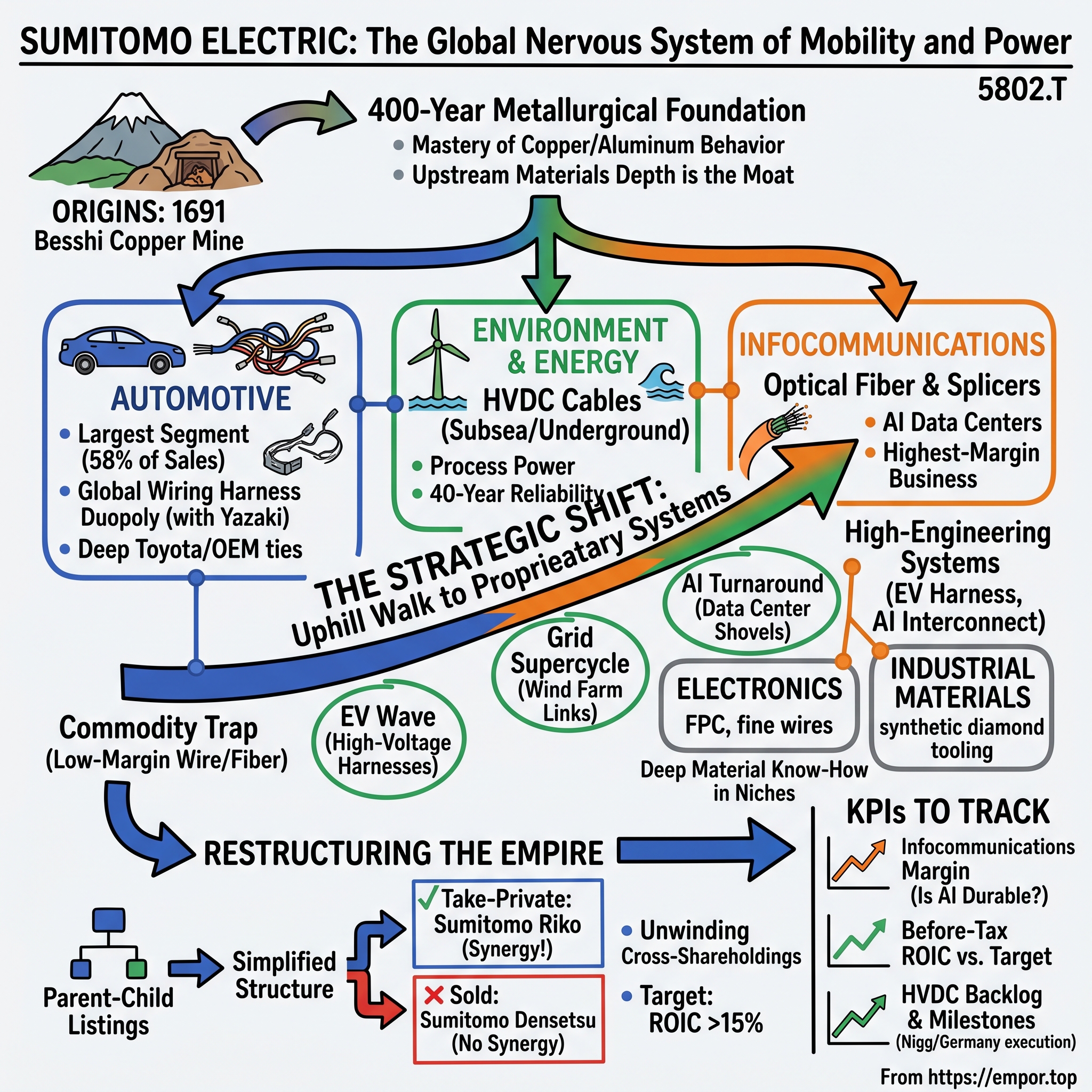
Sumitomo Electric: The Global Nervous System of Mobility and Power
I. Introduction & Episode Roadmap
Peel open the door panel of almost any car built in the last thirty years and you will find a spaghetti of colored wires — dozens of kilograms of them, snaking from the battery to the headlights, from the door lock to the seat heater, from the crash sensor to the airbag. It looks like chaos. It is, in fact, one of the most precisely engineered objects in the vehicle: the wiring harness, the physical nervous system that carries every electron and every instruction through the machine. There is a decent chance that harness was designed, cut, and hand-assembled by a company most drivers have never heard of — a firm whose corporate memory reaches back not decades but centuries, to a copper mine carved into a mountain in western Japan in 1691.
That company is 住友電気工業株式会社 Sumitomo Electric Industries, Ltd., listed on the 東京証券取引所 Tokyo Stock Exchange under ticker 5802.T. It is one of those quietly enormous industrial firms that sits underneath the more famous names — Toyota, Tesla, National Grid, the hyperscale data-center operators of Silicon Valley — supplying the copper, aluminum, and optical glass that make their machines actually work. And in the fiscal year ended March 31, 2026, this 120-year-old manufacturer crossed a threshold it had never touched before: ¥5.11 trillion in net sales, roughly $32 billion, up 9.2% year on year, and ¥418.2 billion in operating profit, up more than 30%.1 Net profit attributable to owners jumped about 91% to ¥369.5 billion — a record on almost every line of the income statement.1
The interesting part is not the size. It is the shape of the portfolio, and the direction it is being pushed. Sumitomo Electric reports across five segments, and the mix tells the whole story:2
The Automotive business — the wiring harnesses and connectors that are the company's largest single activity — generated roughly ¥2.97 trillion of sales, close to 58% of the top line, and about ¥179.7 billion of operating profit. Environment & Energy — power cables, subsea and underground grid infrastructure — delivered around ¥1.18 trillion in sales and ¥90.6 billion in profit. Electronics contributed about ¥409.1 billion in sales and ¥39.5 billion in profit. Infocommunications — optical fiber, splicers, and the fast-growing data-center product line — was the smallest by revenue at roughly ¥326.6 billion, yet threw off ¥77.4 billion of operating profit, the highest-margin business in the house. And Industrial Materials — the ultra-fine wires and specialty alloys — added about ¥388.4 billion in sales and ¥31.4 billion in profit.2
Read those five lines carefully and a thesis emerges. The revenue is concentrated in automotive, but the profitability per yen of sales is increasingly concentrated at the technical, materials-science end of the business — the segments where the product is not a spool of commodity wire but a proprietary system that a customer cannot easily buy anywhere else. Notice, for instance, that Infocommunications generated barely more than a tenth of the automotive division's revenue yet produced nearly half its operating profit. That single comparison is the entire strategic argument of the company in one number: the future value is not in how much wire you ship, but in how much engineering you can embed in each meter of it. This is a company trying to walk itself uphill: away from low-margin, commoditized wire-drawing and toward high-margin, hard-to-copy material systems, while a modern management team simultaneously dismantles the sleepy 系列 keiretsu-era habits — the cross-shareholdings, the half-owned listed subsidiaries, the balance sheet stuffed with idle capital — that long depressed its returns.
The scale of the enterprise underneath that thesis is genuinely global and genuinely vast. Sumitomo Electric employs on the order of a quarter-million people worldwide — the overwhelming majority in the labor-intensive wiring-harness operations scattered across low-cost manufacturing countries — and operates hundreds of consolidated subsidiaries on every inhabited continent. It is, in the literal sense, a company you have relied on without ever choosing it: in the car in your driveway, in the fiber carrying this sentence to your screen, and, increasingly, in the AI clusters answering your questions. And yet for all that ubiquity, it has spent most of the last two decades trading around or below the book value of its own assets — the market's polite way of saying it did not believe the sum was worth even the value of its parts. That gap between industrial indispensability and market skepticism is the tension the rest of this story lives inside.
Whether that walk uphill is real transformation or merely favorable timing is the question this story exists to test. The three demand waves lifting Sumitomo right now — electric vehicles, grid electrification, and AI data centers — are genuine and structural. But favorable weather flatters everyone in a cyclical industry, and the company has been trying to escape its "cheap wire" identity for a very long time. To judge how much of the 2026 record is durable, we have to start where Sumitomo itself always starts: with copper, and with a mountain.
 Subscribe on LinkedIn
II. The 400-Year metallurgical Foundation
The origin story does not begin with wire, or electricity, or even industry. It begins with a book-and-medicine shop in early-seventeenth-century Kyoto, run by a man named 住友政友 Masatomo Sumitomo, and with his brother-in-law 蘇我理右衛門 Riemon Soga, who had learned something far more valuable than bookselling.3 Soga had gotten hold of a metallurgical technique the Japanese called 南蛮吹き Nanban-buki — "Southern Barbarian" smelting, a method reportedly picked up from European traders — that could extract silver still trapped inside crude, unrefined copper. In an age when copper flowed out of Japan by the ton, the ability to pull the hidden silver out of it first was, quite literally, a license to print money. The Sumitomo house became the premier copper refiner in East Asia, and the family motto that came out of that era — a creed valuing solidity, trust, and the long view over quick speculation — still gets quoted in the company's integrated reports four centuries later.3
The physical engine of the dynasty arrived in 1691, when the Sumitomo interests opened the 別子銅山 Besshi Copper Mine in the mountains of what is now Ehime Prefecture. It is hard to overstate what this mine meant. It ran — continuously — for 283 years, closing only in 1973, and for most of that span it was one of the great copper deposits of the world.3 Think about the span of history a single asset lived through: Besshi opened while the Tokugawa shogunate still ruled a closed, feudal Japan, and it closed only after the country had become an industrial democracy exporting cars to America. It financed the family through the collapse of that shogunate, funded their pivot into banking and trading during the Meiji Restoration of the 1860s, and supplied the raw metal that helped electrify and arm an industrializing Japan.
There is a famous episode in the mine's history that Sumitomo still tells on itself. In the late nineteenth century, decades of smelting had poisoned the surrounding hillsides with sulfur-dioxide fumes and stripped the mountains bare, provoking fury from local farmers. Rather than simply pay off the complaints, the family's manager launched a vast, multi-decade reforestation program — planting millions of trees to restore the mountain the business had scarred. Whatever one makes of the sincerity, the instinct is telling: a merchant house that owns a mountain of copper for nearly three centuries cannot afford to think in quarters, because it has to still be operating in the same valley a hundred years later. It thinks in generations, and in the standing of the business within its society. That long-horizon, multi-stakeholder instinct — later formalized in the modern slogan of 五方良し Goho Yoshi — is the cultural bedrock beneath everything that follows, and it explains both the company's patience and, at times, its frustrating reluctance to move fast.
The specific company we care about was spun out of that copper. In 1897 the group established the Sumitomo Copper Rolling Works to turn its metal into copper wire, and in 1911 it formally incorporated 住友電線製造所 Sumitomo Electric Wire & Cable Works — the direct ancestor of today's Sumitomo Electric Industries.3 The logic was elegant and vertical: we already dig up the copper and refine it better than anyone; the fastest-growing use for copper in the twentieth century is electrical wire and cable; so let us capture the whole chain from ore to insulated conductor.
Here is the part that makes the history more than a museum piece. The competitive edge Sumitomo built in that first century was not "we make wire" — plenty of firms make wire. It was mastery of the metallurgy itself: how copper and, later, aluminum behave when you draw them thin, alloy them, join them, and run current through them for decades. That knowledge is not obviously transferable to a modern EV or a subsea power cable — until you realize that the hardest problems in both are metallurgical. How do you make an aluminum wire light enough for an electric car without it corroding where it touches a copper terminal? How do you extrude an insulation layer around a 525,000-volt cable so flawlessly that it survives on the seabed for forty years? These are twenty-first-century questions with a seventeenth-century answer: start upstream, at the material, and earn the right to sell the finished system. That principle is the connective tissue of this entire story, and it shows up first, and most spectacularly, in the business that pays most of the bills — the wiring harness.
III. The Core Engine: The Global Automotive Wiring Harness Duopoly
Walk into a wiring-harness assembly plant in northern Vietnam or central Morocco and the first thing that strikes you is how human it is. You expect a modern auto-parts factory to be a cathedral of robots. Instead you see rows of people — often thousands under one roof — standing at long, angled boards studded with pegs, threading colored wires along printed routes, taping bundles, crimping terminals by hand. This is not a nostalgic holdout. It is the economic heart of a business that, at Sumitomo Electric, generates the majority of corporate revenue, and it is manual for a reason that has defied automation for half a century: wire is floppy. A robotic arm can weld a car door or torque a bolt to the newton-meter, but it cannot easily grab a limp, meter-long cable, route it around three corners, and seat a fragile connector without a human's dexterity and judgment. So the harness stays hand-built — which means the game is really about who can manage the largest, most disciplined, lowest-cost human assembly network on Earth.
That game has produced a near-duopoly at the top of the market. Sumitomo Electric and its Japanese rival 矢崎総業株式会社 Yazaki Corporation together dominate the global wiring-harness industry, with each holding somewhere in the low-to-mid teens of global share — Yazaki generally credited with a slight lead — and the American-listed Aptiv PLC playing the technology-heavy Western challenger from roughly 10–13% of the market. Precise shares are not officially disclosed and estimates vary by source, but the structural point is not in dispute: this is a consolidated oligopoly where three players supply most of the world's cars. That structure matters enormously, because it means pricing is rational, relationships are decades-deep, and a new entrant would have to build a global human-assembly footprint from scratch to compete — a barrier we will come back to.
It is worth pausing on how Sumitomo, a wire-and-cable company, came to sit at the center of the automobile at all. The answer is Japan's postwar industrial rise and the gravitational pull of one customer above all others: Toyota. As the Japanese auto industry exploded from the 1960s onward, its 系列 keiretsu-style supplier networks pulled trusted domestic firms into deep, co-engineering relationships, and Sumitomo — already the country's premier maker of copper wire — was the natural partner to bundle that wire into the harnesses the new cars needed. Those relationships compounded for half a century. Today Sumitomo's harness business is anchored by decades-long ties to Japanese automakers, and its fortunes are correspondingly linked to theirs — a source of stability, but also of concentration risk, since the health of a handful of large OEM relationships drives an outsized share of the segment.
The other thing worth understanding about the harness is just how vulnerable its very simplicity makes it. Because it is cheap, heavy, labor-intensive, and impossible to swap mid-program, the harness is a textbook single point of failure — and the world learned this the hard way in early 2022, when Russia's invasion of Ukraine abruptly halted harness production at plants in western Ukraine that fed European car factories. Assembly lines across Germany and the rest of Europe stuttered and stopped, not for want of chips or steel, but for want of a bundle of wires that normally costs a few hundred dollars. For Sumitomo and its peers, the episode was a double-edged lesson: it proved how indispensable the product is, and it exposed how fragile a globe-spanning, low-cost-labor supply chain can be when geopolitics intervenes. That fragility sits permanently in the bear column of this story.
To run that footprint, Sumitomo operates a sprawling network of assembly plants concentrated in low-wage jurisdictions — Vietnam, the Philippines, Morocco, Mexico, and across Eastern Europe and Southeast Asia — employing a workforce measured in the hundreds of thousands across its automotive operations. The margin on a traditional harness is thin, because a conventional 12-volt internal-combustion-engine harness is, frankly, a commodity: everyone knows how to build one, and OEMs squeeze the price every year. For decades that was the trap of the business — indispensable, gigantic, and barely profitable, growing only as fast as global car production and forever hostage to wage inflation in the next low-cost country.
Then the car started to electrify, and the trap sprang open in Sumitomo's favor. An electric vehicle does not run on 12 volts; its traction system runs on 400 or even 800 volts. A high-voltage harness is a different animal entirely — thicker conductors, heavier insulation, sophisticated shielding to contain electromagnetic interference, and far more demanding safety engineering, because a fault in an 800-volt line is not a blown fuse but a potential fire. That complexity commands a price. Industry analysis puts the average selling price of a high-voltage EV harness at roughly 2.5 to 3 times that of a comparable ICE harness — the same core competence, sold for two or three times as much, into a segment growing far faster than the overall car market. For a business that had spent decades fighting for pennies, the EV transition converted the harness from a commodity anchor into a genuine growth-and-margin story.
It helps to make the physics concrete, because the pricing follows directly from it. Power is voltage times current, so a motor that needs a fixed amount of power can get there with high voltage and modest current, or low voltage and enormous current. Cars went high-voltage precisely to avoid the enormous currents that would otherwise demand absurdly thick, heavy copper — but high voltage brings its own dangers, chiefly the risk of arcing and of lethal shock during a crash or a repair. So the high-voltage harness has to do things an ICE harness never did: shield against electromagnetic interference so the powertrain does not scramble the car's electronics, carry safety interlocks that de-energize the system in a collision, and tolerate the heat that high-power charging and discharging generate. Each of those requirements is a place to add engineering, and engineering is what a customer will pay a premium for. The harness stops being a bundle of wire and becomes a safety-critical power-distribution system — and that reframing is the difference between competing on labor cost and competing on capability.
But volts created a second problem, and this is where the metallurgy from Section II earns its keep. EVs are engaged in a permanent war against weight, because every kilogram of mass costs precious battery range, and a modern EV can carry tens of kilograms of copper wiring. Copper is a superb conductor but it is heavy and expensive. Aluminum is the obvious alternative — roughly 20–44% lighter for the equivalent job — but aluminum is a metallurgist's nightmare in a car. It conducts less well, so you need thicker wire; it is mechanically weaker; and worst of all, where an aluminum wire meets a copper terminal in the presence of moisture, you get galvanic corrosion — the two dissimilar metals form a tiny battery, and the joint quietly eats itself until the connection fails. In a device meant to last fifteen years through rain, road salt, and temperature swings, that is disqualifying.
Sumitomo's answer is the clearest single example of the "start at the material" philosophy paying off. Rather than treating aluminum as an off-the-shelf commodity, the company engineered proprietary aluminum alloys for automotive use and — critically — developed anti-corrosion terminal technology, using resin molding and gel sealing to completely encapsulate the vulnerable copper-aluminum joint so that water can never reach it.4 While competitors wrestled with aluminum reliability, Sumitomo could offer OEMs a harness that shaved meaningful weight — and therefore range — off an EV platform without the corrosion risk. In the language of Hamilton Helmer's 7 Powers, this is a "Cornered Resource": a specific, protected capability the customer values and cannot easily source elsewhere. It is also a vivid illustration of why upstream materials mastery is the real moat here — the harness is manual and hard to differentiate, but the joint is chemistry, and chemistry can be owned.
The honest caveat, and the one a skeptic should hold onto, is that this advantage is only as valuable as the EV transition is fast. If global EV adoption stalls, the high-margin high-voltage harness stays a smaller slice of the mix and Sumitomo is thrown back onto low-margin ICE wire and its endless wage-inflation grind. The company has engineered a genuinely better product for the electric car; whether that translates into durable profit depends on a demand curve it does not control. That same tension — a strong technical position riding a powerful but externally driven wave — repeats almost exactly in the business we turn to next, only this time the wave is made of electricity itself.
IV. The Green Grid Supercycle: High-Voltage Subsea & Underground Cables
Somewhere in the North Sea, a specialized vessel is unspooling a cable as thick as a person's thigh onto the seabed, paying it out inch by inch across a hundred-plus kilometers of ocean floor. That cable will carry the output of an offshore wind farm — or, increasingly, will link one country's grid to another's — and it must sit there, in cold, high-pressure saltwater, carrying hundreds of thousands of volts, without a single fault, for forty years. If it fails, there is no repair truck. You have to locate the fault under the sea, send a ship, haul the cable up from the bottom, splice it, and lay it back down — a repair that can run into the hundreds of millions of dollars and take a grid link offline for months. This is the business of high-voltage subsea and underground power cable, and it is one of the most unforgiving manufacturing challenges on the planet.
The reason it matters now is the energy transition's central logistical problem: the electricity is generated in the wrong place. Offshore wind blows hardest in the North Sea, the Baltic, and off the coasts of Britain; solar and onshore wind are strongest in remote, sunny, windy interiors. The demand — cities, factories, and now enormous AI data centers — sits somewhere else entirely. Bridging that gap requires moving vast quantities of power over long distances with minimal loss, and the technology of choice is High-Voltage Direct Current (HVDC): instead of the alternating current that runs through your walls, you convert the power to direct current, which loses far less energy over long underground or undersea runs. Building HVDC links means building the cables, and the world can suddenly not build them fast enough.
The industry that supplies those cables is a tight oligopoly — Italy's Prysmian, France's Nexans, Denmark's NKT, and Sumitomo Electric — precisely because the barriers are so brutal. This is Helmer's "Process Power" in its purest form: the ability to extrude a flawless insulation layer around an ultra-high-voltage conductor, to vulcanize it, to handle and coil kilometers of finished cable without introducing a single microscopic defect, is embedded in decades of accumulated, hard-won process knowledge that cannot be bought or quickly reverse-engineered. A newcomer with capital can build a factory; it cannot buy the forty-year reliability track record that a utility demands before it will trust you with a billion-euro interconnector.
Consider the manufacturing itself, because it explains the moat better than any market-share chart. High-voltage cable is made in towers — vertical or catenary lines, sometimes over a hundred meters tall — because the insulation must be extruded and cured around the conductor under perfectly controlled tension, with no dust and no sag that would leave a weak point. The finished product is then wound, without kinking or straining, onto giant carousels or directly into the hold of a specialized cable-laying vessel, some of which cost hundreds of millions of dollars and are effectively floating factories in their own right. A single manufacturing defect the size of a grain of sand, buried in a hundred kilometers of cable, can become the fault that fails years later on the seabed. This is why the industry consolidated into so few names: the combination of capital intensity, proprietary process craft, purpose-built installation fleets, and reputational stakes is close to unassailable for an outsider. And critically for Sumitomo, demand is running well ahead of the industry's ability to supply, which has tilted pricing toward the four incumbents in a way that was unimaginable a decade ago — a rare instance of an industrial supplier gaining, rather than losing, leverage over its customers.
What changed Sumitomo's position from "capable Japanese supplier" to "front-line European contender" was a deliberate localization campaign, because in this business geography is strategy. You cannot economically ship finished high-voltage cable halfway around the world, and European grid operators increasingly want — and, amid rising economic nationalism, sometimes require — the cable made close to home. So Sumitomo went local. In 2019 it acquired a 90% stake in the German high-voltage cable maker Südkabel, giving it a European manufacturing base and the credentials to bid on Germany's giant underground transmission corridors — the Korridor A-Nord, Korridor B, and Rhein-Main-Link projects designed to carry northern wind power to the industrial south.[^5]
The German corridor program is worth dwelling on because it is one of the largest grid-infrastructure undertakings in the world, born of a specific political decision. After deciding to phase out nuclear power and lean hard into offshore wind in the north, Germany faced a geography problem: the wind blows over the North Sea, but the factories run in Bavaria and Baden-Württemberg, hundreds of kilometers south. To move that power, the country committed to building enormous underground HVDC "electricity highways" — and chose to bury them rather than string overhead lines, largely to overcome local opposition, at vastly greater cost and engineering difficulty. Underground burial is a subsea-cable-grade challenge on dry land, and it plays directly to the strengths of a firm with both the process craft and, thanks to Südkabel, a German factory and workforce. The lesson generalizes: in strategic infrastructure, the winner is often not the cheapest global exporter but the supplier who has already planted a flag inside the host country's borders and can be seen to create local jobs.
Then came the bigger bet, in Britain. Sumitomo committed roughly £350 million to build a subsea power-cable factory at the Port of Nigg in the Scottish Highlands — the first time in about two decades that transmission cable would be manufactured in the UK — a plant expected to create more than 200 direct jobs and anchor a domestic clean-energy supply chain.[^6] The strategic logic was to sit inside the UK market, insulated from import friction, and to win the wave of British grid-reinforcement work. It paid off: in July 2025 Sumitomo was named preferred bidder for National Grid's Sea Link project, a roughly 2-gigawatt, 525-kilovolt HVDC connection running partly under the sea between Suffolk and Kent, and by December 2025 the supply-and-installation contract was confirmed.56 Construction of the link is scheduled to begin in 2027, with the Nigg factory ramping toward production to feed it.6 A skeptic should note the execution risk baked into that timeline: a brand-new subsea cable plant, in a region without a recent cable-manufacturing tradition, must reach flawless production quality on a fixed schedule — and in this industry, "flawless" is not a figure of speech.
The financial payoff of the grid push is already visible rather than merely promised, which is what separates it from a slide-deck ambition. The Environment & Energy segment reached about ¥1.18 trillion in sales and ¥90.6 billion in operating profit in FY2025 — a roughly 7.7% margin and a meaningful step up, driven by exactly the power-cable and grid-equipment demand the strategy targeted.12 That is the analytical takeaway: grid reinforcement has graduated from speculative "optionality" that investors were asked to imagine into a real, sizeable profit engine backed by a multi-year order book. The risk is the mirror image of the reward — these are long, fixed-price, technically punishing projects, and a single serious execution failure on a flagship contract could erase a year's segment profit and, worse, dent the reliability reputation that is the whole moat. Sumitomo is being paid well to take a risk that is genuinely hard, which is exactly why only four companies in the world are trusted to take it. That same pattern — a commoditized business rescued by a sudden, technically demanding, high-margin new use — is about to repeat one more time, in the segment that only two years ago was bleeding red ink.
V. The AI Turnaround: How Infocommunications Pivot Saved Its Margins
For a decade, Sumitomo's optical-fiber business was a case study in how a great technology becomes a lousy business. Standard single-mode optical fiber — the glass thread that carries the internet as pulses of light — is a genuinely miraculous product, and also, by the late 2010s, a commodity. A wave of low-cost Chinese supply flooded the global market, driving prices down; then the post-COVID telecom hangover hit, as carriers that had over-ordered during the pandemic worked down bloated inventories and stopped buying. The result was ugly. In the fiscal year ended March 2024, Sumitomo's Infocommunications segment fell into an operating loss of roughly ¥11.5 billion — a business that made the physical substrate of the digital age, unable to make money doing it.7 This is the recurring trap of the whole company in miniature: master a material, watch it commoditize, and get squeezed.
What rescued the segment was not a telecom recovery. It was the sudden, ravenous arrival of generative AI. Training and running large AI models requires stitching thousands of GPUs together inside hyperscale data centers into what behaves like a single enormous computer, and those chips must talk to each other at staggering speed. For short distances the industry long used copper cables, but copper has a hard physical ceiling: push the data rate and the distance up together and the signal degrades into noise. Beyond a few meters at modern speeds, copper simply stops working, and the only answer is light. So the AI build-out has forced optical connectivity ever deeper into the data center — not just between buildings, but between racks, and increasingly right up to the chip — and demand for exactly the kind of specialized optical hardware Sumitomo makes has exploded.
The scale of the connectivity problem is easy to underestimate. A single large AI training cluster can contain tens of thousands of GPUs, and the design goal is for any chip to talk to any other chip with as little delay as possible — which means the number of interconnections does not grow linearly with the number of chips but explodes. A data center that once needed thousands of optical links now needs millions. Every one of those links needs fiber, connectors, and a splice; every splice needs a technician with a tool; and the whole thing has to be crammed into physical spaces — racks, trays, conduits — that were never designed for this density. That is why the humble, unglamorous corners of the optical business — the cable that packs the most fibers into the least space, the splicer that joins them fastest — suddenly became scarce, high-value products rather than commodity afterthoughts. The gold rush created a shovel shortage, and Sumitomo happened to make some of the best shovels.
Crucially, Sumitomo did not respond by selling more commodity fiber. It moved up the value chain into the hard, high-margin pieces of the AI interconnect puzzle. One product line is ultra-high-fiber-count cable — the engineering feat of packing thousands of individual glass fibers into a cable slim enough to fit the cramped conduits of a data center, so operators can wire vastly more bandwidth into the same physical space. Another is the fusion splicer: the specialized tool technicians use to weld two optical fibers together end-to-end so precisely that light passes across the joint with almost no loss. In late 2024 Sumitomo introduced a 16-fiber ribbon fusion splicer built around a proprietary AI-assisted "NanoTune" capability, designed to let a technician splice a whole ribbon of fibers at once, faster and with lower signal loss than before — precisely the productivity a data-center build racing to install millions of connections needs.[^10] These splicers are a classic razor-and-blade adjacency: sell the fiber, and sell the expensive tools and consumables required to install it.
The most forward-looking piece is co-packaged optics, or CPO — the frontier of AI networking. Today, the optics that convert electrical signals into light sit in pluggable modules some distance from the switch chip; CPO moves the optical engine right onto the same package as the GPU or switch ASIC, slashing the power and latency lost shuttling signals across a circuit board. Power, in particular, has become the binding constraint of the AI era — data centers are increasingly limited by how many megawatts they can draw and cool, not by how many chips they can buy — so any technology that shaves watts off the interconnect is strategically valuable out of proportion to its cost. Sumitomo has been developing the light-source components CPO requires — modulator-integrated distributed-feedback lasers and continuous-wave light sources that feed silicon-photonics engines. It is early, and CPO's timing and winners are genuinely uncertain, so this belongs firmly in the "optionality" column rather than the "proven profit" column — but it is the kind of upstream-component position that fits the company's pattern of owning the material building block rather than the finished box.
The AI wave also laps against Sumitomo's two smaller segments, which the headline numbers tend to obscure. The Electronics business — flexible printed circuits, fine electronic wires, heat-dissipation components — sells into the same devices and infrastructure that AI is proliferating, and delivered roughly ¥409.1 billion of sales and ¥39.5 billion of operating profit in FY2025.2 The Industrial Materials segment, home to ultra-fine wires, cutting tools, and the company's monocrystalline synthetic-diamond technology, is the least glamorous of the five but a quiet exemplar of the whole thesis: it takes deep materials know-how and sells it into niches where precision, not price, decides the winner, contributing about ¥388.4 billion of sales and ¥31.4 billion of profit.2 Neither segment is a headline act, but together they reinforce the pattern — the further Sumitomo's product sits from raw commodity and the closer it sits to hard-won material science, the better it earns.
The financial turnaround was dramatic enough to invite scrutiny. Infocommunications sales came in around ¥326.6 billion in FY2025 — not a huge jump in revenue — but operating profit rocketed to about ¥77.4 billion, an operating margin near 23.7%.12 A segment that lost money two years earlier became the most profitable business in the company by margin, on only modestly higher sales — which tells you the swing came from mix, not volume: the shift out of loss-making commodity telecom fiber and into scarce, high-value data-center hardware that customers need urgently and cannot easily source elsewhere. The management team openly framed the FY2025 blowout as driven by "explosive" data-center demand, and independent coverage called the result a genuine positive surprise against expectations.1 The bear's question writes itself, and it is a fair one: how much of a 23.7% margin is a durable structural shift, and how much is the peak of an AI-capex spike that will cool the way the telecom and Chinese-fiber cycles did before it? That is not a rhetorical dodge — it is the single most important thing to watch in this segment, and we will return to it in the KPI section. For now, the pattern is unmistakable: three times over — in EVs, in the grid, and in AI — Sumitomo has been saved from commodity purgatory by a demanding new application that rewards its materials depth. The next question is whether the company's management is finally as modern as its product lineup.
VI. Restructuring the Empire: Corporate Governance & Active Capital Allocation
For most of its modern life, Sumitomo Electric carried the classic discount of the Japanese industrial conglomerate — and it was, by the market's judgment, a deserved one. The company sat inside a web of cross-shareholdings, held stakes in a sprawl of non-core businesses, and — most value-destructively — kept several of its own subsidiaries separately listed on the Tokyo Stock Exchange while owning most of their shares. To an outside investor this "parent-child listing" structure is a governance headache: minority shareholders of the subsidiary and shareholders of the parent have conflicting interests, capital is trapped in half-owned entities, and returns on invested capital sag under the weight of it all. The market's verdict showed up in the valuation, with the shares long trading around or below book value.
The catalyst for change was regulatory and cultural at once. The 東京証券取引所 Tokyo Stock Exchange, through its コーポレートガバナンス・コード Corporate Governance Code and a now-famous 2023 campaign, began openly pressuring companies that traded below a 1.0 price-to-book ratio to explain themselves and fix it — to raise capital efficiency, unwind cross-shareholdings, and simplify their corporate structures or face the implicit threat of being named and shamed. For a tradition-bound firm like Sumitomo Electric, this was the external forcing function that made long-deferred reform urgent.
To understand why this landed so hard, you have to appreciate what a below-book valuation actually says. When a company's stock trades below the accounting value of its net assets, the market is making a brutal claim: that management is destroying value by holding those assets, that the business would be worth more broken up or handed back to owners than run as it is. For a proud, 120-year-old firm, that verdict is an accusation of institutional failure — and by attaching a hard, public number to it, the Tokyo exchange made the accusation impossible to ignore behind polite annual reports. The reform wave has drawn foreign activist and value investors back to Japan in force, sniffing out exactly these situations: cash-rich, asset-heavy conglomerates with lazy balance sheets and conflicted structures, where a nudge toward discipline can unlock years of trapped value. Sumitomo Electric, with its cross-shareholdings and its two separately listed subsidiaries, was a near-perfect specimen of the type.
The people steering the response are a management duo who have run the company together since 2017: Chairman and CEO 松本正義 Masayoshi Matsumoto, and President, COO, and Chief Strategy Officer 井上治 Osamu Inoue.8 Matsumoto is a long-serving figure who has come to personify the company's push to modernize its governance while keeping faith with its centuries-old merchant values; the board he chairs now includes a majority-adjacent contingent of independent outside directors — six of fifteen — a meaningful shift for a firm of this heritage.8 The test of any such team, though, is not its org chart but its capital-allocation behavior, and here the 2025 record gives investors something concrete to judge.
The signature move was the take-private of 住友理工株式会社 Sumitomo Riko Company Limited, the listed automotive-components subsidiary known for anti-vibration rubber and thermal-management hoses — components that are increasingly critical for EVs, where managing heat and vibration in the battery and power electronics is a real engineering problem. Sumitomo Electric launched a tender offer at the end of October 2025, and by the December 15 close it and its subsidiaries held about 92.3% of Riko's shares; it then exercised a share cash-out to sweep up the remaining minority holders, and Sumitomo Riko was delisted at the end of January 2026.9 The strategic reading is coherent: rather than leave a strategically important, EV-relevant supplier trapped in a conflicted parent-child listing, management paid to fully own it and integrate its technology.
The counterpart move ran the other way, and is just as revealing of the discipline behind it. Sumitomo Electric concluded that its other listed subsidiary, 住友電設株式会社 Sumitomo Densetsu Co., Ltd. — an electrical-installation and substation-construction contractor — offered no real manufacturing synergy with the core materials business. So instead of absorbing it, management facilitated its sale to 大和ハウス工業 Daiwa House Industry, which ran a tender offer for Densetsu; Sumitomo Electric tendered its stake, and the transaction was structured so that Densetsu became a wholly owned Daiwa House subsidiary while Sumitomo Electric harvested the cash.10 Keep what fits the strategy, sell what does not — the two 2025 deals together read as a genuine portfolio philosophy rather than empire-building or empire-shrinking for its own sake.
The Riko logic deserves a second look, because it is where strategy and capital allocation actually meet. Riko's anti-vibration rubber and thermal-management hoses might sound like sleepy legacy parts, but in an electric vehicle they solve two genuinely hard problems: an EV is eerily quiet, so vibrations and noises that a combustion engine used to mask now have to be engineered out; and a battery pack lives or dies by temperature management, which means an EV is threaded with fluid hoses and thermal components. Owning that capability outright, rather than sharing it with minority shareholders through a conflicted listing, lets Sumitomo integrate it directly into its automotive systems pitch. Read together, the pair of deals is a small master class in the reform playbook: pay up to fully own the piece that compounds with your core, and hand the piece that doesn't to a buyer for whom it does compound — Daiwa House, a construction giant, is a far more natural parent for an electrical contractor than a wire company ever was. The freed capital and the simpler structure are the point; the strategic fit is what keeps it from being mere financial engineering.
Alongside the subsidiary surgery, management committed to unwinding its 政策保有株式 policy-holding shares — the legacy cross-shareholdings held to cement business relationships rather than to earn a return — pledging to roughly halve them to free up capital and lift ROIC. And it turned to shareholder returns directly, targeting a dividend payout ratio around 40% — the FY2026 payout landed near 39% on a dividend of ¥118 per share — alongside a share buyback and a planned stock split to broaden ownership.111 All of this is wrapped in the company's stated modern philosophy of 五方良し Goho Yoshi, a "five-way win" meant to balance customers, employees, suppliers, society, and shareholders — a framing an investor should read with a careful eye, since "balancing five stakeholders" can just as easily become an excuse to underweight the shareholder as a promise to include them.8
So the credibility verdict is genuinely mixed, and worth stating plainly. On the evidence of the last twelve months, this management team has done concrete, hard-to-reverse things — taking a subsidiary private, selling another, committing to cut cross-holdings, raising the payout — that align with what the reform agenda demands, and that is more than many Japanese conglomerates have managed. The open questions are whether the cross-shareholding unwind actually reaches its targets rather than stalling, whether the freed capital is redeployed at high returns or merely returned, and whether a 40% payout is generous or merely adequate for a company now generating record cash. The behavior so far earns cautious credit; the durability is unproven. Those judgments — about moats, about management, about mix — are worth stepping back from the narrative to organize, which is what the playbook and the frameworks that follow are for.
VII. Playbook: Business & Investing Lessons
Strip away the segments and the acronyms, and Sumitomo Electric offers a handful of transferable lessons about how an industrial company survives, and occasionally thrives, across centuries.
Lesson 1: Upstream metallurgy is the true moat. The through-line of this entire company is that it starts at the raw material and earns the right to sell the finished system. The Besshi copper legacy was not just a source of cash; it was a source of knowledge about how metals behave, and that knowledge is what let Sumitomo solve the downstream engineering problems others could not. The anti-corrosion aluminum EV harness is unthinkable without deep aluminum-alloy chemistry; the 525-kilovolt subsea cable is unthinkable without decades of extrusion and insulation process craft. When your differentiation lives in the material, competitors who merely assemble the finished product can never quite catch you.
Lesson 2: Survive commodity traps by integrating upward, not exiting. Three times in this story a Sumitomo business got commoditized — ICE wire harnesses, generic optical fiber, standard power cable — and three times the answer was the same: don't abandon the category, climb into the high-value version of it. When Chinese supply crushed commodity fiber margins, Sumitomo did not exit optics; it integrated upward into AI data-center transceivers, ultra-high-fiber-count cable, and fusion splicers. The willingness to stay and move up, rather than harvest and leave, is what turned a ¥11.5 billion loss into a 23.7% margin.
Lesson 3: The listed-subsidiary trap, and how to escape it. Parent-child double listings look clever — you keep control while accessing outside capital — but they quietly destroy value through conflicts of interest and trapped capital. The Sumitomo Riko take-private and the Sumitomo Densetsu divestment are a two-sided template for how a traditional conglomerate prunes the structure: buy in the pieces that carry real synergy, sell the pieces that don't, and stop pretending that a half-owned public subsidiary is a strategy.
Lesson 4: In infrastructure, you must become a local company. The grid supercycle cannot be served from a factory in Japan, because high-voltage cable is too costly to ship and because host governments increasingly insist on domestic supply for strategic infrastructure. Sumitomo's response — Südkabel in Germany, the Port of Nigg plant in Scotland — shows that winning global infrastructure means physically planting yourself inside each market and accepting the execution risk that comes with it. The reward is contracts a distant exporter can never touch; the cost is that you now have to build flawlessly, on schedule, far from home.
Those lessons describe how the company competes. To judge how defensible that competition is, it helps to run the business through two formal lenses.
VIII. Structural Analysis: Hamilton Helmer's 7 Powers & Porter's 5 Forces
Hamilton Helmer's 7 Powers
Scale Economies (High). The wiring-harness business rests on a manual-assembly network spanning dozens of low-cost countries and hundreds of thousands of workers. That scale drives a cost-per-unit advantage a smaller entrant cannot match, because the fixed costs of managing a compliant, quality-controlled global labor footprint — plant management, OEM co-engineering, logistics — are enormous and only pay off at volume. The caveat is that scale in manual labor is a defense against new entrants but not against wage inflation, which hits the scaled incumbent as hard as anyone.
Switching Costs (High). Harnesses are co-designed with an automaker years before a vehicle reaches production, wired into the specific electrical architecture of that model. Swapping harness suppliers mid-program is close to impossible without re-engineering the vehicle, so once Sumitomo is designed into a platform it tends to stay for the life of that platform. The same lock-in applies, even more strongly, to a utility that has entrusted a forty-year subsea interconnector to a particular cable maker.
Cornered Resource (High). The proprietary aluminum alloys and the resin-molding and gel-sealing terminal anti-corrosion chemistry are protected capabilities that competitors have struggled to replicate, and they unlock a benefit — real EV weight savings without reliability loss — that customers value directly. The company's monocrystalline synthetic diamond technology for precision industrial tooling sits in the same bucket: a niche, hard-to-copy material capability.
Process Power (High). The extrusion, vulcanization, and defect-free handling processes required to make 525-kilovolt HVDC subsea cable that survives decades under the sea are embedded in accumulated know-how that cannot be bought or quickly copied. This is what keeps the subsea cable industry a four-player club, and what a utility is really paying for when it awards a contract.
The remaining three powers — Network Economies, Counter-Positioning, and Branding — are largely not in play here; Sumitomo's defensibility rests on the four industrial powers above, which is exactly what one would expect of a materials-and-manufacturing company rather than a consumer or platform business.
Porter's 5 Forces
Threat of New Entrants (Very Low). The capital and know-how required to stand up a subsea-cable factory or a global automotive supply chain are prohibitive, and reputation in these markets is earned over decades, not bought. This is the strongest force in Sumitomo's favor.
Bargaining Power of Buyers (Medium-High). Large automakers like Toyota and Volkswagen are sophisticated, concentrated, and relentless on price, which historically capped harness margins. The EV transition tilts the balance somewhat toward Sumitomo, because high-voltage systems are harder to source and carry more differentiation — but the OEMs remain powerful, and any single one leaving would sting.
Intensity of Competitive Rivalry (High but Rational). Both the wiring-harness and high-voltage-cable industries are consolidated oligopolies, which tends to prevent the destructive, share-grabbing price wars that plague fragmented industries. Rivalry is intense on technology and on winning long-cycle programs, but the structure discourages mutually assured margin destruction.
Threat of substitutes rounds out the picture and is genuinely mixed: within the car, there is no substitute for a physical harness, but the architecture is evolving toward zonal wiring and higher integration that could, over time, reduce the sheer tonnage of wire per vehicle. In data centers, optical is itself the substitute displacing copper — a tailwind, not a threat. Netting the frameworks together: Sumitomo's defensibility is real and rests on genuine industrial powers, but it is the defensibility of an incumbent in cyclical, capital-heavy end markets, not the compounding, winner-take-most defensibility of a platform. That distinction is the crux of the investment debate.
IX. The Investment Story: Bull vs. Bear Case & KPIs
The Bull Case
The bull case is, at its heart, a story about three demand waves cresting at once. Rarely does a single company sit at the physical chokepoint of three structural, multi-decade megatrends simultaneously — the electrification of the automobile (high-voltage EV harnesses), the rewiring of the power grid around offshore wind and long-distance interconnection (HVDC subsea and underground cable), and the build-out of AI compute (optical interconnect and data-center hardware). Each is large; each is early; and Sumitomo has a defensible, materials-based position in all three. That is an unusually diversified way to bet on the biggest capital-spending themes of the age.
Layered on top is a margin-mix story. As the revenue base shifts away from low-margin ICE harnesses and commodity telecom fiber toward high-voltage EV systems, grid cable, and AI hardware, the quality of each yen of revenue improves — the FY2025 result, with operating profit up 30% on 9% higher sales, is precisely the fingerprint of positive mix shift. And on top of that sits the self-help story: the governance reform, the subsidiary pruning, and the cross-shareholding unwind should, if executed, lift return on invested capital toward the Mid-term Management Plan 2028 target of before-tax ROIC above 15%, on the way to plan goals of roughly ¥6 trillion in sales and ¥600 billion in operating profit by FY2028.122 Three demand engines, an improving mix, and a management team finally attacking the conglomerate discount — that is the bull's trifecta.
There is also a diversification argument that cuts in Sumitomo's favor relative to the pure-plays it competes with. A specialist like Prysmian is a leveraged bet on the grid alone; a harness pure-play lives or dies on the auto cycle; a fiber specialist is hostage to the telecom and AI capex swings. Sumitomo touches all three, plus electronics and industrial materials, so a downturn in any one is cushioned by the others — the classic conglomerate defense. The catch, and the reason conglomerates trade at a discount in the first place, is that the same diversification that smooths the ride also dilutes the upside and makes the whole harder to understand, value, and manage well. The bull has to believe that this particular collection of businesses shares enough underlying materials-science DNA to be worth more together than apart — a claim that is plausible for wire, cable, and fiber, but weaker the further you get from the copper.
The Bear Case
The bear does not dispute the megatrends; the bear disputes the reliability and the price of Sumitomo's participation in them. Start with the EV wave, which is the largest chunk of the company. Global EV adoption has proven lumpy and politically contingent, and a prolonged slowdown would delay the high-voltage harness mix shift and throw Sumitomo back onto the low-margin ICE wire it is trying to escape — a business hostage to the second bear point.
That second point is labor and geopolitics. The harness empire is built on hundreds of thousands of workers in Eastern Europe, North Africa, and Southeast Asia, which makes it acutely exposed to wage inflation in exactly those regions — and to the darker tail risk that conflict, border closures, or political upheaval in a key manufacturing hub could halt OEM assembly lines almost overnight, because there is no quick substitute for a co-designed harness. The 2022 disruption to harness supply out of Ukraine, which idled European car plants, was a live demonstration of how a low-cost, low-margin part can become a single point of failure for an entire continent's auto industry.
The third bear point is the metals themselves. Copper and aluminum are the company's raw materials and, at times, its largest cost, and violent price swings can trap working capital and squeeze margins whenever raw-material cost pass-through to customers lags — a perennial hazard of a business that turns metal into wire. Copper in particular has been bid up by the same electrification themes that drive Sumitomo's demand, so the company faces a curious bind: the metal it must buy gets more expensive precisely when its end markets boom. Layered on top is currency. As a Japanese exporter with vast overseas operations, Sumitomo's reported results swing with the yen — a weak yen flatters translated foreign earnings and has been a quiet tailwind in recent years, which means a yen reversal would be a headwind that has nothing to do with operating performance and everything to do with the accounting. And underneath all three is the framework point from Section VIII: this is a cyclical, capital-intensive industrial supplier riding externally driven waves, not a compounding platform. When the waves are high — as in FY2025 — the numbers look spectacular; the bear's warning is not to extrapolate the crest.
An activist or skeptical long/short investor would press hardest on two things. First, disclosure and mix durability: the eye-popping 23.7% Infocommunications margin is riding an AI-capex spike, and the same segment lost money two years earlier — how much is structural? Second, the pace of self-help: is the cross-shareholding unwind actually hitting its "halve it" target, is the freed capital being redeployed at high returns or just parked, and is a ~40% payout genuinely ambitious for a firm at record cash generation, or the minimum needed to keep the TSE satisfied? These are not gotchas; they are the exact places where a good story can quietly fail to convert into shareholder value.
There is a subtler activist critique lurking in the AI boom itself, and it is worth naming because it applies to the entire optical supply chain, not just Sumitomo. AI data-center capex is being set by a handful of hyperscalers making enormous, concentrated bets on a technology whose ultimate return on investment is still unproven. If that capex cycle cools — because the economics of AI inference disappoint, or because the buyers simply digest what they have built — the demand for interconnect hardware could reverse as sharply as it appeared, exactly as telecom fiber did after the pandemic over-order. A prudent reading of the 23.7% margin, then, is not that it is fake, but that it is cyclical amplitude on top of a genuine structural shift — and the two are very hard to separate in real time. That is precisely why the segment margin, tracked over several quarters rather than celebrated in one, is the first KPI below.
On management credibility, the fair verdict rests on behavior rather than rhetoric, and the behavior is genuinely encouraging without being conclusive. The Matsumoto–Inoue team set a public, quantified plan; took concrete, irreversible actions in the same year that align with it; and has been willing to both buy in a subsidiary and sell one, which is harder and more disciplined than simply doing deals in one direction. What is not yet proven is follow-through across a full cycle: whether the ROIC target survives a demand downturn, whether the cross-holding sales continue once the easy wins are booked, and whether "Goho Yoshi" remains a genuine balancing act or drifts into a rationale for under-rewarding owners. A skeptic is entitled to withhold final judgment until the plan is tested by adversity rather than tailwinds — which, given the cyclicality of every one of these end markets, will not take long to arrive.
KPIs to Track
Three metrics matter more than any others for following this company from here.
1. Infocommunications operating margin. This is the single cleanest test of whether the AI-data-center thesis is a durable structural re-rating or a cyclical spike. A margin holding near the low-20s over several quarters would argue the mix shift is real; a slide back toward high single digits would signal the AI-capex crest has passed and commodity gravity has reasserted itself.
2. Before-tax ROIC versus the >15% target. This is the scoreboard for management credibility. The Mid-term Management Plan 2028 stakes out a public, quantified goal; tracking actual before-tax ROIC against that path is the most honest way to judge whether the governance reform and capital discipline are producing returns or merely producing press releases.12
3. HVDC subsea order backlog and Nigg factory milestones. The grid story is a multi-year execution story, so the leading indicators are the order book — new HVDC awards like Sea Link and the German corridors — and the operational commissioning of the Port of Nigg plant and its ability to deliver flawless cable on schedule. A growing backlog paired with clean execution validates the localization bet; slippage or a quality failure on a flagship project would be the clearest early warning that the process moat is thinner than advertised.
X. Epilogue & Outro
There is an old investing archetype — the "picks and shovels" play — for the company that sells the tools rather than betting on which prospector strikes gold. Sumitomo Electric is close to the purest modern example imaginable, scaled across three gold rushes at once. It does not particularly matter to Sumitomo whether Tesla or Toyota wins the electric car, whether the North Sea or the Baltic hosts the next great wind farm, or whether the AI race is won by one hyperscaler or another. All of them need physical copper, aluminum, and optical glass, engineered to tolerances that only a handful of firms on Earth can meet, to connect their engines, their grids, and their GPUs. That is a durable place to stand.
There is a pleasing symmetry to it all. Four hundred years ago, the Sumitomo house made its fortune by extracting the hidden silver locked inside crude copper — by seeing value where competitors saw only raw metal, and owning the technique to pull it out. The modern company is doing something structurally identical: seeing value locked inside commodity wire, glass, and alloy, and owning the material science to pull it out in the form of an anti-corrosion EV terminal, a defect-free subsea cable, or a sixteen-fiber splice. The refining technique changed; the business model — buy the commodity, apply the proprietary process, sell the refined result — did not. That continuity is the deepest reason to take the company's engineering claims seriously, even while holding its financial claims to account.
The harder question — the one this story has tried to keep honest — is whether the company standing there has genuinely changed. For most of its long life, Sumitomo Electric was a slow, capital-heavy, conglomerate-discounted industrial firm that made indispensable things and struggled to make money doing it. The FY2025 record, the segment-by-segment climb up the value chain, and the visible governance surgery under Matsumoto and Inoue together make a real case that the transformation into a more disciplined, higher-return, globally localized market leader is underway. But a single spectacular year, arriving with three demand waves cresting simultaneously, is exactly the moment to keep the analytical guard up. The metallurgy is 400 years deep and the moats are real. What remains unproven is not the engineering but the economics — whether record profits earned at the simultaneous peak of three demand cycles can be defended when at least one of those cycles inevitably turns, and whether a management team that has said the right things and taken the right first steps will keep taking them once the tailwinds fade. Those are the questions that separate a great industrial company from a great investment, and they cannot be answered from a single triumphant fiscal year. Whether the returns and the discipline prove equally durable is the story's next chapter — and the KPIs above are how a careful investor will read it as it is written.
References
-
FY2025 Financial Results and the Mid-term Management Plan 2028 (President's Message) — Sumitomo Electric Industries, 2026-05 ↩↩↩↩↩↩
-
Mid-term Management Plan 2028 — Sumitomo Electric Industries ↩↩↩↩↩↩↩
-
Sumitomo Electric Integrated Report 2025 (company history and heritage) — Sumitomo Electric Industries, 2025-09-30 ↩↩↩↩
-
Development of Next-Generation Aluminum Wiring Harnesses for Electrified Vehicles — Sumitomo Electric Technical Review ↩
-
Sumitomo Electric Nominated as Preferred Bidder for 525kV Sea Link HVDC Cable Project — Sumitomo Electric Industries, 2025-07 ↩
-
Sumitomo Electric to supply and install 525 kV HVDC cable for Sea Link project in the UK — Sumitomo Electric Industries, 2025-12 ↩↩
-
Financial Highlights — Investor Relations, Sumitomo Electric Industries ↩
-
Notice regarding the Results of the Tender Offer for Shares of Sumitomo Riko Company Limited — Sumitomo Electric Industries, 2025-12-16 ↩
-
Commencement of Tender Offer for Sumitomo Riko and Transfer of Sumitomo Densetsu Shares to Daiwa House Industry — Sumitomo Electric Industries, 2025-10-30 ↩
-
Sumitomo Electric Posts Profit Surge, Hikes Dividend and Plans Stock Split — The Globe and Mail, 2026-05 ↩
-
Sumitomo Electric Group announces its Mid-term Management Plan 2028 — Sumitomo Electric Industries, 2026-05 ↩↩
 LinkedIn
 WhatsApp
 Reddit
 Hacker News
 Email
Email Kindle
 RSS Feed
 Spotify
 Apple Podcasts
 Amazon Music
 Audible
 YouTube