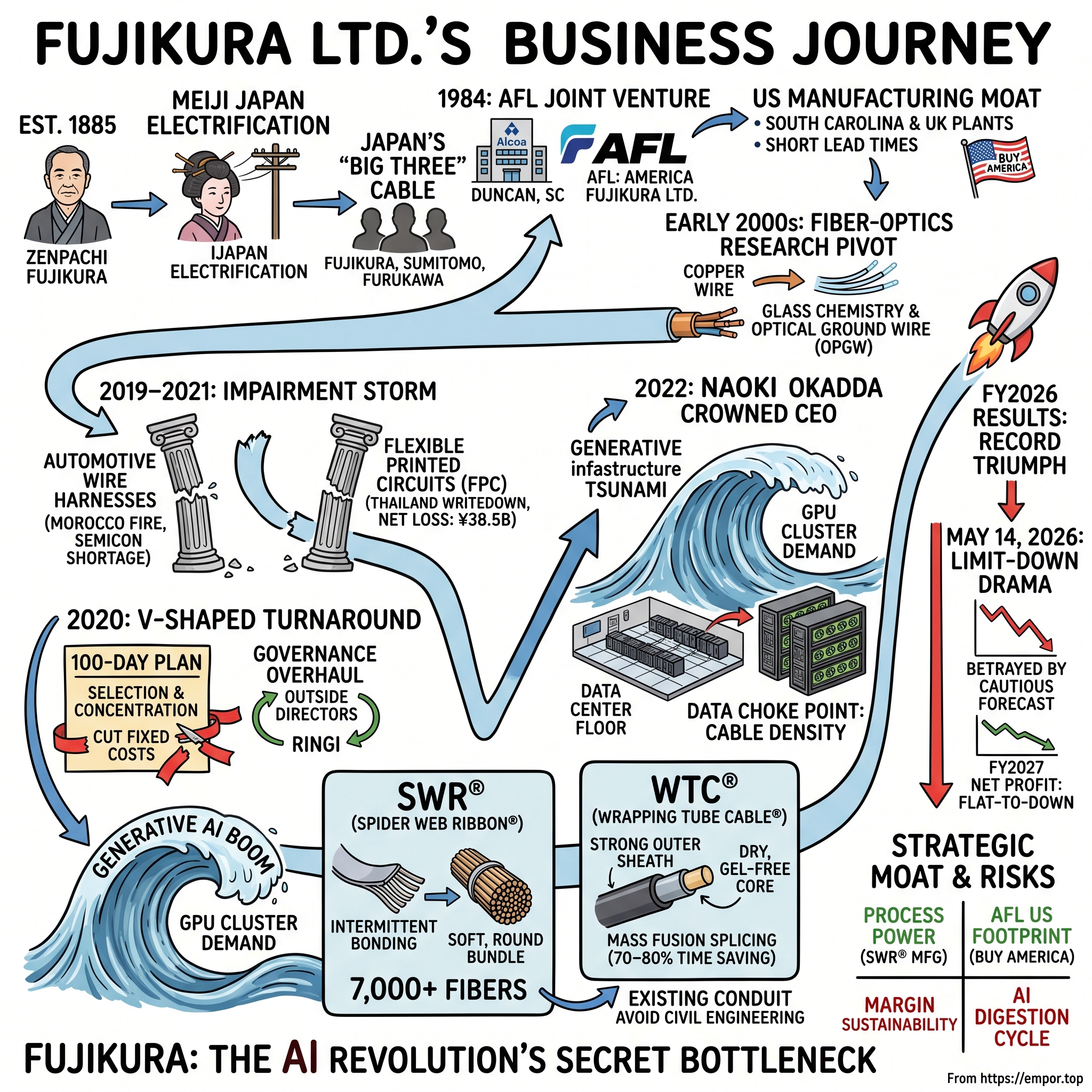
Fujikura Ltd.: The Generative AI Revolution's Secret Bottleneck
I. Introduction & Episode Roadmap
Picture the floor of a hyperscale data center in northern Virginia in the winter of 2024. Racks of NVIDIA GPUs stretch away under cold aisle containment, each one screaming for data, and the entire economic value of the building depends on a single, unglamorous question: can you physically get enough glass fiber between the machines fast enough? Not enough compute. Not enough power, though that is its own crisis. Enough fiber — thin strands of drawn glass, tens of thousands of them, threaded through conduits that were poured for a pre-AI world. The companies spending tens of billions of dollars on artificial intelligence discovered, somewhat to their embarrassment, that the choke point was a cable.
The company that makes the best answer to that question is 株式会社フジクラ Fujikura Ltd. (5803.T), a 140-year-old survivor of Japan's 明治 Meiji industrialization, listed on the 東京証券取引所 Tokyo Stock Exchange.1 For most of the last century it was exactly the kind of business that value investors filed under "boring industrial" and forgot: copper wire, power cables, automotive wiring harnesses, the physical plumbing of the electrified world. Then, over roughly eighteen months, the market changed its mind with violence. Fujikura's shares surged more than 400% during 2024 alone, making it the single best performer on the 日経平均株価 Nikkei 225, and rose roughly 1,400% across the two years to late 2025 as the world's richest technology companies scrambled for its cable.23
This is the paradox at the center of the story. How did a company founded in 1885 to manufacture hairpins and insulated telegraph wire become the supplier whose lead times help determine whether Google, Meta, Microsoft, and Amazon can light up their next multi-billion-dollar GPU cluster on schedule? The honest answer is not that Fujikura got lucky. It is that a near-death experience forced it to bet everything on a niche it had quietly dominated for a decade — and then the world walked into that niche.
The neutral investor's job here is to hold two ideas at once. The first is that Fujikura genuinely owns a piece of process technology that is hard to copy and sits at a real bottleneck. The second is that the market has, at times, priced it as though that bottleneck were permanent and the AI build-out infinite — and on May 14, 2026, that assumption cracked in a single trading session. Both things can be true.
Here is the roadmap. We start with the technology, because you cannot value this company without understanding what SWR (Spider Web Ribbon®) and WTC (Wrapping Tube Cable®) actually do. Then we go back to Meiji-era Tokyo and the founder who saw telegraph poles and smelled opportunity. We trace the 1984 Alcoa joint venture that quietly built Fujikura's American moat. We sit in the corporate emergency room of 2019–2021, when the company was structurally unprofitable and bleeding from two divisions at once. We watch the "100-Day Plan" and the rise of Naoki Okada, the engineer who ran the fiber division and then ran the whole company. We war-game the competitors, apply the standard strategy frameworks honestly rather than as a fan letter, and end where the market ended: a record-breaking earnings report that triggered a limit-down crash.
Let us begin with the cable, because the cable is the whole argument.
 Subscribe on LinkedIn
II. The Secret Bottleneck: SWR® and WTC® Technology
Start with a mental image that makes the problem obvious. Take a handful of dry spaghetti and try to stuff it into a drinking straw. Now imagine the spaghetti is glass, each strand is one-fifth of a millimeter across, and you need 6,912 of them inside a cable no thicker than your thumb — and you need them to survive being yanked hundreds of meters through a buried duct that already has decades-old cable in it. That, roughly, is the physical engineering problem that AI data centers handed the fiber industry.
Why did AI make it worse? Because of how GPU clusters compute. Training a large model is not one big calculation; it is thousands of processors doing pieces of the same problem and then constantly comparing notes. The comparing-notes part — the "east-west" traffic between chips — is enormous, and it all rides on optical fiber. As clusters scaled from hundreds of GPUs to tens of thousands, the number of fiber connections did not grow linearly; it exploded. And data centers were suddenly connecting whole buildings across a campus (the industry calls this Data Center Interconnect, or DCI), where the fiber has to travel through existing underground conduit. You cannot easily dig a new trench between two buildings a mile apart in a live campus. So the fiber has to get smaller and denser — the same conduit, far more strands.
The collapsible ribbon
Fujikura's first answer is a deceptively simple reinvention of how you package fibers. The old way, called ribbon fiber, glues twelve fibers side by side into a flat, rigid tape, bonded continuously along their length, like a flat noodle. Flat noodles pack badly. They only bend one way, and when you bundle many of them they leave triangular gaps of wasted space between the stacks.
Spider Web Ribbon, branded SWR®, changes one thing: instead of gluing the twelve fibers together continuously, it bonds them intermittently — dots of UV-cured resin at intervals, leaving the fibers free to move between the bonds.4 The consequence is almost magical to watch. Under gentle pressure the "ribbon" is not a rigid tape at all; it collapses and rolls up on itself into a soft, round bundle, filling space in every direction with no dead gaps. When you need to work on it, you flatten it back out and it behaves like a normal ribbon again. It is, in effect, a ribbon that is flat when you want it flat and round when you want it round. That single property is what lets you cram thousands of fibers into a cross-section that used to hold hundreds.
The dry cable that carries it
The second piece is the cable that houses the ribbons, Wrapping Tube Cable, or WTC®. Two design choices matter. First, WTC moves the cable's strength members — the stiff elements that keep it from stretching when you pull it — out to the sheath, freeing the entire core to be packed solid with collapsed SWR.4 Second, and this is the part field technicians actually care about, WTC is dry. Conventional high-density cables are filled with water-blocking grease or gel, and every technician who has ever prepared one has spent hours wiping fibers clean with solvents before they can be spliced. WTC replaces the gel with a water-swellable tape, so the core is clean out of the box.4
Why the buyers care — and it is not sentiment
Here the marketing gives way to hard numbers, and the numbers are the reason hyperscalers write purchase orders. A 1,728-fiber WTC cable is roughly 37% smaller in diameter and 65% lighter than a traditional loose-tube ribbon cable of the same fiber count.54 Translate that out of engineering-speak: a smaller, lighter cable slides through existing congested conduit, which means the operator does not have to pay millions of dollars to trench a new pathway or lease more duct. In a build where time-to-power is measured in weeks of foregone revenue, avoiding civil engineering is worth far more than the price of the cable itself.
The second economic lever is labor. Because SWR flattens back into a ribbon on demand, a technician can splice all twelve fibers in one shot — "mass fusion splicing" — using one of Fujikura's fusion splicers, instead of fusing 1,728 fibers one at a time. Fujikura's and AFL's own field data put the reduction in installation and splicing time at up to roughly 70–80% versus single-fiber splicing.54 Skilled splicing crews are scarce and expensive, and the AI build-out is fighting over them; anything that lets one crew do the work of four is not a feature, it is a scheduling weapon.
The density roadmap tells you where the demand curve is heading. The industry moved from 1,728-fiber cables to 3,456, to 6,912, and on to ultra-dense 13,824-fiber designs built specifically to wire dense GPU clusters. Each doubling is a response to the same underlying force: more chips, more connections, same conduit.
None of this makes Fujikura invincible — every claimed advantage here can be, and is being, chased by competitors, which is the subject of Section VIII. But it explains why a "commodity wire maker" suddenly had pricing power. To understand how a company ends up owning a niche like this, you have to go back to the man who started making hairpins.
III. Meiji Origins: Zenpachi Fujikura & Japan's Electrification (1885–1980s)
Tokyo in the 1880s was a city rewiring itself in real time. The 明治維新 Meiji Restoration had, in a single generation, decided that Japan would industrialize or be colonized, and the visible symbol of that decision was the telegraph line — poles marching down muddy streets, carrying the nervous system of a modernizing state. A young craftsman named 藤倉善八 Zenpachi Fujikura looked at those wires and noticed something that would define a company for the next century and a half: the insulation on them was imported.
Zenpachi had been making hairpins — humble, competitive, low-margin work.1 But he saw that Japan's entire electrical future depended on rubber- and silk-insulated wire that the country could not yet make for itself, and in 1885 he began producing insulated winding wire in the Kanda district of Tokyo.1 The early going was the usual origin-story struggle: unreliable materials, failed batches, thin capital. What turned it into a business was the customer that a modernizing Meiji state could offer — government telegraph and, later, telephone contracts. Import substitution, backed by the state's appetite for infrastructure, is the oldest growth story in industrial history, and Fujikura rode it.
From there the arc is the familiar one of a national champion cabling a country: winding wire led to power cables, power cables to telephone lines, telephone lines to submarine cables laid on the sea floor. By the twentieth century Fujikura was woven into Japan's industrial and infrastructure complex, one of a small handful of firms trusted to string the physical connective tissue of the nation. It is worth lingering on that identity for a second, because it recurs: Fujikura has almost always made its best money not selling a gadget but selling the invisible infrastructure that other people's gadgets depend on.
Crucially, it never had the field to itself. Japan's cable industry consolidated into a "Big Three" — Fujikura alongside 住友電気工業 Sumitomo Electric Industries (5802.T) and 古河電気工業 Furukawa Electric (5801.T).1 These three grew up together, competed for the same government contracts, and to this day shadow each other into every new cable technology, a rivalry that matters enormously to the competitive analysis later.
Then came the pivot that eventually made everything else. In the 1970s, Japan's engineers — at 日本電信電話 NTT and at the cable makers who supplied it — recognized earlier than most that copper had a ceiling. You can only push so much information down a metal wire before physics stops you. The future was glass: pulses of light down a strand of ultra-pure fiber, carrying orders of magnitude more data. Fujikura threw itself into the fiber-optics research race, learning the brutally demanding glass chemistry required to draw fiber pure enough that light could travel kilometers without fading.1 That decision, made when fiber was a laboratory curiosity, is the seed of the entire modern company. The hairpin maker had become a glass company — and it was about to take that glass to America.
IV. The North American Foothold: AFL and the Alcoa Strategic Gamble (1984–2005)
In the early 1980s, an American aluminum giant and a Japanese cable company found themselves staring at the same opportunity from opposite sides. Electric utilities across the United States were stringing a clever new product along their high-voltage transmission towers: optical ground wire, or OPGW — a cable that does two jobs at once, protecting the power line from lightning strikes and carrying optical fiber for communications. Whoever could make it well would sell it to every power utility in America.
The Aluminum Company of America — Alcoa — had what a foreign entrant could not easily buy: the aluminum expertise, the industrial brand, and decades of relationships with U.S. utilities. Fujikura had the thing Alcoa could not make: superior optical-fiber and OPGW manufacturing technology. So on November 2, 1984, they split the difference and formed a joint venture, Alcoa Fujikura Ltd. (AFL), to manufacture fiber optic ground wire at a facility in Duncan, South Carolina.6 It was a textbook complementary pairing — local distribution married to foreign technology — and it planted Fujikura on American soil at the exact moment American communications were about to go optical.
Over the next two decades AFL did what good joint ventures rarely do: it expanded well beyond its original mandate. From utility ground wire it pushed into telecommunications cable, enterprise networks, and eventually the early data-center market, gradually becoming a genuinely American company with American factories and American customers rather than a Japanese import operation with a Duncan mailing address.7 This "Americanization" is easy to skip past but strategically enormous, and we will see why in a moment.
In 2005, Fujikura bought out Alcoa's remaining stake and assumed 100% ownership, keeping the AFL name — now standing for America Fujikura Ltd. — and headquartered in Duncan.6 What should a skeptical analyst make of that transaction? The financial terms were never publicly disclosed, so any claim about the price is unverifiable. But the strategic logic is clean. Joint ventures carry a structural tax: every major decision runs through two parents with different priorities, and by the mid-2000s the U.S. broadband and fiber-to-the-home build was accelerating in ways that reward a single, decisive owner. Taking full control removed the governance friction precisely as the market it served began to scale. Whether Fujikura paid a smart price we cannot verify; that it bought strategic control at a useful moment we can.
The real value of AFL, though, only became obvious twenty years later. American hyperscalers building AI infrastructure want — and in some cases are effectively required — to buy high-density cable manufactured in North America and the UK. Local production shortens lead times, satisfies "Buy America"-style procurement preferences, and keeps supply chains inside friendly borders. AFL's South Carolina and UK plants gave Fujikura something a competitor exporting from Asia simply cannot replicate on short notice: a domestic, qualified, at-scale manufacturing footprint sitting exactly where the demand is. In 2024, the Japanese and U.S. governments even signed a memorandum under which Fujikura was tasked with helping supply optical cable for U.S. AI infrastructure — a level of geopolitical embedding that a pure importer could never achieve.8 A 1984 decision to make lightning-protection wire in South Carolina turned out, four decades on, to be the moat.
But a moat around one division does not save a company from bleeding elsewhere. And by the late 2010s, Fujikura was bleeding badly.
V. The Impairment Storm: The 2019–2021 Automotive & Electronics Hemorrhage
Every industrial conglomerate eventually meets the same enemy, and its name is diversification-that-stopped-working. By 2018, Fujikura had it in full. The company that had learned to make anything with a wire in it had accumulated a sprawling portfolio — telecom, energy, automotive, electronics — with high fixed costs, relentless price erosion in the commoditized parts, and no clear center of gravity. It was a collection of businesses rather than a company with a thesis, and two of those businesses were about to open their veins simultaneously.
The first was automotive wire harnesses — the intricate bundles of wiring that run through every car. Fujikura had spent heavily to build a global harness footprint, and it was the wrong place to spend. Harnesses are a brutal business: labor-intensive, low-margin, hostage to automakers' pricing power, and dependent on cheap labor in places like Eastern Europe where wages were rising and workers were scarce. Then came the compounding disasters — supply-chain blockages, the global semiconductor shortage that idled auto production lines, and in May 2020 a catastrophic fire at a harness factory in Morocco that forced heavy restructuring.9 A commodity business with no pricing power and physical single points of failure is a machine for destroying capital, and it was doing exactly that.
The second wound was electronics, specifically flexible printed circuits (FPC) — the thin, bendable circuit films used inside smartphones. This business lived and died on consumer handset volumes, including as a supplier into the Apple ecosystem, and it inherited all the pathologies of being a component vendor to a giant: crushing price pressure, volatile order volumes, and expensive factories — above all a large plant in Thailand — that sat underutilized when a product cycle turned.9
The numbers finally forced the reckoning. In the fiscal year ended March 31, 2020 (which Fujikura labels FY2019), the company posted a net loss of ¥38.5 billion.10 This was not a bad quarter; it was structural. The company was unprofitable at the core, carrying too much debt, and watching its equity ratio deteriorate. The losses were crystallized by a wave of impairment charges — the accountant's admission that assets on the balance sheet were worth far less than their carrying value — including a large write-down of the idled FPC manufacturing assets in Thailand, whose recoverable value was effectively judged to be zero.10
An impairment of that kind is worth pausing on, because it is a confession in accounting language. It says: we invested capital here expecting returns that will never come. For an investor, the FY2019 loss was the moment the "diversified industrial" story became indefensible. The question was no longer whether Fujikura needed to change, but whether it could — and whether management had the stomach to cut its own limbs off. Remarkably, this time it did.
VI. The V-Shaped Turnaround: The 100-Day Plan & Governance Overhaul
There is a particular kind of clarity that only a near-death experience produces, and Fujikura found it in 2020. With creditors and shareholders no longer willing to accept "we are working on it," management launched what it called the 100日プラン, the 100-Day Plan — a compressed, emergency program to restructure the business before the balance sheet forced someone else to do it for them.11 The name itself signaled the shift in tempo. Japanese industrial giants are not famous for moving in 100-day increments.
The strategy went by a phrase that recurs across corporate turnarounds — "selection and concentration," 選択と集中 — and this time it was applied without sentiment. The legacy exit was aggressive: sharply downsizing the automotive harness division, walking away from low-margin vehicle programs, shutting underperforming electronics sites, and cutting corporate headcount. Alongside the operational surgery came financial repair — selling non-core real estate and legacy cross-shareholdings to raise cash and mend the balance sheet.11 The point of all of it was singular: strip out fixed cost so that the company would break even at a far lower level of revenue.
But the more durable change was structural, and it went at the culture. Fujikura abolished its old in-house company system — the siloed structure in which each division operated as a semi-autonomous fiefdom, hoarding resources and resisting coordination — and replaced it with a leaner, unified business-division model.11 Then it went after the boardroom itself: the number of directors and corporate officers was cut by roughly half, and independent outside directors were brought up to about half of the board, breaking the insular, seniority-bound culture that had let the losses accumulate in the first place.11 For a legacy Japanese firm, seating outsiders in half the board seats is not cosmetic; it is a direct assault on the "old boys' club" that consensus-driven 稟議 ringi decision-making tends to protect.
Then the math of operating leverage did its work. When you cut fixed costs deeply and demand subsequently recovers, profit does not rise proportionally — it rises violently, because every incremental yen of revenue now falls through to the bottom line with far less cost attached. As telecom and other markets recovered, Fujikura's restructured cost base turned that recovery into record profits by FY2022.12 A company that had lost ¥38.5 billion was suddenly, structurally profitable.
The honest analytical note here is about what the V-shape does and does not prove. It proves that management, under existential pressure, could execute painful cuts and reform governance — genuine evidence of credibility that we should weight when judging later promises. It does not, by itself, prove that the recovery was durable rather than cyclical, because sitting underneath the cost-cutting was a demand wave nobody had fully priced: the world was about to start building AI. And the man who had spent his career on the technology at the center of that wave was about to get the top job.
VII. The AI Infrastructure Tsunami & Naoki Okada's Coronation (2022–Present)
In April 2022, the Fujikura board handed the presidency to a man whose résumé read like a bet on a single idea. 岡田直樹 Naoki Okada was not a generalist rotated up through finance or general affairs. He had joined Fujikura in 1986 and spent his career inside the optical-fiber cable business — and, critically, he had been central to developing and scaling the very products, Spider Web Ribbon and Wrapping Tube Cable, that were about to become the company's crown jewels.13 He had helped push the telecom business from selling plain fiber toward selling high-value-added optical cable systems. During the crisis he served as a Managing Corporate Officer and was instrumental in the 100-Day Plan; he became COO in 2021 and then President and CEO in April 2022, while also chairing AFL in the United States.13
The choice of Okada was itself a strategic statement. When a company elevates the person who built its highest-margin, most technically differentiated product line, it is telling you where it intends to point its capital and its attention. This was a coronation of the fiber business over everything else — a declaration that Fujikura's future was telecommunications infrastructure, not the automotive and electronics legacies it had just spent two years cutting.
The timing was almost absurdly fortunate. In late 2022, ChatGPT launched, and within months the world's hyperscalers redirected their capital-expenditure plans toward AI data centers on a scale the industry had never seen. The physical architecture of those data centers demanded exactly what Okada's division made: dense optical interconnect to feed and coordinate GPU clusters. Demand for SWR and WTC went vertical. Fujikura was, in a real sense, no longer selling cable by the meter — it was selling time and space to the richest companies on earth, the ability to deploy a GPU cluster weeks sooner in conduit that already existed.
The financial before-and-after is stark, and it is the crux of the bull case. Set the FY2019 net loss of ¥38.5 billion against the fiscal year ended March 31, 2026 (FY2026), when Fujikura's net sales reached ¥1,182.4 billion, up 20.7% year on year, and operating profit soared to ¥188.7 billion, up 39.2%.1415 The engine was unmistakable: the information and telecommunications segment generated operating profit of ¥152.7 billion — roughly a 1.7-fold jump — and accounted for more than 80% of the entire company's operating profit.14 A business that a few years earlier had been an afterthought was now carrying the whole enterprise, at segment operating margins in the mid-teens.
What does that concentration actually tell an investor? Two things, pointing in opposite directions. On the bull side, it is proof of genuine demand and pricing power: you do not put up mid-teens margins in a business historically known for low-single-digit returns unless customers value what you sell and cannot easily get it elsewhere. On the bear side, it is a warning about concentration risk — Fujikura's fortunes are now lashed to a single end-market's capital-spending cycle. A company that just spent two years de-diversifying to survive has re-concentrated into one demand wave to prosper.
Management's response to that demand tells you how much conviction it has. In early 2026, Fujikura committed to invest up to ¥300 billion — roughly $1.9 billion — to raise SWR/WTC and optical-fiber output capacity in Japan and the United States to about three times current levels, including a new plant at its Sakura facility in Chiba prefecture, while saying it would proceed in phases and monitor market trends.168 That last clause matters: even in its most aggressive capital commitment, management hedged on timing. Whether ¥300 billion of capacity is prudent scaling or the seed of future overcapacity is the single most important open question in the story — and it is the question the competition and the skeptics force us to confront next.
VIII. Deep Dive: Global Fiber Industry Structure & Competitors
Every good bottleneck attracts a crowd, and Fujikura's is no exception. To understand whether its advantage is durable, you have to war-game the people trying to take it — and they are not small.
Corning (USA) is the giant in the room. The company that commercialized low-loss optical fiber in the first place holds the largest overall share of the global fiber market, with massive U.S. distribution and its own high-density cable designs, including a collapsible-ribbon product line of its own. Corning is not a company anyone dismisses. But in the specific race that mattered most — intermittently bonded, collapsible ribbon deployed at scale into the first wave of AI data-center builds — Fujikura and AFL got there earlier and won dominant early positions, which is why a "commodity" supplier suddenly had the pricing leverage. The competitive question is not whether Corning can build a competitive ribbon; it plainly can. It is whether it can displace an incumbent whose product is already qualified, installed, and standardized in the customer's construction workflow.
Prysmian Group (Italy) is, by revenue, the largest cable manufacturer in the world, spanning power and telecom and enlarged further by acquiring Encore Wire. It fields genuinely competitive high-density ribbon designs. But Prysmian is a sprawling energy-and-telecom conglomerate in which high-density data-center fiber is one line among many, and Fujikura's SWR has carried a reputation for splice consistency and clean, gel-free handling that specifiers value. Reputation is not a permanent moat, but in a market where a bad splice at scale is a schedule catastrophe, it is worth real money.
The domestic rivals — Sumitomo Electric and Furukawa Electric — are the most interesting comparison, because they reveal Fujikura's actual edge. Sumitomo Electric is a much larger company overall, with enormous automotive and power-systems revenues, and it makes a competing "Freeform Ribbon" to challenge SWR. Furukawa also makes high-density ribbon. But both are broad conglomerates in which telecom fiber is a modest slice of the whole, and neither has concentrated capital and executive focus on U.S. hyperscale data-center fiber the way Fujikura has. Sumitomo's superior overall scale comes with diluted margins — its profits are spread across many lower-return businesses. This is the paradox of focus: the smaller, formerly troubled company may hold the stronger position in the one niche that currently matters most.
How Fujikura wins — and the honest caveats
The first real mechanism is a hardware-and-consumable loop. SWR is designed to be spliced with Fujikura's own fusion splicers, and Fujikura is broadly regarded as the world's leading maker of those splicers, with what industry sources describe as roughly half the global market.17 Crews trained and tooled on Fujikura splicers, working with Fujikura cable, form a self-reinforcing system: the installed base of equipment and the trained-labor standard both pull the next cable order toward Fujikura. This is a genuine switching-cost dynamic, not merely a product-quality claim.
The second mechanism is focus itself. While Prysmian, Sumitomo, and Furukawa allocate capital across power, automotive, and industrial businesses, Fujikura has pointed the bulk of its investment and its CEO's attention at high-density fiber. In a land-grab phase, concentration is an advantage: you move faster and commit harder than a diversified rival whose board is weighing fiber against ten other claims on capital.
The caveat a neutral analyst must state plainly: none of these advantages is a patent-protected monopoly. The splicer share is an industry estimate, not an audited figure; the ribbon technology is being actively replicated; and the "focus" advantage is also a "concentration" risk. Fujikura is ahead. Whether it stays ahead depends on execution, and on whether the demand wave lasts long enough for its ¥300 billion bet to pay back before rivals flood the same capacity in. That is exactly what the strategy frameworks help us test.
IX. Playbook: Hamilton Helmer's 7 Powers & Porter's 5 Forces
Frameworks are only useful if you use them to interrogate a thesis rather than decorate it. So let us apply Hamilton Helmer's 7 Powers and Michael Porter's Five Forces to Fujikura as a stress test, not a celebration.
Process Power (the primary claim). The strongest of Fujikura's powers is process, not product. Intermittently bonding twelve strands of glass with dabs of UV resin at micrometer precision — fast, at industrial yields, without weakening the fiber — is a manufacturing discipline that took the company well over a decade to perfect. Process power is precisely the kind of advantage that is hard to buy or reverse-engineer, because it lives in accumulated production know-how rather than a document a competitor can license. This is the most defensible piece of the moat. It is also, importantly, the piece most vulnerable to time: process advantages narrow as rivals climb their own learning curves.
Cornered Resource. Fujikura holds intellectual property around the SWR bonding structure and around the alignment algorithms in its fusion splicers. Patents are real but finite — they expire, they can be designed around, and they are being challenged commercially by Freeform Ribbon, FlexRibbon, and Corning's designs. Treat this as a supporting power, not a fortress.
Switching Costs. The trained-crew, standardized-equipment dynamic described earlier is a legitimate switching cost. A hyperscaler's construction partners are tooled and certified on Fujikura's system; changing standards mid-build risks delay, and delay is the one thing an AI build cannot afford. This power is real but bounded — it protects the current build cycle more than it guarantees the next one.
Scale Economies. The ¥300 billion capacity expansion is an attempt to manufacture a scale advantage: higher volume, lower unit cost, a harder wall for a smaller entrant to climb. But scale economies only become a power if demand fills the capacity. Build ahead of demand and the same investment converts from a moat into an albatross of fixed cost. This power is contingent, and management itself hedged its timing.
Porter's Five Forces, briefly and honestly:
Threat of new entrants: low. The capital cost, the process learning curve, and the multi-year qualification cycles hyperscalers demand keep newcomers out. You do not casually enter a business where the customer takes a year to certify you.
Bargaining power of suppliers: low. Fujikura is heavily vertically integrated — it makes its own glass preforms and draws its own fiber — which insulates it from upstream squeeze, though not from raw-material and energy inputs.
Bargaining power of buyers: moderate to high. This is the force to watch. Google, Meta, Microsoft, and Amazon are among the most powerful buyers on earth, and they will absolutely build second sources and negotiate hard once supply loosens. Today their leverage is capped by time-to-market — they cannot afford a squeeze that delays a data center. When capacity catches up, that restraint disappears, and buyer power reasserts itself. This is the mechanism through which today's fat margins could compress.
Threat of substitutes: low. For multi-terabit interconnect over any real distance, there is no substitute for glass. Copper survives only inside the rack, over centimeters. Physics is on Fujikura's side here.
Competitive rivalry: moderate and rising. Confined to a handful of sophisticated players — Corning, Prysmian, Sumitomo, Furukawa — but every one of them is now investing to close the gap.
The frameworks converge on a single conclusion: Fujikura's advantages are real, mostly process-driven, and mostly strong-but-erodable. That is not a knock; it is the accurate shape of the moat. Which is exactly why the skeptics deserve a full hearing.
X. The Skeptical-Investor Stress Test & Risk Radar
Now put on the coat of a short-seller or an activist and try to break the story. The honest version of this company includes the parts that could go wrong.
Management credibility, weighed both ways. The positives are earned and specific: the 100-Day Plan was executed, the governance overhaul was real, the strategy has been consistent, and capital allocation has been disciplined enough that the market rewarded it. When a management team promises hard cuts and delivers them, that is data. The negative is a cultural one that international investors repeatedly flag — a deep conservatism in how the company communicates. Fujikura's habit of issuing cautious forward guidance, prizing "guidance discipline" over managing market expectations, has a real cost: it can leave the stock exposed to violent moves when a market conditioned to relentless upgrades finally hears caution. That is not a governance failure; it is a communication style. But as we will see, style can vaporize hundreds of billions of yen of market value in an afternoon.
The margin-sustainability question. This is the heart of the bear case, and it deserves to be stated without flinching. Telecom-segment operating margins climbed from historically low single digits to the mid-teens.14 The skeptic's question is simple: is that a permanent structural re-rating, or a temporary bubble created by supply running behind demand? The mechanism for a reversal is well understood. When Fujikura and its rivals all finish expanding capacity, high-density cable could commoditize, buyer power reasserts itself, and margins drift back toward their historical range. There is no way to prove today which scenario wins; an investor who tells you the mid-teens margin is permanent is guessing, and so is one who tells you it will collapse. What we can say is that the outcome hinges on the timing of capacity versus demand — which is precisely the variable management said it could not fully control.
The capex risk. The ¥300 billion expansion is a bet that demand will still be there when the new lines come online. If the hyperscale build-out hits a digestion phase — a pause while the industry absorbs what it has already built — Fujikura could find itself carrying tripled capacity into a softening order book. Overcapacity in a capital-intensive business is how good companies post bad years.
The current risk radar, restricted to what is genuinely material to this business:
-
AI digestion. If hyperscalers slow physical data-center capex because AI monetization takes longer than the hype implied, Fujikura's order book weakens immediately and directly. Given the segment now drives over 80% of profit, there is little to cushion the blow.
-
Technological duplication. Competitors are actively building dry, high-density, collapsible-ribbon capacity. Each new qualified line erodes Fujikura's scarcity and, with it, its pricing power.
-
Geopolitical and supply-chain exposure. AFL provides a domestic U.S. base, but the broader supply chain — raw materials, chemical inputs, certain preform and component sourcing tied to Asia — remains a systemic execution risk in a world of tightening trade lines.
The stress test does not demolish the bull case; it disciplines it. Fujikura is a genuinely advantaged company riding a genuinely large wave, whose central uncertainties are the durability of a margin and the timing of a capital bet. And on one specific day, the market delivered its verdict on exactly how much uncertainty it was willing to tolerate.
XI. Epilogue: The FY2026 Earnings & The Limit-Down Drama
On May 14, 2026, Fujikura reported the best year in its 140-year history — and the stock crashed to the exchange floor's daily limit.
The results themselves were the stuff of a victory lap. Net sales broke ¥1 trillion for the first time ever, landing at ¥1,182.4 billion. Ordinary profit rose 45.4% to ¥199.4 billion. Net profit jumped 72.5% to ¥157.1 billion, a record.1415 Management simultaneously more than doubled the annual dividend, from ¥100 to ¥225 per share, and announced a stock split — the full ceremonial package of a company confident in its cash generation.15 By every backward-looking measure, it was a triumph.
The market's reaction was to sell it to the floor. Fujikura shares, which had closed the prior day at ¥7,855, collapsed to their limit-down level of ¥6,355 — a roughly 19% single-day plunge — and kept falling the next session.18 The cause was not in the results at all; it was in the forecast. Management guided fiscal 2027 net profit to about ¥156 billion, a fractional decline of roughly 0.7% from the record just posted.18 To a market that had grown addicted to Fujikura's habit of beating and raising, a flat-to-down forecast read as a betrayal.
This is the "sell the fact" in its purest form, and it is worth understanding precisely because it is not a story about a broken business. Nothing about the AI bottleneck changed between May 13 and May 14. What changed was the collision between a stock priced for perpetual acceleration and a management team culturally committed to conservative guidance — the very "guidance discipline" flagged earlier as a double-edged trait. When a company that has trained investors to expect upgrades instead hands them caution, the air comes out of the valuation, not the fundamentals.
For the long-term investor, this is the quintessential lesson, and it is the one this whole story has been building toward: the gap between a company's stock price and the value of its underlying business. On May 14, Fujikura the stock had a catastrophic day. Fujikura the business had just reported record everything and committed billions to expand a franchise anchored to the physical reality of the internet. Those are two different objects, and confusing them is how investors get hurt in both directions — chasing the 1,400% run-up on the way in, panic-selling the limit-down on the way out. The disciplined question is never "what did the price do today?" but "what is this cash-generative industrial franchise actually worth, and has the answer changed?" On May 14, 2026, the price changed violently and the answer to that second question barely moved at all — though, in fairness to the sellers, a flat forecast is also real information about how fast the wave is still cresting.
XII. Outro & Links
Strip away the 500%-and-crash melodrama and Fujikura's story reduces to a few durable lessons for anyone who invests in real, physical businesses.
The first is the power of concentration under duress. A conglomerate that was dying of diversification saved itself by cutting hard and betting on the one thing it did better than anyone — and the discipline of the 100-Day Plan, painful as it was, is what made the company solvent enough to be standing when the AI wave arrived. Focus was not a luxury; it was survival.
The second is that physical distribution footprint can be a deeper moat than any single product. A 1984 decision to make lightning wire in South Carolina became, four decades later, the reason American hyperscalers could buy Fujikura's cable at all. Geography, qualification, and local manufacturing are not glamorous, but they are extraordinarily hard for a competitor to replicate on the timeline that matters.
The third is the quiet superiority of process power over flash. Fujikura's edge is not a patent or a brand; it is a decade of accumulated manufacturing know-how in bonding glass, reinforced by an installed base of splicing tools. That kind of advantage compounds slowly and defends stubbornly — but it also erodes if the company stops running, because rivals are climbing the same curve.
And the fourth is the discipline the limit-down demanded: to hold the business and the stock as separate objects, and to keep asking what could break the case rather than assuming the wave rolls on forever. The margin could compress. The capex could arrive ahead of demand. The buyers could find their leverage. None of that is disqualifying; all of it is worth watching.
What to actually track from here, without drowning in the quarterly noise? Three things carry most of the signal. First, the telecommunications segment operating margin — the single cleanest gauge of whether Fujikura's pricing power is structural or a supply-shortage artifact; watch whether the mid-teens holds as new capacity comes online. Second, SWR/WTC capacity utilization and order backlog against the ¥300 billion build-out — the tell for whether management is scaling into demand or ahead of it. Third, hyperscaler AI capital-expenditure trends, the exogenous tide that lifts or strands the entire thesis. Get those three right and the rest is commentary.
The hairpin maker of 1885 has, improbably, become one of the physical gatekeepers of the machine-intelligence age. Whether it stays one for the next 140 years depends less on the story it tells and more on the two variables the story cannot yet resolve: how long the wave lasts, and how much of its advantage it can defend once everyone else finishes building.
References
-
Fujikura Ltd. Integrated Report 2025 — Fujikura Ltd., 2025-10-31 ↩↩↩↩↩
-
AI boom makes 139-year-old cable company Japan's hottest stock — Fortune, 2024-11-24 ↩
-
AI Demand Strains Japan Cable Firm Fujikura After Stock Surge — Bloomberg, 2025-12-18 ↩
-
Wrapping Tube Cable (WTC) with SpiderWeb Ribbon (SWR) — AFL Global ↩↩↩↩↩
-
How to optimise fibre network deployment: Wrapping Tube Cable (WTC) with SpiderWeb Ribbon (SWR) Fibre — Fibre Systems ↩↩
-
AFL (America Fujikura Ltd.) Corporate Overview — AFL Global ↩
-
Japan cable maker Fujikura to invest in US for AI data center push — Nikkei Asia, 2026 ↩↩
-
Fujikura Annual Report 2022 (Financial Highlights) — Fujikura Ltd., 2022 ↩↩
-
Fujikura 100-Day Plan Accomplishment and Progress Report — Fujikura Ltd., 2021-04-30 ↩↩↩↩
-
Fujikura Ltd. Integrated Report 2024 — Fujikura Ltd., 2024-10-31 ↩
-
Naoki Okada, Chairman of AFL and President & CEO of Fujikura Ltd. — AFL Global ↩↩
-
Fujikura (5803) FY2026: record results and post-earnings analysis — kabuya66 (note.com), 2026-05 ↩↩↩↩
-
Fujikura: Strong sales and profit growth, higher dividends, and a share split highlight FY2026 results — TradingView News / Quartr, 2026-05-14 ↩↩↩
-
Fujikura to triple optical fiber production as part of $2bn investment — Data Center Dynamics, 2026 ↩
-
Fujikura (5803): Analysis of the Limit-Down Earnings Report — note.com (asu916), 2026-05 ↩↩
 LinkedIn
 WhatsApp
 Reddit
 Hacker News
 Email
Email Kindle
 RSS Feed
 Spotify
 Apple Podcasts
 Amazon Music
 Audible
 YouTube