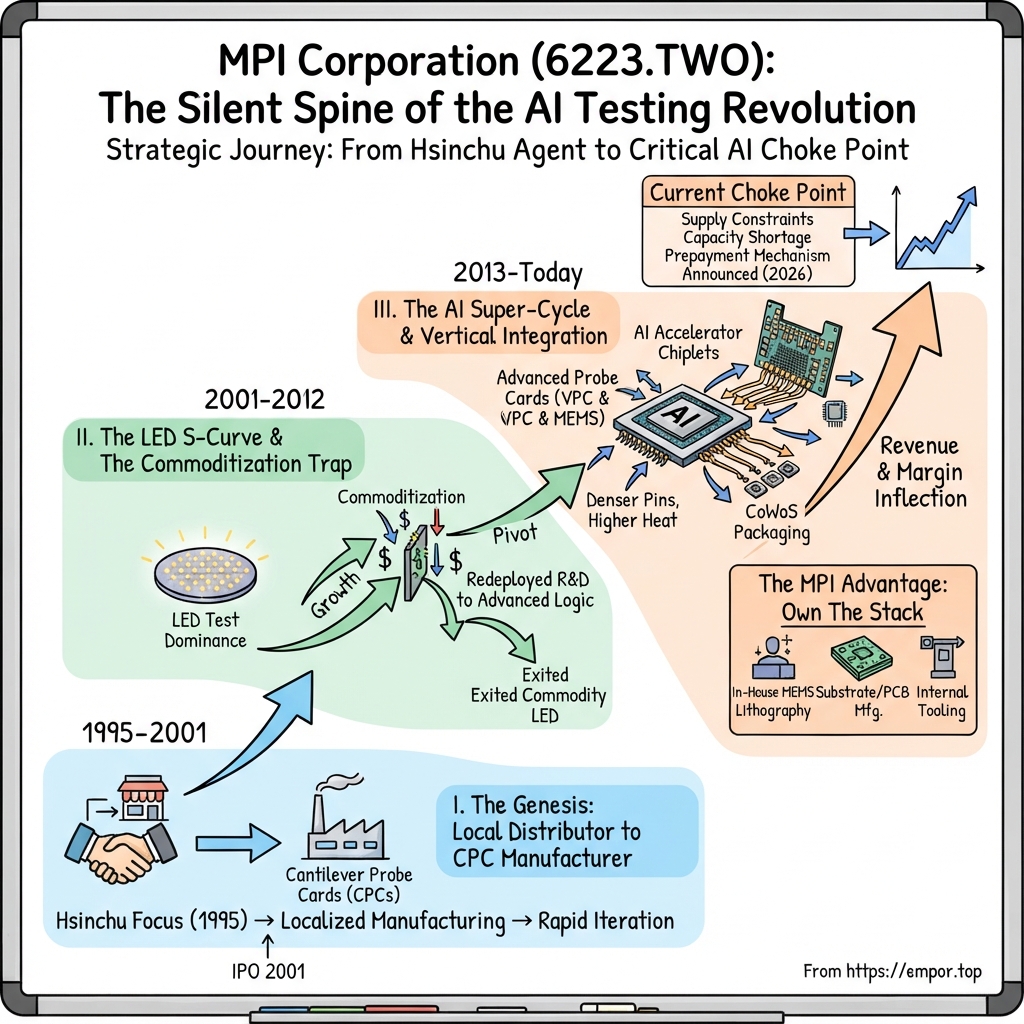
MPI Corporation (6223.TWO): The Silent Spine of the AI Testing Revolution
I. Introduction: The Prepayment Shockwave & The AI Choke Point
On June 17, 2026, at its annual general meeting in Hsinchu County, Taiwan, MPI Corporation held a routine shareholder vote. Investors approved a cash dividend of NT$22 per share, representing a payout ratio of roughly 66% of the company's prior-year earnings.1
The more consequential announcement came from Chairman Brian Ko (葛長林), who has led 旺矽科技股份有限公司 MPI Corporation for three decades. Ko noted that customer demand for probe cards had outstripped supply to the extent that MPI's production capacity could not keep pace. In response, the company announced plans to introduce a prepayment mechanism (預付款機制), asking customers to pay cash upfront to reserve allocation in the production queue.1
The buyers in question are not minor market participants. They are major chip design houses and cloud infrastructure providers purchasing accelerators for artificial intelligence workloads—enterprises with balance sheets running into hundreds of billions of dollars. That a Taiwanese vendor ranked roughly fourth in its market segment would publicly propose upfront cash terms underscores the current supply constraints.
Whether this strategy succeeds remains to be seen. Announcing an upfront payment policy differs from securing executed contracts and cash receipts. As of September 2026, management has framed the mechanism as a plan rather than a fully executed program. Concrete evidence of implementation will appear in balance-sheet items such as contract liabilities and customer deposits rather than executive commentary.
Nevertheless, the feasibility of such a proposal highlights the strategic importance of a specialized niche in the semiconductor supply chain that receives relatively little public attention.
The part of AI nobody photographs
Public attention surrounding the artificial intelligence buildout typically focuses on prominent layers of the value chain: fabless chip designers, advanced wafer fabrication by TSMC (台積電), advanced CoWoS packaging that integrates logic dies with high-bandwidth memory, and the expanding power and cooling infrastructure of data centers.
A less visible requirement is wafer-level electrical testing to verify functionality before final assembly.
A completed 300-millimeter wafer leaving a semiconductor fab contains dozens of large AI accelerator dies, each valued at thousands of dollars. Because visual inspection cannot identify electrical defects, manufacturers must test each die while it remains on the wafer by applying electrical signals, analyzing the response, and marking defective units.
This testing relies on a probe card—a high-precision interface board equipped with thousands of microscopic needles. Each needle must align with metal contact pads narrower than a human hair, maintain consistent electrical connectivity over hundreds of thousands of test cycles, and endure elevated temperatures generated by active chips.
Misalignment by a fraction of a micron risks a false failure, leading to the accidental disposal of a functional die. Conversely, poor electrical contact can result in a false pass, allowing a defective die to proceed to advanced packaging, where it can ruin an assembly containing thousands of dollars in high-bandwidth memory. Consequently, the yield economics of advanced semiconductor manufacturing depend heavily on these consumable test interfaces.
This dynamic creates an operational bottleneck, explaining how a company with 2025 revenue of NT$13.4 billion—less than $500 million—can seek to negotiate favorable commercial terms with major global technology companies.3
Why not just raise prices?
When demand exceeds capacity, standard commercial logic suggests raising prices. Management's stated rationale for pursuing prepayments instead of outright price increases is to avoid embedding structural cost inflation into customer bills of materials, which could encourage buyers to fund competing vendors. Prepayment is designed to secure customer capital for MPI's factory expansions without permanently repricing products.
Whether this approach represents long-term commercial strategy or tactical positioning, the underlying capacity constraint is documented. In a May 2026 investor call, management reported that all probe card product lines were operating at full capacity. To address backlogs, MPI outlined plans to expand MEMS probe card capacity roughly three and a half times to 3.5 million pins per month by the end of 2026, while increasing vertical probe card (VPC) capacity to 2 million pins per month over the same timeline.21
A required capacity expansion of that scale within a single year reflects acute physical and capital scaling challenges rather than a lack of demand.
This context frames how a business established in 1995 as an equipment distributor—reselling third-party testing hardware to Taiwanese chipmakers—developed into a critical supplier in the AI hardware supply chain. Its history spans three distinct phases: an initial decade spent acquiring manufacturing capabilities, a period of margin compression in a commoditized core market, and a decade of vertical integration that established its current profitability structure. Important operational and valuation questions remain regarding its current market positioning.
The company's trajectory began thirty years ago in the shadow of a much larger industry peer.
 Subscribe on LinkedIn
II. The Genesis: From Hsinchu Agent to Taiwan's First CPC Builder (1995–2001)
In the mid-1990s, the Hsinchu Science Park was emerging as the epicenter of Taiwan's semiconductor industry. As TSMC validated the pure-play foundry model, a dense local ecosystem developed around it, encompassing IC design houses, mask shops, assembly and testing providers, and equipment distributors.
Equipment distributors served as essential connective tissue in this developing market. Taiwanese fabs relied on distributors to import, install, and service capital equipment from American, European, and Japanese suppliers. While distribution generated steady fee income, it yielded lower margins and left agents dependent on foreign principals who often had little incentive to address localized customer requirements.
MPI Corporation was founded in July 1995 within this environment.3 Its initial business focused on representing and distributing semiconductor test hardware to chipmakers and assembly houses across Hsinchu.
A persistent pain point for local customers involved probe cards. At the time, Taiwanese chip designers imported nearly all probe cards from overseas vendors. Because probe cards are custom-built for specific chip layouts, delivery timelines were critical. Overseas suppliers operating across time zones and relying on international logistics often required months to deliver custom cards, creating scheduling bottlenecks for Taiwanese fabless companies attempting to meet tight market windows.
Becoming a manufacturer
Transitioning from equipment distribution to hardware manufacturing presents substantial operational challenges. Distribution relies on client relationships, logistics, and field support, whereas manufacturing demands mastery of process engineering, yield management, and tight tolerance control.
Despite these hurdles, MPI expanded into domestic manufacturing in the late 1990s, developing local production capabilities for cantilever probe cards (CPCs). As the traditional probe card architecture, cantilever cards use fine tungsten or beryllium-copper wires assembled under microscopic inspection to align with contact pads on a wafer. The process relied primarily on skilled labor, precision assembly, and rapid custom layout turnaround rather than capital-intensive machinery.
Taiwan's dense labor pool and localized electronics supply chain enabled rapid iteration. By offering regional production and local engineering support, MPI significantly reduced repair and turnaround times compared to overseas competitors. If a customer's probe card required rework, modifications could be completed within hours rather than weeks.
The company's later corporate materials date its probe card operations to 1995, underscoring an early intent to transition beyond third-party distribution into proprietary manufacturing.3
July 2001: going public
In July 2001, MPI completed an initial public offering on the 櫃買中心 Taipei Exchange under stock code 6223.3 The listing occurred during a major global semiconductor downturn following the collapse of the dot-com bubble.
However, raising capital during an industry contraction forced management to deploy proceeds toward long-term operational infrastructure rather than speculative short-term expansion. Corporate disclosures trace MPI's physical expansion from its initial Hsinchu headquarters in 2000 to production and office facilities in Kaohsiung in 2006, a second Hsinchu production site in 2012, a plant in Xinpu in 2014, and a third Hsinchu facility in 2021.3
During this early period, MPI also executed bolt-on transactions, including the acquisition of a semiconductor trading business aimed at broadening its distribution network and field-engineering coverage. Detailed financial terms for these early transactions were not publicly disclosed in corporate filings reviewed for this report.
This initial era established two structural features of MPI's business model. First, the company prioritized customer-facing service and application engineering over pure-play research and development, building products to match explicit customer demand. Second, its competitive advantage relied on turnaround speed, lead-time reduction, and localized engineering support rather than superior initial technological specifications.
While this responsiveness model yielded success in the mature cantilever probe card market, subsequent technology shifts would test whether local service alone could sustain market share against rising technical complexity.
III. The LED S-Curve and the Commoditization Trap (2001–2012)
In the early 2000s, a second growth vector emerged for semiconductor testing that was entirely separate from logic chips.
Light-emitting diodes (LEDs) were transitioning from simple indicator lights into the primary backlighting for consumer electronics—laptops, monitors, smartphones, and televisions—before expanding into general illumination. Manufacturing these devices required immense volume, but LEDs presented a unique testing challenge: chips had to be evaluated optically as well as electrically. Test equipment needed to probe each die on a wafer, illuminate it, measure its brightness and color wavelength, and sort the dies into performance bins, since subtle variations across a single wafer could produce visible color mismatches on finished displays.
This requirement created a complex hardware engineering challenge spanning precision motion control, optical measurement, high-speed wafer handling, and custom control software. Leveraging its existing expertise in probing and automation, MPI entered the LED test automation market in 2001, establishing the unit that evolved into its Photonics Automation business.3
For nearly a decade, the business generated strong growth and high operating margins. As Taiwan established itself at the center of the global LED supply chain, MPI grew into a leading global supplier of LED wafer probers.
The trap closes
Eventually, the LED market followed a path typical of commoditized hardware sectors.
Supported by substantial national and provincial subsidies, Chinese LED manufacturers rapidly expanded production capacity. As supply flooded the market, LED chip prices plummeted. Equipment vendors quickly lost pricing power as customer margins evaporated. Simultaneously, domestic Chinese equipment makers emerged to serve local chipmakers, competing aggressively on price with access to low-cost capital that faced minimal return hurdles.
MPI was caught in a classic commoditization trap: holding market leadership in a segment where market share no longer yielded attractive returns. Gross margins on standard LED probers compressed rapidly, and the division's contribution to group earnings eroded.
This phase provided a critical strategic lesson for MPI's leadership. The company had initially built a strong business through operational excellence and execution. However, execution alone did not confer structural protection. Because high-quality LED probers could be duplicated by well-funded competitors willing to accept lower financial returns, operational performance proved insufficient to defend margins once low-cost capital entered the market.
The decision not to fight
Rather than engaging in a margin-destructive price war to defend market share, Chairman Brian Ko and General Manager Scott Kuo (郭遠明) chose to pivot.
MPI systematically de-emphasized commodity LED equipment and redeployed its optics and automation intellectual property toward higher-barrier applications with specialized customer bases, including micro-LED test systems and, later, silicon photonics and co-packaged optics (CPO). Simultaneously, management redirected research and development capital toward advanced logic probe cards.
Photonics Automation remains active inside MPI as one of five core business units, serving as the foundational repository for the company's optical engineering capabilities—the exact technical foundation required for silicon photonics testing.3 However, the division ceased to be the primary engine of corporate growth.
Evaluating this transition requires distinguishing strategic discipline from standard market share loss. The validity of MPI's strategic pivot rests on two factors: whether redeployed capital generated superior returns, and whether retained optical capabilities created scalable new revenue streams. On the first score, financial results validate the decision; the logic probe card division funded by this capital reallocation now generates the vast majority of group profits. On the second, the outcome remains unproven. Co-packaged optics—the primary target for MPI's optical heritage—remained pre-revenue at scale as of the company's May 2026 investor call, where management projected pilot shipments in the fourth quarter of 2026 and volume production in 2027.1
That schedule represents a development timeline rather than demonstrated commercial adoption. While two decades of accumulated optical engineering expertise is rare, its ability to generate high-margin probe card economics remains unconfirmed. For investors, the co-packaged optics initiative represents a promising strategic option that has yet to convert into material financial revenue.
What this era established. The commoditization crisis instilled an institutional realization that market share lacking structural moats offers limited protection. This experience shaped MPI's strategy over the subsequent decade, prompting a deliberate effort to build competitive advantages resilient to low-cost capital and margin-insensitive competitors.
IV. Cracking the Testing Code: The Move to Advanced Probe Cards (VPC & MEMS)
Evaluating MPI's technological transition requires examining the three distinct tiers of probe card architecture, as the company's valuation hinges on its progress up this technical ladder.
Rung one: cantilever. Cantilever cards feature angled needles whose tips slide across wafer contact pads. Mature and inexpensive to manufacture, cantilever technology faces severe commoditization—mirroring the margin pressures seen in standard LED probers. It remains in use primarily for display drivers, analog components, and legacy semiconductor nodes.
Rung two: vertical (VPC). In vertical probe cards, needles extend perpendicularly to the wafer through a guide plate, flexing slightly under load to maintain contact. Eliminating the horizontal approach angle allows far higher needle density, enabling test systems to evaluate multiple dies simultaneously. This parallel testing significantly lowers testing costs per chip, making vertical probe cards the primary workhorse for logic chip testing.
Rung three: MEMS. Micro-electro-mechanical systems (MEMS) probe cards replace individual needle assembly with lithographic fabrication and electroplating—the same core processes used to manufacture chips. This approach defines probe geometry through a photomask rather than mechanical machining.
Lithographic manufacturing offers three compounding operational advantages for advanced testing:
First, pitch. Photolithography achieves contact spacing beyond the physical limits of mechanical needle insertion, meeting the tight pad pitches demanded by advanced semiconductor nodes and advanced packaging.
Second, uniformity. Because lithography produces virtually identical probes across an entire card, contact variance is minimized. On cards containing tens of thousands of contacts, a single failing probe lowers test yields, making contact consistency far more critical than average performance.
Third, structural design freedom. Photolithography allows engineers to customize spring geometries and cross-sections for specific thermal and electrical requirements. Because artificial intelligence accelerators draw intense current and generate substantial heat during wafer testing, probes must sustain high current without thermal degradation while maintaining spring resilience across hundreds of thousands of contact cycles.
MEMS represents the largest segment of the probe card market. Industry analyst TechInsights estimated the total semiconductor probe card market at approximately $2.7 billion in 2025, projecting a compound annual growth rate of roughly 9% through 2029. Within that total, MEMS probe cards accounted for about $1.04 billion, vertical cards represented $353 million, and cantilever cards trailed at $235 million.3
Breaking into the elite
Historically, the MEMS probe card market was dominated by U.S.-based FormFactor and Italy's Technoprobe. Company disclosures track MPI's progress: in total own-make integrated circuit probe card revenue rankings, MPI moved from fifth place between 2020 and 2022 to fourth place in 2023 and 2024, surpassing Japan Electronic Materials while ranking behind FormFactor, Technoprobe, and Micronics Japan.3 In the non-memory segment—which encompasses AI logic—MPI has held third place globally since 2020. In 2024, its non-memory probe card revenue rose 47% year over year to $196 million, outpacing Technoprobe's 9% growth and FormFactor's 13%.3
Regarding the highest-end MEMS category specifically, management noted during a May 2026 briefing that MPI advanced from eleventh place globally in 2023 to seventh.1
This discrepancy highlights the central dynamic of MPI's market position. While the company ranks third overall in non-memory probe cards, it holds seventh place in high-end MEMS. That gap defines both the potential upside and the core risk: expansion offers substantial room for market share gains, but progress requires competing directly in a technical segment dominated by well-capitalized incumbents.
The real weapon: owning the stack
A major operational differentiator for MPI lies in its degree of vertical integration across the probe card assembly stack.
A complete probe card comprises several interconnected layers: the probe head itself; a multilayer organic or ceramic substrate (MLO or MLC) that fans out ultra-fine probe pin spacing to match standard circuit board dimensions; a printed circuit board (PCB) that transmits electrical signals to the tester; and a structural stiffener. Most probe card manufacturers purchase substrates and PCBs from specialized third-party vendors. Because these components require precision fabrication, third-party supply chains frequently face capacity bottlenecks during industry upturns, extending lead times for probe card assembly.
In contrast, MPI provides an in-house stack, supplying the probe head, substrate, and PCB through integrated internal operations.3 The company has also designed and built its own needle-insertion and assembly machinery, retaining proprietary control over its manufacturing tooling.
This vertical strategy carries three distinct financial and operational implications:
First, margin capture. In-house component manufacturing allows MPI to retain gross margins that would otherwise be captured by external substrate and PCB suppliers, directly supporting the company's consolidated gross margin profile.
Second, lead-time control. By managing substrate and PCB production internally, delivery schedules remain controlled within a single enterprise rather than subject to multi-vendor negotiations. In a semiconductor market where customer tape-out schedules dictate commercial success, shortened lead times provide a key competitive advantage.
Third, capital intensity. Vertical integration requires substantial capital expenditure to build and maintain specialized manufacturing facilities. MPI's property, plant, and equipment grew from NT$6.97 billion at the end of 2024 to NT$10.69 billion at the end of 2025, representing 44% of total assets.3 This high fixed-cost structure creates strong operating leverage during demand expansion, but leaves the company exposed to margin compression if semiconductor volumes contract.
MPI's vertical integration strategy provides measurable cost and lead-time advantages, but it represents a deliberate high-fixed-cost commitment to sustained market demand.
That operational structure frames how this manufacturing model translates into financial performance.
V. Inside the Secret Lab: The Economic Engines of Probe Cards & AST
Behind MPI's growth lies a corporate structure divided across five distinct business units, each established as adjacent technical capabilities matured: probe cards in 1995, photonics automation in 2001, advanced semiconductor test in 2014, thermal test in 2015, and Celadon Systems in 2021.3
In 2025, probe cards generated 72.2% of total revenue, test equipment contributed 26.1%, and other products accounted for the remaining 1.7%.3 On a May 2026 investor call, management characterized the run-rate mix at roughly 70% probe cards and 25% equipment.1
The cash cow, and why it compounds
Probe cards function as consumable hardware driven by two factors: the volume of new chip designs entering test and total wafer starts. Every new design requires a dedicated probe card, while high-volume production consumes multiple cards over time as microscopic contact probes experience mechanical wear.
While both drivers support expansion, the secondary effect of rising test content per wafer is even more critical. As chip architectures increase in complexity, testing demands per wafer multiply—requiring denser pin configurations, expanded parallel testing sites, longer test cycles, and more severe electrical and thermal operating conditions. Consequently, probe card demand can expand even in years when overall wafer starts remain flat.
Financial disclosures reflect this product evolution. MPI's blended gross margin for its cantilever and vertical probe card business expanded from 42% in 2021 to 46%, 48%, 55%, and 56% by 2025—a period during which cantilever volumes stayed roughly flat and vertical volumes grew.3 This trajectory illustrates a textbook product-mix shift, generating higher-value revenue from the same manufacturing footprint.
Across the four quarters of 2025, MPI reported gross margins of 57.4%, 58.3%, 53.4%, and 56.0%—placing it at or near the top of its comparison set—alongside operating margins of 29.7%, 32.8%, 26.2%, and 28.0%, which put MPI's operating margin ahead of the peers it charts.3 The gap between MPI's gross margin lead and its wider operating margin lead indicates a leaner operating cost structure than its competitors, though the small peer comparison set cautions against over-interpreting the data.
Local financial coverage in Taiwan has frequently cited a "60% gross margin" benchmark. However, MPI's full-year 2025 gross margin stood at 56%, and the 59.4% figure came from a single quarter, Q1 2026.31 Management noted on its May investor call that gross margins might moderate slightly in the second quarter before potentially recovering in the second half.1 A 60% gross margin represents a cyclical peak rather than a structural floor.
The AST flywheel — and how much of it is real
Established in 2014, the Advanced Semiconductor Test (AST) division manufactures specialized engineering probe systems. These benchtop and semi-automatic stations handle wafers ranging from 50 to 300 millimeters and support radio-frequency measurements up to 110 GHz.3 Unlike high-volume production equipment, these tools are deployed in design laboratories and failure-analysis facilities.
The strategic argument relies on an early-stage flywheel: engaging chip designers during initial characterization and debugging embeds MPI's test fixtures, measurement data, and workflows. When those designs transition to volume manufacturing, engineering teams are more likely to specify MPI production test hardware to outsourced semiconductor assembly and test (OSAT) providers such as 日月光 ASE or 京元電子 KYEC.
While logically consistent, this commercial mechanism requires cautious evaluation. MPI does not disclose what proportion of probe card sales originated in AST customer engagements. Furthermore, procurement decisions for laboratory equipment and volume production consumables are typically made by different corporate organizations with separate budgets. The flywheel remains a plausible strategy with limited public evidence. A more defensible interpretation views AST as a high-margin, high-barrier equipment business operating within shared customer accounts, where potential cross-selling serves as an incremental benefit rather than the core investment thesis.
Thermal, and the quiet business
Formed in 2015, the Thermal Test Systems division addresses a simple mandate with complex technical execution: directing precisely controlled hot and cold air streams at a device under test to verify functionality across its full operating temperature range. Automotive, aerospace, telecommunications, fiber optic, and sensor applications all require this verification, as a chip operating normally at room temperature but failing at −40°C in a car in Minnesota is a recall.3
Though representing a small niche, thermal testing carries high entry barriers, strong global market share, and proprietary patents around energy-efficient temperature control.3 Its strategic significance stems from thermal management becoming a central operational constraint in high-power AI chip testing, allowing MPI's core thermal capabilities to extend into advanced logic test applications.
What the segment picture means. MPI is primarily a probe card manufacturer supplemented by adjacent, high-margin instrument divisions that reinforce technical credibility and provide modest cyclical diversification. The equipment segment, generating roughly a quarter of revenue, provides stability, but probe card operations drive group performance. Within probe cards, profitability depends on the ongoing mix shift toward MEMS technology—meaning margin durability hinges on whether MEMS capacity remains scarce.
That question turns partly on what MPI has bought.
VI. The M&A Playbook: Masterful, Bolt-On, High-Margin Specialists
Mid-cap technology and equipment manufacturers frequently risk diluting capital by using appreciated shares to acquire large, adjacent businesses that carry weaker margin profiles than their core operations.
MPI has avoided this pattern. Its two disclosed acquisitions over the past five years were targeted, niche transactions in North America aimed at securing specialized technology and geographic coverage rather than buying top-line scale.
However, two transactions over five years provide a limited track record. A short history of small acquisitions reflects past capital allocation rather than a permanent governance trait, particularly as elevated valuations increase the temptation for larger deals. Assessing MPI's M&A strategy requires examining the specific operational logic of each transaction.
Celadon Systems (2021): the extremes
On August 26, 2021, MPI America—a wholly owned U.S. subsidiary established in California in 2017—announced a definitive agreement to acquire Celadon Systems Inc., a Minnesota-based manufacturer of specialized semiconductor test probe cards, with closing scheduled for early September 2021 subject to customary conditions.43 Financial terms were not disclosed.
Celadon specializes in extreme-environment testing, including parametric testing, wafer-level reliability, and wafer-level burn-in. Unlike high-volume production sorting that evaluates immediate die functionality, reliability testing subjects chips to extreme temperatures and voltages to verify operational integrity over long lifespans. This requirement serves distinct customer segments—including power semiconductor manufacturers, automotive suppliers, and aerospace and defense contractors—where domestic U.S. engineering and manufacturing are frequently formal procurement requirements.
The acquisition provided MPI with three assets that would have required significant time to develop organically: a specialized reliability-testing portfolio, an established North American manufacturing and engineering presence, and customer relationships in sectors where non-domestic suppliers face regulatory or supply-chain scrutiny. Five years after the transaction, Celadon operates as a distinct business unit within MPI's corporate structure, reflecting successful operational integration.3
Focus Microwaves (2025): the frequency keys
On November 17, 2025, MPI announced the acquisition of Focus Microwaves Inc., founded in 1988 by Dr. Christos Tsironis and based in the Montreal area of Quebec.53 The reported transaction value was approximately US$28 million.6
Focus Microwaves manufactures impedance tuners and noise-parameter measurement systems used for load-pull characterization. When engineers design radio-frequency power amplifiers, performance varies depending on the surrounding electrical environment. A load-pull system systematically modifies that impedance environment during testing to determine optimal operating conditions. This specialized niche features high technical barriers and a limited number of global suppliers.
Integrated into MPI's Advanced Semiconductor Test (AST) division, the acquisition extends the company's radio-frequency measurement capabilities beyond its existing 110 GHz threshold into 5G and 6G infrastructure, power devices, and silicon photonics characterization.35 Management framed the acquisition as a strategic expansion of its millimeter-wave test portfolio, while Focus Microwaves highlighted shared engineering priorities.5
Strategic implications. Both acquisitions align logically with MPI's core testing capabilities without altering its risk profile. Neither transaction was large enough to disrupt operations; an investment of US$28 million is modest relative to MPI's 2025 operating income of NT$3.8 billion.3 However, because both acquisitions were relatively small, management's integration discipline has not yet been tested by a major transaction or an industry downturn. The critical metric for investors is whether MPI maintains this disciplined sizing as customer prepayments and capital raises expand its cash balance.
That growing liquidity cushion shifts focus to the company's balance sheet and upcoming capital deployment.
VII. The AI Super-Cycle & The Prepayment Revolution (2023–Today)
MPI's financial performance pivoted sharply around 2023, driven by accelerating growth across its core metrics.
Revenue expanded from NT$6.5 billion in 2021 to NT$7.4 billion in 2022, NT$8.1 billion in 2023, NT$10.2 billion in 2024, and NT$13.4 billion in 2025.3 Over the same span, earnings per share rose from NT$7.44 in 2021 to NT$12.89 in 2022, NT$13.92 in 2023, NT$24.42 in 2024, and NT$33.49 in 2025.3
Return on equity followed a similar trajectory, moving from 10.1% in 2019, 14.2% in 2020, 11.9% in 2021, 18.7% in 2022, and 18.1% in 2023 to 27.2% in 2024 and 26.5% in 2025.3
While a low-to-mid-teens return on equity characterizes a steady industrial business, maintaining mid-twenties ROE alongside 30%-plus revenue growth and major facility expansion reflects significant operating leverage.
Growth accelerated further in early 2026. First-quarter revenue reached NT$3.93 billion, up 39% year over year, with a 59.4% gross margin and EPS of NT$12.53—marking a fifth consecutive record quarter.1 Management guided second-quarter revenue up 15–20% sequentially, with second-half revenue projected to grow 10–15% per quarter.1
Why chiplets changed everything
Advanced packaging serves as the structural catalyst behind this financial inflection.
For decades, standard semiconductor manufacturing housed a single silicon die within an individual package. If a unit failed final testing, only that single die was discarded. Modern AI accelerators, by contrast, use complex multi-die architectures. A CoWoS-class package integrates one or more large logic dies alongside multiple stacks of high-bandwidth memory on a shared interposer, creating a finished assembly worth tens of thousands of dollars.
This architecture alters the financial impact of manufacturing defects. If a defective logic die is assembled alongside four functional HBM stacks, the entire package is ruined. The financial loss from a single undetected defect scales with the value of the completed assembly rather than the individual die.
This dynamic creates the "known good die" requirement, fundamentally reshaping wafer test economics. When a test failure risked only a single chip, manufacturers could accept higher test-risk tolerances to minimize testing time. With multi-die packaging, that risk tolerance disappears. Consequently, manufacturers must expand test coverage, lengthen test durations, and apply higher electrical currents under harsher thermal conditions. Probe cards must engage denser contact pad arrays with higher alignment precision across repetitive test cycles.
Each of these operational demands accelerates probe card wear and raises technical entry barriers, driving probe card demand growth above baseline wafer start growth.
The customer set
MPI participates in the AI buildout through two commercial channels: indirectly through the foundry and OSAT ecosystem supplying Nvidia, AMD, and 聯發科 MediaTek, and directly through relationships with hyperscale cloud providers developing proprietary AI accelerators.
Direct engagements represent a key driver for the company's 2026 outlook. During its May 2026 investor call, management reported securing market share gains for AI ASICs among non-traditional design customers, expecting meaningful contributions starting in the second half of 2026.1
However, this management claim warrants measured evaluation. The guidance remains unquantified, providing neither specific customer identities nor revenue projections, and relies on future execution. Furthermore, custom ASIC developments are highly concentrated among a small group of hyperscale buyers. While securing design wins provides substantial upside, losing a major customer program carries significant downside risk. Because public disclosures offer limited visibility into customer concentration, investors face an information gap in assessing revenue durability.
The prepayment mechanism, examined
These commercial dynamics provide the context for MPI's capital expansion strategy.
To support order backlogs, MPI outlined plans to expand MEMS probe card capacity roughly 3.5-fold to 3.5 million pins per month by the end of 2026 and increase vertical probe card capacity to 2 million pins per month, with expansion continuing through 2027.21 Management raised its capital expenditure target to NT$2.7 billion from an earlier NT$2.0 billion budget to cover land acquisition and plant expansion, alongside plans for a NT$5 billion convertible bond to finance construction over one to two years.1
Evaluating the proposed prepayment mechanism against this capital plan reveals its underlying strategic logic. By requesting customer prepayments while simultaneously raising debt, MPI seeks to reduce its net capital at risk while converting non-binding demand forecasts into binding contractual commitments before completing long-term facility investments.
However, the mechanism remains unproven. As of September 2026, public information remains limited to executive commentary outlining the mechanism at a shareholder meeting.1 Concrete validation depends on whether customer deposits and contract liabilities materialize on MPI's balance sheet in subsequent quarters, and whether major buyers accept upfront payment terms.
The prepayment strategy also highlights the commercial power balance between MPI and its customer base. Suppliers with dominant pricing power typically raise product prices to capture excess demand, securing permanent margin expansion rather than temporary deposits. Requesting upfront deposits instead of price increases may indicate deliberate commercial restraint to protect long-term customer relationships, as management asserts. Alternatively, it may reflect the pragmatic limits of a vendor ranking fourth globally that seeks to expand capacity without driving cost-sensitive buyers toward larger market leaders. Both interpretations remain consistent with disclosed data.
VIII. Strategic Analysis: Helmer's 7 Powers & Porter's 5 Forces
Distinguishing between a temporary cyclical beneficiary and a structurally advantaged compounder represents the central question for long-term investors evaluating MPI Corporation.
Helmer's powers, tested rather than asserted
Switching costs — strong, and evidenced. A probe card for an advanced-node device is co-engineered with the customer over several months. It must be characterized, correlated against the test equipment, and fully qualified. Once a card is qualified and volume production begins, switching suppliers mid-lifecycle entails re-qualification costs, yield risks, and schedule delays on products with narrow commercial windows.
The falsification test for switching power is customer multi-sourcing. Large semiconductor companies routinely dual-source critical consumables specifically to prevent single-vendor dependency, and the top-tier structure of the probe card market ensures that qualified alternatives exist. Consequently, switching costs are high per design but weaker per customer. A supplier that fails to deliver on one chip program may retain that specific program while losing the customer's next-generation contract. This dynamic creates meaningful switching power, but with a one-generation limit—explaining why capacity expansion timing is critical. A customer turned away due to capacity constraints will qualify an alternative vendor for its next tape-out.
Process power — the strongest claim, and the best evidenced. This power derives from three decades of micro-machining, insertion tooling, and MEMS process development, embodied in proprietary equipment built internally alongside an in-house substrate and PCB stack.3 Process power is Hamilton Helmer's most difficult attribute to acquire because it cannot be purchased directly. The fact that MPI's gross margin matches or exceeds that of much larger peers despite being the fourth-largest global supplier provides direct evidence that its cost structure is genuinely differentiated rather than merely benefiting from a cyclical upturn.3 If its margin expansion were driven solely by industry-wide pricing power, competitors navigating the same cycle would exhibit similar gross margin improvements, which has not been the case.
Scale economies — moderate, and working against MPI, not for it. Scale represents the weakest element of the bullish narrative. Industry leaders FormFactor and Technoprobe remain significantly larger in the most critical segments. Research and development in MEMS lithography is capital-intensive and amortizes over total volume. In 2024, MPI's non-memory probe card revenue of $196 million was less than half of Technoprobe's $482 million and FormFactor's $410 million.3 MPI operates as a fast-growing challenger rather than the scale leader. Its margin advantage stems from operational integration rather than sheer size—an advantage that larger competitors could eventually replicate with sufficient capital deployment.
Cornered resource — overstated as usually told. Proximity to the Hsinchu talent pool and TSMC's manufacturing ecosystem provides tangible advantages in engineering turnaround speed and information flow. However, this resource is not cornered: every Taiwanese semiconductor supplier shares this geographical access, and major international competitors maintain local Taiwanese operations as well. Regional location functions as a structural tailwind rather than an exclusive moat.
Porter, briefly
Rivalry is oligopolistic and rational. The top five vendors account for the vast majority of total own-make IC probe card revenue, with FormFactor and Technoprobe leading, Micronics Japan ranking third, and MPI holding fourth place as of 2024.3 Competitors compete primarily on technical specifications and lead times rather than aggressive price cutting, supporting healthy industry gross margins.
Barriers to entry remain high—reflecting required process expertise, length of qualification cycles, and capital intensity—as demonstrated by a global leaderboard that has remained largely stable over five years, with MPI and Japan Electronic Materials merely swapping fourth and fifth places.3
Supplier power is exceptionally low because MPI has systematically neutralized it by internalizing substrate and PCB manufacturing.
Buyer power presents a two-sided dynamic. Semiconductor buyers are large, well-capitalized, and sophisticated. However, advanced testing capacity remains scarce, qualification cycles are sticky, and the cost of a probe card is modest relative to the value of the completed wafer it evaluates. Under current supply constraints, vendor scarcity limits buyer leverage. During an industry downcycle, buyer scale reasserts dominance. Buyer power in this sector functions as a variable of the semiconductor cycle, making it an error to view the current balance of power as permanent.
Substitutes represent a long-term risk that receives little public discussion. Design-for-test architectures, built-in self-test (BIST) capabilities, and potential packaging shifts that reduce external electrical contact during wafer testing could erode probe card pin count per wafer over time. While current industry trends point decisively toward higher test intensity rather than substitution, such architectural shifts could quietly compress probe card demand over a multi-year horizon without generating immediate market headlines.
Net. MPI possesses genuine process power and strong per-design switching costs within a favorable industry structure. However, it lacks scale economies, and its standing in the highest-end MEMS segment remains that of a challenger. The assertion that MPI holds a durable competitive moat remains valid, but in a refined form: its moat rests on manufacturing integration and operational responsiveness rather than pure technological dominance, requiring continuous re-earned execution across each semiconductor generation.
IX. Management Credibility & The Dual-Industry Operator
Most semiconductor chairmen have one biography. Brian Ko has two.
In 2000, Taiwan liberalized its commercial brewing laws. Around that time, Ko—traveling constantly on MPI business—was frequently taken by American clients to the brewpub chain Gordon Biersch. Convinced the concept would succeed in Taiwan, he set out to acquire the local franchise rights.
The story of how he secured those rights offers insight into his operating style. During a visit to the American parent company, the executive Ko was scheduled to meet was unavailable. The store manager handed him off to the master brewer, who spent the evening walking him through beers still in development. The next day, the company's executive team approved the deal, reasoning that anyone who engaged so deeply with the product understood the brand.7
Ko opened his first location in Taipei's Xinyi District in 2008, expanding to six sites by 2024 and adding two more in 2025.7 Following the American parent company's pandemic-era bankruptcy, he restructured the licensing agreement and rebranded the Taiwanese business as 吉比鮮釀 GBA Restaurants, continuing operations without paying ongoing royalties.7 He remains personally involved in menu design, including a signature dish named after him.7
Ko's own assessment of the restaurant business is straightforward: while it never generated significant financial returns, it provided over a decade of personal satisfaction.7
What to make of it
Investors can interpret this secondary venture in two ways.
The constructive interpretation views Ko as an executive dedicated to craft, service, and customer experience—disciplines measured nightly in the restaurant industry. Because probe card manufacturing is a high-touch, custom engineering business where responsiveness serves as the core product, operational discipline in one venue aligns logically with the other.
The skeptical interpretation views the restaurant group as a non-core, capital-consuming distraction managed for two decades by the chairman of a publicly traded company without generating an economic return. In corporate governance frameworks, this history represents a potential concern rather than a personal anecdote—particularly given a reported real estate transaction in which a 1,000-ping (3,300-square-meter) Zhubei restaurant property changed hands for approximately NT$518 million to a buyer connected to the same principal.8 While the restaurant business is privately held and corporate entities remain separate, transactions involving a founder's private holdings warrant scrutiny in related-party disclosures.
The central operational question is whether MPI's core business has suffered from divided managerial attention. The company's operating performance over the past five years indicates it has not.
Governance and skin in the game
MPI's corporate ownership structure operates partly through an investment entity, MPI Investment Co., Ltd., alongside Ko's personal equity holdings. Exact share counts and ownership percentages are detailed in annual reports and MOPS filings; secondary market estimates vary, and investors should verify holdings against primary regulatory filings.
Management's operational consistency over time offers a clear view of corporate governance. MPI's investor communications have maintained a consistent structure: presenting the same five business units, emphasizing vertical integration and one-stop probe card supply, and disclosing peer margin comparisons quarter after quarter—even during periods when MPI's gross margin compressed, such as its dip to 53.4% in the third quarter of 2025.3 Maintaining consistent reporting frameworks through cyclical fluctuations reflects transparent reporting practices.
Guidance provided during management's May 2026 briefing follows a similar pattern of specific commitments: sequential revenue growth of 15% to 20% in the second quarter, followed by 10% to 15% quarterly growth in the second half; a slight temporary dip in gross margins before recovering; expanding MEMS capacity to 3.5 million pins per month; and scheduling silicon photonics co-packaged optics (CPO) pilot shipments for the fourth quarter of 2026 ahead of volume production in 2027.1 Management also explicitly detailed an upward revision in capital expenditures to finance land and facility construction.1
Providing specific, testable guidance allows investors to evaluate management against stated operational targets over defined timelines.
Capital allocation, weighed
MPI's track record demonstrates disciplined capital deployment on a modest scale. Retained earnings have been reinvested into manufacturing infrastructure—including expansion across Hsinchu, Xinpu, and Kaohsiung facilities—and into two targeted technology acquisitions, alongside a dividend payout ratio of roughly 66% of prior-year earnings.13 The historical record shows no evidence of unfocused diversification or material asset write-downs.
However, the scale of upcoming capital deployment is unprecedented for the company. MPI is preparing to execute its largest capital program to date—allocating NT$2.7 billion in capex and issuing a NT$5 billion convertible bond within a single planning cycle—to fund capacity expansion based on three years of elevated demand.1 Capital discipline demonstrated during period upturns at modest scale does not guarantee identical outcomes when deploying larger capital sums near cyclical peaks. Additionally, the convertible bond structure introduces potential equity dilution if stock performance triggers conversion.
MPI demonstrates strong operational credibility and transparent guidance practices, though its current capital allocation strategy has not yet been tested by a prolonged industry downturn.
X. The Bear Stress Test, Risk Radar, & Bull Thesis
Evaluating MPI’s long-term outlook requires testing the investment thesis against structural risks and cyclical vulnerabilities. The core question is what could disrupt the company's trajectory.
Risk one: the cycle, amplified by fixed costs
The primary operational risk stems from MPI’s exposure to semiconductor capital expenditure cycles. Hyperscale cloud providers and IC design houses drive chip tape-outs and wafer starts, which dictate probe card demand. Because probe cards are purchased against short-term manufacturing schedules rather than multi-year take-or-pay contracts, any slowdown in artificial intelligence infrastructure spending transmits rapidly to MPI’s order book.
This cyclicality is amplified by the company's heavy fixed-cost base, which expanded significantly during the recent demand surge. Property, plant, and equipment more than doubled over two years to NT$10.7 billion.3 While high operating leverage expands profitability during industry upturns—supporting operating margins near 28%—it exerts downward pressure on margins when volume contracts. Management’s guidance for second-half 2026 sequential revenue growth of 10% to 15% implicitly acknowledges that the 39% year-over-year expansion recorded in the first quarter does not represent a sustainable baseline.1
Risk two: geography
MPI’s primary manufacturing operations remain concentrated in Taiwan, supported by secondary facilities in Kaohsiung, Suzhou, Minnesota, Dresden, and Quebec.3 While international locations handle field support, customer engagement, and specialty product lines, they cannot replace the company's core Taiwanese probe card production capacity.
Beyond geopolitical risks, this geographic concentration leaves operations exposed to local infrastructure disruptions, including seismic events, water shortages, and electrical grid instability. Because probe card manufacturing demands continuous, high-precision cleanroom environments, operational interruptions pose immediate production risks. While this concentration risk is shared broadly across the Taiwanese semiconductor ecosystem, it represents an unhedged operational exposure for the company.
Risk three: key personnel and succession
Chairman Brian Ko and General Manager Scott Kuo have guided MPI for most of its history. However, public disclosures provide limited detail regarding executive succession planning. Given that MPI’s strategy has relied on distinct corporate decisions—including exiting commoditized LED equipment, building an in-house manufacturing stack, and acquiring specialized instrument makers—leadership continuity represents a significant factor in sustaining the company's operational model.
The bear's case, stated at full strength
A skeptical perspective on MPI centers on cyclical timing, competitive dynamics, and capital deployment.
Under this view, the company's fourfold earnings expansion over four years reflects an extraordinary surge in artificial intelligence spending that may not persist as a long-term baseline. Profit margins sit near historical peaks, and management has signaled potential near-term moderation. Furthermore, MPI ranks fourth overall in total probe card revenue and seventh in high-end MEMS technology, leaving it as a challenger competing against larger, well-capitalized global leaders.31
Critiques also focus on capital management. MPI is expanding capital expenditures and issuing a NT$5 billion convertible bond to build capacity near what could prove to be a cyclical high. Meanwhile, the prepayment mechanism remains a planned program rather than a fully executed balance-sheet reality, while key growth vectors—such as custom AI ASIC market share gains and co-packaged optics adoption—remain future opportunities without quantified revenue projections. Finally, equity valuations already reflect significant optimism, a point acknowledged in management's May 2026 investor commentary.1
The counter-argument, and where it actually holds
The structural counter-argument rests on long-term testing intensity rather than short-term market cycles.
Probe card consumption is driven by chip design activity, total wafer starts, and test intensity per wafer. The industry transition toward chiplets and advanced packaging creates a structural increase in testing complexity that persists even during cyclical downturns. Consequently, even a flat semiconductor market can support probe card revenue expansion as advanced packaging adoption rises. Industry projections reflecting a mid-to-high single-digit compound annual growth rate for probe cards indicate a steady, multi-year expansion cycle.3
Company-specific factors support this outlook. MPI’s probe card gross margin expansion from 42% to 56% was driven by a product mix shift toward higher-value vertical and MEMS architectures rather than temporary price increases.3 Additionally, in-house substrate and circuit board manufacturing provides a structural cost advantage, supporting gross margins that compare favorably with industry peers.3 Furthermore, MPI's equipment divisions—Advanced Semiconductor Test and Thermal Test Systems, bolstered by Focus Microwaves—provide partial diversification, as laboratory R&D and device characterization spending typically remain steadier during production downturns.
However, assuming peak margins and growth rates represent a permanent baseline remains an overly optimistic stance. A more realistic thesis acknowledges that while cyclical contractions will impact near-term results, MPI's integrated cost structure and expanding market position leave it equipped to navigate industry downturns effectively.
The activist lens
From an institutional governance perspective, three core areas warrant ongoing evaluation:
First, disclosure transparency. Public filings omit quantitative metrics on customer concentration and actual customer adoption of the proposed prepayment mechanism—two variables critical to evaluating revenue stability and pricing power.
Second, governance and related-party oversight. The chairman’s external business ventures and associated real estate transactions require rigorous corporate governance standards and clear related-party disclosures to ensure complete alignment with public shareholders.
Third, capital allocation strategy. Utilizing a convertible bond to fund major factory expansion during a demand peak introduces financial leverage and potential share dilution if industry conditions soften before new capacity achieves full utilization.
Addressing these transparency and governance factors represents a straightforward opportunity for management to strengthen investor confidence and validate its long-term corporate standing.
XI. Outro: Playbook Lessons & KPIs to Watch
Stepping back from the numbers, MPI's thirty-year arc offers three corporate lessons that extend well beyond probe cards.
One: winning a market is not the same as owning one. MPI led the global market in LED probers, yet that leadership provided limited long-term protection because it relied on operational execution rather than structural moats—an execution model easily duplicated by competitors willing to accept lower financial returns. The company's most strategic decision was recognizing this dynamic early and exiting the segment rather than defending market share during a margin collapse. Most management teams hesitate to abandon market leadership. The discipline lies not in the exit itself, but in redeploying freed capital into markets with stronger structural protection—which MPI accomplished by pivoting into advanced probe cards.
Two: own the tooling. Conventional industry wisdom long favored outsourcing non-core operations. MPI took the opposite approach, developing proprietary needle-insertion machinery and internalizing substrate and circuit board production. That vertical integration yields two distinct operational advantages: higher gross margins and tighter lead-time control. The tradeoff is a heavy, cyclical fixed-asset base. That compromise suits a custom-engineering business where customer schedules are the primary constraint, whereas it would penalize a commodity manufacturer.
Three: acquisitions should buy capability, not revenue. Celadon Systems and Focus Microwaves were acquired for extreme-environment testing and high-frequency measurement, respectively—securing specialized technical capabilities in target niches with minimal balance-sheet risk. The true test of this capital allocation discipline lies not in past small transactions, but in how management deploys capital as its balance sheet and market valuation expand.
An overarching question remains: MPI's current positioning benefits from acute capacity constraints during an industry demand surge. Scarcity alone is a temporary advantage. Durable advantages—process power, vertical integration, and sticky design qualifications—are genuine but narrower than headline growth rates suggest, requiring continuous re-earned execution across every node transition and new packaging architecture.
The three things worth tracking
Beyond headline revenue growth, three specific financial and operational metrics provide the clearest view of whether MPI is executing on its long-term strategy.
Gross margin. MPI's full-year 2025 gross margin reached 56%, peaking at 59.4% in the first quarter of 2026.31 This metric serves as a direct indicator of both pricing power and the financial benefit of vertical integration. If the product mix is shifting toward higher-value MEMS probe cards and internal manufacturing provides a durable cost advantage, gross margins should remain in the mid-50% range as production scales or during cyclical slowdowns. A decline toward the high 40% range would suggest that integration benefits are limited or that competitive pressures are mounting. With management already guiding toward near-term gross margin moderation, the key variable is how far margins retreat and how quickly they stabilize.
Contract liabilities and customer deposits. Balance-sheet items provide the definitive test of MPI's proposed commercial terms. Management has framed the prepayment mechanism as a plan outlined by the chairman.1 If customers accept upfront terms to secure production queue priority, contract liabilities and customer deposits will expand on the balance sheet. Conversely, if those line items remain flat over upcoming reporting cycles, the mechanism represents tactical rhetoric rather than executed commercial policy, warranting a reassessment of customer pricing power.
MEMS monthly pin capacity. Management has committed to expanding MEMS probe card capacity to roughly 3.5 million pins per month by the end of 2026 and vertical probe card capacity to 2 million pins per month, with expansion extending into 2027.21 This operational benchmark carries a firm timeline. Delayed expansion risks losing customer tape-outs to competitors, who would then secure multi-year qualification status—the mechanism through which switching costs can penalize an unprepared vendor. Tracking whether capacity comes online as scheduled indicates whether planned operational gains will translate into realized market share.
These three publicly reported, falsifiable metrics offer a clear framework for evaluating execution at a critical, less visible bottleneck in the artificial intelligence supply chain.
References
-
旺矽(6223) 1150515法說會個人筆記 — vocus, 2026-05 ↩↩↩↩↩↩↩↩↩↩↩↩↩↩↩↩↩↩↩↩↩↩↩↩
-
MPI Corporation Investor Presentation — Fubon Tech Trip, 2026-03-12 ↩↩↩↩↩↩↩↩↩↩↩↩↩↩↩↩↩↩↩↩↩↩↩↩↩↩↩↩↩↩↩↩↩↩↩↩↩↩↩↩↩↩
-
MPI America Inc. Agrees to Acquire Celadon Systems Inc. — PR Newswire, 2021-08-26 ↩
-
MPI Corporation Acquires Focus Microwaves, Strengthening Leadership in RF and Millimeter-Wave Test Solutions — MPI Corporation, 2025-11-17 ↩↩↩
-
MPI Corporation Acquires Focus Microwaves — Tracxn M&A Deals Brief, 2025-11-18 ↩
-
吉比鮮釀背後老闆竟是他!旺矽董座葛長林:沒賺到錢,但賺到10多年快樂人生 — 今周刊 Business Today, 2025-01-22 ↩↩↩↩↩
 LinkedIn
 WhatsApp
 Reddit
 Hacker News
 Email
 Kindle
 RSS Feed
 Spotify
 Apple Podcasts
 Amazon Music
 Audible
 YouTube