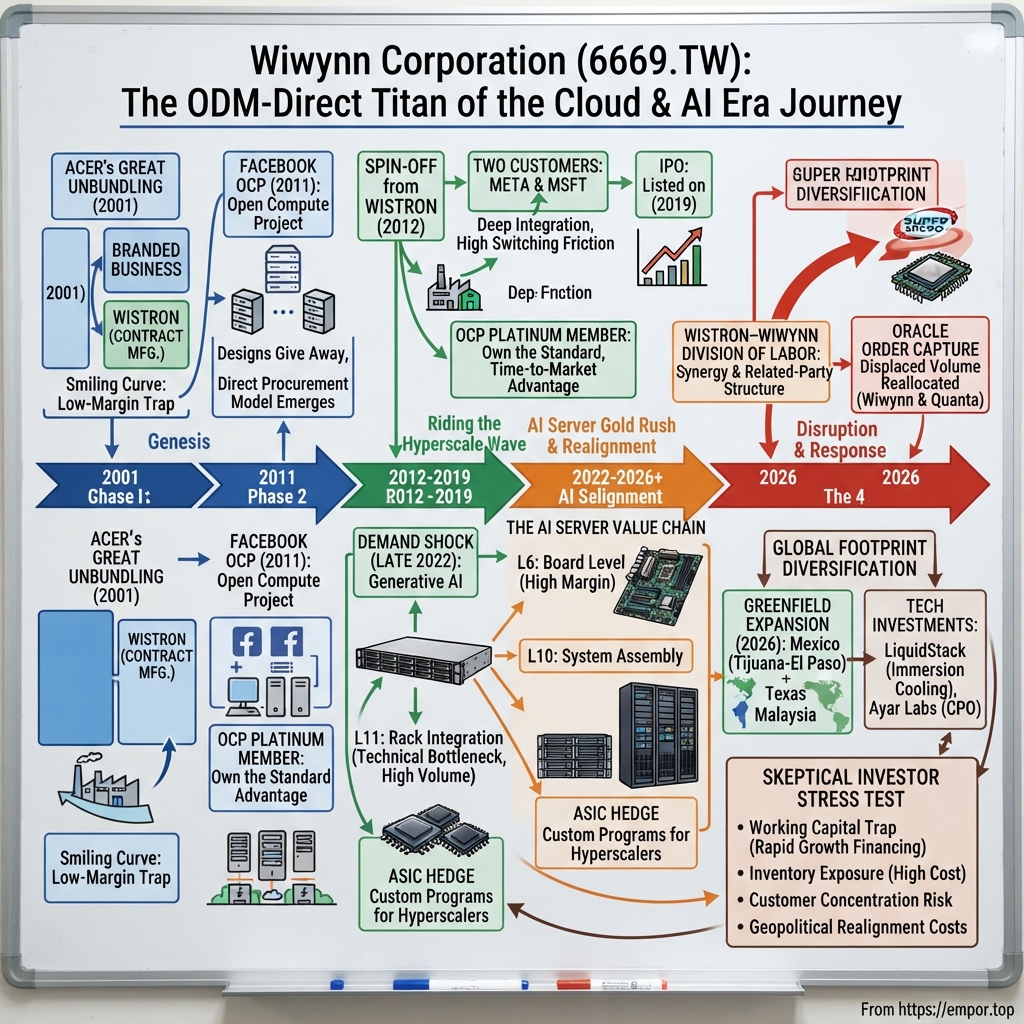
Wiwynn Corporation: The ODM-Direct Titan of the Cloud & AI Era
I. Introduction & Episode Roadmap
There is a building in Hsinchu, Taiwan, that almost nobody outside the hardware industry could pick out of a lineup. No flagship store. No consumer logo. No Super Bowl ad. If you asked a hundred people in San Francisco which company physically built the server racks humming inside the data centers that trained the AI models they use every day, ninety-nine of them would guess wrong.
The answer, for a substantial share of those racks, is 緯穎科技股份有限公司 Wiwynn Corporation.
The scale of this operation defines the story. In fiscal year 2025, Wiwynn reported consolidated revenue of roughly NT$950.66 billion—exceeding US$30 billion—after growing more than 160% year over year.[^1] For an enterprise with an already large base, such rapid expansion is rare. Wiwynn achieved this growth as a primary hardware integrator of the generative AI boom, assembling silicon designed in Santa Clara and Redmond into multi-ton steel cabinets filled with copper, liquid cooling systems, and compute nodes shipped to data centers in Virginia, Oregon, and Johor.
Yet the primary driver of this expansion is structural. Wiwynn was established on a bet made in Taiwan in 2012: that the traditional branded server industry—including HPE, Dell, and IBM's former x86 business—faced disintermediation, and that capitalizing on this shift required a new entity unencumbered by legacy channel relationships.
That model is known as original design manufacturer direct, or ODM-direct. Hyperscale cloud providers bypassed traditional hardware brands to procure equipment directly from the factories that had long built the underlying hardware. By eliminating brand markups, hyperscalers designed servers tailored to their proprietary software rather than off-the-shelf product catalogs. The strategy serves as a classic illustration of what strategist Hamilton Helmer calls counter-positioning: a business model that incumbent brand-name vendors recognized but could not replicate without undermining their existing distribution channels and margin structures.
The model also carries inherent strategic tension. Wiwynn expanded by making itself integral to a highly concentrated group of cloud buyers, notably Meta, Microsoft, and Amazon Web Services. These customers exert immense purchasing power. When Wiwynn's revenue surged, the expansion was driven by capital expenditure decisions made by those hyperscalers rather than initiatives within Wiwynn's direct control. Customer concentration provides massive scale during upcycles, but exposes the business to volatility whenever those buyers adjust spending.
The narrative follows a clear roadmap. It begins in 2001 with the restructuring of 宏碁 Acer and the birth of 緯創資通 Wistron, the contract manufacturer that provided Wiwynn's organizational roots and supply chain foundation. It moves to 2011, when Facebook open-sourced its data center specifications through the Open Compute Project, providing Taiwanese manufacturers with a direct-to-cloud business model. It traces Wiwynn's spin-off in 2012, its public listing in 2019, and its position during the unprecedented demand shock in hardware following late 2022. The analysis evaluates the mechanics of the AI server value chain—explaining L6, L10, and L11 integration levels and their margin impacts—alongside market realignments following corporate governance turbulence at Super Micro Computer in 2026. It follows capital investments migrating out of China into Mexico, Texas, and Malaysia, before evaluating cash flow mechanics: an enterprise expanding revenue by 163% while raising US$2 billion in convertible debt to fund inventory reveals working capital demands that extend beyond top-line income figures.
The story begins where many Taiwanese technology industry shifts take root: with an executive decision that a corporate empire was too large to remain unified.
 Subscribe on LinkedIn
II. The Genesis: Spinoff from Wistron & The Birth of ODM-Direct
Acer's Great Unbundling
In 2000, 宏碁 Acer faced a structural conflict: it was competing directly with its own manufacturing clients. Acer sold personal computers under its own brand across Europe and Asia, while simultaneously manufacturing hardware under contract for IBM, Dell, and other leading global brands. Whenever Acer’s branded sales team won an enterprise deal, one of its contract manufacturing clients lost a sale, creating friction with key clients.
In 2001, Acer founder 施振榮 Stan Shih resolved the conflict by splitting the enterprise into two distinct operations. Acer’s design and contract manufacturing division was spun off into an independent company, 緯創資通 Wistron, headed by longtime Acer executive 林憲銘 Simon Lin.5 Acer retained the consumer brand business, while Wistron assumed control of manufacturing facilities, engineering teams, and existing supplier relationships with major hardware brands.
The restructuring reflected Shih’s "smiling curve" framework, which illustrated that value in the IT electronics supply chain concentrates at the outer edges—component innovation and intellectual property on one side, branding and customer service on the other—while middle-tier assembly yields the lowest profitability. The split separated the branded business from assembly operations, leaving each to pursue its own strategy.
Wistron was left operating at the base of that value curve.
The Low-Margin Trap
That dynamic governed Taiwanese contract manufacturing for two decades. When a US hardware brand sold a server for US$10,000, it typically captured a gross margin in the 20% range or higher. Meanwhile, the Taiwanese original design manufacturer (ODM) that engineered and built the machine recorded single-digit gross margins. The brand commanded higher margins by managing enterprise sales, customer support, and solution architecture, while the ODM functioned primarily as a low-cost supplier.
This division of labor persisted because managing enterprise distribution channels required substantial capital and specialized infrastructure. A commercial client purchasing a cluster of servers required dedicated sales representatives, solution architects, and strict on-site service agreements. Because Taiwanese ODMs lacked that enterprise sales and service network, they remained locked into lower-margin assembly roles.
The arrangement left contract manufacturers with limited strategic flexibility. If Wistron had attempted to sell directly to commercial clients, it would have competed with major OEM customers like Dell and Hewlett-Packard, which generated the bulk of Wistron's revenue. The traditional enterprise sales channel effectively insulated established hardware brands from direct competition by their contract manufacturers.
That dynamic shifted when a new class of cloud buyers emerged that did not require traditional sales channels.
2011: Facebook Gives the Designs Away
In April 2011, Facebook altered the hardware landscape by publicly releasing the hardware and facility designs for its Prineville, Oregon data center—including server architectures, power distribution systems, and mechanical schematics—and establishing the Open Compute Project (OCP) as an open-source hardware organization.6
Facebook's initiative was driven by practical economics. Standard commercial servers were designed with legacy features that hyperscale environments did not require, such as VGA monitor ports, decorative bezels, and complex internal redundancy designed for standalone corporate IT environments. Because Facebook’s distributed software architecture handled system failures at the application level, paying a premium for redundant hardware components proved inefficient.
Instead, Facebook developed custom hardware: removing extraneous components, adopting wider rack dimensions to improve airflow, and centralizing power conversion at the rack level. By publishing these open specifications, Facebook bypassed traditional brand channels and invited Taiwanese manufacturers to build and deliver servers directly to its specifications.
By open-sourcing the designs, Facebook created a direct procurement model. Contract manufacturers no longer needed an intermediary brand to reach hyperscale customers, as specifications were public and buyers engaged directly with suppliers.
Traditional hardware vendors faced structural hurdles in responding to this shift. While legacy OEMs could manufacture hardware to OCP specifications, their business models maintained global sales and support networks that hyperscale cloud providers did not need. Adapting to low-margin direct sales risked cannibalizing the profitable enterprise revenue streams that sustained their operations.
March 2012: The Clean Sheet
For Wistron, this shift presented an organizational challenge. Simon Lin and enterprise business lead 洪麗寗 Emily Hong recognized the market potential of the OCP model, but pursuing direct hyperscale sales risked alienating key OEM clients such as Dell and Hewlett-Packard.
To resolve this conflict, Wistron opted for corporate separation. In 2012, Wiwynn Corporation was established as an independent Wistron subsidiary focused exclusively on delivering rack-scale, workload-optimized hardware directly to hyperscale cloud operators.1
This corporate structure provided distinct operational advantages. Wiwynn established an independent brand identity free of OEM client conflicts, alongside a transparent profit-and-loss structure that reflected the economics of direct hyperscale sales. The standalone entity built an engineering culture tailored to custom co-design rather than standardized product catalogs. Crucially, Wiwynn retained access to Wistron’s established manufacturing infrastructure, component procurement scale, and global supply chain network.
Emily Hong led the strategic execution of this direct-to-cloud model. Building her career in enterprise hardware, Hong focused on the technical interface between customers and engineering teams—translating complex hyperscale workload requirements into hardware specifications. In an ODM-direct model where hardware requirements frequently shift, custom co-design capabilities became a primary competitive differentiator.
Establishing Wiwynn as a separate entity enabled Wistron to capture emerging hyperscale demand while safeguarding its traditional contract manufacturing relationships. By granting the new subsidiary operational independence and dedicated leadership, Wistron positioned Wiwynn to compete directly in the expanding cloud infrastructure market.
What Wiwynn needed next were major hyperscale customers willing to bet on its new model.
III. Riding the Hyperscale Wave: OCP Pioneer Status
Two Customers, No Safety Net
Consider Wiwynn's operational profile in 2013: an enterprise dependent on two primary American internet clients for nearly all of its revenue, operating without a consumer brand, a traditional sales channel, or off-the-shelf products. Under standard financial risk models, such customer concentration presented significant vulnerability. Yet within the expanding cloud hardware sector, it positioned Wiwynn at the center of hyperscale growth.
Wiwynn's early expansion relied on co-design partnerships with Facebook and Microsoft—the two hyperscalers that moved earliest and most aggressively toward custom, open-source infrastructure.1 For Wiwynn, customer concentration was an intentional feature of the ODM-direct model rather than an operational oversight. Delivering ODM-direct infrastructure requires selling engineering capabilities rather than standard catalog hardware. Dedicated engineering teams embed directly within a customer's infrastructure operations to align hardware designs with specific software failure modes, thermal limits, power distribution systems, and maintenance workflows. Because of the intensive resources required, these deeply integrated relationships naturally concentrate among a small group of high-volume buyers.
Once established, these co-design partnerships create high switching friction for hyperscale clients. Although cloud operators maintain secondary sourcing policies, replacing an incumbent ODM requires a competing manufacturer to replicate years of accumulated technical context and operational familiarity. In high-density data center deployments, the delay associated with onboarding a new hardware partner often outweighs potential unit-cost savings.
Owning the Standard
Alongside its customer partnerships, Wiwynn established itself as a primary contributor within the Open Compute Project (OCP).
Wiwynn became an early Platinum-tier member of OCP, and Emily Hong served as chairperson of OCP Taiwan from 2015 to 2019.16 That leadership role provided strategic visibility into emerging technical standards. Within OCP working groups, industry members define upcoming specifications for rack dimensions, power shelf voltages, connector interfaces, and liquid cooling standards long before public release. Participating in design specifications twelve to eighteen months prior to publication gave Wiwynn a distinct time-to-market advantage in an industry where rapid deployment is critical.
This collaborative model also helped consolidate cloud hardware manufacturing in Taiwan. While OCP architectural concepts originated in the United States, execution centered on Taiwanese engineering and manufacturing networks, with Wiwynn's standards engagement reinforcing that regional ecosystem.
However, standards participation provides a temporary operational lead rather than a permanent competitive moat. Because OCP specifications are open, competing manufacturers such as Quanta Computer, Inventec, and Foxconn—alongside cloud operators themselves—participate in the same technical committees. Early access to open specifications yields an advantage measured in months, which does not generate traditional network effects. OCP leadership served primarily as a vital credibility asset during Wiwynn's formative years, establishing technical authority while generating modest informational leads.
The Economics, Plainly
The economic rationale driving hyperscale adopters toward the ODM-direct model rests on three distinct operational advantages.
First, the model eliminates traditional brand markups. Cloud operators purchase hardware at manufacturing cost plus an agreed assembly margin, removing the overhead costs associated with third-party distribution channels.
Second, direct collaboration enables workload optimization at scale. Unlike commercial enterprises requiring balanced, general-purpose servers, hyperscalers deploy specialized infrastructure. A storage-intensive service requires maximum drive density per rack with minimal compute overhead, whereas an artificial intelligence inference cluster demands high-density accelerator configurations. Off-the-shelf OEM servers represent a compromise across diverse corporate needs, whereas co-designed hardware eliminates unnecessary components. Across deployments of hundreds of thousands of units, minor hardware efficiency gains translate into substantial capital expenditure savings.
Third, direct procurement shortens product development cycles. When engineering teams interact directly with manufacturing partners, hardware adjustments and field modifications occur within weeks rather than across multi-year OEM product release schedules.
Crucially, these advantages stem from the ODM-direct business framework itself rather than features exclusive to Wiwynn. Because hyperscalers retain the underlying design IP and can theoretically shift manufacturing to competing ODMs, maintaining client relationships requires continuous execution and cost efficiency.
March 2019: Going Public
In March 2019, Wiwynn listed on the Taiwan Stock Exchange under ticker 6669, offering public investors a dedicated vehicle focused on hyperscale cloud infrastructure unencumbered by legacy consumer electronics or notebook assembly operations.1
The public listing established financial transparency, enhanced talent retention mechanisms, and expanded Wiwynn's balance sheet capacity—a factor that proved critical when working capital requirements surged in subsequent years. The IPO also provided audited visibility into ODM-direct financial dynamics.
The disclosures revealed a business model characterized by modest gross margins, high asset turnover, and top-line performance tightly linked to the capital expenditure budgets of major cloud providers. For several years following the listing, this structure delivered steady, volume-driven growth—setting the stage for the hardware demand shock that arrived with the surge in generative AI deployment in late 2022.
IV. The AI Server Gold Rush & The Parent-Subsidiary Division of Labor
The Architecture Changed Overnight
For roughly fifteen years, hyperscale data center buildouts followed a predictable pattern. Servers became incrementally faster, denser, and more energy-efficient. A single rack drew roughly 5 to 15 kilowatts, cooled by air moving through the chassis. The fundamental unit of procurement was the individual server.
The expansion of generative AI altered those assumptions.
The training and inference workloads that accelerated after late 2022 required a fundamental shift in computing architecture. High-density accelerator clusters linked by high-bandwidth interconnects created power densities that rendered conventional air cooling inadequate. Under these operating conditions, the basic unit of hardware procurement shifted from individual servers to fully integrated racks and multi-rack rows.
This shift reshaped value distribution across the supply chain, a dynamic best understood by examining how the server industry categorizes manufacturing stages.
L6, L10, L11: What Actually Gets Built Where
The server supply chain divides manufacturing into distinct "L" level integration stages, three of which dictate margin structures and capital requirements.
L6 is board level. At this stage, surface-mount technology places and solders hundreds of components onto bare printed circuit boards to produce finished motherboards or GPU baseboards carrying multiple accelerators. Equivalent to building an engine block, L6 manufacturing is capital-intensive, precision-driven, and yield-sensitive. Because manufacturing defects at this stage risk damaging expensive silicon, customer qualification processes require years to complete. Consequently, L6 commands the highest gross margin percentages in the hardware assembly chain.
L10 is system assembly. Manufacturers install finished boards into a chassis alongside CPUs, memory modules, storage drives, power supplies, and cooling fans, followed by cabling, firmware flashing, and system testing. Akin to assembling a vehicle around an engine, L10 requires less capital investment but demands higher labor and logistics management, resulting in thinner gross margins.
L11 is rack integration. Operators mount dozens of L10 systems into a server rack, integrating network switches, power distribution shelves, busbars, cable harnesses, and liquid cooling systems equipped with manifolds, cold plates, and coolant distribution units. The entire assembly undergoes integrated testing before shipping as a two-ton cabinet ready to be connected to data center power, network, and liquid cooling lines.
L11 integration represents the primary technical bottleneck of the AI hardware era. Unlike conventional server racks that served primarily as structural containers, an AI rack functions as an integrated machine featuring hydraulic cooling systems and unified power architectures. Systemic failure modes—ranging from coolant leaks and thermal imbalances to power bus harmonics—require specialized manufacturing infrastructure. Facilities must feature reinforced floor loading, high ceiling clearance, deionized water systems, pressure-leak test benches, high-amperage power infrastructure, and heavy-freight handling capabilities.
The economic profile of L11 integration is defined by thin unit margin percentages offset by high absolute dollar values per rack. Competition is constrained not by proprietary pricing power, but by the substantial operational and capital requirements needed to execute at scale.
The Wistron–Wiwynn Division of Labor
This manufacturing landscape highlighted the strategic utility of the 2012 corporate separation.
Wistron, the parent company, established a significant footprint in board-level AI manufacturing, focusing on high-complexity GPU baseboards at the L6 level. Wiwynn, operating as the subsidiary, focused on rack-scale integration, supplying L10 and L11 systems directly to hyperscale cloud providers.51
This structure established a complementary operational relationship across the corporate group. Wiwynn’s direct customer relationships drive volume, while Wistron’s board-level manufacturing supplies high-value subassemblies. By participating at multiple stages of the manufacturing cycle, the combined enterprise captures margin across the value chain while securing volume purchasing leverage for memory, power modules, and mechanical components.
However, this architecture also establishes a related-party structure between a listed parent and a listed subsidiary. Financial analysts monitor such arrangements for intra-group dynamics, including transfer pricing mechanisms, component allocation during supply shortages, and program assignments between affiliates. While public disclosures reflect standard operating compliance, disclosure quality on intra-group transactions remains a key tracking metric in annual reporting.
The ASIC Hedge
Wiwynn’s strategic positioning in AI infrastructure extends beyond merchant GPU architectures.
To mitigate reliance on dominant silicon vendors, major cloud providers have developed proprietary custom application-specific integrated circuits (ASICs)—such as Microsoft’s Maia series and Meta’s Training and Inference Accelerator (MTIA). These custom processors require specialized system design and rack-level integration to move from foundry fabrication to data center deployment.
Wiwynn serves as a primary integration partner for custom ASIC programs across its core hyperscaler client base.
This diversification alters the underlying unit economics. In standard GPU-based racks, high accelerator costs dominate the overall bill of materials, which mechanically compresses the integrator's gross margin percentage despite expanding total top-line revenue. Custom ASIC deployments involve deeper co-engineering during early design phases, shifting the integrator's role toward customized system development.
Positioning for custom silicon serves as an operational hedge. If cloud capital expenditure tilts further toward in-house silicon over time, Wiwynn’s engineering integration model remains aligned with customer spending.
However, custom ASIC programs introduce distinct risk profiles. Unlike standardized GPU servers, custom ASIC architectures are tied to specific proprietary software environments. An ASIC rack built for Meta's MTIA infrastructure cannot be reallocated to alternate buyers. Consequently, while custom ASIC integration reduces exposure to component supplier concentration, it increases reliance on individual hyperscale procurement decisions.
The 2025 Numbers, and What They Mean
In fiscal year 2025, Wiwynn reported consolidated revenue of approximately NT$950.66 billion, representing a 163.7% year-over-year increase, with AI-related products accounting for over half of total sales.[^1] This expansion marked a sharp shift from 2024, when quarterly revenues reflected standard enterprise hardware manufacturing cycles.2
These figures reflect three distinct operational dynamics.
First, the surge underscores the scale of hyperscale AI infrastructure investment during fiscal 2025.
Second, the top-line growth highlights internal execution capacity. Tripling the physical output of complex, liquid-cooled server racks within twelve months required simultaneous scaling of factory floor space, technical labor, supply chain commitments, and quality control systems without compromising defect rates.
Third, rapid top-line revenue expansion does not automatically translate into proportional earnings quality or cash flow generation. When high-cost processors dominate the bill of materials, reported revenue expands faster than net added value, causing gross margin percentages to compress even as absolute gross profit dollars rise. Furthermore, inventory financing requirements grow in proportion to total revenue rather than net income—a working capital dynamic that shapes the financial structure of high-volume hardware integrators.
V. The Super Micro Collapse & The Oracle Market Share Capture
When Governance Becomes an Operating Risk
One form of competitive advantage stems not from proprietary technology, lower costs, or deep customer relationships, but from operational reliability: remaining a vendor that creates no governance friction.
Super Micro Computer spent the early years of the AI expansion as one of its primary beneficiaries, driven by rapid product cycles, early liquid-cooling capabilities, and founder-led execution that delivered accelerator systems faster than larger competitors. As speed dominated purchasing decisions, Super Micro captured significant market share.
However, between 2024 and 2026, the company became embroiled in accounting, audit, and disclosure challenges that transformed it from an agile vendor into a corporate governance concern. In hyperscale AI infrastructure, governance issues represent direct operational risks. Buyers committing to multi-billion-dollar infrastructure deployments are purchasing delivery certainty—ensuring server racks arrive on schedule to align with data center lease commitments.
According to industry reporting in April 2026, Oracle cancelled an AI server rack order with Super Micro valued between US$1.1 billion and US$1.4 billion, with Wiwynn and 廣達電腦 Quanta Computer identified as the beneficiaries of the displaced volume.3
What the Reallocation Actually Demonstrates
Analyzing this market reallocation reveals several distinct operational implications for the server supply chain.
First, absorbing displaced volume of this scale on short notice requires physical and operational infrastructure that few integrators possess. Integrators require qualified factory floor space, liquid-cooling test capacity, established accelerator supply allocations, and compliance standards acceptable to buyers avoiding disclosure risks.
Second, Oracle allocated the displaced orders to both Wiwynn and Quanta Computer rather than selecting a single supplier. This division highlights the commoditized nature of contract manufacturing: when integration capabilities are scarce rather than uniquely proprietary, buyers distribute risk across multiple qualified suppliers. If integration capabilities were strictly proprietary, the reallocated volume would have been less divisible.
Third, the financial terms of emergency reallocations typically favor the buyer. A customer facing an urgent delivery deadline with two willing suppliers retains significant bargaining leverage during price discovery. Consequently, investors cannot assume that revenue captured under emergency reallocations yields the same margin profile as long-term, co-designed programs established with core customers like Meta or Microsoft.
The Executives in the Room
Executing such a rapid order intake relies on Wiwynn's senior management, led by CEO 林建勛 William Lin and chair Emily Hong, who transitioned from establishing the firm's customer-engineering operations to leading corporate strategy as the business scaled.
Managing emergency order absorption presents delicate supply chain trade-offs: pulling forward component allocations, securing air freight, and expanding burn-in lines without delaying commitments to existing clients. Hyperscale buyers closely monitor how integrators navigate competitors' operational disruptions, evaluating whether a supplier will defer existing delivery schedules to pursue opportunistic volume. Successfully integrating new orders while maintaining existing delivery dates reinforces customer trust, whereas delaying established commitments undermines long-term relationships.
While public disclosures do not indicate whether Wiwynn adjusted existing delivery schedules to absorb the Oracle orders, the episode demonstrated that regulatory compliance and corporate disclosure standards function as commercial differentiators in high-stakes infrastructure procurement. Rather than operating purely as overhead, established governance and transparency can serve as effective customer acquisition tools during market realignments.
This shift introduced another critical evaluation metric for hyperscale buyers during the same period: evaluating not just vendor governance, but factory geography.
VI. Reshaping the Global Footprint: Moving Out of China
The Map Became the Product
For three decades, the central question in Taiwanese electronics manufacturing had a single answer: China. The region offered proximity, scale, an entire supplier ecosystem within a short drive, and an unmatched cost structure.
Between 2018 and 2025, that framework shifted as customer procurement criteria evolved. US export controls on advanced computing, expanding tariff regimes, security requirements for government and defense workloads, and geopolitical concerns regarding the Taiwan Strait combined into a requirement that was unprecedented a decade earlier: manufacturing hardware outside the traditional footprint. In the most stringent cases, hyperscale buyers mandated production outside both China and Taiwan.
This shift represented a redundancy requirement rather than a cost optimization, adding structural expense. Wiwynn's geographical realignment illustrates how management approaches capital deployment under these constraints.
Building Rather Than Buying
The standard approach to rapidly acquiring North American manufacturing capacity is buying an established contract manufacturer with existing facilities, permits, and workforce. Wiwynn largely avoided acquisitions, opting instead for organic footprint expansion through greenfield and brownfield projects built to its own specifications.
In early 2026, the board approved capital injections totaling roughly US$470 million into its US and Mexican subsidiaries to scale operations in Tijuana, Mexico, and El Paso, Texas.4
The Tijuana–El Paso corridor functions as a targeted industrial strategy. Northern Mexico provides a mature electronics manufacturing workforce at labor costs below US levels within the North American trade framework, enabling truck delivery to US data center markets within days. Texas provides the US-soil manufacturing footprint required for specific regulated workloads. Operating the locations as an integrated corridor allows Wiwynn to perform labor-intensive sub-assembly in Mexico while reserving final integration, testing, and secure handling for the US facility.
Separately, Wiwynn has expanded manufacturing capacity in Johor, Malaysia, positioning facilities to serve Southeast Asia's data center buildout. Development in Johor has accelerated due to its proximity to Singapore, where land and power constraints have limited local data center expansion.
Minority Stakes Instead of Takeovers
Wiwynn applies a similar capital framework to technology acquisitions, securing targeted minority positions rather than purchasing companies outright.
The most prominent example is LiquidStack, in which Wiwynn invested approximately US$45 million to secure access to both single-phase and two-phase immersion cooling technologies.
The technical distinction between cooling architectures clarifies why this investment matters. Traditional air cooling forces air across heat sinks, but air is an inefficient thermal conductor. Above specific power densities per rack, air cooling cannot dissipate heat rapidly enough regardless of fan capacity. Direct-to-chip liquid cooling routes liquid coolant through cold plates attached directly to primary processors—a setup that has become standard for high-power accelerator racks. Immersion cooling goes further by submerging entire systems in non-conductive dielectric fluid. Single-phase immersion circulates fluid through an external heat exchanger, while two-phase immersion allows fluid to boil on hot components and condense on cooling coils, capitalizing on the heat absorption of phase transitions.
Immersion cooling offers superior thermal capacity but introduces operational complexity, altering technician maintenance workflows, component qualification standards, and data center plumbing infrastructure. Because market adoption at scale remains uncertain, taking a minority stake rather than acquiring a vendor limits capital exposure while securing access to technology development.
Wiwynn has also partnered with Ayar Labs on co-packaged optics (CPO), which integrates optical interconnects directly onto the chip package rather than at the edge of the printed circuit board. As AI clusters expand, transferring data between accelerators consumes a growing share of total system power, creating a bottleneck on cluster scale. Co-packaged optics offers a potential solution, though the technology remains largely on product roadmaps rather than generating immediate commercial revenue.
The Discipline Question, Tested Honestly
Management and market analysts frequently characterize Wiwynn's strategy as disciplined capital allocation. While the structure is deliberate, its long-term return on capital requires ongoing evaluation.
The evidence shows that Wiwynn avoided high-multiple acquisitions that often impair capital in hardware manufacturing, structuring its technology investments as operational options rather than full corporate commitments.
However, the commercial returns on these investments remain unresolved. A US$45 million stake in immersion cooling yields value only if the technology achieves broad adoption or directly generates customer design wins that Wiwynn would not have otherwise captured. The same condition applies to co-packaged optics. Neither technology currently represents a material share of Wiwynn's commercial shipping volume.
The larger financial commitment involves simultaneous factory construction in Mexico, Texas, and Malaysia during a period of peak hardware demand. Greenfield manufacturing carries a known risk: production capacity frequently comes online after demand cycles peak. The compressed buildout schedules of the AI boom heighten this exposure.
The primary metric evaluating this expansion is not top-line revenue, but capacity utilization—the percentage of installed integration capacity actively operating. Utilization rates will determine whether the geographical expansion yields sustainable returns or excess overhead, though hardware integrators rarely disclose these figures in detail.
Furthermore, expanding physical footprint while tripling unit shipments requires substantial liquidity—demanding far more working capital than indicated by top-line earnings alone.
VII. Skeptical Investor Stress Test: The Working Capital Trap
The Problem Hiding Behind the Growth
Consider a single physical product: a fully configured NVIDIA GB200 NVL72 rack—housing seventy-two integrated, liquid-cooled accelerators—carries an estimated system cost of US$2 million to US$3 million.
The financial impact on an integrator's balance sheet becomes evident as that hardware moves through production.
Wiwynn must procure accelerators, memory modules, power components, cooling systems, and structural chassis. The company holds these capital-intensive inputs throughout assembly and testing before shipping the finished rack to customers—hyperscalers among the largest and most procurement-disciplined corporations globally, which negotiate payment terms from positions of strength.
The interval between paying component suppliers and collecting customer receivables defines the cash conversion cycle. For a high-volume server integrator, this timing gap is a central financial reality: every incremental rack shipped consumes cash well before generating collections. Expanding revenue by 163% in a single year requires financing an expanding volume of high-value inventory and accounts receivable.
This working capital requirement explains why a company experiencing rapid top-line growth has repeatedly returned to capital markets for external financing.
The Financing Record
Wiwynn has maintained a regular presence in capital markets, providing a clear record regarding its balance sheet self-sufficiency.
In October 2024, the company executed a concurrent offering of global depositary receipts and convertible bonds—an equity-and-equity-linked raise completed during a period of strong revenue growth.[^8] In March 2026, Wiwynn completed the largest overseas zero-coupon convertible bond offering in Taiwanese history, raising approximately US$2 billion explicitly to fund working capital and inventory requirements.7
Deconstructing the March 2026 issuance structure illustrates management's approach to financing.
The zero-coupon structure eliminates ongoing cash interest payments. In exchange, bondholders receive conversion options tied to a premium over the share price at issuance. Wiwynn effectively monetized equity optionality to avoid interest costs. If the stock appreciates, conversion dilutes existing equity; if the share price lags, Wiwynn faces a substantial cash principal repayment at maturity.
Compared to alternative financing options—such as equity offerings or bank debt carrying interest expense against single-digit margins—a zero-coupon convertible issued during a period of elevated equity valuations represents a structured capital choice. Management secured liquidity reserves ahead of working capital needs rather than during liquidity constraints.
Nevertheless, the financing record demonstrates that Wiwynn funded its rapid expansion substantially through external capital markets rather than internally generated free cash flow. The repeated capital raises contradict assertions that the high-growth model is fully self-sustaining.
Where the Analysts Push
A distinct contrast exists between corporate presentations and investor earnings calls.
Management presentations routinely highlight demand visibility, global facility expansion, custom server design wins, and the growing share of AI revenue—areas where operational execution remains strong.
By contrast, financial analyst queries focus on three structural factors beyond management's direct control:
First, free cash flow generation—specifically, whether working capital requirements normalize or if continued revenue growth requires ongoing external funding.
Second, inventory exposure—at multi-million-dollar unit costs, program cancellations, specification revisions, or rapid silicon transitions create potential write-down risks that could impact operating profitability. With accelerator product lifecycles compressing to annual update cycles, the window to clear inventory at full carrying value has narrowed.
Third, potential equity dilution—as the US$2 billion convertible bond issuance represents a potential claim on future equity capital.
In response to cash flow concerns, management has indicated that working capital demands will normalize as revenue growth rates moderate. While mathematically consistent, this dynamic reflects the mechanics of inventory management rather than structural margin expansion.
Institutional investors frame the core question directly: whether expanding revenue scale fundamentally alters bargaining power when operating as an integrator for a concentrated buyer base that retains significant market power.
Current financial disclosures do not yet demonstrate structural margin expansion from scale. The grounded investment thesis relies not on pricing power, but on scarce physical integration capacity during periods of peak infrastructure demand. Capitalizing on temporary integration bottlenecks produces top-line expansion during industry upcycles, but differs fundamentally from long-term product differentiation.
The operational benchmark for evaluating this model centers on gross margin trajectory as custom ASIC integration expands and manufacturing facilities in Mexico, Texas, and Malaysia reach full production capacity. Margin expansion would indicate that integration capabilities command premium pricing, whereas flat or compressing margins during revenue growth would suggest hyperscale buyers capture the underlying economic gains.
This strategic positioning can be evaluated through two distinct analytical frameworks.
VIII. Strategic Analysis: Helmer's 7 Powers & Porter's 5 Forces
The Powers Wiwynn Actually Has
Counter-positioning was Wiwynn's foundational advantage, though its strategic potency has largely expired. In 2012, Wiwynn adopted an ODM-direct model that legacy hardware vendors like HPE, Dell, and IBM could not match without undermining their existing distribution channels and margin structures. That dynamic created a genuine, durable advantage for roughly a decade and established Wiwynn's market presence. However, counter-positioning functions primarily against established incumbents. Today, legacy brand vendors no longer dominate cloud hardware procurement, and Wiwynn's primary competitors—廣達電腦 Quanta Computer, 鴻海 Foxconn, and 英業達 Inventec—operate under the identical direct model without legacy channel commitments. Consequently, counter-positioning represents a historical catalyst rather than a current competitive moat.
Switching costs provide real operational friction, though their strategic protection is constrained. A hyperscale cloud provider that has co-designed a server rack architecture, qualified its build, and integrated it into operating workflows faces meaningful friction when changing suppliers. This friction stems from engineering overhead and deployment schedule risks rather than restrictive long-term contracts. However, cloud operators deliberately maintain dual-sourcing strategies to preserve flexibility—as illustrated by the Oracle order reallocation, which showed how rapidly volume shifts when a customer chooses to reassign production. Hyperscalers leverage this dual-sourcing capability to maintain pricing pressure. Consequently, switching costs slow customer departures and support market share retention, but they do not grant Wiwynn meaningful pricing power.
Scale economies function primarily at the corporate group level through 緯創資通 Wistron's consolidated component procurement and global manufacturing footprint. While this scale provides essential purchasing leverage, it does not confer a unique advantage over direct peers. Foxconn commands significantly greater overall purchasing volume, while Quanta operates at a comparable scale. Within high-volume server integration, procurement scale operates as a prerequisite for market entry rather than a structural differentiator.
Process power represents Wiwynn's most credible current operational advantage, even if third-party verification remains difficult. Designing, integrating, testing, and delivering complex liquid-cooled rack systems at scale with low defect rates requires accumulated operational expertise that cannot be easily replicated. Wiwynn's fiscal year 2025 execution—tripling output without an evident quality failure—provides the best available evidence for this capability.[^1] However, evaluating process power based on a single high-demand fiscal year without public comparative data on defect rates or on-time delivery metrics means this advantage is supported by performance trends rather than conclusively proven.
Wiwynn lacks three of Helmer's other strategic powers. There are no network effects, as an expanding customer base creates no direct utility for other hyperscale buyers. Branding yields negligible pricing power in a market where technical buyers evaluate hardware purely on unit economics and performance specifications. Finally, Wiwynn possesses no cornered resource, as accelerator allocations are controlled by silicon vendors such as NVIDIA and by the hyperscalers themselves rather than the hardware integrator.
The Five Forces, Unflattering Edition
Buyer power is extremely high and represents the dominant force shaping the business. A concentrated group of hyperscale cloud operators accounts for the vast majority of Wiwynn's total revenue. These buyers possess sophisticated procurement operations, deliberately maintain qualified secondary suppliers, and maintain detailed insight into component costs since they specify most of the bill of materials. Furthermore, cloud providers retain full operational flexibility to reallocate volume among Wiwynn, Quanta, Foxconn, and Inventec. This extreme customer concentration limits hardware integrators' bargaining leverage and makes buyer spending decisions the single most critical factor in Wiwynn's financial performance.
Supplier power is high and concentrated in key component markets. NVIDIA controls the allocation of key graphics processors, while 台積電 TSMC commands advanced packaging capacity that serves as a primary physical bottleneck for AI silicon production. Additionally, high-bandwidth memory supply is concentrated among a small number of semiconductor manufacturers. As a result, Wiwynn operates as an intermediary positioned between powerful suppliers and dominant buyers, both of which command greater pricing power—a structural dynamic that keeps hardware integration margins thin.
Competitive rivalry is intense and largely rational. Major competitors such as Quanta and Foxconn possess substantial capital, established engineering capabilities, and direct access to the same hyperscale client base. During demand surges, rivalry rarely manifests as destructive price competition because integration capacity remains constrained, leading buyers to prioritize delivery speed over minor unit-cost discounts. However, this pricing discipline reflects favorable market conditions during buildout cycles; if market demand moderates and creates excess integration capacity across major manufacturers, price competition would likely intensify.
Threat of substitutes is low in the short term but presents long-term considerations. Cloud operators will continue expanding data center infrastructure, maintaining high demand for server integration. However, hyperscalers periodically evaluate bringing a larger share of rack assembly in-house. Alternatively, if major silicon vendors expand direct sales of fully integrated reference systems to cloud providers, the scope of the traditional hardware integrator's role could contract.
Threat of new entrants is low at the high end. The physical and capital requirements for high-volume, liquid-cooled L11 integration—including specialized factory floor space, advanced cooling infrastructure, high-power testing capabilities, heavy freight logistics, and multi-year customer qualification processes—create substantial entry barriers. This high barrier to entry represents the most favorable competitive force for established integrators, enabling capable providers to generate solid returns despite limited buyer leverage.
Ultimately, server integration remains a structurally challenging industry in which Wiwynn occupies a strong competitive position. The business benefits from high technical entry barriers while operating in a market where suppliers and buyers capture most of the economic surplus. In this structural environment, financial returns depend on shipment volume, operational execution, and rapid asset turnover rather than gross margin expansion.
IX. The Investment Case: Bull vs. Bear Debate & Risk Radar
What Would Have to Be True
The bull case rests on four primary arguments, which vary in structural strength.
One: Wiwynn is among a very small number of firms that can deliver liquid-cooled AI racks at hyperscale volume. This is supported by the company's fiscal 2025 output and by Oracle's choice set during its vendor reallocation.[^1]3 It represents the strongest leg of the bull case. However, its main limitation is that scarcity reflects temporary industry capacity constraints, and capable competitors are expanding capacity as rapidly as Wiwynn.
Two: The custom ASIC business provides structural protection from an NVIDIA-dominated world. This claim is directionally sound, subject to a key caveat: custom ASIC integration substitutes customer concentration for supplier concentration rather than reducing overall business exposure.
Three: The Wistron relationship provides sourcing and technology advantages a standalone integrator lacks. This structural advantage is genuine, though it remains subject to related-party governance oversight.
Four: Competitor governance failures represent a durable share gain. This is the weakest leg. Market share captured during a competitor's crisis is won on terms dictated by an urgent buyer, and rivals eventually recover. It functions as a temporary timing benefit rather than a permanent moat.
The bear case is simpler and more difficult to dismiss.
Thin value-added margins at L10 and L11 leave Wiwynn structurally exposed to buyers who routinely play integrators against one another. The company operates in the flattest section of Stan Shih's smiling curve—the same assembly position Wistron occupied in 2001, but now on a far larger base with substantially more expensive inventory. The AI expansion did not move Wiwynn up the value curve; it simply routed higher volume through the same thin-margin segment.
Cash conversion has not kept pace with reported growth, requiring recurring external capital to fund expansion.[^8]7 The bullish counterargument holds that working capital strain is a standard feature of rapid growth in hardware assembly that normalizes when revenue growth moderates. While logically sound, that argument concedes the underlying vulnerability: the business model generates substantial free cash flow primarily when top-line expansion slows.
Risk Radar
Customer concentration is the primary first-order risk and requires no external catalyst to materialize. A single hyperscale client shifting from an aggressive build cycle to a digestion phase represents a material revenue event. Historically, data center capital expenditure has never sustained a full decade without an inventory digestion period.
Inventory and working capital strain functions as the direct secondary consequence. During a demand pause, an integrator holding extensive inventories of generation-specific accelerator hardware faces simultaneous revenue deceleration and inventory write-down exposure. Under those conditions, zero-coupon convertible debt shifts from a prudent liquidity reserve to financial leverage.
Execution risk across three simultaneous international facility buildouts in Mexico, Texas, and Malaysia represents a direct operational challenge.4 Each site requires navigating distinct labor markets, regulatory frameworks, and supply chain logistics in unfamiliar jurisdictions.
Geopolitical risk exerts multi-directional pressures. Footprint diversification is itself a response to geopolitical tensions, meaning relocated facilities remain exposed to evolving trade policies, tariff structures, and export control regulations that can alter plant economics after capital is deployed.
Technology transition risk warrants specific monitoring. Wiwynn's competitive positioning is tied to current-generation power and thermal architectures. Because cooling methods, interconnect topologies, and rack-level power distribution standards remain in flux, minority investments in LiquidStack and Ayar Labs reflect an operational hedge against evolving hardware standards.
The Verdict on the Thesis, Stated Plainly
Evaluating Wiwynn's structural position yields a narrower investment thesis than headline growth figures suggest.
The thesis that Wiwynn possesses a durable competitive moat is narrowed rather than rejected. What exists is an operational capability barrier—built on physical infrastructure, engineering execution, and customer qualifications—that restricts the primary competitive set to roughly four global integrators. What does not exist is pricing power, evidenced by thin margin structures and the speed with which more than a billion dollars in server orders shifted between vendors in 2026.
The claim that management allocates capital with discipline remains plausible but unproven. While investment decisions display conservative structuring, commercial returns are not yet demonstrable. Evaluating capital discipline requires monitoring capacity utilization across new facilities and tracking whether technology stakes translate into customer design wins.
The assertion that Wiwynn is a structurally advantaged AI leader remains intact but unconfirmed. Current performance demonstrates strong operational execution during an industry expansion, which is indistinguishable from a durable structural advantage until tested by a cyclical downturn.
The KPIs That Matter
Three specific metrics dictate the analytical outlook:
First: gross margin percentage, evaluated against revenue mix. This represents the clearest measure of whether Wiwynn captures value or acts as a pass-through integrator. If gross margins hold or expand as the share of AI and custom ASIC programs rises, the value-capture thesis gains empirical support. Conversely, compressing margins during product mix shifts would indicate that hyperscale buyers capture the underlying economic gains.
Second: cash conversion cycle—combining days of inventory, days receivables, and days payables. This metric tracks working capital efficiency. A stable or improving conversion cycle during rapid growth would indicate expanding supply chain leverage. A deteriorating cycle signals that incremental revenue growth consumes expanding external capital, raising the likelihood of future debt or equity offerings.
Third: customer concentration disclosures. The percentage of revenue generated by top clients, as reported in annual filings, remains the primary risk indicator. Diversifying revenue toward additional cloud providers, sovereign AI deployments, or emerging cloud operators would mitigate customer concentration risks. Heightened concentration increases operational vulnerability, regardless of top-line revenue expansion.
Top-line revenue growth is intentionally excluded from these core KPIs. While widely reported, top-line growth primarily reflects the capital expenditure decisions of a small group of major cloud operators rather than Wiwynn's standalone pricing power or structural differentiation.
X. Epilogue & Outro
The company that began as an organizational workaround—a way for Wistron to supply Facebook without alienating Dell—became one of the world's largest hardware providers by revenue. It achieved that scale by occupying a position the technology industry had long considered structurally disadvantaged. When Stan Shih formulated the smiling curve, he intended to warn Taiwanese manufacturers away from low-margin assembly. Wiwynn focused directly on that middle tier, proving that when integration demands sufficient operational scale and technical complexity, it can sustain a massive enterprise.
Whether that model proves durable across an industry downturn remains a question for the next market cycle.
Ultimately, Wiwynn's trajectory highlights how intensely physical the artificial intelligence expansion has turned out to be. The primary constraints governing the buildout have not been purely algorithmic. They are thermal—how to dissipate more than a hundred kilowatts of heat from a single rack cabinet; electrical—how to deliver high-amperage power without melting busbars; logistical—how to transport multi-ton systems from Tijuana to Virginia on compressed schedules; and financial—how an enterprise operating on single-digit gross margins finances billions of dollars in inventory.
Wiwynn operates at the intersection of all four challenges. That positioning explains both its rapid top-line expansion and its persistent balance sheet demands. Over a full market cycle, long-term valuation will be determined not by short-term demand surges, but by working capital management. While software platforms scale by duplicating code at near-zero marginal cost, hardware integrators scale by purchasing, holding, assembling, and shipping multi-million-dollar physical systems—and awaiting collection from powerful hyperscale clients.
The narrative surrounding artificial intelligence is frequently framed as a story about software and models. Viewed from a factory floor in Tijuana or Johor, it is equally a story about heat, copper, and cash.
References
-
Wiwynn Consolidated Financial Results — Taipei Times, 2024-11-05 ↩
-
Super Micro Oracle Order Cancellations and Rivals Impact — Digitimes, 2026-04-18 ↩↩
-
Wiwynn Capital Infusion Approved for US and Mexican Units — Taipei Times, 2026-01-24 ↩↩
-
Wiwynn Convertible Bond Offering Disclosure — Taiwan Market Observation Post System, 2026-03-12 ↩↩
-
Wiwynn Groundbreaking for New Head Office in Neihu — Taipei Times, 2025-10-25 ↩
 LinkedIn
 WhatsApp
 Reddit
 Hacker News
 Email
 Kindle
 RSS Feed
 Spotify
 Apple Podcasts
 Amazon Music
 Audible
 YouTube