Sumitomo Mitsui Financial Group: The Iron Bank of the Pacific
I. Introduction & The Trillion-Dollar Pivot
On the afternoon of September 18, 2026, the nine members of the policy board of the 日本銀行 Bank of Japan (BOJ) filed out of their meeting room in Nihonbashi having done something that, for most of the careers of the bankers watching them, would have been unthinkable. By a 7–2 vote, Governor 植田和男 Kazuo Ueda's board raised the short-term policy rate from 1.0% to 1.25%, its highest level since 1995, just three months after the previous increase.1 Only two and a half years earlier, Japan was still running the world's last negative-interest-rate regime.
Few institutions had more riding on that boardroom decision than 株式会社三井住友フィナンシャルグループ Sumitomo Mitsui Financial Group (SMFG; TYO: 8316, NYSE: SMFG). For the fiscal year ended March 31, 2026, SMFG reported net income of ¥1.583 trillion, up roughly 34% year on year and surpassing its own ¥1.5 trillion target, while return on equity reached 10.4%.2 Its balance sheet under Japanese GAAP stood at ¥328.5 trillion, or roughly $2.2 trillion.2 Alongside peers 三菱UFJフィナンシャル・グループ Mitsubishi UFJ Financial Group (MUFG) and みずほフィナンシャルグループ Mizuho Financial Group, Japan's three megabanks generated record combined profits: MUFG earned approximately ¥2.4 trillion, Mizuho ¥1.25 trillion, and SMFG split the difference.3 In the first quarter of the fiscal year ending March 2027, SMFG posted net income of ¥501.4 billion—a 33% increase over the prior-year period—and maintained its full-year guidance of ¥1.7 trillion.4
Those earnings establish the baseline, but the more critical question is how SMFG arrived here. The group originated in a shotgun merger between two fierce merchant rivals: 住友銀行 Sumitomo Bank, the Osaka lender descended from a copper-refining dynasty, and さくら銀行 Sakura Bank, the successor to Tokyo's 三井銀行 Mitsui Bank. Both institutions had suffered severe damage in the collapse of Japan's asset bubble. Over the ensuing quarter-century, the merged group acquired a securities business from a distressed Citigroup, bought a consumer finance lender just as regulatory changes curtailed the industry's profits, and assembled a network of commercial lenders across emerging Asia. It also built the world's second-largest aircraft lessor by fleet count and took a 20% economic stake in Wall Street investment bank Jefferies. Some of those capital allocations yielded durable returns, while others resulted in asset write-downs, market-manipulation scandals, and costly governance lessons. Evaluating the bank requires distinguishing between the two.
That paradox frames the institution's recent history. In Tokyo financial circles, SMFG carries a reputation as the disciplined "execution" bank: the quickest to write down nonperforming loans, the most aggressive on cost containment, and the domestic lender whose leadership talks about return on equity much like Western peers. Yet the primary catalyst for today's surging profits is not internal strategy; it is the unwinding of an ultra-loose monetary regime that SMFG spent a decade attempting to endure. For investors, the analytical challenge is separating the structural rising tide from the swimmer's own performance.
The narrative unfolds in eight movements. It opens with the feudal lineage of copper refiners and kimono merchants. Next comes the bubble economy, the ensuing crisis, and the April 2001 merger that created 三井住友銀行 Sumitomo Mitsui Banking Corporation (SMBC). The third movement covers domestic consolidation: acquiring Promise and Nikko Cordial while repaying public bailout funds. Fourth is the pursuit of yield during the negative-rate era through aircraft leasing and retail banking entries in India, Indonesia, and Vietnam. Fifth is the governance reckoning surrounding the SMBC Nikko market-manipulation scandal and the Tokyo Stock Exchange's capital-efficiency campaign. Sixth examines the current operating segments and the cross-border alliance with Jefferies. Seventh details the financial mechanics of domestic interest-rate normalization and the dismantling of cross-shareholdings. The final movement analyzes strategic moats, key vulnerabilities, and the competing bull and bear cases.
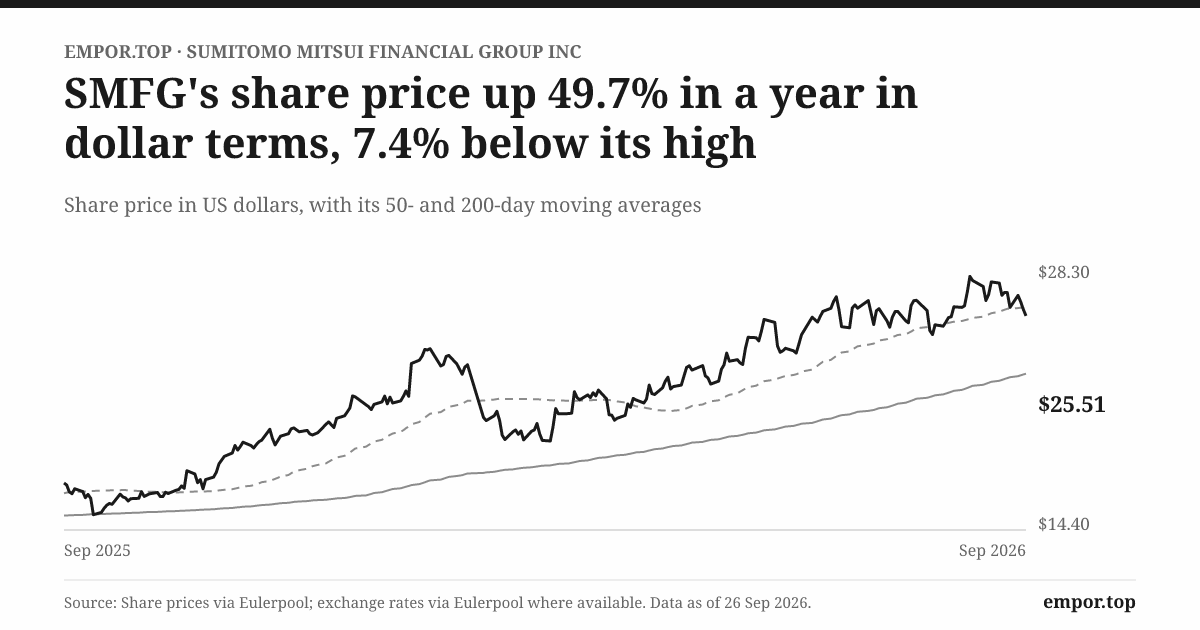
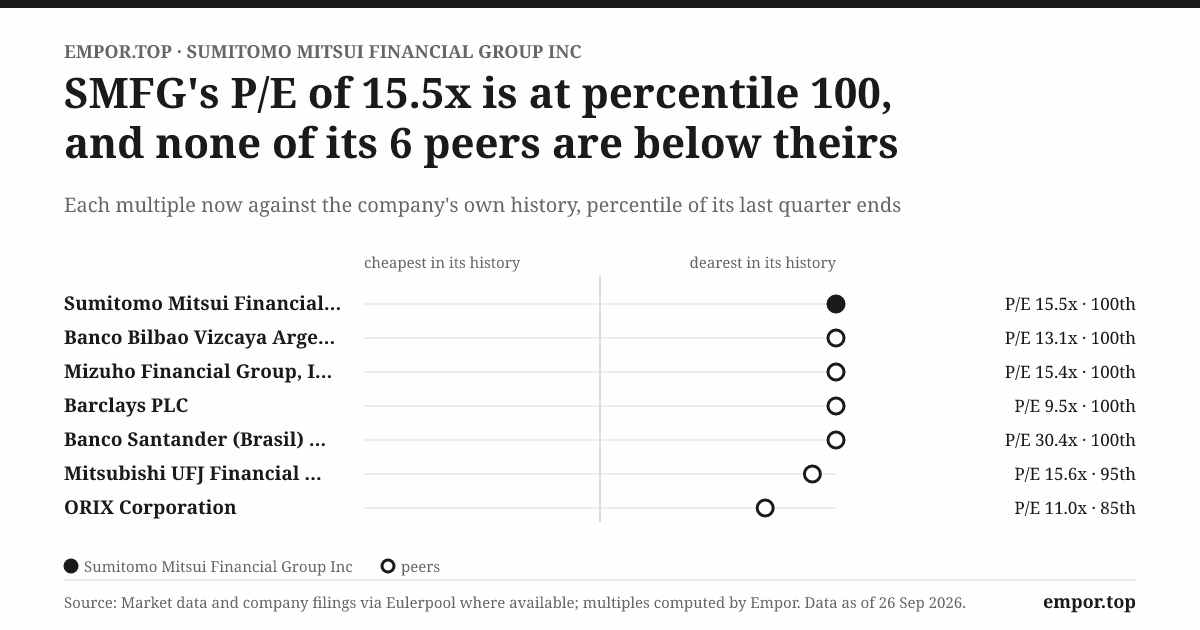
For investors, the central takeaway is that the market no longer prices SMFG as a perpetual "value trap" megabank. The group is increasingly judged against global commercial peers on return on tangible equity, a benchmark management has invited with its own medium-term targets. Whether the institution warrants that valuation depends on how much structural earning power it can retain. Answering that question requires returning to its origins more than four centuries ago.
 Subscribe on LinkedIn
II. Ancient Roots & Zaibatsu Divergence: The Merchant Kings
In Kyoto during the Kan'ei era of the early seventeenth century, a shopkeeper named 住友政友 Masatomo Sumitomo sold books and medicines. He codified merchant conduct in the 文殊院旨意書 Monjuin Shiigaki, or Founder's Precepts, a text Sumitomo still cites as the foundation of its business philosophy.5 Nearby, his brother-in-law 蘇我理右衛門 Riemon Soga ran a copper refinery under the trade name Izumiya. Drawing on methods learned from Portuguese traders, he developed a technique known as 南蛮吹き nanban-buki for separating silver from crude copper.5 Riemon's son subsequently moved the family's operations to Osaka and shared the technique with the city's copper guild, giving rise to the local saying that "Izumiya is unrivaled."5 SMBC Group dates the Sumitomo business to 1590.6
Copper mining established the Sumitomo family fortune and later financed the house's diversification into modern industry and finance. In 1895, Director General Teigo Iba founded Sumitomo Bank in Osaka. In 1912, it became the first Sumitomo division to go public.7 In 1916, it opened a branch in San Francisco, the first overseas branch of any Japanese commercial bank.6
The Mitsui lineage began in Edo in 1673. 三井高利 Mitsui Takatoshi, a merchant's son from Matsusaka, opened the 越後屋 Echigoya kimono store and transformed Japanese retail by selling ready-made cloth for cash at fixed prices.6 That enterprise later evolved into the Mitsukoshi department store. Mitsui Bank was established in 1876 as Japan's first private-sector bank and opened its New York branch in 1922.6 Over the decades, the two houses grew into contrasting corporate archetypes: Sumitomo was Osakan, industrial, and focused on credit discipline, while Mitsui was Tokyo-based, closely tied to the state, and networked through the capital's political elite.
Dissolution, keiretsu, and the "fighting bank"
Following World War II, American occupation authorities dissolved the family-controlled 財閥 zaibatsu holding companies. Sumitomo Bank was forced to drop the family name for several years, operating as the Bank of Osaka from 1948.7 Although family ownership ended, the corporate networks reconstituted themselves into bank-centered 系列 keiretsu groups. Within these alliances, a designated "main bank" served as primary lender, major shareholder, and de facto crisis manager for industrial clients.
Sumitomo Bank earned a reputation as the most aggressive, profit-oriented city bank, willing to back fast-growing borrowers and take decisive measures when they ran into distress. Under its long-serving leader 磯田一郎 Ichiro Isoda, the bank conducted high-profile rescues of troubled affiliates such as the trading house Ataka & Co.7 It also expanded abroad early: in 1986, it invested $430 million for a 12.5% stake in Goldman Sachs, an unusually forward-looking cross-border investment for a Japanese commercial lender at the time.8
Mitsui Bank, by contrast, remained smaller than its historical prestige implied. In 1990, it merged with 太陽神戸銀行 Taiyo Kobe Bank to form Mitsui Taiyo Kobe Bank, which was renamed Sakura Bank in 1992.6 That defensive combination provided the Mitsui lineage with an expansive domestic retail branch network, but it also saddled the combined institution with a heavy portfolio of bad loans just as Japan's asset bubble burst.
Why the lineage still matters
Corporate heritage in banking can easily verge on institutional folklore, but here the historical contrast explains the merged bank's internal balance of power. When the two lenders agreed to combine, it was the Sumitomo side, with its underwriting discipline and cost control, that set the operating tone. Sakura Bank contributed premier corporate relationships in Tokyo and an extensive branch footprint. Analysts still capture that division with an enduring shorthand: SMBC operates as an Osaka operating system running on a Tokyo client base.
For investors, however, that cultural narrative carries an essential caveat. "Culture" is often what analysts cite when institutional advantages resist easy quantification. In practice, Sumitomo's reputation for credit rigour did not prevent it from lending aggressively into one of the largest speculative asset bubbles in modern financial history. How that discipline cracked under bubble-era incentives—and how the resulting bad loans forced two fierce rivals together—forms the foundation of the modern group.
III. The Bubble, The Collapse, & The Shotgun Merger (1985–2002)
In September 1994, the manager of Sumitomo Bank's Nagoya branch was shot dead outside his home. The killing was widely linked to the bank's aggressive attempts to collect bad debts.8 It stood as the grim zenith of how far Japanese commercial lenders had drifted during the bubble economy, when real estate and stock prices escalated to surreal heights—prompting the legendary calculation that the grounds of Tokyo's Imperial Palace were theoretically worth more than all the real estate in California.
Itoman and the fall of Isoda
The 1985 Plaza Accord and the wave of cheap liquidity that followed steered Japanese banks into unbridled property and equity speculation. Sumitomo's most damaging exposure arose through Itoman, an Osaka-based trading company that had morphed into a conduit for speculative real estate and art transactions. The Itoman affair escalated into a national scandal, and in October 1990 Isoda resigned as Sumitomo Bank chairman, taking responsibility for the bank's involvement.7
What distinguished Sumitomo from its peers was not that it bypassed the bubble, but how it confronted the aftermath. In January 1993, the bank took the then-unprecedented step of writing off ¥100 billion in bad loans. For the fiscal year ended March 1995, write-offs surged to ¥826 billion, resulting in a net loss of ¥335 billion.7 That marked the first annual loss recorded by a major Japanese bank since World War II, occurring at a time when regulators actively discouraged write-offs for fear of shaking confidence.7 Yet the credit deterioration ran far deeper than initially recognized. In fiscal 1998, Sumitomo wrote off another ¥1.04 trillion and posted a pretax loss of ¥502.7 billion, leading management to announce in November 1998 that it would apply for public capital.8
That record validates part of the group's "execution culture" narrative: Sumitomo recognized credit losses faster than bureaucratic peers and cautious regulators preferred. Yet the timeline also highlights the limits of that reputation. Sumitomo returned to write off bad loans repeatedly across nearly a full decade. Early loss recognition was necessary, but prolonged disclosure showed that it was far from complete.
The consolidation panic
In late 1997, the failures of Yamaichi Securities and Hokkaido Takushoku Bank triggered a systemic panic, soon followed by the collapse of the Long-Term Credit Bank of Japan. Japan's financial sector entered an era of forced consolidation. In August 1999, Dai-Ichi Kangyo Bank, Fuji Bank, and the Industrial Bank of Japan unveiled a three-way combination that would become Mizuho.9 Every remaining city bank was suddenly forced to secure a defensive merger partner.
SMBC's official history recounts the ensuing negotiations in almost cinematic terms. On August 23, 1999, Sumitomo president 西川善文 Yoshifumi Nishikawa crossed paths with Sakura president 岡田明重 Akishige Okada. They met again the following day, convened detailed negotiations on September 8, and on October 14, 1999, held a joint press conference to announce a full integration.9 The leaders framed the tie-up as an urgent race for scarce partners, observing that whichever partner each bank chose "could significantly change the future trajectory" of the institution.9
The two lenders framed the agreement as an "equal-footing" merger, the standard face-saving phrase in Japanese dealmaking. When the integration took effect on April 1, 2001, it created SMBC with approximately $792 billion in assets.8 Nishikawa became president and CEO of the combined bank.8 SMFG was then created in 2002 as the holding company above SMBC.10
The purge
Nishikawa, a blunt Sumitomo lifer, became the public face of the balance-sheet overhaul. As the merged bank continued absorbing heavy bad-loan provisions, capital adequacy deteriorated to the point where SMFG sought support well beyond official state channels. In February 2003, Goldman Sachs agreed to purchase convertible preferred stock in SMFG. In tandem with that capital injection, SMFG agreed to provide Goldman with credit-loss protection on its investment-grade loan commitments. Goldman's own regulatory filings described this protection as covering up to 95% of first losses, capped at $1 billion.11 It was an extraordinary transaction: a capital-constrained Japanese megabank sold equity to a Wall Street firm while simultaneously insuring that firm's corporate credit book. The arrangement also established an early precedent for SMFG's enduring playbook of partnering with Wall Street institutions where its own balance-sheet or distribution capacity fell short.
State intervention provided the other indispensable lifeline. By October 2006, SMFG was buying back and canceling the last of the preferred shares held by the government's 整理回収機構 Resolution and Collection Corporation. The final Type 3 preferred stock carried an issue price of ¥195 billion and cost SMFG ¥222 billion to retire.12 With that, the public funds that had carried the group through the crisis were fully repaid.10
For investors today, the defining lesson is that this was a near-death experience resolved through recapitalization and disciplined repayment rather than nationalization. The institutional scar tissue from that era helps explain management's contemporary conservatism regarding capital buffers. It also stands as an enduring reminder that Japanese megabank earnings can deteriorate rapidly when domestic asset quality turns. With the crisis behind it, the rebuilt group turned to buying the franchises it lacked.
IV. Domestic M&A & The Post-Crisis Fortification (2002–2012)
In the late 2000s, a borrower in Osaka could walk into an unstaffed booth, feed an identification card into an automated terminal, and walk out minutes later with an unsecured consumer loan carrying an interest rate near 30%. The terminal belonged to プロミス Promise, one of Japan's "big four" consumer finance lenders. SMBC had its own loan-application machines installed in Promise branches, while Promise placed its units inside SMBC locations.13 The arrangement was lucrative, commercially complementary, and politically radioactive.
Promise: buying into a regulatory buzzsaw
SMFG formed a capital and business alliance with Promise in 2004, acquiring an equity-method stake. The two institutions jointly built an unsecured consumer-lending channel internally known as the "cascade" business.13 Then the regulatory architecture collapsed on the industry. In 2006, a landmark Supreme Court ruling cleared borrowers to reclaim interest paid above the statutory ceiling. These reclaimed sums, known as 過払い金 kabaikin, swelled into an industrywide outflow. A revised money-lending law subsequently capped interest rates at 20% and limited total personal borrowing to one-third of annual income, with the new rules taking full effect in 2010.14 The sector's cumulative bill from refund claims eventually reached approximately ¥4.4 trillion.14 武富士 Takefuji, once the nation's largest consumer lender, collapsed into corporate reorganization in September 2010 with ¥433.6 billion in liabilities.14
SMFG did not retreat. In September 2011, already holding a 20.71% direct stake, SMBC launched a tender offer at ¥780 per share to make Promise a wholly owned subsidiary—a 39.5% premium over the previous day's close.13 In its tender documents, SMFG laid out the operating headwinds with unusual candour: tighter rate caps, a shrinking market, and interest-refund claims "hovering at a high level." Yet management maintained that consumer finance remained "relatively higher margin and continuously and steadily profitable."13 Promise became a wholly owned subsidiary in 2012 and was renamed SMBC Consumer Finance.10
Whether that move reflected disciplined countercyclical investing or stubborn capital misallocation depends on the analytical horizon. The surviving business now sits inside 三井住友カード Sumitomo Mitsui Card Company (SMCC), which generated ¥105.7 billion in net income for fiscal 2025, the year ended March 31, 2026.2 Yet the kabaikin overhang proved extraordinarily long-lived. In fiscal 2024, SMCC set aside an additional ¥141.5 billion for interest-repayment claims—a charge that, alongside an impairment on Vietnamese affiliate FE Credit, dragged the card unit into a ¥64.3 billion net loss that year. At the end of March 2026, management stated that its provisions covered approximately 13 years of expected future refunds.2 While executives in 2011 framed Promise as an engine of steady earnings, the group was still absorbing nine-figure provisions for lending practices that predated the 2006 ruling.
Verdict on the Promise bet: The historical record narrows management's claim. Consumer finance did consolidate into a durable, oligopolistic profit pool for SMFG, and holding on while standalone peers collapsed proved commercially vindicated in hindsight. However, applying the "cash cow" label requires the caveat that legacy liabilities repeatedly outlasted executive forecasts. For investors, the key operational metric to monitor is whether interest-refund provisions remain at zero following the fiscal 2024 top-up.
Nikko Cordial: buying from a forced seller
A cleaner strategic windfall arrived courtesy of Citigroup's post-crisis retrenchment. On May 1, 2009, Citi agreed to sell Nikko Cordial Securities and domestic operations of Nikko Citigroup to SMFG for approximately ¥545 billion ($5.6 billion), a transaction that closed in October 2009 as the U.S. bank shed non-core international assets.15 The acquisition delivered Japan's third-largest retail brokerage alongside a network of 111 branches.15
The contrast with 野村ホールディングス Nomura is instructive. When Nomura acquired Lehman Brothers' Asian and European franchises in 2008, it absorbed an expensive, culturally divergent international staff that weighed on returns for years. SMFG instead bought an established domestic retail and underwriting franchise that bolted directly onto its corporate and individual client base, purchased at a distressed valuation from a motivated seller. The unit, renamed SMBC Nikko Securities, generated ¥128.3 billion in net profit in fiscal 2025 while overseeing ¥91.1 trillion in client assets.2 Yet the acquisition also imported internal control vulnerabilities that would later trigger the group's most severe governance crisis.
Growing up in public markets
The group's American Depositary Shares trade on the New York Stock Exchange, with each ADS representing 0.6 of an ordinary share and Citibank acting as depositary.16 That listing tied SMFG directly to U.S. Securities and Exchange Commission reporting standards and international investor scrutiny. The discipline of annual Form 20-F disclosures would later make the bank's underperforming foreign investments, particularly in Vietnam, impossible to conceal.
By 2012, the domestic perimeter was fortified: a core commercial bank, a full-service brokerage, an industry-leading credit card issuer, and a high-margin consumer finance platform. Yet just as the domestic fortress was completed, the Bank of Japan prepared to squeeze the underlying lending economics of the entire structure.
V. The Kuroda Trap & The Global Yield Chase (2012–2020)
On January 29, 2016, 黒田東彦 Haruhiko Kuroda's Bank of Japan surprised financial markets. By a 5–4 vote, the policy board announced it would charge minus 0.1% on a tier of the excess reserves financial institutions held at the central bank, layering negative rates on top of its quantitative and qualitative easing program.17 Yield curve control, which pinned 10-year Japanese government bond yields near zero, followed later that autumn. For a deposit-funded commercial lender, the arithmetic was punishing: domestic deposits could not realistically be priced below zero, lending margins were squeezed ever lower, and surplus yen balances parked with the central bank threatened to incur penalties.
SMFG responded by looking abroad for the asset yield it could no longer generate domestically. That capital redeployment unfolded in two distinct strategic thrusts.
Pivot one: owning aircraft
In January 2012, well before the BOJ adopted negative rates, SMFG led a consortium agreeing to acquire the commercial aircraft leasing business of Royal Bank of Scotland for approximately $7.3 billion, a transaction that closed on June 1, 2012.18 Equity ownership was divided among Sumitomo Mitsui Finance and Leasing (SMFL) at 60%, SMBC at 30%, and 住友商事 Sumitomo Corporation at 10%, with the operating platform renamed SMBC Aviation Capital.18 A decade later, in December 2022, the business completed the $6.7 billion acquisition of Dublin-based competitor Goshawk. The transaction created the world's second-largest aircraft lessor by fleet count, assembling more than 700 owned and managed aircraft alongside order-book commitments for over 240 more.19
The economic logic was straightforward: aircraft leases are long-dated, U.S. dollar-denominated contracts backed by mobile collateral that can be repossessed and placed with alternative carriers across global jurisdictions. For a yen-funded institution navigating domestic margin compression, aircraft provided an outlet for foreign-currency yield. Yet the model presents two structural challenges for public equity investors. First, commercial aviation remains inherently cyclical and vulnerable to systemic disruptions, as demonstrated when travel restrictions grounded global airline fleets during the pandemic. Second, SMFG's annual Form 20-F reports SMBC Aviation Capital as a subsidiary of SMFL, meaning its underlying cash flows accrue to holding-company shareholders through an intermediate leasing joint venture rather than directly.20 Because management does not disclose a standalone return on equity for the aviation portfolio, third-party assertions that the unit reliably generates double-digit returns cannot be verified from statutory filings; its standalone profitability remains undisclosed.
Pivot two: the Asian "multi-franchise" strategy
The group's second foreign initiative was considerably more ambitious: building full-service commercial, small-business, and consumer banking operations across high-growth emerging Asian economies, rather than merely operating wholesale outposts to service Japanese corporate clients abroad.
Indonesia. In 2013, SMBC acquired an initial 24.3% stake in PT Bank Tabungan Pensiunan Nasional (BTPN), a lender established in 1958 to administer military pensions that had expanded into microfinance and small-business banking. In 2014, SMBC lifted its equity interest to 40%, becoming the controlling shareholder.21 In February 2019, BTPN merged with SMBC's local banking subsidiary. The integration raised SMBC's stake to 97.3% and created Indonesia's eighth-largest commercial bank, operating a distribution network of 795 branches.21 The institution was formally renamed PT Bank SMBC Indonesia in October 2024.20
Vietnam. In April 2021, SMFG agreed to purchase a 49% stake in VPBank's consumer lending unit, FE Credit, for a reported $1.4 billion. FE Credit controlled approximately half of Vietnam's unsecured consumer credit market, and the acquisition closed in October 2021.2223 SMBC reinforced that position by taking a direct 15% equity stake in the parent institution, VPBank.24
India. In July 2021, SMFG agreed to acquire 74.9% of Fullerton India Credit Company from Temasek subsidiary Fullerton Financial Holdings, securing a footprint of more than 650 branches serving micro-enterprises, self-employed workers, and mass-market borrowers, alongside a commitment to acquire full ownership over time.25 SMFG completed the buyout in two tranches, purchasing the initial 74.9% in November 2021 and the remaining 25.1% in March 2024, after rebranding the lender as SMFG India Credit Company in May 2023.20 Fullerton India had posted an ¥18.2 billion net loss in the pandemic-impacted fiscal year ended March 2021, shortly before SMFG agreed to terms.25 SMFG subsequently deepened its Indian exposure: in September 2025, SMBC acquired a 24.2% stake in private lender YES BANK, adding an additional 0.7% in October 2025.20 That investment involved acquiring a 13.19% block from State Bank of India alongside 6.81% from seven other Indian commercial lenders, establishing SMBC as the bank's largest single shareholder.26
Philippines. SMBC acquired a 4.999% initial stake in Rizal Commercial Banking Corporation (RCBC) in 2021, followed by an additional 15.01% investment in July 2023 to bring its holding to 20%.27 By March 2026, SMBC had expanded that equity position to 24.4%.20
The falsification test: FE Credit
The strategic rationale for the multi-franchise initiative was that high-margin retail and commercial lending across emerging Asia would establish a permanent growth engine, offsetting domestic demographic decline and compressed interest margins. The clearest empirical test of that premise occurred in Vietnam.
After generating ¥0.6 billion in net profit in 2021, the year of SMFG's acquisition, FE Credit recorded net losses of approximately ¥13.3 billion in 2022 and ¥18.0 billion in 2023.24 Group CEO 中島達 Toru Nakashima attributed the downturn to protracted pandemic dislocations, export weakness tied to China's economic deceleration, and sluggish recovery in domestic mass-market purchasing power.24 The resulting balance-sheet charges were substantial: under IFRS, SMFG recognized equity impairment losses on FE Credit of ¥64.7 billion in fiscal 2023 and ¥59.3 billion in fiscal 2024, in addition to a ¥75.0 billion impairment on its VPBank investment in fiscal 2024.20 Taken together, those three write-downs approximated the entire headline purchase price SMFG had committed to FE Credit three years earlier.
A partial recovery followed. In fiscal 2025, SMFG's Japanese-GAAP holding-company accounts recorded a ¥90 billion reversal of valuation allowances on the VPBank stake, while management disclosed that the absence of prior-year Vietnamese impairments contributed ¥135 billion to the Global Business unit's year-on-year earnings growth.2 Yet while that rebound reflected stabilizing credit conditions and an easy comparison baseline, it highlighted the cyclical volatility inherent in the original thesis.
Verdict: The historical record narrows management's claim. Emerging-market consumer lending offers attractive nominal yields, but it carries high credit beta, currency risk, and local regulatory exposure—requiring domestic Japanese earnings to absorb cyclical drawdowns during distressed periods. SMFG's subsequent move to acquire a significant stake in a regulated commercial franchise like YES BANK, rather than purchasing another subprime consumer lender, indicates that management modified its underwriting posture. The critical benchmark for investors is whether these regional banking assets can earn returns above their cost of equity across an entire economic cycle, rather than solely during expansionary phases.
The overseas expansion diversified the group's balance sheet, but it did not insulate SMFG from governance vulnerabilities closer to home. The next severe institutional crisis emerged not from foreign consumer lending, but from within Tokyo's domestic equity markets.
VI. Governance Reckoning, Market Scandal, & The TSE Revolution (2020–2023)
In March 2022, Tokyo prosecutors arrested Trevor Hill, a senior managing executive officer of SMBC Nikko Securities, alongside other executives of the brokerage. Hill spent roughly a month in solitary confinement in the Kosuge detention center while the investigation proceeded.28 For a megabank that had spent two decades rebuilding its balance sheet and regulatory reputation after the bad-loan crisis, the arrests delivered a severe institutional shock.
What actually happened
The underlying mechanics revealed critical deficiencies in the brokerage's internal controls. In a block offer, a broker agrees to buy or place a large tranche of shares on behalf of a major shareholder after the market closes, with pricing pegged to that day's closing price. If the stock falls into the close, the transaction risks collapsing or imposing steep placement losses on the broker. The 金融庁 Financial Services Agency (FSA) found that SMBC Nikko had used its own capital to purchase shares in 10 listed companies to prop up closing prices on the days block offers were executed, in direct violation of the Financial Instruments and Exchange Act.29 The FSA also determined that internal surveillance systems missed most of the suspect trades: eight of the ten transactions fell outside detection rules designed to identify patterns across multiple days, because the market manipulation took place within single trading sessions.29
The regulatory inquiry uncovered a second breach that struck at the foundation of Japanese bank-brokerage oversight. Japanese financial regulation mandates strict information barriers between commercial banks and their securities affiliates to prevent lenders from exploiting nonpublic corporate borrower confidences for brokerage underwriting. The FSA found that SMBC Nikko had shared nonpublic corporate information with SMBC across three transactions—including details regarding a secondary offering, an acquisition, and tender offers—even after corporate clients had explicitly requested that the information remain restricted.29
The punishment
On October 7, 2022, the FSA suspended SMBC Nikko's block-offer business until January 6, 2023. It also ordered the brokerage to submit a business improvement plan and directed SMFG itself to overhaul holding-company governance over the subsidiary.29 In February 2023, the Tokyo District Court fined SMBC Nikko ¥700 million for market manipulation.30
The financial penalty was negligible relative to the group's net earnings, but the commercial damage was substantial. Corporate issuers and institutional investors pulled underwriting mandates, sidelining SMBC Nikko from prominent domestic equity transactions just as Japanese primary markets were regaining momentum. More fundamentally, the firewall breaches weakened the core rationale of the universal banking model: integrating commercial lending and investment banking generates group-level synergies only if corporate issuers trust that confidential data will not be compromised.
A leadership transition in tragic circumstances
The executive steering the group through the scandal was Group CEO 太田純 Jun Ohta. A Kyoto University graduate who joined Sumitomo Bank in 1982, Ohta had served as chief financial officer, chief strategy officer, and chief digital innovation officer before becoming group CEO in 2019, and in 2020 he was named a vice chairman of the business lobby 経団連 Keidanren.31 Ohta served as the primary architect of the group's overseas expansion, championing the emerging Asian multi-franchise platform and forging the cross-border investment banking alliance with Jefferies. He died of pancreatic cancer on November 25, 2023, aged 65.31
SMFG named Toru Nakashima to succeed him as group CEO, effective December 1, 2023.32 Nakashima, born in 1963, joined Sumitomo Bank in April 1986. He rose through executive-officer ranks from 2014, became a senior managing corporate executive officer of SMFG in 2019, and was appointed deputy president and co-head of the Wholesale Business Unit in April 2023.32 A corporate planner and institutional strategist rather than a traditional relationship rainmaker, Nakashima assumed leadership abruptly during an ongoing regulatory rehabilitation, without the benefit of a structured transition.
The Tokyo Stock Exchange changes the rules
Simultaneously, the regulatory environment across Japanese equity markets shifted. In 2023, the 東京証券取引所 Tokyo Stock Exchange (TSE) launched a structural reform campaign, calling on listed companies—particularly those trading at a price-to-book ratio below 1.0x—to formulate, disclose, and implement plans to improve their cost of capital and equity valuation. In January 2024, the exchange increased peer pressure by publishing monthly lists identifying companies that had complied with the disclosure framework.[^33] For Japan's megabanks, chronic undervaluation could no longer be treated as a permanent fixture of domestic finance.
For SMFG, the most tangible response was dismantling its 政策保有株式 policy shareholdings—the strategic cross-shareholdings Japanese lenders had historically maintained to cement borrower relationships. Because cross-shareholdings tie up substantial risk-weighted capital while generating modest yields, divesting them releases balance-sheet capacity and reduces equity portfolio volatility. The group committed to reducing these strategic holdings by ¥600 billion across fiscal 2024 to fiscal 2028, and to bringing the total market value of its equity portfolio below 20% of consolidated net assets by March 2029.2
Together, internal governance sanctions and the TSE's capital-efficiency campaign accelerated SMFG's shift from a defensive, relationship-driven lender toward a return-focused financial group. The immediate analytical question was whether the operating franchises assembled across the preceding two decades could deliver that earning power.
VII. Today's Business Architecture & Segment Financial Engine
A cross-section of SMFG's contemporary operations illustrates how that earning power is generated across four reporting segments. At a Tokyo railway station, a commuter taps a single card at a convenience store, alternating between debit, credit, or reward points via a smartphone app that also displays her bank balance and brokerage holdings. That consumer platform is Olive. Across town in Marunouchi, a wholesale syndication desk arranges debt financing for a technology company's data center in Virginia. In Mumbai, loan officers at SMFG India Credit underwrite two-wheeler vehicle loans. Together, these operations comprise the four business units through which the group manages capital and reports its financial results: Wholesale, Retail, Global, and Global Markets.
The consolidated picture
In fiscal 2025, the year ended March 31, 2026, SMFG generated consolidated gross profit of ¥4.84 trillion, an increase of ¥718 billion year on year. Consolidated net business profit—measuring core operating earnings before credit costs and equity gains—rose ¥612 billion to ¥2.33 trillion.2 Operating efficiency improved in tandem, with the overhead ratio falling 3.5 percentage points to 54.7%.2 Credit costs totaled ¥388.4 billion, approximately ¥88 billion above management's initial target, driven primarily by forward-looking provisions against geopolitical risks in the Middle East.2 Meanwhile, the group's Common Equity Tier 1 (CET1) capital ratio rose from 10.7% to 11.1%, strengthening its loss-absorbing buffer.2
A closer examination of those results reveals that a significant portion of earnings momentum stemmed from non-operating items. Realized gains on equity sales reached ¥446.1 billion, representing a substantial share of pretax earnings.2 In its internal earnings attribution, management disclosed ¥224 billion in after-tax one-off profits, including a ¥110 billion increase in net equity gains, partially counterbalanced by ¥188 billion in proactive balance-sheet adjustments, such as bond portfolio repositioning and credit provisioning.2 Core operating growth was substantial, but headline profits were amplified by strategic equity liquidations that are by nature non-recurring.
1. Wholesale Business Unit: the powerhouse
The Wholesale Business Unit serves as the group's primary domestic profit engine. In fiscal 2025, wholesale net business profit reached ¥997.1 billion, up ¥213.5 billion, while its overhead ratio stood at an industry-leading 32.5%.2 The bulk of that earnings growth originated from deposit repricing rather than loan expansion: income on wholesale deposits climbed ¥143.2 billion, compared with a ¥24.1 billion increase in loan income.2 Non-interest revenue also expanded, led by structured finance fees, which nearly doubled to ¥88.9 billion.2
Wholesale reported a return on CET1 capital of 21.4%. However, when stripping out realized gains from selling strategic cross-shareholdings, that figure dropped to 16.3%.2 For investors assessing underlying profitability, that 5.1-percentage-point differential is critical. It demonstrates that a notable share of wholesale's return profile relies on monetizing an equity portfolio that will gradually diminish as cross-shareholdings are retired.
2. Retail Business Unit: the triple engine
The Retail Business Unit integrates SMBC's traditional branch network, SMCC's card and payments franchise, and unsecured consumer finance through SMBC Consumer Finance. In fiscal 2025, retail gross profit rose ¥200 billion to ¥1.56 trillion, lifting net business profit by ¥139.4 billion to ¥427.7 billion.2 Payments generated ¥582.6 billion of gross profit, wealth management contributed ¥383.2 billion, and consumer finance added ¥318.1 billion.2
The structural hurdle for retail remains its operating expense base. Despite improving 1.3 percentage points during the year, retail's overhead ratio was 72.9%.2 Physical branch infrastructure, payment processing systems, and Japan's persistent cash-handling costs create substantial overhead, placing the burden of efficiency gains squarely on digital transformation.
Olive represents management's primary vehicle to address that cost structure. Launched on March 1, 2023, the platform offers an integrated account combining commercial banking, credit, debit, and loyalty points within a single card and mobile app.33 The product surpassed 5 million accounts by March 2025, with approximately half of new sign-ups drawn from customers in their twenties or younger.33 By March 2026, user enrollment reached 7.5 million.2 Embedded partnerships with SBI Securities for retail brokerage and Money Forward for personal asset management aim to establish the app as an everyday financial hub.33 Management attributes expansion in retail deposits and credit card transaction volumes directly to the platform.2 Crucially, however, SMFG does not disclose Olive's standalone profitability or average revenue per account. Without unit-level economics, investors cannot determine whether Olive functions as a high-margin cross-selling engine or primarily as an expensive customer-acquisition channel.
3. Global Business Unit: the emerging-markets engine
The Global Business Unit posted a more subdued performance in fiscal 2025. Net business profit edged up ¥16.3 billion to ¥655.8 billion, as the segment's overhead ratio deteriorated 2.5 percentage points to 68.6%.2 Segment credit costs climbed ¥90.9 billion to ¥257.9 billion—an increase management attributed to credit deterioration across "a few large borrowers"—causing unit net income to decline ¥37.6 billion to ¥321.0 billion.2 Overseas assets constituted approximately 35.7% of average consolidated assets in fiscal 2025.20 The human capital footprint is even more pronounced: 56% of the group's roughly 123,000 employees work within the Global unit, and 48% of total group staff are based across Asia and Oceania, compared with 44% in Japan.20 By staffing distribution, SMFG has transformed into an Asian regional bank as much as a Japanese domestic one.
The Global unit also underwent strategic rationalization. In March 2026, SMBC agreed to sell the commercial banking operations of its California subsidiary, Manufacturers Bank (SMBC MANUBANK), to Bank of Hope, explaining that it intended to reallocate U.S. resources toward corporate and investment banking and capital markets.34 The divestment resulted in an after-tax restructuring loss of ¥34 billion.2 While financially modest in the context of group net income, the exit demonstrated management's willingness to prune sub-scale foreign commercial banking assets that lacked a clear competitive moat rather than absorb ongoing drag on capital.
4. Global Markets Business Unit
The Global Markets Business Unit—encompassing treasury operations, foreign exchange, interest-rate trading, and the group's proprietary securities portfolio—delivered ¥508.7 billion in net business profit and ¥356.2 billion in net income for fiscal 2025.2 Performance across trading desks was uneven: amid choppy fixed-income markets, SMBC Nikko's trading operations recorded an operating loss of ¥14.7 billion.2
The more consequential balance-sheet adjustment occurred within the bank's domestic sovereign debt portfolio. Anticipating upward pressure on domestic interest rates, SMBC reduced its available-for-sale Japanese government bond holdings by ¥5.7 trillion to approximately ¥5.5 trillion, while expanding held-to-maturity securities by ¥4.4 trillion.2 By trimming duration risk and reclassifying holdings, management sheltered regulatory capital from mark-to-market bond depreciations just as the Bank of Japan commenced policy normalization.
The Jefferies alliance
The most closely watched cross-border capital deployment is the group's expanding partnership with Jefferies Financial Group. The alliance originated in 2021 and deepened in 2023, when the two firms broadened collaboration across cross-border M&A and equity underwriting, raising SMBC's economic stake from roughly 5% up to 15%.3536 On September 19, 2025, SMBC announced a further ¥135 billion (approximately $913 million) commitment to lift its economic interest from 14.5% to as much as 20%. To comply with U.S. bank regulatory caps, the investment was structured through open-market purchases exchanged for non-voting shares, keeping SMBC's voting interest strictly below 5%.35 Concurrently, the partners agreed to merge their Japanese wholesale equities operations—encompassing equity research, sales and trading, and equity capital markets—into a joint venture scheduled to launch in January 2027. SMBC also extended approximately $2.5 billion in credit facilities to support Jefferies' client activities in U.S. pre-IPO financing, European leveraged lending, and asset-backed securitization.35
The commercial synergy pairs SMBC's massive lending capacity and corporate boardroom relationships with Jefferies' advisory and capital-markets execution capabilities in North America and Europe—talent that Japanese commercial lenders have historically struggled to recruit and retain internally. The transaction architecture deliberately avoids the pitfalls that plagued earlier Japanese acquisitions on Wall Street. There is no fraught integration of compensation pools, no Tokyo-based management committees supervising Western bankers, and no expensive control premium. The model closely mirrors MUFG's highly profitable minority partnership with Morgan Stanley, where MUFG holds an equity stake of roughly 23.6%.35
Yet reliance on a minority partnership also exposes SMBC to operational and reputation risks over which it exercises limited oversight. In late 2025, Jefferies faced scrutiny over its exposure to collapsed auto-parts manufacturer First Brands Group through its Point Bonita trade-finance vehicle. While Jefferies' own financial hit was modest at roughly $30 million pretax, Chief Executive Rich Handler conceded that "there clearly are lessons to be learned" about controls.37 For SMFG, the episode offered a reminder that strategic syndication alliances inevitably import the underwriting and risk culture of the partner alongside its fee pipeline.
The segment breakdown clarifies where SMFG generates its revenue. What transforms those operating figures into record consolidated returns, however, is the structural shift underway in the interest-rate landscape beneath all four divisions.
VIII. The Macro Paradigm Shift: BOJ Normalization & NII Explosion
On March 19, 2024, the Bank of Japan raised its policy rate for the first time in 17 years, ending roughly eight years of negative interest rates and abandoning yield curve control. Governor Kazuo Ueda stated that the decision followed from foreseeing "stable and continuous 2% inflation."38 The central bank subsequently raised the policy rate to 0.25% in July 2024, 0.5% in January 2025, and 0.75% in December 2025.2 It moved to 1.0% in June 2026 and reached 1.25% on September 18, 2026.1
How a Japanese bank makes money when rates rise
The underlying mechanics of this monetary shift can be seen clearly on SMFG's domestic yen balance sheet. Approximately ¥130 trillion sits on the funding side as deposits, comprising roughly ¥90 trillion in ordinary savings accounts, ¥25 trillion in time deposits, and ¥15 trillion in current accounts.2 On the asset side, about ¥70 trillion is deployed as loans—of which roughly ¥40 trillion carries floating rates, ¥20 trillion is fixed-rate, and ¥10 trillion is priced off the short-term prime rate—while another ¥50 trillion sits as reserves at the Bank of Japan.2
When the BOJ lifts the benchmark rate by 25 basis points, transmission moves across three distinct speeds. The ¥50 trillion held at the central bank begins earning higher interest almost immediately. The ¥40 trillion in floating-rate corporate and retail loans reprices within months, whereas fixed-rate loans adjust only as they mature and roll over into higher prevailing yields. On the funding side, however, ordinary savings deposits reprice sluggishly and incompletely. Conditioned by decades of near-zero returns, Japanese households and corporate treasuries have historically left cash parked in transaction accounts rather than shifting funds to pursue higher yields. As a result, the deposit beta—the share of a policy rate hike passed along to depositors—remains exceptionally low in Japan.
Management's own estimate indicates that each 25-basis-point increase adds about ¥110 billion to net interest income in the first year, rising to about ¥150 billion by year five as fixed-rate loans reprice.2 Disclosed figures illustrate the magnitude of that leverage. SMFG's domestic loan-to-deposit spread widened by 18 basis points to 1.14% in fiscal 2025, as loan yields rose 32 basis points while deposit costs rose just 14 basis points to 0.20%.2 Driven by that widening spread, consolidated net interest income rose from ¥2.34 trillion to ¥2.72 trillion.2
Myth versus reality: "pricing power has returned"
A widespread narrative across equity research holds that rate hikes have finally restored Japanese commercial lenders' pricing power over corporate borrowers after three decades of an entrenched borrower's market. SMFG's segmental disclosures, however, complicate that conclusion.
In fiscal 2025, the average spread on SMBC's loans to large corporations actually narrowed by 5 basis points to 0.54%, while the spread on mid-sized and small companies widened by only 2 basis points to 0.68%.2 Loan volumes did expand briskly: average domestic loans rose ¥4.4 trillion to ¥66.7 trillion, driven by a ¥3.6 trillion increase in large-corporate lending.2 Yet almost all the incremental earnings originated on the funding side of the ledger. Retail deposit income rose ¥126.8 billion, while wholesale deposit income climbed ¥143.2 billion.2
The accurate description, then, is that SMFG has deposit franchise leverage, not pricing power over large corporate borrowers. Its vast, low-cost deposit base is finally generating positive yields against a rising policy benchmark, even while competition among megabanks for blue-chip corporate credit remains intense. That distinction is central to evaluating the durability of these earnings. Deposit franchise leverage relies on the BOJ sustaining higher rates and on depositors remaining passive. If central bank policy pivots or depositors begin shopping aggressively for yield, those margins compress quickly.
The limits of normalization
Two additional constraints temper the medium-term outlook. First, management's plan for fiscal 2026 assumed a policy rate of 0.75%, and its three-year targets assume 1.25%.2 Much of the rate upside that equity analysts highlight is already embedded in corporate guidance, which factored in the 1.25% benchmark reached this month. Second, the September 2026 decision passed with two dissents and was accompanied by mixed signals regarding the pace of further tightening. The BOJ acted partly because of a weak yen and higher oil prices, and it faces the fiscal ambitions of Prime Minister 高市早苗 Sanae Takaichi's government.1 Benchmark rates are rising amid cost-push pressures that could also dampen domestic economic momentum and strain corporate borrowers.
For investors, the rate windfall is tangible and transparently disclosed. Yet it represents primarily a macroeconomic tailwind rather than proof of structural competitive differentiation. The critical question is whether management deploys that capital windfall with lasting discipline.
IX. Management, Governance, & Capital Allocation Record
When SMFG presented its fiscal 2025 results on May 13, 2026, the most striking slide in the presentation displayed a bar chart comparing its long-term return targets directly against those of JPMorgan Chase, HSBC, Bank of America, Goldman Sachs, and Barclays.2 A Japanese megabank had rarely been so explicit about benchmarking its own profitability against global Wall Street peers.
The Nakashima record so far
Nakashima's targets set a high bar. For fiscal 2028, the year ending March 2029, the CEO aims to deliver a 13% return on tangible equity, consolidated net income of ¥2 trillion, an overhead ratio in the "low 50s," and a CET1 capital ratio of approximately 10.5%. Management's longer-term objective is a 15% return on tangible equity, framed as competitive with leading international banks.2 The medium-term plan identifies five strategic priorities, emphasizing domestic market leadership, a transformed overseas operating model, and establishing technology as a "core management pillar."2
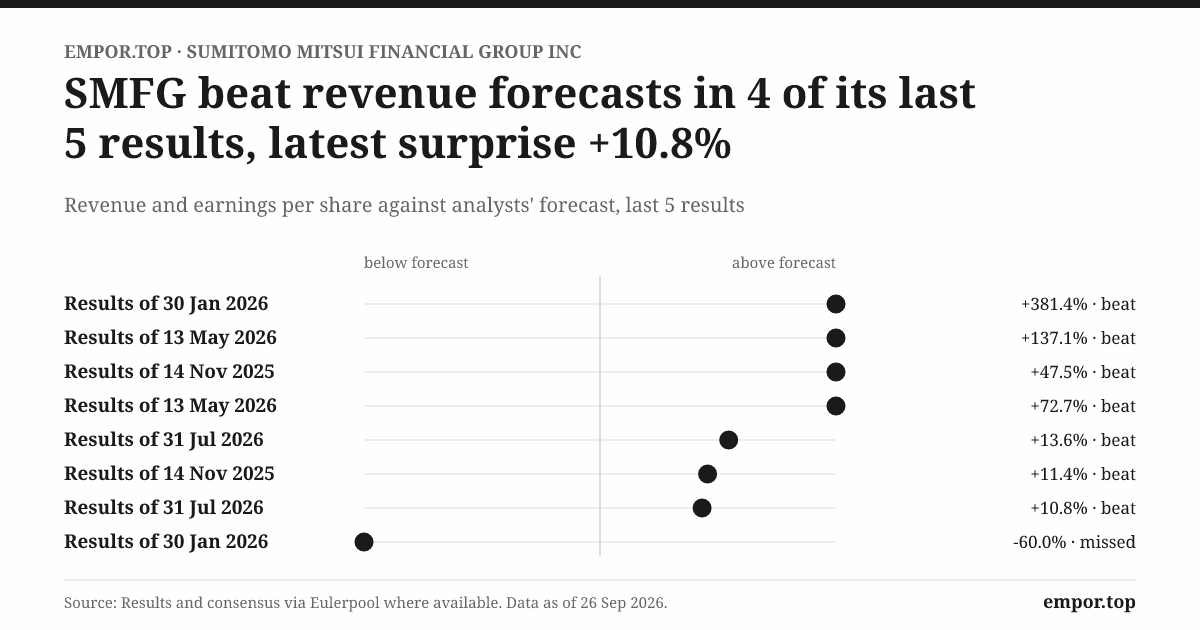
Evaluating credibility requires measuring past commitments against actual delivery. On that score, the initial record under Nakashima is solid. Management established a ¥1.5 trillion net profit target for fiscal 2025 and delivered ¥1.58 trillion. The five-year equity-reduction program reached 52% completion after two years, running comfortably ahead of the straight-line 40% benchmark.2 Leadership has also demonstrated balance-sheet pragmatism, recognizing impairments on FE Credit and VPBank rather than deferring the credit losses, and selling off the commercial banking operations of Manufacturers Bank. Yet two critical caveats qualify that scorecard: virtually all of this progress unfolded during an exceptionally favorable interest-rate environment, and fiscal 2025 net profits were heavily supported by one-off gains from strategic equity liquidations.
Skin in the game
As a career commercial banker, Nakashima held 41,191 shares in September 2023, prior to the group's 2024 three-for-one stock split.32 That stake represented a negligible fraction of the company's total equity, reflecting a standard Japanese executive compensation structure weighted heavily toward base salary and restricted stock rather than substantial personal equity exposure. While compensation details are disclosed in the annual securities report, investors will not find founder-level alignment. Instead, governance alignment depends on formal corporate scorecard targets—and on whether executive compensation is genuinely reduced when those benchmarks are missed.
The capital allocation hierarchy
Management has articulated a transparent hierarchy for capital redeployment.
First, dividends serve as the primary mechanism for returning capital. SMFG distributed ¥157 per share for fiscal 2025, representing a 38% payout ratio. Management forecast ¥180 per share for fiscal 2026, targeting a 40% payout ratio alongside a pledge to raise the payout progressively each year.239 For a commercial bank exposed to macro credit cycles, a progressive dividend commitment is a demanding promise. The post-bubble crisis demonstrated how quickly Japanese megabank earnings can swing into multi-year deficits. The policy is readily sustainable while monetary tailwinds persist; it has yet to be tested across a severe domestic recession.
Second, share buybacks provide a flexible secondary buffer. In May 2026, SMFG authorized a share repurchase of up to ¥180 billion—equivalent to roughly 1% of outstanding stock—with all acquired shares slated for cancellation, and management noted it would consider additional repurchases during the fiscal year.239 By comparison, peers MUFG and Mizuho each announced ¥100 billion repurchases.3
Third, retail shareholder engagement. SMFG executed a three-for-one stock split in October 2024, with a subsequent two-for-one split scheduled to take effect on October 1, 2026.39 To cultivate stable retail ownership, the bank is also introducing perks linked to its Olive platform, offering bonus loyalty points and preferential interest rates on time deposits.2 While commercially effective as a distribution strategy, the initiative intentionally merges the bank's depositor base with its retail shareholder register.
Fourth, mergers and acquisitions. Management characterizes its dealmaking as disciplined, but the deployment pace since 2021 tells a more complex story. The group completed a rapid succession of cross-border transactions: Fullerton India, FE Credit, RCBC, buying out the remainder of SMFG India Credit, taking a major position in YES BANK, and expanding its stake in Jefferies. Several of those assets suffered substantial subsequent impairments. Rather than pure underwriting discipline, the record reveals an active acquirer adjusting its strategy over time, pivoting away from high-risk subprime consumer lenders toward minority stakes in established, regulated institutions.
The cross-shareholding liquidation
The ongoing liquidation of policy cross-shareholdings warrants scrutiny because it simultaneously unlocks regulatory capital and flatters headline earnings. Under its equity-reduction plan, SMFG reported cumulative sales of ¥309 billion across fiscal 2024 and 2025, while securing client consent to divest an additional ¥69 billion. As of March 2026, the market value of its strategic equity portfolio stood at 27.5% of consolidated net assets, tracking toward its target of dropping below 20% by March 2029.2 Because these corporate holdings were largely acquired decades ago at historical cost, each disposal generates substantial accounting profits.
An objective investor must weigh three counterarguments. First, those equity gains are finite by nature, temporarily elevating reported returns—as demonstrated by wholesale banking's underlying return on CET1 capital dropping from 21.4% down to 16.3% once equity sales are excluded. Second, divesting equity ties risks eroding the traditional "main bank" relationships that historically insulated the lender from domestic corporate churn. Corporate clients have accepted these sales without open friction so far, but that acceptance has been tested only during a buoyant domestic lending market. Third, SMFG's annual Form 20-F reveals that while the bank is divesting legacy industrial holdings, it is simultaneously accumulating substantial new strategic equity positions, including its holdings in Jefferies and SBI Holdings.20 The group is not merely reducing aggregate equity risk; it is replacing traditional keiretsu ties with modern commercial alliances. Those new strategic bets must ultimately be judged against the same return hurdles.
Capital allocation has turned decidedly shareholder-friendly in the slipstream of the Tokyo Stock Exchange's governance campaign. The broader strategic question is whether SMFG's underlying competitive advantages can sustain these returns once the domestic interest-rate tailwind begins to fade.
X. Strategic Analysis: Porter's 5 Forces & Hamilton Helmer's 7 Powers
Evaluating whether SMFG can sustain its expanded profitability beyond the current monetary cycle requires mapping the competitive arena it shares with MUFG and Mizuho. The three megabanks contest the same domestic and international profit pools: Japanese corporate treasuries, household savings, and cross-border project finance. None can dislodge the others; all three are domestic and global systemically important institutions operating under identical regulatory constraints and monetary policy. In such an entrenched oligopoly, outperformance turns on small, durable advantages accumulated over decades.
Porter's Five Forces
Buyer power (borrowers): moderate to high, and falling only slowly. Large Japanese corporations maintain robust balance sheets, direct access to capital markets, and established credit lines across all three megabanks. The narrowing of large-corporate loan spreads in fiscal 2025 shows that they still negotiate hard.2 Mid-sized enterprises and retail consumers possess far less leverage, which is why SMFG earns significantly wider margins across those portfolios.
Supplier power (depositors): low. Depositors serve as the banks' primary suppliers of capital, and in Japan they have historically proven remarkably passive. SMFG's deposit costs rose only 14 basis points in a year in which the policy rate rose by 25 basis points twice.2 Its consolidated loan-to-deposit ratio of 58.4% means it has far more deposits than it needs to fund loans.2 The longer-term threat is behavioral: as interest rates normalize further, digital-native lenders, brokerage sweep accounts, and online banking platforms could make Japanese depositors more active in seeking yield.
Threat of new entrants: low for balance-sheet banking, higher for payments. Strict capital rules, surcharges for global systemically important banks, and onerous licensing procedures prevent new competitors from challenging the megabanks at scale. In payments, however, non-bank platforms such as PayPay have captured significant transaction volumes, while online brokerages and e-commerce ecosystems compete directly for household savings.
Threat of substitutes: moderate. Corporate bond and commercial-paper markets provide continuous substitutes for bank loans among top-rated corporate borrowers. In leveraged lending, private credit funds increasingly compete against commercial bank syndicates. SMFG's response has been to partner with that competition: it has ¥1.2 trillion of exposure to financing for business development companies and similar private-credit vehicles, all senior and secured, according to management.2
Rivalry: intense, but rational. Three megabanks share the domestic landscape with regional lenders, Japan Post Bank, and trust banks. Competitive dynamics remain disciplined rather than destructive. MUFG is larger, earning about ¥2.4 trillion in fiscal 2025 against SMFG's ¥1.58 trillion, and has its Morgan Stanley stake.3 Mizuho has grown faster recently, with net profit up 41% to ¥1.25 trillion.3 SMFG's distinctive position within this trio is its cost discipline in wholesale banking and its agility in reshaping its international asset portfolio.
Hamilton Helmer's 7 Powers
Scale economies: present, but shared. SMFG spreads its technology, regulatory compliance, and payments infrastructure across more than ¥300 trillion of assets. That scale creates a formidable barrier against regional banks, but MUFG and Mizuho command comparable balance sheets. Scale operates as a collective barrier to entry for the oligopoly rather than an asymmetric advantage over direct peers.
Network effects: emerging in payments. Sumitomo Mitsui Card Company and the Olive platform exhibit classic two-sided dynamics: expanding cardholder ranks attract more merchants, which in turn reinforces cardholder adoption. The growing number of SMCC cardholders and Olive users indicates real commercial momentum, though PayPay and rival card networks command extensive networks of their own. This power is genuine in consumer payments, but not dominant across the broader group.
Switching costs: SMFG's strongest power. A Japanese corporation's "main bank" relationship integrates payroll distribution, foreign-exchange settlement, supply-chain financing, and committed credit lines. Disentangling those operations to switch lenders is costly and operationally disruptive for a corporate treasury, which explains why SMFG's domestic corporate deposit base remains exceptionally cheap. The critical caveat is that reciprocal cross-shareholdings historically cemented these corporate ties, and those holdings are now being dismantled. Whether corporate switching costs remain just as formidable without equity ties is being tested in real time.
Cornered resource: limited. Commercial banking charters and overseas branch networks are heavily regulated but not exclusive. While SMFG's project-finance and debt-syndication desks maintain top-tier rankings, advisory and underwriting talent can move. The Sumitomo and Mitsui names carry institutional prestige, but heritage alone does not guarantee superior returns.
Counter-positioning: the Jefferies structure. By securing a minority economic stake instead of acquiring or building a Wall Street investment bank, SMFG gained access to U.S. advisory and underwriting capabilities without the fixed overhead and cultural friction that an incumbent bulge-bracket firm would find hard to cut. It represents a compelling example of counter-positioning in the Helmer sense. Its ultimate financial value, however, will depend on shared fee revenue that management has not yet disclosed in detail.
Process power: plausible in wholesale. Wholesale's 32.5% overhead ratio is the best evidence of an efficient operating process.2 The same data show that SMFG has not yet brought that efficiency to retail (72.9%) or Global (68.6%).2 Process power is proven in corporate banking, but remains an unfinished aspiration across retail and foreign operations.
Branding: modest. In consumer banking, brand prestige matters less than digital convenience and pricing, and Olive's growth among younger customers suggests product design matters more than heritage.33
The strategic frameworks demonstrate that SMFG's moats are robust against regional lenders and non-bank entrants, but largely shared with its two megabank peers. Its true differentiation rests on disciplined cost execution in wholesale and the speed of its capital-allocation pivots. The next section tests those core strengths against the group's underlying vulnerabilities and the competing investment cases.
XI. Historical Falsification & The Skeptical Investor Stress Test
For an institutional investor or hedge fund analyst seeking to assemble a credible short thesis on SMFG, the starting point is straightforward: take the primary claims advanced by the bank's proponents and test them against the most damaging evidence in the group's own operating record.
Claim 1: The Asian multi-franchise strategy is high-return optionality
The mechanism that invalidates this thesis is an emerging-market credit downturn—precisely what occurred in Vietnam. FE Credit posted consecutive losses in 2022 and 2023, prompting SMFG to record equity impairment losses on its FE Credit and VPBank holdings over two fiscal years that rivaled the original headline purchase price of the consumer finance unit.2420 Similarly, SMFG acquired Fullerton India shortly after the lender posted an ¥18.2 billion loss during the pandemic.25 Verdict: narrowed. While these Asian franchises provide geographic diversification and nominal loan growth, they carry significant credit beta and have yet to demonstrate returns above SMFG's cost of equity across an entire economic cycle. Management's subsequent pivot toward acquiring a major equity stake in YES BANK indicates an internal recognition of that subprime volatility. The key performance indicator for investors is whether the combined earnings of PT Bank SMBC Indonesia, SMFG India Credit, FE Credit, and the regional minority stakes can remain profitable through the next emerging-market contraction.
Claim 2: The Jefferies alliance beats building a bulge bracket
The primary counterargument stems from the fraught history of Japanese commercial lenders expanding into Western investment banking. Cross-border acquisitions—most visibly Nomura's purchase of Lehman Brothers' international operations—repeatedly triggered cultural friction, talent departures, and chronic earnings drag. SMFG explicitly engineered its minority alliance to sidestep those pitfalls. Yet the block-offer manipulation scandal at SMBC Nikko demonstrated persistent compliance vulnerabilities within the group's domestic brokerage arm, while Jefferies' First Brands episode confirmed that syndication partnerships inevitably import third-party risk.2937 Verdict: intact but unproven. While the transaction architecture is structurally disciplined, management does not disclose standalone joint-venture fee revenue, and the domestic wholesale equities combination scheduled for January 2027 represents the first genuine test of day-to-day integration. The critical benchmarks to monitor are shared fee generation and SMBC's league-table progress in U.S. leveraged finance and debt underwriting.
Claim 3: Cross-shareholdings can be unwound without losing clients
For decades, the standard defense among Japanese lenders was that liquidating client shareholdings would irrevocably fracture corporate relationships. SMFG is now testing that assertion in practice, reaching 52% of its five-year equity-divestment target after just two years, running comfortably ahead of schedule.2 Concurrently, domestic wholesale deposit and loan revenues have continued to expand.2 Verdict: supported to date, but tested only in an expansionary market. Corporate borrowers have tolerated equity sales while domestic credit demand is robust and monetary policy is lifting interest spreads. The genuine test will occur during a macroeconomic contraction, when corporate borrowers might reallocate lucrative advisory or treasury mandates to rival lenders. The essential metric to track is whether management reduces the market value of its equity portfolio below 20% of consolidated net assets by March 2029 without surrendering wholesale market share.
Claim 4: Olive creates a durable, low-cost retail franchise
The group's digital banking record has not been without friction. Its U.S. consumer digital platform, Jenius Bank—a division of SMBC MANUBANK—was carved out when SMBC agreed to divest the California subsidiary's commercial operations in March 2026, an overhaul that generated an after-tax restructuring loss of ¥34 billion.342 In Japan, Olive has scaled rapidly, accumulating 7.5 million consumer accounts in its first three years.2 Verdict: validated on adoption, unproven on unit economics. While user sign-ups demonstrate effective marketing and product appeal among younger demographics, management has yet to disclose standalone revenue or net profit per Olive account. Until those unit-level figures are published, investors cannot verify whether Olive represents a structurally profitable cross-selling ecosystem or a subsidized customer-acquisition vehicle.
Claim 5: SMFG has an elite credit culture forged in crisis
The historical record qualifies this institutional narrative. While Sumitomo recognized bad loans earlier than bureaucratic rivals during the 1990s, it also extended reckless credit into the asset bubble itself, most notoriously to Itoman.7 That pattern of credit recognition over credit avoidance remains visible today: consolidated credit costs in fiscal 2025 totaled ¥388.4 billion, exceeding management's internal projection by approximately ¥88 billion as the Global unit absorbed charges on a handful of large corporate exposures.2 Verdict: narrowed. SMFG's distinguishing characteristic is balance-sheet pragmatism—a willingness to write down impaired assets rapidly—rather than an ability to avoid underwriting mistakes altogether.
The risk radar
Four operational and macroeconomic risks remain material.
Middle East exposure. SMFG disclosed ¥3.5 trillion of exposure to the Middle East, comprising ¥1.3 trillion in Qatar, ¥1.1 trillion in Saudi Arabia, and ¥0.6 trillion in the UAE. Approximately 70% is committed to financial institutions and sovereigns, and more than 80% is rated investment grade.2 Nevertheless, management explicitly built its fiscal 2026 earnings target around absorbing potential headwinds from the region, establishing forward-looking provisions against geopolitical disruptions.2
AI and data-center lending. The group carries ¥4.0 trillion in AI-related credit exposure, including ¥2.6 trillion deployed to data-center infrastructure, where roughly 80% of tenant capacity is contracted to major technology hyperscalers.2 That high-quality tenant concentration provides credit protection, but it concentrates lending risk heavily within the sustained pace of enterprise AI capital expenditures.
Private credit. SMFG maintains ¥1.2 trillion in financing commitments to business development companies, structured as fully senior and secured facilities with loan-to-value ratios averaging roughly 20% and zero nonperforming loans.2 However, as Jefferies' First Brands episode demonstrated, structural vulnerabilities and collateral disputes in private credit and trade finance can escalate abruptly when market conditions tighten.37
Currency and interest rates. While a depreciating yen flatters the translated value of overseas earnings, the currency's slide to roughly 164 per dollar in July 2026 contributed directly to the Bank of Japan's accelerated tightening schedule.1 Rising domestic yields generate unrealized losses on held-to-maturity and available-for-sale yen sovereign bonds.2 A sharp reversal in either foreign exchange or interest-rate trajectories would test capital buffers from opposite directions.
The fundamental takeaway from this stress test is that SMFG demonstrates credible capital discipline and operational responsiveness, but its overseas growth optionality remains unproven and its headline profitability remains heavily tied to macroeconomic tailwinds. Those findings frame the ultimate strategic lessons.
XII. Playbook: Business & Investing Lessons
The vision statement on the cover of SMFG's May 2026 financial presentation reads: "Globally connected. Rooted in Japan."2 That framing neatly captures the strategic tensions and operational lessons emerging from the group's quarter-century history.
1. Escaping the balance-sheet trap
A primary strategic takeaway from SMFG's overseas expansion is the challenge of deploying capital internationally without absorbing expensive, cycle-peak control acquisitions. The group's track record illustrates a deliberate bifurcation. The minority investment in Jefferies, the equity stakes in YES BANK and RCBC, and the post-crisis purchase of Nikko Cordial reflect an opportunistic preference for non-controlling alliances and distressed sellers. Conversely, the investments in FE Credit and Fullerton India demonstrate the downside of paying substantial entry multiples for high-beta, emerging-market consumer lenders. For investors, the analytical takeaway is clear: clever transaction architecture cannot substitute for underlying credit quality. Capital deployments must be judged by the underwriting discipline and cyclical vulnerability of the target asset rather than the structural ingenuity of the partnership.
2. Cost discipline as a moat
The wholesale banking unit's overhead ratio of 32.5% demonstrates that disciplined operational efficiency can be engineered into a commercial lending franchise.2 Yet the group's consolidated overhead ratio of 54.7% confirms that this cost discipline has not permeated the entire organization, remaining burdened by legacy retail branch infrastructure and foreign operating costs.2 Management's commitment to hold core expenses flat or lower while steering the consolidated overhead ratio into the "low 50s" represents the ultimate test of whether operating discipline can function as a group-wide competitive moat rather than an isolated wholesale strength.2
3. Surviving regulatory shocks
The integration and eventual turnaround of Promise illustrate that weathering an industrywide regulatory reset demands patient balance-sheet backing, substantial excess capital, and the willingness to absorb prolonged earnings drag. At the same time, the franchise shows how persistent legacy liabilities can become, as highlighted by the group's ¥141.5 billion interest-repayment provision as recently as fiscal 2024.2 Oligopolistic market share can indeed deliver steady long-term returns once the sector consolidates, but legal and regulatory liabilities from past lending practices often outlast executive planning horizons.
4. Culture as both engine and anchor
The combination of Sumitomo and Sakura paired an aggressive, return-seeking execution culture with Tokyo's premier corporate client rolodex. Yet that same commercial drive also contributed to the internal control breakdowns at SMBC Nikko, where aggressive transaction execution crossed legal and regulatory lines.29 Institutional culture can accelerate performance, but without rigorous internal checks, it can also incubate severe governance risks. For CEO Toru Nakashima, the central challenge is demonstrating that compliance safeguards and risk management can be embedded across operating units just as deeply as the institutional appetite for return on equity.
These strategic and operational lessons reflect an institution that has adapted more pragmatically than its domestic peers. The remaining task is evaluating the forward catalysts and competitive metrics that will determine whether those gains endure.
XIII. Epilogue & Forward Milestones
On October 1, 2026, five days from now, SMFG's two-for-one stock split will take effect, lowering the threshold for Japanese retail investors to purchase a standard trading unit.39 Under a loyalty initiative tied to its digital platform, Olive users who hold shares can earn bonus reward points and preferential yields on time deposits.2 It is a modest corporate action with notable symbolic weight: an institution that once required public recapitalization to survive is actively encouraging its domestic depositors to become equity owners.
What to watch over the next 24–36 months
The BOJ path. SMFG's three-year plan assumes a 1.25% policy rate, a benchmark the central bank has now reached.21 Each further 25 basis points adds roughly ¥110 billion in net interest income in the first year.2 If central bank tightening pauses, SMFG will have to generate earnings growth through loan volume and fee expansion rather than automatic deposit-margin widening.
The Jefferies relationship. The January 2027 launch of the Japanese wholesale equities joint venture represents the first genuine operational integration between the two firms.35 Investors should monitor whether SMFG seeks to expand beyond its 20% economic interest or pursue voting control, a structural escalation that would fundamentally alter its regulatory risk profile.
Returns and valuation. Management's 13% return on tangible equity target for fiscal 2028, alongside its explicit comparison with Wall Street peers, sets a demanding benchmark.2 Achieving that return would narrow the longstanding valuation discount between SMFG and international commercial banks. Falling short after a historic rate tailwind would indicate that its expanded profitability was primarily macro-driven rather than structural.
The three KPIs that matter most
Of all the figures SMFG publishes, three indicators provide the clearest gauge of whether the core investment thesis remains intact:
- The domestic loan-to-deposit spread (1.14% in fiscal 2025).2 It captures the primary economic dividend of rate normalization and reveals how much of that yield depositors ultimately capture.
- Return on tangible equity against the 13% fiscal 2028 target.2 It demonstrates whether the group is converting a cyclical interest-rate windfall into durable structural profitability.
- Market value of equity holdings as a share of consolidated net assets (27.5% at March 2026, against a target of below 20% by March 2029).2 It measures both the de-risking of the balance sheet and the diminishing pool of non-recurring equity gains supporting reported earnings.
Final synthesis
From seventeenth-century copper refineries in Kyoto to the trading floors of Jefferies, the lineages of Sumitomo and Mitsui have endured zaibatsu dissolution, the post-bubble crisis, a decade of negative interest rates, and domestic governance sanctions. Today, SMFG operates as a well-capitalized, cost-disciplined institution generating record profits against transparent performance hurdles. Yet those record earnings owe an immense debt to a central bank finally exiting emergency policy, while the group's overseas ventures reflect an uneven credit record.
The bull case is that SMFG is the Japanese megabank best equipped to translate the end of deflation into sustained, global-standard returns on equity, led by a management team with a proven record of meeting guidance. The bear case is that the deposit windfall is inherently cyclical, equity-liquidation profits are finite, emerging Asian operations introduce volatile credit beta, and a commitment never to reduce dividends has yet to be tested across a severe domestic downturn. Over the next three years, the trajectory of central bank policy, domestic credit costs, and delivery on the 13% return target will determine which verdict endures.
References
-
Bank of Japan raises rate to 1.25%, highest in 31 years — UPI, 2026-09-18 ↩↩↩↩↩
-
Overview of FY3/2026 — Sumitomo Mitsui Financial Group, 2026-05-13 ↩↩↩↩↩↩↩↩↩↩↩↩↩↩↩↩↩↩↩↩↩↩↩↩↩↩↩↩↩↩↩↩↩↩↩↩↩↩↩↩↩↩↩↩↩↩↩↩↩↩↩↩↩↩↩↩↩↩↩↩↩↩↩↩↩↩↩↩↩↩↩↩↩↩
-
Japan's megabanks rake in record profits, forecast further gains — Yahoo Finance, 2026-05 ↩↩↩↩
-
Sumitomo Mitsui first-quarter profit rises sharply (Form 6-K) — Stock Titan, 2026-07-31 ↩
-
Sumitomo Mitsui Banking Corporation — Encyclopedia.com ↩↩↩↩↩
-
Deciding on the merger between Sumitomo Bank and Sakura Bank — The 20-Year History of SMBC Group, Sumitomo Mitsui Financial Group ↩↩↩
-
The Goldman Sachs Group, Inc. Annual Report on Form 10-K for fiscal 2003 — U.S. Securities and Exchange Commission, 2004 ↩
-
Notice regarding acquisition of public fund preferred stock — Sumitomo Mitsui Financial Group, 2006-10-05 ↩
-
Announcement of tender offer for Promise Co., Ltd. — Sumitomo Mitsui Financial Group / SMBC, 2011-09-30 ↩↩↩↩
-
Takefuji becomes lending casualty — Taipei Times, 2010-09-29 ↩↩↩
-
Citigroup sells Japan brokerage business for $5.6B — ABC News, 2009-05-01 ↩↩
-
Introduction of "Quantitative and Qualitative Monetary Easing with a Negative Interest Rate" — Bank of Japan, 2016-01-29 ↩
-
Completion of acquisition of aircraft leasing business from The Royal Bank of Scotland Group plc — Sumitomo Corporation, 2012-06-04 ↩↩
-
SMBC Aviation Capital completes acquisition of Goshawk Management Ltd. — SMBC Aviation Capital, 2022-12-21 ↩
-
Form 20-F for the fiscal year ended March 31, 2026 — Sumitomo Mitsui Financial Group / U.S. Securities and Exchange Commission, 2026 ↩↩↩↩↩↩↩↩↩↩
-
Realizing Asia-centric: The new BTPN opens its doors for business — Sumitomo Mitsui Financial Group, 2019 ↩↩
-
Japanese lender SMFG acquires 49 per cent in FE Credit in a $1.4 billion deal — Vietnam Investment Review, 2021-04-29 ↩
-
VPBank completes transaction of 49% stake in FE Credit to Japan's SMBC Group — VietNamNet, 2021-10-29 ↩
-
Sumitomo Mitsui facing challenges in Vietnam: CEO — The Investor ↩↩↩↩
-
Investment in Fullerton India by Sumitomo Mitsui Financial Group, Inc. — Sumitomo Mitsui Financial Group, 2021-07-06 ↩↩↩
-
CCI approves Japan's SMBC proposal to acquire up to 24.99% stake in Yes Bank — Upstox, 2025-09 ↩
-
Announcement for completion of additional investment in Rizal Commercial Banking Corporation — Sumitomo Mitsui Financial Group / SMBC, 2023-07-31 ↩
-
Administrative Actions, etc. against SMBC Nikko Securities Inc. and Sumitomo Mitsui Financial Group, Inc. — Financial Services Agency, 2022-10-07 ↩↩↩↩↩↩
-
Tokyo Court Fines SMBC Nikko 700 Million Yen in Market Manipulation Case — Reuters, 2023-02-13 ↩
-
Sumitomo Mitsui's Group CEO dies at 65 — finews.asia, 2023-11 ↩↩
-
Change of Representative Executive Officer — Sumitomo Mitsui Financial Group, 2023-11-30 ↩↩↩
-
SMBC's Olive exceeds 5m customers in two years since launch — Fintech Observer, 2025 ↩↩↩↩
-
Sale of the Commercial Banking Business of SMBC MANUBANK — SMBC Group Americas, 2026-03-31 ↩↩
-
SMBC to boost stake in Jefferies to 20% — Banking Dive, 2025-09 ↩↩↩↩↩
-
Jefferies and SMBC Group Expand Global Strategic Alliance — Business Wire, 2023-04-27 ↩
-
Jefferies takes $30M loss over First Brands investment — Banking Dive, 2026-01-08 ↩↩↩
-
The Bank of Japan ends its negative interest rate policy, opting for its first hike in 17 years — Associated Press via KSAT, 2024-03-19 ↩
-
Sumitomo Mitsui (SMFG) profit jumps as board approves ¥180B buyback and stock split (Form 6-K) — Stock Titan, 2026-05-13 ↩↩↩↩
 LinkedIn
 WhatsApp
 Reddit
 Hacker News
 Email
 Kindle
 RSS Feed
 Spotify
 Apple Podcasts
 Amazon Music
 Audible
 YouTube