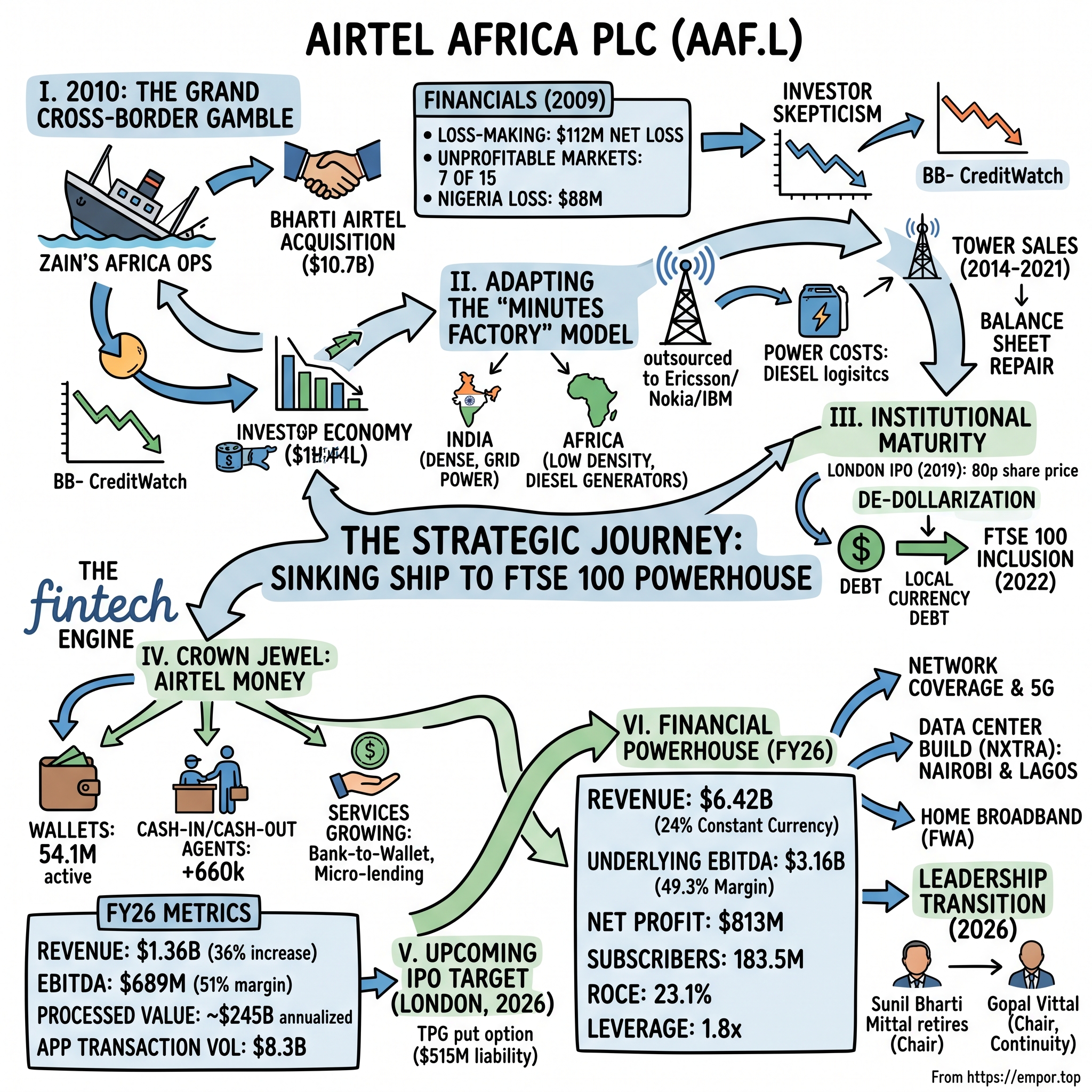
Airtel Africa Plc: The Sinking Ship turned FTSE 100 Powerhouse
I. Episode Intro & The Grand Cross-Border Gamble
On 8 June 2010, signatures in Kuwait City finalized the largest cross-border acquisition ever attempted between two emerging markets. Bharti Airtel, an Indian mobile operator that had never operated a network outside South Asia, took control of Zain Group’s African operations across fifteen countries at an enterprise value of $10.7 billion.9 The structure was straightforward: $8.3 billion paid up front, $700 million due a year later, and roughly $1.7 billion in assumed Zain debt.910 Nearly all of the funding was borrowed in U.S. dollars. Yet virtually all the local cash flows servicing that debt would arrive in Nigerian naira, Kenyan shillings, Congolese francs, and Zambian kwacha—currencies that would repeatedly depreciate against the dollar over the next fifteen years.
Equity markets responded with immediate skepticism. Bharti’s shares dropped 14.5% from the Monday open following the announcement, forcing management into a public campaign to reassure investors.7 Meanwhile, Standard & Poor’s placed the company’s BBB- rating on CreditWatch with negative implications, citing anticipated weakening in cash-flow protection.8
The target asset was financially strained, losing $112 million in the first nine months of 2009. Seven of its fifteen operating markets were unprofitable, and Nigeria—its largest revenue source—posted an $88 million loss despite generating nearly $1 billion in sales.5 Bharti was paying roughly ten times EBITDA for a loss-making business, even as its own stock traded at a lower multiple of 7.2 times.6
For much of the decade that followed, skeptics appeared justified. The African operations drained capital, generated poor cash flows, and stretched Bharti’s balance sheet, unnerving Indian market analysts quarter after quarter. Critics viewed the acquisition as the deal that broke the financial discipline of an operator previously renowned for it.
A fundamental shift eventually took hold. For the financial year ended 31 March 2026, Airtel Africa plc—the London-listed vehicle established to run the business—reported $6,415 million in revenue, representing a 24.0% increase in constant currency and 29.5% as reported. Underlying EBITDA reached $3,162 million, delivering a 49.3% margin for the full year and peaking at 50.3% in the March quarter.1 Net profit rose to $813 million, up from $328 million the previous year. Financial leverage dropped to 1.8 times net debt to EBITDA, falling to 0.5 times on management's preferred lease-adjusted basis.1 The subscriber base expanded past 183.5 million, while return on capital employed reached 23.1%.12 By early August 2026, the company's shares traded around 328 pence, giving Airtel Africa a market capitalization of roughly £12 billion.29
While the financial recovery is undeniable, long-term investors must evaluate whether this performance reflects structural durability or a temporary cyclical surge. A 24% constant-currency growth rate achieved during a period of upward Nigerian tariff revisions differs fundamentally from baseline organic growth. Similarly, maintaining a 49.3% operating margin becomes more challenging when key inputs fluctuate; management acknowledged that fuel prices in Nigeria doubled within ninety days of reporting those figures.22
This analysis examines six central themes: the early African mobile expansion pioneered by Mo Ibrahim and mismanaged by Zain; the execution and market backlash of the $10.7 billion acquisition; the challenging adaptation of Bharti’s low-cost Indian operating model to African market conditions; the evolution of Airtel Money from a secondary service into a fintech engine generating $689 million in FY26 EBITDA ahead of its planned public listing;1 the severe Nigerian naira devaluation and the balance-sheet restructuring that countered it; and the July 2026 leadership transition, when founder Sunil Bharti Mittal stepped down from his position as chairman after guiding the company since its London listing.
The story begins, as modern African telecommunications often does, with a Sudanese engineer who struggled to convince London investors that the continent was ready for mobile connectivity.
 Subscribe on LinkedIn
II. Celtel to Zain: The Sinking Ship of African Cellular
Mo Ibrahim spent the mid-1990s at a British consulting firm trying to convince European telecom executives to look south. The response he remembered most vividly came from an executive who dismissed Uganda on the grounds of Idi Amin—a dictator who had been gone for close to two decades. "I thought you were smarter than that," Ibrahim recalled thinking.3 Africa, in the mental model of Western capital, "connoted uprisings, dictators, deserts, AIDS, and poverty."3 It did not connote a market.
So in 1998, he built the company himself. Celtel International started with five employees and an insight that was remarkably simple: sub-Saharan Africa had no legacy copper infrastructure. There were no incumbent fixed-line monopolies to defend, no legacy billing systems to migrate, and no cannibalisation concerns. Wireless was not an upgrade path—it was the only path. Building a mobile network in a country with fifty thousand landlines was not disruption; it was creation.
Raising capital proved far more difficult. Banks treated African ventures as uniquely dangerous, demanding the entire company's assets as collateral against small loans on unfavourable terms.3 Ibrahim raised over $415 million in short-term rounds across the first five years.3 Alongside that, he maintained strict corporate governance that was unusual for the era and geography: spectrum licences were acquired only through open bidding, board approval was required for any expense above $30,000, and the company refused to enter Guinea and Angola on integrity grounds.3 Salim Ahmed Salim, the former secretary-general of the Organisation of African Unity, sat on the board partly so that officials seeking bribes would have to confront a respected continental statesman.3
When the networks went live, consumer demand was immediate. In Gabon, customers "actually knocked down the door of one of our offices trying to get in."3 A microwave link negotiated across the Congo border cut call rates from $3 to 28 cents per minute and lifted cross-border traffic sevenfold within a week.3 By 2004, Celtel operated in thirteen countries covering a third of Africa's population, serving 5.2 million customers on $614 million in revenue and $147 million in net profit—backed by a workforce that was 99% African by deliberate design.3
In 2005, Ibrahim sold the business. Kuwait's Mobile Telecommunications Company, later renamed Zain, paid $3.4 billion for a business with roughly 24 million subscribers across fourteen countries.34 Ibrahim later noted the irony that the same banks that had previously demanded every asset as collateral readily financed the acquisition using those identical assets as security.3
What Zain did with it. Here the narrative shifts. Telecommunications requires continuous capital reinvestment. Every technology generation demands a new capital cycle, and in markets with low population density and unreliable power grids, that reinvestment is costly. Zain, a Gulf operator with its own regional ambitions and a shareholder base with limited appetite for open-ended African capital expenditure, failed to maintain adequate investment. The consequences appeared in operating metrics long before hitting financial statements: declining employee morale, eroding market share, aging equipment, and networks that fell behind rivals MTN and Vodacom in coverage and data capabilities.
By late 2009, the deterioration was unambiguous. Zain's African unit generated roughly $2.8 billion in revenue during the first nine months of the year but recorded a net loss of $112 million, down from a $169 million profit in the same period a year earlier.5 Seven of its fifteen national markets were unprofitable. Nigeria—which generated 35% of African revenue and where Zain still held a large subscriber base—lost $88 million, compounded by litigation with local shareholders alleging mismanagement.5 Inadequate 3G investment, erratic grid power, and regulatory friction had converted the crown jewel into the unit's largest financial drag.
This decline illustrates a structural reality in telecommunications: a network starved of capital for three or four years does not fail immediately. It degrades quietly through dropped calls, slower data speeds, and subscriber churn toward competitors with superior coverage. Closing that operational gap eventually requires a capital injection far larger than the short-term savings that created it. In 2009, Zain Africa was not facing a demand problem; it was suffering from deferred capital maintenance—a liability that compounds rapidly.
That operational deficit created an opportunity for a buyer equipped with capital, execution discipline, and a low-cost delivery model. In Gurgaon, India, one such operator had spent two years searching for its next growth frontier.
III. The $10.7B Acquisition: Overpaying for Strategic Footprints
By 2009, Bharti Airtel founder Sunil Bharti Mittal faced a strategic dilemma. While Bharti dominated India—then the world's fastest-growing major mobile market—domestic growth at the lower end was beginning to saturate as competition intensified. Although the tariff wars that would eventually accompany Reliance Jio's market entry were still years away, the trajectory was clear. Mittal needed a second growth engine.
He initially pursued the continent's largest operator, South Africa's MTN Group. Both merger attempts collapsed, the second failing due to political resistance in Pretoria over concerns that the transaction would dilute national control. With direct entry blocked, Mittal turned to the side door: Zain's distressed African portfolio, which its Kuwaiti parent was eager to stop funding.
The valuation problem. At an enterprise value of $10.7 billion, Bharti paid roughly ten times Zain Africa's trailing EBITDA. By comparison, Bharti's own shares—backed by a higher-growth, higher-margin business—traded at 7.2 times EBITDA.6 Paying a premium multiple for a loss-making asset requires a clear mechanism for margin convergence. Bharti argued that the target's ten-times multiple was calculated on depressed earnings caused by deferred capital investment, and that operational turnaround under new management would rapidly expand the underlying profit base.
Management defended the price tag using enterprise value per subscriber. On that metric, Bharti paid roughly $252 per user, compared with $361 to $1,050 per user in benchmark African telecommunications deals.5 Operational metrics offered support for the growth thesis: mobile penetration across Zain's footprint ranged between 14% and 50%, monthly average revenue per user was around $6, and subscribers averaged roughly 100 minutes of airtime per month—compared with 350 to 400 minutes in India.5 If Bharti could expand African usage toward Indian levels while holding price points steady, operating cash flows would theoretically outgrow the initial valuation multiple.
While logically coherent, the turnaround strategy required a long execution horizon with few immediate catalysts—a timeline public markets were reluctant to underwrite.
The reaction. Analysts were unpersuaded. A competing consortium of Indian state-owned operators, BSNL and MTNL, had evaluated the same portfolio and walked away rather than offer more than $10 billion.6 Following the announcement, Bharti's equity fell sharply, prompting management to publicly reassure investors that the acquisition was "not that costly."7 Rating agencies reacted swiftly: Standard & Poor's placed Bharti's credit rating on CreditWatch with negative implications, citing significant deterioration in cash-flow protection measures and a weakening business risk profile.8 Domestic agency CRISIL similarly placed four of Bharti's long-term debt and banking programs on ratings watch with negative implications.8
The leverage trap. The transaction's structural vulnerability stemmed from its debt design. Of the $8.3 billion upfront payment, the vast majority was funded through a syndicate of foreign banks and the State Bank of India, anchored by a $1.3 billion commitment from Standard Chartered and $900 million from Barclays.9 Held above the operating subsidiaries, this debt was denominated in U.S. dollars at emerging-market credit spreads. However, servicing those obligations depended entirely on cash generated in local African currencies subject to persistent devaluation.
Consider the financial arithmetic that defined the subsequent decade. Even if the African operations grew local-currency EBITDA at 15% annually, a 12% annual depreciation in weighted local currencies against the U.S. dollar reduced dollar-denominated EBITDA growth to roughly 1%. Meanwhile, the dollar interest bill remained fixed. Geographic diversification across fifteen markets offered little protection, as emerging-market currency weakness during periods of dollar strength tends to occur simultaneously. While Bharti understood the operational opportunity, the acquisition structure effectively bet that operating gains would outpace currency depreciation—an assumption that proved flawed for nearly ten years.
Strategic implications. The primary lesson for investors is that while the purchase price was ultimately absorbed, the dollar-denominated funding structure posed a recurring threat. High acquisition multiples represent a one-time valuation error, whereas currency-mismatched leverage creates a compounding drain on cash flows. Consequently, Airtel Africa's post-2019 balance-sheet restructuring and deleveraging strategy are best understood as an extended unwinding of the risk introduced at signing.
IV. The Lost Decade of Turnaround: Adapting the "Minutes Factory"
Bharti’s Indian reputation rested on an operating model that telecom academics studied extensively. The company had concluded that owning network equipment and running IT systems offered no proprietary advantage. Instead, it outsourced network management to Ericsson and Nokia, paying per erlang of capacity rather than per box installed, and handed IT infrastructure to IBM on a revenue-sharing basis. By keeping capital intensity structurally low, Bharti pushed massive subscriber volumes across its asset base at some of the lowest per-minute prices in the world. Industry observers called it the "minutes factory"—a strategy that treated voice minutes as a manufactured commodity, obsessed over unit costs, and relied on sheer volume to drive profit.
The plan for Africa was to port that model wholesale. However, it quickly ran into the harsh realities of physical geography and infrastructure.
Density. India's operating advantage was not merely managerial; it was geographic. A cell tower in Uttar Pradesh serves an area of extraordinary population density. The same tower in Zambia or Chad might serve a fraction of that population. When the denominator of a cost-per-subscriber calculation is the number of users within a cell tower's radius, lower population density requires more towers per unit of revenue. No contract structure can eliminate that physical constraint.
Power. An even greater operational hurdle was electricity. In India, the overwhelming majority of cell towers draw power from an electrical grid, however imperfect. Across much of sub-Saharan Africa, thousands of sites had no reliable grid connection. Operating them required diesel generators, complex fuel logistics, security against theft, dedicated maintenance crews, and an operating expense line that fluctuated simultaneously with global oil prices and local exchange rates. A tower that cost a few dollars a month to power in Asia could cost hundreds of dollars per month in Africa.
That single expense line explains why African operating margins sat structurally below what the same subscriber base would have generated in Asia for nearly a decade. Sixteen years later, the impact remains material: on a public conference call, Airtel Africa’s chief financial officer noted that a 10% movement in African fuel prices alters the group's annual expenses by $35 million to $40 million at current consumption levels.22
Regulation and infrastructure. Operating across fifteen countries meant dealing with fifteen distinct regulatory frameworks, licensing regimes, spectrum auctions, SIM-registration mandates, quality-of-service obligations, and tax authorities. There was no single pan-African playbook to execute, but rather fifteen individual national strategies sharing a single corporate brand.
The tower pivot. Saddled with heavy debt and non-deferrable capital expenditure requirements, Bharti made a strategic pivot that functioned as a balance-sheet financing decision. Between 2014 and 2015, the company sold its African passive infrastructure—the steel towers, generators, and real estate rights—to independent tower companies. Eaton Towers acquired roughly 3,500 sites across six countries; Helios Towers took around 3,100 sites across four countries; American Tower agreed to acquire over 4,800 sites in Nigeria with Airtel as the anchor tenant under an initial ten-year lease; and IHS acquired approximately 1,100 sites in Rwanda and Zambia.11 The program raised roughly $1.3 billion during its initial year, and selective disposals continued for years—including the March 2021 sale of 1,424 towers in Madagascar and Malawi to Helios for $119 million.12
The sales proceeds were used to pay down debt, but the trade brought structural trade-offs. Selling towers converts physical capital assets into long-term contractual obligations. Instead of owning a depreciating structure and purchasing fuel directly, the operator signs a long-dated master lease that typically includes inflation escalators, fuel-indexed pricing components, and—historically—significant dollar-denominated commitments. The operator exchanges a capital expenditure item under its direct control for an operating expense line it cannot easily alter. In a stable currency environment, this trade-off is manageable. In markets where local currencies can depreciate dramatically, a dollar-linked lease obligation acts as an unhedged short position in the operator's home currency within its cost structure.
This dynamic remains a key structural characteristic of Airtel Africa. While management now emphasizes a strengthened balance sheet, the company spent a decade converting owned physical assets into inflation-indexed liabilities. In the financial year ended March 2026, finance costs excluding currency effects rose from $643 million to $840 million, driven primarily by the full-year impact of interest on lease liabilities following tower contract renewals completed in September 2024.1 Although management noted these renewals were neutral-to-positive for underlying cash flow, the accounting effect reflects a persistent ongoing expense.
Subsequent contract renegotiations brought genuine structural improvements. Across the industry, tower leases signed during the 2010s were progressively restructured to shift a higher proportion of payments into local currencies while adding explicit fuel pass-through provisions. This structure reduces foreign exchange risk for an operator earning revenue in local currency and transfers fuel volatility into a transparent pass-through mechanism. However, it leaves operating costs exposed when oil prices surge—as occurred in the June 2026 quarter, when management reported that Nigerian diesel prices rose by over 100% within ninety days, alongside 20% to 40% increases in other markets.22
So what. The tower sale-and-leaseback strategy provided immediate liquidity for a business unable to raise equity, helping secure its financial survival. However, investors evaluating Airtel Africa's margin profile must recognize that a significant portion of its cost structure remains contractually linked to local inflation and fuel prices—variables outside management's control. Consequently, the group's headline EBITDA margin is far more sensitive to global energy prices than standard telecommunications models suggest. Sensitivity disclosures indicate that the 49.3% underlying EBITDA margin reported for FY26 benefited from favorable fuel market conditions, and management has cautioned that this margin level will face pressure in the near term.122
V. Institutional Maturity: The London IPO & Balance Sheet Repair
By 2018, the African business had established a viable operational foundation, but it remained burdened by a flawed capital structure. Virtually all free cash flow generated in Africa was committed to servicing debt raised in India against those regional assets. Achieving lasting financial stability required granting the African operations direct access to international capital markets, which in turn demanded establishing a dedicated corporate entity suitable for public markets.
Airtel Africa plc was incorporated in the United Kingdom as the holding company for the group's regional operating subsidiaries. In October 2018, ahead of a public listing, six institutional investors—including Warburg Pincus, Temasek, Singtel, and SoftBank Group International—committed $1.25 billion through a primary equity issuance, valuing the business at roughly $4.4 billion and directing the proceeds toward debt reduction.13 Singtel alone contributed $250 million. The capital injection provided important institutional validation: global investors were willing to back the African business on a standalone basis, confirming its potential to operate independently from its Indian parent despite a valuation well below the 2010 acquisition price.
The listing. In June 2019, Airtel Africa priced its London initial public offering at 80 pence per share, the bottom of its 80 to 100 pence targeted range, raising approximately $750 million and valuing the company at about £3.1 billion.1415 A secondary listing on the Nigerian Exchange followed to satisfy regulatory requirements in the group's primary market.
Public markets greeted the offering with deep skepticism. Shares dropped up to 16% on their first trading day to close at 67 pence, making it one of the year's weakest European market debuts.15 Investors were hesitant to take positions in a fifteen-country emerging-market operator carrying substantial debt, unhedged foreign-exchange risks, and a controlling shareholder based in New Delhi.
Despite the difficult public debut, the capital raised enabled a pivotal balance-sheet restructuring. The proceeds funded debt reduction at the parent level, initiating a multi-year effort to transfer borrowing down to local operating subsidiaries. This shift allowed debt to be redenominated into local revenue-generating currencies, mitigating structural foreign-exchange mismatches. By the end of FY26, holding-company debt was completely eliminated, and 95% of operating-company debt was denominated in local currency, up from 93% a year earlier.22
FTSE 100. On 31 January 2022, two and a half years after its subdued market debut, Airtel Africa entered the FTSE 100.16 While inclusion triggered mandatory buying from passive index funds, the broader significance lay in market recognition. Consistent expansion of the subscriber base, revenue, operating margins, and cash generation—combined with steady deleveraging—led investors to revalue the business based on realized operational performance rather than turnaround promises.
The activist lens. Long-term investors must evaluate two ongoing structural considerations. The first is corporate control. Bharti Airtel retains majority ownership through Airtel Africa Mauritius Limited, and a relationship agreement dated 17 June 2019 gives the controlling shareholder the right to nominate directors—a right exercised as recently as March 2026 in appointing the incoming chair.1 Consequently, minority shareholders possess limited governance leverage.
The second challenge is portfolio complexity. Operating across fourteen nations—each with distinct regulatory bodies, tax regimes, local minority shareholders, and fluctuating currencies—creates ongoing reporting complexity. Analyzing consolidated performance across these diverse markets requires careful scrutiny compared to single-market peers. Rather than temporary obstacles, corporate control and operational complexity represent permanent features of Airtel Africa's corporate structure.
So what. The London listing served primarily as a strategic gateway to capital markets. Its ultimate value stemmed from enabling management to pay down parent-level debt, redenominate obligations into local currencies, and transition toward funding expansion through organic operational cash flow. For investors, monitoring balance-sheet composition remains critical, as capital-structure repair has driven much of the group's recent earnings recovery.
With financial leverage stabilized, management could turn its focus to the high-growth fintech assets compounding within its mobile ecosystem.
VI. The Crown Jewel: Airtel Money and the Mobile Wallet Revolution
Consider the problem a bank faces in rural Zambia. To serve a customer, it needs a physical branch. A branch requires premises, staff, security, cash logistics, and compliance overhead—a fixed cost of tens of thousands of dollars annually. If a customer's realistic contribution is only a few dollars per year in small transfer fees, the branch requires thousands of nearby users just to break even. Across most of sub-Saharan Africa, that financial arithmetic fails. The fundamental barrier is not institutional inertia, but a branch network model whose unit economics are structurally incompatible with low-income, low-density populations. As a result, banking penetration across Airtel's markets remains under 50%.1
Now consider the same challenge from a mobile operator's perspective. The operator already maintains an extensive distribution network—hundreds of thousands of airtime retailers embedded in local communities. These retailers already handle cash and maintain commercial relationships with the operator. Converting an airtime vendor into a cash-in, cash-out agent requires training, liquidity float, and software rather than brick-and-mortar infrastructure. Consequently, the marginal cost of adding financial services to an existing cellular footprint is negligible compared to building a physical branch network from scratch.
This counter-positioning forms the core strategic advantage of Airtel Money. The business does not rely on being a superior bank; rather, incumbent financial institutions operate under cost structures that prevent them from serving these customers profitably. Furthermore, traditional banks cannot adopt the agent model without undermining the branch economics that sustain their primary operations.
The numbers, and what they mean. In FY26, Airtel Money generated revenue of $1,355 million, up 28.4% in constant currency and 36.3% as reported, on underlying EBITDA of $689 million—delivering a 50.8% margin.1 The active customer base expanded 21.3% to 54.1 million. Total processed value across the platform reached $195.9 billion for the year, up 43.5% in reported terms, with the March-quarter run rate annualizing above $215 billion.1 By the June 2026 quarter, annualized transaction volume exceeded $245 billion.23 Mobile money contributed 21.1% of group revenue.1
The revenue mix highlights the platform's strategic evolution. Basic wallet utility—cash-in and cash-out transactions—generated $648 million. Payments and transfers, where the wallet functions as a broader transaction network for peer-to-peer and merchant payments, generated $573 million. Higher-margin financial services—including bank-to-wallet transfers, micro-lending, insurance, savings, and wealth products—produced $61 million, but expanded by 61.1% in constant currency, representing the fastest-growing segment.1 While still a small fraction of revenue, this high-growth category marks the transition from a basic payments utility to a full-service financial platform, where market valuations are significantly higher.
A second metric underscores ecosystem depth. Total processed value per customer rose 14.4% to $332 per month.1 Per-user throughput serves as a reliable measure of customer engagement, as registration figures can be distorted by promotion-driven user acquisition. Simultaneously, app-transacting customers increased 74% year-on-year, while transaction volume routed through the mobile application grew 79% to $8.3 billion.1 Shifting users from basic USSD menus to smartphone applications increases transaction frequency, lowers operational costs, and enables cross-selling of broader financial products. Airtel Money's smartphone penetration reached 51% in March 2026, up from 48% a year earlier.1
The 2021 valuation marks. In March 2021, TPG's Rise Fund agreed to invest $200 million in Airtel Mobile Commerce BV at a valuation of $2.65 billion on a cash- and debt-free basis.17 Mastercard followed within weeks with a $100 million commitment at the same valuation.18 In July 2021, Qatar Holding LLC, an affiliate of the Qatar Investment Authority, contributed an additional $200 million.19 In total, four minority investors committed roughly $550 million for a combined 22.1% equity stake.21
The governance terms attached to these investments established a definitive timeline for the business. TPG's agreement required Airtel Africa to pursue an initial public offering of the mobile money unit within four years of closing. If no listing occurred, TPG retained the right to put its shares back to Airtel Africa at fair market value, subject to a minimum return equal to its initial investment and a maximum cap of $400 million.17 Rather than a passive equity investment, the arrangement functioned as a structured financing instrument with an explicit deadline.
The deadline, and how management has handled it. The four-year deadline arrived in 2025. On 1 August 2025, Airtel Africa announced an agreement with The Rise Fund and Mastercard to extend the exercisable date of their put options by twelve months to 31 July 2026.20 In its FY26 financial reporting, the group recognized a potential liability of $515 million associated with these options as of 31 March 2026.21
During the full-year results conference call in May 2026, management addressed questions regarding option extensions beyond July 2026. Chief Financial Officer Kamal Dua stated that while the group was well prepared for an IPO and maintained constructive dialogue with minority partners who supported the listing timeline, "we are yet to receive a formal extension of the put option liabilities."22 He added that Airtel Money's profit after tax had expanded from approximately $280 million to around $350 million.22
This creates a notable disclosure gap: management has expressed confidence in partner alignment while acknowledging the absence of a legally binding extension. For investors, this structure presents two potential interpretations. A supportive minority shareholder expecting a successful public listing has little incentive to exercise a put option. Conversely, an unextended $515 million contingent liability creates liquidity risk if volatile market conditions force a delay in the public offering. As of early August 2026, the group has not announced either a formal option extension or an exercise of the put.
The IPO. Management's execution timeline for the public listing has adjusted over time. Initially targeted for the first half of 2026, Chief Executive Sunil Taldar informed investors during the May earnings call that geopolitical developments and broader market conditions had shifted the target launch to the second half of 2026.1 On 23 July 2026, he confirmed that London was selected as the primary listing venue following a venue review, citing access to international capital with dedicated emerging-market and fintech expertise.23 Unconfirmed media reports have suggested a potential valuation approaching $10 billion with a target capital raise of $1.5 billion.31
Comparing these figures to the 2021 valuation benchmark of $2.65 billion highlights the scale of expected value creation. If public markets validate these valuation targets, the unit would list at nearly four times its private round valuation, backed by expanded underlying EBITDA. However, establishing public market pricing for standalone African fintech assets remains complex, as comparable regional benchmarks are primarily embedded within broader telecommunications conglomerates rather than traded independently.
What could falsify the story. Three primary structural risks threaten this trajectory. First, competitive dynamics in dominant markets. In Kenya, Airtel Money holds a 10.9% subscriber share compared to Safaricom's 89.1% market share.21 The dominance of M-Pesa demonstrates that where a single operator achieves early scale, powerful network effects can permanently restrict secondary competitors.
Second, regulatory oversight. As mobile money networks become systemically important financial infrastructure, regulators are imposing transaction taxes, agent mandates, and coverage requirements. On the FY26 earnings call, management acknowledged that Airtel Money was not fully compliant with updated agent coverage obligations in Uganda while discussions with local regulators remained ongoing.22
Third, related-party transfer pricing. Airtel Money's reported EBITDA margin contracted by 196 basis points to 50.8% in FY26, driven entirely by renegotiated intercompany cost-allocation agreements with the parent group's mobile services division, without affecting consolidated margins.1 When a subsidiary preparing for a standalone listing derives its margin profile partly from intra-group pricing, investors must scrutinize whether these agreements reflect true market conditions. Management has stated that all intercompany contracts are structured at arm's length and benchmarked to prevailing market rates.22
So what. Airtel Money represents a differentiated financial infrastructure asset characterized by a resilient agent distribution network, high operating margins, and expanding per-user transaction volumes. Simultaneously, it remains the group's most complex governance variable, defined by pending option liabilities, related-party margin adjustments, and an upcoming public listing whose proposed valuation approaches the market capitalization of its parent company.
VII. The Core Engines: Nigeria and East Africa Deep Dive
Beyond fintech, mobile services remain the core engine of Airtel Africa's operations. Mobile services generated $5,350 million in FY26 revenue compared to $1,355 million from mobile money, yielding underlying EBITDA of $2,612 million at a 48.8% margin—an expansion of 327 basis points.1 Data revenue reached $2,530 million, overtaking voice revenue of $2,318 million to become the group's largest revenue stream and accounting for 47.3% of mobile services revenue, up from 43.0% the previous year.1 This crossover marked a structural milestone in FY26, transforming Airtel Africa from a voice-centric operator into a data-driven business.
The driver behind this shift is clear. Smartphone penetration across the subscriber base rose 4.7 percentage points to 49.5%, while average monthly data usage per customer expanded from 7.0 gigabytes to 8.9 gigabytes. Total data traffic grew 48.5%, lifting average revenue per user (ARPU) for data by 16.2% in constant currency.1 In markets where mobile networks provide the primary access to the internet, every customer migrating to a smartphone represents a structural increase in average revenue contribution—a transition that roughly half of Airtel Africa's subscriber base has yet to make.
Nigeria: the swing factor. Nigeria generated $1,603 million in FY26 revenue, representing a 47.5% increase in constant currency and 52.9% as reported, with underlying EBITDA reaching $922 million at a 57.5% margin—an expansion of 782 basis points.1 These outsized growth figures require careful context before being projected into future periods.
Nigerian revenue expansion was driven by three main factors. Subscriber growth contributed 9.4%. Data served as the primary catalyst, with data revenue surging 63.6% in constant currency as monthly usage per customer rose 30.8% to 11.0 gigabytes and smartphone penetration increased 5.3 percentage points to 54.9%.1 Additionally, regulatory tariff adjustments implemented in the quarter ended March 2025 lifted voice ARPU by 22.5%, providing a full-year benefit across FY26.1 Regulators permitted operators to adjust pricing after years of naira devaluation had eroded the dollar-denominated economics of the domestic market, providing a one-time structural reset.
Management has explicitly highlighted this lapping effect when discussing financial results. During the May 2026 earnings call, Chief Executive Officer Sunil Taldar attributed the sequential slowdown in fourth-quarter growth relative to the third quarter directly to the anniversary of the tariff increase.22 On the July 2026 call, he reported Nigerian constant-currency revenue growth of 29.8% for the June quarter "without any benefit arising from the tariff adjustments," framing this figure as a clearer reflection of underlying momentum.23 Consequently, long-term projections should anchor on this underlying ~30% growth rate rather than the 47.5% headline figure.
The competitive landscape in Nigeria is more asymmetric than a simple duopoly suggests. By May 2026, MTN Nigeria led the market with approximately 96.98 million subscribers compared to Airtel's 65.45 million, representing market shares of 51.0% and 34.5% respectively in a 189.98 million-line market, with Globacom holding 12.4% and T2 (formerly 9mobile) holding 1.9%.[^24]30 In internet subscriptions, MTN maintained a similar lead with 53.2% share against Airtel's 35.6%.[^24] Nevertheless, Airtel recorded the fastest expansion over the first five months of 2026, adding 3.4 million net mobile lines.[^24]
As the secondary operator in Nigeria, Airtel faces structural constraints. MTN sets the operational pace for spectrum acquisition and 5G deployment in high-density urban areas, forcing Airtel to compete primarily through distribution reach, expanded coverage, and targeted pricing. When a Deutsche Bank analyst noted during the July call that Airtel's attractive data pricing had not closed the growth gap with MTN, Taldar declined to comment directly on the market leader, highlighting instead Airtel's standalone data revenue growth of approximately 28% and voice growth of around 23%.23 While reflecting solid operational execution, this response avoided addressing relative market share dynamics, an area management consistently declines to discuss.
East Africa: the largest region, the hardest fight. East Africa—encompassing Kenya, Malawi, Rwanda, Tanzania, Uganda, and Zambia—generated $3,015 million in total revenue including mobile money, establishing it as the group's largest regional segment. Mobile services revenue reached $2,192 million, up 13.8% in constant currency,1 while regional underlying EBITDA reached $1,602 million at a 53.1% margin.1 Mobile money performance is heavily weighted toward this region, contributing $1,009 million in segment revenue and growing 26.1% in constant currency.1
East Africa's growth rate—roughly one-third that of Nigeria—reflects a highly competitive market structure. In Kenya, Airtel held 23.2 million mobile subscriptions for a 27.6% market share as of the quarter ended March 2026, compared to Safaricom's 57.9 million subscribers and 68.9% share.24 While Airtel has gradually narrowed the subscriber gap in Kenya, Safaricom maintains an overwhelming lead in mobile financial services. In Uganda and Rwanda, the market functions as a stable duopoly alongside MTN, whereas in Tanzania and Zambia, Airtel competes directly for market leadership among multiple operators.
Management characterized East African market conditions as highly competitive during the May call, citing a 15.7% increase in data customers as the primary growth driver. However, fourth-quarter performance was tempered by a temporary, government-mandated network shutdown during elections in Uganda, which temporarily suspended both mobile and financial services revenue.22 This incident illustrates a material political risk inherent to operating in the region: state authorities retain the power to disrupt telecommunications infrastructure during politically sensitive periods.
Francophone Africa: the recovery nobody expected. The Francophone region—comprising Chad, the Democratic Republic of the Congo, Gabon, Madagascar, Niger, the Republic of the Congo, and the Seychelles—generated $1,786 million in total revenue, rising 17.1% in constant currency and accelerating from 9.5% growth in the previous year.1 Mobile services revenue expanded by 14.8%, compared to 7.9% previously, driven by a 33.8% increase in data revenue as the data subscriber base expanded 27.6% and 4G site coverage rose from 87.7% to 93.6%.1 Conversely, voice revenue contracted 0.8% as regulatory reductions in interconnection rates offset a 16.3% expansion in voice subscribers.1
The Francophone segment's underlying EBITDA margin of 39.9% remains substantially lower than Nigeria's 57.5% and East Africa's 53.1%, underscoring the structural diversity across African markets. Management attributed the regional revenue acceleration to sustained capital investment and improved commercial execution, claims supported by expanded 4G coverage metrics.122 This operational turnaround demonstrates how capital deployed into network coverage translates into top-line growth over a multi-year lag.
Capital allocation. Capital expenditure in FY26 increased 31.9% to $884 million, supporting the deployment of more than 3,250 new sites, over 3,600 4G sites, and approximately 3,200 kilometers of additional fiber, bringing the group's total fiber network to 81,900 kilometers.1 Capital expenditure guidance for FY27 is set at approximately $1.1 billion.1 The group front-loaded capital spending entering FY27, with June-quarter capex reaching $389 million compared to $121 million in the prior-year period. Taldar described this acceleration as intentional operational phasing rather than a guidance revision, denying that the spend was driven by network capacity bottlenecks: "it is not a situation of actually demand ahead of our capacity."23
Management has outlined three distinct priorities for this capital investment. Network coverage and capacity expansion continue to receive the vast majority of capital, with management confirming that absolute expenditure in this category will increase over FY26 levels.22
Home broadband represents the second growth initiative. Taldar estimated the addressable market at approximately 30 million households capable of subscribing to broadband, compared to current category penetration of roughly 2%. The group is prioritizing Fixed Wireless Access (FWA)—delivering 5G connectivity to home routers—as its primary access technology, while deploying fiber selectively in high-density urban areas.2223 Management noted that rising global chipset prices are increasing customer-premises equipment costs, though near-term inventory costs remain protected by existing procurement contracts.23
Data centers constitute the third allocation priority. Operating under the Nxtra by Airtel brand, the group broke ground in September 2025 on a 44-megawatt hyperscale facility at Tatu City near Nairobi. The project is being constructed in two 22-megawatt phases at an estimated cost of $150 million, with commercial operation planned for the first quarter of 2027, following the commencement of construction on a 38-megawatt facility in Lagos.125 The data center initiative originated in December 2023 in response to regional data-sovereignty regulations mandating in-country data storage.26 Upon completion, the Nairobi facility is projected to be the largest publicly announced data center in East Africa by capacity.25[^27]
Satellite: threat or complement? In December 2025, Airtel Africa announced a partnership with SpaceX to deploy Starlink Direct-to-Cell services across its fourteen operating markets, building on a May 2025 agreement focused on enterprise and rural connectivity.1
Addressing analyst concerns regarding potential disintermediation by satellite operators during the July 2026 conference call, Taldar outlined a three-part technical rationale for why direct-to-cell technologies complement terrestrial networks: satellite provides enterprise links where fiber buildout is uneconomic; it lowers backhaul costs for remote cell sites; and it enables standard 4G and 5G smartphones to maintain basic connectivity beyond terrestrial coverage, seamlessly handing traffic back to cellular towers when users return to network coverage.23
Furthermore, the direct-to-cell service relies entirely on Airtel's licensed spectrum while Airtel retains direct ownership of the customer relationship and billing. Initial service capabilities remain restricted to text messaging and select messaging applications, with voice connectivity not anticipated until 2028 or later.23
While this structure positions satellite technology as a complement to cellular networks today, investors should recognize that these dynamics reflect current technical and regulatory limits. While spectrum access, device compatibility, and distribution networks currently favor terrestrial operators, future technological generations could alter those economics.
Second-layer notes. Two structural shifts within the passive infrastructure ecosystem warrant monitoring. India's Indus Towers announced its expansion into Nigeria, Uganda, and Zambia, commencing initial operations in Zambia. Taldar indicated that Airtel intends to serve as an anchor tenant subject to commercial terms, expecting to benefit from Indus's operational efficiency, while clarifying that the partnership will not alter Airtel's capital allocation plans.23
Separately, MTN pursued the acquisition of IHS Towers. When asked whether leasing infrastructure from a primary competitor introduced operational risk, Taldar argued that independent tower business models require multi-tenancy to achieve profitability, ensuring continued site sharing. However, management declined to disclose the precise proportion of Airtel's network hosted on specific tower providers.23 This lack of disclosure limits visibility into passive infrastructure concentration risks across the group's markets.
So what. Airtel Africa's core telecommunications business continues to compound through a clear structural engine: expanding smartphone adoption driving data consumption and lifting unit revenue across a subscriber base where roughly 50% of users have yet to upgrade to smartphones. Headline revenue growth in Nigeria will normalize toward its underlying ~30% rate as previous tariff adjustments lapse. While the expanded capital expenditure program is supported by historical returns on coverage investments—most recently demonstrated in Francophone Africa—it represents capital deployed ahead of demand, which will weigh on near-term free cash flow prior to generating revenue returns.
VIII. Boardroom Succession: The 2026 Shift from Sunil Mittal to Gopal Vittal
Some corporate transitions are administrative. This one closes a structural loop.
On 25 March 2026, Airtel Africa announced that founder Sunil Bharti Mittal would retire as chair at the conclusion of the July 2026 annual general meeting.127 Mittal built Bharti from a bicycle-parts business into India's dominant telecom operator, pursued two unsuccessful merger attempts with MTN, signed the $10.7 billion Zain acquisition in 2010 that public markets immediately penalized, and chaired the London-listed company from its 2019 debut through a severe regional currency crisis. He stepped down leaving behind a business that produced $3.2 billion of underlying EBITDA in its final year under his oversight.1
Gopal Vittal takes the chair. Gopal Vittal succeeded Mittal as non-executive chair following the July 2026 meeting, nominated by controlling shareholder Bharti Airtel under the 17 June 2019 relationship agreement after joining the Airtel Africa board as a non-executive director in October 2024.127
Vittal's reputation rests on his record in India. As chief executive of Bharti Airtel's domestic operations, he led the company's response to Reliance Jio—a market entrant that arrived with free voice, deeply discounted data, and a balance sheet built for a multi-year price war. Bharti did not win that fight on pricing. Instead, it survived by protecting high-value subscribers, maintaining network investment through the downturn, and allowing weaker competitors to consolidate or exit. That experience reflects a specific competence: operating a capital-intensive network business under sustained margin pressure without sacrificing quality or bleeding liquidity.
Whether that background fits Airtel Africa's requirements depends on how an investor views the group's forward outlook. If the primary threat is aggressive tariff competition or a well-funded competitor, Vittal's experience is directly relevant. If the core challenges remain currency volatility, regulatory friction, and capital allocation across fourteen jurisdictions, the alignment is less obvious. What the appointment unambiguously signals is continuity of Bharti's operating culture rather than a shift toward independent governance, as Vittal serves as the controlling shareholder's nominee appointed under a contractual right.
Shravin Bharti Mittal as deputy chair. Sunil Mittal's son Shravin, managing director of Bharti Global, assumed the deputy chair role effective from the same date.127 The position provides family-owner continuity and an operational bridge between London, executive leadership, and local subsidiary boards. For institutional investors evaluating controlled-company governance, the structure is explicit: both the chair and deputy chair represent the controlling shareholder.
Wider board turnover. The March announcement also confirmed that Annika Poutiainen would retire at the July 2026 annual general meeting after serving on the board for over seven years.1 Earlier, on 11 November 2025, Andrew Green signaled his intention to retire as senior independent director. Tsega Gebreyes, who chaired the remuneration committee, succeeded Green as senior independent director, while Cynthia Gordon—appointed as an independent non-executive director on 1 April 2025—assumed the remuneration chair.1 Meanwhile, Bharti veteran Akhil Gupta retired as a non-executive director on 9 July 2025.1 Together, these changes represent a substantial board refresh within a single cycle, occurring alongside executive leadership transitions.
The executive bench. Sunil Taldar became chief executive on 1 July 2024, succeeding Segun Ogunsanya.28 Taldar brought an uncommon background for a telecommunications chief executive, spanning over thirty years across consumer goods and telecoms, including fifteen years on Bharti Airtel's management board as director of market operations alongside executive roles at Mondelēz in China, India, and Indonesia.28 He joined Airtel Africa in October 2023 as director of transformation before his executive appointment. Ogunsanya, who led Nigerian operations for nine years before becoming group chief executive in 2021, remained for a year as an adviser.28
Taldar's commercial lineage shapes his operational priorities. His commentary on investor calls emphasizes distribution networks, micro-marketing, customer segmentation, and single-app simplification rather than spectrum and network infrastructure. During FY26, the group added over 660,000 Airtel Money agents and 130,000 activating outlets, while positioning the myAirtel application as a single touchpoint across telecom and mobile money.1 Digitally engaged users expanded 55% year-on-year.1 This reflects a consistent commercial orientation focused on distribution reach and user engagement.
At the financial level, Kamal Dua assumed the role of chief financial officer at the annual general meeting on 9 July 2025, succeeding Jaideep Paul.1 Dua maintains a precise quantitative focus on investor calls, supplying details on fuel sensitivity estimates and foreign-currency debt metrics. Notably, he promptly clarified dividend growth guidance after an HSBC analyst noted that the targeted expansion was mid-to-high single digits rather than the chief executive's initial phrasing of mid-to-high teens.22 The immediate correction demonstrated financial disclosure discipline.
Credibility, assessed on behaviour. Management's operational reporting exhibits clear discipline in several key areas. First, capital allocation guidance has remained consistent. Full-year FY26 capital expenditure reached $884 million, landing in line with management's upwardly revised full-year guidance.1 Management subsequently reaffirmed full-year FY27 capital expenditure guidance of $1.1 billion in July 2026, despite a front-loaded first-quarter spend of $389 million.23
Second, management has proactively disclosed operational pressures. The FY26 results release noted that rising regional energy costs resulting from geopolitical events would pressure margins in the near term, even while reporting record annual margins.1 Third, the group reports return on capital employed (ROCE) as a primary metric alongside constant-currency growth and leverage, delivering 23.1% in FY26 compared to 19.6% in the prior year.1 Emphasizing return on capital provides institutional accountability in a capital-intensive sector.
Conversely, disclosure transparency remains constrained in specific operational areas. Management has declined to break down tower-company concentration risks, isolate capital expenditure across individual growth initiatives, or quantify the financial impact of Nigerian airtime-lending disruptions.2223
One governance housekeeping item. In audit governance, the company initiated a competitive tender process on 3 December 2025 and announced on 10 March 2026 its intention to appoint Ernst & Young LLP starting in the financial year ending 31 March 2028, subject to shareholder approval at the 2027 annual general meeting, with incumbent auditor Deloitte continuing through FY27.1 This scheduled, competitively tendered transition with a multi-year handover reflects standard corporate governance practice.
So what. The board leadership transition preserves operational continuity by placing Bharti veterans at the helm, under a board structure where the controlling shareholder holds both the chair and deputy chair positions. For investors, the central consideration is not management competence—supported by recent operational performance—but corporate governance accountability. In a controlled company, the oversight traditionally provided by an independent chair depends heavily on disclosure quality and management consistency. On those metrics, Airtel Africa's record is strong, though specific operational disclosures remain incomplete.
IX. The Ultimate Stress Test: Nigeria's Currency Devaluation & De-Dollarization
In June 2023, the Central Bank of Nigeria unified its official exchange rate windows into a single market-determined rate. While intended to eliminate an unsustainable parallel-market arbitrage gap, the policy triggered an immediate currency realignment as the naira adjusted to its clearing price.
For Airtel Africa, the resulting financial damage operated through two distinct mechanisms. The first was top-line translation: local naira revenue converted into U.S. dollars at a depreciated exchange rate reduced reported consolidated sales, though the underlying operational cash flow in local currency remained intact.
The more balance-sheet-threatening impact stemmed from structural currency mismatch. The Nigerian operating subsidiary held substantial U.S. dollar-denominated obligations, including tower leases, equipment vendor financing, and intercompany balances. When the naira lost half its value, the local currency needed to service and extinguish those fixed dollar liabilities doubled. Because mark-to-market accounting rules require revaluing dollar debt at each reporting date, non-cash revaluation losses hit the income statement immediately through finance costs.
The initial financial fallout was severe. In the first half of FY25, derivative and foreign exchange losses climbed to $231 million. Although a subsequent recovery in the naira and Tanzanian shilling generated $144 million in gains during the December 2024 quarter, net losses for the year stood at $179 million—comprising $87 million in exceptional items and $92 million in ordinary finance costs.1 Basic earnings per share fell to 6.0 cents, and reported leverage ticked upward, obscuring underlying operational stability behind accounting-driven currency adjustments.
The recovery, and how much of it is real. The financial year 2026 provided a stark contrast as currency tailwinds reversed the previous year's losses. In the March 2026 quarter, the naira strengthened to a weighted average of 1,386 per dollar, up from 1,529 in the prior-year period.1 For the full year, currency movements shifted foreign exchange finance costs from a $179 million loss to a $127 million gain.1 Net profit after tax expanded to $813 million, lifting basic earnings per share to 18.6 cents.1
Evaluating the durability of this turnaround requires isolating volatile exchange-rate swings. The group's underlying performance metric—earnings per share before exceptional items and derivative or foreign exchange effects—rose from 9.8 cents to 16.2 cents.1 This 65% operational growth rate offers a far more accurate gauge of performance than the 212% surge in headline profit, indicating that approximately 2.4 cents of the reported 18.6 cents per share resulted directly from favorable currency fluctuations.
The de-dollarisation. Beyond temporary currency rebounds, management executed a structural overhaul of the balance sheet to permanently lower foreign exchange exposure. The group systematically repaid, refinanced, or redenominated dollar-denominated obligations into local currencies across its operating subsidiaries. By 31 March 2026, holding-company debt was fully eliminated, and 95% of operating-company debt was held in local currencies, compared with 93% a year earlier.22 Consequently, the weighted average interest rate dropped 240 basis points to 10.6% by year-end and further to 10.1% in the June 2026 quarter—a 282 basis point year-on-year reduction that Chief Executive Officer Sunil Taldar attributed to debt portfolio optimization, lower benchmark interest rates, and an improved borrowing mix.123
This strategy involves an intentional trade-off. Local-currency debt in markets like Nigeria or Malawi carries substantially higher nominal interest rates than dollar debt, as lenders demand higher yields to compensate for anticipated inflation and devaluation. Paying 20% interest in naira rather than 8% in dollars increases baseline interest expense. However, this trade-off mitigates severe downside risk. Unhedged dollar debt held by a local-currency operating company creates asymmetrical downside: a 60% drop in currency value inflates the local debt burden by 150% without cap. In contrast, local-currency borrowing fixes the maximum financial liability at the contractual coupon rate. Higher interest expense thus functions as an insurance premium against catastrophic currency shocks.
The group's residual currency exposure is now explicitly quantified. Sensitivities disclosed by management indicate that a 1% movement in the U.S. dollar against all operating currencies over twelve months would impact revenue by $60 million to $62 million, underlying EBITDA by $29 million to $31 million, and foreign exchange line items by $27 million to $29 million excluding derivatives—with the naira accounting for $14 million to $15 million of that foreign exchange sensitivity.1 Under this restructured debt profile, a 10% naira devaluation would result in a $140 million to $150 million foreign exchange impact, compared to the $231 million loss sustained in just six months during the 2024 crisis when balance-sheet dollarization remained higher.
The tariff lever, and its limits. Alongside debt restructuring, pricing adjustments supported the financial recovery. Nigerian regulators authorized inflation-indexed tariff increases in the March 2025 quarter, driving a 22.5% constant-currency increase in voice ARPU.1 Periodic tariff revisions represent the primary mechanism for operators in inflationary environments to restore unit economics. However, this mechanism remains subject to regulatory approval, which hinges on government tolerance for consumer price increases during periods of broader economic strain. While FY26 results illustrate the benefit when rate relief is granted, management cannot unilaterally deploy this lever during periods of regulatory resistance.
The current stress: fuel. Management accompanied its FY26 earnings release with warnings regarding emerging cost pressures. Chief Financial Officer Kamal Dua informed analysts that Nigerian diesel prices surged by over 100% in the ninety days preceding the report, while fuel costs in other operating markets rose 20% to 40%. Dua disclosed that a 10% increase in regional fuel prices reduces annual cash flow by $35 million to $40 million at current consumption levels, warning that sustained fuel prices would reduce underlying EBITDA margins by 2.5 to 3.0 percentage points.22
During the July 2026 conference call, executive leadership confirmed that roughly half of the anticipated fuel cost impact had materialized, with the remainder expected in the September quarter as tower lease indexation clauses take effect, partially mitigated by operational efficiency initiatives.23 First-quarter operating margin held at 51.1%—slightly below the March quarter's record 51.4%—which Taldar highlighted as evidence of the group's ability to absorb energy price volatility.23
This margin lag reflects the structural tower lease indexation described earlier: long-term lease obligations transmit global energy price shifts onto the income statement with a one-quarter delay, lacking an automatic revenue-matching mechanism.
So what. Airtel Africa's balance sheet is structurally more resilient than at any point since the 2010 acquisition, supported by detailed sensitivity disclosures that allow investors to quantify ongoing exposures. Nevertheless, the business remains closely tied to broader African macroeconomic trends. Currency risk has largely shifted away from direct foreign-currency debt service toward reported dollar translation, fuel-indexed tower operating expenses, and the political feasibility of timely tariff increases. While this transition significantly improves the group's risk profile, it does not fully insulate operating cash flows from macroeconomic headwinds.
X. The Playbook: Helmer's 7 Powers & Porter's 5 Forces
Evaluating Airtel Africa’s strategic positioning requires testing its business model against established strategic frameworks. Applying Hamilton Helmer’s 7 Powers and Michael Porter’s 5 Forces reveals a company with distinct, asymmetric competitive advantages divided between its core telecommunications operations and its fintech division.
Scale economies — strong at the national level. Telecommunications networks operate as high-fixed-cost infrastructure businesses where additional subscriber volume drives margin expansion. Airtel Africa’s FY26 performance illustrated this operating leverage: constant-currency revenue expanded 24.0% while underlying EBITDA grew 30.4%, demonstrating how revenue growth converts into higher operating profitability.1 However, scale economies in telecommunications are national rather than continental. Being a market leader in Nigeria confers no direct unit-cost advantage in Madagascar; cross-border synergies remain limited primarily to procurement, platform development, and executive management.
Network effects — strong in fintech, weak in voice. In traditional telecommunications, interconnection mandates neutralise network effects by allowing subscribers on any network to call any other. In mobile financial services, however, network effects are pronounced. A mobile wallet gains utility as more merchants accept it and more cash-in, cash-out agents join the network, creating a self-reinforcing flywheel. The expansion to 54.1 million active wallets supported by 660,000 added agents demonstrates this dynamic.1 Conversely, Kenya illustrates the barrier imposed by an established incumbent flywheel: Airtel Money holds just a 10.9% market share in mobile financial services compared to Safaricom’s 89.1%.21
Switching costs — moderate, but rising in financial services. For basic mobile connectivity, switching costs remain low due to dual-SIM usage and mobile number portability across several markets. However, switching costs rise significantly as users adopt broader financial services within the Airtel Money ecosystem. A customer receiving salaries, paying utility bills, conducting merchant transactions, or holding micro-loans through the platform faces substantial friction when changing providers. Consequently, the 61.1% constant-currency growth in higher-margin financial services revenue off a $61 million base serves as a key indicator of deepening customer lock-in.1
Cornered resource — strong, but subject to regulatory conditions. Spectrum licenses represent state-allocated cornered resources without which mobile networks cannot operate. However, these government-granted assets come with regulatory obligations that require ongoing capital deployment. Management’s acknowledgement that Airtel Africa was not fully meeting updated agent coverage obligations in Uganda highlights how regulatory mandates can impose capital requirements on these operating rights.22
Counter-positioning — strong in mobile money, absent in telecom. Counter-positioning provides Airtel Money with its most distinct strategic advantage over traditional banking institutions. Incumbent banks rely on physical branch networks whose fixed operating costs prevent them from serving low-income populations profitably. Traditional institutions cannot replicate the mobile operator's low-cost, agent-based distribution model without undermining their existing branch economics. However, this counter-positioning power is confined to financial services; in core telecommunications, Airtel and competitors like MTN operate under virtually identical business models.
Process power — moderate and copyable. Airtel’s low-cost operating discipline—inherited from Bharti’s Indian operational model—has contributed to strong operating margins, reaching 49.3% in FY26. However, process power requires an operational capability that competitors cannot easily copy. Major regional rivals like MTN possess comparable scale, market experience, and operational sophistication, indicating that Airtel's operating efficiency, while impressive, is not an unmatchable capability.
Branding — limited as a competitive power. Brand affinity does not constitute a primary source of power in these markets. Where mobile connectivity is evaluated primarily on price, network quality, and coverage, brand loyalty remains limited. Airtel’s core operational strength lies in its distribution reach and agent network rather than consumer brand attachment.
Porter’s Five Forces.
Threat of new entrants: Very low. High capital intensity, spectrum scarcity, and complex regulatory requirements across fourteen countries create formidable barriers to entry. Direct-to-cell satellite technology represents the primary potential disruption, though Airtel has addressed this threat by partnering with operators like SpaceX rather than competing directly.
Bargaining power of buyers: Moderate. While individual retail consumers lack bargaining leverage, high price sensitivity and low switching costs limit pricing power. Demand for mobile data and financial connectivity is largely non-discretionary, making affordability rather than willingness to pay the primary constraint.
Bargaining power of suppliers: High. Independent tower companies own passive infrastructure that cannot be economically duplicated, holding long-term contracts indexed to inflation and local energy prices. This exposure is heightened because Airtel Africa declines to disclose its counterparty concentration across tower providers.23 Furthermore, with MTN acquiring IHS Towers' business and Indus Towers entering key markets, the supplier landscape is actively reshaping around Airtel.
Threat of substitutes: Low. Fixed-line broadband infrastructure remains negligible across most operating markets, positioning mobile networks as the primary gateway to internet access. Satellite services currently function as a complement to terrestrial networks rather than a direct substitute.
Competitive rivalry: High. Airtel faces intense competition from well-capitalized regional peers, including MTN in Nigeria and Uganda, Safaricom in Kenya, and Vodacom in Tanzania and the DRC. Simultaneously, rising capital requirements have fostered industry co-opetition: Airtel signed infrastructure-sharing agreements with MTN in Uganda and Nigeria in March 2025, and with Vodacom in Tanzania, the DRC, and Mozambique in August 2025.1 Competitors compete aggressively for retail subscribers while sharing underlying network plumbing.
Strategic implications. Airtel Africa’s competitive advantages are asymmetric. Its strongest and most defensible powers—network effects and counter-positioning—reside within Airtel Money, the standalone fintech unit targeted for a public listing. Conversely, its core telecommunications business benefits from national scale economies and spectrum barriers, but operates against established competitors possessing equivalent capabilities and, in key markets like Nigeria and Kenya, superior scale. For investors, evaluating Airtel Africa requires distinguishing between the structural moat of its mobile wallet ecosystem and the capital-intensive competition of its underlying mobile networks.
XI. The Investment Story: Bull vs. Bear and KPIs
Empor takes no position on the security. What follows is the investment case, tested against empirical evidence, alongside key indicators that would invalidate either perspective.
Three KPIs, and only three.
Constant-currency revenue growth by region, against reported figures. This serves as the master metric for the business because it isolates operating execution from macroeconomic currency translation. Nigeria's 47.5% constant-currency revenue growth in FY26 reflected a one-off tariff reset, whereas the 29.8% expansion in the June 2026 quarter did not.123 Meanwhile, the spread between constant-currency and reported growth reveals the direction of exchange-rate headwinds. Tracking either figure in isolation is misleading; watching the pair provides the complete picture.
Airtel Money total processed value per customer. Rather than raw wallet counts, throughput per active user—which reached $332 per month in FY26—is what matters.1 Registrations can be incentivised through promotional campaigns, whereas transaction volume reflects genuine platform utility. This metric separates a basic payments utility from an integrated financial platform, and it will ultimately dictate the mobile money unit's valuation at listing.
Underlying EBITDA margin, watched against fuel costs. The group's underlying EBITDA margin reached 49.3% for FY26, peaking at 50.3% in the March quarter.1 However, management has warned investors that rising energy costs will erode margins by 2.5 to 3.0 percentage points in the near term.22 Whether reported margins remain in the high 40s during an energy price spike serves as the direct test of whether operational efficiency represents a permanent capability or a temporary byproduct of favourable market conditions.
The bull case, stated with its evidence.
The demographic foundation is straightforward: unique mobile penetration across the footprint sits around 50%, while banking penetration remains below 50%.1 Unlike growth models dependent on shifting consumer habits, expansion here simply requires the remaining half of the population to adopt services already used by the rest.
The transition to data services is observable across operational metrics. Over the year, smartphone penetration expanded 4.7 percentage points to 49.5%, average monthly data usage per customer grew from 7.0 to 8.9 gigabytes, total data traffic rose 48.5%, and data revenue per user increased 16.2% in constant currency.1 Each metric represents a verifiable step linking smartphone adoption to top-line growth, forming a transparent conversion funnel across every operational stage.
The mobile money division offers substantial strategic upside. A fintech engine generating $689 million in underlying EBITDA at a 50.8% margin and roughly $350 million in net profit—while expanding total processed value by more than 40% annually—represents a potential value-unlocking catalyst as management prepares for a standalone London listing.12223
Balance-sheet deleveraging is reflected in disclosed financial metrics: holding-company debt has been fully eliminated, 95% of operating-company debt is held in local currency, lease-adjusted leverage stands at 0.5 times EBITDA, weighted average borrowing costs have fallen to 10.1%, and operating cash generation reached $3,195 million.12223 Capital returns have expanded alongside cash flow, with the FY26 dividend rising 9.2% to 7.1 cents per share alongside a completed $100 million share buyback.1
The bear case, stated with equal force.
Currency risk has been relocated, not eliminated. The FY26 financial results benefited significantly from exchange-rate translation, with reported revenue growth of 29.5% outpacing constant-currency growth of 24.0%, accompanied by $127 million in foreign-exchange gains within finance costs.1 These gains can quickly reverse during periods of regional currency weakness. Underlying earnings per share before currency effects stood at 16.2 cents compared to reported earnings of 18.6 cents, highlighting that extrapolating headline figures effectively relies on favourable foreign-exchange movements.1
The cost structure remains tied to external variables. Long-term tower leases contain contractual inflation escalators and fuel-indexation clauses. Management estimates that a 10% movement in regional fuel prices alters annual cash flows by $35 million to $40 million, with recent energy cost spikes expected to compress operating margins by 2.5 to 3.0 percentage points.22 Offsetting these cost increases through tariff adjustments requires regulatory approval in markets where consumer pricing is politically sensitive.
Regulatory and political intervention across fourteen markets creates persistent friction. During FY26 alone, the group faced a mandatory Nigerian SIM-verification platform migration that culminated in a legacy system shutdown on 26 June 2025,1 an industry-wide consumer protection directive forcing disengagement from unapproved airtime-lending vendors,22 a government-mandated election-period network shutdown in Uganda that temporarily halted telecom and financial services revenue,22 and ongoing discussions regarding unmet Ugandan agent coverage obligations.22 While individual regulatory hurdles are manageable, their cumulative frequency represents an ongoing operational drag.
The mobile money put option remains an unaddressed liquidity variable. The group recognized a $515 million contingent liability tied to minority put options whose deferred exercise date arrived on 31 July 2026. Management confirmed in May 2026 that no formal extension had been executed, and as of early August 2026, the group has disclosed no further updates regarding an extension or exercise.2122
Airtel Money’s market position remains constrained in two key regional growth markets. In Kenya, Safaricom's M-Pesa maintains market dominance, leaving Airtel Money with a 10.9% subscriber share.21 In Nigeria, the region's largest economy, mobile money generated just $9 million in FY26 revenue; management acknowledged that while the market opportunity is substantial, its current operational footprint remains small.122
The activist stress test.
A critical institutional audit highlights several areas of concern. First, disclosure granularity remains limited: management does not break down capital expenditure across individual growth initiatives, disclose counterparty concentration across tower providers, or quantify market-level financial impacts from regulatory disruptions.2223
Second, related-party cost allocations warrant scrutiny. Airtel Money's reported operating margin contracted by 196 basis points in FY26 following renegotiated intercompany cost-sharing agreements ahead of its planned public listing; while management maintains these contracts are structured at arm's length, external verification is limited.122 Third, capital allocation discipline presents strategic trade-offs. With lease-adjusted leverage reduced to 0.5 times EBITDA, management has indicated interest in selective acquisition opportunities across complementary markets and Nigerian fintech, while capping dividend growth guidance in the mid-to-high single digits.2223 Reinvesting balance-sheet capacity into acquisitions following a multi-year deleveraging cycle mirrors the expansion strategy that created balance-sheet strain in 2010, placing the onus on management to demonstrate disciplined execution.
Fourth, corporate governance structures reflect concentrated control, with both the non-executive chair and deputy chair representing controlling shareholder Bharti Airtel under contractual nomination rights.1
The risk radar, filtered to what is material.
Material operating risks center on several key factors: active fuel and energy price inflation transmitted through long-term tower contracts; permanent currency translation headwinds across fourteen operating markets; chronic regulatory and policy intervention; and execution risk associated with an expanded $1.1 billion capital expenditure program deployed ahead of immediate capacity demand.23
Cybersecurity and platform resilience represent increasingly critical operational risks. The group explicitly identified cybersecurity as a principal risk, noting that threats are intensifying through AI-enabled attack vectors—a vulnerability heightened by a mobile money platform processing annualized transaction volumes approaching $250 billion.1 Furthermore, supply-chain pressures and rising global chipset prices are driving up handset costs in price-sensitive markets where modest price increases directly affect consumer upgrade rates.23
Conversely, artificial intelligence poses little threat of direct core-business disruption, as data demand expands alongside broader AI adoption. The group's investment in Nxtra data centres represents an initial effort to capture regional enterprise demand, though the initiative remains an incremental growth option rather than a near-term earnings driver.
So what.
The bull and bear cases for Airtel Africa evaluate fundamentally different variables. The bull thesis centers on subscriber expansion, data adoption, and fintech usage—supported by observable operational metrics. The bear thesis focuses on translating local-currency operating cash flows into dollar earnings for London-listed shareholders across volatile macroeconomic cycles. Both dynamics can exist simultaneously, as they have throughout the company's operational history.
XII. Epilogue & Surprises
Two elements of this story are genuinely surprising, and neither is the conventional narrative.
The first is the strategic logic of selling the physical infrastructure. Between 2014 and 2021, Airtel Africa sold the cell towers, steel, and real estate that traditional telecom executives view as the core of the business. It sold from a position of weakness to service debt raised for an acquisition the market had largely written off as a failure.
Conventional wisdom framed that move as value destruction—selling core assets under duress to cover a flawed transaction. Yet that leased infrastructure ultimately carried the 4G rollout, 5G launches across six markets, 81,900 kilometers of fiber, and the distribution network and transaction platform on which a standalone fintech business now valued in the billions was built.1 Airtel constructed a high-margin fintech engine on rented steel. The broader lesson is not that asset-light strategies are universally superior, but that in an industry where competitive advantage stems from distribution and customer relationships rather than physical towers, plant ownership was never where the ultimate value resided. The tower companies acquired the real estate; Airtel retained the customer relationship.
The second surprise is the nature of the turnaround. Critics in 2010 were accurate on the initial facts: paying ten times EBITDA for a loss-making portfolio when Bharti's own shares traded at 7.2 times was expensive, and the dollar-denominated debt structure posed an even greater risk than the purchase price.6 What standard financial models failed to capture was fifteen years of operational execution—replacing leadership, upgrading regional networks country by country, divesting infrastructure to maintain liquidity, listing in London to decouple from the parent's balance sheet, redenominating debt into local currencies, and developing a mobile financial ecosystem on top of an airtime distribution network.
For long-term investors, the distinction is fundamental. Purchase-price errors are one-time valuation mistakes that can be absorbed if the underlying asset is sound and the acquirer possesses the capital and patience to endure a long turnaround. Capital-structure errors are compounding liabilities that can force insolvency before a thesis materializes. Bharti nearly learned that lesson at catastrophic cost, and the company that emerged has organized its balance sheet around avoiding a repeat.
What comes next. Gopal Vittal assumed the chair of a business generating $2.3 billion in operating free cash flow with lease-adjusted leverage at 0.5 times EBITDA.1 Chief Executive Sunil Taldar leads an operating company expanding capital expenditure to $1.1 billion while managing an energy cost spike, with a standalone fintech listing targeted for London before the end of the year.123
The near-term questions are concrete and will be tested over upcoming quarters: will the mobile money IPO achieve the valuation figures reported in the press, and how will the group address the $515 million put option liability if it does not? Can operating margins remain in the high-40% range through the current energy price surge? Will Nigerian growth stabilize at the underlying ~30% rate reported in July, or slow further? And will a balance sheet restored through years of deleveraging be deployed into disciplined organic projects, or into regional acquisitions that management has repeatedly signaled it would consider?2223
The foundational question hanging over the business since 2010 remains open. Airtel Africa has demonstrated that it can expand its customer base, drive data adoption, monetize financial transactions, and generate local-currency cash flow at strong margins. What remains unproven—because no regional operator has yet demonstrated it over a full market cycle—is whether a company can fully insulate dollar-reporting shareholders from the macroeconomic volatility of fourteen emerging markets. A de-dollarized balance sheet represents the most rigorous attempt to mitigate that exposure to date. Whether it proves sufficient will ultimately be determined not by executive policy, but by the trajectory of local currencies like the naira.
References
-
Airtel Africa plc — Results for year ended 31 March 2026 — Airtel Africa, 2026-05-08 ↩↩↩↩↩↩↩↩↩↩↩↩↩↩↩↩↩↩↩↩↩↩↩↩↩↩↩↩↩↩↩↩↩↩↩↩↩↩↩↩↩↩↩↩↩↩↩↩↩↩↩↩↩↩↩↩↩↩↩↩↩↩↩↩↩↩↩↩↩↩↩↩↩↩↩↩↩↩
-
Airtel Africa Annual Results for the year ended 31 March 2026 — London Stock Exchange, 2026-05-08 ↩
-
Celtel's Founder on Building a Business on the World's Poorest Continent — Harvard Business Review, 2012-10 ↩↩↩↩↩↩↩↩↩↩↩
-
African Venture: Promises and Pitfalls of Bharti's Deal with Zain — Knowledge at Wharton, 2010 ↩↩↩↩↩
-
Bharti's acquisition of Zain's African operations — tele.net.in, 2010 ↩↩↩↩
-
Zain deal not that costly, Bharti assures investors — Business Standard, 2010-02-17 ↩↩
-
S&P places Bharti on negative credit watch — Business Standard, 2010-02-19 ↩↩↩
-
Bharti Airtel completes acquisition of Zain — Business Standard, 2010-06-08 ↩↩↩
-
Bharti Airtel buys Zain's Africa assets for $10.7 billion — Reuters, 2010-06-08 ↩
-
Bharti Airtel sells Africa towers for $1.3B — RCR Wireless News, 2015-07-06 ↩
-
Airtel Africa to sell 1,424 towers to Helios for $119 million — Business Standard, 2021-03-23 ↩
-
SoftBank, Singtel are leading a pre-IPO $1.25 billion investment in Africa's No.2 mobile company — Quartz, 2018-10 ↩
-
London IPO: Airtel Africa sets price range at 80-100 pence per share, aims to raise $750 million — Business Today, 2019-06-17 ↩
-
Airtel Africa falls in London trading debut after raising $750 million — Business Standard, 2019-06-28 ↩↩
-
The Rise Fund to invest $200 million in Airtel Africa's mobile money business, at $2.65 billion valuation — TPG, 2021-03-18 ↩↩
-
Mastercard to Invest $100 Million in Airtel Mobile Commerce — Mastercard, 2021-04-01 ↩
-
Airtel Africa gets an extra $200M for its mobile money business from QIA — TechCrunch, 2021-07-30 ↩
-
Airtel Africa Agrees Put Option Deferrals with TPG Rise Fund and Mastercard — London Stock Exchange, 2025-08-01 ↩
-
Airtel Africa confirms London for the Airtel Money listing, days before a $515 million deadline — tech-ish, 2026-07-27 ↩↩↩↩↩↩
-
Airtel Africa plc FY2026 results conference call and analyst Q&A, 8 May 2026 — Airtel Africa results and presentations ↩↩↩↩↩↩↩↩↩↩↩↩↩↩↩↩↩↩↩↩↩↩↩↩↩↩↩↩↩↩↩↩
-
Airtel Africa plc Q1 FY2027 results conference call and analyst Q&A, 23 July 2026 — Airtel Africa results and presentations ↩↩↩↩↩↩↩↩↩↩↩↩↩↩↩↩↩↩↩↩↩↩↩↩↩↩
-
Safaricom Nears 60 Million Subscribers as Kenya Hits 84.1 Million Mobile Lines — Techweez, 2026-06-22 ↩
-
Nxtra Secures $1B as Airtel Extends Its Data Center Push Into Africa — TechTrends KE, 2026-04-03 ↩↩
-
Airtel Africa Launches Nxtra Data Centers — Connecting Africa, 2023-12-19 ↩
-
Board and Succession Announcement — London Stock Exchange, 2026-03-25 ↩↩↩
-
Sunil Taldar to succeed Segun Ogunsanya as CEO of Airtel Africa in July 2024 — Techpoint Africa, 2024-01 ↩↩↩
-
Airtel Money's $10bn London listing rests on a margin its parent can move — Ecofin Agency, 2026 ↩
 LinkedIn
 WhatsApp
 Reddit
 Hacker News
 Email
Email Kindle
 RSS Feed
 Spotify
 Apple Podcasts
 Amazon Music
 Audible
 YouTube