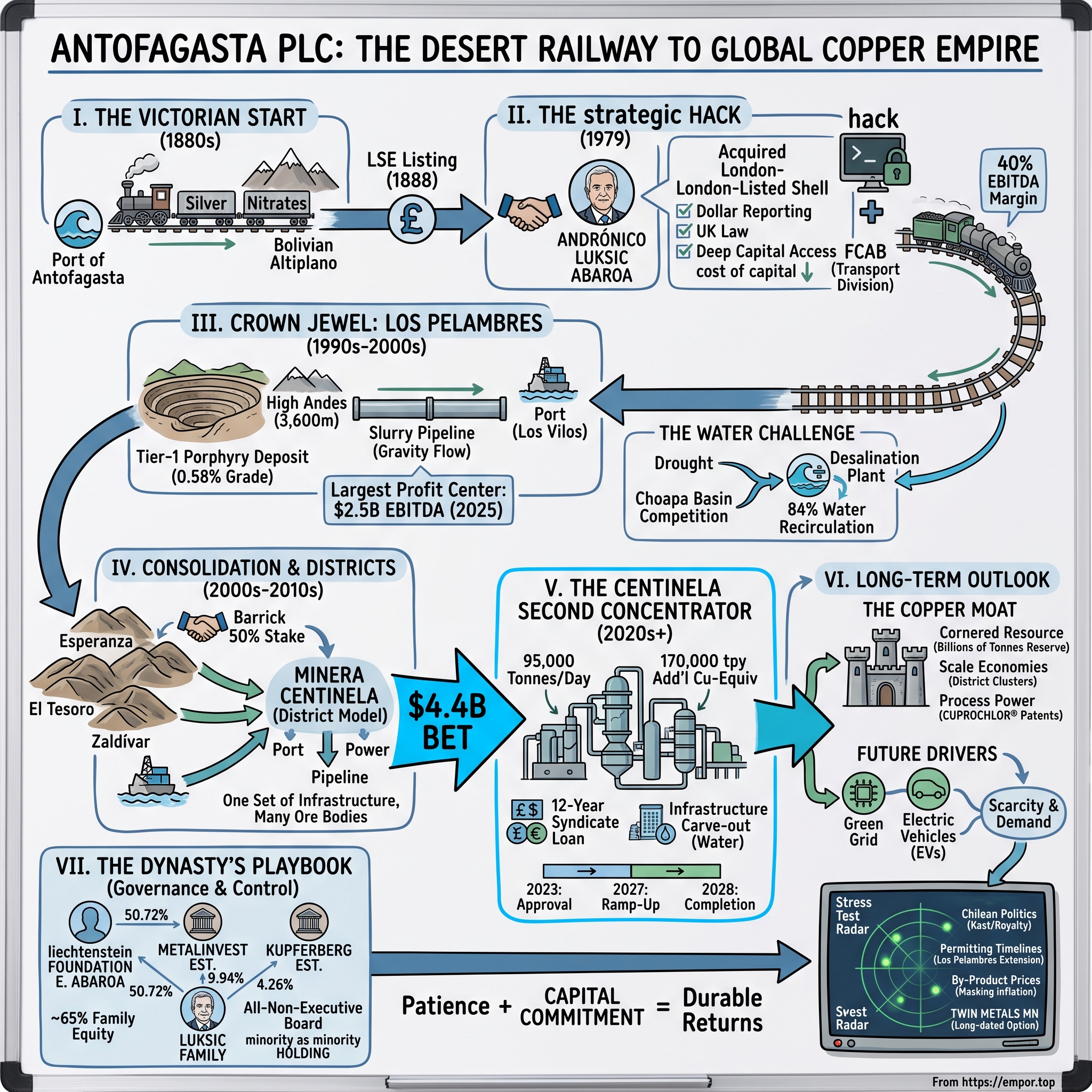
Antofagasta plc: The Desert Railway that Built a Global Copper Empire
I. Introduction & Episode Roadmap
Standing on the coastal escarpment above the Chilean port of Antofagasta at dawn reveals a striking contrast. Below lies the Pacific Ocean, cold and gray with the Humboldt Current. Inland stretches the Atacama Desert—the driest non-polar desert on Earth, where certain weather stations have never recorded rainfall. Between the two runs a narrow-gauge railway laid down in the 1880s by British engineers, climbing from sea level toward the Bolivian altiplano. Built originally to haul silver and nitrates, those tracks remain operational and profitable today. They are also the historical reason a Chilean family's copper empire trades in London rather than Santiago.
Antofagasta plc (ANTO.L) presents a structural paradox. It is a British-incorporated entity—registered number 1627889, domiciled in the United Kingdom, reporting under IFRS, and subject to the UK Corporate Governance Code—whose ultimate parent is a Liechtenstein foundation named after a Bolivian war hero, while its mines, workforce, tax payments, and political risks are almost entirely Chilean.1 More than 99.9% of the taxes and other payments the group made to governments in 2025 went to Chile.2 The London listing functions not as the primary locus of operations, but as a capital-markets vehicle.
A second paradox lies in scale versus corporate control. Antofagasta is the closest equivalent on the London market to a pure-play copper major, operating without exposure to iron ore, coal, diamonds, or oil, and producing gold and molybdenum strictly as by-products. Yet roughly two-thirds of the business belongs to a single family. As of the 2025 annual report, Metalinvest Establishment held 50.72% of the ordinary shares, Kupferberg Establishment a further 9.94%, and Aureberg Establishment—controlled by Chairman Jean-Paul Luksic personally—another 4.26%.1 Metalinvest and Kupferberg are both controlled by the E. Abaroa Foundation, in which members of the Luksic family hold interests, and which the accounts name as the group's ultimate parent company.1 In total, family-controlled entities account for nearly 65% of the equity, leaving the free float as a minority holding in a FTSE 100 constituent.
A third key context is that 2025 delivered the strongest financial results in the company's history. Revenue rose 30% to $8,620.3 million and earnings before interest, taxes, depreciation, and amortization (EBITDA) rose 52% to a record $5,201.9 million, lifting the EBITDA margin nine percentage points to 60.3%.3 Cash flow from operations reached $4,252.9 million, while underlying earnings per share more than doubled to 129.3 cents. The board recommended a final dividend of 48.0 cents, taking the full-year distribution to 64.6 cents and maintaining a payout ratio of 50% of underlying net earnings.34 The company achieved these record figures while executing its heaviest investment program to date—spending $3,684.5 million in capital expenditure—and ending the year with net debt of 0.53 times EBITDA.4
These financial figures require careful context, as much of the growth was driven by commodity prices rather than operational performance. Copper production fell about 2% in 2025 to 653,700 tonnes.5 The main driver of profitability was realized pricing: market copper averaged $4.51 per pound while the company realized $4.93 per pound. Gold experienced a more pronounced surge, rising 44% to average $3,436 per ounce and significantly increasing Antofagasta's by-product credits to offset operating costs.14 Excluding these price tailwinds, the underlying picture in 2025 showed harder ore, declining head grades, increased maintenance requirements, and substantial capital deployment required to sustain baseline capacity prior to expansion. That tension forms the central investment question.
This story follows four primary themes. First, the corporate evolution: how a Chilean family acquired a Victorian British railway and developed it into an international mining group. Second, water infrastructure: a critical engineering challenge in Chilean mining where Antofagasta has established proprietary operational approaches. Third, the $4.4 billion Centinela Second Concentrator project: the largest single capital commitment in the group's history, which will determine production and returns over the coming decade. Fourth, corporate governance: the operational and financial implications for minority shareholders invested alongside a controlling family.
It begins with a railway that almost nobody wanted.
 Subscribe on LinkedIn
II. The 1888 Railway Hack: From Atacama Transport to LSE Listing
In the 1870s, the port of Antofagasta belonged to Bolivia. The nitrate fields inland were worked largely by Chilean labour and financed largely by British capital. The mismatch between who owned the ground and who owned the business became the proximate cause of the War of the Pacific. Chile won, Bolivia lost its coastline, the desert changed flags, and the crews laying rail across the Atacama kept laying rail.
The corporate vehicle that emerged took the shape Victorian capital markets understood best. The Antofagasta (Chili) and Bolivia Railway Company Limited was incorporated in London in 1888, raising capital on the London Stock Exchange to build and operate a line climbing from the Pacific port toward La Paz.67 This was standard practice for the era; British investors funded infrastructure across South America and Asia much as modern funds back telecommunications networks—securing long-dated assets with monopoly corridors and captive freight bases. What was unusual was the corporate shell's longevity. While most Victorian railway companies were nationalised, liquidated, or absorbed, this entity survived, continuously listed, for well over a century.
The line was a notable engineering feat, climbing from sea level to Andean altitudes across terrain with no natural water sources, settlements, or shelter. By early 1889, it stretched more than 600 kilometres inland toward the Salar de Uyuni.7 For decades, hauling Bolivian minerals down to the coast and bringing supplies back up formed the entire business—a transport monopoly across a corridor no competitor sought to duplicate.
By the late 1970s, the railway—known locally as the FCAB, for Ferrocarril de Antofagasta a Bolivia—had become a tired asset. Service was unreliable, the capital base was thin, and the London parent lacked the appetite to reinvest. Andrónico Luksic Abaroa, by then an established regional mining and industrial entrepreneur, was an irritated customer. According to company histories from the period, his frustration with the railway's poor performance prompted him to acquire majority control in 1979.67
The prize was not the tracks
The term "hack" applies precisely to this transaction. The most valuable asset acquired was neither the rolling stock nor the right-of-way, but the London-listed corporate shell.
Consider the context facing a Chilean industrialist in 1979. Chile was three years into the economic reforms of the "Chicago Boys," carrying the financial scars of nationalisation and hyperinflation, and three years away from a banking crisis that would collapse much of the domestic financial system. The peso was unsuitable for long-term project finance, local equity markets were shallow, and sovereign risk premiums were severe. For a capital-intensive sector like mining, the cost of capital represented the ultimate constraint on growth.
A London listing solved that constraint in a single transaction. It provided a sterling-quoted, dollar-reporting, English-law entity with a share register accessible to international institutions, an audit trail those investors recognised, and access to deep capital markets. Renamed Antofagasta Holdings, and later Antofagasta plc in 1999, the corporate vehicle transitioned from a listed railway into a listed holding company that happened to own a railway.6 By 2004, it had entered the FTSE 100.6 The Luksic family maintained operational management in Chile near the physical assets, engineering teams, and government relationships, while sourcing its balance sheet from eight thousand miles away.
This strategic move established a template. While emerging-market family groups have spent decades attempting to lower their cost of capital through American Depositary Receipts, offshore holding companies, or dual listings, Antofagasta achieved this in 1979 by acquiring a century-old British shell with its legal and regulatory architecture already established.
What the railway is worth now
The FCAB remains an operational asset rather than a historical relic. Functioning as the group's Transport Division, it hauls copper concentrate, sulphuric acid, and general freight for Chilean and Bolivian mining clients. In 2025, the division generated $173.5 million in revenue and $69.7 million in EBITDA on 6.4 million tonnes of freight—down from $194.9 million in revenue and roughly $76 million in EBITDA in 2024, as customer freight volumes softened and a stronger Chilean peso reduced reported dollar earnings.14
In relative terms, the division accounts for under 2% of group revenue and just over 1% of group EBITDA. The railway is no longer the core business, but rather a subsidiary logistics operation attached to a copper major. Nevertheless, it generates an EBITDA margin near 40% on a capital base requiring approximately $32 million in annual maintenance capital expenditure, while occupying a logistics corridor that the group uses to transport its own ore, acid, and concentrate.4 On pure financial metrics, the Transport Division is immaterial to the modern investment case; historically, however, it remains the structural reason the corporate entity trades in London today.
This background leads to an essential historical question: how did an entrepreneur from a desert port secure the capital required to acquire a British railway company in the first place?
III. Andrónico Luksic Abaroa: The Dynasty Origins & The "500,000 Dollar Mistake"
In 1926, the port city of Antofagasta was experiencing a severe economic downturn. Synthetic ammonia developed in Germany was dismantling the nitrate trade that had built the city, exposing the vulnerability of a single-commodity economy. In November of that year, Andrónico Luksic Abaroa was born there—the son of Polikarp Lukšić, a Croatian immigrant from the island of Brač who worked in the nitrate fields, and Elena Abaroa, a Bolivian whose family name traced back to a hero of the War of the Pacific.8
That family name carries significance far beyond genealogical detail. The E. Abaroa Foundation—the Liechtenstein entity at the top of Antofagasta plc's ownership structure—bears the name of Eduardo Abaroa, the Bolivian defender killed at Calama in 1879.18 As a result, a FTSE 100 copper producer listed in London is ultimately controlled through a foundation honoring a Bolivian war hero who died fighting Chile.
Luksic Abaroa grew up around northern Chile's mining operations, developing a business model centered on identifying mineral deposits, taking equity stakes, and trading them. His first major asset was Portezuelo, a copper property in which he acquired a controlling interest after buying out a French partner and taking on substantial debt.9
The negotiation that became legend
In 1954, executives from Nippon Mining visited Chile seeking copper supply and identified Portezuelo. What followed became a famous anecdote in Chilean corporate history, recounted decades later by Luksic's daughter in the financial press: after months of technical evaluations, the Japanese buyers proposed a price of "500,000." Luksic accepted immediately, assuming the figure was in Chilean pesos—a solid return on his invested capital. The buyers, however, meant U.S. dollars.9
While the story carries elements of corporate legend that cannot be independently audited seven decades later, the underlying outcome is undisputed. The sale of Portezuelo generated a major capital windfall when Luksic was in his late twenties. Rather than funding personal consumption, he used the proceeds as working capital to build a broader industrial footprint.
Two arms, deliberately separated
Over the next four decades, Luksic Abaroa assembled a conglomerate spanning banking, brewing, cables, shipping, fuel distribution, and port operations. By the time of his death in 2005, he was the wealthiest businessman in Chile.8 Crucially, the family did not integrate these assets into a single sprawling holding company, but established two distinct operational vehicles.
Quiñenco S.A. became the industrial and financial arm, holding interests in Banco de Chile, the brewer Compañía de Cervecerías Unidas, the shipping group CSAV, the cable manufacturer Nexans, and the fuel distributor Enex.10 Antofagasta plc served as the dedicated mining and transport division, with group financial statements consolidating mines and a railway, and nothing else.1
For equity investors, this structural separation mitigates the traditional "family conglomerate discount." Cash generated by copper operations is not diverted to support industrial or financial businesses. When Antofagasta's board approves capital expenditure, the capital goes directly into mining assets. Although the top-level ownership structure remains complex—combining a Liechtenstein foundation, three Establishments, and a UK plc—the operating perimeter is focused strictly on mining and transport.
Succession, and what it signals
The founder's sons oversaw the transition to professional management as the elder generation stepped back. In September 2023, Andrónico Luksic Craig, the founder's eldest son, retired from his chairmanships and vice-chairmanships across Quiñenco, Banco de Chile, CCU, CSAV, and related entities, stating that "the time has come for me to step away from the day-to-day work, to open the way for other leaders."10 Executive leadership at those companies passed to professional managers.
Jean-Paul Luksic, the founder's son by his second marriage, focused on the mining business from the 1980s onward and has chaired Antofagasta plc since September 2014.18 The governance model he presides over is unusual for a UK-listed company: Antofagasta's board consists exclusively of non-executive directors. The chief executive does not hold a seat on the board, an arrangement the company attributes to Chilean legal and business practice.1 Whether this framework provides independent oversight or concentrates operational authority outside the boardroom remains an important governance topic, examined further in Section VI.
With its capital base expanded and its corporate structure established, the family's mining enterprise turned to acquiring primary copper assets.
IV. The Crown Jewels: Minera Los Pelambres and the Seawater Moat
Roughly 200 kilometres north of Santiago, in the Coquimbo Region, the Choapa Valley narrows into the high Andes. At an elevation of 3,600 metres, in terrain that is snowbound in winter and barren year-round, lies Los Pelambres—a massive porphyry copper deposit prospected throughout the 20th century without being developed into an operating mine.
Antofagasta acquired the property in 1986. According to published group histories, the purchase price was $6.2 million for a deposit with estimated reserves exceeding one billion tonnes.6 Yet converting that geological resource into a commercial mine required extraordinary patience. Construction began 11 years later in 1997, and commercial copper production commenced in 1999, reaching full capacity in the early 2000s.116
That 13-year span from acquisition to production illustrates a fundamental reality of major mining projects: converting a tier-one deposit into an operational mine requires over a decade of technical drilling, metallurgical design, water rights acquisition, power infrastructure, tailings engineering, community agreements, and capital assembly. It serves as a reminder for energy-transition models assuming rapid copper supply responses to elevated commodity prices.
The pipeline that made the economics work
The key engineering solution at Los Pelambres was a slurry pipeline. Copper concentrate—the dense, mineral-rich slurry produced by flotation plants—is conventionally moved by truck. Hauling concentrate down more than 100 kilometres of steep Andean switchbacks presented severe logistical, financial, and safety constraints. Instead, the mine pumps concentrate through a buried pipeline that uses gravity for much of its descent from the high mountains to the port at Los Vilos, where the material is filtered and loaded onto ships.
This infrastructure functions as a dedicated transport corridor with low marginal operating costs per tonne. However, pipeline infrastructure degrades over time. Antofagasta is currently constructing a replacement concentrate pipeline as part of two growth-enabling projects totaling approximately $1 billion, alongside expansion works at the El Mauro tailings facility.1
The economics, honestly stated
Antofagasta holds a 60% controlling interest in Los Pelambres alongside Japanese consortium partners, and the deposit remains the group's largest profit center.1 In 2025, the asset generated $2,548.0 million in EBITDA, up from $1,861.2 million in 2024.4 Copper sales brought in $3,248.9 million, supplemented by $536.9 million in molybdenum, $192.4 million in gold, and $91.9 million in silver.1
Beneath these financial headlines, operational performance faced headwind challenges. Copper production declined 8% to 295,300 tonnes in 2025, constrained by lower plant throughput due to increased maintenance, harder ore, and declining copper grades.4 Consequently, gross cash costs before by-product credits increased 6% to $2.21 per pound. What offset these higher operational costs was a surge in by-product revenues: molybdenum output rose 48% due to higher grades, gold output increased 18%, and record gold prices helped drive net cash costs down 35% to $0.82 per pound.4
This divergence reveals a key detail of Antofagasta's reported cost curve: headline cost competitiveness in 2025 was largely driven by gold pricing rather than copper operational efficiency. While the cash flow benefit was real, net cost reduction resulted from commodity price tailwinds rather than unit-cost gains, leaving margins vulnerable should gold prices retreat.
First-half 2026 results underscored this trend. Los Pelambres produced 133,800 tonnes of copper in the first six months of 2026, down 7% year-on-year, with approximately 7,000 tonnes of processed copper held in plant inventory at the end of the second quarter following a concentrate pipeline maintenance shutdown—volume slated for recognition in the second half.12 Gross cash costs rose 17% year-on-year to $2.61 per pound, while net cash costs dropped 26% to $0.76 per pound.12 For the full year 2026, management guided Los Pelambres to copper production of 340,000 to 360,000 tonnes, an operational target requiring a notable recovery in second-half throughput.1
The water problem, and the Michilla laboratory
Water scarcity poses a fundamental challenge across Chilean mining. Central Chile has experienced prolonged drought, leading to intense competition for water rights in the Choapa basin among miners, agricultural producers, and local communities. In the northern Atacama Desert, freshwater is virtually absent. Because flotation—the primary process for separating copper sulfide minerals from waste rock—requires large volumes of water, access to reliable water supplies is critical to operational continuity.
Antofagasta's technical response originated at Michilla, a modest coastal mine acquired in the 1980s.6 Lacking accessible freshwater, Michilla began using raw, untreated seawater directly in its metallurgical processing. While raw seawater solved supply constraints, high chloride concentrations disrupted traditional bacterial heap leaching of secondary copper sulfides.13
In response, an internal research team led by Abraham Backit developed and patented Cuprochlor®. Rather than neutralizing chloride, the process utilizes it: crushed ore is mixed with chloride salts and sulfuric acid to form porous agglomerates that allow uniform leaching solution flow, with chloride chemistry replacing bacterial oxidation. Secondary sulfide recovery rates reached approximately 90%.1314
Antofagasta sold Michilla in 2016, but the site served as an operational proving ground.11 The group subsequently developed Cuprochlor-T®, designed to leach primary copper sulfides like chalcopyrite—the world's most common copper mineral, which historically resisted heap leaching. By maintaining heap temperatures near 30 degrees Celsius, industrial trials on a 40,000-tonne heap at Centinela achieved copper recoveries exceeding 70% over roughly 200 days. In 2025, Antofagasta announced plans to construct an industrial leach pad at Zaldívar in 2026 to validate performance at full operating scale while evaluating technology licensing opportunities.131
If validated at commercial scale, Cuprochlor-T® could allow low-grade primary sulfide ores to be processed without constructing expensive concentrators. However, as of mid-2026, commercial viability at scale remains unproven, making the technology an avenue of upside optionality rather than a guaranteed earnings contributor.
Myth versus reality on water
While industry commentary often suggests Antofagasta has fully insulated itself from water risk, group disclosures show a more nuanced picture.
In northern Chile, Centinela and Antucoya operate almost entirely on seawater, having closed their final continental water wells in 2022 and utilizing renewable power to pump raw seawater from the coast.1 Group-wide, however, seawater represented 63% of total water withdrawals in 2025, up from 58% in 2024, while water recirculation reached 84%.1 Los Pelambres, the group's flagship mine, continues to rely significantly on continental water. A 400-litre-per-second desalination plant operates at design capacity, with an expansion to 800 litres per second currently under construction for completion in 2027 at a cost of approximately $1 billion.1
A key regulatory dependency also remains. Under Chile's Water Code, Los Pelambres relies on an annual water redistribution agreement approved by the Dirección General de Aguas to extract up to 400 litres per second from the Choapa River during drought conditions in accordance with its water rights. As of the July 2026 production report, the renewal of this annual agreement was in its final stages of issuance.12 Relying on an annual administrative approval to secure water supplies for a major profit center represents an ongoing regulatory consideration.
In summary, Antofagasta leads much of the Chilean mining sector in seawater utilization and raw ocean-water metallurgical processing. However, full transition away from continental freshwater exposure requires capital deployment through at least 2027 at Los Pelambres and 2028 at Zaldívar.
That northern district—where seawater infrastructure is already fully operational—represents the foundation for the company's expansion plans.
V. Consolidation & Districts: Minera Centinela and Zaldívar M&A
Driving inland from the port of Antofagasta, the landscape flattens into an arid expanse. There are no rivers, no vegetation, and no major towns. What lies buried beneath the gravel is copper—a series of ore bodies scattered across a district roughly the size of a small county, none of which on its own could justify constructing a port, a power grid, a coastal water pipeline, and a tailings facility.
That economic reality gave rise to what the company calls the district model—the most transferable strategic concept in Antofagasta's operating history.
One set of infrastructure, many ore bodies
Antofagasta spent the 2000s assembling the district's components. El Tesoro, an oxide operation, began production in 2002. The group consolidated control over the area by acquiring Equatorial Mining in 2006. In 2008, it sold 30% stakes in both Esperanza and El Tesoro to Marubeni Corporation to share capital requirements, subsequently constructing Esperanza, which reached production in 2011.11 Then, in 2014, Antofagasta merged Esperanza and El Tesoro into a single operating company: Minera Centinela.11
The merger was administrative on paper, but profound in its underlying economics. Rather than maintaining two separate mines—each carrying duplicate overhead, port allocations, water lines, and management teams—the group established a single complex. Shared infrastructure served multiple open pits through two processing routes: a concentrator for sulfide ore and a leach-and-electrowinning circuit for oxides. Consequently, any incremental ore body added to the district required substantially lower capital expenditure, as the primary infrastructure was already in place.
The financial impact was evident in 2025. Centinela's EBITDA nearly doubled to $2,234.2 million from $1,130.3 million in 2024, supported by a 7% increase in copper production to 240,400 tonnes.4 However, the production mix revealed an underlying shift. Copper-in-concentrate output surged 43% to 174,300 tonnes due to higher ore grades and improved plant throughput, whereas cathode production from the oxide circuit dropped 35% to 66,100 tonnes amid declining grades and recoveries.4 By-product production also expanded, with gold output rising 12% to 156,500 ounces and molybdenum climbing 42%.4
This mix shift toward higher concentrate and lower cathode volumes reflects a permanent structural transition as Centinela's oxide ore deposits are depleted. Future production will rely increasingly on sulfide ore, which yields valuable gold and molybdenum by-products. This transition produced a sharp reduction in reported unit costs for 2025: gross cash costs dropped 13% to $2.27 per pound on higher concentrate throughput, while net cash costs fell 53% to $0.75 per pound after applying by-product credits.4 For 2026, management projected gross costs of $2.45 to $2.65 per pound and net costs between $0.50 and $0.70 per pound, cautioning that concentrate volumes would normalize as ore grades revert to historical baselines.1 Consequently, Centinela's 2025 concentrate performance represents a favorable grade cycle rather than a permanent operational baseline.
Centinela also holds the largest reserve base in Antofagasta's portfolio. As of December 31, 2025, the district contained ore reserves of 2,505 million tonnes at an average grade of 0.41% copper, embedded within a total mineral resource of 5,151 million tonnes.1 This resource represents decades of potential mill feed, though processing it at scale required a major expansion in processing capacity—the central focus of Section VII.
The Zaldívar deal: bought in a downturn, and it showed
In 2015, amid a severe copper market downturn, Barrick Gold sought to reduce corporate debt by selling a 50% stake in its Zaldívar heap-leach mine in northern Chile through a competitive auction that launched in April.15 Antofagasta emerged as the winning bidder, announcing on July 30, 2015, that it would acquire the 50% interest and assume operational control for $1,005 million in cash, structured as $980 million at closing plus five annual installments of $5 million.16 The transaction closed on December 1, 2015, funded entirely from Antofagasta's existing balance sheet.1516
At the time, Zaldívar presented attractive headline metrics. The mine had produced approximately 100,000 tonnes of copper in 2014 at a net cash cost of $1.79 per pound, generating $244 million in pre-tax income, backed by 2.5 million tonnes of contained copper in proven and probable reserves that implied a 14-year mine life.16 Barrick recorded a $427 million impairment on the sale, reflecting a transaction price below book value and highlighting the seller's urgency.15 Then-Chief Executive Diego Hernández described the acquisition as "a rare opportunity to acquire a substantial interest in an established, low-cost mining operation that generates strong cash flow."16
A decade later, the operational and financial track record of Antofagasta's largest completed acquisition remains mixed.
Zaldívar has struggled to generate attractive returns. Attributable EBITDA fell to $61.8 million in 2025 from $99.9 million in 2024, as operating cost inflation outpaced commodity price gains.4 Attributable copper production declined 8% to 36,700 tonnes due to lower plant throughput and recovery rates, while full-year cash costs climbed 14% to $3.44 per pound, driven by reduced output, higher sulfuric acid prices, and the settlement of a three-year collective bargaining agreement.4 Compared to Antofagasta's other operating mines, which report gross costs between $2.20 and $2.80 per pound, Zaldívar remains the group's highest-cost operation. Furthermore, its ore reserves stood at 354 million tonnes grading 0.40% copper at year-end 2025, representing the smallest reserve base in the group's portfolio.1
Relative to the $1.005 billion purchase price for a 50% stake, an asset yielding $60 million to $100 million in annual attributable EBITDA a decade later has generated modest returns—especially when compared to alternative capital deployment in the Centinela district. From a shareholder perspective, Zaldívar has functioned as a mature, high-cost heap-leach operation that required extensive management focus and capital allocation to address environmental permitting.
The permitting fight, and what winning it actually bought
Water rights formed the primary operational constraint. Located inland, Zaldívar historically relied on continental groundwater extraction, subject to increasingly stringent regulation by Chile's Dirección General de Aguas and environmental authorities. Securing the mine's operating horizon required approval of a new Environmental Impact Assessment (EIA) to authorize ongoing operations and transition its water supply.
In May 2025, environmental authorities approved the EIA.1 The permit extended Zaldívar's mining and environmental authorizations through 2051, permitting development of the primary sulfide deposit beneath the existing oxide leaching pads. Crucially, however, the authorization extended the existing continental groundwater extraction permit only through 2028, mandating a complete transition to seawater or alternative non-continental water sources thereafter.4 Consequently, the EIA approval provided operational longevity conditioned on a strict capital compliance timeline.
Antofagasta initiated the required water transition. In the second quarter of 2026, the group approved an investment decision to construct a dedicated pipeline and pumping system designed to eliminate continental water usage at Zaldívar by mid-2028. The project is budgeted at approximately $0.9 billion over two years on a 100% basis, supplying recycled municipal wastewater sourced from the city of Antofagasta.12 On a 50% attributable basis, this requires Antofagasta to commit roughly $450 million in capital to an asset generating approximately $60 million in annual attributable EBITDA, securing operational rights through 2051 and unlocking access to the underlying primary sulfide deposit.
This capital commitment illustrates the dual nature of family-controlled governance: it reflects either patient, long-term capital allocation or continued investment in a marginal asset. The ultimate outcome depends largely on whether the proprietary Cuprochlor-T® leaching process succeeds at industrial scale on Zaldívar's leach pads, as successful primary sulfide leaching would significantly expand recoverable reserves and improve economics. Notably, Antofagasta's capital project disclosures continue to list the broader Zaldívar mine-life extension in the evaluation phase, without disclosing a total capital expenditure estimate for the full development project.1
This brings the story to the leadership and governance structure determining how that capital is allocated.
VI. The Dynasty's Playbook: Governance, Control, and the Arriagada Era
A detail in Antofagasta's annual disclosures often catches corporate governance analysts off guard: the chief executive does not sit on the board.
Every director of Antofagasta plc is a non-executive. Chief Executive Officer Iván Arriagada, who has led the company since 2016, attends board meetings and chairs the executive committee, but holds no seat on the board itself. The company attributes this setup to "the law and practice in Chile," arguing that an all-non-executive board provides a broader perspective and more independent oversight of management.1 While clearly disclosed, this structure means the executive running an $8.6 billion business is absent from the table where his performance is judged, while the chairman representing a controlling two-thirds shareholder presides.
The technocrat in the chair
Arriagada's background explains a great deal about how the company communicates. He is an engineer and economist with more than 30 years of experience across mining, oil, and gas. Before joining Antofagasta in 2015, he served as chief financial officer of Codelco—the Chilean state copper company and the world's largest producer—a role requiring deep political and operational acuity. That followed eight years in BHP's base metals division, where he served as vice president of operations, CFO of base metals, and president of the Spence and Cerro Colorado mines in northern Chile. Earlier in his career, he spent over 15 years at Shell in senior assignments across Chile, the UK, Argentina, and the United States.1
His leadership team shares similar credentials. Chief Operating Officer Octavio Araneda, appointed in 2023, is a former chief executive of Codelco. Chief Financial Officer Mauricio Ortiz, appointed in 2020, previously ran the FCAB railway before transitioning to group finance, having earlier worked at Codelco's Chuquicamata division, Rio Tinto in London, and BHP.1 Rather than an entrepreneurial venture led by an improvising founder, Antofagasta is a technocracy staffed almost entirely from the Chilean copper establishment.
Empirical evidence on management credibility is generally positive, with notable caveats. Production guidance has typically been met: the group entered 2026 targeting 650,000 to 700,000 tonnes of copper. Following two soft quarters—143,000 tonnes in the first quarter and 142,000 in the second, leaving first-half production 9.5% below the prior-year period—management reaffirmed the full-year target rather than widening the range, explicitly noting that output must rise sequentially through the second half to achieve it.1712 That reaffirmation represents a clear, testable operational commitment for the second half of 2026.
Management has also shown a willingness to revise financial guidance upward when cost pressures emerge. In its July 2026 production report, the company maintained its net cash cost guidance at $1.15 to $1.35 per pound, but raised its gross cash cost guidance to $2.40 to $2.60 per pound from $2.30 to $2.50 per pound, citing elevated fuel and consumable prices.123 Arriagada noted candidly that "inflationary pressures persist across the mining industry, following external disruptions in the oil and other feedstock markets."12 Transparently reporting gross cost inflation rather than relying solely on by-product-adjusted metrics reinforces disclosure credibility over time.
Counter-evidence, while narrower, remains relevant. The group's internal Competitiveness Programme delivered $115 million in cost savings in 2025, down from $248 million in 2024. While the company highlighted exceeding its internal $100 million annual target, the year-on-year drop in delivered savings occurred alongside a rising gross cost base.4 Cumulative program savings over ten years exceed $1 billion; however, the recent decelerating trend indicates that lower-hanging cost reductions have largely been captured.1
What two-thirds control actually buys, and costs
The strategic rationale for family control rests on long-term capital commitment. A controlled company can execute 15-year capital investment cycles without facing immediate public market discipline. Antofagasta's actions from 2023 through 2026 demonstrate this dynamic: the group approved a $4.4 billion concentrator project alongside roughly $2 billion in supporting infrastructure, elevated capital expenditure to record levels, and allowed net debt to increase, while maintaining its policy of distributing 50% of underlying net earnings.4 Few widely held mining companies could execute a similar capital program while maintaining dividend payouts.
Conversely, minority shareholders bear distinct structural trade-offs:
First, there is no market for corporate control. A takeover premium is unavailable regardless of valuation, as the controlling family retains equity control and will not sell.
Second, related-party and governance conflicts are structural. Board director Ramón Jara provides advisory services to the group, while director Andrónico Luksic Lederer is the chairman's nephew.1 While properly disclosed, these disclosures do not eliminate inherent governance conflicts.
Third, the board succession in early 2026 highlights the ongoing role of family control. On January 28, 2026, the company announced that Andrónico Luksic Craig had resigned from the board after 12 years as a non-executive director, receiving no loss-of-office payments beyond accrued remuneration. Andrónico Luksic Lederer was appointed as a non-executive director effective March 1, 2026, joining the Sustainability and Stakeholder Management Committee and the Projects Committee on April 1.18 The board stated explicitly that it does not consider him independent under the UK Corporate Governance Code.18
Luksic Lederer brings relevant operational experience, having joined the company in 2006 and served as vice president of development and an executive committee member since 2015, overseeing exploration and strategic transactions, before stepping down from that executive role on February 1, 2026, to become deputy chairman of Quiñenco.18 The chairman's annual report commentary noted his role in advancing exploration and key project development.1 While two decades of internal company experience distinguishes his background, his appointment represents a family designation to a family-controlled board chaired by his uncle.
Minority shareholders have accepted these arrangements without formal challenge, passing all resolutions at the annual general meeting on May 7, 2026.12 With nearly 65% of voting shares held by family-controlled entities, AGM outcomes remain determined by the controlling shareholder.
Capital allocation: the balance sheet as strategy
Financing execution represents a key area where family control has supported long-term balance sheet strategy. Antofagasta closed 2025 with $4.91 billion in cash, cash equivalents, and liquid investments, net debt of $2.75 billion, and a net-debt-to-EBITDA ratio of 0.53 times—compared to 0.48 times in 2024 despite executing its largest capital program to date.4
The group financed this growth without overextending its central corporate balance sheet. In March 2025, a subsidiary of Minera Los Pelambres secured a $2.0 billion project financing package ring-fenced against its water infrastructure, comprising a $450 million bank loan with a nine-year tenor and $1.55 billion in private placement notes with a 20-year term.4 Securing 20-year private placement funding against desalination assets effectively functions as infrastructure financing backed by long-term operational cash flows. Following a subsequent corporate bond issuance, management stated in its full-year results that the capital expansion program was fully funded.4
During the full-year earnings call, executive leadership noted that the $4.91 billion cash balance supports continued capital returns alongside project capital expenditure, while Arriagada stated that the company remains open to strategic opportunities given its market valuation.19 Given Antofagasta's premium equity valuation, substantial liquidity, and controlling family ownership structure, potential M&A remains an ongoing strategic consideration for investors to monitor.
Engineers and capital deployment remain focused primarily on the group's major desert expansion projects.
VII. The $4.4 Billion Bet: The Centinela Second Concentrator
In December 2023, with copper trading well below its subsequent 2025–2026 levels, Antofagasta's board approved the largest single investment in the company's history.
The Centinela Second Concentrator is a second processing plant in the district, capable of treating 95,000 tonnes of ore per day.20 The capital cost at approval stood at $4.4 billion, up 19% from the $3.7 billion indicated in August 2022—a stark illustration of cost inflation across the mining sector during that period.20 Alongside the plant itself, approximately $1 billion in mine development and sustaining capital was allocated to expand the Encuentro pit to supply the new facility.20
The facility is designed to deliver an average of 170,000 tonnes per year of additional copper-equivalent production over its first ten years of operation—comprising 144,000 tonnes of copper, 130,000 ounces of gold, and 3,500 tonnes of molybdenum.20 Relative to 2025 group copper output of 653,700 tonnes, this increment represents a major operational expansion that underpins management's projection of 30% medium-term production growth.4 The underlying reserve base supports a 36-year mine life on roughly two billion tonnes of ore, with management aiming to position the Centinela district in the first quartile of the global cash cost curve.20
The financing, and the trick inside it
On March 19, 2024, the company secured a $2.5 billion term loan facility featuring a four-year drawdown period and a twelve-year tenor, syndicated across a notable group of international institutions: Japan Bank for International Cooperation, Export Development Canada, Export-Import Bank of Korea, Crédit Agricole Corporate and Investment Bank, KfW IPEX-Bank, Natixis, Société Générale, and Sumitomo Mitsui Banking Corporation.21 Chief Executive Iván Arriagada described the financing terms as "testimony to this project's caliber."21
The composition of the syndicate is revealing. Three of the eight lenders are state-backed export credit agencies from Japan, Canada, and South Korea—institutions designed to secure long-term strategic mineral supplies for their industrial economies. Their involvement functions as an implicit sovereign vote on future copper scarcity, providing longer-tenor funding on more favorable terms than standard corporate bond markets.
Alongside debt financing, management executed an infrastructure carve-out for the plant's water supply. Rather than directly funding, owning, and operating the expanded seawater delivery network, Centinela transferred its existing water transportation assets and rights to an international consortium for approximately $600 million in cash, received in 2024, with the consortium funding roughly $380 million in expansion capital in exchange for long-term supply arrangements covering current and future operations.21
This arrangement achieved two strategic objectives. First, it reduced direct capital outlays: group disclosures confirm that the headline $4.4 billion budget was lowered by $380 million following the completion of the outsourcing transaction in the first half of 2024.1 Second, it generated $600 million in upfront cash proceeds. In essence, Antofagasta monetized an asset at infrastructure valuation multiples while converting upfront capital expenditure into a long-dated operating commitment. However, this structure carries ongoing operational costs. The company must now pay tariffs for water infrastructure it previously owned, with interest expenses linked to the water agreement already reflected in financial disclosures.4 The capital burden was shifted rather than eliminated.
Execution: the number that actually matters
Major mining projects across South America have frequently suffered severe capital overruns, as seen in Teck's Quebrada Blanca 2 in Chile and Anglo American's Quellaveco in Peru. Consequently, the central analytical question surrounding Centinela is not whether the district expansion strategy is conceptually sound, but whether management can execute within the approved budget and timeline.
Execution metrics through late 2025 indicated steady progress. By year-end 2025, the project had surpassed 50% completion with $2.6 billion spent, remaining on schedule and within budget for an initial ramp-up in late 2027 and full completion in late 2028.1 Management reinforced transparency by hosting an analyst and investor site visit on November 5–6, 2025, providing direct access to construction progress.22
Disclosures through mid-2026 provided granular engineering milestones. During the first quarter of 2026, fifteen of eighteen electrical rooms were completed, equipment was energized, pre-commissioning started with pumping station recirculation tests, and the expanded water network delivered test water to the site.17 In the second quarter, workers completed the internal lining of the ball mills, erected the fines stockpile dome, tested the primary crusher motor system, and energized the overland conveyor drives.12 These physical milestones mark the transition from heavy structural construction to mechanical and electrical integration.
Group capital expenditure peaked at $3,684.5 million in 2025 and was guided to $3.4 billion in 2026—including approximately $1.5 billion in growth capital, primarily allocated to Centinela—before expected reductions in 2027 as construction winds down.4 The Centinela district absorbed $2,478.1 million of total capital in 2025, with $1,327.1 million invested directly in the second concentrator.4
From an investment perspective, the project has largely progressed past the civil engineering and bulk earthmoving phases where major budget overruns typically occur, entering the commissioning phase where schedule and integration risks predominate. Commissioning risks remain notable, as complex concentrators frequently experience delays in achieving nameplate throughput—a reality reflected in management's multi-quarter ramp-up schedule spanning late 2027 through late 2028. However, the risk of a catastrophic multi-billion-dollar cost overrun has diminished substantially compared to the project's approval stage.
The broader strategic question facing investors is whether this capital deployment establishes a durable long-term competitive advantage, or simply expands a mature asset base.
VIII. The Copper Moat: 7 Powers & Porter's 5 Forces Analysis
Consider a thought experiment: suppose a rival with unlimited capital decided to compete directly with Antofagasta in the Centinela district. What, precisely, would stop them?
Not capital—copper attracts abundant funding. Nor technology in the ordinary sense, as flotation and heap leaching are published engineering methods. A competitor would instead be halted by assets that cannot be purchased at any price and infrastructure that would take fifteen years to replicate. That combination defines a moat in a commodity business, making it essential to distinguish which competitive advantages are genuine.
Applying Hamilton Helmer's 7 Powers
Cornered Resource serves as the dominant power here, fitting Hamilton Helmer's classic definition: preferential access to an attractive asset independent of a firm's other capabilities. A tier-one porphyry copper deposit qualifies unambiguously—it is a geological feature created by specific hydrothermal processes, fixed in location, and impossible to duplicate through capital spending. Antofagasta's four operations contain ore reserves totaling billions of tonnes, with the Los Pelambres reserve grading 0.58% copper—well above the global average for new projects and the primary reason its gross cash costs sit at the low end of the group.1
The qualification is that a cornered resource remains valuable only as long as its reserve life and ore grades hold. At year-end 2025, Los Pelambres held 716 million tonnes in proven and probable reserves against a total mineral resource of 6,047 million tonnes. This gap indicates that most of the deposit is not yet economically reserved, leaving expansion dependent on the Development Options Project, whose Environmental Impact Assessment was submitted in December 2024 and remains under regulatory review.1 A cornered resource requires ongoing permits to maintain its advantage.
Scale Economies function here through physical infrastructure rather than software dynamics. The relevant unit is not the corporate entity but the operating district: a single port, power grid connection, coastal water pipeline, tailings facility, and maintenance organization shared across multiple pits. Each incremental tonne of ore processed through this integrated system carries a lower share of fixed overhead. The Centinela Second Concentrator represents the clearest example—a brownfield expansion leveraging existing haulage, water rights, port capacity, and workforce, allowing construction at a $4.4 billion capital cost where a greenfield equivalent would require far higher expenditure and longer development timelines.
The slurry pipeline, the private port at Los Vilos, and the FCAB railway corridor reinforce this structural cost advantage. A competitor attempting to develop a stand-alone deposit within the same district would bear the full burden of duplicating that infrastructure.
Process Power—defined by Helmer as embedded operational knowledge that competitors cannot easily replicate—represents the weakest claim and warrants close scrutiny. Cuprochlor is proprietary and patented, and Antofagasta is evaluating licensing options with third parties—a step demonstrating management's belief in its standalone value.13 However, licensing technology enables eventual competitor adoption. Furthermore, Cuprochlor-T®, the variant with the greatest economic potential for primary sulfide leaching, has been validated at pilot and industrial-trial scale but not at full commercial operation.1 Until the industrial leach pad at Zaldívar demonstrates performance at scale, treating process technology as a durable moat remains premature.
The remaining four powers—network economies, counter-positioning, switching costs, and branding—are largely absent. Copper cathode is a standardized commodity, while concentrate is sold against published benchmark pricing with treatment and refining charges negotiated annually. Buyers face no switching lock-in, and brand equity holds no pricing power in raw material markets.
Porter's Five Forces, war-gamed
Threat of new entrants: very low, and structurally constrained. The primary barrier to entry is time and regulatory authorization rather than capital. Los Pelambres required thirteen years from initial acquisition to commercial production. Antofagasta's market disclosures note that permitting constraints increasingly restrict global copper supply growth, driven by extended approval timelines and rising regulatory complexity.1 While Chile's congress passed legislative reforms in July 2025 to streamline permitting and reduce administrative burdens, even an expedited regulatory framework cannot compress the decade-long sequence of exploratory drilling, metallurgical testing, and mine construction.1
Bargaining power of buyers: low to moderate, and shifting toward producers. Copper trades on liquid global exchanges like the London Metal Exchange and Comex, leaving individual smelters and fabricators without pricing leverage over major producers. Buyer power manifests primarily in treatment and refining charges—the fees smelters charge to process concentrate into refined metal—which have favored miners as global smelting capacity has expanded faster than mine concentrate supply. Antofagasta's Los Pelambres disclosures reflect this shift, with tolling charges moving from an 11-cent-per-pound expense in the first half of 2025 to a small credit in the first half of 2026.12
Bargaining power of suppliers: high, representing the primary margin risk. The group's cost disclosures highlight this exposure. In 2025, operating expenditure comprised operational services at 19%, materials and spare parts at 14%, labor at 13%, electrical energy at 12%, maintenance services at 12%, fuel and lubricants at 7%, and sulfuric acid at 5%.1 Each line item depends on a concentrated supplier base. Sulfuric acid consumption reached approximately 1.5 million tonnes annually, with prices rising from roughly $130 per tonne in 2024 to around $155 in 2025.1 Haul truck tires—purchased on five-year contracts totaling roughly 1,500 units per year—rose 3% in price.1 Electricity consumption totaled 3,724 gigawatt-hours at a weighted average cost of $128 per megawatt-hour.1 Labor across Chilean operations is unionized, with four three-year collective bargaining agreements concluded in 2025 and four more falling due in 2026; a negotiated settlement with Centinela's supervisors' union added immediate labor costs in the second quarter of 2026.412
Second-order supply factors also shape cost performance. Contracting 100% renewable power since 2022 insulates the group from fossil-fuel electricity price swings, providing a key structural advantage, but offers no protection against rising costs for diesel, acid, or explosives.1 Supplier power remains the principal transmission mechanism for cost inflation, as reflected in management's decision to raise 2026 gross cash cost guidance.
Threat of substitutes: low over the medium term. Aluminum can substitute for copper in select electrical transmission and wiring applications when price ratios widen significantly, creating marginal substitution risk. However, copper's superior electrical conductivity per unit volume maintains its dominant position in electric motors, transformers, and complex wiring systems. Antofagasta's market commentary highlights grid infrastructure expansion, electric vehicle adoption, and rising demand from data centers and artificial intelligence as structural consumption drivers.12
Competitive rivalry: moderate, and centered on operational costs. Copper producers do not engage in price competition, as output sells at prevailing market reference rates. Instead, miners compete for scarce operational inputs—including environmental permits, water rights, skilled labor, drilling rigs, and heavy equipment—as well as acquisition targets. Competition manifests in cost-curve positioning rather than price discounting. Antofagasta maintains a competitive position on the global cost curve, though evaluation should focus on gross costs—guided at $2.40 to $2.60 per pound for 2026—rather than net costs adjusted for by-product credits.
In summary, Antofagasta's economic moat is real, grounded primarily in geology and shared district infrastructure rather than proprietary technology. This advantage protects production volumes and asset longevity, but provides limited protection for operating margins, which remain exposed to external input inflation and volatile by-product credit prices.
And beyond the mine gate sits a different category of risk entirely.
IX. Stress Testing the Luksic Empire: Geopolitics & Permitting Radar
On 11 March 2026, José Antonio Kast was inaugurated as president of Chile, replacing the Boric administration and marking a sharp rightward turn in the country that produces roughly a quarter of the world's mined copper.23 For a company that pays essentially all of its taxes in one jurisdiction, and whose entire producing asset base sits within it, Chilean politics is not background noise. It is the single largest non-operational variable in the story.
The royalty, and the shield
The most consequential fiscal change of the previous cycle took effect on 1 January 2024. Chile's new mining royalty combined a margin-based component that rises with profitability and a 1% ad valorem levy on copper sales, with an overall cap: total taxation — corporate income tax, both royalty components and theoretical tax on dividends — is not to exceed 46.5% of mining operating margin less the ad valorem expense.4
The mechanics matter more than the headline rate, and Antofagasta's disclosure is unusually clear about them. Because the ad valorem component is levied on revenue rather than profit, it is not treated as tax at all in the group accounts; it runs through operating expenses, costing $31.0 million in 2025 against $28.7 million in 2024.4 The margin-based mining tax appeared as a $301.9 million charge in 2025, with a net effective-tax-rate impact of $218.3 million, or 7.0 percentage points, after allowing for its deductibility against first-category tax.4 The group's effective tax rate landed at 36% for the year.19
The shield is real but partial, and the outline's framing needs correcting on one point. Los Pelambres has been subject to the new royalty since it took effect, as has Zaldívar. Centinela and Antucoya hold tax stability agreements and therefore continue under the previous royalty system, with the new rates only affecting their royalty payments from 2030 onwards.4 The company discloses 2030 for both operations; a specific 2031 date for Antucoya does not appear in the 2025 filings.
The investment implication is worth stating plainly, because it is a genuine deferred liability. Centinela — which will be the group's largest and most profitable operation once the second concentrator ramps — currently pays under a grandfathered regime that expires around the time the new plant reaches full production. Any long-horizon model of this business needs to step up Centinela's tax rate from 2030. Management has not, in public materials reviewed, quantified that step-up.
The new administration's direction is more favourable, though nothing is enacted. Kast's government presented a National Reconstruction and Economic Development Bill to Congress on 22 April 2026, whose core is a phased reduction in the corporate tax rate from 27% to 23% by 2029, alongside a twenty-five-year tax invariability regime for major projects that would shield investors from future royalty increases and new sector-specific levies, plus faster permitting.24 Whether it passes in that form is unknown; revisions are widely expected. Investors should treat it as an option, not a plan.
Permitting: the constraint that binds
Chile's environmental and water regulators have become the practical gatekeepers of the industry, and the Zaldívar saga described earlier is the case study. The relevant remaining exposure is Los Pelambres' Development Options Project — the mine-life extension beyond 2035, adding a minimum of fifteen years by increasing El Mauro's tailings capacity to 1.2 billion tonnes, with options to raise throughput to an average 205,000 tonnes per day and to expand desalination capacity by a further 800 l/s. The estimated cost is approximately $2 billion, it remains under study, and the EIA submitted in December 2024 is expected to involve a multi-year process of stakeholder engagement.14
That is the honest state of play: the group's largest cash generator has a defined path to a fifteen-year life extension, and that path runs through a regulatory process with no published completion date. Chile's July 2025 permitting reform may help; the new administration's proposals may help more. Neither has yet produced an approval.
There is also a labour dimension that a strike-focused analyst would flag. Four collective agreements at Centinela and Zaldívar fell due during 2026, and the one settled with Centinela's supervisors' union in the second quarter arrived with a one-off cost.412 Chilean mining labour negotiations are cyclical, well-telegraphed and occasionally disruptive; they are a recurring cost item rather than an existential risk.
The capital intensity problem
The number that ought to sober any bull is $3.4 billion of guided 2026 capital expenditure, excluding Zaldívar entirely, against a business that produced $4.25 billion of operating cash flow in a record year.124 Add the roughly $450 million attributable share of the newly-approved Zaldívar water pipeline and the picture tightens further.12
This is what the industry means when it talks about rising capital intensity. Grades decline, ore hardens with depth, and producers add processing capacity simply to maintain existing output — the company's own market review says exactly that.1 Antofagasta is spending roughly a year's operating cash flow annually to grow production by 30% over the medium term and to secure water for the following quarter-century. If copper prices retrace meaningfully before the projects complete, the balance sheet absorbs the difference. At 0.53 times EBITDA net leverage, it has room to. At a copper price well below current levels, that room shrinks quickly.
Twin Metals: the lottery ticket
Which brings us to the most politically charged and least financially material asset in the portfolio.
Twin Metals Minnesota is a wholly owned copper, nickel and platinum-group-metals project in north-eastern Minnesota, acquired in 2014.111 The configuration under study envisaged an underground mine processing 18,000 tonnes of ore per day for twenty-five years, producing three separate concentrates.4 It sits in the watershed of the Boundary Waters Canoe Area Wilderness, which is why it has spent a decade in court rather than construction.
The legal history is a grind. The federal government cancelled Twin Metals' mineral leases and rejected its mine plan of operation; the company sued in 2022 claiming the actions were arbitrary and capricious; the District Court dismissed the suit in September 2023; Twin Metals appealed in November 2023; oral arguments were heard in January 2025; and the appellate court granted a stay that ran to 6 April 2026.4 Separately, a 2023 public land order had withdrawn more than 225,000 acres of the Superior National Forest from mineral leasing for twenty years.25
Then the politics turned. The Senate passed H.J. Res. 140 by 50 votes to 49 on 16 April 2026 — with two Republicans, Thom Tillis and Susan Collins, voting against — and President Trump signed it into law on 27 April.2526 The resolution used the Congressional Review Act to revoke the public land order, the first time Congress had used that mechanism to reverse a land withdrawal, and it also constrains future administrations from reimposing an equivalent protection by rule.2526
Now the reality check, which is where most commentary stops short. Removing the federal withdrawal did not hand Twin Metals a mine. The cancelled federal mineral leases remain tied up in litigation and must be reissued by the Interior Department.25 Beyond that, the project needs a state Permit to Mine from the Minnesota Department of Natural Resources — which can deny it if the project poses unacceptable environmental risk or fails to demonstrate adequate pollution prevention and tailings storage — plus water discharge, wetlands and dam safety permits, and air permits from the Minnesota Pollution Control Agency.26 Minnesota legislators have advanced state-level permanent protection bills in response.26 Environmental groups have promised continued litigation.
The group's own chairman describes Twin Metals as "a long-dated option."1 That is the right framing, and investors should size it accordingly: it contributes nothing to EBITDA, it carries no disclosed capital budget, and the realistic distance to a production decision is measured in years of state-level process with a genuinely uncertain outcome. It is a call option with a long expiry and an unknown strike — worth something, worth very little in a base case.
Which leaves the question every long-term holder actually has to answer.
X. The Investment Story Spine: Bull vs. Bear
Every commodity investment eventually reduces to two arguments: is the commodity going to be scarce, and is this the operator you want owning the assets when it is? Antofagasta gives an unusually clean read on both, because there is nothing else in the portfolio to obscure the answer.
Why this wins from here
The supply side of copper is constrained, and the evidence lies in industry metrics rather than long-range forecasts. Antofagasta's market review documented that several of the world's largest copper mines suffered significant operational disruptions in 2025 from technical failures and geotechnical risks, while greenfield discoveries remained scarce despite heavy exploration spending, and falling ore grades and rising ore hardness increased the tonnage—and thus the energy and capital—required to produce the same volume of metal.1 Meanwhile, demand drivers expanded across power grid upgrades, electrification, and digital infrastructure for artificial intelligence.12 Market pricing reflected these physical constraints: the London Metal Exchange cash settlement price reached $5.67 per pound at the end of 2025, compared with a full-year average of $4.51, while consensus estimates from over twenty investment banks as of January 2026 stood at $5.43 per pound for 2026 and $5.23 for 2027.1 By mid-2026, the company reported record realized prices during the second quarter.12
Volume growth is contracted and near-term, rather than aspirational. This marks a clear point of differentiation against peers. While many major copper producers are managing asset decline, Antofagasta has a fully funded, on-schedule expansion project arriving in 2027 alongside a second wave of supporting infrastructure projects. The projected 30% medium-term production growth is backed by a specific processing plant, defined reserves, and a concrete construction timeline.420
Jurisdiction offers a relative advantage. Compared to rival operating environments—such as First Quantum's Cobre Panamá, which was ordered closed following a 2023 judicial ruling, or operations in the Democratic Republic of Congo, Peru, and Indonesia—Chile provides established legal frameworks, functioning judicial systems, and a century of mining institutional history, alongside a government in 2026 seeking to accelerate mining investment.2324 Although the 2024 royalty reform demonstrated that tax terms can shift, Chilean country risk remains structured and manageable.
The net cost position appears competitive, subject to key by-product caveats. Group net cash costs declined 27% in 2025 to a five-year low of $1.19 per pound, with 2026 guidance set at $1.15 to $1.35 per pound.53
What could break it
The by-product effect masks underlying cost inflation. If gold prices retreat from record highs, Antofagasta's net cash costs will increase, weakening its first-quartile cost positioning. First-half 2026 performance illustrated this vulnerability: net cash costs rose 26% quarter-on-quarter to $1.36 per pound in the second quarter as gross costs increased and realized gold prices softened.12 High by-product credits currently obscure unit-cost growth that remains outside management's control.
Structural grade decline is an ongoing operational reality. While Los Pelambres' reserve grade of 0.58% copper remains above industry averages, ongoing extraction depletes higher-grade ore first. To sustain production baselines, the group must continually deploy capital into additional processing capacity and infrastructure, pushing capital expenditure close to annual operating cash flows.
Governance structures limit minority shareholder influence. With nearly 65% of voting equity held by family-controlled entities, public shareholders lack an activist path, a takeover premium, or meaningful proxy leverage.1 Minority investors participate in economic outcomes without operational or strategic control, leaving public markets with no structural mechanism to block capital allocation decisions.
Geographic and operational concentration remains absolute. All four producing assets sit within Chile, with three concentrated in the northern mining districts. The entire business shares exposure to the same regional water supply conditions, collective bargaining cycles, national tax authorities, and seismic activity, offering no geographic diversification.
Execution risk centers on plant commissioning. Bringing a 95,000-tonne-per-day concentrator online between late 2027 and late 2028 represents the phase where engineering schedules face potential integration delays. A timeline slippage would defer planned volume growth into uncertain future commodity price environments.
The activist's memo
A critical assessment of the corporate governance and capital allocation track record highlights four specific areas of concern:
First, Zaldívar consumed $1.005 billion in acquisition capital in 2015 and requires an estimated $450 million in attributable capital for a new water pipeline, despite producing under 40,000 attributable tonnes of copper annually at the group's highest cash costs.412 Second, the 2026 board appointment of Andrónico Luksic Lederer—explicitly designated as non-independent—was executed without an external search.18 Third, delivered cost savings from the internal Competitiveness Programme dropped by more than half in 2025 to $115 million even as gross costs rose.4 Fourth, holding $4.91 billion in cash and liquid investments while expressing openness to strategic transactions creates potential risk around large-scale M&A under a controlling shareholder structure.419
While none of these factors invalidates the core investment case, they represent key governance and operational metrics for investors to monitor.
The three things worth tracking
Evaluating Antofagasta's progress relies on tracking three specific operational indicators:
First, construction and commissioning metrics for the Centinela Second Concentrator. The project's progression from mechanical integration to initial production in 2027 and full operational ramp by late 2028 represents the primary driver of group cash flows over the medium term. Key indicators include quarterly progress updates, adherence to the target timeline, and cumulative capital spending against the adjusted $4.4 billion budget.120
Second, the spread between gross and net cash costs per pound. Comparing gross cash costs with net costs after by-product credits reveals whether operational efficiency is improving or whether profitability remains reliant on high gold and molybdenum prices. A widening gap signals that price tailwinds from by-products are masking underlying input cost inflation.
Third, the seawater proportion in the group's total water mix. Seawater accounted for 63% of Mining Division water withdrawals in 2025, up from 58% in 2024.1 This metric measures progress in reducing reliance on continental groundwater and annual river extraction permits. The proportion is expected to increase following the completion of the Los Pelambres desalination expansion in 2027 and the Zaldívar water pipeline transition by mid-2028.
Tracking these three metrics provides a clearer picture of operational execution, cost discipline, and risk mitigation than short-term commodity price movements.
XI. Playbook & Lessons
Lesson 1: Sometimes the asset is the wrapper.
The lasting insight from 1979 is not simply that a Chilean family acquired a regional railway, but that they identified the primary constraint on their industrial ambition—the cost and availability of long-dated capital in an emerging market—and resolved it by acquiring a corporate structure rather than an operating mine. The railway ultimately generated a tiny fraction of group earnings. However, its London listing provided a recognized currency, a governance framework trusted by international institutions, and access to deep global capital markets. Nearly five decades later, that same corporate architecture enabled a mine in the Chilean Andes to raise 20-year private placement notes backed by water infrastructure and allowed a major concentrator project to syndicate a 12-year debt facility across three national export-credit agencies.421 For corporate strategists, the lesson is to identify the binding constraint first, then locate the corporate wrapper that removes it.
Lesson 2: In resources, the ore body is necessary and the infrastructure is decisive.
Antofagasta controls high-grade geological assets that cannot be duplicated, but geology alone does not guarantee long-term returns. What distinguishes an integrated mining district from a collection of isolated pits is shared infrastructure—the port, power grid connections, coastal seawater pipelines, tailings facilities, and centralized maintenance—that converts each incremental ore body from a standalone capital project into a marginal expansion. This shared footprint explains why a 95,000-tonne-per-day concentrator can be built for $4.4 billion inside an existing district when a greenfield equivalent would require far higher capital outlays and an additional decade of development. It also illustrates why water access in the Atacama Desert is an operational imperative rather than a secondary compliance matter: control over coastal pipelines determines what can be mined.
The accompanying reality is that infrastructure moats require continuous capital renewal. The concentrate pipeline that established the operating economics at Los Pelambres in 1999 required replacement a quarter-century later at a cost of approximately $1 billion. In capital-intensive commodity sectors, infrastructure advantages are rented through perpetual reinvestment, not permanently owned.
Lesson 3: Family control is a genuine strategic instrument—and a real governance cost.
The ability to approve a $4.4 billion processing plant during a soft copper market, execute record capital expenditure while maintaining dividend payouts, and commit $450 million to secure long-term water supplies for an asset whose operating horizon extends past 2050 is unavailable to most widely held miners. Controlling ownership provided that operational freedom, as demonstrated during the 2023–2026 capital investment cycle.
Conversely, that same ownership concentration eliminates standard minority protections. Shareholders face an absence of contested corporate control, no potential for activist leverage, and no independent candidate search for a board seat assigned to the chairman's nephew.18 Under this structure, accountability relies on the discipline management chooses to maintain—evaluated over time by whether production guidance is delivered, operational setbacks are transparently explained, gross costs are disclosed alongside by-product-adjusted figures, and capital is deployed as committed.
Through mid-2026, operational execution has generally aligned with those commitments. The next test will be determined by the commissioning and ramp-up of the Centinela Second Concentrator.
References
-
Annual Report and Financial Statements 2025 — Antofagasta plc, 2026 ↩↩↩↩↩↩↩↩↩↩↩↩↩↩↩↩↩↩↩↩↩↩↩↩↩↩↩↩↩↩↩↩↩↩↩↩↩↩↩↩↩↩↩↩↩↩↩↩↩
-
Q2 2026 Production Report (news release) — Antofagasta plc, 2026-07-15 ↩
-
Full Year Results for the Year Ended 31 December 2025 (news release) — Antofagasta plc, 2026-02-17 ↩↩↩↩↩↩↩↩↩↩↩↩↩↩↩↩↩↩↩↩↩↩↩↩↩↩↩↩↩↩↩↩↩↩↩↩↩↩↩
-
Antofagasta plc — Company History, International Directory of Company Histories ↩↩↩↩↩↩↩
-
Antofagasta plc — Encyclopedia.com, International Directory of Company Histories ↩↩↩
-
Montañista, filántropa e inversionista inmobiliaria: los caminos de Paola Luksic — Diario Financiero, 2023-10-07 ↩↩
-
Andrónico Luksic resigns from the boards of Quiñenco, Banco de Chile, CCU, CSAV, LQIF and Invexans — Quiñenco S.A., 2023-09-28 ↩↩
-
Q2 2026 Production Report (news release PDF) — Antofagasta plc, 2026-07-15 ↩↩↩↩↩↩↩↩↩↩↩↩↩↩↩↩↩↩↩
-
Cuprochlor-T: An Innovation with Potential Industry-Wide Implications — Antofagasta plc ↩↩↩↩
-
Antofagasta Minerals' Cuprochlor-T process offers big potential after primary copper sulphide leaching success at Centinela — International Mining, 2022-01-31 ↩
-
Barrick Announces Sale of 50 Percent of Zaldívar Mine, Formation of New Partnership with Antofagasta Plc — Barrick Gold Corporation, 2015-07-30 ↩↩↩
-
Acquisition of 50% Interest in Zaldivar Copper Mine — Antofagasta plc, 2015-07-30 ↩↩↩↩
-
Q1 2026 Quarterly Production Report — Antofagasta plc, 2026-04 ↩↩
-
Antofagasta PLC (ANFGF) Full Year 2025 Earnings Call Highlights — Yahoo Finance / GuruFocus, 2026-02 ↩↩↩
-
Centinela Second Concentrator Project Approved for Development — Antofagasta plc, 2023-12 ↩↩↩↩↩↩↩
-
Centinela Second Concentrator Financing — Antofagasta plc, 2024-03-19 ↩↩↩↩
-
Site Visit: Centinela Second Concentrator — Antofagasta plc, 2025-11 ↩
-
Chile mining sector faces policy test under Kast government — MINING.COM, 2026-03 ↩↩
-
Chile bill targets mining boost, tax cuts, permit speed but revisions likely — The Northern Miner, 2026 ↩↩
-
Congress overturns Biden's Boundary Waters mining ban — E&E News by POLITICO, 2026-04-16 ↩↩↩↩
-
H.J. Res. 140 signed into law — what's next for Boundary Waters protections — Save the Boundary Waters, 2026-04 ↩↩↩↩
 LinkedIn
 WhatsApp
 Reddit
 Hacker News
 Email
Email Kindle
 RSS Feed
 Spotify
 Apple Podcasts
 Amazon Music
 Audible
 YouTube