Medtronic: Engineering the Turnaround
I. Cold Open & Episode Setup
Picture a converted garage in northeast Minneapolis in the spring of 1949. Two young men, one an electrical-engineering graduate student and the other his brother-in-law, a lumberyard hand, are hunched over broken hospital equipment. There are centrifuges that won't spin, oscilloscopes that flicker, and electrocardiograph machines with frayed leads. They charge by the job, and in the first month the new company takes in eight dollars. Nobody in that garage imagines they are founding what will become the largest pure-play medical device company in the world.
Now jump forward seventy-seven years. The same company reported roughly $36.4 billion of revenue for its fiscal year 2026, sells into more than 150 countries, and is legally domiciled in Dublin, Ireland, although much of its engineering muscle still sits a short drive from that original garage.1 In 2026 it did something giant corporations rarely do voluntarily. It got smaller on purpose.
Two stories collided to make that happen. The first was an activist. In August 2025 Medtronic announced board appointments and a slate of "shareholder value creation initiatives" that followed the arrival of Elliott Investment Management as one of its largest investors.2 Elliott is the fund that has pushed AT&T, SAP, Southwest and dozens of others, and its presence changed the tone in the boardroom. The second story was a divorce. Medtronic's Diabetes business, which had been part of the company since the 2001 MiniMed acquisition, was carved out into an independent public company, MiniMed Group, Inc., trading on Nasdaq under the ticker MMED, and on September 14, 2026 Medtronic launched an exchange offer to complete the split-off entirely.3
That leaves a sharper question than the usual earnings-season noise. Is the "New Medtronic" (leaner, heavier in cardiovascular, powered by a new way of treating atrial fibrillation called pulsed field ablation) a real structural turnaround? Or is it another chapter in a long pattern: a company that has done big deals, announced reorganizations, and promised acceleration many times before, without ever quite closing the growth gap to faster peers like Boston Scientific, Intuitive Surgical and Edwards Lifesciences?
This story has a lot of history behind it, but the center of gravity sits in the last fifteen years. The origin is told briskly. Most of the time goes to the four operating portfolios, weighted by how much money they actually make: Cardiovascular, the largest, gets the deepest treatment. Then comes the M&A scorecard, good and bad, followed by the Geoff Martha and Elliott era and a close look at whether management has earned the benefit of the doubt. The bull and bear cases come last.
One framing device runs throughout. Medtronic has a habit of being first at something technical, such as the first wearable pacemaker, the first hybrid closed-loop insulin system, and one of the first FDA-approved pulsed field ablation catheters. It has a far more uneven habit of turning those firsts into durable, share-leading revenue. Holding that gap in view is the most useful way to read everything that follows.
 Subscribe on LinkedIn
II. Origins, Condensed: The Garage, the Pacemaker, and the "Mission"
On Halloween 1957 a power failure blacked out much of Minneapolis. At the University of Minnesota hospital, the heart surgeon C. Walton Lillehei had a problem that the blackout turned into a crisis. Children recovering from open-heart surgery often needed an external pacemaker to keep their hearts beating in rhythm, and those pacemakers were refrigerator-sized boxes plugged into the wall. When the wall went dead, so did the pacing. One child died during that era of wall-socket pacing, and Lillehei went to the young repairman he knew and trusted, Earl Bakken, with a request: make something that doesn't need a wall.
Bakken's answer, built in about four weeks, was a small box adapted from a transistor metronome circuit he found in Popular Electronics. It was battery-powered and small enough to strap to a patient's chest. It was the first wearable, battery-powered external pacemaker, and it turned a repair shop into a device maker. Bakken had co-founded the company in 1949 with his brother-in-law Palmer Hermundslie, and it was Hermundslie's business sense as much as Bakken's soldering iron that kept the garage solvent through the lean early years.
Medtronic was not the only company that grew out of that soil. Minneapolis–St. Paul became the densest medtech cluster in the world, home to St. Jude Medical, Cardiac Pacemakers Inc. (later part of Guidant and eventually Boston Scientific), and hundreds of smaller spinouts founded by engineers who had trained on each other's pacemakers. The cluster still matters. Medtronic's operational headquarters and many of its research campuses sit in Fridley and the Twin Cities, even though the parent company's legal home moved to Ireland in 2015. That split between a Minnesota engineering culture and a Dublin tax domicile is itself a thread worth pulling later.
The Mission, and whether it pays
In 1960, with the company close to insolvent, Bakken wrote a six-point Mission statement. Its first line commits Medtronic "to contribute to human welfare by application of biomedical engineering in the research, design, manufacture, and sale of instruments or appliances that alleviate pain, restore health, and extend life." Medtronic employees still receive a Mission medallion. The company still holds an annual holiday party at which patients tell employees their stories. It is one of the most durable corporate rituals in American business.
The investor's question is simpler than the sentiment. Does the Mission change behavior when behavior is expensive? The record, as later sections show, is mixed. A mission-led culture did not prevent the HeartWare pump failures or the MiniMed quality-system lapses. The better question for today is whether current incentives, the equity-heavy pay packages covered in Section VIII, actually reward the slow, unglamorous quality work the Mission describes.
The first quality crisis
The pattern of high-stakes quality lapses began early. In 1976 Medtronic recalled its Xytron pacemaker after moisture was found to be seeping into the devices and causing failures. For a company whose product sits inside a patient's chest, a recall is not a customer-service problem. It is a trust problem with the surgeon who implants the device and the patient who carries it. Medtronic survived Xytron and regained its lead in pacing, but the episode set a template that repeats with HeartWare and MiniMed: implanted and life-sustaining devices punish quality mistakes far more severely than any sales miss.
Diversification
From the 1970s through the 1990s, Medtronic widened from pacing into neurological stimulation, heart valves, vascular devices, and eventually spine, most dramatically through the 1999 purchase of Sofamor Danek. It also did tuck-ins. Physio-Control, the defibrillator maker, was bought in 1998 for about $538 million, and Xomed Surgical, an ear-nose-and-throat instruments company, followed in 1999 for about $800 million. Keep Physio-Control in mind: its round trip in and out of Medtronic, covered in Section VII, is a small but telling capital-allocation data point.
The overall lesson of the first sixty years is that Medtronic learned to be a scale player in regulated, implant-heavy markets where trust with physicians compounds for decades. The next question is whether that advantage still holds in the fastest-moving part of today's portfolio.
III. Cardiovascular Portfolio — The Growth Engine and the Real Competitive Fight
Walk into an electrophysiology lab at a large U.S. hospital in 2026 and watch an atrial fibrillation ablation. The patient lies sedated. A catheter has been threaded up through the femoral vein into the left atrium. For twenty years the standard way to stop the chaotic electrical signals that cause AFib was to burn them with radiofrequency heat or freeze them with a cryoballoon, carefully, point by point, while worrying about scorching the esophagus that sits millimeters behind the heart wall. Procedures could stretch past three hours.
Now the physician taps a pedal and delivers pulses of electricity lasting microseconds. Heart-muscle cells, which happen to be unusually sensitive to strong electric fields, develop tiny holes in their membranes and die. Neighboring nerves, blood vessels and esophageal tissue are largely spared. That is pulsed field ablation, or PFA. Think of it as a precise electrical "hole punch" for heart muscle in place of a soldering iron. Procedures that took hours can take well under one. In under three years PFA flipped the AFib ablation market from thermal energy to electrical energy, and it is the single most important reason investors began to talk about a Medtronic turnaround.
What the segment actually is
Cardiovascular produced roughly $14.0 billion of revenue in FY2026, about 38% of the company.1 It has four pieces. Cardiac Rhythm Management (CRM) is the Bakken legacy: pacemakers, implantable defibrillators, and the leadless Micra pacemaker, a device about the size of a vitamin capsule that sits inside the heart itself. Structural Heart centers on the CoreValve/Evolut transcatheter aortic valve family, which competes with Edwards Lifesciences' SAPIEN. Coronary and Peripheral Vascular sells stents, balloons and aortic grafts. The fastest-growing piece is Cardiac Ablation Solutions (CAS), which is where PFA lives.
The PFA land grab
Medtronic's first PFA product, PulseSelect, received FDA approval in December 2023. Its second and more strategically important bet came through the 2022 acquisition of Affera, a Boston-area startup whose Sphere-9 catheter can both map the heart's electrical activity and ablate with either pulsed field or radiofrequency energy, all from one lattice-tipped device. The Affera mapping system and Sphere-9 received FDA approval in October 2024.
The ramp since then has been steep. On its first-quarter FY2027 call, for the quarter ending in late July 2026, Medtronic said CAS had crossed $2 billion in trailing-twelve-month revenue, with the business growing 88% year over year, and that PFA now represents roughly three-quarters of CAS sales.45 Management framed crossing the $2 billion line as ahead of its own internal schedule. On the Q4 FY2026 call in May 2026, management had already described CAS as the company's highest-growth franchise and the clearest proof that its innovation engine could produce a new multibillion-dollar business.6
In plain English, this is real demand, not narrative. Hospitals are buying consoles and physicians are switching catheters at a pace no management team could manufacture through messaging. It is the strongest organic growth evidence Medtronic has produced in more than a decade.
The competitive reality check
What the growth rate does not show is who is winning. Boston Scientific's Farapulse reached the U.S. market first, in January 2024, and captured the early adopter wave. Analyst share models cited in recent coverage projected Farapulse at around 16% of the broader electrophysiology field three years out, compared with roughly 10% for PulseSelect and 7% for Affera combined, and about 13% for Johnson & Johnson's Biosense Webster Varipulse.7 On those models, Medtronic's two platforms together approach Boston Scientific but do not pass it.
Zacks' September 2026 comparison of the two companies' electrophysiology businesses reached a similar conclusion: Boston Scientific remains the scale leader in PFA, while Medtronic is the fastest-closing challenger, helped by Affera's integrated mapping-plus-ablation design.7 Medtronic's growth rate is higher partly because it started from a smaller base. An 88% growth rate on a smaller book is impressive, but it is not the same thing as leadership.
The evidence supports a narrower claim than "Medtronic is winning PFA." It supports this: Medtronic has secured a durable seat among the two or three PFA platforms that will matter, and it is taking share at the margin. The KPI that would confirm the stronger claim is Medtronic's reported CAS growth continuing to outpace Boston Scientific's electrophysiology growth after both companies lap their launch years in 2027.
A quick calendar warning
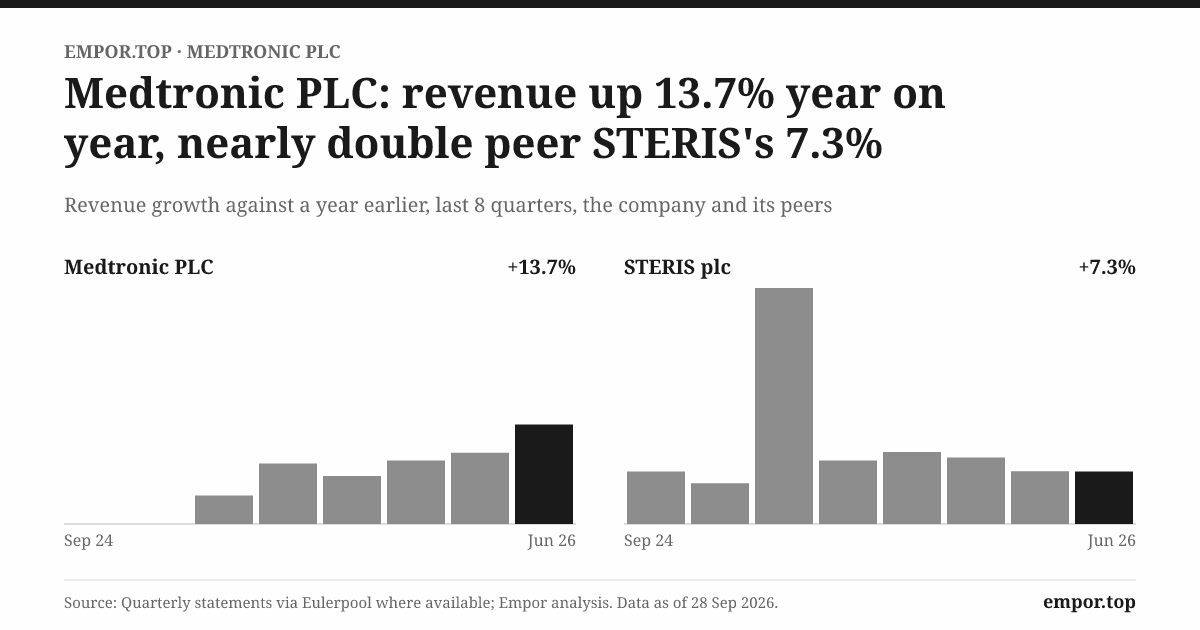
Headline numbers in the quarter need care. Medtronic's Q1 FY2027 organic revenue growth was reported at 13.7%, but management disclosed that about 670 basis points, roughly $570 million, came from an extra selling week (FY2027 is a 53-week year, and the extra days fell into the first quarter).45 Normalized, the company grew closer to 7%. That is respectable for a company this size and better than Medtronic's multi-year average, but it is not the doubled-up acceleration a quick glance at the headline suggests.
Renal denervation: the believers who got burned
The second cardiovascular growth vector has a longer and more humbling past. Renal denervation (RDN) treats stubborn high blood pressure by threading a catheter into the arteries feeding the kidneys and quieting the overactive nerves that tell the body to keep pressure high. Medtronic's system is called Symplicity Spyral.
In 2014 the idea nearly died. The SYMPLICITY HTN-3 trial, a large sham-controlled study, failed to show a meaningful benefit over a placebo procedure, and the category collapsed from Wall Street darling to cautionary tale almost overnight. Medtronic spent the next decade redesigning the catheter and the trials. The FDA eventually approved Symplicity Spyral in late 2023, transitional pass-through payment began in January 2025, and the Centers for Medicare & Medicaid Services finalized a National Coverage Determination effective October 28, 2025.8
That reimbursement decision is a genuine unlock. Without Medicare coverage, a device can be approved and still be commercially invisible. But the history argues for calibrated expectations. The category has already burned believers once, and Medtronic does not have it to itself. 大塚ホールディングス Otsuka Holdings, through its subsidiary Otsuka Medical Devices, owns Recor Medical, whose Paradise ultrasound-based RDN system is also FDA-approved. RDN is now a two-player, newly reimbursed market. The claim that survives is "real optionality with a credible competitor," not "a Medtronic franchise." The event to watch is procedure adoption in the first full year under the NCD, which Medtronic's quarterly commentary should disclose in growth-rate terms.
Porter's Five Forces, applied to ablation
Treat cardiac ablation as its own industry for a moment and run the classic Porter test.
Threat of new entrants: low from here. Regulatory approval, clinical data and a mapping ecosystem are expensive barriers, but the three majors (Boston Scientific, Medtronic, Johnson & Johnson) have all already cleared them. The barrier protects incumbents from startups, not from each other.
Rivalry: intense and rising. Three credible PFA platforms arrived within roughly 24 months of one another. That looks like a share battle, not a moat.
Buyer power: rising. Large hospital systems buy capital equipment at scale and increasingly negotiate catheter pricing across vendors.
Switching costs: more subtle than they look. Catheters are disposable and a physician can try a new one. The real lock-in is the mapping console, the capital system that creates a three-dimensional electrical map of the heart, along with the training around it. Once a lab owns a console, the catheters that work best with it follow. That is why Affera's integrated mapping-and-ablation design matters more strategically than PulseSelect.
Supplier power and substitutes: modest. The substitutes, which are drugs, left atrial appendage closure and older thermal ablation, are losing ground to PFA rather than gaining.
The net reading is that ablation is an attractive, fast-growing profit pool with structurally intense rivalry. Medtronic's CAS franchise earns high growth today because the market is being re-platformed. What happens after the land grab, when two or three players settle into a mature share split and hospitals push on price, is the right frame for the long-term thesis.
The rest of Cardiovascular
The quieter parts of the segment carry the legacy advantages. CRM is where Medtronic's switching costs are deepest. Cardiologists have implanted its pacemakers for decades and its programmers, remote-monitoring network and follow-up clinics are embedded in hospital workflows. Structural heart, by contrast, is a solid second to Edwards in transcatheter aortic valves, and nothing in the recent record suggests that ranking is changing. Medtronic's cardiovascular story, in short, is one entrenched franchise, one steady number two, and one high-growth challenger. The next segment tests whether Medtronic's scale buys it more than defense.
IV. Neuroscience Portfolio — Spine, Neuromodulation, and the Mazor Robotics Test Case
A spine surgeon placing pedicle screws works in a space where millimeters decide outcomes. Drift a screw a few millimeters medially and it can touch the spinal cord; drift laterally and it misses bone entirely. For decades surgeons placed these screws by feel, anatomy and repeated X-ray shots. Robotic guidance promised to change that. A robot arm, aligned to a pre-operative CT scan, holds a guide tube at exactly the planned trajectory, and the surgeon drills through it. The pitch was irresistible: more accuracy, less radiation, and a reason for hospitals to consolidate their spine business with whoever owns the robot.
Segment shape
Neuroscience generated about $10.3 billion in FY2026, roughly 28% of Medtronic.1 It includes Cranial & Spinal Technologies (spinal implants, the StealthStation navigation system, the Mazor robot and neurosurgery tools), Neuromodulation (deep brain stimulation for Parkinson's and epilepsy, and spinal cord stimulation for chronic pain), and Specialty Therapies (ENT and pelvic health). In Q1 FY2027 Cranial & Spinal Technologies grew 13% on a reported basis, a number flattered by the extra week but still a sign of health.4
The Mazor falsification test
In December 2018 Medtronic completed the purchase of Mazor Robotics, the Israeli spine-robot maker, for about $1.64 billion, or about $1.34 billion net of the stake it already owned. The logic was that robotics would pull a surgeon's entire spine case, from implants to navigation to biologics, toward the robot's owner. In 2020 then-CEO Omar Ishrak described the deal as "beginning to pay off," pointing to mid-single-digit spine growth and an increasing share of cases pulled through by the enabling technology.9
Six years on, the evidence supports a narrower story. Medtronic is still a leading spine player, but it has not separated from the pack. Stryker has built its own enabling-technology ecosystem. Globus Medical, which merged with NuVasive in 2023, markets the ExcelsiusGPS robot and has taken share with aggressive, surgeon-centric sales. Zimmer Biomet and Johnson & Johnson's DePuy Synthes remain meaningful. Mazor has worked mainly as a share-of-wallet tool, which means it helps Medtronic sell more implants into hospitals that already bought its robot, rather than a share-taking weapon that pulls competitors' accounts across.
So the claim that Mazor bought Medtronic a moat in spine is narrowed rather than confirmed. The deal plausibly protected a franchise that might otherwise have eroded as Globus and Stryker pushed robotics. Protection has value, but it is not the expansion the 2018 story implied. The KPI that would reopen the stronger claim is Medtronic reporting spine growth consistently above Globus's for several quarters in a row, which the public record has not shown.
Neuromodulation: the quiet, advantaged pocket
The more competitively advantaged part of the segment gets less airtime. Deep brain stimulation is an implanted "pacemaker for the brain" that delivers electrical pulses to specific structures to calm Parkinson's tremors. It is a small field with high clinical barriers, few competitors (Boston Scientific and Abbott are the main others), and patients who stay on a platform for years. Medtronic's newer adaptive DBS technology, which senses brain signals and adjusts stimulation automatically, is a genuine clinical differentiator. Spinal cord stimulation for chronic pain is more contested, but the whole neuromodulation business benefits from aging demographics and from the switching costs of implanted devices.
Neuromodulation is real optionality, but it is small compared with spine. Neuroscience overall is a strong, profitable franchise defending its position well rather than a new growth engine. The next segment, Medical Surgical, faces the harder question: can Medtronic take share from a leader that seems unassailable?
V. Medical Surgical Portfolio & the Hugo Robot's Six-Year Road to a U.S. Clearance
In late 2019 Medtronic unveiled its Hugo robotic-assisted surgery system to investors, and the pitch was bold. Intuitive Surgical had enjoyed nearly two decades of near-monopoly with the da Vinci. Medtronic, the company that already supplied many of the staplers, energy devices and sutures used in those robotic operations, would build an open, modular alternative. Instead of one large patient-side cart, Hugo would use separate arm carts that can be positioned independently. Instead of a closed console where the surgeon's head is buried in a viewer, Hugo would offer an open console with 3D glasses. And it would be priced below da Vinci.
Then came the long wait.
The base business first
Before Hugo, remember what Medical Surgical actually is. The segment produced roughly $8.8 billion in FY2026, about 24% of revenue, and grew 9% in Surgical in Q1 FY2027 (again helped by the calendar).14 Most of that is the business inherited from Covidien: surgical staplers, the LigaSure vessel-sealing energy platform, sutures and wound closure, patient monitoring such as pulse oximetry, airway and ventilation products, and renal care. It is steady, unglamorous and cash-generative. Hospitals buy it by the pallet. Its competitive advantage is breadth, contracting power with group purchasing organizations, and the habit of surgeons who trained on LigaSure. It is not a growth engine, but it funds growth engines elsewhere.
Hugo's timeline, with the gap made explicit
Hugo received its CE Mark in Europe in October 2021 and began selling in several international markets. U.S. clearance took far longer. The FDA cleared Hugo in December 2025, initially for urologic procedures including prostatectomy, nephrectomy and cystectomy.6 That is six years from unveiling to first U.S. regulatory clearance, in the world's most important robotic surgery market. In 2026 Medtronic filed for hernia/general-surgery and gynecologic indications, which together represent a much larger share of soft-tissue robotic volume than urology, and in September 2026 it won FDA clearance for the LigaSure RAS Maryland instrument, bringing its signature energy device onto the robot.4
Each step is real. None of them is revenue yet.
Benchmarking against Intuitive
Intuitive reported an installed base of roughly 11,710 da Vinci systems as of June 2026, up about 12% from a year earlier, and the company is generally estimated to hold somewhere between 60% and 70% of the soft-tissue surgical robotics market.10 Intuitive's moat is not just the robot. It is twenty-plus years of surgeon training programs, residency curricula built around da Vinci, published clinical evidence across dozens of procedures, a recurring-revenue stream from instruments and service that makes up the majority of its sales, and hospital administrators who already know how to finance and schedule robot time.
Hugo's claimed advantages are price, reportedly in the range of $1.5 million to $2 million per system compared with higher da Vinci pricing, and its modular open design, which some hospitals and surgeons prefer. Those are genuine product-differentiation claims. They are also unproven at scale. Against Intuitive's installed base and training ecosystem, a cheaper robot with fewer cleared indications faces a long climb.
Applying the company's own history
Medtronic's own record argues for skepticism here. The MiniMed 670G, told in the next section, was a genuine technical first that did not translate into lasting category leadership. Mazor was a technology purchase that protected rather than expanded share. Hugo is currently a technical-milestone story, and the evidence available does not yet support calling it a commercial one.
The single most falsifiable claim in this entire story is that Hugo will become a revenue-material challenger in the U.S. The KPI is U.S. Hugo system placements and procedure volumes through FY2027 and FY2028, and specifically whether general-surgery and gynecologic clearances, if granted, turn into orders from hospitals that already own a da Vinci. Management has not disclosed Hugo placement numbers in a form that allows a clean read, and investors should treat that disclosure gap as part of the evidence.
Medtronic's willingness to wait six years and keep funding Hugo shows persistence. Whether it shows good capital allocation is a question only the next three years can answer. The company's most recent example of a technical first that stalled commercially is the business it just spun out.
VI. Diabetes: From the MiniMed Acquisition to an Independent Public Company
Alfred Mann was one of the premier serial entrepreneurs in medical technology, a physicist who built fortunes in aerospace and pacemaker batteries before funding ventures in cochlear implants, retinal prosthetics, and insulin delivery. MiniMed, based in Northridge, California, was his insulin-pump business. When Medtronic acquired it in 2001, it secured the leading position in U.S. insulin pumping. For an enterprise built on cardiac rhythm management, the strategic rationale seemed clear: if a pacemaker monitors electrical signals and delivers electrical therapy to the heart, an insulin pump paired with a glucose sensor could monitor interstitial fluid and deliver chemical therapy to the bloodstream. It was, in effect, a pacemaker for the pancreas.
The genuine technical first
In September 2016 the FDA approved the MiniMed 670G, the first commercial hybrid closed-loop system, widely referred to as an "artificial pancreas." The system linked an insulin pump with a continuous glucose monitor (CGM) through an algorithm that automatically modulated basal insulin delivery every five minutes. Commercial rollout followed in 2017. For patients with Type 1 diabetes, who routinely navigate constant carbohydrate calculations and nocturnal hypoglycemia risks, this was a tangible clinical advance. Medtronic had reached the milestone ahead of every competitor.
The falsification layer
What followed became an instructive case study in modern Medtronic execution, testing whether technical priority translates into a durable commercial moat.
It did not. In December 2021 the FDA issued a warning letter to Medtronic's Diabetes headquarters in Northridge.11 The regulatory action traced back to two previous recalls: a 2018 alert addressing a cybersecurity vulnerability in remote controllers that could allow unauthorized command transmissions, and a 2019 recall of MiniMed 600-series pumps caused by a broken or missing retainer ring that prevented the reservoir from locking securely, risking under- or over-delivery of insulin.11 While warning letters do not carry direct monetary fines, their operational impact is severe: the FDA routinely withholds premarket approvals for new devices manufactured at inspected facilities until violations are remediated. The Northridge warning letter remained active until April 2023. In the interim, Medtronic's next-generation MiniMed 780G system received regulatory clearance in Europe but remained locked out of the U.S. market.
Resolving the letter did not mark the end of product quality challenges. In October 2024 the FDA posted a Class I recall covering MiniMed 600- and 700-series pumps over internal component damage that caused shortened battery life and unexpected shutdowns.12
While Medtronic focused management attention on regulatory remediation, rivals capitalized on the gap. Tandem Diabetes Care and Insulet steadily gained share in automated and tubeless insulin pumps. Simultaneously, Abbott's FreeStyle Libre and Dexcom's G-series platforms captured the continuous glucose monitoring category. CGM developed into a larger, faster-growing addressable market than pumps, and Medtronic's proprietary sensor ecosystem never matched the scale, ease of use, or physician adoption of standalone monitors.
The operational takeaway extends across Medtronic's other divisions. An undisputed engineering breakthrough was undercut by quality-system failures and agile competitors. That history informs how Medtronic's pipeline claims in pulsed field ablation, renal denervation, and soft-tissue surgical robotics should be evaluated: being first to market is an important technical achievement, but it does not guarantee a lasting commercial franchise.
The separation, mechanically
Medtronic first announced plans to pursue a separation of its diabetes unit in 2022, an initiative that gained urgency after Elliott's engagement. MiniMed Group, Inc. completed its listing on Nasdaq under the ticker MMED on March 9, 2026, led by Que Dallara, the former Medtronic executive vice president who had managed the business.133 Medtronic initially retained a majority controlling stake. On September 14, 2026, Medtronic initiated an exchange offer permitting its shareholders to tender Medtronic stock for MiniMed shares—a tax-free split-off structured to exit the parent company's remaining equity position while retiring a portion of Medtronic's outstanding shares.3
The business rationale was pragmatic. Diabetes generated roughly 9% of legacy Medtronic revenue but diluted overall corporate operating margins and organic revenue growth. It also operated under a fundamentally different commercial cadence, requiring rapid consumer hardware refresh cycles, direct-to-patient marketing, and open platform connectivity. Dallara highlighted that an independent company could execute partnerships more flexibly, including MiniMed's collaboration with Abbott to integrate FreeStyle Libre sensor technology directly with MiniMed automated insulin delivery systems.13 That agreement underscored the competitive shift: the original closed-loop thesis assumed Medtronic would capture margin on both the pump and the sensor; ultimately, it integrated a sensor built by the competitor that won the category.
The split-off reflects disciplined portfolio rationalization, and management followed through on execution rather than keeping the asset in strategic review. However, the move arrived after years of market-share loss and regulatory overhang, taking four years from initial announcement to final exchange. The transaction removes an operational drag; it does not validate the initial acquisition's long-term thesis. It also serves as the clearest bridge to examining Medtronic's broader historical record of capital allocation and M&A execution.
VII. The M&A Scorecard: Covidien, HeartWare, and What Capital Discipline Actually Looks Like
On Sunday, June 15, 2014, Omar Ishrak, the Bangladeshi-born engineer who had come to Medtronic from GE Healthcare, announced the biggest deal in medical-device history. Medtronic would buy Covidien, the Dublin-domiciled maker of surgical staplers, energy devices and patient-monitoring equipment, for about $42.9 billion in cash and stock.14 The combined company would reincorporate in Ireland. At a stroke, Medtronic became the largest medtech company by revenue.
Covidien: scale achieved, candor incomplete
The public case, as the press release laid out, emphasized a broader portfolio, a stronger position with hospitals, and access to emerging markets.14 The offer carried a premium of about 29% over Covidien's undisturbed share price. Cost synergies were projected at roughly $850 million in pre-tax savings by fiscal 2018, against a premium approaching $10 billion over the unaffected price. Cost savings alone did not fully justify the price.
The missing piece was the tax domicile. The deal was an inversion: by moving the parent to Ireland, Medtronic gained access to overseas cash without the U.S. repatriation tax that applied at the time and lowered its effective tax rate. The Obama Treasury Department and several senators attacked inversions in the months after the announcement, and Treasury tightened the rules in September 2014, which briefly threatened the financing structure. Medtronic reworked the financing and closed in January 2015. Ishrak later conceded the company underestimated the political backlash and said it should have explained its position to key senators earlier.
Scale was achieved and the tax benefit realized. Medical Surgical still sits on the Covidien base today. But the economic case leaned harder on tax arbitrage than the public synergy story acknowledged. For an investor weighing current management's claims of guidance discipline, the Covidien episode is a reminder that Medtronic's announcement-day framing has not always matched the real economics.
HeartWare: the clean failure
In 2016 Medtronic paid about $1.1 billion for HeartWare International, the maker of the HVAD, a small left ventricular assist device. An LVAD is a pump implanted in the chest that helps a failing heart push blood, used as a bridge to transplant or as permanent therapy. Medtronic paid a premium of more than 90% for the company, betting on heart failure, one of the largest unmet needs in cardiology.
It went badly. HVAD accumulated a long list of Class I recalls, the FDA's most serious category, including problems with pump restarts after stoppages, controller faults and welding defects.15 In 2021 alone, the device was tied to seven Class I recalls, and the FDA's records attributed dozens of injuries and multiple deaths to the malfunctions, including 91 injuries and 15 deaths linked to the pump-restart problem.1615 Studies also showed higher rates of neurological adverse events than Abbott's competing HeartMate 3. In June 2021 Medtronic stopped distributing and selling the HVAD, five years after buying it, and patients already implanted had to be managed for years afterward.16
This is the strongest single piece of disconfirming evidence against any claim that Medtronic reliably integrates and scales acquisitions. The failure caused direct patient harm, not just a write-down. And its resolution falls inside the current leadership's tenure: Geoff Martha became CEO in April 2020, and the HVAD exit happened on his watch.9 Discontinuing the product was the right decision. But it is part of the record against which today's capital allocation should be judged, not ancient history.
Physio-Control: sold too early
Physio-Control, bought in 1998 for about $538 million, was sold to Bain Capital in 2012 for about $478 million after a difficult period that included FDA manufacturing problems. Bain sold it to Stryker in 2016 for $1.28 billion. Medtronic roughly broke even in nominal terms over fourteen years, which is a loss in real terms, while a private-equity owner more than doubled its money in four years. This is a mild data point, but a real one about divestiture timing.
Mazor, briefly
As Section IV concluded, Mazor produced a moderate outcome: franchise protection rather than expansion.
The net read
Medtronic's M&A record is mixed. Covidien delivered scale and a durable cash base. Affera, bought in 2022, is now the heart of the PFA story and looks like the best deal in the portfolio. HeartWare was a clean failure with human costs. Mazor was defensive. Physio-Control left money on the table. That record does not support calling Medtronic a disciplined serial acquirer with an edge in integration. It supports a more modest statement: some deals succeeded, some failed, and each deserves to be judged on its own commercial conversion rather than management's framing at announcement. That standard applies directly to the man now running the company.
VIII. The Martha Era, the Elliott Reckoning, and Current Management Credibility
Geoff Martha does not look like the stereotypical medtech CEO. A former Division I defensive back at Rutgers who never quite lost the linebacker's demeanor, he came up through GE Capital before joining Medtronic in 2011 as head of strategy and business development. He ran the Restorative Therapies Group, which included spine and neuroscience, and was the architect of Medtronic's decentralized "operating model," which pushed profit-and-loss responsibility down to about twenty operating units. The board named him CEO effective April 27, 2020, succeeding Omar Ishrak, who remained executive chairman before Martha added the chair role as well.9
Martha took over in the first weeks of the COVID-19 pandemic, when elective procedures collapsed worldwide. His first years brought the HVAD exit, the diabetes warning letter, and a stock price that lagged peers. His strongest argument is the organic innovation pipeline: PFA, RDN, Hugo, and adaptive DBS all reached major regulatory milestones during his tenure.
Pay and ownership
According to Medtronic's FY2026 proxy statement, Martha's total reported compensation was about $22.9 million, up roughly 7% from the prior year.17 It consisted of about $1.4 million in salary, about $13.7 million in stock awards, about $5.2 million in option awards and a roughly $2.3 million annual cash incentive.17 The package is heavily weighted toward equity, which in principle aligns pay with shareholders. But Martha's direct ownership is roughly 0.01% of shares outstanding, worth on the order of $11 million, which is thin relative to annual pay. Alignment through grants is not the same as alignment through personal capital at risk.
Guidance: a pattern still forming
The most useful credibility test is recent. During FY2026, Medtronic trimmed its non-GAAP EPS outlook to a $5.50–$5.54 range, citing about $185 million of net tariff impact along with dis-synergies from the MiniMed separation.16 Tariffs are partly outside management's control. The dis-synergies were not a surprise; they were the predictable cost of a decision management itself made.
For FY2027, the initial guide in May–June 2026 was $5.90–$6.00, below the roughly $6.06 consensus at the time.6 One quarter later, on the September 1 call, management raised the range to $5.94–$6.00 after beating first-quarter expectations.45 But part of that beat came from the extra selling week, which management had known about all along.
There are two readings. One is disciplined conservatism: set a guide the company can beat and raise. The other is a forecasting model still catching up to a business whose mix is changing fast. Management's explanations on the calls have been concrete, in fairness, attributing specific dollar amounts to tariffs and to the extra week rather than hiding behind vague language. But three quarters of one pattern is not yet a track record. The next two or three quarters will reveal whether "guide low, raise" is a habit or an artifact.
Elliott arrives
In August 2025 Medtronic announced that two new independent directors would join its board: John Groetelaars, former CEO of Hillrom (sold to Baxter in 2021) and later interim CEO of Dentsply Sirona, and Bill Jellison, former CFO of Stryker.2 The board also created two new committees, a Growth Committee and an Operating Committee, focused respectively on portfolio decisions and margin and capital efficiency.2 The changes followed engagement with Elliott, whose partner Marc Steinberg led the position.18
CNBC's analysis at the time framed Elliott's likely agenda as portfolio simplification, margin expansion, and better capital allocation, noting that Medtronic's operating margins had lagged peers and that its stock had underperformed for years.18 Medtronic also said it would hold an Investor Day to lay out a new financial framework. As of late September 2026, investors should check the company's events page for whether and when that meeting took place and what targets were set; this article does not assume its contents.19
The activist stress test
Is this a real strategic reset or a defensive governance gesture?
The evidence for "real" is specific. The MiniMed separation was executed, not just announced. CAS momentum is real and accelerating. The new committees carry defined operating and growth mandates rather than the ceremonial roles common in governance settlements. And Groetelaars and Jellison bring hands-on experience selling a company and running a high-performing medtech's finances.
The evidence for "still to prove" is also specific. Medtronic generated about $5.43 billion of free cash flow in FY2026, up about 4.6%, while paying roughly $3.64 billion in dividends.1 Share repurchases, by comparison, remained at what one analysis described as token levels.10 An activist that invests in a company promising a "new chapter of value creation" typically wants to see excess capital returned or redeployed at high returns. That has not yet happened in a visible way. The MiniMed exchange offer will reduce the share count, but that is a byproduct of the separation, not a new capital return program.
The dividend: the most consistent signal
One part of the record is unambiguous. In June 2026 Medtronic raised its dividend for the 49th consecutive year, to $0.72 per quarter, a yield of roughly 3.2% at recent prices.110 One more raise, expected in June 2027, would make it a Dividend King, a company that has raised its dividend for fifty straight years. Through the Covidien inversion, the HeartWare failure, the diabetes warning letter and a pandemic, the dividend kept rising. For all the mixed signals elsewhere, it is the longest-running and most consistent proof of capital discipline in the company's history. The playbook section asks what lessons the whole record adds up to.
IX. Playbook: Strategy & Investment Lessons
Imagine the Medtronic board meeting where a director asks the obvious question: why do these four businesses belong together? Cardiac ablation is a fast-moving capital-equipment and disposables fight. Spine is a sales-rep-intensive implants business. Surgical staplers are a contracting game. Neuromodulation is a niche of implanted electronics. They share hospital customers, regulatory expertise and a global distribution network. They do not share growth rates, margins or competitors.
Lesson one: the conglomerate discount is earned, not inherited
The case for diversification is real. A global regulatory and distribution machine spread across 150-plus countries lowers the cost of launching each new product, and a broad hospital relationship helps sell the next device. The case against is that capital allocation across businesses with very different returns tends to drift toward the average. Elliott's arrival suggests at least one sophisticated investor believes Medtronic's portfolio is still too broad. The MiniMed separation was step one, and the market is now watching for step two.
Lesson two: culture is necessary, not sufficient
The Mission is sincere and it shapes behavior on the margin. It did not prevent HeartWare. It did not prevent the diabetes warning letter. Culture matters most when it shows up in quality systems and in how pay rewards long-cycle quality work, and that is where investors should look for evidence, not in the rituals.
Lesson three: serial M&A is not automatically value-creating
Covidien, HeartWare, Mazor and Affera together argue that deals should be judged one at a time, on commercial conversion. Affera looks like the winner. HeartWare was the loser. The average tells you little.
Lesson four: spin off what dilutes, and do it sooner
MiniMed is a good template for separating a drag, but it took about four years from first signal to completion and arrived under sustained activist pressure. The lesson for future portfolio moves is that speed matters. Businesses lose value while management debates them.
Lesson five: technical milestones are not revenue
Hugo's six-year path to U.S. clearance and the 670G's first-but-lost-share outcome are the two cleanest illustrations in Medtronic's own history. An FDA approval is a license to compete, not a win. Those lessons point directly to the question of where Medtronic actually holds competitive power.
X. Competitive Landscape Synthesis & Hamilton Helmer's 7 Powers
In a quiet cardiology follow-up clinic, a nurse holds a wand over a patient's chest, and a Medtronic programmer downloads months of heart-rhythm data from a pacemaker implanted years earlier. The patient is not going to switch brands. The hospital is not going to retrain its device clinic lightly. The cardiologist has implanted hundreds of these devices and knows their quirks. That scene contains most of Medtronic's real competitive power.
Hamilton Helmer's 7 Powers framework asks which of seven sources of durable advantage a company really holds: scale economies, network economies, counter-positioning, switching costs, branding, cornered resource and process power. Applied honestly to Medtronic, it gives an uneven answer.
Where the power is real
Switching costs are strongest in cardiac rhythm management and neuromodulation, where devices are implanted for years, programmers and remote-monitoring systems are embedded in clinic workflows, and physicians have trained for decades on the same platforms. This is Medtronic's deepest moat, and it is inherited from Bakken's pacemaker business rather than built recently.
Scale economies are real in global regulatory affairs, clinical-trial infrastructure, manufacturing and distribution. A smaller competitor cannot easily replicate approvals and sales channels in 150-plus countries. That scale lowers Medtronic's cost of bringing a new product to market worldwide.
Where the claimed power is thin or unproven
Counter-positioning in surgical robotics is the claim that Hugo's modular, lower-priced design can attack Intuitive in a way Intuitive cannot copy without hurting itself. The idea is coherent, but the evidence does not support it yet. Intuitive's installed base and training ecosystem are the true moat, and nothing in the record shows Medtronic denting it.
Cornered resource claims around any single approval, whether PFA, RDN or Hugo, fail the history test. Every major competitor has now cleared regulatory barriers in PFA, and Recor/Otsuka shares RDN. Regulatory approval is necessary, not sufficient.
Process power is where the record is weakest. Recurring quality failures in implantables are the opposite of the embedded operational excellence Helmer describes.
China: a dominant buyer, not a normal market
The biggest structural bargaining-power problem is in China. Since 2019, China's 集中带量采购 volume-based procurement (VBP) program has run national and provincial tender rounds for medical devices in which manufacturers bid for guaranteed hospital volumes in exchange for deep price cuts, often reported in the range of 60% to more than 90% across categories such as coronary stents, orthopedic implants and pacemakers. Medtronic's 10-K discusses VBP as a risk to pricing in China.1
This is not ordinary demand risk. It is a single, state-controlled buyer that can re-bid tenders, broaden vendor lists to favor domestic manufacturers such as 微创医疗 MicroPort, and squeeze price repeatedly. Medtronic's breadth in China, which spans many product categories, makes it more exposed than peers with narrower portfolios. The competitive position that Medtronic's scale built there is exposed to a buyer with far more bargaining power than any hospital system in the West. That leaves the bull and bear cases to weigh it all.
XI. Bear vs. Bull Case
Two analysts could look at the same Q1 FY2027 press release on September 1, 2026, and come away with different companies. One sees 13.7% organic growth, an 88%-growing ablation franchise and a raised outlook.4 The other sees a calendar quirk, a number-two position in the hottest product category and a robot that has barely started selling in the United States. Both readings are grounded in facts. The question is which facts matter more over five years.
Bear case
The growth gap persists. Under both Ishrak and Martha, Medtronic has promised acceleration and repeatedly grown slower than Boston Scientific, Intuitive and Edwards. Normalized for the extra week, Q1 FY2027 growth was roughly 7%, respectable but not category-leading.45
The M&A record is genuinely mixed. HeartWare is not a hypothetical risk. It already happened, it harmed patients, and it took five years to unwind. Future deals deserve a discount until proven otherwise.
China and tariffs compress pricing and cost. VBP structurally compresses prices in a market where Medtronic is broadly exposed, and tariffs cost about $185 million net in FY2026, a headwind that trade policy could worsen.1
The growth stories are number-two stories. Hugo is years behind Intuitive with no demonstrated path to share, and in PFA Medtronic is a fast-closing second or third rather than the leader.7
Capital return lags rhetoric. Buybacks remain small even as free cash flow covers the dividend comfortably, so the gap between Elliott-era language and shareholder returns persists.10
Bull case
CAS is a genuine new profit pool. An 88% growth rate and the $2 billion run-rate crossed ahead of schedule are hard evidence of physician adoption, not narrative.4
Renal denervation has reimbursement. After a decade of false starts, the Medicare coverage decision gives RDN a real commercial runway, tempered by Recor/Otsuka's competing system.8
MiniMed is gone. Removing a lower-margin, quality-challenged business improves the consolidated growth and margin profile and frees management attention.3
Governance pressure is real. Elliott-backed directors and new committees create leverage outside shareholders historically lacked.218
Demographics help almost everywhere. Aging populations drive heart-rhythm, structural-heart, spine and neuromodulation procedure volumes.
The dividend record is intact. Forty-nine consecutive increases is the most consistent capital-allocation signal in the company's history, and Dividend King status is one raise away.1
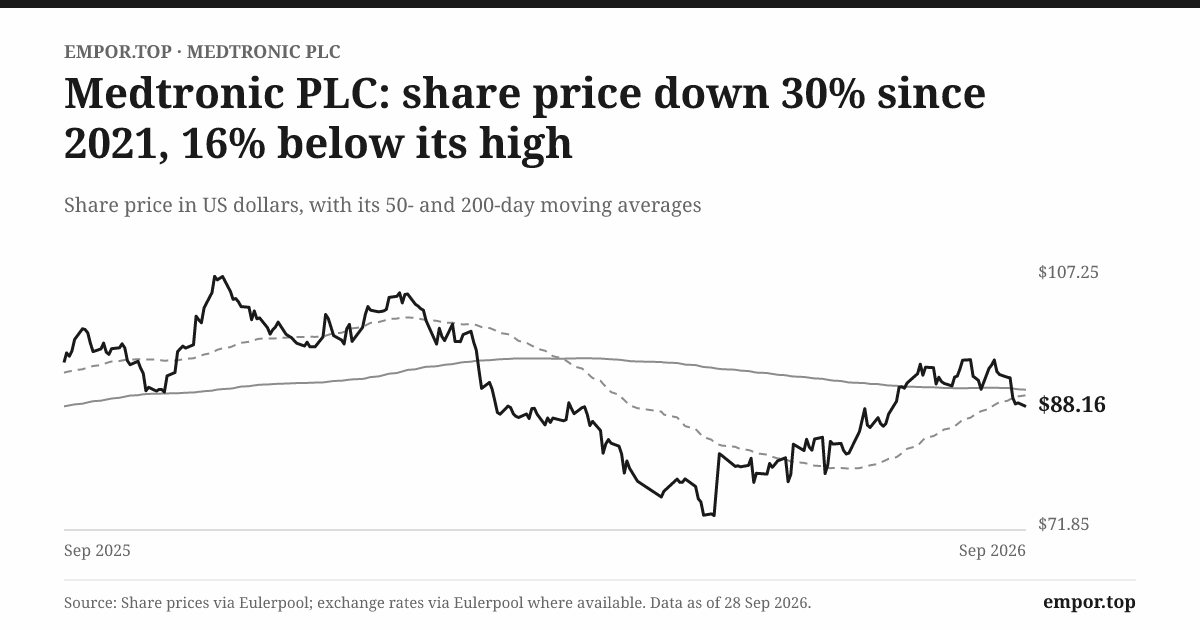
Expectations are modest. The stock has traded around $89–90, below a consensus analyst target near $98, with a wide range of views from about $83 to $115, which suggests the market still doubts the turnaround's durability.10 Jim Cramer summarized the investor mood as a "quandary."
Porter's frame, company-wide
At the company level, Porter's forces show a mixed industry position. The threat of new entrants is low across most of Medtronic's markets because of regulatory and clinical barriers. Rivalry ranges from moderate (CRM, neuromodulation) to intense (PFA, spine, robotics). Buyer power is rising everywhere: U.S. hospital systems and group purchasing organizations negotiate harder, and China's VBP is an extreme case. Supplier power is modest. Substitutes, from drugs such as GLP-1 therapies influencing cardiometabolic disease to non-surgical alternatives, are a slow-moving, long-term consideration rather than an immediate threat.
Weighing it
The history narrows the bull thesis rather than rejecting it. The strongest bull claim, that Medtronic has become a category-leading growth company, is not supported by current evidence. A narrower claim is supported: Medtronic now has one genuinely high-growth franchise (CAS), one newly reimbursed option (RDN), a simplified portfolio, and more governance pressure than at any point in its modern history. Whether that adds up to sustained above-market growth depends on execution in precisely the areas where the company's record is weakest: commercial conversion of technical firsts, and quality in high-stakes devices.
The KPIs that matter
Three metrics will tell investors most of what they need to know. The first is Cardiac Ablation Solutions revenue growth, particularly relative to Boston Scientific's electrophysiology growth once both lap launch comparisons. The second is organic revenue growth excluding calendar effects, because it strips out the extra week and shows whether the company has really moved above its historical mid-single-digit range. The third is U.S. Hugo system placements and procedure volumes, the most falsifiable forward claim in the story. Those metrics sit on top of a set of risks worth mapping explicitly.
XII. Current Risk Radar
Consider the risks less as a checklist and more as a set of mechanisms that could break specific parts of the thesis.
China VBP and geopolitical pricing. The mechanism is repeated tender rounds by a dominant buyer that can squeeze price and favor domestic vendors.1 Medtronic's breadth in China turns one country's procurement policy into a multi-category headwind that lasts years.
Tariffs. About $185 million of net impact in FY2026 shows how quickly trade policy can take a real bite out of earnings, and the direction of policy remains uncertain.1 Medtronic's global manufacturing footprint helps but does not eliminate the exposure.
Robotics execution. Hugo requires sustained R&D, sales and training investment to close a twenty-year gap. If placements stay modest, that spending becomes a drag on margins rather than an option on growth.
Quality and regulatory risk in implantables. The HeartWare and MiniMed histories show this risk recurs rather than appearing once. A major recall in pacing, PFA or neuromodulation would hit both revenue and physician trust, and warning letters can freeze product approvals at affected sites.1116
Cybersecurity. The 2018 insulin-pump remote-controller vulnerability is a direct precedent for connected-device risk.11 As pacemakers stream data to the cloud and surgical robots connect to hospital networks, the attack surface grows.
Guidance credibility. The FY2026 trim and the conservative-then-raised FY2027 guide are recent enough to be live evidence.64 The next two or three quarters will show whether the pattern reflects discipline or forecasting catch-up.
Post-spinoff entanglement. Transition service agreements, supply arrangements and shared systems with MiniMed will run through FY2027. Separation costs, stranded overhead and operational disputes are common in the first years after a split, and they cut both ways.3
Legal and accounting overhangs. Product-liability litigation connected to past recalls, including HVAD, remains a background exposure disclosed in the 10-K, and accounting for the MiniMed separation (discontinued operations treatment and any gain or loss on the exchange offer) will make year-over-year comparisons noisier than usual.1 Readers should rely on the company's organic, like-for-like disclosures when judging growth.
None of these risks is unusual for a large medtech company. Together they explain why the market is waiting for proof rather than paying for promises. The final section looks at what that proof would look like.
XIII. Epilogue: The Next Chapter
Back in Fridley, the Earl Bakken museum still displays the metronome-derived pacemaker that started it all, a small box of transistors that now looks almost comically primitive. Down the road, engineers are working on catheters that deliver microsecond pulses, robots with modular arms, and implants that listen to the brain. The distance between those objects is seventy years of engineering. The distance between the promise of the newest objects and durable revenue is the story still being written.
What comes next is a structurally smaller Medtronic, with MiniMed gone once the exchange offer completes, and the clearest test yet of whether a focused portfolio grows faster than a sprawling one.3 The Elliott-era thesis will be judged on whether organic growth, adjusted for calendar effects, stays meaningfully above the company's historical range for several consecutive years.
Hugo's U.S. ramp is the single most falsifiable claim. If general-surgery and gynecologic clearances arrive and translate into orders from hospitals that already own da Vinci systems, the story changes. If placements remain modest, Hugo will join the list of Medtronic technical firsts that never became franchises.
In PFA, the question is what happens after the land grab. Markets that are being re-platformed reward whoever is growing fastest. Mature markets reward whoever has the best economics, installed base and pricing discipline. Medtronic's Affera mapping integration gives it a credible claim to a durable seat, but Boston Scientific and Johnson & Johnson will not concede share quietly.
Then there is June 2027 and the likely fiftieth consecutive dividend increase, a symbolic capstone to the most reliable part of the capital-allocation record.
The final question is the one this story opened with. Can a company with a market value of roughly $114 billion and a genuinely mixed twenty-five-year record in M&A and quality convert today's momentum into its first multi-year stretch of category-leading growth in more than a decade? Or is 2026 another chapter in a long pattern of promised acceleration that arrives partially, but not fully? The answer will not come from an Investor Day slide. It will come, quarter by quarter, from ablation growth, calendar-adjusted organic growth and Hugo placements.
References
-
Medtronic plc — Form 10-K, FY2026 — SEC EDGAR, 2026 ↩↩↩↩↩↩↩↩↩↩↩↩↩
-
Medtronic announces Board appointments and shareholder value creation initiatives to advance strategic priorities — Medtronic News, 2025-08-19 ↩↩↩↩
-
Medtronic Launches Exchange Offer to Complete Separation of MiniMed Group, Inc. — Medtronic News, 2026-09-14 ↩↩↩↩↩↩
-
Medtronic reports first quarter fiscal 2027 results, delivers broad-based portfolio performance and raises fiscal 2027 guidance — Medtronic News, 2026-09-01 ↩↩↩↩↩↩↩↩↩↩
-
Medtronic (MDT) Q1 2027 Earnings Call Transcript — The Motley Fool, 2026-09-08 ↩↩↩↩
-
Medtronic FY2026 Q4 Earnings Release — SEC 8-K Exhibit 99.1, 2026 ↩↩↩↩↩
-
BSX vs. MDT: Which Electrophysiology Stock Is the Better Bet Now? — Zacks Investment Research, 2026-09-17 ↩↩↩
-
U.S. Centers for Medicare & Medicaid Services finalizes National Coverage Determination for the Medtronic Symplicity Spyral renal denervation (RDN) system — Medtronic News, 2025-10-28 ↩↩
-
Medtronic's Ishrak set to retire after nearly decade as CEO — MedTech Dive ↩↩↩
-
Medtronic: The Turnaround Is No Longer Quiet — Seeking Alpha, 2026-09-23 ↩↩↩↩↩
-
Medtronic Diabetes receives FDA warning letter — Medtronic News, 2021-12-15 ↩↩↩↩
-
Insulin Pump Recall: Medtronic Notifies Users of MiniMed 600 and 700 Series Pumps of Risk of Shorter Expected Battery Life — U.S. FDA ↩
-
Que Dallara on Medtronic's diabetes spinoff, pipeline and Abbott partnership — MedTech Dive ↩↩
-
Medtronic to Acquire Covidien for $42.9 billion in Cash and Stock — Medtronic News, 2014-06-15 ↩↩
-
Medtronic pulls HeartWare HVAD pump from market amid recalls, patient deaths — MedTech Dive, 2021 ↩↩↩
-
Medtronic plc — Form DEF 14A Proxy Statement, FY2026 — SEC EDGAR, 2026 ↩↩
-
Medtronic makes two key additions to its board — how activist Elliott can build shareholder value — CNBC, 2025-08-23 ↩↩↩
-
Medtronic Investor Relations — Events & Presentations — Medtronic ↩
 LinkedIn
 WhatsApp
 Reddit
 Hacker News
 Email
 Kindle
 RSS Feed
 Spotify
 Apple Podcasts
 Amazon Music
 Audible
 YouTube