NXP Semiconductors: The Chip Maker That Sold Itself Twice and Stayed Independent
I. Introduction & Episode Roadmap
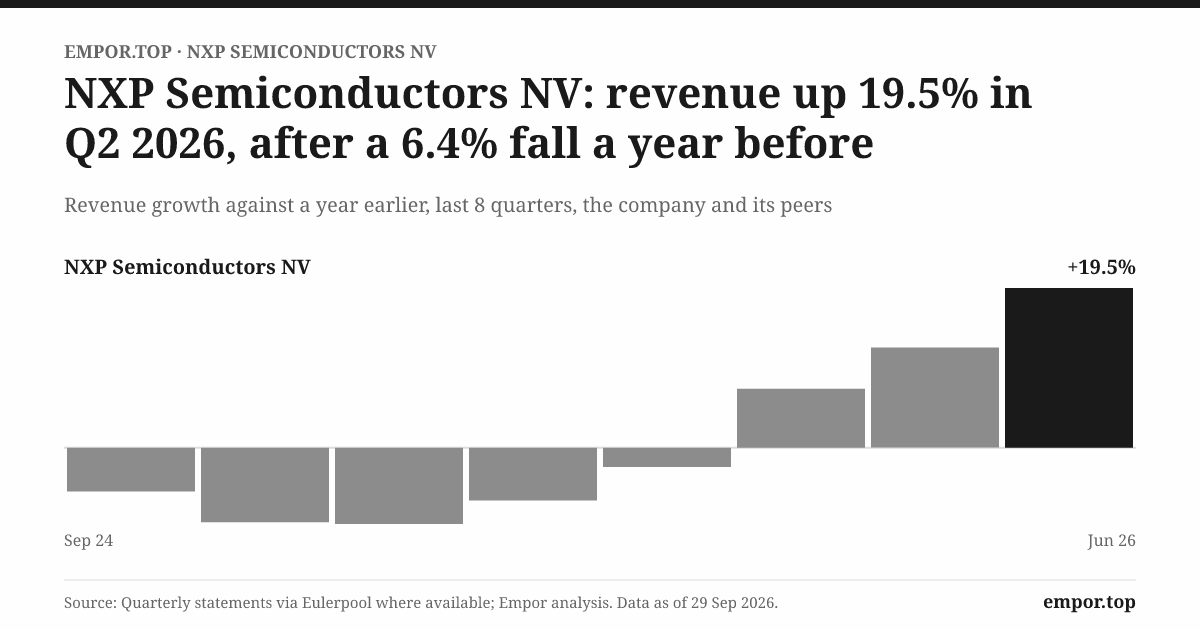
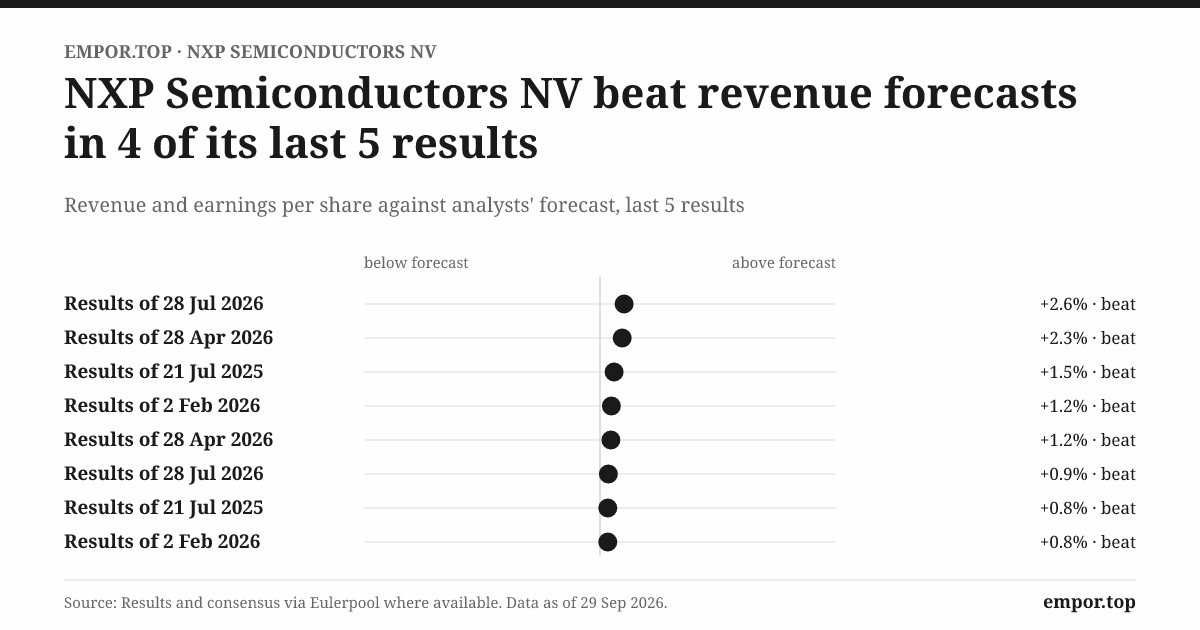
On a late-July evening in 2026, NXP Semiconductors published a results release that its investors had waited almost three years to read. Second-quarter revenue came in at $3,496m, up 19.5% on a year earlier1. Operating margin reached 30.6%, the best quarterly figure in two years1. All four of the company's end markets grew1. After a long, grinding decline, the line on the chart had turned.
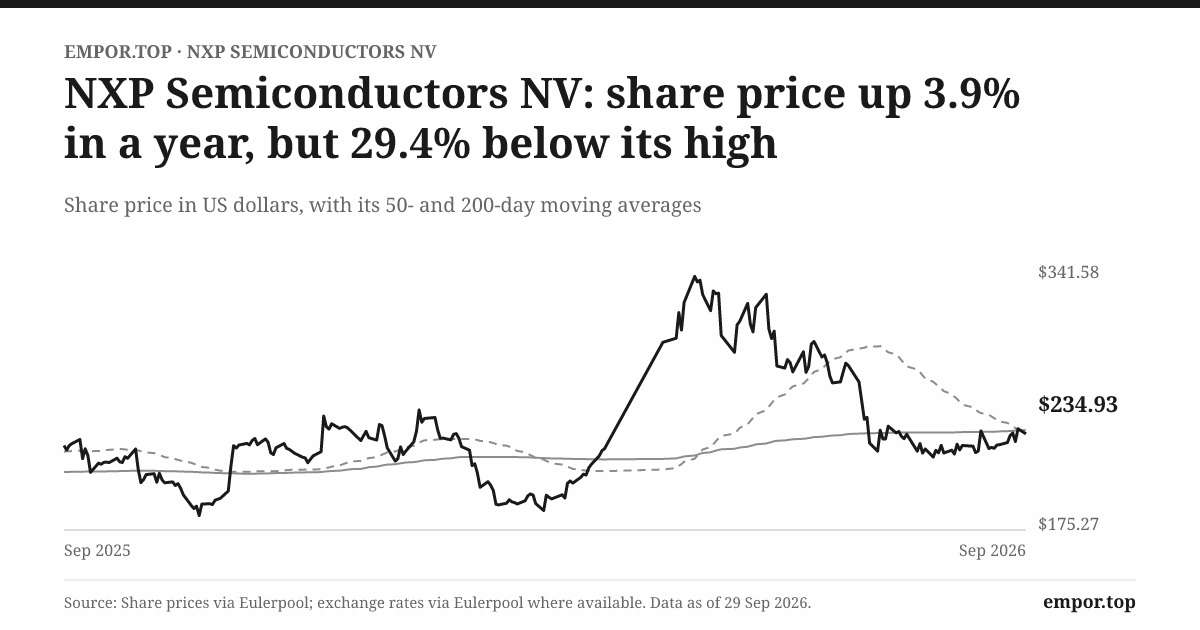
Most turnarounds end with a rising share price. This one did not. At the end of September 2026 NXP's shares traded at about $235, almost 30% below their 52-week high of roughly $3333. Over the previous year the stock had swung with a volatility of about 50%, the kind of movement more typical of a small biotech than a $59bn chip company4. The numbers improved while the market argued about what they meant.
That argument is the subject of this story. NXP ended 2025 with revenue of about $12.3bn2, still below the roughly $13.3bn it reached at the 2023 peak2. So the question is not whether the business recovered. It clearly did. The question is what kind of recovery it is.
Some basics first. NXP is incorporated in the Netherlands, headquartered in Eindhoven and listed on Nasdaq. It designs and sells the chips that sit inside cars, factory machines, payment cards, phones and network equipment. It employs roughly 32,000 people, and about a third of them work in research and development2. Just over half its revenue comes from automotive, which makes it one of the largest suppliers of silicon to the car industry1.
The paradox is its corporate history. Few large companies have been sold, spun out, floated, merged and nearly acquired as often as NXP. Philips gave it away to private equity. Private equity took it public. It merged with its American near-twin, Freescale. Qualcomm then agreed to buy it for about $44bn and walked away when Chinese regulators would not sign off5. Today it has no controlling shareholder. It is independent less by design than because the deals that would have absorbed it never closed.
Five questions run through what follows. Is the 2026 recovery a durable upcycle or a restocking bounce? Is the inventory that piled up in 2023–2025 a hidden drag on earnings quality? Does a chief executive whom the company itself calls "temporary", combined with a new acquisition programme, change the strategic risk6? Is the share price already paying for the recovery? And how real is the automotive moat, given how much of NXP's growth was bought rather than built?
That last point needs a warning at the start. Over ten years NXP's revenue grew at about 7.2% a year2. That is a respectable figure, but it hides one enormous event: the Freescale merger, which on its own added more than half to the company's size in a single year. Take it out and the organic story is slower and more cyclical. Keep it in mind whenever a long-run growth rate appears.
The recovery shows up in the income statement. The share price, and the way it swings, shows that investors have not agreed on what it is worth. The inheritance comes first, because NXP's current business still reflects choices made by a Dutch light-bulb company decades ago.
 Subscribe on LinkedIn
II. Philips Semiconductors: The Inheritance (1953–2005)
Late in 2005, Philips executives in Amsterdam faced a decision that many European conglomerates of the time were facing. The company owned one of the world's larger semiconductor businesses. It did not want to keep funding it.
The chip unit went back half a century. Philips began making semiconductors in Nijmegen, in the east of the Netherlands, in 1953, a few years after the transistor was invented. In 1975 it bought Signetics, an American integrated-circuit pioneer from Silicon Valley, which gave it a foothold in the US7. By the late 1980s Philips Semiconductors was among Europe's largest chipmakers, supplying the televisions, radios and CD players that Philips itself sold worldwide.
Two quieter inheritances matter more today than any of that scale. The first is identity. Through the 1990s Philips developed MIFARE, the contactless smart-card technology behind many transit tickets and building access cards, and later co-invented Near Field Communication (NFC) with Sony, the short-range radio link that lets a phone pay at a terminal. Put simply, a MIFARE chip is a tiny secure vault that answers only to readers it trusts. That franchise, secure elements for passports, bank cards and phones, still sits inside NXP and still wins slots in the world's largest smartphone platforms2.
The second inheritance is automotive and mixed-signal know-how. Mixed-signal chips translate between the analog world (voltage from a sensor, a radio wave) and the digital world of processors. They are harder to design than pure logic chips, rely more on engineering experience than on the latest factory, and once designed into a product they tend to stay there for years. That combination of stickiness and specialisation shaped every later choice NXP made.
What Philips mostly did not leave behind was a mass-market position. By the early 2000s the consumer electronics chips that had given Philips its scale were becoming a brutal business. Asian rivals competed on price, product cycles shortened and each new generation of factory cost billions. For a conglomerate that also sold shavers, lighting and medical scanners, a capital-hungry and violently cyclical chip unit was a poor fit.
So Philips let go. The sale was not a judgment that chips were a bad business. It was a judgment that chips were a bad business for Philips: too cyclical to sit beside medical equipment, too capital-intensive to compete for investment with the parent's core bets.
For investors today, the point of this history is narrow. NXP's durable assets are a portfolio of niches (secure identity, NFC, automotive, mixed-signal) rather than a dominant position in any huge commodity category. Niches like these can earn good returns. They rarely come with the scale needed to shape an industry's prices. The buyers who arrived in 2006 bet on exactly that trade-off, and they brought a lot of debt with them.
III. The Buyout and the IPO: A Levered Rebirth (2006–2014)
In the late summer of 2006, a consortium of private-equity firms (KKR, Bain Capital, Silver Lake, Apax and AlpInvest) agreed to take 80.1% of Philips' semiconductor business, with Philips keeping the rest7. The deal valued the unit at around €8bn, one of the largest technology buyouts in European history at that point. The new company needed a name. It chose NXP, meant to suggest "next experience"7.
The timing turned out to be dreadful. Leveraged buyouts rest on a simple bargain: borrow heavily against steady cash flows, cut costs, and use the cash to pay the debt down. Semiconductors do not produce steady cash flows. Within two years of the deal the global financial crisis had hit, demand for consumer electronics and cars fell sharply, and NXP was carrying billions of dollars of debt through one of the worst downturns in the industry's history7. The company responded with plant closures, job cuts and debt exchanges that pushed maturities out. It survived. It did not come through unscathed.
The most important thing the owners did was strategic rather than financial. They made NXP say no. The company exited its mobile and wireless handset chips in a joint venture with STMicroelectronics, sold its television and set-top-box businesses, and narrowed its focus to what it called "high-performance mixed-signal": automotive, identification, industrial and infrastructure chips, plus a separately managed "standard products" arm of simple, high-volume components7. Consumer electronics, the business that had given Philips its size, was mostly gone.
This is the pattern to watch for across the whole story. The best version of NXP has usually been a smaller one. Pruning has made the business more profitable. The problem is that pruning also leaves it more exposed to a few cyclical end markets.
In August 2010 NXP listed on Nasdaq, with an initial public offering priced below its hoped-for range at a time when investors were still wary of indebted technology companies7. The listing gave the private-equity owners a route out, which they used through sell-downs over the following years. The shares did well as the focused strategy began to show in margins, and NXP joined the Nasdaq-100 in 20138.
By 2014 the business looked healthy on some measures. Revenue was about $5.6bn and operating margin about 18.6%8. Return on equity was an extraordinary 100%8. That number should be treated with care. Shareholders' equity at the end of 2014 was only about $538m, against borrowings of roughly $4bn8. Years of losses, restructuring and buybacks had worn the equity base down to almost nothing. A 100% return on a sliver of equity is what leverage does to arithmetic. It is not evidence of an exceptional business.
That thin capital base matters for the next chapter. A company with debt at more than seven times its equity has limited options. It cannot easily buy a large rival for cash. It can, however, issue shares to merge with one. In 2015 NXP did exactly that.
IV. The Freescale Merger: Buying a Twin (2015)
On March 2, 2015, NXP and Freescale Semiconductor announced that they would combine. The deal valued Freescale at about $11.8bn plus its debt, and the companies described the merged business as worth just over $40bn in enterprise value[^7]. When it closed in December 2015, NXP became one of the largest chip suppliers to the car industry in the world[^7].
The symmetry was almost literary. Freescale had been spun out of Motorola in 2004 in much the same way NXP had been spun out of Philips. Like NXP it had been bought by private-equity firms (Blackstone, Carlyle, TPG and Permira) in 2006, at the top of the buyout boom. Like NXP it had spent the crisis carrying heavy debt. Two children of old-line electronics conglomerates, both loaded with leverage by the same generation of buyout funds, were now combining to make the scale neither could achieve alone.
What NXP bought
Freescale's crown jewel was its microcontroller (MCU) business. A microcontroller is a small, cheap computer on a single chip that runs one job reliably: opening a window, managing a brake, controlling a motor. A modern car contains dozens of them. Freescale also had a strong position in automotive radar and networking processors. Put that together with NXP's in-vehicle networking, car radio, secure access and infotainment chips, and the combined company could offer carmakers and their suppliers a much larger slice of the car's electronics[^7].
The financial result is plain in the accounts. Revenue went from about $6.1bn in 2015 to about $9.5bn in 2016, a jump of almost 56%8. Total assets almost quadrupled, from under $7bn to about $26bn8, and borrowings more than doubled to about $9.2bn8. Most of that asset growth was not factories. It was goodwill and intangible assets: the accounting record of paying for Freescale's customer relationships, technology and brand.
Did NXP overpay?
The best way to judge the price is against the deals of the same period. The mid-2010s were a consolidation wave in chips. Avago bought Broadcom for about $37bn. Microchip bought Atmel. Infineon bought International Rectifier. Intel bought Altera. These deals were generally struck at around three to six times sales, with the premium larger for businesses with higher margins or strategic scarcity.
Freescale, with revenue of about $4.6bn and debt taking its enterprise value to around $16–17bn, was bought at roughly three and a half times sales. By the standards of that wave it was not an expensive deal. A large part was paid in NXP shares rather than cash, which spread the risk between the two sets of shareholders. On price alone, NXP did not overpay.
On return, the evidence is more mixed. The 2016 accounts show an operating loss of about $150m8, as amortisation of acquired intangibles and integration costs swamped the combined company's underlying profit. Return on invested capital, close to 30% in the thinly capitalised 2014, fell to low single digits and took years to recover to the mid-teens8. Part of that fall is accounting: acquiring a business at full price always depresses the reported return on capital. Part of it is real. Shareholders were now being asked to earn a return on a much larger capital base.
There is also a clue in the relationship between profit and cash. Over 2014–2025, NXP reported cumulative net profit of about $19bn but generated about $33bn of cash from operations2. The gap exists largely because amortisation of the intangibles created by the Freescale deal is charged against profit but does not use any cash. For years this made reported earnings look weaker than the cash the business produced. It is also a reminder that the true cost of the merger was paid up front, in shares, and cannot be found in the cash flow statement.
The divestitures that followed
NXP did not keep everything. In 2016 it agreed to sell its Standard Products business (the discrete diodes, transistors and logic chips that sold by the billion at tiny prices) to a Chinese investor consortium for about $2.75bn9. The business was renamed 安世半导体 Nexperia and was later taken over by 闻泰科技 Wingtech Technology. Its RF power business was sold to another Chinese buyer. Both sales repeated the pattern from the private-equity years: keep the specialised, sticky products and sell the commodities.
Nexperia's later history is a footnote with an edge. In 2025 the Dutch government intervened in the company's governance on national-security grounds, and China responded by restricting exports from Nexperia's Chinese plants, briefly threatening parts supply to carmakers9. NXP no longer owned it. But a business it sold for cash a decade earlier became a flashpoint in the technology conflict between Europe and China, which says a great deal about the political weight European chip assets now carry.
The verdict on Freescale
The merger made NXP the business it is today. It also means the ten-year growth rate is largely acquisition arithmetic. Strip out the 2016 step-up, and NXP's revenue has grown modestly and unevenly with the chip cycle. The deal was fairly priced and strategically coherent. Its main legacy for shareholders was a much larger, more automotive-heavy company with a lot of debt and a quality of earnings muddied by amortisation.
A company that size, with those customers, was bound to attract an even larger buyer. Within a year one arrived.
V. The Qualcomm Saga: $44bn and a $2bn Consolation (2016–2018)
At midnight Pacific time on July 25, 2018, the deadline passed. A few hours later, on July 26, Qualcomm announced that it was terminating its agreement to buy NXP5. China's State Administration for Market Regulation, 国家市场监督管理总局 (SAMR), had never approved the deal. Qualcomm paid NXP a $2bn termination fee and, within the same announcement, set out a $30bn share buyback for its own shareholders5. After almost two years, the largest semiconductor acquisition ever attempted at that time was over.
The bid
The story had begun in October 2016, when Qualcomm agreed to buy NXP for $110 a share in cash, valuing the company at about $47bn including debt5. The logic was straightforward. Qualcomm dominated phone processors and modems but needed to diversify beyond a smartphone market that was maturing. NXP gave it the car, the factory and secure identity. Its automotive customers were exactly the ones Qualcomm wanted to sell connected-car and infotainment chips to.
Then the shareholders pushed back. Elliott Management, the activist hedge fund, built a stake in NXP and argued publicly that $110 undervalued the company9. Because the deal was structured as a tender offer requiring most shareholders to hand over their shares, a determined minority had real power. In February 2018 Qualcomm raised its offer to $127.50 a share, about $44bn in equity value, and Elliott agreed to support it5.
The regulator
By then the price was no longer the obstacle. The deal needed clearance from nine competition authorities. Eight approved. The ninth was China. Chinese regulators have long used merger review as a lever in trade negotiations, and in 2018 the US and China were sliding into a trade war. The US government had just imposed sanctions on the Chinese telecom maker ZTE. SAMR's approval never came, and the deal lapsed as the trade conflict intensified9.
That is the lasting lesson of the Qualcomm episode. The fate of a Dutch company, owned mostly by US and European investors, was decided in Beijing by an agency responding to Washington. NXP sells a large share of its chips into China and depends on Chinese customers for part of its growth. The geopolitical exposure that killed the Qualcomm deal has not gone away. It now shows up as export controls and supply-chain policy rather than as merger review.
What the failed sale bought
The $2bn fee landed in NXP's accounts in 2018. Together with the proceeds of the Standard Products sale, it helped fund a very large return of capital. In 2017, investing cash flow turned positive by about $2.1bn because of the divestiture proceeds8. In 2018, financing outflows reached about $4.6bn, mostly share buybacks and debt repayment8. NXP also began paying a regular dividend that year8.
In one sense the saga validated the asset. A sophisticated buyer had been willing to pay about $44bn, and an activist had argued even that was too little. In another it cost the company two years. During the long pending period NXP could not freely hire, acquire or commit to strategy in ways that might upset the deal. Management's attention was divided.
The earnings that followed showed how cyclical the underlying business remained. The 2018 operating margin of about 29% fell to about 7% in 20198, as the chip cycle turned down and write-downs arrived. Anyone who thought the Qualcomm valuation meant NXP had escaped the chip cycle learned otherwise within a year.
Just as the company had got used to independence, the cycle handed it the strangest three years in semiconductor history.
VI. The Trough and the Boom: 2019–2023
In the spring of 2021 carmakers were idling factories. The problem was not demand. Buyers wanted cars. The problem was a shortage of chips costing a few dollars each. Automakers had cancelled orders in early 2020 as COVID shut showrooms. When demand came back faster than expected, the chip foundries had already given the capacity to makers of laptops, game consoles and phones. A missing microcontroller could hold up a $50,000 vehicle.
For NXP this was a sudden reversal of fortune. In 2020, a year of weak demand and heavy amortisation, it reported net profit of just $52m on revenue of about $8.6bn8. In 2021 net profit reached about $1.9bn8. Customers who had spent years squeezing chip suppliers on price were now asking to sign long-term supply agreements.
How NXP served the shortage
NXP describes itself as running a "hybrid" manufacturing model. It owns some factories, particularly for the mature analog and mixed-signal processes where its expertise lies, and outsources its most advanced digital chips to foundries such as TSMC2. In a shortage, that mix had advantages and disadvantages. Its own factories let it prioritise its own customers. For outsourced products it had to compete with every other chip company for scarce foundry capacity.
The results were remarkable. Revenue rose from about $8.6bn in 2020 to about $13.3bn in 20238, and operating margin rose from under 5% to almost 29% at the 2022 peak8. Return on equity reached about 37%8.
Structural step or shortage peak?
The key question is how much of that improvement was permanent. There is a real structural argument. Cars were becoming more electronic. Electric vehicles contain far more chips than petrol cars, especially for battery management. Driver-assistance systems need radar and processors. Each car simply carries more semiconductor dollars than before, and NXP sells many of those dollars.
The later record narrows the argument. Return on invested capital, about 21% in 2022, fell to about 14% by 20258. Return on equity halved from its peak to about 20%8. Revenue fell two years in a row. If the whole step up had been structural, the retreat would not have been so large. The honest reading is that NXP's earning power rose from its 2019–2020 trough to a higher level, but that the 2022 peak was inflated by shortage pricing and customer panic buying. Content per car is real; the 2022 margin was not a new normal.
Debt and dividends on peak earnings
The balance sheet moved the other way. Borrowings rose from about $7.6bn in 2020 to about $11.2bn in 20228, funding buybacks and a rising dividend. The dividend payout grew from about 30% of net profit in 2021 to about 51% in 20258, and dividends paid reached about $1bn a year from 20238. That is a commitment set when profits were at their peak and maintained as profits fell.
This is not reckless. The company's credit rating remained investment grade throughout11. It does mean that a larger share of each year's earnings is already spoken for, and it leaves less room if the cycle turns down again. The same peak-era enthusiasm showed up somewhere far less visible than the dividend: in the warehouses.
VII. The Inventory Question: Cash Behind the Profit (2023–2026)
A company's balance sheet can tell a story the income statement leaves out. Between 2023 and 2025, NXP's revenue fell. Over the same period the amount of inventory it held, measured against the cost of what it sold, kept rising. At the end of 2020 NXP held about 86 days of inventory2. By the end of 2025 it held about 168 days2. It had almost twice as much stock relative to sales as it had five years earlier.
Why inventory matters
Inventory is cash that has been turned into chips and put on a shelf. It can be sold later, and if demand recovers it will be. But while it sits there, it ties up cash that could have gone to shareholders or debt repayment. If demand does not recover, or products become outdated, it has to be written down, and the profit that seemed to exist disappears.
The effect shows up in the measure analysts call the cash conversion cycle: how many days pass between NXP paying its suppliers and collecting from its customers. It went from about 36 days in 2020 to about 135 days in 20252. Cash from operations as a share of EBITDA (a rough gauge of how much of the operating profit arrives as cash) fell from about 106% to about 74%2. Put simply, for every dollar of cash-type profit, NXP collected about a quarter less cash in 2025 than it had in 2020.
Receivables are not the problem. Debtor days stayed between about 25 and 31 through the period2. Customers pay on time. The risk lies in stock, not in credit.
Why NXP built stock
Management chose this deliberately, and the reason is worth understanding. NXP sells more than half its products through distributors: about 58% of revenue in 2025, or about $7.1bn2. Avnet alone accounted for about 23% of revenue2. During the downturn NXP kept distributor inventory lean (below its long-term target), and instead held more finished and part-finished products on its own balance sheet2. The theory was that the company would rather hold stock itself than allow distributors to stuff the channel, which could cause price erosion and a nasty slump when they stopped ordering.
This is a reasonable choice, but it has a cost. The company's reported revenue looks healthier than it would if distributors held more stock. And the inventory burden is visible on NXP's balance sheet rather than hidden in the channel. By the second quarter of 2026, channel inventory stood at about 11 weeks[^11], close to the level management considers normal.
Has the unwind begun?
The second quarter of 2026 gave a first answer. Cash from operations was about $860m and free cash flow about $791m, roughly 23% of revenue1. Inventory stood at about $2.6bn at the end of June10. That is a strong quarter for cash. It is one quarter. The test that would settle the question is whether inventory days for the whole of 2026 fall below the 2025 level of about 168 days, and whether cash conversion climbs back towards its historical level. Until then, the claim that the inventory is simply finished product waiting for demand remains management's position, backed by one good quarter.
The company's accounting for obsolescence reserves offers little additional comfort or alarm. NXP's policy writes down stock that is excess to forecast demand2, so the adequacy of that reserve depends entirely on the demand forecast being right. That is the same question the whole recovery debate turns on.
The earnings figure that needs adjusting
There is one more reason to read the headline numbers carefully. On a last-twelve-months basis, earnings per share are about $11.711. That figure includes a gain of about $627m from the first-quarter sale of NXP's MEMS sensors business10. The underlying earnings are therefore materially lower. A reader who compares the share price with the $11.71 figure gets a flattering multiple. Using the $7.95 earnings of 20252 as a base gives a more sober picture, and the truth for 2026 lies between the two.
Inventory tells us about cash. It does not tell us whether the business behind it has a real advantage. To answer that, one has to look at what NXP actually sells, and to whom.
VIII. The Business Today: Cars, Factories and the Edge
The end-market table in NXP's second-quarter 2026 release is the most compact description of the company available. Automotive revenue was about $1.94bn, up 12%. Industrial and IoT was about $755m, up 38%. Communications infrastructure and other was about $452m, up 41%. Mobile was about $351m, up 6%1. Automotive, at about 55% of revenue, is the core. The fastest growth, though, came from smaller, more volatile markets.
What NXP sells a carmaker
A modern car is a network of computers. NXP sells many of its components. Microcontrollers run individual functions. Processors coordinate zones of the car. Radar chips see other vehicles. Battery management chips monitor electric-vehicle cells. Networking chips carry data between them, and secure elements protect the digital key on the driver's phone2.
The biggest end customers include Bosch, Continental's former automotive arm Aumovio, デンソー Denso, Aptiv, 현대자동차 Hyundai, Visteon, Harman and LG's automotive unit, alongside 삼성전자 Samsung and Apple in mobile2. No single direct customer accounts for more than 10% of revenue2. The main concentration is Avnet in the distribution channel.
How the money is made
NXP's revenue model is simple. It sells chips one at a time, largely on purchase orders or short forecast-based agreements2. It has no subscription revenue and no long contracts that guarantee volume. The moat, if there is one, lies in the design cycle. A car platform takes several years to develop. A chip that wins a slot must pass extensive safety qualification, and once the car is in production, the carmaker has little reason to requalify an alternative. The chip then ships for the life of the model, often five to seven years or more.
Think of it as being written into a recipe. Once a restaurant chain has put a particular sauce into its standard recipes and trained every kitchen to use it, changing suppliers means redoing every recipe. The switching cost is not in the price of the ingredient. It is in the retraining.
The competitive field
NXP competes against Infineon, the German leader in automotive power chips; ルネサス エレクトロニクス Renesas Electronics of Japan, historically its fiercest rival in automotive microcontrollers; STMicroelectronics; Texas Instruments; and Microchip. NXP, Infineon and Renesas are usually counted among the top automotive chip suppliers, with each holding a share in the low-teens percentage of the market, though the exact ranking depends on how the market is defined. None dominates the whole car. Each is strongest in particular categories: Infineon in power semiconductors, NXP and Renesas in processing and microcontrollers.
The newer threat comes from companies that design processors for computing rather than control. Qualcomm, having failed to buy NXP, built its own automotive business and has won cockpit and driver-assistance platforms. Nvidia sells high-end computing platforms for autonomous driving. Mobileye dominates vision-based driver assistance. As cars become "software-defined", with centralised computers running software that is updated over the air, the most valuable chip in the car may shift towards these high-end processors. NXP's answer is its S32 processor family and the 2025 purchase of TTTech Auto, a company that makes safety software for exactly these centralised systems10.
Testing the moat
The claim is that NXP has a durable automotive moat. Here it is tested once, in full.
Switching costs are the strongest of Hamilton Helmer's seven powers in NXP's case. The long qualification process and multi-year design cycles make customers reluctant to change suppliers mid-platform. This is real, and it is the best explanation for why automotive revenue fell far less than industrial revenue in the downturn.
Scale economies are the second. With a breadth of products that few rivals match, NXP can spread its roughly 18% of revenue spent on R&D1 across many customers, and it can offer a carmaker a large slice of the car's electronics from one supplier. About 11,000 of its roughly 32,000 employees work in R&D2.
Cornered resource, network effects and brand are weak or absent. Secure identity is the nearest thing to a cornered resource, through long-standing certification with payment and government-ID systems, but it is a smaller business than automotive.
Turn to Porter's five forces. Rivalry is intense, with five or six well-funded competitors. Buyer power is limited at the level of the end customer, because no single carmaker or supplier dominates NXP's revenue. It is more significant in the channel, where Avnet's share means one distributor's inventory decisions can move NXP's quarterly revenue. Supplier power is moderate: NXP depends on outside foundries, including TSMC, for advanced products. The threat of substitution is the force that is getting stronger, as high-end computing chips from Qualcomm and Nvidia take a growing share of the car's electronics budget. New entry at the MCU level is hard because of qualification requirements.
Now the falsification test. If NXP had strong pricing power, its margins should have held up in the 2023–2025 downturn. Operating margin did slip, from about 29% to about 27%8, a modest decline for a revenue fall of that size, which argues for real stickiness. But revenue fell two years in a row as customers worked through their stock, which shows that design wins protect share, not volume. NXP is a price-taker on the cycle. And no clear evidence exists that NXP has captured the most valuable new sockets in software-defined vehicles, where Qualcomm and Nvidia have won visible platforms.
The verdict: the moat is real but narrower than the reputation. It protects NXP's position within individual car platforms. It does not protect it from the cycle, and it has not yet been shown to extend to the central computers that will shape the next decade of automotive electronics. The KPI that would confirm or break it is simple: whether NXP's automotive revenue grows faster than global vehicle production over a full cycle.
The smaller bets
Industrial and IoT, and communications infrastructure, grew fastest in the latest quarter. Management calls this "physical AI": putting intelligence into robots, factory machines and devices at the edge of the network rather than in the data centre[^11]. The growth rates look impressive because they come off small, depressed bases, and industrial is historically the most cyclical of NXP's markets. It is a vector worth watching, not yet a second pillar.
Strategy is one side of the investment case. How management spends the cash is the other.
IX. Capital Deployment: Deals, Dividends and the Debt Wall
In 2025 NXP went shopping. It bought TTTech Auto, the Austrian automotive-software company, for about $766m. It bought Aviva Links, a maker of in-car connectivity chips, for about $248m, and Kinara, an edge-AI processor start-up, for about $284m10. Together that is about $1.3bn. Then, in the first quarter of 2026, it went the other way, selling its MEMS sensors business (the tiny motion and pressure sensors used in airbags and tyre monitors) to STMicroelectronics for about $878m in cash plus a possible earn-out, and booking a gain of about $627m10.
Coherent, but unproven
The logic holds together. The purchases add software, connectivity and edge-AI processing, the pieces NXP needs to compete in software-defined cars and smart industrial devices. The sale removes a sensor business that competed in a scale game NXP was not winning. The same "strategic no" that shaped NXP under private equity is at work.
Scale matters here, though. The three acquisitions together cost about a tenth of a year's revenue. They are small bets. None has disclosed meaningful revenue, and NXP does not break out their contribution. Buying a company is not the same as converting its technology into revenue, and NXP's record on that front is short. Until the deals show up in design wins and revenue, they are options, not results.
Where the cash went
Over the twelve years from 2014 to 2025, NXP generated about $25bn of free cash flow8. It paid about $5.3bn of that, around a fifth, as dividends8. Much of the rest went into share buybacks, particularly after the Qualcomm fee arrived. Over the same period, borrowings rose from about $4bn to about $12bn8. In other words, NXP returned more to shareholders than its free cash flow alone would have allowed, and borrowed to make up the difference.
In 2025, free cash flow was about $2.3bn8. Dividends took about $1bn of it8. The acquisitions and buybacks consumed most of the rest. In the first half of 2026 buybacks were a more modest $206m10, suggesting some restraint while the company rebuilds cash.
The debt
Net debt stood at about $7.75bn at the end of June 2026: roughly $11bn of borrowings against about $3.2bn of cash10. S&P rates NXP BBB+ with a stable outlook11, two notches above the threshold for junk. The debt is spread across senior notes maturing as late as 2051, loans from the European Investment Bank and a revolving credit facility extended to February 20312. Notes due in 2026 have come or are coming due, and the company has refinanced in the market2. Refinancing risk is moderate. An investment-grade issuer with a long maturity ladder is not facing a debt wall.
The activist stress test
A skeptical shareholder would ask a simple question. What happens to the payout in a bad year? The record already answers it. In 2019 dividends amounted to about 131% of net profit, and in 2020 more than eight times net profit8, because profits collapsed while the dividend continued. NXP maintained the dividend by relying on cash flow, which remained far above reported profit because of amortisation, and on its balance sheet.
That can happen again. At a 51% payout and debt at about 1.2 times equity8, NXP is not stretched. But it is not built for a deep downturn either. A skeptic would press management to set a policy that grows the dividend only with cash flow, and to prove that each small acquisition earns its keep before the next one is made.
The verdict: the portfolio moves are strategically consistent, the balance sheet is sound but not conservative, and the only large acquisition in NXP's history is Freescale. The small deals have not yet earned their cost. Whether they will depends heavily on who is running the company, and that is currently an open question.
X. A Temporary CEO: Management and Credibility
On October 28, 2025, Kurt Sievers retired as chief executive of NXP6. Rafael Sotomayor, who had become president earlier that year, took over. The title the company gave him was striking: "temporary executive director and chief executive officer"6. Nearly a year later the company has not publicly named a permanent successor[^4].
Two leaders
Sievers was an NXP lifer. A German physicist by training, he spent more than two decades inside the company and its Philips predecessor, running the automotive business before taking over as CEO from Rick Clemmer in 2020[^4]. He led NXP through the shortage, the boom, and the start of the downturn. His strategic message was consistent: focus on automotive and industrial, use the hybrid manufacturing model, and return capital. By the standard of consistency, his tenure was coherent.
Sotomayor came from a different world. An engineer who worked at Qualcomm before joining NXP, he ran the company's secure connected edge business, covering IoT and security, before being promoted to president6. His appointment as CEO signals continuity rather than change. The title signals something else: that the board had not settled the succession.
What the "temporary" label means
A temporary CEO is not necessarily a weak one. But it does create a tension. The company has just spent $1.3bn on acquisitions, sold a business, and embarked on restructuring, with charges of about $85m in the first half of 2026 for workforce cuts and facility closures10. Those are decisions whose results will be judged over years. The person accountable for them has a title that implies he may not be there to see them through.
Pay and governance
Sotomayor's 2025 pay totalled about $14.7m, of which about $13.4m was in stock6. The ratio of the CEO's pay to the median employee's was 268 to 16. At the June 2026 annual meeting, about 94% of votes supported the pay plan6. Nine of the ten directors are independent6.
Equity-heavy pay aligns management with shareholders, in theory. In practice, it rewards a rising share price more than it rewards the harder work of improving cash conversion or proving acquisitions. There is no controlling shareholder to hold the board to account, and the independent board has been quiet about succession.
Guidance and the calls
The best test of a management team is whether it does what it says. NXP guides revenue one quarter ahead. For the third quarter of 2026 it guided $3.65–3.85bn1, implying growth of about 18%. Through 2024 and early 2025, the company repeatedly lowered its expectations as the downturn dragged on longer than first hoped. On the calls of that period, management kept pointing to a recovery that arrived later than it suggested[^11].
On the channel-inventory question, the answers have been more precise. On recent calls management has given specific weeks-of-inventory figures and explained its policy of keeping distributor stock lean[^11]. On internal inventory the language has been vaguer, relying on the argument that the stock consists of long-lived products that will sell as demand recovers. That is plausible. It is also exactly what one would expect any company with too much inventory to say.
The overall verdict: the board is independent, shareholders back the pay plan, and the strategy has been consistent. But strategy is currently in the hands of a leader the company itself calls temporary, and that leaves an open accountability question over the new acquisitions and the restructuring. A permanent appointment, and whether it is Sotomayor or an outsider, would resolve it.
What, then, does this long and winding story teach?
XI. Playbook: Business & Investing Lessons
"The best deal is the one you can afford to lose." On July 26, 2018, NXP lost a $44bn sale and collected a $2bn cheque5. The fee did not make up for two years of strategic limbo, but it was the difference between a failed deal and a damaging one. For founders and boards, the lesson is to write a break fee large enough to pay for the time a deal consumes. For investors, it is a reminder that a stock priced on a takeover is a bet on regulators, not on the business.
"Buy the twin, then live with the amortisation." Freescale doubled NXP and made it a leader in automotive chips at a fair price[^7]. It also buried a decade of earnings under amortisation charges and made the long-run growth rate a statement about one deal. A merger of equals changes what a company is. It also changes what its numbers mean, and investors have to read them differently for years.
"In chips, the shortage gives profit and inventory takes it back." In 2021 customers begged for supply and NXP's margins almost doubled. By 2025 its inventory days had doubled too2. A cyclical company's peak margin is a loan from the future. Anyone judging such a business should value it on the average of its cycle, not on its best year, and should watch the warehouse as closely as the income statement.
"A payout set at the peak is a promise made to the cycle." NXP's dividend rose to about $1bn a year on peak earnings8, and then stayed there as profit fell. Promises like that can be kept, as NXP's past shows, but they are kept with the balance sheet. The lesson for a company that pays out a large dividend is to link it to cash flow through a cycle, not to the best year.
"Every good NXP was a smaller NXP." Consumer electronics under private equity, standard products after Freescale, MEMS sensors in 2026: each sale left a more focused and more profitable company. The strategic "no" has been NXP's most reliable source of value. Its acquisitions still have to prove they belong alongside it.
XII. Analysis & Bear vs. Bull Case
On September 29, 2026, NXP's shares closed at about $2353. They had fallen almost 30% from their high and, over five years, had at one point lost about 47% of their value from peak to trough4. At that price, the market value is about $59bn, and the enterprise value including net debt about $67bn4.
What the price assumes
The standard multiples tell different stories depending on the earnings base. On 2025's earnings per share of about $7.952, the price is about 30 times. On the fact-sheet basis that blends in the recent quarters and the disposal gain, it is about 20 times4. Enterprise value is about 17.6 times EBITDA and the free-cash-flow yield is about 5%4. NXP does not publish a five-year median multiple, and on any reasonable reading the current price sits in the middle of the range for large automotive and industrial chip companies, above the European peers Infineon and STMicroelectronics in recent years and below Texas Instruments.
The honest conclusion is that the recovery is partly priced. Investors are not paying peak-cycle multiples on peak earnings. Nor are they treating 2025 as a permanent trough. The case turns on what NXP earns in 2026 excluding the MEMS gain, measured against the $7.95 of 2025, and on whether the inventory clears.
The bull case
The recovery is broad-based: all four end markets are growing1. Guidance for the third quarter implies about 18% growth1. Free cash flow in the second quarter was almost a quarter of revenue1, suggesting the inventory unwind has started. Channel inventory is near normal[^11], which means distributors are ordering to meet real demand rather than stocking up. The design-win model gives visibility, and electrification and driver-assistance continue to raise the chip content in each car. If revenue returns to its 2023 peak with the cost base trimmed by restructuring, margins could exceed their previous high.
The bear case
Much of the recent growth may be restocking after two years of depletion rather than new demand. Automotive, the largest market, is growing more slowly than the smaller ones. Avnet's 23% share of revenue2 means one distributor can move the numbers. China remains an exposure through customers, export controls and the precedent of SAMR. Debt is about 1.2 times equity2. Qualcomm and Nvidia are competing for the most valuable sockets in the car. And the CEO is described as temporary.
Three KPIs that matter
- Channel inventory in weeks. The latest reading is about 11 weeks[^11]. A sharp rise would mean distributors are building stock ahead of demand and the recovery is overstated.
- Inventory days and cash conversion. Inventory stood at about 168 days at the end of 2025, and cash from operations at about 74% of EBITDA2. Both need to improve through 2026 for the "temporary stockbuild" argument to hold.
- Automotive growth against vehicle production. Automotive revenue grew 12% in the second quarter1. Over a full cycle, it has to exceed growth in the number of cars produced for the content-per-car thesis to be proved.
The risk radar
The material risks are few. Demand cyclicality is the largest. Geopolitics and China, through export controls and trade retaliation, is the second. Execution on the restructuring and small acquisitions is the third. Refinancing risk is low given the investment-grade rating and long maturities. A settlement in 2026 of the remaining Motorola personal-injury lawsuits, which reduced the related accrual from $75m to about $1m10, removed one legacy legal overhang.
XIII. Epilogue
Tonight NXP stands where it has stood many times before: halfway up a cycle, with a board deciding who will lead it, and with a market unsure how high the climb will go.
The next few moments will decide the story. The first is the third-quarter results in late October 2026. If revenue lands inside or above the $3.65–3.85bn guidance1 with channel inventory stable, the "restocking bounce" reading weakens and the "durable upcycle" case gains ground. If channel weeks jump, the reverse holds.
The second is the fourth-quarter report early in 2027, which will give the full-year inventory days and cash conversion. A reading below 168 days would show the stockbuild was temporary. A reading above it would suggest that some of NXP's reported profit is sitting in a warehouse.
The third is the permanent CEO. A permanent appointment would answer the governance question. Whether the board picks Sotomayor or an outsider will also say whether it wants continuity or change.
The fourth is the integration of TTTech Auto and Kinara. These deals will be judged by design wins in software-defined vehicles and edge-AI devices, and then by revenue. If NXP can show that the software it bought helps it win the central processors in next-generation cars, the moat extends. If Qualcomm and Nvidia keep winning those sockets, the moat stays narrower than the reputation.
The fifth is China policy, which has already killed one deal and disrupted one former NXP business. It will not go away.
The tension that remains is this. NXP has the design wins, the customer relationships and the product breadth that make its automotive position hard to dislodge. It also has a cyclical business, a stretched inventory, meaningful debt and a temporary chief executive. Which of those facts matters more will be decided not by management's presentations but by the next four quarters.
XIV. Outro
In July 2026, NXP reported a quarter with an operating margin of about 31%1. It came from a company that had been handed off by Philips, loaded with debt by private equity, doubled by merging with its American twin and nearly absorbed by Qualcomm, before the cycle knocked its profits down by more than a quarter.
Every chapter of that history could have ended with NXP disappearing into someone else. None did. NXP is independent not because anyone planned it, but because every deal that would have ended its independence failed to close.
References
-
NXP Q2 2026 results, exhibit 99.1 — SEC EDGAR, 2026-07-28 ↩↩↩↩↩↩↩↩↩↩↩↩↩↩↩
-
NXP Form 10-K FY2025 — SEC EDGAR, 2026 ↩↩↩↩↩↩↩↩↩↩↩↩↩↩↩↩↩↩↩↩↩↩↩↩↩↩↩↩↩
-
Qualcomm–NXP termination announcement — Qualcomm, 2018-07-26 ↩↩↩↩↩↩
-
NXP 2026 proxy statement DEF 14A — SEC EDGAR, 2026-04-27 ↩↩↩↩↩↩↩↩
-
NXP S-1 IPO prospectus, 2010 — SEC EDGAR filings list ↩↩↩↩↩↩
-
NXP filings list — SEC EDGAR ↩↩↩↩↩↩↩↩↩↩↩↩↩↩↩↩↩↩↩↩↩↩↩↩↩↩↩↩↩↩↩↩
-
NXP Form 10-Q, quarter ended 28 June 2026 — SEC EDGAR ↩↩↩↩↩↩↩↩↩
 LinkedIn
 WhatsApp
 Reddit
 Hacker News
 Email
 Kindle
 RSS Feed
 Spotify
 Apple Podcasts
 Amazon Music
 Audible
 YouTube