Ryanair: How Europe's Most Disliked Airline Became Its Most Valuable, and Whether the Peak Is Behind It
I. Introduction & Episode Roadmap
Picture a Boeing 737 on a Tuesday morning in June 2026, parked at the far end of the apron at a secondary airport somewhere in Europe. The aircraft is full. Every seat on it was sold, as were almost all the seats on Ryanair's other flights that quarter. More people flew Ryanair in the three months to June 2026 than a year earlier, about 6% more. They paid about 6% less on average for their tickets1.
A full plane at a lower fare is the oldest move in the Ryanair playbook. Usually it ends in a bigger profit. This time it did not. Profit after tax for the quarter fell 34% to €538m1. The airline that built a fortune on filling planes at prices rivals could not match had filled them again, and the arithmetic had turned against it.
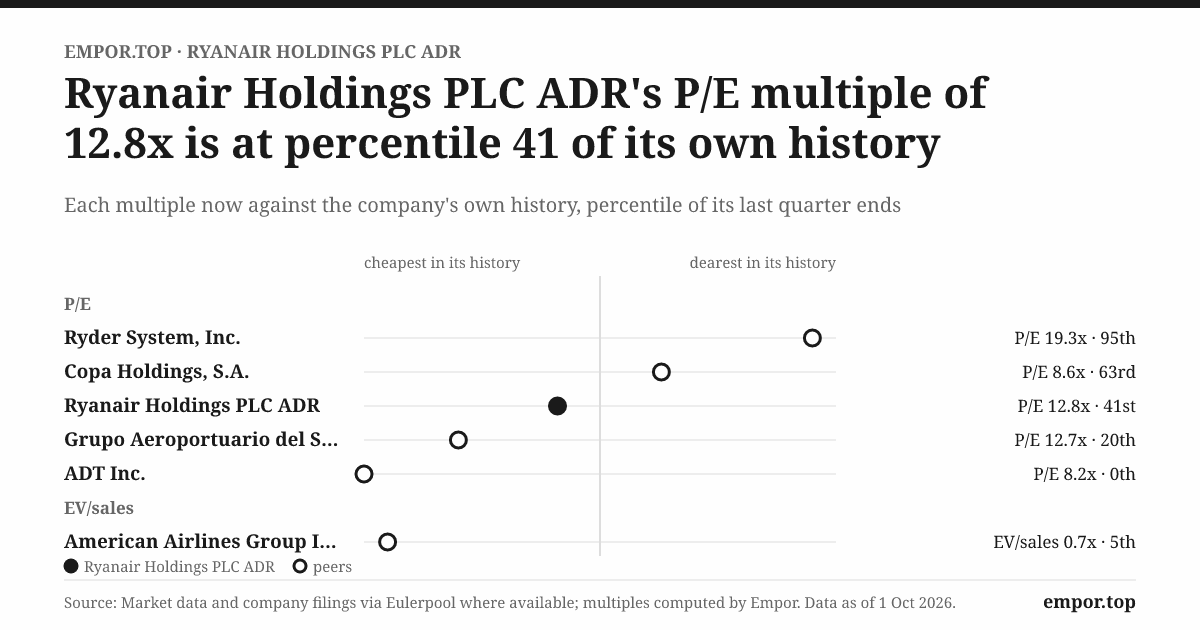
That quarter is the reason for this story. Ryanair has just finished its best year by almost every measure of scale. In the year to March 2026 it carried 208.4m passengers at a 94% load factor and booked revenue of €15.54bn2. No European airline carries more people. Few airlines anywhere earn higher returns on the money they tie up. Yet the stock market prices the shares at about 12.8 times earnings, below their own five-year median of about 13.8 times2. In plain English, investors are paying less for each euro of Ryanair profit than they have on average since the pandemic. They seem to be asking whether those euros of profit have already peaked.
The paradox
Ryanair is the airline people love to complain about. The baggage rules, the seat that does not recline, the airport an hour's bus ride from the city it is named after, and a chief executive who has called his own customers idiots in public. Then those same people open a booking app and choose Ryanair again, because the price is lower. The complaints and the bookings are two sides of the same choice. Ryanair has never tried to be loved. It has tried to be cheaper, and passengers rewarded it for that.
The verdict this story will test is simple to state. Ryanair is the lowest-cost scale operator in European short-haul flying. That is a fact supported by two decades of margins and returns. Whether that cost lead still turns into growing profit is a different question, and it is open.
Four questions
The story follows four questions.
First, is the profit peak behind it? Fares are falling, costs are rising, and the fuel hedges that protect this year run thin next year.
Second, is Michael O'Leary's new contract a warning? At the September 2026 annual meeting almost four in ten votes cast went against the chief executive's last big pay deal4.
Third, are the fines one-offs or a pattern? Italy and Spain have together fined Ryanair more than €360m2, and both cases hit the same lever: control of the passenger.
Fourth, does capital discipline survive the next aircraft cycle? Ryanair has paid off its last bond1 just as 300 new Boeing 737 MAX-10s are due to start arriving2.
The plumbing
A word on structure before the story starts. Ryanair Holdings is an Irish company. Its shares trade in Dublin, and US investors buy them as American Depositary Shares on Nasdaq, where one ADS represents two ordinary shares3. The company reports in euros and its financial year ends on 31 March3. So "FY26" means the year to March 2026, and "Q1 FY27" is the quarter to June 2026.
That calendar matters more than it seems. Europeans fly on holiday in summer. Ryanair's year begins in April, peaks in the July-to-September quarter and ends in the dark, cheap months of winter. Almost everything about the quarterly numbers, and about the panic or calm they produce, follows from that seasonal shape. To see why the shape exists at all, the story has to go back to a small airline in the south of Ireland that nearly did not survive its first five years.
 Subscribe on LinkedIn
II. Origins in One Breath: Tony Ryan, Failure, and the Dallas Pilgrimage (1984–1997)
The first Ryanair aircraft was not a jet. It was a 15-seat Embraer Bandeirante, a Brazilian turboprop, and in 1985 it flew between Waterford, in the south-east of Ireland, and London Gatwick3. The man paying for it was Tony Ryan, a former Aer Lingus manager who had grown rich building GPA, one of the world's largest aircraft-leasing companies. Ryan knew how aircraft were financed. He did not yet know how to run an airline that made money.
The luxury mistake
For its first few years Ryanair tried to beat Aer Lingus by being a nicer, cheaper version of it. It flew more routes, added more aircraft types and even experimented with a business-class product. It carried passengers. It lost money. By around 1990 the losses had reached about £20m, and the Ryan family had put in roughly another £20m to keep it alive. That outline figure appears in most accounts of the company's founding, and it captures the point: Ryanair began life as a cash furnace.
Into this walked Michael O'Leary. He was a young accountant who had trained at a big firm before going to work as Tony Ryan's personal financial adviser. O'Leary was blunt, impatient and, by his own later telling, unconvinced the airline was worth saving. Ryan sent him to look anyway.
The pilgrimage to Dallas
The story of what O'Leary found has become company legend. He travelled to Texas to study Southwest Airlines and its founder, Herb Kelleher. Southwest flew one type of aircraft, the Boeing 737. It turned planes around at the gate in minutes rather than an hour. It avoided expensive hub airports and congested schedules. It sold a seat, not an experience.
The lesson O'Leary took home was not about service. It was about cost. An airline that keeps its unit costs below everyone else's can charge less and still make money, and it can survive price wars that kill its rivals. Ryanair stripped out the business-class experiment, standardised its fleet and started to behave like a European Southwest. The founding bet was cost, not service. Everything that follows in this story is a bigger version of that one choice.
Deregulation and the listing
The timing was lucky. European aviation had been a patchwork of national monopolies with fares set by governments. A series of liberalisation packages from the late 1980s culminated in the 1992 package that, by 1997, let any EU airline fly between any two EU points. Ryanair moved onto Boeing 737s in the mid-1990s and floated its shares in 1997, in Dublin and on Nasdaq3. The listing gave it a currency and a source of capital at exactly the moment the continent opened up.
Why the copy did not stay a copy
Here is the test of the moat claim. Southwest's model is not a secret. Kelleher explained it to anyone who asked. In Europe, easyJet copied it from 1995, Wizz Air from 2004, and dozens of others tried and failed. If the model alone were the moat, there would be many Ryanairs. There is really only one with Ryanair's cost position.
The history therefore narrows the moat claim from "Ryanair invented low-cost flying" to something more specific: Ryanair executed the copy more ruthlessly than anyone else, and then layered advantages on top that are harder to copy. The founding story matters only because it planted that obsession with cost. The next three sections are about how the cost lead was actually built, and the first brick was laid on a computer screen.
III. Distribution, Ancillaries and the Boeing Orders That Built the Cost Lead (1998–2013)
In 1998 Ryanair placed an order for 45 new Boeing 737-800s3. For an airline of its size, that was an enormous commitment. It was also the first of the big contrarian aircraft orders that define the company. But the more radical move of that era was quieter. Around 2000, Ryanair launched its own booking website and began pushing passengers away from travel agents.
Killing the middleman
Travel agents took commissions on every ticket. For a network airline selling expensive seats, that was a cost of doing business. For an airline selling seats for a few tens of euros, it was a large slice of the fare. Ryanair decided it would rather not pay it. Within a few years nearly all its bookings came through its own site.
That decision did three things. It removed a cost. It gave Ryanair direct control of the customer at the moment of purchase, which is where it could sell extras. And it gave it the passenger's money before the flight, often weeks before. Hold that last point; it comes back later as the cash engine.
There is a legal sequel. Twenty-five years later, Italy's competition authority would fine Ryanair for the way it treats travel agents and online booking sites that try to resell its seats. Control of distribution, once purely a cost lever, became a competition-law problem. Section VII tells that part.
O'Leary summed up the philosophy in a line he has repeated in many forms: other airlines were asking how they could put fares up, while Ryanair was asking how it could get rid of them. The line is theatre. It is also a fair description of the business model, because the fare was never meant to carry the whole load.
The ancillary machine
Once the passenger books directly, every step is a chance to sell something: a checked bag, a priority boarding slot, a reserved seat, a car hire, insurance. These are "ancillary" revenues. In FY26 they reached €4.99bn, or about €24 for every passenger2. That is roughly a third of the company's revenue.
What this means is that Ryanair can price the seat itself below what a rival with no ancillary engine would need, and still earn its return. The headline fare is the hook. The bag and the seat pay for part of the flight.
Now the clue that the lever is maturing. In FY26 ancillary revenue grew about 6%, while scheduled fare revenue grew about 14%2. Fares recovered strongly; extras grew roughly in line with passenger numbers. In the June 2026 quarter, management again described ancillary revenue as growing in line with traffic1. The likely reading is that Ryanair has squeezed most of what it can from extras per passenger, and that future growth in this line will come mainly from carrying more people. That matters, because when fares fall, as they did in the June quarter, ancillaries no longer cushion the blow with their own momentum. It is also the precise lever that regulators in Spain are now attacking.
Buying when everyone else is selling
The third advantage is the one O'Leary is proudest of. Ryanair buys aircraft when nobody else wants them.
The playbook was clearest after 2008. The financial crisis hit airlines hard, demand fell and many carriers cancelled or deferred orders. Ryanair kept growing and kept negotiating. Boeing needed customers. Regional airports that had lost traffic needed passengers. Ryanair could offer both, and in return it extracted low aircraft prices and low airport charges. When the cycle turned, it had a fleet bought at a discount and route deals rivals could not match.
The evidence that this works is in the margins. Through the 2010s, as the profit and loss history shows, Ryanair's operating margin sat between about 18% and 23% in the years from FY15 to FY183. Most European network carriers would be pleased with a margin a third of that. Ryanair's returns on invested capital were above 25% in most of those years3.
The cash engine
Now return to the money paid in advance. Passengers pay when they book. Ryanair pays its suppliers later. In FY26 the company collected the money owed to it in about a day on average, and it paid its own bills about 17 days after receiving them, leaving a cash conversion cycle of about minus 17 days3. Its broader working-capital position, which includes the much larger pile of tickets sold for flights not yet flown, was more strongly negative still.
Think of it as a shop where customers pay for the goods weeks before the goods exist. As long as the shop grows, the pile of prepaid cash grows with it, and that pile funds part of the growth. Over the twelve years to FY26, Ryanair produced about $28.8bn of cash from operations against $12.5bn of net profit, or about 2.3 times3. Heavy depreciation on an owned fleet explains much of the gap. Advance bookings explain the rest.
The caveat belongs right here, beside the claim. This engine runs in reverse if growth stops or if passengers start booking later. In FY26 the working-capital cushion, measured in days of revenue, shrank from about −160 to about −1033. And in July 2026 management told investors the booking curve was "closer-in" than a year earlier1. Neither is yet a crisis. Both are the kind of early signal that a self-funding growth model is becoming less self-funding.
So by 2013 Ryanair had stacked three advantages: direct sales with no commissions, an ancillary engine that subsidised the fare, and a fleet bought cheaply in a downturn. The next decade would test all three, first through an aircraft that fell out of the sky elsewhere, and then through a virus that grounded everyone.
IV. The MAX Gamble and the Pandemic: Two Crises, One Strategy (2014–2022)
In September 2014 Ryanair signed as the launch customer for a new variant of Boeing's 737 MAX, a high-density version it would later brand the "Gamechanger"3. It was the kind of order Ryanair loved: a big commitment to a new aircraft, negotiated early, at a price only a launch customer could get. Five years later the bet looked disastrous.
What the MAX 8200 is
The aircraft, known in Boeing's catalogue as the 737-8200, packs 197 seats into a fuselage where the older 737-800 held 1893. That is about 4% more seats per flight. It also burns materially less fuel per seat, thanks to newer engines. For an airline whose entire model is unit cost, more seats and less fuel per seat is the whole game. Each additional seat on a flight that was going to happen anyway is almost pure margin.
The grounding and the virus
Then came March 2019. After two fatal crashes involving the 737 MAX, regulators around the world grounded the type. Ryanair's deliveries froze. The aircraft at the centre of its cost plan were sitting in Boeing's yards in Seattle, unable to fly.
Twelve months later, the pandemic arrived. Within weeks, European air travel almost stopped. Ryanair's revenue, about $9.4bn in FY20, collapsed to about $1.9bn in FY21, and the operating margin that year was about −51%3. Few businesses survive losing four-fifths of their revenue in a year.
Ryanair did. It cut jobs, negotiated pay cuts with unions, and leaned on the balance sheet and credit markets it had kept access to. Its debt-to-equity ratio rose to about 1.17 by March 20213. It also raised fresh equity in September 2020, a placing of roughly €400m9, a fact worth putting on the record because the airline is often described as never having needed shareholders' help. It did, briefly, and on a modest scale relative to its size.
The contrarian order
In December 2020, in the depths of the crisis, Ryanair ordered 75 more MAX 8200s, taking its commitment to 2103. The timing looks inspired in hindsight. Boeing was desperate for good news. Ryanair locked in a price negotiated in the depths of the crisis, and when travel came back after 2022, aircraft were scarce, engines were scarcer and every seat that could fly had buyers.
Was it brilliant or lucky? The honest answer is both. The bet that demand would return was a reasonable one. The scale of the shortage of aircraft that followed, driven by supply-chain failures at Boeing, Airbus and the engine makers, was not something anyone forecast. Ryanair was positioned to benefit from luck because it had a habit of buying in downturns. That is a repeatable habit, not a repeatable outcome.
Dependency and leverage
The Boeing relationship cuts both ways. Delays to the 8200 meant Ryanair had fewer aircraft than planned for several summers, which cost it growth. In return, Boeing paid compensation for late deliveries, which reduced Ryanair's costs. The last of the 210 Gamechangers arrived in February 20261. With it, the compensation ended. In the June 2026 quarter, management listed the end of that compensation as one of the reasons costs rose1. A former tailwind became a headwind.
Testing the "counter-cyclical genius" claim
The story Ryanair tells about itself is that it is strongest when the industry is weakest. The record supports that in 2008–2013 and in 2020–2022. But there is a disconfirming episode, and it is uncomfortably close to today.
In FY19 and FY20, before COVID, Ryanair's operating margin fell to about 13%, roughly ten percentage points below its FY17–FY18 level3. Net profit fell about 39% in FY193. The causes were familiar: fuel was rising, pilots had unionised and won pay rises, and fares were falling because of overcapacity in European short-haul. Ryanair issued profit warnings in that period. The cost leader could not stop its own margin being squeezed by industry-wide pressure.
The lesson is a narrower version of the claim. Ryanair is best in a crisis that weakens rivals' balance sheets, because it can buy cheaply and take share. It is not immune to a slow squeeze in which fares fall and costs rise for everyone. In that kind of year, being lowest cost means losing less margin, not gaining it. That distinction is the whole question for 2026.
The subsidiaries
A brief note on the alphabet soup of brands. Ryanair Holdings owns Ryanair DAC, Buzz, Lauda, Malta Air and Ryanair UK1. They exist largely for regulatory reasons: EU rules on airline ownership, operating licences in different countries, and Brexit, which required a UK-licensed carrier. They are not separate profit centres with their own strategies. They are where the same fleet sits on different certificates.
The pandemic chapter ended with a recovered business and a bigger, cheaper fleet. The question in 2026 is whether the next squeeze looks like 2008 or like 2019.
V. The Q1 FY27 Squeeze: Is the Peak Behind It? (2025–Today)
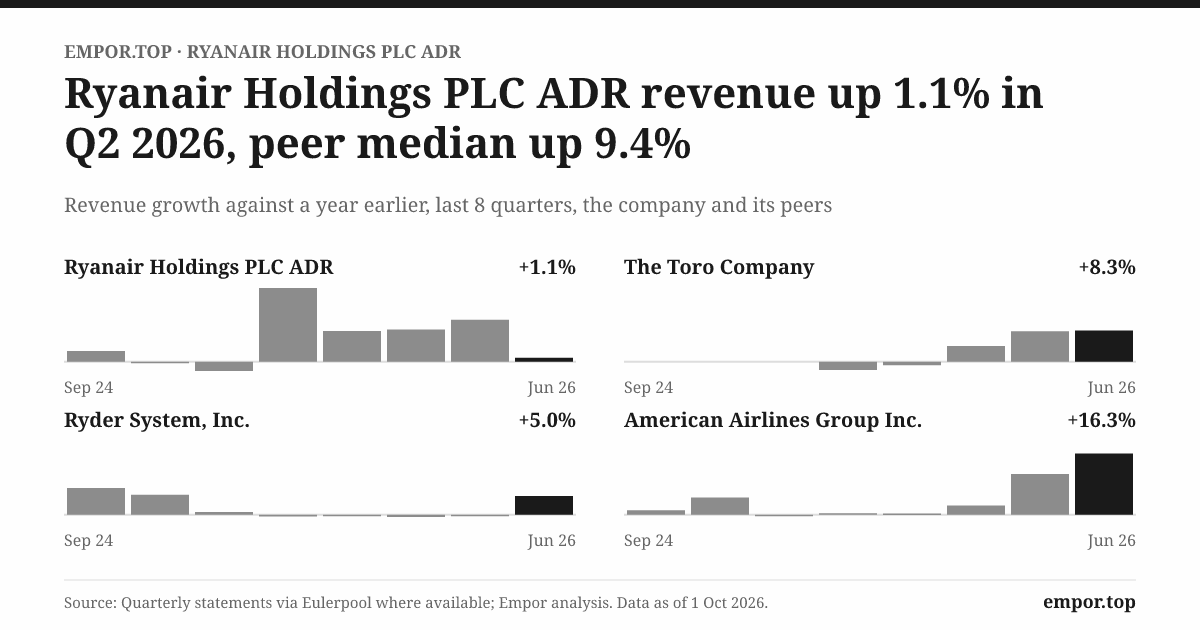
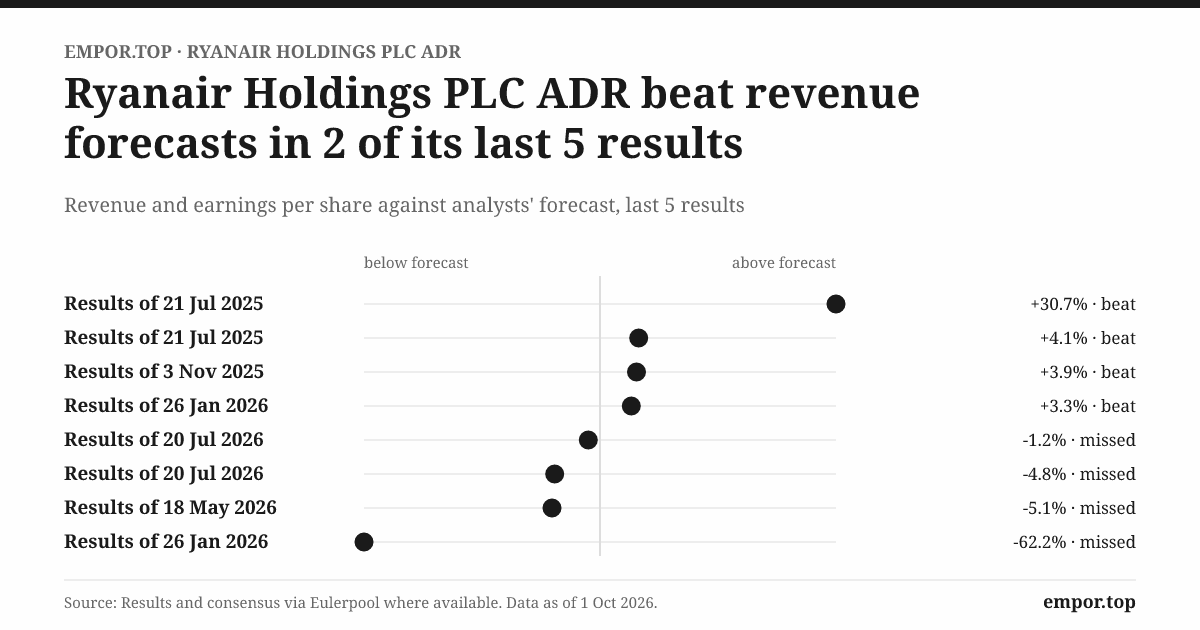
On 20 July 2026, Ryanair released its first-quarter results1. The headline was the fall in profit. The detail was worse. The average fare was down 6%, costs were up 11%, and the company said customers were booking later than a year before1. Management also warned that it had "zero visibility" over the second half of the year1.
For a company whose founder made his name with confident forecasts, that phrase is the most useful thing in the release. It is management's own counterweight to the bull case.
How the year really works
To understand why one quarter matters so much, look at the shape of the year. In each of the last three years, the July-to-September quarter produced operating margins of about 32% to 35%3. The October-to-December quarter roughly broke even. The January-to-March quarter lost money every single year3.
In other words, the whole year's profit is made in roughly fourteen summer weeks. If summer fares are strong, the year is good. If they are weak, nothing in winter can make up for it. The June quarter is the first look at summer, which is why investors reacted so sharply to a 6% fare decline.
Why costs rose
Ryanair's unit costs, the cost of flying one passenger, rose about 5% in the quarter1. Management named the drivers1:
- European environmental taxes, which it expects to add about €300m to costs in FY27.
- Multi-year pay deals with crew agreed in recent years.
- Higher maintenance costs as the fleet ages and parts become more expensive.
- Air-traffic-control disruption, which forces delays and extra fuel burn.
- And, as noted, the end of Boeing's late-delivery compensation.
Notice what is not on the list: fuel. Ryanair hedges its fuel well in advance. For FY27, about 80% of its jet fuel is locked in at about $67 a barrel1. That shields this year from a spike in oil prices. For FY28, only about 15% is hedged, at about $85 a barrel1. The protection that makes this year's cost base predictable runs out next April, and the small slice already bought for next year is at a much higher price.
So the cost problem in FY27 is mostly about things Ryanair cannot hedge: taxes, wages, maintenance and air-traffic control. FY28 adds fuel to that list.
Prepared remarks versus the questions
Ryanair's results calls follow a pattern. O'Leary and his team present a confident story about capacity, costs and market share. Then analysts push. On the July 2026 call, the pressure points were the second-quarter fare trend, which management described as "trending modestly down", and the effect of conflict in the Middle East on travel demand15.
Management attributed the weak June quarter partly to "Middle East conflict hesitancy" and to the timing of Easter, which fell in a way that pulled some demand into the previous year's quarter1. Both explanations are plausible. Both are also temporary by design. If fares recover in the September quarter, the explanations will have been right. If they do not, the market will conclude that pricing strength is fading for reasons that do not go away.
The comparison with FY19 is instructive. Then, too, management said fares were falling and costs rising, blamed overcapacity and promised it would pass. It did eventually, but only after two years of lower margins. The current language is similar. That does not mean the outcome will be, but it means investors have a precedent for how long these squeezes can last.
The competitive map
Ryanair, at about 208m passengers a year, is well ahead of easyJet and Wizz Air, its two low-cost rivals, and it carries more passengers than any of the three big network groups, Lufthansa, IAG and Air France-KLM, which run their own short-haul low-cost arms28[^10]. Its cost per passenger is generally regarded as the lowest in the market, a position it argues in every results presentation2.
What matters for the "peak" question is not who is cheapest, but whether supply will stay tight. Management's view is that European short-haul capacity is constrained until 20302. The reasons are real: Boeing and Airbus are behind on deliveries, and Pratt & Whitney's engine problems have grounded a large share of the Airbus A320neo fleets that Wizz Air in particular relies on[^10].
But that is a management claim, not a fact. It can be tested. If rivals' engine problems are fixed, if Airbus catches up on deliveries, or if Wizz and easyJet add capacity faster than expected, the constraint loosens. The fall in Ryanair's fares in the June quarter, at a time when supply was supposed to be tight, is itself a small piece of evidence that pricing power is weaker than the "constrained until 2030" story implies.
The verdict for now
FY27 is protected by hedges, and the summer quarter, the one that matters, has largely been sold. The exposure lies in FY28, when fuel is mostly unhedged and the cost lines that rose this year keep rising. The question of whether the peak is behind Ryanair will not be settled until the half-year results in November, when the September-quarter fare is known and the company gives its first real view of FY28 hedging.
Those November numbers will also be the first test of whether the man who has run Ryanair for more than three decades is worth what shareholders just agreed to pay him.
VI. Michael O'Leary's Last Contract: Alignment or Windfall? (2026)
On 10 September 2026, Ryanair's shareholders gathered for the annual general meeting. Michael O'Leary was re-elected to the board with about 98% of the votes4. Then came the resolution on his new pay arrangements. About 60.7% of the votes cast were in favour. About 39.3% were against4.
It passed. But nearly four in ten votes against a chief executive who has just delivered record passenger numbers is not a rounding error. It is a message.
The man
O'Leary is now in his sixties and has run Ryanair since 1994. He owns about 4% of the company3, a stake worth over a billion dollars at current prices. He is famous for stunts, insults and forecasts: that Ryanair would one day fly passengers for free, that Boeing would cut its prices, that fares would rise or fall by double digits in a given season.
His record on those forecasts is mixed but honest. He warned in 2018 and 2019 that fares would fall and profits would weaken, and they did. He predicted in the pandemic that demand would return strongly and fares would rise, and they did. He has been wrong about specific numbers, sometimes by a lot, but rarely about direction. The phrase "zero visibility" in July 2026 is in that tradition: he is telling investors not to expect him to know.
The 2019 deal and whether it worked
The previous contract, agreed in 2019, granted O'Leary options that would pay up to about €100m if Ryanair doubled its profit or its share price rose about 80% within a set period4. Nearly half of shareholders voted against that one too4.
Did it work? Ryanair's profit after tax went from about €1bn in FY19 to €2.17bn in FY2623, so on the profit test the target was met. Whatever one thinks about the size of the reward, the design did what it said: it paid for an outcome shareholders wanted.
The new deal
The 2028–2032 contract grants 10m share options4. They pay out if the share price reaches €42 or if post-tax profit reaches about €4bn4. The Irish Times put the potential value at €150m or more4.
How demanding is that? Profit after tax was €2.17bn in FY262. Reaching €4bn means growing it by about 85%. The share price, at about $53 per ADS, works out to roughly €23 per ordinary share. Reaching €42 needs an increase of about 80%.
Both hurdles are demanding on paper. Neither is impossible if the MAX-10 fleet arrives on time and fares recover. The design ties the reward to the share price, which aligns O'Leary with every other owner.
Why four in ten said no
The objection is not mainly about alignment. It is about two other things. First, the size: a contract worth €150m or more for a chief executive who already owns a large stake. Second, succession. The Irish Times described this as likely his last contract4. Shareholders are paying for a founder-like figure whose departure has no public plan. Ryanair has not named a successor. That makes the 39% vote a vote about governance as much as pay.
Ryanair has said it will consult shareholders about the response. How it handles that consultation will tell investors more about the board's independence than any governance statement in the annual report.
The buyback question
Pay tied to share price creates an incentive to buy back shares. Ryanair has retired about 38% of its share capital since 20082. In the current €750m programme it bought over 25m shares at an average of about €26.351.
That average is higher than the price in early October 2026. In plain terms, Ryanair bought back shares at prices above where they trade today. That is not a sign of bad judgment; it bought during a year of record profit. But it is a reminder that buybacks are only good value if the shares are cheap relative to future profits, and that depends on the same "peak" question this story keeps returning to.
The board
Ryanair's board includes Stan McCarthy as chair, alongside directors such as Roisin Brennan, Amber Rudd, Elisabeth Kästinger, Eamonn Brennan and Bertrand Grabowski3. The burden is on the board to show it can manage the chief executive's eventual departure as well as it manages his pay.
A skeptical investor would ask three things. Who is the successor? What happens to the culture of cost obsession when O'Leary leaves? And why does a company with a record of meeting its targets need a contract that two-fifths of its owners would not support?
Those are governance questions. The next set of questions is about regulators.
VII. Fines and Fights: A Pattern or a One-Off? (2024–Today)
The Italian competition authority, the AGCM, fined Ryanair €255.8m for abusing its dominant position in its dealings with travel agents2[^6]. Ryanair booked an exceptional provision of €85m in FY26 against the case2. The gap between the fine and the provision is about €170m.
The Italian case
The case goes straight back to the website decision of 2000. Ryanair wants passengers to book on its own site, where it can sell them extras and keep their data. Online travel agents want to resell Ryanair seats alongside other airlines'. Ryanair restricted that and offered agents its own white-label iFrame and API tools on its terms.
The AGCM concluded that this was abuse of dominance: Ryanair used its market position to make it harder for agents to compete. Ryanair argues that it is protecting passengers from overcharging by "screen-scraper" sites and that it will appeal2. The provision of €85m, against a fine three times larger, signals the company's view that it has a reasonable chance of reducing the fine on appeal. The company has not explained publicly how it arrived at €85m.
The Spanish case
In Spain, the consumer ministry fined Ryanair about €108m over its baggage policies, in particular charges for cabin bags. Ryanair is appealing2. Separately, the company has been in a long dispute with AENA, the Spanish airport operator, over charges at regional airports, and responded by cutting about one million seats of winter capacity in Spain.
State aid
The European Commission has examined arrangements at about a dozen airports where Ryanair flew: Carcassonne, Frankfurt Hahn, La Rochelle, Montpellier, Cagliari, Klagenfurt, Pau, Nîmes, Angoulême, Altenburg, Zweibrücken and Charleroi36. The question in each case is whether the airport, often publicly owned, gave Ryanair a deal that amounted to illegal state aid.
The precedent is Charleroi. In 2004 the Commission ruled that some of Ryanair's deal there was illegal aid, and the company was ordered to repay part of it. Ryanair appealed and largely won in 2008. Later cases followed the same arc: long examinations, mixed rulings, modest sums. The pattern is that Ryanair fights everything, wins some, loses some and rarely changes its model.
The pattern
Combined, the Italian and Spanish fines are about €364m, roughly 17% of FY26 profit after tax2. That is survivable. But both cases attack the same thing: Ryanair's control of the passenger relationship, through distribution in Italy and through baggage charges in Spain. That is the lever that drives ancillary revenue, the engine described in section III.
The sums matter less than the pattern. If regulators across Europe decide that Ryanair's control of booking and baggage is a competition or consumer problem, the risk is not one fine but a gradual erosion of the ancillary model. That has not happened yet. But two large fines on the same lever in a short period is a signal investors should take seriously.
Environmental cost
Regulation already costs money in one area. The €300m of extra EU environmental taxes in FY271 is a direct cost Ryanair cannot avoid. Ryanair ranks among Europe's largest carbon emitters by virtue of its size, even though it argues its new aircraft are among the most efficient per passenger. The environmental cost line will only grow as EU carbon prices rise and free allowances are phased out.
The fines are survivable. The question is whether they are the first in a series. The next section turns to the balance sheet that would have to absorb them.
VIII. Cash, Capital and the MAX-10 Cycle
In May 2026 Ryanair repaid its final €1.2bn bond1. For the first time in its history it has no financial debt. It keeps a €1.1bn revolving credit facility, mostly undrawn1. Its credit ratings are BBB+ at both S&P and Fitch2. Its fleet of about 620 aircraft is unencumbered, meaning no lender has a claim on it2.
That is the balance sheet of a company that has spent a decade paying down debt. The next test is whether it stays that way through the arrival of 300 MAX-10s.
Where the cash went
Over the twelve years to FY26, Ryanair generated about $11.9bn of free cash flow3. It paid about $1.5bn in dividends, about 12% of that free cash3. The rest went to repaying debt and buying back shares. Debt-to-equity fell from about 1.10 in FY15 to about 0.15 in FY263.
The dividend is modest. The payout is about 20% of profit and the yield about 0.8%23. Ryanair has preferred buybacks, which suit a company whose management believes its shares are undervalued and whose chief executive is paid on the share price. A skeptic might call that under-distribution. A supporter would call it flexibility. The honest answer is that it depends on whether the buybacks were done at good prices, which, as section VI noted, is not yet clear for the most recent programme.
The MAX-10 order
Ryanair's 300 MAX-10s, a longer version of the 737 MAX with about 228 seats, are due to start arriving in spring 2027 and run through March 20342. The MAX-10 has not yet been certified by the US Federal Aviation Administration7. Boeing has targeted certification before, and missed. The original timetable for the type had first deliveries years earlier.
This is the forward test of Ryanair's Boeing dependence. If certification slips, the first deliveries slip, and so does the growth plan to 300m passengers a year by FY342. If it arrives on time, Ryanair gets an aircraft with about 20% more seats than the 737-800 and materially lower fuel burn per seat, which would extend its cost lead.
The arithmetic of 300m
Getting from 208m to 300m passengers means about 44% more traffic in eight years, about 5% a year. The MAX-10s add seats; the aircraft retiring take some away. The remaining question is airports: can Ryanair find enough slots, at low enough charges, to fill those seats? The Spanish dispute shows that airport owners are not always willing partners.
Capex and cash conversion
FY26 capital expenditure was about €1.9bn, about 12% of revenue2. Depreciation rose about 13%2. Cash from operations was about 97% of EBITDA, below the long-run average3. The MAX-10 deliveries will raise capex further from FY28. The company plans to rebuild gross cash to about €4bn while funding the aircraft, the dividend and the buyback1.
That is achievable if profit holds. If FY28 brings unhedged fuel, lower fares and rising capex in the same year, something will have to give, and the most likely candidate is the buyback.
Lauda
Ryanair's one notable acquisition was Lauda, the Austrian airline founded by the racing driver Niki Lauda, bought in stages from 20183. It was small, loss-making for years and eventually folded into Ryanair's operations. The lesson is that Ryanair does not do large deals. It grows organically, buys aircraft rather than airlines, and avoids the integration risk that has damaged many airline mergers. That is a capital-allocation point in its own right.
Treasury
The hedging book is part of the balance-sheet strength. Derivative assets on the balance sheet fell from about €2.1bn in March 2026 to about €0.9bn in June 20261, as hedges rolled off and fuel prices moved. Those hedges have been a source of value; their run-off is the same story as the FY28 exposure seen from a different angle.
The balance sheet is strong. The next section asks whether the business that sits on top of it still has a moat.
IX. Frameworks: Why Ryanair Wins, Why It Might Not
Imagine the same Ryanair 737 at a secondary airport, landing, unloading, refuelling, reloading and taking off again in about 25 minutes. A network carrier at a hub might take an hour or more for the same turn, waiting for connecting passengers and baggage transfers. That difference, repeated across hundreds of aircraft and thousands of daily flights, is the operational heart of the cost lead.
What the numbers say
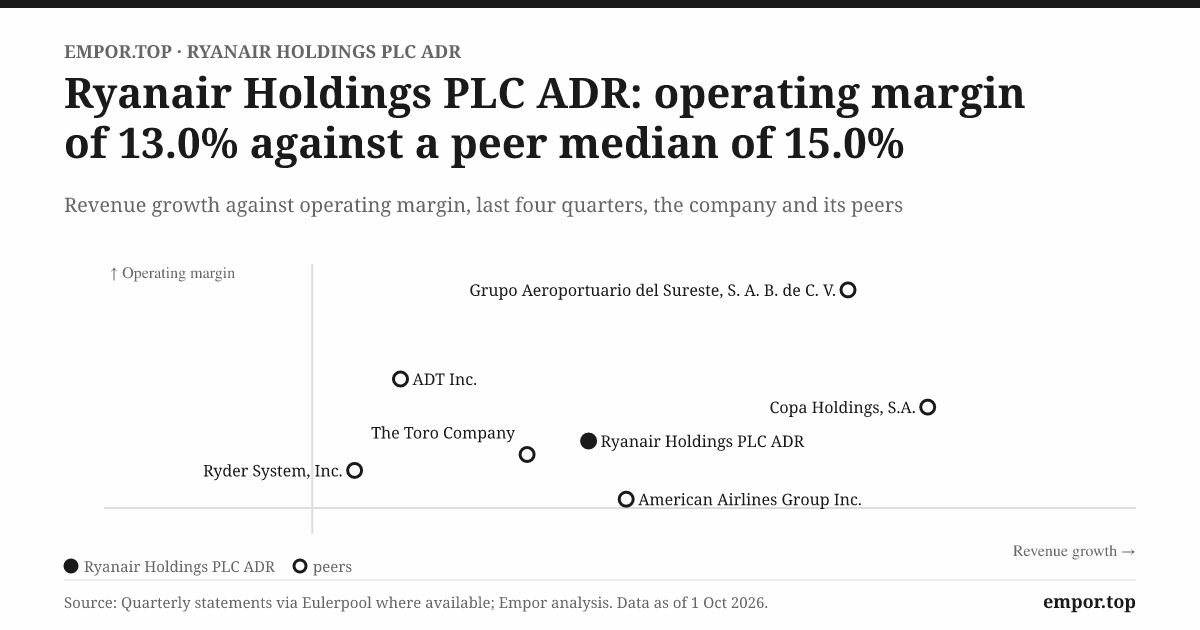
Ryanair's operating margin was about 15.8% in FY263. Outside the pandemic years, it has ranged from about 11% to about 23% over the last decade3. Return on invested capital over the last twelve months was about 26.8%3. Asset turnover, a measure of how much revenue each euro of assets produces, was about 0.793, which for an airline that owns most of its fleet is high.
The evidence is that Ryanair earns well above its cost of capital in normal years, falls toward it in squeezes and dips below it only in true catastrophes.
Seven Powers
Hamilton Helmer's framework identifies seven sources of durable advantage. Ryanair's map is clear.
Scale economies are the strongest. Ryanair's size lets it buy aircraft cheaper, negotiate lower airport fees, spread overheads more thinly and fill planes more consistently. A rival with half the fleet pays more per seat for almost everything.
Counter-positioning is close behind. Network carriers cannot copy Ryanair's model without destroying their own premium and connecting businesses. Their low-cost arms, such as Lufthansa's Eurowings or IAG's Vueling, are constrained by group costs and labour contracts.
Cornered resource is weaker. Airport slots and Boeing pricing are real advantages, but slots can be lost and Boeing's terms are negotiated, not owned.
Brand is weak by design. People do not book Ryanair because they love it. They book it because it is cheapest. That means there is no loyalty to fall back on if a rival is cheaper.
Switching costs, network effects and process power are minor. Passengers switch freely, and the operational playbook, while well executed, is not unique.
Five Forces
Porter's framework highlights the pressures.
Supplier power is the dominant force. Boeing, CFM (the engine maker), airports and air-traffic control can all impose costs Ryanair cannot avoid. The MAX-10 delay and the ATC disruption in the June quarter are recent examples.
Buyer power is high at the passenger level, because price is the only thing most passengers compare. A 6% fall in fares shows how quickly that power is exercised.
Rivalry comes from Wizz, easyJet and the network carriers' low-cost arms. It is intense but disciplined by supply constraints for now.
Substitution comes from rail on short routes, particularly in France, Spain and Italy, and from video calls replacing some business travel.
New entrants are rare. Starting an airline at scale is hard and expensive.
The KPIs to watch
Two numbers tell most of the story: cost per passenger and average fare. If fare stays above cost by a wide margin, Ryanair makes money. If the gap narrows, it does not. In the June 2026 quarter, fares fell about 6% and unit costs rose about 5%1, so the gap narrowed sharply. Add load factor as a third check: it was about 94% in FY262. If it falls while fares also fall, demand is weakening.
Verdict on the moat
The moat is real but narrower than the legend. Ryanair's cost lead is durable, and the evidence is twenty years of returns above peers. But the moat does not protect against fuel, regulation or a broad fall in fares. It protects Ryanair from losing to rivals, not from losing margin in a bad year. The story's history, from 2019 to 2026, says that much.
What does all of this teach anyone who isn't a Ryanair shareholder?
X. Playbook: Lessons From Ryanair
Be the lowest-cost producer, then let everyone else guess how. When Ryanair bought aircraft in the depths of 2008 and again in 2020, rivals were cutting. The lesson is not that buying in a downturn always works. It is that the company with the lowest costs is the only one that can afford to try. A cost lead is an option on every future crisis.
Make the customer pay in advance and growth funds itself. Ryanair collects the fare weeks before it spends the money flying the passenger. That one detail funded much of its growth for two decades. A prepayment is a promise, not a profit, and the moment growth stops the promise has to be kept from the company's own pocket.
Controversy is free marketing until it becomes a regulator's file. O'Leary's stunts kept Ryanair in the headlines for thirty years at almost no cost. The Italian and Spanish fines show that the same tactics, applied to distribution and baggage, now attract regulators. The publicity was free. The fines are not.
Boeing is both your best supplier and your biggest risk. Ryanair's single-type fleet is the source of its operational efficiency and its total dependence on one manufacturer. The MAX grounding, the 8200 delays and now the MAX-10 certification show that the same choice that makes it cheap can make it stall.
Pay the founder for the share price, and expect to be asked why. The 2019 deal worked. The 2026 deal will probably work too. But 39% of shareholders voted against it, because aligning a founder with the share price is not the same as planning for the day he leaves.
XI. Bull vs. Bear
The bull case
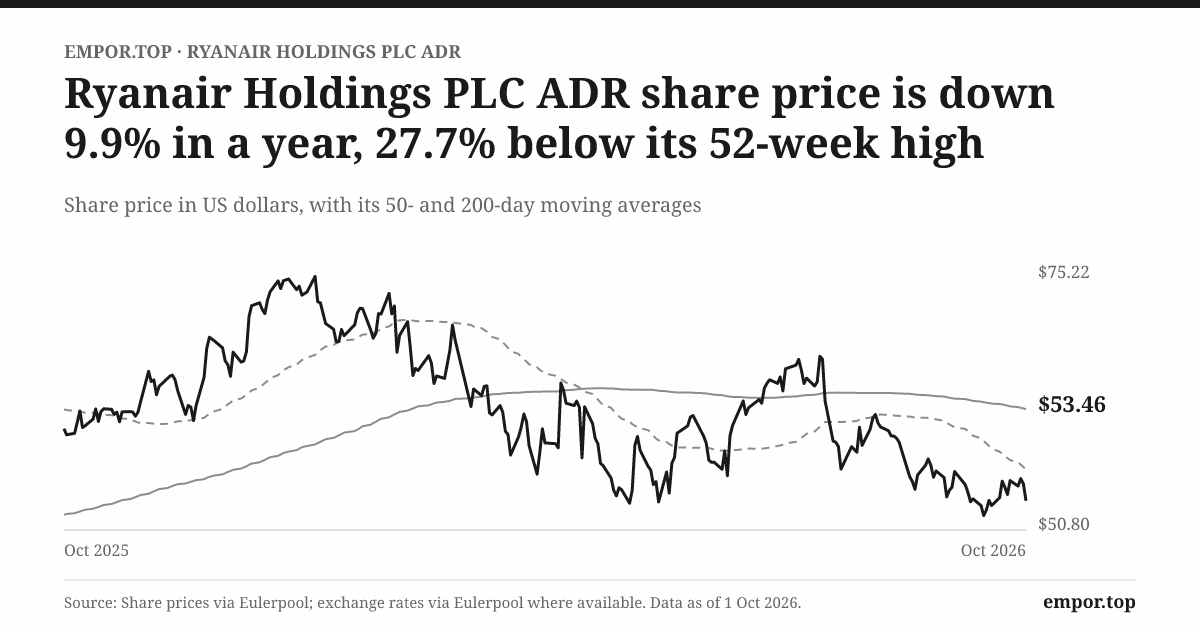
Ryanair has the structural cost lead in European short-haul, a debt-free balance sheet and an industry where capacity is constrained by aircraft and engine shortages, at least for now. The shares trade near their 52-week low, about $53.46 against a range of about $52.11 to $73.922, at about 12.8 times earnings and a free-cash-flow yield of about 7.1%2. Buybacks shrink the share count every year, which raises each remaining holder's share of future profit.
If fares stabilise in the September quarter and the MAX-10 arrives on time, the bull would argue, the current price assumes too much decline.
The bear case
Fares are falling, costs are rising and FY28 is mostly unhedged. Fuel, labour and environmental taxes are costs a low-fare airline cannot easily pass on, because its customers choose it precisely for price. Regulatory fines are hitting the ancillary model. Boeing dependence means the growth plan rests on a certification that has not happened. And the chief executive whose judgment the company relies on has signed what may be his last contract, with no named successor.
The risk radar
The material risks are fuel, Boeing and engine supply, regulation, labour and air-traffic-control disruption. Each has hit Ryanair before. Fuel and labour squeezed margins in FY19. Boeing grounded its fleet in 2019. Regulators have fined it repeatedly. ATC strikes disrupt every summer.
Valuation
At about 12.8 times earnings, below its five-year median of about 13.8 times2, the market has priced in some decline. But the shares fell about 55% peak-to-trough in the last five years2, which shows how far sentiment can swing when the cycle turns. The current price appears to assume that FY27 is a modest step down, not the start of a long squeeze. If FY28 looks like FY19, that assumption will be tested.
XII. Epilogue: What Decides the Story Next
Tonight, Ryanair stands at a crossroads it has seen before. The summer has been flown. The fares have been collected. The question is what the next twelve months will bring.
November 2026: the half-year results. This is the moment the September-quarter fare is known. If it holds up, the "peak" question eases. If it falls again, the market will conclude that pricing strength is fading. The first view of FY28 fuel hedging will show how exposed next year really is.
Spring 2027: the first MAX-10. If Boeing secures certification and the first aircraft arrives on schedule, the growth plan is intact. If it slips, so does the path to 300m passengers and the €4bn profit hurdle in O'Leary's contract.
The Italian appeal. If the fine is reduced toward the €85m provision, the regulatory pattern looks manageable. If it stands, the gap hits profit, and the precedent invites other regulators.
The pay consultation and succession. If the board announces a credible succession plan, the governance concern fades. If it does not, the 39% vote will be remembered.
Each of these maps to one of the four questions. Together, they will decide whether the peak was a peak or a pause.
XIII. Outro
Return to that full plane in June 2026, every seat sold at a lower fare than the year before. Ryanair has never needed to be loved. It has only needed to be cheaper. For thirty years, being cheaper was enough, because everyone else's costs were higher and rising faster.
The question now is whether being cheaper is still enough when the cost of everything else, fuel, labour, taxes, regulation, is rising for Ryanair too. The airline that built its business on getting rid of fares now depends on how far those fares will fall.
References
-
Ryanair Q1 FY27 results (Q1 PAT falls 34% to €538m) — Ryanair investor site, 2026-07-20 ↩↩↩↩↩↩↩↩↩↩↩↩↩↩↩↩↩↩↩↩↩↩↩↩
-
Full Year FY26 Ryanair Holdings plc Earnings — Investegate (RNS), 2026 ↩↩↩↩↩↩↩↩↩↩↩↩↩↩↩↩↩↩↩↩↩↩↩↩↩↩↩↩↩
-
Ryanair Holdings plc Form 20-F for the year ended 31 March 2026 — SEC EDGAR, 2026 ↩↩↩↩↩↩↩↩↩↩↩↩↩↩↩↩↩↩↩↩↩↩↩↩↩↩↩↩↩↩↩↩↩
-
Ryanair investors revolt over O'Leary pay — The Irish Times, 2026-09-10 ↩↩↩↩↩↩↩↩↩
-
Ryanair Holdings plc earnings call transcripts — Seeking Alpha ↩
-
European Commission state aid case search — European Commission ↩
 LinkedIn
 WhatsApp
 Reddit
 Hacker News
 Email
 Kindle
 RSS Feed
 Spotify
 Apple Podcasts
 Amazon Music
 Audible
 YouTube