Trane Technologies: The Purple Machine That Turned Air Conditioning Into a Compounding Franchise
I. Cold Open: The $12.1 Billion Backlog
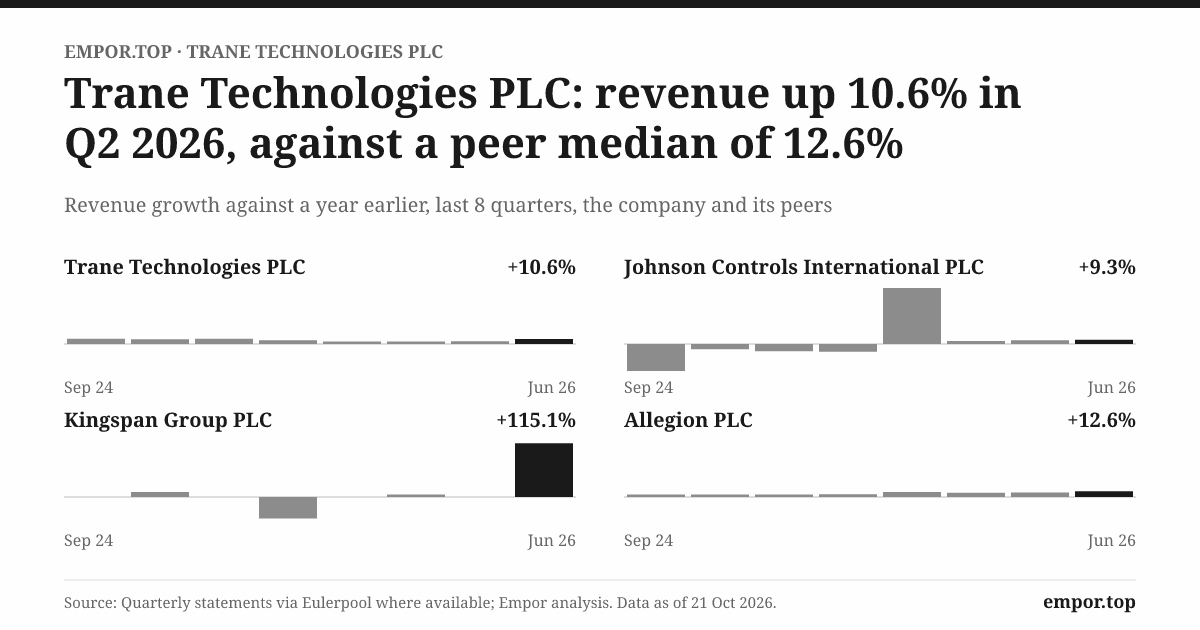
On the morning of 30 July 2026, Trane Technologies put out a set of second-quarter numbers that read more like a semiconductor company in a boom than a maker of chillers, air handlers and truck refrigeration units. In three months, customers had placed $7.8bn of orders, 39% more than a year earlier.1 The company shipped $6.35bn of goods and services in the same quarter, so for every dollar it billed, customers handed it about $1.23 of new work.1 The order book, the stack of signed projects not yet built, reached a record $12.1bn, up 70% in a year.1 Six months earlier, at the end of 2025, that same backlog had stood at $7.77bn.2
The detail that made analysts sit up came on the call. Chair and chief executive Dave Regnery said bookings of applied equipment, the big engineered chillers and air-handling systems that cool hospitals, campuses, factories and data centres, had risen 130%, the fourth quarter in a row of growth above 100%.3 On a two-year view, he said, applied bookings had more than quadrupled.3 And roughly $6bn of the backlog, he added, was not even scheduled to ship until 2027 or later.3 Put plainly, Trane had already sold a large slice of next year.
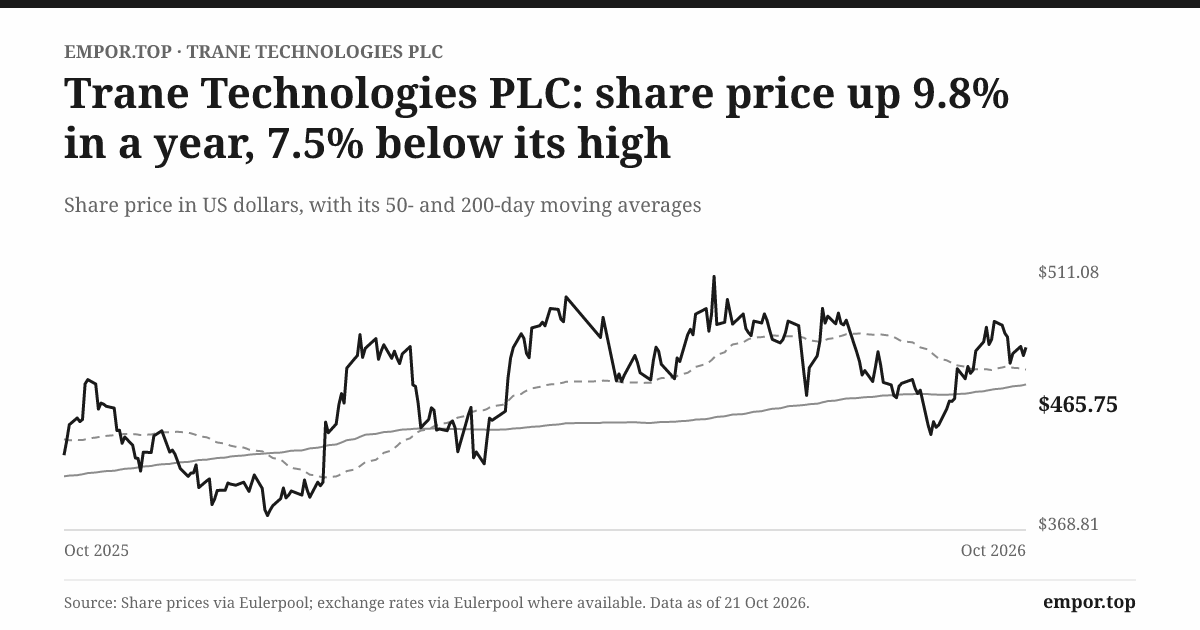
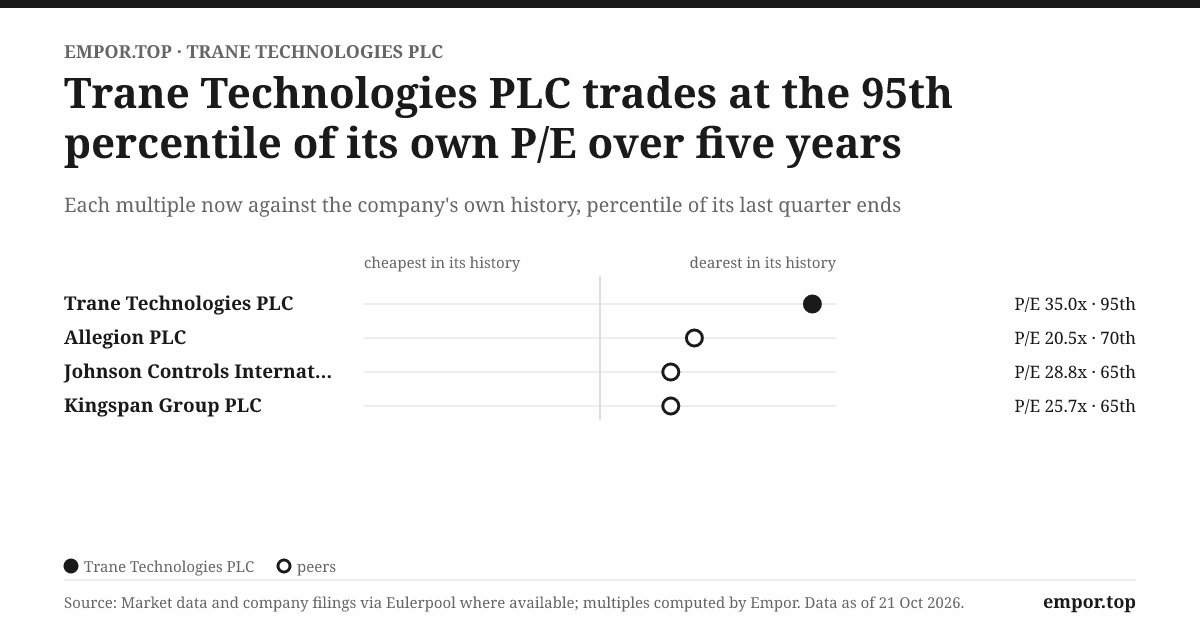
The stock market had long since decided that this is one of the best industrial businesses in the world. On 21 October 2026, Trane's shares closed at about $466, valuing the company at roughly $103bn, or about 35 times the past year's earnings.4 That is a multiple more often paid for software than for sheet metal and compressors. The five-year median is about 30 times, so investors are paying a premium even against the company's own expensive history.4
That price is the tension at the centre of this story. The business is plainly excellent. The question is how much of its excellence the price has already assumed, and whether the order surge that justifies it is a durable step up in demand or a rush that will be followed by a long pause.
Start with what Trane Technologies actually is. It is an Irish-incorporated holding company, listed on the New York Stock Exchange, with no controlling shareholder and no founding family pulling strings.2 Under it sit two famous brands. Trane makes heating, ventilation and air-conditioning equipment, from the rooftop units on suburban supermarkets to the centrifugal chillers in the basements of skyscrapers, and it services that equipment for decades. Thermo King makes the refrigeration units that keep food and medicines cold in trucks, trailers and shipping containers. Together they employed about 44,000 people in 62 countries at the end of 2025 and brought in $21.3bn of revenue that year.2 Mix the red of the Trane badge with the blue of Thermo King and you get the purple that the company now wears.
Here is the puzzle that runs underneath everything else. Over ten years, revenue grew by only about 4.8% a year.2 Over the past five, it grew by about 11.4% a year.2 Profit tells the same story more loudly: operating margin was about 11% in 2014 and about 18.6% in 2025.2 Somewhere in the past decade, a slow-growing piece of an industrial conglomerate became a fast-compounding, high-return franchise. How did that happen, and how much of it was skill rather than a fortunate cycle?
To answer that, the story has to travel from a plumbing shop in Wisconsin, through a series of corporate marriages and divorces, into the economics of a chiller plant, the mechanics of an order book, the discipline of a buyback programme and the quiet tail of an asbestos bankruptcy. Then it has to come back to the 35 times question, because that is the one investors are being asked to answer every trading day.
And the first thing to understand is that the brand is old, but the margins are not.
 Subscribe on LinkedIn
II. The Heritage That Still Matters: From La Crosse to Ingersoll-Rand (1885–2019)
In 1885, in the river town of La Crosse, Wisconsin, a plumber named James Trane opened a shop to fit pipes and install heating.5 It was an ordinary trade business in a growing Midwestern town, and for a generation it stayed one. What changed it was his son. Reuben Trane trained as an engineer at the University of Wisconsin and came home with ideas about heat that went well beyond fitting pipes.6 In 1923 he came up with the convector radiator, a lighter, more compact way of heating a room by running hot water through a copper coil instead of through a heavy cast-iron block.6 Father and son had incorporated The Trane Company in 1913, and within a few years they had left plumbing behind to manufacture heating equipment.7
The decisive turn came in the 1930s, when Trane moved from warming buildings to cooling them. The company sold its first air-conditioning unit in 1931, and in 1938 it launched the Turbovac, a hermetic centrifugal machine built to cool large buildings.5 "Hermetic" sounds technical, but the idea is simple: the motor is sealed inside the refrigerant circuit, like a submarine sealed against the sea, so nothing leaks and the machine can run for years. The Turbovac's descendants, the CenTraVac family of water-cooled chillers, still sit at the heart of Trane's commercial range.7
Why does a 1938 machine matter to an investor in 2026? Because a chiller is a long-lived asset. A building owner who installs one is buying something that will run for twenty years or more and will need maintenance, parts, controls upgrades and eventually a replacement. Every machine Trane sold over the decades added to an installed base, a population of equipment in the field that the company's technicians know how to service and that the building's owners are inclined to replace with the same brand. That installed base is the origin of the service business that now drives the economics, and it is worth keeping in mind that it was built slowly, unit by unit, over most of a century.
The corporate history after the war is a sequence of combinations. In 1982 Trane bought General Electric's central air-conditioning business, which gave it a large position in home and light commercial systems.7 Two years later, in 1984, Trane itself was swallowed by American Standard, the bathroom-fixtures and plumbing company, which later spent years carrying a heavy debt load after a leveraged buyout.7 For roughly two decades, Trane was one division inside a sprawling group that also made toilets and vehicle brakes. American Standard eventually broke itself up, and the air-conditioning company that remained took the Trane name.
Meanwhile, a different conglomerate was assembling the other half of today's company. Ingersoll-Rand, a New Jersey maker of compressors, tools and security hardware, bought Thermo King from Westinghouse in 1997 for about $2.56bn in cash, at the time a dominant player in transport refrigeration.8 Then, at the end of 2007, it agreed to buy Trane for about $10.1bn including assumed debt, offering Trane holders $36.50 in cash plus a slice of Ingersoll-Rand stock for each share.9 The deal closed on 5 June 2008.10
The timing could hardly have been worse. Ingersoll-Rand had borrowed heavily to buy a business tied to commercial construction just as the global financial crisis was about to freeze commercial construction. The consensus history of Trane Technologies tends to start with a great brand and run in a straight line to a great company. The record is lumpier than that. For years after the merger, the combined group earned modest returns. As late as 2014 its operating margin was about 11% and its return on invested capital about 12%, which is respectable, but not the profile of a franchise.2
What Ingersoll-Rand did learn in that period was pruning. In December 2013, it spun off its residential and commercial security businesses as Allegion, handing shareholders one Allegion share for every three Ingersoll-Rand shares they held.11 The logic was that a focused security company and a focused climate-and-industrial company would each be easier to run and easier for investors to value. It was the first of the portfolio separations that would eventually leave a pure climate business behind.
The financial picture going into 2019 sets the "before" for what followed. Revenue in 2018 and 2019 ran between roughly $12.3bn and $13.1bn, and operating margins were around 12% to 13%.2 A careful reader should handle those older figures with care. They are the conglomerate's numbers before the industrial businesses were carved out, so comparisons between, say, 2016 and 2025 are not like for like. The dramatic 13% fall in 2018 revenue, for example, reflects reporting changes as much as any real collapse in air-conditioning demand. What the record does say clearly is that the margin story is not inherited. For decades, Trane was a fine brand inside a low-teens-margin conglomerate. The question of who built the margin, and how, belongs to the years after 2019.
That brings the story to the boldest piece of corporate surgery in the company's history, and to the worst possible moment to perform it.
III. The Split: Gardner Denver, a Reverse Morris Trust and a New Name (2019–2021)
On 2 March 2020, a company that had been called Ingersoll-Rand for more than a century began trading on the New York Stock Exchange under a new name and a new ticker, TT.12 Its industrial businesses, the compressors, pumps and power tools that had defined Ingersoll-Rand, had left over the weekend to merge with Gardner Denver. The new combined industrial company took the Ingersoll Rand name. What remained, the climate business built around Trane and Thermo King, was renamed Trane Technologies.12 Within weeks, the world went into lockdown.
The structure the company used was a Reverse Morris Trust, a piece of tax engineering that deserves a plain-English explanation. Normally, if a company sells a division, it pays tax on the gain. In a Reverse Morris Trust, the parent instead spins the division out to its own shareholders and immediately merges it with another company, in this case Gardner Denver. As long as the parent's shareholders end up owning a majority of the combined company, the separation can be tax-free. Here, Ingersoll-Rand's existing shareholders received 50.1% of the new industrial company, and Gardner Denver's holders kept 49.9%.12 The climate business got to shed the industrial segment without writing a large tax cheque, and its shareholders kept a majority stake in the industrial side as well.
The thesis was focus. Ingersoll-Rand's management had argued that a pure climate company, with one set of customers, one technology roadmap and one capital-allocation story, would be worth more than a conglomerate. Investors would no longer need to hold a compressor business to get exposure to chillers. Management, in turn, would no longer need to choose between funding a new pump line and a new heat pump.
Then COVID struck, and the first year of the pure play looked like a poor advertisement for it. Revenue in 2020 fell about 4.7%, and net profit fell about 39% to $854m.2 Part of that collapse reflected one-off costs of the separation and the deconsolidation of businesses, but much of it was simply a frozen construction market. The company did the defensive things well. It ended 2020 with $3.3bn of cash, the most it had held in a decade, because it had drawn and conserved liquidity while the world waited.2 That cushion meant there was never any question of the dividend or the balance sheet, even in the worst quarter.
Then the rebound arrived. Revenue rose 13.5% in 2021 and kept growing at double-digit rates for three more years.2 Profit compounded even faster. It is here that the most commonly quoted statistic about Trane needs correcting. Over the five years from 2020 to 2025, net profit grew at almost 28% a year.2 That figure is true and almost meaningless, because it starts at the trough. Measure from 2022, a more normal year, and the growth rates are still excellent but more human: revenue up about 10% a year and net profit up about 18% a year over three years.2 Those are the cleaner base rates for anyone trying to judge what the business can do from here.
So did the split create the margin gains? Not by itself. A tax-efficient separation does not make chillers more profitable. What it did was remove distractions and make the company legible. After 2020, every dollar of capital expenditure, every acquisition and every buyback was a bet on climate. Investors could see the economics clearly, and management could no longer hide a weak industrial quarter behind a strong climate one, or the other way round. Part of what followed was a cyclical upswing that would have lifted any HVAC company. Part of it was a genuine change in mix and discipline.
The people running the new company changed too. In July 2021, Dave Regnery became chief executive, and he added the chair's role in January 2022.13 Regnery is a lifer. He started at Ingersoll-Rand as a financial management trainee and spent his whole career inside the company, running businesses including commercial HVAC and transport refrigeration before becoming president and chief operating officer.13 He holds a finance degree from Northeastern and an MBA from Lehigh.13 Chris Kuehn became chief financial officer in the same month, and the pair have run the company together since.2
That continuity matters for the investor. The executives who now ask the market to pay 35 times earnings are the same ones who built the post-split record, so their promises can be tested against their own outcomes rather than a predecessor's. The first test is the one that sits at the heart of the business: how a company that sells big metal boxes came to earn margins that look like a software company's.
IV. How a Chiller Company Earns 18.6% Margins
Picture a university planning a new science building, or a hyperscaler planning a data-centre campus outside Phoenix. Somewhere in the project, an engineer has to decide how the place will be cooled. For large buildings the answer is usually a central plant: a bank of chillers that cool water, pumps and pipes that carry that water through the building, air handlers that blow air across coils, and a control system that runs the whole orchestra. The chiller order is a project, priced as a project, often specified by consulting engineers and fought over by a handful of manufacturers. It is shipped from the order book months or years after it is won.
And then the real business begins. The plant will run for twenty years or more. It needs maintenance contracts, replacement parts, refrigerant handling, controls upgrades, energy-efficiency retrofits and, eventually, replacement. The original manufacturer knows the machine best, often holds the controls software and has technicians trained on that specific equipment. A simple way to think about it: the chiller is the razor, and the service contract is the blade.
That is the revenue model in miniature. Trane sells three broad kinds of things. Applied systems are the large engineered plants. Unitary equipment covers the standardised boxes, rooftop units, heat pumps and home systems, sold through dealers and distributors at a unit price. Thermo King sells refrigeration units for trucks, trailers and containers. Layered on top of all three is services and parts, which management says is now about one-third of total revenue and has grown at a "low teens" compound rate since 2020.3 On 2025 revenue of $21.3bn, a third is roughly $7bn of mostly recurring income that grows faster than the company as a whole.
Geographically, the business is overwhelmingly American. In 2025, the Americas segment brought in $17.17bn, about four-fifths of the total, against $2.80bn from Europe, the Middle East and Africa and $1.35bn from Asia Pacific.2 Thermo King sits inside these three regions rather than as a separate segment, and the company does not report its revenue or margin on its own. That is a disclosure choice worth noting, because transport refrigeration has a different cycle, tied to truck and trailer builds, from building HVAC.
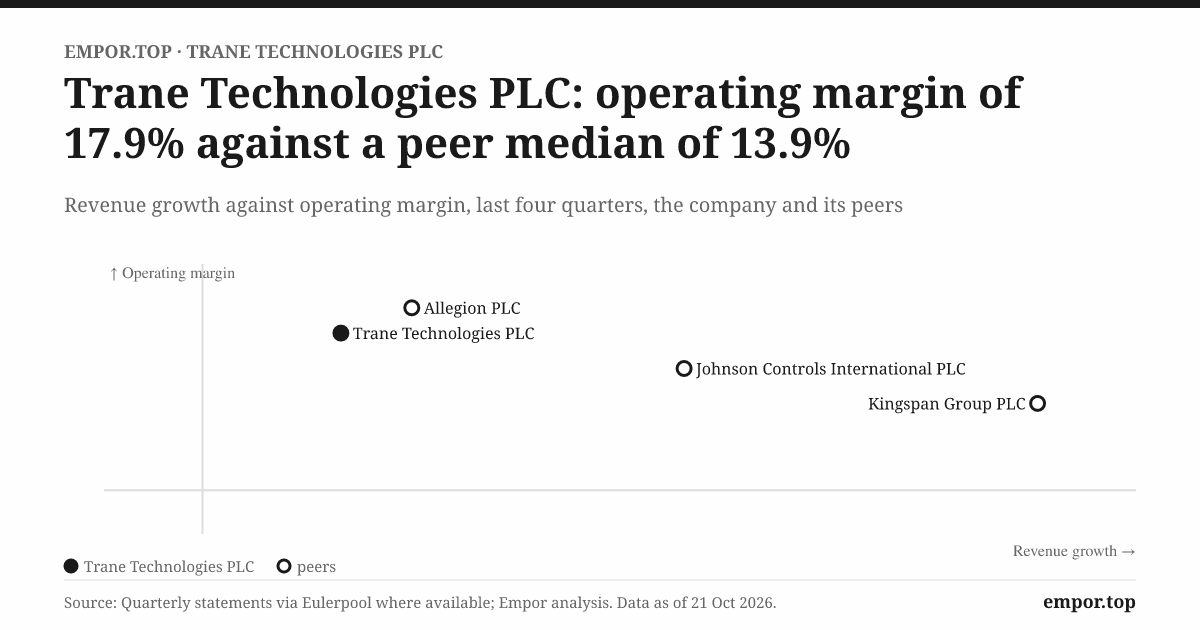
Now to the margin itself. Operating margin rose from about 10.9% in 2014 to 18.6% in 2025, a gain of almost eight percentage points.2 The cleanest way to see where it came from is to look at the post-split years, when the business was the same business. Between 2020 and 2025, revenue rose by about 70%, from $12.5bn to $21.3bn, while operating profit more than doubled, from $1.5bn to about $4.0bn.2 Three forces explain the gap. The first is mix: services, which carry higher margins than equipment, grew faster than the whole. The second is the applied business, where large engineered systems for data centres, hospitals and campuses command better pricing than commoditised unitary boxes. The third is price. Through the inflation of 2021 to 2023, Trane raised prices at least as fast as its costs, and the margin kept climbing even as steel, copper and labour costs surged. Volume helped, as it always does in a business with factories, but the margin rose in a slow year like 2025 as well as in fast ones, which suggests mix and pricing did more of the work than throughput.
The segment figures show where the profit lives. In 2025, the Americas earned an adjusted EBITDA margin of about 21.6%, up from 20.9%.2 Asia Pacific, small as it is, earned about 23.9%.2 EMEA earned about 18.3%, down from 19.8%.2 By the second quarter of 2026, the gap had widened sharply: the Americas posted an adjusted operating margin of about 22.1%, while EMEA's fell 420 basis points to about 13.1%.1 The cause was the conflict in the Middle East. Kuehn said the region was less than 3% of enterprise revenue but about 15% of EMEA, and that its revenue had dropped about 30% in the quarter and would stay down about that much in the second half.3 Management took cost actions at the end of June, which Kuehn described as "rightsizing for positions and also for infrastructure".3
The rest of the portfolio tells a more mixed story than the headline. Residential, the business most exposed to American homeowners and housing turnover, had a strong quarter, with bookings up in the high twenties and organic revenue up in the low teens, but management kept what it called "a prudent outlook for modest growth in the second half".3 Asia Pacific recovered sharply, with bookings up 31% and organic revenue up 10%, after a year in which its revenue had shrunk.32 Thermo King's market was still climbing out of a slump. Regnery said the company saw the Americas transport market "improving in late 2026 leading into a multiyear up cycle", an outlook he called "directionally aligned" with industry forecasters but assuming "a more gradual slope of recovery".3 That caution is telling. A management team keen to talk up every corner of the business would have leaned into the forecasters' numbers. This one chose to hedge.
There is also the question of how much stock sits in dealers' warehouses, because inflated channel inventory is how equipment makers flatter one quarter at the expense of the next. When Melius Research's Scott Davis asked whether inventories in the residential channel had become too low, or whether Trane had overcorrected, Kuehn answered that year-to-date "sell-in is really approximately equal to sell-through", and Regnery said inventory was "still at the right level".3 In plain terms, the company says it is shipping to distributors roughly what they are selling to installers. That is the right answer, and an investor should check it against the residential growth rate over the next two quarters.
Is the moat real?
This is the place to argue the moat once, properly. Hamilton Helmer's framework of seven powers asks what lets a company earn returns above its cost of capital for a long time. Trane has a credible claim to three of them. The strongest is switching costs, which come through the installed base. Once a building runs on Trane chillers and Trane controls, changing the service provider or the replacement brand means retraining staff, rewriting control sequences and accepting the risk that a third party does not know the machine. The second is scale economies. A company that sells more than $21bn of equipment and services can spread research and development, a national service network and factory capacity over more units than smaller rivals. The third is brand, in the narrow sense that consulting engineers who specify plants trust names that have worked before. A fourth, more speculative, is a form of counter-positioning around regulation: each change in refrigerant rules or efficiency standards forces the whole industry to redesign products, and the companies with the deepest engineering benches can turn regulatory churn into an excuse to raise prices on new, compliant equipment.
Michael Porter's five forces point the same way, with caveats. Buyers are fragmented: no customer accounted for even 10% of revenue in 2025, 2024 or 2023.2 That keeps any single buyer from dictating prices, although large hyperscalers buying for data centres are sophisticated, multi-sourcing customers who are perfectly capable of playing manufacturers off against each other. Rivalry is real but disciplined. The main competitors in commercial HVAC are Carrier, Johnson Controls with its York chillers, and Daikin Industries, with Lennox and Carrier strongest in residential and Asian manufacturers pressing in from below. Suppliers of steel, copper, compressors and electronics have some power, and the company's own words acknowledge that "price versus all inflation" turned against it in 2026. The threat of substitutes is the most interesting force of all.
What does the evidence say about whether the moat translates into superior economics? The peer comparison is the best available test. Carrier, the largest American rival, reported 2025 sales of about $21.75bn, almost exactly Trane's size, but with an adjusted operating margin of about 15.1% and sales down 3% on the year.14 Lennox, a residential specialist, reported revenue of about $5.2bn, down 3%, with a segment margin of about 20.4%, but on volumes that were falling.15 Johnson Controls grew sales about 6% in fiscal 2025, with its segment margins in the high teens in its strongest quarter.16 Against that field, Trane combined the fastest growth with margins at or near the top. That is the clearest affirmative evidence that its position is better than average, not merely that the industry is having a good decade.
What the evidence does not show is just as important. The company does not publish service attach rates, contract renewal rates, or price realisation against peers. Technical firsts such as the Turbovac are history, not proof that customers pay more today. The moat case therefore rests on outcomes, faster growth and higher margins than similarly sized rivals, rather than on the direct operating metrics an investor would want.
And management's own words bound the margin story. On the second-quarter call, Kuehn said price versus all inflation "was a headwind in the second quarter as we thought" and "will be a bit of a headwind in the second half of the year as well."3 Adjusted operating margin fell 60 basis points in the quarter, to 19.7%.1 When analysts pressed, Kuehn's answer was that "margins are stronger in the second half and comps do matter", pointing to an unusually strong prior-year quarter.3 That is a reasonable explanation, but it is an explanation for a decline, not a promise of continued expansion.
Weighing it up, the history narrows the claim rather than rejecting it. Trane's margins are structurally higher than they were a decade ago, because the business mix and its competitive position have genuinely improved. But the company has plausibly reached a near-term plateau, because pricing no longer outruns costs and EMEA is shrinking. The test is simple: whether adjusted operating margin in the second half of 2026 holds at or above the 19.7% of the second quarter, and whether the Americas keeps its margin above 22% as applied equipment, which is lower margin than service, becomes a larger share of shipments.
That last point leads straight to the order book, because the more the mix tilts toward big projects, the more the margin story depends on whether those projects keep coming.
V. The Order Book: Durable Step-Up or Pull-Forward?
On 6 January 2026, at the CES technology show in Las Vegas, Nvidia's chief executive Jensen Huang (黃仁勳) walked through the specifications of Vera Rubin, the company's next-generation AI computing platforms. In passing, he said something that sent a shiver through every HVAC stock in the market: "no water chillers are necessary" for data centres built around the new chips, because they could be cooled with warmer liquid.17 By the close, Trane's shares had fallen 5.3% to $370.40, and Johnson Controls had dropped 7.5%.17 Barclays' analysts estimated that data centres made up about 10% of Trane's business, against a low-double-digit share at Johnson Controls and about 5% at Carrier.18
That afternoon captures the anxiety around Trane's order book better than any spreadsheet. The worry is not that air conditioning will go out of fashion. It is that a large part of the recent surge depends on one category of buyer, building one type of facility, with technology that could change what it needs.
Seven months later, the order book looked like a rebuttal. Applied bookings rose 130% in the second quarter, and Americas bookings hit an all-time high of $6.6bn.1 Regnery said the company was seeing "strength in data centers, but also broad-based growth across the majority of our key verticals", with 11 of 14 Americas commercial verticals growing year to date and most of those at double-digit rates.3 Four orders in the quarter exceeded $100m each, and one of them came through Stellar, the data-centre cooling business Trane had bought earlier in the year.3 The Americas commercial HVAC backlog alone was up about 90% on a year earlier.1
Those orders also reveal something about how the order book works, which is worth slowing down for. A booking is a signed commitment to buy, usually with a delivery date attached and sometimes with a deposit. It is not revenue. Revenue arrives only when the equipment ships or, for long installation projects, as the work progresses. A backlog is therefore a queue of future revenue, but a queue that customers can sometimes leave, delay or renegotiate. In ordinary times, Trane expects to ship most of a year-end backlog in the following year; the end-2025 backlog was described exactly that way.2 What is unusual about mid-2026 is that half of the queue stretches beyond the next twelve months. That gives the company more visibility than it has ever had, and also more exposure to a change of mind by customers who signed up two years before their buildings would be ready.
The case that the step up is durable rests on three pieces of evidence. The first is breadth. If eleven of fourteen verticals are growing, the surge is not just data centres; hospitals, education, manufacturing and offices are all contributing. The second is the services layer, which grows on its own clock because it depends on the installed base rather than on new construction. The third is that management has positioned itself for both outcomes in data centres. In February 2026, Trane closed the acquisition of Stellar Energy Americas, a maker of modular, prefabricated cooling plants for data centres, for gross consideration of about $553m.1920 It also bought out the remaining interest in LiquidStack, a liquid-cooling company, during the first half of 2026.20 If the next generation of chips needs less chilling and more liquid cooling and heat rejection, Trane wants to sell that too.
The case against is equally concrete. A 130% jump in applied orders is, by definition, unusual. Large project orders tend to come in waves, as customers rush to lock in capacity when lead times stretch, and then pause when they have enough. The company does not disclose what share of its bookings or backlog comes from data centres, so investors cannot measure the concentration for themselves. Management's own descriptions of the backlog mix were not perfectly consistent on the call: Regnery put commercial HVAC at about 90% of the backlog, and Kuehn later said "almost 95%".3 And when UBS's Amit Mehrotra asked directly whether the industry was at peak orders, Regnery's answer began with an emphatic reassurance, "We're not turning away orders, okay?", rather than a number.3
There is also a pattern in the recent quarterly record that the bulls tend to skip. Revenue growth slowed to about 5.5% in the September and December quarters of 2025 and 6% in the March 2026 quarter, and net profit fell about 2% and 3% year on year in the last two of those.2 Part of that slowdown came from transport refrigeration, where Regnery described a "prolonged downturn" in the Americas market that he expected to turn in late 2026.3 Part came from Asia Pacific, where revenue fell 2% in 2025.2 The lesson is that even inside a boom, parts of this business are cyclical and can drag the whole down for several quarters at a time. Only in the June 2026 quarter did revenue growth reaccelerate, to almost 11%, as the backlog began to ship.1
Capacity is the other half of the puzzle. Regnery said the company had expanded its applied capacity four times over in three years.3 Property, plant and equipment rose from about $1.5bn at the end of 2022 to $2.3bn at the end of 2025.2 Capital expenditure was $383m in 2025, about 1.8% of revenue, and management guided to 2% to 3% of revenue for 2026.23 Research and development spending was about $348m, or 1.6% of revenue.2 These are low numbers. Trane is building capacity into a cycle, which is the classic way industrial companies get hurt, but it is not betting the balance sheet on it. If orders slowed sharply, the cost of underused factories would dent margins but would not threaten the company.
How has the business behaved in past downturns? The company's own record offers two tests. In 2020, revenue fell about 5% and profit fell much more, though separation costs muddied the picture.2 In 2018, the reported fall was larger, but that reflected the conglomerate's reporting more than HVAC demand. Neither episode shows what happens when a giant applied backlog meets a sudden cancellation wave, because the company has never had a backlog this large. That is the honest limit of history here.
Europe adds a twist to the durability debate. With the Middle East shrinking, EMEA bookings rose only 7% in the second quarter, but management argued that the rest of the region was quietly improving.1 When Citi's Andrew Kaplowitz asked about it, Regnery said "the pipeline in Europe has really started to increase".3 The two executives did not quite agree on the size of that improvement: Regnery put commercial HVAC bookings outside the Middle East up in the "mid-20s", while Kuehn described them as "mid-teens".3 Small inconsistencies like this are normal on a live call. They are also a reminder that the confident story of broad-based growth is told in round adjectives rather than published figures, and that investors should wait for the reported numbers before treating Europe as a second engine.
So the question stays open, and it should. The order surge is broader than a pure data-centre story and is supported by a services base that does not depend on new construction. But the applied spike is extraordinary, the data-centre share is undisclosed, and technology shifts at Trane's largest new customers could change what they buy. The evidence that will settle it is the quarterly book-to-bill ratio through 2027, which reached 123% in the second quarter, and the rate at which the $12.1bn backlog converts into revenue without cancellations.1
Orders, though, are only half of what a long-term investor owns. The other half is what the company does with the cash those orders throw off.
VI. The Cash Machine: Where $18 Billion of Free Cash Went
Every February, Trane's board makes the same decision. The business will throw off billions of dollars more than it needs to keep running. That cash can buy other businesses, be paid out as dividends, be used to buy back the company's own shares, or sit on the balance sheet. Over the twelve years from 2014 to 2025, the company generated about $18.3bn of free cash flow.2 Only about a third of that, some $6.3bn, went out as dividends.2 Cash on the balance sheet ended the period almost exactly where it began, at about $1.8bn.2 Nearly everything else, roughly $12bn, went to acquisitions and, above all, to buying back stock.
Start with how good the cash is. Over those twelve years, net profit added up to about $18.7bn, while cash from operations totalled about $21.5bn, around 115% of reported profit.2 That excess is what you would expect from a business with real depreciation charges and stock-based pay, both of which reduce profit without consuming cash. In 2025 alone, free cash flow was about $2.9bn on net earnings of about $2.9bn.2
But one measure warns against complacency. The share of EBITDA that arrived as operating cash has swung widely, from almost 100% in 2019 to about 55% in 2022, before settling at about 76% in 2025.2 The weak year was 2022, when supply chains were broken and the company built inventory to keep shipping. In that year Trane also paid $270m into a trust connected to its asbestos subsidiaries, a cash outflow that had no counterpart in that year's profit.21 There is a subtler point too. Trane runs with slightly negative working capital: customers' deposits and suppliers' credit fund more than its receivables and inventory.2 In an order boom, customers pay advances, and that cash flatters free cash flow. In a downturn, advances shrink and the flow reverses. Some of today's cash generation is therefore borrowed from the cycle. In the first half of 2026, free cash flow almost doubled to $1.6bn, from $841m a year earlier, as orders and advances poured in.1 The receivables picture is healthier: debtor days fell from a peak of 79 in 2018 to about 55 in 2025, which suggests customers are paying faster rather than being given longer terms to win business.2
The buyback ledger
Now to where the money went. Trane repurchased about $1.28bn of its shares in 2024 and about $1.48bn in 2025, exhausting a $3bn authorisation from 2022 and starting on a fresh $5bn programme approved in December 2024.2 In the first half of 2026 it bought about 1.7m more shares for $756m, an average of roughly $445 a share.20 Shares outstanding stood at about 220m in late July 2026.20 In 2020, the company's earnings and earnings per share imply roughly 244m diluted shares; by 2025, the same arithmetic gives about 225m. That is a reduction of about 8% in five years, which means part of the jump in earnings per share, from $3.50 in 2020 to $13.05 in 2025, came from dividing a growing profit among fewer owners.2
The skeptical question is the price. Buybacks create value only if the shares are bought for less than they are worth. In the last quarter of 2025, Trane paid an average of about $413 a share.2 In early 2026 it paid closer to $445. The stock now trades near $466.4 So far, the recent purchases are in the money, but not by much, and they were made at multiples near or above 30 times earnings. The purchases made in 2022, when the shares traded for less than half today's price, look far better in hindsight. The pattern is that Trane buys steadily rather than opportunistically. Kuehn says the company expects "to deploy 100% of excess cash over time", with a 2026 target of $2.8bn to $3.3bn.3 Steady buying at high multiples is shareholder-friendly when the business compounds. It becomes expensive if the multiple falls back to its median.
Acquisitions have been smaller and more targeted. In 2025, Trane spent about $276m on deals, including BrainBox AI, a building-controls software company, and several European distributors.2 In 2026 the pace picked up: Stellar Energy, LiquidStack, transport refrigeration distributors and a 49% stake in Kieback&Peter, a German building-automation firm, together cost well over $800m.20 Stellar alone brought about $379m of goodwill onto the balance sheet.20 The pattern in these deals is consistent: almost none of them buys revenue for its own sake. BrainBox and Kieback&Peter add software and controls, the layer that makes a building's equipment talk to its operators and that ties the owner more tightly to one service provider. The distributors give Trane direct access to European and transport customers it previously reached through middlemen, which brings their margin in-house. Stellar and LiquidStack are options on how data centres will be cooled. Strategically, each one deepens the installed-base model rather than diversifying away from it, which is the right instinct for a company whose economics depend on owning the relationship after the sale. Is this "M&A excellence", as admirers sometimes claim? The company does not disclose the earnings multiples it paid, so the claim cannot be tested on price. One small warning sign sits in the annual report: two of the company's reporting units had fair values that "did not significantly exceed" their carrying value, with combined goodwill of $355m.2 No impairment was taken, but it is a reminder that not every past purchase has outperformed. The fairest verdict is that the M&A record is disciplined in size and intact, but unproven on returns.
The balance sheet gives the board room to keep going. Total debt was about $4.6bn at the end of 2025, against equity of $8.6bn, and debt to equity fell from 0.72 to 0.54 over the year.2 S&P upgraded the company to A- in December 2025, and Moody's rates it A3 with a positive outlook.2 By mid-2026, cash had fallen to about $1.3bn after buybacks and deals, and $400m of commercial paper had appeared.20 That is not a stretched balance sheet, but it is a fully used one: the company is converting its cash into shares and acquisitions almost as fast as it earns it.
The maturity schedule is gentle. At the end of 2025, about $400m of notes were due in March 2026, and holders of some older debentures could put up to $256m back to the company for settlement in November 2026; the rest of the long-term debt runs out between 2027 and 2049.2 Behind that sit two $1bn revolving credit lines that were completely undrawn.2 The test of financial strength the company has actually faced, the spring of 2020, it passed easily, ending the year with more cash than at any time in the decade. Nothing in today's balance sheet suggests it would fare worse in a repeat.
The dividend sits on top of all this as a steady, rising floor. The company raised its quarterly payout by 12% to $1.05 a share from the first quarter of 2026.2 The payout ratio has drifted down, from more than a third of profit in the years before the split to about 29% in 2025, because profit has outgrown the dividend.2 That leaves the board room to keep paying it through a downturn without straining the cash flow, which is what happened in 2020, when the dividend held roughly steady and the payout ratio briefly rose to almost 60% of a shrunken profit.2
Then there is pay. Regnery received total 2025 compensation of about $27.3m.22 Against net earnings of about $2.9bn, that is less than 1% of profit, and his pay is weighted toward performance-based equity and annual incentives. Shareholders have consistently approved the pay plan, but not overwhelmingly: about 87% voted in favour in 2024, about 90% in 2025 and about 88% in 2026.2324 Those levels signal broad acceptance with a persistent minority of dissent, worth watching if returns falter.
The capital machine, in short, is disciplined, transparent and very shareholder-friendly, with one caveat that matters at today's price: part of the earnings growth investors are paying for comes from share count reduction, and that only keeps creating value if the shares are bought below their worth. The one place where cash has gone out for a reason that has nothing to do with growth is a set of old asbestos claims, and that tail deserves its own look.
VII. The Tail: Aldrich, Murray and the Asbestos Trust
On 18 June 2020, two little-known subsidiaries of the newly renamed Trane Technologies, Aldrich Pump LLC and Murray Boiler LLC, filed for Chapter 11 bankruptcy in Charlotte, North Carolina.2 Neither made anything anymore. They existed to hold the legacy asbestos claims tied to pumps and boilers made by predecessor companies decades earlier. Their filing, months after the split from the industrial business, was the company's attempt to draw a line under a liability that had followed it for decades.
The mechanism is worth explaining. Section 524(g) of the US Bankruptcy Code allows a company with asbestos liabilities to set up a trust that takes on all current and future claims. Once a court confirms the plan, claimants are paid from the trust, and the company is protected by an injunction from further suits. Before filing, the companies used a restructuring that critics call the "Texas two-step": the legacy liabilities were moved into separate entities, which then filed for bankruptcy while the rest of the group kept operating normally. Courts and lawmakers have debated whether that structure is fair to claimants, and the claimants' committee in this case has fought it hard.
Here are the numbers. When the subsidiaries filed and were deconsolidated, Trane recorded a liability of about $249m for its funding agreements with them, and a year later raised it to $270m.21 In August 2021, Aldrich and Murray reached an agreement in principle with the court-appointed representative for future claimants: a 524(g) trust funded with $545m, made up of $540m in cash and a $5m promissory note, with the subsidiaries keeping the right to pursue their asbestos insurance.2125 In March 2022, a $270m fund was set up and paid in as a down payment on that trust.21 Trane's funding agreements also oblige it to cover the subsidiaries' costs while the cases run, and to fund the trust if their own assets fall short.2
What is not settled is whether the plan will ever be confirmed. The committee representing current claimants is not a party to the deal.21 It moved to dismiss the cases; the bankruptcy court denied those motions in December 2023, and the Fourth Circuit declined to take a direct appeal in 2024.21 In December 2025, the court agreed to streamline the estimation of the subsidiaries' total asbestos liability, with the first phase of the estimation hearing set to start in the week of 10 August 2026.2 As of the company's latest annual report, the cases remained pending, and the company said it was "not possible to predict" the outcome or how long they will last.221
The claimants' side has not limited itself to defending the bankruptcy. In 2022 the asbestos claimants' committee filed adversary complaints against Trane-related companies, seeking to undo the effects of the 2020 restructuring that moved the liabilities into Aldrich and Murray in the first place.26 The argument, in essence, is that the healthy parts of the group were moved out of reach of the people who were owed money. If a court eventually agreed, the remedy could reach beyond the two subsidiaries and toward the operating businesses. That is the scenario that turns a capped liability into an open one, and it is why the case has run for more than six years without a confirmed plan. It is also why the company keeps its funding agreements in place: as long as Trane stands behind the subsidiaries' obligations, it can argue that claimants lose nothing by being channelled into a trust.
So how large is the tail? The base case is about $545m, of which about half has already been paid into the settlement fund. For a company generating close to $3bn a year of free cash flow, that is small: roughly two months of cash. The risk is that the estimation trial or a later appeal produces a much higher number, or that a court rejects the two-step structure itself. Even then, a multiple of the current figure would be painful rather than threatening. The structure has worked as a cap so far, but a cap is only as strong as the confirmation order that seals it, and that order has not yet been issued.
The other tails are modest. Environmental reserves, mostly tied to sites from formerly owned businesses, stood at about $52m in mid-2025.21 The company's Irish domicile and its operations in the US and UK expose it to changes in international tax rules, and it says it has "adequately provided" for foreseeable tax disputes, without quantifying them.2 Currency is a small risk, because only about a fifth of revenue comes from outside the Americas and the company hedges the exposures it cannot offset naturally.2 PricewaterhouseCoopers audited the 2025 accounts and found internal controls effective, with no material weakness reported.2
The tail, then, is real but small relative to the business. It does not decide the investment case. What decides it is the price, and whether 35 times earnings leaves any room for the cycle to turn.
VIII. The 35x Question: Frameworks, Bulls and Bears
On 21 October 2026, Trane's shares closed at about $466, roughly 7.5% below their 52-week high of $503.4 At that price the company is worth about $103bn, or about $106bn including debt.4 It trades at about 35 times the past year's earnings, against its own five-year median of about 30 times.4 Put the other way round, every $100 invested in the stock buys about $2.90 of current earnings and about $3.60 of free cash flow.4 That is less than an investor can get from a US Treasury bond, so the entire case rests on growth.
What growth is the market assuming? Management raised its 2026 guidance on 30 July to adjusted earnings per share of $15.20 to $15.30, with reported revenue growth of about 11.5%.1 On the midpoint, the shares trade at about 30.5 times this year's expected earnings. That is not wildly expensive for a business with Trane's record. It does mean that the price already assumes 2026 is delivered, and that 2027 brings further growth from the long-dated backlog.
The bull's argument and the bear's
The bull case is the one the company tells, and much of it is backed by evidence. The backlog provides unusual visibility into 2027. The services base, about a third of revenue and growing at low double digits, is the part of the business least exposed to the construction cycle. Regulation on refrigerants and energy efficiency forces customers to replace and upgrade equipment, and electrification, the shift from gas furnaces and boilers to heat pumps, plays to Trane's strengths. Returns are exceptional: return on invested capital was about 28% in 2025, up from about 12% a decade earlier.2 Buybacks steadily shrink the share count, and the credit agencies have been upgrading the company rather than downgrading it.
It is worth taking that return on capital apart, because it explains why the market is willing to pay so much. Return on capital is margin multiplied by how hard the assets work. Both have improved. Operating margin rose by almost eight points over the decade, and asset turnover, revenue divided by total assets, rose from about 0.75 to about 1.0, so every dollar of assets now produces a third more sales than it did in 2014.2 Part of that came from shedding the asset-heavier industrial businesses, and part from running a business whose customers fund much of its working capital. A company that earns close to 30% on its capital and can reinvest even part of its cash at that rate deserves a premium multiple. The catch is that Trane reinvests only a small share of its cash in its own operations, because capital needs are low, and returns the rest. So the premium has to be justified by growth on a small capital base and by the price of the buybacks, not by a long runway of high-return reinvestment.
The bear case is less often heard and deserves equal time, with each risk tied to the mechanism that would hurt. The first and largest is the order cycle. If the applied surge is a pull-forward, bookings will fall below shipments for several quarters, the backlog will shrink, and the expanded factories will run below capacity just as fixed costs have risen. The second is technology at the largest new customers. Huang's January remark was a preview of a real risk: if future data centres reject large central chillers in favour of liquid cooling and warm-water heat rejection, the most profitable growth project in the order book could shrink. Trane's Stellar and LiquidStack acquisitions are its hedge, but they are early, and their profitability is undisclosed. The third is price against cost, which management has already said is a headwind. The fourth is EMEA, where margins dropped by more than four points in a quarter because of a regional war. The fifth is the multiple itself: the stock fell about 40% at one point in the past five years, which shows what happens when the market changes its mind about a premium industrial.4
An activist or long-short investor would push on three things. Why is Thermo King not reported separately, given that its cycle differs from HVAC and has been in a "prolonged downturn"? Why is the data-centre share of the backlog not disclosed, when the stock moves on every comment about data centres? And why buy back stock steadily at 30 times earnings rather than accumulate cash for the next downturn, when the shares would likely be cheaper? None of these is an accusation. Each is a request for disclosure or a debate about price discipline that a premium valuation invites.
What a stumble would cost
It helps to run the numbers on a plausible bad case. Assume that in 2027 applied orders normalise and revenue stays flat at the 2026 guided level of about $23.8bn, rather than growing. Assume too that operating margin falls by two percentage points, roughly back to its 2023 to 2024 level, as factories run below capacity and pricing softens. Two points of margin on $23.8bn of revenue is about $475m of operating profit. After tax at about 19%, that is roughly $385m of net profit. Spread across about 221m shares, it comes to roughly $1.75 a share. Take that from the 2026 midpoint of $15.25 and earnings per share fall to about $13.50, which is roughly where trailing earnings sit today.
In that scenario, nothing collapses. Trane remains a highly profitable business with strong returns. But at today's share price, the stock would be trading on about 34 times those lower earnings rather than about 30 times this year's guide, and the growth that justifies a premium multiple would have stalled. For investors, that is the meaning of "priced for continuation": the risk is not bankruptcy or ruin, but a long period in which a good business delivers mediocre returns because the starting price assumed too much.
The peer comparison sharpens the point. Carrier, almost the same size, earns lower margins and shrank in 2025.14 Lennox's margins match Trane's but its volumes fell, and its own guidance for 2026 called for revenue growth of only 6% to 7%.15 Johnson Controls is growing more slowly.16 Trane's premium is partly earned by superior performance, and the market is right to pay something for that. Whether 35 times is the right something depends on whether the order surge holds.
Three numbers will tell investors which story is unfolding. The first is the book-to-bill ratio and the pace at which the backlog converts into revenue; it stood at 123% in the second quarter, with the backlog at $12.1bn.1 The second is the Americas adjusted operating margin, which was about 22.1% in the second quarter, down 30 basis points.1 The third is services growth, which management describes as low teens since 2020 but does not report quarterly as a figure.3 If book-to-bill stays above 100%, Americas margins hold above 22% and services keep compounding, the premium will look reasonable. If all three slip at once, it will not.
The company has no controlling shareholder, and its register is dominated by index funds and large institutions; the market value held by non-affiliates was about $97bn in mid-2025.2 That means the price reflects the consensus of professional money, not the whim of a founder, which cuts both ways: it is liquid and well informed, but it can also move as a herd when the narrative shifts. With that market in mind, the story's lessons are worth drawing out.
IX. Playbook: Lessons From the Purple Machine
Go back to that first quarter of 2020, when a newly named company watched its first-year profit fall by almost two-fifths. The temptation then would have been to blame the split, reverse course, or buy something big to restart growth. Trane did none of those things. It held cash, kept paying its dividend, and waited for its markets to come back. That restraint is the starting point for the lessons this company teaches, which are specific to it rather than generic truths about industrial investing.
The first lesson is that pruning is a strategy, not a retreat. Ingersoll-Rand shed its security business in 2013 and its industrial business in 2020, and each separation left a company that was smaller, simpler and easier to price.1112 The margin and the return on capital rose after each cut, not before. The pre-split record shows a conglomerate earning low teens margins on a famous brand; the post-split record shows the same brand earning almost 19%. For founders and boards, the lesson is that a company's best assets can be hidden by its average ones. For investors, it is that "focus" is not a slogan when it changes what management can and cannot hide. The line to remember: Trane did not become great by adding; it became legible by subtracting.
The second lesson is the one the whole business rests on: own the installed base, and the service follows. The century of chillers that began with the Turbovac created a population of machines that need maintenance, controls and replacement. That population now generates about a third of revenue and grows faster than equipment. The chiller is the razor; the service contract is the blade. But the 2025 slowdown is a reminder of the limits. When transport refrigeration and Asia Pacific turned down, the service base cushioned the blow without preventing it. A blade business softens the cycle; it does not abolish it.
The third lesson concerns capital. Buy back the stock when you cannot buy a better business, and know what you are paying. Trane's buyback cadence, more than $1bn a year, steady through good and bad quarters, has reduced the share count by about 8% in five years and turned a strong profit record into a stronger per-share record. That works brilliantly when the shares are cheap, as they were in 2022, and less well when the company buys at 30 times earnings. The line to remember: a buyback is an investment decision dressed up as a distribution, and the price is the whole decision.
The fourth lesson is for the market rather than the company. Quality at 35 times is a bet on the cycle, not on the product. Nobody serious disputes that Trane makes good chillers, has a strong service network and is run by disciplined managers. What the price adds is a forecast that the order surge of 2025 and 2026 will roll into 2027 and beyond without the long pause that has followed every previous boom in commercial construction. The stock's 40% drawdown in the past five years and its 5% drop on a single January comment from Jensen Huang show how quickly the market can re-price that forecast.417 Great businesses still have cyclical stock prices.
And a fifth, quieter lesson runs through the asbestos tail. Old liabilities do not disappear when the company changes its name. Aldrich and Murray were tied to products made long before anyone in today's management joined, yet they have absorbed management time, court hearings and $270m of cash since 2020.21 The lesson for any company emerging from a conglomerate past is that heritage comes with a bill, and the bill arrives on its own schedule.
Those lessons point forward as well as backward, because the next few months will test every one of them.
X. Epilogue: The Next Moments That Decide It
Tonight, Trane Technologies stands at a strange place for a company with its record. Its order book has never been larger, its returns on capital have never been higher, and its credit rating is the best it has had. Yet its shares sit below their summer high, and every investor conversation about the company returns to the same worry: what if this is as good as it gets?
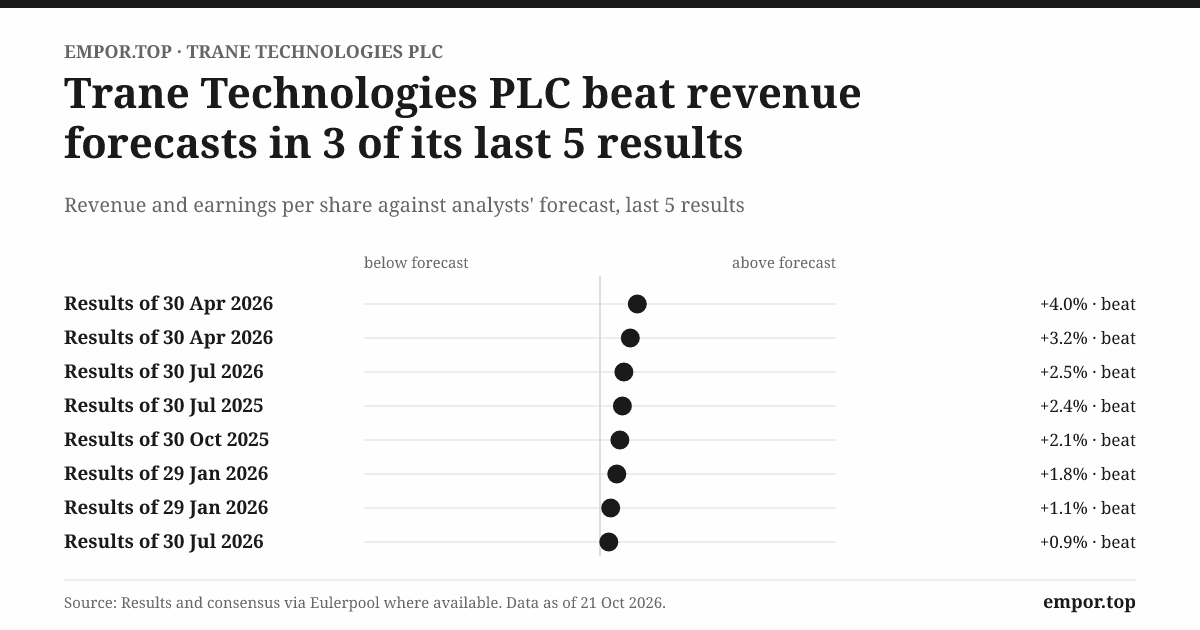
The first answer arrives in eight days. On 29 October 2026, Trane will report its third-quarter results, with its conference call at 10am Eastern time.27 Management has already told investors to expect organic revenue growth of about 10% and adjusted earnings per share of about $4.70 for the quarter.3 Analysts' consensus sits a hair above that, at about $4.72 to $4.74.28 For a stock on 35 times earnings, a clean beat matters less than what comes with it. The headline numbers matter less than two details beneath them. The first is the margin. Kuehn promised that margins would be "stronger in the second half". If the third quarter's adjusted operating margin holds at or above the second quarter's 19.7%, the plateau thesis loosens. If it slips again, the argument that pricing has stopped outrunning costs gains force. The second detail is the book-to-bill ratio. After four quarters of applied bookings growing by more than 100%, the comparisons are about to get much harder. A ratio below 100% would not mean the boom is over, but it would be the first sign that the backlog has begun to shrink.
The second moment is spread across 2027. About $6bn of today's backlog is scheduled to ship in 2027 or later.3 If it ships on schedule, without cancellations, delays or renegotiated prices, the bull case will have been proven in the most direct way possible. If customers, especially data-centre builders, begin pushing out delivery dates or redesigning projects around new cooling technology, the market will learn how firm those orders really were. History offers no guide here, because Trane has never carried a backlog this large into an uncertain technology cycle.
The third moment is in a courtroom in Charlotte. The estimation hearing that began in August will eventually produce a figure for the subsidiaries' total asbestos liability, and with it either a path to confirming the $545m trust or a fight over a larger number.225 A confirmed plan would close a chapter that has run since 2020. A much higher estimate would not threaten the company, but it would reopen a question the market thought was capped.
The fourth moment is the year-end report in early 2027. Did Trane deliver adjusted earnings of $15.20 to $15.30, as promised in July?1 Management's record on guidance since the split has been to raise rather than cut, which is a credibility asset worth respecting, but also a high bar to keep clearing. And what will the 2027 guidance say? A company that guides to another year of double-digit growth from a $12bn backlog sustains the premium. One that guides to flat earnings, even for good reasons, will find out how much of the multiple was patience and how much was momentum.
Each outcome maps onto the questions this story began with. If orders hold, margins stabilise and 2026 is delivered, the order surge will look like a step up, the margin like a plateau rather than a peak, and the 35 times multiple like a fair price for a rare business. If orders pause and margins slip together, the same business will look like a cyclical industrial that was priced for perpetual growth, and the multiple will compress toward its history, whatever the quality of the chillers. The split, the buybacks and the service base will have created real value either way. The only question left is how much of that value the buyer of today's shares will share in.
XI. Outro
In 1885, James Trane's promise to the people of La Crosse was simple: he would keep their homes warm through the Wisconsin winter. A century and a half later, the company that carries his name makes the same promise on a scale he could not have imagined, to keep hospitals cool, data centres running and food cold on its way across continents. The $12.1bn order book is that promise, multiplied by every customer who has signed up for it.
What has changed is how the market values the promise. For most of its history, Trane was priced like what it was, an excellent manufacturer of cyclical capital goods. Today it is priced more like a growth technology company, on the belief that the installed base, the services and the discipline will keep compounding no matter where the construction cycle turns. That belief may well prove right. But this is the rare industrial where the question is no longer whether it is a great business. It is how much of that greatness is already in the price.
References
-
Trane Technologies Q2 2026 earnings release (Exhibit 99.1) — SEC, 2026-07-30 ↩↩↩↩↩↩↩↩↩↩↩↩↩↩↩
-
Trane Technologies plc Form 10-K for fiscal year 2025 — SEC, 2026-02-05 ↩↩↩↩↩↩↩↩↩↩↩↩↩↩↩↩↩↩↩↩↩↩↩↩↩↩↩↩↩↩↩↩↩↩↩↩↩↩↩↩↩↩↩↩↩↩↩↩↩↩↩↩↩↩↩↩↩↩↩↩
-
Trane Technologies (TT) Q2 2026 earnings call transcript — Motley Fool, 2026-08-03 ↩↩↩↩↩↩↩↩↩↩↩↩↩↩↩↩↩↩↩↩↩↩↩↩↩
-
Trane Technologies company page and market data — Reuters, 2026-10-21 ↩↩↩↩↩↩↩↩↩
-
Trane Company history, archival record — La Crosse Public Library Archives ↩↩
-
Cool ideas, hot commodity: La Crosse County — Wisconsin Alumni Association ↩↩
-
Ingersoll Rand to acquire Trane Inc. for approximately $10.1 billion — ACHR News, 2007-12-17 ↩
-
Ingersoll-Rand completes acquisition of Trane — Trane Technologies, 2008-06-05 ↩
-
Ingersoll-Rand completes spinoff of Allegion — Trane Technologies, 2013-12-02 ↩↩
-
Trane Technologies completes Reverse Morris Trust transaction and begins trading today on NYSE — Business Wire, 2020-03-02 ↩↩↩↩
-
Dave Regnery, Chair and Chief Executive Officer — Trane Technologies ↩↩↩
-
Carrier Q4 deep dive: residential weakness offsets data center and aftermarket momentum — Barchart, 2026-02 ↩↩
-
Lennox International fourth-quarter and full-year 2025 results (Exhibit 99.1) — SEC, 2026-01-28 ↩↩
-
Johnson Controls Q4 earnings and revenues top estimates, increase Y/Y — Nasdaq, 2025-11 ↩↩
-
Vera Rubin hot water cooling reveal triggers HVAC share drop — DatacenterDynamics, 2026-01-06 ↩↩↩
-
AI boom warning sign? Nvidia's new chips hit data center cooling stocks — NBC News, 2026-01-06 ↩
-
Trane Technologies completes acquisition of Stellar Energy — Business Wire, 2026-02-18 ↩
-
Trane Technologies plc Form 10-Q for the quarter ended June 30, 2026 — SEC, 2026-07-30 ↩↩↩↩↩↩↩
-
Trane Technologies Form 10-Q for the quarter ended June 30, 2025, commitments and contingencies note — SEC, 2025-07-30 ↩↩↩↩↩↩↩↩↩
-
Trane Technologies 2026 definitive proxy statement (DEF 14A) — Boardroom Alpha, 2026-04-23 ↩
-
Trane Technologies Form 8-K, 2025 annual general meeting voting results — SEC, 2025-06-05 ↩
-
Trane Technologies Form 8-K, 2026 annual general meeting voting results — Boardroom Alpha, 2026-06-05 ↩
-
Aldrich Pump debtors propose bankruptcy plan with $545M asbestos trust — Mealey's / Lexis Legal News, 2021-09 ↩↩
-
Asbestos committee sues to undo effects of Trane, Ingersoll-Rand restructuring — Mealey's / Lexis Legal News, 2022 ↩
-
Trane Technologies schedules third quarter 2026 earnings conference call — Finviz, 2026-10 ↩
-
TT Trane Technologies plc earnings — Earnings Whispers, 2026-10 ↩
 LinkedIn
 WhatsApp
 Reddit
 Hacker News
 Email
 Kindle
 RSS Feed
 Spotify
 Apple Podcasts
 Amazon Music
 Audible
 YouTube