Aditya Birla Fashion and Retail (ABFRL): The Architecture of an Empire and the Great Demerger
I. Introduction & Episode Roadmap
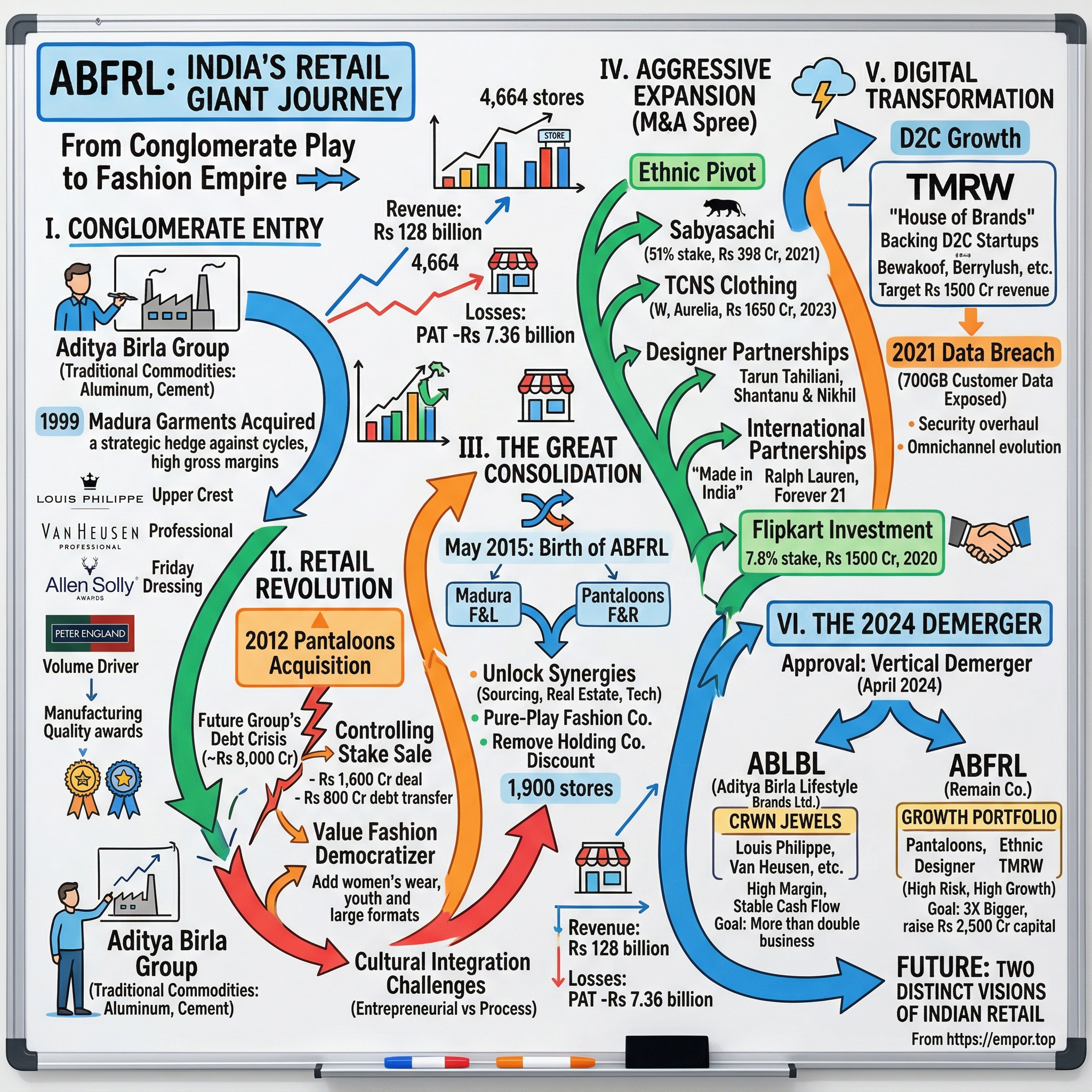
On the morning of June 23, 2025, two stock tickers appeared where one had stood the day before. Aditya Birla Lifestyle Brands Limited opened on the National Stock Exchange at ₹167 a share, marking the moment a corporate entity that had spent a decade building an integrated fashion empire formally split into two distinct companies.1
It was an unusual restructuring. Shareholders received no IPO prospectus or new subscription offer; every existing ABFRL investor was issued one share of the new entity for every share held. The Madura brand portfolio—Louis Philippe, Van Heusen, Allen Solly, and Peter England—separated with its own balance sheet, board, and operational strategy. Left behind under the ABFRL name were Pantaloons, the ethnic and couture acquisitions, the luxury retail division, and a portfolio of digital-first brands. One entity generated steady cash flow; the other absorbed it. For ten years, their metrics had been aggregated into a single consolidated report that grew increasingly difficult to defend.
This trajectory represents a study in corporate architecture rather than operational decline. The Aditya Birla Group built India's largest branded apparel platform primarily through acquisition: buying a menswear business from a British textile firm in 1999, acquiring a department store chain out of a rival's debt restructuring in 2012, and subsequently purchasing stakes in established couture houses, a millennial designer label, a listed women's ethnic-wear company, and direct-to-consumer apparel brands. At its pre-demerger peak in FY24, the consolidated company reported ₹13,996 crore in revenue across 4,664 stores and 11.9 million square feet of retail space.2
The central question of this case is whether housing diverse fashion segments under one corporate umbrella yields durable cost and distribution synergies, or whether it primarily multiplies exposure to lease liabilities, markdowns, and working capital drag. Management framed the demerger as an effort to unlock two focused growth engines. Yet corporate splits of this nature typically occur when a consolidated portfolio fails to compound efficiently.
The post-split financial figures highlight the performance gap between the two divisions. In FY26, the lifestyle brands business performed like a mature consumer franchise, generating ₹8,396 crore in revenue, increasing EBITDA by 13% to ₹1,429 crore—a 17.0% margin—and expanding normalised profit after tax by 61% to ₹209 crore.3 By contrast, the remaining ABFRL entity grew FY26 revenue by 11% to ₹8,177 crore while posting a consolidated net loss of roughly ₹830 crore.45 Two entities with nearly identical top-line revenues delivered opposite bottom-line results. The demerger did not create that divergence; it exposed it.
Categorising this outcome as a total failure mischaracterises the underlying assets. The Madura labels represent established consumer apparel franchises in post-liberalisation India. The luxury and couture division has no listed peer in the domestic market, and the digital brands unit scaled from inception to over ₹1,000 crore in revenue in under four years. The central issue was structural: combining cash-generative mature assets with capital-intensive growth bets within a single balance sheet resulted in consolidated returns on capital that lagged the value of the individual parts.
The company's trajectory offers broader lessons for corporate strategy in emerging markets. Across India's decade-long formalisation of retail consumption, major industrial groups have deployed balance-sheet leverage to acquire early leadership in categories shifting from unbranded to branded apparel. ABFRL executed this strategy earlier and more aggressively than its peers. Its progression—from ambitious aggregation to portfolio rationalisation—provides a comprehensive dataset on the limits of multi-brand retail consolidation.
The following sections examine the historical origin of the group's retail ambitions, the operational playbook behind Madura, the Pantaloons restructuring, the 2015 corporate integration, the 2019–2023 acquisition wave in ethnic wear and couture, the direct-to-consumer strategy, a capital allocation audit, the mechanics of the 2025 demerger, a competitive benchmark against Trent and Vedant Fashions, a governance review, and the key metrics shaping the company's multi-year outlook.
The narrative begins with an industrial conglomerate's pivot into consumer apparel.
 Subscribe on LinkedIn
II. The Birla Legacy & Strategic Rationale for Fashion
The Birla group operated in textiles long before Indian independence, though primarily in upstream industrial manufacturing—cotton mills, rayon, viscose staple fibre, caustic soda, cement, aluminium, and carbon black. G.D. Birla's generation constructed an industrial foundation suited to a protected economy: B2B operations where the primary customer was another factory, competitive moats relied on government licences, and products carried no retail brand. In 1975, a customer wearing fabric produced in a Birla mill bought it by the metre and had it cut by a local tailor, who served as the primary point of brand identity.
When Kumar Mangalam Birla assumed leadership of the group in 1995 at age 28, following the sudden death of his father Aditya Vikram Birla, India's economic liberalisation was dismantling the utility of licence-based moats. As import barriers fell, commodity businesses that had extracted scarcity rents were reduced to earning cyclical spreads between raw material inputs and output prices. Conglomerate leadership in the late 1990s required identifying new engines of capital return beyond regulated industrial capacity.
Birla, a chartered accountant with an MBA from London Business School, brought a balance-sheet-focused approach to corporate strategy. He professionalised management structures across the group while establishing a distinct capital allocation style marked by two contrasting traits: an appetite for high-valuation acquisitions and a long holding horizon. The willingness to deploy substantial capital enabled the purchases of Madura, Pantaloons, Sabyasachi, and TCNS. Simultaneously, the reluctance to exit underperforming assets left capital tied up in loss-making retail operations long after their initial thesis had degraded.
The group's response to post-liberalisation competition followed a two-pronged strategy. First, it expanded scale in core industrial commodities, establishing global scale at Hindalco and UltraTech. Second, it entered consumer-facing sectors—telecom, financial services, retail, and apparel—where brand equity and pricing power replaced regulatory protection as the primary moat.
Apparel presented a compelling structural opportunity. In the late 1990s, the Indian clothing market remained overwhelmingly unbranded, defined by fabric sold by the metre and custom-stitched by local tailors without standardized sizing, returns, or national marketing. The transition toward ready-made garments represented a fundamental shift toward formalisation—similar to packaged consumer goods replacing unbranded commodities. Formalisation trends unfolded over decades, rewarding firms that established early retail distribution and brand recall. Furthermore, branded apparel allowed manufacturers to capture gross margin expansions unavailable in raw fibre production.
Demographic and workplace shifts accelerated this transition. Rapid growth in software services, banking, telecommunications, and corporate retail during the late 1990s created millions of office jobs, driving demand for western formal wear. At the same time, modern shopping malls began emerging in major Indian urban centres, providing the retail real estate, foot traffic, and brand positioning necessary to support national chains.
For a cash-generative industrial group, M&A offered a shortcut to scale. Building national apparel brands organically required more than a decade of sustained marketing and retail store expansion. Leveraging cash flows from industrial units and low-cost debt, the group could acquire established brands directly, bypassing organic development cycles. However, this balance-sheet advantage carried structural risks: access to conglomerate capital reduced price discipline, laying the groundwork for subsequent overpayment across future acquisitions.
The initial execution of this strategy occurred in December 1999, marking the group's entry into branded retail.
III. The Madura Foundation: Mastering Premium Brands in India (1988–2012)
The assets the Aditya Birla Group acquired were not Indian in origin. Madura Garments traced its lineage to Coats Viyella, then Europe's largest clothing supplier, which had established an Indian apparel division featuring licensed and owned Western labels.6 In December 1999, group entity Indian Rayon and Industries acquired Madura for ₹236.23 crore—roughly $54 million at the prevailing exchange rate—securing the domestic rights to four brands that would come to define the Indian corporate wardrobe: Louis Philippe, Van Heusen, Allen Solly, and Peter England.6
Compared to the group's later transactions, the purchase price proved remarkably modest. A ₹236 crore outlay in 1999 secured a portfolio that, by FY26, generated ₹7,154 crore in lifestyle-brand revenue at a 19.6% EBITDA margin within Aditya Birla Lifestyle Brands Limited.3 No subsequent acquisition in the group's retail expansion matched that return on capital. The outsized yield stemmed less from proprietary foresight than timing: the group acquired optionality on a fundamental consumer shift at the inception of category formalisation, before Indian consumers had fully demonstrated a willingness to pay premium prices for branded apparel.
Over the following decade, Madura executed an operational strategy that built the foundation for the lifestyle division's long-term profitability.
The first element was disciplined brand segmentation. Rather than allowing the four labels to compete for the same demographic, Madura assigned each brand a distinct price point and wear occasion. Louis Philippe anchored the top tier, positioned for senior executives and formal occasions. Van Heusen targeted mid-career corporate professionals with modern formalwear. Allen Solly carved out a distinct niche by introducing "Friday Dressing"—popularising business-casual attire in Indian corporate offices and creating a new wardrobe category. Meanwhile, Peter England expanded downward and geographically into smaller cities, offering aspirational yet affordable branded shirts to first-time buyers.
The second element was a dual distribution architecture. In the late 1990s, Indian apparel retail relied heavily on independent multi-brand outlets, which controlled display placement, dictated discounting, and offered no brand loyalty. To establish pricing power and brand control, Madura invested aggressively in Exclusive Brand Outlets (EBOs)—single-brand stores where the company governed visual merchandising, inventory assortment, and customer experience. Although capital-intensive and slow to scale, dedicated store networks converted licensed brand names into durable consumer equities.
Madura maintained both channels to balance brand authority with physical reach. Today, Aditya Birla Lifestyle Brands Limited operates 3,362 exclusive stores alongside distribution across more than 39,500 multi-brand outlets and 6,500 shop-in-shops.7 This hybrid model—owned retail for brand equity and wholesale distribution for volume—established a structural barrier to entry that digital-native competitors cannot easily replicate.
The third operational driver involved localising fit and seasonal cycles. Western brand licenses arrived with European fit templates that did not match the body proportions of average Indian consumers. Redesigning fit blocks reduced product return rates and improved repeat purchase rates. Concurrently, management adjusted inventory planning to align with Indian retail demand, which centers around festival and wedding seasons rather than traditional Western spring and autumn collection schedules.
The fourth factor was category selection. Menswear formalwear functioned as a consumer staple within apparel retail. Unlike fast fashion, formal shirts feature stable design cycles, predictable sizing, and consistent replacement demand. This predictability limited inventory markdowns, accelerated working capital turns, and sustained gross margins. Supported by these operational economics, Madura's turnover grew at roughly 20% annually over a decade, reaching ₹3,735 crore by FY15.6
By 2012, the group possessed a cash-generative, distribution-rich, and highly profitable branded apparel franchise. The strategic challenge shifted to expanding beyond menswear formalwear into broader retail formats—an ambitious transition triggered not by internal organic development, but by a distressed competitor's balance sheet.
IV. The Pantaloons Acquisition: Transforming Manufacturing into Retail (2012–2015)
Kishore Biyani spent the 2000s as one of India's most prominent retailers, but ended the decade heavily leveraged. Future Group built Big Bazaar, Pantaloons, Central, and Food Bazaar on the assumption that consumption growth would outpace its interest obligations. By early 2012, consolidated debt across Future Group reached approximately ₹8,000 crore, with roughly ₹6,000 crore sitting in its retail businesses, leading lenders to push for debt reduction.8
Pantaloons was Future Group's flagship fashion department store format, comprising roughly 65 stores in prime mall locations, strong brand recognition, and an urban customer base. Vishal Kampani of JM Financial, the investment banker managing the sale process, described negotiations as intense, keeping transaction details restricted to a small circle that included Biyani, Birla, group CFO Sushil Agarwal, and key advisors.8
Under the transaction structure announced in April 2012, Aditya Birla Nuvo subscribed to ₹800 crore of optionally fully convertible debentures issued by Pantaloon Retail India. The Pantaloons department store business was subsequently demerged into a separate company through a court-approved scheme, taking on ₹800 crore of apportioned debt alongside the ₹800 crore in debentures. Upon conversion and a mandatory open offer, the Birla entity secured at least 50.01% of the resulting listed company.8 Total committed capital reached approximately ₹1,600 crore, with all funds directed toward paying down Future Group's debt.
This deal structure provided two distinct strategic advantages. First, acquiring control through convertible debt rather than a direct equity purchase gave the buyer senior capital protection if operations deteriorated before conversion. Second, acquiring a listed shell established the legal architecture that later facilitated both the 2015 corporate integration and the 2025 demerger.
Evaluating the transaction price requires looking beyond top-line multiples. At roughly 0.8 times enterprise value to sales, the acquisition appeared discounted relative to listed department store peers. However, sales volume alone is an incomplete metric for large-format retail, where profitability depends heavily on gross margins after markdowns and store-level working capital efficiency. The Aditya Birla Group acquired prime mall footprints, operating teams, and consumer brand equity, but inherited a supply chain built for discount-driven promotions, a low-margin private label mix, and slow inventory turnover.
An alternative allocation strategy highlights the underlying trade-off. The group could have directed the ₹1,600 crore toward expanding Exclusive Brand Outlets for Madura's high-return menswear portfolio. Management chose the department store format primarily to secure anchor tenant slots in tier-one shopping malls that rarely returned to the commercial leasing market. While this secured physical reach, maintaining the capital-intensive format required a decade of operational restructuring.
Operational integration exposed structural differences between the two business models. Madura operated on a brand-and-wholesale model, managing seasonal design cycles, unit gross margins, and brand equity across exclusive outlets and multi-brand distributors. Conversely, Pantaloons operated as a high-density retail venue, managing weekly inventory flow, footfall conversion, sales per square foot, and lease costs while absorbing regular markdowns.
To improve unit economics, management increased the share of higher-margin private labels, capturing integrated manufacturing and retail margins rather than relying primarily on third-party brands. While this shift expanded gross margins, it could not fully offset long-term retail rent commitments and ongoing markdown requirements, resulting in fluctuating operational profitability.
With a large-format retail chain operating alongside a branded wholesale business, the group faced a broader structural question: whether to manage the two assets independently or combine them into a single consolidated platform. In 2015, management chose full corporate integration.
V. The Great Consolidation: Birth of ABFRL & Scale Playbook (2015–2019)
The 2015 restructuring created a streamlined corporate architecture: Madura Fashion & Lifestyle was demerged from Aditya Birla Nuvo and merged into the listed Pantaloons Fashion & Retail vehicle, which was renamed Aditya Birla Fashion and Retail Limited.6 The transaction established a listed pure-play apparel company of significant scale—a standalone entity spanning value, mid-market, premium, and, through The Collective, luxury multi-brand retail.
Management framed the merger around four structural synergies. First, consolidated procurement would grant the combined entity greater purchasing power with garment manufacturers. Second, unified logistics and warehousing would lower per-unit freight and distribution costs. Third, joint retail real estate negotiations across hundreds of locations would secure more favorable lease terms from commercial mall developers. Fourth, a shared enterprise resource planning (ERP) system and IT infrastructure would eliminate redundant software expenses, leveraging Madura's established enterprise technology foundation.6
Certain operational benefits materialized. Aggregating production orders across Indian, Bangladeshi, and Vietnamese suppliers enhanced pricing leverage. Backend warehouse consolidation reduced overhead expenses, while master lease negotiations—offering developers both a Pantaloons anchor store and multiple Exclusive Brand Outlets within the same property—improved commercial bargaining power.
However, the rationale for consolidation overlooked a fundamental operational mismatch: the two divisions operated on incompatible working capital cycles. A branded wholesale business ships inventory, books receivables, and collects cash on predictable credit terms. By contrast, a department store purchases inventory, holds it across an entire retail season, applies markdowns to unsold merchandise, and only then converts inventory into cash. Consolidating these distinct financial profiles onto a single balance sheet allowed the department store's extended cash conversion cycle to depress the returns of the branded business, producing a blended performance metric that obscured the economics of both segments. While central procurement saved basis points on raw materials, the working capital drag reduced overall returns on capital by percentage points.
Consolidated financial performance reflected this structural friction. Prior to the adoption of modern lease accounting standards, consolidated EBITDA margins remained in the high single digits—a respectable result for multi-format Indian retail, but well below the standalone margin potential of the Madura portfolio. The aggregated metrics reflected a compromise between a high-margin brand portfolio and a capital-intensive retail network, leading public markets to value the company based on its blended return profile.
This period also defined ABFRL's primary growth strategy: physical retail expansion. Management systematically added square footage by expanding Pantaloons department stores and opening new Exclusive Brand Outlets. Retail footprint expansion offered a straightforward growth mechanism that was easily communicated to capital markets and readily financed through commercial leases. However, it also introduced substantial fixed-cost commitments. Each new location locked in long-term rent, staffing, and inventory requirements regardless of store-level footfall or sales velocity. Competing primarily through retail space rather than inventory turnover created a heavy fixed-cost structure.
Consolidation also created subtle capital allocation inefficiencies. A single balance sheet containing a cash-generative core provided internal funding for expansion without requiring explicit capital deployment decisions or shareholder dividends. Retained cash flows from Madura quietly absorbed the working capital requirements and store rollout costs of loss-making divisions under the banner of internal accruals. Over the following five years, this cash re-allocation occurred at substantial scale.
Public markets initially valued ABFRL as a high-growth retail platform based on top-line revenue multiples. Over time, investor sentiment adjusted as consolidated financial results failed to deliver expanding returns on capital. The underlying brand equity of the core labels remained intact, but valuation multiples increasingly reflected the structural drag of the integrated retail portfolio.
By 2019, strategic priorities within ABFRL began to pivot. Western menswear—the historic foundation of the company's profitability—was approaching category maturity, while the fastest-growing segment of domestic apparel consumption lay in a category where ABFRL had minimal market presence.
VI. The Aggressive M&A Spree: Ethnic Wear, Luxury & International Brands (2019–2023)
India stages an estimated ten million weddings annually, creating an occasion-wear apparel market that operates under distinct economic dynamics compared to Western fashion. A wedding outfit is typically purchased for a single event, valued for its emotional and cultural significance rather than cost per wear. Consumers rarely negotiate prices on bridal attire or defer purchases for end-of-season markdowns. Consequently, the domestic occasion-wear sector represents one of the highest-margin apparel segments in retail: defined by high average selling prices, strong gross margins, structural resistance to discounting, and minimal brand penetration outside a few established houses.
Historically, ABFRL had minimal presence in this category. Its ₹10,000-crore platform had been built almost entirely on Western formalwear and casualwear at a time when industry growth and gross margin expansion were increasingly shifting toward ethnic wear. To bridge this gap, management initiated a four-year acquisition drive between 2019 and 2023, assembling an extensive designer and ethnic wear portfolio among Indian listed apparel companies—though the campaign also generated substantial balance-sheet drag.
The acquisition strategy began at the luxury tier. In January 2021, ABFRL acquired a 51% stake in Sabyasachi Couture for ₹398 crore.9 The label represented the aspirational apex of the Indian bridal market. The transaction implied an enterprise valuation exceeding ₹750 crore for a business generating modest top-line revenue at the time, drawing initial investor criticism for its high acquisition multiple.
In retrospect, Sabyasachi proved to be one of the company's most effective transactions since Madura. Sabyasachi reached ₹100 crore in quarterly revenue in Q1 FY27, while the broader designer-led segment—comprising Sabyasachi, Shantanu & Nikhil, House of Masaba, and Tarun Tahiliani—delivered what management described as strong double-digit profitability alongside double-digit top-line growth in FY26.1011 The underlying economics mirror global luxury goods rather than traditional apparel retail: established couture houses possess pricing power that resists seasonal depreciation, as consumers purchase brand equity and craftsmanship rather than seasonal utility.
Subsequent transactions constructed a comprehensive price ladder below the luxury tier. In February 2021, ABFRL acquired a minority stake in Tarun Tahiliani's business and launched Tasva, a mid-premium men's ethnic brand designed to compete directly in the wedding wear market long dominated by Vedant Fashions' Manyavar. In January 2022, ABFRL agreed to acquire a 51% stake in House of Masaba—a digital-first label founded by Masaba Gupta—for approximately ₹90 crore, targeting ₹500 crore in annual revenue within five years alongside expansion into beauty and lifestyle categories.12 The earlier acquisition of Shantanu & Nikhil had added structured occasion-wear menswear to the portfolio.
Then, in May 2023, ABFRL executed its largest ethnic wear transaction by acquiring TCNS Clothing.
Unlike boutique designer houses, TCNS was a publicly traded company with an extensive national retail footprint, owning prominent women's ready-to-wear ethnic brands W, Aurelia, and Wishful. ABFRL agreed to acquire a 51% stake for approximately ₹1,650 crore, assuming promoter control by September 2023 following approval from the Competition Commission in June 2023 and subsequent merger by absorption sanctioned by the National Company Law Tribunal on August 2, 2024.1314
While the strategic rationale appeared logical—women's daily and workwear ethnic apparel represents a larger, higher-frequency purchase market than occasion wear—the deal suffered from unfavorable timing and valuation.
At an enterprise value of approximately 3.5 times sales for a business experiencing decelerating growth, ABFRL paid a peak valuation multiple just as the segment entered an industry-wide cyclical downturn. Post-pandemic demand normalization led to widespread inventory overhang, causing TCNS to suffer declining like-for-like sales and elevated markdown requirements. Funded substantially through debt, the transaction weighed heavily on corporate earnings: company filings explicitly attributed consolidated losses during this period to investments in digital-first brands and operational losses at TCNS.14
Operational metrics subsequently showed gradual stabilization. Full-year cash losses at TCNS roughly halved in FY26, supported by a 900-basis-point improvement in EBITDA margin and 19% like-for-like sales growth for the full year.10 However, in the quarter ending June 2026, like-for-like growth slowed to 2%, with management noting that inventory rationalization and brand repositioning remained ongoing.15 The prolonged turnaround highlighted the core capital allocation error: acquiring an asset requiring substantial operational restructuring at a valuation that priced in seamless execution.
Parallel to its ethnic wear expansion, ABFRL pursued international brand licensing agreements, including Reebok's India operations, American Eagle, Forever 21, Ralph Lauren, Hackett London, and Ted Baker. Licensing allowed the group to leverage established brand equity with lower upfront capital expenditure, albeit with capped long-term upside compared to owned labels. Among these, Reebok demonstrated strong commercial momentum, exceeding ₹450 crore in annual revenue in FY24 with 29% year-on-year growth.2 The majority of these international brand licenses were subsequently allocated to Aditya Birla Lifestyle Brands Limited during the 2025 demerger.
To support its capital requirements during the pandemic, ABFRL secured strategic equity funding in October 2020. Flipkart invested ₹1,500 crore for a 7.8% equity stake at ₹205 per share, a transaction accompanied by commercial distribution agreements across Flipkart and Myntra as well as pre-emption rights.16 Operating 3,004 stores and reaching 23,700 multi-brand outlets at the time, ABFRL management framed the alliance as a transformational omnichannel partnership for Indian retail.16 The capital infusion provided immediate balance-sheet liquidity during a period of severe retail disruption.
The ultimate trajectory of the Flipkart alliance is examined in the governance review. First, however, requires analyzing the company's concurrent investment in digital-native brands.
VII. The D2C Bet & Digital Realities: TMRW, Omnichannel, and Security (2021–2024)
In November 2022, ABFRL launched TMRW, a dedicated subsidiary designed to acquire and scale digital-native apparel brands.[^17] The strategic premise assumed that the next generation of Indian fashion labels would bypass traditional shopping malls and multi-brand outlets entirely, building audience engagement on social media platforms, selling through online marketplaces, and scaling beyond ₹100 crore in revenue before opening physical retail stores. Under this thesis, ABFRL's primary competitive advantage—its extensive national store network—risked diminishing relevance among younger consumers.
Rather than resisting the direct-to-consumer shift, ABFRL acquired majority stakes in a portfolio of digital-first brands, including Bewakoof, Wrogn, The Indian Garage Co, Nobero, Veirdo, and Urbn. Transactions were structured with performance-linked triggers that permitted TMRW to increase equity ownership as brands hit operational targets. Bewakoof exemplified this model: under a March 2023 agreement with pre-defined milestones, TMRW steadily raised its holding, reaching 99.03% by June 8, 2026, as Bewakoof generated ₹243 crore in FY26 revenue.17
The digital unit rapidly expanded beyond an experimental portfolio. In FY26, revenue across TMRW's brand holdings rose 34% to ₹876 crore. Including Wrogn, the business reached an annualized revenue run rate of approximately ₹1,100 crore—positioning TMRW among the top ten apparel platforms in India by top-line scale.11
However, unit economics remain unproven. TMRW recorded an EBITDA margin of roughly negative 19% in the first quarter of FY27. While this marked an improvement from negative 32% in the prior-year period, the business continued to consume cash to sustain top-line growth.18 During the same quarter, primary revenue growth of 11% lagged secondary end-consumer growth of 16%, reflecting channel inventory digestion rather than accelerating consumer demand.15 While TMRW demonstrated an ability to scale top-line revenue and compress operating losses, direct-to-consumer apparel platforms face structural pressure from customer acquisition costs, which typically escalate alongside scale. The platform has yet to achieve the contribution margins necessary to deliver sustainable returns on invested capital.
Underpinning this digital portfolio was a broader omnichannel integration across ABFRL's existing retail operations. E-commerce sales grew by more than 20% in FY26 to represent approximately 16% of total revenue, accelerating to over 30% growth in the fourth quarter.54 This expansion highlighted an ongoing strategic trade-off: third-party platforms such as Myntra, Flipkart, and Amazon provide immediate reach and high volume, but retain customer relationships, control promotional timing, and promote competing private labels. Proprietary direct-to-consumer channels protect gross margins and customer data, but require heavy marketing investment. Illustrating this cost, ABFRL's advertising and sales promotion expenditure rose 20% to ₹707 crore in FY26—representing 8.6% of revenue—as the company funded brand visibility across digital channels.11
Operationally, omnichannel integration relies on unified inventory visibility, enabling online orders to be fulfilled from local retail stores rather than central distribution centers. Unified inventory prevents stock from remaining isolated in a single store catchment, opening inventory to national demand, raising full-price sell-through rates, and reducing late-season markdowns. However, store-level integration requires extensive technology deployment. Aditya Birla Lifestyle Brands Limited reported that approximately half of its store network was omnichannel-enabled by FY26—reflecting steady operational progress, but indicating that the enterprise technology rollout remained incomplete.3
The risks associated with rapid digital integration surfaced in January 2022, when the cyber threat group ShinyHunters published approximately 700 gigabytes of compromised ABFRL data after extortion negotiations broke down. The breach exposed roughly 5.4 million customer email addresses, phone numbers, delivery addresses, birth dates, order histories, and user passwords protected only by outdated MD5 hashing algorithms. Internal records containing employee salaries, religious affiliations, and marital statuses were also leaked. ABFRL confirmed unauthorized access to its e-commerce database, engaged forensic experts, mandated password resets, implemented one-time password (OTP) authentication, and reinforced access controls, while stating that the event caused no operational or business disruption.19
While day-to-day retail operations continued uninterrupted, the reliance on outdated cryptographic standards underscored technical debt within the company's enterprise infrastructure during a period of aggressive digital expansion. Following the subsequent passage of India's Digital Personal Data Protection Act, cybersecurity vulnerabilities carry heightened regulatory and compliance risks. For investors, the breach illustrated the operational gap between corporate digital ambitions and legacy IT infrastructure.
By 2024, the financial consequences of rapid acquisition, digital expansion, and operational complexity were manifesting directly in ABFRL's consolidated balance sheet.
VIII. Financial Deep Dive, Debt Stack & Unit Economics
A corporate growth narrative inevitably confronts balance-sheet realities, a transition that materialized for ABFRL in FY24. Top-line expansion initially appeared robust: consolidated revenue rose 13% to ₹13,996 crore, fourth-quarter EBITDA grew 63% year over year on cost discipline, and the retail network expanded to 4,664 stores across 11.9 million square feet.2 Beneath the top line, however, consolidated performance deteriorated sharply. The company recorded a net loss of ₹736 crore compared to a loss of ₹59 crore in the prior year, while net debt climbed to ₹2,862 crore.202
Evaluating how an enterprise generating ₹14,000 crore in revenue incurred a loss of ₹736 crore requires isolating four simultaneous operational and accounting dynamics.
First, the newly acquired ethnic wear portfolio generated operational losses. TCNS was navigating an extensive inventory rationalization, while Tasva remained in an upfront investment phase—rolling out retail locations in a category where brand building must precede sales volume.
Second, the digital-first subsidiary TMRW absorbed planned EBITDA losses to finance top-line expansion.
Third, debt service costs incurred from funding the TCNS acquisition compounded before the target's operating earnings materialized.
Fourth, mandatory lease accounting under Ind AS 116 altered financial statements by capitalizing store leases as right-of-use assets and corresponding lease liabilities. The standard reclassified traditional operating rent into depreciation and interest expenses, artificially elevating reported EBITDA while expanding balance-sheet liabilities. Consequently, reported total borrowings of ₹6,189 crore for FY26 on data platforms included capitalized lease obligations.20 As a result, store-intensive department store networks appear significantly more leveraged under Ind AS 116 than wholesale-centric apparel brands, making reported EBITDA a misleading proxy for operating cash flow and elevating free cash flow as the primary gauge of financial health.
Segment performance in FY26 illustrated the divergent operating models within the portfolio. Pantaloons generated ₹4,560 crore in revenue, up 4% year over year, while its store count contracted to 399 as management shuttered underperforming locations—indicating that incremental growth stemmed from store productivity rather than footprint expansion.11 The ethnic wear segment generated ₹2,227 crore, representing a 14% increase, as EBITDA more than doubled from ₹102 crore to ₹242 crore and operating margins expanded from 5.2% to 10.8%.10 Luxury retail, comprising The Collective and mono-brand boutiques, generated ₹596 crore, up 15%, delivering a 29.4% EBITDA margin—the highest operating margin in the company.11 Meanwhile, TMRW contributed ₹876 crore in top-line revenue while continuing to post negative operating margins.
In aggregate, FY26 consolidated revenue reached ₹8,177 crore with EBITDA of ₹967 crore, even as consolidated net loss expanded to approximately ₹830 crore from ₹456 crore in the prior period.520 Although revenue grew and EBITDA expanded by 28%, net losses deepened because depreciation charges and interest expenses associated with an expanded store network and lease liabilities outpaced operating profit growth.
Working capital dynamics serve as a primary determinant of long-term returns in apparel retail. Fashion inventory carries seasonal depreciation risks: unsold merchandise ties up retail floor space and eventually requires margin-dilutive markdowns to clear. Inventory turnover consequently functions as a vital operational metric across the sector. Retailers achieving six inventory turns annually operate with a fraction of the working capital requirements and markdown exposure of competitors managing only three turns. ABFRL's structural model—spanning multiple brands, diverse retail formats, extensive SKU assortments, and owned inventory across 7.9 million square feet—remains fundamentally working-capital intensive.5 This configuration requires incremental revenue growth to absorb substantial cash upfront, allowing an expanding enterprise to report gains in operating profit while simultaneously consuming balance-sheet liquidity.
Unit economics illustrate the core operational divergence between formats. While ABFRL does not break out store-level sales density by division, macro metrics provide clear directional insight. ABFRL's FY26 revenue of ₹8,177 crore across 7.9 million square feet yields approximately ₹10,000 per square foot in annual revenue.5 By comparison, Aditya Birla Lifestyle Brands Limited (ABLBL) generated ₹8,396 crore across roughly 4.9 million square feet of exclusive retail space, translating to approximately ₹17,000 per square foot—though this figure is elevated because a substantial portion of ABLBL's sales moves through wholesale distribution rather than retail storefronts.3 Nevertheless, the underlying pattern remains clear: the lifestyle brand portfolio generates significantly higher revenue productivity per square foot of retail space than department store and value formats.
Sales density serves as the key lever of physical retail profitability because lease obligations and store staffing represent fixed operating commitments. For instance, in a store generating ₹10,000 per square foot with lease costs of ₹1,200 per square foot, rent accounts for 12% of sales. Elevating sales density to ₹15,000 per square foot reduces lease expense to 8% of revenue, allowing the 400-basis-point operational gain to flow directly to store-level profit. This financial operating leverage explains why disruptive value formats like Trent's Zudio achieve high returns: rapid inventory velocity and low pricing points dilute fixed real-estate costs relative to total throughput, neutralizing lease drag.
By FY26, ABFRL's debt profile had stabilized substantially. Gross cash reserves stood at ₹1,150 crore against net debt of ₹149 crore, leading CRISIL to reaffirm its AA+/Stable credit rating.5 This balance-sheet transformation resulted not from operational cash generation, but from structural corporate reorganization and fresh equity capital that reshaped the company's financial foundation ahead of its demerger.
IX. The 2024–2025 Demerger: Unlocking ABLBL vs Standalone ABFRL
On April 19, 2024, the ABFRL board approved the vertical demerger of the Madura Fashion & Lifestyle business into a standalone entity, Aditya Birla Lifestyle Brands Limited.[^22] Management framed the transaction around creating two independent growth engines with distinct capital structures—a corporate rationale that acknowledged the incompatibility of financing a mature, cash-generative apparel business alongside capital-intensive, loss-making retail ventures on a single balance sheet.2
The demerger mechanics preserved proportional equity ownership, issuing every ABFRL shareholder one share of ABLBL for each share held.21 The core balance-sheet negotiation centered on debt allocation: of roughly ₹3,000 crore in consolidated obligations, ABLBL assumed approximately ₹1,000 crore while the remaining ABFRL retained approximately ₹2,000 crore.21 Assigning the smaller debt load to the cash-generative entity and the larger share to the loss-making entity departed from conventional restructuring practices, which typically place debt where operating cash flows can readily cover interest obligations. However, assigning a lighter debt burden to ABLBL established a clean financial profile for public markets, while positioning ABFRL to reduce its remaining leverage through fresh equity.
Prior to executing the split, ABFRL moved to fortify its balance sheet. In January 2025, the board approved a capital raise equivalent to roughly $500 million, split between a preferential allotment of up to ₹2,379 crore—including ₹1,297.50 crore from promoter entity Pilani Investment and Industries Corporation at ₹317.45 per share—and a qualified institutional placement (QIP).22 Opening on January 16, 2025, and closing on January 21, the company's debut QIP raised ₹1,860 crore through 68.58 million shares at ₹271.30 per share, oversubscribed approximately two times.22 The transaction structure favored minority shareholders, as the promoter group paid a premium at ₹317.45 relative to the institutional issue price of ₹271.30. Total proceeds surpassed the ₹2,500 crore management originally signaled, fulfilling the stated ambition to clear net debt prior to the separation; post-raise and post-demerger, ABFRL concluded FY26 with net debt of ₹149 crore.522
Following approval by the National Company Law Tribunal in March 2025, the scheme took effect on May 1, 2025, leading to a record date of May 22 and ABLBL's stock market debut on June 23 at ₹167 per share on the NSE.1 Chairman Kumar Mangalam Birla marked the listing by outlining an ambition to build India's first portfolio of billion-dollar fashion and lifestyle brands, while management established a five-year target to double scale while expanding profitability.1
The separation granted ABLBL meaningful capital allocation flexibility, backed by FY26 EBITDA of ₹1,429 crore against net debt of ₹726 crore.3 Management retains the capacity to fund dividends, share buybacks, retail expansion, or acquisitions. Early capital deployment has focused primarily on network growth, adding more than 300 gross stores in FY26, alongside a stock option scheme approved in Q1 FY27 capped at 1.5% dilution.37 However, management has not formalized an explicit capital return framework for public market investors seeking steady cash distribution. Moreover, operating as an independent cash generator within an acquisitive corporate group introduces the risk of future inorganic capital deployment, which could duplicate the portfolio aggregation that previously constrained returns.
After fourteen months of independent trading, market valuations reflect distinct investor expectations for the two entities. By mid-August 2026, ABLBL commanded a market capitalization of approximately ₹11,100 crore, while ABFRL traded at ₹55.30 per share for a market capitalization of roughly ₹6,750 crore.2320 Their combined valuation of ₹17,850 crore against consolidated revenues exceeding ₹16,500 crore indicates that public markets maintain conservative valuation multiples across both entities. Nevertheless, the separation achieved its core structural objective: allowing public markets to price the mature branded portfolio independently from the loss-making turnaround operations.
Crucially, the corporate split ended ABFRL's ability to subsidize growth initiatives in Pantaloons, ethnic wear, luxury retail, and digital-first brands using cash flows generated by Madura. Capital allocation across ABFRL's remaining portfolio must now be sustained by its own operations or external financing, introducing strict market discipline.
This structural reset leads to the core operational question facing both entities: whether either business possesses a durable competitive advantage in its respective market segment.
X. Porter's Five Forces & Helmer's 7 Powers Analysis
From a structural perspective, apparel retail presents a difficult environment for capital deployment. Evaluating the sector through established strategic frameworks explains why much of ABFRL's expansion generated limited returns on capital—and highlights where genuine competitive advantages reside within the enterprise.
Threat of new entrants: High. The capital required to launch an apparel brand in India has dropped sharply. Contract manufacturing, e-commerce marketplaces, and social media advertising enable digital-first labels to scale rapidly without physical store networks. At the higher end, international fast-fashion retailers—including Uniqlo, Zara, and H&M—deploy global supply chains and rapid design cycles. Additionally, quick-commerce platforms have begun offering basic apparel items, competing directly for impulse purchases. Consequently, category-level barriers to entry remain minimal.
Bargaining power of buyers: High. Switching costs for apparel consumers are virtually zero. Brand loyalty in value and mid-market retail remains limited, as consumers routinely migrate to competing labels offering deeper discounts. In Indian apparel retail, seasonal sales and promotional pricing have largely evolved from tactical events into standard consumer expectations.
Bargaining power of suppliers: Low to moderate. This represents a relative operational strength for ABFRL. The company sources across a fragmented supplier base in India, Bangladesh, and Vietnam, ensuring no individual vendor controls critical inputs. Purchasing at enterprise scale commands vendor leverage that smaller labels cannot match. However, geographic concentration creates supply chain vulnerabilities—political volatility in Bangladesh since 2024 poses an ongoing operational risk, while raw cotton price cycles impact gross margins with a multi-month lag.
Threat of substitutes: Moderate. Garment rental and resale options remain small niches in India, while the unorganized custom-tailoring market continues to shrink. The primary threat of substitution occurs within the discretionary consumer budget, where apparel competes against travel, dining, and consumer electronics. During periods of economic slowdown, discretionary clothing purchases are among the first items deferred.
Competitive rivalry: Extreme. The benchmark for operational efficiency in domestic retail is rigorous. Trent reported standalone FY26 revenue of ₹19,701 crore, representing an 18% increase, while operating 1,286 stores—including 963 Zudio locations and 300 Westside department stores—after adding 198 Zudio outlets in a single year.24 Reliance Retail's Trends network operates at comparable or greater scale, while department store chains and international retailers contest prime commercial real estate. ABFRL competes directly against well-capitalized conglomerates capable of sustaining long-term investment cycles.
Hamilton Helmer's 7 Powers framework provides a complementary perspective, shifting focus from overall industry attractiveness to whether a specific company possesses structural drivers of differential returns.
Branding: Strong in select segments, weak in core retail formats. Brand equity is concentrated primarily within the Madura portfolio and the luxury couture division. Louis Philippe and Van Heusen carry decades of brand recall in Indian corporate wear, with ABLBL disclosing that each core lifestyle label generates over ₹1,000 crore in annual revenue, and two exceed ₹2,000 crore.3 Similarly, Sabyasachi commands distinct pricing power and cultural authority in the bridal market. This brand equity explains the profit margin divergence between the lifestyle business and the broader retail operations. Conversely, branding power remains largely absent across department store formats like Pantaloons, value initiatives like OWND, and most digital-first labels under TMRW, where titles function as retail labels rather than consumer motivators.
Scale economies: Moderate and format-dependent. Purchasing leverage in raw material sourcing and unified marketing across brands offer genuine cost efficiencies. However, physical retail's largest expense items—store leases and floor staff—do not scale down on a per-unit basis as store networks expand. A new department store location secures prevailing commercial lease rates rather than institutional discounts, limiting the operational leverage typically found in digital platforms and favoring focused single-format operators.
Counter-positioning: Weak. Counter-positioning requires adopting a business model that an incumbent cannot replicate without damaging its existing operations. Trent's Zudio executed this strategy across the mid-market value segment by combining minimal advertising, rapid inventory turnover, everyday low pricing, and no promotional discount calendar. Pantaloons could not match this model symmetrically without diluting its gross margins and core department store proposition. ABFRL launched its value-focused initiative, OWND, on September 17, 2025, converting existing Style Up stores with a target of 100 outlets.25 Although OWND expanded to 79 locations by Q4 FY26 and posted 55% year-on-year revenue growth in Q1 FY27, it remains unprofitable at the segment level and operates in an investment phase—roughly seven years after Zudio began its national expansion.415 Delayed responses to counter-positioning force incumbents to fund new business models while legacy operations face margin pressure.
Switching costs: Absent. Consumers face no financial or operational friction when choosing alternative apparel brands or retail formats.
Process power and network economies: Absent. Neither entity has established a proprietary operating capability that competitors cannot replicate, as value retail playbooks are widely understood across the industry. Furthermore, apparel consumption exhibits no network effects, as individual purchases do not enhance product utility for subsequent consumers.
Cornered resource: Present in luxury couture. Sabyasachi Mukherjee's design leadership and brand authority constitute a cornered resource—an asset secured under preferential terms that competitors cannot easily duplicate. Similar dynamics apply to the group's partnerships with other designer houses, supporting the elevated margins across the couture portfolio.
The most instructive strategic contrast within listed domestic apparel is not Trent, but Vedant Fashions. The parent company of Manyavar generated approximately ₹1,345 crore in trailing revenue at a 48% operating margin and ₹403 crore in net profit, commanding a market capitalization of roughly ₹13,190 crore in mid-August 2026—exceeding the standalone market valuations of either ABFRL or ABLBL.26 Vedant achieved this financial performance through a network of 669 exclusive stores, primarily operating under a franchisee model that transfers store-level capital expenditure off its balance sheet.
Comparing this architecture with ABFRL's ethnic wear portfolio—which generated ₹2,227 crore in revenue at a 10.8% EBITDA margin—highlights the impact of business model design.10 ABFRL generated over 1.5 times the revenue of Vedant, but delivered roughly one-quarter of the operating margin and a fraction of the market valuation. The primary distinction lies in capital structure: Vedant franchises store locations, avoids inventory risk at the point of sale, and maintains a focused brand portfolio, whereas ABFRL owns store real estate, holds inventory, and manages multiple labels. While Vedant's asset-light model carries its own operational limits—reflected in flat revenue and 2.7% same-store sales growth in FY26 alongside share price moderation—its structure yields higher returns on capital employed, presenting a direct contrast to ABFRL's asset-heavy expansion.
While structural dynamics define industry boundaries, execution ultimately depends on capital allocation decisions made by corporate leadership.
XI. Management Credibility, Capital Allocation & Trust Audit
Ashish Dikshit's executive trajectory reflects the evolution of the group's retail platform. Starting his career at Asian Paints, Dikshit spent fifteen years at Madura Fashion & Lifestyle, assuming the role of president of the lifestyle division in 2007, chief executive in 2012, and managing director of ABFRL in February 2018.27 When the demerger took effect on May 1, 2025, Dikshit was appointed managing director of ABFRL while remaining managing director of ABLBL. Concurrently, Vishak Kumar—who joined the group as a management trainee in 1995 and previously managed Madura—relinquished his ABFRL role on April 30, 2025, to become deputy managing director and chief executive of ABLBL.27 Consequently, executive leadership remains overlapping at the top.
While dual leadership maintains institutional continuity—a frequent structure in Indian corporate demergers—it indicates that operational separation remains incomplete at the board level. The arrangement introduces a governance question regarding how executive focus is divided between a profitable entity requiring operational stewardship and a loss-making legacy platform requiring strategic restructuring. Official annual reports detail executive remuneration, though variable compensation structures remain tied to overarching corporate metrics.
Promoter ownership shifted noticeably over the five years leading up to the demerger. Following Flipkart's strategic investment in 2020, promoter group equity stood at 55.13%, but diluted to approximately 46.6% by June 2026, with foreign portfolio investors holding 12.9% and domestic institutional investors holding 5.7%.1620 This dilution resulted from successive capital raises designed to fund acquisitions and deleverage the balance sheet. Although the promoter group retained effective control—subscribing to the January 2025 preferential issue at a premium above institutional placement pricing—the nearly nine-percentage-point reduction in equity stake reflects the capital cost of funding inorganic growth through equity issuance rather than internal cash generation.
An audit of the group's capital allocation record reveals a stark contrast between high-return early investments and capital-dilutive later acquisitions.
What worked. The 1999 acquisition of Madura for ₹236 crore remains the primary generator of economic value across the enterprise's history. Decades later, the 2021 purchase of a controlling stake in Sabyasachi for ₹398 crore established a highly profitable cornerstone in luxury bridal wear. Similarly, the expansion of luxury retail—culminating in the 2022 Galeries Lafayette partnership and the opening of a 90,000-square-foot Mumbai flagship in the heritage Fort district in October 2025—generated the highest segment operating margins across the group.28 Furthermore, the January 2025 equity raise was executed effectively, securing two-times oversubscription at valuations above subsequent market trading levels while gaining promoter capital at a premium to institutional pricing.
What did not. The acquisition of TCNS Clothing represents the primary capital allocation misstep. Acquiring a decelerating business at a premium valuation multiple, funding the transaction with debt, and managing a multi-year operational turnaround created immediate drag on consolidated earnings. More broadly, the aggressive acquisition pace between 2019 and 2023—spanning designer houses, mass ethnic wear, digital platforms, and international brand licences—diverted capital and executive bandwidth while the core department store format faced market share erosion from fast-expanding value competitors like Trent's Zudio. The corporate counter-response in value retail arrived in late 2025, several years after the shift in consumer demand became apparent.
The narrative consistency test. In 2015, management framed corporate strategy around integration: building a single consolidated platform to extract backend synergies across procurement, logistics, and real estate. By 2024, the strategic narrative inverted to separation: creating two independent listed entities with dedicated capital structures. While corporate strategy must adapt to changing market conditions, the timing of this shift indicates reactive restructuring rather than proactive portfolio design. The integrated model was maintained throughout years of deteriorating returns on capital, and the decision to split emerged only after consolidated net losses compromised public market valuations.
The Flipkart signal. On June 4, 2025—eleven days after the demerger record date and nineteen days prior to ABLBL's market listing—Flipkart liquidated its remaining 6% equity stake in ABFRL through block deals totaling ₹582 crore at ₹80.32 per share.29 The announcement triggered an intraday stock decline of up to 11.5%.29 Compared to Flipkart's initial entry price of ₹205 per share in October 2020, the e-commerce entity exited its position at approximately 40% of its initial purchase price, liquidating its holding precisely as the corporate restructuring aimed to realize value.16 While ABFRL stated that the divestment would not alter its broader commercial strategy, the transaction signaled that the strategic retail partnership had failed to yield its intended omnichannel synergies.29
Capital monitoring and governance disclosures. In fund utilization filings as of March 31, 2026, ABFRL reported that ₹566 crore of preferential issue proceeds remained unutilized—with ₹169.58 crore allocated for debt reduction and ₹396.42 crore earmarked for capital expenditure and operating requirements. Independent monitoring agencies Axis Bank and ICRA confirmed that deployed capital complied with stated issuance objectives. However, monitoring reports from ICRA highlighted that specific payments from subsidiary operational accounts to third-party vendors lacked complete documentation, emphasizing the necessity for strengthened oversight regarding intra-group fund transfers.30 While monitoring observations of this nature occur periodically in complex corporate structures, verification notes across subsidiary accounts warrant ongoing investor tracking given the group's extensive related-party transactions.
Executive incentive structure. ABLBL's newly instituted stock option plan aligns management compensation directly with the equity performance of the cash-generative lifestyle division.7 Conversely, management at standalone ABFRL oversees a turnaround portfolio that has operated at a net loss post-demerger. The structural separation creates divergent incentive dynamics across the two entities. Future regulatory disclosures will reveal whether ABFRL anchors executive compensation to strict store-level return and profitability hurdles rather than top-line revenue expansion or retail footprint growth.
Forward guidance and execution timelines. Management guidance projects progressive loss reduction through FY28, targeting full consolidated profitability by FY29 and positive free cash flow generation between FY29 and FY30.15 This multi-year timeline provides clear targets for evaluating turnarounds in ethnic wear and digital brands. However, given prior delays in achieving profitability across acquired business units, public markets remain focused on empirical quarterly progress rather than long-term forward projections.
The central challenge facing corporate leadership is demonstrating that the remaining retail portfolio can achieve sustainable returns on capital as a standalone enterprise.
XII. The Investment Spine: Bull vs. Bear Case & Activist Stress Test
The bull case.
The bull case for Aditya Birla Lifestyle Brands Limited (ABLBL) centers on portfolio clarity: a mature, high-margin asset previously obscured by consolidated retail losses. Reporting ₹7,154 crore in lifestyle brand revenue at a 19.6% EBITDA margin, alongside 16% retail like-for-like growth and 420 basis points of margin expansion in its emerging portfolio of American Eagle, Reebok, and Van Heusen innerwear during FY26, the business demonstrates strong operating leverage.3 Performance in Q1 FY27 sustained this trajectory, as revenue grew 11% to ₹2,046 crore, EBITDA expanded 14%, profit before tax increased 39%, emerging brands grew 19%, and the network added over 65 stores.7 Net debt of ₹726 crore against this earnings base represents a manageable leverage profile for an independent branded platform.3
For standalone ABFRL, the bull case rests on three pillars. First, the balance sheet has been restructured, concluding FY26 with net debt of ₹149 crore, gross cash reserves of ₹1,150 crore, and a CRISIL AA+/Stable credit rating.5 Management noted during the Q1 FY27 earnings call that existing liquidity provides a two-year operational runway against annual cash requirements of ₹500 crore to ₹550 crore and planned capital expenditure of roughly ₹300 crore, removing immediate solvency pressures.15
Second, operational metrics across the ethnic and designer segment reflect early stabilization. Segment EBITDA more than doubled in FY26—driven by 38% revenue growth at Tasva and 23% at Jaypore—while the designer cluster delivered double-digit profitability, providing initial empirical evidence supporting the 2019–2023 acquisition strategy.1110 The combined portfolio of Sabyasachi, Shantanu & Nikhil, Tarun Tahiliani, House of Masaba, W, Aurelia, and Tasva represents a comprehensive assembly of domestic occasion wear. Should Indian wedding and festival apparel formalize along the trajectory established by Western menswear, ABFRL holds strategic positioning across multiple price tiers.
Third, Pantaloons demonstrates improving store-level productivity. In Q4 FY26, revenue increased 19% on 14% like-for-like sales growth while operating from a smaller store count than the prior year.411 Generating higher revenue from a rationalized physical footprint indicates gains in sales density and operational efficiency rather than reliance on store expansion.
The bear case.
The bear case opens with a stark financial reality: stripped of Madura's operating cash flows, standalone ABFRL's bottom-line losses expanded. Consolidated net loss deepened to roughly ₹830 crore in FY26 from ₹456 crore in FY25, while Q1 FY27 net loss widened to ₹249 crore from ₹234 crore in the prior-year period.2015 With top-line revenue growing 11% alongside an 11.5% expansion in total operating expenses during the June quarter, cost growth continues to outpace revenue gains.15
Second, the gap between reported EBITDA and net profitability remains structural. In Q1 FY27, EBITDA margin contracted 110 basis points to 8.2%, with management attributing the expanding net loss to elevated interest charges and store lease depreciation.1815 Under Ind AS 116 accounting, physical store expansion incurs upfront lease liabilities that generate substantial non-operating expenses below the EBITDA line. Consequently, a retailer operating below cash break-even risks reporting superficial gains in EBITDA while continuing to accumulate net losses.
Third, the strategic positioning in value apparel remains unproven. OWND represents a late entry into a market dominated by Trent's Zudio, which operates 963 stores and adds approximately 200 locations annually.24 Management's decision to moderate OWND's store rollout until unit economics stabilize is an operationally prudent move, but it underscores that the value format has yet to achieve store-level profitability.15
Fourth, operational complexity poses an ongoing execution challenge. Managing luxury bridal couture, mass-market ethnic retail, mid-market department stores, digital-native platforms, and high-end international flagship retail requires vastly different merchandising cycles, supply chains, and customer acquisition strategies—all competing for executive bandwidth.
Finally, external risks exacerbate balance-sheet vulnerabilities. Indian discretionary consumption has proven choppy, with management pointing to calendar disruptions like Adhik Maas during the June 2026 quarter as evidence of occasion wear's exposure to seasonal shifts.15 Raw material inflation passes through with an operational lag, political uncertainty in Bangladesh creates supply chain exposure, and stricter domestic data privacy regulations increase compliance costs following the 2022 security incident. A company operating near break-even possesses limited financial cushion to absorb these external shocks.
Myth versus reality.
Three prevailing market narratives regarding ABFRL require analytical scrutiny.
Myth: The demerger repaired the balance sheet.
Reality: The January 2025 equity infusion deleveraged the enterprise; the demerger merely partitioned the balance sheet. Without the capital raise, standalone ABFRL would have separated carrying approximately ₹2,000 crore in net debt against an unprofitable operating base. Furthermore, the equity issuance carried a structural cost, diluting promoter group ownership from 55.13% to roughly 46.6%.1620
Myth: ABFRL dominates the Indian occasion-wear market.
Reality: The company controls a broad collection of ethnic labels, but brand aggregation does not automatically yield market dominance. Competitor Vedant Fashions operates a focused single-brand, franchised network that converts a significantly higher percentage of revenue into operating profit and commands a market valuation exceeding either independent Birla entity.26 Portfolio breadth generates economic value only when it yields procurement scale or pricing power—outcomes ABFRL's ethnic segment is only beginning to demonstrate following its FY26 margin expansion.10
Myth: The Pantaloons department store format is in terminal decline.
Reality: Pantaloons is undergoing operational rationalization rather than outright failure. Managing store closures while expanding top-line revenue—evidenced by store count contracting to 399 in FY26 while Q4 delivered 14% like-for-like growth—reflects an intentional focus on store productivity.114 The central investment risk is not that Pantaloons will cease operating, but that its long-term returns on capital may remain too modest to justify its footprint.
The activist stress test.
An activist investor evaluating standalone ABFRL would likely focus on four strategic demands to extract shareholder value.
First, divest or spin off TMRW. Generating ₹876 crore in revenue at a negative 19% EBITDA margin while funded by a parent company reporting an ₹830 crore net loss presents a clear capital drag. In an environment of compressed valuations for digital-native platforms, TMRW's expansion capital would be more efficiently provided by dedicated venture funding than an unprofitable public platform. While management notes that TMRW compressed its operating losses while growing top-line revenue by over 30%, housing an early-stage digital incubator within a turnaround balance sheet remains difficult to defend.
Second, reclassify Pantaloons as a mature cash generator rather than a growth vehicle. An activist would push to shutter underperforming locations, limit capital expenditure to maintenance levels, and harvest store cash flows. Management's counter-argument—that Q4 FY26's 14% like-for-like sales growth indicates a broad operational recovery—must be weighed against the multi-year capital outlay required to maintain large-format department stores.
Third, exit or re-evaluate the OWND value retail venture. Funding an unproven, unprofitable value format against an entrenched competitor with nearly ten times the store network risks diluting management focus and consuming capital needed for debt reduction.
Fourth, reallocate capital toward high-return luxury and couture assets. Sabyasachi, the designer cluster, and luxury retail represent ABFRL's highest-margin operations and face the lowest competitive pressure. Accelerating the international expansion of Sabyasachi and scaling luxury flagships offers a far higher return on invested capital than expanding mass-market value stores.
Ultimately, an activist would challenge the post-demerger corporate architecture itself. If the primary rationale for the 2025 separation was that distinct retail models require independent capital structures, standalone ABFRL still aggregates four fundamentally mismatched assets: a legacy department store chain, a digital brand incubator, a value fashion launch, and an elite luxury couture house. The strategic logic that justified separating Madura applies with equal force to the remaining enterprise.
XIII. Playbook: Durable Business & Investing Lessons
Buying a brand is a purchase. Integrating a retail operation is a project. The Madura acquisition succeeded because the group acquired established brand equities and systematically built distribution around them over a decade and a half. By contrast, acquiring Pantaloons and TCNS Clothing required deep operational repair across supply chains, merchandise assortments, markdown discipline, and store productivity—challenges that no purchase price can bypass. When evaluating acquisitive consumer platforms, the primary strategic question is not the entry valuation, but whether the target requires operational restructuring and whether the acquirer possesses the specific execution capabilities to deliver it.
Cultural authority is the only apparel moat that compounds. Few assets in the group's portfolio match the economic model of Sabyasachi, where a premier couture house sells cultural provenance rather than seasonal utility. Its pricing power resists inflation, promotional discounting, and fashion turnover because direct substitutes do not carry equivalent brand authority. By contrast, mid-market apparel remains vulnerable to competitors with superior supply chain velocity or lower price points. True pricing power in fashion rarely stems from physical product features; it derives from un-manufacturable assets like heritage, craftsmanship, and cultural relevance.
Category selection beats operational excellence in apparel. The strategic foundation of the company's early success was the 1999 acquisition of Madura's menswear portfolio—a category defined by predictable replacement cycles, standardized fit blocks, and minimal seasonal fashion risk. The group's operational headwinds emerged in segments with opposing structural traits: fast-moving, trend-driven women's ethnic wear and discount-heavy department store retail. Even capable operators struggle to extract high returns from structurally challenging retail formats, whereas average operators in structurally favorable categories generate consistent cash flow. Analytical diligence must evaluate category markdown dynamics before assessing management execution.
A blended P&L is an information-destroying device. For a decade, ABFRL's consolidated financial statements blended the cash flows of a mature, high-return brand portfolio with the losses of capital-intensive retail ventures. Aggregated reporting obscured the underlying economics of both segments, allowing management to fund underperforming units without presenting an explicit capital allocation defense to public markets. While the 2025 demerger did not alter operating unit economics overnight, it established reporting clarity across both entities—and financial legibility commands distinct market value. Opaque segment reporting frequently obscures structural cross-subsidization.
In modern retail, velocity beats footprint. The competitive challenge posed by formats like Trent's Zudio centers on operational velocity rather than initial price points. Rapid inventory turnover and high sales density determine whether fixed store real-estate costs can be absorbed efficiently. A retail format optimized for throughput can generate superior returns over a broad-assortment department store, even without heavy marketing expenditure. Total store count functions as an input metric that capital markets frequently reward, but underlying retail economics depend strictly on sales density, inventory velocity, and like-for-like store productivity.
Lease accounting hides the cost of physical growth, so read below EBITDA. Under Ind AS 116 accounting, store lease liabilities are capitalized on the balance sheet, removing traditional operating rent from reported EBITDA and reclassifying it into depreciation and finance costs. Consequently, an expanding store network can record rising EBITDA alongside widening net losses—a financial dynamic that reflects accounting mechanics rather than cash generation. For store-intensive retail platforms, evaluating financial health requires analyzing net profitability after lease charges and tracking free cash flow after lease liabilities.
Watch what the strategic investor does, not what the press release says. Flipkart's ₹1,500 crore equity investment in 2020 was announced with broad claims regarding omnichannel synergies and the transformation of Indian retail commerce. Its complete divestment in June 2025—executed via block deals at a 60% discount to its entry price just prior to ABLBL's public listing—provided a far clearer signal regarding operational realities. The willingness to absorb a substantial capital loss upon exit offers a definitive assessment of whether the strategic partnership delivered its intended operational synergies.
XIV. Earnings Call Guide & Key Transcript Moments
For investors tracking the enterprise, quarterly earnings calls record how strategic promises encounter operational realities. Four specific calls chart the company's trajectory into its current post-demerger structure.
Q4 FY23, May 2023 — The TCNS defence. Management announced the transaction alongside full-year results, defending a valuation of roughly ₹1,650 crore for a business where sales growth was already decelerating.13 Leadership framed the transaction around securing category leadership in women's ethnic apparel through established brands W and Aurelia. However, that rationale understated inventory overhang and discounting pressure across the sector. In retrospect, the call serves as a case study in how strategic alignment can be undermined by peak valuation and adverse timing.
Q3 FY24, February 2024 — The debt reckoning. With net debt rising toward the ₹2,862 crore recorded at the end of FY24, and Pantaloons generating just 1% same-store sales growth in the subsequent quarter, investor inquiries shifted from growth strategy to balance-sheet leverage.2 Analysts pressed management on how acquisitions would be funded, when ethnic-wear investments would stop consuming cash, and what contingencies existed if turnaround milestones stalled. The vertical demerger announced two months later provided the structural response to those balance-sheet pressures.
April 2024 — The demerger call. Management outlined the framework for the vertical split: issuing shares on a one-for-one basis, allocating ₹1,000 crore of net debt to the lifestyle division and ₹2,000 crore to standalone ABFRL, and signaling plans to raise ₹2,500 crore in fresh capital within twelve months.[^22]21 The subsequent capital raise exceeded the original target and closed ahead of schedule in January 2025, marking an instance where execution outpaced initial guidance.22
Q1 FY27, August 2026 — The current state of play. The August 2026 earnings conference call provided a detailed update on standalone ABFRL's operational status under Managing Director Ashish Dikshit, Chief Executive Suraj Bahirwani, and Chief Financial Officer Jagdish Bajaj. Financial leadership characterized consumer demand as stable, noting that calendar shifts like Adhik Maas temporarily weighed on occasion wear, while core operations expanded in the high single digits and emerging digital platforms grew by approximately 30%.15
The analyst Q&A highlighted operational pressures across key business units. On Pantaloons, analysts probed the deceleration in like-for-like sales growth to 4% from 14% in the previous quarter. Management attributed the moderation to holiday calendar timing, noted improved momentum in May relative to June, and maintained full-year like-for-like growth guidance of high single digits.15 On TCNS, executive leadership acknowledged modest 2% like-for-like growth alongside ongoing inventory rationalization, while indicating that the unit had completed its primary restructuring and would return to growth during the festive season with 35 to 40 planned store openings annually.15 Addressing the value retail entry OWND, management reported 55% top-line growth while acknowledging segment losses, stating that physical expansion would be restricted to 20 to 22 stores in the first half until store-level unit economics stabilized.15 On Tasva, leadership disclosed that the ethnic menswear brand requires an annual revenue run rate of ₹400 crore to ₹500 crore to reach break-even, compared to current sales well below that threshold.15 Regarding TMRW, management addressed the gap between primary wholesale shipments and secondary retail sell-through, reiterating a long-term annual growth target above 20% despite quarterly fluctuations.15
The tone of the conference call reflected greater specificity in operating metrics, store expansion counts, and segment break-even thresholds. This increased disclosure provides clearer benchmarks for tracking operational progress.
A multi-year review of these disclosures reveals a shifting timeline for full profitability. In 2023, management projected that TCNS would become earnings-accretive following operational integration. Through FY25 and FY26, guidance transitioned to loss reduction and EBITDA margin expansion. By August 2026, the guidance was framed around specific fiscal targets: achieving net profitability by FY29 and generating positive free cash flow between FY29 and FY30.15 While explicit dates enhance transparency, the operational timeline to break-even has systematically receded. The critical test over upcoming quarters is whether management maintains the FY29 target or defers it further, establishing a key benchmark for executive credibility.
By contrast, earnings calls for Aditya Birla Lifestyle Brands Limited (ABLBL) reflect a stable operating profile. In Q1 FY27, the standalone entity reported 11% revenue growth, a 16.0% EBITDA margin, a 39% increase in profit before tax, and the adoption of an executive stock option scheme capped at 1.5% equity dilution.7 The contrast between the two earnings calls underscores the core outcome of the demerger: separating a mature consumer franchise discussing margin expansion from a complex turnaround platform explaining its timeline to profitability.
XV. Epilogue & 1-3 Core KPIs to Watch
Twenty-seven years after acquiring Madura's brand portfolio for ₹236 crore, the Aditya Birla Group's fashion business has split into two corporate entities that capital markets can evaluate independently.
Aditya Birla Lifestyle Brands Limited (ABLBL) represents the established consumer franchise. It holds mature brand equities, a multi-channel distribution network built over decades, and operating margins that comfortably cover its cost of capital. The primary risk facing ABLBL is not solvency, but growth velocity: domestic formalwear demand expands slowly, premiumisation remains a gradual trend, and modest single-digit top-line growth limits valuation expansion. Management's performance will be evaluated against its stated five-year target of doubling scale while expanding profitability.1
Standalone ABFRL represents the primary strategic uncertainty. It controls an extensive portfolio of domestic designer and ethnic labels in listed equities, a high-margin luxury retail division, a department store format showing initial productivity gains, and a digital brand platform approaching an annualized run rate of ₹1,100 crore. Conversely, the company faces ongoing bottom-line losses, competes in value retail against Trent's established Zudio format, and is asking public markets to wait until FY29 for full profitability.
The bull and bear cases do not contest the underlying operational data; rather, they disagree on whether a multi-format, multi-brand, owned-inventory retail architecture can generate sustainable returns on capital in India. Peer benchmarks such as Vedant Fashions and Trent achieved high returns by focusing on specialized models—franchised distribution and rapid inventory velocity, respectively. ABFRL's counter-thesis asserts that scale and breadth across domestic occasion wear constitute a defensible moat, though this premise remains unproven without sustained profitability.
Specific operating metrics will test both investment perspectives over upcoming quarters. The bull case would be undermined if ethnic segment margins plateau in the low teens or if Pantaloons' like-for-like sales growth decelerates into low single digits, as either outcome would prevent the company from meeting its FY29 profitability target without scaling back growth investments. Conversely, the bear case would be disproved if ethnic margins continue expanding while TCNS restores positive growth, demonstrating that the acquisition drive assembled a differentiated asset rather than a collection of subscale labels.
Three key operational metrics will track execution progress:
One: ABFRL's consolidated EBITDA-to-net-loss bridge. Reported EBITDA alone provides an incomplete metric, as lease accounting reclassifies store rent into below-the-line expenses while bottom-line losses have expanded. The spread between operating profit and net loss—driven by depreciation charges and interest expenses—measures whether store expansion is supported by operating cash flow or balance-sheet leverage. Management has committed to narrowing losses through FY28 and achieving consolidated profitability in FY29.15 Quarterly disclosures will directly track progress toward that milestone.
Two: Pantaloons like-for-like sales growth. This metric offers the direct measure of store productivity across the value and mid-market network. Pantaloons recorded 14% like-for-like growth in Q4 FY26 before moderating to 4% in Q1 FY27.415 Management projects full-year like-for-like growth in the high single digits. Sustained mid-to-high single-digit growth without store expansion would indicate rising sales density and improved competitiveness against value formats and e-commerce platforms, whereas persistent low single-digit growth would signal store-level stagnation.
Three: Ethnic segment EBITDA margin alongside TCNS like-for-like growth. The ethnic portfolio expanded its EBITDA margin from 5.2% to 10.8% in FY26.10 Validating the 2019–2023 acquisition thesis requires margins to expand further toward the mid-teens. Achieving that trajectory depends on TCNS returning to top-line expansion and Tasva scaling toward the ₹400 crore to ₹500 crore revenue run rate management identified as its break-even threshold.15 Margin expansion without TCNS top-line growth reflects short-term cost reduction, while top-line growth without margin expansion indicates price discounting.
A final structural comparison remains instructive. Both post-demerger entities operate in a domestic retail market where top-performing peers achieved high returns through focus rather than diversification—Trent by driving inventory velocity in value retail, and Vedant Fashions by expanding a single brand through a franchised store network. Standalone ABFRL is testing whether multi-brand breadth across occasion wear can serve as an exception to that industry pattern.
Whether ABFRL establishes a profitable house of ethnic fashion or whether ABLBL proves to be the sole cash-generative entity will be determined by execution over coming fiscal years. Quarterly progress across these operational disclosures will provide the empirical baseline to evaluate the outcome.
References
-
Aditya Birla Lifestyle Brands Limited (ABLBL) debuts on the bourses — Aditya Birla Group, 2025-06-23 ↩↩↩↩
-
Aditya Birla Fashion and Retail (ABFRL) posts 63% YoY EBITDA growth in Q4FY24; revenue grew 18% — Aditya Birla Group, 2024 ↩↩↩↩↩↩
-
ABLBL Q4 FY2026: Another quarter of double-digit sales growth — Aditya Birla Group, 2026-05 ↩↩↩↩↩↩↩↩↩
-
ABFRL posts 16% revenue growth in Q4FY26, led by strong double-digit growth in Pantaloons & TMRW — Aditya Birla Group, 2026-05 ↩↩↩↩↩↩
-
ABFRL FY26 Results: Revenue Up 11% to ₹8,177 Crore; AGM Set for August 25 — ScanX, 2026 ↩↩↩↩↩↩↩↩
-
Madura Fashion & Lifestyle: Dressing to impress — Aditya Birla Group ↩↩↩↩↩
-
Aditya Birla Lifestyle Brands posts 11% revenue growth in Q1FY27 — ScanX, 2026-08 ↩↩↩↩↩
-
The Biyani way of dealing with debt — Business Today, 2012 ↩↩↩
-
Aditya Birla Fashion acquires 51% stake in Sabyasachi Couture for ₹398 crore — The Economic Times, 2021-01-27 ↩
-
India's ABFRL's FY26 revenue rises 11% on Pantaloons, TMRW growth — Fibre2Fashion, 2026 ↩↩↩↩↩↩↩
-
Aditya Birla Fashion's ad spend rises 20% to Rs 707 crore in FY26; ethnic, digital-first brands drive growth — Storyboard18, 2026 ↩↩↩↩↩↩↩↩
-
ABFRL to buy majority stake in Indian lifestyle brand Masaba — Retail Insight Network, 2022-01-17 ↩
-
ABFRL acquires 51% controlling stake in TCNS Clothing for ₹1,650 crore — The Economic Times, 2023-05-05 ↩↩
-
NCLT approves merger of TCNS Clothing into Aditya Birla Fashion and Retail — Apparel Resources, 2024 ↩↩
-
Earnings call transcript: ABFRL Q1 FY2027 results — Investing.com, 2026-08 ↩↩↩↩↩↩↩↩↩↩↩↩↩↩↩↩↩↩↩↩
-
Flipkart to invest Rs 1,500 crore in Aditya Birla Fashion for 7.8% stake — The Week, 2020-10-23 ↩↩↩↩↩
-
ABFRL strengthens ownership of Bewakoof; raises stake to 99% — Apparel Resources, 2026-06 ↩
-
ABFRL Q1 FY27 slides: 11% revenue growth masks margin pressures — Investing.com, 2026-08 ↩↩
-
Aditya Birla Fashion and Retail Ltd suffers data breach, over 700GB data released online — W.Media, 2022-01 ↩
-
Aditya Birla Fashion & Retail Ltd — consolidated financials and shareholding — Screener.in, accessed 2026-08-17 ↩↩↩↩↩↩↩
-
Understanding the Aditya Birla Fashion and Retail Demerger: Key Insights — Observer Voice, 2024 ↩↩↩
-
Aditya Birla Fashion & Retail completes fund raise of Rs 1,860 cr through QIP issue — Business Standard, 2025-01-22 ↩↩↩↩
-
Aditya Birla Lifestyle Brands Ltd — share price and market capitalisation — Screener.in, accessed 2026-08-17 ↩
-
Trent reports ₹19,701 crore FY26 revenue with 18% growth, expands store network — Free Press Journal, 2026-04 ↩↩
-
OWND! brand launched by ABFRL, with target to reach 100 stores by year-end — Apparel Resources, 2025-09-17 ↩
-
Vedant Fashions Ltd — consolidated financials — Screener.in, accessed 2026-08-17 ↩↩
-
Vishak Kumar appointed Deputy MD & CEO of ABLBL; Ashish Dikshit named MD of ABFRL — Board Stewardship, 2025 ↩↩
-
Aditya Birla Group announces partnership with Galeries Lafayette — Aditya Birla Group, 2022 ↩
-
Flipkart sells entire 6% stake in ABFRL for ₹582 crore — In Fashion Business, 2025-06-04 ↩↩↩
-
ABFRL confirms fund use aligns with plans; Rs 566 Cr undeployed — Whalesbook, 2026 ↩
 LinkedIn
 WhatsApp
 Reddit
 Hacker News
 Email
Email Kindle
 RSS Feed
 Spotify
 Apple Podcasts
 Amazon Music
 Audible
 YouTube