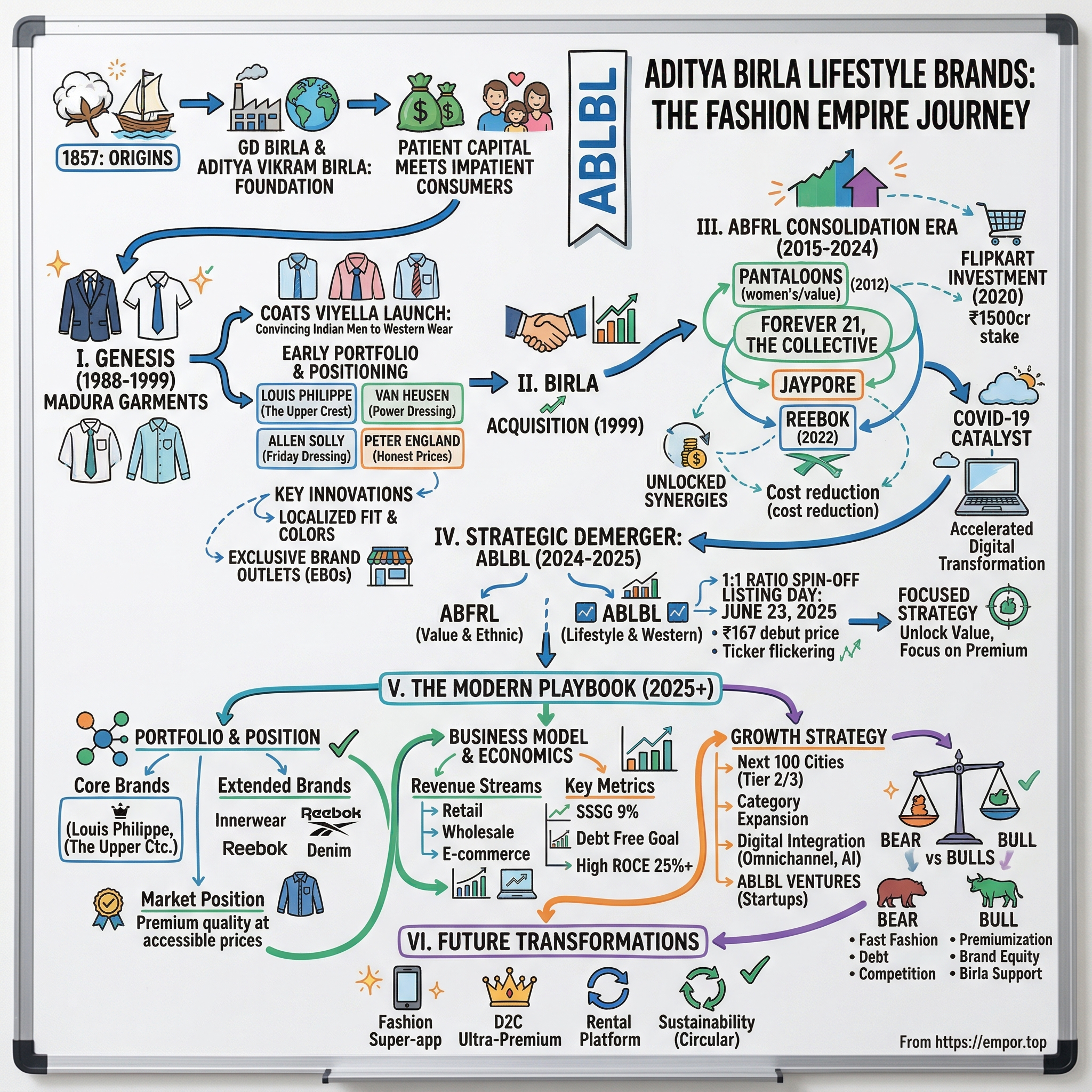
Aditya Birla Lifestyle Brands: The Art of Building India's Premium Fashion Empire
I. Introduction & Episode Roadmap
At 9:00 a.m. on June 23, 2025, a new ticker appeared on Indian trading screens. There was no roadshow, no anchor book, no grey-market premium, and no oversubscription drama. Aditya Birla Lifestyle Brands Limited — ABLBL — simply began trading, priced by a special pre-open session at ₹172.84 on the NSE and ₹167.75 on the BSE, instantly becoming one of the largest branded apparel companies in the country.1
No investor had purchased a single share. Existing shareholders received one share, free of charge, on a one-for-one basis for every share held in Aditya Birla Fashion and Retail Limited.2 Overnight, roughly 1.22 billion shares of a ₹7,800-crore-revenue business were distributed into portfolios that had not requested them. Investors who originally bought into a loss-making conglomerate spanning ethnic wear and department stores suddenly found themselves holding a focused, cash-generating premium menswear company alongside it.
That is the setup. What followed is the story.
Kumar Mangalam Birla, chairman of the Aditya Birla Group, marked the debut with a broad goal: "To build India's first portfolio of billion-dollar brands in fashion and lifestyle."1 The listing note went further, projecting that the business would "double in scale with improved profitability over the next five years."1 In corporate finance terms, it was designed as a value-unlocking transaction: separating a mature, high-return cash generator from a capital-hungry growth vehicle so the market could re-rate the standalone business.
Fourteen months later, in mid-August 2026, ABLBL shares trade near ₹90, close to their 52-week low. Market capitalisation stands at approximately ₹10,900 crore, roughly half its implied valuation on listing day.3 Meanwhile, the underlying operating business largely delivered on management's targets. For FY26, revenue rose 7% to ₹8,396 crore, while EBITDA increased 13% to ₹1,429 crore as operating margins expanded to 17.0%, supporting a maiden dividend of 50 paise per share.4 Momentum continued into Q1 FY27, marking a third consecutive quarter of double-digit growth with revenue rising 11% to ₹2,046 crore.5
Here lies the core tension. The operating trajectory and the stock market's valuation have diverged sharply. Either public markets are mispricing a durable compounder, or investors are discounting a risk that headline figures conceal — that a portfolio of 25-year-old formalwear brands, regardless of operational execution, faces structural headwinds as consumer wardrobes evolve.
The roadmap:
- The origin. How an industrial conglomerate built on cotton trading, aluminium, and viscose ended up owning India's most valuable rack of shirts — and why the group's balance sheet was the actual product.
- The acquisition. The December 1999 purchase of Madura Garments from a distressed British parent, which handed the Birlas four brand franchises that have compounded for a quarter-century. Benchmarked against 2012's Pantaloons deal, which did not.
- The unit economics. What 3,362 exclusive stores, 39,500 multi-brand outlets, and 6,500 shop-in-shops actually earn, and where the operating leverage sits.
- The war game. Hamilton Helmer's 7 Powers and Porter's Five Forces applied honestly — including where the moat is thinner than the marketing.
- The audit. A line-by-line comparison of what management promised on the maiden earnings call in August 2025 against what it delivered by May 2026. This is where the article gets uncomfortable.
- The debate. Bull, bear, and the three metrics that will settle it.
Start where every Indian business story starts: with a family, a balance sheet, and a bet on what a country would want next.
 Subscribe on LinkedIn
II. Empire Origins & The Conglomerate Advantage
The Aditya Birla Group did not start in fashion. Its roots lie in jute, cotton, and the heavy industrial machinery of twentieth-century India—beginning with Ghanshyam Das Birla trading commodities, and continuing with his grandson Aditya Vikram Birla building manufacturing operations across Thailand, Indonesia, the Philippines, and Egypt during the 1970s and 1980s. When Kumar Mangalam Birla assumed the chairmanship in 1995 at age 28, he inherited a group focused on heavy industry: viscose staple fibre, carbon black, aluminium, cement, and chemicals.
Over the three decades since, Birla expanded the group into a conglomerate generating roughly $67 billion in annual revenue, with nearly half originating outside India across some 40 countries.6 Fashion remains a minor fraction of that total revenue, which is precisely what makes the segment revealing: it illustrates how the conglomerate allocates capital and uses strategic optionality when its core industrial engines generate excess cash.
Why apparel at all?
The strategic case for entering apparel was vertical integration. The group already occupied the top of the textile supply chain—Grasim's viscose staple fibre business was one of the world's largest, producing raw materials that end up in woven garments. However, upstream operations run on commodity economics: producers sell undifferentiated inputs, absorb cyclical swings, and compete primarily on cost. Downstream retail economics, where garments carry recognizable brand names, offer a stark contrast: the same underlying fibre yields vastly higher gross margins attached to brand equity that does not depreciate like industrial equipment.
While downstream integration makes logical sense, industrial conglomerates often execute it poorly. The core capabilities required for apparel retailing—merchandising, fast design cycles, prime retail real estate acquisition, store operations, and seasonal inventory management—share almost no overlap with running a chemical or fibre plant. The Aditya Birla Group eventually resolved this skill gap not by building retail operations from scratch, but by acquiring an established player in need of capital.
The India that made it possible.
Timing was critical. In the mid-1990s, India's economic liberalisation was less than a decade old. A new generation of corporate professionals entered expanding private-sector offices across technology hubs in Bengaluru, financial centers in Mumbai, and consulting firms in Delhi. They required formal attire that previous generations had rarely worn. At the time, the dominant supplier of formal menswear was the local tailor: customers bought fabric by the metre, got measured, waited a week, and received unbranded garments of variable fit.
Organized, branded, ready-to-wear formalwear was a nascent market. This structural context explains the long-term durability of the brands that now form ABLBL's core. Rather than fighting for market share in an established segment, these brands converted unbranded tailor-made consumers, convincing a rising middle class that a branded shirt off the rack provided superior fit, status, and convenience worth paying a premium for.
That structural conversion remains underway. Management has consistently argued across investor calls that a major driver of growth comes from selling higher-value items rather than just higher unit volumes—a trend known as premiumisation. On the Q1 FY27 earnings call, Managing Director Ashish Dikshit was asked how much of the company's same-store sales growth stemmed from footfall increases versus pricing power. He acknowledged: "over a longer term when I see, a half of it at least would be coming through premiumization."5
That metric presents a dual narrative. Deriving half of comparable-store growth from product mix and pricing power demonstrates brand equity. Conversely, it implies that physical unit volume growth across existing stores has been relatively modest.
The group's mixed record in consumer.
A clear view of the conglomerate advantage requires acknowledging that deep capital reserves have not guaranteed uniform success across all consumer ventures. The group's most ambitious non-apparel retail effort—a national supermarket chain—absorbed substantial capital for years in an Indian grocery sector notorious for challenging store-level economics. Vishak Kumar, who ran that business as chief executive of Aditya Birla Retail from 2012 to 2016, now serves as ABLBL's deputy managing director and chief executive.24
This operational history provides crucial context. The executive leading ABLBL has direct experience managing both low-margin retail turnarounds and high-margin branded apparel. For investors, conglomerate backing does not automatically guarantee market dominance. Instead, it provides balance-sheet resilience—the liquidity required to sustain a physical store network through macroeconomic downturns, demand shocks, or external disruptions without distress sales. In retail apparel, where businesses often fail due to cash depletion during downcycles rather than fashion missteps, balance-sheet backing is a vital strategic asset.
The conglomerate's ultimate contribution to the apparel business was neither raw fibre supply nor innate merchandising expertise. It was capital deployment—specifically, the capacity to fund strategic acquisitions during industry downturns. In December 1999, precisely such an opportunity emerged.
III. The Madura Garments Acquisition (1988–1999): The Foundation
In mid-1999, labor strikes hit Madura Coats' textile mills in Tamil Nadu. The company's quarterly results tracked the operational decline: a profit of ₹4.2 crore in the first quarter gave way to a loss of ₹7.9 crore in the second and ₹5.4 crore in the third.7 The Indian subsidiary of Coats Viyella — the British thread-and-apparel conglomerate undergoing its own restructuring — urgently needed capital.
What it owned, almost incidentally, was India's premier collection of branded menswear franchises.
Madura Coats' garments division had been assembled since the late 1980s: British-heritage apparel names licensed or developed for India, sold through a nascent distribution network, and managed by a parent primarily focused on industrial thread. The portfolio included Louis Philippe, Van Heusen, Allen Solly, and Peter England, alongside Byford and San Frisco.7 For Coats Viyella, these were non-core assets tied to a loss-making mill operation. For a patient buyer backed by a strong balance sheet, they offered a rare strategic entry point.
In December 1999, Indian Rayon and Industries — an Aditya Birla Group entity — acquired the division. Contemporaneous reporting framed the sale plainly: for Madura Coats, the transfer signified "its exit from the premium branded men's wear segment."7 While secondary accounts vary on the purchase price and the company has not published a definitive figure, the transaction valuation was a fraction of the portfolio's eventual worth. Twenty-six years later, the four core brands acquired in that transaction generated ₹7,154 crore of revenue in FY26 at an EBITDA margin of roughly 19.6%.8
Why it worked: buying an idea, not a factory.
The key insight of the deal lay beyond the entry price. The Aditya Birla Group did not acquire physical manufacturing capacity, real estate, or established market dominance in a mature category. Instead, it acquired four distinct positioning territories in consumers' minds just as India's organized apparel market was taking shape.
Each brand targeted a specific tier on the consumer aspirational ladder, allowing them to coexist for a quarter-century without cannibalizing market share:
Louis Philippe occupied the top tier — branded as "The Upper Crest," with a distinctive crest logo and a price point signaling executive seniority. It is the brand a newly promoted manager buys to reflect career advancement.
Van Heusen targeted the corporate mainstream, focusing on technical fabrics, wrinkle resistance, and performance-oriented business attire. It later served as the launchpad for the group's innerwear extension.
Allen Solly introduced a new market segment. Launched in India in 1993 into an undeveloped smart-casual market, its advertising — created by Ogilvy & Mather's Bengaluru office — featured unconventional office wear and coined the phrase "Friday Dressing." The term moved from advertising into corporate culture, establishing a new apparel category: smart casuals.9 It remains one of the few instances in Indian consumer marketing where a brand created an entirely new usage occasion.
Peter England targeted value-conscious consumers in emerging markets. It offered branded formalwear at price points accessible to entry-level professionals in Tier-3 towns. While operating at lower price points than its sister brands, it represents a critical growth driver due to its footprint in rapidly expanding smaller urban centers.
Why four brands and not one.
Apparel companies often face the temptation to consolidate marketing spend behind a single brand and stretch it across multiple price tiers. Such a strategy rarely succeeds due to narrow brand elasticity in apparel retailing.
A brand's price point signals consumer status. Extending a premium brand downward risks diluting its aspirational appeal among core buyers, while stretching a value brand upward faces consumer skepticism.
By maintaining four distinct brands across clear price tiers, the group captured customers throughout their career progression without compromising brand equity. An entry-level professional starting with Peter England might transition to Van Heusen following early promotions, add Allen Solly for casual workwear, and move to Louis Philippe upon reaching senior management. Customers experienced these shifts as personal upward mobility rather than conscious brand loyalty.
This multi-brand architecture requires higher operational overhead: distinct marketing budgets, design teams, retail formats, and merchandising calendars. However, it allows the company to address the entire income spectrum while protecting brand positioning. Preserved over twenty-six years, this multi-tiered portfolio remains exceptionally difficult for new entrants to replicate rapidly.
The distribution insight.
Brand ownership alone does not dictate retail execution. In the 1990s, Indian apparel distribution relied heavily on multi-brand outlets — independent retailers that controlled product selection, discounting, and brand presentation.
Following the acquisition, management pivoted toward Exclusive Brand Outlets (EBOs) — single-brand, company-controlled or franchised stores that dictated the retail environment. Although capital-intensive, this model allowed full-range display, maintained pricing discipline, and provided direct sell-through data across micro-markets.
This multi-decade retail expansion built a network exceeding 3,300 exclusive stores. The company treats this physical footprint as a core asset, shifting competitive emphasis toward real estate site selection and franchise management rather than wholesale shelf space.
The honest counterfactual.
The long-term return on the acquisition reflects more than an advantageous entry price. Madura Garments was acquired at a low multiple because the parent was distressed and the future scale of Indian branded apparel remained unproven. The subsequent value creation required twenty-six years of sustained reinvestment across advertising, store expansion, product refreshes, and line extensions. An attractive entry price provided the option to compound, but operational execution delivered the ultimate returns.
Which brings the narrative to the deal where the Birlas paid a higher premium, and where long-term compounding proved far harder to achieve.
IV. The Consolidation & Expansion Era (2012–2024)
By 2012, Kishore Biyani stood among India's most celebrated retailers—and its most leveraged. His Future Group had built Big Bazaar, Central, and Pantaloons into the country's first modern department-store network, but it did so on roughly ₹5,000 crore of debt, creating debt-servicing demands that became unsustainable.10
Aditya Birla Nuvo stepped in, acquiring a majority stake in Pantaloons for approximately ₹1,600 crore, a transaction that included taking on roughly ₹800 crore of transferred debt.10 Strategic logic drove the acquisition: while the Madura deal secured high-margin menswear brands, Pantaloons offered retail scale, entry into women's fashion, steady family footfall, and prime real estate across major urban markets.
The M&A benchmark, honestly scored.
Comparing the Madura and Pantaloons acquisitions highlights two contrasting retail strategies.
Madura represented an investment in brand equity: intellectual property that expands through marketing rather than physical store expansion, extending into new categories at minimal incremental cost. Pantaloons represented an investment in physical retail capacity: hundreds of large-format leases carrying rent, payroll, inventory, and fit-out costs, operating in a format where the retailer bears fashion risk on third-party merchandise.
The former operates as a high-margin brand franchise; the latter demands relentless sales velocity per square foot to offset fixed operational overhead. Over the following decade, operational returns reflected this structural difference. While the lifestyle brands maintained segment-level operating margins between the high teens and twenty percent, consolidated returns on capital declined as long-term lease liabilities accumulated. By FY26—the entity's first full fiscal year following the demerger of the lifestyle brands—the residual ABFRL reported revenue of ₹8,177 crore, EBITDA of ₹967 crore, and a net loss of ₹830 crore.11 Within that business, the Pantaloons-led masstige and value segment generated ₹4,560 crore in revenue, reflecting 4% growth, at an operating margin of 16.2%.11
These results describe a business generating respectable segment margins that are subsequently absorbed by depreciation, interest charges, and underperforming adjacent ventures—precisely the structural drag the demerger intended to eliminate.
The 2015 consolidation.
In May 2015, the group consolidated its apparel operations into a single listed entity: Aditya Birla Fashion and Retail Limited (ABFRL). Combining Madura's brand portfolio with Pantaloons' retail network created India's largest pure-play branded apparel company, generating approximately ₹5,290 crore in revenue across 1,869 stores with about ₹1,775 crore of net debt.12
Management framed the consolidation around operational synergies, including unified procurement, shared back-end infrastructure, and pooled capital deployment. However, combining a high-return brand business with a capital-intensive retail operation under a single balance sheet obscured underlying segment performance, preventing investors from valuing the distinct business models independently for nearly a decade.
Buying growth with licences and capital.
During the late 2010s, management expanded by licensing established global brands rather than building new proprietary labels from scratch. This strategy minimized upfront brand-development expenditure, though ongoing royalty obligations attached to sales.
In August 2017, the company signed an exclusive retail and e-commerce licensing agreement with American Eagle Outfitters, launching its initial Indian retail locations in Mumbai and Delhi in September 2018 to target premium casual denim consumers.13
In December 2021, the company expanded its licensing strategy through a long-term agreement with Authentic Brands Group. The deal granted exclusive rights to distribute and market Reebok across India, Bangladesh, Bhutan, the Maldives, Nepal, and Sri Lanka across wholesale, e-commerce, and exclusive retail channels, while collaborating with the Reebok Design Group in Boston on product direction.14 Structured around working capital and inventory acquisition rather than a large upfront licensing fee, the deal provided a low-risk entry into sportswear—a category where established international brands and domestic competitors held strong market positions.15
Reebok transitioned to company management in 2022.8 Operating metrics since the transition demonstrate clear turn-around execution: revenue expanded from approximately ₹250 crore at acquisition to roughly ₹500 crore within three years, supported by mid-teens like-for-like sales growth across a network of roughly 210 stores, compared to 500 to 700 stores for the company's mature lifestyle brands.58 Crucially, higher-margin apparel—where the company possesses established manufacturing and design capability—increased from 26–27% of Reebok's sales mix at acquisition to approximately one-third.5
This operational turn-around illustrates management's capability to improve underperforming acquired assets rather than relying solely on legacy brand equity.
The Flipkart cheque.
In October 2020, amid severe pandemic-related disruptions to physical retail, Flipkart invested ₹1,500 crore for a 7.8% equity stake, subscribing to 73 million preference shares at ₹205 per share, with regulatory approval from the Competition Commission of India following in January 2021.16 Beyond providing immediate liquidity to stabilize the balance sheet, the investment aimed to align physical retail infrastructure with digital marketplace distribution at a time when e-commerce platforms wielded significant pricing leverage in fashion retail.
However, whether this strategic alignment delivered sustained value remains an open question, as subsequent executive commentary reflected growing scrutiny regarding the long-term margin quality of marketplace-driven volume. The subsequent earnings-call audit examines this trade-off, as it highlights management choosing margin defense over top-line revenue growth and navigating the resulting public-market optics over three years.
By 2024, the conglomerate structure created significant valuation friction. A single listed entity encompassed a mature cash-generating brand division, a large value-retail chain, an ethnic-wear division assembled through designer label acquisitions, a luxury department-store joint venture, and a venture-stage D2C incubator burning capital by design. Possessing distinct capital requirements, growth trajectories, and investor profiles, these disparate businesses could no longer be efficiently evaluated or valued under one corporate umbrella.
V. The Strategic Demerger: Birth of ABLBL (2024–2025)
On April 19, 2024, the ABFRL board approved a vertical demerger of the Madura Fashion & Lifestyle business into a newly formed entity, Aditya Birla Lifestyle Brands Limited.17 The mechanics were conventional: an NCLT scheme of arrangement issuing one ABLBL share for every ABFRL share, ensuring shareholders held identical proportional stakes in both companies without dilution or mandatory choices.17
Two key numbers defined the split: roughly ₹1,000 crore of debt was allocated to the new entity,17 while ABFRL announced plans to raise about ₹2,500 crore in fresh equity within twelve months of the demerger, supported by promoter participation, to fund the remaining growth businesses.18
Taken together, the financial logic was clear. The transaction was less about structural focus and more about balance-sheet optimization. Management loaded the mature lifestyle business with debt it could reliably service through predictable cash flows, isolating it from the capital-hungry growth arms. Those remaining ventures could then seek equity from investors comfortable with venture-stage risk, rather than drawing capital from core apparel operations.
What went where.
ABLBL inherited the four core legacy brands, along with Simon Carter in premium menswear, American Eagle in youth casual wear, Reebok in sportswear, and the Van Heusen innerwear line.1 ABFRL retained Pantaloons, the ethnic-wear portfolio, the luxury retail venture, and the TMRW digital-brand platform. In FY26, TMRW expanded revenue by 34% to ₹876 crore while reporting an EBITDA loss of ₹207 crore, essentially flat compared to ₹206 crore the previous year.11
Those figures illustrate the strategic rationale. A business expanding top-line revenue by a third while keeping operating losses flat requires patient equity capital, not cash siphoned from mature formalwear operations.
Execution.
The NCLT sanctioned the scheme of arrangement on March 27, 2025.19 The demerger took effect on May 1, 2025, initiating a transition that, as the CFO noted on the maiden earnings call, spanned "front-end and back-end systems to employee records and operational processes."20 Following a record date of May 22, 2025, the board allotted 1,22,02,94,773 equity shares of ₹10 face value to ABFRL shareholders on May 26,2 leading to its stock market debut on June 23.
The capital allocation mandate — and the first test.
The newly independent entity promised increased agility, sharper strategic focus, and "more disciplined capital allocation."1 On the maiden earnings call in August 2025, Managing Director Ashish Dikshit outlined specific targets: reducing net debt by ₹200–300 crore annually to achieve debt-free status within "two and a half years to three years," alongside annual capital expenditure of ₹200–250 crore.20
Nine months later, the FY26 results showed a different outcome. Net debt dropped from ₹781 crore to ₹726 crore—a reduction of ₹55 crore, well short of the initial target.4 Capital expenditure reached approximately ₹325 crore.8 While the company generated ₹450 crore in operating cash flow before capital expenditure and security deposits, the CFO explained that "a large share of this cash has gone towards funding aggressive store expansion during the year."8
Prioritizing retail expansion over rapid deleveraging is a defensible strategic trade-off when store opportunities exist. However, it represents a clear departure from the capital allocation framework presented at listing. When questioned on the Q4 call regarding the slower debt reduction, Deputy Managing Director and CEO Vishak Kumar stated that "our debts are fairly within norms as a business," adding that deciding how much net debt to retire involved "calls you can take on whether it should be zero or not zero."8
While reflecting operational flexibility, this stance contrasts with the explicit commitments made nine months earlier. The company also declared a maiden dividend of 50 paise per share in its first year post-demerger, establishing a payout target of 15% to 25% of net profit while extending the debt-free timeline out to "the next three years."8
Deleveraging, capital expenditure, and shareholder dividends compete for the same pool of operating cash flow. In its first year, management prioritized physical store expansion.
Myth versus reality.
Three prevailing market narratives accompanied the demerger, each requiring careful evaluation against disclosed results.
Myth: The demerger separated a high-ROCE cash cow from unprofitable operations, positioning ABLBL as a 25%-plus return business. Reality: Reported data shows return on capital employed at approximately 15% and return on equity around 14.9%.3 While this represents a healthy consumer business earning above its cost of capital, it falls short of the returns implied by a high-return "cash cow" label. A business generating a 15% return on capital with high single-digit growth commands a lower valuation multiple than one generating 25% returns with double-digit growth.
Myth: The standalone entity would experience a valuation re-rating once disentangled from conglomerate drag. Reality: Public markets valued the standalone business lower post-listing. Market capitalization roughly halved from its implied debut valuation, even as EBITDA grew 13% and normalized profit rose 61%.34 Increased financial transparency revealed both a self-funding business and a mature core portfolio growing in single digits, illustrating that unbundling does not automatically unlock valuation expansion.
Myth: ABLBL operates as a capital-light enterprise. Reality: The business is less capital-intensive than department-store operations, but far from capital-light. FY26 capital expenditure of about ₹325 crore absorbed most of the ₹450 crore in pre-capex operating cash flow, with another ₹100 crore deployed into working capital and roughly ₹130–140 crore spent on interest payments.8 Reinvesting two-thirds of operating cash flow to deliver 7% top-line growth reflects ongoing capital requirements.
The core structural rationale remains valid: the lifestyle brand portfolio generates steady operating cash, requires no external equity funding, and previously cross-subsidized capital-intensive segments. However, the expectation of immediate valuation expansion has not materialized.
VI. Core Business Model & Unit Economics
Walking into a Louis Philippe store in a Bengaluru mall offers an immediate view of the operating model: roughly 1,500 square feet, four staff members, and merchandise organized by usage occasion rather than product category—formal shirts along one wall, blazers across another, and smart-casual collections in a dedicated corner. Prices routinely end in 99, and discounting remains restricted primarily to scheduled end-of-season sale windows.
That single retail format, scaled to 3,362 locations across more than 800 cities and towns covering nearly five million square feet, defines the company's core distribution footprint.5
Where the money comes from.
The revenue architecture splits into two main divisions. The core Lifestyle Brands segment—comprising Louis Philippe, Van Heusen, Allen Solly, Peter England, and Simon Carter—generated ₹7,154 crore in FY26, accounting for roughly 85% of total revenue at an EBITDA margin of 19.6%.8 The Emerging Business segment—comprising Reebok, Van Heusen Innerwear, and American Eagle—forms the remainder, growing at a faster pace: revenue rose 18% in FY26 with EBITDA margin expanding 420 basis points, followed by 19% growth in the June 2026 quarter as margin expanded another 240 basis points to 4.3%.45
This margin gap highlights a key structural dynamic. The legacy brand portfolio generates roughly 19 to 20 paise of EBITDA for every rupee of revenue, whereas the emerging portfolio yields approximately four paise. Consequently, mix shifts toward Reebok and innerwear temporarily dilute consolidated margins until those brands achieve scale and operating leverage. Management expanded the emerging segment's EBITDA margin from near breakeven to roughly 4% within a single year, though long-term margin accretion depends on whether the segment can reach mid-teens operating margins.8
The four-channel machine.
Exclusive retail stores—combining company-owned and franchised locations—account for approximately 65% of total revenue.5 Management treats exclusive retail as its primary channel because it maintains direct control over pricing, visual merchandising, and sell-through data. Channel revenue increased 10% in Q1 FY27, supported by 8% same-store sales growth, marking a seventh consecutive quarter of positive comparable-store performance.5
Wholesale operations span more than 39,500 multi-brand outlets, providing distribution in smaller regional markets unable to support dedicated brand stores.4 Wholesale represents the company's lowest-margin and most working-capital-intensive channel due to trade credit extended to independent dealers. Channel growth slowed to 5% in the June 2026 quarter, which management attributed to a 10-to-15-day shift in festive billing that deferred primary shipments into the second quarter, while noting that underlying secondary retail sales grew in the early double digits.5 Performance in the subsequent quarter will indicate whether wholesale demand has fully recovered.
Large-format department stores contribute through more than 6,500 shop-in-shop locations.4 Following several years of network rationalization to eliminate unprofitable store accounts, the channel returned to double-digit growth.
The digital channel reflects a distinct strategic choice. For nearly three years, the company intentionally limited its participation in third-party online promotional volume. Managing Director Ashish Dikshit addressed the rationale during the Q1 FY27 call, stating that much of the broader industry's online expansion "was driven by steeper discount, very competitive pressure, which at some level gets you growth, but the quality of growth is suspect."5 After restructuring unit economics, management reported that online channel profitability approached parity with physical retail, accompanied by 23% growth in the June 2026 quarter and over 50% growth on the company's proprietary digital platform.5
This sequence—curtailing low-margin digital volume to stabilize channel economics before resuming expansion—prioritized margin preservation over short-term revenue growth, though it temporarily slowed the company's online expansion narrative.
The store-level arithmetic.
Headline store counts obscure a key structural feature of the retail network.
Company-owned and company-operated locations account for only 36% to 37% of the network, representing roughly 1,200 to 1,250 stores.8 Franchise partners operate the remaining two-thirds. This structure significantly reduces capital intensity: franchise partners finance store fit-outs and inventory carrying costs, while the company realizes wholesale margins rather than full retail sales. Although generating lower gross margins per store, franchising yields substantially higher return on capital, enabling a 3,362-store footprint to operate on annual capital expenditure of approximately ₹300 crore.
Out of that ₹300 crore annual capital allocation, management directs about ₹200 crore toward retail, splitting the funds evenly between new store openings and existing store renovations. Dikshit noted that "a typical store needs to be refurbished at least once in five or six years" to maintain sales productivity.8 In FY26, the company renovated more than 175 lifestyle-brand stores.4 This ongoing refurbishment requirement represents an essential maintenance expenditure in physical retail, ensuring older stores sustain conversion rates and support same-store sales growth.
The capital efficiency of the franchise model comes with operational trade-offs. Franchisees operate under their own balance-sheet constraints, inventory targets, and risk tolerance during demand downturns. Consequently, management emphasizes partner collaboration and tech-enabled inventory replenishment systems to ensure optimal product allocation across franchised locations.4
Gross versus net: the number that matters.
A critical metric in assessing network expansion is the variance between gross and net store additions. In FY26, the company opened more than 300 stores on a gross basis but recorded a net gain of roughly 90 locations.4 For FY27, management guided for over 300 gross openings and 150 to 200 net additions.5
Store rationalization follows a structured annual schedule: management evaluates store performance in January and February following the Diwali holiday season, executing closures between February and July.5 Deputy Managing Director Vishak Kumar characterized annual closures of 3% to 5% of the network as an ongoing operational discipline, asking rhetorically during an earnings call, "will we ever stop closing stores? I think it will be difficult because locations do become irrelevant over a period of time."8
This regular network churn shapes total retail expansion. Across a 3,000-store footprint, adding 200 net stores of slightly larger average size generates "higher than 5%-6% kind of network-related growth," which, combined with 7% to 8% same-store sales growth, yields early double-digit overall retail growth.5 Consequently, net additions—rather than gross store openings—provide the true measure of retail expansion economics.
Working capital and the manufacturing question.
In-house facilities supply approximately 40% of total garment production, with third-party vendors supplying the remainder.5 Manufacturing capacity is distributed across Tamil Nadu, Andhra Pradesh, Odisha, and Karnataka. This geographic diversification helped mitigate localized cost increases, such as statutory minimum-wage hikes in Karnataka, where management noted that garment manufacturing remained temporarily excluded pending judicial review in the state high court.5
Operating results for FY26 included a one-time ₹20 crore incentive under the government's Production Linked Incentive (PLI) scheme, recognized in the fourth quarter in connection with a new manufacturing facility in Pulivendula.8 Management noted that this non-recurring benefit offset initial factory startup costs incurred earlier in the year. However, the timing of recognition elevated Q4 Lifestyle Brands segment margins above the underlying operational run rate, making full-year results—which reflected "about 20 basis points" of margin expansion, according to Vishak Kumar—the more representative benchmark.8
Working capital efficiency represents an ongoing operational focus. In FY26, working capital absorbed approximately ₹100 crore as the company built inventory to support new manufacturing capacity.8 Management committed to releasing a portion of this capital in FY27 by curbing pre-production. In a business generating ₹450 crore in pre-capex operating cash flow, working-capital management remains critical to achieving guidance targets for net debt reduction.
VII. Competitive Landscape, Porter's 5 Forces & Hamilton Helmer's 7 Powers
Picture the Indian menswear market as a stadium. In the expensive seats near the pitch sit international brands — Zara, H&M, Uniqlo — with global supply chains and a design cadence measured in weeks. In the vast middle tiers sit the domestic branded players, of whom ABLBL is the largest by premium menswear share. In the standing terraces, unbranded and regional labels still command an enormous share of Indian wardrobes. And running up and down the aisles are the D2C insurgents — Snitch, Rare Rabbit, and a hundred Instagram-native labels — selling directly to consumers who have never set foot in a mall.
The named competition.
Arvind Fashions is the closest structural analogue: a portfolio of licensed international brands — U.S. Polo Assn., Tommy Hilfiger, Calvin Klein, Flying Machine, Arrow — with strong execution and a genuine turnaround under way, reporting FY26 revenue of ₹5,266 crore, up 14%, and a return to profit after prior-year losses.21 Arvind's structural disadvantage is the mirror image of ABLBL's advantage: most of its equity is licensed, which means royalties leave the P&L every year and the underlying brand can, in principle, be taken away. ABLBL owns Louis Philippe, Van Heusen, Allen Solly and Peter England outright for its markets. That is a permanent margin differential and a permanent optionality differential — but note that ABLBL's own growth engine, Reebok, carries exactly the licensed-brand structure it otherwise avoids.
Raymond Lifestyle carries the deepest heritage in Indian menswear and is emerging from its own restructuring, reporting FY26 total income of ₹7,034 crore, up 11%, with EBITDA up 23% to ₹804 crore.22 Raymond grew faster than ABLBL in FY26 off a comparable base — a fact worth sitting with, since it undercuts any claim that the category itself is the constraint on ABLBL's 7% growth.
Trent is the genuine strategic threat, and it is not close. The Tata group retailer reported FY26 revenue of ₹20,189 crore and profit of ₹1,721 crore — roughly two and a half times ABLBL's revenue and, on a rough basis, several times its profit.23 Zudio's value fast-fashion model attacks from below: fast turns, aggressive price points, and a consumer who is being trained to expect newness every few weeks. Zudio does not compete with Louis Philippe. It competes for the wallet of the Peter England customer in exactly the small towns ABLBL now describes as its fastest-growing market.
The D2C insurgents compete on velocity. A digitally native brand can go from trend observation to product on sale in a fraction of the traditional seasonal cycle. ABLBL's counter-argument — that fashion at premium price points still requires trust, fit and physical trial — is real but incomplete, and management's own answer on Gen-Z positioning was noticeably thin: Dikshit acknowledged it is "arguably a smaller part of our current business," pointed to sub-brands like Peter England's Vybe and collections within Allen Solly, and offered no sizing.5
Hamilton Helmer's 7 Powers, scored honestly.
Branding — strong, and the core of the case. Four brands with more than 25 years of continuous presence, priced at a premium a consumer accepts without deliberation.4 The evidence is in the mix: half of long-run comparable-store growth coming from premiumisation is precisely what branding power looks like in a P&L. The caveat management itself supplied is that brand-equity scores have been "stable" with "nothing which has changed dramatically" — stability is the signature of a mature asset, not an appreciating one.5
Scale economies — real but bounded. Sourcing leverage across nearly five million square feet, centralised distribution, and negotiating weight with mall developers. Vishak Kumar's description of working directly with the Phoenix group on new mall launches in Chandigarh, Thane and Kolkata illustrates the practical form this takes: preferential access to the best sites before they are on the market.8 But apparel scale economies plateau. Trent is larger and gets more of them.
Cornered resource — the strongest and least replicable power. Perpetual ownership of four brand franchises in India and neighbouring markets, plus a distribution web across 39,500 multi-brand outlets and 500-plus small-town stores generating roughly 15–16% of retail revenue and growing above 15% annually against roughly 10% in metros.45 No international entrant can economically replicate a small-town dealer network built over twenty-five years. This is the moat that is actually widening.
Counter-positioning — weak, and pointed the wrong way. ABLBL is not counter-positioned against anyone; it is the incumbent that others counter-position against. Zudio's throughput model and D2C velocity are both structurally difficult for a traditional seasonal wholesaler to copy without damaging existing channel economics.
Switching costs, network economies, process power — largely absent. A consumer switches shirt brands at zero cost. There is no network effect in apparel. Process power — the accumulated organisational capability to do something rivals cannot — is the one to watch: management's claims about "tech-enabled replenishment," reduced lead times and an omni-enabled network now covering roughly half the stores would, if they compound, constitute genuine process advantage.4 Today they are assertions with early supporting evidence, not proven power.
Porter, briefly.
Rivalry is intense and rising, with competition arriving simultaneously from value fast-fashion below, international brands above, and D2C laterally. Buyer power has increased structurally: price discovery online means a consumer can compare a Van Heusen shirt across five platforms in thirty seconds, which is precisely why management's refusal to chase discount-led online volume was strategically coherent. Supplier power is moderate — fragmented garment manufacturing, though input costs track cotton and, via polyester, crude, and management has confirmed the crude linkage is real.8 Threat of substitutes is the underrated force: the substitute for a formal shirt is not a cheaper formal shirt, it is a polo. Threat of new entrants is low for national physical scale and high for online-only niches, where entry costs almost nothing.
The competitive picture, then: a defensible core, an expanding distribution moat in small towns, and genuine vulnerability at both the fast-fashion and digital-velocity edges. What separates a good outcome from a mediocre one is execution — which makes the credibility of the people executing the central question.
VIII. Management Credibility, Governance & Earnings Call Audit
On August 14, 2025, three men dialled into ABLBL's first earnings call as an independent company. Ashish Dikshit, managing director, had run the broader fashion business for years. Vishak Kumar, deputy managing director and CEO, had joined the group as a management trainee in 1995, run Aditya Birla Retail's grocery venture from 2012 to 2016, and then led Madura Fashion & Lifestyle; his appointment to the new role was approved for a three-year term from February 1, 2026 to January 31, 2029.24 Dharmendra Lodha, the CFO, opened the call.
The tone.
Across four calls, one characteristic stands out: management does not perform. Asked on the maiden call about e-commerce weakness, they conceded it outright — "had it been outside of e-commerce, we would have had a 10% plus growth."20 Asked about gross margin contraction of roughly 150 basis points in the June 2026 quarter, Dikshit did not reach for raw material costs. He attributed it to channel mix and provisioning timing and then said something most managements avoid: "this quarter, we seem to be on slightly adverse side. But it is not material."5
That is either admirable candour or convenient minimisation, and an investor should hold both readings. Gross margin contraction of 150 basis points in a business earning 16% EBITDA is not trivially immaterial, and "it will even out as we progress during the year" is a claim, not a demonstration.
Equally, when an analyst on the Q4 call complained that store counts exclude factory outlets and asked for better disclosure, Vishak Kumar's response was to offer "any slice and dice that you want."8 When another pressed on a P&L line he could not reconcile, management engaged rather than deflected, then took it offline.8 Small things, but they accumulate.
The audit: promises versus delivery.
Here is where the record gets mixed, and where the specifics matter more than the tone.
Debt. At the maiden call, ₹200–300 crore of annual reduction and debt-free in 2.5 to 3 years.20 Delivered in FY26: ₹55 crore.4 The target subsequently restated as debt-free "in the next three years" — which, from May 2026, is a full year later than the original path implied.8 Management's explanation, that cash went to store expansion, is factually correct and strategically defensible. It is still a missed commitment, and it was not framed as one.
Capital expenditure. Guided at ₹200–250 crore in August 2025, reaffirmed on that call.20 Actual FY26 spend: about ₹325 crore.8 Guidance for FY27: ₹250–300 crore.8
Store additions. A 250-store target discussed in August 2025.20 FY26 delivered 300-plus gross — but roughly 90 net, because closures ran heavy.4 For FY27 management has been notably more precise, guiding gross and net separately.5 That improvement in disclosure discipline is a genuine positive, and suggests the prior year's gap registered.
Innerwear breakeven. On the maiden call, asked whether Van Heusen Innerwear would break even in FY26 or FY27, Dikshit answered: "Full year basis will be FY '27."20 Nine months later the framing had softened materially: Vishak Kumar hoped for "at least one profitable quarter in FY27," said it would be the best quarter of the year, and estimated "maybe six quarters away for us to be able to then say that it's steady state every quarter profitable."8 That is a slip from full-year profitability in FY27 to steady-state profitability somewhere in FY28. It was not flagged as a change.
Lifestyle Brands growth. At the analyst meet the company indicated double-digit growth for the lifestyle portfolio.20 FY26 delivered roughly 8%.8 An Emkay analyst put the point squarely on the Q4 call: growth was high single-digit while "some of the other mid-premium branded players" delivered low double digits. Vishak Kumar's answer was that the last two quarters had been double-digit and the shortfall was concentrated in the first half's e-commerce rationalisation.8 The subsequent three quarters of double-digit consolidated growth support that account.
The stress test.
What would a sceptical activist challenge here?
First, the pace of value creation relative to the promise. The listing communication projected doubling scale over five years — implying roughly 15% compound revenue growth.1 FY26 delivered 7%; the run rate since is 11–12%. Meeting the ambition requires acceleration that the company has not yet demonstrated for a full year.
Second, disclosure granularity. Management explicitly declines brand-level revenue: "we don't reveal, Archana," and, when pressed again, "there is a reason we have stayed consistent at the level of reporting that we do."5 For a company whose entire investment case rests on four distinct brands at four distinct price points, refusing to disclose how each is performing is a defensible commercial position and an analytically frustrating one. It means outsiders cannot verify whether Louis Philippe is compounding while Peter England stagnates, or the reverse.
Third, the three-way claim on cash. A company simultaneously targeting debt-free status, ₹250–300 crore of annual capex, and a 15–25% dividend payout, on roughly ₹450 crore of pre-capex operating cash flow, has arithmetic to resolve.8 In FY26 it resolved it by not deleveraging.
Fourth, governance and alignment. Promoter holding stands at approximately 46.6% as of June 2026, with domestic institutions at roughly 20.8% and foreign institutions around 12.7%.3 That is a control position without majority, and the promoter's economic interest is genuinely aligned with minorities — the promoter took the same 1:1 entitlement everyone else did. The related-party question worth monitoring is the ongoing operational entanglement with ABFRL post-separation, given shared history in systems, real estate and sourcing.
The narrative-consistency verdict.
Strategy has been consistent across all four calls: retail-led growth, disciplined channel economics, small-town expansion, emerging brands scaling into profitability. Numbers attached to that strategy have been revised, mostly in the direction of more spending and slower deleveraging, and the revisions have been explained when asked but rarely volunteered. Management is credible on direction and loose on timelines — a common combination, and one investors should price accordingly rather than either dismiss or ignore.
IX. Risk Radar & Vulnerabilities
Every risk in this business runs through the same physical object: a shirt hanging in a store, purchased on a forecast made months earlier. Understand that supply constraint, and the risk matrix organises itself.
The casualisation of the wardrobe.
The most fundamental threat is cultural rather than competitive. Indian office dress codes are shifting permanently toward informal wear. Asked on the Q1 FY27 earnings call whether the trend had stabilised, Managing Director Ashish Dikshit confirmed it had not: "it continues to grow, the share of casual wear continues to grow," noting that the product mix shifts by a "two to three percentage point increase in the share of casual wear" annually.5
A steady two-to-three-point annual shift represents a compounding reallocation away from the formalwear category that built the company's core brands. Management has expanded casual lines and adapted assortments—a transition Allen Solly was launched to address three decades ago—but formal attire commands higher price points and superior margins compared to casual shirts. Without offsetting gains from premiumisation elsewhere, a mix shift toward casual wear depresses revenue per transaction even if unit volumes remain steady.
Input costs and pricing leverage.
Cost pressures pose a near-term margin hurdle. For the second half of FY27, management projected a 3–4% increase in input costs driven by raw materials, logistics, and minimum-wage labor adjustments. Dikshit stated that management intends to offset "a major part of it" through operational productivity and cost rationalisation, alongside "smaller priced price hikes."5
The primary risk lies in timing. Autumn-winter buying decisions are committed in January and February, meaning input cost inflation hits profitability with a multi-quarter lag before retail price increases can be implemented.8 When asked whether the company possessed sufficient pricing power to pass on higher costs without dampening consumer demand, Deputy Managing Director Vishak Kumar acknowledged the uncertainty, describing such trade-offs as "million-dollar questions" that require management to "stay nimble, stay agile."8 He also confirmed that raw material expenses remain tied directly to crude oil prices through polyester inputs.8
Wholesale channel working capital.
The multi-brand wholesale network relies on thousands of independent dealers operating on trade credit. During consumption slowdowns, dealers delay payments while channel inventory accumulates. The divergence between primary wholesale growth of 5% and underlying secondary retail growth in the early double digits during the June 2026 quarter highlights this vulnerability, making management's explanation of a festive-billing shift an important metric to track in subsequent quarters.5
Small-town expansion: growth engine versus cyclical exposure.
Small-town expansion forms a central growth narrative, spanning over 500 stores, generating 15–16% of retail revenue, and expanding at over 15% annually compared to roughly 10% in metropolitan markets, with management targeting a revenue share above 20% within three to four years.5 However, Dikshit also noted the cyclical nature of these markets, recalling that "two years back, two and a half years back, when the smaller towns were actually under pressure and some of them were declining or growing very marginally."5
That historical context underscores a key structural reality: small-town demand in India reflects cyclical factors—rural income trends, monsoon performance, agricultural pricing, and government spending—rather than an uninterrupted secular trend. Expanding physical footprints in tier-3 and tier-4 markets increases operational exposure to these regional demand cycles, adding fixed rent and payroll overhead to lower-density trade areas.
Regulatory and supply-chain constraints.
Regulatory hurdles pose additional operational friction. Annual Bureau of Indian Standards (BIS) certification creates ongoing compliance requirements for Reebok's supply chain, with Dikshit acknowledging that "BIS does remain a problem," even as existing overseas factories obtain certification and domestic vendor capacity expands.5
Similarly, labor cost pressures remain active in Karnataka, where key manufacturing facilities are located. While garment manufacturing remains temporarily excluded from statutory minimum-wage increases pending state high court review, management is diversifying production geographically to mitigate potential cost increases.5 A third regulatory impact is already reflected in historical financials: FY26 reported net profit of ₹171 crore reflected a one-time exceptional charge for statutory labor code adjustments, compared to normalized net profit of ₹209 crore.4
Store network payback risks.
Finally, physical network expansion carries quiet execution risks. With 3% to 5% of stores closing annually due to shifting retail micro-markets, and plans calling for over 300 gross store additions annually across smaller urban centers, store payback periods risk extending unnoticed over multi-year horizons. In the absence of disclosed store-level payback metrics, investors must evaluate expansion quality primarily through net store additions and like-for-like sales growth.
X. Bull vs. Bear Case Analysis
Two coherent stories can be told from the same set of facts, and both deserve a fair hearing.
The bull case.
Start with what the business actually did. Three consecutive quarters of double-digit revenue growth leading into August 2026 show operating momentum, with EBITDA growing faster than revenue—14% against 11% in the June 2026 quarter—and operating margin expanding 50 basis points.5 Seven consecutive quarters of positive like-for-like retail growth across a 3,000-store base demonstrate that the core business remains operational.5 These are not the figures of a retail franchise in decline.
The premiumisation engine remains intact. India's per-capita income is crossing thresholds at which discretionary apparel spending accelerates, and the transition from unbranded to branded apparel remains a long-term structural shift that ABLBL's brands capture across four distinct price tiers simultaneously. With half of long-run comparable-store growth coming from product mix and pricing power, brand equity continues to deliver operating leverage.
The emerging portfolio offers tangible optionality. Reebok expanded from ₹250 crore to ₹500 crore in under three years across approximately 210 stores—compared to 500 to 700 stores for mature lifestyle brands—delivering mid-teens like-for-like growth while management targets roughly 20% annual growth to double revenue again over the next three to three-and-a-half years.58 Meanwhile, Van Heusen Innerwear is approaching profitability across an under-penetrated distribution network of 38,000 to 40,000 outlets, with management targeting roughly 20% network expansion.5 Currently generating 4% margins, neither business is fully priced into the company's valuation.
The balance sheet is self-sustaining. Generating ₹450 crore of pre-capex operating cash flow, net debt sits at ₹726 crore against ₹1,429 crore of EBITDA—a leverage ratio under 0.6 times—supported by a maiden dividend declared within twelve months of listing and a capital structure that funds expansion without equity dilution.48 This self-funding capability reflects the central financial objective of the demerger.
The valuation has already de-rated. Market capitalisation has roughly halved from its listing-day level, even as EBITDA grew 13% and normalized profit rose 61%.34 Consequently, current equity prices reflect a substantial discount relative to fourteen months prior.
The bear case.
The re-rating thesis has not materialized. The primary financial premise of the demerger was that an independent, high-return cash generator would command a higher valuation multiple than a conglomerate structure. Fourteen months of trading have yielded lower multiples. While not definitive proof that the thesis is flawed, market pricing provides empirical context that warrants evaluation.
Growth depends heavily on the smallest segment. The core Lifestyle Brands division—accounting for 85% of total revenue—grew 8% in FY26 and 10% in the June quarter.58 Management projects steady-state like-for-like growth of roughly 7%.8 Combined with net network expansion of 5% to 6%, retail operations yield low double-digit top-line growth across a channel representing two-thirds of total sales. Achieving the five-year target of doubling company scale requires the emerging portfolio—currently 15% of revenue—to deliver disproportionate expansion.
Returns on capital are solid rather than exceptional. Published data shows return on capital employed at approximately 15% and return on equity around 14.9%.3 While reflecting a healthy consumer business, these figures fall short of the 25%-plus profile associated with high-return cash generators, directly influencing the defensible valuation multiple.
Margin expansion faces cost pressures. When asked if lifestyle margins had peaked, Deputy Managing Director Vishak Kumar noted that while margins had not capped out, dramatic structural shifts were unlikely.8 Meanwhile, gross margins contracted roughly 150 basis points in the June quarter, while 3% to 4% input cost inflation is expected in the second half of FY27 against minimal planned retail price increases.5
Competitive dynamics remain challenging. Trent's scale advantage continues to widen, while Raymond Lifestyle grew faster off a comparable base in FY26.22 Digitally native brands compete on shorter design cycles, and management's response regarding Gen-Z positioning remained qualitative.5 Furthermore, quick commerce—a rapidly expanding consumer channel—remains a minor component of current operations, confined primarily to innerwear.5
Operational milestones have been extended. Guidance for debt reduction, capital expenditure, and innerwear profitability shifted within nine months of listing. While individual adjustments reflect operational flexibility, the pattern indicates that management targets serve as directional indicators rather than firm commitments.
The three metrics that will settle the debate.
Three primary operating metrics provide the clearest indication of whether the business is compounding or stagnating, all of which are disclosed in quarterly reporting.
1. Lifestyle Brands retail like-for-like growth. This metric serves as the direct measure of brand health, isolated from network expansion and channel mix shifts. After reaching 15% before moderating to 7% in the most recent quarter, full-year FY26 growth stood at 8%, alongside management's long-term projection of roughly 7%.58 Sustaining growth at or above 7% validates the premiumisation thesis, whereas a decline toward low single digits would indicate a mature annuity asset regardless of total store count.
2. Net store additions over gross openings. The gap between opening more than 300 gross locations and adding 90 net stores in FY26 represented the central physical retail metric of the year.4 For FY27, management guided for 150 to 200 net additions.5 Net additions reflect genuine selling capacity expansion, distinguishing physical growth economics from total development ambition.
3. Net debt relative to capital allocation targets. Net debt moved from ₹781 crore to ₹726 crore in FY26.4 This metric balances cash allocation between deleveraging, capital expenditure, and dividend distributions, providing a direct measure of capital discipline against original guidance commitments.
A fourth metric provides secondary verification: the emerging portfolio's EBITDA margin, which expanded from near breakeven to roughly 4% in FY26 and 4.3% in the June 2026 quarter.58 The trajectory from 4% toward mid-teens operating margins determines whether segment growth translates into meaningful earnings contribution.
XI. Epilogue & Playbook Lessons
There is a particular kind of Indian business that does not photograph well. It has no founder myth, no garage, and no dramatic pivot. Its core products are shirts. Its innovation is a fabric blend that breathes slightly better than last year's. Its most consequential decisions are made in real estate meetings and merchandising reviews that will never make headlines.
And yet the underlying arithmetic is remarkable. A distressed British thread company sold its garments division in December 1999 to raise cash after a strike. Twenty-six years later, that division generates ₹8,396 crore of revenue, ₹1,429 crore of EBITDA, and roughly ₹450 crore of pre-capex operating cash flow, spanning nearly five million square feet across more than 800 Indian cities and towns.48 Almost none of that value creation stemmed from the purchase price alone; nearly all of it came from twenty-six years of disciplined execution and brand preservation.
What the story teaches.
Buying intellectual property beats buying operations — but only if you keep investing in it. The Madura franchises compounded because their distinct brand identities were maintained and extended: Van Heusen became a platform for innerwear, Allen Solly expanded into womenswear, and Peter England established a dedicated small-town retail format. Pantaloons, acquired at scale for a full price, brought heavy lease commitments and fashion risk rather than an extensible brand franchise. The strategic lesson is not that physical retail is inherently flawed, but that brand assets capable of low-cost category expansion compound differently from format-heavy operations that consume capital in direct proportion to growth.
Demergers are a financing tool disguised as a strategy announcement. The ABLBL separation was, at its core, a balance-sheet decision about capital allocation: assigning debt to a predictable cash generator while freeing speculative growth arms to seek external equity. That separation creates financial clarity, but not intrinsic value. Long-term value must still be generated by the underlying operating business under full public market scrutiny.
Physical distribution in emerging markets remains a durable moat — at a real maintenance cost. Distribution across 39,500 multi-brand outlets and over 500 small-town exclusive stores cannot be replicated quickly by capital alone; it reflects twenty-five years of dealer relationships and market penetration. However, that physical footprint requires ongoing rent, annual store renovation capital, and regular closures of three to five percent of the store network each year as retail micro-markets shift. Moats built on real estate leases require continuous reinvestment.
Guidance discipline is an operational habit that must be built. For investors, tracking management's execution requires maintaining a consistent ledger comparing initial guidance against delivered results. In the company's first year post-demerger, strategic direction remained consistent, even as debt-reduction timelines and capital expenditure targets were extended.
Where it stands.
Aditya Birla Lifestyle Brands enters its second full year as an independent company with an operational narrative more nuanced than its share price suggests. The business is generating double-digit top-line growth, expanding EBITDA margins, improving unit economics in a digital channel it intentionally disciplined, and scaling a sportswear franchise from a license acquired with minimal upfront capital. At the same time, its mature core portfolio faces an ongoing structural shift toward casual wear of two to three percentage points annually, public markets have discounted its initial five-year growth targets by nearly half, and management's operational execution has proven stronger than its forecasting precision.
Both dynamics exist simultaneously. Over the next three years, like-for-like retail growth, net store additions, and net debt reduction will determine whether public markets have mispriced a compounding brand portfolio or correctly discounted its structural limits.
References
-
Aditya Birla Lifestyle Brands Limited debuts on the bourses — ABLBL press release, 2025-06-23 ↩↩↩↩↩↩
-
ABFRL Completes Demerger from Aditya Birla Lifestyle Brands, Equity Allotment Approved — HDFC Sky ↩↩
-
Aditya Birla Lifestyle Brands Ltd — share price, shareholding and key financials, Screener ↩↩↩↩↩↩
-
ABLBL delivers another quarter of double-digit sales growth — ABLBL Q4 FY26 press release, 2026-05-07 ↩↩↩↩↩↩↩↩↩↩↩↩↩↩↩↩↩↩↩↩
-
Aditya Birla Lifestyle Brands Limited Q1 FY27 Earnings Conference Call transcript, 2026-08-03 ↩↩↩↩↩↩↩↩↩↩↩↩↩↩↩↩↩↩↩↩↩↩↩↩↩↩↩↩↩↩↩↩↩↩↩↩↩↩↩↩
-
Aditya Birla Group — corporate overview, Aditya Birla Group ↩
-
Aditya Birla Lifestyle Brands Ltd. Q4 FY26 Earnings Conference Call transcript, 2026-05-08 ↩↩↩↩↩↩↩↩↩↩↩↩↩↩↩↩↩↩↩↩↩↩↩↩↩↩↩↩↩↩↩↩↩↩↩↩↩↩
-
How Friday dressing revolutionised Indian work wear — India Retailing, 2015-07-01 ↩
-
India's ABFRL's FY26 revenue rises 11% on Pantaloons, TMRW growth — Fibre2Fashion ↩↩↩
-
Aditya Birla Group merges apparel businesses to form Rs 5,290 crore entity — Business Today, 2015-05-04 ↩
-
Aditya Birla Fashion and Retail Ltd brings American Eagle Outfitters to India — Aditya Birla Group ↩
-
Authentic Brands Group and ABFRL announce strategic partnership for Reebok in India — Aditya Birla Group ↩
-
ABFRL to acquire exclusive rights to sell Reebok products in India — Reuters, 2021-12-14 ↩
-
Flipkart to acquire 7.8% stake in Aditya Birla Fashion for Rs 1,500 crore — Business Standard, 2020-10-23 ↩
-
ABFRL board approves vertical demerger of Madura Fashion and Lifestyle biz — Business Standard, 2024-04-19 ↩↩↩
-
Aditya Birla group approves demerger of Madura business into a separate listed entity, to raise Rs 2,500 cr in one year — Business Today, 2024-04-19 ↩
-
ABFRL shares rise 3% as NCLT approves demerger of Madura Fashion business — Business Standard, 2025-03-28 ↩
-
Aditya Birla Lifestyle Brands Limited Q1 FY26 Earnings Conference Call transcript, 2025-08-14 ↩↩↩↩↩↩↩↩
-
Arvind Fashions Returns to Profit in FY26, Strengthens D2C Growth and Omnichannel Fashion Expansion — D2C Insider Pulse ↩
-
India's Raymond Lifestyle's FY26 income tops $743 mn for 1st time — Fibre2Fashion ↩↩
-
Aditya Birla Lifestyle Brands Names Ashish Dikshit as MD, Vishak Kumar as CEO — Indian Retailer ↩↩
 LinkedIn
 WhatsApp
 Reddit
 Hacker News
 Email
Email Kindle
 RSS Feed
 Spotify
 Apple Podcasts
 Amazon Music
 Audible
 YouTube