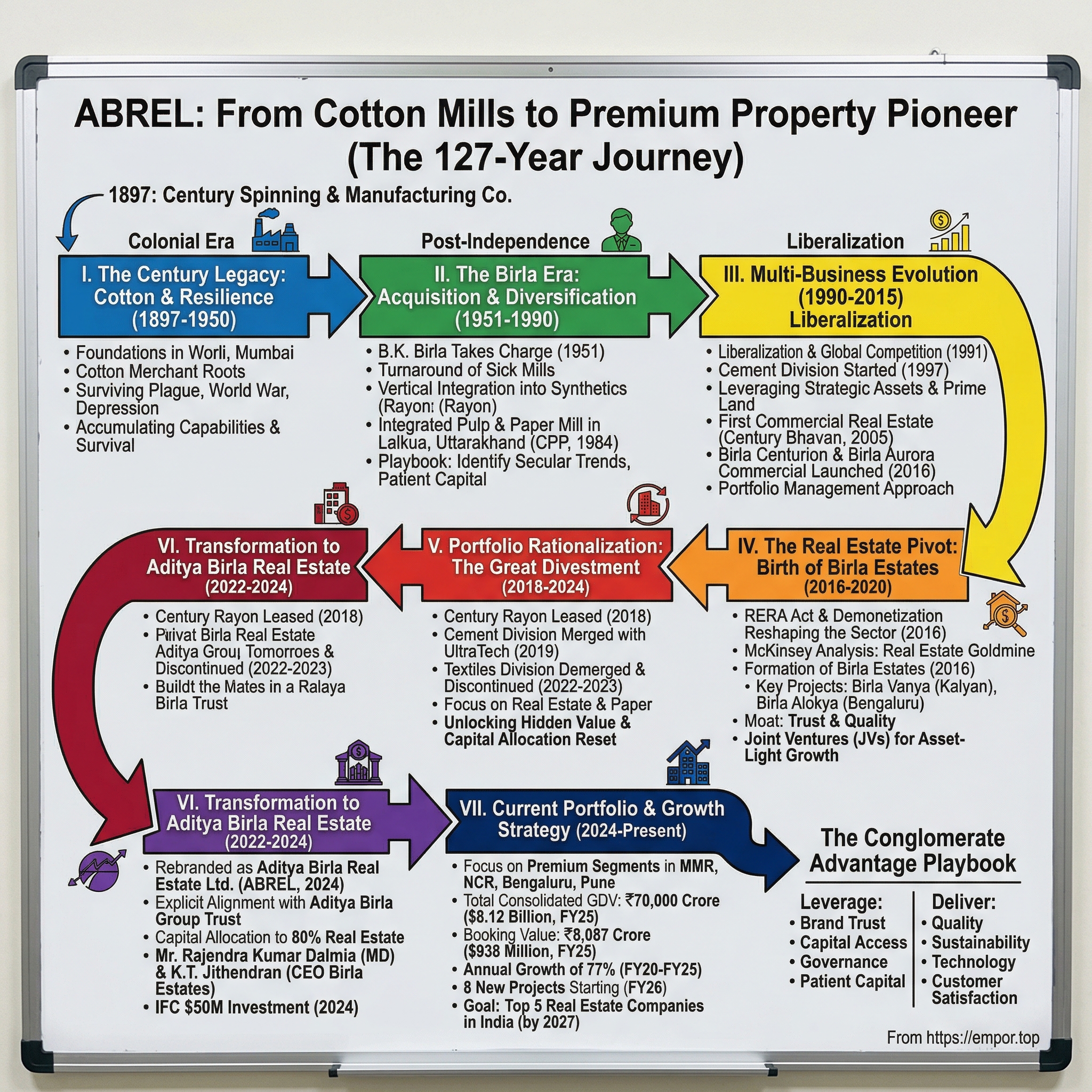
Aditya Birla Real Estate: From 127-Year Textile Conglomerate to India's Branded Real Estate Contender
I. Introduction & Episode Roadmap
On the morning of August 1, 2026, a company that had spent 129 years making things — cotton cloth, rayon filament, cement clinker, tissue paper — stopped making things altogether. That was the day ITC Limited completed its ₹3,498 crore purchase of Century Pulp and Paper, the integrated mill at Lalkuan in Uttarakhand that had been the last manufacturing asset on Aditya Birla Real Estate's balance sheet.12 The transfer was structured as a slump sale on a going-concern basis: assets, liabilities, contracts, workers, all of it moved across in a single legal motion.1 When the paperwork cleared, what remained of the entity once known as Century Textiles and Industries Limited was a land bank, a brand, and a development pipeline.
It is worth pausing on how unusual this is. Corporate India is littered with conglomerates that talk about focus and never get there — the legacy division that is always about to be sold, the loss-making arm that survives another five-year plan because someone's uncle runs it. Aditya Birla Real Estate actually did it, and did it in sequence: cement out in 2019, rayon leased away in 2018, textiles wound down by 2023, the name changed in 2024, paper gone in 2026.345 Each step was reversible in principle. None was reversed.
What emerged is a company with an unusual shape. Its total project portfolio carried an estimated gross development value of ₹73,858 crore as of the FY26 close, spread across 34.7 million square feet and 349 acres — roughly ₹31,753 crore already launched and the balance sitting in future pipeline.6 Its residential sales run at scale: bookings of ₹8,136 crore in FY26, following ₹8,087 crore in FY25, up from roughly ₹600 crore in FY21.789 Its brand is arguably the most recognisable four syllables in Indian industry.
And yet the reported financials look like a company in distress. FY26 revenue from continuing operations was ₹407 crore. EBITDA was negative ₹362 crore. The bottom line was a loss of ₹294 crore.6 Return on equity, computed the conventional way, was negative. In the June 2026 quarter the company reported a further loss of ₹38.55 crore on revenue of ₹188.85 crore.10
The core paradox, and what actually explains it. Indian developers recognise revenue under Ind AS 115 on a project-completion basis — nothing hits the profit and loss account until keys change hands. A company that has sold ₹8,000 crore of apartments this year and will hand them over in 2028 shows almost nothing today. So the reported numbers are not a scandal; they are an artefact of a business that is front-loading sales and back-loading completions. That is the charitable reading, and it is largely correct.
The uncharitable reading is that the accounting distortion has become a convenient shield. It is genuinely difficult to falsify a real estate growth story when the profit statement is three years behind the sales statement, and management teams across the sector have learned to point analysts toward presales and away from returns. The honest position for an investor is that both things are true at once: the accounting genuinely understates progress, and the absence of a P&L makes it harder to catch problems early. This article is built around trying to find the evidence that survives that ambiguity.
Four questions frame the story. First, conglomerate arbitrage: how much value was actually unlocked by stripping a 1897-vintage textile balance sheet down to its Mumbai land, and how much of that is still theoretical? Second, the branded developer migration: India's post-RERA, post-NBFC-crisis market genuinely shifted share toward institutional builders, but market share gains are not the same as returns on capital. Third, capital allocation: with the paper cash gone from the income statement and ₹3,325 crore of proceeds in hand, what does the company actually do with it — and does its recent record of buying land inspire confidence?11 Fourth, execution: FY26 was a year in which the company added just ₹1,700 crore of new project GDV against a stated target of ₹10,000 crore, and then declined to give FY27 guidance at all.6 That is the single most important fact in this story, and we will return to it.
A note on what this story is not. It is not an argument that a 129-year-old company reinventing itself is inherently admirable, nor that the Aditya Birla name guarantees an outcome. Indian corporate history contains plenty of well-branded developers who ran into approval walls, land-price cycles or their own ambition. The material presented here leans on credit rating rationales, quarterly result disclosures, sell-side coverage and earnings call transcripts, and the aim throughout is to separate what the company has demonstrated from what it intends.
The tension throughout is between a genuinely rare asset base and a business development engine that stalled at exactly the moment it needed to run. Which is where a 1897 cotton mill comes in.
 Subscribe on LinkedIn
II. Century Legacy: Cotton, Cement & Conglomerate Origins (1897–2015)
The American Civil War is an odd place to begin an Indian real estate story, but that is where the land came from. When the Union blockade choked off Confederate cotton exports in the 1860s, Bombay's traders discovered they were sitting on the world's alternative supply. The money that flooded in built the mills, and the mills built the city's industrial spine — a belt of spinning and weaving sheds running through Worli, Prabhadevi, Lower Parel and Byculla. Century Spinning and Manufacturing Company was established in 1897 to operate a cotton textile mill in Mumbai, joining that belt.12
For the first half-century, Century was one mill among many. The transformation came in 1951, when management control passed to the Birla family and Basant Kumar Birla took over the textile mills business.13 B.K. Birla was, by temperament, an accumulator. Over the following four decades, the company he built out of a single cotton mill expanded into an industrial portfolio that reads like a survey of post-Independence Indian manufacturing.
Century Rayon opened in Kalyan, on Mumbai's outskirts, in 1956 — a viscose filament yarn plant that would later become a strategic asset in an entirely different sense than intended.13 Chemicals followed in 1964. Cement arrived in 1974 and grew, over four decades, into integrated plants across Madhya Pradesh, Chhattisgarh and Maharashtra.13 Pulp and paper operations started at Lalkuan in 1984. A vertically integrated cotton yarn facility went up in Indore in 1994, and a 100-acre textile mill in Bharuch, Gujarat, in 2008.13
Read that list again and notice what it is: a portfolio assembled by a man who believed that industrial breadth was itself a form of safety. In the licence-raj economy, that belief was often correct. Capacity was scarce, competition was administered, and a company with permits across cement, paper and textiles was diversified against the arbitrary decisions of a single ministry.
The trap. Liberalisation inverted the logic. Once capacity could be added freely and capital could flow to specialists, breadth stopped being protection and started being dilution. By the mid-2010s, Century Textiles was a textbook conglomerate discount case. Its cement business needed continuous capital expenditure to stay competitive against UltraTech, Ambuja and Shree — and it was sub-scale relative to all of them. Its paper business was cyclical, capital-hungry, and structurally exposed to imported pulp prices and cheap Asian import competition. Its textile business was losing money in an industry where India had ceded the volume game to Bangladesh and Vietnam. Each division competed internally for the same rupee of capital, and none of them got enough to win.
Meanwhile, on the company's books, sat something no analyst modelled properly: acres of land in Worli, one of the most expensive postcodes in Asia, carried at a historical cost that bore no relationship to reality. The mill land was not idle in an accounting sense — it hosted operations — but it was catastrophically underutilised in an economic one. A square foot of Worli that produces cotton cloth is a square foot that is not producing an apartment worth several lakh rupees.
Consider the arithmetic that public markets were applying. A holding company whose divisions each earn a mediocre return, compete internally for capital, and require separate management attention will trade below the sum of what those divisions would fetch individually. Investors were not being irrational; they were pricing the observable fact that no single Century business was best-in-class, and that the group's capital was being spread thinly enough to guarantee that none would become so.
There was a complication, and it mattered. Much of the Century Mills land in Worli was held on leasehold, with the underlying ownership resting with the Wadia family — a legacy of Bombay's tangled nineteenth-century industrial property arrangements. That split title sat unresolved for decades and became, in effect, the padlock on the vault.
What this history means for an investor today. Almost nothing about the pre-2015 Century Textiles matters as an operating business. What matters is that a hundred and eighteen years of industrial activity left behind two things of durable value: an urban land position that cannot be replicated at any price, and a family name that Indian consumers associate with not defaulting. Everything the company has done since 2016 has been an attempt to convert the first asset using the second.
It is worth being precise about the scale of what was inherited, because the temptation is to treat "Worli land" as an unlimited resource. It is not. The contiguous holding runs to roughly thirty acres.22 That is a large number for central Mumbai and a small number relative to a company that wants to sell ₹15,000 crore of housing a year.6 The legacy land is a spectacular opening position, not a business plan.
The conversion began, appropriately enough, with offices.
III. The Great Conglomerate Rationalization (2016–2024)
Inflection Point 1: Proving the concept with commercial towers (2016)
Before the group risked its name on selling homes to individual buyers, it tested the proposition on corporate tenants. Two Grade-A office towers rose on the Worli mill land: Birla Aurora and Birla Centurion, together roughly six lakh square feet of leasable space.61415 The B.K. Birla group's debut in real estate was projected at the time to generate rental income in the region of ₹125 crore annually.16 A decade on, the two assets are nearly fully leased and generate stable annual rentals of approximately ₹130 crore, backed by a tenant base that includes several Aditya Birla group companies on long-term leases with contractual escalations.17
The economics were pleasant but the strategic value was greater than the yield. Commercial leasing is the low-risk end of real estate: you build, you lease, you collect. It gave the group a construction organisation, a design vocabulary, and — critically — proof that Birla-branded space could command premium rents in a competitive market. It also, less flatteringly, established a pattern worth noting: a meaningful share of the tenancy is related-party. Anchor tenancy from group companies de-risks a building, but it also means the rental proof point is partly self-generated.
The real estate subsidiary that would carry the ambition, Birla Estates Private Limited, was incorporated in FY18 as a wholly owned vehicle focused on premium and ultra-luxury residential development alongside commercial offices.18 The group had decided that offices were the appetiser.
Inflection Point 2: The cement demerger (2018–2019)
In May 2018, Century Textiles announced that it would demerge its cement business into UltraTech Cement — another Aditya Birla Group company, and India's largest cement producer.19 The market's immediate verdict was harsh: Century's shares fell 12% on the announcement.19 Investors had, until that morning, been buying a diversified industrial with cement optionality. They were now being handed a stub.
The mechanics were straightforward and the strategic logic was not. The demerged business comprised three integrated cement units in Madhya Pradesh, Chhattisgarh and Maharashtra with a combined 11.4 million tonnes per annum of capacity, plus a 2.0 MTPA grinding unit in West Bengal.20 UltraTech issued one equity share for every eight Century shares held, with the scheme declared effective from October 1, 2019 and 1,39,61,960 shares allotted against a record date of October 14, 2019.321
The elegance of the structure deserves attention, because it explains why this transaction is the hinge of the whole story. Century shareholders were not diluted — they received UltraTech paper directly, and could hold or sell it as they chose. Century itself was relieved, in one stroke, of the single largest claim on its future capital: cement is a business where you either keep adding kilns or you slowly lose relevance, and Century's 13-odd MTPA was never going to compete with UltraTech's national footprint. The demerger converted an obligation to spend into an asset the shareholder could monetise personally.
It also solved a problem that only exists inside family conglomerates. Century was competing with a sister company for the same market. Consolidating cement under UltraTech ended an internal contradiction and freed Century to become something the group did not yet have. Whether Century shareholders got a fair ratio is a separate question that was contested at the time and is now academic; what is not academic is that the transaction is the reason a real estate business exists at all.
Inflection Point 3: Shedding the rest (2018–2023)
The rayon exit came first, and it was the cleverest of the disposals. Effective February 1, 2018, Grasim Industries acquired the right to operate and manage the Century Rayon viscose filament yarn division for fifteen years, in exchange for a commuted royalty of ₹600 crore.4 Century kept the asset on its books and transferred the operating risk, the working capital burden, and the management attention to a company for which VFY was core. It is the kind of structure that only works between affiliates — an arm's-length buyer would have wanted the asset — but for a group optimising across entities, it was efficient.
Textiles took longer and was messier, because textiles always is. The yarn and denim units at Satrati in Madhya Pradesh were too small to be viable and were dealt with through a demerger in 2022; the residual textile division was discontinued in 2023.5 There is a quiet cost embedded here that surfaced years later: in the March 2026 quarter, other expenses included roughly ₹39 crore of exceptional items related to provisioning in the textile business and changes in labour codes.6 Legacy manufacturing does not exit cleanly. Statutory dues, labour settlements and site liabilities keep arriving for years after the last machine stops.
Inflection Point 4: The Worli padlock, and the new name (2024)
September 2024 produced the transaction that mattered most to the underlying asset value. Century Textiles acquired ownership rights to an approximately 10-acre leasehold land parcel in Worli from Nusli Wadia for ₹1,100 crore, merging its existing leasehold interest with freehold ownership and ending a long-running dispute between the two groups over the property.22 The company indicated the parcel added roughly ₹14,000 crore of booking value potential and paved the way for a gross 30-acre contiguous landholding in the area with overall booking value potential of about ₹28,000 crore.22 The stock rose sharply on the news.23
Strip away the excitement and consider what was actually bought. ₹1,100 crore for ten acres in Worli works out to roughly ₹110 crore an acre — expensive in absolute terms, cheap relative to South Mumbai comparables, and almost meaningless as a standalone number because the real value was contiguity. A 30-acre contiguous parcel in central Mumbai permits master planning, phased release, amenity sharing and pricing control in a way that thirty separate acres never could. The company was not buying land; it was buying the right to develop the land it already controlled.
There is also a governance observation buried in the Wadia settlement. The dispute had run for years, and the resolution required the Birla group to write a very large cheque to a rival industrial family for land it had already been occupying and operating on. Companies routinely defer such payments indefinitely, litigating on the theory that possession is most of ownership. Paying to clear the title before launching the development is the more expensive path and the correct one, because a title defect discovered mid-project in Mumbai can freeze a tower for a decade. It is a datapoint in favour of this management on the one dimension that matters most in Indian real estate.
The name change followed, effective October 10, 2024, when Century Textiles and Industries Limited became Aditya Birla Real Estate Limited and the trading symbol moved from CENTURYTEX to ABREL.2425 Renaming a company is cheap and proves nothing on its own. What made this one substantive was that it attached the group's master brand — the "Aditya Birla" prefix, used sparingly and only on businesses the group intends to own permanently — to a division that had existed for eight years. That is a signalling decision with a cost: it makes retreat expensive.
By late 2024, then, the transformation was structurally complete except for paper. The question shifted from what is this company to can it actually build and sell at scale.
IV. Core Business Deep-Dive: Birla Estates & Real Estate Economics
The structural shift that made this possible
In 2016 and 2017, three shocks hit Indian real estate within eighteen months of each other. Demonetisation removed the cash component from a market that had run on it for decades. The Real Estate (Regulation and Development) Act came into force, forcing developers to register projects, escrow 70% of buyer collections into project-specific accounts, and expose themselves to penalties for delay. Then in 2018, the collapse of IL&FS froze the non-banking finance channel that had funded the thinly capitalised builder.
The combined effect was to kill a business model. The classic Indian developer had operated on a float: take money from buyers of Project A, use it to buy land for Project B, and rely on rising prices to eventually deliver both. Escrow rules broke the float. The NBFC freeze broke the refinancing. What followed was a multi-year clearing of the market's undergrowth, and buyers — who had watched enough stalled projects to become permanently sceptical — began paying explicit premiums for the certainty of delivery. The pan-India residential market share of top listed developers rose from around 25% in FY21 to about 29% in FY24, and the consolidation was expected to continue as buyers leaned toward established brands.26
This is the single most important piece of context for understanding Birla Estates, and it needs stating plainly: the company did not create its tailwind. It arrived, in 2016, at the exact moment when being a trusted balance sheet became the scarcest resource in Indian housing. Excellent timing is a real advantage. It is not the same as a durable competitive edge, and distinguishing the two is most of the analytical work in this story.
The scale-up, and what the numbers actually show
The presales trajectory is genuinely striking. Bookings ran at roughly ₹600 crore in FY21, ₹1,900 crore in FY22, ₹2,200 crore in FY23, ₹3,985 crore in FY24, and ₹8,087 crore in FY25 — a compound growth rate of about 90% over four years.817 Sold area in FY25 reached 50.2 lakh square feet against 17 lakh square feet in FY24, a 198% increase.17 Collections roughly doubled, from ₹1,323 crore in FY24 to ₹2,706 crore in FY25.17
Then FY26 arrived and the curve flattened. Bookings came in at ₹8,136 crore — up 1% year on year.79 Collections did grow, reaching approximately ₹3,341 crore, up 23.5%, which is the more encouraging half of the picture because collections reflect construction progress on units already sold rather than fresh demand.76
The quarterly shape of FY26 tells you why the headline was flat. Presales ran ₹423 crore in Q1, ₹890 crore in Q2, ₹2,536 crore in Q3, and ₹4,288 crore in Q4.6 Well over half the year's sales landed in the final quarter. This is the defining operational characteristic of the business and it is not a minor technicality: Birla Estates sells almost nothing except when it launches, and it launches when regulatory approvals land. In FY25, the same pattern was even more extreme, with ₹5,738 crore of the year's ₹8,087 crore booked in the March quarter alone.6
When launches do happen, the absorption is real and it is fast. In FY26, Birla Pravaah in NCR sold all 492 units within 24 hours of launch, generating roughly ₹1,851 crore of booking value. Birla Arika Phase 2 booked over ₹1,600 crore with 97% of residences sold within a month. In Bengaluru, Birla Evara clocked ₹1,044 crore and the fourth phase of Birla Trimaya added roughly ₹649 crore. In MMR, Birla Taranya in Thane recorded approximately ₹952 crore across around 627 units, and the company made its first move into plotted development with Birla Mrida in Boisar.76
What this evidence supports and what it does not. Sell-outs in 24 hours are a genuine demand signal — you cannot manufacture that with marketing spend. They demonstrate that the Birla name, correct pricing and a well-chosen micro-market together produce clearing velocity most developers would envy. What they do not demonstrate is a self-sustaining growth engine, because the binding constraint is upstream. The company is not short of buyers. It is short of approved, launchable projects. That is a different problem, and a harder one.
The Worli crown jewel
Birla Niyaara launched in January 2022 on 14 acres of the legacy Worli land, with 2.48 million square feet of saleable area, three clubhouses, and status as India's first LEED Platinum pre-certified residential project.27 By the September 2025 quarter, 1.8 million square feet had been launched and 1.48 million sold, with cumulative presales of ₹6,760 crore against collections of ₹2,240 crore.27 The estimated GDV of the Niyaara development exceeds ₹17,000 crore.17
The economics here are unlike anything else in the portfolio, and the reason is simple arithmetic. Land is typically 30–40% of a Mumbai project's cost. At Niyaara, the land came from a mill that stopped spinning cotton decades ago and is carried at a historical cost that is effectively noise. Management has indicated EBITDA margins at Niyaara in the 45–50% range against a targeted blended portfolio margin of around 30%, with the first tower's handover expected to drive a step-change in recognised revenue from FY28.28 On the June 2026 quarter call, management pointed to Tower A margins in the 40–50% band.11
That margin gap — roughly fifteen to twenty percentage points between the legacy-land project and everything else — is the clearest quantification available of what "cornered resource" is worth in practice. It is also, by definition, finite. Worli is a depleting asset. Every tower sold is a tower of exceptional-margin inventory that will not recur, and the replacement projects the company buys in Gurugram and Bengaluru carry ordinary land costs and ordinary margins. The investment question is not whether Worli is valuable — it obviously is — but whether the business being built with Worli's cash flows can earn an acceptable return once Worli is gone.
The company continues to extend the Worli position. A 1.3 million square foot commercial tower is planned on the Worli land with construction targeted to commence before the end of FY27, expected to generate around ₹800 crore of annual leasing revenue when stabilised, and a further office component is planned at Century Bhavan in Prabhadevi.1128
JDAs versus outright: the real trade-off
Birla Estates operates a mixed acquisition model, and the FY27 launch pipeline makes the structure unusually legible. Birla Niyaara Tower C in Worli is 100% owned. Birla Taranya in Boisar runs at 54% economic interest under a private equity profit-share. The Khar redevelopment carries 87% economic interest on a revenue-share basis. Birla Navya on Gurugram's Golf Course Extension sits at 50% profit share. Birla Punya in Pune is 100% outright, while Birla Evam in Manjri is 54% under a PE profit-share.6
Region by region, management has signalled the intended mix: outright in Noida, JDA in Gurugram, both in Mumbai, outright in Pune, and both in Bengaluru.6 The logic tracks land market structure. Where land ownership is fragmented and pricing is opaque, partnering is cheaper and faster. Where parcels are large, clean-titled and available from institutional sellers, buying outright captures the full margin.
The trade-off is genuine and often glossed over in developer presentations. A joint development agreement converts a capital problem into a margin problem: no upfront land payment, but 40–50% of the economics permanently ceded to the landowner. An outright purchase inverts it — full economics, full capital risk, and full exposure to having bought at the top of a land cycle. Neither is superior in the abstract. What matters is whether the developer is disciplined about which lever it pulls in which market, and that discipline is only observable over a full cycle. Birla Estates has not yet been through one.
Redevelopment has emerged as a third route. The Khar West project, at ₹1,631 crore of GDV, was the company's first, and in the June 2026 quarter it added a Vashi project in Navi Mumbai spread across 3.06 acres with approximately ₹2,600 crore of revenue potential, undertaken with an affiliate of the Priyanka Group.29 Management framed the Vashi economics as roughly 90% economic interest at expected margins of 25–30%, taking the redevelopment portfolio to about ₹4,300 crore.11 Redevelopment in Mumbai is a distinctive skill: it means negotiating with hundreds of existing residents, rehousing them, and managing a consent process that can take years. Higher economic interest is the compensation for that difficulty, and it explains why the segment favours developers with brand credibility and patient capital.
One structural feature of the model deserves a plain-English explanation, because it is where most of the capital efficiency in modern Indian development comes from. In a joint development agreement, the landowner does not sell the land and the developer does not buy it. The land is contributed into the project, the developer brings capital, approvals, construction and sales, and the two split either revenue or profit according to a pre-agreed formula. The developer's upfront cash outlay collapses to approvals and early construction, which means return on invested capital can look excellent even when the absolute profit is modest. The catch, which presentations rarely dwell on, is that the developer has also permanently sold half the upside on a project it will manage for six or seven years — and if construction costs run over, that overrun comes disproportionately out of the developer's half.
Where the company sits among peers
Scale comparison is bracing. In FY25, presales across listed Indian developers ran roughly as follows: Godrej Properties ₹29,400 crore, DLF ₹21,200 crore, Macrotech Developers (Lodha) ₹17,600 crore, Prestige Estates ₹17,000 crore, Signature Global ₹10,300 crore, ABREL ₹8,100 crore, Brigade ₹7,800 crore, Sobha ₹6,300 crore, Oberoi Realty ₹5,300 crore.30
ABREL is therefore a credible mid-table player, not a titan. It sells roughly a quarter of what Godrej Properties sells, and Godrej is the direct comparator — the same conglomerate-brand-plus-asset-light-JDA model, executed for two decades longer by the organisation that trained Birla Estates' chief executive. DLF brings a dominant NCR position and a large income-producing commercial base that ABREL cannot match. Lodha owns the MMR volume market. Prestige has Bengaluru depth and is pushing into MMR and NCR. Oberoi Realty runs the highest margins in the sector on a concentrated Mumbai luxury portfolio.
Against that field, ABREL's stated aspiration is a top-five position and ₹15,000 crore of annual presales, a target management has indicated may slip from FY28 to FY29.6 Getting there requires roughly doubling from FY26 levels, which requires launches, which requires a pipeline. Which brings us to the part of the story that management would prefer to discuss less.
V. Secondary Segment & Financial Anchor: Century Pulp & Paper (CPP)
For most of the last decade, the standard bull argument for holding Century Textiles included a comfortable line about the paper division: real estate is lumpy, paper is steady, and the mill at Lalkuan would fund the land bank while Birla Estates grew into itself. It was a tidy story. It was also, on inspection, wrong — and management appears to have concluded so before most analysts did.
Century Pulp and Paper began operations at Lalkuan in 1984 and grew into an integrated mill producing writing and printing paper, rayon-grade pulp, tissue and multilayer packaging board, with total installed capacity of 4.81 lakh tonnes per annum as of March 2025.1318 In FY25 it generated revenue of approximately ₹3,150 crore.17
Here is the number that dismantles the cash-cow thesis: operating margins on that revenue ran at 6–7%.17 On ₹3,150 crore of sales, that is roughly ₹200 crore of operating profit before interest, depreciation and tax — from a business carrying about ₹1,800 crore of its own debt.17 A capital-intensive commodity mill earning single-digit operating margins while servicing near-equal debt is not a cash engine. It is a business that consumes capital to stand still, in an industry exposed to global pulp price swings and import competition, where the required maintenance capital expenditure never stops.
The structural reasons for those thin margins are worth spelling out, because they explain why no amount of operational effort was going to fix the division. An integrated pulp and paper mill is exposed on both sides of its income statement. On the input side, a mill that supplements captive pulp with imported wood pulp is a price-taker on a globally traded commodity whose price can swing violently on a Scandinavian mill outage or a Chinese restocking cycle. On the output side, Indian paper producers compete against imports — periodically including heavily discounted Asian volumes — in product categories where the buyer cares about grammage and price and nothing else. Between those two forces sits a fixed-cost asset that must be run near capacity to be economic at all.
Management's operational answer was the standard one: shift mix toward higher-margin tissue and multilayer packaging board and away from commodity writing and printing paper. That is the right response, and it is what the eventual acquirer will pursue with far more scale behind it. But it was never going to change the fundamental character of the business, which is that it converts capital into modest, cyclical returns and demands more capital to keep doing so.
Set that against real estate. A rupee of capital deployed into a Worli tower was working at 45–50% project EBITDA margins. A rupee locked in a paper mill was working at six. No amount of narrative about diversification survives that comparison.
The exit. The business transfer agreement with ITC Limited was executed on March 31, 2025, at a consideration of ₹3,498 crore.182 From that date, paper revenues were excluded from ABREL's reported operating income and prior periods were restated — which is the single largest reason the company's headline revenue appears to have collapsed from thousands of crores to hundreds.18 The Competition Commission of India cleared the transaction, and completion followed on August 1, 2026, with ITC acquiring the business as a going concern including its employees.1712 For ITC, the deal made it India's largest integrated paperboards and paper company.1
Net cash received by ABREL was ₹3,325 crore.11 Management had told investors it intended to use proceeds to retire around ₹2,000 crore of debt, including roughly ₹1,800 crore of bridge financing that had been raised against the expected consideration.17 On the June 2026 quarter call, management stated that following receipt, net debt stood at effectively zero.11
How to read the price. ₹3,498 crore against roughly ₹200 crore of annual operating profit is a demanding multiple for a commodity paper asset — the seller, on this evidence, negotiated well, helped considerably by ITC's strategic need to consolidate the paperboard market. That is a genuine capital allocation win and deserves to be recorded as one.
But note the sequencing, because it is the more interesting fact. The bridge loan came first; the completion came second. The company borrowed against a sale that had been agreed but not closed, spent the money on land and construction, and then repaid the bridge when ITC's cash arrived. That is efficient treasury management when the deal closes on schedule. It is a liquidity event when it does not — and the CCI approval process ran long enough that CARE Ratings explicitly flagged transaction progress and the servicing of the bridge as a key monitorable in its December 2025 review.17 The deal closed, the risk did not crystallise, and the episode tells you something real about this management's risk appetite: it is not conservative.
The optionality argument is now closed. There is no second business to sell. Whatever ABREL becomes from here, it becomes it as a developer, funded by development cash flows and debt, with the one-time paper windfall already spent or committed. That raises the stakes on who is running it.
VI. Current Management, Governance & Capital Allocation
The people
Kumar Mangalam Birla has chaired the Aditya Birla Group for nearly three decades, since taking over at 28 following his father's death, expanding a roughly $65 billion conglomerate across 40 countries and six continents, with more than 40 acquisitions executed globally across cement, metals, chemicals, fashion and financial services.28 A chartered accountant with an MBA from London Business School, he has built an organisation of around 187,000 employees drawn from 100 nationalities.28
His relevance to this story is specific rather than operational. Birla does not run Birla Estates. What he supplies is the decision that the group's master brand may be attached to residential real estate — a category that has destroyed reputations across India — and the implicit standard that goes with it. In practice, that means group-level hurdle rates and a governance overlay: more than 50% of ABREL's board comprises independent directors.17 It also means an implicit expectation of support that the credit market prices in explicitly. CARE Ratings' AA/A1+ ratings incorporate notching for the strength of linkages to the parent group.17 A meaningful part of ABREL's cost of capital is inherited rather than earned, which is a real advantage and worth naming as such.
K.T. Jithendran, MD & CEO of Birla Estates, is the operator. A civil engineer from IIT Kharagpur with a postgraduate diploma from IIM Calcutta and an Advanced Management Program from Harvard Business School, he spent his formative career at Godrej Properties, rising to Executive Director and serving on its board, where he played a central role in scaling that business into a national developer.3128 Before Godrej, he worked at Mecon India as a metallurgical engineering consultant.31
The Godrej lineage is the point. Godrej Properties pioneered the capital-light joint development model in Indian residential real estate — using a trusted brand to attract landowners who would contribute land in exchange for a share of economics rather than an upfront cheque. Hiring the executive who helped build that machine and asking him to build it again under a different family name is about as explicit a strategy statement as a company can make. It is also a reminder that the playbook is not proprietary. Everything Birla Estates does structurally, Godrej Properties does at roughly four times the scale, with a longer track record and deeper landowner relationships.
Rajendra Kumar Dalmia has been Managing Director of ABREL since 2022 and has been associated with the Birla Group for over four decades, having risen through senior leadership roles across textiles and real estate.28 A chartered accountant by training, he also manages Birla schools in India and abroad and has been involved in temple development and social initiatives.28 His function in this structure is the unglamorous one that determines whether the whole thing works: corporate restructuring, regulatory transitions, statutory closure of legacy operations, and land title clearance. In Indian real estate, title work is where value is created or destroyed, and it is done by people who have known the relevant registrars for thirty years.
Keyur Shah became Chief Financial Officer effective March 1, 2026, succeeding Snehal Shah, who retired on February 28, 2026 under the company's superannuation policy.32 The incoming CFO brings roughly three decades of real estate investment experience including time in the HDFC group.32 The transition was disclosed in advance and framed as planned succession rather than a surprise — which is the correct way to do it, and worth noting because CFO departures at developers in the middle of a leverage build are not always so orderly. It does mean, however, that the executive who signed off on the FY25–FY26 debt build is not the executive who must now deploy the paper proceeds.
Ownership and outside capital
Promoter and promoter group holding stood at 51.21% as of September 30, 2025, held across Aditya Birla Group entities.17 The shareholding pattern was stable through FY26 at approximately 50.2% promoter, 9.0% foreign institutional, and 16.4% domestic institutional as of March 2026.6 A promoter holding just above half is meaningful: it means control is not contestable, minority activism has limited leverage, and the group's incentives and the minority shareholders' incentives need to be aligned by design rather than enforced by the market.
More interesting is the outside capital the company has attracted at the project level. In January 2025, Birla Estates formed a joint venture with 三菱地所 Mitsubishi Estate, investing ₹560 crore through a special purpose vehicle to develop a premium residential project of roughly 40 lakh square feet of built-up area in southeast Bengaluru, with Birla Estates holding 51% and an MEC affiliate 49%.33 It was Mitsubishi Estate's first entry into Indian residential real estate.33 In June 2025, the International Finance Corporation committed $50 million — approximately ₹420 crore — across two projects, roughly ₹148 crore into the Manjri project in Pune with about 3.13 million square feet of saleable area and ₹272 crore into the Thane project with about 6.43 million square feet, with Birla Estates retaining 56% economic interest and IFC 44%.34
What third-party capital actually tells you. It is easy to over-read these partnerships as validation, and management presentations encourage that reading. The more precise interpretation: institutional partners underwrite at the project level, not the company level. Mitsubishi Estate and the IFC each conducted diligence on specific land parcels, specific approvals and specific business plans, and priced their participation accordingly. That is a genuine external check on individual project underwriting — a sophisticated foreign investor looked at the Bengaluru land and concluded the numbers worked. It is not an endorsement of enterprise-level capital allocation. CARE Ratings cited these partnerships as enhancing project credibility and funding flexibility, which is the appropriately narrow framing.17
The capital allocation record, examined
Here the picture becomes uncomfortable, and it is the section where an investor should slow down.
In FY25, the company added roughly ₹25,000 crore of new project GDV.6 That is a spectacular year of business development by any standard. It was funded by debt: overall gearing rose from 0.61x at March 2024 to 1.29x at March 2025, and further to 1.45x at September 2025.18 Consolidated total loans expanded from roughly ₹2,500 crore at FY24 to roughly ₹5,000 crore at FY25.28
In FY26, against a stated business development target of ₹10,000 crore of GDV, the company added one project — the Khar West redevelopment, at ₹1,700 crore.6 That is a 17% achievement rate against target.
Two readings are available and both should be held simultaneously. The generous one is that after an aggressive FY25, management deliberately paused, refused to chase inflated land prices in competitive micro-markets, and preserved balance sheet capacity ahead of the paper proceeds. On the June 2026 call, management defended precisely this position, characterising the approach as prudent rather than conservative and citing the need for the right location, pricing, product and risk management — even as multiple analysts pressed on why closures were so slow against a ₹60,000 crore pipeline of opportunities under evaluation.116
The sceptical reading is that the company set a public target, missed it by 83%, and reframed the miss as discipline after the fact. Note the sequencing: the ₹10,000 crore target was not withdrawn during the year on the grounds of overheated land prices. It was missed, and then explained. And when the time came to set FY27 expectations, management declined to give guidance at all, citing project approval uncertainties affecting launch timing.6
That last decision is defensible — approval timing genuinely is outside a developer's control, and refusing to guide on something you cannot forecast is more honest than guiding and missing. But it also removes the mechanism by which investors hold management accountable. A company that misses a target and then stops setting targets has, functionally, opted out of being measured. Investors are entitled to note that, whatever the merits of the underlying reasoning.
VII. Deconstructing the Financial Engine: Ind AS 115 & Earnings Call Evidence
Why the profit and loss account is nearly useless here
Start with a simple analogy. Imagine a shipbuilder who takes orders, collects staged payments over four years, and is forbidden by accounting rules from recording any revenue until the ship is handed to the buyer. In year one, the yard is full, the order book is at a record, cash is flowing in from deposits — and the income statement shows a loss, because wages and steel are expensed as incurred while revenue waits at the dock.
That is exactly what Indian residential developers face under Ind AS 115. Revenue is recognised on the project completion method: nothing enters the profit and loss account until possession transfers.28 Meanwhile employee costs, marketing, administrative overhead and a portion of finance costs are expensed as they arise.
The consequences at ABREL are stark. FY26 revenue from continuing operations was ₹407 crore against ₹1,219 crore in FY25 and ₹1,101 crore in FY24 — a decline of 67% in a year when the company sold ₹8,136 crore of apartments.6 EBITDA was negative ₹362 crore against ₹30 crore in FY25 and ₹243 crore in FY24. Adjusted net loss was ₹294 crore. Reported return on equity was negative 7.9% and return on capital employed negative 4.6%.6 In the March 2026 quarter alone, operating income was ₹82.6 crore against ₹394.8 crore a year earlier, producing EBITDA of negative ₹160 crore.6
The June 2026 quarter added a wrinkle that deserves attention independent of the accounting. Revenue from operations rose 29.74% year on year to ₹188.85 crore, but total expenses rose faster — up 38.11% to ₹287.34 crore — driven by a 3.66-times jump in finance costs and a 61.46% increase in other expenditure.10 Finance costs multiplying by more than three in a single year is the visible cost of the FY25 land acquisition spree working its way through the income statement, as interest that was previously capitalised into project inventory began to be expensed. Investors should expect this line to remain elevated even after the debt reduction, because the timing of interest expensing follows project stages, not the debt balance.
None of this reflects a demand problem. It reflects the fact that very few projects reached handover in FY26 while the company simultaneously carried the fixed cost of a much larger organisation — employee expenses rose to ₹232 crore in FY26 from ₹172 crore in FY25 as headcount scaled for a bigger pipeline.6
Where the distortion becomes a hiding place. The right response is not to ignore the P&L but to recognise what it can and cannot tell you. It cannot tell you whether the business is growing. It can tell you whether overhead is scaling faster than the underlying business, whether finance costs are compounding, and whether the eventual recognised margins match what was promised. Those are exactly the questions to ask when the revenue catch-up arrives. Analyst models point to recognition gathering momentum from FY28, coinciding with the handover of the first Niyaara tower.28 That handover is the moment the accounting shield comes off, and it is the single most informative event on this company's calendar.
The metrics that do work
Three things are observable in real time. Collections — actual cash from customers against construction milestones — reached ₹3,341 crore in FY26 and ₹713 crore in the June 2026 quarter, up 31% year on year, at collection efficiency of approximately 98%.3511 Registration discipline matters too: 91% of sold area was registered as of June 30, 2025, which reduces cancellation risk and firms up cash flow visibility.17 And construction progress is a hard physical fact: as of September 30, 2025, nine residential projects were in execution with approximately 33% of total project cost incurred.17
That 33% figure cuts two ways and it is worth sitting with. It means substantial revenue is coming — cost incurred is the proxy for how close a project is to the recognition threshold. It also means roughly 70% of the project cost is still ahead, which CARE Ratings flagged as the principal execution and saleability risk in the credit, with around 50% of the portfolio at a nascent stage where less than 30% of cost has been incurred.17 A developer with a large book and an early-stage pipeline is a developer with a lot left to prove.
What analysts actually pressed on
The June 2026 quarter call, held on August 14, 2026, is instructive on three fronts.11
Cancellations. Net sales for the quarter were ₹329 crore, down 22% year on year, but gross sales exceeded ₹700 crore. The gap was cancellations and terminations. Management addressed this directly, attributing cancellations to non-payment and customer financial difficulty rather than weak demand, and noting that the returned units were being rebooked at higher prices — including premiums of around ₹4 crore per unit at Birla Niyaara.11 If that rebooking claim holds, it is genuinely reassuring: a cancelled unit that resells at a higher price is a pricing signal, not a demand warning. It is also the kind of claim that should be tested against subsequent quarters rather than accepted on first telling, because "we resold it for more" is the standard developer response to any cancellation question.
Business development. This was the dominant theme, with multiple analysts questioning the pace of closures against the ₹60,000 crore pipeline under evaluation — of which roughly ₹35,000 crore sits in MMR.116 Management's answer was consistent with prior calls, which is worth crediting: the narrative has not shifted opportunistically. But consistency in a stated philosophy is not the same as delivery against a stated number, and the analysts on the call were clearly distinguishing between the two.
Approvals and slippage. The launch pipeline for FY27 was set at ₹9,596 crore of GDV across 3.3 million square feet, weighted toward the second half: Niyaara Tower C in Worli at ₹4,868 crore, Taranya in Thane at ₹1,375 crore, the Khar redevelopment at ₹1,631 crore, Navya in NCR at ₹710 crore, Punya in Pune at ₹583 crore, and Evam in Pune at ₹429 crore.6 Two projects were deliberately held back — the final tower at Arika in NCR and the last phase of Trimaya in Bengaluru — on the stated logic of maximising value.6 A third, Mathura Road in NCR, was described as still struggling with approvals with launch pushed to the following fiscal year.6
Holding inventory back to price it higher is a legitimate strategy in a rising market and a costly one in a flat market. Investors should watch whether "waiting to maximise value" becomes a recurring explanation, because at some point it becomes indistinguishable from an inability to launch.
The debt picture
Net debt stood at approximately ₹3,200 crore at the FY26 close, a net debt to equity ratio of about 0.87x, against gross debt of ₹5,636 crore and cash of ₹1,399 crore.6 At June 2026, gross debt was ₹5,824 crore and net debt ₹3,438 crore, including ₹420 crore of IFC funding.35 The ITC proceeds then landed and, per management, took net debt to effectively zero.11
Reaching a zero-net-debt position is a genuinely strong balance sheet outcome for a developer mid-growth-phase. The right question is what happens next. The company has stated a business development ambition of ₹10,000–15,000 crore of GDV in FY27 and construction spending of ₹1,200–1,300 crore.11 Land acquisition at that scale consumes cash years before it produces any. The clean balance sheet is therefore best understood not as a destination but as dry powder — and how it is spent over the next eighteen months will define this investment case more than anything in the historical record.
CARE's own framing is useful here: it set improvement in residential segment debt-to-collections below 1.00x as a positive rating trigger, and a significant un-envisaged increase in debt alongside lower-than-expected bookings as a negative one.17 That is the correct dial to watch.
VIII. Strategic Analysis: Helmer's 7 Powers & Porter's 5 Forces
Frameworks are only useful if they can distinguish between an advantage and a pleasant circumstance. Applied honestly to ABREL, they mostly do.
Hamilton Helmer's 7 Powers
Helmer's central discipline is that a power must produce persistent differential returns — it must both raise the firm's economics and be something a determined competitor cannot simply copy. Applied to a mid-scale developer in a consolidating market, most candidate advantages fail the second test. That is the finding, and it is not a criticism so much as a description of the industry.
Brand Power — real, quantified, but narrower than it sounds. Helmer's definition is specific: brand power exists when a firm can charge more for an objectively identical product because of habitual buyer affinity or uncertainty reduction. Indian housing is close to the textbook case for the second mechanism. The buyer is committing the largest sum of their life to a product that does not exist yet, built by a counterparty who might not finish. In that transaction, the seller's balance sheet is the product specification. The Aditya Birla name reduces perceived completion risk, and the evidence shows up in absorption velocity — 492 units clearing in 24 hours — rather than in a cleanly observable price premium.7 Average realisations have grown at a 14% compound rate over five years, though that reflects mix shift toward premium products as much as pure pricing power.28
The limit is that this power is shared. Godrej, Tata, Mahindra, L&T, DLF, Lodha, Prestige and Oberoi all clear the trust threshold in their respective markets. Brand power that four or eight competitors also possess is a licence to compete in the premium segment, not a moat within it. Note too that ABREL's ratings and cost of debt derive substantially from group linkage — the brand advantage runs through the funding side as much as the customer side.17
Cornered Resource — the strongest and the most finite. The Worli holding is the genuine article: contiguous acreage in one of Asia's most expensive submarkets, at a cost basis no competitor can replicate, and with the leasehold-freehold split now resolved. Worli comprises more than 50% of the overall portfolio GDV.6 The margin differential quantifies the advantage. But a cornered resource that depletes as you sell it is a wasting asset, and the strategic question is whether the operating platform built on top of it will be worth anything once it is exhausted.
Scale Economies — modest, and easy to overstate. With FY25 presales roughly a quarter of Godrej Properties' and half of Prestige's, ABREL is a scale taker in most input markets.30 Group procurement relationships in cement and steel help at the margin, and central design and approvals capability spreads across four cities. But residential construction is not a business with steep scale curves — land, approvals and labour are all local, and the largest developers in India do not enjoy dramatically lower cost per square foot than mid-sized ones. Calling this a power at ABREL's current scale is generous.
Process Power — asserted, not yet demonstrated. Process power in Helmer's sense requires an organisational capability that competitors cannot copy even knowing what it is — Toyota's production system, not merely good management. ABREL's claim would rest on multi-city approval management, design standardisation and sales execution. The evidence is mixed at best: Mathura Road was still stuck in approvals, FY26 business development achieved 17% of target, and the launch calendar remains hostage to municipal timelines.6 A company genuinely possessing process power in Indian real estate would show smoother launch cadence than a 5:1 quarterly swing in presales. This is, at most, emerging.
Switching Costs, Network Economies, Counter-Positioning — essentially absent. Housing is a one-off purchase; there are no switching costs. There are no network effects in apartments. And ABREL is not counter-positioned against anyone — it runs the same model as Godrej Properties, later and smaller. Recognising the absence of these is as analytically important as cataloguing the powers that exist.
Porter's Five Forces
Threat of new entrants — genuinely low, and this is the most durable structural feature. The barriers are not capital alone. RERA compliance requires systems, escrow discipline and delivery track record. Land titling in Indian cities is a specialist legal capability accumulated over decades. Approval processes reward relationships and patience. And the brand trust required to sell a ₹5 crore apartment off-plan cannot be bought quickly at any price. A new entrant in 2026 faces a decade-long runway before competing for the same buyer. This force works decisively in favour of every incumbent branded developer, ABREL included.
Competitive rivalry — high, and intensifying in exactly the markets ABREL needs. The consolidation that handed share to branded developers also concentrated the fight among them. In Gurugram, DLF and Signature Global are entrenched. In Bengaluru, Prestige, Brigade and Sobha have decades of land relationships. In MMR, Lodha operates at volume and Oberoi at the top of the price ladder. Rivalry manifests less in price wars — premium housing does not discount easily — and more in land acquisition, where competitive bidding for the same parcels compresses returns before a single brick is laid. The ₹60,000 crore of opportunities ABREL is evaluating are being evaluated by others too.6
Bargaining power of buyers — low at the point of sale, higher over the cycle. For prime tier-one housing backed by structural urban shortage, individual buyers have limited leverage; sell-outs in 24 hours are the proof.7 But the segment is discretionary and rate-sensitive. Buyer power is dormant in an up-cycle and reappears abruptly when interest rates rise or sentiment turns — and ABREL's concentration in premium and luxury makes it more exposed to that swing than a mid-income developer would be.28
Bargaining power of suppliers — moderate and rising. The critical supplier in this industry is the landowner, not the cement vendor. In a JDA, the landowner captures 40–50% of project economics, and as more branded developers compete for the same parcels, landowner terms improve at the developer's expense. Construction input inflation in steel, cement and labour is a second-order pressure on margins.28
Threat of substitutes — low but non-trivial. Renting substitutes for buying at the margin, and India's rental yields remain low enough that ownership stays the default. The more relevant substitution is geographic: a buyer priced out of Worli may buy in Thane or Navi Mumbai, which is precisely why ABREL's portfolio spans the price ladder from Malabar Hill boutique towers to plotted development in Boisar.277
The composite picture: strong structural protection at the industry level, moderate and depleting protection at the firm level. ABREL is well positioned in a well-protected industry, without a clear edge over the six or seven peers similarly positioned. That is a perfectly respectable place to be — but it means the investment case rests on execution rather than on structural advantage, which raises the stakes on everything a sceptic would attack.
IX. Skeptical Investor Stress Test & Risk Radar
Imagine an activist investor building a position and preparing a letter. What is in it?
"You missed your own target by 83% and then stopped setting targets." This is the opening paragraph and it writes itself. FY26 business development of ₹1,700 crore against a ₹10,000 crore goal, followed by a refusal to guide for FY27, and a flagship presales aspiration of ₹15,000 crore that may slip a full year.6 Management's response — that discipline in a competitive land market is a feature — is plausible and possibly correct. But the activist's rejoinder is sharper: if land was too expensive in FY26, why was ₹25,000 crore of GDV acquired in FY25 when the same market was hotter, and why did gearing more than double in the process?618 Either FY25 was undisciplined or FY26 was over-cautious. Both cannot be the considered application of a single philosophy.
"You are a growth company with negative returns and no accountability mechanism." The reported numbers — negative EBITDA, negative ROE, negative ROCE in FY26 — are defensible under project-completion accounting.6 But the defence is unfalsifiable until FY28 handovers arrive. In the interim, an investor is being asked to accept management's own operating metrics as the scorecard, on a company with just over 50% promoter control and limited minority leverage.17
"What exactly did the paper proceeds buy?" The strategic case for exiting a 6–7% margin mill is unanswerable.17 But the ₹3,325 crore has now been received and largely applied to retiring debt raised earlier — including a bridge taken against the sale before it closed.1117 The activist would ask whether the group has effectively pre-spent a one-time windfall on a land acquisition spree in FY25, and whether shareholders were given any say. Note that no material capital return accompanied the divestment; dividend payout has been nominal.28
"Your best asset is being consumed to subsidise ordinary projects." Worli generates 45–50% project EBITDA margins against a blended portfolio target of around 30%.28 Every rupee of Worli cash flow deployed into a Gurugram JDA at half the margin is, arithmetically, a transfer from an irreplaceable asset to a replaceable one. The counter-argument — that a business must reinvest to survive Worli's exhaustion — is sound. But it needs to be argued, not assumed, and the returns on the reinvestment need to be demonstrated.
"Related-party density." Group companies are among the anchor tenants of the commercial portfolio.17 The rayon business was leased to a sister company, the cement business was demerged into another, and credit ratings rest partly on group linkage.4317 None of this is improper and all of it is disclosed. But an investor should understand that several of the value-creating transactions in this story occurred between related parties, where price discovery is administered rather than market-tested. The ITC transaction is the notable exception and, not coincidentally, the one where the realised price looks unambiguously good.
Myth versus reality: three consensus claims, tested
Myth: the paper division was funding real estate. Reality: it was not, and probably could not have. A business earning roughly ₹200 crore of operating profit while carrying ₹1,800 crore of its own debt does not fund ₹5,000 crore of land acquisition.17 The land was funded by borrowing, and the paper business was ultimately worth more as a sale asset than as a cash generator. The "internal cash-flow engine" framing that circulated for years was, on the numbers, closer to a comfort story than a financial fact.
Myth: low reported ROE is purely an accounting illusion. Reality: mostly, but not entirely. Project-completion accounting genuinely defers the revenue and profit associated with ₹8,000 crore of annual sales, and that explains the bulk of the distortion.28 What it does not explain is the growth in fixed overhead — employee costs rising to ₹232 crore in FY26 from ₹172 crore the prior year — or finance costs that are real cash out of the door regardless of when revenue is recognised.6 A portion of the current loss is timing. A portion is the cost of running an organisation sized for a pipeline that did not fill in FY26.
Myth: presales growth of ~90% demonstrates a repeatable growth engine. Reality: it demonstrates a base effect and a successful launch sequence. Growth from ₹600 crore in FY21 to ₹8,087 crore in FY25 is real and impressive, but the FY26 outcome of ₹8,136 crore is the more informative datapoint, because it shows what the business does in a year when the launch calendar does not cooperate.87 The correct read of the record is not "90% compounder" but "a business whose output is set by approvals, capable of very high absorption when it launches."
The risk radar, restricted to what is material
Approval and execution risk is the binding constraint, not demand. Around 70% of total project cost remains to be incurred and roughly half the portfolio sits at a nascent stage with under 30% of cost spent.17 Nine residential projects run simultaneously across four metros with distinct regulatory regimes.17 The Mathura Road delay is a live illustration.6 Middle-management bandwidth — the layer of project directors and approval managers who actually move a file through a municipal corporation — is the practical constraint on how many launches a developer can run at once, and it is the hardest input to scale.
Cycle and rate risk, concentrated in the premium segment. Real estate demand tracks the economy, interest rates and sentiment.17 ABREL's concentration in premium and luxury amplifies the swing: high-ticket buyers defer more readily than first-home buyers, and the ₹5 crore-plus segment is where discretionary demand evaporates first.28 A meaningful share of GDV sits in MMR, so a Mumbai-specific slowdown would hit disproportionately.28
Refinancing and cost of capital. Gross debt of ₹5,824 crore at June 2026 sits against ratings of CARE AA/A1+, with roughly ₹1,000 crore of commercial paper capacity and lease rental discounting of about ₹900 crore already drawn against the Worli offices and deployed into subsidiary business development.3517 Lease rental debt against a stable ₹130 crore rental stream is prudent leverage; what matters is that the proceeds went into development, so the safe asset is now supporting the risky one.
What is not a material risk here. Technology disruption does not meaningfully threaten residential development. Geopolitical supply chain exposure is limited for a domestic developer. Cybersecurity is a housekeeping matter, not a thesis risk. Including them would pad the list without informing the decision. The genuine risks are approvals, the cycle, the land market, and management's own acquisition discipline — in roughly that order.
X. The Investment Spine: Bull vs Bear Case
Why ABREL could win
The asset base is not replicable. Whatever one thinks of execution, no competitor can assemble 30 contiguous acres in Worli at ABREL's cost basis, and no competitor will. That produces a multi-year runway of exceptional-margin inventory, extending beyond residential into a planned 1.3 million square foot office tower expected to generate around ₹800 crore of annual leasing revenue when stabilised.11226 Annuity income of that magnitude, if delivered, would materially change the cash flow profile of a business currently dependent on lumpy residential recognition.
The balance sheet is, for the first time, genuinely clean. Net debt at effectively zero after the ITC proceeds, ratings of AA/A1+, and a nearly fully leased commercial portfolio give the company the capacity to buy land counter-cyclically — the single most valuable capability in this industry and the one most developers lack precisely when they need it.1117
Demand conversion, when launches happen, is demonstrably strong. The FY26 evidence is unambiguous: full sell-outs within a day, 97% absorption within a month, collection efficiency at 98%, 91% of sold area registered.71117 These are operating facts, not projections. The company's problem is supply of launchable inventory, not demand for it — and supply problems are more tractable than demand problems.
Revenue recognition catch-up is arithmetic, not hope. Roughly ₹8,000 crore of annual sales must eventually flow through the profit and loss account. Handover of the first Niyaara tower is expected to begin that process from FY28.28 When it does, the reported financials will change character sharply, and the return ratios that currently look alarming will reset.
Third-party institutional capital has underwritten the projects. Mitsubishi Estate and the IFC conducted independent diligence and committed at the SPV level.3334 That is a meaningful, if narrow, external validation of underwriting.
Why it might not
The growth engine stalled and has not visibly restarted. One project added in FY26. No FY27 guidance. A flagship target slipping a year.6 Presales flat year on year.7 Everything in the bull case above assumes a pipeline that continues to refill, and the most recent evidence is that it did not.
The FY27 launch plan is back-loaded and approval-dependent. ₹9,596 crore of planned launches weighted to the second half, with more than half the value sitting in a single Worli tower.611 If Niyaara Tower C slips a quarter — and Phase 3 was still targeting RERA approval in the September 2026 quarter as of the August call — the year's presales number moves materially.11 Concentration of that kind in a single launch is fragility, not strength.
Competition compresses returns exactly where growth must come from. Worli cannot be replicated, so growth must come from Gurugram, Bengaluru, Pune and outer MMR, where DLF, Prestige, Godrej, Lodha and Signature Global are competing for the same land at the same time.30 The margin on that growth will be ordinary, and the blended ~30% portfolio target already assumes it.28
The premium concentration is a cyclical liability. A portfolio skewed to lifestyle-led and luxury product limits diversification and is the first to feel an affordability or rate shock.28 The Boisar plotted-development launch suggests management sees this, but the portfolio remains top-heavy.7
Management has not yet been tested by a downturn. Every operating datapoint in this story comes from India's strongest residential upcycle in fifteen years. The capital-light model, the JDA partnerships, the approval machine and the brand premium have never had to work in a market where inventory does not clear. Absence of evidence, in this case, is genuinely absence of evidence.
Market pricing has already moved a long way. ABREL shares traded in a 52-week range of ₹2,535 to ₹1,080 as of May 2026, with market capitalisation around ₹13,961 crore, after a period of sharp underperformance — the stock had fallen roughly 43% relative to the index over the twelve months to December 2025.628 The market has been repricing the gap between the presales narrative and the delivered business development. That repricing may be an overreaction or a correct read; it is certainly not a market ignoring the story.
What would settle the argument. Three observable events, in order of informativeness: whether the company closes meaningful business development in FY27 at terms it discloses; whether Niyaara Tower C launches inside the guided window; and whether the first Niyaara handover, when it arrives, produces recognised margins in the promised 45–50% band.11628 Each is a falsifiable test with a date attached, which is more than most investment cases offer.
The honest synthesis
ABREL owns a genuinely rare asset, carries a genuinely valuable brand, operates in a genuinely well-protected industry, and has a genuinely clean balance sheet. It also has an unproven growth engine, no current guidance, a track record of one badly missed target, an accounting regime that will obscure the truth for another eighteen months, and no structural advantage over half a dozen better-scaled competitors. Both halves of that sentence are supported by evidence. Which half dominates depends almost entirely on what the company buys in the next four to six quarters, and at what price.
XI. Key Metrics to Watch & 3-KPI Framework
Most developer disclosure is designed to be reassuring. Three numbers cut through it, and they should be read in sequence, because they measure the three consecutive stages at which this business can fail.
KPI 1: New GDV added through business development, measured against stated targets. This is the leading indicator and, on current evidence, the binding constraint. It measures whether the company can keep buying developable land at prices that work — the input without which everything downstream stops. The historical readings are ₹25,000 crore in FY25 and ₹1,700 crore in FY26 against a ₹10,000 crore target, with management indicating ₹10,000–15,000 crore of intended closures for FY27 out of a ₹60,000 crore pipeline under evaluation.611 Read this alongside the terms: a large GDV number added through 45% profit-share JDAs is worth far less than the same number acquired outright. Track additions and structure together, or the metric flatters.
KPI 2: Presales, but disaggregated into launched versus sustenance sales. The headline presales number conflates two very different things: sales from newly launched inventory, which reflect launch timing, and sustenance sales from existing inventory, which reflect ongoing demand. The FY26 quarterly pattern — ₹423 crore, ₹890 crore, ₹2,536 crore, ₹4,288 crore — shows a business where the headline is dominated by launch calendar rather than market conditions.6 The useful signal is whether sustenance sales hold up in quarters without launches, because that is what separates genuine brand pull from a well-timed release schedule. The June 2026 quarter, with net sales of ₹329 crore against gross sales above ₹700 crore, is exactly the kind of quarter where this distinction matters.11
KPI 3: Collections, and the ratio of net debt to collections. Collections are the closest thing this business has to real revenue: cash actually received against construction milestones, immune to accounting timing. They reached ₹3,341 crore in FY26 and ₹713 crore in the June 2026 quarter at approximately 98% efficiency.711 Pair them with debt. CARE Ratings has set residential debt-to-collections below 1.00x as a positive trigger and un-envisaged debt increases alongside weak bookings as a negative one.17 With net debt reset to roughly zero after the ITC proceeds, the trajectory of this ratio over the next eight quarters is the cleanest available read on whether growth is being funded by the business or by the balance sheet.11
A note on what deliberately is not on this list. Gross development value is the number every developer leads with and the least informative of the lot: it is a gross revenue estimate for projects that may not launch for five years, computed at today's prices, on land the company may hold only a partial interest in. A ₹73,858 crore portfolio GDV tells you the ambition, not the economics.6 Similarly, book value and price-to-book are close to meaningless for a developer whose principal asset is land carried at 1950s historical cost. Neither belongs in a monitoring dashboard.
Everything else — GDV headlines, launch pipelines, aspirational presales targets, market share ambitions — is downstream of these three. A reader tracking only these will know before the profit and loss account does whether the story is working.
XII. Epilogue & Strategic Takeaways
There is a particular kind of corporate courage involved in dismantling your own company, and it is rarer than the management literature suggests. Century Textiles could have limped on for another decade as a diversified industrial, generating modest returns across cement, paper and textiles, employing thousands, offending nobody, and trading at a permanent discount to the sum of its parts. Plenty of Indian conglomerates chose exactly that path. Instead, between 2018 and 2026, the company sold or shut every business it had ever operated — and did so in an order that suggests the endpoint was understood from the start.
The lesson is not that focus beats diversification; that is a truism, and often wrong. The lesson is more specific: conglomerate value is unlocked by sequencing. Cement went first because it was the largest claim on future capital and had a natural buyer inside the group. Rayon was leased rather than sold because a lease transferred the risk without triggering a bad price. Textiles were closed slowly because closing manufacturing in India is a legal process, not a decision. Paper went last, and at the best price, because by then the buyer had a strategic reason to pay up. Reverse that order and the company almost certainly ends up with less.
The second lesson concerns brands in commodity industries. An apartment is, physically, a commodity: concrete, steel, glass, tile, arranged in configurations that any competent contractor can replicate. What is not commodity is the promise that the building will exist, on time, with clear title. In a market where that promise was routinely broken, the ability to make it credibly became the entire margin. This is why a family name accumulated over a century of making cotton cloth and cement turned out to be the most valuable asset on a real estate balance sheet — more valuable, arguably, than the land, because the land could eventually have been bought by someone and the trust could not.
The third lesson is a caution, and it belongs at the end because it is the one most easily lost in the transformation narrative. Reinvention creates the opportunity to earn returns; it does not earn them. ABREL has completed the hard, irreversible, admirable part — the part that required deciding what not to be. What remains is the ordinary, relentless work of a developer: buying land at prices that work, moving files through municipal corporations, building on schedule, and handing over keys. On that work, the record so far is genuinely strong on demand conversion and genuinely weak on pipeline replenishment, and eighteen months of project-completion accounting stand between an investor and a clear view of which matters more.
The 1897 cotton mill is gone. The 1974 cement kilns belong to UltraTech. The 1984 paper mill belongs to ITC. What is left is thirty acres in Worli, a name, and a promise to build. Whether that is enough is a question the next three years will answer more honestly than any presentation can.
References
-
ITC strengthens paperboard business with acquisition of Aditya Birla Real Estate's Century Pulp & Paper for Rs 3,498 crore — ITC Limited ↩↩↩↩
-
ITC completes Century Pulp acquisition, expands paper business scale — Business Standard, 2026-08-03 ↩↩↩
-
Grasim's deal with Century: An earnings-accretive proposition — Business Standard, 2017-12-15 ↩↩↩
-
Century Textiles & Industries Ltd: Fundamental Analysis — Dr Vijay Malik ↩↩
-
Aditya Birla Real Estate — Q4FY26 Result Update — ICICI Direct Research, 2026-05-08 ↩↩↩↩↩↩↩↩↩↩↩↩↩↩↩↩↩↩↩↩↩↩↩↩↩↩↩↩↩↩↩↩↩↩↩↩↩↩↩↩↩↩↩
-
Birla Estates reports FY26 bookings of ₹8,136 crore, up nearly 1.7% — Business Standard, 2026-04-23 ↩↩↩↩↩↩↩↩↩↩↩↩
-
Aditya Birla Real Estate — Initiating Coverage: Shaping homes, crafting legacies — Motilal Oswal Financial Services, 2025-12 ↩↩↩
-
Birla Estates FY26 bookings hit ₹8,136 cr driven by strong sales in NCR, Bengaluru, MMR markets — ICICI Direct ↩↩
-
Aditya Birla Real Estate's Q1 loss widens to ₹39 cr as total expenses rise — Business Standard, 2026-08-13 ↩↩
-
Earnings call transcript: Aditya Birla Real Estate Q1 FY27 — Investing.com, 2026-08-14 ↩↩↩↩↩↩↩↩↩↩↩↩↩↩↩↩↩↩↩↩↩↩↩↩
-
About the company — Aditya Birla Real Estate Limited, CARE Ratings press release, 2025-12-31 ↩
-
Our Journey — ABREL's Milestones & Growth, Aditya Birla Real Estate ↩↩↩↩↩
-
Birla Aurora: Premium Office Space in Worli, Mumbai — Birla Estates ↩
-
Birla Centurion: Premium Office Space in Worli, Mumbai — Birla Estates ↩
-
BK Birla group debuts in real estate, might earn Rs 125 crore in rent — Business Standard, 2016-12-02 ↩
-
Aditya Birla Real Estate Limited — rating rationale and key rating drivers, CARE Ratings, 2025-12-31 ↩↩↩↩↩↩↩↩↩↩↩↩↩↩↩↩↩↩↩↩↩↩↩↩↩↩↩↩↩↩↩↩↩
-
Aditya Birla Real Estate Limited — company background, financials and BTA disclosure, CARE Ratings, 2025-12-31 ↩↩↩↩↩↩
-
Century Textiles falls 12% on demerger of cement business into UltraTech Cement — Business Standard, 2018-05-21 ↩↩
-
Demerger of Cement Business of Century Textiles and Industries Limited into UltraTech Cement Limited — UltraTech Cement ↩
-
UltraTech Cement allots 1.39 crore equity shares — Business Standard, 2019-10-16 ↩
-
Century Textiles acquires Rs 1,100 crore prime land from Nusli Wadia — Business Standard, 2024-09-10 ↩↩↩↩
-
Century Textiles Buys 10-Acre Land In Mumbai From Nusli Wadia For Rs 1,100 Crore — Outlook Business, 2024-09 ↩
-
Century Textiles Changes Company Name to Aditya Birla Real Estate — MarketScreener, 2024-09-19 ↩
-
Century Textiles rebrands as Aditya Birla Real Estate — Business Today, 2024-10-15 ↩
-
Consolidation in India's residential real estate set to gain ground — Business Standard, 2021-09-15 ↩
-
Ongoing residential projects and sales velocity — Motilal Oswal Financial Services initiating coverage, 2025-12 ↩↩↩
-
Margins, management overview, SWOT and downside risks — Motilal Oswal Financial Services initiating coverage, 2025-12 ↩↩↩↩↩↩↩↩↩↩↩↩↩↩↩↩↩↩↩↩↩↩↩
-
Birla Estates Enters Navi Mumbai with Rs 2,600 Crore Project — Construction World, 2026 ↩
-
FY25 presales peer comparison across listed Indian developers — Motilal Oswal Financial Services, 2025-12 ↩↩↩
-
Aditya Birla Real Estate Names Keyur Shah as New CFO After Snehal Shah's Retirement — TipRanks, 2026-01 ↩↩
-
Birla Estates, Mitsubishi Estate JV for Rs 560 cr Bengaluru housing project — Business Standard, 2025-01-24 ↩↩↩
-
IFC Invests $50 Million in Birla Estates Projects — Construction World, 2025-06 ↩↩
-
Aditya Birla Real Estate Q1 FY27 slides: collections surge 31% — Investing.com, 2026-08-14 ↩↩↩
 LinkedIn
 WhatsApp
 Reddit
 Hacker News
 Email
Email Kindle
 RSS Feed
 Spotify
 Apple Podcasts
 Amazon Music
 Audible
 YouTube