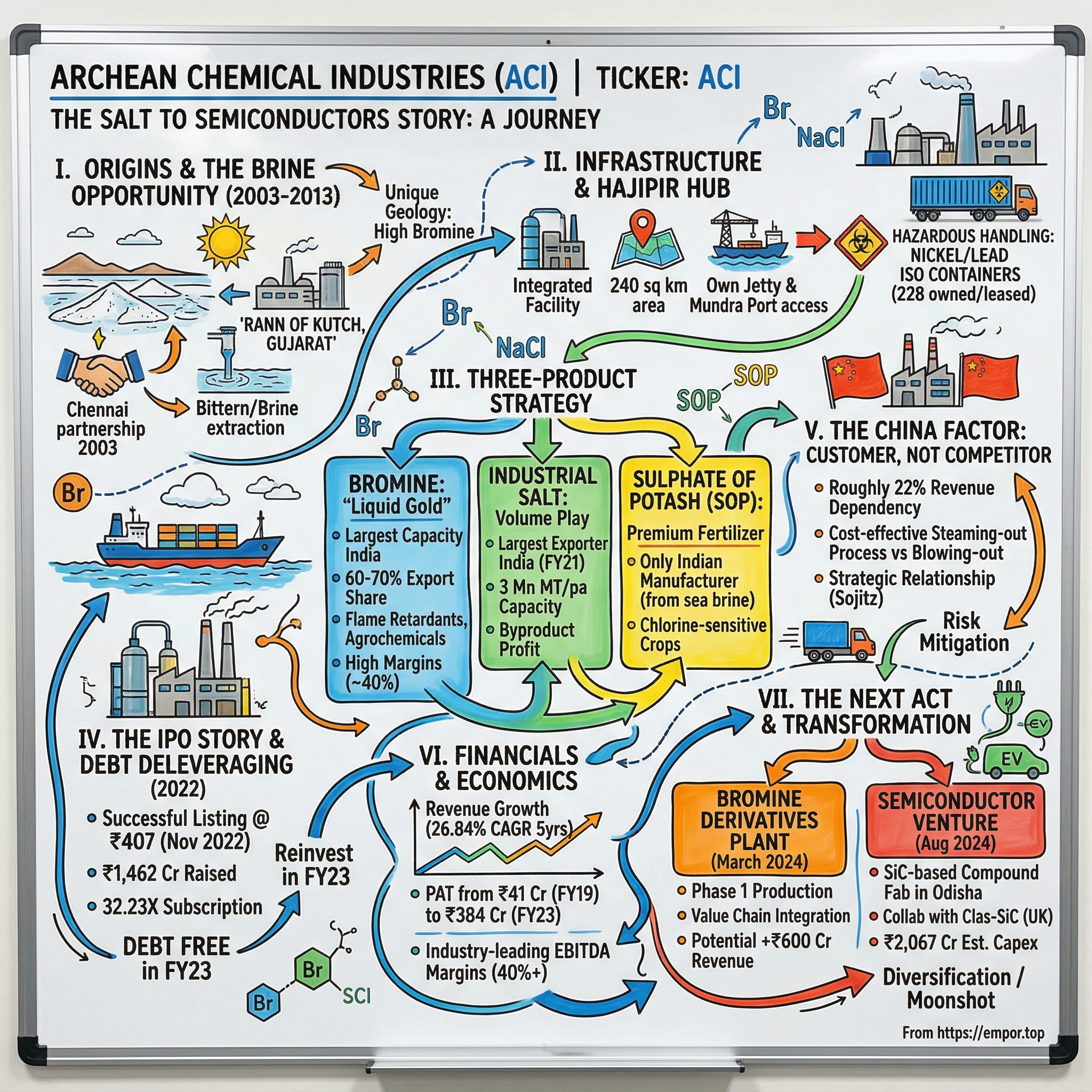
Archean Chemical Industries: The Salt, Brine, and Semiconductor Pivot
I. Introduction & The Rann of Kutch Paradox
Drive north-west from Bhuj for three hours and the landscape stops behaving like landscape. The scrub thins, then vanishes. The horizon flattens into a white crust that reflects the sun so violently that the sky and the ground trade places. This is the Great Rann of Kutch — a seasonal salt marsh the size of a small country, flooded by the Arabian Sea each monsoon and baked into a mineral pavement each summer. Nothing grows here. Almost nothing lives here. And near a place called Hajipir, on the northern edge of that white nothing, sits a chemical complex whose salt fields and brine reservoirs sprawl across roughly 240 square kilometres.1
That plant is the entire economic engine of Archean Chemical Industries Limited, which trades on the NSE under the symbol ACI. It is India's largest exporter of both elemental bromine and industrial salt, and by the reckoning of CRISIL Ratings it holds something like 60–70% of India's bromine export market.2 Its cost of producing industrial salt from sea brine has been estimated at roughly $5.5–6 per tonne against an industry benchmark of $12–15 — a cost position that is not a rounding-error advantage but a different order of magnitude.1
Here is the paradox. A company sitting on that kind of geological and cost advantage has, over the past two years, committed itself to building India's first commercial compound semiconductor fabrication plant — a ₹2,066 crore silicon carbide wafer fab and packaging facility in Bhubaneswar, Odisha, approved by the Union Cabinet in August 2025 under the India Semiconductor Mission.3 The company that boils bromine out of desert bittern now intends to run a cleanroom.
The obvious question — is this brilliant or is this madness? — is the wrong question, and this story will not try to answer it. The better question is narrower and more answerable: what is the actual evidence, in the operating record, that this management team can execute a project of that complexity, at that scale, from that starting point? Because the last three years have given investors an unusually clean natural experiment. Between fiscal 2023 and fiscal 2026, Archean's consolidated revenue went essentially nowhere — from ₹1,441 crore to ₹1,081 crore — while operating margin collapsed from 44% to 22% and net profit fell from ₹383 crore to ₹105 crore.4 Over the same window, management promised and then postponed a bromine derivatives ramp-up, a sulphate of potash restart, and the revival of a distressed oilfield chemicals business bought out of insolvency.
None of which makes the semiconductor bet wrong. But it means the bet is being placed by a team whose recent record on smaller, more familiar projects has been, by its own new managing director's admission on the February 2026 earnings call, "probably 12 to 18 months behind."5
The story that follows moves through five acts. First, the geology and the chemistry — why this particular patch of desert matters and how you get a violently corrosive orange liquid out of it. Second, the founding, the near-death debt experience, and the private-equity rescue that made everything after possible. Third, the 2022 IPO that erased the debt and briefly made Archean a market darling. Fourth, the global bromine oligopoly, the China dependency, and the price cycle that stress-tested the whole thesis. And fifth, the fork in the road: forward integration into bromine derivatives, which is the obvious adjacency, versus silicon carbide, which is not.
 Subscribe on LinkedIn
II. Origins & Mining the Great Salt Desert (2003–2014)
The Pendurthi family's chemicals venture began not as a factory but as a piece of paper. Archean was incorporated in Chennai on November 20, 2003 — a Tamil Nadu company, registered a thousand kilometres from the Gujarat desert it would eventually mine.1 That distance matters to the story. The promoters were not Kutch salt families with generations of local knowledge. They were outsiders who identified a resource, secured access to it, and then had to build everything else from scratch. Chemikas Speciality LLP, along with Ravi Pendurthi and Ranjit Pendurthi, formed the promoter group.1
Ranjit Pendurthi ran the business as managing director through the entirety of its scaling, crisis, rescue, and public listing — more than two decades in the operating seat before stepping into an executive vice chairman role in January 2026.5 What is knowable about him from the public record is less about biography than about behaviour: a promoter who took on enough leverage to nearly lose the company, accepted an outside financial partner's control disciplines rather than fighting them, and then used the resulting public listing to wipe the balance sheet clean. That is a specific pattern, and it recurs.
The geological gift
The chemistry of the Rann of Kutch is worth slowing down on, because it is the whole competitive position.
Seawater contains bromine, but at concentrations too dilute to be worth chasing — roughly 65 parts per million. Extracting it from raw seawater is like trying to make a living panning for gold in a river where the gold is measured in specks per tonne. What makes some places economic is natural pre-concentration: brine that has been evaporated, over geological time or over a production season, until the dissolved salts have crowded together.
Archean's process exploits both. Sea brine is drawn into vast shallow solar evaporation ponds. As water leaves, sodium chloride precipitates out first — that is the industrial salt, harvested as a crystalline crop. What remains is called bittern: a residual liquor, bitter as the name suggests, in which everything that did not crystallise as common salt is now dramatically concentrated. Potash and magnesium salts come out of that bittern next. And what is left after those precipitate is a highly concentrated brine that is unusually rich in bromide.1 That end-liquor is Archean's bromine feedstock.
The elegance is that the three products are not three businesses stapled together. They are sequential fractions of a single evaporation cascade. The salt pays for the ponds. The bittern is free. The bromine is the high-value tail of a process whose fixed costs have already been absorbed by the volume product. This is why Archean describes itself as an integrated marine chemicals producer rather than a bromine company that also sells salt.
Building in no man's land
There was no infrastructure. The Hajipir facility sits on the northern edge of the brine fields, and everything — the ponds, the washeries, the co-generation power plant, the desalination unit, the effluent treatment plant, the stockyard, the housing — had to be built where nothing was.1 Brine reservoirs are not switched on. Archean's existing brine fields took three to four years to establish before commercial harvesting was possible, a gestation lag the company itself cites as a barrier to any domestic entrant thinking about copying the model.1
The location choice was made for logistics rather than comfort. Hajipir sits near the captive Jakhau Jetty and within reach of Mundra Port.1 Jakhau is a fair-weather facility — it operates only seven to eight months a year, roughly October or November through May, closing when the monsoon arrives. It was designed for five million tonnes a year, can load 28,000 tonnes, runs a twin conveyor system, and is backed by a stockyard holding more than 350,000 tonnes so that product keeps flowing to ships even when production and shipping schedules do not align.1
That jetty is both the moat and the vulnerability. It is why Archean can move bulk salt to Asian buyers at a delivered cost domestic competitors cannot match. It is also why a monsoon that runs long, or a road that gets dug up, can knock a quarter sideways — as investors would discover in 2026.
What the three products actually do
Bromine is the only non-metallic element that is liquid at room temperature — a dense, deep-orange, ferociously corrosive fluid that fumes in air.1 It is a chemical building block rather than an end product. Brominated compounds go into flame retardants for electronics housings and automotive interiors; into agrochemical and pharmaceutical intermediates; into clear brine fluids that oil and gas drillers pump downhole because they are dense enough to control well pressure without the solids in conventional mud; into water treatment; and, increasingly, into zinc-bromine flow batteries for stationary energy storage.1 Think of bromine as a specialty halogen with a diversified but cyclical demand base, every strand of which is tied to industrial activity somewhere.
Industrial salt is the opposite in every way: unglamorous, priced by the tonne, and enormous. Its principal use is as feedstock for chlor-alkali plants, which electrolyse brine into chlorine and caustic soda — the twin pillars of the chemical industry, feeding PVC, alumina, paper, detergents, and water treatment.1 Archean exported 100% of its industrial salt production, chiefly to Japan and China.1 The buyers are large, sophisticated, and price-disciplined. What they will pay a premium for is purity — high sodium chloride content and low insolubles — because impurities foul electrolysis cells.
Sulphate of potash, or SOP, is the promising sibling that has never grown up. It is a premium, chloride-free potassium fertiliser used on crops that react badly to the chloride in ordinary muriate of potash — citrus, grapes, pomegranates, tobacco, vegetables, nuts.1 Globally, only about 15% of SOP is made through the brine route; the remaining 85% comes from more energy-intensive chemical processing.6 Archean has been the only Indian producer making it from natural sea brine, and it holds REACH certification allowing European sales.1 On paper this is the perfect product: import substitution, green process, premium price, cornered feedstock. In practice, as the next twenty years would show, it has been the single most consistent disappointment in the portfolio.
By 2014 the architecture was in place: ponds, plant, jetty, and a set of export relationships. What was not in place was the capital structure to survive what came next.
III. The Core Engine: Bromine, Industrial Salt & SOP Economics
To understand what Archean actually is as a business, hold two pictures side by side.
Picture one, fiscal 2022, the year before listing. Bromine generated ₹605 crore of revenue, industrial salt ₹513 crore, SOP ₹11 crore.1 Bromine was the majority of the business, the margin engine, the reason to own the stock.
Picture two, fiscal 2026. Industrial salt contributed roughly 70% of standalone revenue for the year, elemental bromine around 30%, and SOP produced ₹3.5 crore of revenue on 644 tonnes.7
In four years the mix inverted. The high-margin product shrank and the low-margin ballast grew. That single fact explains more about Archean's share price and margin trajectory than any strategic narrative, and it is the lens through which every other operating detail should be read.
The two ways to get bromine out of brine, explained simply
There are broadly two industrial routes, and the difference is essentially a question of how dilute your feedstock is.
The dominant global method is blowing-out, or air stripping. You acidify the brine, add chlorine to displace the bromide into elemental bromine, then blow enormous volumes of air through the liquid to carry the bromine vapour out, and finally recapture it. Imagine trying to recover a teaspoon of perfume from a swimming pool by blowing air across the surface and condensing what comes off. It works, but it is capital-hungry and energy-hungry, and you consume a lot of chlorine and electricity per kilogram recovered. This is the route you are forced into when your brine is thin — which describes much of Chinese production.
Archean's Hajipir bittern is concentrated enough to allow steaming-out instead: chlorinate, then apply direct steam and distil the bromine off in a tower. Fewer moving parts, less air handling, materially less energy per kilogram. The cost advantage is not the result of clever engineering that competitors could copy. It is the result of the feedstock arriving pre-concentrated by the sun and by the sequential crystallisation of everything else. CRISIL, in its September 2025 rationale, credited exactly this — low-cost integrated production with a steaming process more efficient than competitors' — as a core rating strength.8
This is the closest thing Archean has to a durable structural edge. It is worth being precise about what it does and does not do. It sets a floor on cost, which means Archean should be able to keep producing profitably at prices that would push higher-cost producers to idle capacity. It does not set a floor on revenue, on volume, or on margin, because none of those are determined by cost. That distinction gets tested hard later in this story.
The container fleet nobody talks about
Here is a moat that sounds boring and is not. Liquid bromine attacks almost everything. Shipping it requires nickel- and lead-lined ISO tank containers — purpose-built, expensive, and useless for anything else. As of June 2022, Archean operated 228 such containers, owned and leased.1
Consider what that means for a would-be Indian competitor. Before selling the first kilogram of export bromine, you need brine fields that take three to four years to mature, a plant, regulatory clearance in an environmentally sensitive coastal zone, port access, customer qualification with buyers who run rigorous impurity specifications, and a fleet of specialised containers. Archean itself argues that switching bromine suppliers costs customers significant time and expense, which disincentivises change.1 That is a real switching cost, though it is worth noting it is a claim made in a prospectus by the incumbent that benefits from it.
The fleet is also why logistics is not a line item for Archean — it is a core operating capability, and when it breaks, earnings break. That, too, comes back later.
The customer concentration problem
Archean sells to a small number of very large buyers. As of the IPO, it had 18 global customers across 13 countries and 24 domestic ones.1 Its largest customer is Sojitz Corporation — 双日株式会社 Sojitz — the Japanese trading conglomerate, which is also a shareholder in Archean.1 Other named customers included Shandong Tianyi Chemical, Unibrom, Wanhua Chemical, and Qatar Vinyl.1
By CRISIL's assessment in September 2025, Sojitz accounted for roughly 25% of total revenue and 50–55% of industrial salt sales, while the top ten customers together represented about 70% of revenue.8 Bromine is meaningfully more diversified — around 43 customers — but salt is concentrated in four or five relationships.8 Exports run 75–80% of the business.8
The honest reading is two-sided. A committed long-term offtake with a counterparty of Sojitz's standing gives Archean something most commodity producers would envy: volume visibility that lets it invest in salt beds with three-to-four-year gestation without guessing at demand. Archean has a long-term offtake arrangement with Sojitz covering roughly 2.2 million tonnes of industrial salt a year.9 But a customer that large is also a price-setter, not a price-taker. When management explained salt pricing pressure on the May 2026 call, the framing was revealing: pricing holds up in nearby, quality-sensitive markets like Indonesia, and erodes in distant markets like China where Archean competes against local salt and closer suppliers.7 That is the language of a producer whose realisation is set by the buyer's alternatives, not by its own cost position.
Which brings us to the period when the cost position nearly did not matter at all, because the company almost went under.
IV. The Debt Crisis & The IndiaRF Turnaround (2015–2021)
Every capital-intensive resource business eventually faces the same trap, and Archean walked straight into it. You build ahead of demand because the assets take years to mature. The assets take longer and cost more than planned. Then the commodity cycle turns down before your utilisation turns up, and the interest clock — which does not care about brine gestation periods — keeps running.
That is roughly what happened between 2015 and 2018. The company had spent heavily to build out Hajipir. Rated capacities were not being achieved. Global chemical markets were soft. And Archean was carrying expensive non-convertible debentures alongside bank debt.
The scale of the operating shortfall is visible in the numbers the company disclosed at IPO. In fiscal 2020, installed bromine capacity was 10,500 tonnes a year and actual production was 8,855 tonnes.1 SOP told a starker story: against installed capacity of 130,000 tonnes a year, fiscal 2020 production was 19,042 tonnes, fiscal 2021 was 2,002 tonnes, and fiscal 2022 was 2,483 tonnes — utilisation of 14.65%, 1.54%, and 1.91% respectively.1 A plant sized for 130,000 tonnes was running at under 2%. That is not a soft patch. That is a stranded asset sitting on the balance sheet earning nothing while its financing costs accrue.
Enter IndiaRF
In November 2018, India Resurgence Fund — the joint venture between Piramal Enterprises and Bain Capital Credit — invested about $156 million into the Archean group's marine chemicals business.[^10] Reported at the time in rupee terms at over ₹1,100 crore, it was structured as a combination of debt and equity, with proceeds used to refinance existing borrowings and to fund the capital investment needed to lift plant output across product lines.[^11]
The structure deserves attention because it tells you what the parties actually believed. IndiaRF's terms were designed so that the early years' cash flows would be reinvested into growing the business, with capital returned once the turnaround was complete.[^10] This is special-situations investing rather than growth equity: the fund's underwriting case was not that Archean was about to compound, but that a fundamentally low-cost asset was trapped inside a broken capital structure, and that fixing the structure would release the value.
What followed validated that read. Bromine capacity was expanded from 10,500 tonnes to 28,500 tonnes a year, and production climbed to 14,751 tonnes in fiscal 2021 and 20,293 tonnes in fiscal 2022.1 Industrial salt output reached 3.59 million tonnes in fiscal 2022 against 3.0 million tonnes of installed capacity — 120% utilisation, which tells you the constraint had moved from the plant to the ponds.1 Bromine production compounded at 51% a year between fiscal 2019 and fiscal 2022.1
The financial result was dramatic. Revenue rose from ₹608 crore in fiscal 2020 to ₹741 crore in fiscal 2021 to ₹1,130 crore in fiscal 2022, and the company swung from a ₹36 crore net loss in fiscal 2020 to ₹188 crore of net profit in fiscal 2022.4 Operating margin reached 41%.4
What the turnaround actually proves — and what it does not
It is tempting to read this as a story about operational genius. The evidence supports something more specific and more useful. Two things happened simultaneously: Archean lifted utilisation of assets it had already built, and global bromine prices rose sharply into 2022. Volume growth of that magnitude in a fixed-cost-heavy business produces enormous operating leverage regardless of price; rising prices on top of it produces the kind of margin expansion that looks like transformation.
The disciplined conclusion is that the turnaround demonstrated Archean's assets were good and its balance sheet had been bad — not that its management had discovered a repeatable capability for fixing hard operating problems. The clearest counter-evidence sits inside the same period: SOP, which no amount of IndiaRF capital or board oversight fixed. That plant stayed broken through the turnaround, through the boom, and, as of the most recent disclosures, remains a work in progress two decades after the technology was first attempted.
Still, by early 2022 Archean had what it needed: a repaired operation, a hot specialty chemicals market, and a private equity holder that wanted an exit. The obvious next move was the public market.
V. The 2022 IPO & Balance Sheet Transformation
November 2022 was, in hindsight, close to the last good week of a bull market in Indian specialty chemicals. The "China+1" narrative was at full volume — global buyers were said to be structurally diversifying supply chains away from China, and any Indian chemicals company with export credentials was being valued as a beneficiary. Archean walked into that window with an unusually clean pitch: a cornered natural resource, a documented low-cost position, export revenue, and a specific, verifiable use of proceeds.
The offer opened on November 9 and closed on November 11, 2022, at a price band of ₹386 to ₹407, raising ₹1,462 crore in total — a fresh issue of up to ₹805 crore alongside an offer for sale by the promoters and IndiaRF.10 Investors put in bids for roughly 64.3 crore shares against 2.0 crore on offer: 32.23 times subscribed overall, with the institutional book at 48.91 times, non-institutional at 14.90 times, and retail at 9.96 times.10 The shares listed on November 21 at ₹449, a 10.32% premium.[^13]
A 32-times-subscribed book with institutions bidding nearly 49 times is not a valuation signal so much as a scarcity signal. There is no other listed pure-play way to own Indian marine chemicals at this scale. Investors were not buying a business model they could compare against ten peers; they were buying access to a specific patch of desert.
The part that actually mattered
The fresh proceeds went almost entirely to killing the debt. By the February 2023 earnings call, the CFO confirmed that IPO proceeds had been used to redeem the entire NCD stack, with net debt-to-equity down to 0.1 as of December 31, 2022, and both return on equity and return on capital employed above 40%.6
This is the single most consequential capital allocation decision in Archean's history, and it deserves to be understood as more than deleveraging. A commodity producer with heavy fixed costs and expensive debt has almost no strategic freedom — every downturn is potentially existential, every capital decision is hostage to a covenant, and the company is forced to sell into weak markets to service interest. A commodity producer with no debt can wait. It can hold inventory through a bad price window. It can invest counter-cyclically. Wiping out the NCDs did not make Archean more profitable; it made Archean's profits survivable.
The immediate post-listing operating performance was extraordinary. In the December 2022 quarter, revenue rose 19% year on year with EBITDA margin at 45%, and net profit roughly doubled.6 Across the first nine months of fiscal 2023, revenue grew 42% and EBITDA 51%, with margins at 43.5% and net profit up 131%.6 Full-year fiscal 2023 consolidated revenue reached ₹1,441 crore with 44% operating margin and ₹383 crore of net profit — the high-water mark that every subsequent year has been measured against.4
The trap inside the triumph
On that same February 2023 call, management laid out an expansion agenda that reads today like a list of things that would take much longer than promised. Bromine capacity was heading from 28,500 tonnes toward more than 42,000 tonnes. A fourth salt washery was being added. And a greenfield bromine derivatives complex was under construction at Jhagadia in Gujarat — roughly 10,000 tonnes a year of brominated flame retardants, 13,000 tonnes of clear brine fluids, and 5,000 tonnes of bromine catalysts, for about ₹250 crore of capex, with production expected to commence by the end of fiscal 2024.6
Hold that date. It is the cleanest available test of management's forecasting discipline, and the answer arrives in Section VIII.
There is a subtler problem too. Peak-cycle margins recorded at the moment of listing become the anchor against which every future quarter is judged — by analysts, by index committees, and by management's own internal targets. Archean listed at the top of a bromine price cycle with 44% margins and immediately began building capacity sized for a world in which those margins persisted. They did not.
VI. The China Factor, Global Competitors & Industry Structure
To war-game bromine, start by accepting an uncomfortable truth: this is not a market where the low-cost producer sets the price. It is a market where a handful of very large incumbents with the world's best brine set the price, and everyone else finds out what it is.
The oligopoly
Global bromine production is concentrated in a small number of geologies. The Dead Sea, exploited by ICL Group through its Israeli operations and by Jordan Bromine, offers naturally extraordinary bromide concentrations. The Smackover brine formation in Arkansas underpins Albemarle Corporation's US position and a meaningful share of LANXESS's. Together with a handful of others, these producers hold the large majority of global capacity — an industry structure conventionally described as an oligopoly with high entry barriers.11 The global bromine market was around $3.13 billion in calendar 2021 by Frost & Sullivan's estimate, expected to grow at roughly 5.8% a year to 2025.1
Archean is not in that tier and does not pretend to be. Its bromine volumes, at their fiscal 2022 peak of about 20,000 tonnes, are a fraction of what the majors produce. What Archean is, precisely, is the largest Indian merchant seller and exporter of bromine1 — a low-cost swing supplier into Asia rather than a global price-setter. Domestically it competes against a small set of Gujarat coastal players, and its brine quality and integrated scale give it cost leadership in that comparison; internationally, it is a price-taker with a good cost position.
That is an important framing. A cornered resource that confers cost advantage without scale advantage produces a business that survives downturns better than peers but does not control its own revenue line.
China: customer, competitor, and constraint
China is the demand centre of gravity for bromine — it is where flame retardants, agrochemical intermediates, and much of the world's fine chemistry get made. China is also a producer, drawing from underground brine in Shandong, where the resource has been depleting and environmental enforcement has periodically shut capacity. The result is that Chinese buyers need imported bromine, and Archean has historically been a substantial supplier into that market. In fiscal 2022, exports accounted for about 45% of bromine revenue.1
This creates a two-sided exposure that investors sometimes get backwards. Chinese supply weakness is good for Archean's price. Chinese demand weakness is bad for Archean's volume. Both have been in play simultaneously, and the net effect is not obvious from the outside.
Management's own framing on the May 2026 call is the most useful description of how the market actually clears. Roughly 60–70% of industry volume — and about 70% of Archean's own — transacts under long-term contracts with annual pricing.7 Only 20–30% trades spot. So when a producer somewhere has an outage, its contracted customers are thrown into the spot market and bid frantically for a small residual pool, and spot prices spike far beyond anything that reflects the blended economics of the industry. The managing director was blunt about the implication for anyone modelling Archean off published benchmarks: do not look at the landed Shanghai index, look at what the company reports.7
That is analytically correct and also self-serving, and both things can be true. It is correct because spot genuinely is a thin tail. It is self-serving because the same contract structure that dampens the upside is what management invokes when realisations lag a rising market.
The 2023–2024 crash and what it revealed
The cycle turned hard. Global agrochemical customers, having over-ordered through the post-pandemic scramble, spent 2023 and 2024 working down inventory rather than buying. Consumer electronics demand was soft, which hit flame retardants. Bromine realisations fell roughly 35% in fiscal 2024, and stayed depressed through fiscal 2025.89
Then look at what happened to Archean's revenue mix. Bromine's share of revenue contracted from 50% in fiscal 2023 to 34% in fiscal 2025, while industrial salt's share rose to 64% — not because salt boomed, but because bromine shrank.8 Consolidated operating margin went from 44% in fiscal 2023 to 35% in fiscal 2024 to 30% in fiscal 2025.4
Here is the honest verdict on the cost-floor thesis. It held, in the sense that Archean remained profitable throughout — it never posted a loss, never breached a covenant, never needed rescue financing. That is genuinely what a low-cost position is supposed to buy you, and it worked. But it did not protect margin, cash generation, or the investment case as it had been sold at IPO. Roughly a third of the company's revenue base repriced downward and there was nothing the cost structure could do about it. Investors who bought the "protected by cost leadership" story got survival, which is not the same thing as protection.
Then, in fiscal 2026, bromine prices went the other way — and Archean discovered that its contract book worked in both directions.
VII. Financial Deep Dive & Capital Allocation Track Record
The most revealing document in Archean's recent history is not a results release. It is the transcript of the earnings call held on May 13, 2026, in which a managing director three months into the job walked investors through a year in which almost everything that could go wrong operationally did.7
The shape of the decline
Trace the arc. Revenue climbed from ₹608 crore in fiscal 2020 to a peak of ₹1,441 crore in fiscal 2023, then fell to ₹1,330 crore in fiscal 2024, ₹1,041 crore in fiscal 2025, and recovered marginally to ₹1,081 crore in fiscal 2026.4 Net profit followed a steeper path down: ₹383 crore, ₹319 crore, ₹162 crore, ₹105 crore.4
Fiscal 2026 is worth unpacking because the causes were unusually granular and unusually external. On a standalone basis, revenue was ₹1,088.8 crore, up 2%, with EBITDA of ₹308 crore, down 17%, and profit after tax of ₹154.3 crore, also down 17%.7 Consolidated, the picture was worse — ₹1,108 crore of revenue, ₹265 crore of EBITDA, and ₹105.4 crore of net profit — because the subsidiaries were consuming rather than contributing.7
Three shocks landed in the fourth quarter. The Gujarat administration began road and bridge repairs on the corridor connecting Hajipir to the Jakhau and Mundra ports, which roughly doubled the effective haul distance and destroyed truck turnaround times.7 Industrial fuel prices rose about 50% from late February, with inconsistent retail availability.7 And a US–Iran conflict pushed global freight up 18–20% for Archean's customer geographies while lifting coal, sulphur, and propanol costs 20–30%.7
The quantified damage was ₹200–220 per tonne of additional transport cost by quarter-end, or roughly ₹14–15 crore in the quarter.7 Salt volumes came in 1.1 million tonnes, with about 120,000 tonnes lost to customer deferrals and 250,000 tonnes of shipments simply undeliverable.7 Full-year salt volume of 4.2 million tonnes was up 22% but short of the roughly 4.5 million tonnes management had earlier signalled.7
Now the analytical point, which is easy to miss. Every one of those factors is real, external, and temporary. And yet the aggregate story is that a company whose central competitive claim is delivered cost leadership had its margin cut by a road repair and a diesel price. That is what single-site, single-corridor concentration looks like when it bites. The cost advantage is embedded in a physical logistics chain with no redundancy.
Bromine: the contract book cuts both ways
The more instructive drama was in bromine, where a genuine price recovery took an infuriatingly long time to reach the income statement.
Production was disrupted through the first half of fiscal 2026 by something quite specific: erratic monsoons and flooding changed the composition of the brine, which changed feedstock quality, which forced changes to both brine field operations and the plant itself to handle a wider input range.5 The company ran at reduced throughput for months. By the February 2026 call, an order backlog of roughly 6,500 tonnes had accumulated — down from about 9,500–10,000 tonnes a quarter earlier — with management noting that it had not seen significant cancellations, which was itself a real signal about customer stickiness.5
Meanwhile bromine spot prices spiked. Following the Middle East conflict, spot reached RMB 70,000–80,000 per tonne, roughly $8–9 per kilogram, before settling back to around $4–4.5 by May 2026.7 Archean's realisations rose 14% year on year in the fourth quarter — a fraction of the move.7
Analysts pushed. Aditya Khetan of SMIFS put it directly: spot prices had gone up sharply while Archean's realisations looked almost flat.7 Sanjesh Jain of ICICI Securities had pressed the same theme in February, asking how much of the backlog was locked at low prices and whether the company would spend the recovery playing catch-up.5 The answer, in both calls, was the contract structure — annual pricing on the long-term book, meaning Archean lags on the way up and is cushioned on the way down.7
To management's credit, the response was concrete rather than rhetorical. Rather than wait for contracts to expire, the company went back to customers mid-term and reopened them. By May 2026 the managing director stated that the majority of long-term bromine contracts had been renegotiated upward, while explicitly declining to quantify.7 Fiscal 2026 bromine volume was 13,263 tonnes with segment revenue of about ₹308 crore, down 13% on technical downtime.12
The proof arrived one quarter later. In the June 2026 quarter, bromine revenue rose 58% year on year to ₹1,333 million on 4,175 tonnes — the highest volume in five quarters — with realisations around ₹300 per kilogram, up about 50%.13 Consolidated revenue grew 10.7% to ₹3,328 million and EBITDA rose 48.5% sequentially to ₹729 million, though profit after tax fell to ₹304 million from ₹401 million a year earlier as salt volumes dropped 12% on the continuing transport disruption.1314
So the repricing was real and it did flow through. That is a point in management's favour on commercial execution. It is also a reminder that Archean's earnings are the product of two independent variables — a price it does not set and a volume it has struggled to control — and that in fiscal 2026 both went wrong at once.
Reading management credibility from the record
The most useful governance evidence in this story comes from an exchange in February 2026, when Vinay Nadkarni of Hathway Investments asked whether the pattern of delays across Oren, bromine derivatives, bromine itself, and SOP pointed to a management bandwidth problem.5
The reply was unusually candid. Rampraveen Swaminathan pushed back on the bandwidth framing but conceded the underlying charge, saying that on the derivatives business "we have to execute that a little bit better" and estimating the programme was "probably 12 to 18 months behind."5 When Rikin Shah of The Boring AMC pressed harder — asking why diligence on a known-complex insolvency asset had been so far off — the answer distinguished between what was forecastable (plant readiness, products, go-to-market) and what was not (state approvals, local community and labour engagement), while accepting the facts of the delay.5
That is a better answer than most. It names the miss, separates controllable from uncontrollable, and does not blame the market. On SOP, the language was more troubling in a different way: management said conviction remained "extremely strong," that short-term fixes had not delivered the expected yield, and that a more enduring fix was now close but would take a few more quarters.5 The company has been saying versions of that since at least February 2023, when the CFO told investors that technical raw-material issues had been worked through and production would improve.6 Three years and multiple restatements later, fiscal 2026 SOP output was 644 tonnes against 130,000 tonnes of installed capacity.
The company's disclosure practice is also worth noting. Archean explicitly does not give forward guidance — a position management restated firmly on the May 2026 call when pressed for revenue and EBITDA trajectories.7 That is defensible for a commodity business, but it sits awkwardly beside a history of specific operational targets that were then missed: the ₹150–160 crore of Oren revenue for fiscal 2026 that became nothing, the derivatives utilisation targets, the salt shipment estimate.
On ownership: promoters held 53.43% as of June 2026, with foreign institutions at 11.00%, domestic institutions at 24.18%, and public shareholders at 11.40%.4 A 24% domestic institutional holding in a mid-cap this volatile suggests genuine fundamental conviction from Indian funds, not just index tracking. The company declared a final dividend of ₹2.50 per share for fiscal 2026 — a token return in a year of heavy commitments.15
The balance sheet turn nobody discussed
Here is the least-remarked and possibly most important number in this story.
At March 31, 2025, Archean held a cash surplus of ₹268 crore, with consolidated debt of ₹178 crore against ₹60 crore a year earlier.8 At March 31, 2026, cash and bank balances were ₹37 crore standalone and ₹55 crore consolidated.7 CRISIL has projected peak debt of ₹550–600 crore by fiscal 2028, with net debt to EBITDA rising to 0.8–1.4 times in fiscal 2027 from 0.4–0.6 times in fiscal 2026.8
The company that used its IPO to become debt-free is re-levering. Not dangerously — these are modest ratios by any standard, and the balance sheet still carries a net worth near ₹1,859 crore.8 But the direction is unambiguous, it is happening while core-business cash generation is at a multi-year low, and it is happening because of commitments made when cash generation was much higher. Reversing a hard-won capital structure is precisely the thing a low-cost commodity producer should be most careful about, for the reasons Section V laid out.
That re-levering has three destinations: a derivatives plant, a distressed acquisition, and a semiconductor fab.
VIII. Forward Integration & M&A: Derivatives, Jhagadia & Oren Hydrocarbons
Forward integration into bromine derivatives is the move every analyst wanted Archean to make, and on the strategy logic they were right.
The problem with selling elemental bromine is that it is a commodity whose price is set by other people's outages. The solution, in theory, is to convert your own bromine into products where you compete on formulation, certification, and service rather than on price per kilogram: brominated flame retardants for electronics and automotive; clear brine fluids like calcium bromide and zinc bromide for oilfield pressure control; specialty intermediates for pharmaceutical and agrochemical synthesis. You capture the conversion margin, you diversify away from spot volatility, and you build switching costs, because a customer who has qualified your specific product into their process does not casually change supplier.
Archean built that plant. It sits at Jhagadia in Gujarat's chemical belt, housed in a subsidiary called Acume Chemicals Private Limited. The original plan, presented in February 2023, was roughly ₹250 crore of capital for flame retardants, clear brine fluids, and catalysts, with production commencing by the end of fiscal 2024.6
What actually happened
Phase 1 commenced in the fourth quarter of fiscal 2025 — about a year late — and generated ₹27 crore of revenue with a small operating loss for that fiscal year.8 Phase 2, the flame retardants line, was deferred beyond fiscal 2026 on weak demand.8 By February 2026 it was still in "project evaluation phase," with management describing the market environment as mixed.5
Fiscal 2026 revenue grew nearly 300% to about ₹81 crore on 5,300 tonnes.7 Impressive as a growth rate, modest as an absolute — roughly 7% of consolidated revenue after two years of construction and ramp. Capacity utilisation was around 45% in the fourth quarter.7
The diagnosis management gave in May 2026 was refreshingly specific and, read carefully, somewhat damning of the original plan. Three problems: product development for pharmaceutical applications ran longer than expected; commercial pricing had to be more aggressive than anticipated because Acume was a new entrant into markets with established suppliers; and the plant's bromine feedstock came from Hajipir, so the upstream production problems propagated straight into the downstream ramp.7
That third point is the one investors should sit with. Vertical integration was supposed to reduce risk by decoupling Archean from commodity bromine pricing. Instead it coupled two businesses to a single upstream operating failure. And there is a further irony surfaced on the February 2026 call: because bromine prices rose while Acume's customer contracts did not fully permit pass-through, higher bromine prices actively squeezed the derivatives business.5 Archean has built a structure where the same price move helps one segment and hurts the other — real diversification, but not the margin-stabilising kind that was advertised.
The response has been portfolio breadth. The new-product pipeline expanded from five or six candidates to about fifteen in trials by February 2026, and the company launched PBR-3 and upgraded its zinc bromide product during the March quarter while scaling calcium bromide and NPBR volumes.57 Management targeted 60–70% utilisation across fiscal 2027.5
The first genuine evidence arrived in the June 2026 quarter: Acume turned EBITDA-positive for the first time, at ₹19 million against a ₹27 million loss a year earlier, on revenue up 28% to ₹296 million, with NPBR volumes jumping to 350 tonnes from 25–30 tonnes.1314 One profitable quarter does not validate a strategy. But it is the first hard datapoint that the conversion economics work at all, after roughly three years of capital and promises.
Buying a broken business out of insolvency
The inorganic move was Oren Hydrocarbons, a maker of specialty mud chemicals — barites, bentonites, drilling fluids, starch and PAC products — for oil and gas drillers, with five plants across Gujarat, Andhra Pradesh, and Tamil Nadu.
Archean's wholly-owned subsidiary was declared the successful bidder in a liquidator's auction on December 21, 2023, and the business was acquired for ₹77 crore in January 2024 and renamed Idealis Mudchemie.816 The sale certificate was issued in February 2024, with the NCLT granting reliefs and concessions in an order uploaded in July 2024.16
The strategic logic was clean: an existing oilfield chemicals customer base into which Archean could cross-sell the clear brine fluids Acume was about to start making. Buying it for ₹77 crore — a deep discount to what building those plants would cost — looked like the kind of opportunistic distressed purchase that creates value cheaply.
It has not worked yet. The plants had been shut for roughly six years.5 Three were commissioned within twelve months, which management fairly characterises as fast for an insolvency asset.5 But the Mandvi bentonite plant in Gujarat — the source of 40–45% of the projected revenue — could not start because the Gujarat government interpreted certain NCLT provisions differently than Archean expected, and the company was still working with local authorities to resolve it as of May 2026.7 The Andhra Pradesh plant at Nagri required a product roadmap redesign because the market had moved.7 And the whole segment's end market — oilfield drilling — was depressed by weak crude and Middle East disruption.7
Guidance of ₹150–160 crore of fiscal 2026 revenue, given in the fourth quarter of fiscal 2025, was withdrawn by the second quarter of fiscal 2026 and shifted to fiscal 2027.5 By May 2026 management expected a lean first half with two of three plants at reasonable volume in the second half, and declined to put a number on it.7
The measured assessment: the price paid was low enough that the downside is contained — ₹77 crore plus refurbishment against a company with ₹1,859 crore of net worth is not a solvency question. But the acquisition consumed something scarcer than money. It consumed management attention and organisational bandwidth during exactly the period when the core bromine operation was struggling with feedstock chemistry and the derivatives plant was missing its ramp. A skeptical investor would argue the pattern across Acume, Idealis, and SOP is not three unrelated delays but one recurring characteristic: this organisation consistently underestimates the time between commissioning an asset and earning money from it.
Which is a genuinely uncomfortable thing to keep in mind before turning to the semiconductor fab.
IX. The Semiconductor Optionality: SiC Fab, Clas-SiC & Strategic Risk
On October 25, 2024, Archean's board approved two investments that had nothing to do with marine chemicals: up to GBP 15 million into Clas-SiC Wafer Fab Limited, a UK silicon carbide foundry, and up to USD 12 million into Offgrid Energy Labs, a Delaware-registered zinc-bromide battery developer. The agreements with Clas-SiC were executed the following day, alongside a binding term sheet with Offgrid for a 21% stake in its Series A.17
Clas-SiC, established in June 2017, is a dedicated silicon carbide wafer foundry specialising in SiC MOSFETs and diodes, with process modules and design kits for power electronics used in electric vehicles, renewable energy, industrial power systems, and data centres.17 Archean took a reported stake of about 21.33% for the GBP 15 million, combining a primary subscription and a secondary purchase, and paired it with a licensing, royalty, and consulting arrangement giving its Indian venture access to the technology.18
Ten months later, on August 12, 2025, the Union Cabinet approved four more projects under the India Semiconductor Mission. Among them was SiCSem Private Limited, collaborating with Clas-SiC to build an integrated silicon carbide compound semiconductor facility at Info Valley, Bhubaneswar — described by the government as the first commercial compound fab in the country, with annual capacity of 60,000 wafers and packaging capacity of 96 million units, targeting applications from missiles and defence equipment to electric vehicles, railways, fast chargers, data centre racks, and solar inverters.3
What silicon carbide actually is, and why governments care
Conventional power electronics are built on silicon. Silicon works, but it has physical limits: above certain voltages and temperatures it becomes lossy and needs heavy cooling. Silicon carbide is a compound semiconductor that handles far higher voltages and temperatures with much lower switching losses.
The practical translation: an electric vehicle inverter built on SiC wastes less energy converting battery DC into motor AC, which means more range from the same battery, or the same range from a smaller one. A solar inverter built on SiC delivers more of the panel's output to the grid. A data centre power supply built on SiC throws away less electricity as heat. As electrification accelerates, SiC moves from exotic to essential — which is exactly why India, having watched its electronics supply chain run through other countries, is willing to subsidise domestic capacity.
Making SiC is genuinely hard. Silicon carbide crystals grow slowly, at very high temperatures, and are prone to defects that ruin device yield. Wafers are brittle and difficult to cut and polish. Then the fab itself demands contamination control, process metrology, and yield engineering disciplines that have essentially nothing in common with running a distillation tower in a salt desert.
Sizing the bet honestly
Phase 1 is costed at ₹2,066 crore over two to two and a half years. Critically for shareholders, Archean funds approximately 25% of that, with the remaining 75% coming from the Government of India and the Odisha state government on a pari passu basis.8
That structure changes the risk calculus substantially, and it is the single most important fact in this section. Archean's own equity commitment is roughly ₹500 crore — large against a company generating ₹265 crore of consolidated EBITDA in fiscal 2026, but not company-threatening. This is not a bet-the-company wager; it is a large, concentrated, multi-year call option purchased with a mixture of internal accruals and new debt.
The step-by-step record is more disciplined than the sceptics allow. The 25-acre Info Valley site was allotted and a groundbreaking survey held in November 2025, with land levelling complete and topographical and soil work underway by February 2026.5 SiCSem executed the Fiscal Support Agreement with the India Semiconductor Mission on May 11, 2026, which management described as the milestone enabling financial closure.7 Detailed engineering, supply partnerships, and fab design and EPC partner selection proceeded in parallel.57 A pilot wafer line is being run at IIT Bhubaneswar, with that spending and the Clas-SiC technology transfer commitment both capitalised as intangible assets under development.7
As of the August 2026 update, construction was scheduled to start in late August or early September, with 60–65% of capital expenditure falling in fiscal 2027 and the balance in fiscal 2028, and commercial production targeted 24–27 months out.1314 CRISIL expects material revenue only from fiscal 2029.8
Where it could break
Four honest risks, in order of severity.
Capability. This is the big one, and no amount of government support addresses it. Fab yield is an organisational competency built over years by people who have done it before. Archean's answer is Clas-SiC's technology licence and equity relationship — a real asset, but Clas-SiC is a boutique UK foundry, not a scaled volume manufacturer. Under the arrangement, Clas-SiC receives licence fees, royalties, and reportedly 15% of the Indian fab's capacity.18 Whether a specialist foundry's process know-how transfers into a first-of-its-kind Indian volume fab is unproven and unprovable in advance.
Subsidy conditionality. The 75% government share is not a cheque. Disbursement under the mission's fiscal support framework is tied to milestones, which means Archean must fund ahead of receipts and absorb timing mismatches on its own balance sheet — the same balance sheet whose cash fell from ₹268 crore to ₹55 crore in twelve months.
The execution track record. Archean has recently been 12–18 months late on a derivatives plant it designed itself, has not fixed an SOP process in two decades, and cannot start a bentonite plant because of a state-level legal interpretation. A wafer fab is orders of magnitude harder.
Attention. Ranjit Pendurthi said in February 2026 that his own focus as executive vice chairman would shift toward strategic initiatives and "making the semiconductor business happen on the ground."5 Read positively, the promoter is personally accountable for the hardest project. Read sceptically, the founder's attention is now on a business that generates no revenue while the business that generates all of it runs at its worst margins since listing.
There is one more piece of the advanced-materials thesis: Offgrid Energy Labs, in which Archean acquired 18.14% in May 2025, working on zinc-bromide batteries with a patent portfolio spanning cathodes, anodes, and separators, and which inaugurated a 10 MWh demonstration facility in Hampshire, UK.513 Unlike the fab, this one has an obvious logic — zinc-bromide flow batteries consume bromine, so Archean would be investing in future demand for its own product. It is small, and it is the most coherent piece of the diversification.
X. Playbook: Lessons in Cornered Resources & Business Transformation
Strip away the specifics and Archean offers five transferable lessons, several of which cut against the way these situations are usually described.
1. A cornered resource sets a cost floor, not a revenue floor. Hamilton Helmer's cornered resource power describes preferential access to a coveted asset that produces superior returns. Archean has it: brine of a quality and concentration that cannot be replicated at will, on land whose regulatory and gestation barriers are formidable. And it delivered exactly what it should — the company stayed profitable through a 35% collapse in its highest-margin product's realisations.89 But the four years since listing establish the limit of the power with unusual clarity. A cornered resource protects your position on the industry cost curve. It does not protect the price on that curve, the volume you can sell, or the margin you earn. Investors who conflate "lowest cost" with "protected earnings" will be repeatedly surprised.
2. Process power without scale power is a defensive weapon. The steaming-out advantage is real and structural. It also cannot be converted into offence. Archean cannot use its cost position to take share from ICL or Albemarle, because those producers have better geology and vastly more scale, and because customers buy on long-term contracts rather than on marginal price. Process power lets you survive the trough and earn well in the peak. It does not let you set terms.
3. Balance sheet discipline is a strategic asset that depreciates. Using the IPO to extinguish the entire NCD stack transformed Archean's survival envelope. But a clean balance sheet is not a permanent state — it is an option that gets consumed the moment you spend it. Between fiscal 2024 and fiscal 2026, Archean spent its net cash position on a derivatives plant, a distressed acquisition, a battery stake, a semiconductor equity investment, and the early capital for a fab, while core earnings were falling. CRISIL's revision of its outlook to Negative in September 2025, and its projection of peak debt at ₹550–600 crore by fiscal 2028, are the market's way of noting that the option has been exercised.8
4. Anchor customers buy you scale and sell you your pricing power. The Sojitz relationship let Archean build salt capacity against contracted volume rather than hope, and gave it a Japanese trading house's global distribution from day one. The cost is visible in the salt segment's economics: 100% export, a handful of buyers, thin margins, and realisations that erode fastest in the geographies where the customer has the most alternatives.78 Concentration is not automatically bad. It is a trade — visibility today for margin ceiling tomorrow — and it should be priced as one.
5. Cash-generative commodity businesses face a specific temptation, and it has a name. When a cyclical business earns 40%-plus margins, management confronts a genuinely hard question: reinvest, return capital, or diversify. Returning capital feels like admitting the business has no growth. Reinvesting in the core runs into the physical limits of the resource. So the third door — an adjacent, exciting, capital-intensive new industry — becomes attractive precisely when it is least well-scrutinised, because the peak-cycle cash flow makes everything look affordable. Archean announced its advanced-materials investments in October 2024, roughly eighteen months after the peak-margin year and before the full extent of the downcycle was visible. The fab is not obviously a mistake. But the timing pattern — diversification decided at the top, funded through the trough — is one of the most reliably value-destructive sequences in industrial history, and it is a pattern rather than an accusation.
The question for anyone underwriting Archean today is whether these lessons cut for the company or against it.
XI. Bull vs. Bear Case & Skeptical Investor Stress Test
Myth versus reality
Three consensus beliefs deserve testing.
Myth: Archean's low-cost position protects its earnings through the cycle. Reality: it protects its solvency. Operating margin fell from 44% to 22% in three years and net profit dropped by roughly three-quarters.4 The cost floor kept the company profitable. It did nothing for shareholders' earnings.
Myth: Archean is a bromine company. Reality: in fiscal 2026, industrial salt was about 70% of standalone revenue and elemental bromine about 30%.7 The economics that most investors underwrite — the high-margin, cornered-resource halogen business — are now the minority of the revenue base. The majority is a low-margin bulk commodity shipped on trucks and bulk carriers whose economics are hostage to freight and fuel.
Myth: the semiconductor fab is a free option. Reality: it is a purchased option. Archean funds roughly 25% of ₹2,066 crore, mostly in fiscal 2027 and 2028, at a moment when consolidated cash stood at ₹55 crore and CRISIL projected peak debt of ₹550–600 crore.78 Free options do not require you to re-lever.
Porter's five forces
Supplier power: very low. The primary input is seawater and sunshine on leased land. This is as good as input economics get, and it is the origin of the entire cost advantage.
Buyer power: high, and structurally so. A handful of large trading houses and industrial buyers take most of the volume, with the top ten at roughly 70% of revenue.8 Salt buyers can source from closer suppliers. Bromine buyers contract annually across multiple producers.
Threat of new entrants: low domestically, irrelevant globally. Brine fields take years to mature, coastal environmental clearances are hard, container fleets are specialised, and customer qualification is slow.1 But the entrants that would matter are existing global majors with better geology, and the relevant new supply is capacity expansion elsewhere — management flagged salt capacity additions in Australia and the Middle East during fiscal 2026, and expected new bromine supply from Australia around calendar 2027.57
Substitutes: moderate and slow-moving. Regulatory and environmental pressure on brominated flame retardants is a long-term structural question for the largest bromine end market. Conversely, zinc-bromine energy storage is a potential new demand source — which is precisely why the Offgrid stake exists.
Rivalry: intense on salt, oligopolistic on bromine. Salt is a delivered-cost fight in every geography. Bromine rivalry is mediated by contracts rather than price wars, which suppresses both volatility and opportunity.
Seven Powers
Of Helmer's seven, Archean plausibly holds two. Cornered resource is the strongest and has been examined. Process power is real, documented by CRISIL, and worth something in the trough.8 Scale economies exist at the site level — one of the world's largest single-location salt works1 — but not at industry level. Switching costs are asserted in the prospectus and partially corroborated by the fact that a 10,000-tonne order backlog through a production crisis produced no significant cancellations.15 Counter-positioning, branding, and network economies are absent.
Two powers, one of them purely defensive, is a modest hand for a business trading on transformation.
The bull case
Bromine is recovering and the contract book has been repriced upward. The June 2026 quarter delivered the highest bromine volumes in five quarters at realisations up roughly 50%, and management has articulated a path to a 20,000–25,000 tonne annual run rate as brine field expansion completes.713 Salt volumes should normalise once the Gujarat highway work finishes and fuel costs subside — management expects recovery from the third quarter of fiscal 2027 and continues to guide salt volume growth of 10–12% annually as the brine fields expand.713 Acume has turned EBITDA-positive and has fifteen products in the pipeline, offering genuine mix improvement if utilisation reaches the targeted 60–70%. SOP produced ₹113 million of revenue in a single quarter in fiscal 2027 against ₹35 million for all of fiscal 2026, with a full-year target of 9,000–10,000 tonnes — the first tangible sign in years that the technical problem may be solved.13 And the fab, if it works, gives a mid-cap chemicals company a position in a strategically protected industry with three-quarters of the capital coming from taxpayers.
The bear case and the activist stress test
An activist looking at Archean today would build the case on five planks.
Capital allocation. The company promised discipline at IPO, delivered it for eighteen months, and has since committed capital to bromine derivatives, an insolvency asset, a UK battery start-up, a UK foundry equity stake, and a semiconductor fab — none of which yet generates meaningful profit, all while core earnings fell by three-quarters. The activist's ask would be simple: publish return-on-capital targets by project and report against them.
Governance and disclosure. Two overhangs deserve flagging. Archean's brine reserves sit on leasehold land whose renewal application has been pending since December 2017, following lease expiry in July 2018 — CRISIL lists non-renewal as an explicit downside rating trigger.8 A company whose entire economic value derives from access to one site has been operating for eight years on an unresolved lease renewal. Separately, the Income Tax Department concluded a search operation on September 9, 2025; no demand had been issued and no material immediate financial impact was identified, but CRISIL flags an adverse ruling as a monitorable.8 Neither is currently a crisis. Both are the kind of thing that becomes one at the worst possible moment.
Single-site concentration. All primary extraction is at Hajipir. Cyclone Asna inflicted a ₹40.2 crore stock loss on 4.72 lakh tonnes of salt in fiscal 2025; erratic monsoons altered brine chemistry and cut bromine throughput through fiscal 2026; a road repair added ₹200-plus per tonne of transport cost.578 Three consecutive years, three different physical-world events, all hitting the same asset. There is no second site and no realistic prospect of one.
Portfolio complexity. A shareholder buying Indian marine chemicals now also owns a UK foundry stake, a US-registered battery developer, an oilfield chemicals turnaround, and a semiconductor fab. Each may be individually defensible. Collectively they make the business harder to value, harder to manage, and easier to discount.
Customer concentration. A renegotiation by Sojitz on the salt offtake would hit the segment that now carries most of the revenue, at a moment when its margins are already compressed.
The credit market has already registered its view: CRISIL revised the outlook to Negative in September 2025, citing a second consecutive year of lower-than-expected profits, and set a downside trigger at operating profitability falling below 15–16% — a threshold that a quarter like the March 2026 period, at 21.8% standalone EBITDA margin, does not clear by much.78
The case that Archean wins from here rests on one testable proposition: that fiscal 2026 was a trough caused by identifiable, temporary, external factors, and that the earnings power of the core is intact while three separate growth engines mature. The case against rests on an equally testable one: that a company which has missed its own timelines on every growth project it has attempted since listing is now attempting the hardest one, with less cash, more debt, and an unresolved land lease.
Both propositions produce observable evidence over the next four to six quarters.
XII. Epilogue & Key KPIs to Watch
There is something genuinely emblematic about a company that boils bromine out of a salt desert deciding to build a wafer fab. India's industrial ambition has, for two decades, been a story about moving from extraction to value addition — from shipping raw material to shipping the thing the raw material becomes. Archean is attempting that transition twice at once: upstream commodity into downstream derivative, and marine chemistry into compound semiconductors. The first is a natural adjacency that has taken three years longer than promised and has just posted its first profitable quarter. The second is a leap into an industry with no shared skills, funded three-quarters by the state.
Whether that reads as vision or overreach depends entirely on evidence that does not yet exist. What can be said with confidence is that the marine chemicals business remains a genuinely advantaged asset — one of the world's lowest-cost producers of two industrial commodities, sitting on brine nobody else can access, with a customer base that stayed loyal through a production crisis. That asset is not in question. What is in question is whether its cash flows are being deployed by an organisation that has demonstrated it can execute large, unfamiliar projects on time.
Three things are worth watching, and none of them require a spreadsheet.
First, bromine realisation per kilogram, reported quarterly by the company. This is the cleanest single read on the thesis. Watch the reported number rather than the Shanghai spot benchmark, precisely for the reason management insists on — spot reflects a thin residual market, not the blended contract book that determines Archean's economics. The specific test is whether the renegotiated long-term contracts hold their higher pricing when the Middle East supply disruption fades. If realisations retreat toward pre-conflict levels as spot normalises, the repricing was a windfall. If they hold, management has genuinely improved its commercial position.
Second, the derivatives share of the business — Acume's revenue and, more importantly, its utilisation rate. Management has committed to 60–70% utilisation across fiscal 2027 from roughly 45%. This is the most falsifiable promise on the table: a specific number, a specific timeframe, from a plant that already exists. Whether Acume gets there, and whether its EBITDA positivity is sustained rather than a single good quarter, is the direct test of whether Archean can convert commodity bromine into specialty margin. It also happens to be the prerequisite for the bromine capacity expansion to 40,000 tonnes, which management has said moves in lockstep with derivatives demand.
Third, the fab's cash outflow against subsidy receipts. With 60–65% of the ₹2,066 crore programme scheduled for fiscal 2027, the relevant question is not whether the plant gets built but how much of Archean's own balance sheet is committed ahead of government disbursement, and what that does to net debt. The two numbers to hold together are consolidated net debt and the pace of milestone-linked receipts under the fiscal support agreement. If debt tracks toward CRISIL's ₹550–600 crore peak while core earnings recover, the structure holds. If debt runs ahead of that while bromine or salt disappoints again, the company will be funding a cleanroom out of a shrinking chemicals business — which is the specific scenario every bear in this story is underwriting.
The Rann of Kutch will still be there either way. It has been producing salt for longer than anyone has been counting, and it will keep doing so long after this particular capital allocation debate resolves. The question is only what Archean chooses to build on top of it.
References
-
Archean Chemical Industries Ltd — IPO Note, Axis Capital (drawing on the Red Herring Prospectus), November 2022 ↩↩↩↩↩↩↩↩↩↩↩↩↩↩↩↩↩↩↩↩↩↩↩↩↩↩↩↩↩↩↩↩
-
Archean Chemical Industries Limited — Rating Rationale, CRISIL Ratings, 2024-07-05 ↩
-
Cabinet approves semiconductor manufacturing units in Odisha, Punjab and Andhra Pradesh with an outlay of Rs.4600 crore — Press Information Bureau, Ministry of Electronics & IT, 2025-08-12 ↩↩
-
Archean Chemical Industries Ltd — Consolidated Financials and Shareholding, Screener.in ↩↩↩↩↩↩↩↩↩
-
Archean Chemical Industries Limited — Q3 FY26 Earnings Conference Call Transcript, 2026-02-06 ↩↩↩↩↩↩↩↩↩↩↩↩↩↩↩↩↩↩↩↩↩↩↩
-
Archean Chemical Industries Limited — Q3 FY23 Earnings Conference Call Transcript, 2023-02-13 ↩↩↩↩↩↩↩
-
Archean Chemical Industries Limited — Q4 FY26 Earnings Conference Call Transcript, 2026-05-13 ↩↩↩↩↩↩↩↩↩↩↩↩↩↩↩↩↩↩↩↩↩↩↩↩↩↩↩↩↩↩↩↩↩↩↩↩↩↩↩
-
Archean Chemical Industries Limited — Rating Rationale (Outlook revised to Negative), CRISIL Ratings, 2025-09-17 ↩↩↩↩↩↩↩↩↩↩↩↩↩↩↩↩↩↩↩↩↩↩↩↩
-
Archean Chemical Industries Limited — Rating Rationale, CRISIL Ratings, 2023-06-30 ↩↩↩
-
Archean Chemical IPO Subscribed 32.23 Times on Final Day — Business Standard, 2022-11-11 ↩↩
-
Global Bromine Market Analysis & Supply-Demand Dynamics — ICIS Chemical Business ↩
-
Archean Chemical Industries Limited — Annual Report 2025-26, Performance and Strategic Roadmap summary, InvestyWise ↩
-
Archean Chemical Q1 FY27 investor presentation: revenue gains offset by margin pressure — Investing.com, 2026-08 ↩↩↩↩↩↩↩↩
-
Earnings call transcript: Archean Chemical Industries Q1 FY27 — Investing.com, 2026-08-03 ↩↩↩
-
Archean Chemical Industries Limited — Q4 & FY26 Performance and Semiconductor Expansion, InvestyWise, 2026-05 ↩
-
Archean Chemical Industries pays entire sale consideration to liquidator of Oren Hydrocarbons — Indian Chemical News ↩↩
-
Intimation for execution of Investment Agreement with Clas-SiC Wafer Fab Limited and Binding Term Sheet with Offgrid Energy Labs — Archean Chemical Industries Limited, 2024-10-27 ↩↩
-
Clas-SiC: A thriving three-pronged attack — Compound Semiconductor ↩↩
 LinkedIn
 WhatsApp
 Reddit
 Hacker News
 Email
Email Kindle
 RSS Feed
 Spotify
 Apple Podcasts
 Amazon Music
 Audible
 YouTube