ACME Solar: From Telecom Towers to India's Renewable Energy Revolution
I. Introduction & Cold Open
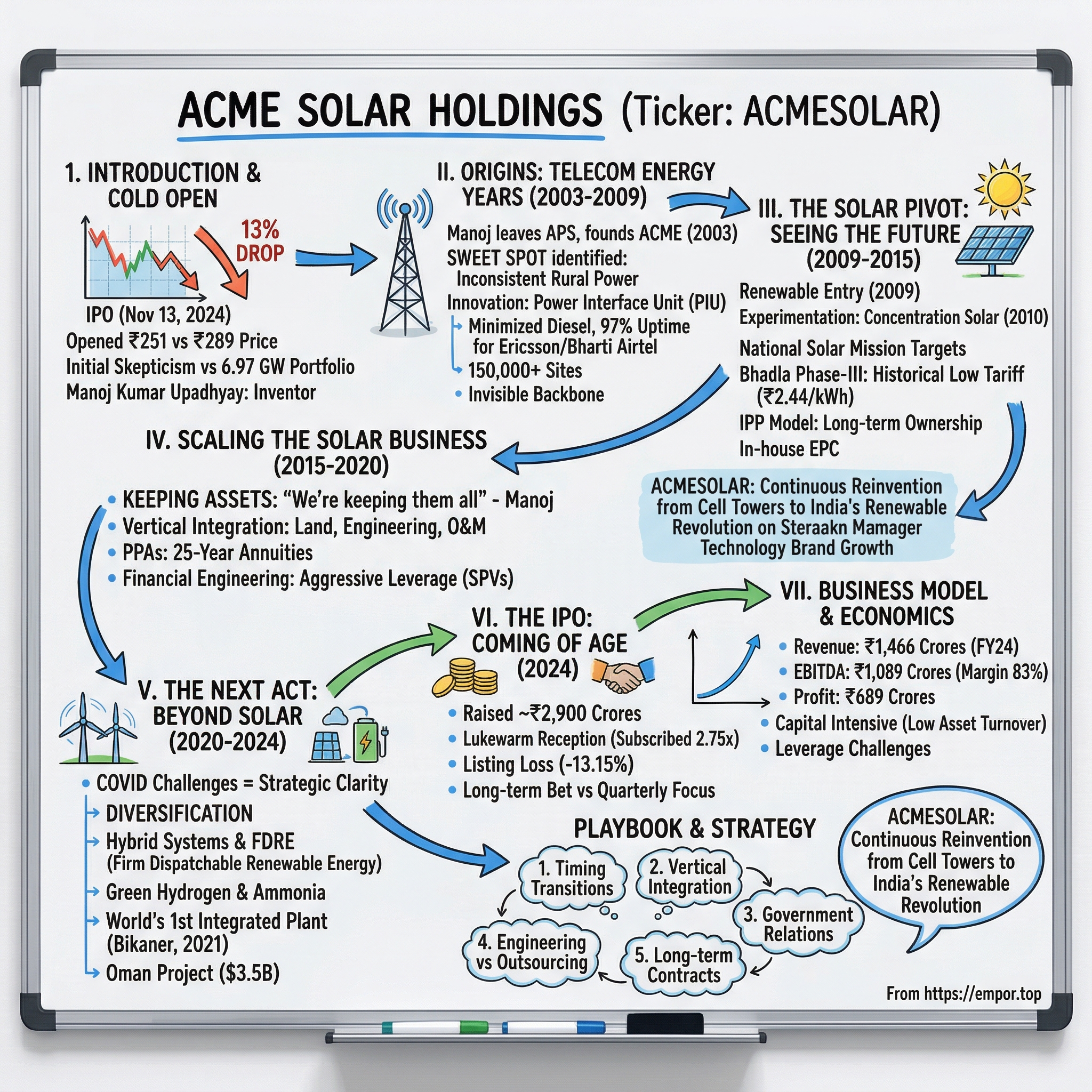
On the morning of November 13, 2024, the opening bell on the National Stock Exchange delivered a verdict that had nothing to do with sunshine. ACME Solar Holdings — ticker ACMESOLAR, and 544283 on the BSE — had priced its initial public offering at ₹289 per share, the top of a ₹275–₹289 band, raising ₹2,900 crore.1 The shares opened at ₹251. A 13.15% haircut, before lunch, on day one.2
The book had told the story in advance. The offer closed subscribed just 2.75 times overall — institutions took 3.54 times their allocation, retail 3.10 times, and the high-net-worth bucket did not even fill, at 0.97 times.3 For an Indian renewable-energy company in a market that had spent two years handing out triple-digit listing pops to far flimsier businesses, this was a rebuke with a specific address. Public investors were not skeptical about solar. They were skeptical about this shape of solar: a leveraged independent power producer, carrying roughly ₹9,892 crore of borrowings on a consolidated basis as of August 31, 2024, earning a return on equity in the low single digits, and asking the market to fund a construction pipeline several times larger than the assets it already ran.[^4]
Underneath the discount sat a genuinely large asset base: a 6.97 GW portfolio spanning operational, under-construction and awarded solar, wind, hybrid and Firm and Dispatchable Renewable Energy projects across ten states.[^4] The market looked at that number and asked the only question that matters for capital-intensive infrastructure: at what cost of capital, and returning what to equity?
Twenty-one months later, the answer looks different from the one the order book priced. In the quarter ended June 30, 2026, ACME Solar reported revenue of ₹954 crore, up 63% year on year, EBITDA of ₹831 crore, and profit after tax of ₹235 crore, up 80%.4 Its shares changed hands around ₹374 in mid-August 2026, well above the issue price and near an all-time high, for a market capitalisation in the vicinity of ₹26,000 crore.5 The company that could not fill its HNI book raised ₹2,800 crore from institutions in a three-day qualified institutional placement in June 2026 — with Nippon, SBI, Kotak and HDFC mutual funds among the buyers.6
That reversal is the reason this story is worth telling carefully rather than triumphantly. Something changed between 2024 and 2026, and it was not simply that the sun kept shining.
The central thesis
The question that organises everything that follows: how did a company founded in 2003 to make passive cooling boxes and power conditioners for telecom towers end up among India's larger renewable independent power producers — and, more interestingly, become the single largest owner of commissioned grid-scale battery storage in the country?
The through-line is a founder, Manoj Kumar Upadhyay, who has repeatedly done the thing that looks reckless eighteen months before it looks obvious. In May 2017 he shocked the Indian power sector by bidding ₹2.44 per kilowatt-hour for solar at Bhadla — a number so low that competitors publicly questioned whether the project could be built.7 Five years later he pushed the balance sheet into Firm and Dispatchable Renewable Energy and lithium-ion batteries while most Indian peers were still modelling plain solar.
That is the pioneer's pattern, and it is also the pioneer's dilemma. Being early in an auction-driven, government-procured business earns you a price for a few years — until every competitor learns to model the same thing and bids the premium away. The 2017 tariff record is not a moat today; it is a historical artifact. The battery lead is real right now. Whether it is durable is the live question.
Layered on top is a capital-allocation puzzle that Indian infrastructure keeps posing and rarely answers cleanly. For a decade ACME built projects and then sold them — to Brookfield, to Actis, to Scatec, to Petronas-backed Amplus — recycling scarce equity out of de-risked operating assets and back into higher-return development.89 That model made ACME a formidable developer. It did not make it a compounder, because compounding requires keeping the cash flows. The post-IPO company is trying to be both, and the tension between those two identities runs through every section that follows.
Roadmap
We start in the telecom equipment business of the mid-2000s, where the operating DNA was formed. We move through the solar pivot and the tariff war that made ACME infamous; the utility-scale IPP engine and the asset-recycling machine that funded it; the pivot into FDRE, storage and backward integration; the anatomy of the listing and the deleveraging that followed; the segment economics and where the money actually comes from; the competitive field, where ACME is decisively not the biggest player; the strategic frameworks that test whether any of this constitutes an advantage; governance and a skeptic's cross-examination; the live risk radar; the bull and bear cases with the two or three metrics that genuinely matter; and finally the durable lessons.
It begins, improbably, with a mobile phone tower in rural India that kept losing power.
 Subscribe on LinkedIn
II. Origins: The Telecom Infrastructure Years (2003–2009)
In January 2003, Manoj Kumar Upadhyay walked away from his stake in a power-systems venture called APS, handing it to his collaborators, and started again from nothing under a new name: ACME.10 He was not a finance man or a family-business heir. He was an engineer — one who had worked as a research engineer and technical head at Benning GmbH in Germany, a telecom power specialist, where his job had been to modify European power systems to survive Indian conditions.10 That detail is the whole origin story in miniature: his professional formation was about the gap between what equipment was designed for and what India actually did to it.
India in 2003 was doing something violent to electrical equipment. The mobile phone boom was moving out of the metros and into districts and villages, and every new subscriber required a base transceiver station — a cabinet of sensitive electronics sitting on a tower, needing clean, continuous power and a controlled temperature. The rural grid supplied neither. Voltage swung wildly, outages ran for hours, and the industry's answer was to bolt a diesel generator to every site and burn fuel around the clock. Diesel was expensive, the logistics of trucking it to thousands of remote towers were absurd, and the air-conditioning units keeping the cabinets cool were themselves enormous power hogs.
The break came fast — roughly three months after ACME's founding. Someone from Ericsson approached Upadhyay about the power problem plaguing towers it was building for Bharti Airtel, and he responded with a Power Interface Unit: an electronics package that took the erratic mains supply and conditioned it into something the base station could actually use.10 Alongside it came passive cooling — engineering the enclosure itself to shed heat so that the air conditioner ran far less, or not at all.
It is worth being precise about why this was a good business rather than merely a clever product. ACME was not selling towers a nicer box. It was selling them a reduction in diesel consumption, which was one of the largest recurring line items in a tower company's operating cost. The pitch was arithmetic, not aesthetics: here is what you spend on fuel today, here is what you spend after, here is the payback period. In a market where thousands of towers were going up every month, a product that paid for itself in fuel savings sold itself.
The growth was extraordinary. ACME Tele Power went from a turnover of around ₹30 lakh in 2003 to roughly ₹2,000 crore by 2009 — a business that multiplied several thousandfold inside six years.11 Along the way it accumulated a portfolio of core patents around its power-electronics and thermal-management designs.
What the telecom years actually built
Strip away the products and three durable capabilities emerge, all of which matter to the ACME of 2026.
The first is power electronics as a native language. The company's founding competence was managing the messy interface between an unreliable grid and equipment that demands stability. Two decades later, that is a startlingly good description of what a grid-scale battery does — absorb power when the grid has too much, release it when the grid has too little. ACME's storage pivot is less of a leap than it appears from the outside.
The second is high-volume execution under compressed timelines. Telecom rollout in that era was a land grab; operators added sites at a pace that punished any supplier who could not ship, install and commission on schedule. A culture that internalises "the deadline is the product" carries over directly into an industry where a missed commissioning date triggers contractual penalties.
The third is comfort operating inside Indian infrastructure bottlenecks rather than around them. ACME's entire value proposition was monetising the fact that Indian infrastructure did not work properly. That is a specific kind of institutional temperament, and it is not the same as engineering excellence.
There is a fourth lesson, and it is the one Upadhyay appears to have drawn himself. Telecom hardware was destined to commoditise. Passive cooling and power conditioning were clever, but they were bounded — a fixed addressable market that would eventually be served by cheaper competitors, and a customer base of three or four buyers with enormous leverage. He had built a high-margin equipment business on a tailwind that had a visible end.
So he went looking for the next multi-decade infrastructure tailwind, one with a longer runway and, crucially, a different customer: not a handful of price-squeezing telecom operators but the Indian state itself, buying electricity on twenty-five-year contracts. The transition from selling boxes to owning assets is one of the hardest in business — it converts a working-capital business into a balance-sheet business, and swaps quick cash conversion for two decades of patience. ACME made it anyway.
III. The Great Solar Pivot & Breaking Tariff Records (2009–2015)
To understand why 2009 was the right year to make an irreversible bet on Indian solar, you have to remember how badly Indian electricity worked. The country ran chronic peak power deficits through the 2000s. Factories kept captive diesel gensets because the grid could not be trusted. Load-shedding was a scheduled feature of urban life. Demand was structurally ahead of supply, and everybody knew it would stay that way for a decade.
Simultaneously, something was happening in global photovoltaics that most Indian power executives were not tracking closely: module prices had entered a cost-deflation curve of a kind rarely seen in heavy industry. Solar panels were behaving less like turbines and more like semiconductors — every doubling of cumulative production knocked a predictable percentage off unit cost.
The policy trigger arrived with the Jawaharlal Nehru National Solar Mission, which gave India a formal architecture for procuring utility-scale solar: standardised auctions, standardised long-term contracts, and a central counterparty. For a developer, this converted solar from a speculative technology bet into something a bank could underwrite.
ACME entered renewables in 2009 and commissioned its first solar plant in 2012 — a three-year gap that is itself instructive about how long it takes to convert intent into concrete in Indian infrastructure. In 2015 the renewable business was formally consolidated under ACME Solar Holdings.12
The decision to own the shovel
The most consequential structural choice of this era was one that never made headlines: ACME built full in-house Engineering, Procurement and Construction capability rather than contracting the work to specialists like Sterling and Wilson or Larsen & Toubro.
Think about what this means economically. In the outsourced model, a developer hires a contractor who builds the plant for a fee that includes the contractor's profit margin. That margin — call it a mid-single-digit percentage of project cost — is permanently gone from the developer's returns. In a business where levered equity returns live in the low-to-mid teens, several percentage points of project capex is not a rounding error; it is a meaningful slice of the equity return.
Doing it yourself captures that margin, and it does something subtler: it gives you real-time cost information. A developer who outsources knows what the contractor charges. A developer who self-performs knows what things actually cost — which cable run is over budget, how many days the transformer really takes to energise. In an auction business where you commit to a price for twenty-five years before you have bought a single panel, knowing your own cost structure to the rupee is the difference between a disciplined bid and a hopeful one.
The trade-off is honest and permanent: fixed overhead. An in-house EPC organisation is a standing army. When the pipeline is full it is a margin machine; when auctions dry up it is a cost centre with nothing to build. This choice only pays if you can keep it fed — a constraint that quietly explains a great deal of ACME's subsequent appetite for growth.
The ₹2.44 bid
In May 2017, the Solar Energy Corporation of India auctioned 500 MW at Bhadla Solar Park in Rajasthan. ACME Solar won 200 MW at ₹2.44 per unit — the lowest solar tariff ever discovered in India at that point. SBG Cleantech took 300 MW at ₹2.45.7 The tariff was fixed for twenty-five years with no escalation, and the winners sought no viability gap funding from the government.7
The Indian power sector reacted with something close to alarm. The number sat below prevailing coal-fired tariffs from many thermal plants — meaning solar had crossed from "clean but subsidised" to "cheapest available," without a subsidy, in a country whose entire energy planning apparatus assumed coal was the cheap baseload option.
The competitive reaction was less about climate policy and more about survival. Incumbent developers argued the bid was undeliverable — that ACME would breach covenants, fail to arrange debt, or simply walk away from the letter of award. This is standard behaviour in auction industries: when a rival discovers a price you cannot match, the comfortable explanation is that they made a mistake.
How did the arithmetic work? Three components. First, a forward view on module prices: bidders were committing to a tariff eighteen to twenty-four months before they would actually buy panels, and ACME bet that the cost-deflation curve would keep bending. Second, in-house EPC compressing balance-of-plant costs — the civil works, mounting structures, cabling and substation that make up the non-module half of a solar plant, and where an efficient builder genuinely beats an average one. Third, the specific advantage of a solar park: Bhadla came with land and evacuation infrastructure pre-arranged, stripping out the two risks that kill Indian renewable projects.
The projects were built. PPAs for the Bhadla capacity were signed in November 2017, and the plants entered commercial operation.13 The skeptics were wrong about deliverability.
But they were right about something else, and it is the part that gets lost in the mythology. A record-low tariff is a permanent commitment to a low revenue per unit for twenty-five years. If your cost assumptions come in slightly worse than modelled — a rupee that depreciates faster, an interest rate that resets higher, a module shipment that arrives late — there is no mechanism to recover. You have sold your output at the bottom of the price range for a quarter of a century.
That is the honest reading of ₹2.44: it was a brilliant piece of competitive positioning and a genuinely thin piece of economics. It established ACME as a developer who could see around corners. It also locked a meaningful chunk of early portfolio into tariffs that would never look generous again. The company's later average portfolio realisations — and the low returns on equity that so bothered IPO investors — trace partly back to auctions won in this era.
The deeper market impact outlived any single project. After May 2017, no Indian state utility could justify signing a new long-term thermal contract without explaining why it was not buying solar instead. ACME did not just win 200 MW. It moved the reference price for an entire economy's electricity procurement — and then had to go live inside the price environment it had created.
IV. The Utility-Scale IPP Engine & Capital Recycling Model (2015–2020)
There is a moment in every Indian renewable project that never appears in an investor presentation. It happens in a tehsil land records office, where a company representative is trying to establish who actually owns a particular twenty-acre parcel — and discovers that the registered owner died in 1987, that the land has been informally divided among eleven heirs, that three of them live overseas, and that two of the remaining eight dispute the division.
Multiply that by the several thousand contiguous acres a utility-scale plant requires, and you have the real bottleneck in Indian renewables. It is not panels. It is not even money. It is assembling a contiguous, litigation-free land bank near a high-voltage substation, at a cost that lets you honour the tariff you already bid.
Why utility-scale, and why central off-takers
ACME made an early and consequential choice to concentrate on utility-scale generation sold to central intermediaries — the Solar Energy Corporation of India, NTPC, and later NHPC and SJVN — rather than the commercial and industrial rooftop market that attracted several peers.
The logic is credit, not engineering. A utility-scale PPA with a central agency is a standardised twenty-five-year contract with a counterparty backed, directly or indirectly, by the sovereign. It is boring, it is bankable, and a lender will finance seventy-five to eighty percent of the project cost against it. The C&I market offers better tariffs and shorter contracts, but every customer is a separate credit assessment, and open-access regulations can be rewritten by any state government that decides it is losing its most profitable industrial consumers.
For a company that intended to lever aggressively, bankability beat headline tariff. That choice compounds: because ACME's contracts were financeable, it could grow faster than its equity alone would allow.
The counterparty question is not academic. Andhra Pradesh demonstrated as much when a change of state government led to attempts to renegotiate signed renewable PPAs — the precise nightmare scenario for an asset with a twenty-five-year fixed-price contract and no alternative buyer. The episode ran through the courts and regulators for years, and ACME was still recovering disputed dues from AP discoms as recently as FY25.[^15] It is the clearest possible illustration of why "who signs the cheque" matters more than "how big is the cheque."
Geographically, the portfolio concentrated where the resource was best and execution easiest: Rajasthan above all, plus Andhra Pradesh, Telangana, Karnataka and Madhya Pradesh. Rajasthan's appeal is straightforward and enduring — the highest global horizontal irradiance in the country, cheap flat land, and the longest dry season in India, which matters enormously when your critical path is civil construction.
The capital recycling engine
Here is the structural problem ACME faced through this period, and it is worth stating plainly because it explains a decade of behaviour.
Building a gigawatt of solar requires roughly ₹4,000–4,500 crore of capital. Even at 80% leverage, the equity cheque is ₹800–900 crore per gigawatt. Domestic banks had sector exposure limits and charged 9–11% for project debt. And an operational solar plant, once built, throws off a stable but unspectacular cash yield — good for a pension fund, useless for a developer trying to grow at forty percent a year.
ACME's answer was to become an asset manufacturer. Build the project, take it through the highest-risk phases — land, connectivity, construction, commissioning — and then sell the de-risked operating asset to a global infrastructure investor whose cost of capital was structurally lower.
The buyers were exactly who you would expect. Brookfield Renewable agreed a deal covering a 450 MW solar project in Rajasthan.9 Actis's Long Life Infrastructure Fund acquired a 400 MW portfolio, and a 100 MW project went to Petronas-owned Amplus.8 Scatec ASA partnered on a 900 MW Rajasthan project as an equal partner. Denmark's state fund IFU and the UN's S3i took 39% and 10% respectively in a 250 MW Rajasthan project.8 By 2019, press reports had Brookfield and Actis in discussions over a further roughly 300 MW slice valued near ₹1,200 crore.8
Why would sophisticated global investors pay up for assets a developer wanted to sell? Because they were buying a different risk profile. A commissioned plant with a signed PPA and an operating history is a bond-like instrument. A pension fund with a 7% required return values that stream far more highly than a developer with a 15% hurdle. The developer captures the difference. This is not financial engineering; it is a genuine arbitrage between two investors' costs of capital, and it is how infrastructure gets built in every emerging market.
The uncomfortable question
The skeptical framing is equally valid, and post-listing investors are entitled to press it. Every asset sale converts a twenty-five-year annuity into a one-time gain. If your reported cash generation depends on periodically selling the crown jewels, you are not compounding — you are running a treadmill, and the treadmill only works while buyers keep showing up at attractive prices.
The honest answer is that both readings were true at different times. Pre-IPO ACME had no realistic alternative: it could not access equity markets, domestic banks were expensive and capped, and the only way to fund the pipeline was to monetise what it had already built. Recycling was a constraint dressed as a strategy.
What the IPO changed was not the wisdom of recycling but the availability of alternatives. A listed company with a rated balance sheet can raise equity, issue bonds, and refinance at lower spreads. The interesting test — which we will return to — is whether ACME uses those alternatives to retain assets, or reverts to the flipping model when growth outruns funding.
By 2020, the constraint that had defined ACME's first decade in solar was about to be replaced by a very different one. The problem was no longer that India needed more solar power. It was that India was starting to have too much of it at exactly the wrong time of day.
V. The Next Act: Hybrid, FDRE, and Backward Integration (2020–2024)
Draw India's daily electricity demand as a line across twenty-four hours and it has a distinctive shape. It rises through the morning, dips modestly at midday, and then climbs to a hard evening peak as tens of millions of households switch on lights, fans, televisions and air conditioners after sunset. Now overlay solar generation: a bell curve peaking at noon, falling to zero by seven in the evening.
The mismatch is the entire problem of the 2020s Indian grid. It is called the duck curve, and every gigawatt of new solar makes it worse. Midday brings a glut of power nobody needs, driving prices toward zero and forcing grid operators to curtail renewable output. Then the sun sets, demand peaks, and the system scrambles for expensive dispatchable generation — usually coal or gas.
Once you see this, you understand why the Indian procurement machine changed its shape, and why ACME reorganised its entire business around the change.
From energy to firmness
The auction structures that emerged were Firm and Dispatchable Renewable Energy — FDRE — and round-the-clock tenders. Instead of buying kilowatt-hours whenever the weather supplies them, these contracts require a developer to guarantee availability during specified hours, typically at 85–90% of contracted capacity during peak windows, with financial penalties for shortfalls.
CEO Nikhil Dhingra explained the distinction with useful precision on the Q1 FY26 earnings call: FDRE and solar-plus-storage are technically the same architecture, and the tenders use the terms almost interchangeably. The real variable is duration. "A solar plus storage tender can have a peak for 2 hours, 4 hours, and beyond that you will need to put some bit of wind if you want to extend at a competitive price," he told analysts — while ACME's FDRE contracts typically carry four hours of storage.14
He was also unusually candid about a design choice most developers do not volunteer: ACME deliberately minimises the wind component in its FDRE projects. Wind resource is harder to forecast than solar, and forecast error in a firmness contract translates directly into penalties. "The wind resource assessment is a complication which is not execution-wise heavy. But from a risk perspective, it is heavy, which we are trying to minimize by not putting much wind," Dhingra said, adding that ACME sizes batteries to meet the full requirement rather than relying on wind to fill gaps.14
That is a genuinely informative admission. It says ACME chose to buy certainty with capital expenditure rather than harvest a cheaper resource and absorb variability risk. It costs more upfront. It makes the revenue far more predictable. For a levered business, predictable beats cheap.
The tariff structure reflects the added complexity. Under-construction FDRE contracts in ACME's book carry tariffs of ₹4.33 to ₹4.73 per unit with NHPC, SECI and SJVN, against a hybrid project with NTPC at ₹3.36 — and in the June 2026 quarter the company signed a 300 MW FDRE project with SECI at ₹6.28 per unit alongside a 300 MW hybrid at ₹3.25.1516 That ₹6.28 number is roughly two and a half times the famous Bhadla tariff, and it is the clearest evidence available that the market now pays substantially for when power arrives, not merely that it arrives.
Batteries, and the decision not to be clever
The storage build has become the most consequential thing happening inside this company, and it moved faster than management's own guidance.
The sequencing matters. In the June 2025 quarter, ACME had placed orders for over 3.1 GWh of batteries with 南都电源 Narada and 天合光能 Trina, and had just won its first standalone storage contract — 550 MWh with NHPC, with the PPA signed inside a month.14 By March 2026 it had commissioned roughly 2.32 GWh, one of India's largest battery deployments.15 By July 2026 commissioned storage stood at 3,621 MWh — around 3.62 GWh — after roughly 2.3 GWh went live in a single quarter.1617 Management put its share of India's cumulative commissioned battery capacity at approximately 40%, and raised FY27 guidance to more than 10 GWh, pulling the target forward by roughly three quarters.4
Two strategic decisions inside that build deserve scrutiny.
The first is sourcing. Asked repeatedly by analysts why ACME imports fully containerised battery systems rather than importing cells and assembling locally — which would save duty — Upadhyay was blunt. "India is deploying for the first time a large scale battery," he said, arguing that at this stage of the market it was more important to get a complete product from a supplier with global deployment experience than to chase cost. Dhingra quantified the trade precisely: cells are about 40% of pack cost, the duty differential is roughly 6% on that portion, so local assembly saves about 2.4% of total cost — in exchange for fragmenting the fifteen-year performance warranty across a smaller integrator. "For 2.5 percentage of cost improvement, are you willing to sacrifice a large FDRE project revenue? We are currently not in favor of that," he said. Group CFO Rajat Singh added that Indian insurance markets had not developed enough to wrap the resulting patchwork of liabilities.14
This is a defensible answer and an unusually specific one — management showed its arithmetic rather than gesturing at "quality." It also reveals a strategic posture worth noting: ACME has explicitly chosen not to integrate backward into storage manufacturing. "We are a developer. We are not a manufacturer at the end of the day," as Singh put it.14 Suppliers have since expanded to include 宁德时代 CATL and Hithium.16
The second decision is early commissioning. Rather than waiting for the full FDRE projects to complete, ACME energised the battery portions early, plugging them into transmission infrastructure already built for existing operational plants, and sold the storage service into short-term markets. That generated ₹226 crore of revenue in the June 2026 quarter alone from roughly 3.1 GWh, with realisations of ₹8–10 per unit on merchant peak-power sales, and more than ₹1,400 crore of short-term contracts locked in for part of the FY27 capacity.164
The capital cost is disclosed at roughly ₹93 lakh per MWh — approximately $100 per kilowatt-hour all-in, including transformers and power conversion systems.16 Battery EBITDA margin runs around 82%, below the 88–91% of the core renewable portfolio, because the cost of purchased charging power sits in operating expenses.164
The strategic read: ACME found a way to earn merchant returns on assets contracted for something else, during the window before the contracts start. That is genuinely clever capital efficiency. It also means a meaningful share of current storage revenue is uncontracted — management indicated roughly 85% of battery revenue currently comes from short-term arrangements and acknowledged "potential for price normalization" as peak-power scarcity eases.4 Investors should treat today's ₹8–10 per unit realisations as a cyclical windfall, not a run-rate.
Manufacturing and hydrogen: the perimeter question
Two adjacent ventures require careful boundary-drawing, because both sit under the ACME Group umbrella rather than clearly inside the listed company.
ACME commissioned a 1.2 GW solar module manufacturing plant in Jaipur with an investment of about ₹230 crore, employing over 700 people, and secured inclusion in the Ministry of New and Renewable Energy's Approved List of Models and Manufacturers — the domestic-content regime that restricts which panels can be used in government-backed projects.18 The stated ambition runs further: a cell plant, and ₹10,000 crore of revenue from module and cell manufacturing by 2030, housed in a new entity called ACME Renewable Equipment Manufacturing.18
The critical point for a shareholder in ACMESOLAR: module manufacturing does not appear as a reported business segment in ACME Solar Holdings' investor materials, which describe the listed entity's capabilities as long-term contracted cash flows, in-house EPC and O&M, and technology adoption.15 The manufacturing venture is best understood as a group-level supply-chain hedge against ALMM constraints and import duties — useful to the listed company as a procurement option, but not a disclosed profit driver of it.
The same discipline applies to green molecules, at far larger scale. ACME Cleantech is building a green hydrogen and ammonia complex at Duqm in Oman. Phase 1 carries a binding offtake with Norway's Yara for 100,000 tonnes per year of renewable ammonia.19 In June 2026 the group signed an investment agreement with Oman's special economic zone authority for Phases 2 and 3 — a roughly $4.2 billion expansion, each phase targeting 400 kilotonnes per year of ammonia and 71 kilotonnes of hydrogen, with commercial operations targeted for 2030 and 2033.20
These are enormous, early-stage, capital-hungry projects with unproven end-market economics. They sit in the promoter entity, not the listed IPP. For investors, that is simultaneously reassuring — the listed balance sheet is not funding them — and a governance flag, because a promoter with a multi-billion-dollar capital commitment elsewhere has attention and resources deployed outside the company whose shares you own. The related-party perimeter between ACME Solar Holdings and ACME Cleantech is not a footnote; it is a standing item on any serious diligence list.
Which brings us to the moment those questions were first put to public investors, at a price.
VI. The IPO Anatomy: Listing Discount & Debt De-leveraging (2024)
The mechanics were conventional. ACME Solar Holdings opened its offer on November 6, 2024, targeting ₹2,900 crore at a band of ₹275 to ₹289 per share.1 The structure split ₹2,395 crore of fresh issue — new money into the company — against ₹504.96 crore of offer for sale by promoter ACME Cleantech Solutions.1 The day before opening, the board allotted 4.5 crore shares at ₹289 to 58 anchor investors, raising ₹1,300.50 crore, with participants including Nippon, HDFC and ICICI Prudential mutual funds and the Abu Dhabi Investment Authority.21
Strong anchors, weak book. That combination is diagnostic. It says long-horizon institutions were willing to underwrite the asset base at the offered price, while the marginal, price-sensitive buyer was not.
Reading the discount honestly
The bear case in November 2024 was not vague. Four specific objections showed up in the pre-listing commentary, and each was grounded in the disclosed financials.
Return on equity had averaged in the neighbourhood of 4.6% — a number that, against an Indian cost of equity of roughly 12–14%, described a business destroying economic value on the reported measure. Leverage was high, with consolidated fund-based borrowings near ₹9,892 crore against a far smaller equity base.[^4] Revenue had actually contracted over the preceding five years on a compound basis, an artifact of the asset-recycling model: when you sell operating plants, reported revenue falls even as the business grows. And the pipeline was several times the operating fleet, meaning most of the value depended on execution that had not yet happened.
There is an important accounting subtlety underneath the ROE complaint that deserves explanation, because it recurs throughout this story. A renewable IPP under construction is a machine for generating expenses without revenue. Interest on construction debt and depreciation on newly commissioned assets hit the profit and loss statement immediately, while the revenue from those assets ramps over months and years. A company adding capacity fast will therefore look structurally unprofitable on accounting measures even when the underlying projects are perfectly sound. This is why the industry watches cash profit — profit plus depreciation — alongside reported earnings.
That does not make the ROE criticism wrong. It makes it incomplete. The genuine question was never "is reported ROE low?" — it obviously was — but "does reported ROE rise as the construction book converts to operations, or is this a structurally low-return business?" The market in November 2024 declined to pay in advance for the optimistic answer.
Where the money went
The proceeds had a specific job. Of the fresh issue, ₹1,795 crore was earmarked for investment in subsidiaries to repay or prepay a portion of their outstanding borrowings, with the balance for general corporate purposes.[^4]
The mechanism is worth spelling out because it drives most of the subsequent earnings improvement. In a project-finance structure, each plant sits in its own subsidiary carrying its own debt at its own interest rate. Retiring the most expensive of that debt does three things at once: it directly cuts the finance cost line; it improves the interest coverage ratio, which had historically been tight; and it improves the credit profile of the borrowing entities, which lowers the rate on everything that gets refinanced later.
That third effect is the one that compounds, and the evidence since listing supports it. In April 2025 the company secured ₹2,491 crore of refinancing.22 In the June 2025 quarter it drew ₹1,070 crore for a 250 MW operational project at 8.5% fixed for five years — a 95 basis point reduction — and in doing so brought Bank of America, Standard Chartered and India Infradebt into its lender group for the first time.14 Across FY26 it tied up over ₹15,000 crore of debt for roughly 1.5 GW of construction and refinanced about ₹3,300 crore across 850 MW of operational projects, cutting rates by around 150 basis points.15 By the June 2026 quarter, the weighted average cost of debt on operational projects stood at 8.4%, and over ₹6,000 crore had been arranged with REC and PFC for 700 MW of FDRE.16
The credit ratings tell the same story with less noise. In July 2025, the holding company carried an A+ rating with positive outlook, and CFO Rajat Singh told analysts the ambition was to move the group consistently into the AA family as more central-agency projects entered the portfolio.14 By early 2026 ACME Solar Holdings itself held AA-/Stable from both CRISIL and ICRA, with roughly 2.2 GW of operational projects separately rated AA-.15
That is a management team that stated a specific financing objective on a public call and then delivered it within twelve months. It is one of the more concrete credibility data points available in this story, and it is worth more than any strategic narrative.
The proof of the deleveraging thesis shows up in the operating numbers — which is where we go next.
VII. Segment Breakdown, Unit Economics & Financial Anatomy
Strip ACME Solar to its economic core and it is one business with two accounting faces.
At the consolidated level, essentially all revenue is the sale of electricity. The in-house EPC operation shows up only in the standalone accounts, because when a company builds plants for its own wholly-owned subsidiaries, the construction revenue eliminates on consolidation. The scale of that internal activity is striking: standalone revenue for FY26 was ₹4,357 crore with an EBITDA margin of 17.1%, against consolidated revenue of ₹2,507 crore.15 The EPC arm is, in revenue terms, larger than the power business — it just never reaches the consolidated top line.
This is worth understanding rather than glossing over, because it is where a chunk of the value creation happens invisibly. Every rupee of construction margin ACME does not pay to Larsen & Toubro or Sterling and Wilson stays inside the group as a lower capitalised project cost, which shows up years later as a better return on a plant that a shareholder never sees quoted as "EPC profit."
The generation business
The consolidated economics are what you would expect from utility-scale renewables and then some. FY26 delivered revenue of ₹2,507 crore, up 59.2%; EBITDA of ₹2,265 crore, up 61.2%, at a 90.3% margin; and profit after tax of ₹498 crore, up 98.5%.15
A 90% EBITDA margin sounds implausible until you understand the cost structure. A solar plant has no fuel. Once built, its operating costs are module cleaning, inverter maintenance, security, insurance and land lease — a small fraction of revenue. Essentially all of the economics sit above the EBITDA line; the entire competitive contest happens in capital cost and cost of debt, which appear below it. That is why this industry's winners and losers are separated by financing skill, not operating skill.
Unit economics, project by project: pure solar costs roughly ₹4.0–4.5 crore per MW to build; hybrid and FDRE configurations with storage run ₹6.5–8.0 crore per MW. Solar plant load factors sit in the 24–28% range on AC capacity, while FDRE hybrid configurations achieve far higher effective utilisation. Projects are financed at roughly 75:25 or 80:20 debt to equity, generating unlevered project returns around 10–12% and levered equity returns in the low-to-mid teens.
Management has been specific about its own hurdle. On the standalone storage project won with NHPC, Dhingra said returns were "in high-teens" and added the discipline directly: "We don't do a project which is less than a 16% return."14 Whether that hurdle survives competitive pressure is exactly what the auction results will reveal over the next two years.
The operational evidence
The most encouraging numbers in ACME's disclosure are not the financial ones. They are the operating metrics, because those are harder to engineer.
Capacity utilisation factor — the share of theoretical maximum output a plant actually delivers — improved from 27% in the June 2024 quarter to 28.5% a year later to 30.9% in the June 2026 quarter, the highest in company history.1416 Rajasthan assets with 2,250 MW of contracted capacity delivered 32.5% in that quarter, and the 150 MW wind fleet ran at 41.4%.16 Generation reached 2,020 million units, up 23%.4
Rising CUF on a portfolio that is also growing is a meaningful signal. It means the newer plants are better than the older ones and the existing plants are being run harder — a combination that suggests genuine operating improvement rather than favourable weather alone.
The receivables story is even starker. Days of sales outstanding fell from 181 in FY23 to 93 in FY24 to 42 in FY25 to 14 in FY26.15 Getting paid in two weeks in the Indian power sector is close to remarkable, and the cause is structural rather than clever: central off-takers accounted for 67% of the operational portfolio and 84% of the total portfolio, and central agencies pay on time in a way that financially stressed state distribution companies do not.15
The balance sheet, honestly
This is where the picture requires care, because two things are true simultaneously.
The leverage ratios have improved substantially. Net debt to trailing EBITDA on the operational portfolio fell from 4.4x at March 2025 to 3.9x at March 2026 to 2.9x by June 2026, against a management ceiling of 5.5x.1516 Net debt to net worth moved from 2.5x at March 2026 to 1.6x in June 2026.16 Cash return on equity reached 20.1% for FY26 — a very different number from the 4.6% accounting ROE that spooked IPO investors.15
And yet the absolute asset base keeps expanding: ₹21,952 crore at March 2026, ₹24,910 crore by June 2026, with capital work in progress of ₹5,297 crore.1516 Net debt was ₹12,600 crore in June 2026 — of which ₹5,050 crore relates to projects not yet earning anything.16
Two caveats belong alongside the improved ratios. First, the June 2026 improvement was substantially driven by the QIP: management explicitly attributed the lower net-debt-to-EBITDA and net-debt-to-net-worth ratios to the equity inflow.16 Deleveraging by issuing shares is real deleveraging, but it is a different achievement from deleveraging out of cash flow. Second, cash return on equity actually fell from 23.0% to 17.3% year on year for the same reason — a larger equity base against the same profits.16 Both effects will reverse as the new capital converts into operating assets, but investors should not read the June 2026 ratios as an organic trend line.
The deeper point stands: a company that generates roughly ₹2,565 crore of trailing EBITDA against ₹7,550 crore of operational net debt is not a distressed borrower.16 The financial pathology that dominated the IPO narrative has materially eased. What remains is a straightforward capital-intensity question — whether the returns on the next ₹15,000–20,000 crore of capital expenditure match the returns on the last tranche.
Which raises the obvious comparison: against whom, in a field with players many times ACME's size?
VIII. Industry Dynamics, Named Peers & Competitive Scale
India's stated ambition is 500 GW of non-fossil capacity by 2030. The relevant question for an investor is not whether the target is met — targets are political artifacts — but what the pursuit does to the competitive structure of the industry.
On the evidence, it has done two things: expanded the addressable market enormously, and simultaneously ensured that returns get competed toward the cost of capital. In the June 2025 quarter alone India added over 12 GW of renewable capacity, taking total installed renewable capacity including large hydro to roughly 234 GW, with non-fossil sources crossing 50% of total installed electric capacity five years ahead of the original schedule.14 Everyone can build. That is precisely the problem.
The procurement architecture has shifted underneath the volume. Plain vanilla solar and wind tenders have given way to FDRE, peak power and round-the-clock structures run by SECI, NTPC, SJVN and NHPC — a transition that rewards technical sophistication and balance-sheet capacity over pure land aggregation.23 Policy has followed: the Ministry of Power announced a second tranche of viability gap funding for storage with an outlay of around ₹5,400 crore at ₹18 lakh per MWh, enabling roughly 30 GWh of battery deployment, and extended the 100% inter-state transmission charge waiver for co-located storage commissioned by June 2028.14 The MNRE also extended the commissioning deadline for renewable projects to December 31, 2026, and the Central Transmission Utility began processing storage connectivity requests under a right-of-first-refusal mechanism.415
Where ACME actually sits
The scale comparison is not flattering, and pretending otherwise would be dishonest.
Adani Green Energy crossed 20.1 GW of operational capacity in the June 2026 quarter, up 27% year on year — roughly seven times ACME's operational generation fleet.24 Its Khavda development in Gujarat is conceived as a single site larger than most countries' entire renewable programmes, and it has access to Adani Group's domestic capital machinery and a partnership with TotalEnergies.
NTPC Green Energy crossed 10,076 MW of operational capacity at March 2026 and reported FY26 consolidated profit after tax of ₹521 crore.25 Its advantage is not engineering; it is the balance sheet of its state-owned parent. A public sector undertaking with sovereign-adjacent credit borrows at rates a private developer simply cannot match, and in a business where financing cost determines the winning bid, that is close to a structural head start.
Tata Power Renewable Energy reached 10.9 GW of total renewable capacity with roughly 5.5 GW operational — 4.5 GW solar and 1 GW wind.26 Its differentiation is genuine vertical integration: cell and module manufacturing inside the listed group, plus rooftop, EV charging and distribution businesses that no pure-play IPP possesses.
ReNew, with a portfolio around 18.5 GW, spent much of 2025 as an acquisition target — a consortium including Masdar (مصدر Masdar), CPP Investments, ADIA and chairman Sumant Sinha bid to take it private before Masdar withdrew in December 2025 and the talks terminated.27 That episode is itself a data point about how the market values Indian renewable platforms: even a large, established operator could not agree a clearing price with its own controlling shareholders.
Against that field, ACME Solar operates roughly 2,990 MW of generation with a total portfolio of 8,070 MW, plus around 20 GWh of planned storage, targeting 10 GW of generation capacity and 25 GWh of storage by 2030.16 Promoter and promoter group holding stands at 71.40% following the QIP.16
How ACME wins, and how it loses
The winning mechanics are specific and observable, not rhetorical.
Connectivity is sourced ahead of bidding. Dhingra explained the logic directly: "We source connectivity prior to the bids... that really de-links the PPA signing to the connectivity timelines."14 The company held roughly 10 GW of connectivity inventory — secured and applied — over and above its existing portfolio as of June 2026, plus more than 18,000 acres of acquired land for the construction pipeline.16 In an industry where grid access is the binding constraint, holding an inventory of it is a real asset.
Location is optimised on resource quality rather than administrative convenience. Dhingra described setting a minimum irradiance threshold and matching bid tariffs to actual site quality — noting that a project nominally described as being at Neemuch is physically located in Chittorgarh because the irradiance is better there.14 This is the kind of granular discipline that separates developers who model returns from developers who realise them.
And the storage lead is, for now, quantifiable rather than aspirational: roughly 40% of India's commissioned battery capacity, in a market where competitors are still ordering.4
The losing mechanics are equally clear. ACME's 8.4% cost of debt is good for a private developer and structurally worse than NTPC Green's sovereign-adjacent funding. It has no ingot, wafer or cell manufacturing inside the listed entity, leaving it exposed to solar supply shocks in a way Tata Power is not. It cannot match Adani's site-scale economics. And it is the smallest of the major players, which in an auction industry means it wins by being sharper, not by being bigger — a permanent requirement to out-execute rather than out-spend.
The question that follows is whether any of that constitutes durable advantage, or merely a well-run business in a commodity industry.
IX. Strategic Frameworks: 7 Powers & Porter's 5 Forces
There is a temptation in renewable energy to mistake scale for moat. Building a lot of something is not the same as having a defensible position in it, and the frameworks below are useful precisely because they force that distinction.
Hamilton Helmer's 7 Powers
Scale economies — moderate. ACME's regional density in Rajasthan produces real advantages: shared transmission infrastructure, concentrated land teams, and the ability to energise a battery system on an existing plant's evacuation infrastructure, which is exactly how the early storage commissioning was achieved.15 But the output is a commodity sold at an auction-determined price. Scale reduces cost; it does not create pricing power.
Process power — the strongest claim, and still bounded. Twelve-plus years of in-house EPC and O&M generates cost data and execution muscle that a newer entrant cannot buy. The evidence is visible in rising CUF, in the granularity of management's cost discussion, and in the speed of the storage build. The bound is that process advantages in construction are erodible — competitors hire your people, and the learning curve on batteries is steepest in the first two years, which everyone is now climbing simultaneously.
Cornered resource — weak. Land and grid connectivity are scarce, and ACME's roughly 10 GW connectivity inventory and 18,000 acres are genuine assets.16 But they are not cornered: Adani, NTPC and Tata are securing adjacent parcels and connectivity through the same processes. There is no proprietary generation technology here; the panels and batteries come from the same global suppliers everyone uses.
Counter-positioning — historically powerful, now largely spent. In 2017, bidding ₹2.44 put incumbents in a genuine bind: match it and destroy your own returns, or cede the market. In 2021–22, moving into FDRE and storage before peers modelled battery cost declines produced the same effect. Today every major player bids FDRE. Adani has entered the merchant storage market that ACME pioneered, and management acknowledged on the June 2026 call that this competitive entry could compress spreads.4 Counter-positioning is by nature temporary; the honest assessment is that ACME has roughly a two-year head start in storage operations and no structural barrier preventing peers from closing it.
Switching costs — none. Electricity is fungible. A discom buying from ACME under a twenty-five-year PPA is locked in contractually, not preferentially, and at expiry it will run a fresh auction.
Network effects — none. There is no mechanism by which ACME's generation becomes more valuable because it has more generation.
Brand — negligible. SECI and state distribution companies award contracts through electronic reverse auctions on lowest price. No procurement officer has ever paid a premium for the ACME name, and none ever will.
The composite verdict: ACME has one real power (process), one expiring power (counter-positioning), and five that do not apply. That is not a criticism — it is an accurate description of what an independent power producer is. The returns must come from execution and financing skill, repeatedly re-earned, not from a structural position that protects them.
Porter's Five Forces
Buyer power — very high. Central agencies and state discoms procure through reverse auctions where the lowest bid wins outright. Buyers set the contract terms, the penalties, and the timelines. The mitigating factor is credit quality: central off-takers pay reliably, which is why ACME has deliberately shifted its portfolio toward 84% central off-take.15 But reliability of payment is not the same as pricing power for the seller.
Supplier power — high, and concentrated in China. Solar cells and wafers come overwhelmingly from Chinese producers — 隆基绿能 LONGi, 晶科能源 JinkoSolar, 天合光能 Trina — and lithium cells from 宁德时代 CATL and peers. ACME's decision to buy fully containerised battery systems rather than assemble domestically deepens this dependence in exchange for warranty integrity.14 Management has been managing the exposure financially rather than structurally: it disclosed hedging $300 million at ₹89–93 to the dollar and flagged that Chinese export tax changes expected in January 2027 make late-2026 module procurement attractive.4 That is prudent treasury work. It is not supply-chain independence.
Threat of new entrants — moderate. Capital requirements, land aggregation and grid allocation deter casual entry, but they do not deter well-capitalised entry. Global infrastructure funds have repeatedly bought their way in — often by purchasing assets from developers like ACME.
Threat of substitutes — low and falling. Renewable purchase obligations mandate offtake, coal faces rising marginal costs and carbon constraints, and the storage layer is progressively eliminating renewables' dispatchability disadvantage.
Competitive rivalry — very high. This is the force that determines returns. Reverse auctions among well-funded rivals compress equity IRRs toward the cost of capital, and the range of tariffs in ACME's own book — from ₹3.25 for a hybrid project to ₹6.28 for an FDRE contract signed in the same quarter — shows how quickly bidding dynamics move.16
The synthesis is uncomfortable but clarifying. ACME operates in an industry with weak structural protection, where the durable differentiators are cost of capital, execution speed and willingness to underwrite complexity earlier than peers. It scores well on the last two and mid-pack on the first. That is a business that can earn good returns while running fast, and will struggle to earn them while standing still.
Which makes the people running it, and how they behave when things go wrong, unusually important.
X. Governance, Management Credibility & Skeptical Investor Stress Test
Manoj Kumar Upadhyay remains Chairman and Managing Director; Nikhil Dhingra runs the company as Chief Executive Officer. Their division of labour is visible on the earnings calls in a way that is genuinely informative. Dhingra handles strategy, industry structure and execution detail. Upadhyay intervenes selectively — and when he does, it is almost always on a technology or risk question, in the flat register of an engineer who has already decided.
The battery sourcing exchange is the clearest example. When an analyst pushed a third time on why ACME was not capturing the duty saving from local assembly, Upadhyay cut in over his own CEO to make the point about reliability at nascent scale, then closed with a timeframe: local assembly becomes appropriate "when in India we have 100-gigawatt of battery deployment."14 That is a founder who thinks in industry S-curves and is comfortable being unfashionable about cost.
Promoter and promoter group hold 71.40% following the June 2026 QIP — down from roughly 83.3% at March 2026, and from about 83.4% immediately post-IPO.16 The dilution was not opportunistic; it was substantially driven by SEBI's minimum public shareholding requirement, which obliges listed companies to reach 25% public float.6 That is a useful thing to understand, because it means further promoter dilution is a regulatory certainty rather than a signal about conviction.
Testing the record against the promises
The most reliable way to assess a management team is to compare what it said it would do against what it did, across multiple periods. ACME's record over the last four quarters is unusually checkable.
On financing, the July 2025 commitment was explicit: move ratings into the AA family, diversify away from traditional power lenders, and reduce cost of debt below 8.5%.14 By the June 2026 quarter, the holding company held AA-/Stable from both agencies, the lender base included global banks and infrastructure debt funds alongside REC and PFC, and the weighted average cost of operational debt stood at 8.4%.1516 Delivered, on schedule.
On execution, the July 2025 statement was that 2.2 GW of PPA-signed capacity would be commissioned by FY27, staggered across two years, with connectivity secured independently of the bids.14 Operational capacity moved from 2,890 MW to 2,990 MW while storage went from zero commissioned to 3.62 GWh — a build that skewed heavily toward batteries.16 Partially delivered, with the mix shifted.
On storage guidance, management raised the FY27 target to more than 10 GWh and pulled it forward roughly three quarters.4 Raising guidance is easy; the credibility comes from the fact that the prior quarter's build ran ahead of plan.
Set against that, two items require watching. The FY27 capital expenditure guidance of ₹15,000–20,000 crore is a substantial upgrade from prior plans, arriving immediately after a period of stated deleveraging discipline.4 And roughly 1,200 MW of the 5,080 MW under construction still lacks a signed PPA, leaving that capacity exposed to merchant pricing or delayed contracting.4 Neither is alarming on its own. Both are exactly the kind of thing that turns into a problem if the storage merchant window closes faster than expected.
The disclosure culture is a genuine positive. When a fire broke out at the ACME Suryodaya battery facility at Pokhran, Rajasthan on July 17, 2026, social media rapidly labelled it a "BESS fire" — language implying lithium cells in thermal runaway, the industry's nightmare scenario. ACME published a root cause analysis: an electrical short circuit in the AC cabling between a transformer and the power conversion system, affecting four PCS units. No battery container damaged, no cell failure, no battery management system failure, restoration completed, estimated revenue impact around ₹20 lakh.28 Whether or not one accepts every detail of a self-published RCA, publishing a specific technical cause and a quantified impact within days is materially better behaviour than the vague reassurance that is the industry norm.
The activist cross-examination
A skeptical investor with a large position would press on five fronts.
The related-party perimeter. ACME Cleantech is simultaneously the controlling promoter, the seller in the IPO's offer-for-sale, the sponsor of a multi-billion-dollar Oman hydrogen project, and the parent of a module manufacturing venture that supplies the sector the listed company operates in. Every one of those creates a potential channel for value to move in a direction shareholders cannot see. The RHP's related party transactions disclosures are the right place to test this, and it should be re-tested every year, not once.[^4]
Is the ROE improvement structural or cyclical? Cash return on equity of 20.1% for FY26 is a dramatic improvement over the pre-IPO record.15 But a meaningful component of recent profitability comes from merchant battery arbitrage at ₹8–10 per unit in a market management itself describes as nascent and subject to normalisation, with roughly 85% of storage revenue on short-term contracts.4 Strip out an unusually favourable merchant spread and the underlying contracted return looks less spectacular. This is the single most important analytical question in the story right now.
Execution concentration. Commissioning more than 10 GWh of storage and 1.5 GW of generation in a single fiscal year, while spending ₹15,000–20,000 crore, is an enormous amount of simultaneous activity for a company of this size. Management flagged the dependency directly: transmission availability determines whether FY27 targets slip into FY28.4
Merchant exposure dressed as contracted growth. The early-commissioning strategy is genuinely clever, but it produces revenue that looks like operating income while carrying merchant risk. Investors should track how quickly that revenue migrates onto long-term contracts.
Competitive compression in the one place ACME leads. Adani's entry into merchant storage is the direct threat to the highest-margin new revenue stream. Management's response on the June 2026 call was to point to the size of the addressable peak-power market rather than to any barrier protecting ACME's position — Dhingra suggested India's peak power market could grow from roughly 300 GWh to 400–500 GWh with upside to 1 TWh.4 That is a market-growth answer to a competition question. It may well be right. It is not the same as a defensive answer.
Those pressures are the internal version of a broader set of exposures worth mapping explicitly.
XI. Current Risk Radar & Macro Vectors
Risk in a levered infrastructure company is rarely dramatic. It is arithmetic that stops working.
Cost of capital and refinancing. This is the dominant risk, and it is mechanical. Roughly 75–80% of every project is debt-funded, and the equity return is the thin residual between the contracted tariff and the debt service. A 100 basis point increase in borrowing cost translates to roughly 150–200 basis points of equity IRR erosion. ACME has been actively reducing this exposure — the 8.5% five-year fixed facility explicitly diversified part of the book away from floating rates — but the majority of the debt still reprices with the cycle.14 The company is, in a real sense, a leveraged position on Indian interest rates wearing the costume of a power producer. The mitigation is visible and working; the exposure is structural.
Supply chain and geopolitics. China dominates upstream solar wafer and cell production and lithium cell manufacturing. ACME has chosen deeper dependence on Chinese battery suppliers in exchange for warranty integrity, and hedged the currency exposure on $300 million.144 A sudden change in basic customs duty, an export restriction, or a shipping disruption would inflate capex on projects whose tariffs are already fixed. The ALMM regime cuts both ways here: it protects domestic manufacturers but can create genuine scarcity of compliant modules, threatening commissioning deadlines and exposing developers to penalties.
Execution and transmission. The binding constraint on Indian renewables is increasingly the wire, not the panel. Dhingra was explicit that Rajasthan connectivity in 2026–27 is insufficient for everyone who wants to build there, which is why ACME has spread projects into Madhya Pradesh, Andhra Pradesh and Karnataka despite Rajasthan's superior resource.14 Management also confirmed that none of the current pipeline depends on the high-voltage direct current corridors targeted for around 2029 — a deliberate choice to avoid single-point dependency on a mega-project.14 The residual risk is timing: transmission slippage pushes commissioning into the next fiscal year, delaying revenue while interest accrues.
Off-taker behaviour and curtailment. The central off-take shift has substantially defused this, and fourteen-day receivables prove it.15 But curtailment persists on state-connected projects and cost roughly 1% of revenue in the June 2026 quarter.4 Management noted that around 80% of projects are now aligned with the Central Transmission Utility, which should reduce it further.14 It has not gone to zero.
Merchant price normalisation. The most underappreciated near-term risk. Current battery economics benefit from an acute shortage of peak power in a market with almost no storage. As competitors commission gigawatt-hours of their own, spreads compress. Management has acknowledged the possibility while arguing demand growth will outrun supply.4 Investors should size the position on the assumption that today's merchant realisations are a peak, not a baseline.
Technology deflation against fixed commitments. The structural hazard of auction-based infrastructure. You bid a fixed twenty-five-year tariff eighteen to twenty-four months before procuring equipment. If module or battery prices fall, you win. If they rise — and management flagged potential 5–10% increases in battery costs ahead — the margin compresses with no recovery mechanism.4 This is the same exposure that made ₹2.44 an act of courage in 2017, and it never goes away.
Operational safety. Grid-scale lithium storage is new in India, and the sector's social licence is fragile. The Pokhran incident caused negligible financial damage but demonstrated how quickly an electrical fault gets narrated as a battery fire.28 A genuine thermal runaway event at any Indian operator would likely trigger regulatory response affecting everyone.
Weighing these against the opportunity is the work of the investment case itself.
XII. The Investment Thesis: Bull vs. Bear Case & 3 Key KPIs
Why this could work from here
The strongest argument is not the pipeline. It is that ACME identified a specific structural bottleneck in the Indian grid — the absence of evening dispatchability — and built the country's largest position in the asset that solves it, roughly two years before its competitors.
The evidence supporting that claim is operational rather than promotional: 3.62 GWh commissioned by July 2026, around 40% of India's cumulative commissioned battery capacity, generating ₹226 crore in a single quarter from assets that were not supposed to be earning anything yet, with reported round-trip efficiency near 89%, depth of discharge around 93%, state of health above 99.9% and plant availability above 99%.17416 Those are real numbers from real assets, not a slide about addressable markets.
The second argument is that the financial pathology that defined the IPO has genuinely eased, and did so through actions management stated in advance. Cost of debt down to 8.4%, ratings at AA-, receivables at fourteen days, operational net debt to EBITDA at 2.9x against a 5.5x internal ceiling.16 Where a company said it would improve its financing and then demonstrably did, that is evidence about management quality that no strategy narrative can substitute for.
The third is the pipeline itself, appropriately discounted: 8,070 MW total portfolio with 3,880 MW of under-construction capacity already carrying signed PPAs and roughly 85% of that PPA portfolio debt-tied, against 2,990 MW currently operating.16 Commissioning the contracted book alone would more than double the generation fleet, and the storage build changes the revenue mix toward higher-tariff firm power.
The fourth is the in-house EPC and O&M capability, which converts a contractor's margin into shareholder return and provides the cost visibility that makes disciplined bidding possible.
Why it could break
The bear case does not require anything to go badly wrong. It only requires the current environment to normalise.
Start with the returns. The dramatic improvement in cash return on equity coincides with a merchant storage market that management itself calls nascent, where realisations of ₹8–10 per unit reflect acute peak-power scarcity, and where roughly 85% of storage revenue sits on short-term contracts.4 Adani has already entered. If merchant spreads compress toward contracted levels, a meaningful component of recent earnings momentum reverses, and the underlying business reverts to the low-to-mid-teens levered equity returns that characterise competitive utility-scale renewables.
Then the capital treadmill. FY27 capex guidance of ₹15,000–20,000 crore against FY26 EBITDA of ₹2,265 crore means this business will consume far more cash than it generates for years.415 Dividends are a distant prospect. Growth depends on continuous access to debt and equity markets, which is fine until it isn't — and the ₹2,800 crore QIP was priced at ₹279.50, a 4.97% discount to a floor that was itself set below the prevailing market price, a reminder that raising equity is never free.6
Third, the moat analysis is unforgiving. Process power and a two-year head start are real, but neither is structural. There is no switching cost, no network effect, no brand premium, and no cornered resource. Every advantage must be re-earned in the next auction.
Fourth, scale. Against Adani's 20 GW, NTPC Green's 10 GW backed by sovereign-adjacent funding, and Tata Power's vertical integration, ACME competes as the smallest of the serious players.242526 In an industry where cost of capital is the primary competitive weapon, being the private developer with the fourth-best funding cost is a permanent handicap that execution must continuously overcome.
Fifth, execution concentration. The FY27 plan requires commissioning more than 10 GWh of storage and 1.5 GW of generation simultaneously, with management having already flagged that transmission timing determines whether targets hold.4
The three metrics that matter
Everything above collapses into three things worth tracking quarter by quarter.
First, the conversion of contracted capacity into operating capacity — megawatts and gigawatt-hours commissioned, versus the schedule management has stated. This is the master variable. The entire valuation rests on the under-construction book becoming revenue-generating assets on time. Watch the gap between guidance and delivery, and watch the explanation when it slips: a specific transmission substation named is a different quality of answer than a general reference to grid delays.
Second, the share of battery revenue under contract versus merchant, and the realised merchant spread. This is where the bull and bear cases actually diverge. If ACME migrates storage revenue onto long-term contracts while merchant realisations hold, the earnings quality is far higher than today's headline suggests. If merchant volumes grow while spreads compress, the recent profit growth was a window, not a franchise.
Third, cost of debt against operational net debt to EBITDA. In a business where nearly all competitive advantage lives below the EBITDA line, the financing trend is the business trend. Falling cost of debt with stable-to-falling leverage means the model is compounding. Rising leverage with flat cost of debt means growth is being bought rather than earned.
Three numbers. Everything else is commentary.
XIII. Strategic Playbook & Durable Investing Lessons
Strip away the specifics of Indian power procurement and four transferable lessons remain.
Value in infrastructure accrues to whoever solves the bottleneck that is about to appear, not the one everyone is discussing. ACME's three pivots share a structure. In 2003, the visible story was mobile subscriber growth; the bottleneck was that rural towers could not get reliable power. In 2009, the visible story was India's power deficit; the bottleneck was that nobody had built a financeable utility-scale solar business. In 2020, the visible story was renewable capacity targets; the bottleneck was that solar produced power when nobody needed it. Each time, the money was in the constraint rather than the headline. The corollary is uncomfortable: by the time a bottleneck is consensus, the excess return has been competed away. Being early is not a personality trait; it is the entire economic model, and it must be repeated indefinitely.
Equity recycling is a legitimate engine, with a specific failure mode. Developing assets, de-risking them through commissioning, and selling to lower-cost-of-capital buyers is real value creation — it arbitrages the genuine gap between a developer's required return and a pension fund's. The failure mode is confusing the proceeds with earnings. An asset sale is a liquidation of future cash flows recognised today. It funds growth beautifully and compounds nothing by itself. The discipline that makes it work is redeploying every rupee into development returns meaningfully above the yield surrendered — and being honest with shareholders about which portion of reported cash generation came from operations and which from selling the business.
In-house execution is a bet on your own pipeline. Retaining EPC and O&M capability captures contractor margin and generates the cost intelligence that makes competitive bidding possible — ACME's standalone EPC revenue of ₹4,357 crore in FY26 shows the scale of activity involved.15 But it converts a variable cost into a fixed one. An organisation built to construct gigawatts must construct gigawatts, and that creates a structural bias toward growth that can outlast the availability of attractive projects. The capability is only an asset while the pipeline is full. Investors should read a developer's overhead structure as a statement about how much it needs to build.
In business-to-government infrastructure, bidding discipline is the whole game. There is no pricing power, no brand premium, no way to renegotiate. A tariff bid in a reverse auction is a twenty-five-year commitment made on assumptions about interest rates, equipment costs and currency that nobody can forecast that far out. Over-bid by fifty paise and you have destroyed the equity return for a quarter century with no recovery mechanism. The most important thing to know about a developer, therefore, is not how much it wins but whether it walks away — and management's stated 16% minimum project return threshold is exactly the kind of claim to hold them to across cycles.14 The auctions ACME loses will tell you more about the next decade than the ones it wins.
XIV. Earnings Call & Transcript Primary Evidence Guide
For anyone doing their own work on this company, the primary documents are unusually accessible and unusually informative. Three sets matter most.
The Red Herring Prospectus, filed November 2024. This remains the definitive baseline for everything the company looked like before public markets changed its capital structure.[^4] Two sections repay careful reading. "Objects of the Offer" documents the exact allocation of ₹1,795 crore toward subsidiary debt repayment and the underlying project-level debt schedule — the raw material for assessing how much of the subsequent finance cost improvement came from prepayment versus refinancing versus rate compression. "Our Business" contains the pre-IPO portfolio composition and, critically, the related party transactions disclosures covering dealings with ACME Cleantech Solutions. That last section is the single most important document for the governance perimeter question, and it should be compared against each subsequent annual report rather than read once.
The FY26 quarterly earnings calls, particularly Q1 FY26 in July 2025. This call is the best available window into how management reasons, because analysts pressed hard on unfamiliar territory and got specific answers rather than deflections. The battery sourcing exchange runs several pages and contains explicit cost arithmetic. The FDRE execution discussion reveals the deliberate decision to minimise wind exposure. The connectivity discussion explains the pre-bid sourcing strategy and the irradiance-threshold siting logic. And CFO Rajat Singh's prepared remarks lay out a financing roadmap — AA-family ratings, lender diversification, sub-8.5% cost of debt, eventual capital markets issuance — that can now be scored against outcomes.14 Reading that call from July 2025 alongside the June 2026 disclosures is the cleanest available test of narrative consistency in this story.
The Q4 FY26 and Q1 FY27 materials, May and July 2026. These document the storage transition and the balance sheet reset.1516 Specific things to check: the year-on-year movement in net debt composition between operational and construction-stage debt; the explicit attribution of improved leverage ratios to QIP proceeds rather than operating cash flow; the disclosed battery performance metrics; and the FY27 commissioning schedule broken out by substation and grid-connectivity timeline, which converts vague execution risk into a checkable list. On the Q1 FY27 call, the analyst questioning concentrated on merchant battery sustainability, competitive entry, and the Pokhran fire — and management's answers on the first two leaned on market growth rather than defensibility, which is worth noting as a pattern.4
The discipline that matters across all three: read the prepared remarks for what management wants emphasised, and the Q&A for what analysts refuse to let go. On this company, the gap between those two is where the analysis lives.
XV. Epilogue & Outlook
In August 2026, ACME Solar Holdings occupies a position it has never occupied before: a listed company whose market price sits comfortably above its issue price, whose ratings have climbed into the AA family, whose receivables clear in a fortnight, and whose most distinctive asset is not a solar farm but roughly 3.6 gigawatt-hours of lithium-ion batteries sitting in the Rajasthan desert, absorbing surplus midday sunshine and selling it back to the grid at dusk.1715
Twenty-one months earlier, the market had marked its shares down 13% on the first day of trading. That gap between the November 2024 verdict and the current one is not primarily a story about sentiment. It is a story about a company that told public investors what it would do about its cost of capital and its execution schedule, and then, for four consecutive quarters, largely did it.
The open question is harder than the one the IPO priced. In 2024, investors were asking whether this business could survive its own balance sheet. That question has been substantially answered. The 2026 question is whether it can compound — whether returns earned in a storage market with almost no competition survive the arrival of competitors, whether a business that must spend ₹15,000–20,000 crore in a single year to grow can generate returns above its cost of capital while doing so, and whether the founder's habit of arriving early enough to matter can be repeated a fourth time rather than being a pattern visible only in hindsight.
The evidence available today supports a specific, bounded conclusion and no more. ACME has demonstrated genuine execution capability, real financing improvement, and a first-mover position in Indian grid storage that is quantifiable rather than rhetorical. It has not demonstrated a structural advantage that protects those returns, because in auction-driven power generation such advantages barely exist. What it has instead is a set of capabilities — process, speed, willingness to underwrite complexity early — that must be re-earned in every bidding cycle, forever.
There is a fitting symmetry in where the story has arrived. The company began by solving a problem of intermittency — telecom towers whose power supply failed unpredictably — with a box of power electronics that smoothed an unreliable input into something a sensitive machine could use. Two decades later, at a scale several thousand times larger, it is doing exactly the same thing for an entire national grid: taking an intermittent, unpredictable energy source and conditioning it into firm, dispatchable power that arrives when people actually need it.
The engineering problem never changed. Only the size of the machine did.
References
-
ACME Solar targets Rs 2,900 crore via IPO; sets price band at Rs 275-289 — Business Standard, 2024-11-04 ↩↩↩
-
ACME Solar Holdings listing: Shares list at 13% discount to issue price — Business Standard, 2024-11-13 ↩
-
ACME Solar Holdings IPO subscribed 2.75 times — Business Standard, 2024-11-11 ↩
-
Earnings call transcript: ACME Solar Q1 FY27 results — Investing.com, 2026-07-30 ↩↩↩↩↩↩↩↩↩↩↩↩↩↩↩↩↩↩↩↩↩↩↩↩↩
-
ACME Solar Holdings Ltd — financial analysis and peer comparison — Screener.in ↩
-
ACME Solar raises INR 2,800 crore via QIP — pv magazine India, 2026-06-05 ↩↩↩
-
Historic low tariff of Rs. 2.44 per unit discovered in Bhadla Phase-III Solar Park in auction by SECI — Press Information Bureau, Government of India, 2017-05-15 ↩↩↩
-
Brookfield, Actis eager to buy assets of India's Acme Solar — Renewables Now, 2019 ↩↩↩↩
-
ACME signs deal with Brookfield Renewable for 450 MW solar project — Saur Energy International ↩↩
-
Manoj Kumar Upadhyay: Founder, Chairman and Managing Director, ACME — Power Line Magazine, 2016-06-15 ↩↩↩
-
PPAs signed for 750 MW Bhadla solar projects — pv magazine India, 2017-11-28 ↩
-
ACME Solar Holdings Limited Q1 FY26 Earnings Conference Call Transcript — ACME Solar Holdings, 2025-07-28 ↩↩↩↩↩↩↩↩↩↩↩↩↩↩↩↩↩↩↩↩↩↩↩↩
-
ACME Solar Holdings Limited Earnings Presentation — Q4 & FY2026 — ACME Solar Holdings, 2026-05-07 ↩↩↩↩↩↩↩↩↩↩↩↩↩↩↩↩↩↩↩↩↩↩
-
ACME Solar Holdings Limited Earnings Presentation — Q1 FY2027 — ACME Solar Holdings, 2026-07-30 ↩↩↩↩↩↩↩↩↩↩↩↩↩↩↩↩↩↩↩↩↩↩↩↩↩↩↩↩
-
ACME Solar rises after operationalising 3.62 GWh BESS capacity in Rajasthan — Business Standard, 2026-07-24 ↩↩↩
-
ACME Group targets INR 10,000 crore revenue from solar cell, module manufacturing business by 2030 — pv magazine India, 2025-04-07 ↩↩
-
ACME, Yara sign binding deal for 100,000 mt/year renewable ammonia supply from Oman — S&P Global, 2024-03-01 ↩
-
ACME's Oman green ammonia project set for $4.2bn expansion — gasworld, 2026 ↩
-
ACME Solar Holdings IPO — issue details, anchor allotment and subscription — Chittorgarh, 2024-11 ↩
-
ACME Solar hits the roof after securing Rs 2,491 cr refinancing for project — Business Standard, 2025-04-03 ↩
-
Solar Energy Corporation of India — tender archives and bidding results — SECI ↩
-
Adani Green Q1 FY27 results: operational capacity crosses 20 GW — India Infoline, 2026 ↩↩
-
NTPC Green Energy crosses 10 GW renewable capacity in FY26, reports INR 521 crore consolidated PAT — SolarQuarter, 2026-08-05 ↩↩
-
Tata Power Renewables reaches 10.9 GW capacity after signing PPA with NTPC for 200 MW FDRE project — Tata Power ↩↩
-
Masdar confirms leaving India's ReNew buyout consortium — AGBI, 2025-12 ↩
-
ACME Solar clarifies social media rumours, confirms minimal impact from localised fire at Rajasthan plant — EquityBulls, 2026-07 ↩↩
 LinkedIn
 WhatsApp
 Reddit
 Hacker News
 Email
Email Kindle
 RSS Feed
 Spotify
 Apple Podcasts
 Amazon Music
 Audible
 YouTube