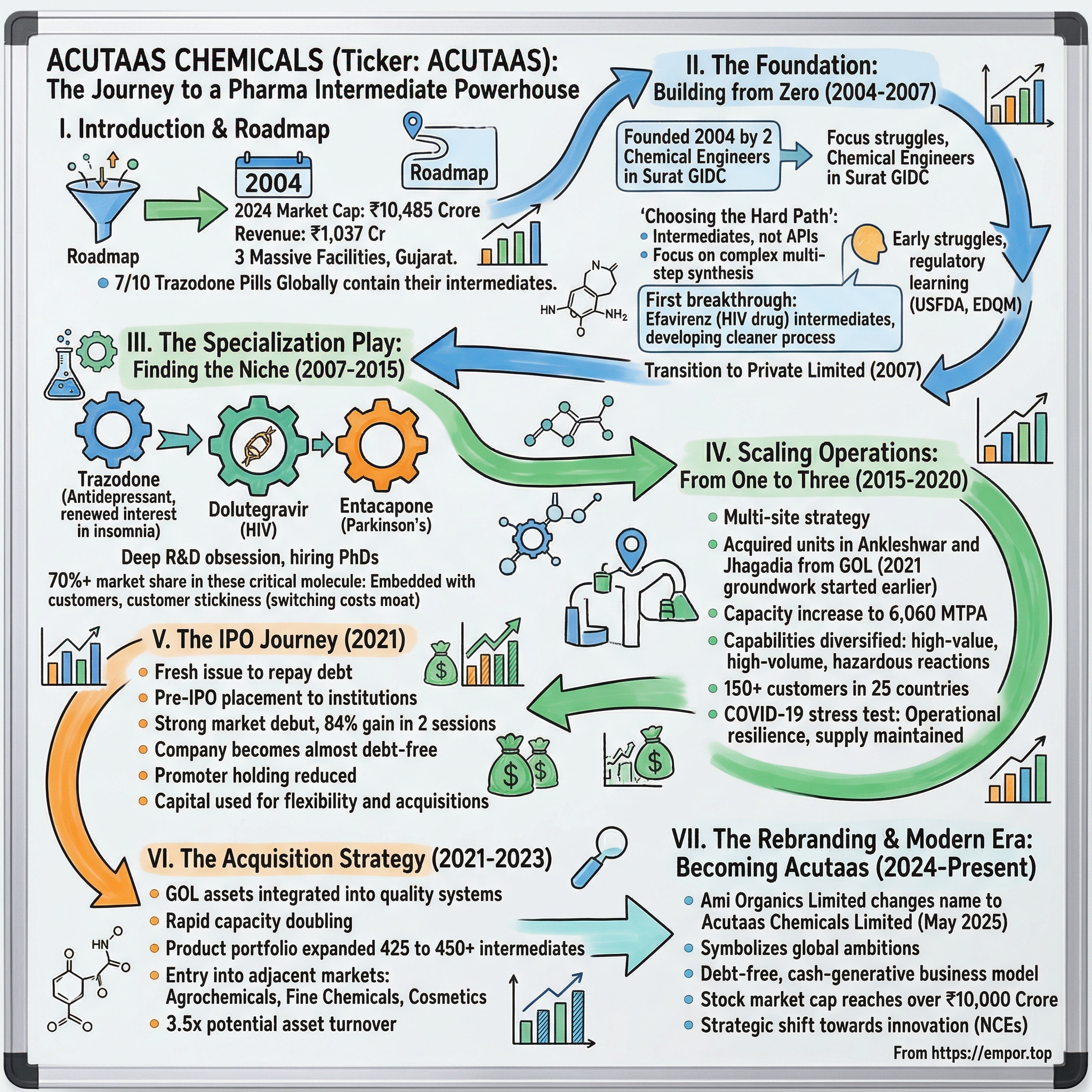
Acutaas Chemicals: From Surat's Lab to India's Specialty Chemistry Powerhouse
I. Introduction & Episode Roadmap
In the industrial sprawl of Sachin GIDC, on the southern edge of Surat, there is a plot of land — Plot No. 440/4, 5 and 6, Road No. 82/A — that reads like the address of a mid-sized job-work unit. Textile dyeing sheds sit nearby. Trucks queue at the common effluent lines. It is the sort of place where thousands of small Gujarati chemical outfits have been born, made a modest living for a family, and quietly disappeared.
That address is the registered office of a company now worth roughly ₹26,450 crore.12
Acutaas Chemicals Limited — until May 2025 known as Ami Organics — closed FY26 with ₹1,339.4 crore of revenue, up 33% year on year, ₹480.4 crore of EBITDA, and ₹356.4 crore of profit after tax.34 The EBITDA margin for the year was 35.9%. In the March 2026 quarter alone it touched 42.4%, the highest in the company's history.5 For context, this is a business that made ₹239 crore of revenue and ₹23 crore of net profit in FY19.2 Seven years later it earns more in a single quarter than it once earned in a year, at roughly double the margin.
What the company actually sells
Acutaas does not make medicines. It makes the second-to-last chemical step before a medicine — what the industry calls an advanced pharmaceutical intermediate. If an active pharmaceutical ingredient (API) is the finished engine of a drug, Acutaas builds the crankshaft: a complex, multi-stage molecule that the API maker then converts in one or two final steps. The company describes its capability as manufacturing "up to N-1" — one synthetic step short of the API itself — and, at the other end, working from basic commodity chemicals at the "N minus 12" level.71
That single choice — to stop one step short — is the spine of the whole story. It is also the company's most durable competitive asset, and the thing most likely to be misread by investors who file Acutaas under "Indian pharma."
Alongside that core, which contributed 87.7% of FY26 revenue, sit three smaller businesses: a legacy commodity chemicals portfolio inherited from an acquisition (11.2%), a semiconductor photoresist chemicals business (1.2%), and a battery electrolyte additives venture that generated no commercial revenue at all in FY26.1 Those last two are where the story gets interesting — and where the gap between narrative and cash flow is widest.
The central question
The bull case writes itself: a niche chemistry house with regulatory lock-in, no debt, and two optionality bets on semiconductors and batteries that the market is happy to pay for. The stock trades at roughly 68 times trailing earnings.2
The harder question is whether the FY26 margin — a 13-percentage-point EBITDA expansion in a single year, from 23.0% to 35.9% — represents a permanent re-rating of the business's earning power or a favourable confluence of product mix, a maturing contract with one European customer, and the deliberate pruning of loss-making revenue.27 Management says the former. Q1 FY27 gave the first real test: revenue jumped 59%, but the EBITDA margin fell back to 34.3% from the December-quarter peak, and the stock dropped 6% on the day.8
This piece works through that question chronologically: the Surat cluster and the founding choice; the decade of building monopoly positions in obscure molecules; the multi-plant scale-up and the export shift; the 2021 IPO and the balance sheet reset; two very different acquisitions; the pivot into electronic and battery chemistry and the rebrand; then a hard look at the business model, management's track record against its own guidance, the risks that could break the case, and the small number of things worth actually tracking.
 Subscribe on LinkedIn
II. Founding Context & Surat's Chemical Ecosystem (2004–2007)
Surat in the early 2000s was not a pharmaceutical town. It was a diamond and textile town with a chemicals problem — thousands of dyestuff and intermediate units clustered around the Gujarat Industrial Development Corporation estates at Sachin, Pandesara and Palsana, most of them making the same handful of commodity molecules for the same handful of buyers, competing purely on price.
It was into this that Nareshkumar Ramjibhai Patel walked with a small laboratory and, by the company's own timeline, roughly thirty employees.1
The founder who thought in decades
The years 1998 to 2004 are described in Acutaas's own corporate history simply as "Early Days" — a small lab, founders selling chemicals to various industries at small scale.1 What existed then was a job-shop: make quality molecules for catalogue companies and traders across Mumbai and Gujarat, take whatever came in the door.
The turn came when a pharmaceutical company brought Patel a molecule moving from Phase I to Phase II clinical trials and asked whether his team could make it. In Patel's telling, that request was less a purchase order than a verdict: "It was a recognition of the quality of our work and the potential our team possessed, serving as a catalyst that accelerated our journey in ways we had only dreamed of."9 On the back of it he built a proper plant in Surat, and Ami Organics was formally established in 2004 as a partnership firm with a single 33 kilolitre manufacturing unit and an in-house R&D lab.16 The firm converted to a private limited company in 2007 and to a public limited company in 2018.6
The founding promoter group settled around Patel as Executive Chairman and Managing Director and Chetankumar Vaghasia as Wholetime Director, both of whom have now spent more than twenty-five years in the chemicals industry.6
What distinguishes Patel from a thousand other Gujarati chemical entrepreneurs of that generation is not the plant. It is a specific habit of mind, which he has described plainly: patent cliffs are visible a decade in advance, so the work has to start a decade in advance. "If a patent was set to expire in 2020, we needed to start preparations as early as 2010, a decade before others."9 That sentence explains almost everything about how the company's product portfolio was assembled — not opportunistically, but as a rolling ten-year queue of molecules whose exclusivity was scheduled to lapse.
The second discipline was therapeutic selection. Ami deliberately concentrated on chronic conditions — diseases where a patient takes a daily dose for years or for life. By FY26, roughly 95% of the pharmaceutical intermediates portfolio served chronic therapies.1 Acute drugs spike and fade; chronic drugs generate the same tonnage every quarter for a decade. For a manufacturer whose economics depend on plant utilisation, that is not a marketing preference. It is the difference between a factory that runs and a factory that idles.
Why Surat, and why it mattered
The GIDC estates offered things a young chemical company could not otherwise afford: shared effluent infrastructure, steam and utility connections, a dense local supplier base for solvents and basic feedstocks, and — critically — a labour pool of chemistry graduates and plant operators who had grown up inside chemical plants. Land came pre-zoned for hazardous manufacturing, with environmental clearances that a greenfield site elsewhere in India would take years to obtain.
The structural advantage this created was not cheap labour, which is often overstated. It was speed and optionality: the ability to try a molecule, fail, and try another without bearing the fixed cost of a purpose-built asset. Acutaas's Sachin unit today remains a multipurpose facility with thirteen separate product lines, forty reactors and seventeen dryers in a single block — a design that trades throughput efficiency for the ability to run many different chemistries in the same building.1
The choice not to make drugs
The hardest early problem was not chemistry. It was trust. A global pharmaceutical company deciding where to source a critical intermediate for a regulated drug is not buying a commodity; it is inviting a stranger into a filing that costs hundreds of millions of dollars to defend. In 2005, an unknown Surat firm had no audit history, no regulatory track record, and no reference customers.
Ami's answer was to remove the one objection it could control: it refused to make finished APIs.
The logic is worth stating carefully, because it is the most important strategic decision in the company's history. Ami's customers were — and are — API manufacturers and innovator pharmaceutical companies. Had Ami built API capability, every intermediate it sold would have been sold to a competitor. Every process improvement it shared would have been a gift to a rival. By staying one step short, Ami made itself structurally safe to work with. Twenty years later, management still frames it in exactly those terms; on the July 2026 earnings call, Patel put it in five blunt words: "We do not compete our customer."8
This is textbook counter-positioning — adopting a business model the incumbent cannot copy without damaging its existing business. An integrated API player cannot credibly promise a customer it will never compete with them, because it already does. That promise is Ami's product as much as the molecules are.
The trust took a decade to convert into money. Revenue crossed ₹100 crore only in 2015, eleven years after founding.1 But by then the company had something more valuable than scale: a growing list of drug dossiers in which its name was written down.
III. The Niche Play: Mastering Advanced Pharma Intermediates (2007–2015)
Picture the economics that a specialty chemist has to solve. A blockbuster API might need 500 tonnes a year of a given intermediate, and every large Chinese and Indian producer will chase it. A molecule needing eight tonnes a year attracts almost nobody — the revenue is too small to justify a dedicated plant, and the chemistry is usually nasty. But if you have a multipurpose facility and a research team that enjoys nasty chemistry, eight tonnes a year at a high price with no competitor is a much better business than 500 tonnes at commodity margins.
That arbitrage — complexity for scale, share for size — is what Ami Organics spent its first decade industrialising.
Building the portfolio
The method was systematic. Identify a drug whose patent would lapse in eight to ten years. Work out a synthetic route to its key intermediate that did not infringe the innovator's process patents. Prove the route at lab scale, then pilot scale. File process patents on the route. Be ready with commercial quantities and full documentation the day generic manufacturers start filing.
By the time of the 2021 IPO, the company had commercialised over 450 pharmaceutical intermediates across seventeen therapeutic areas.9 By March 2026 the portfolio had grown to more than 610 products serving roughly 600 customers across some fifty-five countries.1 The pharma segment alone served over 160 customers in 25-plus countries.1
Three molecules became the calling cards. The intermediate for Trazodone, an antidepressant used widely in central nervous system therapy. The intermediate for Dolutegravir, the backbone of modern first-line HIV treatment and one of the highest-volume antiretrovirals on earth. And the intermediate for Entacapone, used in Parkinson's disease. At the time of the IPO the company claimed over 70% global market share in all three.10 Later additions included intermediates for Nintedanib, used in idiopathic pulmonary fibrosis and oncology, and Rivaroxaban, a widely prescribed anticoagulant.9
It is worth noting how the claim has been phrased over time. The IPO-era language was a clean ">70% market share" in three named molecules.10 The FY26 corporate presentation states a range — "50-90% Global Market Share in Key Intermediates" — without naming which molecule sits where in that band.1 That is not necessarily a retreat; the portfolio is far broader now and the mix has changed. But an investor should read the 2026 formulation as a softer, less falsifiable claim than the 2021 one, and treat the specific "70%" figure as a historical statement rather than a current audited fact.
The regulatory wall, explained plainly
Here is the mechanism that turns a chemistry win into a durable one.
When a pharmaceutical company seeks approval to sell a drug in the United States, Europe or Japan, it files an enormous dossier with the regulator describing exactly how the drug is made — including who supplies each material and by what process. The supporting document for a given material is often a Drug Master File. Once a regulator approves that dossier, the manufacturing chain described inside it is effectively frozen. Changing a supplier of a critical intermediate is not a procurement decision; it is a regulatory event. It means new impurity profiles, new stability data, new documentation, potentially new bioequivalence work, and a filing amendment that can take one to three years to clear across dozens of jurisdictions.
The practical consequence is that a customer will tolerate a lot before switching. They will accept a price increase. They will accept a longer lead time. What they will not accept is a quality failure — because that is the one thing that forces the change anyway.
This is why Acutaas's regulatory record matters more than its price list. Its Sachin unit was inspected by the US FDA in 2016 and received Establishment Inspection Reports in 2018 and again in 2020; it received GMP approval from Japan's Pharmaceuticals and Medical Devices Agency in 2024 with no major observations, and the newer Ankleshwar unit obtained the same in 2025.16 Every clean inspection lengthens the switching cost that protects the existing book.
The moat is real, but it should be described precisely. It is a moat around installed molecules, not around the company. It does not stop a competitor winning the next molecule. It only makes losing an existing one slow and unlikely. A company with this structure grows by adding new locked-in positions faster than old drugs lose relevance — which is why the pipeline, not the current portfolio, is the thing to watch.
From tier-two exporters to innovators
The customer migration tells the same story from the demand side. In the early years Ami sold mostly to Indian generic exporters — buyers who cared about price and paid on time but conferred no prestige. Over the following decade the mix shifted toward European, Japanese and American buyers, including innovator companies working on patented molecules. By FY24, roughly 50% of pharma intermediate revenue came from generics, 40% from innovators, and 10% from contract development and manufacturing (CDMO) work for innovators — a mix that CARE Ratings expected to tilt further toward the last category.7
That shift is the single clearest evidence that the trust strategy worked. Innovator customers are harder to win, slower to qualify, and far stickier once won. They also pay for chemistry rather than for tonnage — which is precisely why the margin arithmetic of this company changed so violently a decade later.
IV. Multi-Plant Scaling, Regulatory Moats & Export Expansion (2015–2020)
By 2015 Ami Organics had a problem that most founders would happily accept and most companies mishandle: it had won more molecules than its single plant could make.
Crossing ₹100 crore of turnover that year was a milestone, but the constraint was physical.1 A multipurpose block running thirteen product lines can flex between chemistries, but every changeover costs days of cleaning and validation. As the order book grew, the cost of that flexibility rose. The company needed more reactors — and, more importantly, more kinds of reactors.
Building capability, not just capacity
The 2016-2020 period was spent on the unglamorous work that determines whether a chemical company gets to play in regulated markets at all. Ami completed its first US FDA inspection in 2016 and had its in-house R&D unit formally recognised by India's Department of Scientific and Industrial Research the same year.1 It filed process patents on five products in 2017. In 2018 it commissioned a GMP-compliant manufacturing and storage facility at Sachin and received its first FDA Establishment Inspection Report.1 In 2020 it commissioned a new R&D lab and a solvent recovery plant at Sachin, and received its second EIR.1
None of these generate revenue directly. All of them are prerequisites for a customer's auditor to sign off. A solvent recovery plant, in particular, does something subtle: it reduces both cost and effluent load simultaneously, which matters because pollution control compliance in Gujarat is not a formality. The Sachin plant has operated on zero liquid discharge since 2015, using soil biotechnology, multi-effect evaporation and reverse osmosis to recycle water back into utilities.6
The R&D organisation grew alongside. By the early 2020s the company was spending roughly 1.4% of revenue on research and employed over 120 scientists including PhDs and masters-level chemists — a figure that has since grown to a team of over 130 with 30-plus PhDs, 26 process patents filed, and stated capability across 43-plus reaction types.91 The technology stack includes continuous flow chemistry and photochemistry alongside conventional batch manufacturing.1
Flow chemistry deserves a brief explanation, because it is the sort of capability that sounds like jargon and is actually an economic weapon. Conventional batch manufacturing works like cooking in a very large pot: load everything in, react, empty, clean, repeat. Flow chemistry works like a pipeline — reagents move continuously through narrow channels where temperature and mixing are controlled far more precisely. For dangerous or highly exothermic reactions, flow lets you run chemistry that would be unsafe at batch scale, in a much smaller footprint. One reaction the company re-engineered went from a 48-hour cycle to three minutes through reagent optimisation.9 That is not a rounding error; it is a different cost structure.
The export tilt and the China question
The other transformation of this period was geographic. Exports rose steadily, reaching roughly 56% of net sales by FY23 and FY24, spread across Europe, Japan, Israel, the UK, Italy, Finland, Latin America, China and the US.7
Two global shocks accelerated this. From 2017, China's environmental crackdown forced widespread closures and relocations of chemical capacity in provinces like Jiangsu and Shandong, and buyers who had assumed permanent Chinese supply discovered that assumption was political. Then COVID-19 shut the same supply chains again in 2020. For the first time, procurement teams at European and Japanese pharmaceutical companies were told to find a second source outside China — and were given budget to qualify one.
Ami had been preparing for this without knowing it. Patel's team had spent a decade reducing dependence on Chinese inputs by developing proprietary routes and cultivating Indian suppliers for key starting materials, taking Chinese imports down from roughly 72% of inputs to 18%.9 Whatever the original motivation — cost, control, or reliability — the effect during the pandemic was that Ami kept running while some competitors could not.
A note of caution against the standard "China+1" narrative, though. Being a viable alternative to China is a necessary condition, not a sufficient one. Every Indian specialty chemical company said the same thing in 2021, and many of them subsequently saw margins compressed as Chinese capacity came back online and undercut them. What actually protected Ami was not that it was Indian; it was that the specific molecules it sold were regulatory-locked and too small to be worth a price war over. That distinction becomes very important in the risk section.
By 2020 the company had customers with decade-long relationships, a top-ten customer concentration around 57-58% of sales, and a portfolio of positions that were, in a regulatory sense, difficult to dislodge.7 What it did not have was a balance sheet capable of funding the next leg. That is what 2021 solved — twice over.
V. The IPO Inflection & Balance Sheet De-leveraging (2021)
March 2021 was, in retrospect, the busiest month in Ami Organics' history — and the IPO was not even the main event.
On March 4, 2021, the company agreed to buy the specialty chemicals business unit at Ankleshwar from Gujarat Organics Limited for ₹23 crore. Nine days later it agreed to buy the Jhagadia unit for approximately ₹70 crore. Both deals closed on March 31.1112 In a single month, a company with one plant became a company with three, and its aggregate manufacturing capacity went from 2,460 MTPA to 6,060 MTPA.12
It did this while carrying a debt-to-equity ratio of 0.82 and while its draft prospectus sat with the regulator.10 That is either conviction or recklessness, depending on how the next six months went.
The offer
The six months went well. The IPO opened on September 1, 2021 and closed on September 3, priced at ₹610 per share at the top of a ₹603-610 band. The total issue was ₹570 crore: a ₹200 crore fresh issue by the company and an offer for sale of 60,59,600 shares by the promoter and other selling shareholders.1013 Anchor investors were allotted 28,01,485 shares at ₹610 on August 31, aggregating ₹170.89 crore.13
The book was subscribed 64.54 times.13 Shares listed on both exchanges on September 14, opening at ₹910 on the NSE — a 49% premium — and closing the first day at ₹935, up 53% on the issue price.14
A 64-times subscription and a 53% first-day pop are usually described as validation. They are more honestly described as a statement about the market than about the company. Late 2021 was the peak of Indian retail enthusiasm for specialty chemicals, and almost anything with "chemicals" in the name and an export story was oversubscribed. The signal worth extracting is narrower: there was deep public-market appetite specifically for asset-owning, debt-light, export-oriented chemistry — and Ami was about to become exactly that.
What the money was actually for
The use of proceeds is the part that mattered. Of the ₹200 crore fresh issue, ₹140 crore was earmarked for repayment or prepayment of borrowings and ₹90 crore for working capital, with the balance to general corporate purposes.15
Note that ₹140 crore plus ₹90 crore exceeds ₹200 crore — the objects were funded together with a pre-IPO placement. But the direction is unambiguous: roughly seventy per cent of the fresh capital went to killing debt rather than building anything.
For a company that had just spent ₹93 crore on two plants, this was the right sequencing. The acquisition bought physical capacity; the IPO bought the freedom to fill it without a lender's covenant sitting on the timeline. In FY21 the company reported ROE of 38.74% and ROCE of 32.58% — figures inflated by a small, leveraged equity base.10 The point of deleveraging was not to make those ratios look better. It was to make them survivable when the balance sheet tripled in size.
The second raise nobody talks about
The 2021 IPO gets the headlines, but the capital event that actually reshaped the balance sheet came three years later. In Q1 FY25 the company raised approximately ₹500 crore — around ₹400 crore through a qualified institutional placement (net ₹388.43 crore) and around ₹100 crore through a preferential allotment (₹99.10 crore) — and used a large part of it to prepay ₹253 crore of debt entirely.167
The effect was dramatic. Tangible net worth rose from ₹593.96 crore in March 2023 to ₹1,211.76 crore by September 2024. Overall gearing collapsed from 0.32x in March 2024 to 0.01x by September 2024, where it has essentially stayed.76 By September 30, 2025 the company held ₹240.63 crore of free cash and had drawn nothing on its sanctioned working capital limits for twelve consecutive months.6 CARE Ratings upgraded the company to CARE A+ / CARE A1+ from CARE A / CARE A1 in December 2024, citing the scale-up and the debt prepayment, and reaffirmed that rating in December 2025.76
There is a cost to this that shareholders paid and management rarely emphasises. Every one of those raises diluted the founders. Promoter holding was around 41% immediately post-IPO; it was 35.98% by June 2024, and 32.66% by June 2026.102 Over three years, promoter ownership fell by roughly 6.75 percentage points.2 That is not a governance red flag — the dilution funded growth, not exits, and institutional ownership rose sharply in parallel, with FIIs at 21.61% and DIIs at 19.55% by June 2026.2 But investors who describe this as a founder-controlled company should note that the founders now own less than a third of it, and that the company has shown a consistent willingness to issue equity when it wants capital.
The balance sheet was now clean. The question was what to do with it — and here the record is genuinely mixed.
VI. The M&A Playbook: Gujarat Organics & Baba Fine Chemicals (2021–2023)
There is a version of the Acutaas story in which every acquisition was a masterstroke. That version does not survive contact with the financial statements. The truthful version is more useful: the company has made three material inorganic bets, two of which look sound and one of which was written off entirely.
Acquisition #1: Gujarat Organics — buying time, not a business
The Gujarat Organics purchase was, on its face, unglamorous. For ₹93 crore across two transactions, Ami acquired two operating plants at Ankleshwar and Jhagadia making parabens, methyl salicylate, para anisic acid and related preservatives and personal care intermediates — products with combined FY21 sales of ₹106 crore.11121
At roughly 0.9 times sales, that looks cheap. It was cheap for a reason: these were low-margin commodity lines in a global market prone to overcapacity, and margins on the acquired book were initially negative before being nursed toward 11% and then targeted at 19%.9
What Ami was really buying was not the paraben business. It was 56,698 square metres of land at Jhagadia and 10,375 square metres at Ankleshwar, with environmental clearances, effluent infrastructure and hazardous-manufacturing consents already in place.1 In India, a greenfield chemical site can take three years or more to clear. Buying an operating site collapses that to zero.
The subsequent history proves the point. Ankleshwar was demolished and rebuilt — the corporate presentation describes the ₹320 crore pharma capex as a "3x Capacity Expansion at Ankleshwar site by redevelopment of the site by demolishing the old structure and constructing a new plant."1 The rebuilt unit was inaugurated in December 2023 with three blocks, 80-plus reactors and a fully automated distributed control system, and today carries 442 KL of installed capacity against Sachin's 144 KL.1 Jhagadia, meanwhile, hosts both the 512 KL commodity chemicals plant and the entirely new battery chemicals block.
So the correct reading of the GOL deal is that Ami paid ₹93 crore for pre-cleared industrial land with a cash-generating tenant attached, and then spent multiples of that turning it into the plants it actually wanted. The commodity revenue was the price of admission, not the prize — which is why management has been steadily discontinuing it. Commodity chemicals contributed ₹149.5 crore in FY26, and the specialty segment shrank 10.6% year on year in Q1 FY27 precisely because of what management calls a deliberate phase-out.18
Deliberately shrinking a revenue line to improve mix is genuine discipline, and it is rarer than it sounds. But it also means the reported "specialty chemicals" segment has been going backwards while the story about it has been going forwards.
Acquisition #2: Baba Fine Chemicals — buying scarcity
In April 2023 the board approved the purchase of a 55% partnership interest in Baba Fine Chemicals for approximately ₹68.2 crore, subject to closing adjustments, paid through a combination of cash and preferential share issuance.17 The valuation was struck at four times adjusted FY23 EBITDA — a strikingly low multiple for a business the acquirer described as unique.17
BFC makes photoresist chemicals. Photoresists are the light-sensitive coatings used in semiconductor lithography: a wafer is coated, exposed to patterned light, and the exposed regions dissolve away, transferring the circuit pattern onto silicon. The materials must be pure at parts-per-billion levels, because a single stray metal ion in the wrong place ruins a chip. The company's claim — repeated in its FY26 presentation — is that it is the only Indian manufacturer of photoresist chemicals.117 Its facility sits at Greater Noida in Uttar Pradesh, and it is tiny: 999 square metres of land and 1.8 KL of installed capacity, essentially a collection of seven lab rooms with glass-lined vessels and fourteen glass assemblies.1
Patel's framing at the time was that BFC was "a name to reckon with in the semiconductor industry," and that the attraction was a "niche product basket given that they are the only manufacturers in the country in their product category."17 The third partner, Rakesh Gupta, stayed on for marketing and technical development.17
Three years on, the honest assessment is that this was a cheap option that has not yet paid off. BFC's revenue declined in FY25, dragging the specialty segment even as commodity chemicals grew.6 Semiconductor chemicals generated ₹15.7 crore in FY26 — 1.2% of group revenue.1 Management described the business as "recovering from Q4 onwards" with new products replacing a lost customer concentration, and the Q1 FY27 commentary pointed to structural AI-driven demand for CPUs and memory.518
For ₹68 crore at 4x EBITDA, the downside was always capped. But investors should be clear-eyed: three years after entry, this is a business generating roughly one per cent of revenue, whose main contribution so far has been to give Acutaas a credible reason to talk to semiconductor customers in Korea, Japan and Taiwan.6 That relationship access may prove to be worth far more than the P&L contribution. It has not proved it yet.
The acquisition that failed
The third bet is the one that does not appear in the corporate presentation's growth narrative. Ami held 50% of Ami Onco-Theranostics LLC, a US joint venture with Photolitec LLC aimed at drug discovery and development for cancer using photosensitiser and imaging technology.19
In the September 2023 quarter, the company fully impaired its ₹31.75 crore investment, on the reasoning that revenue generation would take significant time given the long gestation and uncertain success rate inherent to research.19 The FY26 corporate presentation records the resulting exceptional loss of ₹32.1 crore in FY24, and reported profit for that year fell to ₹48.7 crore from an adjusted ₹80.8 crore.1
This is a small number against today's earnings, and management deserves credit for taking the write-off cleanly and quickly rather than nursing a dead asset. But it is a real data point about capital allocation judgement. A process chemistry company with a genuine edge in synthesis put ₹32 crore into US drug discovery — a business with entirely different risk characteristics, no obvious link to its manufacturing moat, and a probability of success it was in no position to underwrite. That it recognised the error early is good. That it made the investment at all is the kind of thing a skeptical investor should file away when assessing the next adjacent bet — and there are now two large ones underway.
VII. The Next Frontier: Battery Chemicals, Semiconductors & The Rebrand to Acutaas (2024–Present)
On January 19, 2026, at the Jhagadia site, Acutaas inaugurated Phase 1 of an automated plant with a fully operational distributed control system, running an indigenously developed flow technology.1 It does not make anything a pharmaceutical company would recognise. It makes vinylene carbonate and fluoroethylene carbonate — two of the small-molecule additives that go into lithium-ion battery electrolyte.
This is the third act of the story, and the one on which a large part of today's valuation rests.
What an electrolyte additive actually does
A lithium-ion cell works by shuttling lithium ions between two electrodes through a liquid electrolyte. The problem is that on the first few charge cycles, the electrolyte reacts with the negative electrode surface. Left uncontrolled, this reaction consumes electrolyte continuously and the battery degrades fast.
Additives like vinylene carbonate solve this by sacrificing themselves first. They decompose preferentially and form a thin, stable protective film — the solid electrolyte interphase — that passivates the electrode surface while still letting lithium ions through.16 Fluoroethylene carbonate does the same job for silicon-containing electrodes, which are essential to next-generation high-energy cells but swell and crack badly without protection.16
These additives are a tiny fraction of a cell's mass and a meaningful fraction of its cycle life. They are also, overwhelmingly, made in China. Acutaas's claim is that it is the first electrolyte additives manufacturer in India, and one of the few outside China at scale.116
The build-out and its slippage
The programme has been running since 2022, when the company set up Ami Organics Electrolytes as a wholly owned subsidiary.1 The additives plant was commissioned in Q4 FY24 with 1,000 MT of capacity split evenly between two products.16 In January 2024, at the Vibrant Gujarat summit, the company signed an MoU with the Gujarat government for investment of up to ₹300 crore for a dedicated electrolytes facility.20 In June 2024 it incorporated Enchem Ami Organics Private Limited, a joint venture with 엔켐 Enchem, the Korean electrolyte maker, to produce electrolyte solutions and allied materials — expected to contribute revenue only from FY28.1620
The expansion to 4,000 MT — 2,000 MT each of VC and FEC — was originally budgeted at ₹177 crore for completion by H1 FY26.7 It was subsequently revised upward to approximately ₹220 crore and pushed to H2 FY26, partly to accommodate infrastructure for new products and partly because of an extended monsoon.6 Phase 1 was inaugurated in January 2026; Phase 2 remains under construction, with completion targeted for Q2 FY27.18
The commercial record so far is thin and should be stated as such. Battery chemicals generated no commercial revenue in FY26.1 Two products were commercialised, five-plus customers have validated the additives, and 10-plus products sit in the pipeline.1 Commercial supply began only in Q1 FY27, after successful trials.18 Management expects the 4,000 MT capacity to reach full utilisation within about three years and has described demand as "unprecedented, driven by tight global supply."8
That last phrase should be tested, not accepted. Global electrolyte additive supply is dominated by Chinese producers who have historically responded to tight markets by adding capacity quickly. An Indian producer's advantage here is not cost — it is that Western and Korean cell makers want a non-Chinese source badly enough to pay for one, and that long-term contracts with three-year visibility have reportedly been signed.5 Whether that willingness survives a Chinese price cycle is the single largest open question in this segment.
The Korean semiconductor bet
The parallel bet is more capital-intensive and further out. In 2025 Acutaas formed Indichem Inc., a 75:25 joint venture between its wholly owned subsidiary Acutaas Advance Materials Limited and South Korea's J and Materials Co. Ltd., to build a semiconductor chemicals plant at 공주 Gongju, South Korea.61 Total planned investment is approximately ₹200 crore, of which ₹50 crore was infused in H1 FY26 with the balance from internal accruals.61 In February 2026 the group completed the acquisition of 300,000 shares taking its controlling position, with regulatory approvals obtained in both India and South Korea.21
The site covers 16,513 square metres and is under construction.1 Management has guided plant completion by the end of Q1 calendar 2027, with revenue expected from FY28 and commercialisation of individual products taking three to four years thereafter.8 Peak revenue potential from the facility has been put at around ₹400 crore.5
Building a semiconductor materials plant inside Korea — rather than exporting to Korea — is a deliberate choice. Korean chipmakers qualify materials suppliers slowly and prefer local supply chains for logistics and quality control. Locating there buys proximity and credibility. It also means operating under a foreign regulatory regime with a partner whose technical support the company depends on, which CARE Ratings explicitly flags as an implementation risk.6
The rebrand
On April 16, 2025, the board approved changing the company's name from Ami Organics Limited to Acutaas Chemicals Limited.22 Shareholders approved it at an extraordinary general meeting on May 10, and the change took effect on May 15, 2025; the ticker moved from AMIORG to ACUTAAS on June 2.22 Separately, members approved a stock split via postal ballot on March 26, 2025, sub-dividing each ₹10 face value share into two ₹5 shares with an April 25, 2025 record date.23
Corporate renamings usually signal either an identity crisis or an ambition. Here it was plainly the latter: "organics" describes what the company made in 2004, not photoresists or battery additives. The rebrand is best read as a commitment device — a public declaration that the company intends to be judged as a multi-vertical materials business rather than a pharma intermediates supplier.
That is a promise with a bill attached. In FY26, 98.9% of revenue still came from pharmaceutical intermediates and commodity chemicals.1 The rebrand describes a company that does not yet exist financially.
The financial surge
What did exist in FY26 was an extraordinary set of numbers. Revenue reached ₹1,339.4 crore, up 33%.4 EBITDA doubled to ₹480.4 crore at a 35.9% margin, against 23.0% in FY25.51 PAT more than doubled to ₹356.4 crore.54 The March quarter alone delivered ₹432.8 crore of revenue (+40.3%), ₹183.5 crore of EBITDA at a 42.4% margin, and ₹134.3 crore of PAT at a 31% margin — records on every line.524 The company ended the year with net cash of ₹198.3 crore.5
The cause is not mysterious, but it is worth stating precisely because it determines durability. Cost of materials consumed barely moved — from ₹569.8 crore in FY25 to ₹595.0 crore in FY26 — while revenue rose by ₹332 crore.1 Essentially all the incremental revenue came in at very high incremental margin. Management attributes this to three things: the ramp of higher-margin CDMO volumes at the rebuilt Ankleshwar plant, deliberate churn of low-margin products out of the pharma intermediates book, and operating leverage as multi-year capex reached utilisation.255
That is a coherent explanation, and the segment data supports it: pharma intermediate margins ran at approximately 44% in Q4 FY26 against 29% for specialty chemicals.5 But it also means the margin is a mix outcome, not a price outcome — and mix can move both ways.
VIII. Business Model Deep Dive, Segment Economics & Strategic Moats
Strip away the verticals and Acutaas is one machine: a set of multipurpose reactors, a research group that designs synthetic routes, and a regulatory documentation function that gets those routes written into other companies' filings. Everything else is a choice about which end market to point the machine at.
The four businesses, honestly sized
Advanced pharmaceutical intermediates generated ₹1,174.1 crore in FY26 — 87.7% of revenue — serving over 160 customers in more than 25 countries across 17-plus therapeutic areas.1 Margins ran around 44% at the segment level in the March 2026 quarter and approximately 36% in Q1 FY27.58 More than 90% of products are backward-integrated to basic chemicals, which is why raw material inflation shows up as a delayed, dampened effect rather than an immediate margin hit.1 Within this segment, CDMO work is the growth engine: management targets ₹1,000 crore of CDMO revenue by FY28, developing 30-40 molecules a year, with four validated products awaiting regulatory approval and each carrying ₹50-100 crore of annual peak revenue potential.58
Commodity chemicals — the Gujarat Organics legacy — generated ₹149.5 crore, 11.2% of revenue, across 30-plus products and 400-plus customers in 55-plus countries.1 Margins are lower and the strategy is explicitly to replace these products with better ones rather than defend them.1
Semiconductor chemicals generated ₹15.7 crore, 1.2%, from five-plus customers in four countries.1
Battery chemicals generated nothing in FY26.1
That distribution is the most important table in this story, and it differs sharply from how the company is often discussed. The "three growth verticals" framing that dominates management commentary describes roughly one per cent of realised revenue plus two businesses in construction. The pharma intermediates business is not one leg of a diversified stool; it is the entire stool, with two extensions bolted on and one being sawn off.
Competitive position
The Indian landscape splits into distinct games. Divi's Laboratories operates at an order of magnitude more scale in large-volume APIs and custom synthesis, reporting Q4 FY26 revenue near ₹2,831 crore with EBITDA margins around 33%.26 Laurus Labs runs an integrated API-to-formulation model with heavy antiretroviral exposure. Neuland Laboratories is arguably the closest philosophical peer — a CDMO-plus-generic-API house that grew FY26 revenue to about ₹2,023 crore.27 Anupam Rasayan plays the same custom-synthesis game in agrochemicals, posting FY26 revenue of roughly ₹2,384 crore at a 23% EBITDA margin.28 Clean Science & Technology and Suven Pharmaceuticals occupy adjacent high-margin niches.
Two observations follow. First, on margin, Acutaas at 35.9% now sits at the top of this cohort rather than the middle — which is either evidence of a superior niche or a signal that the current mix is unusually favourable. Second, on scale, Acutaas remains the smallest of the group by revenue. CARE Ratings continues to cite "moderate scale of operations" as a rating constraint and has set ₹2,000 crore of volume-backed revenue with sustained 20%-plus ROCE as the threshold for an upgrade.76 Small scale in a business with lumpy, project-driven capex means a single customer loss or a single delayed plant matters more than it would at Divi's.
Helmer's 7 Powers, applied with a scorecard
Switching costs — strong, and the most reliable of the set. The regulatory mechanism described earlier is not a soft preference; it is a filing constraint. Evidence: customer relationships extending beyond a decade, top-ten concentration that has stayed roughly stable at 57-58% while absolute revenue nearly doubled, and repeat expansion of the Fermion relationship into additional molecules rather than competitive re-tendering.729
Process power — strong, but harder to verify. The claim rests on 26 process patents, 43-plus reaction capabilities, flow chemistry and photochemistry platforms, and the ability to run N-12 to N-1 chemistry in-house.17 The observable proof is the FY26 gross margin expansion achieved without a proportionate rise in material cost, which is consistent with genuinely better processes.1 The caveat is that process advantages in organic chemistry erode; a competitor with a good research group can eventually design around a route.
Counter-positioning — strong, and structurally protected. The refusal to make APIs cannot be copied by an integrated competitor without that competitor abandoning its own API business. This is the rare power that gets stronger as rivals grow.
Cornered resource — weak to moderate, and often overstated. Being India's only photoresist chemicals manufacturer is a real fact, but "only in India" is not the same as "only in the world"; the global photoresist materials market is dominated by Japanese, Korean and American suppliers with decades of qualification history. On the evidence of ₹15.7 crore of FY26 revenue, this is currently an option, not a resource.1
Scale economies, network economies and branding — essentially absent. There is no meaningful network effect in intermediates, no consumer brand, and at ₹1,339 crore of revenue no scale advantage over Chinese producers.
Four of seven powers, with the two strongest concentrated in the pharma business. That is a good scorecard. It is not a fortress.
Porter's five forces
Buyer power is genuinely moderate rather than low. Innovator customers are locked in by filings, but they are also large, sophisticated, and aware that Acutaas needs them more than the reverse — top-ten concentration near 57% cuts both ways.7 Generic customers are price-sensitive and switch when the regulatory friction is low.
Supplier power is low to moderate. Raw materials are approximately 72% of cost of sales, and export prices are revised quarterly against key starting material costs and forex, which passes through most volatility.6 Domestic sales, priced on spot, are not protected — a genuine if modest exposure.
Threat of new entrants is low for regulated intermediates: cGMP compliance, hazardous handling licences, environmental clearances and the multi-year qualification cycle together form a barrier that capital alone cannot cross quickly.
Threat of substitutes is low at the molecule level and high at the drug level. Nobody substitutes a different intermediate into an approved filing. But a superior drug can make the whole filing obsolete, which is why the ten-year pipeline queue matters more than the current portfolio.
Competitive rivalry is low in proprietary niches and severe in commodities — which is precisely why management is exiting the commodity book. The strategy and the force map are aligned.
What the economics really say
Reduced to a sentence: Acutaas earns high returns because it sells small quantities of hard-to-make molecules into contracts that are expensive to break, and it has spent the last three years reallocating its plants away from everything that does not fit that description. The FY26 numbers are what that reallocation looks like when it works. The open question is whether the same machine can produce the same returns in end markets — batteries, electronic chemicals — where there are no filings, no switching costs, and Chinese competitors with a decade's head start.
IX. Management Integrity, Capital Allocation & Conference Call Analysis
On July 30, 2025, on a conference call after a modest June quarter, Acutaas told analysts what to expect from the year ahead: revenue growth of about 25%, and an EBITDA margin somewhere between 28% and 30%.30 At the time, the company had just delivered a 24.6% margin. Guiding to 28-30% was already ambitious.
Six months later, on January 28, 2026, management raised the bar mid-flight — revenue growth of 30%, margin of about 35%.25 The year finished at 33% and 35.9%.41
Guiding conservatively, revising upward with evidence, and then beating the revised number is the behaviour pattern investors should want. It is also, importantly, a pattern rather than a single event: the FY27 guidance issued on the April 30, 2026 call — 25% revenue growth with margins at a "similar level" — was repeated without modification on the July 24, 2026 call, even as the company reported a 59% revenue jump that would have tempted a promotional management to raise it.58 Refusing to extrapolate a strong quarter is a credibility signal in its own right.
Who runs the company
Patel remains Executive Chairman and Managing Director, with Chetan Vaghasia, Virendra Mishra and Ram Mohan Lokhande as Wholetime Directors.1 Bhavin Shah is Chief Financial Officer. Abhishek Patel heads strategy — and was described as Vice President, Strategy on the April 2026 call and as President, Strategy on the July 2026 call, a promotion the company did not otherwise flag.58 The technical bench includes Dr. Sanjay Vasoya on R&D and Dr. Ajit Choubey on technical functions.1
The board has eight members, of whom four are independent and two are women; the company reported zero conflict-of-interest cases and zero safety-related incidents in FY25.61 Promoter shares carried no pledge as of June 2024.16
The workforce numbers reveal something the financials do not. The company employs over 1,000 people with an average age of 33, average age above manager level of 47, and roughly 15% annual turnover — and describes itself internally as a "young startup."1 For a chemical manufacturer running regulated GMP plants, a 15% turnover rate is neither alarming nor comfortable; it is the number to watch if quality incidents ever appear, because regulated manufacturing is fundamentally a discipline problem before it is a chemistry problem.
Capital allocation: the good, and the unresolved
The good is easy to document. Debt was eliminated and has stayed eliminated. Growth capex has been funded from equity raises and internal accruals rather than leverage. Underperforming revenue has been deliberately cut rather than defended. And when a bet failed, it was written off in full and quickly rather than carried at a flattering valuation.
The unresolved question is what the money is buying now. FY26 capex was ₹195 crore, spread across the Jhagadia electrolyte block, the Sachin pilot plant, and maintenance.5 Guidance for FY27 is far lighter — roughly ₹90-100 crore, including a ₹50 crore spillover, ₹40 crore of maintenance, and an R&D centre expansion.58 In January 2026 the company outlined a ₹350 crore investment programme spanning FY26 capex and the Korean joint venture.32 The longer arc is a stated ₹1,000-crore-plus capital programme running from FY23 to FY30: approximately ₹320 crore into pharma capacity (completed), ₹220 crore into battery chemicals (partially complete), ₹200 crore into the Korean semiconductor venture (under construction), ₹25 crore into pilot plant R&D, and ₹50 crore into 16 MW of solar.1
Here is the consequence that does not show up in the headline earnings. Capital work-in-progress on the balance sheet stood at ₹332.4 crore at the end of FY26, up from ₹130.3 crore a year earlier.1 That is a large block of capital earning nothing yet. It is also why FY26 free cash flow was negative approximately ₹36 crore despite operating cash flow of ₹292 crore.2 The company is profitable and cash-generative at the operating level and still consuming cash overall, because it is building three businesses at once.
The reported return ratios need reading with that in mind. The company presents ROCE of 39.3% and ROE of 32.5% for FY26 — but explicitly adjusted for cash, exceptional items and capital work-in-progress.1 Unadjusted, screening data puts ROCE nearer 31.6% and ROE at 24.0%.2 Both sets are strong. The adjusted set flatters, and the gap between them is precisely the capital sitting in unfinished plants.
The dividend tells the same story about priorities. The board recommended a final dividend of ₹2.50 per ₹5 face value share for FY26 — a token distribution against ₹356 crore of profit.3 This is a company that intends to reinvest, and is telling shareholders so through its payout.
What the calls actually reveal
The tone across recent calls is notably unpromotional in places. Management volunteered that the business is seasonally back-loaded — roughly 40% of revenue in the first half and 60% in the second — which is the kind of disclosure that pre-empts a disappointing June quarter rather than explaining one away.5 When the electrolyte project slipped, the reasons given were specific and checkable: additional infrastructure for new products, plus an extended monsoon, with the budget openly revised from about ₹177 crore to about ₹220 crore and the timeline from H1 FY26 to H2 FY26.76 Specific explanations for delays are a better credibility indicator than smooth ones.
The analyst pressure has been consistent and pointed. On the April 2026 call, hosted by 361 Capital with Rohit Nagraj leading, the questions clustered on whether a 42.4% quarterly margin could possibly hold and when Baba Fine Chemicals would actually ramp.5 On the July 2026 call, hosted by Nuvama, analysts pressed on battery chemicals revenue recognition timing, margin sustainability as lower-margin new products enter the mix, CDMO customer concentration, and execution risk across the semiconductor and electrolyte ramps.8 Management's answers on timing have generally been concrete — plant completion by end of Q1 calendar 2027 for the Korean facility, revenue from FY28, individual product commercialisation three to four years after that.8 Its answers on margin have been less falsifiable: "similar level" is a comfortable phrase.
The one claim that deserves the most scepticism is the framing of battery demand as "unprecedented, driven by tight global supply."8 That is a market condition, not a competitive advantage, and market conditions in commodity-adjacent chemistry mean-revert. The company has offered a harder piece of evidence — long-term contracts with roughly three-year visibility and five-plus customers who have validated the additives.51 Those contracts, not the demand adjective, are what an investor should want to see converted into recognised revenue.
X. Skeptical Investor Stress Test, Risk Radar & Competitive Benchmarking
If a short-seller or an activist were to build a case against Acutaas in the summer of 2026, they would not start with the business. They would start with the multiple. At roughly 68 times trailing earnings, the stock prices in the successful execution of two businesses that have between them generated about 1.2% of revenue.21 That is the frame within which every one of the following challenges has to be assessed, because at that valuation the cost of being wrong is asymmetric.
Challenge one: concentration
The obvious attack is molecule concentration — that the whole company rests on Trazodone, Dolutegravir and Entacapone intermediates. The company's rebuttal is documented and reasonably strong: no single product accounts for more than 10-15% of total sales, and the portfolio now spans over 610 products.761
But the rebuttal answers the wrong question. The real concentration is at the customer level, not the product level. Revenue from the top ten customers was approximately 57% of sales in FY24 and 58% in FY23 — a level that barely moved while revenue grew.7 And the strategy actively increases it: the CDMO business, which management has targeted at ₹1,000 crore by FY28, is built around a small number of deep innovator relationships, most visibly the Fermion agreements signed in November 2022 and September 2023 for intermediates used in Darolutamide, with subsequent agreements expanding the total to five advanced intermediates for that drug across a projected ten-year horizon.297
Five intermediates for one drug, for one customer, targeted to become the largest growth engine in the company. If Darolutamide underperforms commercially, or if the innovator reformulates, or if a competing therapy takes share, Acutaas absorbs it directly. This is the single largest undiscussed dependency in the story, and it is the mirror image of the switching-cost moat: the same regulatory lock-in that prevents the customer leaving also prevents Acutaas from redeploying that capacity elsewhere quickly.
Challenge two: is the margin real?
FY26's margin expansion was extraordinary, and extraordinary things deserve scrutiny before applause.
Three components are worth separating. First, genuine mix improvement — higher-margin CDMO volumes replacing lower-margin generic and commodity revenue. This is real, structural, and visible in the near-flat cost of materials against sharply higher revenue.1 Second, operating leverage as the rebuilt Ankleshwar plant absorbed fixed costs. Also real, and by definition it continues only while utilisation rises. Third, and least discussed, other income of ₹41.6 crore in FY26, up from ₹16.9 crore in FY25, alongside a foreign exchange gain of ₹6.12 crore in FY25 against ₹4.18 crore in FY24.16 Treasury income on a large cash pile and favourable currency moves are legitimate earnings but they are not operating quality, and they will not compound.
The first hard evidence arrived in Q1 FY27: revenue up 59.1% to ₹329.7 crore with gross margin of 57.9%, but EBITDA margin at 34.3% — well below the 42.4% peak — as specialty chemicals revenue fell 10.6% and pharma intermediate segment margin normalised to about 36%.8 The market read it as a mix warning and marked the stock down 6% on the day.8 That reaction was arguably correct in kind if not degree: the number that matters is not the peak margin, it is the margin at which the business settles once new, lower-margin battery and semiconductor products enter the revenue base.
Challenge three: governance and the open regulatory file
On June 22 and 23, 2026, the Central Goods & Services Tax and Central Excise anti-evasion department in Surat conducted an inspection and search at the company's registered office and its Sachin manufacturing unit under Section 67(2) of the CGST Act, 2017.31 The company disclosed the action, stated that it was cooperating fully, that no specific violations had been communicated to it, and that it did not expect a material impact on its financial position or operations.3118
This is an unresolved item and should be treated as one. Section 67(2) searches are not routine audits; they follow a formal reason-to-believe recorded by a senior officer. Nothing in the public record establishes wrongdoing, and Indian tax authorities conduct such actions frequently across the chemicals sector. But an investor cannot mark this to zero until it concludes, and the absence of a communicated violation two months on is informative but not dispositive.
Two further governance observations belong here. Promoter ownership has fallen from roughly 41% post-IPO to 32.66%, entirely through issuance rather than sales, and the company has now used an IPO, a QIP and at least two preferential allotments to fund itself.102166 The alignment argument weakens with each round. And the Ami Onco-Theranostics write-off remains the cleanest available evidence of how this management behaves when it strays outside its circle of competence — worth remembering as it simultaneously builds a Korean semiconductor plant and an Indian battery chemicals plant.
The risk radar
Chinese overcapacity. The mechanism is specific rather than general. Acutaas's regulated pharma intermediates are largely insulated, because a Chinese producer cannot simply substitute itself into an approved filing. Its commodity chemicals are not insulated at all — the company itself notes that global overcapacity has adversely affected various players in that segment over the past three years.1 Battery electrolyte additives sit in the exposed category: no regulatory lock-in, Chinese incumbency, and a customer base that will pay a premium for non-Chinese supply only for as long as that premium is politically justified.
Input cost and currency. Raw materials are approximately 72% of cost of sales.6 Export prices are reset quarterly against key starting material costs and currency, which absorbs most of the volatility; domestic sales priced on spot are not protected. As a net exporter, the company benefits from rupee weakness and is hurt by strength — and, as noted, some of FY26's reported profit came from that channel rather than from operations.
Regulatory and environmental. The FDA and PMDA track record is clean, and the Sachin plant runs zero liquid discharge with 62% of total waste recycled and an EcoVadis Platinum rating.61 The exposure is asymmetric: a decade of clean inspections earns modest goodwill, while one adverse finding at a plant embedded in customer filings can halt revenue from multiple molecules simultaneously. Add the open GST matter to this bucket.
Execution. Three projects are in flight at once: Phase 2 of the electrolyte plant targeted for Q2 FY27, the Korean semiconductor facility targeted for completion by end of Q1 calendar 2027 with revenue from FY28, and four validated CDMO products awaiting regulatory approval.85 Each requires purity standards measured in parts per billion in end markets where Acutaas has no operating history.1 The company has already demonstrated that its project timelines slip by a quarter or two under ordinary conditions.
Utilisation. In Q1 FY27, Sachin ran at 83%, Jhagadia Unit 3 at 55%, and Ankleshwar Unit 2 at just 23%.8 Ankleshwar is where the CDMO growth is supposed to land, and management expects it to reach full capacity by FY28.8 That single number carries more of the growth case than any strategic narrative in this story.
Why it wins, and what breaks it
The case for Acutaas winning from here rests on evidence that is genuinely observable: regulatory-locked positions in molecules with decade-long lives, a customer set that has expanded relationships rather than re-tendered them, a demonstrated willingness to destroy its own low-quality revenue, a balance sheet with no debt, and a research organisation that has repeatedly converted process chemistry into margin.
The case breaks in one of three ways. The CDMO concentration turns from a strength into a liability. The two new verticals consume capital and management attention for years without producing returns, while the pharma business — now carrying the entire company — matures. Or the FY26 margin proves to have been a peak driven by a favourable mix that new products dilute faster than volume replaces.
None of these are hypothetical objections invented for balance. Each has a corresponding line item that an investor can watch quarter by quarter.
XI. Acquired Playbook: Essential Lessons for Tech & Industrial Investors
1. In chemistry, share of a small market beats a slice of a large one. The economics that built Acutaas were never about volume. A molecule that the world needs eight tonnes of per year is invisible to a large competitor and enormously profitable to a small one with the right reactors and a research team that likes hard problems. The trap for investors is the reverse: a company boasting about entering a "$5 billion market" is usually telling you it has chosen a fight it cannot win. What matters is not the size of the market but whether anyone else wants to serve it at that scale.
2. The best switching costs are the ones someone else enforces. Acutaas does not have to persuade customers to stay. Regulators do that work, by freezing an approved manufacturing chain into a dossier that costs years to amend. When an investor finds a business whose customers face government-mandated costs to leave, the durability question is largely answered — but only for the installed base. The growth question still depends entirely on winning the next position, which is why pipeline disclosure matters more than portfolio disclosure in businesses like this.
3. Buying an asset is not the same as buying a business. The Gujarat Organics deal looked like an entry into preservatives. It was actually a purchase of pre-cleared industrial land with effluent infrastructure, environmental consents and an operating cash flow attached — followed by the demolition of the buildings on it. Investors evaluating industrial M&A in permitting-constrained geographies should ask what the acquirer intends to do with the site, not what the target currently sells. Sometimes the revenue is the thing you throw away.
4. Refusing to compete with your customer is a strategy, not a limitation. Ami's decision to stop one synthetic step short of the API looked in 2005 like a young company declining to move up the value chain. It was in fact the only credible way for an unknown Surat firm to be trusted with a molecule that a global pharmaceutical company had spent a decade developing. Integrated competitors cannot copy that promise without dismantling their own businesses. The general lesson: when a structural constraint prevents your competitors from making a promise you can make, the constraint is the product.
5. Adjacent optionality is cheap to buy and expensive to prove. Acutaas paid ₹68 crore at four times EBITDA for a semiconductor materials business and has committed roughly ₹420 crore more across Korea and battery chemicals. The first bet was a genuine option — small cost, capped downside, real upside. The subsequent commitments are no longer options; they are projects, with construction schedules, foreign partners and purity specifications the company has never had to meet. The line between the two is the point at which a company stops being able to walk away cheaply, and investors should mark it precisely rather than continuing to describe large capital commitments as free optionality. The ₹31.75 crore written off in a US drug discovery venture is the reminder of what happens when adjacency is defined too loosely.
XII. Epilogue, Key KPIs & What to Watch
There is a photograph implicit in the corporate presentation that captures the whole arc. In 2004, the company had one plant of 33 kilolitres, thirty-odd employees, and a single lab.1 By March 2026 it operated five manufacturing facilities across three Indian states and, once the Korean plant completes, two countries — with roughly 1,100 kilolitres of installed capacity, over 1,000 employees, and a research group of 130-plus including 30-plus PhDs.1 The reactors got bigger. The essential activity — figure out how to make a hard molecule cheaply and reproducibly, then get that route written into someone else's regulatory filing — never changed.
What has changed is the number of games being played at once. For twenty years Acutaas played one game extremely well. It is now playing three, and the two new ones have rules it has not yet been tested against.
The three numbers that matter
Ankleshwar Unit 2 capacity utilisation. In the June 2026 quarter it ran at 23%, against 83% at Sachin.8 This is the plant that was rebuilt from the ground up for CDMO work, it is where the four validated products awaiting approval are meant to land, and management has said it should reach full capacity by FY28.8 Because incremental volume at an under-utilised plant flows through at very high margin, this single operating number drives both the growth and the margin case simultaneously. If it climbs steadily quarter over quarter, the thesis is working. If it stalls, no amount of narrative about batteries or semiconductors will compensate.
Segment-level EBITDA margin in advanced pharmaceutical intermediates. The group margin is a blend, and blends can be flattered by mix. What matters is what the core business earns on its own — approximately 44% in the March 2026 quarter, normalising to about 36% by June.58 Management guides to group margins holding at FY26 levels while lower-margin battery and semiconductor products enter the mix.8 Those two statements are only compatible if the core margin holds up. Watching the segment number rather than the group number is the way to find out which is giving.
Recognised revenue from battery and semiconductor chemicals. Not capacity announcements, not customer validations, not MoUs — rupees of recognised revenue per quarter. Battery chemicals contributed nothing in FY26 and began commercial supply only in the June 2026 quarter; semiconductor chemicals contributed ₹15.7 crore for the full year.118 Management has put peak potential from the Korean facility at around ₹400 crore and expects the 4,000 MT additive capacity to fill within three years.58 Between the promise and the proof sits a series of quarterly numbers that will either validate the rebrand or expose it.
The shape of the question
Acutaas Chemicals today is a company whose realised earnings come almost entirely from a business it has spent twenty years perfecting, and whose valuation reflects businesses it has spent three years building. Both halves of that sentence are true, and they are in tension.
The pharma intermediates franchise is genuinely defensible for the reasons this story has laid out — and it is also, by the company's own admission to its rating agency, still sub-scale, working-capital intensive, and exposed to a customer set concentrated enough that ten relationships carry more than half the revenue.67 The new verticals are real assets with real customers validating real products, and they are also unproven in end markets where the regulatory shield that protects the core business simply does not exist.
What makes the company worth following is not that either half is obviously right. It is that the tension will resolve visibly, in public, over the next eight to twelve quarters — in a utilisation rate, a segment margin, and a line of revenue that is currently close to zero. Few Indian industrial stories offer a test that clean.
References
-
Acutaas Chemicals Limited — Corporate Presentation, data as of 31 March 2026 (NSE filing), 2026-05-16 ↩↩↩↩↩↩↩↩↩↩↩↩↩↩↩↩↩↩↩↩↩↩↩↩↩↩↩↩↩↩↩↩↩↩↩↩↩↩↩↩↩↩↩↩↩↩↩↩↩↩↩↩↩↩↩↩↩↩↩↩↩↩↩↩↩↩↩↩
-
Acutaas Chemicals Ltd — Financial Overview, Ratios and Shareholding, Screener.in ↩↩↩↩↩↩↩↩↩↩↩
-
Acutaas Chemicals FY26 Results: PAT ₹356 Cr, Guides 25% FY27 Growth — ScanX, 2026-04-30 ↩↩
-
Acutaas Chemicals reports 40% revenue growth in Q4 FY26 — Indian Chemical News, 2026-05 ↩↩↩↩
-
Acutaas Chemicals Ltd (ACUTAAS) Q4 FY26 Earnings Call Transcript — AlphaStreet, 2026-04-30 ↩↩↩↩↩↩↩↩↩↩↩↩↩↩↩↩↩↩↩↩↩↩
-
Acutaas Chemicals Limited — Rating Press Release, CARE Ratings, 2025-12-09 ↩↩↩↩↩↩↩↩↩↩↩↩↩↩↩↩↩↩↩↩↩↩↩↩
-
Ami Organics Limited — Rating Press Release (upgrade to CARE A+), CARE Ratings, 2024-12-26 ↩↩↩↩↩↩↩↩↩↩↩↩↩↩↩↩↩↩
-
Earnings call transcript: Acutaas Chemicals Q1 FY27 — Investing.com, 2026-07-24 ↩↩↩↩↩↩↩↩↩↩↩↩↩↩↩↩↩↩↩↩↩↩↩↩
-
Ami Organics' growth mantra: Lead, innovate, revolutionise — Business India ↩↩↩↩↩↩↩↩
-
Ami Organics IPO: Information analysis — Value Research, 2021-08 ↩↩↩↩↩↩↩
-
Ami Organics Limited acquired Specialty Chemicals Business Unit in Ankleshwar of Gujarat Organics Ltd. for INR 230 million — MarketScreener, 2021-03-04 ↩↩
-
Ami Organics Limited acquired Specialty Chemicals Business Unit in Jhagadia of Gujarat Organics Ltd. for approximately INR 700 million — MarketScreener, 2021-05-06 ↩↩↩
-
Ami Organics IPO subscribed 64.5 times — ICICI Direct IPO News, 2021-09-03 ↩↩↩
-
Ami Organics makes strong market debut, share lists at 49% premium to IPO price — Business Today, 2021-09-14 ↩
-
Ami Organics IPO ends with robust subscription (objects of the issue) — ICICI Direct IPO News, 2021-09 ↩
-
Ami Organics — Company Update "Fermi-ON", HDFC Securities Institutional Research, 2024-08-27 ↩↩↩↩↩↩↩↩
-
Ami Organics forays into the semiconductor industry — Indian Chemical News, 2023-04-24 ↩↩↩↩↩
-
Acutaas Chemicals (ACUTAAS) Q1 FY27 earnings summary — Quartr, 2026-07-24 ↩↩↩↩
-
Ami Organics Limited — Rating Press Release (impairment of Ami Onco-Theranostics LLC), CARE Ratings, 2023-11-23 ↩↩
-
Ami Organics to set up Rs. 300 crore electrolytes manufacturing plant in Gujarat — Indian Chemical News, 2024-01 ↩↩
-
Acutaas secures controlling stake in Korea's Indichem to boost semiconductor portfolio — Indian Chemical News, 2026-02-16 ↩
-
Board of Ami Organics approves change in company name to Acutaas Chemicals — Business Standard, 2025-04-16 ↩↩
-
Ami Organics Limited fixes April 25, 2025 as record date for 2-for-1 stock split — EquityBulls, 2025-04 ↩
-
Acutaas Chemicals Q4 FY26: PAT Surges 114%, Revenue at ₹4,328 Mn — ScanX, 2026-04-30 ↩
-
Acutaas Chemicals — Q3 FY26 Result Review, IDBI Capital, 2026-01-29 ↩↩
-
Divi's Laboratories Q4 FY26 Results and Dividend — Lemonn, 2026 ↩
-
Anupam Rasayan delivers record FY26 revenue surge as global expansion gains pace — Indian Chemical News, 2026 ↩
-
Ami Organics and Fermion ink another multi-million dollar agreement for additional advanced pharmaceutical intermediate — EquityBulls, 2023-09 ↩↩
-
Acutaas Chemicals projects 25% revenue growth for FY26, raises EBITDA margin guidance — ScanX, 2025-07-30 ↩
-
Tax Authority Conducts Search at Acutaas Chemicals' Surat Facilities — TipRanks, 2026-06 ↩↩
-
Acutaas Chemicals Plans Rs 350 Crore Investment Drive with Major Capex and Joint Venture Expansion — ScanX, 2026-01 ↩
 LinkedIn
 WhatsApp
 Reddit
 Hacker News
 Email
Email Kindle
 RSS Feed
 Spotify
 Apple Podcasts
 Amazon Music
 Audible
 YouTube