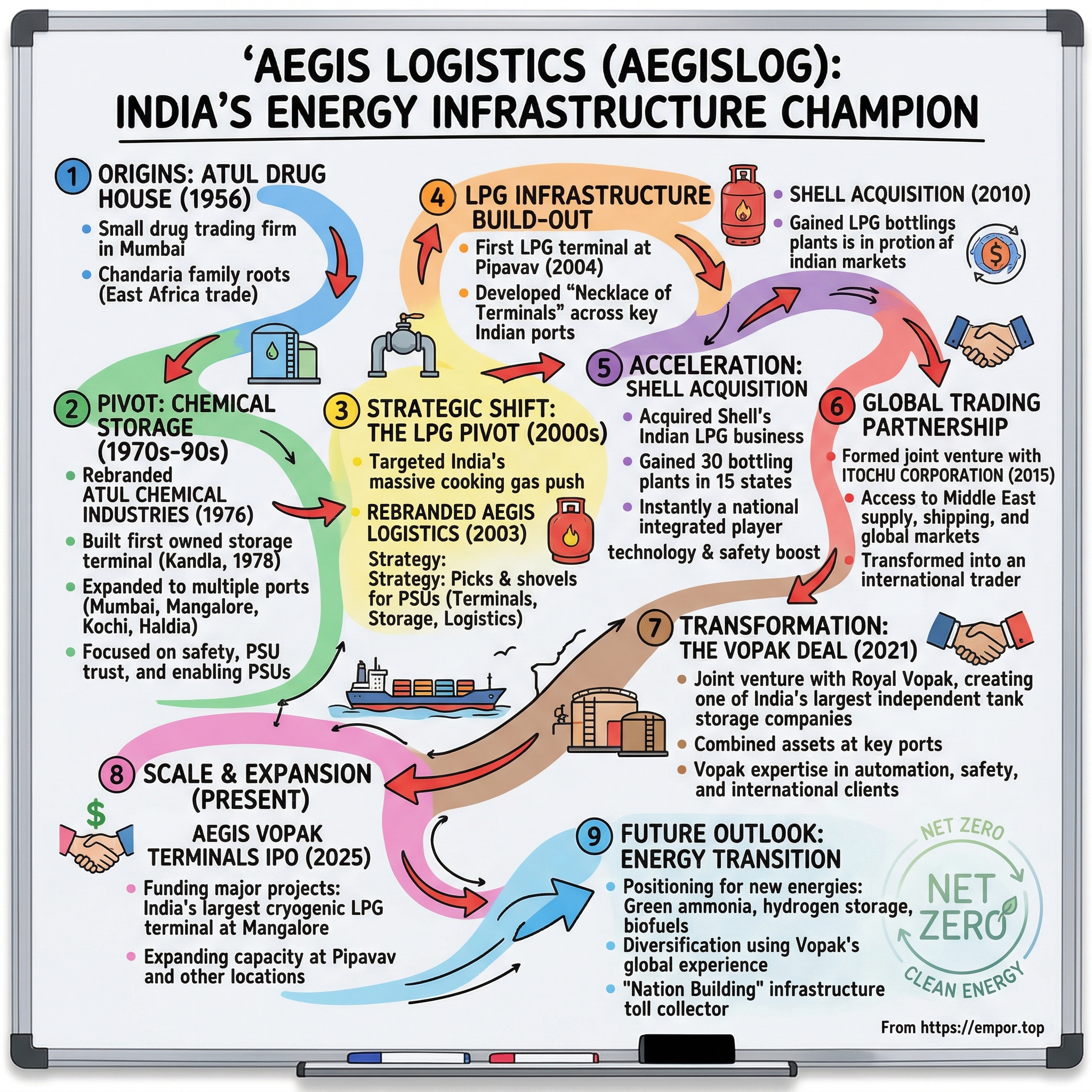
Aegis Logistics: The Story of India's Energy Infrastructure Champion
I. Introduction & Episode Teaser
In the last week of February 2026, the world's most important oil chokepoint went quiet. Tanker traffic through the Strait of Hormuz — normally around 54 oil, chemical and gas carriers a day — collapsed toward a trickle, and by late May the daily count averaged eleven vessels.21 For most of the world, this was a headline about crude prices.
For India, it was something more intimate: roughly 88% of the country's liquefied petroleum gas imports in the first nine months of FY2026 had passed through that strait, and LPG is what 332 million Indian households use to cook dinner.22 Within weeks, the Saudi contract price — the benchmark that sets the landed cost of a cooking gas cylinder in Chennai or Chandigarh — jumped from about $543 a tonne in February to $775 for April cargoes, and drifted to roughly $790 by June.22 Cylinder booking queues stretched to 45 days in some cities. State oil marketing companies absorbed the pain, with cumulative under-recoveries on domestic LPG crossing ₹59,000 crore by the end of July 2026.23
And in the middle of that chaos, a company most Indians have never heard of posted the best quarter in its seventy-year history.
On August 14, 2026, Aegis Logistics reported Q1 FY2027 revenue of ₹2,357 crore, up 37% year on year, normalized EBITDA of ₹727 crore — up 184% — and consolidated profit after tax of ₹545 crore, more than triple the prior-year quarter.3 The gas division alone generated ₹591 crore of EBITDA, a 296% increase.3 Chairman and Managing Director Raj Chandaria opened the earnings call by noting the company had crossed ₹500 crore of quarterly profit for the first time.4
That juxtaposition — a national energy emergency and a record corporate quarter — is the tension this story is built around. Is Aegis Logistics a durable infrastructure toll booth on India's energy imports, or did it just have an extraordinarily good war? The honest answer, as we'll see, is that both things are true at once, and separating them is the single most important analytical task facing anyone looking at this company.
Here is what Aegis actually is. It owns and operates bulk liquid and gas terminals at seven Indian ports — Kandla, Pipavav, Mumbai, JNPA (Nhava Sheva), Mangalore, Kochi and Haldia — with roughly 1.66 million cubic metres of liquid tankage across its Mumbai, JNPA, Kandla, Mangalore and Kochi sites and 247,000 MT of static LPG capacity.3 Through that network it handled 5.152 million MT of LPG logistics throughput in FY2026, an all-time high and roughly a quarter of everything India imported that year.320 It also buys LPG internationally through a Singapore trading arm and sells it domestically to industrial users, autogas stations and commercial cylinder customers — a business that has quietly become the profit engine.
The macro thesis is seductive and, unusually, mostly correct. India consumes roughly 31 million tonnes of LPG a year, against domestic production of only about 12 million tonnes; the remainder — some 20 million tonnes, or around 400 Very Large Gas Carrier shiploads annually — arrives by sea.20 Every one of those tonnes has to be discharged, stored, and evacuated inland. Somebody owns the pipe it flows through. Increasingly, that somebody is Aegis.
But this is not a story about a company that stumbled onto a good macro. It is a story about a corporate identity that was rebuilt from scratch — twice — and about a family that decided, sometime in the late 1990s, that owning waterfront concrete beat owning chemical plants.
Along the way, it involves a 1956 pharmaceutical company called Atul Drug House, a Gujarati trading dynasty that made its fortune in Nairobi, a Shell asset sale, two of the most consequential foreign partnerships in Indian mid-cap history, a ₹2,800 crore subsidiary IPO, and a governance structure complicated enough that a skeptical investor could reasonably spend a full afternoon just mapping who owns what.
We'll cover four themes. First, the improbable corporate metamorphosis from drug house to chemical trader to port infrastructure operator. Second, the capital-allocation pattern that defines this company: repeatedly selling minority stakes in its own assets to global strategic partners — ITOCHU of Japan, Royal Vopak of the Netherlands — to fund expansion without either drowning in debt or diluting the promoter family.
Third, the dual-engine economics of a business where one segment is a high-margin annuity and the other is a high-volume, thin-margin flow business whose profitability just tripled for reasons largely outside management's control. And fourth — the part that matters most from here — the question of what happens when the Hormuz premium normalizes.
Start at the beginning, which is not a port at all.
 Subscribe on LinkedIn
II. Origins & The Chandaria Legacy: From Atul Drug House to Industrial Logistics (1956–1990s)
Picture Bombay in the summer of 1956. Nine years after independence, the Indian state was building itself a planned economy, and a small private limited company was incorporated on June 30 of that year under the name Atul Drug House Limited.1 It made basic pharmaceutical formulations and formaldehyde. It was, in every meaningful sense, a nobody — one of thousands of small licensed manufacturers operating inside the industrial-licensing regime that would later be called the Licence Raj.
The story of how that company became the operator of India's largest private LPG import network is inseparable from the family that took it over. The Chandarias are a Gujarati merchant family whose modern history began not in India but in East Africa: the patriarch left Saurashtra for Nairobi around 1915 and opened a provisions shop, and the family subsequently built the Comcraft Group, a metals-and-plastics manufacturing enterprise that came to operate across dozens of countries.33 That diaspora background matters more than it sounds.
A family that has run manufacturing businesses in Kenya, the UK, and Asia develops two habits that most Indian promoter families of the era did not have: comfort dealing with foreign partners as equals, and an instinct for arbitrage across borders. Both would show up decades later in the deal-making.
The corporate name changed with the strategy. On September 14, 1976, Atul Drug House became Atul Chemical Industries Limited as the business pivoted toward bulk chemical manufacturing and trading.1 For the next two decades it was, essentially, a small chemicals company — and small chemicals companies in India in the 1980s were not good businesses. They were capital-intensive, cyclical, price-controlled, and squeezed between government-set input costs and government-influenced output prices. Margins compressed in downturns and competition arrived instantly in upturns.
Somewhere in that grind, the company noticed something. It had built liquid storage tanks at Trombay, on Mumbai's eastern waterfront, to serve its own chemical operations. And the tanks made money more reliably than the chemicals did. A storage tank does not care what the price of the product inside it is. It charges rent. It charges a fee to pump product in and out. It charges extra to heat viscous cargoes or blend them. Its customer is not a consumer whose demand fluctuates with fashion but an industrial buyer who has already committed capital downstream and cannot easily move.
This is the founding insight of the modern company, and it is worth stating plainly because everything since follows from it: the Chandarias concluded that in an economy where the government controlled the product, the durable profit pool was in controlling the infrastructure the product had to pass through. Chemicals were a business you competed in. Waterfront was a business you owned.
Acting on that insight required something scarce: land at a port, with draft access, environmental clearance to handle hazardous cargo, and a lease long enough to justify the concrete. In the 1980s and early 1990s, before private infrastructure investment became fashionable in India, this was unglamorous, illiquid, and cheap.
Aegis accumulated waterfront positions and — just as importantly — accumulated the technical and regulatory competence to handle corrosive chemicals, flammable petrochemicals and volatile gases without incident. Safety track record is a licensing asset in this industry; a serious accident does not just cost money, it costs the permits.
The rebranding came last. On August 29, 2003, Atul Chemical Industries Limited became Aegis Logistics Limited — the name change signalling that third-party terminalling, not manufacturing, was now the business.1 The Latin root is not subtle: aegis, the shield. A company that stores other people's dangerous liquids is selling, above all, the promise that nothing will go wrong.
Two family members drove the modern era. Raj K. Chandaria, born in Kenya and largely educated in North America, has been associated with the company since 1982 and became Vice Chairman and Managing Director on March 31, 2008 before assuming the Chairman and Managing Director role; he is based in Geneva.19 His younger relative Anish K.
Chandaria — born September 17, 1967, a Cambridge graduate with an MBA from Wharton — joined in 1993 and became the operational architect of the terminal strategy.18 Anish was the one who pushed the port expansion, and his sudden death in London on September 11, 2021, six days before his 54th birthday, removed the executive most identified with the build-out at precisely the moment the company was entering its largest transaction ever.1718 We will return to what that succession gap has and has not cost.
By the late 1990s, then, Aegis had the right idea and the wrong scale. It had storage in Mumbai and a conviction about ports. What it did not have was a reason for anyone outside the chemical industry to care. That reason arrived from an entirely different direction: the Indian kitchen.
III. The Great Pivot: Developing the "Necklace of Ports" (2000–2010)
The most consequential fact about Indian energy in the 2000s was not about oil. It was about smoke. Hundreds of millions of Indian households still cooked over wood, dung and kerosene, with the health and time costs falling overwhelmingly on women. Successive governments concluded that converting those kitchens to LPG was among the highest-return social interventions available — and set about doing it. Indian LPG consumption roughly doubled over the following decade, from around 15 million tonnes in 2012 to about 31 million tonnes by 2025.20
Here is the problem that created, and it is the problem that made Aegis. India's refineries could not produce anywhere near that much LPG. LPG is a by-product of refining and gas processing; you cannot simply decide to make more of it without building refineries you do not need. So the marginal molecule had to be imported. Today domestic production runs around 12 million tonnes against roughly 31 million tonnes of demand, leaving the country dependent on seaborne imports for about 60% of its cooking gas.20
Now consider who had to handle those imports. The public sector oil marketing companies — Indian Oil, Bharat Petroleum, Hindustan Petroleum — owned the bottling plants, the distributor networks, the brands and the subsidy relationship with the government. What they did not have, in sufficient quantity, was specialised deepwater import terminal capacity.
Building one is a peculiar kind of project: it requires port land with enough draft for a Very Large Gas Carrier, refrigerated or pressurised storage engineered to hold hydrocarbon at minus 42 degrees Celsius, a jetty, a pipeline corridor to the tank farm, and a rail or road gantry to get product inland. It is expensive, slow, and it earns a service fee rather than a retail margin — which is to say, it is exactly the kind of asset a state-owned enterprise focused on refining and retail keeps deprioritising.
Consider what a VLGC discharge actually involves, because the physical detail is where the barrier to entry lives. A Very Large Gas Carrier arrives holding on the order of 44,000 tonnes of propane and butane chilled to roughly minus 42 degrees Celsius. It needs enough water under the keel to berth — which most Indian ports do not have without dedicated dredging.
It needs an insulated jetty line to carry the cargo ashore without warming it. It needs refrigerated shore tanks large enough to take the whole parcel, because a partially discharged gas carrier is an expensive problem. And it needs somewhere for the product to go afterwards: a pipeline to a bottling plant, a rail gantry loading pressurised wagons, or a road tanker bay. Miss any link in that chain and the terminal is a very costly ornament.
That gap is the entire commercial opening. Aegis's strategic response, which management came to describe as building a "necklace" of terminals, was to position facilities at India's principal maritime gateways on both coasts so that an OMC could pull imported product ashore wherever its inland demand happened to sit. Kandla in Gujarat — India's dominant bulk liquid gateway — was the anchor on the west. Mumbai's Trombay tankage was the legacy core. Over time the chain extended down to Mangalore and Kochi and around to Haldia in West Bengal.
The transaction that turned the strategy into scale came at the end of 2009. Royal Dutch Shell had built a genuinely good LPG business in India — a deepwater import terminal at Pipavav port in Gujarat, a filling plant, and a packed-cylinder distribution network — and had concluded, as many multinationals did in that era, that competing in a subsidised Indian retail fuel market against state-owned incumbents was not a winnable game. Aegis agreed to acquire Shell Gas (LPG) India Private Limited, which became a wholly owned subsidiary with effect from April 1, 2010.56 The consideration was not disclosed.6
There is a detail in the timing worth noticing. The deal was announced in December 2009 and took effect from April 1, 2010 — the beginning of an Indian fiscal year, which is how buyers structure acquisitions they intend to integrate cleanly rather than trade.65 Aegis was not flipping an asset. It was absorbing an operating business it intended to run for decades.
The strategic logic deserves more attention than the price tag it lacks. Aegis was not buying a consumer brand or a subsidy entitlement; it was buying hard assets — a deepwater jetty position, pressurised storage, a bottling plant, and pipeline tie-ins — of a type that would take years and multiple regulatory approvals to replicate. Shell was a motivated seller of a business it had decided was strategically orphaned. That combination is where disciplined acquirers make their money: buying infrastructure from someone who is exiting the sector, not the asset.
What the Pipavav acquisition changed, structurally, was Aegis's relevance to the PSUs. Before it, Aegis was a regional chemical storage operator. After it, Aegis was a national LPG import gateway with a deepwater berth on the Gujarat coast — the closest Indian landfall to the Persian Gulf, and therefore the natural first discharge point for Middle Eastern cargoes.
There is a caveat worth holding onto. Buying import infrastructure only pays if the ships actually come and the volumes actually flow, and both depend on things Aegis does not control: OMC procurement decisions, subsidy policy, and international price spreads. Through the 2010s the company was, in effect, making a leveraged bet on the Indian state continuing to push LPG into households. That bet was correct. It is not obvious it was low-risk at the time.
By 2010 Aegis had the concrete. What it did not have was the ability to compete on the cost of the molecule flowing through it. Owning the door is valuable; owning the door and being cheapest through it is a different business entirely. Solving that required going to Japan.
IV. Global Sourcing Scale & Joint Ventures: The ITOCHU Partnership (2010–2015)
Think about what actually happens when an Indian oil marketing company decides to import a cargo of propane. Someone has to have a relationship with a Gulf producer or a global trader. Someone has to charter a Very Large Gas Carrier — a specialised refrigerated vessel that costs tens of thousands of dollars a day and is booked out weeks ahead.
Someone has to post credit for a cargo worth tens of millions of dollars, hedge the price between fixing and discharge, and manage the timing so the ship arrives when the tank has room. This is a business of scale, balance sheet and information, and a mid-cap Indian terminal operator competing against Vitol, Trafigura and the Japanese trading houses was, to put it gently, a price taker.
Aegis had set up a Singapore vehicle, Aegis Group International Pte Ltd, precisely to do this sourcing work. It supplied roughly 700,000 tonnes of LPG a year into India — respectable, but not scale.7 The company's response was the move that would become its signature: rather than trying to build global trading capability itself, it sold a minority stake in the capability to someone who already had it.
In September 2014, Aegis sold 40% of Aegis Group International to ITOCHU Petroleum Co. (Singapore) Pte Ltd, a subsidiary of the Japanese trading house ITOCHU Corporation, for $5.85 million — roughly ₹35 crore.78 By the standards of the deals that followed, this was a rounding error. In terms of what it bought, it was arguably the highest-return transaction in the company's history.
What Aegis got was not cash; ₹35 crore funded nothing. What it got was ITOCHU's global LPG procurement book, its chartering relationships, its credit lines, and its market intelligence — plugged directly into the Indian import chain. The mechanism by which that turns into competitive advantage is worth spelling out in plain terms, because it is the least understood part of this business.
An OMC awarding an import contract is not choosing a terminal; it is choosing a landed cost per tonne, which bundles the cargo price, the freight, the financing, and the terminal handling. If your sourcing partner can shave a few dollars a tonne off cargo and freight, your terminal wins volume even if the terminal fee itself is identical to a competitor's. Sourcing scale, in other words, is a customer-acquisition tool for infrastructure.
It is worth being concrete about the counterfactual, because "sourcing scale" can sound like corporate boilerplate. Suppose an OMC tender is decided on a landed cost of, say, $600 per tonne. A trading partner with global reach might secure the cargo two or three dollars cheaper and the freight another two or three dollars cheaper by optimising vessel positioning across a fleet it is already chartering for other routes.
On a 44,000-tonne cargo, five dollars a tonne is $220,000 — money that either widens the bidder's margin or wins the tender. Repeat that across dozens of cargoes a year and the advantage compounds into terminal utilisation, which is the variable that actually determines whether the concrete earns its cost of capital. That is why a trading relationship worth $5.85 million in equity terms was worth vastly more in strategic terms.
ITOCHU's own framing of the Indian opportunity was demographic and blunt: demand already exceeding 20 million tonnes a year, driven by population growth, rising incomes and government clean-energy policy, and expected to keep climbing.9 Japanese trading houses take twenty-year views on commodity infrastructure. Finding one willing to sit as a minority partner rather than a controlling acquirer is the specific thing Aegis got right.
The relationship deepened rather than stalled, which is itself evidence about how the partnership was working. On June 1, 2017, ITOCHU acquired a 19.7% stake in Hindustan Aegis LPG Limited — the entity built to develop a major new LPG import terminal at Haldia Port in West Bengal — for ₹2.5 billion, or approximately ¥4.3 billion.9 Haldia mattered strategically because the eastern seaboard had almost no private LPG import capacity, and eastern and northern India were where household penetration was growing fastest. ITOCHU's capital funded the terminal; Aegis retained operational control.
Look at the pattern that had now been established twice. Aegis identified an asset or capability it needed, found a strategic partner with a structural advantage it lacked, sold that partner a minority position at the asset level rather than the parent level, and used the partner's money and expertise to build. The promoter family's stake in the listed entity was never diluted to fund a terminal. Debt was never loaded onto the parent to fund a terminal. The partners took equity risk in the specific projects they understood.
The skeptical reading is worth stating too, because it becomes material later. Every one of these deals added a layer to the corporate structure. By 2017 an investor in the listed parent owned a share of a company that owned varying percentages of a Singapore trading JV, an eastern-India terminal JV, and a set of directly held terminals — each with a different partner and a different economic interest. Consolidated headline profit stopped being the same thing as profit attributable to shareholders. That complexity was the price of the funding model, and it has only grown.
By the late 2010s Aegis had the terminals and the sourcing. What it still lacked was the capital and the technical depth to make the jump from a mid-cap operator to a genuinely national storage platform. For that, it went to the Dutch.
V. The Vopak Mega-Deal & Transformation (2021–Present)
Royal Vopak is a company most investors have never had reason to think about, which is roughly what you would expect from a business whose entire product is tanks. Founded in Rotterdam with roots going back to 1616, it is the world's largest independent tank storage operator, and by 2021 it faced the problem that afflicts every mature infrastructure company: its home markets were growing at GDP rates while Asia was growing at multiples of that. India was the obvious gap. Building there from scratch would mean competing for port land against incumbents who had spent thirty years accumulating it.
The specific match mattered. Vopak is not a financial investor; it is an operator with centuries of accumulated institutional knowledge about how to store things that can kill people. That distinction determines what a partner actually contributes. A private equity buyer would have brought capital and a five-to-seven-year exit clock. An operator brings capital, permanent-capital patience, and a technical standard that unlocks cargo categories a domestic operator cannot easily win.
Aegis had the opposite problem. It had the land, the concessions and the customer relationships, and a capital expenditure ambition far larger than its balance sheet comfortably supported.
On July 12, 2021 — ten months before the transaction actually closed, and two months before Anish Chandaria's death — the two companies announced they would combine forces.10 The structure is worth walking through slowly, because understanding it is a prerequisite for understanding the financial statements today.
A new entity, Aegis Vopak Terminals Limited, was created. Aegis contributed its terminal assets at Kandla, Pipavav, Mangalore, Kochi and Haldia. Vopak contributed its existing CRL terminal entity at Kandla, which became a wholly owned subsidiary of the JV, and acquired a 49% shareholding in the combined vehicle.10 Separately, Vopak took 24% of Hindustan Aegis LPG, leaving Aegis at 51% and ITOCHU at 25% of that entity.10 The resulting platform operated eight terminals across five ports with roughly 960,000 cubic metres of capacity, making it one of the largest independent tank storage businesses in India.10 The enterprise value ascribed to Vopak's shareholding was EUR 185 million, plus a further EUR 15 million contingent on certain conditions being met.10 The transaction completed in May 2022.[^12]
Strip away the deal mechanics and three things happened. First, Aegis converted a chunk of illiquid, wholly owned terminal assets into a partly owned platform with a global partner's capital behind it — the same playbook as ITOCHU, executed an order of magnitude larger. Second, it imported operating standards.
Vopak's institutional expertise in handling dangerous liquids, cryogenic gases and emerging fuels is not a marketing claim; it is the thing that lets a terminal operator credibly bid for ammonia, hydrogen derivatives and speciality chemical business that a purely domestic operator would struggle to get insured, let alone permitted. Third — and this was the point the market took longest to price — it created an asset that could be listed separately.
That listing arrived in 2025. Aegis Vopak Terminals opened its ₹2,800 crore initial public offering on May 26, 2025, entirely a fresh issue of about 11.91 crore shares at a price band of ₹223 to ₹235, closing on May 28.11 Thirty-two anchor investors — including SmallCap World Fund, Norway's Government Pension Fund Global, Goldman Sachs, HDFC Mutual Fund and Motilal Oswal Mutual Fund — took ₹1,259.99 crore on May 23.13 The book was subscribed 2.09 times.13 As of December 31, 2024 the company held roughly 1.5 million cubic metres of liquid capacity and 70,800 tonnes of LPG capacity, and ₹671.3 crore of the proceeds was earmarked to acquire a cryogenic LPG terminal at Mangalore with a total project cost of ₹968 crore.13 That Mangalore terminal was commissioned in June 2025.27
The market's verdict was tepid, and it is more instructive than the deal announcement. The shares listed on June 2, 2025 at ₹220 on the BSE — a 6.3% discount to the issue price — before recovering intraday.12 A year later, in mid-June 2026, they traded around ₹233, still marginally below the issue price, against a 52-week high of ₹302.12 For a business whose FY2026 revenue rose about 17% to ₹923 crore and whose profit jumped 52% to ₹341.92 crore on operating EBITDA of ₹686.5 crore, that is a striking disconnect.26
The disconnect tells you something the bull case tends to skip. Investors were being asked to pay an infrastructure-scarcity multiple for an asset whose returns are contractually capped, whose capital intensity is enormous, and whose largest shareholder is also its largest counterparty. The IPO unlocked a market price for the terminal assets. That price has so far been unenthusiastic.
There is also a governance wrinkle that a skeptical investor should sit with. On July 10, 2025 — five weeks after the AVTL listing — Aegis Logistics executed a business transfer agreement to acquire the 48,000 MT cryogenic LPG terminal at Pipavav from Aegis Vopak Terminals, as a slump sale on a going-concern basis, for ₹428.4 crore in cash funded from internal accruals.1415 The company characterised the transaction as related-party but conducted at arm's length.15 Then on August 6, 2026, AVTL entered a ₹142.5 crore framework agreement with its own promoter, Aegis Logistics, to fund construction of a 51,998 MT refrigerated propane storage tank at JNPA.29 And on March 26, 2026, the AVTL board approved selling 10% of its subsidiary Aegis Terminal (Pipavav) Limited to ITOCHU for ₹80.32 crore, with ITOCHU signalling an intention to reach 25% over three years.16
None of these is evidence of wrongdoing. All of them are assets moving between entities with overlapping ownership, at prices set by the parties themselves, in both directions. Minority shareholders in AVTL and minority shareholders in Aegis Logistics do not have identical interests in those transfers. This is the structural cost of the partnership model, and it deserves standing scrutiny rather than a one-time disclosure check.
With the architecture now laid out, the question becomes how the money is actually made.
VI. Core Business Deep Dive: Dual Engines & Port Infrastructure Economics
Walk onto a bulk liquid terminal at Kandla and the first thing that strikes you is how little is happening. Rows of tanks, a spider of insulated pipe, a control room with four people in it, a jetty where a ship might berth twice a week. It is one of the least labour-intensive businesses on earth, and that is exactly the point: the capital is in the ground, and once it is there, the incremental cost of moving another tonne through it is close to nothing.
Aegis runs two quite different businesses on top of that concrete, and they behave nothing alike.
The liquid terminal division is the annuity. It stores third-party chemicals, petrochemicals, petroleum products, vegetable oils and increasingly speciality cargoes. It does not own the product. It charges monthly tank rental — which is contracted, and paid whether or not the customer uses the tank — plus throughput fees for pumping in and out, and value-added charges for heating viscous cargo, blending, or nitrogen blanketing.
Because there is no commodity cost line, revenue is small but margin is enormous. In Q1 FY2027 the liquid division generated ₹178 crore of revenue and ₹136 crore of EBITDA — roughly a 76% margin — and it was the fifth consecutive quarter of EBITDA expansion.3 For the full FY2026 year, liquid revenue was ₹644 crore and essentially flat.25
That flat-then-accelerating pattern is the analytically interesting part. Tank storage revenue grows in steps, not curves: you commission a tank farm, fill it over eighteen months, and then the revenue plateaus until the next one lands. Aegis is in the middle of a large step.
Current liquid capacity sits at 334,000 cubic metres at Mumbai, 952,000 at Kandla, 193,000 at Mangalore, 101,900 at JNPA and 82,545 at Kochi.3 Under construction are a further 64,000 cubic metres at Mumbai targeted for the first half of FY2027, a 100,000 cubic metre first phase at JNPA expected in the third quarter of FY2027, 94,148 cubic metres at Kandla's CRL-4, and 49,577 cubic metres at Kochi in early FY2028.3 That is roughly 300,000 cubic metres of new capacity — close to a fifth of the existing base — landing over about eighteen months.
A brief technical detour, because the storage engineering determines the economics. LPG can be held two ways. Pressurised storage keeps it liquid by squeezing it — think of the steel spheres and bullet tanks visible at older facilities. It is cheap to build but does not scale: to store 50,000 tonnes under pressure you would need an implausible field of vessels. Cryogenic storage keeps it liquid by chilling it to around minus 42 degrees Celsius at near-atmospheric pressure, in large insulated tanks with continuous refrigeration.
Cryogenic tanks cost far more and require specialist engineering, boil-off gas handling and constant power, but they are the only way to take a full VLGC parcel in one go. The practical consequence is stark: a terminal without cryogenic capacity cannot serve the deepwater import trade at all. It is confined to smaller coastal parcels at worse economics. This is why Aegis's cryogenic footprint — including the Mangalore facility commissioned in 2025 and the 48,000 MT Pipavav capacity — is the load-bearing part of the gas franchise rather than a technical footnote.2714
The gas terminal division is the flow business, and it has three distinct legs that investors routinely conflate. Logistics is the pure toll: discharging, storing and evacuating LPG for the state oil marketing companies under long-term arrangements, earning a fee per tonne. Sourcing is the Singapore trading activity, earning a dollar-denominated margin per tonne procured. Distribution is Aegis buying LPG and selling it directly to industrial users, autogas stations and commercial cylinder customers under its own brand — which means Aegis takes title to the molecule and carries price risk.
Those three legs behaved completely differently in the most recent quarter, and the divergence is the whole story. Logistics throughput was 1.124 million MT, down about 3% year on year — flat to slightly negative, because the ships were not arriving.3 Sourcing volumes were 121,000 MT, up 1%.3 Distribution volumes were 277,000 MT, up 91% year on year and 19% sequentially.3 And distribution margin — historically around ₹4,000 per tonne — ran above ₹7,000.4
That is why gas division EBITDA nearly quadrupled while gas volumes barely moved. Aegis did not earn a record quarter by handling more cargo. It earned it because a supply shock widened the spread between what it paid for a tonne of LPG and what Indian industrial customers would pay to get one, and because it had product in tanks when others did not. On the Q1 call, CFO Murad Moledina argued the new level was durable, saying that ₹7,000 is sustainable and that the ₹4,000 margin "is history," pointing to procurement efficiencies and new VLGC jetty infrastructure.4
Investors should treat that claim as a hypothesis to be tested, not a fact. The mechanism that produced the margin — a chokepoint closure that made physical availability more valuable than price — is by construction temporary. The mechanisms management cites for permanence — better procurement, better jetty economics, scale — are real but were also present a year ago, when the margin was ₹4,000.
There is a third piece of infrastructure that receives almost no investor attention and probably deserves the most: evacuation. A terminal's value is capped by how fast product can leave it. Pipeline connectivity to inland bottling plants, rail gantries capable of loading pressurised wagons, and road tanker bays determine the number of times a tank can be turned in a year — and turns, not capacity, drive returns.
Management's description of Pipavav as evolving into an integrated platform combining VLGC handling, a rail gantry, a bottling plant and pipeline connectivity is precisely this point.4 It also explains why management flagged that a "step-up" in logistics growth beyond the 25% baseline depends on pipeline and multimodal evacuation infrastructure rather than on adding tankage.4 Investors who track only capacity in cubic metres are measuring the wrong side of the equation.
The unit economics underneath both engines explain why the moat exists at all. Liquid tankage is built for something in the order of ₹8,000 to ₹12,000 per kilolitre of capacity, earns back over several years, and requires high utilisation to work.
Cryogenic LPG storage is dramatically more expensive — refrigerated tanks holding hydrocarbons at minus 42 degrees are engineering projects, not construction projects — and the Mangalore facility's ₹968 crore total cost for a single site gives a sense of the ticket.13 The returns come almost entirely from volume turns per year: the same tank filled and emptied twelve times earns twelve times the fee of one filled once. Operating leverage in this business is not a metaphor; past a threshold, virtually every incremental tonne drops to EBITDA.
Which raises the obvious question: if the economics are this attractive, why hasn't everyone built one?
VII. Competitive Landscape, 7 Powers & Porter's 5 Forces
Try to replicate Aegis. You need a parcel of land at an Indian port with sufficient draft for a VLGC, a lease long enough to amortise a cryogenic tank, environmental clearance to handle explosive hydrocarbons next to a populated coastline, a pipeline corridor from jetty to tank farm, and a customer willing to sign a multi-year commitment before you pour concrete. Then you need to do it while the incumbent — who already holds the adjacent parcel, the existing corridor and the customer relationship — bids against you.
That is the honest description of the moat, and in Hamilton Helmer's framework it is overwhelmingly a cornered resource. Aegis's advantage is not primarily technological or brand-based. It is that it holds long-term waterfront concessions and pipeline corridors at seven ports that cannot practically be recreated, because the shoreline is finite and the environmental permitting regime for hazardous cargo has tightened substantially since most of those positions were acquired.
Scale economies is the second power, and it is real but narrower than the bull case implies. Combining sourcing volume through the ITOCHU relationship with multi-port terminal capacity lets Aegis quote a landed cost per tonne that a single-terminal operator cannot match. That is genuine. But it is a cost advantage in a business where the customer is a sophisticated state buyer running competitive tenders, which caps how much of the advantage Aegis retains rather than passes through.
Switching costs are the third, and they are the most durable. Once an OMC has connected its inland evacuation — pipeline, rail gantry, road loading — to a specific terminal, redirecting import flows to a different port is not a procurement decision; it is a capital project with its own approvals and timelines. This is why terminal relationships, once established, tend to persist for decades. It is also why the JNPA and Vadhavan positions matter disproportionately: winning the connection now determines flows for a generation.
Counter-positioning applies in a limited, historical sense. The PSUs' reluctance to build speculative third-party import capacity — because their capital is committed to refining and, increasingly, to energy transition projects — left a structural opening that Aegis filled as a neutral, multi-client operator that does not compete with its customers downstream. This is a real advantage but a fragile one: it depends on a continuing PSU decision not to build, which is a policy choice rather than an economic law.
Running Porter's framework produces a similar picture with sharper edges.
Threat of new entrants is genuinely low. The barriers described above are not soft. Adani Ports and SEZ is the most credible potential entrant — it has the land bank, the balance sheet, the political relationships and the demonstrated willingness to build integrated port-to-tank logistics — and any serious bear case on Aegis starts here rather than with demand.
War-game the Adani scenario properly, because it is the one that would matter. APSEZ controls a large share of Indian port throughput and has repeatedly demonstrated that it will build integrated logistics rather than rent it. If it decided to enter bulk liquid and cryogenic gas storage at scale, it would start with advantages Aegis cannot match: land it already controls, a lower cost of capital on infrastructure debt, and the ability to bundle terminal services with berth allocation at its own ports.
What it would lack is the operating history with hazardous cargo, the OMC service relationships built over fifteen years, and the international sourcing arm. The realistic outcome is therefore not displacement at Kandla or Pipavav — the switching costs there are prohibitive — but aggressive competition for new concessions, which is exactly where Aegis's growth is targeted. A bidding contest for Vadhavan-era capacity against a counterparty with a structurally lower hurdle rate is a materially different competitive environment than the one that produced the last two decades of returns.
Bargaining power of buyers is moderate and structurally uncomfortable. Three state-owned oil marketing companies dominate the customer base for the logistics leg. Concentrated, politically directed monopsony buyers are not a comfortable customer set, and their pricing behaviour in a normalised supply environment is a live risk. The offsetting factor is that alternative private import infrastructure of comparable scale simply does not exist yet.
Bargaining power of suppliers is low. Gulf and increasingly US LPG producers operate in a competitive international market, and the ITOCHU relationship gives flexibility on origin — which proved its worth when Indian buyers concluded a one-year structured contract for roughly 2.2 million tonnes of US Gulf Coast LPG for contract year 2026, close to 10% of national imports.24
Threat of substitutes is the real long-term question, and we treat it properly in the risk section.
Rivalry is currently low to moderate. The independent Indian tank storage field is fragmented. Ganesh Benzoplast operates terminals at JNPT, Cochin and Goa with installed capacity of over 352,000 kilolitres across 98 tanks as of March 31, 2025 — meaningful, but roughly a fifth of Aegis's liquid footprint and concentrated in chemicals rather than gas.30 IMC Limited is a long-established independent bulk liquid storage operator.31 JM Baxi's Nhava Sheva Distribution Terminal handles multiple cargo types at JNPA. None of them combines liquid storage, cryogenic gas import capability, international sourcing and a national multi-port footprint.
Set against FY2026 LPG logistics throughput of 5.152 million MT and national imports of roughly 20 million tonnes, Aegis handled something on the order of a quarter of everything India imported.320 That is a dominant private position — and it is also the number that makes the company politically visible, which is a risk as much as an achievement. An infrastructure operator earning outsized margins during a national cooking-gas shortage is an operator with a target on it.
The moat, in short, is real, physical and hard to replicate. Whether the returns on that moat hold depends on who is allocating the capital.
VIII. Management, Governance & Capital Allocation Playbook
Raj Chandaria runs a company with seven port terminals in India from an office in Geneva. That fact, which sounds like a governance red flag, is closer to a description of what the company actually is: a capital allocation and partnership-structuring vehicle sitting on top of an Indian operating business run by professional managers. The strategic decisions that have mattered most in this company's modern history — sell 40% of the Singapore arm to ITOCHU, sell 49% of the terminal platform to Vopak, list the JV — are deal decisions, not operating decisions.19
The 2021 succession was the real test of whether that division of labour held. Anish Chandaria had been the operational architect since 1993, and his death in September 2021 came weeks after the Vopak announcement and months before it closed.1718 A JV of that complexity failing to complete would have been an unremarkable outcome; instead the transaction closed in May 2022 and the terminal build-out continued.[^12] That is genuine evidence of institutional depth beyond the founding family — though it should be weighed against the reality that no single executive has since occupied the operational-visionary role Anish held.
On alignment, the numbers are unambiguous. Promoters held 58.10% of Aegis Logistics as of the June 2026 shareholding, with foreign institutional investors at 19.54%, domestic institutions at 3.60% and public shareholders at 18.77% across roughly 77,000 holders.2 A promoter family with the majority of its wealth in the listed entity has structurally aligned incentives on the downside; it also has the votes to approve related-party transfers between entities it controls. Both consequences follow from the same fact.
The capital allocation record is the strongest part of the bull case, and it holds up to scrutiny better than most Indian mid-cap infrastructure stories. Over eleven years the company grew consolidated profit from ₹112 crore in FY2015 to ₹1,107 crore in FY2026 — roughly a tenfold increase — with revenue rising from ₹3,915 crore to ₹8,333 crore over the same span.2 The gap between those two growth rates is the entire thesis in one comparison: revenue slightly more than doubled while profit rose tenfold, which is what happens when a company shifts its mix from trading commodity volume toward owning the infrastructure that volume passes through.
The path was not smooth, and the bumps are instructive. FY2016 revenue collapsed from ₹3,915 crore to ₹2,212 crore while profit rose — a commodity price effect, not an operating one.2 FY2020 profit fell to ₹134 crore from ₹252 crore the prior year, a nearly 47% decline.2 Anyone treating this as a smooth compounder should study those two years: in a business that takes title to hydrocarbons, reported earnings will periodically be hostage to price moves that have nothing to do with terminal performance. This is precisely why the company reports a "normalized" EBITDA figure — a presentation choice that is defensible but also, by definition, management's own judgment about which effects to strip out.
Returns tell a more mixed story than the profit growth does. Return on equity of about 16.3% is respectable; return on capital employed of roughly 13.3% is not exceptional for a business whose bull case rests on irreplaceable assets.2 The gap reflects the reality that Aegis is in a heavy build phase — large amounts of capital sit in projects not yet earning. It also means the promised operating leverage has to actually arrive for the returns story to work.
The funding philosophy — bring in partner equity at the asset level rather than issuing parent equity or loading parent debt — has now been executed four times across ITOCHU, Vopak, the AVTL IPO and the ITOCHU stake in the Pipavav subsidiary. Management targets a gearing ratio around 0.6x.4 Dividends per share reached ₹8.70 in FY2026, compounding at roughly 29% annually from ₹1.40 in FY2019 — a payout policy that has grown with earnings rather than substituting for reinvestment.3
On credibility, the behavioural evidence is reasonably good and the rhetoric is worth watching. Management has described its own philosophy on the Q4 FY2026 call as choosing "not to overpromise, always to underpromise, and hopefully overdeliver."25 Companies that say this while posting a 184% EBITDA increase and simultaneously guiding to distribution volume growth of "above 25%, possibly closer to 50%" are making a claim that will be checked within a year.4 The capex framing invites the same scrutiny: across recent calls management has pointed to a cumulative capital programme of roughly $1.2 billion by March 2027, a further ₹5,000 crore of investment by March 2028, and an aspirational pipeline running toward the end of the decade — figures presented in a mix of dollar and rupee terms across calls, and large relative to a company with roughly ₹6,000 crore of cash and investments.425 Reconciling those numbers is a fair question for the next call.
Which brings us to the financials themselves, and to the question of how much of the current earnings power is real.
IX. Financial Mechanics, Hidden Drivers & Skeptical Investor Stress Test
Start with the shape of FY2026, because it is the last full year before the distortion. Consolidated revenue rose 23% to ₹8,333 crore, normalized EBITDA rose 36% to ₹1,599 crore, and profit after tax rose 41% to ₹1,107 crore, crossing ₹1,000 crore for the first time.325 Within that, LPG revenue reached ₹7,689 crore, up 26%, with segment EBITDA up 68%; liquid revenue was ₹644 crore, broadly flat.25 Distribution volumes rose 45% to 754,000 MT and logistics throughput rose 14% to 5.152 million MT, an all-time high.3 The fourth quarter alone delivered ₹2,594 crore of revenue, up 52%, and ₹596 crore of profit, up 56%.25
Read that carefully and you notice the acceleration was already underway before the strait closed in late February 2026. Distribution volumes were compounding at 45% for the full year; the Hormuz effect explains the Q4 and Q1 spike, not the trend. That distinction matters enormously, and it is the strongest available evidence for management's case that something structural is happening in the distribution business rather than merely something opportunistic.
Now the distortion. Q1 FY2027's ₹727 crore of normalized EBITDA and ₹719 crore of profit before tax, up 215%, sat on top of a gas EBITDA line that nearly quadrupled while gas volumes were flat to down.3 Note also the reporting nuance an investor should catch: consolidated profit after tax was ₹545 crore, while profit attributable to the company's own shareholders was around ₹484 crore — the difference being minority interests in AVTL, HALPG and the subsidiary structures.332 In a group with this many partly owned entities, the consolidated headline systematically overstates what accrues to the listed parent's shareholders. Anyone modelling this business on consolidated PAT alone is modelling the wrong number.
Below the EBITDA line, two items deserve attention. Finance, hedging and forex expenses more than doubled to ₹55 crore from ₹24 crore, and depreciation rose to ₹53 crore from ₹41 crore.3 Both are the visible cost of the build phase, and both will keep rising as the tankage under construction is commissioned. The effective tax rate ran around 24%.3
Two accounting and disclosure judgments deserve flagging rather than alarm. First, the "normalized" EBITDA the company leads with is a management-defined measure, not a statutory one; in a business that takes title to hydrocarbons and hedges them, the choice of what to normalise materially shapes the headline. Investors should reconcile it to reported EBITDA each quarter rather than accept it.
Second, working capital in the distribution business scales with LPG prices, not volumes — when Saudi CP moves from $543 to $790 a tonne, the same physical book absorbs roughly 45% more cash.22 Analysts have historically pressed management on trade receivables during volatile price periods, and that pressure is well placed: rapid distribution volume growth into a rising price environment is precisely the combination that consumes cash even as reported profits rise.
The optionality worth sizing properly. The most material new growth vector is cryogenic and ammonia storage. Aegis commissioned a 36,000 MT ammonia terminal at Pipavav backed by a fifteen-year take-or-pay agreement with Hindustan Zinc.4 This is the model that should interest long-term investors far more than the trading margin: a fifteen-year contracted revenue stream on a specialised asset, in a product category where India's import needs are growing and where handling capability is genuinely scarce.
Ammonia is also the physical precursor to the green hydrogen economy — if India ever exports hydrogen at scale, it will do so as ammonia through terminals like this one. That is a call option with a long expiry and, critically, a paying tenant in the meantime.
Biofuels and sustainable aviation fuel blendstocks are the second-order version of the same idea: existing chemical tankage upgraded to handle ethanol, biodiesel and SAF components. Strategically aligned, growing, and cheap to pursue because the tanks already exist.
Retail and autogas distribution remain a minor contributor and should be treated as such. It is a niche margin capture business, not a driver.
Now the stress test. Four challenges a skeptical long-short investor would put to this company.
First, and most obviously: the margin is a war premium. Distribution margin above ₹7,000 per tonne exists because a chokepoint closed and physical LPG in an Indian tank became scarce. Analysts on the Q1 call pressed exactly this point, asking whether margins had peaked; management pointed to procurement efficiencies and VLGC jetty infrastructure as support for holding above ₹7,000 even as geopolitics normalise.4 The market was unconvinced — the stock fell on results day despite a substantial beat.4 The falsifiable test is simple and will arrive within two or three quarters: if Hormuz traffic normalises and the margin holds near ₹7,000, management was right. If it reverts toward ₹4,000, roughly half of the current gas division EBITDA disappears.
Second, structural complexity and the holding-company problem. Assets sit across AVTL — itself now separately listed and majority-owned — Hindustan Aegis LPG with two foreign partners, the Singapore trading JV, and directly held terminals. Assets have moved between these entities in both directions at self-determined prices, including the ₹428.4 crore Pipavav transfer back to the parent and the ₹142.5 crore JNPA funding agreement.1429 Nothing disclosed suggests impropriety. But holding-company discounts exist for a reason, and the market's tepid treatment of AVTL's own shares suggests investors are already applying one.
Third, PSU dependency. If Indian Oil or BPCL decided to build captive deepwater LPG import capacity at scale, the logistics leg's pricing power would erode materially. The counter-evidence is that OMC capital is going to refining expansion and energy transition, and that after the 2026 supply crisis their balance sheets carry more than ₹59,000 crore of accumulated under-recoveries.23 That is not a balance sheet positioned for discretionary terminal construction. But it is a policy-dependent argument, not a structural one — and a government that has just watched a cooking gas crisis may decide import infrastructure is a strategic priority.
Fourth, tariff and regulatory intervention. Most of Aegis's economics sit at non-major ports such as Pipavav or under long-term commercial contracts outside strict tariff caps, which limits direct exposure to Tariff Authority for Major Ports or PNGRB pricing intervention. The more realistic risk is political rather than regulatory: an operator visibly earning record margins during a shortage invites attention from a state that has already absorbed enormous LPG subsidy losses.
Each of those is a question about earnings quality. The next set are questions about whether the demand exists at all.
X. Risk Radar & Energy Transition Challenges
Every infrastructure thesis has a terminal-value problem, and Aegis's is a kitchen appliance.
Residential energy substitution is the slow-moving risk that will not show up in any quarter but determines what the terminals are worth in 2040. Two forces are pushing against household LPG. City Gas Distribution licensees are extending piped natural gas networks through urban India, and piped gas, once connected, is structurally cheaper and more convenient than a 14.2 kg cylinder someone has to deliver. Separately, electric induction cooking is becoming viable as grid reliability improves.
Neither displaces LPG quickly — India has around 332.1 million active domestic LPG connections, including 104.29 million subsidised connections under the Pradhan Mantri Ujjwala Yojana as of January 2026, and rural areas will not get piped gas for decades.20 But the growth rate of residential LPG demand is where the substitution shows up first, and that growth rate is what underwrites the import volume Aegis handles. The plausible scenario is not collapse; it is a plateau, arriving sooner than the terminal depreciation schedule assumes.
Port concession and lease renewal risk is the most underappreciated item on this list, precisely because it is invisible until it isn't. Aegis's cornered resource is a set of leasehold interests, not freehold land. Thirty-year leases at major port trusts including Mumbai and Kandla eventually come up for renewal, and the renewal terms are set by a landlord that has watched the tenant earn attractive returns for three decades.
The likely outcome is not eviction but repricing — higher rentals, revenue-share arrangements, or competitive re-bidding. Every rupee of that repricing comes directly out of terminal margin. Investors should track lease expiry disclosures in the annual report with more attention than they typically receive.
Geopolitical and supply chain volatility has just demonstrated itself to be a double-edged instrument. The 2026 Hormuz disruption inflated distribution margins spectacularly while simultaneously depressing logistics throughput, which fell 3% in Q1 FY2027 because cargoes were not arriving.3 Note the asymmetry: the trading-adjacent business benefits from scarcity, the pure infrastructure business suffers from it.
A prolonged supply interruption that permanently reduced Indian import volumes would be unambiguously negative for the toll-booth business regardless of what happened to spreads. The structural response — India's shift toward US Gulf Coast supply — is helpful for security but changes the freight economics, since the US-to-India voyage is far longer than the Gulf-to-Kandla run.2124
Strategic storage as policy risk and opportunity. India's dedicated LPG strategic reserve is minimal: two underground caverns at Visakhapatnam and Mangaluru holding 150,000 MT combined, roughly two days of national demand, against policy proposals for a 3 million MT reserve covering 30 to 40 days.20 If the government funds such a reserve, someone builds and operates it, and the shortlist of Indian operators with cryogenic competence is short. That is genuine upside optionality. It also implies the state taking a larger role in import infrastructure, which cuts both ways.
Subsidy and policy change. Direct benefit transfer reform, subsidy withdrawal, or changes to the PMUY refill economics would alter the affordability of LPG for the marginal household. The under-recovery burden already carried by the OMCs makes some policy adjustment likely; the direction is uncertain.
Concentrated operational risk. This is the risk that does not appear in any financial model and would matter more than all the others combined. A company whose entire franchise rests on permits to handle explosive and toxic cargo next to Indian coastal cities is one serious incident away from a fundamentally different situation — insurance repricing, permit review, community and political response, and reputational damage with the very customers whose cargo it holds.
The unblemished safety record that made Aegis a credible custodian is an asset with no book value and enormous replacement cost. Related, and increasingly relevant: terminal control systems are industrial control networks, and a successful intrusion into refrigeration or transfer controls at a cryogenic facility is a safety event, not merely a data breach.
Execution risk on the capex programme. A company committing to a multi-billion-dollar build pipeline — including a non-binding memorandum for a ₹20,000 crore multi-cargo terminal at the new Vadhavan Port, part of ₹2.2 trillion of MoUs JNPA signed in November 2025 — is by definition taking on delivery risk.2825 Non-binding MoUs at Indian ports have a mixed conversion record, and investors should discount headline commitment numbers accordingly until financial closure is announced.
Weighing all of this requires setting the frameworks against each other.
XI. Bull vs. Bear Case & What to Watch
The bull case rests on three legs, in descending order of how well they are evidenced.
The strongest is the liquid storage build-out. Roughly 300,000 cubic metres of new tankage is landing between the first half of FY2027 and early FY2028 into a market where India's chemical imports and exports are growing on China+1 manufacturing shifts.3 This is the highest-quality earnings in the group — 76% EBITDA margins, contracted rentals, no commodity exposure — and the capacity is already being built. The five consecutive quarters of liquid EBITDA expansion suggest utilisation is holding as capacity has grown, which is the specific thing that has to be true for the leg to work.3
The second is the ammonia and cryogenic optionality, anchored by a real fifteen-year take-or-pay contract rather than a slide deck. If India's green hydrogen ambitions materialise even partially, coastal cryogenic capacity is the physical bottleneck, and Aegis with Vopak's technical standards is positioned better than any domestic alternative.
The third and weakest is the LPG volume floor. India's per-capita LPG consumption remains below global benchmarks and rural penetration continues, which should underwrite import volumes for several years. But "several years" is the honest framing, not "a generation" — the substitution dynamics are real.
The bear case is more specific than the usual energy-transition hand-waving.
The immediate bear argument is earnings quality: current profitability embeds a war premium in distribution margins that management asserts is permanent and the market clearly doubts. The Q1 stock reaction was the market voting on exactly this.4 If margins revert, the reported growth rate over the following four quarters turns sharply negative regardless of underlying business health — and that optical reversal will occur alongside rising depreciation and finance costs from the build programme.
The second is capital allocation risk in a build phase. Return on capital employed at roughly 13.3% is the number to hold management to.2 A company deploying capital at this pace into tankage, ammonia, and potentially a ₹20,000 crore port terminal has plenty of room to build capacity ahead of demand. Overbuilt tankage does not fail dramatically; it just sits at 60% utilisation and quietly destroys returns.
The third is Adani. APSEZ has the port land, the capital, and the demonstrated appetite for integrated logistics. Aegis's moat is strongest where it already sits and weakest where new capacity is being awarded — which is precisely where the growth is.
The fourth is structural discount. With earnings split across partly owned vehicles and assets transferring between related entities in both directions, a persistent valuation discount is a rational market response, not an inefficiency waiting to be arbitraged.
Set against the frameworks: the cornered resource is the most defensible power Aegis holds, switching costs reinforce it, and scale economies are real but partly competed away by a concentrated state buyer. The weakest link in Porter's terms is buyer concentration combined with the political visibility of earning record margins in a shortage. The single most falsifiable element of the bull case is the durability of the distribution margin.
Myth versus reality, briefly. Three consensus framings deserve correction. The first is that Aegis is a "logistics company" — the name says so, and index classifications reinforce it. In economic reality the majority of recent profit growth has come from buying and reselling LPG, which is a distribution and merchant business carrying commodity price risk, not a fee-for-service logistics business. The second myth is that the Vopak partnership made Aegis asset-light.
It did the opposite in aggregate: it enabled a larger capital programme than the company could have financed alone, and group capital employed has grown accordingly. What changed was who bears the equity risk, not how much concrete is being poured. The third is that the AVTL listing "unlocked value." It established a price. That price has hovered around or below the issue level for more than a year, which is a market judgment rather than a delay in recognition.12
Three KPIs to track — and only three.
LPG distribution margin per tonne. This is the number that decides whether FY2027 earnings are a base or a peak. Management has staked its credibility on ₹7,000 being the new floor rather than a crisis high. Watch it every quarter against the ₹4,000 historical level.
Liquid terminal capacity commissioned and utilisation. Cubic metres actually in service, and how quickly new tanks fill. This is the highest-quality earnings stream and the cleanest read on whether the capex programme is creating value or absorbing it.
LPG logistics throughput in MT. The purest measure of the toll-booth franchise, stripped of commodity price and trading margin. If throughput grows while margins normalise, the infrastructure thesis is intact. If throughput stalls, no amount of trading margin fixes the long-term story.
XII. Epilogue: The Energy Infrastructure Imperative
Seventy years separate a small Bombay drug manufacturer from a company handling roughly a quarter of India's imported cooking gas. Almost nothing about the original business survives — not the products, not the name, not the industry. What survived was a judgment call made somewhere in the 1980s: that in an economy where the state controls the commodity, the durable profit sits in the physical bottleneck the commodity must pass through.
Executing that judgment required something rarer than the insight itself — a willingness to give away large minority stakes in the best assets. Selling 40% of the Singapore sourcing arm, 49% of the terminal platform, 25% of an eastern terminal entity, and then listing the platform separately is not how most promoter-controlled Indian companies behave.
It cost the family economic ownership of the assets. It bought capital, technical standards, global procurement, and a build-out that would otherwise have required either crippling leverage or heavy equity dilution at the parent. The same choices produced the structural complexity that now depresses the group's valuation. Both consequences are real; neither cancels the other.
The open question is whether the playbook transfers. LPG worked because a specific, government-driven demand shift collided with a specific physical bottleneck at a moment when private capital was scarce. Green ammonia, hydrogen and sustainable fuels may present the same shape of opportunity — or they may arrive later, smaller, and with far more competition for the waterfront than existed in 2003. The 36,000 MT ammonia terminal with a fifteen-year contracted tenant is a real first data point rather than a slide.
There is a broader lesson here for anyone studying emerging-market infrastructure. The returns in this sector do not come from operating brilliance — running a tank farm is not a skill that compounds. They come from being early to a physical bottleneck that a growing economy will be forced to route through, and then holding the position long enough for scarcity to do the work.
That requires patient capital and a tolerance for years of unremarkable returns while the demand arrives. It also means the moment of maximum reported profitability is often the moment of maximum risk, because scarcity rents attract both competitors and regulators.
What can be said with confidence is narrower and more useful: Aegis holds physical positions that would be extremely difficult to recreate, and it is currently earning a level of profitability that the physical positions alone do not explain. The next several quarters will separate the two.
XIII. Earnings Call Roadmap & Transcript Guide for Researchers
For anyone doing primary work on this company, the transcripts matter more than the press releases, and three in particular repay close reading.
Q1 FY2027, August 14, 2026. The central document for the current debate. Prepared remarks emphasise the record — ₹727 crore normalized EBITDA, the first ₹500 crore-plus profit quarter, 91% distribution volume growth.34 The Q&A is where the real information sits.
Analysts pushed directly on whether distribution margins had peaked; Moledina's answer that ₹7,000 is sustainable and ₹4,000 "is history" is the single most consequential forward-looking claim management has made, and it is specific enough to be checked.4 A second exchange on inventory philosophy is equally revealing: asked whether the company would build inventory positions to capture price moves, Moledina declined, saying "We are distributors.
We do it month on month" — an explicit refusal to convert the distribution business into a speculative trading book.4 That is a meaningful risk-management disclosure and consistent with how the company has historically described itself. Management also declined to give specific volume guidance on the logistics leg beyond a 25% baseline, which is worth noting against the more expansive distribution guidance given in the same call.
Q4 and full-year FY2026, May 2026. The best available baseline for pre-crisis run-rate economics. Full-year normalized EBITDA of ₹1,599 crore and PAT of ₹1,107 crore, with the LPG segment's 68% EBITDA growth and the liquid segment's flat ₹644 crore, establish what the business looked like before the Hormuz premium fully arrived.25 The call is also where management articulated the "underpromise and overdeliver" framing and laid out the capex ambitions, including the Vadhavan MoU.25 Comparing the capex numbers stated here against those repeated in August is a useful consistency check.
Q2 FY2022, mid-2021 — the post-Vopak announcement call. The historical document that explains today's structure. This is where management justified the JV valuation, the governance split, and the decision to move terminal assets into a partly owned vehicle. Reading it alongside the AVTL IPO prospectus and the subsequent related-party transfers gives the clearest picture of how the group's architecture was intended to work versus how it has actually evolved.
The recurring analyst pressure points across all three are consistent and worth tracking as a set: trade receivables and working capital during periods of high commodity volatility, commodity price pass-through mechanics in the distribution book, brownfield project timelines against stated commissioning dates, and the reconciliation between consolidated earnings and earnings attributable to the parent's shareholders. Management has generally answered the operational questions with specifics and the margin-durability questions with reasoning rather than evidence. That distinction is itself the finding.
References
-
Aegis Logistics Ltd — Company History — Business Standard ↩↩↩
-
Aegis Logistics Ltd — Consolidated Financials, Shareholding & Ratios — Screener.in ↩↩↩↩↩↩
-
Aegis Logistics Q1 FY2027 investor presentation slides: record EBITDA surges 184% — Investing.com, 2026-08-14 ↩↩↩↩↩↩↩↩↩↩↩↩↩↩↩↩↩↩↩↩↩↩
-
Earnings call transcript: Aegis Logistics Q1 FY2027 — Investing.com, 2026-08-14 ↩↩↩↩↩↩↩↩↩↩↩↩↩↩↩
-
Aegis Logistics acquires Shell Gas (LPG) India — Business Standard, 2010-04-06 ↩↩
-
Aegis Logistics acquires Shell Gas — Business Standard, 2009-12-21 ↩↩↩
-
Aegis Logistics forms JV with Japan's Itochu Petroleum for LPG — Business Standard, 2014-09-22 ↩↩
-
Aegis to enter into a Joint Venture for its Singapore-based LPG Sourcing and Supply Business with ITOCHU Petroleum Co. (Singapore) Pte Ltd — Aegis Logistics press release ↩
-
Announcement of Acquisition of Shares in LPG Import Terminal in India — ITOCHU Corporation press release, 2017-06-01 ↩↩
-
Aegis and Vopak joining forces for LPG and chemical storage in India — Royal Vopak, 2021-07-12 ↩↩↩↩↩
-
Aegis Vopak Terminals IPO — Date, Price Band, Issue Size and Details — Chittorgarh, 2025 ↩
-
Aegis Vopak Terminals shares make muted D-Street debut, list at 6% discount — Business Standard, 2025-06-02 ↩↩↩
-
Aegis Vopak Terminals IPO ends with 2.09x subscription — ICICI Direct, 2025-05-28 ↩↩↩↩
-
Aegis Logistics Limited acquired 48,000 MT LPG cryogenic terminal of Aegis Vopak Terminals Limited — MarketScreener, 2025-07-10 ↩↩↩
-
Aegis Logistics to sell Pipavav LPG terminal to associate firm for ₹4.3 billion — BasisPoint Insight, 2025 ↩↩
-
Aegis Vopak Terminals signs pacts with Itochu to sell 10% subsidiary stake for ₹80.32 crore — ScanX, 2026-03-26 ↩
-
Aegis Logistics Limited Announces Sudden Demise of Anish K. Chandaria, Vice Chairman & Managing Director — MarketScreener, 2021-09 ↩↩
-
Late Anish Kapoor Chandaria — Oshwal Association of the U.K. ↩↩↩
-
Raj K. Chandaria — Chairman & Managing Director at Aegis Logistics — The Org ↩↩
-
Geopolitics of LPG Supply in India — Takshashila Institution, 2026-03-18 ↩↩↩↩↩↩↩
-
Hormuz Crisis Is Rewriting the Global LPG Trade — OilPrice.com, 2026 ↩↩
-
India LPG Supply Crisis: Strait of Hormuz Impact 2026 — Discovery Alert, 2026 ↩↩↩
-
Oil PSUs' LPG under-recoveries surpass ₹59,000 crore — NewKerala, 2026 ↩↩
-
India signs one-year deal to import 2.2 million tonnes of LPG from the US — NewsOnAir, 2025-11-17 ↩↩
-
Aegis Logistics Limited Q4 & FY26 Earnings Conference Call Highlights — InvestyWise, 2026-05 ↩↩↩↩↩↩↩↩↩
-
Aegis Vopak Terminals posts 52% profit jump to ₹341.92 crore in FY26 — Whalesbook, 2026 ↩
-
Aegis Logistics' arm commissions cryogenic LPG terminal at Mangalore — Business Standard, 2025-06-12 ↩↩
-
JNPA signs MoUs worth ₹2.2 trillion for port infra, Vadhvan port project — Business Standard, 2025-11-03 ↩
-
Aegis Vopak Terminals signs ₹142.5 crore deal with promoter for tank expansion at JNPA — ScanX, 2026-08-06 ↩↩
-
Ganesh Benzoplast Ltd — Company profile and installed liquid storage capacity — Screener.in ↩
-
Aegis Logistics Q1 Results: Net profit jumps 270% YoY to ₹484 crore, revenue up 37% — Business Upturn, 2026-08-14 ↩
-
The Chandaria family — Founding Members, Casa Laxmi Charitable Foundation ↩
 LinkedIn
 WhatsApp
 Reddit
 Hacker News
 Email
Email Kindle
 RSS Feed
 Spotify
 Apple Podcasts
 Amazon Music
 Audible
 YouTube