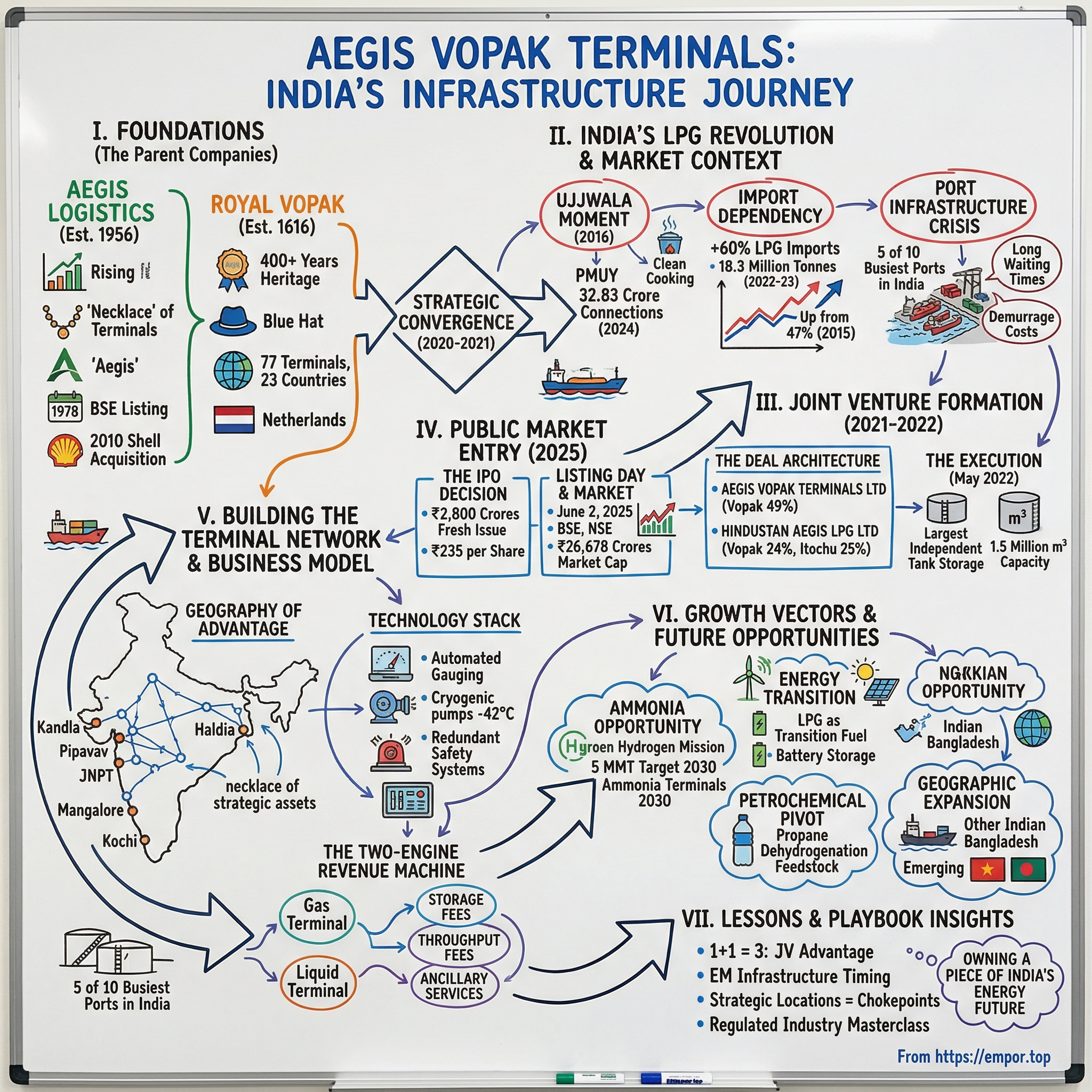
Aegis Vopak Terminals: The Tollbooth of India's Energy Grid
I. Introduction & Episode Preview
On the morning of June 2, 2025, the newest listing on India's exchanges did something that infrastructure IPOs in a bull market are not supposed to do. Aegis Vopak Terminals Limited opened at ₹220 on the BSE against an issue price of ₹235 — a 6.3% discount before a single day of trading had elapsed.1 The book had closed the previous week at 2.09 times subscribed, a number that in India's IPO climate of 2025 counted as an outright rejection: qualified institutions took 3.3 times their allocation, but retail investors subscribed only 77% of theirs and the non-institutional segment managed 56%.2
The market's verdict was that this was a boring, expensive, capital-hungry business. Fourteen months later, that verdict has partially reversed. As of August 17, 2026, the stock traded at ₹265.40, giving the company a market capitalisation of roughly ₹29,833 crore — but the path there ran through a 52-week range of ₹158 to ₹311.49, which is an unusually violent band for something that markets itself as infrastructure.3
That volatility is the tell. Underneath the label "tank storage" sits a genuinely unresolved question, and it is the question this story is built around.
Here is what Aegis Vopak Terminals actually is. It is a 51:49 joint venture — since diluted by the IPO — between Aegis Logistics, a Bombay-listed company whose corporate ancestry runs back to 1956, and Koninklijke Vopak N.V., the Dutch tank-storage group whose lineage traces to seventeenth-century Amsterdam. The venture owns and operates bulk liquid and refrigerated gas terminals at the gates of six Indian ports — Kandla, Pipavav, Mangalore, Kochi, Haldia, and now JNPA at Navi Mumbai. It does not own the cargo. It never takes commodity price risk. It rents steel and charges a fee to move product through a pipe.
The analogy that fits is a tollbooth on a highway that the government has decided the country must drive on. India cannot produce enough liquefied petroleum gas to feed its own kitchens; the shortfall arrives by sea, and every imported tonne must be discharged, chilled, stored and evacuated inland by somebody. At the time of its IPO, the company held roughly 11.5% of India's total LPG storage capacity and 25.5% of the country's third-party liquid storage capacity — the latter a genuinely dominant share of the merchant market, the former a reminder that state refiners still own most of the gas tankage themselves.4
Now the paradox. In the June 2026 quarter, the company converted 76.75% of its revenue into EBITDA — a margin that would flatter a software business, let alone one made of concrete and steel.5 And yet its return on capital employed has been running in the 7.5% to 8.5% range, its return on equity around 11% to 12%, and in FY2026 it generated ₹702 crore of operating cash flow and converted essentially none of it into free cash flow — ₹3 crore, after capital expenditure.6 The stock has traded around 110 times trailing earnings and roughly seven times book value.6
A business can have a 77% EBITDA margin and an 8% return on capital only if it is enormously capital-intensive, or if a very large share of its capital is not yet earning anything. Both are true here. Which of those two explanations dominates — and whether the capital being poured in today will earn a respectable return tomorrow — is the entire investment question. Everything else is detail.
The road ahead: where the two parents came from and what each actually brought; the Indian cooking-gas expansion and the port congestion that made this asset class valuable; the 2021–2022 transaction that assembled the company; the disappointing IPO and what management did with the money; the segment-level economics that produce those margins; the competitive structure, including a competitor that quietly walked away; a stress test of the moat claims using Helmer and Porter; the ₹90 billion capital plan; the governance questions a skeptical investor should be asking about transactions with the parent; and the three metrics that will settle the argument.
Start with the two families of capital that built it, because they could hardly be more different.
 Subscribe on LinkedIn
II. Strategic Origins & Parent Company DNA
There is a version of this story that begins in a boardroom in Rotterdam and a version that begins in a small chemicals office in Bombay, and the interesting thing is how long it took the two to find each other.
The Indian side: a company that changed its name twice to change its identity.
The Aegis lineage begins with a private limited company incorporated on June 30, 1956, under the unpromising name Atul Drug House Limited — a maker of basic pharmaceutical formulations and formaldehyde, operating inside India's industrial licensing regime.7 Twenty years later, on September 14, 1976, it became Atul Chemical Industries as the business pivoted toward bulk chemicals. The final rename came on August 29, 2003, when it became Aegis Logistics Limited — the moment the company formally declared that third-party terminalling, not manufacturing, was the business.7
The insight behind that rename is the founding intellectual property of everything that followed. The company had built liquid storage tanks at Trombay on Mumbai's eastern waterfront to serve its own chemical operations, and discovered that the tanks earned more reliably than the chemicals did. A storage tank is indifferent to the price of what sits inside it. It charges rent, it charges a handling fee, and its customer has already sunk capital downstream and cannot easily relocate. Chemicals were a business you competed in; waterfront was a business you owned.
The family that acted on that insight was the Chandarias, a Gujarati merchant dynasty whose modern commercial history began not in India but in East Africa, where the family built a metals-and-plastics manufacturing group across dozens of countries. That diaspora inheritance matters more than it sounds. A family that has run factories in Kenya and the UK develops a habit most Indian promoter families of that era lacked: complete comfort negotiating with foreign strategic partners as equals, rather than as supplicants for technology.
Raj K. Chandaria — associated with the company since 1982, appointed Vice Chairman and Managing Director in March 2008 before taking the Chairman and Managing Director role, and based in Geneva rather than Mumbai — is the architect of the capital-allocation doctrine that governs both parent and subsidiary.8 That doctrine is unusually rigid and worth stating in plain terms: the terminal business will not take commodity price risk. It earns fixed storage rentals and per-tonne throughput fees, structured wherever possible as multi-year take-or-pay contracts. If LPG doubles in price, the terminal earns the same. If it halves, the terminal earns the same.
That is an admirable discipline and it is also a ceiling. A pure fee-for-service operator captures none of the upside when its customers are making extraordinary money — a distinction that became vividly visible during the energy dislocations of 2026, when the parent's trading arm posted record profits while the terminal subsidiary's earnings went sideways. We will return to that divergence.
The Dutch side: a 400-year-old company in the middle of a strategic retreat and advance.
Royal Vopak's own materials date the lineage to the Amsterdam warehousing partnerships of the early seventeenth century, and the modern group operates a network of terminals across more than twenty countries.9 But the version of Vopak that came to India in 2021 was not a company confidently extending a global franchise. It was a company reallocating capital under pressure.
The European chemicals storage market had become structurally oversupplied and low-return. Vopak's answer, formalised at its Capital Markets Day on March 13, 2025, was to double its planned investment in gas and industrial terminals to roughly EUR 2 billion by 2030, with a stated intention that a significant share go to growth markets including India, while maintaining a separate EUR 1 billion ambition in energy-transition infrastructure — low-carbon fuels, ammonia as a hydrogen carrier, liquid CO2.10 The funding source was equally explicit: the company agreed to sell its three Rotterdam chemical terminals to Infracapital for EUR 407 million, including a conditional deferred payment of EUR 19.5 million.11
Read those two decisions together and the strategic logic is unambiguous. Vopak was selling mature European chemical tankage at a fair price and redeploying into Asian gas infrastructure — not because gas is fashionable, but because in India the demand curve was being set by government policy rather than by the industrial cycle.
Why the two needed each other.
Vopak could have built greenfield in India. It chose not to, and the reason is the least glamorous and most durable asset in this entire story: Indian port land. Waterfront plots with adequate draft, environmental clearance for hazardous cargo, jetty access and a lease long enough to justify the concrete are allocated by port trusts through processes that reward incumbency and local relationships. A foreign entrant starting from zero would have spent a decade on approvals before pouring foundations.
Aegis, conversely, had the land and the licences but faced a financing problem. Terminal construction consumes capital years before it produces cash, and a mid-cap Indian company funding a multi-billion-dollar build-out entirely with debt would eventually break. Selling a minority stake in the terminal business to a global strategic partner solved the capital problem without diluting the parent's control — a pattern the Chandarias had already run once before with ITOCHU of Japan.
What Aegis received beyond money was standards. Vopak's operating system, safety protocols and technical audit rigour are, in an industry where a single serious incident can cost you the licence rather than merely the insurance claim, a genuine input — and one that opens doors to multinational chemical shippers who will not hand hazardous cargo to an operator without documented global-standard controls. Whether that translates into pricing power, as opposed to merely market access, is a question we will test later.
The deal made sense to both sides. What made it urgent was what was happening in a hundred million Indian kitchens.
III. Macro Backdrop: India's LPG Revolution & Port Bottlenecks
The most consequential fact about Indian energy over the past decade was not about oil. It was about smoke.
For most of independent India's history, hundreds of millions of households cooked over wood, dung cakes and kerosene, with the health burden — respiratory disease, eye damage, burns — falling overwhelmingly on women and children. Successive governments concluded that converting those kitchens to bottled cooking gas was among the highest-return public health interventions available, and the Pradhan Mantri Ujjwala Yojana became the delivery vehicle. By mid-2026 the scheme had released more than 10.5 crore LPG connections to eligible households, with a further 25 lakh connections approved for FY2026 alone.1213
Now consider the industrial consequence of that social programme, because it is the reason this company exists.
LPG is not something India can simply decide to make more of. It is a by-product of oil refining and natural gas processing; you cannot increase LPG output without building refining capacity you do not otherwise need. India's domestic production has run at roughly 12 million tonnes against total consumption in the region of 30 million tonnes.14 The gap — the better part of 20 million tonnes a year — arrives by sea, which means India has become the world's largest LPG importer, and the marginal molecule that lights a burner in Patna was on a ship three weeks earlier.
That is a structural, policy-driven import dependency, and it is the single most important fact underwriting the entire thesis. It is also the source of the most important risk, as 2026 demonstrated with unusual clarity. Roughly 90% of India's LPG imports historically originated in the Middle East, and when Gulf flows through the Strait of Hormuz collapsed — regional exports through the strait fell from about 1.5 million barrels per day in 2025 to a fraction of that by April 2026 — Indian arrivals fell more than 40% from January–February levels despite a surge in US cargoes.15 The United States emerged as India's largest single LPG source during the disruption, a rerouting that lengthened voyage distances substantially.1617
Now the part that turns a national import dependency into a private business.
Here is the physical problem. LPG can be transported and stored two ways. The traditional Indian method uses pressurised storage: keep the gas liquid by squeezing it, in relatively small thick-walled bullets and spheres. Pressurised tanks are simple, but they are small, and small tanks mean small ships. The alternative is cryogenic storage: refrigerate propane to roughly minus 42 degrees Celsius and butane to around minus 6, at which point they become liquids at ordinary atmospheric pressure and can be held in very large, insulated, double-walled tanks — essentially giant vacuum flasks.
Cryogenic tankage is far more expensive to build. What it buys you is the ability to receive a Very Large Gas Carrier — a ship carrying 45,000 to 80,000 cubic metres — and discharge the entire cargo directly through a jetty pipeline into static storage in one continuous operation, instead of transferring it at sea into smaller vessels or waiting for a berth.
That distinction has a price, and the price is set by ship demurrage. Indian LPG terminals have been chronically congested: in August 2025, VLGCs waited eight to ten days before discharging at east coast ports such as Ennore, Haldia and Paradip, and seven to eight days at west coast ports including Mangalore, with delays contributing to freight rates near sixteen-month highs.18 At the charter economics prevailing for large gas carriers, every day a ship idles off an Indian coast burns tens of thousands of dollars, and the importer pays.
So a cryogenic terminal with a dedicated deep-draft jetty is not selling storage. It is selling the elimination of waiting time. That is why an importer will sign a ten-year take-or-pay contract for tankage it does not always fill — the contract is insurance against a cost that is larger than the rent.
Two policy developments completed the picture. India built cross-country LPG pipelines — the Kandla–Gorakhpur line and the Jamnagar–Loni system among them — that connect coastal import points directly to inland bottling plants, turning a port terminal from a local facility into the head of a national distribution artery. And state oil marketing companies, whose own captive terminals were congested and whose capital budgets were committed elsewhere, became increasingly willing to lease third-party capacity rather than build it.
For an investor, the honest reading of this macro backdrop is that the volume is close to guaranteed and the timing is not. India will import LPG for the foreseeable future because the arithmetic of domestic production leaves no alternative. But as 2026 showed, the flow can be interrupted violently by events no Indian terminal operator influences, and a business paid partly on throughput feels that immediately.
Which brings us to how this particular set of terminals came to sit under one roof.
IV. The Deal Mechanics: Forming Aegis Vopak Terminals (2021–2022)
The announcement landed on July 12, 2021, in the middle of a pandemic, and its structure tells you more about how both parties thought than any press release quote could.
The headline was straightforward enough: Vopak would take 49% of a newly constituted entity, Aegis Vopak Terminals Limited, with Aegis Logistics retaining 51%. The assets going in were roughly 960,000 cubic metres of capacity across eight terminals at five ports on both Indian coasts — Kandla, Pipavav, Mangalore, Kochi and Haldia.19 Raj Chandaria framed it as an accelerant for the terminals business; Vopak's then-CEO Eelco Hoekstra framed it as an investment in a growth market with a ten-year horizon.19
The valuation architecture is where it gets interesting. The transaction was struck at an enterprise value of EUR 185 million plus a conditional EUR 15 million, against which Vopak's net consideration was initially EUR 100 million plus EUR 15 million, with further contingent payments of EUR 18 to 40 million tied to milestones, and a total Vopak equity investment of EUR 153 million.19 Alongside the main entity, a separate structure covered Hindustan Aegis LPG Limited, in which Vopak took 24%, Aegis held 51% and ITOCHU retained 25% — a legacy of the earlier Japanese partnership that would take another four years to fully resolve.19
Two features of that structure deserve attention. First, the heavy use of contingent consideration: a meaningful slice of what Vopak would ultimately pay depended on projects actually being completed. That is not how a buyer behaves when it is confident about execution risk; it is how a buyer behaves when it wants the seller's incentives aligned to the construction schedule. Second, the deliberately fragmented ownership across entities — a 49% here, a 24% there, a 25% legacy stake elsewhere — created a structure that was efficient for the sellers and genuinely complex for an outside investor to map. That complexity has not gone away.
Closing, and the price that moved.
The partnership completed on May 25, 2022, and the final number was not the one announced.20 Vopak's net consideration at closing had risen from EUR 115 million to EUR 137 million — EUR 12 million of the increase attributable to foreign exchange movements and EUR 10 million to three additional terminals and growth projects that had been folded into the transaction during the ten months between signing and closing.20
The resulting company was, at that moment, the largest independent tank storage operator for LPG and chemicals in India, running eleven terminals at five ports with approximately 1.5 million cubic metres of capacity.20 The stated growth agenda named LPG first, with chemicals, LNG and industrial terminals behind it.20
What did each party actually get? Aegis converted illiquid, capital-hungry infrastructure into cash and a partner willing to fund the next decade of construction. Vopak bought its way past a decade of Indian permitting into a market where the demand growth was underwritten by a national social programme rather than a manufacturing cycle. On the face of it, an unusually clean 51:49.
The part that should give an outside investor pause.
The joint venture inherited an operating model in which the parent remained deeply entangled in the subsidiary's construction pipeline. Terminals continued to be built by Aegis Logistics entities and subsequently transferred to Aegis Vopak — a pattern the company itself has acknowledged, with dependency on Aegis Logistics for construction flagged as a risk factor in its own FY2026 earnings discussion.21
There are defensible reasons for that arrangement. The parent had the engineering teams, the port relationships and the project management track record; duplicating them inside the JV would have been wasteful. But it means a significant share of the JV's capital expenditure flows to its controlling shareholder at prices negotiated between related parties, with minority shareholders relying on audit committee oversight and arm's-length certification rather than on competitive tendering. This is not an allegation of wrongdoing. It is a structural feature that a serious investor must monitor continuously rather than assess once, and we will look at a live example of it later.
Governance on paper was designed to be balanced: joint board oversight, deployment of the Vopak operating and safety framework, and access to Vopak's global customer relationships alongside the domestic state refiners. In practice, the balance shifted once the company listed — because listing changed who else was in the room.
V. Public Market Entry & Capital Deployment (2024–2025)
By late 2024 the joint venture had a problem that is common to infrastructure companies and rarely discussed honestly: it had built faster than its balance sheet could comfortably carry.
The draft prospectus went to SEBI in November 2024, the red herring followed in May 2025, and the book opened on May 26, 2025.22 The structure was a pure fresh issue — no promoter selling a single share — of 119,148,936 equity shares at ₹235 apiece against a band of ₹223 to ₹235, raising ₹2,800 crore.23 That detail matters: the parents were not cashing out. They were recapitalising a subsidiary they intended to keep building.
The stated uses were similarly unglamorous. Approximately ₹2,015.95 crore — nearly three-quarters of the raise — was earmarked to repay or prepay outstanding borrowings. A further ₹671.3 crore was allocated to acquiring a cryogenic LPG terminal at Mangalore. The remainder went to general corporate purposes.23 The company subsequently reported full utilisation of the ₹2,800 crore.24
Read that use-of-proceeds table again, because it is the honest summary of the company's condition at listing.
A business that must devote 72% of its IPO proceeds to debt repayment is telling you that its expansion had outrun its cash generation, and that the equity market was being asked to refinance the gap. The company was not raising growth capital in the venture sense; it was replacing expensive project debt with permanent equity so that the next round of construction could be levered again. That is a legitimate and common infrastructure playbook. It is also a materially less exciting proposition than "we are raising money to grow", and the market noticed.
The reception was cold. The issue closed 2.09 times subscribed on strength from institutions alone, with retail and non-institutional investors both failing to fill their books, and the stock listed at a discount.21 For a company that was, by its own prospectus, the largest third-party tank storage operator in the country, this was a striking rebuke. Anchor and institutional money understood the asset; the broader market looked at the multiple and declined.
The Mangalore transaction, in detail, because it illustrates the whole structure.
The asset the IPO was partly funding was not built by Aegis Vopak. It was built by Sea Lord Containers Limited, a wholly owned subsidiary of Aegis Logistics — the promoter — on behalf of the joint venture. The terminal, with 82,000 metric tonnes of static cryogenic LPG capacity at New Mangalore Port, was commissioned on June 12, 2025, ten days after the listing.25 A week later, on June 19, Sea Lord transferred the entire business to Aegis Vopak on a slump-sale basis for a total consideration of ₹671.3 crore against a stated total project cost of approximately ₹968 crore.2623
So the sequence was: promoter builds, listed subsidiary raises public equity, listed subsidiary buys the completed asset from the promoter at a negotiated price. Each individual step is legal, disclosed and, in the case of the Mangalore terminal, priced below the stated project cost. But the pattern is worth naming plainly: public shareholders funded, at a price they did not set, an asset constructed by the entity that controls the company they invested in. The consideration being below project cost is reassuring on this specific transaction. It does not resolve the question for the next one.
Valuation at listing, and what the market was actually arguing about.
The bull case at ₹235 rested on three legs: EBITDA margins above 70%, multi-year take-or-pay commitments that made revenue look annuity-like, and the scarcity value of Indian waterfront land. The bear case was arithmetic. At the issue price the company was capitalised at many times its trailing earnings on a business whose return on capital employed sat in single digits.6
Both sides were describing the same fact from opposite ends. High margins on low returns means the denominator is enormous — and in an asset-heavy business where new tanks take two to three years from foundation to first cargo, a large share of that denominator is construction-in-progress earning precisely zero while its interest cost is capitalised or expensed. The bulls were valuing the capital that will earn. The bears were counting the capital that does not yet. Fourteen months of results have given us some evidence about which view is closer to right, and the picture is genuinely mixed.
To see why, you have to understand how the two halves of this company actually make money.
VI. Core Business Architecture & Segment-Level Economics
Walk onto one of these sites and the first thing you notice is how little is happening. A gas terminal at full commercial utilisation looks abandoned. There are no forklifts, no queues of trucks, no visible activity at all — just a jetty line running to a cluster of white insulated tanks, a control room with perhaps a dozen people in it, and a rail gantry. The product moves through pipes. Almost nothing is touched by human hands.
That is the physical explanation for the financial statements. Once the concrete is poured, the marginal cost of moving another tonne through the terminal is close to power, minor maintenance and a fractional increase in staffing. In the June 2026 quarter the company generated ₹1,794 million of EBITDA on ₹2,338 million of revenue — a 76.75% margin, up from 74.65% a year earlier, with operating expenses of only ₹543 million.5
The gas division.
By Q1 FY2027, static LPG capacity stood at 355,100 metric tonnes across five terminals, and the company handled 0.9 million metric tonnes of LPG throughput in the quarter.5 That ratio is the single most revealing operating number in the business, and it deserves unpacking in plain terms.
A tonne of static capacity is not a tonne of annual revenue. It is a slot that can be filled and emptied repeatedly. If a terminal's tanks turn over roughly ten to twelve times a year, then 355,100 tonnes of steel handles something on the order of three-and-a-half to four million tonnes of product annually. The throughput fee is charged on every tonne that passes. Which means the economics of the asset depend far less on how much steel you own than on how fast product cycles through it — a function of jetty availability, ship scheduling, pipeline evacuation capacity and inland demand.
This is the crucial mental model. Aegis Vopak is not a landlord collecting rent on tanks. It is closer to a turnstile operator, and the number of turns matters more than the size of the lobby. A terminal running at four turns a year and one running at twelve have identical balance sheets and wildly different returns.
The cryogenic capability is what enables the high turn rate. Because refrigerated tanks can absorb a full VLGC discharge through a dedicated jetty pipeline, the terminal is not rate-limited by ship-to-ship transfer operations or by waiting for smaller pressurised vessels. It is the difference between a highway off-ramp and a single-lane toll gate.
The liquid division.
The liquid business is older, less glamorous and more stable. Operational liquid storage stood at approximately 1.7 million cubic metres, with 2.1 million cubic metres including capacity under construction.5 The tanks are spread across roughly twenty terminals at six ports and handle a deliberately heterogeneous slate: petroleum products, hazardous and specialty chemicals, lubricants, bio-fuels and vegetable oils.4
That heterogeneity is a design choice, not an accident. Coated and stainless-steel tanks capable of handling corrosive or high-purity chemicals command higher rates than plain carbon steel holding vegetable oil, and a multi-product terminal can re-let a vacated tank to a different industry rather than waiting for one customer segment to recover. It is diversification built into the steel.
In FY2026, liquid terminalling revenue grew 27.8% to ₹440.5 crore while gas terminalling grew 8.6% to ₹482.6 crore, taking total revenue to ₹923.1 crore, up 17%.27 By the June 2026 quarter the mix stood at 54.1% gas and 45.9% liquid.5 Management has indicated it expects the balance to tilt further toward gas, toward a 55:45 or 60:40 split within three years.21
The FY2026 divergence is analytically important and cuts against the standard narrative. The segment management describes as the growth engine — gas — grew at roughly a third the rate of the segment described as the anchor. The proximate cause was the Middle East supply disruption, which the company has cited as reducing LPG import flows by around half at the worst point.21 It is a reminder that take-or-pay contracts protect the storage rental component of revenue but not the throughput component, and the throughput component is precisely what makes the asset turn.
The revenue model, stated cleanly.
Two streams. A base storage rental for reserved capacity, contracted with state refiners and industrial customers on terms running roughly three to ten years, frequently on take-or-pay terms. And a throughput or handling charge levied per tonne or per cubic metre actually moved. The first is an annuity. The second is a toll. The first is what allows the company to raise project debt against contracted cash flows. The second is what determines whether the return on that project is good or merely acceptable.
The evidence that this pricing structure holds up is real but partial. Revenue has compounded from ₹353 crore in FY2023 to ₹923 crore in FY2026, a roughly 38% three-year compound rate, and profit after tax has grown from ₹87 crore in FY2024 to ₹341.9 crore in FY2026.627 Margins have expanded rather than compressed, which is not what you would expect if state refiners were successfully squeezing rates.
But look at the June 2026 quarter for the counterweight. Revenue grew 12.4% and EBITDA grew 15.6%, yet profit after tax fell 11.9% to ₹694 million, because depreciation rose to ₹555 million from ₹418 million and finance costs rose almost 30% to ₹393 million.5 Cash profit grew just 3.6%.5 This is the arithmetic of an infrastructure company in the middle of a build cycle: new assets bring their depreciation and interest charges the moment they are commissioned, and the revenue ramp arrives afterward. Whether that gap closes is not a matter of opinion — it will show up in the numbers over the next eight quarters.
Which raises the question of who else is competing for those tonnes.
VII. Competitive Landscape & Market Structure
In May 2025, three weeks before Aegis Vopak's shares began trading, one of its most cited future competitors quietly stopped competing.
BW LPG — the Singapore-listed operator of the world's largest fleet of very large gas carriers — had spent two years assembling a plan to build a cryogenic LPG import terminal at JNPA in Navi Mumbai. The joint venture, 55% held by BW Confidence Enterprise and 45% by Ganesh Benzoplast, was designed around 120,000 cubic metres of propane and butane storage, sized specifically so that a fourth-generation VLGC of roughly 93,000 cubic metres could be fully discharged in a single operation, with the potential to connect into the Uran–Chakan pipeline.[^28] BW LPG had committed around USD 10 million to the initiative.
Then it walked away. In May 2025, citing rising uncertainty in global markets and a decision to concentrate on its core shipping and trading business, BW LPG announced it was discontinuing the investment.28
This deserves to be stated as a myth-versus-reality correction, because the BW LPG terminal appears in a great deal of published competitive analysis of Aegis Vopak as though it were under construction. It is not. The most-discussed new-entrant threat to west coast LPG import capacity was abandoned by its anchor sponsor before the incumbent even listed.
For an investor, the withdrawal is more informative than the project would have been. BW LPG owns the ships. It has the customer relationships, the balance sheet and the strongest possible strategic reason to want terminal capacity in the world's largest LPG import market — controlling the shore end of its own voyages. And it concluded the returns did not justify the capital and the execution risk. That is a data point about the difficulty of the business, and it cuts in the incumbent's favour.
Aegis Vopak, meanwhile, is building at JNPA itself: a ₹1,675 crore programme comprising 318,100 cubic metres of new liquid capacity, 77,286 metric tonnes of LPG storage and a 35,000 tonne-per-annum bottling plant.29 The competitor's abandoned site is, in effect, the incumbent's expansion site.
Who actually competes, then.
State oil marketing companies. Indian Oil, Bharat Petroleum and Hindustan Petroleum collectively own the majority of India's LPG import and storage infrastructure — which is why Aegis Vopak's 11.5% share of total national LPG capacity looks modest against its 25.5% share of third-party liquid storage.4 But those facilities are overwhelmingly captive, chronically congested, and built for an earlier scale of demand. The refiners' revealed preference has been to lease third-party capacity for spillover and dedicated import handling rather than build new terminals themselves, because their own capital is committed to refining and marketing. That preference is a choice, not a constraint, and it could reverse if the state decides terminal ownership is strategic.
Adani Ports and SEZ. The most credible large-scale competitor, expanding liquid and gas storage at Mundra, Hazira and Dhamra and competing on integrated port logistics — offering a customer the berth, the storage, the evacuation and the land in one contract. Adani's structural advantage is that it owns the ports. Aegis Vopak leases land inside ports owned by others. In a negotiation over concession renewal, that asymmetry matters.
Reliance Industries. Enormous captive tankage at Jamnagar and Hazira, but oriented to internal refining and petrochemical integration rather than merchant third-party storage. A latent competitor rather than an active one.
Smaller independents. Ganesh Benzoplast, IMC and similar operators hold liquid tankage at Indian ports but lack cryogenic gas capability at scale. They compete on price for commodity liquid storage; they do not compete for VLGC discharge.
Where the switching costs actually come from.
The moat claim usually made for this business is "port land scarcity", which is true but incomplete. The more precise mechanism is physical integration. When a state refiner connects its inland pipeline network to a terminal's manifold, or an industrial plant runs an over-the-fence line to a dedicated tank, the customer has embedded the terminal in its own operating topology. Switching then means not just signing a different contract but rerouting product through a different port, absorbing incremental inland freight over hundreds of kilometres, and potentially re-permitting.
The cost of switching is therefore not the difference in storage rates. It is the difference in total delivered cost — and storage rental is a small fraction of that. This is a genuine and measurable switching cost, and it is the strongest single element of the competitive case.
It is also, crucially, port-specific rather than company-wide. Aegis Vopak's position at Kandla or Pipavav does not protect it at a port where it has no presence. Every new geography is a fresh competitive contest, and the company's stated plan to reach twelve ports by 2030 means most of its future capital will be deployed into places where its existing switching costs do not apply.21
That distinction — between defending a position and buying a new one — is where the moat frameworks earn their keep.
VIII. Strategic Moats: Helmer's 7 Powers & Porter's 5 Forces
Frameworks are useful precisely when they force you to distinguish between an advantage a company has and an advantage a company asserts. Applied honestly, Hamilton Helmer's taxonomy grades this business generously in two places and much less so in two others.
Cornered Resource — the strongest claim, with a fixed expiry date.
Waterfront land with deep-water draft, hazardous-cargo clearance, jetty access and pipeline rights-of-way at major Indian ports is genuinely finite. It cannot be manufactured, it is allocated by port authorities through processes that favour incumbents, and the environmental approval cycle alone runs for years. A competitor with unlimited capital cannot buy its way into Kandla next quarter.
But a cornered resource held under lease is not the same as a cornered resource owned. These are concessions from port trusts, and concessions expire. The renewal terms and tariff frameworks are set by counterparties that are ultimately arms of the state, in an industry the state considers strategic. The correct way to hold this in mind is not "the company owns irreplaceable land" but "the company holds time-limited rights to irreplaceable land, on terms that will be renegotiated." A serious diligence exercise starts by pulling the individual lease expiry dates from the prospectus and mapping them against the depreciation schedule of the assets sitting on them.
Switching Costs — real, mechanically grounded, port-specific. Covered above; the mechanism is physical integration into customer logistics rather than contractual lock-in, which makes it more durable than a contract but narrower than the corporate footprint.
Scale Economies — modest, and frequently overstated. Terminal economics are overwhelmingly site-level. A tank at Haldia does not make a tank at Kochi cheaper to operate; the fixed costs that matter — jetty, pipeline, firefighting systems, safety staffing — are incurred per site. Where genuine scale shows up is in three narrower places: the cost of capital, since a larger contracted asset base supports cheaper project debt; procurement leverage on tank construction; and the ability to amortise regulatory and compliance infrastructure across sites. Those are real but second-order. Anyone claiming that the unit cost of handling a tonne falls materially with national scale should be asked to show the evidence.
Process Power — plausible, unproven as a pricing lever. The Vopak operating and safety framework is a genuine capability, and it is the reason multinational chemical shippers will store hazardous product here. But process power in Helmer's sense requires that the capability be hard to replicate and translate into superior economics. The first is arguably true. The second is not yet demonstrated in the numbers — margins are high, but they are high for tank storage generally, and no disclosure separates a "Vopak standards premium" from ordinary terminal pricing.
The powers that are absent. No network economies — a customer at Pipavav derives no benefit from another customer at Haldia. No branding power in any meaningful sense; industrial buyers procure on cost, reliability and safety record. No counter-positioning; the business model is entirely conventional and any incumbent could copy it if they could get the land.
So: two strong powers, one modest, one unproven, three absent. That is a good business with a real moat, not an unassailable one.
Porter, briefly, with the emphasis on what is contestable.
Threat of new entrants — genuinely low, and empirically demonstrated. The BW LPG withdrawal is the evidence, not the theory. Multi-year approvals, waterfront scarcity and heavy upfront capital have deterred a sophisticated, well-capitalised, strategically motivated entrant.
Bargaining power of buyers — the most contestable force, and the one to watch. State refiners are large, sophisticated, price-sensitive and politically backed. The counterargument is that congestion at their own facilities constrains their alternatives. But this is a balance of power, not a settled outcome, and it will be tested at every contract renewal. The company does not disclose enough contract-level detail — renewal schedules, rate escalators, take-or-pay coverage as a percentage of capacity — for an outsider to verify how favourable the terms actually are. That disclosure gap is itself worth noting.
Bargaining power of suppliers — low on operating inputs, high on land. Port trusts are effectively the supplier of the one input that cannot be substituted. Long concessions provide stability within their term and nothing beyond it.
Threat of substitutes — low near-term, non-trivial long-term. Domestic LPG production cannot close the import gap on any visible timeline. Over a decade-plus horizon, piped natural gas expansion into urban households and industrial electrification are real substitution vectors for the cooking-gas demand that anchors the business.
Rivalry — moderate and geographically uneven. Intense where Adani has integrated port positions; minimal where the company holds the only cryogenic jetty.
The frameworks converge on a specific conclusion. The existing asset base is well defended. The growth plan is not, because it involves buying into contests the company has not yet won. And the growth plan is very large.
IX. Future Growth Vectors & The ₹9,000 Crore Capex Blueprint
Management has been unusually specific about the scale of its ambition, which is either admirable transparency or a hostage to fortune, depending on how the next five years go.
The stated targets are USD 1.2 billion of cumulative capital expenditure by FY2027 — roughly ₹10,000 crore — and USD 5 billion by 2030, with an intention to hold leverage at a modest gearing ratio and a stated debt ceiling around 3.5 times EBITDA.295 The company has said its capital expenditure tripled between 2022 and 2025 and is planned to double again by 2027, with a footprint expanding from six ports to twelve by 2030.21
Set that against the current base. FY2026 revenue was ₹923 crore and EBITDA ₹686.5 crore.27 Borrowings stood at ₹3,731 crore against total assets of ₹8,421 crore.6 A USD 5 billion programme is therefore roughly five times the company's entire existing asset base, to be funded from a business generating ₹700 crore of operating cash flow.6 The arithmetic does not close without substantial external capital — debt, further equity, or partner capital at the subsidiary level. Investors should expect all three.
Industrial and dedicated terminals — the most financially material vector.
The clearest growth logic is over-the-fence storage: tanks built adjacent to a chemical complex or refinery, connected directly to the plant, contracted long-term to a single customer. The customer avoids the capital cost and gets specialist operation; the terminal operator gets a contracted asset with a defined counterparty and near-zero marketing risk.
The economics of these projects are structurally better than merchant terminals because utilisation is contracted from day one. The risk is concentration — a dedicated terminal has exactly one customer, and if that customer's plant runs poorly, the take-or-pay clause becomes a legal question rather than a cash flow.
Ammonia — the most interesting real option, and it is no longer speculative.
Aegis Vopak has commissioned a 36,000 metric tonne ammonia terminal at Pipavav, described as India's first independent third-party ammonia storage facility.30 Crucially, it is anchored by a fifteen-year take-or-pay agreement with Hindustan Zinc for a planned di-ammonium phosphate plant.29
That contract structure is what separates this from the usual green-hydrogen press release. Ammonia storage is technically demanding — it is toxic, corrosive to certain metals, and stored refrigerated at around minus 33 degrees Celsius — and the same cryogenic engineering that handles propane transfers reasonably well. The near-term demand driver is entirely prosaic: fertiliser. The long-term option is that ammonia becomes the practical carrier for transporting hydrogen energy across oceans, since liquid hydrogen itself is impractical at scale. If that thesis materialises, India's ammonia import and export terminals become strategically valuable. If it does not, the company still has a fifteen-year fertiliser contract.
That is the right way to structure an energy-transition bet: get paid by today's economy while holding the option on tomorrow's. It is a meaningfully more disciplined approach than most decarbonisation capital allocation in the sector.
ITOCHU validated it commercially, agreeing in March 2026 to acquire 10% of the ammonia subsidiary, Aegis Terminal (Pipavav) Limited, for ₹80.32 crore, with the reported intention of increasing to 25% over three years.31 Note the pattern repeating: the Chandarias again sold a minority stake in a specific asset to a Japanese or Dutch strategic partner rather than funding it alone. It is a consistent, capital-efficient method — and it also means the consolidated entity owns progressively less of its most attractive growth assets.
Jetty and port infrastructure. Upgrades at Pipavav and Mangalore aimed at handling fully laden VLGCs without ship-to-ship lighterage, a rail gantry under construction at Mangalore, the CRL4 liquid terminal at Kandla adding 94,148 cubic metres, and completion of the Jamnagar–Loni LPG pipeline connection.2932 These are the unglamorous projects that raise the turn rate on existing steel, and on a per-rupee basis they are probably the highest-return capital in the entire plan.
Inorganic growth. In January 2026 the company completed the acquisition of a 75% equity stake in Hindustan Aegis LPG Limited for ₹1,130 crore, adding 25,000 metric tonnes of LPG capacity and consolidating the legacy structure created back in 2021.32 Management has also signalled interest in ethane and natural gas infrastructure as future product lines.21
The strategy is coherent. The execution burden is enormous, and the entity carrying it is run by a small senior team whose track record deserves direct examination.
X. Management Credibility, Governance & Capital Allocation
Assessing management here requires separating two things that are easily conflated: operational execution, which has been good, and governance structure, which is complicated by design.
The operating record.
The build-out since the joint venture formed is the strongest evidence in management's favour. Liquid storage capacity has grown roughly 3.75 times and LPG capacity roughly 4.5 times since the 2021 transaction.21 Those are not incremental expansions; they represent a company that has commissioned large, technically demanding, permit-intensive assets repeatedly, in a country where infrastructure projects routinely slip by years.
The Mangalore terminal is the cleanest example. It was commissioned in June 2025, in line with the timeline disclosed in the offer documents, and delivered at a stated project cost below the figure that would have embarrassed anyone.2523 The Pipavav ammonia terminal was commissioned broadly on the schedule management had described.30 In an industry where "expected commissioning" is often a euphemism, this matters, and investors should weight it accordingly.
Financial discipline has been consistent with stated policy as well. Management has articulated a leverage framework — a target gearing ratio around 0.6 and a debt ceiling near 3.5 times EBITDA — and has funded expansion through a mix of debentures, including series of ₹660 crore and ₹1,030 crore, rather than through unconstrained borrowing.215
The disclosure record — mixed.
Management does separate static tank capacity from annual throughput volumes, which is the right disclosure practice and lets an outside analyst compute the turn ratio that actually drives returns. It has also been candid about risk, explicitly flagging geopolitical vulnerability, the dependency on Aegis Logistics for construction, the magnitude of capital required, and the operational complexity of geographic diversification in its own FY2026 earnings discussion.21 Naming your own related-party dependency as a risk factor is a mark in favour of candour.
What is not adequately disclosed is contract economics. There is no public breakdown of what proportion of capacity sits under take-or-pay versus spot terms, when major contracts expire, what escalators apply, or how storage rental splits from throughput fees within segment revenue. For a company whose entire bull case rests on contracted annuity revenue, that is a material gap, and it is the first thing an activist investor would demand.
The related-party question, with a live example.
On August 6, 2026, Aegis Vopak entered into an agreement with Aegis Logistics — its promoter — worth ₹142.5 crore, for construction of a refrigerated double-steel-wall, full-containment insulated propane storage tank of 51,998 metric tonnes capacity at the JNPA tank farm area, together with allied facilities.33 The transaction was disclosed under SEBI's listing regulations and certified as being on an arm's-length basis.
Two features of the structure deserve scrutiny. First, the full ₹142.5 crore was payable to the promoter on execution of the agreement, with a separate asset transfer agreement to follow on project completion.33 Paying the entire consideration up front, before the asset exists and before title transfers, places the timing and completion risk squarely on the listed entity while the cash sits with the controlling shareholder. Second, this is a construction contract awarded without a visible competitive process, in a market where multiple Indian EPC contractors build cryogenic tankage.
None of this is improper. All of it is disclosed. But an investor who owns the minority is entitled to ask a simple question about every such transaction: was this priced the way an unrelated third party would have priced it, and how would I know? The answer currently rests on the audit committee's certification. That is the standard Indian answer, and it is not the same as evidence.
Ownership and alignment.
As of the June 2026 quarter, promoters held 86.93% of the company, with Vopak India B.V. holding 42.23% and Aegis Logistics the balance of the promoter block.3435 Institutional holdings were modest — around 6.07% foreign and 4.62% domestic — with retail at roughly 2.37%.34
Skin in the game is not in question; both parents kept everything and sold nothing in the IPO. But a free float in the low teens has a second-order consequence that investors should sit with. A thinly floated stock can sustain a valuation that a fully floated one would not, because the marginal buyer is competing for a small quantity of shares. It also means a future promoter sell-down — whether to meet minimum public shareholding norms or to fund the capital programme — represents a permanent supply overhang. Neither parent has indicated an intention to sell. The structural pressure exists regardless of intention.
Leadership.
Raj Chandaria chairs both parent and subsidiary, with Murad Moledina among the directors fronting investor communication; the two led the Q1 FY2027 earnings call on August 14, 2026.36 The consistency of the story across calls has been high — the same capital expenditure targets, the same port expansion map, the same emphasis on turn rates. That consistency is a credibility asset.
It also creates the central governance tension of the structure. The same individual chairs the company that awards construction contracts and the company that receives them, and that individual's economic interest is spread across both. Vopak's nominee directors provide a genuine counterweight, since Vopak has no interest in value leaking to Aegis Logistics. But minority public shareholders own a small fraction of a company whose two controlling owners have their own bilateral negotiation running permanently in the background.
For anyone wanting to test these claims directly, the primary documents are more revealing than any summary.
XI. Earnings Call & Transcript Guide for Researchers
The filings that matter for this company are unusually concrete, because the business is physical and the disclosures are quantitative. Four sources carry most of the analytical weight.
The red herring prospectus, May 2025. Still the single richest document, and not superseded by anything published since. It is where the individual port land lease expiry dates, concession terms, per-terminal capacity, and segment-level margin breakdowns live.23 The specific exercise worth doing: build a table of every terminal's lease expiry against the remaining depreciable life of the assets on that plot. Anywhere the lease expires materially before the asset is written down, you have identified either a renewal risk or an impairment risk, and the prospectus is the only place that information is systematically assembled.
Quarterly investor presentations. These consistently disclose static LPG capacity, quarterly throughput tonnage, operational versus under-construction liquid capacity, and the gas-versus-liquid revenue split.5 They are the raw material for the turn-rate calculation.
The earnings calls, and specifically the Q&A. The prepared remarks reliably emphasise capacity commissioned and capital deployed. The Q&A is where the harder subjects surface. Four lines of questioning are worth tracking call over call:
One — the throughput multiple. Is the ratio of annual tonnage handled to static capacity rising, flat, or falling as new capacity commissions? A falling ratio during a build phase is normal. A ratio that stays depressed two years after commissioning is the signal that a project is not ramping.
Two — contract renewals with state refiners. When management is asked about pricing negotiations with oil marketing companies, listen for whether the answer contains actual terms — escalation clauses, duration, coverage — or only reassurance about relationships. The difference is diagnostic.
Three — ramp velocity at newly acquired assets. Mangalore and the Haldia capacity acquired through Hindustan Aegis LPG are the current test cases. The question is not whether they are operating but at what utilisation, and management has historically preferred to discuss capacity rather than utilisation.
Four — capital expenditure pacing against the FY2030 target. A USD 5 billion aggregate target invites a simple annual check: how much was actually spent this year, and does the run-rate reconcile? Targets that are reaffirmed while the run-rate falls behind are among the most reliable early warnings in infrastructure investing.
The parent company's calls, which are arguably more revealing. Aegis Logistics reports separately and discusses the same terminals from a different vantage point, including its own commentary on LPG supply conditions and the construction pipeline it is executing for the subsidiary.37 Reading both sets of calls in the same sitting is the most efficient way to detect narrative inconsistency between the entity building the assets and the entity buying them. It also throws the economics into relief: during the 2026 supply dislocation, the parent's trading-exposed business posted extraordinary results while the terminal subsidiary's profits declined — the clearest possible illustration of what a pure fee-for-service model gives up.375
On accounting. Pay particular attention to how management frames return on equity during construction. The company's return on capital employed in the 7.5% to 8.5% range and return on equity around 11% to 12% include a denominator loaded with assets producing no revenue.6 Management's framing — that accounting returns understate underlying cash generation during a build cycle — is analytically legitimate. It is also the exact argument that every serially value-destroying infrastructure company in history has made. The way to adjudicate it is not to accept or reject the framing but to check whether returns actually improve as projects mature. That evidence accumulates one quarter at a time.
Which sets up the argument between the two credible views of this company.
XII. Bear vs. Bull Stress Test & Current Risk Radar
Both cases here are serious. Neither is obviously right, and an investor who cannot state the opposing case in its strongest form does not understand the position.
The bear case.
Valuation leaves no room for error. At roughly 110 times trailing earnings and around seven times book value against a return on equity of 11% to 12%, the market is capitalising an outcome, not a current condition.63 For that to be justified, earnings must compound rapidly for years while returns on incremental capital improve. Any slippage — a delayed commissioning, a slower ramp, a contract renewed at worse rates — arrives against a multiple with no cushion. The 52-week range from ₹158 to ₹311.49 shows how quickly the market repriced when doubts surfaced.3
Returns on capital are the unresolved problem. Single-digit ROCE is not a rounding error; it is roughly at or below the cost of debt in India. Management's explanation is construction drag, and that explanation is credible today. It stops being credible if the ratio has not moved meaningfully by FY2029.
Free cash flow is currently absent. FY2026 operating cash flow of ₹702 crore converted to ₹3 crore of free cash flow.6 Every rupee the terminals earn is being reinvested, and the plan calls for far more than the terminals earn. Growth on this scale is funded by outside capital, and outside capital has a price that changes.
Earnings quality during the build cycle is deteriorating on the surface. The June 2026 quarter is the exhibit: EBITDA up, profit down, driven by depreciation and finance costs on newly commissioned assets.5 If commissioning outpaces ramp for several more quarters, reported earnings can stagnate while capacity grows — the least comfortable phase of an infrastructure cycle.
Concession and tariff dependence. Every terminal sits on leased port land under concessions granted by state authorities. Renewal terms are negotiated, not guaranteed.
Geopolitical throughput risk is now demonstrated, not theoretical. The 2026 Middle East disruption cut Indian LPG import flows sharply and slowed gas terminalling revenue growth to 8.6% for the year.2127 Take-or-pay protects rentals; it does not protect the toll.
Related-party complexity. An activist would focus here first — construction contracts to the promoter awarded without visible tender, full payment before asset transfer, minority stakes in the best growth assets sold to partners, and a corporate structure that requires real effort to map.3331
Long-term substitution. Piped natural gas into urban households and industrial electrification erode the growth rate of the cooking-gas demand that anchors the business — slowly, but in one direction.
The bull case.
The demand is structural and policy-underwritten. India's LPG import dependency is arithmetic, not preference: domestic production simply cannot meet consumption, and the connections delivered under Ujjwala are not going to be surrendered.1214 Absent a technological shift in Indian kitchens that nobody has demonstrated at scale, those molecules keep arriving by ship.
The entry barrier is empirically real. BW LPG — with the fleet, the customers and the strongest strategic motive available — assessed the opportunity and withdrew.28 That is stronger evidence for the moat than any framework.
Unit economics are genuinely exceptional once assets mature. A 76.75% EBITDA margin with operating expenses of ₹543 million against ₹2,338 million of revenue reflects a cost structure that is overwhelmingly fixed and largely sunk.5 The operating leverage on incremental throughput is close to total.
Margins have expanded, not compressed. Margin moved up year on year even as revenue grew and even during a supply disruption.5 If state refiners were successfully extracting rate concessions at scale, this is not what the numbers would look like.
The Vopak relationship is a live commercial asset. A global network that routes multinational chemical shippers into India, alongside operating standards those shippers require. Vopak's own strategy explicitly directs capital toward Indian gas infrastructure, which means the partner has both the incentive and the balance sheet to keep supporting the build.10
Optionality is being acquired cheaply and contracted early. The ammonia terminal is anchored by a fifteen-year take-or-pay agreement with a fertiliser customer, with the energy-transition upside free on top.2930
The risk radar, restricted to what is actually material.
Cost of capital is the live one. A programme of this magnitude, executed largely with debt, is a direct function of Indian interest rates; a sustained rise both raises the funding cost and compresses the valuation multiple on a long-duration asset. Geopolitical supply interruption is proven. Execution risk across twelve ports by 2030 is substantial and increases with geographic spread — a point management has itself acknowledged.21 Regulatory risk sits with the port authorities. Technology disruption is close to irrelevant here; steel tanks are not being disintermediated by software, and investors worried about artificial intelligence can safely look elsewhere.
Which leaves the question of what an investor should actually watch.
XIII. Key Investor Playbook & 3 KPIs to Watch
Three lessons generalise beyond this company, and three numbers settle the argument about it.
Lesson one: the minority-stake playbook is a genuine capital-allocation technology. The Chandarias have repeatedly sold minority positions in specific assets to global strategic partners — Vopak at the terminal level, ITOCHU at the legacy LPG entity and now at the ammonia subsidiary — rather than funding expansion alone or surrendering control.1931 Each sale brought capital, technical standards and customer access without diluting the parent's position. It is elegant, and it has funded a build-out no mid-cap Indian balance sheet could have carried unaided.
The cost is that the consolidated entity owns progressively less of its most attractive assets. An investor buying the listed company is buying a shrinking share of the best projects. That is a trade-off, not a flaw, but it should be priced.
Lesson two: tollbooth economics require the toll to be collected, not merely owned. The fee-for-service model is genuinely defensive — the company took no commodity price hit during a violent energy dislocation. It also captured none of the upside, and its gas revenue growth slowed to single digits precisely when the commodity was most valuable.27 Fee-for-service is a volatility reducer, not a return enhancer, and investors who buy it expecting participation in energy booms have misunderstood the instrument.
Lesson three: accounting returns during a build cycle are ambiguous, and the ambiguity resolves in a knowable way. Heavy depreciation on newly commissioned assets depresses reported returns while cash generation builds — that is arithmetically true. It is also indistinguishable, in any single year, from a company that is simply investing at poor returns. The distinction is not resolvable by argument. It is resolvable by watching returns on the maturing asset base over time, which is exactly what the metrics below are for.
The three KPIs.
One — the LPG throughput ratio: tonnes handled per year divided by static tonnes of capacity. Both inputs are disclosed quarterly.5 This is the master metric for the gas business because it measures how many times the same steel gets paid for. It captures berth efficiency, evacuation capacity, ship scheduling and demand in a single number. A rising ratio means the asset base is working harder; a falling ratio means capacity has been added faster than volume, and every rupee of that capacity is carrying depreciation and interest while it waits. Watch it as a trend across four to eight quarters, not quarter to quarter, since monsoon seasonality and festival demand distort short intervals.
Two — liquid capacity utilisation: the percentage of tank cubic metres actually occupied. The liquid business is the older, steadier half, and its utilisation is the cleanest available read on Indian chemical, petroleum and edible-oil import demand. It is also where competitive pressure would show up first, because liquid storage is the segment with the most alternative providers. Falling utilisation alongside stable rates suggests demand weakness; falling rates alongside stable utilisation suggests competition. The two diagnoses have entirely different implications.
Three — EBITDA per unit of capacity: EBITDA divided by cubic metres of liquid capacity and tonnes of gas capacity. This is the pricing-power test. Margin percentage can stay high while unit economics deteriorate, because a percentage tells you nothing about how much revenue each unit of steel generates. If unit EBITDA rises as the network expands, the company is genuinely earning more per asset — the signature of pricing power and operating leverage. If it flattens or falls while total EBITDA grows, then the growth is being bought rather than earned, and the return-on-capital problem is structural rather than temporary.
Three numbers, all derivable from disclosed data, no forecasting required. They will answer the central question of this business long before the earnings do.
XIV. Final Thoughts & "What Would We Do?"
What Aegis Vopak Terminals really represents is a specific and repeatable idea: when a country's consumption of an essential commodity outruns its ability to produce it, the durable profit pool migrates from the commodity to the infrastructure the commodity must pass through. India decided that a hundred million households should cook with gas. It could not make the gas. Someone had to own the pipe between the ship and the kitchen.
The company that owns most of that pipe was assembled by pairing an Indian family with the land, the licences and the local relationships against a Dutch operator with four centuries of tank storage practice and a strategic mandate to redeploy European capital into Asian gas. Each side contributed exactly what the other could not manufacture. That is what makes the joint venture structure worth studying independent of the stock.
The honest assessment of where things stand is that the asset base is well defended, the demand is structurally underwritten, the operating execution has been credible, and the returns on capital have not yet arrived. A 77% EBITDA margin producing an 8% return on capital and essentially no free cash flow is the financial signature of a company in the middle of building something much larger than what it currently owns. Whether that is value creation or value destruction is genuinely undetermined today, and the market's willingness to pay 110 times earnings for the outcome is a bet, not an observation.
If we were running it. Four things.
First, close the disclosure gap on contracts. The entire premium valuation rests on contracted annuity revenue, and the company does not publish what share of capacity is contracted, at what duration, or with what escalators. Publishing a contract maturity profile would cost nothing and would let the market underwrite the annuity claim rather than assume it.
Second, put the promoter construction contracts out to competitive tender, or publish the benchmarking that justifies not doing so. The current arrangement may well deliver fair value. But structure the disclosure so an outsider can verify it, particularly where full consideration is paid before the asset transfers.
Third, prioritise turn-rate capital over footprint capital. The jetty upgrades, the rail gantry, the pipeline connections — these raise throughput on steel already paid for, and they carry a fraction of the execution risk of a new port. Expanding from six ports to twelve enters twelve competitive contests where the existing switching costs provide no protection. The highest-return rupee in the plan is almost certainly the one spent making Kandla and Pipavav cycle faster.
Fourth, keep structuring the energy-transition assets exactly as the ammonia terminal was structured — anchored by a long-term contract with a customer in today's economy, with tomorrow's option attached free. The discipline of refusing to build speculative decarbonisation capacity is what separates infrastructure from venture capital, and it is the single most encouraging thing in the current capital plan.
The tollbooth is real. The traffic is coming. What remains unproven is whether the toll, after the enormous cost of building the road, is high enough.
References
-
Aegis Vopak Terminals shares make muted D-Street debut, list at 6% discount — Business Standard, 2025-06-02 ↩↩
-
Aegis Vopak Terminals IPO subscribed 2.09x — Business Standard, 2025-05-28 ↩↩
-
Aegis Vopak Terminals Ltd share price, market capitalisation and 52-week range — Bajaj Finserv ↩↩↩
-
Aegis Vopak Terminals IPO — company profile, capacity and market share — Zerodha, 2025-05 ↩↩↩
-
Aegis Vopak Q1 FY27: strong EBITDA growth, capacity-led expansion — Multibagg, 2026-08 ↩↩↩↩↩↩↩↩↩↩↩↩↩↩↩
-
Aegis Vopak Terminals Ltd — Consolidated financials, ratios and shareholding — Screener.in ↩↩↩↩↩↩↩↩↩
-
Aegis Logistics Ltd — Company history — Business Standard ↩↩
-
Raj K. Chandaria — Chairman & Managing Director, Aegis Logistics — The Org ↩
-
About Aegis Vopak Terminals — company and promoter overview ↩
-
Vopak hosts Capital Markets Day, reconfirms strategic priorities and announces EUR 1 billion additional investments in gas and industrial infrastructure — Royal Vopak, 2025-03-13 ↩↩
-
Vopak reaches agreement with Infracapital on the sale of its chemical terminals in Rotterdam — Royal Vopak ↩
-
Pradhan Mantri Ujjwala Yojana — scheme overview and connections released — IBEF ↩↩
-
Govt to release 25 lakh new LPG connections under Ujjwala in FY26 — Business Standard, 2025-09-22 ↩
-
Geopolitics of LPG Supply in India — Takshashila Institution, 2026-03-18 ↩↩
-
Hormuz crisis is rewriting the global LPG trade — OilPrice.com, 2026 ↩
-
US emerges as India's largest source of LPG amid Gulf disruption — ThePrint, 2026 ↩
-
India's LPG imports from US set to hit record 1 million tonnes in June amid Mideast disruption — Republic World, 2026-06-23 ↩
-
Persian Gulf–Japan VLGC rate near 16-month high on India port congestion — S&P Global Commodity Insights, 2025-08-15 ↩
-
Aegis and Vopak joining forces for LPG and chemical storage in India — Royal Vopak, 2021-07-12 ↩↩↩↩↩
-
Indian partnership Aegis Vopak Terminals successfully completed — Royal Vopak, 2022-05-25 ↩↩↩↩
-
Aegis Vopak Terminals Ltd (NSE:AEGISVOPAK) Full Year 2026 earnings call highlights — GuruFocus via Yahoo Finance, 2026-05 ↩↩↩↩↩↩↩↩↩↩↩
-
Aegis Vopak Terminals IPO 2025: price, dates, financials and key details — Kotak Neo ↩
-
Aegis Vopak Terminals IPO to open on May 26, price band fixed at ₹223–235 per share; objects of the issue — Business Standard, 2025-05-21 ↩↩↩↩↩
-
Aegis Vopak Terminals reports full utilisation of ₹2,800 crore IPO proceeds — ScanX ↩
-
Aegis Logistics' arm commissions cryogenic LPG terminal at Mangalore — Business Standard, 2025-06-12 ↩↩
-
Aegis Vopak buys cryogenic LPG terminal for ₹671.3 crore — HDFC Sky, 2025-06 ↩
-
Aegis Vopak FY26 profit rises 52.1% to ₹341.9 crore on 17% revenue growth — Whalesbook, 2026-05 ↩↩↩↩↩
-
BW LPG discontinues investment in LPG import terminal project in India — Offshore Technology, 2025-05 ↩↩
-
Aegis Vopak Terminals accelerates expansion with ₹1,675 crore JNPA project, eyes ₹10,000 crore capex by FY27 — ScanX ↩↩↩↩↩
-
Aegis commissions 36,000-tonne Pipavav ammonia terminal — Port Technology International ↩↩↩
-
Aegis Vopak Terminals signs pacts with Itochu to sell 10% subsidiary stake for ₹80.32 crore — ScanX, 2026-03-26 ↩↩↩
-
Aegis Vopak expands footprint with 75% stake in Hindustan Aegis LPG — InvestyWise, 2026-01 ↩↩
-
Aegis Vopak Terminals signs ₹142.5 crore deal with promoter for tank expansion at JNPA — ScanX, 2026-08-06 ↩↩↩
-
Aegis Vopak Terminals latest shareholding pattern — promoter, FII, DII and retail — Trendlyne ↩↩
-
Vopak India confirms no encumbrance on 42.23% stake in Aegis Vopak — ScanX, 2026-04 ↩
-
Aegis Vopak Terminals Q1 results: earnings call set for August 14 — ScanX, 2026-08 ↩
-
Earnings call transcript: Aegis Logistics Q1 FY2027 — Investing.com, 2026-08-14 ↩↩
 LinkedIn
 WhatsApp
 Reddit
 Hacker News
 Email
Email Kindle
 RSS Feed
 Spotify
 Apple Podcasts
 Amazon Music
 Audible
 YouTube