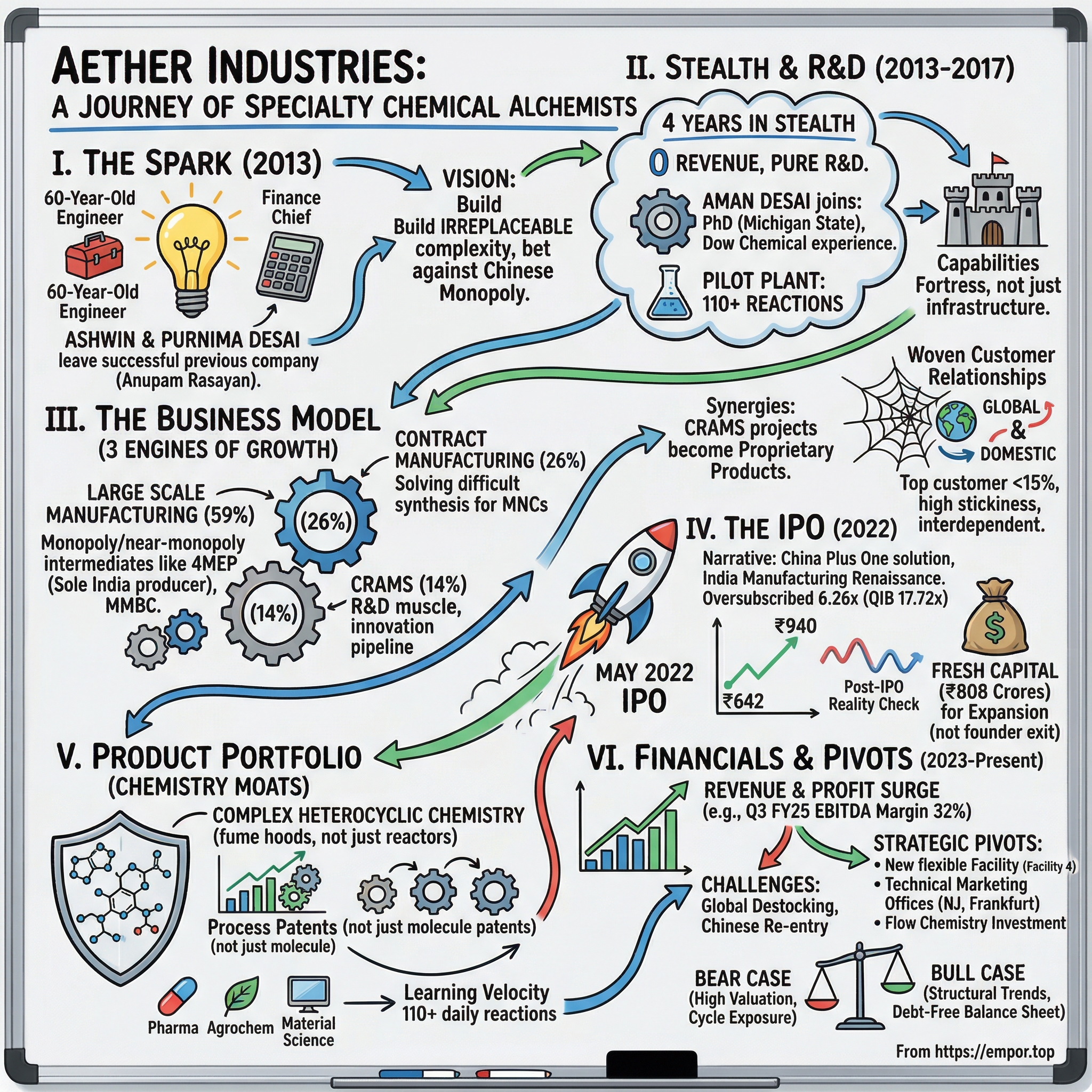
Aether Industries: The Specialty Chemical Alchemists of India
I. Introduction & Episode Roadmap
In the winter of 2013, a 62-year-old chemical engineer walked away from the company he had built over 37 years. He did not sell it to a private equity fund and retire to a farmhouse. He did not take a board seat and collect dividends. Ashwin Desai handed Anupam Rasayan — the Surat fine-chemicals business he had co-founded in 1976 and grown into a ₹150 crore exporter — to his nephew, sold his half of it, and started again from what he later described as "slate zero": no products, no people, no customers carried over.1
Then he did something stranger. For four straight fiscal years, the new company sold essentially nothing.
Aether Industries spent its first phase building laboratories and a pilot plant, burning capital on reactors that produced no revenue, while the rest of Indian specialty chemicals raced to install commodity capacity and chase cash flow. That decision — patient, expensive, and completely unfashionable — is the single most important fact in this story. By fiscal 2026, thirteen years later, the company reported consolidated revenue of ₹1,160 crore, EBITDA of ₹355 crore at a 31% margin, and profit after tax of ₹219 crore.23 The stock closed in mid-August 2026 around ₹1,640, giving Aether a market capitalisation of roughly ₹21,800 crore against a 52-week low of ₹726 — a range that tells you the market has been violently re-rating this business, in both directions, for years.4
The business in one paragraph. Aether is a Surat-headquartered manufacturer of advanced intermediates and specialty chemicals — the middle of the chemical value chain, between bulk commodities and the finished drug or crop-protection molecule. It sells a portfolio of just over 29 commercialised products to more than 280 customers, of which about 50 are global multinationals across 19 countries and roughly 210 are domestic.5 Its calling card is a set of molecules where it claims to be the sole manufacturer in India — 4-(2-Methoxyethyl) Phenol (4MEP), 3-Methoxy-2-Methylbenzoyl Chloride (MMBC), Thiophene-2-Ethanol (T2E), Ortho Tolyl Benzo Nitrile (OTBN), N-Octyl-D-Glucamine and Delta-Valerolactone among them.[^6] Pharma is the largest end market at roughly 46% of fiscal 2025 revenue, agrochemicals about 21%, and material sciences 11%.5
The strategic narrative. Every Indian chemicals story since 2020 has been sold on the same slide: global buyers de-risking away from China, and India catching the overflow. That tailwind is real, but it is also the most crowded thesis in the Indian mid-cap market, and it has already produced a graveyard of companies that built capacity into a destocking cycle. The interesting question about Aether is not whether "China Plus One" exists. It is whether Aether has built something a competitor cannot copy with capital — and whether the three-engine business model it has assembled genuinely converts research effort into contracted, sticky revenue, or merely into an expensive fixed-cost base.
What follows. The story starts with the founder and the family rupture that created the company, then moves to the four silent years and the pilot plant that came out of them. From there it deconstructs the three revenue engines and their very different economics, tests the moat against Hamilton Helmer's 7 Powers rather than assuming it, and walks through the capital-markets record: a 2022 IPO, a 2023 institutional placement, and a promoter sell-down that was not voluntary. Then comes the November 2023 fire that killed workers at the company's main plant — the hardest test of management credibility in its history — followed by the current expansion programme, the Baker Hughes contract, the Saudi Aramco licence, and the semiconductor and battery ambitions. Finally, the stress test: at roughly 90 to 100 times trailing earnings, what has to go right, and what would break the case?
Myth versus reality, before the story begins. Three claims follow Aether around, and all three need trimming.
The first is that Aether is a "China Plus One monopoly." It is not a monopoly. It holds sole-manufacturer status in India for a handful of molecules — a position built on being first and being difficult, not on any legal or structural exclusivity — and its own Large Scale Manufacturing volumes fell 22.5% year on year in the June 2026 quarter under competitive pressure.6
The second is that Aether operates a Saudi Arabian joint venture. It does not. It holds a technology licence from Saudi Aramco Technologies and a manufacturing contract with Baker Hughes, both executed from Gujarat.75 The distinction changes the capital intensity of the entire international story.
The third is that the November 2023 fire was a temporary setback fully offset by insurance. The money was recovered; the year it destroyed was not, and a second fire-related inventory loss followed in March 2026.3
None of this makes the business unattractive. It makes it a more interesting question than the marketing suggests.
Start with the man who walked away.
 Subscribe on LinkedIn
II. The Pre-History & Founder Genesis: UDCT, Anupam Rasayan, & The Age-60 Re-Invention
Ashwin Desai grew up in Indore in a large bungalow, the son of an umbrella manufacturer who died while his son was still in college. The family business was commerce. Desai chose chemistry instead, taking a degree in chemical engineering from the Institute of Chemical Technology in Mumbai — the school still known to a generation of Indian industrialists as UDCT, and arguably the single most productive founder factory in Indian manufacturing history.1 He graduated in 1974.
In 1976 he moved to Surat with his mother and, with his brother-in-law, started Anupam Rasayan. Their first product was sulfuryl chloride — a corrosive, fuming inorganic reagent that India was then importing.1 This is a detail worth pausing on, because it is the entire Desai method in miniature, established at age 25 and never abandoned: find a chemical that India buys from abroad, that is unpleasant enough to deter casual entrants, and make it locally. Not cheaper. Locally, and first.
Over the following 37 years Anupam Rasayan grew into a fine and specialty chemicals manufacturer with fiscal 2013 sales of about ₹150 crore, roughly 4,000 tonnes of capacity across two units, more than 400 employees, and a largely export-oriented book serving multinational customers built over decades.[^6] By any ordinary measure it was a success. Desai was in his early sixties, chairman and managing director, with a business that threw off cash and a reputation across Gujarat's chemical belt.
The 2013 break. In 2013 he stepped away, allowing his nephew to lead Anupam Rasayan, and sold his 50% stake rather than retaining a passive holding.1 Indian promoter families rarely execute clean separations; the more common outcome is a decade of litigation or an awkward joint control that paralyses both sides. Desai's exit was unusually complete — and the completeness was strategic, not sentimental. Retaining a stake would have created a permanent non-compete problem, because what he intended to build next occupied adjacent chemistry. Selling out bought him a free hand.
It also cost him the thing every industrial founder values most: an installed base. He restarted at 62 with capital, a network, and nothing else. Aether was incorporated in 2013 with his wife Purnima and his two sons as directors.1
The son who made it different. Anupam Rasayan was an operator's company — process discipline, cost control, decades of customer relationships. Aether was designed from the start as something else, and the reason is Dr. Aman Desai. He took his bachelor's degree at ICT and then a PhD in organic chemistry in the United States, before joining The Dow Chemical Company. That last credential matters more than the doctorate. Dow's core research organisation is where the discipline of scale-up science lives: the systematic, instrumented, deeply unglamorous work of proving that a reaction which behaves in a flask will also behave in a ten-thousand-litre reactor. He returned to Surat with a working model of how a Western industrial research organisation actually runs, and he now serves as Joint Managing Director with responsibility for research, manufacturing, and operations.58
The father-son division of labour is the operating core of the company. Ashwin Desai brings five decades of raw-material sourcing, plant economics, and the instinct for which molecules will still matter in ten years. Aman Desai brings the machinery for de-risking them. Neither half works alone: research without commercial judgement produces expensive curiosities, and commercial judgement without research produces a commodity plant.
Aether has since layered professional management on top of the family. Dr. James Ringer, a chemist with more than three decades at Dow and later Corteva Agriscience across agriculture, electronics, pharmaceuticals, and hydrocarbons, joined the company as a business development leader and was elevated to Chief Technology Officer with an explicit process-safety mandate.75 Faiz Nagariya serves as Chief Financial Officer.5 The elevation of a Western process-safety veteran to CTO is not a decorative appointment — as Section VII will show, the timing was not coincidental.
Governance. Promoters held 81.79% of the equity through fiscal 2024 and into fiscal 2025, an unusually high figure that signals alignment but also, bluntly, a controlled company where minority shareholders own a sliver of the float.7 That changed in May 2025, and not by choice — a point the capital-allocation section returns to.
The India he restarted into. In 2013 the Indian chemical industry was, with honourable exceptions, a volume business. Its comparative advantage was cheap labour and cheap batch capacity, and its typical product was a commodity intermediate sold on price into a crowded market. Environmental compliance was tightening and expensive. Capital was scarce and impatient.
Meanwhile the customers who mattered — European and American innovator pharmaceutical and agrochemical companies — had spent two decades consolidating their complex multi-step synthesis into China, where scale, integration and a permissive regulatory environment had produced unbeatable economics. Indian suppliers were largely relegated to the easy steps.
That was the structural gap Desai walked into: Western buyers who were beginning to feel uncomfortable about single-country dependence, and an Indian industry that could not yet do the hard chemistry those buyers needed. Closing that gap required something Indian chemical companies had generally refused to fund, because it produced no near-term revenue — deep, patient process research.
Aether's founding thesis was therefore not "make it cheaper in India." It was "make in India what only China currently makes, and make it by a better process." Whether that thesis holds is the subject of the rest of this story; that it was correctly identified in 2013, before the phrase "China Plus One" existed in any investor deck, is a genuine point in the founder's favour.
The India that Desai restarted into in 2013 was not, on the surface, a promising place to attempt any of this.
III. The Stealth R&D Moat & Pilot Plant Foundation (2013–2017)
Picture the balance sheet of a chemical company with no revenue. There is no receivables line because there are no customers. There is no finished-goods inventory because nothing has been sold. There is a building, there are reactors, there are salaries for chemists, and there is a steadily draining cash balance. Now hold that picture for four consecutive fiscal years.
That is what Aether looked like between 2013 and 2017. The company was founded in 2013 with a vision of redefining India's place in the global chemical landscape, and by its own account the early years went into building the research infrastructure before the product.5 Capital went into an advanced R&D centre and an industrial-scale pilot plant at Site 1 in Surat, not into commercial capacity.
Why anyone would do this. To understand the bet, you have to understand what actually kills fine-chemicals projects. A synthetic route with six or eight steps can work beautifully at one gram. Scale it to a hundred tonnes and three things go wrong. Heat generated by the reaction, which a small flask sheds harmlessly into the room, accumulates in a large vessel and can run away. Mixing that is instantaneous in a beaker takes minutes in a reactor, so different parts of the batch experience different conditions and impurities appear. And yield — the percentage of your expensive starting material that becomes product rather than waste — quietly erodes, which is the difference between a profitable molecule and a loss-making one.
A pilot plant is the machine that finds these failures before a customer's supply chain does. It sits between the laboratory and the factory: reactors large enough to behave like industrial equipment, small enough that a failed batch costs thousands rather than crores.
Aether describes its facility as one of the largest pilot plants globally, featuring over 100 reactors configured for both batch and continuous reaction chemistry.5
That last phrase carries the technical heart of the story. Batch chemistry is cooking: load a vessel, react, stop, empty, clean, repeat. Continuous flow chemistry is a pipeline: reagents are pumped continuously through narrow channels and mix, react, and emerge as product in a steady stream. Because only a small volume is reacting at any instant, a runaway reaction has almost nothing to run away with. That makes it possible to run chemistry — hydrogenations, nitrations, ozonolysis, high-pressure work — that is genuinely dangerous in a large batch vessel. It also uses less solvent, occupies far less floor space, and typically improves yield. The catch is that continuous processes are far harder to design. You cannot buy the know-how; you have to accumulate it, reaction by reaction, over years.
Which is precisely what a pilot plant with a hundred reactors and no revenue pressure is for.
The selection filter. The discipline shows in how Aether picks what to make. The company's stated criteria are explicit: the product should be infrastructure-oriented and sit in a specialty chemical field with a minimum of four synthetic steps; it should not be actively produced by any company in India; it should offer substantial revenue potential at maturity; and Aether should be able to achieve a market-leading position in it.5 Over eleven years to March 2025, that filter produced a portfolio of just over 29 commercialised products.5
Read those four criteria again as an economist rather than a chemist. "Minimum four synthetic steps" is a barrier-to-entry test — each additional step multiplies the process knowledge required and the yield that can be lost. "Not actively produced in India" is a competition test, and by implication an import-substitution test. "Market-leading position at maturity" is a pricing-power test. This is a company that decided, deliberately, never to compete on cost in a crowded market.
The results are the sole-manufacturer positions the company is known for. Aether describes itself as the only Indian producer of 4MEP, MMBC, T2E and OTBN, and as one of the largest global producers by volume of several of these — displacing Chinese imports and then exporting the same molecules back out.[^6] 4MEP feeds beta-blocker cardiovascular drugs; OTBN feeds the sartan class of blood-pressure medicines; MMBC serves agrochemicals; T2E is a pharmaceutical building block.
The honest caveat. "Sole manufacturer in India" and "monopoly" are not the same sentence. These are niche molecules by design; the addressable market for any one of them is small precisely because that is what keeps larger competitors away. A determined Chinese producer with a cost advantage and a willingness to accept low returns can enter any of them. What protects Aether is not that entry is impossible but that it is unattractive: the market is too small to repay the process development, and the incumbent already has the customer's qualification.
What the products actually do. It helps to know what these molecules are for, because the abstraction hides how ordinary the end use is. Aether's intermediates end up in medicines for hypertension, in anti-platelet and anti-psychotic drugs, in antihistamines and in non-steroidal anti-inflammatory painkillers.5 4MEP feeds beta-blocker cardiovascular therapy. OTBN feeds the sartan family of blood-pressure medicines. Beyond pharma, the same chemistry capability supplies agrochemicals, coatings, high-performance photographic materials and food additives — smaller lines, each in the low single digits of revenue, but each evidence that the company sells a capability rather than a product.5
Automation as a safety and cost decision. The plants run on distributed control systems — Yokogawa Centum VP — which allow processes to be operated and interlocked from a control room rather than by hand at the vessel.5 For a company whose competitive position rests on running dangerous reactions, moving the human being away from the reaction is simultaneously a safety measure, a consistency measure, and a cost measure. It also matters commercially: multinational customers audit for exactly this before they qualify a supplier.
By fiscal 2017 the reactors had answers, and the company began converting research into revenue. The commercial architecture it built on top of that base is where the economics get genuinely interesting — and considerably more nuanced than a single margin number suggests.
IV. Deconstructing the Business Model & Segment Economics
There is a slide in every Aether investor deck showing three business models. It looks like a diversification chart. It is not. It is a funnel, and understanding the direction of flow explains almost everything about how this company intends to make money.
Engine one: Large Scale Manufacturing. This is the original business — the proprietary intermediates from the pilot-plant portfolio, produced at volume and sold to whoever needs them. In fiscal 2024 it was 59% of revenue; by fiscal 2025 it had fallen to roughly 56% of revenue from operations, not because it shrank but because the other two grew faster.75 Economically it is the most exposed of the three. Aether owns the process, owns the inventory, and takes the price. When Chinese producers cut prices, this is the segment that feels it first. Fiscal 2024 demonstrated the point brutally: revenue fell 8% year on year despite volumes growing about 8%, because product realisations corrected sharply, and gross margin contracted by nearly five percentage points.7 Volume up, revenue down — the signature of a business with less pricing power than its margin profile implies.
Engine two: Contract / Exclusive Manufacturing (CEM). Here Aether manufactures a customer's product under a long-term supply agreement, often exclusively, sometimes in dedicated capacity. This grew from 25.65% of revenue from operations in fiscal 2024 to 31.36% in fiscal 2025 — a 71% increase in absolute terms, driven overwhelmingly by one contract.5 Contracts typically run three to five years with formula-based pricing, meaning raw-material movements pass through rather than being absorbed.5 That is the structural reason CEM margins are steadier than LSM margins: the customer, not Aether, carries input-cost risk.
Engine three: CRAMS. Contract Research and Manufacturing Services is the smallest line and the most misunderstood. It accounted for 12.25% of revenue from operations in fiscal 2025, down from 13.82% the year before.5 The work is contract research, pilot scale-up, process development and optimisation, and full-time-equivalent arrangements where Aether scientists are effectively rented to a customer's project.5 The revenue is modest and lumpy. Its value is not the revenue.
The funnel. CRAMS is how a global innovator meets Aether. A pharmaceutical company with a molecule in development needs a partner to design a manufacturable route. If that work succeeds, the same partner is the obvious choice to make the material at commercial scale — which converts into a Contract Manufacturing agreement, which over a long enough life may migrate into Large Scale Manufacturing. Aether says as much directly: CRAMS projects have the potential to convert into regular commercial supplies and become large-scale manufacturing products.5 The company reported onboarding ten new clients and clearing more than nine customer audits in a single quarter of fiscal 2027 — the raw throughput of that funnel.6
So the correct way to read a decline in CRAMS share is not as weakness. It is as conversion. Revenue that used to be counted as research is now counted as manufacturing.
Where it is heading, and the tension inside that. Management has been explicit and consistent: it targets roughly 70% of revenue from CRAMS and CEM combined and 30% from LSM, a mix it has framed as a fiscal 2030 objective.93 By the June 2026 quarter the two contract-led engines had reached 60% of revenue.10
But the path there has a sharp edge. In that same quarter, LSM volumes fell 22.5% year on year — partly because production was reallocated to contract work, and partly because Chinese pricing pressure made some LSM business unattractive.6 Management framed this as deliberate portfolio repositioning. An analyst is entitled to ask whether the mix shift is a strategy or a rationalisation of lost ground. The honest answer is probably both: the contract wins are real and documented, and the LSM erosion is also real. What matters for investors is that a company deliberately shrinking its most price-exposed segment while growing its contracted segment should show rising blended margins — and in fiscal 2026 it did, with EBITDA margin at 31% against 28% the prior year.3
Customer concentration, and why the standard reassurance is only half true.
The comfortable argument runs like this: in regulated pharmaceutical supply chains, once a supplier is named in a customer's regulatory filings, replacing them requires re-qualification and re-filing that can take years. Therefore concentration is stickiness, not fragility.
That is genuinely true for the pharma intermediates book. It is materially less true elsewhere.
Aether's own disclosure is refreshingly blunt: supply contracts may be terminated on expiry or on notice from the customer, and for many customers the company relies simply on purchase orders.5 And the geographic data shows how fast a book can move. Revenue from Italy collapsed from 10.78% of operations in fiscal 2024 to 1.77% in fiscal 2025, while Mexico exploded from 0.96% to 10.49% over the same period.5 Those are not the numbers of an unbreakable annuity. They are the numbers of a business whose revenue base can be reshaped within twelve months by one contract arriving and another leaving.
A note on segment economics, and what is not disclosed. Aether does not publish segment-level EBITDA margins, so any precise ranking of profitability by engine is inference rather than fact. What the disclosed data supports is a directional conclusion. CRAMS is the least capital-intensive of the three — it consumes scientist time and pilot-plant capacity rather than dedicated production assets — and therefore earns the highest return on capital employed even at modest absolute revenue. Contract manufacturing sits in the middle: dedicated capacity, but formula-based pricing that protects the margin. Large Scale Manufacturing carries the full asset base and the full price risk.
The blended outcome is visible even if the components are not. Fiscal 2026's 31% EBITDA margin was achieved with contract-led revenue at roughly 60% of the mix; fiscal 2024's 22.1% came with that mix nearer 40%.3107 Correlation is not proof — fiscal 2024 also absorbed a fire and a price collapse — but the direction is consistent with the claim that contracted revenue carries better and steadier economics than merchant sales.
A second-order cost story worth noticing. Aether commissioned a 15 MW solar installation with auto-tracking by the end of December 2024, sized to meet more than 75% of the company's electricity requirement.5 Power and fuel is a meaningful line in energy-intensive chemistry, and the company recorded a 26% reduction in power and fuel expenses in fiscal 2024 with electricity costs down 30%.7 Captive renewable generation is unglamorous capital allocation that permanently lowers the cost floor and reduces exposure to grid tariff inflation. It also, incidentally, answers a procurement question that European customers increasingly ask.
The one that arrived is worth a section of its own. But first, the question of whether any of this constitutes a durable competitive advantage — or just a well-run factory.
V. Chemistry as a Moat: Helmer's 7 Powers & Continuous Flow Innovation
Hamilton Helmer's framework asks a deliberately hostile question: what stops a competent, well-capitalised competitor from taking your customers? Not what makes you good — what makes copying you uneconomic. Run Aether through it honestly and the answers are uneven.
Process Power — the strongest claim, and it is real but bounded. Process Power is advantage embedded in accumulated operational know-how that a rival cannot buy, only build slowly. Aether's continuous-flow capability qualifies. So does the pilot plant, which is now materially larger than it was: the company expanded its research facilities from 17 fume hoods to 55, giving it the capacity to run over 110 reactions concurrently, and has committed to a further build-out targeting roughly 140 cumulative fume hoods across 15 laboratories in a new facility slated for commissioning in fiscal 2028.53 An interim expansion added 18 fume hoods and a 400 MHz NMR spectrometer — an instrument that lets chemists see molecular structure directly rather than inferring it, which is the difference between diagnosing an impurity in days versus weeks.3
Research headcount backs the infrastructure: 145 scientists and 141 engineers as of March 2025, together nearly 29% of total manpower.5 Spending has been volatile in a revealing way — R&D expenditure roughly doubled from ₹501 million in fiscal 2023 to ₹987 million in fiscal 2024, reaching 16.5% of revenue in a year when revenue was falling, then normalised to ₹681 million or 7.74% of revenue in fiscal 2025.75 A company that increases absolute research spend into a demand downturn is behaving like one that believes its pipeline is its product. Management has since indicated willingness to run research at 10–12% of revenue.9
The bound on Process Power is this: it protects the portfolio, not any individual molecule. It means Aether can develop the next hard process faster than a rival. It does not mean the current process cannot be reverse-engineered given time and motive.
Switching Costs — real in pharma, thin elsewhere. When Aether's material is written into a customer's regulatory dossier with the FDA or EMA, changing supplier means re-qualification, stability data, and regulatory amendment — a multi-year, expensive exercise that customers avoid unless forced. That is genuine lock-in and it explains why the pharma book, at roughly 46% of fiscal 2025 revenue, is the most defensible part of the business.5 But oil and gas chemicals, coatings, and material-science products carry nothing comparable. As oil and gas has grown from 1.56% to 5.98% of revenue in fiscal 2025 and past 30% by mid-fiscal 2027, the average switching cost across Aether's book has been falling even as revenue rises.510 That is an underappreciated shift.
Scale Economies — weak, and the numbers say so. Fixed research overhead spread across more molecules is a genuine effect, but Aether is not yet a scale player in any meaningful industrial sense. The clearest evidence is fixed asset turnover, which collapsed from 2.3x in fiscal 2021 to 0.7x in fiscal 2024 as capital was poured into plants that had not yet commissioned.7 Scale economies are what you harvest after utilisation arrives, not a moat you possess while building.
Cornered Resource — arguable, and family-dependent. The combination of Ashwin Desai's five decades of process and sourcing judgement with Aman Desai's Dow-trained scale-up methodology and the ICT talent network is difficult to replicate. It is also, uncomfortably, concentrated in two people from one family. Key-person risk here is not a boilerplate disclosure; it is the substance of the Cornered Resource claim. The professionalisation of the CTO role is a partial mitigant and should be tracked as such.
Branding, Network Economies, Counter-Positioning — largely absent. Industrial buyers of intermediates do not pay for brand. There are no network effects. Counter-positioning would require incumbents to be structurally unable to respond, which is not the case.
Where Aether sits against its peers. Anupam Rasayan — the founder's former company — remains the closest comparable in custom synthesis and carries more leverage and more legacy batch infrastructure. Clean Science and Technology generates higher margins from catalytic chemistry but across a narrower product set. SRF and Aarti Industries operate at far greater scale in fluorination and nitration, with the cost advantages and the cyclicality that scale brings; neither is built for low-to-mid-volume development work. Laxmi Organic and Fine Organics occupy acetyls and food additives, adjacent but not overlapping. The competitive gap Aether occupies is genuine: complex, low-volume, high-difficulty chemistry with a research front end. It is also, by construction, a small gap.
The war-game, played out. Suppose a competitor decides tomorrow to take one of Aether's sole-source molecules. What actually happens?
If the attacker is a Chinese producer, the weapon is price and the timeline is short. It works — but only in the segments without regulatory qualification, which is why Aether's response has been to retreat from contested merchant volume rather than to defend it. The company effectively concedes the price war and redeploys the capacity into contracted work. That is a rational response and also an admission: in a straight cost fight, Aether loses.
If the attacker is an Indian peer, the weapon is capital and the timeline is three to five years — process development, environmental clearance, plant construction, customer qualification. By the time they arrive, the incumbent has moved on to the next molecule. This is where the pilot-plant advantage genuinely bites, and it is why the research infrastructure is the moat rather than any individual plant.
If the attacker is the customer itself — an innovator pharma company deciding to redesign the synthetic route and eliminate the step Aether supplies — there is no defence except being in the room early. That is the strategic purpose of CRAMS restated as a threat rather than an opportunity.
The verdict. Aether has one strong power and one moderate one. That is more than most Indian chemical manufacturers can claim and considerably less than the valuation implies. The moat is in the pipeline and the pharma qualifications, not in the balance sheet.
Which brings us to how that balance sheet got built.
VI. The 2022 IPO, 2023 QIP, & Capital Allocation Record
By 2022 the Indian primary market had discovered specialty chemicals. Every listing came with the same deck: China consolidating capacity on environmental grounds, Western buyers seeking a second source, India positioned to capture it. Into that window, Aether launched its initial public offering.
The issue opened on May 24, 2022 and raised approximately ₹808 crore — about ₹627 crore of fresh capital for the company and roughly ₹181 crore as a secondary sale by existing holders. It was subscribed 6.2 times overall by the final day, with the institutional tranche taking 17.6 times its allocation while retail managed 1.14 times.11 That split is diagnostic: the institutions who could model a pipeline of unlaunched molecules wanted it badly; retail investors, looking at a company with modest current earnings and a name most had never heard, largely did not. The shares listed on June 3, 2022 at a premium to the issue price.
Twelve months later the company returned for institutional money in a very different mood. In June 2023 Aether placed 8,012,820 shares at ₹936 each — a discount to the ₹984.90 floor — raising ₹750 crore from 36 qualified institutional buyers including SBI Mutual Fund, Axis Mutual Fund, Goldman Sachs Funds, HDFC Mutual Fund, White Oak Capital and Société Générale.12[^14] Notably, the placement carried no offer-for-sale component: every rupee went into the company rather than to selling shareholders.12
What happened to the money — and this part deserves credit. Companies that raise capital on a growth narrative routinely let the deployment story go quiet. Aether did not. The monitoring agency's final report for the quarter ended December 31, 2025, submitted by CRISIL Ratings and disclosed in February 2026, confirmed that the entire ₹7,286.14 million of placement proceeds had been deployed exactly as stated: ₹1,830 million to expand Manufacturing Facility 3, ₹3,300 million to set up Facility 5, ₹450 million to working capital, and ₹1,706.14 million to general corporate purposes — with no deviation from the original objects, and escrow and monitoring balances at nil.13
Full utilisation with zero deviation across a multi-year capital programme is a meaningful governance data point. It is the kind of thing that is boring when it goes right and career-defining when it goes wrong. Note also the correction it forces: the placement funded Sites 3 and 5, not Site 4 as is sometimes claimed. Site 4 was built and commissioned through the wholly owned subsidiary Aether Speciality Chemicals Limited, funded from internal accruals and prior raises.714
Greenfield over acquisition. Aether has built rather than bought. There is no acquisition track record to assess, which is itself a form of discipline — the specialty chemicals sector is littered with acquirers who paid for capacity and inherited a culture and a safety record they could not fix. The cost of the greenfield choice is time: a plant conceived in 2023 generates revenue in 2026.
What the money actually bought. The largest single tranche went into land and plant at Panoli. The rest went into a less visible but arguably higher-return project: expanding the existing Site 3 through adjacent blocks designated 3+ and 3++, at a cost of roughly ₹2 billion, adding about 3,500 tonnes of capacity — which together roughly doubled Site 3's output potential.7
Brownfield expansion beside a running plant is the cheapest capacity a chemical company can buy. Utilities, effluent treatment, warehousing, security and management are already in place; only the reactors are incremental. That Aether funded both the cheap adjacent expansion and the expensive greenfield simultaneously is a reasonable reading of capital discipline — it did not skip the easy return to chase the ambitious one.
A minor dilution note for completeness: employee stock option costs rose 137% to ₹36.76 million in fiscal 2024, and a small tranche of shares was issued on option exercise at ₹321 apiece.7 Immaterial to the share count, but worth knowing that equity compensation exists and is growing.
The uncomfortable arithmetic. Equity raised ahead of earnings does exactly what arithmetic says it must. Return on equity, which was 56.3% in fiscal 2021 and 38.8% in fiscal 2022 when the company was small and levered, fell to 16.0% in fiscal 2023 and to 5.6% in fiscal 2024.7 Return on capital employed followed the same path down. Screener data shows a three-year average ROE of about 8%, recovering to roughly 10% in the most recent year.2 The company itself reported ROE of 7.12% and ROCE of 8.50% for fiscal 2025.5
The generous reading is that this is a denominator problem: cash sitting on the balance sheet and capital work-in-progress earn nothing until plants commission, and returns normalise as utilisation arrives.
That reading is defensible — but it is a promise, and it has now been outstanding for four years.
The harder number. Aether generated negative operating cash flow in fiscal 2021 through fiscal 2024, with the cash conversion cycle deteriorating from 102 days to 148, then 220, then 328 days.7 A company can grow revenue while consuming cash for a long time before anyone notices. The CFO addressed it directly, noting that fiscal 2025 brought positive operating cash flows for the first time after being negative through the prior year, and framing further working-capital reduction as an ongoing priority.5 That is a genuine inflection and management named it without being asked — but working capital in fiscal 2027 remains elevated on management's own account, with inventory positioning straining the cycle.6 Anyone underwriting this business should treat the working-capital line as a live issue, not a solved one.
The sell-down that was not a choice. In May 2025 promoter Purnima Desai sold 8.979 million shares — 6.77% of the company — through an offer for sale at a floor price of ₹700, raising ₹628.54 crore.15 The framing matters. This was not a promoter monetising conviction; it was compliance. Aether's deadline to meet the minimum public shareholding requirement of 25% was May 31, 2025, and promoter holding stood at 81.77%.15 The floor was set roughly 13% below the prior close, and the stock fell on the news. Promoter holding now sits near 74.92%, with foreign institutional ownership having risen from 2.90% in mid-2024 to 7.42% by mid-2026.2
The regulatory origin makes the sale neutral rather than negative as a signal. But investors should note what it means going forward: the promoter family is now at the statutory floor, which removes sell-down as a source of future supply — and removes it as a source of future signal.
All of that capital, however, was being deployed against a backdrop that changed in a single night in November 2023.
VII. The November 2023 Safety Crisis: Stress-Testing Management Credibility & Operational Resilience
At roughly two in the morning on November 29, 2023, a storage tank at Manufacturing Facility 2 in Sachin GIDC, Surat, exploded. The tank held tetrahydrofuran — a solvent so common in organic chemistry that most working chemists have handled it, and so flammable that its vapour will ignite from a distant spark. The blast started a fire that burned through the plant.
Workers died. The company's own investor presentation of May 2024 recorded 11 casualties, with families of the deceased compensated ₹50 lakh each; the National Green Tribunal's file, opened suo motu on December 12, 2023 from press reports, referenced ten fatalities.1416 Dozens more were injured, and Aether bore their hospital costs.14 Whatever the precise final count, this was among the worst industrial accidents in the recent history of India's chemical sector, and no amount of financial analysis should be allowed to sand that down.
The immediate consequences. The Gujarat Pollution Control Board issued a closure direction and levied a ₹50 lakh penalty.14 The affected facility stayed shut for 39 days.7 The company estimated total loss at around ₹100 crore, and stated that assets, inventories, people and loss of profit were all insured.14 Manufacturing Facilities 1 and 3 continued running, which is why the customer-supply consequences were survivable rather than catastrophic — the fire tested the value of having more than one site, and multi-site redundancy passed.
What the financials absorbed. The damage flowed through fiscal 2024 in several places, and Aether disclosed each of them rather than burying the total in a single exceptional line: an inventory write-off of ₹138.97 million for stock damaged in the fire, ₹69.64 million of compensation to families and hospital expenses for the injured, and ₹29.57 million of incremental insurance premium triggered by lodging the claim.14 Depreciation was left uncharged for impairment pending assessment of the insurance claim — an accounting judgement worth flagging, because it deferred recognition of asset loss into a future period on the expectation of recovery.7
The full-year result tells the rest. Fiscal 2024 revenue fell 8.1% to ₹598 crore, EBITDA fell 29% to ₹132 crore, and margin compressed from 28.6% to 22.1%.72 Profit after tax dropped to ₹82 crore.2 Not all of that was the fire — Chinese price competition and an agrochemical destocking cycle were running simultaneously, and management said so at the time rather than blaming the accident for everything.5 That distinction matters for credibility assessment: a management team that attributes a bad year entirely to an act of God is telling you something about itself.
Did management behave well? On the evidence available, largely yes, with caveats.
Disclosure. The company filed nine separate intimations on the incident and the claims process between November 2023 and January 2025 before final settlement — a cadence of updating that goes beyond minimum compliance.17[^20]
Consistency. On the fiscal 2025 numbers, the CFO stated plainly that a ₹100 crore claim had been lodged and accepted, that ₹36 crore had already been received, and that the balance would come in phases with full settlement expected in fiscal 2026.5 That guidance proved accurate: Aether disclosed receipt of the final settlement on June 5, 2026, closing the financial impact of the incident.17 A materials-loss-of-profit claim of ₹200 million was booked in the third quarter of fiscal 2026, lifting that quarter's EBITDA by around ₹150 million and profit by ₹112 million — and management flagged it explicitly as a one-off when the following quarter looked weaker by comparison, rather than letting the sequential decline pass unexplained.3 Setting an expectation eighteen months out and hitting it is the most useful single piece of evidence on this management team's guidance discipline.
Regulatory outcome. GPCB revoked the closure notice in January 2024, allowing unaffected plants to restart; the facility was roughly 50% operational by the end of February 2024.147 The NGT disposed of its case on August 13, 2024 without imposing penalties or special instructions.16
Remediation. Aether initiated an immediate global safety review of all processes and full, systematic HazOp studies for every running process at Site 1 and at production Sites 2 and 3.14 A HazOp — hazard and operability study — is a structured line-by-line interrogation of a process asking what happens if each variable deviates. Committing to run one on every process, not just the failed one, is the correct scope. The company subsequently intensified safety training, upgraded emergency response, and named strengthened HSE and risk controls as an explicit management priority.5
The caveats an investor should keep. First, the elevation of a process-safety-focused CTO followed the accident rather than preceding it, which invites the question of what the safety function looked like before. Second, and more soberingly, a warehouse fire at an external facility on March 11, 2026 caused a ₹70 million inventory loss — no casualties, and at a third-party site, but a reminder that fire risk in this industry is chronic rather than episodic.3 Third, no root-cause finding has been publicly disclosed in detail, and the NGT's disposal without instruction closes the legal file without settling the engineering question for outside observers.
Insurance recovered the money. Insurance does not recover the workers, and it does not by itself prove that the underlying hazard has been engineered out.
That is what the next several years of operating without incident, across five sites rather than three, will have to demonstrate.
And five sites is now the plan.
VIII. Current Strategy, Site 4/5 Scaling, & Saudi JV Expansion (2024–Present)
In mid-2026 Aether did something small and revealing: it renamed its factories. Site 1 became Catalyst, Site 2 Genesis, Site 3 Ascend, Site 4 Strata, Site 5 Magnum.10 The names are marketing. What they encode is not: each name maps to a business model, and the fact that management felt the need to give the sites identities says the company now thinks of itself as a portfolio of capabilities rather than a set of plots in Sachin GIDC.
The asset base, and what each piece is for. Catalyst is the research and pilot-plant hub, the machine described in Section III. Genesis is the original large-scale plant — the one that burned — running at 74% capacity utilisation by the June 2026 quarter. Ascend is the second commercial site, expanded through the 3+ and 3++ blocks funded by the placement, at 69%. Strata is dedicated to contract and exclusive manufacturing, at 59%. Magnum, the newest, had commercial sales underway with a 45-tonne-per-month block expected online by September 2026.610
Magnum deserves attention because of its scale. Located at Plot 14+15 in Panoli GIDC, about 54 kilometres from Surat, it covers 125,874 square metres — roughly 31 acres, and about twelve times the land bank of Site 2.14 This is not an expansion; it is a second company being built alongside the first. The first two Phase 1 blocks were commissioned during fiscal 2026, and management has indicated total capital expenditure on the site running to ₹2,200–2,300 crore through fiscal 2030, with a target asset turnover of 1.5x to 1.75x once fully operational.9 Capital expenditure was ₹3,838 million in fiscal 2026 with ₹3,000–3,500 million guided for fiscal 2027, directed at Magnum and the new research campus.6
That asset-turnover target is the number to hold onto. At 1.5x, ₹2,250 crore of plant eventually supports something over ₹3,300 crore of revenue — roughly triple the entire company's fiscal 2026 sales. That is the size of the bet. It is also the size of the risk if the molecules to fill it do not arrive.
The Baker Hughes contract — the single most consequential commercial event since listing. Aether signed a letter of intent with Baker Hughes in June 2023 and commenced supply from Site 4 in March 2024, executed through the wholly owned subsidiary Aether Speciality Chemicals Limited. The agreement covers six new products manufactured for Baker Hughes globally with a focus on India's oil and gas sector, running an initial five years with a one-year extension.75 By the June 2026 quarter the contract alone was generating ₹700 million in a single quarter, and oil and gas revenue crossed ₹1,000 million for the quarter — over 31% of the total.10
Consider what that means. An end market that was 1.56% of revenue in fiscal 2024 became roughly a third of revenue in under three years.510 It transformed the geographic mix — Mexico went from under 1% of revenue to 10.49% in a single year.5 It is the reason the contract-manufacturing engine grew 71% in fiscal 2025.5 And it is, on the disclosed terms, a five-year agreement with one counterparty. Aether's diversification story and its concentration risk are currently the same contract.
Correcting the record on Saudi Arabia. It is frequently reported that Aether has a Saudi joint venture to manufacture oilfield chemicals in the Kingdom. The verifiable facts are different and worth stating precisely. Aether signed a licence agreement with Saudi Aramco Technologies Company in March 2023 to commercialise the Converge polyols technology — a platform for making polyols that can incorporate up to 40% carbon dioxide by weight, with applications in coatings, adhesives, sealants and elastomers. Aether, Saudi Aramco Technologies and the American adhesives company H.B. Fuller subsequently announced the first commercialisation of that technology, with a licensed production capacity of 2 KTA and a pilot capacity of 500 MT.75 Separately, Aether manufactures for Baker Hughes — in India, at Site 4, not in Saudi Arabia.5
The distinction is not pedantic. A licensed technology commercialised from Gujarat and an equity joint venture building a plant in Jubail carry entirely different capital requirements, entirely different risks, and entirely different economics. Aether's international strategy to date has been to import technology and export product, not to build foreign assets. That is the capital-light version, and on the evidence it is the version that is actually happening.
The other bets. Aether entered the lithium-ion battery supply chain in December 2023 through a strategic agreement with an unnamed global battery producer, finalising commercial supply of one electrolyte additive with discussions opened on three more. Aman Desai's framing was characteristically cautious — the company had been developing for the field for a long time but chose to make it public only after securing a substantial commercial contract.8 A contract manufacturing agreement with Chemoxy International, a subsidiary of France's SEQENS group, covers a series of bio-based products exclusively for SEQENS over an initial three years at 100-plus tonnes per year.5 A partnership with Novoloop targets converting post-consumer polyethylene waste into virgin-quality monomers.7 And in fiscal 2027 the company disclosed an exclusive, Dow-funded research collaboration on silicone manufacturing technologies, alongside work at Magnum on low-dielectric monomers for 5G and AI hardware.6
How to read that list. It is genuinely impressive breadth for a company of this size, and it is also a long list of options rather than earnings. Management could not disclose the size of the Dow investment, no order book exists for the semiconductor materials, and commercialisation timelines are unclear.6 The correct posture is to value what is contracted — Baker Hughes, SEQENS, the electrolyte additive — and to treat the rest as free optionality that costs research money today.
The financial recovery. The trajectory since the fire is unambiguous. The December 2024 quarter delivered EBITDA of ₹75.7 crore at a 32% margin, up sharply from the depressed prior-year comparison, with profit rising 149% year on year to ₹43.39 crore.18 Fiscal 2026 delivered revenue of ₹1,160 crore, up 38%, EBITDA up 53% to ₹355 crore at a 31% margin, and profit up 39% to ₹219 crore.3219 The June 2026 quarter continued it: revenue ₹3,266 million up 27%, EBITDA ₹1,028 million up 31% at a 31.5% margin, profit ₹627 million up 33%.610
The fourth quarter of fiscal 2026 is worth reading carefully, because it is the kind of quarter that reveals disclosure habits. Revenue was ₹3,051 million, EBITDA ₹814 million and profit ₹540 million — sequentially softer than the preceding quarter.3 Two one-off items explained the gap: the insurance claim income that had flattered the prior quarter did not repeat, and the March 2026 warehouse fire cost ₹70 million of inventory. Management identified both, called them transient, and stated that pricing had held through April and May 2026.3
A management team that walks investors through why a sequential decline is not a trend — naming its own prior-quarter windfall as the main cause — is behaving the way a credible one should. Whether the claim that pricing is holding proves durable is a separate matter, and one the next several quarters will settle.
Two years of consecutive margin expansion alongside 27–38% revenue growth, achieved while deliberately shrinking the most price-exposed segment, is evidence that the contract-led mix shift is doing what management said it would. That is the case for the defence. The case for the prosecution is what the market is currently paying for it.
IX. The Skeptical Investor & Activist Stress Test: Risk Radar & Valuation Reality
Imagine an activist investor with a short book and a spreadsheet arriving at Aether's investor day. She has read the annual report twice, cross-referenced four years of transcripts, and has five questions. Every one of them is fair.
1. "You want me to pay ninety times earnings for a company earning a single-digit return on equity." This is the central tension and there is no elegant way around it. At roughly ₹1,640 per share and a market capitalisation near ₹21,800 crore, Aether trades at approximately 99 times fiscal 2026 earnings of ₹219 crore.4202 The stock has roughly doubled off its 52-week low of ₹726.4 Meanwhile the company reported ROE of 7.12% for fiscal 2025 and a three-year average nearer 8%.52 A business earning single-digit returns on equity and priced at a triple-digit earnings multiple is making a specific promise: that the current earnings base is a fraction of the earnings the installed asset base will eventually produce. If Magnum ramps to its target asset turnover on schedule and margins hold, the multiple compresses rapidly on its own. If commissioning slips two years, it does not.
There is no margin for execution error at this price. That is not a criticism of the business; it is a description of the entry point.
2. "Your working capital has been a black hole and you only just plugged it." Four consecutive years of negative operating cash flow while the cash conversion cycle stretched from 102 to 328 days is not a rounding error; it is a structural characteristic of a business carrying long-cycle inventory for complex multi-step chemistry.7 Fiscal 2025 turned operating cash flow positive.5 But management acknowledged in fiscal 2027 that elevated inventory positioning continues to strain working capital.6 One good year does not retire the question. If growth accelerates, working capital consumes cash faster — which is why revenue growth and cash generation need to be tracked as separate things here, not as proxies for each other.
3. "China is not a passing weather event." Aether's own annual report names intensified competition from Chinese players and an agrochemical slowdown among the headwinds of fiscal 2025.5 Chinese overcapacity in chemical intermediates is a structural consequence of a domestic property and infrastructure slowdown redirecting industrial output into export markets. The bull answer is that Aether's sole-manufacturer molecules are too small and too difficult to attract Chinese entry. That answer is credible for the pharma intermediates with regulatory qualification behind them. It is weaker for the rest — and the 22.5% year-on-year decline in Large Scale Manufacturing volumes in the June 2026 quarter, which management attributed partly to competitive pricing pressure, is the mechanism showing up in the numbers.6
4. "One contract is a third of your revenue." The oil and gas segment exceeded 31% of revenue in the June 2026 quarter, and the Baker Hughes relationship contributed ₹700 million of it.10 The agreement runs five years with a one-year extension option from a March 2024 start.7 That means renewal risk arrives around 2029–2030 — precisely when Magnum's capital programme is scheduled to complete. Aether has not disclosed exclusivity terms, minimum volumes, or termination provisions for this contract, and its general disclosure that supply agreements may be terminated on notice applies.5 An activist would press hard on this and would be right to.
5. "Hazardous chemistry is your business model, and you have had two fires." The November 2023 explosion and the March 2026 warehouse loss are different in scale and in fault, but they sit on the same risk surface.143 Aether's competitive position depends on running chemistry that others avoid — hydrogenations, high-pressure work, flammable solvents at volume. The moat and the hazard are the same asset. Insurance covered the financial loss both times; insurance does not cover an extended regulatory closure at a site that carries a qualified pharmaceutical customer's only approved supply.
The risk radar beyond the activist's list.
Execution risk is the largest and the most concrete: three concurrent programmes — Magnum's phased build, the fiscal 2028 research campus, and continued ramp at Strata and Ascend — running simultaneously in one management team.6 Site 4 sitting at 59% utilisation more than two years after commissioning is a useful reality check on how long ramps actually take.6
Regulatory and environmental risk is chronic in Gujarat's chemical clusters. GPCB demonstrated in 2023 that it will close a plant first and assess later. Aether's mitigation is multi-site redundancy, which worked once.
Currency and geographic exposure: exports ran 43.42% of revenue in fiscal 2025, predominantly in US dollars, and the company hedges only a minimal portion of its net foreign exchange position.5 That is a deliberate choice to accept translation volatility.
Refinancing risk is minimal. Borrowings stood at ₹458 crore against reserves of ₹2,323 crore at the end of fiscal 2026 — this is not a leveraged story, and the balance sheet is not what breaks first.2
Accounting judgements to watch: the deferred impairment charge pending insurance assessment in fiscal 2024 was resolved by the June 2026 final settlement, but the episode illustrates how much of this company's reported profit can hinge on estimates.717 Related-party exposure through the family shareholding structure and the subsidiary Aether Speciality Chemicals — which carries the Baker Hughes contract and, per management, provides a tax benefit — deserves continued scrutiny simply because so much value now sits inside it.5
The bull's counter-arguments, stated fairly. First, the sole-manufacturer positions have already survived one full Chinese pricing cycle: fiscal 2024 was the stress test, and Aether emerged with margins recovering to 31% two years later rather than permanently reset.23 Second, the capital monetisation curve is arithmetic, not hope — assets already built and paid for will either produce revenue or they will not, and the fiscal 2026 and fiscal 2027 numbers show them beginning to. Third, the mix shift toward contracted revenue mechanically improves earnings quality, and the trajectory from 41% of revenue in contract-led models to 60% in three years is documented rather than promised.10
The disagreement between bull and bear here is not about the facts. It is entirely about the discount rate applied to a ramp that is visibly underway but incomplete.
X. Playbook: Core Business & Investing Lessons
Strip away the specific molecules and the Surat geography, and Aether offers a set of transferable lessons — several of which cut against conventional operating wisdom.
1. Patient capital creates advantages that fast capital cannot buy. Four fiscal years with no commercial revenue would end most management careers. What it bought Aether was a pilot plant with over 100 reactors and, more importantly, the accumulated experience of failing at scale-up privately rather than in front of a customer.5
The generalisable point is about sequencing: in businesses where the binding constraint is knowledge rather than capacity, building capacity first inverts the problem and locks you into whatever you happened to know on day one. The counter-lesson is equally important — this only works if the founder can fund the silence. Desai could because he had sold a 37-year-old company. Most founders cannot, and the strategy is not available to them at any price.
2. Deliberately choose markets too small to be worth attacking. Aether's product filter explicitly requires a minimum of four synthetic steps and no active Indian producer.5 This is not modesty; it is a calculated choice to operate below the threshold where a large competitor's economics justify entry. The trade-off is a ceiling: a portfolio of niches grows by adding niches, which requires continuous research output. That is why the research spend is not discretionary for this business — it is the growth engine, and cutting it would be equivalent to a consumer company cutting new product development.
3. Treat research throughput as a customer-acquisition channel. Expanding from 17 fume hoods to 55 with capacity for over 110 concurrent reactions is usually filed under cost.5 For Aether it is closer to a sales function: every CRAMS project is a paid audition for a manufacturing contract, and ten new clients and nine customer audits cleared in a single quarter is the throughput of a pipeline, not a laboratory.6 The lesson generalises to any business where technical collaboration precedes commercial commitment.
4. Process advantage outlasts product advantage — but only in the aggregate. Individual molecules commoditise; they always have. What persists is the capability to develop the next difficult process faster than the competition. Aether's blended EBITDA margin recovering from 22.1% in the fire-and-destocking year to 31% two years later, while the segment mix shifted decisively toward contracted work, is consistent with process advantage doing real work.73 The caution: process power protects the portfolio, not the position. Any single sole-source molecule can be taken.
5. Crisis response is a disclosure problem before it is an engineering problem. Aether's handling of the 2023 fire — nine separate intimations over fourteen months, an explicit ₹100 crore claim figure with received-to-date amounts, a stated settlement timeline that was subsequently met, and the flagging of the one-time claim income as a one-off when it flattered a quarter — is the behaviour of a management team that decided credibility was worth more than short-term optics.1753 The measurable outcome was that no material customer defection was reported and the recovery arrived roughly when management said it would. Companies that go quiet after industrial accidents usually pay for the silence twice.
6. Fund the boring cost advantages while you are funding the exciting ones. Captive solar generation does not appear in any pitch deck about advanced chemistry, and it permanently lowers the cost of running energy-intensive reactors. The same logic applies to control-system automation, which improves safety, consistency and audit performance simultaneously. Companies that spend exclusively on the differentiated part of the business and treat infrastructure as overhead usually discover, one cycle later, that the differentiated part was subsidising an inefficient base.
7. The lesson management has not yet proven. Every item above is about building. None is about harvesting. Aether has not yet demonstrated that it can convert a large, expensive asset base into returns on equity that justify the capital consumed. That is the fifth chapter of this playbook, and it has not been written.
XI. Analysis & The Bull vs. Bear Investment Case
Porter's Five Forces, applied honestly.
Threat of new entrants: moderate, not low. The barriers are real — process knowledge, regulatory qualification in customer dossiers, environmental clearances that take years in Gujarat, and capital. But they are barriers of time and effort, not of impossibility. A well-funded competitor willing to spend four years can replicate the model; Aether itself proved that by doing exactly that starting in 2013.
Supplier power: moderate. Aether sources raw materials from the open market rather than under long-term contracts, which leaves it exposed to input-price swings.7 The mitigation is contractual, not operational: formula-based pricing in contract manufacturing passes movements through to customers.5 That protection does not extend to the Large Scale Manufacturing book, which is precisely where fiscal 2024's gross-margin compression showed up.
Buyer power: high and rising. Customers are multinational pharmaceutical, agrochemical and energy-services companies — larger than Aether by orders of magnitude, professionally procured, and holding contracts terminable on notice.5 Regulatory qualification is a genuine offset in pharma. It is close to zero in oil and gas, the fastest-growing part of the book.
Threat of substitutes: low at the molecule level, high at the route level. Nobody substitutes a different chemical for OTBN in a sartan process. But a customer can re-engineer a synthetic route to eliminate a step, and innovator pharma companies do this routinely to cut cost. Aether's protection is being embedded early enough in development to be designed in rather than designed out — which is the strategic purpose of the CRAMS funnel.
Rivalry: intense and asymmetric. Domestic peers compete for the same customers with different structures. Chinese producers compete on price with a cost base Aether cannot match. Aether's response — retreat from contested LSM volume into contracted work — is rational, and the 22.5% volume decline is the cost of that retreat.6
The bull case. Aether occupies a genuinely defensible position in complex, low-volume chemistry that neither commodity producers nor large-scale specialists are structured to serve. It has converted that position into contracted revenue: contract and exclusive manufacturing plus CRAMS moved from roughly 41% of revenue to 60% within three years, with a stated 70% target.7103 It has a near-debt-free balance sheet with ₹2,323 crore of reserves against ₹458 crore of borrowings.2 It deployed ₹729 crore of placement proceeds with zero deviation from stated objects, verified by an external monitoring agency.13 It has an asset base — Ascend, Strata, and Magnum — that is largely built and only partially utilised, meaning incremental revenue arrives at high incremental margin without new equity. And it has genuine optionality in battery electrolytes, carbon-dioxide-derived polyols, bio-based chemistry and electronic materials, each with a named commercial partner rather than a press release.8576
The bear case. The valuation prices perfection at roughly 99 times trailing earnings against a single-digit return on equity that has not yet turned.425 The capital programme is enormous relative to the company — ₹2,200–2,300 crore committed to Magnum alone through fiscal 2030, against fiscal 2026 revenue of ₹1,160 crore — and Site 4's 59% utilisation two years post-commissioning shows ramps take longer than decks suggest.96 Revenue concentration has shifted, not diminished: one energy-services contract now underpins roughly a third of sales with renewal falling around 2029.10 Chinese pricing pressure is structural and is already visible in declining LSM volumes. Working capital intensity remains unresolved. And the business runs hazardous chemistry across five sites in a jurisdiction whose regulator has demonstrated it will close a plant on the day of an incident.
Management credibility: the balanced verdict. The evidence favours this team more than it indicts it. They set a specific insurance-recovery timeline and met it. They named the fiscal 2026 third-quarter claim income as a one-off rather than letting it inflate a run-rate. They disclosed the March 2026 warehouse loss promptly. They have held the same 70/30 mix target across multiple calls rather than quietly revising it. They separated fire damage from cyclical weakness when explaining a bad year. Against that: the CTO safety appointment followed the accident, no detailed root cause has been made public, the promoter sell-down was regulatory rather than voluntary, and the semiconductor and silicone initiatives were disclosed with unusual enthusiasm relative to their contracted content.6 That last habit — announcing optionality with the vocabulary of certainty — is the pattern to watch on future calls.
On stated targets. Management has put numbers on the record rather than hiding behind qualitative language: EBITDA margin sustained around 29–30%, profit margin near 18%, and revenue compounding at roughly 18–20% annually over three to four years, with the possibility of faster growth if new customers and contracts land.9 Those targets are modest relative to what fiscal 2026 delivered, which is the right way round — a team that guides below its own recent performance is easier to trust than one that extrapolates a good year.
Exports ran 43.42% of revenue in fiscal 2025 against 41.76% the prior year, with India's share slipping from 64.05% to 60.51%.5 The internationalisation is real but gradual, and it is being driven by contracts rather than by a country strategy.
The three KPIs that matter. Aether generates a large volume of metrics. Three of them determine whether this works.
First: blended EBITDA margin. This is the single cleanest test of whether process advantage is real. It survived a fire and a destocking cycle at 22.1%, recovered to 31% in fiscal 2026, and management targets 29–30% sustainably.739 A blended margin drifting below the high-20s would signal that Chinese pricing pressure is reaching the protected part of the portfolio, not just the contested part. Watch it every quarter and watch it blended, because a mix shift toward contract work should support it mechanically.
Second: capacity utilisation and asset turnover at the new sites. Aether now discloses site-level utilisation, which is unusually useful.6 Management targets 1.5–1.75x asset turnover at Magnum once fully operational.9 The entire valuation rests on the speed at which built-and-paid-for assets convert to revenue. If Ascend, Strata and Magnum are collectively above 70% utilisation two years after commissioning, the return-on-equity recovery follows automatically. If they are not, the ROE problem is not temporary.
Third: the contract-led revenue share. CRAMS plus contract and exclusive manufacturing as a percentage of total revenue — 60% as of the June 2026 quarter against a 70% target.10 This is the earnings-quality metric. Rising share means more formula-priced, multi-year, harder-to-displace revenue and less exposure to spot chemical pricing. A stalled or reversing trend would mean the funnel has stopped converting.
Three numbers. Margin tells you whether the moat holds, utilisation tells you whether the capital works, and mix tells you whether the earnings are durable.
XII. Epilogue & "If We Were CEOs"
Thirteen years after a 62-year-old chemical engineer started again with nothing, Aether Industries employs 145 scientists and 141 engineers, supplies more than 280 customers in 19 countries, and is building a 31-acre chemical complex at Panoli that will eventually dwarf everything it has constructed to date.514 The strange bet of 2013 — that knowledge compounds faster than capacity — has been vindicated at least once. Whether it survives contact with a much larger asset base is the open question.
Three things worth doing differently.
Disclose the safety architecture, not just the safety commitment. Aether's post-fire remediation was substantive — global process review, systematic HazOp studies across every running process at three sites.14 What has not been published is a root-cause analysis, an independent third-party audit conclusion, or a recurring safety metric investors can track. Chemical companies that operate hazardous processes at scale increasingly find that ESG-driven capital discounts them by default. The remedy is measurement: publish process-safety incident rates the way manufacturers publish lost-time injury rates, and let external auditors sign the work. A company whose competitive advantage is running dangerous chemistry safely should want that advantage audited.
Push commercial development further upstream in the pharma pipeline. The CRAMS funnel works, but by the time a molecule reaches commercial-scale sourcing decisions the field of qualified suppliers is often already set. The higher-value entry point is Phase II and Phase III clinical development, when routes are still being designed and the eventual commercial supplier can be written into the file from the start. That requires business development presence in Boston, Basel and New Jersey rather than commercial teams operating out of Gujarat. Aether has begun hiring senior Western technical talent; extending that to front-end business development would shorten the funnel materially.
Say less about optionality until it is contracted. The semiconductor monomers, the silicone collaboration, and the electrolyte additive programme are all genuinely interesting and none has a disclosed order book.6 Every unquantified initiative announced today becomes a question on a call two years from now. The company's credibility asset — built by meeting a hard insurance-recovery timeline and by flagging its own one-off gains — is worth protecting from the temptation to narrate a pipeline as though it were a backlog.
Publish segment economics. Aether reports revenue by business model and by end market but not profitability by segment. Since the entire investment thesis rests on the claim that contracted revenue is structurally better revenue, the company is asking the market to take on faith the one number that would prove it. Disclosing segment-level margins would either validate the mix-shift narrative or discipline it. Either outcome is better than the current ambiguity.
The next decade. Two questions will decide it. The first is whether Aether becomes a materials company rather than an intermediates company. Low-dielectric monomers for 5G and AI hardware, battery electrolyte additives, and carbon-dioxide-derived polyols all sit in end markets growing far faster than generic pharmaceutical intermediates, and all reward exactly the multi-step process capability Aether has spent thirteen years building.685 But they are also markets where Japanese, Korean and Chinese incumbents have decades of head start and far deeper customer entanglement.
Winning a qualification slot in a semiconductor supply chain is a harder problem than replacing a Chinese import in an Indian pharma intermediate, and nothing in Aether's history yet demonstrates it can do that.
The second is whether the international model scales. To date it has been elegant and capital-light: license technology from Saudi Aramco Technologies, manufacture for Baker Hughes and SEQENS from Gujarat, and let Indian cost structure do the work.57 That model has an obvious limit — it makes Aether a supplier to other people's global positions rather than a holder of its own. The alternative, building assets abroad, would consume capital the company is already committing at home and would trade the one thing that currently works in its favour: the arbitrage between Indian engineering cost and global specialty chemical pricing.
What Aether has proven is that a technically obsessive Indian company can take positions global buyers previously sourced from China, hold them through a price war and an industrial disaster, and come out with margins intact. What it has not yet proven is that this converts into returns on capital worthy of the price the market is currently paying. The next three years of utilisation data will settle it — and unlike most investment debates, this one has a scoreboard that updates every quarter.
References
-
Swimming Against the Tide: Technocrat Ashwin Desai's Journey to the Billionaires Club — Forbes India, 2023 ↩↩↩↩↩
-
Aether Industries Ltd — Financials, Ratios and Shareholding — Screener.in ↩↩↩↩↩↩↩↩↩↩↩↩
-
Aether Industries Q4 and FY26 Earnings Conference Call Transcript Summary — InvestyWise, 2026-05 ↩↩↩↩↩↩↩↩↩↩↩↩↩↩↩↩↩↩
-
AETHER Company Page, Quote and Financial Announcements — NSE India ↩↩↩↩
-
Annual Report FY 2024-25 — Aether Industries Limited, 2025-08 ↩↩↩↩↩↩↩↩↩↩↩↩↩↩↩↩↩↩↩↩↩↩↩↩↩↩↩↩↩↩↩↩↩↩↩↩↩↩↩↩↩↩↩↩↩↩↩↩↩↩↩↩↩↩↩↩↩
-
Aether Industries Ltd (BOM:543534) Q1 FY27 Earnings Call Highlights — Investing.com / GuruFocus, 2026-07-31 ↩↩↩↩↩↩↩↩↩↩↩↩↩↩↩↩↩↩↩↩↩
-
Aether Industries Company Update: Expansion and Diversification — HDFC Securities Institutional Research, 2024-08-26 ↩↩↩↩↩↩↩↩↩↩↩↩↩↩↩↩↩↩↩↩↩↩↩↩↩↩↩↩↩↩
-
Aether Industries Secures Electrolyte Additive Contract with Lithium Battery Producer — pv magazine India, 2023-12-19 ↩↩↩↩
-
Aether Industries Ltd Earnings Call Analysis — Arthneeti ↩↩↩↩↩↩↩
-
Aether Industries: Q1 FY27 Performance and Site Renaming Update — InvestyWise, 2026-07 ↩↩↩↩↩↩↩↩↩↩↩↩↩
-
Aether Industries IPO Subscribed 6.2 Times on Final Day — Financial Express, 2022-05-26 ↩
-
Aether Industries Completes QIP to Raise Rs 750 Cr — Indian Chemical News, 2023-06 ↩↩
-
Aether Industries Limited Completes Full Utilization of Rs 7,286.14 Million QIP Proceeds — ScanX, 2026-02-14 ↩↩
-
Investor Presentation — Aether Industries Limited, 2024-05-21 ↩↩↩↩↩↩↩↩↩↩↩↩
-
OFS Today: Aether Industries Promoter to Sell 6.77% Stake in Offer for Sale — Business Today, 2025-05-13 ↩↩
-
NGT Disposes of Case Against Aether Industries — India Infoline, 2024-08 ↩↩
-
Aether Industries Receives Final Insurance Claim for Fire Losses — ScanX, 2026-06-06 ↩↩↩↩
-
Aether Industries Q3 FY25 Results: Net Profit Jumps 112% YoY, EBITDA Margin Rebounds to 32% — NDTV Profit, 2025-01-28 ↩
-
AETHER: FY26 Revenue and EBITDA Surged, with New Production Sites and Strong R&D Investment Driving Growth — TradingView / Quartr, 2026-05-15 ↩
-
Aether Industries Ltd Stock Information, Security Code 543534 — BSE India ↩
 LinkedIn
 WhatsApp
 Reddit
 Hacker News
 Email
Email Kindle
 RSS Feed
 Spotify
 Apple Podcasts
 Amazon Music
 Audible
 YouTube