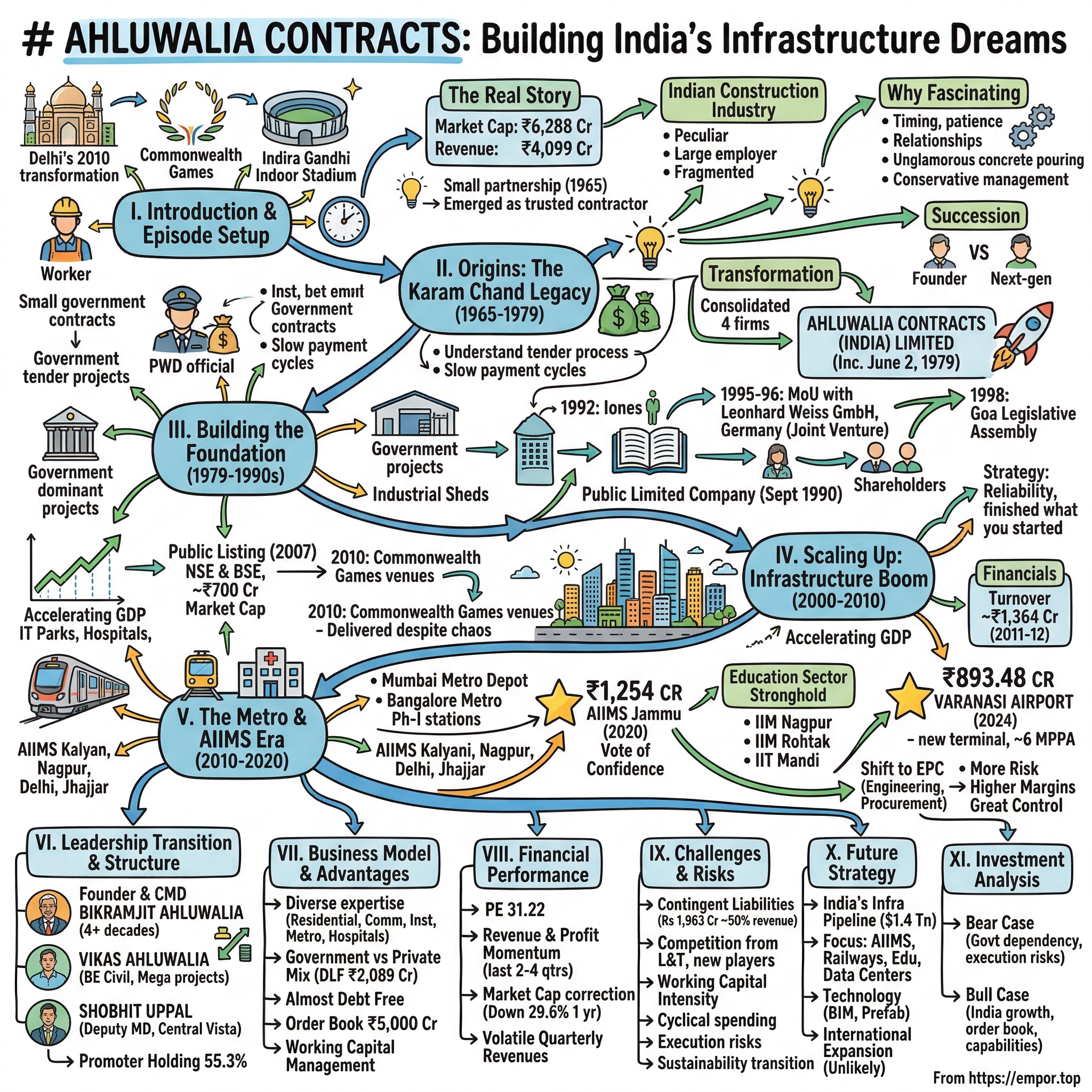
Ahluwalia Contracts: Building India's Infrastructure Dreams
I. Introduction & Episode Setup
On the afternoon of August 17, 2026, an investor conference call hosted by Ambit Capital turned into a rare occurrence on an Indian mid-cap earnings line: an argument.
Sandip Sabharwal, a prominent investor, had been analyzing the numbers. Ahluwalia Contracts had held its previous call in early June. Its June-quarter results had just landed with an EBITDA margin of 4.29%—roughly half the level from a year earlier—and management attributed the drop, among other factors, to a sudden 35% to 40% surge in construction wages across the National Capital Region.
Sabharwal's question was blunt: how could a company speaking to investors midway through the quarter fail to anticipate the spike? And if it could not, "then any kind of guidance is of no relevance."1
Shobhit Uppal, the Deputy Managing Director and the public face of the company for two decades, did not deflect. He escalated. "Are you insinuating that I was aware and I hid that?" he asked. A few exchanges later, he offered the analyst "a refresher course" on the construction industry. The analyst declined, and the moderator moved on.1
That exchange provides a revealing introduction to Ahluwalia Contracts (India) Limited (NSE: AHLUCONT, BSE: 532811). The company finished the fiscal year ending March 2026 with revenue of ₹4,565 crore and a net order book of ₹21,096 crore. It then reported a June quarter in which revenue grew 12% year-on-year, while profit after tax fell 77.65%, from ₹51.11 crore to ₹11.42 crore.12 The builder carries virtually no debt—gross borrowings of ₹2.28 crore against ₹920 crore in cash and bank balances—in an industry that has buried more listed Indian companies than almost any other.1 Yet, a management team with over four decades of execution history could not forecast its own gross margin one quarter ahead.
The order book remains the headline metric. As of June 30, 2026, the unexecuted order book stood at ₹20,663.52 crore—approximately 4.5 times the prior year's revenue, representing three to three-and-a-half years of work by management's estimation.1 For a civil contractor, that represents significant revenue visibility. Nevertheless, the market responded to the quarterly performance by sending the shares down more than 7% in a single session, falling from a previous close of ₹837.35 to an intraday low of ₹773.5
The central question for Ahluwalia Contracts is not whether it can secure contracts, but whether that work yields adequate profitability.
That distinction carries specific weight in Indian civil contracting before examining the company's origins in 1965. Ahluwalia constructs buildings—hospitals, government secretariats, airport terminals, railway stations, and luxury residential towers. It does not own toll roads, hold concessions, or take equity stakes in completed assets. It operates as a pure service business that converts working capital and engineering capabilities into fee-for-service revenue.
During stronger economic cycles, this model generated double-digit operating margins and returns on capital in the high teens to low twenties.4 Over the past two years, however, record revenue has coincided with compressed incremental economics. As an analyst noted directly to management on the June 2026 call: "when we were doing one-third, one-fourth the current revenue base, that time we were doing 12%, 13% EBITDA. And now we are triple the revenue we are doing 9.5%, 10%?"12
This creates a central paradox: a contractor with a strong balance sheet, a record order book, and declining unit margins. It is a family-managed business spanning three generations, holding substantial cash reserves while operating in a sector marked by frequent corporate distress.
The roadmap for this analysis includes:
- The foundation years. How a Delhi flooring contractor built the essential asset in government contracting: a track record of completed projects.
- The listing decade and the developer trap. What happened when key private developers defaulted, and how the company navigated a period omitted from its corporate history.
- The megaproject era. AIIMS campuses, metro depots, airport terminals, and how the CSMT bid illustrates the dynamics of lowest-bidder (L1) tendering.
- Management and governance. Promoter ownership, professional management dynamics, a 55% family stake, and ongoing debate around cash allocation.
- The economics. The factors driving margin compression, management's explanation, and the underlying financial metrics.
- The stress test. Contingent liabilities, retention funds, labour supply constraints, and the key risks and catalysts.
The story begins with a contractor that specialized in floors.
 Subscribe on LinkedIn
II. Origins & The Foundation Years (1965–1999)
Delhi in 1965 was not a construction market in any modern sense. India was in its second decade of independence, three years past a war with China and in the middle of another with Pakistan. The economy operated under the licence-permit system: steel and cement were allocated rather than bought, and a private firm's capacity to grow was capped less by market demand than by bureaucratic paperwork.
Building work was dominated by the state—including the Central Public Works Department, municipal bodies, and public sector undertakings. Private contractors survived in the margins, taking on smaller projects government engineering divisions preferred not to handle.
That was the market Karam Chand Ahluwalia entered. He founded the family's contracting business in 1965, and his son Bikramjit—born December 4, 1939, and holding a diploma in civil engineering from Meharchand Polytechnic in Jalandhar, Punjab—grew up inside it.7 The earliest work was unglamorous: specialized flooring and small civil jobs around New Delhi, the sort of scope a general contractor subcontracts and forgets.
There is a structural lesson in that starting point. Specialized flooring is a trade where defects are immediately visible. Done poorly, the finish cracks and discolors, creating reputational damage with the client's engineering staff.
Done well and repeatedly for government departments with regularly rotating officers, a contractor accumulates an asset omitted from formal balance sheets: bureaucratic credibility. In a sector where formal pre-qualification rewards documented past performance, that informal track record secures invitations to bid on larger projects.
By the late 1970s, the family's operations were spread across multiple partnership firms—a standard structure for Indian family businesses of that era, driven partly by tax considerations and the ease of establishing and dissolving partnerships.
On June 2, 1979, that structure was consolidated: Ahluwalia Contracts (India) was incorporated as a private limited company, taking over the business of four construction partnerships in July of that year.6 Bikramjit Ahluwalia has led the firm since incorporation and remains Chairman and Managing Director.8
The 1979 consolidation was strategic rather than purely administrative. A partnership could not easily hold heavy equipment, present an audited net worth to a tender committee, or raise external equity. A limited company could do all three. The firm's eventual business model—owning tower cranes and batching plants rather than renting equipment from subcontractors—required a corporate entity.
The second structural transition occurred on September 6, 1990, when the company converted to a public limited company.68 Public status provided the gateway to raising equity from outside investors. Six years later, in 1996, the company launched its first public issue and listed on the Delhi, Calcutta, and Jaipur stock exchanges.6 Retrospective accounts often compress Ahluwalia's equity history into a 2007 debut.
The company's milestone timeline reveals a phased migration: a first public issue and regional listings in 1996, followed by listings on the Bombay Stock Exchange in 2007 and the National Stock Exchange in 2009.6 The equity expansion tracked the firm's operational evolution from a regional contractor to a national builder.
Operational execution in the 1990s established credentials through two key projects whose significance exceeded their contract values.
The first was the Chancery Building for the Embassy of India in Dubai, completed in 1992.6 Delivering a security-sensitive, architecturally complex project in a foreign jurisdiction demonstrated to government officials that the contractor could execute complex overseas assignments.
The second was the Goa State Legislative Assembly complex.7 Constructing a state capitol building carries high political visibility and strict pre-qualification standards. Completing the project moved Ahluwalia from a regional Delhi contractor into the tier of builders shortlisted for landmark government architecture.
These projects illustrated the primary mechanism of Indian public tendering: a two-envelope bidding system. The technical envelope is evaluated first to verify whether the bidder has completed comparable projects, possesses sufficient net worth, and maintains adequate working capital and equipment lines.
Only bidders who clear the technical threshold have their second envelope—the price bid—opened. Consequently, each completed project does not merely generate revenue; it permanently expands the scope of future projects the contractor is eligible to target.
This pre-qualification dynamic functions as a ratchet. Completing a ₹50 crore institutional building qualifies a firm for ₹150 crore projects, which subsequently opens access to ₹500 crore tenders. The ratchet operates in one direction and cannot be bypassed solely through balance sheet capital. A 1998 assembly building in Goa thus laid the pre-qualification groundwork for a major railway station project decades later, explaining why well-capitalized new entrants cannot instantly compete for multi-thousand-crore tenders.
However, while this ratchet mechanism qualifies a firm to bid, it does not dictate how to price work profitably. By the turn of the millennium, Ahluwalia had earned the right to compete for India's largest building contracts. The subsequent fifteen years would test whether its bidding strategy could maintain profitability.
III. Public Market Scaling & The Real Estate Pivot (2000–2015)
By 2006, the skyline of Gurgaon reflected the rapid pace of India's real estate boom. A decade earlier, the area consisted primarily of agricultural land anchored by a Maruti Suzuki manufacturing facility. Within ten years, it transformed into a dense commercial corridor of glass office towers, nighttime construction cranes, and technology parks. Commercial developments such as Cyber City and DLF Phase V defined the National Capital Region's building surge, mimicking rapid East Asian urban expansion across northern India.
Ahluwalia Contracts scaled alongside that market expansion. Annual revenue crossed ₹100 crore in 2002 and reached ₹300 crore by 2005. Net profit surpassed ₹15 crore in 2006, leading the company to issue a 3-for-1 bonus share offering. Revenue topped ₹500 crore in 2007 as the company listed on the Bombay Stock Exchange. Net profit exceeded ₹50 crore in 2008, and by 2009—when the stock listed on the National Stock Exchange—annual turnover crossed ₹1,100 crore.6 This eleven-fold revenue increase over seven years occurred without the company taking equity stakes in projects, acquiring land, or diversifying into road concessions.
Resisting asset ownership was notable during the mid-2000s, when Indian infrastructure firms aggressively adopted the Build-Operate-Transfer (BOT) model. Under BOT arrangements, contractors constructed highways, bridges, or power plants and retained toll or tariff streams for multi-decade concession periods. Although touted as a way to convert low-margin civil contracting into recurring annuity cash flows, the model turned construction companies into highly leveraged project-finance vehicles vulnerable to long-term traffic and demand assumptions. Over the subsequent decade, excessive debt from BOT concessions triggered widespread financial distress across India's infrastructure sector.
Ahluwalia remained focused on fee-for-service civil construction, primarily building commercial towers, institutional campuses, hospitals, and industrial facilities. While the company described its portfolio as encompassing commercial buildings, hotels, hospitals, educational institutions, industrial plants, residential projects, townships, limited urban infrastructure, and minor BOT scope, its core operations consistently centered on vertical building for third-party clients.8 This pure-play service model traded the capital appreciation potential of asset ownership for a balance sheet shielded from concession debt, leaving credit risk limited to customer receivables.
During this growth phase, the builder secured major institutional and corporate contracts across northern and western India. High-profile assignments included the 22-storey IFCI Tower, the NDMC City Centre, the Saket District Court complex for the Delhi Public Works Department, headquarters for SEBI and IDBI in Mumbai, hotel properties for the K. Raheja Group, ITC, and Leela, as well as industrial plants for Moser Baer in Noida and CIELO automobiles in Surajpur.7 Ahead of the 2010 Commonwealth Games in Delhi, Ahluwalia won key infrastructure contracts, including the Games Village residential complex at Khelgaon near Akshardham and the renovation of the Dr. S.P.M. Swimming Pool Complex at Talkatora Stadium.67
While public memory of the 2010 Commonwealth Games centered on cost overruns and construction delays, delivering key venues significantly altered pre-qualification benchmarks for civil contractors. Executing fixed-deadline, high-visibility public projects demonstrated complex project management capabilities, strengthening Ahluwalia's qualification profile for future large-scale government tenders.
However, the post-2010 downturn interrupted this trajectory. Ahluwalia's corporate milestone history reflects a decade-long gap: after recording a net profit threshold of ₹50 crore in 2008, the company did not log another profit milestone until 2018, when net profit reached ₹115 crore.6 Aside from references to the 2010 Commonwealth Games and a 2009 turnover benchmark, the sole entry recorded between 2008 and 2018 is a 2015 preferential equity allotment to the promoter family.6 The absence of operational milestones during this period underscores the severe operational strain the business faced following the real estate slowdown.
The primary cause of that strain lay in customer receivables. During the mid-2000s boom, private real estate developers accounted for a substantial portion of Ahluwalia's contract portfolio. When the Indian property market stalled after 2011–2012, private developers encountered severe liquidity shortages as sales slowed and debt-financed land holdings turned illiquid. Facing financial pressures, developers prioritized debt servicing over contractor payments. Civil contractors faced an inherent structural risk: once physical structures were built, contractors possessed limited bargaining power or collateral to compel payment from distressed private developers.
To mitigate counterparty default, Ahluwalia fundamentally altered its client mix. The company pivoted toward central and state government entities, as well as public institutions, bidding on public hospitals, medical colleges, universities, courthouses, and administrative complexes.
This strategic pivot involved clear economic trade-offs. Public sector tenders are awarded through competitive price bidding and generally yield lower gross margins than negotiated private contracts. Public projects also entail lengthy administrative approvals, strict milestone certification by public engineers, and multi-year retention money withholdings. However, public contracts carry sovereign or quasi-sovereign credit backing, making receivables significantly safer from outright default even when payment cycles are delayed.
By prioritizing counterparty credit quality over headline operating margins and relying on internal accruals rather than debt to fund working capital, Ahluwalia survived a downturn that forced several higher-margin, highly leveraged competitors into restructuring. This realignment positioned the company for its next phase of growth: competing for large-scale, complex public institutional and infrastructure projects as the government expanded capital expenditures in the late 2010s.
IV. The Megaproject Era: Metros, AIIMS, and Airports (2016–2023)
A modern super-specialty hospital is one of the most complex structures to construct, presenting specialized engineering challenges that lie largely hidden from public view.
The concrete frame is straightforward. The primary complexity resides within the ceiling void. An operating theater requires fifteen to twenty air changes per hour, filtered to remove microscopic particles, and maintained at a positive pressure relative to adjoining corridors to prevent contamination. A radiology suite requires thick lead shielding embedded directly into structural walls.
Medical oxygen, vacuum lines, and specialized gases must be distributed to every bed through a certified, pressure-tested copper network. Emergency backup power must reach critical ventilators within seconds. Every system must be coordinated within a ceiling space measuring a few hundred millimeters and fully commissioned before regulatory authorities approve patient admissions.
In civil contracting, these mechanical, electrical, and plumbing systems—collectively termed MEP—represent a third or more of total construction costs on a hospital project, compared to roughly ten percent on a standard warehouse. A general contractor capable of pouring concrete slabs cannot execute hospital contracts without mastering these complex electromechanical installations.
During the late 2010s, Ahluwalia built out internal capabilities in engineering design, ready-mix concrete production, electromechanical installation, plumbing, firefighting, HVAC, and aluminum facades. This backward-integrated operational model replaced reliance on external sub-contractors.8 The strategy enabled the company to secure major healthcare contracts across India, including AIIMS campuses at Kalyani in West Bengal, Nagpur in Maharashtra, and Jammu, alongside the LTMG Sion Hospital expansion in Mumbai, a government medical college at Chhapra in Bihar, and another campus at Mohindergarh in Haryana. Together, these assignments encompassed over one crore square feet of built area valued at approximately ₹6,000 crore, designed for nearly 6,000 hospital beds.8 Prior work at AIIMS Delhi and AIIMS Jhajjar established the foundational pre-qualification credentials for these awards.7
The healthcare expansion culminated in February 2020, when the Central Public Works Department awarded Ahluwalia a ₹1,254 crore Engineering, Procurement, and Construction (EPC) contract for Phase I of AIIMS Jammu at Vijaypur in Samba district.10 Covering the hospital complex, medical college, hostels, and residential quarters, it represented the largest single order in the company's history at the time.
Concurrently, Ahluwalia expanded its footprint in transportation infrastructure. Executive Director Vikas Ahluwalia led execution across key projects, including the D. N. Nagar metro depot for Mumbai Metro One, the Jolly Grant Airport terminal upgrade in Dehradun, the modernization of Chandigarh Railway Station, and earlier structural work at Chhatrapati Shivaji Maharaj Terminus (CSMT) in Mumbai.8 Regional airport execution expanded further when the Airports Authority of India awarded the firm an ₹893 crore contract for developing Lal Bahadur Shastri International Airport at Varanasi, alongside infrastructure works at Darbhanga Airport.116
In April 2023, Ahluwalia secured the project that defined both its revenue scale and its subsequent operational challenges.
The Rail Land Development Authority invited tenders in October 2022 for the comprehensive redevelopment of CSMT in Mumbai, a UNESCO World Heritage Site and active railway terminal handling heavy daily passenger volume. The scope required clearing decades of piecemeal extensions surrounding the main Victorian Gothic structure while leaving the historic station building untouched.
Four infrastructure firms submitted financial bids on April 12, 2023. Ahluwalia Contracts placed the lowest bid at ₹2,450 crore, followed by NCC at ₹3,667 crore, Afcons Infrastructure at ₹3,910 crore, and Larsen & Toubro at ₹4,141 crore.9 Having submitted the lowest price, Ahluwalia won the L1 contract award.[^11]
The bidding spread illustrated sharp differences in risk pricing across major industry players. Ahluwalia's winning figure came in 33% below the second-lowest bidder and 41% below Larsen & Toubro's price, creating a ₹1,700 crore gap between the lowest and highest submissions for the same site and technical specifications.
The wide divergence implied either superior cost structure, a lower risk premium assigned to site execution next to active railway lines and complex heritage approvals, or aggressive pricing to secure a marquee order.
Subsequent execution highlighted the operational friction embedded in the bid. By the second half of fiscal year 2025, CARE Ratings reported that the CSMT project—representing 15% of Ahluwalia's total order book—experienced slow progress due to client-initiated design modifications.[^9] On the June 2026 investor call, management acknowledged that execution remained constrained for eighteen months while design approvals pended.12 By August 2026, Uppal explained that work was divided between new building construction subject to staged client clearances and platform modifications restricted to designated railway traffic blocks, leading management to revise expected fiscal year 2027 revenue from the project down to roughly ₹500 crore from an earlier target near ₹600 crore.1
The CSMT project demonstrated the long-term mechanics of aggressive public sector bidding: rather than producing immediate financial write-offs, low-margin L1 awards can lead to extended execution timelines and delayed cash realization.
Despite these execution hurdles, Ahluwalia maintained balance sheet stability by avoiding equity investments in public-private partnerships or concession assets. While peers in the Build-Operate-Transfer sector accumulated heavy debt loads during earlier infrastructure cycles, Ahluwalia funded working capital requirements primarily through internal accruals and operational cash flow.
As of March 31, 2024, the company maintained a total outside liabilities to tangible net worth ratio of 1.00x. Over the twelve months ending October 2024, average utilization of fund-based working capital limits remained low at approximately 15%, supporting CARE's reaffirmation of its long-term credit rating at AA- with a stable outlook.[^9]
Ahluwalia's expansion during this period demonstrated both the strength and limits of its core business model. While technical pre-qualification enabled the contractor to move from institutional buildings into major healthcare, aviation, and rail infrastructure projects without impairing its balance sheet, competitive L1 tendering continued to cap margin expansion on complex megaprojects.
V. Modern Operations, Management & Governance
The most revealing document Ahluwalia publishes is not its annual report. It is a two-page document on its website listing brief director profiles, which quietly explains how the company actually operates.
Bikramjit Ahluwalia, Chairman and Managing Director, is 84 and has held the position since the company was incorporated on June 2, 1979.78 Carrying more than five decades of hands-on construction experience, he has not treated the firm as a personal annuity: his remuneration was fixed at ₹10.50 lakh per month in 2018 and was carried forward unchanged upon his reappointment.7 For context, that compensation is modest compared to typical mid-cap Indian executive packages.
He held 7,994,257 shares—representing 11.93% of the company—in his personal capacity as of the 2020–21 disclosure.7 His primary function today aligns closely with that of a risk officer: maintaining bidding conservatism, overseeing governance, and protecting the balance sheet.
Shobhit Uppal, Deputy Managing Director, serves as the operational center of gravity and the primary management spokesperson on earnings calls. An electrical engineering graduate from NIT Kurukshetra with over three decades of industry experience, he is Bikramjit Ahluwalia's son-in-law.8
As a promoter-family member by marriage and a technically trained engineer, Uppal is credited by the company with transforming Ahluwalia "from a plain civil construction company to an EPC company."8 He is a past President of the Indian Buildings Congress, an industry body that liaises with the Union government on building policy—a role that provides valuable institutional connectivity in a sector dominated by state contracts.8
Uppal's presentation style on conference calls offers insight into corporate operations. He provides detailed descriptions of physical project milestones—such as slab counts, structure demolitions, and traffic window constraints on live railway platforms—while remaining cautious regarding specific financial forecasts.
He frequently offers analysts site visits ("we would be more than happy to take you to our project sites") and defers detailed financial quantification to the CFO.1 While this reflects an operational focus, it has coincided with a pattern of financial guidance that is stated with confidence but subsequently revised.
Vikas Ahluwalia, Whole-Time Director, is 49, a civil engineering graduate, the founder's son, and Uppal's brother-in-law.8 Having joined the business in 1996, he chairs the company's Project Monitoring Committee, overseeing key projects including the Mumbai Metro depot, Sion Hospital, the Dharavi wastewater treatment facility, the Chandigarh station upgrade, and the Tata Memorial Centre cancer block at Parel.8 Representing second-generation executive continuity, his focus remains centered on field execution rather than commercial strategy.
Two non-family board appointments further illustrate the firm's operational structure. Sanjiv Sharma, a Whole-Time Director, holds a Master's in civil engineering with honors from IIT Roorkee and spent 1993 to 2007 inside the Central Public Works Department as an engineer-in-charge, managing government projects for the Ministries of Finance, Home, Shipping, and Urban Development.8 Appointing a 14-year CPWD veteran to the executive board provides institutional familiarity with the procurement processes of the company's primary client.
Similarly, independent director Rajendra Prashad Gupta served in the Indian Railway Service of Engineers starting in 1973—background relevant to major rail infrastructure tenders.8 Satbeer Singh, the CFO, manages financial controls, working capital allocation, and the bank guarantee facilities required for large-scale tendering.1
The ownership structure remains stable: promoters hold 55.32%, foreign institutions hold 14.05%, domestic institutions hold 22.32%, and public shareholders hold 8.32%.4 While a promoter stake above 50% aligns family equity directly with business performance, it also limits the ability of minority shareholders to influence capital allocation decisions.
This dynamic has made capital allocation a central topic during recent investor interactions.
The primary debate centers on cash management. Ahluwalia holds approximately ₹920 crore in cash and bank balances against gross debt of ₹2.28 crore.1 Dividend distribution remains minimal, with historical records showing a payout ratio of roughly 1.55% and a dividend yield around 0.11%.4 On the June 2026 investor call, shareholders questioned why the company accumulated idle cash reserves rather than executing share buybacks, noting that the stock price had appreciated from around ₹350 in 2008 to roughly ₹760 eighteen years later—representing a modest return alongside limited cash payouts.12
Management defended the cash reserves on risk mitigation grounds. Uppal noted: "our industry has always been at the forefront of cycles... during such time, it's always better to have a war chest with you... During the last downturn, when a lot of our peers fell by the wayside, we could survive the downturn."
He stated that a buyback was "not in the offing. That's not even crossed our mind."12 Ten weeks later, management reiterated that available cash would be prioritized for digitization and equipment upgrades to mitigate labor shortages.1
While cash reserves provided balance sheet protection during prior sector downturns, maintaining an ₹800 crore to ₹920 crore cash pile earning bank deposit yields creates a drag on return on equity for a business generating ₹280 crore in annual operating cash flow against capital expenditures of ₹220 crore to ₹260 crore.14 Management has prioritized balance sheet conservatism over capital efficiency, establishing cash retention as a permanent structural feature of the company.
This policy highlights the broader question of forecasting reliability.
Recent conference calls demonstrate notable revisions to near-term guidance. On June 1, 2026, management projected 15% to 20% execution growth for FY27, targeted order inflows of approximately ₹8,000 crore, and stated: "we will be into double-digit margins in this year."12 On August 17, 2026—seventy-seven days later—management reduced growth guidance to 12–15%, lowered inflow expectations to ₹4,000–5,000 crore, and revised margin expectations: "this financial year, we are ruling out having a double-digit EBITDA margin."1
Capital expenditure targets followed a similar downward revision, moving from an earlier target near ₹500 crore to actual FY26 spend of ₹274 crore, before being adjusted from an initial FY27 plan of ₹300 crore down to ₹220–250 crore in August.121
Longer-term margin projections have also diverged from earlier targets. Management previously indicated that operating margins would recover toward the low teens as private sector contracts expanded within the order book. Although private sector clients grew to represent roughly 62% of unexecuted orders, margins continued to contract.1 Management attributed this divergence to external pressures, including labor shortages, elevated staff costs, project complexity, and higher interest costs during construction.
Several of these operational headwinds are verifiable across the regional construction market. Mandated minimum wage increases across Haryana and Uttar Pradesh directly impacted labor costs, while election schedules and voter-roll updates in West Bengal and Assam temporarily disrupted site activity. Global supply chain disruptions extended lead times for specialized electrical switchgear from four weeks to up to four months.1 Additionally, environmental restrictions imposed by the National Green Tribunal periodically halted construction across the National Capital Region—a factor previously cited in credit ratings reports from January 2025.[^9] Uppal also stated that "till date, Ahluwalia has not paid any penalty to any customer," indicating that project delays were formally accepted by clients as non-attributable to contractor default.1
Ahluwalia Contracts maintains a strong track record in debt avoidance, balance sheet preservation, and project completion. However, its short-term financial guidance has proven volatile, with repeated revisions across revenue growth, margin targets, order inflows, and capital expenditure plans. For investors, management guidance serves primarily as directional intent, leaving the balance sheet and cash reserves as the primary metrics for evaluating downside risk.
VI. Industry Structure, Competition & Strategic Moats
To understand how a contractor with a ₹20,000 crore order book can record a 4% quarterly margin, one must examine how public contracts are awarded.
Indian public procurement relies on a two-envelope bidding system. The first envelope evaluates technical qualification: a bidder's record of completed projects, single-project size capacity, net worth, working capital lines, equipment, and key personnel. Bidders that fail the technical stage have their financial bids returned unopened. The second envelope contains the financial bid, and among technically qualified bidders, the lowest price—the L1 bid—wins the award. The system includes no evaluation of construction quality, no weighting for past delivery speed, and no adjustment for a contractor that has never abandoned a project site.
This procurement structure is designed defensively. In a public sector system with a history of procurement controversies, the L1 standard minimizes administrative discretion and reduces corruption risks. However, that administrative protection carries an economic trade-off: it converts a complex, risk-laden engineering service into a price-driven auction. In common-value auctions, contracts are systematically won by the most optimistic bidder—a phenomenon economists call the "winner's curse," where the winning firm is frequently not the most efficient operator, but the one that most severely underestimated execution costs.
The bidding for the Chhatrapati Shivaji Maharaj Terminus (CSMT) redevelopment illustrates this dynamic. A ₹1,700 crore spread between the lowest and highest submissions on identical tender documents cannot be explained by operational cost efficiencies alone. It reflects a fundamental divergence in risk pricing, where the contractor assigning the lowest risk premium secured the award.9
Four competitive elements shape a contractor's position within this framework, though their protective value varies.
The pre-qualification portfolio functions as a genuine cornered resource. Formal certificates verifying the completion of multi-hundred-crore hospitals, airport terminals, and heritage rail hubs cannot be acquired quickly or replicated through balance sheet capital alone. This track record restricts competition in the ₹500 crore to ₹2,500 crore project bracket to a narrow group of pre-qualified builders.
While this portfolio grants access to large tenders—explaining how Ahluwalia maintains an order book equal to roughly 4.5 times annual revenue during sector slowdowns—it provides no pricing power. Every competitor on a shortlist holds an equivalent set of qualification credentials.
Escalation clause design serves as the primary mechanism for margin protection. Roughly 89% of Ahluwalia's order book includes material cost escalation provisions, while only 10.34% consists of fixed-price contracts.1 The adjustment mechanisms vary by customer segment: private contracts typically set baseline prices for cement and steel, reimbursing price increases on monthly billing cycles with approximately a 30-day lag. Government contracts index escalation to quarterly updates of the Wholesale Price Index.1
While these contract structures protect against commodity inflation, they leave contractors exposed to unindexed inputs. As Shobhit Uppal noted, government-mandated minimum wage hikes are not classified as statutory law changes—unlike revisions to Provident Fund contributions or Goods and Services Tax rates—and cannot be automatically passed on to clients.1 Consequently, contractual escalation clauses insulated the firm against material price fluctuations while leaving it vulnerable to rising labor costs.
Operational processes offer real but modest efficiencies. Standardized formwork and shuttering cycles, structured site mobilization templates, in-house electromechanical capabilities, ready-mix concrete production, and long-standing subcontractor relationships lower unit construction costs relative to new entrants.8 However, these practices represent standard operational techniques rather than proprietary technology. Management commentary indicates that these process advantages face pressure as labor skill levels decline while architectural and engineering designs increase in complexity, reducing output per worker.12
Scale economies provide the weakest competitive shield. Bulk purchasing yields marginal discounts on steel and cement, but major project inputs are either contractually passed through to clients or consist of site labor. Labor costs are determined by regional supply and demand conditions and do not decline through corporate purchasing volume.
Set against these factors, broader industry forces remain challenging. Buyer power is substantial: public sector clients establish contract terms unilaterally, retain 5% to 10% of project values in retention money for multi-year periods, control milestone certifications, and can suspend payment processing. Recent examples include payment halts in Assam during election cycles and a five-month payment freeze on certified bills for a Central University project in Himachal Pradesh after project spending exceeded budget allocations.1 On the input side, supplier power among construction labor has emerged as a primary operational constraint for the first time in company history.
Industry rivalry remains high due to the price-focused nature of L1 tendering. Barriers to entry represent the most favorable structural force, maintained by stringent pre-qualification standards. Substitutes remain limited in the short term, though modular building methods, precast concrete, and off-site manufacturing represent structural shifts toward factory-based assembly. Widespread adoption of these techniques would favor specialized manufacturing capabilities over traditional site-based construction expertise built over five decades.
The competitive landscape spans several distinct player tiers. Larsen & Toubro serves as the broader industry benchmark but rarely competes directly in the ₹500 crore to ₹2,500 crore bracket, choosing instead to focus on larger infrastructure packages—though its participation in the CSMT tender showed it will bid on landmark projects while maintaining higher risk pricing.
NCC and KEC International operate as diversified infrastructure conglomerates carrying higher debt levels and substantial exposure to power transmission and water projects. ITD Cementation—rebranded as Cemindia Projects following a change of control—specializes primarily in marine, underground, and heavy civil engineering rather than vertical building construction. PSP Projects competes directly with Ahluwalia in institutional, commercial, and industrial building contracts.
The most direct peer comparison is Mumbai-focused Capacit'e Infraprojects. For fiscal year 2026, Capacit'e reported revenue of ₹2,623 crore—roughly half of Ahluwalia's turnover—alongside EBITDA of ₹427 crore, yielding a 16.3% EBITDA margin. Capacit'e maintained an order book of ₹13,498 crore (5.1 times revenue), improved working capital days to 152 from 195, and held gross debt of ₹472 crore, resulting in a net debt-to-equity ratio of 0.10x.14
This performance highlights a key tension in Ahluwalia's margin narrative. Management has consistently characterized recent margin compression as an industry-wide trend, asserting that the company remains in the upper range of declared margins among peers.12 While that comparison holds against heavily levered, diversified infrastructure firms, it diverges from the financial results of specialized building contractors like Capacit'e, which sustained mid-teens margins despite operating at a smaller scale and carrying moderate debt.
This comparison underscores a fundamental strategic question: while Ahluwalia's pre-qualification credentials secure access to major public tenders, its bidding strategy has yet to deliver consistent margin expansion.
Management asserts that bidding discipline is being tightened. Uppal stated that the company virtually doubled its internal cost estimates for shuttering, steel work, and labor-intensive items, increased budgeted project staff costs from a range of 3.5%–4.5% to over 5%, and raised safety allocations from roughly 1% to nearly 3% of project costs.1 Demonstrating this selective approach, Ahluwalia withdrew from a fixed-price university tender in Odisha rather than extending bid validity during a volatile cost environment.1
These repriced bids represent the primary path toward structural margin recovery. However, because new contract rates flow through the order book over multi-year execution cycles, their impact on financial performance will require two to three years to fully materialize in reported earnings.
VII. Emerging Growth Engine: High-Tech EPC & Data Centers
A narrative circulating among market participants suggests that Ahluwalia Contracts is quietly evolving into a high-tech engineering, procurement, and construction contractor—transitioning from commoditised civil work into higher-margin data centres, green-certified terminals, and complex heritage station redevelopments. That thesis warrants critical scrutiny before being accepted as an investment driver.
The firm's baseline technical capability is documented. Ahluwalia's investor presentation lists data centres among its completed project categories, alongside metro stations, depots, railway station redevelopments, automated parking structures, and urban infrastructure.6
What remains unverified is the scale and economic contribution of this segment. No data centre project appeared among the company's top ten ongoing contracts as of December 2025.6 Similarly, no data centre orders are itemised within the segment classification of the unexecuted order book.
Furthermore, across two full investor conference calls in June and August 2026—comprising several hours of executive commentary and analyst Q&A covering major contracts by name—management and market analysts made no reference to data centres.121 Because the firm does not disclose the margin profile for this category, claims that data centre construction contributes materially to current revenue or commands premium pricing remain unsupported by corporate disclosures.
Data centre construction represents an established technical capability for the firm, but it is currently unsized and not an active growth engine. The segment remains an area to monitor because India's data centre expansion features hyperscale clients that prioritize completion schedules and commissioning reliability over lowest-bidder pricing. However, current evidence indicates it functions as an unpriced option rather than a near-term financial catalyst.
The verifiable shift toward technically complex contracts is instead visible within public sector infrastructure tenders across the top-project portfolio. The CSMT redevelopment represented an unexecuted contract value of ₹2,048 crore at the close of 2025. Meanwhile, India Jewellery Park in Mumbai—a special-purpose vehicle established by the country's gems and jewellery industry council, which CARE Ratings designates as a key project for the Ministry of Commerce—was recorded at ₹2,157 crore and remained entirely unexecuted.[^9]
In aviation, the contract for Lal Bahadur Shastri International Airport at Varanasi stood at ₹624 crore unexecuted, alongside active sites at Darbhanga, Jewar, and a new contract award in Kota.6[^9] In January 2026, Ahluwalia secured the largest single order in its history: a ₹3,069.70 crore EPC package (including GST) from the CPWD's Central Vista Project Division-12 to construct Common Central Secretariat Buildings 8 and 9 on Maulana Azad Road in New Delhi under a 21-month execution window.13 Company shares rose more than 7% following the announcement.13
A 21-month timeline for a contract of that scale creates distinct operational dynamics. Projects of this nature offer potential margin expansion not through decorative complexity, but because tight schedules and specialized commissioning requirements limit the pool of eligible bidders. Rapid project delivery also allows the contractor to cycle fixed overheads and owned equipment across larger annualized revenue volumes. Management expects the Central Vista project to generate ₹100 crore to ₹150 crore in monthly billings at peak execution.12 At that run-rate, a single contract would account for more than a quarter of the company's annual revenue base.
However, project execution timelines create a temporary imbalance between costs and receipts. Awarded in mid-January 2026, the Central Vista project remained in site demolition and early foundation stages by August 2026—with Nirman Bhawan fully demolished to begin foundation casting, while Udyog Bhawan was handed over three weeks prior and stood 90% demolished.1 Management projected project billing at ₹700 crore for FY27 and ₹1,000 crore for FY28, with final completion targeted for FY29.1
Meanwhile, the executive and site staff mobilised to execute Central Vista—alongside private commercial developments such as DLF's The Dahlias and DLF Downtown—were fully recognized in current operating expenses, which management cited as a primary driver of the June-quarter margin compression.1
This sequence defines the financial profile of the high-tech EPC segment: upfront resource mobilization expenses precede operational revenue realization. Whether this initial cost expansion leads to higher net operating margins or permanently elevates the firm's overhead structure remains the key open variable in Ahluwalia's medium-term outlook.
VIII. Financial Breakdown & Recent Margin Forensics
The recent financial performance of Ahluwalia Contracts requires detailed examination, as market reactions to the June 2026 quarter overstated a structural collapse rather than a specific operational disruption.
A review of the five-year trajectory shows consistent top-line expansion. On a standalone basis, revenue from operations grew from ₹1,982 crore in FY21 to ₹2,692 crore in FY22, ₹2,838 crore in FY23, ₹3,855 crore in FY24, and ₹4,099 crore in FY25, representing a three-year compound annual growth rate of approximately 15%.6 Over the same period, EBITDA margins recorded 7.8%, 9.5%, 10.7%, 10.1%, and 8.3%, respectively.6 Fiscal year 2026 concluded with revenue of ₹4,565 crore—an 11.38% annual increase—an EBITDA margin of 9.52%, and profit after tax of ₹264.32 crore (up 31.17%), pushing net worth above ₹2,000 crore for the first time.12
An accounting adjustment must be considered when evaluating the FY24 profit figures. Reported net profit of ₹375.5 crore in FY24 included exceptional gains of ₹195 crore before tax (₹144.9 crore net of tax).6 Excluding that exceptional item, underlying net profit for FY24 stood at approximately ₹231 crore. This adjustment smooths the reported profit sequence from ₹375 crore, ₹202 crore, and ₹264 crore into an underlying trajectory of ₹231 crore in FY24, ₹202 crore in FY25, and ₹264 crore in FY26.
The expansion of the order book demonstrates consistent top-line momentum. The gross order book grew from ₹13,115 crore in FY21 to ₹23,539 crore in FY25, while the unexecuted order book rose from ₹7,283 crore to ₹15,775 crore over the same period, reaching ₹18,680 crore by December 2025 and ₹21,096 crore by March 2026.612 New order inflows reached ₹10,257 crore in FY26, exceeding twice the company's annual revenue.12 As of June 30, 2026, the net order book stood at ₹20,663.52 crore.1
While market commentary frequently characterizes Ahluwalia as primarily a builder of public hospitals and government institutional projects, current order book disclosures show a different reality.
As of June 2026, the unexecuted order book comprised residential projects at 39.7% (₹8,198 crore, the largest single segment), institutional work at 18.3%, infrastructure at 18.2%, commercial and industrial projects at 17.4%, hospitals at 5.8%, and hotels at 0.6%.3 By client type, the private sector accounted for 61.7%, the central government for 28.3%, and state governments for 9.3%.3 The December 2025 distribution reflected a similar pattern, with residential projects representing 44.7%, hospitals 7.9%, and private clients 68.3%.6 Credit rating agency CARE Ratings had previously highlighted this shift, noting that private-sector contracts increased from 29% of the order book at the end of 2023 to 52% by September 2024.[^9]
Having pivoted away from private developers following the post-2012 slowdown, Ahluwalia has substantially returned to the private sector over the past three years. Approximately six of every ten rupees of unexecuted work now sits with private real estate developers—including Godrej, DLF, Signature Global, and Whiteland—with residential construction forming the single largest concentration. Geographically, the order book remains concentrated in North India, which accounts for 52% of total work; within that region, Delhi NCR represented 41.7% of the unexecuted book in December 2025, with Haryana alone accounting for 37.4%.36 Combining high exposure to private residential developers with heavy geographic concentration in NCR converted an underlying market risk into a direct operational impact during the June 2026 quarter.
In the first quarter of FY27, revenue reached ₹1,125.81 crore, representing a 12.03% year-on-year increase. However, the EBITDA margin declined to 4.29% from 8.59% in the prior-year period, while the net profit margin dropped to 1.00% from 5.01%. Profit after tax fell from ₹51.11 crore to ₹11.42 crore, reducing earnings per share from ₹7.63 to ₹1.70.12 Management attributed the quarterly margin compression to three primary factors.
First, on the completed AIIMS Jammu project, final billing was fixed during the quarter at a level ₹29 crore below previously recognized revenues, resulting in a direct write-down of receivables for incurred costs. This adjustment reduced the quarterly EBITDA margin by 2.6 percentage points, accounting for more than half of the year-on-year margin decline. Management indicated that the client altered previously agreed billing figures, prompting the initiation of arbitration proceedings. When asked whether additional financial adjustments could occur from this contract, Deputy Managing Director Shobhit Uppal stated that "the project is now closed."1
Second, statutory minimum wage increases across Haryana and Uttar Pradesh in the National Capital Region rose by 35% to 40% across skilled and unskilled labor categories in a region holding roughly half the order book.1 Uppal quantified the quarterly EBITDA margin impact at approximately 1.5 percentage points, estimating an ongoing residual impact of roughly 1.0 percentage point if uncompensated by clients, given that contract escalation clauses vary in timing and pass-through coverage.1
The underlying cost pressure extended beyond statutory rate changes. Ahluwalia deploys between 10,000 and 12,000 site workers, approximately 70% of whom are skilled tradespeople—including bar binders, masons, carpenters, electricians, and plumbers—who typically command wages above statutory minimums.1 The primary margin driver was a supply constraint in skilled labor, compounded by regional election cycles, voter-registration drives in home states, and seasonal calendar disruptions. Uppal noted that projects across NCR operated at 40% to 50% of planned labor capacity for two to two-and-a-half months.1 Operating sites at partial labor capacity compresses margins because fixed overheads, equipment lease fees, and interest costs continue to accrue regardless of daily output.
Third, upfront resource mobilization preceded revenue realization on major new contracts. Staffing and site establishment expenses increased ahead of billing cycles for major projects, including the Central Vista complex (exceeding ₹3,000 crore), DLF's The Dahlias (exceeding ₹2,000 crore), and DLF Downtown (₹1,600 crore to ₹1,700 crore), where site execution faced delays due to design revisions.1 Interest costs during construction increased accordingly, though management expects overhead ratios to normalize as project billing scales.1
Beyond operational cost items, two structural financial changes will impact net earnings going forward. Finance costs increased as the company drew mobilization advances for the Central Vista project, establishing a quarterly run-rate of approximately ₹15 crore to ₹16 crore; management confirmed that 31% of the total ₹924 crore mobilization advance carries interest at roughly 8%.1 Simultaneously, depreciation charges stepped up following multi-year capital expenditures, a cost management confirmed as permanent and recurring.1 While both expenses sit below the EBITDA line, they permanently reduce the conversion of operating profit into net earnings.
The company's balance sheet as of June 30, 2026, provides a contrasting picture of liquidity stability. Reported figures showed trade payables of ₹776 crore, trade receivables of ₹632 crore, retention money of ₹401 crore, inventory (including real estate) of ₹391 crore, mobilization advances of ₹924 crore, unbilled revenue of ₹946 crore, cash and bank balances of ₹920 crore, and gross debt of ₹2.28 crore.1 Management reported working capital at 119 days for the quarter, projecting improvement as receivables from projects in Assam normalize.1 Published metrics for working capital vary significantly depending on accounting methodology: third-party financial databases cite working capital cycles of 55 days and debtor cycles of 59 days, whereas credit rating agency CARE measures gross current asset days at 205 for FY24.4[^9]
A key balance sheet item is unbilled revenue of ₹946 crore against trade receivables of ₹632 crore. Unbilled revenue represents work performed and recognized in profit-and-loss statements for which formal invoices have not yet been issued pending milestone certification. While common for large-scale contracting, this account can harbor valuation discrepancies between contractor recognition and client certification—as demonstrated by the ₹29 crore adjustment on the AIIMS Jammu project after physical completion.
The financial results for the quarter reflect three distinct operational dynamics: a non-recurring billing write-down, an ongoing cost adjustment in regional labor, and an execution timing mismatch on major contracts. The non-recurring adjustment is resolved. The labor cost reset will depend on client compensation negotiations or the gradual rollout of higher-priced contracts over a two-to-three-year cycle, while the timing mismatch relies on execution scaling across primary megaprojects.
IX. Skeptical-Investor Stress Test & Risk Radar
A rigorous assessment of Ahluwalia Contracts moves past headline operating margins to examine off-balance-sheet commitments, contract terms, and structural operational vulnerabilities.
The contingent liability line. Contingent liabilities stand at ₹2,507 crore against a net worth slightly above ₹2,000 crore.412 For a civil contractor, the bulk of this exposure consists of performance bank guarantees, financial guarantees issued for bidding qualification, and pending tax or arbitration claims, rather than conventional debt. Bank guarantees represent the operational currency of large-scale contracting; CARE's rating on the firm's credit facilities covers ₹170 crore of long-term bank facilities and ₹2,345 crore of long-term and short-term facilities—overwhelmingly non-fund-based bank guarantee lines that enable the company to maintain its ₹20,000 crore order book.[^9] Consequently, the headline figure overstates immediate balance sheet risk.
However, off-balance-sheet guarantees carry structural risks. Guarantees can be called upon client assertion of default, while disputed tax claims resolve unpredictably. An off-balance-sheet exposure exceeding total equity remains a key line item requiring ongoing verification.
Retention money and the certification chokepoint. Public and institutional construction contracts routinely retain a percentage of each progress billing until the defect liability period expires, typically one to three years post-completion. As of June 30, 2026, that retention pool stood at ₹401 crore.1 Retention money is not a disputed receivable; it represents approved funding withheld by clients as security.
This withholding effectively operates as an interest-free loan from contractor to client, expanding alongside order book growth. The associated operational risk rests on invoice certification: public sector engineers control the timeline for converting completed work into cash. Assam's election-period freeze and the five-month payment freeze on certified bills at a Central University project in Himachal Pradesh illustrate that administrative certification delays remain a real operational factor.1
Liquidated damages and time extension risk. Contractual delay penalties can be substantial. Ahluwalia's primary defense is its execution record: management stated on the August 2026 investor call that the company has never paid a penalty to a client, as delays have historically been accepted as non-attributable to contractor default.1 Formal extensions of time protect contractors when delays stem from client-initiated design changes, site handovers, or regulatory approvals—as occurred at CSMT, DLF Downtown, and India Jewellery Park.1[^9] However, time extensions require negotiation; if a client disputes a delay justification, a schedule slip converts directly into a financial penalty.
Fixed-price exposure. Only 10.34% of the unexecuted order book consists of fixed-price contracts, serving as a primary defense against material inflation.1 The firm demonstrated bidding discipline when it refused to extend bid validity on a fixed-price Odisha state university tender amid volatile input markets, forfeiting an L1 position that formed part of its ₹1,621 crore L1 pipeline.112 Withdrawing from an awarded tender underscores a commitment to margin preservation over volume growth.
Concentration. Geographic and client concentration represents a key vulnerability highlighted in recent performance. As of late 2025, North India accounted for over half the order book, with Haryana alone representing 37.4% at the end of 2025, while private clients—led by DLF, Signature Global, Godrej, and Whiteland—accounted for over 60%.63 Consequently, localized regulatory actions—such as Haryana's minimum wage hikes, regional shutdowns of ready-mix concrete plants, or National Green Tribunal construction bans across the Delhi NCR airshed—impact a large portion of active sites simultaneously.1 When asked on an earnings call about sudden state-mandated shutdowns of concrete facilities, Uppal candidly observed that government administrative decisions remain difficult to anticipate, highlighting the vulnerability of project schedules to unforecastable policy shifts.1
The credit rating trigger. Credit rating conditions introduce another key monitorable. CARE's key negative rating triggers include a sustained contraction in operating margins below 8% and gross current asset days exceeding 275.[^9] While FY26 cleared that threshold with an EBITDA margin of 9.52%, the first quarter of FY27 dropped to 4.29%, and management subsequently ruled out double-digit margins for the full fiscal year.121 Although a single quarter does not constitute a trend and balance sheet liquidity remains backed by substantial cash reserves, credit ratings govern the pricing and availability of bank guarantee facilities required to bid on major public contracts. A prolonged margin compression could therefore spill over into bidding capacity.
Related-party and complexity questions. Corporate structure and inventory composition also draw scrutiny. Promoter directors hold board seats across several private family entities—including Capricon Industrials, Tidal Securities, Ahluwalia Builders & Development Group, Premsagar Merchants, Splendor Distributors, Paramount Dealcomm, Jiwanjyoti Traders, and Dipesh Mining.78 CARE evaluates Ahluwalia Contracts on a standalone basis, noting that its five subsidiaries maintain no active operations.[^9] However, the presence of an affiliated private real estate development entity alongside a listed contractor warrants clear governance disclosures. Furthermore, management confirmed that the ₹391 crore of inventory on the June 30, 2026, balance sheet includes real estate inventory.1 Carrying real estate inventory introduces asset-ownership exposure to a balance sheet primarily underwritten as a pure-play construction service business.
Key-man risk. Key-person dependence remains an operational vulnerability. Chairman Bikramjit Ahluwalia is 84.8 Operational execution, commercial negotiations, bidding strategy, and public investor communications center heavily on Deputy Managing Director Shobhit Uppal. While second-generation leadership is active across project monitoring, the concentration of commercial risk pricing within a single executive represents a structural risk factor.
The macro radar, filtered for relevance. Evaluating broader macroeconomic risks reveals a distinct profile. Input inflation is largely hedged for materials through indexation clauses but remains structurally unhedged for labor. Geopolitical supply chain disruptions present tangible execution delays, as war-related events extended lead times for specialized electrical switchgear and panels from four-to-six weeks to three-to-four months, delaying project commissioning and subsequent billing.1 Refinancing risk remains negligible due to the company's near-zero debt load. Technology risk centers on whether precast and pre-engineered modular construction will gradually migrate value from site execution to factory manufacturing; management is researching these techniques but views adoption as a two-to-three-year horizon requiring standardized client designs.12 Demand risk is minimal. With a robust national infrastructure pipeline and an unexecuted order book equivalent to 4.5 times annual revenue, Ahluwalia's primary challenge lies not in securing contract volume, but in executing work at sustainable margins.
X. Investment Analysis: Bull vs. Bear Case
The bull case rests on three main pillars, each supported by historical and disclosed evidence.
First, order visibility remains substantial. Ahluwalia holds three to three-and-a-half years of booked work, representing more than twice its annual revenue in fiscal year 2026, distributed across sixteen Indian states and Nepal.112[^9] Top-line visibility over the next two years is largely established, leaving profitability as the primary variable.
Second, the balance sheet provides defensive strength and strategic flexibility. Unlike leveraged contractors vulnerable to customer payment delays, Ahluwalia funds working capital from internal cash reserves and uses roughly 15% of its fund-based bank limits.[^9] Supported by an AA- credit rating and available guarantee capacity, this liquidity allows the firm to compete during market downturns—a buffer management explicitly cites as key to navigating prior industry contractions.12
Third, margins retain potential for structural recovery. The primary driver of the June 2026 quarterly margin drop was a non-recurring project-closure billing adjustment. Concurrently, management has adjusted bidding parameters, doubling internal cost estimates for labor-intensive items, increasing project staff cost assumptions, and tripling safety allocations.1 If these repriced contracts replace legacy orders over a two-to-three-year execution cycle and key megaprojects meet billing milestones, operating leverage could steer margins back toward the 9% to 10% range achieved in fiscal year 2026.
The bear case counters each argument using the company's operational disclosures.
Regarding the order book: a large contract backlog secured at aggressive prices represents an execution risk rather than an asset. The CSMT redevelopment bid was won at roughly a third below the second-lowest submission, subsequently experiencing slow progress and absorbing capital.9[^9] Furthermore, over 60% of the unexecuted order book sits with private developers in North India—a region exposed to wage increases, environmental construction halts, and temporary concrete plant shutdowns—within contracts that largely lack statutory labor escalation protections.31
Regarding the balance sheet: holding cash that earns bank deposit returns while return on equity stands at 13.8% represents capital retention rather than value creation, particularly with management ruling out share buybacks or expanded dividend payouts.412 Long-term total returns for shareholders have lagged inflation over extended periods, while management maintains that cash reserves serve primarily as downside protection.121
Regarding margin recovery: the structural constraint highlighted by analysts during the June 2026 call remains central—the company generated 12% to 13% EBITDA margins when operating at one-third of its current revenue base, yet yields lower margins at triple the scale.12 While management points to capital expenditure and mechanization as medium-term efficiency drivers, executive commentary acknowledges that mechanization payback requires three to four years and still depends on scarce skilled operators.12 Meanwhile, capital spend has permanently raised depreciation and elevated finance costs tied to mobilization advances.1 If industry dynamics have permanently increased overhead, compliance, and capital requirements for equivalent fees, historical double-digit margins may not serve as a reliable baseline for future performance.
Applying analytical frameworks clarifies these dynamics. Under Hamilton Helmer's 7 Powers model, Ahluwalia possesses two primary advantages: a cornered resource in its technical pre-qualification portfolio and modest process power in integrated electromechanical delivery. However, standard tender processes yield no meaningful scale economies, network effects, switching costs, counter-positioning, or brand pricing power. Because competing pre-qualified contractors hold comparable credentials, pre-qualification functions as a sector entry barrier rather than a firm-specific moat. Under Michael Porter's Five Forces framework, competitive pressure has intensified: skilled labor availability has become a binding operational constraint, while buyer power was demonstrated when a client unilaterally revised a finalized project bill, leaving arbitration as the sole recourse.1
An activist perspective would focus directly on capital allocation and governance: the company retains over ₹900 crore in cash reserves, generates returns on equity below historical averages, declines share buybacks, maintains minimal dividend payouts, carries real estate inventory on a civil contracting balance sheet, maintains a family-dominated board chaired by an 84-year-old founder, and responds defensively to analyst queries regarding guidance accuracy.
The management counter-argument—that cash reserves preserved the business while competitors defaulted and that sector volatility warrants conservative liquidity—is supported by the firm's multi-decade survival record. However, given that the promoter family holds a 55.32% equity stake, capital allocation policy remains firmly under promoter control.4
Key operational monitorables will clarify the company's trajectory across three quarter-by-quarter metrics.
First, the blended EBITDA margin sequence. Management has informed investors to expect sub-double-digit margins for fiscal year 2027, followed by gradual recovery alongside potential seasonal disruptions from environmental restrictions in the third quarter.1 The key metric is whether operating margins recover toward high single digits or establish a lower baseline.
Second, working capital conversion—specifically the trend in unbilled revenue and retention money relative to sales. For a civil engineering contractor, top-line growth translates into value only when converted into operational cash flow. An unbilled revenue growth rate exceeding revenue growth indicates potential execution friction before it manifests as formal billing write-downs.
Third, monthly billing run-rates across major projects—Central Vista, CSMT, and India Jewellery Park. Management has outlined specific revenue milestones: approximately ₹700 crore from Central Vista in FY27 and ₹1,000 crore in FY28; ₹400 crore to ₹500 crore from CSMT in FY27 rising toward ₹700 crore; and ₹100 crore from India Jewellery Park in FY27 rising to ₹450 crore in FY28.1
Execution progress against these published targets will offer a direct measure of operational capability and project delivery speed.
XI. Playbook & Key Takeaways
Balance sheet survival is the only durable moat in civil EPC. This is the primary lesson of Ahluwalia’s five-decade history, and it is the principle management repeats most insistently. In an industry where the finished asset is handed over upon delivery, where the client controls billing certification, and where a single counterparty's liquidity crisis can freeze a year of cash flow, a firm funding working capital through internal accruals routinely outlives one reliant on bank debt.
Ahluwalia has watched larger, more diversified, and more celebrated competitors fall into distress across multiple industry cycles. Its strategy—maintaining a conservative balance sheet, holding negligible debt, avoiding equity concessions, and retaining substantial cash reserves rather than repurchasing shares—addresses corporate survival rather than equity compounding. Investors must distinguish between the two objectives when evaluating the company.
The pre-qualification treadmill must be climbed continuously, and climbing it is not the same as profiting from it. The credential ratchet is structural: progressing from specialized flooring to institutional buildings, hospitals, airport terminals, and heritage rail redevelopments unlocks larger tender brackets that bar new entrants.
Yet each higher tier is contested by the same small group of pre-qualified builders, and public L1 auctions naturally favor the bidder offering the lowest price. Ahluwalia’s CSMT bid—won at roughly a third below the second-lowest submission for a complex heritage site—serves as a cautionary case study. Pre-qualification grants the right to compete; underpricing a bid erodes the margin protection that pre-qualification provides.
Revenue growth without pricing power and working capital discipline is a trap, and the order book is the least informative number a contractor publishes. An order book standing at 4.5 times annual revenue confirms project volume, but reveals little about project margins, whether escalation clauses index labor inflation, whether clients will certify bills promptly, or whether cost assumptions remain valid in a changing input market.
The company’s recent performance illustrates this gap: record order inflows, a record backlog, and expanding revenue coincided with margin compression. Contract structures effectively hedged material price fluctuations but left labor costs exposed, while upfront mobilization expenses for major new projects preceded revenue realization.
The final takeaway centers on corporate disclosure itself. Across recent investor calls, management provided granular operational details—skill-specific headcount, platform traffic windows, project-level monthly billing targets, and exact basis-point margin attributions—while simultaneously revising its near-term financial guidance downward within ten weeks. These two traits are not contradictory.
They reflect an operator-led management team with deep field visibility on job sites that nevertheless struggles with short-term financial forecasting. For investors, the practical approach is to place less emphasis on quarterly management guidance and instead evaluate detailed operational indicators: monthly project billing targets, labor availability, unbilled revenue conversion, and contract escalation coverage. Ahluwalia offers extensive visibility into its current operations, even if its financial forecasts remain volatile.
References
-
Ahluwalia Contracts (India) Limited 1QFY27 Earnings Conference Call Transcript — Ahluwalia Contracts (India) Ltd., 2026-08-17 ↩↩↩↩↩↩↩↩↩↩↩↩↩↩↩↩↩↩↩↩↩↩↩↩↩↩↩↩↩↩↩↩↩↩↩↩↩↩↩↩↩↩↩↩↩↩↩↩↩↩↩↩↩↩↩↩↩↩
-
Ahluwalia Contracts Net Profit Falls 77% as Margins Contract — Moneycontrol, 2026-08-14 ↩↩
-
Ahluwalia Q1 FY27 slides: order book surges amid margin squeeze — Investing.com, 2026-08 ↩↩↩↩↩
-
Ahluwalia Contracts (India) Ltd — Financials, Shareholding and Key Ratios — Screener.in ↩↩↩↩↩↩↩↩
-
Ahluwalia Contracts shares fall over 7% as Q1 EBITDA drops 45%, margins shrink — Business Upturn, 2026-08-17 ↩
-
Investor Presentation, Q3 FY26 Results — Ahluwalia Contracts (India) Ltd., 2026-02-14 ↩↩↩↩↩↩↩↩↩↩↩↩↩↩↩↩↩↩↩↩
-
Brief Profile of Mr. Bikramjit Ahluwalia, Chairman & Managing Director — Ahluwalia Contracts (India) Ltd. ↩↩↩↩↩↩↩↩↩
-
Brief Profile of Directors — Ahluwalia Contracts (India) Ltd., 2025-01 ↩↩↩↩↩↩↩↩↩↩↩↩↩↩↩↩↩
-
Ahluwalia Wins Mumbai CSMT Railway Station Redevelopment Project — The Metro Rail Guy, 2023-04-12 ↩↩↩
-
Ahluwalia Contracts Bags Rs 1,254 Cr Project for AIIMS Jammu — Financial Express, 2020-03-24 ↩
-
Ahluwalia Contracts Wins Rs 893 Cr Order for Varanasi Airport Terminal — Business Standard, 2024-04-16 ↩
-
Ahluwalia Contracts (India) Limited Q4 FY26 Earnings Conference Call Transcript — Ahluwalia Contracts (India) Ltd., 2026-06-01 ↩↩↩↩↩↩↩↩↩↩↩↩↩↩↩↩↩↩↩↩↩↩↩
-
Ahluwalia Contracts shares rally over 7% after bagging EPC order worth Rs 3,069.70 crore from Central Public Works Department — Business Upturn, 2026-01-16 ↩↩
-
Capacit'e Infraprojects Reports FY26 Revenue of ₹2,623 Crore, Order Book Touches ₹13,498 Crore — Realty n More, 2026 ↩
 LinkedIn
 WhatsApp
 Reddit
 Hacker News
 Email
Email Kindle
 RSS Feed
 Spotify
 Apple Podcasts
 Amazon Music
 Audible
 YouTube