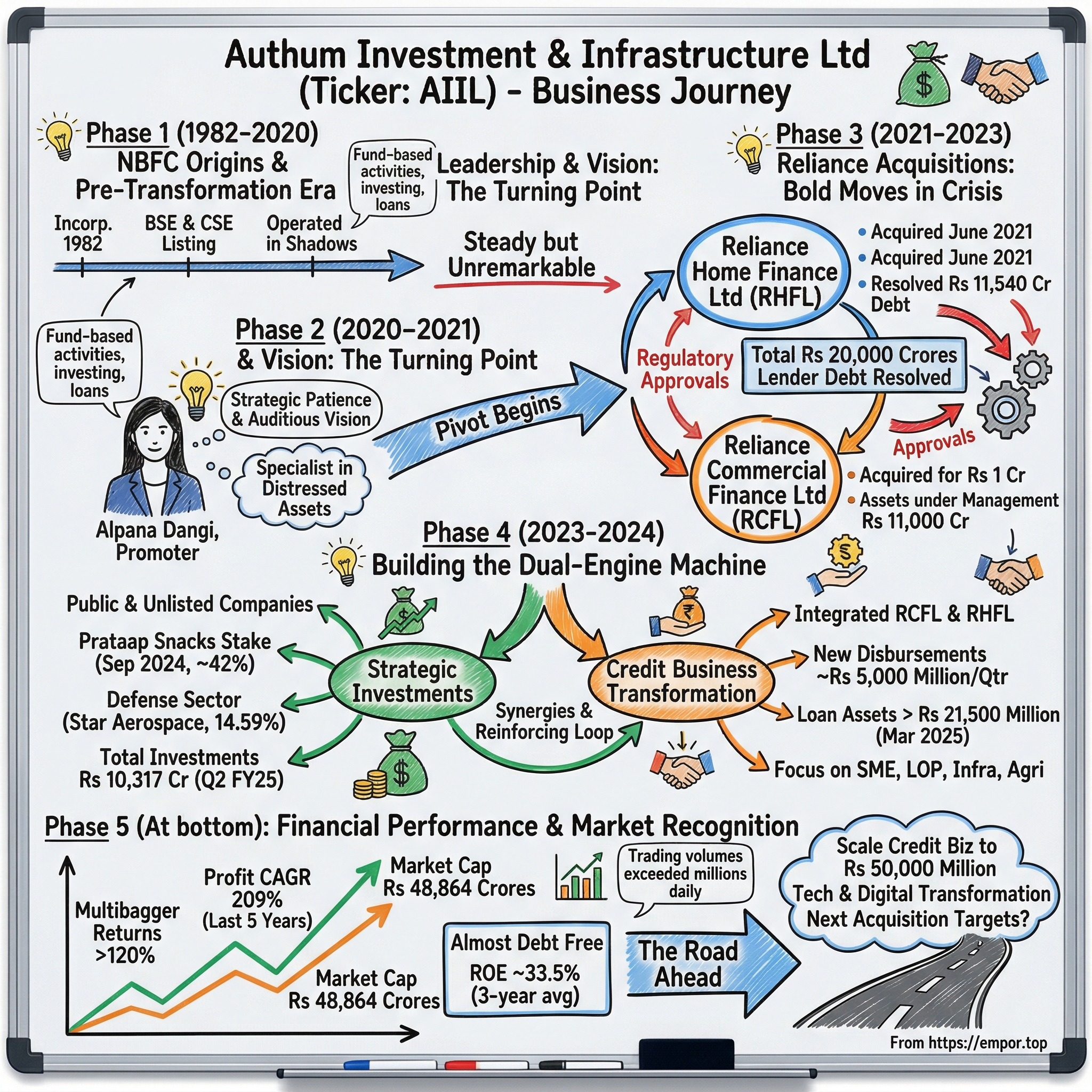
Authum Investment & Infrastructure Ltd: From NBFC Origins to India's Distressed Asset & Investment Powerhouse
I. Cold Open & Setting the Scene
On a Monday in mid-January 2026, shares of a company most Indian fund managers could not have described three years earlier hit a 52-week high. The trigger was mundane: a four-for-one bonus issue had just gone ex-bonus, with 679,380,400 new shares landing in shareholder accounts on January 14.3 The stock rose roughly 9% on the day. What made the moment striking was not the bonus itself, but the underlying arithmetic: a company incorporated in 1982 that had remained dormant for nearly four decades was suddenly valued above most of India's mid-sized listed banks.
Seven months later, on August 21, 2026, Authum Investment & Infrastructure closed at about ₹555 a share, giving it a market capitalization near ₹47,000 crore.1 Its consolidated net worth at the end of FY26 stood at ₹14,727.8 crore.2 That division yields a valuation of roughly 3.2 times book value — for a balance sheet where, by the company's own disclosure, the single largest asset class is a portfolio of listed and unlisted equities carried at fair value.2 Investors are not paying a franchise premium in the traditional sense; they are paying more than three times the marked value of a securities portfolio, plus whatever value they assign to the deal pipeline attached to it.
The enigma
That is the enigma at the core of the business. Authum has no branded consumer product, no proprietary technology, and no conventional distribution moat. Instead, it relies on a non-banking financial licence, a balance sheet that historically carried minimal leverage, and a promoter family that decided around 2019 to buy distressed debt portfolios at discounts steep enough to absorb elevated underwriting risk.
The founding act of the modern firm took shape between 2021 and 2023, when Authum acquired Reliance Commercial Finance Limited and the business assets of Reliance Home Finance Limited — two units from Anil Ambani's collapsed financial empire — resolving roughly ₹20,000 crore of consortium lender debt.[^7]7 Authum executed these transactions outside India's Insolvency and Bankruptcy Code, relying on a Reserve Bank of India restructuring circular rather than a bankruptcy court, while the Supreme Court, the Securities and Exchange Board of India, and thousands of retail debenture holders disputed whether the mechanism was lawful.9
Three candidate explanations
The central question is straightforward, but its resolution is complex: what constitutes Authum's competitive edge, and how durable is it? Three candidate explanations emerge from its records. First, regulatory arbitrage — the ability to structure workouts outside a congested insolvency court system. Second, capital agility — a balance sheet with minimal debt capable of deploying liquidity rapidly when lender consortiums demand prompt cash settlements. Third, market tailwinds — an Indian equity bull market that converted a market-sensitive proprietary portfolio into a high-reporting earnings engine.
Filing disclosures provide evidence for and against each hypothesis.
In FY26, the equity-market explanation faced its first major test. Consolidated profit after tax dropped to ₹1,929.35 crore from ₹4,241 crore in FY25. When including mark-to-market revaluations that bypass the profit and loss statement, the group's total comprehensive income for FY26 slipped to negative ₹55.77 crore.3 On a full economic accounting basis, the company generated no net income for the year despite reporting nearly ₹2,000 crore in net profit.
In the subsequent quarter — the three months ending June 2026 — that same balance sheet recorded ₹2,591.29 crore of total comprehensive income.3 The underlying assets and management remained identical; market sentiment had shifted.
Myth versus reality
A standard consensus narrative surrounds Authum: a debt-free distressed-asset specialist generating over 200% profit growth, trading at an attractive earnings multiple while riding India's bad-loan resolution cycle. An examination of the financial statements shows that three of these four assertions are stale or misleading. First, the firm is no longer debt-free: borrowings and payables quadrupled during FY26 to ₹4,444.9 crore.2 Second, historical profit growth reflected a one-time accounting gain in FY23 that cannot recur. Third, standard price-to-earnings multiples offer little analytical value when reported net profit is decoupled from total economic income.
What remains after stripping away the popular narrative is notable. Authum navigated an alternate path through India's insolvency framework that larger competitors bypassed, using acquired assets to establish an operating credit platform.
This narrative traces how a dormant shell entity transformed into a capital pool, grew into a distressed-asset workout operation, and subsequently sought institutional scale — absorbing an asset reconstruction company, a snack food producer, a pen manufacturer, a wind-energy consortium, and an Enforcement Directorate inquiry onto a single consolidated balance sheet.3
The analysis follows Authum's arc from its License Raj origins through non-IBC resolutions, capital allocation strategy, consumer investments, promoter governance history, and the structural factors determining its long-term stability.
The origin begins with four decades of relative inaction.
 Subscribe on LinkedIn
II. Origins & The Pre-Transformation Era (1982–2020)
In 1982, the Indian financial system operated under strict state controls: bank nationalisation was thirteen years old, foreign exchange was rationed, and equity issuance was priced by a government controller. In that environment, hundreds of small investment vehicles were incorporated across Kolkata, Mumbai, and Ahmedabad to hold family shareholdings, park surplus cash, and extend occasional inter-corporate loans. Authum Investment & Infrastructure was one of them, incorporated in 1982 and eventually listed on the Bombay Stock Exchange under scrip code 539177 and later the National Stock Exchange under symbol AIIL.42019
For nearly four decades, the company maintained a low profile. It operated as a registered non-banking financial company with a small loan book, minimal leverage, and a passive treasury.4 It had no flagship products, no celebrated founding narrative, and no major strategic pivots.
What thirty-eight years of nothing was quietly worth
That long period of dormancy, however, preserved two assets that proved critical to its later strategy.
First was the non-banking financial company registration itself. In India, an NBFC licence allows an institution to lend, trade securities across asset classes, acquire loan portfolios, and apply leverage against capital without the deposit-taking rules, branch mandates, and priority-sector obligations imposed on commercial banks. Obtaining a new licence from the Reserve Bank of India is a slow and uncertain process. Acquiring an established, dormant shell provided an efficient shortcut. When the Dangi family acquired the company in FY2020, they essentially bought a clean regulatory framework with a public listing attached.2
Second was an unblemished balance sheet. A dormant shell carries no legacy non-performing loans, unresolved litigation, or hidden write-offs. Authum began its transformation with a net worth of ₹419.8 crore at the end of FY20 — modest relative to major financial firms, but completely unencumbered.2
The crisis that created the opportunity
The broader market context shaped the firm's opportunity set. Through the 1990s and 2000s, India's non-bank lenders expanded rapidly, offering credit faster than traditional banks, taking higher risk, and relying heavily on short-term wholesale funding from mutual funds and insurance companies.
This model created structural asset-liability mismatches across the sector. Non-bank lenders routinely issued commercial paper maturing in 90 days to fund long-term assets, such as 15-year mortgages. The strategy generated attractive yield spreads as long as short-term debt could be rolled over continuously. It effectively hinged on uninterrupted market liquidity.
In September 2018, the default of Infrastructure Leasing & Financial Services halted that refinancing mechanism. Mutual funds abruptly stopped renewing short-term paper across the entire sector. Non-bank lenders that had borrowed short to lend long faced immediate liquidity shortages. Dewan Housing Finance collapsed, and two major lending arms of Reliance Capital — Reliance Commercial Finance and Reliance Home Finance — defaulted on their debt obligations.
A queue with no exit
Indian banks were left holding tens of thousands of crores in non-performing exposure to troubled financial firms. Although India had enacted the Insolvency and Bankruptcy Code in 2016 to resolve corporate distress, the framework had two major limitations for these entities: it initially lacked clear mechanics for financial service providers, and proceedings routinely dragged on far beyond the statutory 270-day limit.
This delay eroded recovery value. Unlike physical assets, defaulted loan books decay quickly over time. As resolution proceedings stall, collection networks dismantle, field agents depart, documentation degrades, and borrower compliance drops. Every additional month in litigation reduced the recoverable value of the underlying assets.
By 2019 and 2020, the central issue for India's financial system was not whether these distressed debt portfolios would be sold, but who would acquire them, at what price, and through which regulatory channel. Traditional buyers — such as asset reconstruction companies Edelweiss ARC and ARCIL, global distressed funds Oaktree and Cerberus, and domestic special-situations managers like Kotak — possessed substantial capital. However, they were bound by multi-layered investment committees, offshore approval mandates, fund leverage constraints, and a preference for court-supervised settlements.
This backdrop opened a window for a promoter family with two decades of Indian equity trading experience, an RBI-licensed shell, and a streamlined decision-making structure capable of acting outside lengthy court proceedings.
III. The Strategic Pivot & Management Architecture (2020–2021)
There was no press conference, no public unveiling, and no founder's letter to shareholders. In the financial year spanning April 2019 to March 2020 — while India's financial sector was still assessing the fallout from the IL&FS collapse — a private investment family acquired a listed shell entity with a net worth smaller than a mid-sized real estate project and a regulatory licence older than most of its prospective workforce.
The takeover nobody noticed
The formal transaction was low key. In FY2020, Alpana Sanjay Dangi acquired control of Authum Investment & Infrastructure, formally shifting the company's stated mandate toward mid- and large-cap equity investments.24
Shareholding disclosures as of March 2026 show the promoter group holding 68.81%, with foreign institutional investors holding roughly 14% and domestic institutions owning a negligible fraction of a percent.1 This distribution highlights a notable pattern: a company with a market valuation approaching ₹47,000 crore maintains virtually no domestic mutual fund ownership, reflecting how Indian institutional investors have evaluated the firm's governance history.
The core leadership structure remains tightly held. Sanjay Dangi — a chartered accountant who moved to Mumbai from Rajasthan in the early 1990s and built a career in equity trading — serves not as a member of the board of directors, but as Advisor to the Board.211 Alpana Dangi is the primary promoter. Amit Dangi and Divy Dangi serve as whole-time directors, both holding Big Four accounting backgrounds and investment analysis portfolios.4 The leadership expanded in September 2023 with the appointment of Group CEO and whole-time director Akash Suri, an INSEAD alumnus with roughly eighteen years of commercial banking experience across consumer, corporate, and stressed-asset resolution.4
Suri's hiring represented a strategic pivot from a purely promoter-driven trading entity toward an institutional platform. A veteran banker leaving an established institution signaled an ambition to convert an acquired debt collection operation into an active credit origination business supported by dedicated licensed entities. Whether this professional management structure can operate independently of the promoter family remains an open question for outside observers.
The file that will not close
The Advisor title is neither decorative nor accidental. It reflects a central governance factor that shapes market perceptions of the company.
On December 2, 2010, the Securities and Exchange Board of India issued an order involving Sanjay Dangi.10 Subsequent regulatory rulings through 2011 barred Dangi and approximately two dozen associated entities — including family members — from capital markets activity, citing alleged price manipulation and circular trading across shares of Ackruti City, Welspun, Murli Industries, and Brushman India.11 The most prominent case involved Ackruti City, whose share price rose roughly 250% over fifty-two trading days in 2008–09 amid a broader market decline, creating a squeeze on foreign institutional short positions.11 The matter subsequently proceeded to the Securities Appellate Tribunal.
Legal and regulatory scrutiny continued in later years. In June 2024, financial publication Moneylife reported that the Central Bureau of Investigation informed the Bombay High Court of its intention to name Sanjay Dangi as an accused in the DHFL investigation, with his wife expected to be named in a related charge sheet.12 While these proceedings remain ongoing without a final judicial finding of guilt, their existence presents a documented risk factor for investors. CRISIL explicitly cited potential "litigation or adverse regulatory developments affecting promoters" among its downside risk triggers in an October 2025 rating rationale.5
In response, the company emphasizes its governance structure: the board of directors is majority-independent and includes experienced institutional figures, such as former banker Ajai Kumar, former Deputy Managing Director at the State Bank of India Santosh Nayar, and former Principal Chief Commissioner of Income Tax Asha Agarwal.24 Sanjay Dangi's advisory status creates a formal distinction between transaction advisory and statutory board governance. For prospective investors, assessing whether this distinction represents operational separation or formal positioning remains critical, given how closely the firm's enterprise value relies on specialized distressed-asset judgment.
Building the war chest
Between 2020 and 2021, management focused on capital accumulation. Reallocating capital into the post-pandemic equity market recovery, the firm's net worth expanded from ₹419.8 crore at the end of FY20 to ₹1,431.8 crore in FY21, reaching ₹3,121.3 crore in FY22.2
This sevenfold expansion over two years was driven predominantly by capital gains during a broad Indian equity market rally. The rapid increase demonstrated an ability to deploy concentrated capital during market rebounds, though it did not separate structural investment skill from broader market tailwinds — a distinction highlighted by subsequent financial results in FY26.
The high concentration of equity ownership also presents distinct governance characteristics. While a 68.81% promoter stake ensures strong financial alignment between the controlling family and company valuations, it limits traditional public market governance checks. Minority shareholders have minimal voting leverage over strategic decisions or board composition, making their investment dependent on management's execution track record.
Critically, the capital gains generated between 2020 and 2021 positioned Authum with a low-leverage balance sheet holding several thousand crore rupees in liquid assets. This liquidity coincided with efforts by an Indian public sector banking consortium, led by Bank of Baroda, to identify buyers capable of providing immediate cash settlements for two defaulted lending institutions.
Authum had assembled its capital reserves just as the asset workout process commenced.
IV. The Reliance Acquisitions: Masterclass in Stressed Debt (2021–2023)
Understanding the Reliance acquisitions requires examining the regulatory channel Authum used.
On June 7, 2019, the Reserve Bank of India issued its Prudential Framework for Resolution of Stressed Assets.6 Replacing an earlier, stricter framework invalidated by the Supreme Court, the circular created a formal mechanism for lenders to restructure or sell defaulted loans by agreement through an Inter-Creditor Agreement, outside the National Company Law Tribunal framework. Creditors holding 75% of total debt by value and 60% by number could bind the remaining lenders, avoiding court moratoriums, resolution professionals, and multi-year legal queues.
For bank consortiums managing non-performing loan books, this framework offered a faster exit. For a buyer with ready cash and streamlined decision-making, it presented a less competitive acquisition channel. Major global distressed asset funds and domestic asset reconstruction companies typically relied on bankruptcy court approvals, which legally extinguish prior claims. An inter-creditor agreement offered less complete legal immunity. Authum chose to underwrite that residual legal exposure, a risk larger competitors generally avoided.
Two carcasses, one buyer
Deal one: Reliance Commercial Finance. Reliance Commercial Finance Limited, a wholesale and small-enterprise lender within Anil Ambani's Reliance Capital group, defaulted on roughly ₹9,000 crore owed to lenders. The creditor consortium approved Authum's resolution plan in 2021, and the acquisition closed during FY2023.7 Under the agreement, participating lenders recovered roughly 25% of their principal, specifically 24.96%.9 Authum executed the transaction through Open Elite Developers Limited—now operating under the market name Reliance Money—which remains a wholly owned subsidiary housing the acquired lending operations.3
Deal two: Reliance Home Finance. The larger transaction involved Reliance Home Finance Limited, a housing finance company whose debt was distributed across lead lender Bank of Baroda, twenty-nine other banks, approximately forty institutional investors, and roughly twenty thousand retail debenture holders.8 Authum submitted the winning bid in mid-2021 and finalized the acquisition of RHFL's business assets on April 11, 2023, paying ₹3,351 crore to resolve approximately ₹11,540 crore in creditor claims.8 Combined, the two transactions resolved nearly ₹20,000 crore in defaulted debt.[^7]7
The part that nearly unravelled it
A major obstacle emerged over creditor voting rights. Retail debenture holders—who had purchased debt initially rated AAA—faced steep haircuts negotiated by bank consortiums under a framework to which the retail investors were not signatories. The Securities and Exchange Board of India had issued a circular on October 13, 2020, establishing voting procedures for debenture holders in out-of-court resolutions, and argued that the RHFL process improperly relied on legacy Debenture Trust Deed provisions.9 The Bombay High Court dismissed SEBI's challenge, ruling the circular could not apply retroactively, prompting an appeal to the Supreme Court.
On August 30, 2022, the Supreme Court ruled in SEBI v. Rajkumar Nagpal.9 The Court upheld SEBI's circular as valid for future restructurings, establishing regulatory protections for retail bondholders. However, it declined to apply the rule retroactively to the RHFL transaction, finding that dismantling an advanced resolution would delay recoveries and harm retail investors. Under the final terms, retail debenture holders with exposure up to ₹10 lakh received 100% of their principal, while secured retail holders above that limit recovered 29.69%.9 Dissenting investors retained the option to seek separate legal remedies.
This judicial outcome highlights a key nuance in Authum's growth trajectory. The Supreme Court did not endorse non-IBC resolutions as a broad precedent; rather, it permitted this specific transaction on equitable grounds while enforcing stricter voting standards for subsequent workouts. Consequently, the regulatory arbitrage window that facilitated these transactions was narrowed significantly.
The accounting entry that changed everything
The financial reporting of these acquisitions fundamentally altered Authum's balance sheet metrics. When a company acquires financial assets for less than their fair value in a business combination, Indian Accounting Standards require the difference to be recognized immediately as a gain on bargain purchase. In FY2023, Authum booked exceptional income of ₹4,285.9 crore.2 With total revenue reaching ₹4,744.3 crore that year, this single accounting entry—reflecting the discount on the two acquired loan portfolios—accounted for approximately 90% of top-line revenue.2
The resulting balance sheet expansion was swift. Authum's net worth rose from ₹3,416.4 crore in March 2023 to ₹10,345.1 crore in March 2024, and reached ₹14,689.3 crore by March 2025.2 The equity base quadrupled over two years, driven primarily by purchase-accounting gains rather than ongoing operational cash flows.
Did Authum overpay, and what kind of profit was that?
While actual debt collections confirm the underlying asset value, the nature of this profit warrants analysis. A bargain purchase gain is a non-cash accounting entry representing expected future value; actual cash flow depends on collections execution. Company filings offer specific detail on this potential upside. As of March 2026, Authum held ₹8,573.2 crore in fully written-off loans across three pools: ₹503.7 crore in retail mortgages, ₹2,110.8 crore in other retail and commercial vehicle loans, and ₹5,958.7 crore in corporate debt—all carried at zero value on the balance sheet with recovery efforts ongoing.2 Any future collections from these zero-value pools flow directly into income.
This written-off portfolio provides off-balance-sheet recovery optionality. However, realization remains uncertain. The ₹5,958.7 crore corporate loan pool represents a historically challenging segment of Indian debt recovery, and Authum has not disclosed specific timelines or projected recovery curves for these assets.
Authum acquired its operational collection framework alongside the loan assets: twenty-five branch offices, more than 150 field collection agencies, fifty repossession and enforcement agencies, a centralized call center handling up to 100,000 calls per month, and approximately 300 collection employees.2 Rather than building a collection infrastructure from scratch, the company acquired an established operational network through the distressed debt transactions.
With the acquisitions completed and collection operations active, Authum's focus shifted toward broader asset management and corporate investments.
V. The Dual-Engine Business Model (2023–2026)
Management has a name for the phases, and it is revealing in its plainness. Authum 1.0, FY2020 to FY2022, was a pure investment book. Authum 2.0, FY2022 to FY2024, added the acquired credit business. Authum 3.0, from FY2025 onward, is the attempt to turn a family investment vehicle into a set of institutional platforms.2
Engine one: the investment book
As of March 31, 2026, investments stood at ₹13,116.9 crore, split between what the company calls Flow Investments — positions where it holds under 20% of an entity — at ₹10,693.5 crore, and Strategic Investments, meaning control or above-20% positions, at ₹2,423.4 crore.2 Within the total, roughly 60% is listed equity, 21% unlisted equity and other instruments including mutual funds and alternative investment funds, and 19% strategic.2 The company states that its largest single position is about 10% of the portfolio, and describes its listed holdings only by sector: a global conglomerate in water rehabilitation and oil and gas, an integrated long-steel and ferroalloy producer, a complex-biologics pharmaceutical company, a telecom tower infrastructure business, and an integrated iron ore and steel producer.2 On the unlisted side it discloses a renewable energy platform, an electric commercial vehicle manufacturer, a rewards-points platform, a small-arms manufacturer, and a stake in what it describes as the largest stock exchange in India.2
The refusal to name positions is a defensible commercial choice — telegraphing an active book invites front-running — but it has an analytical cost. An outside investor cannot independently verify concentration, liquidity, or valuation. For a company whose largest asset class is this portfolio, that opacity is a real disclosure gap, and it is one reason the shares are difficult for institutions to underwrite.
The performance disclosure that is provided is more candid than most. In FY25, exited investments generated ₹1,797.0 crore of booked profit, with the top exits at multiples of invested capital ranging from about 1.5x to 5.1x.2 In FY26, exits generated just ₹155.7 crore — a ninety-one percent collapse — with several exits below 1.0x, including one at 0.88x.2 Existing positions carried cumulative unrealised gains of ₹1,358 crore at March 2026.2 Two years, same process, radically different outcomes. That is not an indictment; it is the honest signature of a directional equity book. It simply means the investment engine cannot be underwritten as a recurring earnings stream, which is exactly how a naive price-to-earnings multiple treats it.
Engine two: credit, which finally showed up
This is where the more interesting institutional story lives, and where FY26 quietly delivered. Fresh credit deployment scaled from ₹759.4 crore in FY24 to ₹2,231.5 crore in FY25 to ₹3,570.9 crore in FY26.2 The loan and credit-substitute book reached ₹4,364.1 crore at March 2026, of which ₹3,928.1 crore was freshly originated and only ₹436 crore was the residue of the acquired Reliance portfolios and pass-through certificates.2 Gross non-performing assets were ₹251.4 crore against net NPAs of just ₹14.9 crore, because the legacy book carries full provisioning — and roughly 85% to 90% of that stressed exposure is mortgage-backed.2
Here is the number that matters most and that almost no commentary picked up. On a segment basis in FY26, the lending activity produced ₹1,349.69 crore of revenue and ₹1,127.63 crore of segment result, while the investment activity produced ₹1,275.78 crore of revenue and ₹985.36 crore of result.3 For the first time, credit out-earned investing. That is meaningful evidence that the diversification is not merely rhetorical. It comes with an asterisk: a large part of the lending line reflects provision write-backs and recovery income from the acquired book — ₹1,778.5 crore of "change in provision, bad debt recovery and redemption upside" across FY26 — rather than clean spread income, which was ₹551.9 crore of interest income.2 Recovery income is real cash, but it is a depleting resource. The test of the credit platform is whether interest income keeps climbing after the recovery tailwind stops.
Engine three, sort of: the ARC
On June 17, 2025, Authum completed the acquisition of 88.37% of India SME Asset Reconstruction Company, a SIDBI-sponsored ARC, for a total investment of roughly ₹313 crore including about ₹193 crore of fresh primary capital.2 Bank of Baroda, UCO Bank, Indian Bank and Canara Bank retain small residual stakes.2 The strategic logic is clean: an ARC licence lets Authum acquire distressed debt using security receipts with third-party co-investors, deploying other people's capital alongside its own rather than funding every workout off its own balance sheet. Execution in year one was brisk — deployment of ₹338.5 crore against AUM of ₹692.6 crore by March 2026, a roughly 2.1x leverage on invested capital, against a stated target of about ₹700 crore of AUM.2 It is small — ₹12.24 crore of FY26 revenue and ₹7.38 crore of segment result — but it is the first Authum business that scales on fee-and-carry economics rather than balance sheet.3
The consumer pivot, and what it cost
On September 26, 2024, Authum acquired approximately 42.3% of Prataap Snacks — the Indore-based maker of Yellow Diamond chips and Rich Feast sweet snacks — from Peak XV and Sequoia-affiliated entities, alongside co-investor Mahi Madhusudan Kela, in a transaction valuing the combined 46.85% stake at ₹846.6 crore at ₹746 per share.132 A mandatory open offer followed at ₹864 per share. Authum's total invested amount is approximately ₹790 crore for a holding that stood at 43.66% as of March 2026.2
This deserves a hard look, because it is the clearest test of capital allocation discipline in the file. Prataap Snacks in FY26 generated revenue of ₹1,724.6 crore — up just 1% — operating EBITDA of ₹81.8 crore, and net profit of ₹9.7 crore, against a loss of ₹34.2 crore in FY25.14 The turnaround is real: EBITDA rose 68% and the fourth quarter swung to a small profit on 4.9% margins.14 Management is guiding to double-digit revenue growth in FY27 on the back of quick-commerce expansion, while flagging inflation in packaging film and edible oils.14
But hold the valuation next to the earnings. Authum paid roughly ₹790 crore for a business currently earning under ₹10 crore. On any conventional earnings basis that is not a distressed purchase — it is a bet that a sub-scale challenger in one of the most competitive categories in India, up against Haldiram's, Balaji Wafers and PepsiCo's Lay's, can be restructured into materially higher margins. Nothing in Authum's demonstrated capability set — buying loan books at a discount and enforcing collateral — obviously transfers to winning shelf space for potato chips. It may work. But the honest characterisation is that this is a private-equity control bet in an unrelated industry, made by a financial firm, and it should be judged as such rather than as an extension of the core.
The eclectic tail
The same pattern recurs. NITCO Limited, a listed tile and marble maker, came in through the debt door: Authum bought roughly 97% of the consortium debt from an ARC in April 2024 for ₹225.1 crore, then converted approximately ₹1,040 crore of unsustainable debt into equity at ₹93 per share in October 2024, ending with about 46.8% of the company on a fully diluted basis — and, notably, has already been fully repaid its invested amount.2 That is the playbook working exactly as designed: buy the debt cheap, convert to equity, get the cash back, keep the equity as free optionality.
Then the list gets eclectic. BIC Cello (India), acquired for ₹153.34 crore and completed on November 22, 2025, is now a wholly owned pen manufacturer renamed Primetek Pens.3 Billion Dream Sports became a wholly owned subsidiary on July 31, 2025 — the "sports, arcade gaming and hospitality" business referenced in the portfolio disclosure.23 Rivaara Labs became an associate on October 30, 2025.3 Creatoz Builders, a real estate company, was won through insolvency with the NCLT order uploaded to the IBBI website on July 16, 2026.17 And in 2026, an NCLT bench approved a ₹2,775 crore resolution plan for Wind World (India) submitted by a consortium in which Inox Neo Energies takes the wind power and operations-and-maintenance businesses while Authum contributes ₹350 crore to acquire identified real estate and other specified assets, with 96.47% creditor approval.1617
There is also a rental real estate business, which generated ₹16.19 crore of revenue in FY26 and a segment loss of ₹2.95 crore — genuinely immaterial, and worth mentioning only to size it correctly against the noise it sometimes receives.3
Step back and the shape becomes clear. Authum is assembling a conglomerate, not a lender. The stated architecture — NBFC, ARC, asset management company, and third-party servicing, with a target of over ₹2,000 crore in third-party servicing AUM already achieved for about ₹6 crore of FY26 fee income — is a coherent financial-services platform.2 Pens, snacks, sports venues and tiles are not part of that architecture. They are the residue of a deal machine that buys whatever is cheap. Which is a strategy. It is just a different strategy than the one on the slide.
VI. Industry Dynamics, Competitive Moats & 7 Powers Analysis
Consider the environment where these transactions close: not a courtroom, but a conference room in a public-sector bank's Mumbai headquarters. A lead lender chairs the meeting, two dozen consortium members dial in, a quarterly provisioning deadline looms, and the portfolio under discussion has already been partially written down. In that setting, creditors do not prioritize the highest hypothetical bid; they prize the bidder capable of delivering immediate cash before the reporting window closes.
Every distressed-asset market shares a common structure: a motivated seller bound by a timetable, an asset with decaying value, and a small pool of executable buyers. The central competitive metric is not total available capital, but the speed with which an institution can convert underwriting decisions into settled funds at acceptable legal risk.
Who else was in the room
The Indian distressed-debt market divides into four distinct categories. Asset reconstruction companies, including Edelweiss ARC and ARCIL, possess specialized licences and security receipt structures, but historically deployed limited proprietary capital and relied on bank co-investment. Global special-situations funds, such as Oaktree, Cerberus, and JC Flowers, offer scale and structuring expertise but operate under offshore investment committees and generally prefer court-sanctioned resolutions. Domestic special-situations platforms like Kotak combine local presence with execution speed, yet remain accountable to fund LPs with fixed investment horizons and mandates. Meanwhile, diversified non-banking financial companies, such as Piramal Enterprises and Bajaj Finance, maintain large balance sheets but focus primarily on credit origination rather than debt workouts.
Seven Powers, honestly applied
Applying Hamilton Helmer's 7 Powers framework to Authum reveals a focused set of competitive drivers alongside significant structural limitations. Brand equity, switching costs, and network economies offer no meaningful protection; bank consortiums selling defaulted loan books face zero switching costs and evaluate buyers purely on execution certainty.
Counter-positioning represents the firm's primary competitive advantage during its initial growth phase. While the Reserve Bank of India's 2019 Prudential Framework allowed any eligible buyer to restructure debt out of court, institutional competitors faced structural constraints. Institutional asset managers could rarely accept the residual legal liabilities of an inter-creditor resolution over a court-approved insolvency plan, while traditional asset reconstruction companies lacked the liquidity to write a single ₹3,351 crore cash cheque. Authum accepted these residual risks because its capital was permanent, promoter-controlled, and unencumbered by fund documentation. This dynamic fits the definition of counter-positioning, as established incumbents declined to match the strategy to protect their existing operating models.
However, counter-positioning decays as regulatory frameworks adapt and arbitrage windows close. The Supreme Court's 2022 ruling in SEBI v. Rajkumar Nagpal upheld SEBI's debenture-holder voting circular prospectively.9 Consequently, subsequent out-of-court resolutions involving listed debentures must satisfy stricter consent thresholds, closing the specific legal avenue Authum utilized for its initial scale acquisitions.
Scale economies and cornered resources offer minimal structural defense. Authum's cost structure does not yield operational efficiencies that peers cannot replicate, nor does the firm hold proprietary assets. While promoter decision-making provided speed, key-person dependence represents a governance risk rather than a defensible moat.
Process power is reflected in the company's acquired collection infrastructure. Managing over 150 field collection agencies, fifty enforcement firms, and a centralized call center handling granular retail debt requires dedicated operational capabilities.2 However, because this network was acquired rather than developed internally, competitors with equivalent capital can purchase comparable servicing infrastructure.
Capital structure advantage functions as the firm's most tangible operational edge. CRISIL recorded low gearing of 0.05 times in March 2025 and 0.1 times in June 2025, against a rating expectation of maintaining leverage below 1.0 times.5 Operating with minimal debt allowed Authum to offer quick cash settlements without financing contingencies. Yet this low-leverage profile shifted during FY26: total borrowings and payables expanded from ₹1,398.1 crore in March 2025 to ₹4,444.9 crore in March 2026, driven by ₹2,122.4 crore in redeemable preference shares and ₹540.5 crore in inter-corporate deposits from promoter entity Mentor Capital.2 Over the same period, annual finance costs increased from ₹52.0 crore to ₹198.8 crore.2 Although leverage remains conservative relative to industry peers, the balance sheet is no longer debt-free.
The five forces, and the cycle underneath them
Porter's Five Forces framework highlights an evolving competitive landscape. Threat of new entrants remains low due to strict RBI licensing requirements for NBFCs and ARCs, substantial capital demands, and the operational complexity of building resolution networks. Bargaining power of sellers—the bank consortiums—remains constrained during peak provisioning cycles when lenders prioritize quick cash exits. However, this bargaining dynamic is cyclical. By mid-2026, Indian bank balance sheets reached their healthiest state in fifteen years, with system-wide non-performing assets falling sharply from their 2018 peak. A banking system with lower bad-loan volumes creates intense competition among buyers for a shrinking inventory of distressed debt. Consequently, competitive rivalry is moderate to high and increasing as published returns attract competing capital into mid-market workouts.
Authum's competitive advantage between 2021 and 2023 was distinct and effective. Moving forward, its edge relies on transaction speed in mid-sized workouts backed by permanent capital. To adapt to a tighter distressed-asset supply, management has initiated a platform model: expanding its asset reconstruction arm to manage third-party capital, planning an asset management company, and building a fee-based debt servicing business.2 While strategically aligned with long-term financial trends, this platform transition remains unproven at institutional scale, supporting CRISIL's observation regarding the firm's limited track record in profitably scaling its non-investment operations.5
VII. Management Credibility, Capital Allocation & Governance Audit
Assessing management credibility normally involves analyzing earnings transcripts—comparing executive promises across quarters and evaluating how directly leadership answers analyst inquiries.
At Authum, that analytical record is missing. The company's investor relations page lists annual reports dating back to FY2021, quarterly results, shareholding filings, and corporate presentations, but no earnings call recordings or transcripts.17 Public transcript databases contain no record of live earnings calls. For an enterprise valued near ₹47,000 crore, relying solely on quarterly slide decks without open analyst questioning represents a deliberate disclosure choice. This absence of direct institutional Q&A helps explain why domestic mutual funds hold only a fraction of one percent of the equity.1
The record they did leave
Where written commitments are published, management's execution aligns closely with its guidance. Comparing filings from early and mid-2026 shows consistent delivery against stated operational targets. The asset reconstruction arm was guided to deploy roughly ₹350 crore and achieve ₹700 crore in assets under management in FY26; it delivered ₹338.5 crore in capital deployment and ₹692.6 crore in AUM.218 Third-party servicing AUM was projected to exceed ₹2,000 crore beginning in FY26; company decks confirm that milestone was reached within a year.2 Similarly, credit disbursements scaled as promised, rising from ₹2,231.5 crore to ₹3,570.9 crore.2
On core financial metrics, capital allocation has driven substantial balance sheet expansion. Net worth compounded from ₹419.8 crore in FY20 to ₹14,727.8 crore in FY26 with minimal external equity dilution, while three-year return on equity averaged approximately 30%.21 Reflecting this capital expansion, CRISIL upgraded the company's long-term rating from Crisil A-/Stable to Crisil A/Stable in October 2025, citing its strengthened capital position.5
The harder file
Alongside these operating results, company disclosures outline several structural governance and accounting complexities.
A going-concern qualification at a key subsidiary. Open Elite Developers Limited, the subsidiary housing the acquired Reliance lending business, reported an accumulated loss of ₹902.66 crore as of June 30, 2026, resulting in negative net owned funds. Filings note that these conditions create significant doubt regarding the subsidiary's ability to continue as a going concern, with financial statements prepared on a going-concern basis relying on holding company support and underlying property values.3 While Authum's consolidated net worth of nearly ₹15,000 crore absorbs this exposure, the subsidiary remains dependent on parent support seven years after the initial debt default.
Regulatory penalties and market restrictions. In August 2024, the Securities and Exchange Board of India imposed a ₹25 crore penalty on Open Elite Developers and banned it from accessing securities markets for five years, citing fund diversions within Reliance Home Finance prior to Authum's acquisition. Authum appealed the order to the Securities Appellate Tribunal, securing a stay after depositing half the penalty amount in December 2024, with the next hearing scheduled for September 22, 2026.3 Although the underlying conduct predates Authum's ownership, the regulatory liability transferred with the acquired entity.
An ongoing Enforcement Directorate inquiry. Filings also disclose an Enforcement Directorate inquiry into specific transactions at acquired entities prior to their acquisition. Management states it has submitted requested documentation and maintains that the inquiry will not impact operations or financial performance.3
Unresolved auditor fraud reports. Fraud reports filed with the Ministry of Corporate Affairs in June 2019 under Section 143(12) of the Companies Act—covering the pre-acquisition period—remain pending. The company notes it cannot determine the ultimate outcome or potential financial impact.3
Prior-period financial restatements. Accounting adjustments related to a scheme of arrangement at Open Elite Developers were omitted from initial FY24 disclosures and subsequently restated in comparative periods, altering reported consolidated equity.3 While the monetary adjustments were modest, the restatement reflects an error in initial accounting execution.
Non-consolidation of strategic equity holdings. In its June 2026 disclosures, Authum chose not to consolidate or equity-account its major stakes in Prataap Snacks, NITCO, MIRC Electronics, or Katra Phytochem, citing management's position that these represent strategic investments without an intention to exercise control, exert significant influence, or participate in corporate affairs.3 Authum holds 43.66% of Prataap Snacks and approximately 46.8% of NITCO.2
Under Indian Accounting Standard 28, holding more than 20% of an entity creates a presumption of significant influence. Rebutting that presumption at ownership levels above 40% requires maintaining a strict arm's-length relationship. However, Authum's May 2026 investor presentation classifies Prataap Snacks as a strategic investment where operational metrics improved following Authum's involvement, and describes NITCO's restructuring as executed under binding agreements led by Authum.2
This accounting distinction carries material financial implications. Equity-accounting Prataap Snacks would require recognizing its proportional net earnings within consolidated profit. Accounting for it as a fair-value investment allows market value fluctuations to flow through other comprehensive income, altering how the investment is reflected on the balance sheet. While auditors have accepted this classification, the treatment relies on management's interpretation of operational influence.
How they handle a setback
In July 2026, the Mumbai bench of the National Company Law Tribunal rejected Authum's ₹85.05 crore resolution plan for Vas Infrastructure and instructed the IBBI Chairman to investigate the resolution professional for misrepresentation, citing incorrect claims regarding property ownership rights in the information memorandum.15 While the tribunal's findings focused on the resolution professional rather than Authum, the outcome indicated that Authum submitted a binding bid without fully verifying land titles during underwriting.
The two-sided verdict
Evaluating Authum requires balancing operational execution against governance risk. Operationally, management has delivered on published targets and expanded book value faster than most Indian financial peers. Institutionally, the company carries complex legacy issues, including promoter regulatory history, pending regulatory inquiries, subsidiary going-concern flags, financial restatements, non-traditional consolidation choices, and limited direct institutional engagement. Both dimensions define the firm's overall risk and return profile.
VIII. Financial Performance, Accounting Realities & Risk Radar
Most companies have a headline earnings figure that reflects their underlying operations. Authum has three distinct metrics, and each tells a different story.
Story one — the income statement. In FY26, consolidated total income reached ₹2,653.89 crore against expenses of ₹536.47 crore, generating profit before tax of ₹2,115.03 crore and profit after tax of ₹1,929.35 crore.3 Compared with FY25's net profit of ₹4,241 crore, reported net earnings fell by more than half.1 The underlying driver is visible in the revenue mix: investment income dropped sharply from ₹2,663.4 crore in FY25 to ₹164.1 crore in FY26, while interest income grew from ₹396.0 crore to ₹551.9 crore and recovery-related income expanded to ₹1,778.5 crore.2 In essence, as equity trading gains moderated, credit resolution activities carried the year's reported earnings.
The number that reframes everything
Story two — comprehensive income. This metric highlights the divergence between reported accounting profit and net economic performance. Under Indian Accounting Standards (Ind AS), mark-to-market movements on equity instruments designated at fair value through other comprehensive income (OCI) bypass the profit and loss account and flow directly into balance sheet reserves. Authum recorded an OCI of negative ₹1,985.12 crore in FY26, driven by a ₹2,289.13 crore fair-value loss on equity holdings, offset by ₹303.28 crore of related deferred tax.3 Combining reported net profit of ₹1,929.35 crore with OCI yields a total comprehensive income for FY26 of negative ₹55.77 crore.3
This accounting treatment explains why net worth remained virtually flat—moving from ₹14,689.3 crore in March 2025 to ₹14,727.8 crore in March 2026—despite reporting nearly ₹2,000 crore in net profit.2 On a comprehensive economic basis, net wealth creation for the financial year was close to zero.
Quarterly fluctuations illustrate the volatility of this reporting structure even more sharply. For the fourth quarter ending March 2026, Authum reported profit after tax of ₹57.54 crore, but negative OCI of ₹1,347.70 crore resulted in a total comprehensive loss of ₹1,290.16 crore.3 In the following quarter ending June 2026, market movements reversed: profit after tax of ₹1,108.22 crore combined with positive OCI of ₹1,483.07 crore produced total comprehensive income of ₹2,591.29 crore.3
Consider an illustrative parallel: a household operating a retail store while holding a substantial investment portfolio. In a down market, the family reports earnings from the store while logging equity markdowns directly against net worth. The reported operating profit is factual, yet it does not reflect the net change in overall household wealth. That distinction defines Authum's income statement.
Why the multiple lies
This accounting structure complicates standard price-to-earnings evaluations. Trailing multiples based on FY26 net profit (roughly 22 times) or FY25 earnings (₹4,241 crore) primarily reflect directional stock market movements and are both artefacts of which way markets moved.1 For an entity structured around mark-to-market investment holdings, book value provides a more reliable analytical anchor, alongside an assessment of asset liquidity, recurring credit operations, and potential recoveries from written-off loans. Trading at approximately 3.2 times book value—where the underlying balance sheet is already carried largely at fair value—the market price incorporates a premium for future transaction execution. That valuation relies on prospective deal flow rather than current asset backing alone.
Where the cash actually is
Story three — cash and tax. Authum reported FY26 current tax expense of ₹14.31 crore against profit before tax of ₹2,115.03 crore, with the bulk of the tax charge—₹171.19 crore—being deferred.3 A low current tax burden relative to accounting profit reflects income derived from unrealized revaluations and non-cash recovery adjustments, emphasizing the difference between reported earnings and realized cash flow.
The risk radar
Evaluating the risk profile highlights six main structural factors.
Market risk represents the primary exposure, and it is not diversifiable within the model. Approximately 79% of total assets consisted of investments as of CRISIL's October 2025 rating review, predominantly equities.5 A 20% decline in Indian mid-cap equity values mechanically removes several thousand crore rupees from net worth. This sensitivity represents an inherent feature of the operating model rather than an exceptional tail risk. The principal structural buffer is low asset leverage, which limits the risk of forced liquidations or margin calls during market downturns.
Concentration risk operates on two levels. Authum's largest single position is disclosed at roughly 10% of the investment portfolio, which is concentrated but not extreme.2 A more significant concentration lies in key-person reliance, given the enterprise's dependence on promoter decision-making across deal underwriting and capital allocation.
Recovery execution risk depends on off-balance-sheet upside. Market valuations frequently factor in potential realizations from ₹8,573.2 crore in fully written-off loan portfolios. However, no recovery curve, vintage analysis or expected timeline has been disclosed for that pool.2
Regulatory and litigation risk remains elevated relative to peers and specifically identified by the rating agency as a downgrade trigger.5 Pending matters—including the SAT appeal regarding Open Elite Developers, the Enforcement Directorate inquiry, legacy MCA fraud reports, and CBI investigations—collectively weigh on market valuation multiples.
Funding risk is currently low but the profile is changing. While historical leverage was minimal, recent expansion in borrowings, ₹2,050 crore in compulsorily redeemable preference shares counted as Tier 2 capital, and inter-corporate deposits from promoter-affiliated Mentor Capital mean the capital structure is more complex than "debt-free."2 Rating agency CRISIL specifically noted "limited, though gradually increasing, demonstration of sustainable diversification in debt profile."5
Credit cycle dynamics present a countercyclical constraint. Authum's acquisition pipeline relies on non-performing exposure within the broader financial sector. With Indian commercial banks maintaining low non-performing asset ratios and strong capital buffers in 2026, the volume of distressed portfolios available for out-of-court acquisition has narrowed. This supply dynamic increases the importance of scaling fee-based servicing and asset reconstruction operations.
Ultimately, financial analysis indicates that earnings remain volatile by construction, balance sheet solvency is supported by low leverage, and assessing enterprise value requires distinguishing reported accounting profits from total comprehensive economic income.
IX. Strategic Playbook & Investment Lessons
A clear distinction exists between Authum's formal disclosures and its actual operational behavior. Regulatory filings describe an integrated financial services platform with distinct operating verticals. The company's execution reveals a simpler model: acquiring debt claims from exiting creditors at a discount, securing priority positions, and waiting for asset resolution.
Stripping away individual deal mechanics reveals a repeatable investment strategy worth examining regardless of valuation debates.
The method
Buy the debt, not the company. Authum has consistently established its entry points within the credit stack rather than through equity purchases. Its restructuring of tile maker NITCO illustrates the approach: acquire consortium debt at a discount from an asset reconstruction company, negotiate a restructuring that converts the unsustainable portion into equity at a fixed price, recover the cash outlay through the sustainable debt portion, and retain the equity holding at a near-zero cost basis.2 Holding senior debt backed by collateral limits downside risk, while equity conversion preserves upside potential.
Choose the forum, not just the asset. The strategic core of the Reliance transactions lay not merely in discounted loan books, but in identifying an alternative procedural channel where regulatory risk was mispriced relative to available entry discounts. For special-situations investors, the resolution mechanism often dictates investment returns as much as asset selection.
Permanent capital is the asset. Authum's main structural edge over private equity or distressed funds is the absence of exit mandates. Without fund lifespans, redemption pressures, or annual mark-to-market benchmarks, the firm can maintain long holding periods for illiquid assets. The trade-off is governance accountability: public shareholders lack the redemption rights of fund limited partners, leaving open-market sales as their primary recourse.
The hybrid model is a funding structure, not an operational synergy. Management presents its dual structure as complementary, using credit cash flows to fund equity holdings while equity gains cushion credit write-offs. In FY26, credit earnings indeed supported overall profitability as equity gains slowed. However, this balance reflects earnings diversification across a shared balance sheet rather than operational synergy between unrelated businesses. Authum operates as a permanent-capital holding company with a lending arm, where capital discipline depends on holding cash when attractive opportunities are absent rather than manufacturing cross-business synergies.
The discipline is knowing when not to deploy. For a permanent-capital vehicle, cash management represents a critical test. Authum's disclosed cash and cash equivalents hovered in a narrow band between roughly ₹455 crore and ₹630 crore across four financial year-ends, even as its investment portfolio quadrupled.2 Maintaining near-full capital deployment reflects a strategy built for permanent capital without redemption risks. However, it also limits uncommitted liquidity for new market dislocations unless existing holdings are liquidated first.
Distinguish structural advantages from cyclical tailwinds. Authum's expansion between 2021 and 2023 coincided with a distressed-asset supply wave, an out-of-court resolution window, and a broad equity bull market. While all three factors buoyed returns, only the willingness to underwrite procedural risk with permanent capital represents a repeatable competitive edge.
Distinguishing durable competitive capability from temporary market tailwinds remains the central analytical challenge, with FY26 performance offering the initial test case.
X. Bull vs. Bear Case & Key Performance Indicators
The bull case
The bull case rests on four pillars.
First is the demonstrated ability to source, price, and resolve complex distressed financial assets that larger competitors bypassed—with the Reliance resolutions validated through the Supreme Court and roughly ₹20,000 crore of lender debt resolved.[^7]9 Second is a resilient capital structure: gearing near 0.1 times, a CRISIL A/Stable rating upgraded in October 2025, and minimal risk of forced liquidation during market drawdowns.5 Third is the off-balance-sheet optionality in ₹8,573.2 crore of fully written-off loans carried at zero value, where any recovery generates direct income.2 Fourth—and most critical for long-term expansion—is initial evidence of operational scaling outside proprietary investing: credit disbursements grew 60% in FY26 to ₹3,570.9 crore, the lending segment out-earned the investment arm, the asset reconstruction company met its first-year targets, and third-party fee income began contributing to operations.23
The bear case
The bear case is equally concrete and centers on structural governance and valuation constraints rather than core asset quality.
First is earnings quality. Financial results remain tightly tied to Indian equity market performance. The FY26 results—reporting negative total comprehensive income—demonstrated that a single down year in the equity market can erase annual economic gains regardless of reported net profit.3 Furthermore, trading at roughly 3.2 times marked-to-market book value requires confidence in a deal pipeline whose largest transaction window has passed and whose primary procedural advantage was narrowed by the Supreme Court ruling.91
Second are key-person dependencies and legal complexities. Centralized leadership is closely linked to promoter regulatory histories that CRISIL explicitly identified as potential rating downgrade triggers.5 Active governance factors include an Enforcement Directorate inquiry, a Securities Appellate Tribunal appeal regarding a market ban and penalty at a subsidiary, pending MCA fraud reports, a going-concern qualification at the primary lending subsidiary, and prior-period financial restatements.3
Third are capital allocation and transparency concerns. Capital has expanded into unrelated operating businesses—highlighted by ₹790 crore committed to a snack manufacturer earning under ₹10 crore in net profit—while non-consolidation of holdings above 40% limits external auditability.23 Without public earnings calls and with undisclosed portfolio positions, prospective investors must rely heavily on management assertions.17
What an activist would demand
An institutional activist analyzing the business model would likely focus on three operational demands: standardizing equity-accounting or consolidation for strategic stakes above 20% to clarify true earnings; publishing vintage recovery timelines for written-off loan portfolios to quantify off-balance-sheet options; and instituting quarterly earnings calls to detail capital allocation across non-financial acquisitions. These governance changes would not alter existing assets, but they could directly impact valuation multiples.
Where the war game lands
Authum's long-term thesis succeeds if its lending, asset reconstruction, and debt servicing operations expand into a sustainable credit franchise that generates mid-to-high-teens return on equity across economic cycles, rendering proprietary equity gains a secondary benefit. Segment results from FY26 offer preliminary evidence of this transition. Conversely, the thesis falters if non-investment platforms stall at sub-scale, distressed debt inventory remains constrained by a healthy banking environment, or equity market declines coincide with adverse regulatory outcomes—reverting the firm to a leveraged equity portfolio operating under a financial licence.
The three metrics that matter
Evaluating Authum's fundamental trajectory requires moving beyond reported net profit and price-to-earnings ratios, which primarily reflect equity market swings. Three specific operational indicators provide true diagnostic signal:
One: total comprehensive income and resulting changes in net worth per share. This represents the complete metric for net economic performance. Because reported profit can remain near ₹2,000 crore even when total comprehensive income declines, tracking book value per share across quarters—adjusted for bonus share issuances—offers the clearest measure of real wealth creation.
Two: fresh credit interest income relative to recovery and provision write-back income. This metric tracks whether Authum is establishing an ongoing credit origination franchise or remaining reliant on workout realizations. In FY26, interest income of ₹551.9 crore compared to ₹1,778.5 crore in recovery-linked income indicates that while the operational transition is underway, it remains incomplete.2 Because recovery income is inherently finite, sustained growth in core interest income is necessary as legacy portfolio workouts taper.
Three: cash realizations from the ₹8,573.2 crore written-off loan pool. This represents a primary valuation driver within the bull case. Because these assets carry zero book value, recoveries generate direct income. However, without published recovery timelines or vintage curves, every year of unrealized option value reduces its effective present value.
XI. Lessons, Epilogue & What to Watch
The central lesson of Authum’s trajectory is less about how a dormant 1982 shell expanded into a ₹47,000 crore enterprise, and more about the mechanism behind that growth. Rather than inventing a new product or expanding consumer distribution, the company identified a structural bottleneck: in a financial system burdened by non-performing loans and congested courts, liquidity and rapid execution commanded a steep discount.
While most Indian financial services returns over the past decade tracked credit expansion and branch network growth, Authum’s returns stemmed from process arbitrage and discounted pricing. Its ₹4,285.9 crore bargain purchase gain in FY2023 resulted not from underwriting standard loan originations, but from providing immediate cash settlements while competitors awaited formal bankruptcy court proceedings.2
A second lesson highlights the analytical challenge of pricing such hybrid structures. Standard valuation metrics designed for conventional lenders—which rely on predictable loan book growth and return on equity—struggle to capture Authum’s balance sheet. The firm combines a daily mark-to-market equity portfolio, an off-balance-sheet ₹8,573.2 crore written-off recovery pool carried at zero value, and major operating stakes accounted for as investments.23 Evaluating this structure through traditional price-to-earnings multiples introduces mispricing risk, as reported net profit remains decoupled from underlying economic income.
Trade or business
The core strategic question facing Authum is whether its transformation represents a repeatable operating model or a series of opportunistic trades. The FY26 financial records support both perspectives. On one hand, as equity investment gains moderated, the credit platform generated the majority of segment revenue, fulfilling a primary requirement of the long-term thesis. On the other hand, total comprehensive income turned slightly negative, book value growth stalled, and quarterly filings disclosed subsidiary going-concern qualifications alongside an ongoing Enforcement Directorate inquiry.
What to watch
Several key factors will determine the firm's operational trajectory: whether core interest income on fresh credit continues to compound as the acquired Reliance portfolio tapers, with the legacy book down to ₹275.2 crore;2 whether ISARC expands beyond its ₹692.6 crore assets-under-management base to deploy significant third-party capital, and whether the planned asset management platform moves past the blueprint stage;2 whether Prataap Snacks converts its operational recovery into its targeted double-digit revenue growth in FY27, with disclosures that allow shareholders to evaluate the return on that ₹790 crore investment;14 whether pending legal and regulatory matters—including the Securities Appellate Tribunal hearing scheduled for September 2026, the Enforcement Directorate inquiry, and legacy MCA fraud reports—reach resolution;3 and whether eclectic acquisitions across writing instruments, arcade gaming, floor tiles, and wind-energy real estate resolve into a coherent holding company or remain a collection of opportunistic purchases.
Transitioning a proprietary treasury into an institutional financial platform remains a complex undertaking. Authum has expanded its operations further than most comparable Indian investment vehicles, yet long-term stability requires establishing institutional governance and underwriting processes that can function independently of key-person promoter judgment.
References
-
Authum Investment & Infrastructure Ltd — Consolidated financials, ratios and shareholding — Screener.in ↩↩↩↩↩↩↩
-
Business Update and Corporate Presentation, May 2026 (filed with BSE and NSE, 2026-06-01) — Authum Investment & Infrastructure Ltd ↩↩↩↩↩↩↩↩↩↩↩↩↩↩↩↩↩↩↩↩↩↩↩↩↩↩↩↩↩↩↩↩↩↩↩↩↩↩↩↩↩↩↩↩↩↩↩↩↩↩↩↩↩↩↩↩↩↩↩
-
Unaudited Standalone and Consolidated Financial Results for the Quarter Ended June 30, 2026, with notes (approved 2026-07-20) — Authum Investment & Infrastructure Ltd ↩↩↩↩↩↩↩↩↩↩↩↩↩↩↩↩↩↩↩↩↩↩↩↩↩↩↩↩↩
-
About Authum — company history, business verticals and board of directors — Authum Investment & Infrastructure Ltd ↩↩↩↩↩↩
-
Authum Investment & Infrastructure Limited — Rating Rationale, upgrade to Crisil A/Stable — CRISIL Ratings, 2025-10-24 ↩↩↩↩↩↩↩↩↩
-
Prudential Framework for Resolution of Stressed Assets — Reserve Bank of India, 2019-06-07 ↩
-
Credit Business — acquisition of RCFL and RHFL business assets, loan assets and disbursements — Authum Investment & Infrastructure Ltd ↩↩↩
-
Authum acquires Reliance Home Finance for Rs 3,351 crore — completion, creditor claims and recovery split — PropNewsTime ↩↩
-
SC upholds applicability of SEBI Circular but gives green signal to Reliance Commercial Finance resolution — SCC Online, 2022-09-02 ↩↩↩↩↩↩↩↩
-
Order in the matter of Mr. Sanjay Dangi — Securities and Exchange Board of India, 2010-12-02 ↩
-
Sanjay Dangi: Bull Penned — SEBI bans Sanjay Dangi from investing in stock markets over Ackruti City — Business Today, 2011-02-08 ↩↩↩
-
CBI To Name Controversial Market Operator Sanjay Dangi as Accused in the Rs34,000 Crore DHFL Scam — Moneylife, 2024-06-10 ↩
-
Authum Investment, Mahi Kela to buy 46.85% stake in Prataap Snacks for Rs 846 crore — The Economic Times, 2024-09-26 ↩
-
Prataap Snacks returns to profit in FY26 as margins recover, bets on quick commerce for growth — Storyboard18 ↩↩↩↩
-
'Shocking And Bewildering': NCLT Mumbai Bench Rejects VAS Infrastructure Resolution Plan, Orders IBBI Probe Into RP — LiveLaw Biz, 2026 ↩
-
NCLT Ahmedabad Approves ₹2,775 Crore Inox Neo–Authum Resolution Plan For Wind World India — LiveLaw Biz, 2026 ↩
-
Investor Relations — annual reports, financial results, corporate presentations, credit rating and Regulation 30 intimations — Authum Investment & Infrastructure Ltd ↩↩↩↩
-
Authum Investment & Infrastructure Business Update and Corporate Presentation Highlights (February 2026) — InvestyWise ↩
-
Authum Investment & Infrastructure Ltd (AIIL) — Stock quote and disclosures — NSE India ↩
-
Authum Investment & Infrastructure Ltd (539177) — Corporate portal — BSE India ↩
 LinkedIn
 WhatsApp
 Reddit
 Hacker News
 Email
Email Kindle
 RSS Feed
 Spotify
 Apple Podcasts
 Amazon Music
 Audible
 YouTube