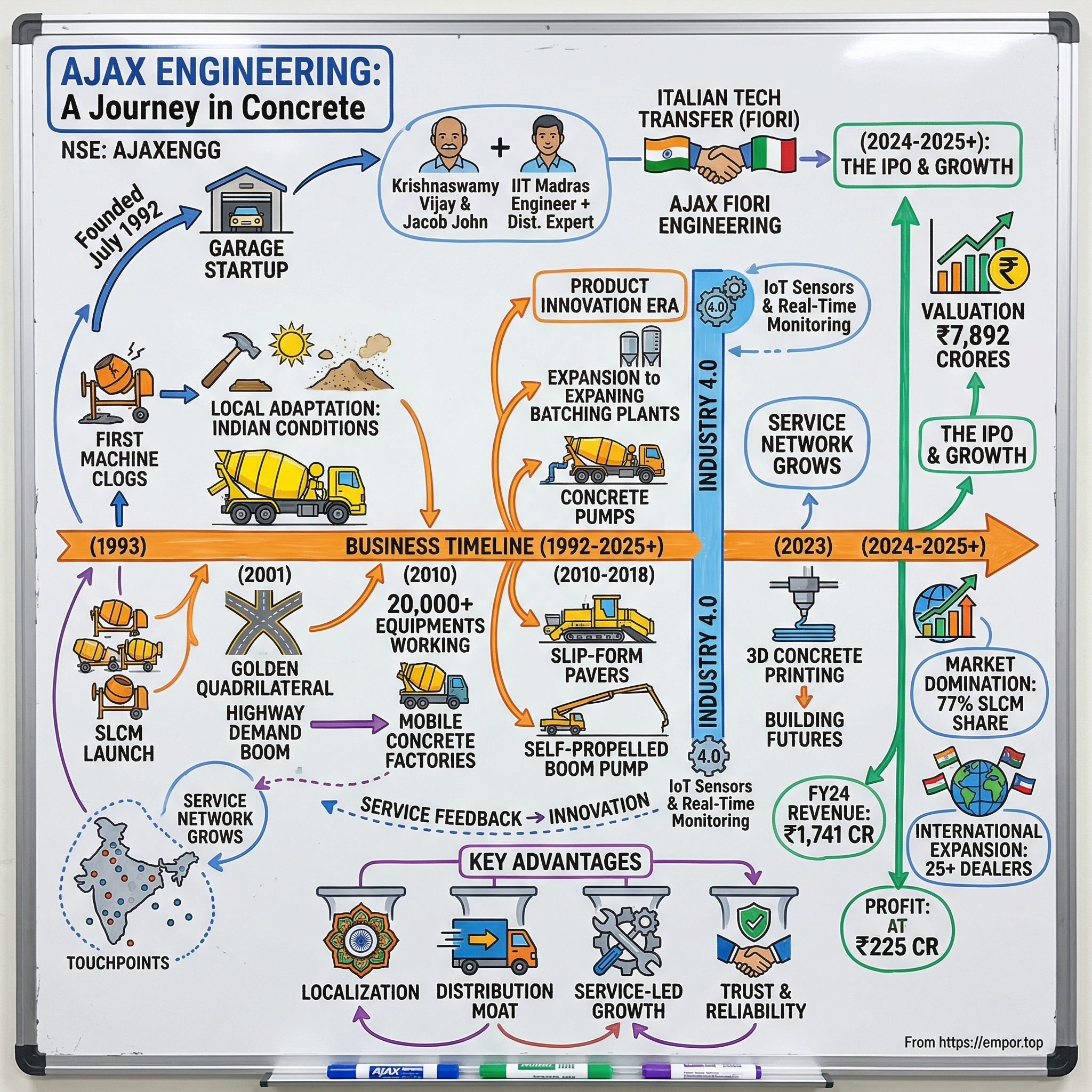
Ajax Engineering: India's Concrete Monopoly
I. Cold Open & Episode Setup
On a patch of converted farmland between Rajkot and Jamnagar in Saurashtra, a contractor is pouring the foundation slab for a warehouse. There is no batching plant within forty kilometres, nor a fleet of transit mixers queuing on a highway. Instead, a single yellow four-wheel-drive machine—resembling a cross between a backhoe and a cement truck—scoops sand and aggregate from a pile with a front-mounted shovel, weighs each ingredient on load cells, adds water and cement, mixes on the move, drives to the pour point, and discharges. One operator. Twenty minutes a batch.
That machine is almost certainly an Ajax. In the quarter ended June 2026, roughly three out of every four self-loading concrete mixers registered in India carried the Ajax badge—a retail market share of 75.1%, up from about 69% a year earlier.1 In a capital goods sector where market leadership is typically fragmented around twenty percent, this represents an unusual degree of market concentration.
The central paradox of Ajax Engineering is that it did not merely capture a category; it created one. The company brought the first self-loading concrete mixer to India in 1992 in collaboration with an Italian partner, spending the next three decades adapting the equipment for local operating conditions.4 It achieved this without carrying debt, maintaining an asset-turnover ratio above seven times and an asset-light manufacturing model that gives its balance sheet the appearance of a software distributor rather than a heavy-equipment manufacturer.1 When it tapped the public markets in February 2025, the initial public offering was subscribed 6.45 times.9
Yet almost immediately after listing, operational performance diverged from the growth trajectory implied in its prospectus.
Revenue reached ₹1,741 crore in the year to March 2024 and ₹2,103 crore in the year to March 2026—only slightly above the ₹2,074 crore recorded in FY25, marking a plateau after four years of compounding at roughly 29%.1 EBITDA margin, which stood at 15.8% in FY24, contracted to 12.6%, while profit after tax fell 13% year on year.1 The stock, issued at ₹629 per share, traded around ₹577 in late August 2026, placing its market capitalisation at roughly ₹6,600 crore—below where public investors first bought it eighteen months earlier.3
The core analytical question is not simply how a niche equipment maker achieved market dominance, but rather: what is a monopoly in a cyclical category actually worth? Ajax expanded its market share while industry volumes shrank, stood out as the sole competitor able to raise prices, and generated record cash flow during a down cycle. None of these operational strengths, however, prevented net earnings from contracting.
This story examines the key phases of that journey: the original Italian technology transfer and the eventual dissolution of the joint venture; how a specialized machine expanded into a broader equipment category backed by an exclusive dealer network; the emission-norm transition that temporarily wiped out a quarter of Ajax's market share and reset its margin profile; the asset-light economics of an outsourcing assembler; a promoter family holding 80% equity that recently restructured its board presence; an IPO structured entirely as a 100% offer-for-sale that left ₹1,121 crore of idle cash on the balance sheet; and the bull-and-bear case for a company whose competitive moat remains robust even as financial growth has stalled for two years.
A useful analytical lens across this trajectory is that Ajax does not merely sell construction machinery. It sells a substitute for organisation—a unit that enables a single operator to perform reliably what previously required an uncoordinated crew of fifteen on remote jobsites. Consequently, its demand curve reflects small, dispersed regional projects rather than headline mega-infrastructure, leaving its financial performance closely tied to local contractor cash flows in tier-two and tier-three markets.
The story begins with an engineer who could not find the machine he needed.
 Subscribe on LinkedIn
II. The Founding Story & The Italian Connection (1992–2004)
On a road-widening site in Karnataka in 1991, concrete was mixed much as it had been for a century: sand and aggregate piled on the ground, torn cement bags, an operator estimating water volume with a hose, and a crew of fifteen carrying head pans to the pour site. The resulting batch rarely matched engineering specifications. Without load cells or precise water-cement measurement, concrete quality varied widely—a flaw that frequently manifested as structural cracking within five years.
The alternative belonged to industrial-scale infrastructure. A stationary ready-mix plant feeding a fleet of transit mixers required substantial capital, dedicated land, and a large, continuous local order book. While that model suited mega-projects like the Sardar Sarovar dam or multi-lane national highway packages, it was unviable for smaller, dispersed jobs such as a two-kilometre rural road, an irrigation canal lining, or a district school building.
Indian construction suffered from a structural gap: high-volume industrial mechanisation at one extreme, and manual labour at the other. Thousands of small, geographically scattered projects had no suitable middle ground.
The timing coincided with India's 1991 economic liberalisation. As import licensing unwound and foreign technical collaborations became feasible without lengthy regulatory approvals, Indian engineering firms could license proven global designs directly. Ajax's founding emerged from that policy shift—importing foreign machinery technology and absorbing it until the foreign partner was no longer required.
Founder Krishnaswamy Vijay brought an industrial manufacturing background to the venture. A mechanical engineering graduate of IIT Madras, he had worked at Tractors Engineers Limited and Larsen & Toubro—key training grounds for Indian heavy manufacturing.4 He has been associated with Ajax since incorporation and brings four decades of manufacturing experience.4 That background emphasized designs built to withstand harsh Indian operating conditions, where equipment reliability often matters more than initial purchase price.
The core concept originated in Italy. The self-loading concrete mixer—a self-propelled machine that loads raw materials, batches them by weight, mixes in transit, and discharges at the pour site—had been developed for European terrain. In 1992, Ajax Fiori Engineering (India) Private Limited was incorporated, introducing India's first self-loading concrete mixer through a technical collaboration with Italy's Fiori.4 An earlier entity, Ajax Engineering Private Limited, established in 1983, was later merged into the company.4
The nature of that relationship has occasionally been misunderstood in market commentary. On a February 2026 earnings call, when an analyst referred to Fiori as Ajax's parent company, management clarified that Fiori was never a parent entity, but a 50:50 joint venture that had been dissolved years earlier.6 What began as an equal technology and branding arrangement was eventually unwound as Ajax built out independent capabilities. Accounting for that buyout remains visible on the balance sheet as a negative capital reserve of ₹2,434 million (₹243.4 crore), recognized during a business combination in the financial year ended March 2019.4
Selling a machine nobody had asked for
The main challenge was not the technical transfer, but market adoption.
In the mid-1990s, Indian contractors relied on low-cost manual labor and faced high capital costs. Purchasing an expensive machine to replace daily-wage workers was initially difficult to justify on pure wage replacement alone. Consequently, the commercial proposition relied on capacity expansion rather than labor substitution.
A self-loading mixer producing two cubic metres every twenty minutes delivers roughly six cubic metres an hour, or about forty-eight cubic metres in a standard workday—a figure Chief Executive Shubhabrata Saha has highlighted to illustrate the machine's operational fit.6 For contractors bidding on culverts or rural roads, that throughput offered three key advantages over manual mixing: consistency, through precise load-cell batching; speed, by raising daily output; and reach, by mixing on-site in remote locations. Rather than simply reducing wage costs, the equipment enabled small contractors to qualify for larger project packages.
This mobility explains why demand for self-loading mixers remains tied to dispersed, small-ticket infrastructure—such as rural roads, canal linings, and foundations—rather than urban mega-projects. Saha has acknowledged these operational boundaries, noting that for high-rise residential towers, an SLCM's throughput is insufficient, making stationary batching plants and transit mixers the appropriate choice.6 Ajax captured a distinct segment of the concrete equipment market rather than attempting to serve every project scale.
Adapting the European design to Indian field conditions required extensive engineering modifications. While European machinery was designed for mild temperatures and paved access roads, Indian jobsites presented 45-degree Celsius heat, abrasive aggregates, inconsistent cement quality, frequent overloading, and unpaved terrain. At its facility in the Peenya industrial area in Bengaluru—which remains the company's registered office address today15—Ajax reengineered the Italian model. The team reinforced drum liners, modified hydraulic systems, strengthened the chassis, and built a service framework tailored for remote locations.
Through this local adaptation, Ajax evolved from a foreign licensee into an owner of proprietary designs, field performance data, and category-specific operational knowledge. This engineering foundation established a defensible position in the self-loading mixer segment that the company would later leverage across adjacent equipment lines.
III. Category Creation & Technology Partnerships (2004–2018)
If the 1990s were about proving the self-loading mixer worked, the fifteen years that followed addressed a far more consequential question: who sells the machine, and who fixes it when it breaks?
Ajax answered that question in incremental stages.
The technology partnerships came first, following a consistent pattern: license complex subsystems from foreign specialists while controlling local integration and distribution. In 1998, Ajax partnered with Italy's Officine Riunite – Udine to launch radius lift-arm batching plants in India.4 In 2006, it partnered with Eurostar of Italy for planetary mixers—the high-shear mixing units required for commercial batching plants.4 In 2013, Ajax collaborated with South Korea's Junjin Heavy Industries to launch the JSP concrete pump, marking its entry into concrete placement rather than just production.4
Taken together, these agreements reflected an explicit strategic choice: Ajax outsourced metallurgy and fluid dynamics to specialized international partners while retaining in-house control over Indian design integration and customer distribution. Chief Executive Officer Shubhabrata Saha has articulated that same operational focus, identifying the company's core competencies as design and engineering, supply-chain management, and assembly.5 Notably absent from that capability list are heavy fabrication, casting, and engine manufacturing, all of which Ajax purchases from external suppliers.
The manufacturing footprint expanded alongside these product lines while remaining geographically concentrated. A second facility opened at Doddaballapur in Karnataka in 2012, a third at Gowribidanur in 2014, and a fourth returned to the Doddaballapur cluster in 2018.4 The active plants are known by their village names—Obadenahalli, Bashettihalli, and Gowribidanur—with a fifth facility at Adinarayanahosahalli under development.1 The Obadenahalli plant, spanning just under four hectares, ranks among the largest self-loading mixer facilities globally, with a single-shift annual capacity of 7,200 units.1 Because every plant sits within a two-hour drive of Bengaluru—without secondary manufacturing hubs, coastal export facilities, or overseas assembly—this geographic concentration poses operational risks, even as it enables an asset-turnover ratio exceeding seven times.
This capital restraint reflects an unconventional manufacturing strategy. Conventional equipment makers typically integrate vertically as volume grows—building captive foundries, machining plants, and engine assembly lines to capture component margins. Ajax remained an assembler and integrator. While that model foregoes component-level margins and leaves the company exposed to input costs from steel and engine suppliers, it avoids the fixed overhead of heavy manufacturing plants. In a cyclical industry where quarterly demand can drop sharply, avoiding fixed-cost absorption pressures helps protect balance-sheet flexibility during downturns.
The decision that actually built the moat
In 2018, Ajax shifted from direct sales to a pan-India dealership model.4 That transition proved to be its most consequential strategic decision following the initial machine launch.
For contractors, a self-loading mixer is a revenue-generating asset rather than capital equipment stored in a yard. Bids depend on pouring a fixed volume of concrete each day; an operational breakdown halts contract revenue and risks project penalties. Consequently, the purchasing decision relies heavily on service responsiveness and spare-parts availability.
By June 2026, Ajax's distribution network spanned 68 dealers across 26 states, operating 132 customer touchpoints that included 64 service centres, backed by 71 dedicated after-sales support staff.1 Every dealer in the network operates on an exclusive basis within the concrete equipment market, and 22 have partnered with Ajax for over five years.1 At its February 2025 initial public offering, the network comprised 51 dealers with 111 touchpoints across 22 states,4 and management indicated on a February 2026 earnings call that it intended to add around fifteen more.6
This exclusivity rests on a mutual economic incentive: dealers forgo competing brands in exchange for protected territories covering a market-leading product. Because distributor commitment depends on high sales volumes, market share and network scale reinforce each other. The dealership structure also optimizes working capital, transferring finished-goods inventory to dealers—who typically maintain four to five weeks of stock—rather than holding it on Ajax's balance sheet.5
Ajax's expansion into concrete pumps and batching plants aligns with this distribution strategy. Adding complementary products allowed dealers to cross-sell to established contractor clients, deepening account relationships. Management has highlighted this dynamic, noting that selling pumps, batching plants, and transit mixers to contractors already using Ajax self-loading mixers represents its primary channel for expanding outside the core mixer segment, particularly among small and mid-sized ready-mix operators.5
By 2018, Ajax had also initiated export sales.5 The company formally changed its name from Ajax Fiori Engineering to Ajax Engineering Limited upon converting to a public limited company in 2024, concluding its legacy branding long after the original technical joint venture had dissolved.4
By the end of this expansion phase, Ajax's primary competitive moat was not merely product design, which inevitably faces competitive erosion in mechanical engineering. Rather, it had built an exclusive distribution network and a large installed machine base—two advantages that compound over time.
IV. The Product Innovation Era & Emerging Vectors (2018–2024)
In 2019, an engineering team in Karnataka completed development of a machine previously unavailable from Indian manufacturers: a slip-form paver.4
A slip-form paver is a crawler-mounted machine that receives concrete at the front, extrudes it through a profiled mould, vibrates the mixture to eliminate air voids, and lays down a continuous, reinforced concrete slab. Chief Executive Officer Shubhabrata Saha has noted to analysts that no manual alternative exists for constructing seven- to twelve-metre-wide concrete highways, leaving contractors entirely dependent on mechanised paving.6
Before 2019, Indian contractors relied exclusively on imported equipment for large-scale paving projects. Ajax became the first Indian company to develop a slip-form paver entirely in-house.1 That same year, it introduced a self-propelled boom pump, designed to place concrete at height via an articulated arm on cramped urban sites where truck-mounted pumps cannot manoeuvre.4
In 2023, Ajax commercialised India's first domestically developed 3D concrete printing machine—a robotic printer that deposits specialized concrete layer by layer without traditional formwork.14
Sizing the optionality honestly
Despite these technical milestones, Ajax's financial performance remains heavily concentrated in its core product line.
In the financial year ended March 2024, self-loading concrete mixers generated ₹1,482.5 crore (₹14,825 million) of Ajax's ₹1,741.4 crore in total revenue—or 85.1%. The remainder of the equipment portfolio, including batching plants, transit mixers, concrete pumps, boom pumps, and pavers, contributed ₹154.1 crore (8.9%), while spare parts and services accounted for the remaining 6.0%.1 Operationally, Ajax remains a single-product business.
Commercial sales of slip-form pavers remain infrequent. Ajax exported two units in FY25 and one unit to Saudi Arabia in the quarter ended June 2026,1 while earlier machines operated in Russia and Gabon.6 Domestically, a contractor leased a paver following its display at the EXCON trade show to construct a 25-kilometre highway stretch in southern Tamil Nadu.6 While high-margin, paver sales are too sparse to form a predictable revenue stream; the absence of a single paver sale in a given quarter has swung reported gross margins by more than 100 basis points.7
Three-dimensional concrete printing represents an even smaller share of operations. On a February 2026 earnings call, Saha described the technology's adoption as a "slow burn," with initial interest limited to specialized applications for the Border Roads Organisation and the Ministry of Defence, and no international sales.6 The company's internal research division, the Ajax School of Concrete, focuses on the material science required for high-performance extrusion, and management has evaluated printing a demonstration structure at its new manufacturing plant.7 While 3D printing offers strategic optionality in defense and low-cost housing, it remains immaterial to near-term earnings.
Secondary commentary has occasionally overstated the digital scope of Ajax's product line. The company's disclosed innovation record focuses on its proprietary load-cell weighing system—certified by the Legal Metrology Department of the Government of India and specified by state Public Works Departments, irrigation authorities, and the Border Roads Organisation—alongside SCADA control panels for batching plants and pre-programmed steering for pavers.1 Investor disclosures make no mention of a proprietary telematics or connected-fleet software platform. Consequently, Ajax's customer switching costs derive from physical factors—such as service coverage, spare parts availability, and operator familiarity—rather than software lock-in.
The product that may matter more than any of them
A more commercially significant addition arrived in FY26 with the launch of the UDAAN, an entry-level self-loading mixer with a capacity of roughly 0.75 to 0.8 cubic metres—substantially smaller than the flagship ARGO series, which begins at two cubic metres.17
The commercial logic targets small-scale applications where larger mixers are cost-prohibitive or impractical: brick manufacturing, small precast walling, building foundations, culverts, storm drains, and village panchayat water tanks.6 Because these jobs historically relied on manual labor or basic drum mixers, the UDAAN represents an attempt to penetrate the unmechanised lower tier of the market rather than expand into adjacent equipment categories.
Initial sales traction has been prompt. Ajax sold 202 UDAAN units in FY26, followed by 121 units in the first quarter of FY27 (ended June 2026) and an additional 35 to 40 units in July 2026.25 Management expressed ambition to double or triple FY26 volumes in FY27.5 However, because UDAAN units are classified within total self-loading mixer volumes despite selling at a lower unit price, headline volume growth now conceals a product mix shift that diverges from revenue growth.5
Alongside product launches, Ajax modified its distribution strategy in FY26 by establishing a direct business-to-business sales team across India's top eight metropolitan markets, operating alongside its dealer network.7 This dual structure allows major institutional accounts to negotiate directly with the manufacturer while relying on local dealers for equipment installation and after-sales service, minimizing potential channel friction.7 In the quarter ended June 2026, this enterprise team secured initial orders or re-engaged dormant accounts with major cement and infrastructure groups, including UltraTech, JSW, ACC, and J. Kumar.2 Whether these institutional relationships will generate substantial volume growth remains to be proven, but they mark a distinct effort to expand beyond small regional contractors.
In summary, Ajax's product innovation strategy between 2018 and 2024 produced high-profile, low-volume machinery that expanded its technical credentials without materially altering its revenue mix, alongside a compact mixer designed to capture lower-tier contractor demand. Evaluating how these product choices affect overall profitability requires examining the regulatory shifts and cost structures that govern the company's financial model.
V. Core Economics, Segment Breakdown & Industry Structure
Behind the heavy machinery lies a straightforward operational structure. The company procures most of its input materials domestically from more than 500 suppliers, assembles equipment across four Karnataka plants using lean techniques, and distributes finished units to exclusive dealers who carry the finished inventory.1 Ajax does not manufacture its own engines, build chassis for transit mixers, or operate a captive foundry. Instead, it maintains control over design, engineering integration, supply-chain management, and customer relationships. This capital-light approach yields an asset-turnover ratio exceeding seven times—meaning every rupee of fixed assets supports more than seven rupees of net sales, a productivity metric typically associated with distribution businesses rather than heavy equipment manufacturers.1
That operational model directly shapes the company's return profile. Return on capital employed reached 32.8% in FY24 and 30.2% in FY25 before contracting to 21.6% in FY26, while return on equity experienced a corresponding decline from 24.5% to 16.2%.1 Two factors drove this margin contraction: net earnings fell, and cash reserves expanded on the balance sheet. On invested capital—excluding cash and debt investments—returns registered at 64.4% in FY26, down from 82% in FY24, reflecting strong underlying operational efficiency.1 Consequently, while the core operating business generates high returns on capital, the consolidated entity's overall returns are diluted by an increasing portion of capital held in low-yielding debt instruments.
The segment picture, updated
By FY26, Ajax's revenue mix had shifted only slightly. Self-loading mixers generated ₹17,575 million (₹1,757.5 crore), remaining virtually flat year on year. Non-mixer equipment revenue reached ₹1,934 million (₹193.4 crore), up 6.6%, while spare parts and services expanded 8.7% to ₹1,517 million (₹151.7 crore).1 Self-loading mixers still accounted for 83.6% of total revenue, illustrating that product diversification efforts have expanded the non-mixer share by only about one percentage point annually.
The spare parts segment represents a crucial recurring revenue driver. Ajax sold more than 13,000 self-loading mixers in the five years leading to FY26. Management estimates average machine lifespan at eight to ten years, with spare parts and maintenance demand typically accelerating in years three or four at approximately ₹80,000 to ₹100,000 (₹0.8 to ₹1.0 lakh) per unit annually.1 Applied across the installed base, this implies an addressable after-market demand significantly higher than the ₹1,517 million currently recorded, especially given management's push for annual maintenance contracts and recognition of the segment's higher gross margins.12 Chief Executive Officer Shubhabrata Saha estimated the total active machine population at 35,000 to 38,000 units in May 2026.5 This installed base represents the company's most direct path toward building high-margin, recurring revenue streams.
Myth versus reality
Three common assumptions regarding Ajax require clarification before evaluating its competitive position, as each is frequently cited in market commentary despite being inaccurate or outdated:
-
Myth: Ajax is the Indian subsidiary of an Italian parent. Reality: The Fiori relationship was a 50:50 joint venture rather than a parent-subsidiary structure, and it was unwound years ago—a distinction management explicitly clarified on an earnings call to correct an analyst.6 The engineering designs, intellectual property, and brand ownership are entirely Indian and have been for years.
-
Myth: Ajax holds a static 77% market share. Reality: The 77% figure reflects performance for the six months ended September 2024 as disclosed in the IPO prospectus.8 Retail market share subsequently contracted to 69.8% in the June 2025 quarter, recovered to 73.5% for FY26, and reached 75.1% in the June 2026 quarter.15 Market share fluctuates across operational cycles, providing meaningful insight into underlying competitive dynamics.
-
Myth: The company maintains baseline mid-teens operating margins. Reality: Ajax delivered mid-teens EBITDA margins in FY24 and FY25, but margins contracted to 12.6% in FY26 and 12.5% in the quarter ended June 2026, with management acknowledging that sustaining that level into the September quarter would be challenging.12 Mid-teens profitability currently represents a target operational corridor rather than an active baseline run rate.
These corrections do not dismantle the investment thesis, but they reframe the core operating metrics that investors must underwrite.
The competitive field, war-gamed
In the self-loading mixer segment, primary competitors identified by management include Schwing Stetter India (a subsidiary of Germany's Schwing Group)17, Conmat, and Venus. Saha noted in August 2026 that the second-ranked player lost roughly four percentage points of market share during the quarter, while Conmat and Venus recorded modest gains.25 In adjacent product categories such as batching plants and boom pumps, Ajax operates as a challenger against established multinationals and domestic manufacturers including Action Construction Equipment18 and Escorts Kubota. However, Saha emphasized that listed peers derive the majority of their sales volumes from pick-and-carry cranes, serving distinct end-markets with separate demand cycles.2
The most revealing metric regarding Ajax's competitive strength occurred in the March 2026 quarter, when the company implemented a price increase of approximately 2% across its flagship ARGO mixer lineup, and no competitor matched the price adjustment through August 2026.15 Saha estimated the resulting price premium at 5% to 6% on average, expanding to 10% on specific models, even as Ajax's retail market share rose to 75.1%.25 Addressing analyst inquiries regarding potential inventory discounting by rivals, management highlighted an April 2026 market share of 76% while the price premium remained active.5
This pricing action serves as a practical test of pricing power during an industry contraction. Few heavy equipment manufacturers in India have successfully increased prices and expanded market share while broader industry registrations declined by 27%.
Hamilton Helmer's 7 Powers, tested rather than asserted
Process Power — Strong and demonstrated. The primary evidence stems from the CEV-5 emission transition. Ajax launched compliant equipment a full quarter ahead of the regulatory deadline in Q4 FY25, generating approximately one-third of that quarter's sales from CEV-5 units and reporting no major field defects after machines logged 500 operating hours.7 Management attributed this transition to validation processes established during the CEV-3 to CEV-4 regulatory shift in 2021.5 Achieving regulatory compliance without field reliability issues demonstrates accumulated, institutionalized engineering capabilities.
Switching Costs — Present but bounded. Operators are trained on Ajax controls, local mechanics maintain Ajax components, dealers maintain spare parts inventories, and Ajax equipment commands what management identifies as the highest resale value in the industry, supported by an informal dealer-led trade-in ecosystem operating on a seven-to-eight-year replacement cycle.15 However, the limits of these switching costs became apparent in Q1 FY26, when competitors heavily discounted legacy CEV-4 inventory using what Saha described as unsustainable pricing practices, causing Ajax's market share to temporarily drop to 69.8%.57 While customer lock-in supports a 5% to 6% price premium, it does not insulate the company against deep competitor discounting.
Scale Economies — Moderate. Fixed research and development costs are distributed across the industry's largest sales volume, with 67 design and engineering personnel backed by a revenue base multiple times larger than any direct competitor's.1 Because lean assembly requires limited fixed overhead, scale advantages manifest primarily in purchasing leverage across 500 component suppliers and dealer channel economics rather than steep manufacturing cost curves.
Branding — Substantial. Equipment resale value reflects market consensus on machine durability. This reputational strength influences first-time buyers—who historically comprise about 40% of Ajax's customer mix, alongside 30% small and mid-sized contractors and 30% equipment rental companies—who pay a price premium based on brand track record.7
Counter-Positioning — Historical and diminished. Ajax's early positioning against stationary batching plants represented classic counter-positioning, as incumbent manufacturers could not match the self-loading model without cannibalizing traditional product lines. Over time, that structural advantage has evolved into a standard market-share competition.
Cornered Resource and Network Economies — Absent. Ajax possesses no exclusive raw materials, patent thickets, or software network effects. Descriptions of network effects in this context refer to distribution coverage, which represents dealer network scale rather than a platform network effect.
In summary, Ajax's competitive moat is real, built primarily on distribution reach and brand reputation. That moat has been stress-tested twice: first during a discounting cycle in which it temporarily lost market share, and subsequently during a price increase in which it successfully expanded its market position. Crucially, however, this competitive moat shields market share rather than volume, leaving company performance bound to the broader infrastructure demand cycle.
VI. Management, Ownership & Governance
On 18 May 2026, the Ajax board did two things in the same meeting. It accepted the resignation of Jacob Jiten John as Whole-time Director, and it appointed Sachin Rajkumar Nandgaonkar as an additional non-executive nominee director.11 Nandgaonkar was nominated by The Johns Loaves Trust and the Jacob Hansen Family Trust — the two vehicles through which the John family holds the largest single block of Ajax equity.12
That is the sound of a founding family converting executive control into ownership control, and it is the most significant governance development at Ajax since the listing.
Who runs the company
Shubhabrata Saha became Managing Director and CEO in January 2023 on a five-year term.4 He holds a bachelor's degree in science (engineering) from Aligarh Muslim University and a master's in management studies from Bombay University, and came to Ajax from Mahindra & Mahindra, with earlier time at Mangalore Chemicals and Fertilisers — 23 years in manufacturing.4
His style is legible from the transcripts, and it is distinctive. He answers state-by-state, application-by-application, in a level of operating detail most Indian CEOs delegate: which corridor in Karnataka is seeing warehouse foundations, why Gujarat farmland conversion is generating demand, that Maharashtra's volumes went from roughly 750 to 950 to 430 units across three years.2 He refuses point forecasts almost as a matter of principle — "it'll be all crystal ball gazing"5 — while committing to directional corridors he then gets held to. He is willing to be sharp with analysts who mis-state facts, correcting one who suggested competitors had raised prices with a flat "I am again repeating, none of the other players have taken any price increases so far."5 And he narrates a company philosophy consistently across calls: three value disciplines of customer intimacy, product leadership and operational excellence, and a repeated insistence that the business must be judged annually, not quarterly, because roughly 60% of revenue lands in the second half.2
Krishnaswamy Vijay remains Executive Chairman and Whole-time Director on a five-year term from September 2024.4 In FY25 his total remuneration was ₹73.67 million, including profit sharing — more than Saha's ₹65.43 million as MD and CEO.4 An executive chairman out-earning the chief executive he hired to professionalise the company is a legitimate governance question, and one an activist would ask.
Ketan Pendse joined as Chief Financial Officer effective 2 June 2026 — a chartered accountant with over two decades across finance, treasury, governance and risk in engineering, EPC and capital equipment, most recently CFO and Whole-time Director at TKIL Industries, formerly Thyssenkrupp Industries India.10
Which brings up the least comfortable fact in this section. In the twelve months to June 2026, Ajax cycled through three finance-function configurations: Tuhin Basu as CFO through the August 2025 call, then in an advisory capacity by February 2026, with B. J. Ganesh as interim CFO through the Q4 results, before Pendse's arrival.567 Basu was, on the evidence of the transcripts, an unusually clear communicator of the company's margin bridge. For a company eighteen months into public life, an extended interim CFO period is a real disclosure risk, and it coincided precisely with the quarters in which the margin story was hardest to explain.
Add two more board departures — independent director Raghavan Sadagopan resigning on 1 April 2026, and John's executive exit six weeks later1211 — and the governance picture in 2026 is one of unusual churn for a company whose operating narrative is stability.
Who owns it
The promoter and promoter group hold 80.00% of equity, unchanged through every quarter since listing.3 Within that, the structure is a family compact split across trusts: as at 31 March 2025, the Vijay side — Krishnaswamy Vijay, Kalyani Vijay, Green Haven Trust and Ohana Trust — held about 45.5%, and the John side — Johns' Loaves Trust, Jacob Hansen Family Trust and Jacob Jiten John personally — about 30.2%, with the promoter block having sold 19.0 million shares in the offer.4
Eighty percent promoter ownership is a double-edged instrument. It aligns the family's wealth with the share price. It also means the free float is 20%, minority shareholders have no realistic path to influence, and every major capital-allocation decision — including what to do with the cash — is effectively a family decision ratified by a board on which the family now sits in both executive and nominee capacities.
Institutional behaviour is worth noting as a second-layer signal: foreign portfolio investors have trimmed from 5.95% at March 2025 to 4.67% at June 2026, while domestic institutions have added, moving from 7.92% to 11.17% over the same period.3 Domestic money has been buying what foreign money has been selling.
Employee incentives are modest but real. The company runs a stock option plan overseen by its nomination and remuneration committee, with an employee stock option outstanding reserve of ₹80.55 million at March 2025, roughly double the prior year, and grants that included 54,796 options to the chief executive.4 Neither the chairman nor the whole-time director held exercised or allotted options in FY25.4 That is a conventional structure for a promoter-controlled Indian manufacturer, and it means the alignment of professional management with minority shareholders runs mostly through cash compensation and performance-linked incentives rather than through equity of consequential size.
The capital allocation record, and the regulatory footnote
Ajax is debt-free, funds its plants from internal accruals, and generated 142% of EBITDA as operating cash flow in FY26 with net working capital at 21 days, the lowest in five years.1 The company has paid a dividend only twice in roughly a decade — once around FY19 and once paid out in FY25 — with the board's stated reasoning being reinvestment for growth, organic or inorganic.7 No dividend was announced with the FY26 results, and the current dividend yield is nil.3
Meanwhile ₹1,121 crore sits on the balance sheet.1 Management has been talking about deploying it for over a year. In August 2025 the position was that options had been examined and rejected for not matching "guardrails and corridors."7 In May 2026, Saha listed what Ajax will not buy — turnarounds, businesses with indifferent promoters or accounting practices below its standards, sunset sectors, anything failing return metrics — and said he hoped to do something in the latter half of the year.5 By August 2026 the language had sharpened to "aggressively pursuing," still with nothing to announce.2
Discipline and paralysis look identical from the outside until the moment a deal is announced. A skeptical investor should note that the guardrails are admirable, the cash drag on return on equity is measurable, and the promise has now been outstanding for four consecutive quarters.
Finally, a genuine regulatory overhang that deserves flagging. The FY25 annual report discloses that a March 2009 bonus issue included the allotment of 97,500 shares to Fiori SpA that was not reported to the Reserve Bank of India at the time. Ajax filed Form FC-GPR in September 2024, refiled twice, obtained RBI approval in November 2024, and was directed to file a compounding application, which it did in January 2025. In May 2025 the RBI identified additional contraventions and the company resubmitted a revised compounding application. The company states it may be subject to fines and penalties, and management, on advice, expects no material financial implication.4 It is almost certainly immaterial in rupee terms. It is a reminder that a company which spent thirty years as a private family enterprise carries paperwork legacies into public life.
VII. Financial Performance & The 2025 IPO
The four years leading to March 2025 marked the strongest growth period in Ajax's history, establishing performance expectations the company has since struggled to match.
Revenue compounded from ₹763 crore in FY22 to ₹2,074 crore in FY25—an annual growth rate of roughly 40%—while profit after tax quadrupled from ₹66 crore to ₹260 crore.1 Over the same period, EBITDA margin expanded from 11.9% to a peak of 15.8% in FY24.1 This expansion was driven by expanding core machine volumes, operating leverage on a lean cost structure, and an aftermarket spares business compounding at 20% annually.1
Chief Executive Officer Shubhabrata Saha has consistently framed that multi-year rally as the delayed payoff from a prior regulatory shift: after navigating the CEV-4 emission transition in FY21–22, Ajax compounded at 40% over three years, outstripping the broader construction equipment industry's 26% growth rate.27 That narrative carries analytical weight, as management uses it to argue that the recent performance plateau reflects a cyclical transition rather than a structural break—a claim that warrants close examination against disclosed results.
The float
Ajax launched its initial public offering in February 2025, pricing shares between ₹599 and ₹629 to raise ₹1,269.35 crore via an offer for sale of 2.02 crore shares.[^4] The issue was subscribed 6.45 times overall, driven by qualified institutional buyers at 14.41 times and non-institutional investors at 6.46 times, while retail subscription lagged at 1.92 times.9 Trading commenced on the BSE and NSE under the ticker AJAXENGG on 17 February 2025.16
Two structural aspects of the transaction highlighted the company's capital position.
First, the issue was structured entirely as a 100% offer for sale, bringing zero primary capital into the business. While management presented this as proof of an asset-light entity capable of funding internal growth purely through cash flow, critics argued that Ajax was listing with more capital than it could effectively deploy. The transaction primarily served as a liquidity exit for existing shareholders; among those departing shortly after the float was Parin Nalin Mehta, a non-executive director associated with Kedaara Capital Advisors, who resigned from the board on 9 March 2025, three weeks post-listing.4
Second, the retail subscription was subdued at 1.92 times, contrasting sharply with institutional demand that exceeded fourteen times.9 Institutional buyers bet on market leadership, whereas retail investors proved cautious. In the near term, that caution proved justified: the stock has traded below its issue price for most of its public life, remaining around ₹577 in August 2026 compared to the ₹629 IPO price.3
What happened next, and what it actually means
FY26 unfolded as a period of macro demand headwinds. Central government capital expenditure was scaled back from a budgeted ₹11.21 lakh crore to ₹10.96 lakh crore, with execution reaching only about 55% through December 2025.5 Infrastructure momentum had already softened, with rural road completion under the Pradhan Mantri Gram Sadak Yojana dropping 37% between FY24 and FY25, and national highway construction slowing by 9%.7 Meanwhile, payment delays across key states including Maharashtra, Karnataka, Madhya Pradesh, Telangana, and Rajasthan prompted contractors to pause bidding, as Saha noted that accepting new contracts meant incurring execution costs without guaranteed payment timelines.6
The broader economic slowdown stalled top-line momentum. Total FY26 revenue rose just 1.4% to ₹2,103 crore, while EBITDA dropped 16.4% to ₹266 crore, compressing margins to 12.6%, and profit after tax fell 13.4% to ₹225 crore.1 Results were further impacted by a ₹31 million exceptional charge related to revised gratuity provisions under new labor regulations.11
Beneath the muted earnings headlines, two operational trends emerged.
First, operating cash flow diverged dramatically from reported earnings. In FY25, when revenue grew 19% ahead of the public listing, operating cash flow represented just 13.4% of EBITDA as inventory expanded ahead of regulatory shifts and receivables nearly doubled.1 In financial terms, that expansion absorbed substantial working capital. In FY26, as inventories normalized and receivables were collected, operating cash flow surged to 142% of EBITDA, bringing net working capital down to 21 days.1 Total cash and liquid investments expanded from ₹722 crore to ₹1,121 crore.1 Despite flat revenue, the business generated far more cash in the downturn than during its preceding growth phase, providing empirical backing for management's capital-efficiency model.
Second, intra-year market share and margin dynamics revealed intra-cycle resilience. After market share dipped to 69.8% in Q1 FY26 due to rival discounting of legacy CEV-4 inventory, Ajax recovered ground through the remainder of the year—reaching 82% in October, 78% in November, 80% in December, and 78% in January—to close FY26 with a 73.5% share.56 By the fourth quarter, supported by a 2% price increase and structural cost controls, revenue stabilized at ₹758 crore while EBITDA margin rebounded to 15.1%, topping the 14.7% recorded in the prior-year period.15
That Q4 margin recovery serves as the central focal point for investors. Management relies on that performance to support its target of maintaining a 13% to 15% medium-term margin corridor.5 Skeptics counter that a single quarter—occurring during the industry's seasonal high-water mark—does not offset a full-year margin of 12.6%.
The full-year figures mask the severity of the mid-year slowdown. The quarters ending September and December 2025 marked the weakest operational stretch in recent years, generating revenues of ₹445 crore and ₹434 crore, and operating profits of ₹45 crore and ₹44 crore respectively—translating to margins near 10%, down from ₹88 crore on ₹548 crore of revenue in the December 2024 quarter.3 Results in the December quarter were further weighed down by marketing expenses for the EXCON trade exhibition in Bengaluru, marking Ajax's return to the event.6 Management defended the outlay by noting that all displayed units were sold directly from the floor rather than returned to inventory.6
A retrospective on management's communication during this downturn reveals a mixed execution record. On cost and margin guidance, disclosures proved accurate: in August 2025, leadership cautioned that CEV-5 compliance would add over 400 basis points to material costs before price adjustments could take effect,7 and in May 2026, they noted that the full-year margin contraction aligned with their projected 200-to-250 basis point range.5 Conversely, volume projections fell short: early-double-digit growth guidance issued in August 2025 failed to materialize, as full-year self-loading mixer sales volume ultimately contracted by approximately 4%.5
VIII. Playbook: Business & Operating Lessons
1. Own the category, but do not confuse category ownership with demand. Creating the self-loading concrete mixer market in India allowed Ajax to establish industry standards, pricing norms, and distribution architecture—and a market share exceeding 75% means the company effectively is the category for most Indian buyers.1 The lesson of recent years is the corollary. A dominant share of a cyclical category delivers stability of relative position, not of absolute results. Ajax's self-loading mixer volumes declined about 4% in FY26 against an estimated 11% decline for the broader construction equipment industry—an outperformance of seven percentage points, but a contraction nonetheless.5 Market share protects a manufacturer from competitors, but it does not protect it from customers who lack cash.
2. In hardware, distribution and service are the product. The 2018 transition to an exclusive pan-India dealership network converted a proprietary machine into a defensible business. The underlying logic is straightforward: contractors purchase uptime, spare parts availability determines uptime, and dealer density dictates parts availability. Ajax's dual-action sales and service system formalises this dynamic: sales teams acquire new accounts, service units maintain the installed base, and a tracking database of five- to eight-year-old machines forms a predictable trade-in and replacement pipeline.5 For a capital equipment manufacturer, competitive advantage hinges less on whether a machine is incrementally better and more on whether the replacement sale requires less friction than the initial conversion.
3. Early regulatory preparation can be turned into a competitive weapon. Emission standard updates typically compress margins across equipment makers. Ajax, however, leveraged the CEV-5 emission transition to manage market share fluctuations and ultimately capture pricing power. By introducing compliant models early, the company established field validation ahead of the mandate; by conducting rigorous testing, it avoided reliability failures that could undermine premium pricing; and by completing its fleet transition while rivals cleared legacy inventory, it absorbed short-term market share loss before executing an industry-exclusive price increase.57 Major regulatory shifts represent rare windows where incumbents can reset relative market standing, making operational readiness a decisive differentiator.
4. Frugal localisation outperforms imported designs, but carries cost trade-offs. Engineering machinery specifically for Indian aggregate quality, high ambient temperatures, jobsite overloading, and operator habits enabled Ajax to command a price premium over global competitors. Yet the CEV-5 transition underscored the cost limits of this approach: direct material costs expanded by more than 400 basis points on a blended basis, which the company was unable to offset through price increases for three consecutive quarters.7 Domestic design tailoring creates a structural advantage, but rapid regulatory shifts can elevate input costs faster than price adjustments can be passed to buyers.
5. Leadership transitions from founders to professional management require extended execution. The appointment of Chief Executive Officer Shubhabrata Saha in January 2023 introduced structured operational discipline, including granular regional demand analytics, a direct corporate sales channel in major metropolitan markets, and expanded investor disclosures. However, members of the founding family continued to serve in executive board roles for more than three years, the executive chairman drew higher remuneration than the chief executive, and the family's subsequent governance adjustment in 2026 shifted executive seats to nominee director positions rather than a full exit.411 Appointing professional leadership marks the inception of a corporate governance transition rather than its conclusion.
6. An asset-light model is a cash-generation strategy that is proven during industry downturns. Transferring finished inventory to dealers, outsourcing component fabrication, and operating assembly facilities at high capital turnover enabled Ajax to post its highest cash-flow performance during a fiscal year in which net profits declined.1 An asset-light framework provides modest differentiation during expansionary cycles; its true test lies in whether it releases working capital and maintains positive cash generation when equipment sales contract.
7. Premium pricing must be reasserted during downturns rather than upcycles. Equipment manufacturers facing double-digit industry contractions typically resort to discounting to defend volume. Ajax adopted the opposite approach in January 2026, implementing a 2% price increase across its flagship mixer line despite weak market demand and the risk of losing volume to competitors holding prices steady.5 Addressing analysts, Chief Executive Officer Shubhabrata Saha argued that market leaders must periodically establish pricing discipline.5 While such strategy carries operational risk, subsequent market share gains supported the decision. A brand premium is not a static reserve of goodwill to be eroded during lean periods; it requires periodic reassertion when failing to adjust prices jeopardizes target operating margins.
These operational principles reflect a company with strong execution credentials. The concluding section evaluates the structural risks and counterarguments that skeptics continue to raise.
IX. Skeptical Investor Stress Test & Current Risk Radar
Imagine a long-short investor sitting across from Managing Director Shubhabrata Saha and Chief Financial Officer Ketan Pendse. Here is the skeptical case she would present:
"You are a single-product company that has stopped growing." Self-loading concrete mixers generate 83.6% of total revenue.1 The diversification effort, running for years, moved non-mixer equipment revenue from ₹154.1 crore (₹1,541 million) in FY24 to ₹193.4 crore (₹1,934 million) in FY26—an increase of ₹39.3 crore (₹393 million) on a core mixer base exceeding ₹1,700 crore (₹17,000 million).1 When an analyst asked in August 2026 whether 20% to 30% annual growth in non-mixer equipment was realistic, Saha guided to 10% to 15% off that small base.2 Management has repeatedly framed non-mixer growth as an imminent inflection, yet at that pace, the product mix will not shift meaningfully over the next decade. Meanwhile, consolidated revenue has plateaued for two consecutive years while profits have declined.
"Your 77% market share is now 75%, and the company has already demonstrated what happens under attack." Retail market share dropped to 69.8% during Q1 FY26 when competitors discounted aggressively.5 While Ajax subsequently recovered market share while raising prices as rivals held theirs steady, the episode demonstrates the limits of customer lock-in. If a well-capitalized competitor chose to buy market share over three years rather than three months, Ajax's historical performance suggests its market share would erode.
"The margin corridor has been quietly reset." After achieving an EBITDA margin of 15.8% in FY24, management now guides to a 13% to 15% medium-term corridor and describes 12.5% as the near-term baseline, with Saha acknowledging that sustaining even 12.5% in the September 2026 quarter looks challenging.25 This represents a two-to-three-percentage-point structural compression from peak levels, despite being framed as a temporary cyclical adjustment. Whether this margin contraction is cyclical or structural remains the central unresolved question for equity investors eighteen months after the IPO.
"The listing raised no primary capital, leaving the business sitting on ₹1,121 crore of idle cash." The initial public offering was structured entirely as an offer for sale, providing liquidity to the promoter family and an early investor without injecting fresh capital into the business, which subsequently accumulated cash reserves anyway.1[^4] Management has discussed inorganic acquisitions for four consecutive quarters without announcing a transaction.257 Each quarter this capital remains unallocated, it dilutes return on equity, which declined from 24.5% in FY24 to 16.2% in FY26.1 The risk is asymmetric: after an extended search, pressure to execute an acquisition increases precisely when capital discipline is most critical. While management's stated investment guardrails offer reassurance, the underlying incentives create potential risk.
"Product disclosures remain unnecessarily opaque." Ajax declines to disclose unit sales volumes for non-mixer products, contending that volume is not an identified key performance indicator for those categories.7 For a company urging public markets to underwrite a product diversification strategy, withholding volume metrics for non-core segments limits analytical transparency.
"Governance activity has been unusually high for a company asserting operational stability." The past year witnessed a whole-time director's resignation, an independent director's exit, three leadership changes across the finance function, an executive chairman receiving higher remuneration than the chief executive officer, and an 80% promoter equity concentration.34101112
"Management's primary defense relies on historical outperformance." Management frequently points to its track record, citing a 16% to 17% revenue compound annual growth rate from 2014 to 2026, alongside a 36% growth rate across FY23–25 compared to 26% for the broader construction machinery sector.2 While that historical record is factual, skeptics highlight two qualifications. First, a portion of that outperformance rebounded from a pandemic-depressed base, as revenue dropped to ₹750–760 crore from approximately ₹1,150 crore in 2019 before recovering.2 Second, past recovery cycles do not guarantee future timing. The primary catalyst required to reignite volume growth—state governments clearing contractor payment backlogs—remains entirely outside Ajax's operational control, a constraint leadership acknowledges.
The risk radar, as it stands in August 2026
Government capex transmission, rather than budget allocation, remains the binding operational constraint. The Union Budget for FY27 increased capital expenditure allocations by roughly 11% to approximately ₹12.2 lakh crore.6 However, budgeted allocations have struggled to reach field contractors, with budget utilization standing at just 55% through December 2025 and state-level payment delays persisting into FY27.25 The economic transmission mechanism is direct: delayed government disbursements cause contractors to defer new project bidding, which directly reduces equipment orders. This transmission bottleneck lies entirely outside Ajax's control.
Input costs are experiencing renewed upward pressure. Prices for E250 and E350 grade steel increased alongside rising fuel costs during the June 2026 quarter, elevating direct material and outbound freight expenses.2 In response, Ajax accelerated cost-reduction programs originally scheduled for later in the fiscal year and evaluated a calibrated price increase during the September quarter.2 Additionally, imported components in specialized product lines expose the company to currency fluctuations and international supply-chain risks that were less pronounced a decade ago.
Future emission and technology shifts will present recurring operational hurdles. The transition to CEV-5 emission standards expanded direct material costs by more than 400 basis points while delaying price adjustments for three consecutive quarters.7 Subsequent regulatory mandates will demand similar engineering investments and inventory discipline. Ajax's ability to maintain its margin profile during future transitions depends on executing early compliance models, an advantage that requires continuous operational focus.
Dealer network and contractor liquidity represent key channel vulnerabilities. While dealer inventory levels of four to five weeks remain manageable under normal market conditions, inventory holding periods in select regional markets expanded by four to five days as retail demand slowed.5 Furthermore, Ajax's accounts receivable stretched modestly during FY26, even as overall working capital efficiency improved.6
Geographic and regulatory concentration risks persist. Manufacturing operations remain entirely concentrated within a single industrial cluster near Bengaluru, Karnataka. Furthermore, regional demand is highly concentrated, with the top ten states generating roughly two-thirds of sales volume—a distribution subject to sharp annual swings, as illustrated by Maharashtra's drop from top-ranked volume state to approximately 430 units.26 Finally, regulatory compounding proceedings with the Reserve Bank of India regarding past foreign investment filings remained pending as of the latest disclosures.4
X. Bull vs. Bear Case & Key KPIs
Evaluating the bull and bear arguments requires first examining the structural forces governing the market Ajax occupies.
Threat of new entrants: Low, driven by distribution rather than technology. While standard fabrication shops can assemble a basic self-loading mixer using licensed hydraulic components, replicating a network of 68 exclusive dealers, 64 service centres, and 132 customer touchpoints across 26 states—alongside the associated spare-parts logistics—presents a high commercial barrier.1 Consequently, entry barriers derive from commercial distribution rather than machinery design, making them durable and slow to erode.
Threat of substitutes: Low within core applications, but active at segment boundaries. Manual labor cannot meet technical concrete specifications on public works, while central batching plants remain impractical for dispersed rural construction. However, substitution boundaries shift depending on project scale and local regulations: small batching plants paired with transit mixers serve high-rise urban developments, whereas municipal bans on local batching plant operations in Pimpri-Chinchwad and Ahmedabad prompted a temporary rise in self-loading mixer demand.2
Bargaining power of buyers: Moderate and highly fragmented. Ajax serves a fragmented customer base of roughly 23,000 buyers—which grew at a 20% compound annual rate from FY22 to FY26—preventing customer concentration risk.1 Furthermore, public infrastructure agencies do not procure machinery directly; private contractors handle equipment purchases.7 This customer fragmentation enables Ajax to maintain a 5% to 6% price premium, though buyer bargaining power manifests through deferral when contractor cash flow is constrained.
Bargaining power of suppliers: Moderate. A network of more than 500 mostly domestic suppliers limits individual vendor leverage over the company.1 Nevertheless, key commodity inputs such as structural steel remain subject to broader market pricing, and specialized engine supply relies on a concentrated group of manufacturers.
Competitive rivalry: Low in self-loading mixers, intense in adjacent product lines. Competitors in the core mixer category have periodically engaged in price discounting to clear legacy inventory, yet none have sustained lower pricing structures or matched Ajax's August 2026 price increase—a dynamic pointing to tighter operating margins among rivals.5 In contrast, Ajax operates as a challenger in batching plants and concrete boom pumps, where competition from established domestic and multinational manufacturers remains intense.
The bull case
The bullish thesis rests on structural under-penetration across the Indian construction market. India's annual per-capita cement consumption stands at approximately 260 kilograms, compared to a global average of 470 to 520 kilograms. Furthermore, ready-mix concrete accounts for roughly 11% of total domestic concrete consumption, far behind the 53% to 76% penetration rates recorded in mature and emerging markets such as the United States, the United Kingdom, France, Germany, Russia, and China.1 Industry projections estimate that the domestic market for mechanised concrete equipment will expand from ₹6,100 crore (₹61 billion) in FY24 to ₹17,800 crore (₹178 billion) by FY29—representing a 24% compound annual growth rate—while mechanised units are expected to rise from 17% to 28% of total concrete equipment sales volume.1 Positioned as the market leader in self-loading mixers, Ajax stands to capture a significant share of this mechanisation transition.
At the company level, three operational vectors support growth potential: - Product extension into unmechanised segments: The compact UDAAN mixer extends the company's addressable market downward toward small-scale projects historically handled manually, with early sales volume outpacing internal management targets.25 - International market expansion: Overseas shipments generated 9% of revenue in the quarter ended June 2026 following a 40% growth rate in FY26, driven by repeat orders across core African markets including Algeria, Morocco, and Nigeria, which collectively accounted for roughly 38% of export volume; leadership has targeted a 30% compound annual growth rate for international sales over three years.25 - Aftermarket monetization: The spare parts and services division remains under-monetized relative to an active installed base estimated at more than 35,000 machines.15
Finally, fourth-quarter FY26 performance demonstrated underlying operating leverage. Despite flat top-line revenue, a 2% price increase and structural cost-reduction initiatives helped recover the EBITDA margin to 15.1%, indicating that earnings recovery remains tied to volume normalization rather than aggressive operational restructurings.1
The bear case
-
Revenue stagnation may reflect structural constraints rather than a cyclical trough: Two consecutive years of flat revenue during an active national infrastructure cycle suggest deeper headwinds. Skeptics interpret state-level contractor payment backlogs not as temporary cash-flow disruptions, but as evidence of structural fiscal constraints among state governments—strained by welfare commitments that management highlighted when citing pre-election spending dynamics in states like Bihar.6 Because Ajax relies heavily on small, regional infrastructure projects, state fiscal limits directly constrain its core demand pipeline.
-
Operating margins face structural resetting: Operating margins compressed from 15.8% in FY24 to 12.6% in FY26. Restoring historical profitability requires both volume recovery and realization of price increases that competitors have thus far resisted matching. If rivals continue pricing aggressively to maintain factory utilization, Ajax's price premium risks suppressing unit volume growth.
-
Product mix shift dilutes average realization: The compact UDAAN model represents the primary driver of unit volume growth but carries the lowest price point in the self-loading mixer portfolio.5 If unit growth relies increasingly on lower-priced equipment, expanding sales volumes could coincide with declining average revenue per unit—diverging from the growth profile presented during the initial public offering.
-
Product diversification remains unproven: Adjacent product lines, including concrete batching plants and boom pumps, continue to grow off small revenue bases without materially altering the company's sales mix. Similarly, while the direct enterprise sales channel established in FY26 secured initial engagements with major infrastructure contractors such as UltraTech, JSW, ACC, and J. Kumar, its contribution to sustained volume growth remains unproven.2 Meanwhile, 3D concrete printing remains immaterial to near-term earnings.
-
Capital allocation presents asymmetric downside risk: Holding ₹1,121 crore in liquid reserves after four quarters of searching for acquisition targets creates capital allocation risk. Executing a large acquisition in an adjacent sector represents the single largest event capable of altering the company's financial risk profile and return on equity.
The spine: why this wins from here, and what breaks it
Evaluating the investment thesis requires isolating its essential operating assumptions.
The bull thesis holds if: 1. Indian concrete mechanisation proceeds along projected penetration paths, allowing Ajax's dealer network to capture a disproportionate share of industry growth; 2. The 5% to 6% price premium remains durable across an active 75% market share, generating substantial operating leverage as market volumes recover; and 3. Cost-reduction initiatives sustain target operating margins at scale, as demonstrated in the fourth quarter of FY26.
The thesis breaks if: 1. Revenue stagnation reflects a structural ceiling rather than a cyclical downcycle. The critical mechanism is not technological obsolescence or competitive disruption, but the fiscal capacity of state governments to disburse contractor payments on schedule. Because regional contractors depend on public sector cash flows for working capital, persistent payment delays bottleneck equipment demand regardless of market share dominance. 2. Unproductive capital deployment dilutes financial returns. Acquiring an underperforming business in an adjacent sector risks turning an asset-light, high-return equipment assembler into an integrated manufacturer burdened with operational overhead and integration challenges.
Notably, competitive displacement—frequently highlighted as a primary investment risk—remains the scenario least supported by empirical market evidence. Competitors had an opportunistic window during FY26 when Ajax absorbed unpassed input cost increases, yet rivals failed to retain the market share gains they temporarily secured through discounting.
The three KPIs that matter
Tracking three key metrics provides the clearest signal of operational health and thesis progression:
1. Retail market share combined with unit sales volume in self-loading mixers. Evaluating market share in isolation is insufficient. Monthly VAHAN registration data tracks market share, while quarterly disclosures report unit sales volumes. Expanding market share during declining industry volumes—the pattern observed in FY26 and the first quarter of FY27—demonstrates competitive moat strength within a contracting market. A true operational recovery requires simultaneous expansion in both market share and unit volume. Conversely, a drop in market share below 70% while Ajax maintains premium pricing would indicate that pricing power has begun to erode.
2. EBITDA margin performance relative to management's 13% to 15% target corridor. This metric serves as a direct test of operational execution and management guidance. While leadership has consistently outlined a 13% to 15% medium-term margin target, actual performance compressed to 12.5% in FY26, with management noting potential near-term margin pressure during the September 2026 quarter.2 Key indicators to monitor include margin recovery in the second half of FY27 and the successful implementation of planned price adjustments.
3. Deployment of the ₹1,121 crore cash reserve. The allocation of liquid capital will determine future return on equity metrics. Key parameters include the valuation multiples, target sector, and strategic fit of any acquisition, as well as adherence to the acquisition guardrails management has established. Capital deployment remains the single largest balance-sheet catalyst capable of driving earnings growth or impairing return capital metrics.
XI. Guidance for Downstream Article Writer
For an analyst or writer researching Ajax Engineering, the primary regulatory and corporate disclosures offer an unusually detailed record of the company's operating trajectory.
Start with the offer document. The draft red herring prospectus filed with SEBI in October 2024 contains the "Our Business" section with the baseline pre-listing performance: self-loading mixer market share of roughly 77% for the six months to September 2024, 75% in FY24, 77% in FY23, and 86% in FY22; a dealer network of 51 dealers and 111 touchpoints across 22 states; manufacturing concentration at Obadenahalli; and customer-mix disclosures.84 Subsequent performance is best evaluated as a series of deltas against that baseline: the dealer network expanded by a third, retail market share dipped before partially recovering, and operating margins compressed.
Analyze the earnings call transcripts sequentially. The transcripts from August 2025, February 2026, May 2026, and August 2026 form a continuous operational narrative. Three critical strategy threads track this evolution: pricing commentary moving from monitoring market conditions to implementing a 2% price increase to evaluating further adjustments; medium-term margin guidance shifting from an implied 15% to a 13% to 15% target corridor and a 12.5% near-term baseline; and capital allocation commentary escalating from evaluating inorganic options to aggressively pursuing acquisitions without finalizing a transaction.2567
Focus on the executive Q&A sessions. While prepared remarks adhere to standard corporate positioning, the analyst Q&A provides granular operating details: exact volume splits between CEV-4 and CEV-5 models, dealer inventory measured in days, state-level volume dynamics, UDAAN unit counts, and the precise pricing differential relative to competitors. These exchanges also reflect active thesis testing, as analysts from firms including Nuvama, ICICI Securities, JM Financial, Citi, and Edelweiss push management on whether the top-line plateau stems from temporary cyclical headwinds or structural growth limits.2
Cross-reference public registration data. Self-loading concrete mixer registrations are recorded in the government's VAHAN vehicle database, allowing external observers to track regional market share in near real time.27 When evaluating these figures, account for management's operational caveat: wholesale dispatches to dealers can precede final customer registration by 30 to 45 days.7
Examine the annual reports and quarterly investor presentations. The FY25 annual report details corporate governance structures, executive compensation, promoter equity movements, and the regulatory compounding application submitted to the Reserve Bank of India.4 The quarterly investor presentations provide five-year segment breakdowns, financial ratio trends, cash-flow metrics, and industry-penetration data.1 Both are published on the company's investor relations portal.13 Finally, trade publications such as NBM&CW offer industry-level context on how Ajax's machinery innovations are received by equipment operators.14
References
-
Ajax Engineering Limited Investor Presentation — Ajax Engineering Limited, 2026-08-05 ↩↩↩↩↩↩↩↩↩↩↩↩↩↩↩↩↩↩↩↩↩↩↩↩↩↩↩↩↩↩↩↩↩↩↩↩↩↩↩↩↩↩↩↩↩↩↩↩↩↩
-
Ajax Engineering Limited Q1 FY27 Earnings Conference Call Transcript — Ajax Engineering Limited, 2026-08-06 ↩↩↩↩↩↩↩↩↩↩↩↩↩↩↩↩↩↩↩↩↩↩↩↩↩↩↩↩
-
Ajax Engineering Ltd — Financial Analysis, Shareholding and Quarterly Results — Screener.in ↩↩↩↩↩↩↩
-
Ajax Engineering Limited Notice and Annual Report 2024-25 — Ajax Engineering Limited, 2025 ↩↩↩↩↩↩↩↩↩↩↩↩↩↩↩↩↩↩↩↩↩↩↩↩↩↩↩↩↩↩
-
Ajax Engineering Limited Q4 FY26 Earnings Conference Call Transcript — Ajax Engineering Limited / NSE, 2026-05-19 ↩↩↩↩↩↩↩↩↩↩↩↩↩↩↩↩↩↩↩↩↩↩↩↩↩↩↩↩↩↩↩↩↩↩↩↩↩↩↩↩↩↩
-
Ajax Engineering Limited Q3 and 9M FY26 Earnings Conference Call Transcript — Ajax Engineering Limited / BSE, 2026-02-13 ↩↩↩↩↩↩↩↩↩↩↩↩↩↩↩↩↩↩↩↩
-
Ajax Engineering Limited Q1 FY26 Earnings Conference Call Transcript — Ajax Engineering Limited, 2025-08-04 ↩↩↩↩↩↩↩↩↩↩↩↩↩↩↩↩↩↩↩↩↩↩↩
-
Ajax Engineering Limited Draft Red Herring Prospectus — SEBI, 2024-09-30 ↩↩
-
Ajax Engineering IPO Subscribed 6.45 Times on Final Day — Business Standard, 2025-02-12 ↩↩↩
-
Ajax Engineering Appoints Ketan Pendse as CFO — Business Standard, 2026-06-02 ↩↩
-
AJAX Engineering Q4 Profit Surges; FY26 Profit Declines, Board Changes Made — Whalesbook, 2026-05-18 ↩↩↩↩↩
-
Ajax Engineering Seeks Nod for Non-Executive Nominee Director — ScanX, 2026-07-08 ↩↩↩
-
Ajax Engineering Official Investor Relations Portal — Ajax Engineering Limited ↩
-
Ajax Engineering: Pioneering Concrete Equipment Innovation — NBM&CW, 2023-11-15 ↩
-
Ajax Engineering Corporate Website — Ajax Engineering Limited ↩
-
Ajax Engineering Ltd Stock Page (AJAXENGG / 544356) — BSE Limited ↩
-
Schwing Stetter India Corporate Portal — Schwing Stetter India ↩
-
Action Construction Equipment Investor Relations — ACE Cranes ↩
 LinkedIn
 WhatsApp
 Reddit
 Hacker News
 Email
Email Kindle
 RSS Feed
 Spotify
 Apple Podcasts
 Amazon Music
 Audible
 YouTube