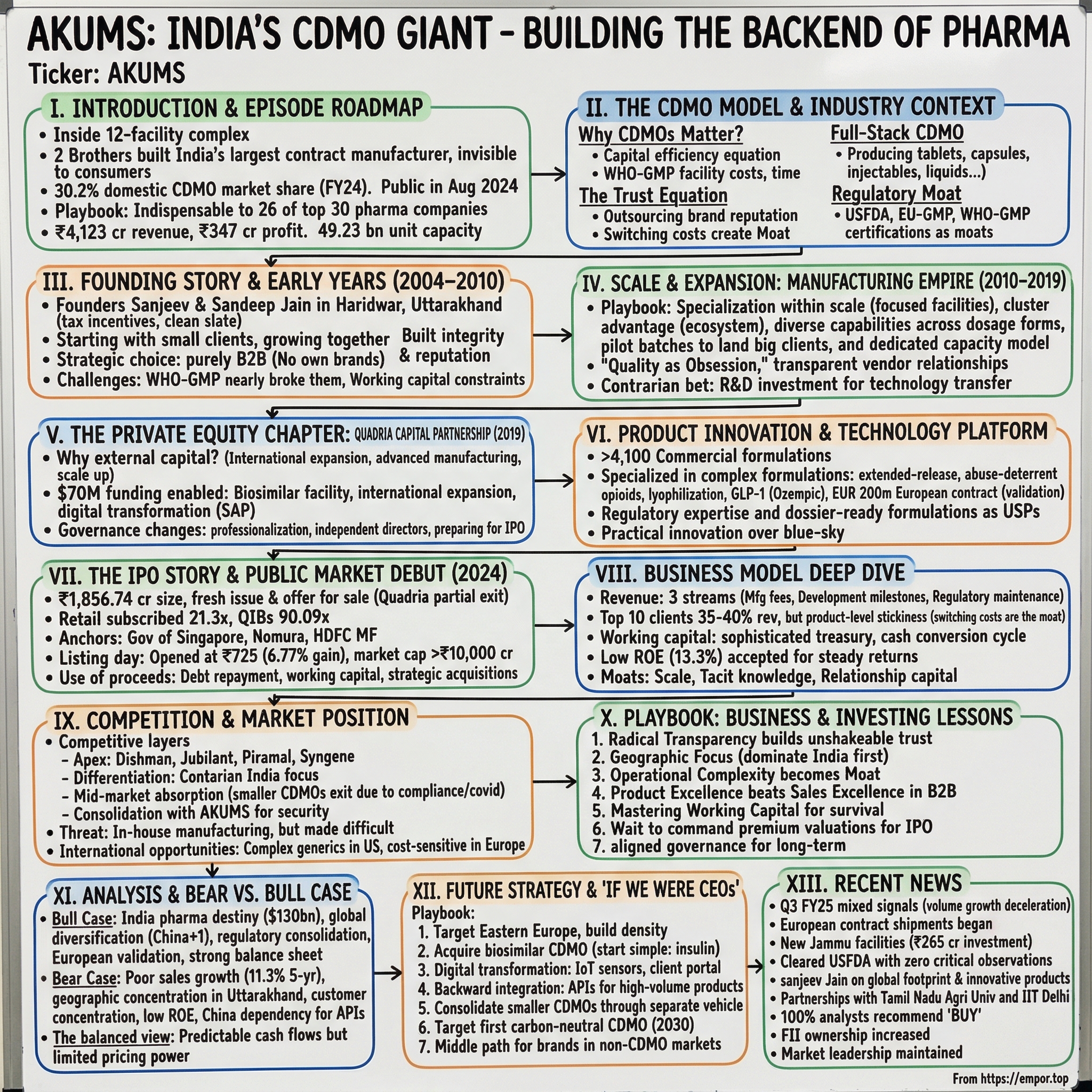
Akums Drugs and Pharmaceuticals: Building the Backend of Indian Pharma
I. Introduction & Episode Roadmap
Walk into a chemist's shop anywhere in India — a fluorescent-lit cubicle in Ludhiana, a glass-fronted counter in Chennai, a village dispensary in Bihar — and ask for a strip of antacids, an antibiotic, or a paediatric cough syrup. The box handed across the counter will carry a familiar brand name: Sun Pharma, Cipla, Mankind, Abbott, or Lupin. What it rarely displays in prominent lettering is the name of the contract manufacturer that actually produced the medicine.
There is a strong possibility that manufacturer was Akums Drugs and Pharmaceuticals.
By FY24, Akums held a 30.2% share by value of India's domestic contract development and manufacturing market — up from 26.7% in FY21 — positioning it as the largest India-focused CDMO by revenue, production capacity and clients served.1 Its ten formulation plants maintained an annual capacity of 49.23 billion units, roughly 4.5 times the second-largest assessed domestic peer.1 It served 1,543 clients across 60 countries and had commercialised more than 4,000 distinct formulations across 60 dosage forms since inception.1 By its FY25 annual report, that catalogue had grown to 4,146 commercialised formulations and 21,687 stock-keeping units, produced by a workforce of over 17,500 people.2
According to company disclosures, Akums accounts for roughly 12% of India's pharmaceutical production, running 15,000-plus employees and over ₹2,000 crore of invested manufacturing infrastructure across a portfolio that at one point spanned 16,500 SKUs.6 Its client roster includes established pharmaceutical leaders such as Lupin, Abbott, Cipla, Novartis, Merck and Ranbaxy, alongside Dabur, Marico and Procter & Gamble on the consumer side.6 Akums makes Eno and Gas-O-Fast.6 Most Indian households have consumed an Akums product without any practical way of knowing it.
Despite manufacturing a substantial share of what the country consumes, Akums remained largely unrecognised outside the industry until August 2024, when it listed on the NSE and BSE.
What makes the company an intriguing business case is that its operational scale and financial performance have diverged sharply — a gap driven not by operational failure, but by the structural economics of domestic contract manufacturing. Understanding those contracts is essential to evaluating whether recent performance reflects a broken business or a misunderstood asset.
The central question facing investors is straightforward: can a business that spent twenty years winning on scale, compliance and reliability in a cost-plus domestic market convert that position into the kind of returns that justify a public listing? For most of its first two years as a listed company, public markets remained skeptical. The stock fell 40% from its issue price.3 Its private equity backer sold every share it owned at ₹428 — roughly 37% below the ₹679 IPO price.4 Return on equity in FY25 was 7.40%.2
Then, over four quarters, key operational metrics began to shift. The core analytical task is separating durable structural changes from standard cyclical fluctuations.
Here is the route. Part I unpacks what a CDMO actually is and why Indian pharma is structurally handing its factories to third parties. Part II goes back to a 55-square-foot shop in Old Delhi and a muddy plot in Haridwar with no road, no power and no telephone. Part III covers the scaling decade, when Akums turned a tax-driven cost advantage into a dossier library that became something closer to a moat. Part IV examines capital allocation: the Quadria Capital partnership, the API acquisition that became a multi-year drag, and the move into colour cosmetics. Part V analyzes the IPO and the bruising public-market education that followed. Part VI dissects segment economics — specifically why a company with a 30% market share earns an 11% consolidated EBITDA margin. Part VII war-games the competitive set through strategic frameworks. Part VIII stress-tests management against eight quarters of earnings call commitments. Part IX builds the bull and bear cases alongside a risk radar. Part X extracts transferable operational lessons. Part XI looks forward.
Start with the business model, because almost everything that follows — the margins, the moat, and the structural friction — flows directly from it.
 Subscribe on LinkedIn
II. The CDMO Model & Indian Pharma Industry Dynamics
Consider the economics facing a mid-sized Indian pharmaceutical brand owner in 2015. She has a field force of 900 medical representatives, relationships with 40,000 doctors, and a portfolio of 40 brands. She wants to launch a fixed-dose combination for type-2 diabetes. To make it herself, she needs a granulation line, a compression suite, a blister packing hall, a quality control laboratory equipped with high-performance liquid chromatography instruments, a stability chamber, a qualified release officer, and a facility that can pass a drug controller inspection. That requires ₹15 crore to ₹20 crore of fixed capital and 18 months of development time for a product that might generate ₹8 crore a year.
Or she can call Akums.
The arithmetic of that choice reflects the broader industry dynamic. Building a plant ties up cash in a fixed asset that depreciates, requires staffing, and incurs auditing costs regardless of whether the product succeeds. Outsourcing converts those fixed commitments into a variable cost per batch that drops to zero if the product fails commercially. For a company whose core competitive asset is its sales force and doctor network, tying up capital in manufacturing infrastructure is a misallocation of resources. The brand owner's return on capital improves not by operating a plant more efficiently, but by exiting manufacturing entirely.
This trend extends beyond India. Global outsourcing penetration in the small-molecule market rose from 27% in 2017 and was projected to reach 37% by 2027, expanding the global CDMO market at a 6.8% compound annual rate from 2023 to 2027.1 Small molecules — conventional chemical therapeutics rather than biologics — represented approximately 80% of the global CDMO market in 2023, while commanding a 69.4% market share and accounting for 69.1% of US FDA approvals that year.1 This distinction is central to Akums' positioning: its operational footprint is concentrated in small-molecule oral solids, liquids, and injectables, placing it within the largest and most established segment of the outsourcing sector.
CMO versus CDMO — the distinction that matters. A contract manufacturing organization acts as a job shop: the client supplies the formulation recipe and specifications, and the contractor produces the batches. A contract development and manufacturing organization operates differently. It formulates the product in-house, validates analytical methods, generates stability data, compiles the regulatory dossier, and submits the filings. This difference is critical because the regulatory dossier — the documented technical record of chemistry, manufacturing, and controls — legally binds an approved product to a specific plant, production line, and manufacturing process.
That link creates substantial switching costs. Moving an approved drug from one facility to another requires running new stability batches (typically six months of accelerated testing and 12 months of real-time monitoring), potentially demonstrating bioequivalence, submitting a post-approval change filing to the regulator, and awaiting clearance. Throughout that period, the brand owner risks supply disruptions on a product actively marketed by its sales team. Consequently, switching suppliers to save 3% on conversion costs rarely makes financial sense.
Akums built its strategy around this locking-in mechanism. Rather than executing client recipes, it develops proprietary formulations and licenses the corresponding dossiers. The company received 559 dossiers since FY22 and holds 997 FSSAI approvals alongside its pharmaceutical filings.2 In FY24 alone, Akums secured 45 DCGI approvals — approximately 2.7 times the combined total of three assessed domestic peers for that year.1 For a brand manager, this shifts the procurement process from custom manufacturing to catalog selection: choosing a molecule and dosage form off the shelf enables commercial launch in weeks rather than quarters.
Why the outsourcing wave is structural, not cyclical. India's domestic CDMO market was valued at approximately $1.7 billion in FY24, out of a total addressable domestic manufacturing spend of $5.0 billion.1 Outsourcing penetration reached 33% in FY24 and is projected to expand to 39% by FY28, which would grow the served market to roughly $2.8 billion — representing a 14.3% compound annual growth rate over four years, compared with 8.3% over the prior five.1 The broader domestic formulation market expanded at 8.5% annually between FY19 and FY24 and is projected to grow at 9.6% through FY28.1
Capital expenditure trends among major brand owners highlight this structural transition. Between FY19 and FY23, capex as a percentage of revenue averaged 6.4% for Dr. Reddy's, 6.0% for Lupin, and 5.5% for Sun Pharma. By contrast, dedicated outsourcing providers like Divi's Laboratories and Suven Pharmaceutical recorded capex-to-revenue ratios of 11.5% and 12.2% over the same period.1 Major domestic pharmaceutical firms — including Cipla, Sun Pharma, Glenmark, Wockhardt, Emcure, Lupin, Intas, Ajanta, Mankind, Indoco, Zuventus, and Eris — have increasingly delegated manufacturing to third-party CDMOs.1 In FY24, Akums produced formulations for all ten of India's top pharmaceutical companies.1
Quality management represents another driver of outsourcing. When a production batch fails quality checks, the associated costs — product recalls, regulatory alerts, and brand damage — fall on the brand owner. Delegating production to a specialized facility transfers part of this operational risk. Between FY22 and FY24, Akums' manufacturing facilities underwent 58 regulatory inspections and 527 customer audits.1 Managing this continuous audit process serves as a core service for clients seeking to limit internal compliance overhead.
The honest caveat. These structural drivers clarify why the broader CDMO market is expanding and why incumbent providers retain client volumes. However, high switching costs and market growth do not automatically yield strong profit margins, particularly under cost-plus pricing structures. This dynamic remains a primary operational tension for the business.
To understand how Akums established its market position, the timeline traces back to a small shop in Old Delhi.
III. Founding Story & The Uttarakhand Arbitrage (2004–2010)
In 1984, a man named D.C. Jain — twenty years in the pharmaceutical wholesale trade before moving to Dalmia Cement, where he rose to company secretary — gave his two sons ₹1.5 lakh and told them to do something with it.5 The family lived in a two-room rented house in Shakti Nagar, north Delhi. Sanjeev was eighteen. Sandeep was sixteen, and would finish Class 12 that year, later taking a B.Com from Delhi University as a private student while running the business.5
They considered a juice stall and a paan shop. They chose medicines, on the entirely practical grounds that their father knew the trade.5 With the money they rented 55 square feet at Bhagirath Palace in Old Delhi — the chaotic warren of pharmaceutical wholesalers behind the Red Fort — and started buying and selling drugs.45 They ran that counter for two decades.
The observation that became a company. Wholesale is an information business disguised as a logistics business. Standing behind a counter for twenty years, the brothers watched something happen every monsoon: malaria season would arrive, demand would spike, and the medicines simply would not be there. When they pressed manufacturers on why they could not supply, one owner threw the question back at them: start your own factory, and we will buy from you.5
They did — first at Bhiwadi in Rajasthan in the mid-1990s, a small unit making their own line before drifting into contract work for others.6 That business taught them the mechanics. What made it a real company was a policy decision in Delhi.
The Haridwar bet. In 2003, the central government designated Uttarakhand, Himachal Pradesh and Jammu & Kashmir as excise-free industrial zones, offering exemptions designed to industrialise hill states.6 Capital moved fast. Sheds went up across the SIDCUL industrial area in Haridwar.
Akums was incorporated in Delhi in 2004 and the brothers put roughly ₹1.17 crore of accumulated savings into a plot at Haridwar, mortgaging the family home in Delhi to raise the rest; the initial project came to about ₹4 crore, of which around ₹1 crore was founder capital and the remainder debt.56 They bought 1.2 lakh square feet of land. It had no road, no electricity and no telephone line.5
The details of that first year are the kind that do not appear in a red herring prospectus. They funded and built an 800-metre road themselves so trucks could reach the site.5 They ran the plant on generators for years before grid power arrived.5 To speak to a client, someone had to walk a kilometre to the nearest telephone; eventually they erected an iron tower with stairs on the factory grounds so employees could climb high enough to find a mobile signal.5 They opened with 40 employees, 12 products, and exactly one customer — Intas Pharmaceuticals of Ahmedabad.5 The name Akums comes from a Sanskrit epithet of Shiva and means, roughly, "unique."5
The strategic bet that most competitors did not make. Here is where the Haridwar story diverges. A tax holiday is, by construction, temporary — the excise exemption ran ten years. The rational response for a purely opportunistic operator is to minimise sunk capital: put up a modest shed, buy the cheapest workable equipment, harvest the duty differential for a decade, and walk away with the cash. Across the industrial estates of Haridwar and Baddi, a great deal of that happened. Second-hand pharmaceutical machinery is a large and legitimate global market, and depreciated European lines — tablet presses, blister packers, filling machines retired from plants in Germany, Italy and Spain — could be bought and reinstalled at a fraction of new cost.
The claim frequently made about Akums, and central to how the company describes its own origins, is that it did the opposite: it bought new, built to international standard from the start, and ploughed cash flow back into the plants rather than out to the promoters. It is worth being straight with readers that Akums' public filings do not itemise new-versus-refurbished equipment purchases, so this specific contrast cannot be verified line by line from disclosure. What can be observed is the pattern the strategy would produce, and the pattern is there. Akums has invested over ₹2,000 crore in manufacturing infrastructure and describes its plants as running ultra-modern equipment across 16,500 SKUs.6 By FY24 it was the only assessed Indian CDMO with hormone and steroid capability, and the only one covering 29 of 34 catalogued dosage forms — against 12 for Tirupati Medicare, 8 for Synokem Pharmaceuticals and 6 for Innova Captab.1 Its dosage-form range was benchmarked as comparable to global leaders Catalent, Recipharm and Lonza.1 And the audit record — 58 regulator inspections and 527 client audits in three years — is not something a shed survives.
The economic logic is worth stating plainly, because it is the single most transferable idea in this story. A tax exemption is a subsidy on operating profit for a fixed number of years. Deployed into distributions, it disappears when the clock runs out. Deployed into compliant fixed assets and a client list, it becomes a permanent cost and capability position that outlives the policy. Akums used a ten-year fiscal window to fund a twenty-year infrastructure base.
Earning the first orders. Contract manufacturing is sold on a single promise: your batch will be ready, correct, and audit-proof. Akums was profitable from its first year and compounded gross turnover at roughly 67% annually from FY05 to FY13, from ₹17 crore to ₹1,025.9 crore.6 By 2013 it ran six plants in Uttarakhand and served over 200 clients including Abbott, Cipla, Novartis, Merck and Ranbaxy, and had quietly become the maker of consumer names like Eno and Gas-O-Fast.6 Two client quotes from that period tell the story better than the revenue line: Intas' chief financial officer said Akums had the best service levels and product quality of some eighty vendors, while a Lupin deputy general manager confirmed Akums was their single largest supplier at 35% of sourced drugs, at extremely competitive pricing.6
Note what is not in those quotes. Neither client mentions technology, novelty, or a unique molecule. They mention reliability and price. That is a description of an outstanding vendor, not a description of pricing power — and two decades later, that distinction still governs the margin structure.
The choice to stay in the back office. Through the growth phase, Akums largely resisted building a competing front-end brand at scale. The logic was defensible: a brand manager at Cipla will not hand her formulation to a supplier who might launch the same molecule under its own label next quarter. Trust in this industry is not sentiment; it is a commercial input. The company would later violate this principle in its trade generics business and pay for it, but the founding instinct was correct and it is why the client list assembled so quickly.
By 2010, Akums had proven the model. The next decade was about multiplying it.
IV. Scaling the Manufacturing Empire (2010–2019)
The Haridwar–Roorkee corridor of Uttarakhand is a flat industrial plain of boundary walls, water tanks, and truck yards that became the densest concentration of pharmaceutical manufacturing capacity in India during the 2010s. Akums' strategy through this expansion period was straightforward: build production capacity in tight geographic clusters.
The clustering playbook. By FY24, the company operated ten formulation manufacturing plants with 49.23 billion units of annual capacity—nine located in Haridwar, alongside a facility in Kotdwar acquired in 2021 and another in Nalagarh, Himachal Pradesh, acquired through Ankur Drugs and Pharmaceuticals.16 The Ankur acquisition was executed specifically to expand oral tablet and liquid throughput.1 Supporting these manufacturing units is a central warehouse facility in Haridwar.1
Geographic concentration alters the cost structure of a compliance-heavy manufacturing business. Quality assurance personnel, analytical testing laboratories, engineering maintenance teams, calibration schedules, warehousing, effluent treatment, and the institutional capability required to manage regulatory audits represent fixed overheads shared across adjacent sites. While a CDMO operating isolated facilities across multiple states cannot amortise these central costs efficiently, operating nine facilities within a 15-kilometre radius enables significant operational sharing. This facility density forms the foundation of Akums' scale advantage, creating a practical cost efficiency barrier against fragmented competitors.
R&D as the product, not the overhead. The second pillar of this growth phase was structuring formulation development as a commercial service rather than an internal cost centre. Akums operates four R&D centres—three dedicated to formulations and one at Barwala in Haridwar focused on active pharmaceutical ingredients (APIs), which includes a small-volume, high-potency API manufacturing unit.1 The R&D division employs over 350 scientists, including more than 250 with postgraduate or doctorate qualifications.2 R&D expenditure reached 2.8% of revenue in FY23 and 2.7% in FY24—a reinvestment rate higher than most domestic peers—and rose to ₹130 crore in FY25.12
This technical investment built development capabilities in specialized formulation categories, including complex fixed-dose combinations, modified- and sustained-release tablets, bilayer and tablet-in-tablet constructions, taste-masked paediatric suspensions, gummies, chewables, and softgels.1 The company also developed proprietary drug delivery technologies, such as Excederm for enhanced dermal penetration.1 These complex dosage forms present higher technical entry barriers for brand owners trying to manufacture in-house, generating higher conversion margins than standard immediate-release oral solids.
Technical capability expanded further into specialized dosage categories. By FY25, Akums added production capacity for eye drops, bi-layered tablets, ampoules, and form-fill-seal parenterals across small and large volumes, alongside nasal sprays, gummies, and lyophilised vials.2 New manufacturing sites at Kotdwar for penem anti-infectives and Haridwar for general injectables commenced operations, complemented by a multi-dosage facility at Baddi.2 The Barwala API research facility received accreditation from the Department of Scientific and Industrial Research (DSIR), while FY25 yielded 31 DCGI approvals and 117 FSSAI approvals.2 Each additions shifts the product mix away from commodity tablet compression toward specialized dosage formats with fewer qualified domestic vendors.
The proof of the operating machine. The operational elasticity of this multi-plant network was demonstrated during the COVID-19 pandemic, when Akums scaled production of Vitamin C and associated combination formulations 4.4-fold to meet unexpected demand surges.1 Absorbing this volume spike required real-time adjustments across batch scheduling, raw material sourcing, packaging procurement, and quality release across several plants. Customer feedback from this period centered on supply reliability and throughput during supply-chain dislocations rather than unit pricing.6
Volume elasticity as a competitive weapon. The manufacturing platform offers substantial batch-size flexibility. For example, Akums can run a Pantoprazole oral solid batch anywhere from 100,000 units to six million units (one lakh to 60 lakh units).1 This 60-fold range allows clients to launch a formulation at pilot volumes and expand to commercial scale without transferring technology, filing new dossiers, or repeating stability testing. This operational breadth enables Akums to capture the complete volume lifecycle of a successful pharmaceutical brand as its market distribution expands.
Customer acquisition tracked this capacity expansion, growing from 1,161 clients in FY21 to 1,524 in FY24, reaching 1,543 across 60 countries by the end of that fiscal year, and exceeding 1,600 total clients—including over 1,400 in the core CDMO division—by FY25.12 International commercial operations were formalised through a dedicated marketing subsidiary, Unosource Pharma, established in 2014, expanding export operations to over 70 countries.26
What scale did and did not buy. Large-scale operations provide clear procurement advantages: purchasing active ingredients and excipients for 49 billion units annually yields lower input costs than purchasing for five billion units. However, because a large portion of contract manufacturing contracts are structured on cost-plus terms, much of this raw-material cost saving is passed through to brand owners rather than retained as operating margin.
This structural dynamic highlights the primary financial trade-off of Akums' expansion. The company built the largest and most broadly audited formulation platform in domestic Indian pharma, capturing a 30.2% market share, yet this market dominance did not produce high profit margins. In FY25, CDMO segment earnings before interest, tax, depreciation, and amortisation (EBITDA) stood at ₹418.2 crore on segment revenue—a 13.03% margin, down from 14.90% in FY24.2 While typical for contract manufacturing operations, these margins remain modest for a market leader operating at 4.5 times the capacity of its nearest domestic competitor.
Akums demonstrated that it could build and operate manufacturing scale. The strategic question facing the business was whether subsequent capital allocation could generate returns proportionate to that physical footprint.
V. M&A, Capital Deployment & The PE Chapter (2019–2024)
Every founder-run Indian industrial business eventually faces a choice: remain private, family-held, and closely guarded, or accept institutional capital and the governance framework that comes with it. Akums took institutional capital in 2019.
Quadria arrives. Quadria Capital, a Singapore-headquartered healthcare private equity firm, invested approximately $70 million—around ₹500 crore—for a minority stake held through Ruby QC Investment Holdings Pte Ltd.6 Industry analysis of private equity investments in Indian contract manufacturers records Quadria's stake at 15.09%.1 The shareholder agreement was executed on 3 October 2019.2
The explicit rationale was institutionalisation: adding independent directors, establishing formal board committees, implementing environmental, social, and governance frameworks, standardising audit processes, and strengthening the balance sheet for an eventual public listing. Governance structures were indeed upgraded. The board added independent directors including Kewal Handa, Matangi Gowrishankar, and Satwinder Singh, alongside Sunil Kumar Thakur as a non-executive director representing the investor.2 Walker Chandiok & Co LLP was appointed statutory auditor, complemented by internal management audits from Ernst & Young LLP and Protiviti.2
This transaction reflected a broader sector trend across Indian pharmaceutical manufacturing. During this period, global institutional investors deployed substantial capital into Indian pharmaceutical outsourcing: Goldman Sachs acquired 33% of Aragen, Everstone bought 70% of Rubicon Research, Carlyle took 20% of Piramal Pharma Solutions, Advent acquired 50.1% of Suven Pharmaceutical, TA Associates backed Synokem, and Morgan Stanley Private Equity alongside InvAscent secured a majority position in Maiva Pharma.1 This capital inflow signalled that institutional investors had reached a consensus on the structural shift toward outsourcing—betting on backend suppliers rather than individual brand owners. Crucially, it also meant sector valuations were increasingly established by financial sponsors operating with fixed exit timelines.
One structural feature of the agreement temporarily distorted the company's reported earnings. Quadria's investment included exit rights that imposed a buyback obligation on Akums if the fund chose to put its shares back to the company. Under Indian Accounting Standard 109, this obligation was classified as a financial liability, requiring fair-value remeasurements at each reporting period that flowed directly through the profit and loss statement.2 Consequently, statutory earnings in FY24 appeared artificially depressed, showing net profit of just ₹0.79 crore and a return on equity of 0.11%, compared to an adjusted return on equity of 17.19% when stripping out the put-option accounting entries.2 Ruby QC formally waived these exit rights on 29 May 2024, shortly before the public offering filing.2 Evaluating FY24 comparative financial performance without isolating this accounting adjustment presents an inaccurate picture of underlying operations.
The API acquisition, and what it cost. In December 2019, Akums acquired insolvency-bound bulk drug manufacturer Parabolic Drugs through the Insolvency and Bankruptcy Code framework. The transaction brought three manufacturing units across Punjab and Haryana capable of producing over 40 active pharmaceutical ingredients—focused primarily on beta-lactams and cephalosporins—and integrated them into a subsidiary, Akums Lifesciences.6 The strategic intent was classic backward integration: secure key raw materials, buffer against Chinese supply disruptions, and capture internal API manufacturing margins.
Subsequent execution, however, diverged sharply from strategic goals.
The active pharmaceutical ingredient division generated persistent losses following the acquisition. Segment EBITDA recorded losses of ₹45.5 crore in FY24 and ₹42.8 crore in FY25, representing negative segment margins of 21.42% and 19.52% respectively.2 Annual API revenue stood at ₹219 crore in FY25.2 By FY26, the segment recorded an EBITDA loss of ₹40 crore, compared to a ₹44 crore loss the prior year.7 More than six years after the purchase, the bulk-drug business remained unable to cover its cash operating expenses.
Three compounding factors explain this underperformance. First, cephalosporin production is a high-volume commodity business where Chinese manufacturers maintain structural cost advantages in key starting materials. Second, the facilities suffered from structural scale mismatches; the FY25 annual report noted that capacity for individual API products exceeded market requirements by over 160%—a dynamic described as built-in supply resilience, but reflecting operational underutilisation.2 Third, integrating distressed assets introduced legacy restructuring overhead that exceeded initial projections.
Ultimately, a sound strategic concept faltered due to asset selection, consuming management bandwidth and capital over six years. Rather than mitigating supply-chain risk, the acquisition became a primary drag on consolidated margins. Notably, company disclosures quietly reduced the count of operational API facilities from three at acquisition to two by early 2026, indicating capacity rationalisation occurred without a formal restructuring announcement.18
Pure & Cure and the cosmetics adjacency. Pure and Cure Healthcare Private Limited operates as a wholly owned subsidiary managing dedicated high-end formulation facilities. On 23 July 2026, its board approved the acquisition of Oriflame India Private Limited's manufacturing assets for ₹56 crore in cash, encompassing two production units in Roorkee, Uttarakhand and Noida, Uttar Pradesh, along with a leased warehouse in Noida, with completion scheduled for 31 August 2026.9 Brand rights and marketing channels for Oriflame products in India were explicitly excluded from the deal.9 Management cited entry into colour cosmetics and expanded manufacturing of skincare and wellness products as the primary strategic objective.9
Rather than buying a consumer brand, Akums acquired manufacturing infrastructure to extend its backend CDMO model into personal care. Contract manufacturing for cosmetics commands higher gross margins than basic oral solid formulations and operates free of price controls. Because the Roorkee facility is situated within the existing Haridwar cluster, shared logistics and administrative overhead apply. The purchase price of ₹56 crore presents limited balance-sheet risk given a net cash balance of ₹1,616 crore as of June 2026.10 However, operational risk remains relevant: this marks the company's second major expansion outside core pharmaceutical formulations, while the earlier API acquisition continues to incur operational losses. The key milestone for Pure & Cure will be establishing positive margin contributions within a defined operational window.
Whether management establishes transparent performance benchmarks for non-core investments became a central focus when the company went public in August 2024.
VI. The IPO Debut & Public Market Reality (2024–Present)
The bell rang on 6 August 2024. Twenty years after two brothers mortgaged their home to build an 800-metre road across a plot of empty land in Haridwar, Akums Drugs and Pharmaceuticals listed on both Indian exchanges.2
Anatomy of the offer. The book opened on 30 July 2024 and closed on 1 August, priced between ₹646 and ₹679 per share, raising a total of ₹1,856.74 crore.11 The transaction combined a ₹680 crore fresh issue with an offer for sale of roughly 1.73 crore shares valued at about ₹1,177 crore from selling shareholders Sanjeev Jain, Sandeep Jain, and Ruby QC.12 Fifty anchor investors allocated ₹828.78 crore for 1.22 crore shares at the top of the price band on 29 July.12
Demand was heavy, closing 63.56 times subscribed overall, led by qualified institutional buyers at 90.09 times, non-institutional investors at 42.21 times, and retail investors at 21.3 times.1314 Despite this demand, the stock debuted at ₹725, reflecting a modest 6.8% listing premium over the issue price.
The subscription metrics revealed two distinct market signals. First, institutional demand demonstrated widespread confidence in Akums' market-share dominance. Second, the modest listing pop relative to a 63-times subscribed book indicated that the IPO had been fully priced near fair value.
What the money did. Proceeds from the fresh issue were earmarked to repay company and subsidiary debt, fund working capital, pursue acquisitions, and support general corporate needs.11 Deleveraging followed rapidly, with the consolidated debt-to-equity ratio dropping from 0.69 as of 31 March 2024 to zero by 31 March 2025.2 By June 2026, Akums accumulated a net cash balance of ₹1,616 crore with zero debt, keeping 98% of those funds in fixed deposits with nationalised banks.10
Eliminating interest expense provided a permanent boost to the earnings base for a company that had historically relied on debt and internal accruals to finance plant expansion. However, it also created a fresh capital allocation challenge. Maintaining ₹1,616 crore in low-yielding bank deposits does not constitute a growth strategy, and during the Q1 FY27 earnings call, management noted that the cash reserves were intended for value-accretive acquisitions without identifying targets or timelines.10 In light of the earlier API acquisition performance, uncommitted capital earmarked for future transactions introduces lingering operational risk.
The education. Public markets repriced the stock quickly. On 12 November 2024, following soft second-quarter results, the shares hit a 10% lower circuit at ₹645.30—falling below the IPO price after a two-day, 19% drop from ₹796.60 on 8 November.15 On the surface, the quarter's headline metrics appeared stable, with total income of ₹1,046.6 crore, adjusted EBITDA of ₹134.7 crore, and adjusted profit after tax of ₹66.7 crore, which was up 16% sequentially.16 However, management attributed muted CDMO growth to falling active pharmaceutical ingredient prices—which mechanically deflate revenue under cost-plus contracts—while noting lower sales in trade generics and APIs amid efforts to reduce segment losses.15
This performance clarified the mechanics of the business model. Because contract revenue depends on input costs plus a fixed conversion fee, lower raw material prices depress top-line growth even when unit volumes remain steady. Investors anticipating a high-margin growth compounder recognized that the core business functioned more like a volume-driven toll operator tied to commodity pricing cycles.
A sustained de-rating followed. By early July 2025, the stock had fallen 40% below its listing price,3 eventually reaching a 52-week low of ₹409.30.17 On 24 December 2025, private equity sponsor Ruby QC sold its remaining 4.62% stake—comprising 72.78 lakh shares—at an average price of ₹428 per share, generating ₹311.52 crore in an open-market block trade bought by ICICI Prudential Mutual Fund.4 Having previously monetised a substantial stake through the IPO offer for sale,18 the sponsor completed its exit at a 37% discount to the IPO issue price.
The turn. Operational metrics began to recover in late 2025. The December 2025 quarter marked an inflection point: revenue reached ₹1,160 crore, up 14.8% year over year and 14% sequentially, while adjusted EBITDA rose 21% to ₹147 crore, lifting operating margins to 12.7% as capacity utilization improved and newer facilities expanded production.29 CDMO segment revenue grew by more than 16% on double-digit volume expansion, the international branded business doubled sequentially following demand recovery, and cash reserves reached ₹1,573 crore.29 This marked the first reporting period where management's explanation—that underlying volume growth remained steady despite raw-material price deflation—aligned with margin expansion.
For the full year FY26, operating revenue rose 5.9% to ₹4,359 crore from ₹4,118 crore, while adjusted EBITDA grew 13.3% to ₹522 crore and adjusted profit after tax increased 27.3% to ₹276 crore.7 Fourth-quarter performance drove much of the annual gain: revenue reached ₹1,158 crore compared to ₹1,056 crore in the prior-year period, adjusted EBITDA rose 61.6% to ₹152 crore from ₹94 crore as margins expanded from 8.9% to 13.1%, and adjusted profit after tax surged 135% to ₹83 crore.7 Consequently, the board recommended a final dividend of ₹1 and a special dividend of ₹2 per share.7
The momentum continued into the June 2026 quarter, with revenue rising 13.9% year over year to ₹1,166.6 crore, operating EBITDA climbing 35.4% to ₹175 crore at a 15.0% margin, and profit after tax growing 56.1% to ₹101 crore.1019 By August 2026, the stock recovered from its ₹409 low to trade near ₹770—approaching its 52-week high of ₹780.85—giving the company a market capitalization of approximately ₹11,800 crore.17
The critical analytical question is what drove the margin expansion. Three factors converged: double-digit CDMO volume growth coincided with a reversal in API input prices, which inflated cost-plus revenues and improved fixed-cost absorption; higher-margin facilities scaled up operations; and losses in auxiliary segments narrowed. Gross margin expanded from 43.2% to 44.7% year over year.19 While these results reflect genuine operational progress, a portion of the financial recovery reflects a favorable commodity price cycle rather than structural contract repricing or newfound pricing power.
Evaluating whether these gains are durable requires examining the underlying business segments.
VII. Segment Breakdown, Financials & Unit Economics
Here is the puzzle in one sentence. Akums holds roughly 30% of its domestic market, runs the broadest dosage-form platform in the country, and earned a consolidated EBITDA margin of about 11% in FY25 — while Indian pharmaceutical peers were earning 24% to 35%.3
That gap is not an accident, a management failure, or a temporary condition. It is the business model, and understanding it is the single most important thing an investor in this company can do.
The cost-plus mechanic. In the dominant CDMO contract structure, the client pays Akums the cost of raw materials plus a fixed conversion fee.3 Think of it as a toll on a bridge where the toll is set as a percentage of the value of the cargo. Three consequences follow, and none of them are intuitive.
First, revenue is not a measure of demand. When API prices fall, the pass-through component of revenue falls with them even if Akums is running more batches than ever. This is precisely what happened in FY25 and the first half of FY26, and it is why the company kept reporting flat-to-negative revenue while insisting volumes were growing. In the September 2025 quarter, revenue fell 1.45% to ₹1,018 crore and EBITDA fell 22.3% to ₹94 crore, with PAT down 35.8% to ₹43 crore — while CDMO volumes grew 7% year on year against a much weaker industry.20 Both statements were true.
Second, efficiency gains do not fully accrue to Akums. If the company negotiates a better excipient price or improves batch yield, a meaningful share flows back to the client through the cost line. This is the opposite of a Divi's Laboratories, which controls patent-protected chemistry and keeps what it saves.
Third, margin expansion has to come from mix, not from price. The only levers that genuinely move the consolidated number are shifting production toward complex dosage forms with higher conversion fees, filling expensive new plants, and eliminating loss-making segments.
The FY25 segment map. Roughly 78% of revenue came from the CDMO vertical at about a 14% EBITDA margin. Domestic branded formulations contributed about 11% at 17.7%. International branded contributed about 3% at 19.3%. APIs were about 5% at negative 20%. Trade generics were about 3% at negative 24%.3 In the annual report's own segment disclosure, CDMO results before depreciation were ₹418.2 crore at 13.03%, APIs were negative ₹42.8 crore at negative 19.52%, and branded and generic formulations together were ₹97.1 crore at 14.05%.2
Read that carefully and the arithmetic of the turnaround becomes obvious. The two smallest segments — about 8% of revenue combined — were destroying roughly ₹70 crore of EBITDA a year against a base of around ₹500 crore. Simply stopping the bleeding was worth 150 basis points of consolidated margin without selling a single additional tablet.
Segment one: the CDMO engine. This is the business and it is performing. In the June 2026 quarter CDMO revenue reached ₹964 crore, up 18.6%, with segment EBITDA of ₹163 crore, up 36.8% — margins expanding faster than revenue, which is the signature of operating leverage on a fixed-cost plant base.19 In the March 2026 quarter, CDMO revenue was ₹952 crore against ₹840 crore, with EBITDA of ₹137 crore and margin rising from 10.6% to 14.4%.7 CDMO contributed 80% of FY26 revenue.7
The economics here are throughput economics. What moves the needle is line utilisation, batch yield, and product mix — an injectable or a lyophilised vial earns a materially higher conversion fee than a plain compressed tablet, because fewer competitors can make it and the failure cost is higher. The newer sterile and lyophilisation capacity is precisely a mix play, and as of mid-2025 those plants were running below 10% utilisation with a stated target of 60% by FY27 at 18–20% margins.3 If that utilisation ramp lands, it is worth more to consolidated margin than anything else management is working on. If it does not, the depreciation on those plants becomes a drag.
Segment two: branded and trade generics. Domestic branded formulations, sold through subsidiary Akumentis Healthcare, generated ₹446 crore in FY26, up 2.9%, with EBITDA of ₹90 crore, up 17.0%.7 Akumentis ranks 58th in the Indian pharmaceutical market with 73% of revenue from chronic and sub-chronic therapies — a favourable mix, since chronic prescriptions renew.2 International branded was ₹143 crore in FY26, flat, but EBITDA rose 32.3% to ₹36 crore.7
Trade generics is the interesting one, because it is the story of a strategic error being corrected. Selling unbranded generics through the distribution trade put Akums into direct competition with the very brand owners whose products it manufactured — a textbook channel conflict in a business whose entire asset is client trust. Management chose the clients. Revenue has been deliberately shrunk; the FY26 EBITDA loss narrowed to ₹10 crore from ₹28 crore, and the fourth quarter turned positive at ₹1.4 crore.7 By June 2026 the segment was at ₹21 crore of quarterly revenue, down 9.5%, at breakeven versus a ₹5 crore loss a year earlier.19
This deserves credit as a capital allocation decision. Voluntarily shrinking a revenue line to protect a relationship is unusual and, here, correct.
Segment three: the API problem. June 2026 API revenue was ₹32 crore, down 29.7%, with a ₹4 crore loss against ₹6 crore.19 The losses are narrowing because the mix is shifting away from commodity cephalosporins toward higher-margin non-cephalosporin molecules — management named lansoprazole and montelukast on the Q1 FY27 call, with the Q1 filing coverage also citing linezolid.1019 Akums holds 20 Drug Master Files and serves 197 API clients.2
The trajectory is right. The timeline is the issue, and it has moved. Where earlier guidance pointed to FY26, management now targets monthly EBITDA positivity by February or March 2027 and a positive contribution at the corporate level only in FY28.10 Analysts on the call asked directly whether the segment should simply be discontinued; management said it remains fully committed.10 An investor is entitled to hold both thoughts: the commitment may be right, and the repeated slippage is a fact about management's forecasting.
Myth versus reality. Three consensus beliefs about this company deserve testing against the record.
Myth: a 30% market share means pricing power. Reality: it does not, because the contract form transfers input economics to the client and caps the conversion fee. Market share here buys volume security and cost absorption, not price. The evidence is the margin itself — a dominant player earning roughly 11% while sub-scale specialists in complex delivery earn multiples of that.3 Share and margin are separate variables in this industry, and Akums is proof.
Myth: the FY26 recovery proves the turnaround worked. Reality: it proves part of it worked. Volume growth, sterile ramp-up and the elimination of two loss-making segments are genuine, durable improvements. But the same period saw API prices turn from falling to rising, which mechanically inflates a cost-plus revenue line and improves fixed-cost absorption. Management itself attributed first-quarter FY27 growth to double-digit volumes along with improvement in API prices.10 Separating the two is the central analytical task, and no disclosure currently on the record lets an outside investor do it precisely.
Myth: Akums is India's answer to Lonza or Catalent. Reality: on dosage-form breadth, the comparison genuinely holds — the industry assessment placed Akums' range alongside those global leaders.1 On business model, it does not. Akums sells conversion capacity into a domestic market at cost-plus; the global leaders sell development capability into regulated markets at negotiated value. The European contract is precisely an attempt to close that gap, which is why it matters far more than its headline value suggests.
What the numbers mean. Akums is not a high-margin business masquerading as a low-margin one. It is a genuinely low-margin, high-volume, capital-intensive contract manufacturer whose consolidated margin can plausibly reach the mid-teens — management guides 14% to 15% for FY27, with a possible lean toward the upper end after a strong first quarter.10 The realistic bull outcome is a durable 15% EBITDA business with 20%+ returns on capital as the cash gets deployed. The realistic bear outcome is a 12% business whose reported growth oscillates with API pricing. Neither outcome makes this a compounder in the Divi's mould, and investors who underwrite it as one are underwriting the wrong company.
Whether even the good outcome is defensible depends on who else is competing for the same batches.
VIII. Competitive Landscape, Industry Structure & The 7 Powers
Picture a procurement head at a top-ten Indian pharmaceutical company running a tender for a new fixed-dose combination. She has perhaps six credible names on her list. Understanding what happens in that room explains the competitive structure of the entire sector.
The domestic field. Akums sits alone at the top of the domestic formulation CDMO segment. Its 30.2% value share of the domestic CDMO market compares against a long tail of substantially smaller players.1 Windlas Biotech is the closest philosophical comparison—Dehradun-based, domestic-formulation-focused, and credible, though materially smaller in dossier count and complex-formulation share. Innova Captab is a mid-scale peer with a growing export orientation but a far narrower dosage-form footprint, present in just six of 34 catalogued forms against Akums' 29.1 Tirupati Medicare with 12 forms, and Synokem Pharmaceuticals with eight forms—backed by private equity firm TA Associates and expanding into injectables via a 74% stake in Nitin Lifesciences—round out the assessed domestic set.1
Then there are the companies that look like competitors on paper but operate in different arenas. Rubicon Research, backed by Everstone, focuses on complex drug delivery for regulated markets with high margins and low volumes. Jubilant Pharmova is a diversified global player weighted toward radiopharmaceuticals and US contract manufacturing. Syngene International, the Biocon subsidiary, sells discovery research and biologics development to global innovators. While Syngene competes with Akums for the broad label of "Indian CDMO," they share virtually no overlap in actual business. Comparing Akums' margins to Syngene's is like comparing a bus fleet operator to an architectural practice.
The genuinely relevant global benchmarks are Lonza, Catalent, and Recipharm. Industry benchmarking showed that Akums' dosage-form breadth was assessed as comparable to theirs, while its cost base is not.1 That divergence defines the core export opportunity.
Helmer's 7 Powers, applied honestly.
Scale economies—strong, and the clearest advantage. Operating nine plants in a single corridor, sharing quality, regulatory, engineering, and warehousing overhead across 4,146 commercialised formulations and 21,687 SKUs, creates a cost position no domestic rival can replicate without a decade of capital.2 A production capacity 4.5 times larger than its nearest domestic peer serves as quantitative proof.1
Switching costs—strong and demonstrable. The regulatory dossier mechanism creates a strict binding constraint, while a client base expanding from 1,161 to 1,543 over three years with long-standing relationships serves as behavioural evidence.1 Furthermore, a 60-fold batch-size flexibility ensures clients rarely outgrow the relationship as product volumes scale.
Process power—moderate to strong, but difficult to monetize. Two decades of technical transfers, low batch failure rates, and the capability to navigate 527 client audits in three years represent genuine accumulated know-how.1 However, under cost-plus contract structures, process power generates vendor preference rather than premium pricing. Akums wins the tender, but it does not set the fee.
Counter-positioning—weak, and historically negative. The expansion into trade generics represented counter-positioning in reverse, as Akums entered a business line that directly competed with its own brand-owner clients. Management has since moved to unwind that channel conflict.
Branding, network economies, cornered resources—largely absent. As a business-to-business contract manufacturer, Akums possesses no consumer brand equity, no network effects, and no exclusive control over scarce raw inputs.
The composite strategic picture reveals two strong powers driving volume retention and cost efficiency, but none granting pricing power. That produces a defensible market position rather than a high-margin enterprise—a dynamic reflected directly in reported financial results.
Porter's five forces.
Supplier power—high, and the primary external risk. India's reliance on Chinese active pharmaceutical ingredients and key starting materials remains a structural vulnerability. Akums notes imports account for only 6% of sales, offering a natural hedge alongside multiple sourcing routes and surplus inventory.2 While these measures mitigate physical supply disruptions, they do not insulate the company from price swings, as demonstrated by the revenue contraction during FY25 and the first half of FY26.
Buyer power—moderate to high. Major domestic pharmaceutical companies operate with significant purchasing scale, technical sophistication, and concentrated volumes, giving them strong bargaining leverage. While dossier registration locks in existing product lines, brand owners retain full negotiating power when allocating new formulation contracts.
Threat of insourcing—moderate and volume-dependent. The primary risk is not client attrition to a competitor, but rather a client moving a high-volume blockbuster formulation in-house once commercial demand justifies building a dedicated production line. This dynamic places a natural ceiling on earnings from any single product.
Threat of new entrants—low. High capital intensity, stringent regulatory audit requirements, and mandatory compliance track records present formidable entry barriers at scale. While small manufacturers frequently enter the unorganised market segment, they lack the accreditation required to compete for major corporate tenders.
Industry rivalry—rational at the top, aggressive at the bottom. Competition among established CDMOs capable of serving top-tier pharmaceutical clients remains disciplined. Conversely, competition for unbranded, low-complexity formulations is intense on price. This disparity explains why Akums' strategic shift toward injectables, lyophilised products, and hormone formulations matters more for future profitability than aggregate volume growth.
The structural reality is that Akums holds the dominant position within a domestic industry whose underlying economics remain moderately constrained. Elevating return metrics requires expanding higher-margin exports into regulated international markets or shifting the product mix toward specialized dosage forms with fewer qualified competitors. Management maintains that both initiatives are underway, making operational execution against those targets the primary test of performance.
IX. Management & Governance Stress Test
Sandeep Jain, according to one account of his career, has taken fewer than forty days of leave in forty years.5 That track record represents either disciplined operational commitment or key-person risk, depending on an investor's perspective, and it reflects the underlying character of the company's leadership: intensely operational, founder-driven, and—until August 2024—unaccustomed to quarterly conference calls with public markets.
Ownership and alignment. Sanjeev Jain and Sandeep Jain serve as joint Managing Directors, with promoter holdings remaining around 75%.21 This concentration creates close alignment, as the founders' wealth remains tied to equity performance, though it also limits the public float and concentrates board influence.
Governance structures have evolved since listing. Sandeep Jain stepped down from the Audit Committee on 6 February 2025, leaving it chaired by independent director Kewal Handa alongside Matangi Gowrishankar, Satwinder Singh, and non-executive director Sunil Kumar Thakur.2 This voluntary removal of an executive promoter from audit oversight builds on the company's pre-IPO decision to establish independent audit and remuneration committees to satisfy multinational client standards.6
The family payroll. Related-party disclosures in the FY25 annual report list each Managing Director's remuneration at ₹8.18 crore, up from roughly ₹5.4 crore the prior year.2 The disclosures also list seven relatives of key management personnel on the payroll: Arushi Jain at ₹0.76 crore, Kanishk Jain at ₹0.73 crore, Lata Jain at ₹0.55 crore, Archana Jain at ₹0.54 crore, Umang Jain at ₹0.24 crore, Shivangi Jain at ₹0.22 crore, and Manan Jain at ₹0.03 crore.2 While these expenses are small relative to ₹4,118 crore in revenue, they highlight family representation across executive ranks. Additionally, second-generation family members—Arushi Jain as Director of Corporate Growth and Excellence, and Kanishk Jain as Director of Operations Marketing at Akumentis—co-authored a signed shareholder letter in the annual report,2 indicating that leadership succession is aligning with family lineage rather than formal external selection.
The capital allocation scorecard. Organic capital deployment has driven compounding in the core formulation business, funded largely through internal accruals and achieving a fixed-asset turnover ratio of 2.95 times in FY25.2 Inorganic expansion has proven more challenging: the acquisition of distressed bulk-drug assets has failed to earn its cost of capital over six years, continuing to weigh on consolidated returns. A return on capital employed of 14.45% in FY25 alongside a 7.40% return on equity illustrates an operating model diluted by balance-sheet structure,2 particularly with ₹1,616 crore currently held in low-yielding bank deposits.10
What the calls reveal. A sequential analysis of earnings call transcripts outlines management's execution against guidance.
Target timelines for the API business show persistent adjustments. Management shifted its breakeven target from FY26 to achieving monthly EBITDA positivity by February or March 2027, with positive corporate-level contributions deferred to FY28.10 While explanations have consistently cited a product mix shift away from bulk cephalosporins toward higher-margin non-cephalosporin molecules, repeated target revisions have drawn analyst scrutiny, including direct questions regarding potential division divestment.10
Conversely, communications regarding the core CDMO business have proven more reliable. Management directed focus toward volume expansion ahead of top-line recovery, and volume growth continued through active pharmaceutical ingredient price deflation—recording 7% growth in the September 2025 quarter, double-digit expansion throughout FY26, and high-teens guidance for the September 2026 quarter.1020 Highlighting volume over headline revenue provided early clarity on underlying operational strength.
The domestic branded segment presents a distinct operational test. Segment margins declined by 25.4% in the June 2026 quarter, which management attributed to a 15% expansion in sales personnel through the hiring of 200 field-force staff, projecting margin recovery as productivity scales.10
Regarding the ₹1,616 crore net cash reserve, management maintains that capital remains designated for value-accretive acquisitions.10 Given historical API integration delays, capital deployment performance will depend on strict asset selection.
Earlier communication patterns also offer context on strategy execution. Following soft results in September 2024, management cited specific operational targets: strengthening CDMO market share, expanding domestic and export branded formulations, and reducing losses in bulk drug manufacturing and trade generics.15 By FY26 and early FY27, trade generics reached breakeven, API segment losses narrowed,7 and the CDMO division expanded to 80% of total revenue.19
Second-layer signals. Statutory audits by Walker Chandiok & Co LLP for FY25 contained no qualifications, while put-option liabilities that affected FY24 reported results were disclosed in financial notes.2 Board oversight also saw structural updates, as independent director Nand Lal Kalra departed all committees on 5 February 2025, and Sanjay Kumar Sinha was appointed whole-time director with annual compensation increasing from ₹0.21 crore to ₹1.32 crore.2 Related-party transactions for FY25 included ₹3.56 crore in sales to May and Baker Pharmaceuticals Limited and ₹1.14 crore in transactions with promoter-linked charitable trusts.2
Ownership structure shifted in December 2025 when private equity firm Ruby QC fully exited its position, with a domestic mutual fund acquiring the remaining block.4 This transaction transferred shares from an early-stage institutional sponsor completing its fund lifecycle to institutional investors underwriting operational turnaround initiatives.
Which sets up the argument over what happens next.
X. Bull vs. Bear Case & Investor Risk Radar
The bull case.
Regulated-market exports, finally arriving. On 24 December 2024, Akums announced a contract with an undisclosed global pharmaceutical company with annual revenues exceeding $10 billion. Valued at approximately €200 million (around ₹1,760 crore), the agreement covers the manufacture and supply of multiple oral liquid formulations for European markets, with commercial supply scheduled from 2027 through 2032.22 The transaction includes an upfront payment of €100 million (roughly ₹880 crore) upon securing regulatory approvals to fund development and site qualification.22
Crucially, this initiative has moved past initial commitments. In February 2026, Akums secured EU GMP certification for its oral solid dosage facility and its oral liquid unit—the key plant for the contract—alongside its first UK MHRA approval for rivaroxaban.823 During FY26, the company completed its first commercial supply of formulations to Europe and received Brazilian ANVISA approval for its injectable plant.7 On the Q1 FY27 earnings call, management targeted FY28 for commercial European operations, projecting a margin profile in the upper teens.10 Achieving this goal would mark Akums' first major commercial footprint outside domestic cost-plus contracts.
A cleaned-up balance sheet. Achieving a zero-debt position with ₹1,616 crore in net cash ensures that operational gains in CDMO EBITDA flow directly to net profit rather than interest coverage.10 This cash balance also funds the Baddi oral facility, targeted for completion by end-FY27, and the Zambia joint venture without requiring equity dilution.10
Structural outsourcing tailwind. As established earlier, brand owners' disciplined capital expenditure provides ongoing evidence of this shift.
Mix migration into complex forms. The commissioning of a sterile facility at Haridwar in January 2025 for lyophilised products, vials, ampoules, form-fill-seal lines, and ophthalmic and otic drops expanded platform capabilities into higher-value dosage formats.24 In-licensing agreements—such as the October 2024 deal with Canada's Triple Hair Group for Therapy-07 in India, and the December 2024 partnership with South Korea's Caregen for peptide- and growth-factor-based dermatology and metabolic products—extend Akums beyond conventional contract manufacturing into proprietary formulations.2526
Africa optionality. On 22 August 2025, Akums signed a framework agreement to construct a manufacturing facility in Zambia's Lusaka South Multi-Facility Economic Zone, holding a 51% stake in the joint venture. The Zambian government committed to purchasing $25 million of medicines annually from Akums' Indian plants in 2026 and 2027 during facility construction.[^27]27 Management projects approximately ₹240 crore of revenue from this arrangement in the second half of FY27.10 This agreement establishes a government-backed order book to support entry into a market lacking incumbent domestic manufacturers.28
The bear case.
Returns still lag. A return on equity of 7.40% in FY25 trails domestic pharmaceutical peers significantly, marking a key structural concern.2 Similarly, a consolidated EBITDA margin of around 11% compared to peer margins of 24% to 35% reflects the structural limitations of cost-plus contracting.3 Even optimistic projections cap consolidated margins in the mid-teens.
Input-cost exposure runs both ways. Reliance on Chinese key starting materials exposes operations to supply and price volatility. Moreover, recent performance highlights how falling active ingredient prices compress Akums' top-line revenue and margins, whereas rising ingredient prices artificially inflate both. Much of the financial improvement in FY26 and Q1 FY27 coincided with a rebound in active ingredient prices.10 Consequently, a portion of the recent margin recovery reflects cyclical commodity pricing rather than structural operational gains.
Geographic concentration. Nine formulation plants remain clustered in Uttarakhand.6 While geographic proximity drives operational cost efficiencies, it also creates a single point of failure susceptible to regional flooding, localized regulatory action, or labor disruptions. Capital expenditure in Baddi and Zambia provides marginal diversification, but geographic risk remains concentrated.
Execution risk on the sterile ramp. Specialized high-margin facilities operated below 10% utilization against a 60% target by FY27.3 Failing to achieve planned throughput would convert fixed depreciation expense into an ongoing margin drag.
Client in-sourcing on winners. Commercial success exposes high-volume formulations to the risk of brand owners bringing manufacturing in-house once volumes justify dedicated production lines.
Guidance credibility. Turnaround timelines for the active pharmaceutical ingredient division have been revised repeatedly. The current target of corporate-level profitability in FY28 represents the third iteration of this timeline.
Cash deployment. Maintaining ₹1,616 crore in fixed deposits offers balance-sheet safety, but presents reinvestment risk given the mixed performance of prior acquisitions.10
The risk radar, filtered to what is material. Geopolitical and supply-chain exposure from Chinese ingredient dependencies represents the primary operational risk, directly affecting revenue through cost-plus contract mechanisms. Regulatory oversight ranks second; because Akums' competitive position depends on audit compliance, a major inspection failure at a primary facility would disrupt both capacity and client trust. Execution risks surrounding European commercial supply contracts and sterile plant utilization rank third. Broader demand slowdowns present minor risk, as domestic pharmaceutical consumption remains defensive. Refinancing risk is negligible under a zero-debt balance sheet. Technological disruption remains low for conventional small-molecule oral solids over the medium term, though a broader shift toward biologics and injectable peptides could reduce the long-term value of tablet-heavy infrastructure—underscoring the strategic necessity of recent sterile and lyophilisation investments.
The three KPIs that actually matter. Evaluating operational progress requires monitoring three primary metrics:
-
CDMO volume growth, reported separately from CDMO revenue. Because pass-through active ingredient pricing distorts top-line revenue, volume expansion provides the only clear measure of market-share gains and facility utilization.
-
Consolidated EBITDA margin against the 14–15% guidance. This consolidated metric reflects operational performance across sterile plant utilization, product mix migration, active ingredient loss reduction, trade generic restructuring, and export contribution.
-
Export and regulated-market revenue as a share of the total. While the domestic contract manufacturing business offers stable volume, valuation re-rating depends on expanding regulated-market exports across Europe, the United Kingdom, Brazil, and Africa.
XI. Playbook: Business & Investing Lessons
1. Convert temporary subsidies into permanent assets. The Haridwar excise exemption was available to anyone capable of pouring a concrete slab. What separated enduring businesses from temporary operators was how they deployed the windfall. Cash extracted from a tax holiday is consumed; cash invested in compliant, audited, internationally certified fixed assets and an established client base survives the policy that funded it. The core principle: when granted a time-limited economic advantage, the defining question is what durable asset it secures.
2. Own the regulatory artefact, not just the process. In conventional contract manufacturing, a vendor executes a client's specification and remains easily replaceable. By developing proprietary formulations and securing regulatory dossiers, Akums embedded itself directly in its clients' regulatory filings—becoming an essential input to their legal permission to sell, rather than just an operator on their production schedule. Whenever a compliance artefact sits between a supplier and an end market, controlling that artefact yields far greater strategic value than controlling the manufacturing process alone.
3. Do not compete with the customers who feed you. Expanding into trade generics appeared to be a natural extension: identical facilities, familiar molecules, and incremental volume. However, the initiative proved misaligned, transforming Akums from a trusted partner into a direct competitor in a business built on client confidentiality and brand trust. Management's decision to contract that business line restored partner alignment, reflecting a willingness to accept near-term revenue reductions to protect core client relationships.
4. Backward integration is a claim about competence in an adjacent business. The acquisition of active pharmaceutical ingredient assets was justified on supply security and margin expansion. In practice, success required competing in high-volume, fine-chemical manufacturing against scale-advantaged Chinese producers—a fundamentally different operating model from finished formulation manufacturing. Acquiring distressed suppliers in an adjacent market to secure inputs often dilutes return metrics. The critical question before pursuing such integration is whether an operator would acquire the asset if it did not consume the output.
5. Understand contract structures before underwriting growth. Investors attracted to Akums' initial public offering by its 30% market share and expanding addressable market were often caught off guard when falling active ingredient prices depressed top-line revenue. This trajectory was an inherent feature of cost-plus contracting rather than an operational surprise. Evaluating contract terms before analyzing income statements clarifies which financial metrics reflect true operational momentum and which represent pass-through adjustments.
6. In compliance-driven industries, the audit is the product. Clients selected Akums not merely for competitive conversion fees, but because facility inspections yielded acceptable compliance findings across 527 customer audits in three years.1 In markets requiring buyer inspection prior to procurement, verification costs create a hidden competitive layer. Facilities that streamline client verification consistently capture volume from competitors offering superior basic unit economics.
7. Corporate disclosures must separate volume from price. The primary analytical challenge in evaluating Akums' performance is that headline revenue blends physical batch volume with fluctuating active ingredient costs, preventing straightforward quarterly analysis. While management partially addressed this by reporting contract manufacturing volume growth, the broader lesson remains clear: when headline financial metrics are subject to external pricing distortions, the granularity of management's operational disclosures serves as a key indicator of governance quality.
XII. Future Strategy & "If We Were CEOs"
Twenty-two years after the iron signal tower in the Haridwar mud, Akums operates 14 facilities — 12 formulation and 2 API — with capacity above 50 billion units annually and more than 20,000 SKUs, serving over 1,500 clients.8 The strategic agenda from here is unusually clear, which is not the same as easy.
Resolve the API question definitively. The current plan is a mix migration toward higher-value non-cephalosporin molecules with monthly EBITDA positivity targeted by early 2027.10 A more decisive framing would tie the segment explicitly to captive consumption for regulated-market contracts, where controlling the input has genuine strategic value, and exit commodity lines where competing with Chinese scale remains unviable. The strongest signal management could send is not another breakeven date — it is a public commitment that if the segment fails to contribute positively by a stated quarter, it will be restructured or divested. Setting a falsifiable condition is what distinguishes a plan from a hope.
Execute Europe flawlessly, because it is the primary path to structural margin expansion. The regulatory groundwork is complete: EU GMP certifications on oral solids and oral liquids, a first UK approval, Brazilian ANVISA approval on injectables, and initial commercial European supply.78 The commercial ramp begins in FY28 at higher-teens margins.10 The strategic value exceeds the immediate contract revenue. A CDMO that supplies a $10 billion-revenue partner into European markets for five years without a compliance failure establishes a reference no domestic competitor can match — gaining entry into the global outsourcing pool where Lonza, Catalent, and Recipharm operate at margins Akums has yet to achieve. This represents the single highest-leverage initiative for the company this decade.
Scale high-margin adjacencies with discipline. The Oriflame acquisition brings colour cosmetics and skincare manufacturing into a subsidiary already structured for premium formulations, located within the existing geographic cluster, at minimal balance-sheet risk.9 Combined with the Caregen peptide portfolio, a credible cosmeceutical and dermatology platform is emerging.26 Maintaining capital discipline requires reporting this unit as a distinct segment with its own unit economics, ensuring underperforming operations are not obscured within consolidated results.
De-risk geography without diluting cluster advantages. Concentration in Uttarakhand provides essential cost efficiencies while representing a primary operational vulnerability. The Baddi multi-dosage plant in Himachal Pradesh, scheduled to become operational by end-FY27, alongside the Zambian facility targeted for completion in 2028, represent the active diversification projects.21028 The Zambian project is strategically notable because off-take precedes asset construction: the government's commitment to purchase $25 million of medicines annually from Indian facilities while the local factory is under construction validates market demand before capital expenditure is fully deployed.[^27] This structure offers a model for emerging-market expansion.
Publish operating metrics that provide market clarity. If management considers the margin recovery structural rather than cyclical, granular disclosure offers the most direct proof: publishing capacity utilisation by facility class, the split between cost-plus and fixed-price contracts, and export revenue percentages. None of these metrics compromise competitive strategy at standard aggregation levels. Their historical absence contributed to stock price volatility between ₹409 and ₹770 within twelve months on a largely stable asset base.17
Deploy cash or expand distributions. Retaining ₹1,616 crore in bank deposits depresses return on equity.10 The board initiated capital return through a ₹1 final dividend and a ₹2 special dividend for FY26, acknowledging that not all cash requires internal reinvestment.7 Given past integration challenges, a structured distribution policy alongside a clear acquisition framework would support return metrics more effectively than opportunistic transactions.
The broader perspective remains straightforward. Akums established a backend manufacturing infrastructure of national scale in Indian pharma, built from a wholesale counter in Old Delhi without inherited capital. What remains unproven is whether market indispensability translates directly into sustained high profitability. Domestic operations, despite their scale, remain structurally constrained by cost-plus contract terms. Long-term value creation depends on expanding European exports, scaling complex sterile dosage formats, and maintaining strict capital discipline on underperforming assets.
The next eight quarters — covering the European commercial expansion, sterile plant utilisation, active ingredient profitability, and cash deployment — will provide the ultimate test.
References
-
Global and India CDMO Market — Frost & Sullivan report commissioned by Akums Drugs and Pharmaceuticals, 2024 ↩↩↩↩↩↩↩↩↩↩↩↩↩↩↩↩↩↩↩↩↩↩↩↩↩↩↩↩↩↩↩↩↩↩↩↩↩
-
A Journey of Care & Compassion — Akums Drugs and Pharmaceuticals Integrated Annual Report 2024-25 ↩↩↩↩↩↩↩↩↩↩↩↩↩↩↩↩↩↩↩↩↩↩↩↩↩↩↩↩↩↩↩↩↩↩↩↩↩↩
-
Down 40% since IPO, is Akums Drugs finally a bargain? — Value Research, 2025-07-02 ↩↩↩↩↩↩↩↩↩
-
Quadria Capital sells entire stake in Akums for Rs 311 crore — Medical Dialogues, 2025-12-24 ↩↩↩↩
-
How Sanjeev and Sandeep Jain Built Akums Pharmaceuticals and Drugs into a Rs. 4,212 Crore Pharmaceutical Giant — The Weekend Leader ↩↩↩↩↩↩↩↩↩↩↩↩↩
-
Giants of tomorrow: Akums Drugs & Pharmaceuticals — Business Today, 2013-09-28 ↩↩↩↩↩↩↩↩↩↩↩↩↩↩↩↩↩
-
Akums reports Q4 FY26 and full year FY26 results with healthy top line and strong EBITDA growth; Board recommends dividend — Business News This Week, 2026-05-15 ↩↩↩↩↩↩↩↩↩↩↩↩↩
-
Akums Strengthens European and UK Presence — India's Largest CDMO Expands Global Footprint — PR Newswire, 2026-02-23 ↩↩↩↩
-
Akums Arm to Acquire Oriflame India's Manufacturing Facilities for Rs 56 Crore — Medical Dialogues, 2026-07 ↩↩↩↩
-
Earnings call transcript: Akums Drugs beats revenue estimates in Q1 FY27 — Investing.com, 2026-08-10 ↩↩↩↩↩↩↩↩↩↩↩↩↩↩↩↩↩↩↩↩↩↩↩↩↩
-
Akums Drugs and Pharmaceuticals Limited — SEBI Red Herring Prospectus, 2024-07 ↩↩
-
Akums Drugs IPO Subscription Status — IPO Watch, 2024-08-01 ↩
-
Akums Drugs & Pharma IPO subscribed 40x on Day 3 so far; QIB portion booked 50 times — Business Today, 2024-08-01 ↩
-
Akums Drugs tanks 10%, falls below issue price on weak Q2 earnings — Business Standard, 2024-11-12 ↩↩↩
-
Akums Drugs and Pharmaceuticals posts Q2 FY25 adjusted PAT at Rs. 66.7 Cr — Indian Pharma Post, 2024-11 ↩
-
Akums Drugs and Pharmaceuticals Limited — NSE India Equity Quotes (Symbol: AKUMS) ↩↩↩
-
Quadria Capital Sells 10% Stake In Akums Drugs Through Successful IPO — BW Healthcare World, 2024-08 ↩
-
Akums Drugs Q1 results: Net profit surges 56% YoY; concall flags API turnaround — ScanX, 2026-08 ↩↩↩↩↩↩↩
-
Akums Q2 PAT falls 35.8% on muted CDMO biz growth, declining API prices — Business Standard, 2025-11-13 ↩↩
-
Akums Drugs & Pharmaceuticals Ltd latest Shareholding Pattern — IIFL Capital ↩
-
Akums Group signs 200 million euro deal for European market expansion — Business Standard, 2024-12-26 ↩↩
-
Akums Secures EU GMP Certification for Two Manufacturing Facilities in India — Contract Pharma, 2026-02 ↩
-
Akums announces new facility for lyophilized, sterile dosage manufacturing — Business Standard, 2025-01-02 ↩
-
Triple Hair Group Enters Into Licensing Agreement with Akums for Therapy-07 in India — GlobeNewswire, 2024-10-22 ↩
-
Akums Drugs hits life high on inking pact with Caregen — Business Standard, 2024-11-19 ↩↩
-
Akums Drugs announces JV to set up manufacturing facility in Zambia — Business Standard, 2025-08-25 ↩
-
Akums Drugs & Pharmaceuticals Breaks Ground on First Overseas Plant in Zambia — PharmaSource ↩↩
-
Akums Delivers Strong Q3 FY26 Performance with 14.8% Revenue Growth and 21% Adj EBITDA Growth — ANI, 2026-02-14 ↩↩
 LinkedIn
 WhatsApp
 Reddit
 Hacker News
 Email
Email Kindle
 RSS Feed
 Spotify
 Apple Podcasts
 Amazon Music
 Audible
 YouTube