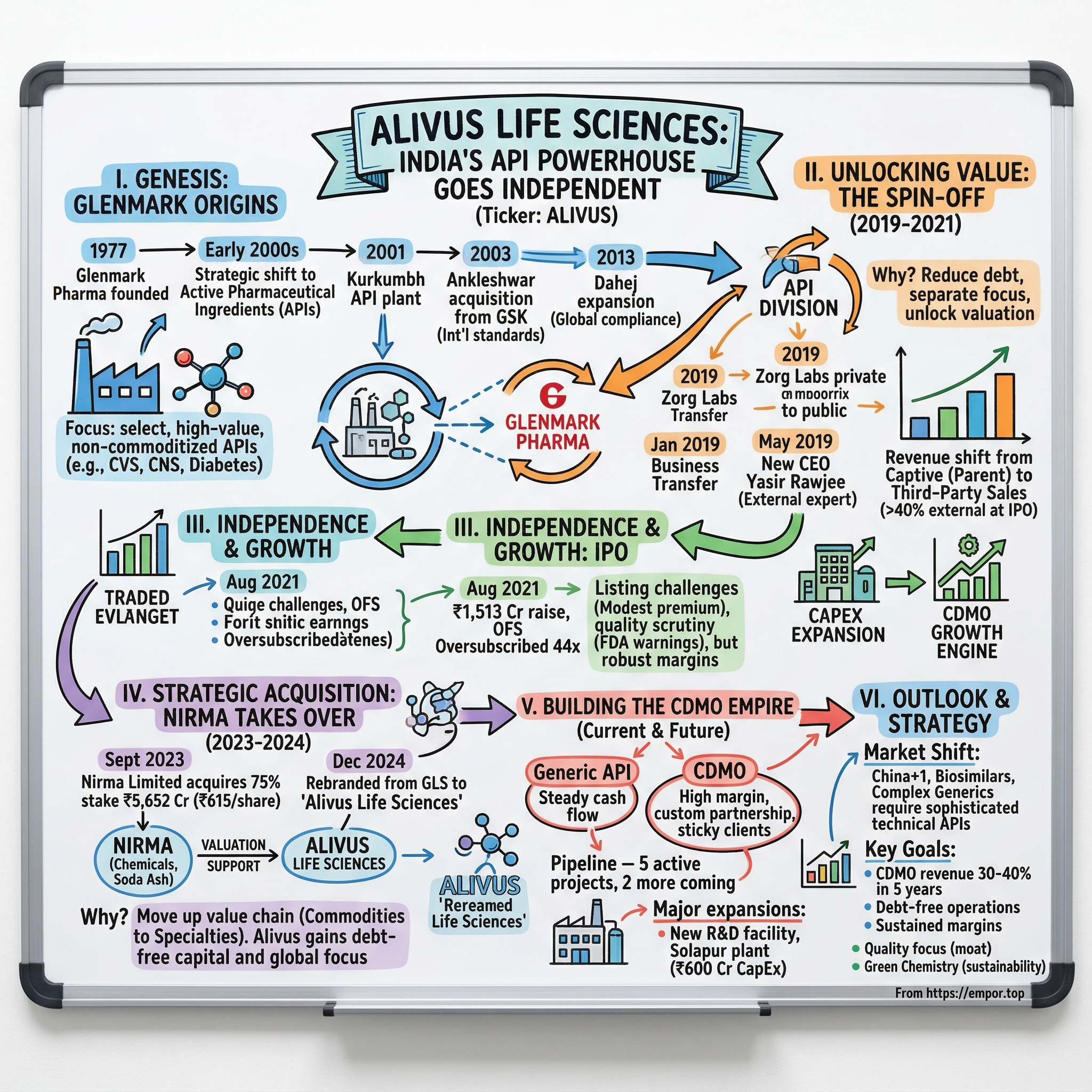
Alivus Life Sciences: India's API Powerhouse Goes Independent
I. Introduction & Episode Roadmap
On a Friday morning in July 2026, a chemist holding a doctorate from Texas A&M sat in a Mumbai conference room and presented a result that seemed contradictory on its face: revenue from the company's largest single customer had dropped by more than half during the quarter, yet the business had just delivered the highest operating margins in its history.
That customer was Glenmark Pharmaceuticals, the former parent company whose name the business bore for six years. Glenmark's purchases fell 52.6% year-over-year in the quarter ended June 30, 2026. Yet total revenue still grew 6.4% to ₹640 crore, gross margin expanded to 60.2%, and EBITDA margin reached 36.6%—an improvement of roughly 650 basis points over the same period a year earlier.12
That single quarter encapsulates the structural shift at Alivus Life Sciences. The business spent two decades operating as a captive active pharmaceutical ingredient (API) manufacturer inside a mid-sized Indian formulation company. It was later carved out to reduce parent debt, sold to an industrial conglomerate, rebranded, and transformed into an independent, high-margin supplier focused on regulated international markets.
The financial snapshot, as of late August 2026. Alivus reported fiscal year 2026 revenue of ₹2,552 crore, up 6.9%, with EBITDA reaching ₹858 crore at a 33.6% margin—the highest annual margin in company history and a 360-basis-point expansion over the prior year. Net profit reached ₹565 crore.34 The balance sheet carries no meaningful debt and held approximately ₹880 crore in cash and short-term investments as of June 30, 2026.1 Investors have reflected these gains: by late August 2026, the stock traded near ₹1,366, giving Alivus a market capitalization of roughly ₹16,800 crore against a 52-week trading range of ₹819 to ₹1,418.56
These figures contrast sharply with earlier consensus estimates that framed Alivus as a business generating ₹2,400 crore in revenue with 28% to 32% margins, ₹550 crore in cash, and a market valuation near ₹11,500 crore. While accurate within the preceding twenty-four months, those legacy metrics no longer reflect current operations. The equity has re-rated primarily through margin expansion rather than top-line growth—a distinction central to the current valuation thesis.
The core hook. How does a captive API division—an internal unit originally built to supply its parent's formulation lines—become one of India's highest-margin mid-cap API suppliers? The essential question is whether this profitability represents a durable structural advantage or a mix shift as low-margin parent volumes decline alongside favorable currency movements.
The M&A catalyst. In September 2023, Glenmark Pharmaceuticals agreed to sell its 75% stake in Glenmark Life Sciences to Nirma Limited for ₹5,651.5 crore at ₹615 per share, valuing the entity at approximately ₹7,535 crore.78 Nirma subsequently conducted a mandatory open offer at ₹631.20 per share for up to 2,12,77,736 shares, representing 17.33% of voting capital, between February 15 and February 29, 2024.9 Following regulatory approval from the Competition Commission of India in December 2023, the transaction officially closed in March 2024.10[^11]
The rebranding. On January 20, 2025, Glenmark Life Sciences formally changed its name to Alivus Life Sciences Limited, trading under ticker ALIVUS on the National Stock Exchange and code 543322 on the BSE.1112 Severing the corporate name was more than symbolic. Management noted on an earnings call that global innovator pharmaceutical firms historically viewed formulation-owned API suppliers "with a bit of suspicion," a perception that had long restricted commercial opportunities.13
The roadmap. The subsequent sections trace the company's trajectory: its captive origins inside Glenmark; the 2018–2019 carve-out and 2021 initial public offering; the technical and economic mechanics of its API portfolio; the operational and governance changes following Nirma's acquisition; the financial dynamics of the parent revenue unwind; the contract development and manufacturing (CDMO) business alongside the Solapur greenfield expansion; a competitive analysis against peers like Divi's Laboratories and Laurus Labs; and an evaluation of the bull and bear cases centered on the core question of long-term top-line growth.
Ownership structure remains a central governance consideration. The promoter group controls 74.87% of the equity, with foreign institutional investors holding 5.54%, domestic institutions at 7.18%, and public float representing approximately 12%.5 Because Alivus is tightly controlled, minority shareholder outcomes depend heavily on the strategic execution of a controlling group whose historical expertise lies primarily in industrial chemicals rather than specialty pharmaceuticals.
The core investment thesis rests on three variables: whether commercial molecules transition off-patent on schedule across key global markets, whether planned manufacturing capacity comes online as projected, and whether current operating margins can persist if former parent purchasing stabilizes. Conversely, if top-line expansion remains near its historical five-year average of roughly six percent, the equity risks derating if market multiples price in growth that fails to materialize. Everything in the following sections evaluates evidence on either side of that balance sheet.
 Subscribe on LinkedIn
II. The Glenmark Origins & API Business Genesis
In 2002, inside Kurkumbh—an industrial estate in Maharashtra's Pune district filled with reactors, pipe racks, and solvent drums—Glenmark Pharmaceuticals set up its first active pharmaceutical ingredient plant.14 Founded in 1977 by the Saldanha family, Glenmark was expanding rapidly, and its leadership sought greater independence over key inputs.
The strategic rationale reflected standard practice among Indian formulation companies of that era. A manufacturer selling finished tablets internationally could not risk dependence on external suppliers for core active ingredients. Producing ingredients in-house ensured direct control over manufacturing costs, production timelines, and international regulatory filings.
For eighteen years, the API division functioned primarily as an internal utility. It expanded its site footprint, constructed new facilities, and broadened its synthetic chemistry capabilities. Yet it operated within a corporate parent whose primary focus lay elsewhere—first in branded formulations across dermatology and respiratory medicine, and later in novel drug discovery.
The nature of active pharmaceutical ingredients explains why that operational distinction mattered. An API is the biologically active compound in a drug—typically 10 to 500 milligrams per dose that produces the therapeutic effect—while the remainder of the tablet consists of inactive binders, fillers, and coatings. Manufacturing an API requires multi-step organic synthesis, often involving eight to twelve sequential chemical transformations. Each step must achieve pharmacopoeial purity at hundred-kilogram scale, maintain documentation rigorous enough for foreign regulatory audits, and remain economical enough for generic formulations to sell competitively. Industry economics turn on a simple asymmetry: more complex multi-step chemistry yields fewer direct market competitors.
The footprint that got built. By the time the API business was prepared for separation, it operated four multi-purpose manufacturing facilities across Gujarat and Maharashtra—Ankleshwar, Dahej, Mohol, and Kurkumbh—with an aggregate installed capacity of 726.6 kilolitres as of March 31, 2021.14 Ankleshwar served as the primary production hub and most heavily audited site in the network, inspected over the years by the USFDA, the UK's MHRA, Finland's FIMEA, Japan's PMDA, Mexico's COFEPRIS, Health Canada, Korea's KFDA, and the WHO.15 Dahej, established on land leased in July 2010, served as the export-scale plant, carrying approvals from the USFDA, EDQM, PMDA, KFDA, and Brazil's ANVISA.1415 Mohol handled a focused set of cardiovascular molecules, while Kurkumbh, the original site, operated as the smallest facility with state-level approvals only.1415
The product portfolio at the time of separation reflected Glenmark's own therapeutic history: amiodarone, etoricoxib, omeprazole, fluconazole, and cilostazol at Dahej; telmisartan, rosuvastatin, and vildagliptin at Mohol; and glimepiride, sertaconazole, and adapalene at Kurkumbh.14 Spanning cardiovascular, pain, diabetes, dermatology, and anti-infective therapies, the product mix was built to supply a mid-sized Indian formulator. The division's initial commercial challenge was outgrowing that captive inheritance without disrupting its core revenue base.
Capacity in API manufacturing is measured not in metric tonnes of finished drug substance, but in total reactor volume—the liquid capacity of the stainless-steel and glass-lined vessels where chemical synthesis occurs. Think of a facility's capacity as a commercial kitchen measured by the total volume of its cooking pots rather than the number of dishes served. A plant with 700 kilolitres of reactor volume can run many small, complex, high-value batches or fewer high-volume commodity batches. Choosing between high-volume bulk supply and specialized niche synthesis formed the strategic core of the business model.
The benefits of captive life. Operating inside Glenmark provided the API business three distinct operational advantages. First, guaranteed base volume: a parent company selling formulations across North America, Europe, and Japan offered predictable demand that insulated the unit from market downturns. Second, access to centralized corporate infrastructure, including R&D centers, quality control systems, and regulatory filing expertise. Third, early exposure to stringent international regulatory oversight. Between 2015 and its initial public offering, the sites underwent 38 inspections by global regulators—including the USFDA, PMDA, COFEPRIS, Health Canada, Korea's MFDS, EDQM, and India's CDSCO—alongside 432 customer audits without receiving a single warning letter or import alert.14 That compliance record gave the independent company immediate credibility with global buyers.
The costs of captive life. Those operational advantages came with structural trade-offs. Because the parent company sold finished formulations in the same therapeutic categories as prospective API customers, external generic drug makers were reluctant to purchase ingredients from a direct competitor's subsidiary. Managing Director and Chief Executive Officer Yasir Rawjee described the residual effect years later: even though the API division operated independently without direct parent interference, the market perception persisted, leading innovator pharmaceutical companies in particular to keep their distance.13 Capital allocation posed an equally rigid constraint: as a subsidiary competing internally for capital against global formulation expansion and novel drug research, the API unit received limited reinvestment.
The result was a high-margin business constrained by an artificial growth ceiling. In fiscal year 2019—the final year before carve-out preparations began in earnest—the business reported revenue of ₹886 crore at a 28% operating margin.5 While cash-generative, top-line expansion remained tightly bounded.
That capital constraint shaped the company's legacy asset base. Rawjee highlighted this dynamic retrospectively on an earnings call, noting that under legacy ownership, strategy focused purely on molecule selection rather than technological breadth, with R&D confined to advancing those specific products. Capital expenditure was similarly restricted to expanding capacity for existing pipeline volumes, leaving little room for broader technological investments. "There wasn't much scope to go laterally," he said.3 A business permitted to select molecules but not to build broader capabilities was optimized to generate immediate cash for its parent rather than compound long-term enterprise value.
Eventually, balance sheet pressures at the parent company forced a strategic separation.
III. The Spin-off Journey & IPO: Structuring Independence (2019–2021)
The corporate entity that eventually became Alivus Life Sciences originated as a shell company. On June 23, 2011, a private entity named Zorg Laboratories Private Limited was incorporated in Pune.14 After remaining dormant for seven years, Glenmark Pharmaceuticals acquired it outright on July 4, 2018, renamed it Glenmark Life Sciences Private Limited, and converted it into a public limited company on August 28, 2018.14
This acquisition provided the legal structure for the subsequent divisional carve-out.
The Business Purchase Agreement. On October 9, 2018, Glenmark Pharmaceuticals and its newly acquired subsidiary executed a Business Purchase Agreement transferring the entire API division—including manufacturing plants, physical assets, intellectual property, personnel, and associated liabilities—via a slump sale for an aggregate consideration of ₹11,621.94 million, or roughly ₹1,162 crore.14
Under the agreement terms, the subsidiary was required to pay that consideration within 120 days of closing. Instead, payment was delayed. By March 31, 2021—more than two years later—the subsidiary had remitted ₹350.3 crore, while interest accrued on the outstanding balance at annual rates of 12% and later 9%. As of July 9, 2021, the unpaid obligation to the parent, including accrued interest, stood at ₹800.8 crore.14
In effect, while the carve-out was legally completed in 2018, the subsidiary operated for nearly three years carrying a substantial interest-bearing debt owed to its parent. Rather than establishing immediate operational autonomy, the structure created a standalone, financeable entity from a division previously embedded in parent accounts, providing Glenmark with a clear financial claim it could later monetize.
Why the parent needed this. Glenmark Pharmaceuticals faced persistent corporate debt pressures. By the time the eventual sale to Nirma was announced, Chairman Glenn Saldanha estimated gross debt at roughly ₹4,600 crore, framing the transaction plainly: "The total debt gets extinguished after the deal."16 Although the API unit generated only about 11% of Glenmark's consolidated revenue, it contributed roughly 20% of its operating earnings—a disproportionately profitable segment that the parent sacrificed to eliminate its debt load.16
The July 2021 offering. The July 2021 initial public offering comprised a fresh issue of 14,722,222 shares raising ₹1,060 crore, alongside an offer for sale of 6,300,000 shares by the parent raising ₹453.6 crore. The combined offering raised ₹1,513.6 crore, with shares priced between ₹695 and ₹720.1417
The allocation of net proceeds revealed the transaction's primary beneficiary. Of the ₹1,010.4 crore in net proceeds from the fresh issue, ₹800 crore went directly to Glenmark Pharmaceuticals to settle the outstanding purchase consideration and accrued interest. Capital expenditure received ₹152.8 crore, while ₹57.7 crore was set aside for general corporate purposes.14
Nearly four out of every five rupees raised in the fresh issue flowed directly to the parent, which simultaneously collected ₹453.6 crore by selling a portion of its existing holding—a structural dynamic disclosed as a risk factor in the prospectus.14 For Glenmark, the listing functioned as a major monetization event. For the subsidiary, the key operational benefit was balance sheet simplification: the offering retired its debt to the parent and established a clean, unleveraged capital structure.
The identity problem at listing. Alivus entered public markets with a portfolio of 120 molecules and 403 Drug Master File (DMF) and Certificate of Suitability (CEP) filings across major international markets, including the United States, Europe, Japan, Russia, Brazil, South Korea, Taiwan, Canada, China, and Australia. Commercial relationships were already established with sixteen of the world's twenty largest generic pharmaceutical manufacturers.14 Despite this broad regulatory footprint, revenue remained concentrated: the top five customers accounted for more than half of total sales across fiscal years 2019, 2020, and 2021, with Glenmark serving as the largest single buyer.14 Therapeutic concentration was similarly pronounced, with cardiovascular molecules generating 45.4% of generic API revenue in fiscal year 2021.14
Consequently, public markets received an asset with established regulatory compliance and strong manufacturing infrastructure, but one bound by customer concentration and an equity overhang from a parent seeking full exit. Following its August 2021 listing, the stock traded sideways for two years as top-line growth moderated, with revenue increasing from ₹1,885 crore in fiscal year 2021 to ₹2,161 crore in fiscal year 2023—a compound annual growth rate under 8%.5
Public investors also navigated the expiration of government subsidies under India's Production Linked Incentive (PLI) scheme for bulk drugs. Chief Executive Officer Yasir Rawjee later noted that when PLI benefits expired, management initially questioned whether lost operating margins could be recovered.13 The business subsequently rebuilt and expanded its margin profile beyond pre-expiration levels, offering empirical evidence of cost discipline and operational efficiency following the loss of government subsidies.
While the listing eliminated the interest drag and created a transparent public reporting track record, the broader operational transformation of the business lay ahead.
IV. Core API Engine & Industry Moats: The Non-Commoditized Strategy
Understanding the margin profile of Alivus requires examining what the company deliberately avoids manufacturing.
A significant portion of the Indian active pharmaceutical ingredient (API) industry relies on high-volume generic scale—producing commodity compounds such as paracetamol, ibuprofen, and metformin. These off-patent molecules involve well-established chemical synthesis where numerous domestic and international producers compete primarily on cost per kilogram. Consequently, capital intensity remains high, margins stay compressed, and pricing power resides almost entirely with buyers.
Alivus built the opposite business model. Its portfolio expanded to 176 unique molecules as of fiscal year 2026, added at a deliberate pace—including eleven new products introduced during fiscal year 2026—serving approximately 900 commercial customers.3 The portfolio focuses heavily on chronic and sub-chronic therapies: cardiovascular and central nervous system treatments together contributed 58% of revenue in the quarter ended June 30, 2026, with overall chronic therapies representing 74%.1 Expanding therapeutic categories, such as respiratory and anti-allergy products, have grown to account for more than 10% of revenue.3
The economics of complex chemistry. Chief Executive Officer Yasir Rawjee outlined this selection discipline on an earnings call, noting that the firm targets "some element of uniqueness or higher entry barrier in whatever we are doing," a positioning established seven years earlier when the division set its strategic direction.3 Asked on the same call about new product selection, Rawjee detailed the company's operating rule: "typically, we don't go for already genericized APIs."3
That principle defines the commercial strategy. Alivus targets molecules prior to patent expiration, submits regulatory filings years in advance, and positions itself as the qualified supplier when generic versions launch. This allows the business to enter molecule supply contracts at peak commercial pricing rather than competing later in commoditized market cycles.
Drug Master Files as switching barriers. Regulatory requirements create substantial switching costs for generic drug formulators. To market a generic drug in regulated jurisdictions like the United States, a pharmaceutical company submits an Abbreviated New Drug Application (ANDA) to regulatory authorities. That application specifies the precise API manufacturer, facility, and synthesis route, while the supplier files a corresponding Drug Master File (DMF) detailing manufacturing and quality controls. Once approved, substituting an API supplier requires new stability testing, potential bioequivalence studies, and regulatory amendments that can take several months to over a year.
Consequently, an incumbent API supplier embedded within an approved drug filing faces limited risk of immediate displacement based on price alone. Alivus held 617 DMF and Certificate of Suitability (CEP) filings globally as of June 30, 2026, compared to 611 three months prior and 403 at the time of its 2021 initial public offering—including 187 in North America serving over 30 customers, 120 in Europe serving over 70 clients, 101 in Brazil covering over 50 buyers, and 162 across the rest of the world serving over 370 customers.13142
This cumulative regulatory portfolio functions as an off-balance-sheet asset, anchoring customer relationships across multi-year commercial lifecycles.
Limits of regulatory switching barriers. Regulatory switching costs mitigate but do not eliminate pricing pressure. Management reported that portfolio-wide annual price erosion averages between 4.5% and 5.5%, reaching approximately 5.5% in fiscal year 2026 within the core non-parent, generic API base business.313 Rawjee drew a distinction between regulated markets, where customer relationships are locked in and pricing remains relatively stable, and rest-of-world markets where "changes to API vendor can be pretty quick" and the company must maintain pricing agility.13
Across the approximately 83% of revenue generated from regulated markets, DMF registrations secure customer volume even as unit prices decline.2 In non-regulated markets, products compete on standard price terms. Within regulated markets, regulatory locks protect market share rather than fixed pricing, giving the company time to engineer "second-generation processes"—more cost-effective synthetic routes designed to preserve operating margins even as selling prices erode.1 Maintaining profitability thus requires continuous chemical process re-engineering.
Regulatory track record and operational risks. A consistent regulatory compliance record has historically distinguished Alivus from several domestic peers. On a July 2026 earnings call, Rawjee noted that the Ankleshwar facility held a Voluntary Action Indicated classification while Dahej maintained a No Action Indicated status from the USFDA, observing that the inspection calendar had been light as a result.1
However, environmental compliance interruptions have affected operations. On July 26, 2024, the company disclosed that the Gujarat Pollution Control Board had ordered a production halt at the Ankleshwar facility after water samples from an industrial stormwater drain revealed chemical oxygen demand levels exceeding permitted limits. The company attributed the discharge to heavy monsoon rainfall across Bharuch district, posted a bank guarantee of ₹15 lakh, and faced environmental damage compensation to be determined.18 Although the order was subsequently revoked and operations resumed, the financial impact landed in the quarter ended September 30, 2024: revenue fell 14.9% to ₹506.9 crore, net profit dropped roughly 20% to ₹95.3 crore, and the EBITDA margin compressed to 28.2%.19
Operational disruptions continued with two subsequent plant fires: a flash fire at Ankleshwar in September 2025 that incurred minor compensation costs, and a larger fire at Dahej that damaged the intermediate production section and resulted in a ₹20 crore loss recognized under other expenses in the quarter ended March 31, 2026.320 Management characterized the Dahej event as contained, with no significant production spillover.3
Three manufacturing site incidents within a two-year window highlight operational concentration risks, given that Ankleshwar and Dahej together contribute roughly 65% to 70% of total revenue, by Rawjee's account.3
Capacity expansion and backward integration. Installed capacity has nearly doubled since the 2021 public offering, expanding from 726.6 kilolitres to 1,424 kilolitres at the end of fiscal year 2026, with a stated plan to reach 2,150 kilolitres in fiscal year 2027 and 2,690 kilolitres by fiscal year 2028.1423 A meaningful portion of that expansion—around 400 kilolitres—is dedicated to backward integration: producing key chemical intermediates in-house to protect supply security and recapture vendor margins on molecules generating ₹40 crore to ₹50 crore each in annual revenue.13
Raw material exposure to Chinese suppliers remains lower than broader industry narratives suggest. Single-source Chinese procurement accounts for less than 10% of total raw material purchases, distributed across multiple vendors with qualified domestic alternatives.13 The principal exposure to China stems from currency movements: as Rawjee noted, a strengthening renminbi against the U.S. dollar combined with a weakening Indian rupee creates compound cost pressure on imported chemical inputs.13
These input-cost dynamics emerged as a key operating variable in 2026, coinciding with the transition to a new parent owner with distinct balance sheet priorities.
V. The Nirma Acquisition: Conglomerate Capital & Transformation (2023–2024)
In the summer of 2023, bankers were shopping one of the better assets in Indian pharmaceutical manufacturing, and the shortlist of buyers was short. Private equity looked. Strategic pharma looked. The winner was a company most Indians associate with a jingle about washing powder.
On September 21, 2023, Glenmark Pharmaceuticals announced it would sell its entire 75% stake in Glenmark Life Sciences to Nirma Limited for ₹5,651.5 crore at ₹615 per share.721 Because Glenmark Life Sciences declared an interim dividend of ₹22.50 per share in October 2023, the per-share consideration on the block was subsequently adjusted to ₹592.50.9 Nirma's mandatory open offer to public shareholders followed at ₹631.20, and the CCI signed off in December.910[^11] The transaction closed in March 2024.[^11]
Did Glenmark under-sell? The deal valued the entire company at roughly ₹7,535 crore.8 Against FY24 EBITDA of approximately ₹675 crore, that is a shade over 11 times — a price that looks, in hindsight, extremely favourable to the buyer.58 For context, Divi's Laboratories has consistently traded at multiples several times that level, and the broader Indian complex-chemistry cohort was, even in 2023, valued far above 11 times.
Two things explain the discount. First, this was a forced seller. Glenmark's chairman was explicit that the point was extinguishing debt, and a seller who must transact does not extract the last rupee.16 Second, the market's genuine anxiety about the asset was reasonable: a business deriving a large minority of revenue from a parent who was about to become an unrelated third party, in an industry facing generic price deflation, with a five-year revenue CAGR that had already slowed to single digits.5
The honest verdict is that Glenmark did not get a bad price for a distressed sale — it got a fair price for a good asset sold under duress, and Nirma got a genuinely attractive entry point. By August 2026, the market value of the company had roughly doubled from the transaction valuation.5 Whether that reflects Nirma's stewardship or simply a re-rating the asset always deserved is a question the next few sections will test.
Why Nirma? Nirma's chairman on the Alivus board, Hiren K. Patel, is the managing director of Nirma Limited, and his background spans consumer goods, chemicals, cement and healthcare.22 That list is the group's history in four words: a detergent business that industrialised backward into soda ash and surfactant chemistry, then diversified into cement, and more recently into healthcare. The pharmaceutical ambition predated this deal — the group had been, in the words of one contemporary account, "actively seeking an opportunity to enter the flourishing pharmaceutical sector for quite some time," and Glenmark Life Sciences was the ideal entry point.8
The industrial logic is coherent. Soda ash and API manufacturing are not the same business, but they rhyme: continuous-process chemical plants, utilities and energy management, effluent treatment, safety systems, and the unglamorous discipline of running assets at high utilisation. What Nirma brought that a financial buyer could not was patience and a balance sheet — permission to spend on R&D and capacity without quarterly earnings anxiety.
What actually changed in the boardroom. The most striking feature of this ownership change is what did not happen: management continuity was total. Yasir Rawjee, who joined as chief executive on May 2, 2019 and became managing director on August 13, 2019, stayed.14 His profile is unusual for an Indian API company — a bachelor's degree from St. Xavier's College and a technology degree from UDCT in Bombay, a PhD from Texas A&M, then GlaxoSmithKline in the United States, senior vice president at Matrix Laboratories, and head of global API operations at Mylan before joining Glenmark.1422 He is a process chemist who ran global operations, not a general manager who learned chemistry — and it shows in how he answers questions. Ask him about flow chemistry and he will tell you which reactions are not amenable to it and why.13
The board around him was rebuilt. Beyond Patel as chairman, it includes Kaushikbhai N. Patel, a chartered accountant who also sits on the boards of Nuvoco Vistas and Nirma Limited; Manju Agarwal, with 34 years at the State Bank of India; T L Easwar, an IIT Kanpur chemical engineer with senior operational experience at Aurobindo Pharma, Porus Laboratories and Mylan; and Savan Godiawala, a retired Deloitte partner. Vinod Naik serves as executive director for technical operations, with prior experience at Sun Pharmaceutical and Cipla.22
That is a genuinely capable board on paper — two independent directors with deep financial credentials and one with hands-on API manufacturing experience. An activist would nonetheless note the obvious: with promoter holding at 74.87% as of June 2026, the free float is thin and public shareholders have essentially no ability to influence outcomes.5 Related-party discipline and capital allocation are matters of promoter goodwill, not shareholder power.
Incentive alignment. The retention of a chief executive through a change of control is not automatic, and the disclosed arrangements suggest it was deliberately engineered from the start. At the time of the IPO, Rawjee's FY2021 remuneration was ₹45.71 million, and he was separately entitled to a one-time payment of ₹25.71 million compensating for long-term incentives forfeited at his previous employer, payable in instalments through July 2021, plus an extension of his retirement date linked to the vesting of any stock options granted to him.14 That is the compensation structure of someone recruited to run a business through a multi-year transition rather than to caretake it. Post-acquisition disclosure on performance-linked pay is thinner, though the FY26 accounts did reflect accrued performance bonuses across the employee base tied to the year's results — Mistry cited them as the reason employee costs stepped up in the March 2026 quarter.3
The financial regime change. The CFO, Tushar Mistry, described the shift with unusual candour on the FY26 call.The first year was ugly. It is worth remembering that the ownership change did not produce an immediate operational lift. In the March 2024 quarter — the transaction's closing quarter — net profit fell 33% year over year to ₹97.9 crore.23 The Ankleshwar environmental shutdown followed four months later, and the September 2024 quarter delivered a 15% revenue decline and a sub-29% margin.1819 Anyone marking the Nirma acquisition to market at the end of calendar 2024 would have concluded it had achieved nothing. The inflection came later and came from operations, not ownership — which is the honest way to attribute credit here. Nirma removed a constraint; the operating team then did the work.
Prior to FY24, he explained, the operating engine generated cash consistently — "but a large part of that cash was upstream." FY24 marked the inflection. Over the following two years, the company generated about ₹984 crore of operating cash, invested ₹472 crore in capital expenditure, paid ₹61 crore of dividends, and accumulated what he called a "war chest" of ₹451 crore.3
Translated: under the old owner, the subsidiary's cash flowed out to service parent obligations. Under the new one, it stays and compounds. That is the single largest economic consequence of the ownership change, and it is a fact rather than a claim — it is visible in the cash balance, which climbed from ₹446 crore in September 2024 to ₹880 crore in June 2026 while the company simultaneously funded a greenfield plant.119
The name. On January 20, 2025, the Glenmark prefix disappeared.1112 Management framed it as reflecting an evolving vision. The commercial reality was more specific and was articulated later, on the January 2026 call: with the Glenmark umbrella gone, innovators who had eyed the company warily as part of a big pharma group now looked at it "more favourably."13 That is a testable claim, and section VII examines whether the CDMO order book bears it out.
VI. Operational Reality & Financial Deep Dive
Behind the corporate restructuring lies a fundamental strategic question: is Alivus's recent margin expansion a durable structural upgrade or a temporary benefit driven by favorable product mix and currency tailwinds?
The eight-year record. Top-line revenue expanded from ₹886 crore in fiscal year 2019 to ₹2,552 crore in fiscal year 2026. However, that growth was heavily front-loaded. Sales roughly doubled between fiscal years 2019 and 2021 during the initial carve-out and pandemic-related demand surge, but subsequently plateaued: ₹2,123 crore in FY22, ₹2,161 crore in FY23, ₹2,283 crore in FY24, ₹2,387 crore in FY25, and ₹2,552 crore in fiscal year 2026.5 This represents a five-year revenue compound annual growth rate of approximately 6%.5
A 6% top-line growth rate over five years represents modest performance for a producer in specialized active pharmaceutical ingredients. Evaluating the company's bull case requires addressing this limited top-line expansion directly.
Where the profit came from instead. While top-line growth remained modest, profitability expanded significantly. Operating margins widened from 28% in fiscal year 2024 to 33.6% in fiscal year 2026, based on CFO Tushar Mistry's disclosures.3 Over that two-year period, revenue grew at a 5.7% compound annual rate while EBITDA grew at 15.8%, adding roughly ₹270 crore in revenue and ₹220 crore in EBITDA.3 In effect, the incremental EBITDA margin on new business exceeded 80%.
Management attributes this expansion to four primary operational drivers, each carrying different strategic weight. First, new product launches generated premium initial pricing, though such pricing naturally erodes over time. Second, an improved product mix took effect as lower-margin parent volumes contracted—an arithmetic shift rather than an operational breakthrough. Third, operational efficiencies improved in process yields, raw material consumption, and energy management; for instance, transitioning from natural gas to briquette boilers insulated operating costs from global energy price spikes following the 2026 Middle East conflict.3 Fourth, contract development and manufacturing (CDMO) sales expanded from 6% of total revenue in fiscal year 2025 to 7% in fiscal year 2026—a positive contribution, though currently a modest portion of total revenue.3
A fifth factor, less emphasized by management, involves foreign exchange dynamics. Alivus recorded a net foreign exchange gain of approximately ₹31 crore in its fiscal year 2026 income statement.3 In the quarter ended June 30, 2026, Mistry disclosed that of the 26.5% growth in non-parent business, approximately 7 percentage points resulted from currency movements. Constant-currency growth stood at roughly 20%, driven by volume growth of 21% to 22% alongside price declines of 1% to 2%.1 While a depreciating rupee benefits a net exporter, currency tailwinds can reverse, warranting careful adjustment when assessing baseline operating margins.
The parent unwind, quantified honestly. The transition away from parent revenue represents a critical aspect of Alivus's commercial shift.
Glenmark's share of total revenue declined from 41% in fiscal year 2022 to 29% in fiscal year 2026, corresponding to an increase in non-parent revenue from 59% to 71%.3 Mistry noted that Glenmark's absolute purchasing volumes remained relatively stable over the prior two years, while non-parent revenue compounded at 7.5%.3 Consequently, the mix shift reflects growth in external customer accounts rather than a sudden contraction in parent purchases.
However, quarterly purchasing patterns exhibit substantial volatility. Parent sales fell approximately 22% year-over-year in the quarter ended June 30, 2025.24 In the quarter ended June 30, 2026, parent purchases dropped 52.6% year-over-year to ₹72.3 crore (₹723 million), representing just 11% of quarterly revenue.2 Management attributed both quarterly contractions to customer inventory rationalization following strong preceding quarters, maintaining full-year expectations based on an underlying portfolio of over 50 commercial molecules supplied across diverse end-markets.1
During a July 2026 earnings conference, an analyst from Unifi Capital highlighted investor concerns regarding whether potential declines in parent purchasing might offset commercial gains in external accounts. CEO Yasir Rawjee responded that single-quarter fluctuations do not define annual trends, reiterating expectations for stable full-year performance.1 While management successfully navigated a similar first-quarter dip in fiscal year 2026,3 a 52.6% quarterly fluctuation in a primary customer account highlights ongoing revenue volatility.
The non-parent engine. Commercial expansion outside the parent relationship represents the primary engine of long-term growth. Non-parent revenue expanded 13% in fiscal year 2026 and 26.5% in the quarter ended June 30, 2026, supported by sales across Europe, Japan, Latin America, India, and rest-of-world markets.13 Rawjee described the geographic distribution as balanced, highlighting Japan—entered four to five years prior—as the company's fastest-growing market.3 Alivus added 49 new commercial customers during fiscal year 2026.3
This expansion relies less on traditional sales acquisition and more on global patent expiration cycles. Molecules selected five to seven years ago are entering off-patent windows across different international jurisdictions. Rawjee explained that regulatory filings and customer qualifications are completed in advance, allowing commercial supply to initiate as soon as patent protection expires.13 In markets where Alivus partners with two established formulation developers, such as Brazil, the company targets a 20% to 25% market share for specific molecules.13 Across mature commercial products, global market share ranges between 10% and 35% depending on the therapeutic category.13
This regulatory and patent-sequencing model provides a structured growth framework, explaining management's positive outlook despite modest historical top-line trends.
Balance sheet and returns. Cash and short-term investments totaled ₹880 crore as of June 30, 2026, compared to total debt of approximately ₹57 crore at the end of fiscal year 2026.15 Trailing return on capital employed stood at 23.8%, with return on equity at 17.9%.5 Free cash flow reached ₹259 crore in fiscal year 2026 and ₹90 crore in the quarter ended June 30, 2026, with the quarterly step-down reflecting capital expenditure timing rather than operational deterioration.14
Fixed asset turnover moderated to approximately 2.2 times. Management indicated that asset turnover may temporarily drop below 2.0 as greenfield capacity at Solapur and brownfield expansions come online ahead of full commercial utilization.13 Mistry expects fixed asset turnover to stabilize near 2.0 over time.13 This capital deployment schedule will temporarily weigh on return metrics during the construction and ramp-up phase.
Two accounting judgments worth noting. Two specific accounting treatments influence how operating results are interpreted. First, the ₹20 crore loss resulting from the Dahej plant fire was recorded under other expenses rather than as an exceptional item; Mistry confirmed this accounting treatment explained the year-over-year increase in that expense line.3 Consequently, reported fiscal year 2026 EBITDA reflects this one-time charge, which temporarily depressed reported operating results. Second, foreign exchange gains are recognized within general income statement lines and other income, but management does not publish a standalone constant-currency EBITDA bridge.3 While disclosures meet reporting standards, the absence of a detailed currency bridge leaves the exact operating margin impact of foreign exchange movements unquantified.
That financial foundation frames the company's next major capital commitment.
VII. The CDMO Pivot & Solapur Expansion: Real Optionality
In the 2021 prospectus, buried in the growth plans section, Glenmark Life Sciences described a new greenfield manufacturing facility on a 40-acre footprint, designed to house multi-purpose blocks for both APIs and intermediates, providing "a platform for the growth of our CDMO business." Construction was to begin in FY2022. It was "expected to become operational in the fourth quarter of the financial year 2023."14
As of August 2026, that plant has not produced a single kilogram of commercial product.
This delay represents a central element of Alivus's execution record and defines the timeline for its operational growth. The Solapur greenfield site is now scheduled to become operational by Diwali—early in the December 2026 quarter—roughly three and a half years behind the timeline given to IPO investors.1
The delay, quarter by quarter. The slippage was not disclosed in one reset; it came in increments across successive earnings calls. In January 2026, Rawjee acknowledged that Solapur was "delayed by like three months" and would start operations by July 2026.13 In May 2026, management indicated construction was "progressing as planned" and "expected to be operational in Q2 of this year."3 In July 2026, guidance shifted to "a little bit of a delay," targeting "early Q3 of FY '27."1 Analysts noted the pushouts: Pratik Kothari of Unique PMS pointed out that, alongside the delays, planned initial capacity had been reduced from approximately 600 kilolitres for Phase 1 to between 450 and 500 kilolitres.13
Management defended the extended timeline as a deliberate operational choice. Rawjee framed capacity expansion as "calibrated" to prevent excess idle volume that could create under-absorption and drag down operating margins.13 He also noted that the delay does not immediately constrain growth in regulated markets, which generate over 80% of revenue, because a new greenfield facility cannot supply regulated markets on day one—it requires prior inspection by authorities such as the USFDA or European regulators.113 Meanwhile, brownfield expansions at existing regulated sites—160 kilolitres at Dahej and 100 to 110 kilolitres at Ankleshwar—remain on schedule to support double-digit growth through fiscal years 2027 and 2028.1
Management also cited construction headwinds, noting "a slowdown with labor and a few other things."1
How to weigh this. A constructive reading suggests management has consistently prioritized return on capital over headline capacity, exercising discipline to protect operating margins. A more critical reading views the repeated delays—stretching three and a half years past the original target, shrinking the first phase, and pushing Phase 3 out by another year—as an execution shortfall, where "calibrated" serves as a narrative framing for project slippage.113
Both perspectives carry weight, and the operational consequence defines the path forward. The critical path for Solapur now follows a multi-stage timeline: commissioning around Diwali 2026, running rest-of-world business and internal intermediate supply for about a year, and triggering regulatory audits within twelve months by deliberately validating shortage-listed products that agencies prioritize—and, if successful, beginning commercial supply to regulated markets from the site by late fiscal year 2028.113 Rawjee called triggering that inspection "a big milestone."1 It stands as the clearest near-term empirical test of management's execution.
What Solapur actually is. Phase 1 comprises roughly 370 kilolitres for a backward-integration block and 120 kilolitres for API manufacturing, with Phase 1.1 adding around 115 kilolitres.32 Rawjee clarified that backward-integration volume "won't contribute directly to front-end sales" and "should not be factored into any kind of model you're building."3 Initial site utilization is expected at 40% to 50%, rising toward 60% to 70% in the following year—versus brownfield capacity, which he expects to reach 80% to 90% utilization within two to three quarters because those sites are already inspected.3 The 40-acre site retains room to add another 700 to 800 kilolitres of API capacity once regulatory pathways are cleared.3
A separate R&D centre is under construction at Taloja in Navi Mumbai.13 Planned capital expenditure for fiscal year 2027 stands at approximately ₹540 crore, funded entirely through internal accruals—a commitment supported by the company's ₹880 crore cash balance.13
Now the CDMO business, sized honestly. Contract development and manufacturing generated ₹37.8 crore (₹378 million) in the June 2026 quarter—6% of total revenue.2 The segment operates at an annualized run rate of roughly ₹160 crore to ₹170 crore across five commercial projects.1 CDMO revenue grew 18% in fiscal year 2026 and 3.8% year-over-year in the June 2026 quarter.13
For a business narrative built partly on CDMO optionality, that contribution remains modest and lumpy. However, performance improved in the second half of fiscal year 2026. The December 2025 quarter delivered CDMO revenue growth of 100% sequentially and 85.3% year-over-year as the fourth and fifth commercial projects scaled up—the second-half turnaround management had guided toward.13 Management is in active discussions for seven further projects and expects to close two contracts in the second half of fiscal year 2027—a target that pushed back from an earlier guidance of mid-calendar 2026, which Rawjee characterized as moderating expectations "to be on the safe side" rather than a delay.13
The strategic critique, from an analyst who knows the sector. During a January 2026 conference call, analyst Sajal Kapoor of Antifragile Thinking challenged the company's CDMO approach. Kapoor pointed out that Alivus focuses on long-gestation projects with small annual run rates of $4 million to $6 million each, whereas leading Indian CDMO peers partner with innovators at Phase 2 and Phase 3 on new chemical entities, targeting individual molecules worth $50 million to $100 million annually. Kapoor also noted that a November 2022 investor presentation had promised the CDMO business would double by 2025—a target it did not achieve.13
Rawjee defended the strategy as a realistic assessment of commercial opportunities. He questioned how many $50 million to $100 million opportunities actually materialize for Indian manufacturers, noting that global pharmaceutical companies frequently keep patented commercial manufacturing in-house or in tax-efficient locations such as Ireland. Instead, Alivus targets lifecycle management and specialty pharma customers, where projects move from initial discussion to full commercial supply within 18 to 24 months—evidenced by Project 5, which was initiated in November 2024 and began contributing by early 2026. While acknowledging that Alivus possesses the technical capabilities for earlier-phase development, Rawjee emphasized that "attrition is very high" in late-stage clinical projects.13
Both perspectives reflect valid strategic logic. Alivus has chosen a lower-variance, lower-ceiling CDMO model—a defensible approach for a business prioritizing predictable cash flow over growth optics. Consequently, investors should view CDMO as a steady contributor rather than a transformational earnings driver. Management itself refrains from providing specific targets beyond expecting CDMO to "grow faster than the overall business."1
The genuine long-dated option: high-potency APIs. The high-potency API initiative represents the portfolio's most asymmetric growth option, though its contribution lies largely in the future. The active grid includes 29 high-potency products addressing an estimated total addressable market of $82 billion—up from 27 products and a $70 billion market estimate disclosed two quarters earlier.113 Thirteen products are validated, seven are in advanced development, and nine are in laboratory stages.1
High-potency APIs require specialized containment infrastructure—such as small dedicated reactors, isolators, and negative-pressure suites—due to their extreme pharmacological activity. Oncology drugs dominate this therapeutic category, establishing high entry barriers and potential margin premiums.
However, commercial realization remains several years away. Major patent expirations on these molecules begin at the end of calendar 2027, deferring material revenue contributions until fiscal year 2028 at the earliest. Current contributions remain limited to exhibit batch sales, which Rawjee explicitly characterized as "not very significant."13 Rawjee also declined to guarantee margin expansion, noting that while "typically, these molecules do attract better margins," that outcome "has to play out."3
That cautious framing is characteristic of management's tone, rendering the Solapur timeline slippage all the more notable as an operational exception.
VIII. Competitive Dynamics & Strategic Frameworks
Comparing Alivus against the broader Indian complex-chemistry sector in fiscal year 2026 reveals a distinct strategic positioning.
Divi's Laboratories, the sector's bellwether, generated revenue of ₹10,388 crore in fiscal year 2026, up 12.9%, with EBITDA of ₹3,920 crore—a 37.7% margin—and net profit of ₹2,607 crore, while investing more than ₹1,500 crore in capital expenditure, including a dedicated peptide center of excellence.25 Divi's is four times the size of Alivus, growing roughly twice as fast, operating at higher margins, and committing more than three times as much capital to future capacity.
Laurus Labs, historically a lower-margin antiretroviral specialist, delivered revenue of ₹6,813 crore in fiscal year 2026, up 23%, as its EBITDA margin expanded from 20.1% to 26.8% and net profit jumped 148% to ₹889 crore. Its contract development and manufacturing (CDMO) business alone reached ₹2,080 crore—representing roughly 31% of total sales, a division larger than the entire operational revenue of Alivus.26
Alivus, by contrast, grew 6.9% to ₹2,552 crore at a 33.6% margin.3 Among this peer group, it ranks second on profitability but last on top-line expansion.
That contrast frames the core competitive question: Alivus is not losing market share so much as optimizing for a different variable. The investor's assessment turns on whether that strategy reflects operational discipline or corporate timidity.
Applying Helmer's 7 Powers. Switching costs represent the company's primary strategic moat, operating through a dual-layered lock: the regulatory commitment required by specifying a supplier inside an approved drug filing, alongside the commercial cost of re-qualifying an alternate source. Empirical performance supports this distinction—regulated markets, where switching barriers are highest, generate 83% of revenue with relatively stable pricing, whereas rest-of-world markets experience more rapid vendor turnover and greater price volatility.1132 Yet this structural barrier is bounded, with annual portfolio price erosion averaging between 4.5% and 5.5%.3
Process power serves as a secondary driver, underpinning much of the company's recent margin gains. The clearest technical implementation is flow chemistry—a continuous manufacturing process that pumps reagents through targeted channels rather than mixing them in large batch vessels. The technique optimizes reactions requiring extended synthesis times, high energy input, or heavy reagent volumes. Chief Executive Officer Yasir Rawjee disclosed that process re-engineering reduced one molecule's manufacturing cost to 40% of its traditional batch baseline following the successful commercialization of the firm's first flow chemistry product.313 However, management has acknowledged clear boundaries to this advantage: many multi-step chemical conversions cannot adapt to continuous flow, while high-potency molecules lack the production volumes needed to justify the equipment investment.13 Process power is structurally verified but selective in application.
Counter-positioning strengthened following the ownership change, representing a clear structural gain from Nirma's acquisition. As an independent supplier without a competing finished-formulation arm, Alivus avoids conflict of interest with generic and innovator customers. Rawjee noted that global innovator pharmaceutical firms view the independent corporate structure more favorably, contributing to an active pipeline of seven prospective CDMO projects.113 While strategically coherent, commercial revenue from these engagements has yet to materialize at scale.
Scale economies remain the weakest dimension. With installed reactor capacity at 1,424 kilolitres, Alivus operates at a fraction of Divi's manufacturing scale. Because management's product strategy explicitly avoids high-volume commodity compounds, scale economy is a strategic power the firm has deliberately chosen not to pursue.
Porter's five forces. Threat of new entrants: low. The entry barrier is protected by multi-year regulatory audit histories from the USFDA and EDQM, hundreds of active Drug Master File filings, zero-liquid-discharge environmental infrastructure, and long customer qualification timelines. A greenfield competitor faces the same regulatory ramp visible at Solapur: generic commercial supply to regulated markets cannot begin until regulatory authorities audit and approve the facility.
Bargaining power of buyers: moderate to high. Generic formulation manufacturers experience continuous downstream pricing pressure, transmitting price compression back to active ingredient suppliers. This dynamics manifests in the 4.5% to 5.5% annual portfolio price erosion. Alivus mitigates buyer power through early molecule selection and lower-cost second-generation synthetic processes rather than direct price resistance.3
Bargaining power of suppliers: moderate and rising. Solvents, representing 12% to 13% of total production costs, experienced sharp price increases in 2026, followed by inflation in key starting materials.13 Mitigating factors include a diversified vendor footprint, expanding in-house backward integration, and partial cost pass-through capability. Rawjee reported that key commercial customers agreed to selective price adjustments to protect supply security, providing empirical evidence of supplier leverage during input cost spikes.3
Threat of substitutes: low. Small-molecule synthetic chemistry remains the standard for oral chronic therapeutics, with biologic substitution progressing slowly in key cardiovascular and central nervous system indications.
Competitive rivalry: high and asymmetric. Alivus competes against larger, better-capitalized domestic peers expanding capacity more rapidly, as well as Chinese chemical suppliers operating on scale efficiency. The company responds by focusing on a narrower therapeutic niche—targeting complex molecules prior to widespread generic adoption.
Myth versus reality. Three prevailing market narratives require factual clarification.
Myth: The legacy parent relationship is collapsing and impairing performance. Reality: Absolute revenue from Glenmark has remained relatively stable over two years. The declining revenue share reflects expansion in non-parent accounts, while quarterly purchasing fluctuations stem from customer inventory management rather than structural account loss.32
Myth: Alivus is primarily a contract development and manufacturing (CDMO) growth story. Reality: CDMO accounts for 6% of total revenue and exhibits quarterly volatility, with management targeting commercial projects yielding $4 million to $6 million in annual revenue rather than large-scale NCE manufacturing.1132 Generic API supply represents 94% of operations and remains the principal driver of business performance.2
Myth: Recent margin expansion is entirely a temporary mix effect that will reverse if parent purchasing rebounds. Reality: Partially accurate, as management acknowledges. CFO Tushar Mistry indicated that if parent purchasing normalizes, operating margins would likely settle near 34%—down from the 36.6% recorded in the June 2026 quarter, but substantially above the 28% baseline recorded in fiscal year 2024.1 While product mix provided a short-term boost, operational efficiencies have established a higher baseline margin floor.
IX. Playbook: Business & Investing Lessons
1. The spin-off value creation playbook, with an asterisk. The textbook says separating a high-margin unit from a debt-burdened parent unlocks value. It did here—but not through the IPO, which mostly transferred cash from public investors to the parent. Value was unlocked at the second step, when a new owner with no need to upstream cash allowed the business to retain and reinvest its own earnings. The lesson for investors evaluating carve-outs: a listing is not independence. Watch where the free cash flow actually goes. The FY24 inflection Mistry described—cash staying in the business rather than flowing upstream—is what independence looks like on a cash flow statement.3
There is a corollary about commercial independence that is easy to miss. The carve-out removed the ownership link on paper in 2019, but customer perceptions did not shift until the corporate name changed in 2025 and the parent ceased being the promoter. Six years elapsed between legal separation and commercial separation. For any investor underwriting a carve-out thesis on the argument that "now they can sell to competitors," that lag is the number to model.
2. Regulatory compliance is a hard moat, and environmental compliance is a hard liability. A clean FDA record is a genuine asset that shows up in fewer audits and smoother customer qualification.1 But the Ankleshwar shutdown demonstrated that in Indian chemical manufacturing, the binding constraint is often the state pollution control board, not the USFDA—and a single stormwater sample can cost a quarter's worth of earnings.1819 Investors modeling API businesses should treat environmental and safety incidents as a recurring operational cost rather than a tail risk. The asymmetry is stark: a clean regulatory track record earns a slow, cumulative pricing and qualification advantage measured in basis points, while a single environmental or safety disruption penalizes an entire quarter immediately. The upside compounds; the downside arrives all at once.
3. Debt-free discipline as strategic optionality. Funding a ₹540 crore capital program entirely through internal accruals, during a period of elevated global interest rates, ensures the company never has to time capital markets or accept covenant constraints on delayed projects.13 The flip side is the question every cash-rich company eventually faces, which Omega Portfolio Advisors raised directly in January 2026: why not be more aggressive? Rawjee answered that the funds were "hard-earned" and would not be deployed "willy nilly."13 Investors must evaluate whether an ₹880 crore cash pile earning treasury yields represents prudent liquidity or under-deployed capital.1 The strategic logic for holding cash is subtler than it first appears, as Rawjee articulated: high-margin, low-volume product lines generate cash, whereas chasing volume in lower-margin compounds requires working capital that "sucks out whatever money you make."13 In a business where inventory and receivables scale with revenue, pursuing top-line growth at compressed margins erodes enterprise value. That is a coherent operational philosophy, even if it conveniently avoids taking balance-sheet risk.
4. Transitioning from captive to merchant is a multi-year grind, not an event. Five years after its initial carve-out, the former parent still accounts for roughly 29% of revenue and generates quarterly purchasing swings of ±50%.32 The non-parent business had to compound at double-digit rates over several years simply to dilute that dependency. Corporate carve-out investors should model customer transitions across multi-year horizons—and track absolute parent sales figures alongside relative percentages to distinguish genuine customer diversification from parent volume decline.
5. The conglomerate sponsor advantage is real but unproven at the top of the range. Nirma has provided patient sponsor capital and a stable board without disrupting core operations.322 What it has not yet delivered is the element often expected from conglomerate sponsors: transformational M&A. Rawjee described the inorganic strategy as "lateral"—focused on enhancing the existing platform and maximizing the API pipeline rather than acquiring plant capacity, noting that "capacity is not a challenge."13 With no transactions announced, the sponsor advantage remains a balance-sheet asset rather than a strategic catalyst. Rawjee's stated criteria are unusually stringent for an Indian mid-cap: avoiding facility purchases, rejecting pipelines outside distinct technical platforms, and declining deals where "1 plus 1 is equal to 2."1 That high bar reflects disciplined capital allocation, but it also describes a deal threshold that may prove difficult to clear.
6. Beware the calibrated capex narrative. "Calibrated" expansion represents sound capital discipline, given that under-absorbed manufacturing assets depress operating margins. Yet the term can also absorb extended project delays without registering as an explicit execution miss. The true evaluation of management lies not in narrative framing, but in whether the fiscal year 2028 capacity target of 2,690 kilolitres and the Solapur regulatory inspection materialize on schedule.13
7. Read the second-order disclosure, not the headline. The most material disclosures in Alivus's filings are rarely highlighted in executive summaries. The ₹800 crore debt settlement to the parent was detailed within the objects of the issue in the IPO prospectus, not the marketing presentation. The historical upstreaming of cash prior to fiscal year 2024 was clarified in CFO remarks two years after the ownership change. The Solapur capacity reduction surfaced only when analysts cross-referenced quarterly presentation decks. In a tightly controlled enterprise with a limited public float and modest sell-side coverage, earnings call transcripts and granular filings remain the primary source of factual verification.
X. Analysis & Bear vs. Bull Case
The bull case: why Alivus wins from here.
The core bull case relies neither on contract manufacturing nor on Solapur greenfield expansion. Instead, it rests on a patent-expiry pipeline initiated five to seven years ago that is now entering commercial production with high visibility. Regulatory filings are complete, customer registrations are established, and commercial launches trigger as patent protections expire across international jurisdictions.13 Managing Director and Chief Executive Officer Yasir Rawjee noted that a significant portion of this portfolio will unfold over the next two years. Operational evidence supports this progression: constant-currency volume growth in the non-parent merchant API business reached 21% to 22% in the quarter ended June 30, 2026, offsetting a mild price decline of 1% to 2%.1 Volume expansion of this scale—in a portfolio where newly launched molecules command premium pricing during their initial 18 to 24 months—has driven margin expansion with an ongoing multi-year runway.
Second, brownfield expansions at Dahej and Ankleshwar remain on schedule at pre-inspected manufacturing sites, with utilization expected to reach 80% to 90% within two to three quarters of commissioning.13 This lower-risk capacity directly serves regulated markets, where existing facilities have operated above 90% utilization—a level Rawjee characterized as "pretty risky" due to the lack of buffer capacity for new customer orders.13 Unlocking this operational bottleneck supports management's fiscal year 2027 revenue growth guidance of 10% to 12%, which would mark the company's strongest top-line expansion in five years.1
Third, high-potency active pharmaceutical ingredients offer long-term option value starting in fiscal year 2028, backed by a portfolio grid of 29 molecules, including 13 already validated.1 Should even a portion of these commercialize on schedule, they will introduce higher-margin volume into expanding production capacity.
Fourth, the baseline margin floor has structurally shifted upward. Management's conservative target of 30% to 32% EBITDA margin—with 34% framed as achievable under steady-state conditions absent conflict-driven input inflation—stands five to six percentage points above fiscal year 2024 levels.13 Applied to an expanding revenue base, this structural shift provides sustained earnings leverage.
Fifth, Nirma's corporate balance sheet provides capital backing for potential platform acquisitions at a time when Alivus's equity has re-rated and internal cash reserves continue to accumulate.
The bear case: what breaks it.
First, historical top-line expansion remains modest. Alivus expanded revenue at a compound annual rate of roughly 6% over five years, whereas listed peers Divi's Laboratories and Laurus Labs grew revenue by 13% and 23% respectively in fiscal year 2026 alone.52526 Trading near 27 times earnings, the valuation reflects market expectations for accelerated growth that has yet to be demonstrated across a full multi-year cycle.5
Second, parent revenue volatility presents ongoing customer concentration risk. A 52.6% single-quarter drop in sales to Glenmark—which still accounts for roughly 29% of annual revenue—highlights persistent exposure to parent purchasing patterns.32 Management's outlook for stable full-year parent purchases relies on a third party's inventory decisions that remain outside Alivus's operational control.
Third, recent margin gains include temporary tailwinds. Approximately 7 percentage points of the 26.5% non-parent growth in the quarter ended June 30, 2026, resulted from currency depreciation, while fiscal year 2026 net profit included a ₹31 crore foreign exchange gain.13 Additionally, initial pricing premiums on new product launches naturally decline over 18 to 24 months, and Chief Financial Officer Tushar Mistry explicitly noted that operating margins would temper if lower-margin parent purchasing normalizes.1
Fourth, input cost inflation creates ongoing margin pressure. Solvent costs increased first, followed by key starting material inflation and elevated freight charges beginning in late February 2026.13 While management has initiated more frequent price renegotiations with customers,1 Rawjee acknowledged that full cost pass-through cannot be achieved across the entire product portfolio.1
Fifth, capital project execution exhibits a pattern of schedule pushouts. The Solapur greenfield facility is three and a half years behind its original prospectus timeline, Phase 1 capacity was reduced, and Phase 3 completion has slipped by another year.11314 Similarly, contract development and manufacturing (CDMO) revenue fell short of management's 2022 guidance to double by 2025,13 while the execution of two new CDMO contracts moved from mid-2026 into the second half of fiscal year 2027.13
Sixth, governance and capital allocation reflect promoter control. An ₹880 crore cash balance earns treasury yields while return on equity stands at 17.9%, a 74.87% promoter holding leaves public shareholders with limited governance leverage, three plant safety and environmental incidents occurred within two years, and the fiscal year 2026 dividend of ₹5 per share represented a payout ratio near 1% against ₹565 crore in net earnings.13561820 Proponents counter that cash reserves are earmarked for a ₹540 crore capital expenditure program and that patient promoter backing enabled the multi-year margin expansion.
Seventh, geopolitical and supply chain vulnerabilities remain active. Management cited global conflict impacting freight rates from late February 2026, elevated energy expenses, and supply chain constraints when establishing conservative 30% to 32% margin guidance despite higher recent run rates.13 For a net exporter dependent on international customers and Chinese chemical inputs, Rawjee candidly described the supply chain environment as "extremely fragile."13
Finally, long-term technological and therapeutic transitions present strategic constraints. Rather than software-style artificial intelligence disruption, the immediate technology risk involves continuous-flow manufacturing: if generic peers commercialize flow chemistry across their portfolios faster than Alivus, the cost advantages underpinning its high-margin molecules could narrow. Rawjee disclosed that Alivus has commercialized its first flow chemistry product, indicating the technology remains in an early stage of deployment rather than a mature capability.313 Longer-term therapeutic trends pose an additional challenge as biologics and peptides capture a growing share of global drug approvals; peers like Divi's Laboratories have committed capital to a dedicated peptide center of excellence,25 while Laurus Labs is expanding into peptide, fermentation, and gene therapy platforms.26 Alivus has explicitly declined to enter novel molecule discovery or complex biomanufacturing, focusing instead on lateral expansion within small-molecule synthetic chemistry.13 This remains a disciplined strategy for the medium term, but narrows the addressable market over a longer investment horizon.
The synthesis.
Alivus operates as a specialized active pharmaceutical ingredient manufacturer with an established regulatory track record, verified process engineering capabilities, a higher baseline margin profile, and management that has demonstrated operational discipline alongside persistent project delays. The bull thesis depends on the patent-expiry pipeline generating sustained double-digit growth in non-parent sales while former parent purchasing stabilizes. The bear case requires only that currency tailwinds fade, initial product launch premiums decay on schedule, and greenfield timelines push out further. Both trajectories remain open as of late August 2026.
XI. Epilogue & Strategic Roadmap
Two and a half years after the ownership change, the company that emerged is meaningfully different from the one Nirma acquired—though the difference is not what the transaction was expected to produce.
Investors evaluating a mid-cap active pharmaceutical ingredient (API) manufacturer in 2023 were not underwriting an operating margin expansion from 28% to 34%. They were underwriting growth: scaling contract development and manufacturing (CDMO), commissioning the Solapur plant, and commercializing high-potency APIs. Those operational catalysts have largely not materialized yet. What occurred instead was an operational and portfolio-mix transformation that lifted profitability to industry-leading levels on a nearly flat revenue base, generating the cash required to fund future expansions.3
That is a positive outcome, but it is also a finite one. Margin expansion of that magnitude cannot easily repeat.
What success would look like by 2031. Scaling revenue toward ₹4,000 crore or beyond would require sustained low-double-digit annual growth—achievable if the patent-expiry pipeline delivers and parent purchasing stabilizes, but well above the company's five-year average. CDMO expanding from 6% of revenue to between 20% and 25% would require that business segment to roughly quintuple. Based on management's estimate of $4 million to $6 million in annual revenue per project, that trajectory implies securing significantly more projects than the seven currently under discussion.12 Meanwhile, the Solapur facility would need to be not merely commissioned, but audited, approved, and operating at high utilization across multiple phases—providing the runway Chief Executive Officer Yasir Rawjee described as offering three to four years of growth capacity once cleared.3
None of those targets are implausible, but all depend on execution against project timelines that management has repeatedly extended.
There is also a capital allocation question the company has yet to resolve, but likely will within this multi-year window: how to deploy capital if lateral acquisitions fail to materialize. Strong free cash flow generation, paired with a capital program that tapers after fiscal year 2028 and a dividend payout ratio near 1% of net earnings, points to an accumulating cash balance that will eventually demand strategic deployment.136 Management's options include increasing dividend payouts, initiating share buybacks, executing a transformational acquisition, or permitting the business to drift into a manufacturing operation with a large corporate treasury attached. The promoter group's ultimate choice will reveal more about minority shareholder alignment than any governance disclosure.
The KPIs that matter. Three core metrics contain nearly all the analytical signal for Alivus; all other indicators are derivative.
First: non-parent revenue growth in constant currency. Neither the parent's declining revenue share—which flatters diversification through basic arithmetic—nor reported top-line growth, which is currently buoyed by rupee weakness, provides a clear operational signal. Constant-currency non-parent growth measures whether the patent-expiry pipeline is converting into commercial sales. That metric reached roughly 20% in the quarter ended June 30, 2026, with underlying volume growth of 21% to 22%.1 Sustained readings in the mid-teens would validate the bull case, whereas a moderation toward high single digits would indicate that the company's structural growth rate remains near 6%.
Second: the Solapur regulatory inspection. The critical milestone is neither plant commissioning nor initial capacity utilization, but regulatory inspection. Until an international regulatory agency audits and approves the site, roughly 490 kilolitres of Phase 1 capacity can supply only rest-of-world markets and internal chemical intermediates—which together represent the lower-margin 17% of total revenue.12 Management has committed to triggering an agency inspection within twelve months of initiating site operations.1 This binary, dated milestone serves as the single best empirical test of execution credibility.
Third: EBITDA margin relative to the guided 30% to 32% corridor, evaluated alongside foreign exchange gains. Operating margins have exceeded formal guidance for three consecutive quarters.1313 The key test will occur as parent purchasing volume normalizes and currency tailwinds subside. A sustained margin of 33% to 34% through normalized parent purchasing would demonstrate structural operational gains, whereas a decline toward 30% would indicate that recent performance was primarily driven by favorable customer mix and currency shifts.
Alivus enters its next operational phase with the balance sheet of a much larger enterprise, the historical growth rate of a smaller one, and a flagship facility in Solapur that has remained eighteen months from completion for three and a half years. The chemical synthesis capability is established; execution against project timelines remains the open question.
XII. Earnings Call & Transcript Guide for Researchers
For researchers rebuilding this analysis from primary sources, the earnings call transcripts provide essential detail—with executive Q&A sessions consistently delivering more operational insight than the prepared remarks.
The Q1 FY27 call, July 31, 2026. This session features the sharpest exchange on gross margin sustainability, where Ahmed Madha of Unifi Capital asked directly whether 60% gross margin is durable or a temporary result of new product launches, prompting Rawjee to argue that second-generation process improvements and expansion into untapped geographies make the expansion sustainable.1 It also provides management's explicit rationale for maintaining conservative guidance: Rawjee stated that while the business could guide to 34% operating margins, geopolitical conflicts advised caution, while Mistry confirmed margins would likely settle around 34% under steady-state conditions once parent purchasing volumes normalize.1 Updates on the Solapur timeline and the commitment to trigger a regulatory inspection within twelve months of commissioning are also detailed in this call.1
The Q4 FY26 call, May 15, 2026. Functioning as a strategic retrospective, this call framed the company's first two years under Nirma ownership, highlighted by Mistry's disclosure that operating cash was routinely upstreamed to the former parent prior to fiscal year 2024.3 The Q&A session quantifies the financial impact of the Dahej facility fire at ₹20 crore, discloses a ₹31 crore net foreign exchange gain for fiscal year 2026, and details an exchange with Nitin Agarwal of DAM Capital regarding shifts in capital allocation strategy—where Rawjee explained that R&D had expanded beyond legacy molecule selection into lateral capabilities like flow chemistry, particle engineering, and specialized product offerings.3
The Q3 FY26 call, January 22, 2026. This transcript offers the most granular operational disclosure across the recent series. It features analyst Sajal Kapoor challenging the execution of the contract development and manufacturing (CDMO) business—referencing an unmet November 2022 target to double segment revenue—and Rawjee defending a strategy focused on lifecycle-management projects over high-variance novel chemical entity contracts.13 The session also details portfolio pricing dynamics across regulated and non-regulated jurisdictions, quantifies single-source raw material exposure to Chinese suppliers, presents a case study in flow chemistry cost reduction, and marks management's initial acknowledgment of project delays and Phase 1 scaling adjustments at the Solapur greenfield site.13
Historical baseline. The 2021 initial public offering prospectus serves as the primary benchmark for evaluating long-term execution, specifically regarding the expansion plans section that projected the 40-acre greenfield facility to become operational by the fourth quarter of fiscal year 2023, the issue details outlining the ₹800 crore debt settlement to the parent company, and initial customer concentration metrics.14 Comparing these original disclosures against subsequent financial filings provides a clear baseline for tracking operational execution over time.
What to listen for. Across recent earnings calls, analyst inquiries focus on four unresolved operational questions: whether gross margins above 58% can persist under normalized customer mix; whether purchasing volumes from the former parent will stabilize; whether planned manufacturing capacity will come online according to updated timelines; and whether contract manufacturing will expand into a material revenue driver. While executive responses remain consistent regarding strategic direction, project timelines have experienced ongoing adjustments, indicating that prepared remarks outline corporate targets while Q&A exchanges highlight schedule risk.
References
-
Alivus Life Sciences Limited — Q1 FY'27 Earnings Conference Call Transcript, 2026-07-31 ↩↩↩↩↩↩↩↩↩↩↩↩↩↩↩↩↩↩↩↩↩↩↩↩↩↩↩↩↩↩↩↩↩↩↩↩↩↩↩↩↩↩↩↩↩↩↩↩↩↩↩↩↩↩↩↩↩↩↩↩↩↩↩↩↩
-
Alivus Q1 FY27 slides: margins hit 36.6% as non-GPL surges — Investing.com, 2026-07-31 ↩↩↩↩↩↩↩↩↩↩↩↩↩↩↩
-
Alivus Life Sciences Limited — Q4 FY26 Earnings Conference Call Transcript (NSE filing), 2026-05-15 ↩↩↩↩↩↩↩↩↩↩↩↩↩↩↩↩↩↩↩↩↩↩↩↩↩↩↩↩↩↩↩↩↩↩↩↩↩↩↩↩↩↩↩↩↩↩↩↩↩↩↩↩↩↩↩↩↩↩↩↩↩↩↩↩↩↩↩
-
Alivus Life Sciences posts steady FY26 growth as margins surge past guidance — Indian Pharma Post, 2026 ↩↩
-
Alivus Life Sciences Ltd — Financial Summary and Shareholding, Screener.in ↩↩↩↩↩↩↩↩↩↩↩↩↩↩↩
-
Alivus Life Sciences (NSE:ALIVUS) Stock Price & Overview — StockAnalysis.com ↩↩↩
-
Glenmark Pharma to sell 75% stake in Glenmark Life Sciences to Nirma for Rs 5,651.5 cr — Livemint, 2023-09-21 ↩↩
-
Nirma to acquire majority stake in Glenmark Life Sciences — Value Research, 2023 ↩↩↩↩
-
Glenmark Life Sciences stock: Nirma announces open offer at Rs 631.20 per share — Business Today, 2024-02-09 ↩↩↩
-
CCI approves Nirma's acquisition of Glenmark Life Sciences — The Economic Times, 2023-12-18 ↩↩
-
Glenmark Life Sciences Name Has Been Changed to Alivus Life Sciences Ltd Effective From Jan 20, 2025 — Angel One ↩↩
-
Glenmark Life Sciences rebranded as Alivus Life Sciences following Nirma acquisition — Moneycontrol, 2025-01-20 ↩↩
-
Alivus Life Sciences Limited — Q3 FY'26 Conference Call Transcript, 2026-01-22 ↩↩↩↩↩↩↩↩↩↩↩↩↩↩↩↩↩↩↩↩↩↩↩↩↩↩↩↩↩↩↩↩↩↩↩↩↩↩↩↩↩
-
Glenmark Life Sciences Limited — Prospectus (IPO), 2021 ↩↩↩↩↩↩↩↩↩↩↩↩↩↩↩↩↩↩↩↩↩↩↩↩
-
Glenmark solves its 'decade-long' debt problem with $681M sale of API unit to Nirma — Fierce Pharma, 2023 ↩↩↩
-
Draft Red Herring Prospectus of Glenmark Life Sciences Limited — SEBI, 2021-04-16 ↩
-
Glenmark Life Sciences shares in focus after closure notice issued to Ankleshwar facility — Upstox, 2024-07 ↩↩↩↩
-
Glenmark Life Sciences Shares Slipped Over 2%: Announced Q2 FY25 Results — Angel One, 2024-10 ↩↩↩↩
-
Alivus Life Sciences Ltd (BOM:543322) Q2 2026 Earnings Call Highlights — GuruFocus via Yahoo Finance, 2025 ↩↩
-
Glenmark Pharma to sell 75% stake in life sciences unit to Nirma for $684 mln — Reuters, 2023-09-21 ↩
-
Glenmark Life Sciences Q4 results: Net profit drops 33% to Rs 97.9 crore — Business Standard, 2024-04-25 ↩
-
Alivus Life Sciences Ltd (BOM:543322) Q1 2026 Earnings Call Highlights — GuruFocus via Yahoo Finance, 2025 ↩
-
Divi's Labs FY26 Profit ₹2,607 Cr, Revenue Up 13%, Invests ₹1,500 Cr — Whalesbook, 2026 ↩↩↩
-
Laurus Labs bets big on CDMO as growth pushes margins higher in FY26 — Business Today, 2026-04-30 ↩↩↩
 LinkedIn
 WhatsApp
 Reddit
 Hacker News
 Email
Email Kindle
 RSS Feed
 Spotify
 Apple Podcasts
 Amazon Music
 Audible
 YouTube