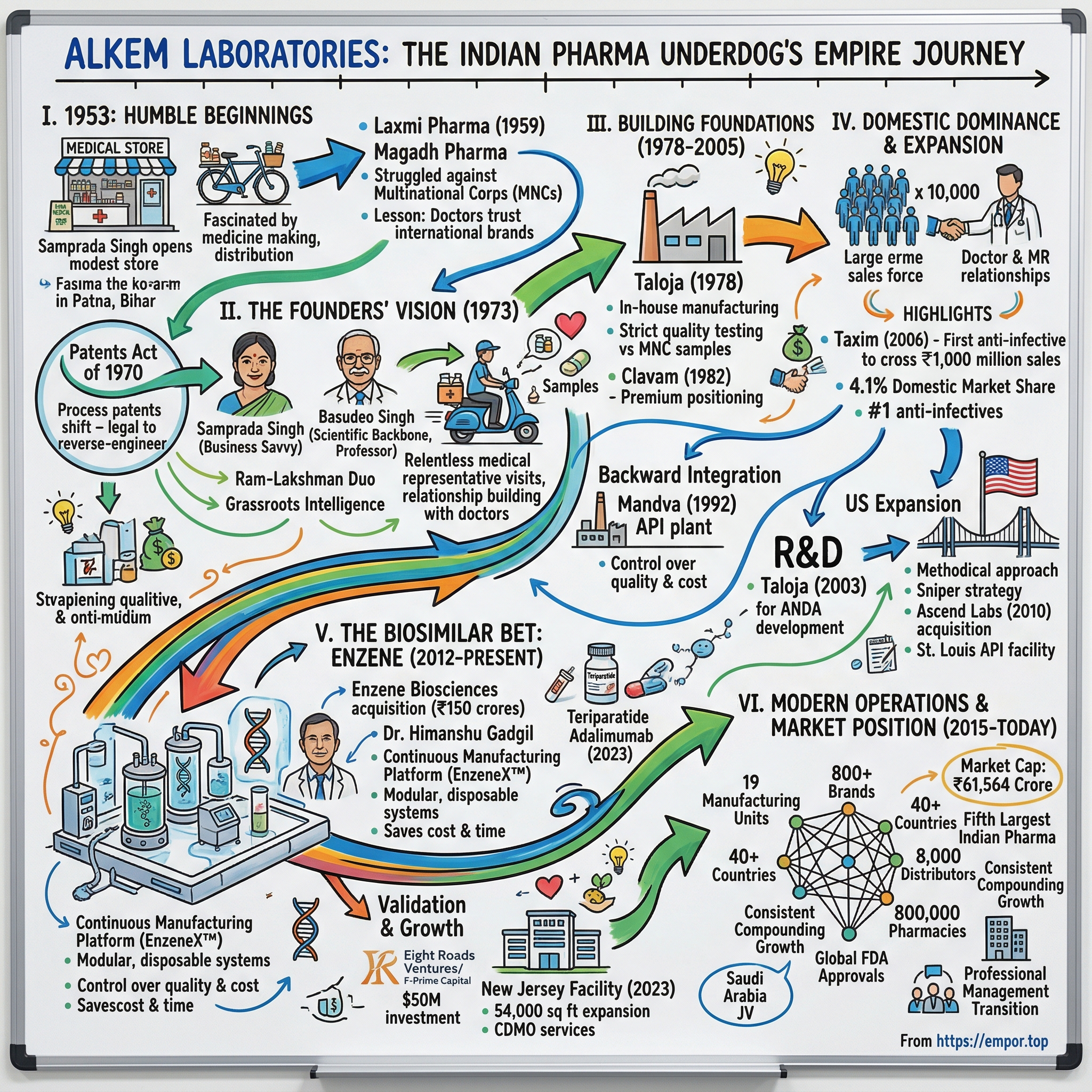
Alkem Laboratories: The Indian Pharma Engine and the Biosimilar Frontier
I. Introduction & Episode Roadmap
There is a particular kind of Indian business that almost never gets written about properly. It does not sell software. It does not feature a charismatic founder on magazine covers. It does not claim to disrupt anything. Instead, every single morning, roughly 14,500 representatives in polyester shirts and laminated ID badges walk into clinics in towns like Muzaffarpur, Warangal, Rajkot, and Siliguri, wait forty minutes behind a queue of patients, secure a four-minute window with a general practitioner, hand over a sample strip and a notepad, and leave. Multiply that routine by two hundred working days. That is the engine. That is Alkem Laboratories.
The financial results produced in the fiscal year ended March 2026 were the highest in the company's history. Consolidated operational revenue reached ₹147,123 million (approximately ₹14,712 crore or $1.7 billion), representing a 13.5% expansion over the prior year. Earnings before interest, tax, depreciation, and amortization (EBITDA) crossed ₹3,000 crore for the first time, with operating margins widening to 20.4% from 19.4%.12 Net profit after non-controlling interest rose a more modest 6.3% to ₹23,018 million as a long-anticipated tax normalization took effect.2 As of August 24, 2026, equity market capitalization stood at approximately ₹63,967 crore, with shares trading near ₹5,350.3
That divergence — operational revenue and EBITDA compounding briskly while net profit growth moderates — provides an instructive initial lesson on Alkem. The operating engine and reported net earnings have periodically diverged, making underlying segment performance the primary indicator of underlying momentum.
The central question. Two brothers from an agricultural family in Bihar's Jahanabad district built a single pharmacy into India's largest anti-infectives franchise by winning the trust of general practitioners in regional markets overlooked by multinationals. That origin story remains compelling, but investors evaluating the company in 2026 face a structural shift: the Indian Pharmaceutical Market is evolving away from Alkem's core strengths. In March 2026, chronic therapies expanded roughly 14% year-on-year and acute therapies grew about 8%, whereas anti-infectives — Alkem's dominant category, where it has held the top market position for over fifteen years — grew just 2%.45 Consequently, the company's core commercial engine is anchored in the industry's slowest-growing segment.
Management's strategy relies on three pillars. First, accelerate expansion into chronic therapies such as cardiology, diabetology, neurology, and dermatology. In the quarter ended June 30, 2026, Alkem's chronic segment grew 17.9% compared to broader market growth of 15.4%, though it still represents a relatively small base of approximately 22% of its domestic branded sales.52 Second, deploy balance sheet strength — supported by ₹5,764 crore in net cash as of June 30, 2026 — to acquire strategic options outside its traditional core.5 Third, scale Enzene Biosciences, a biologics subsidiary leveraging continuous manufacturing in an attempt to reduce production costs for biosimilars and contract biologics.
The scale, briefly. Alkem operates approximately twenty manufacturing plants, three global research and development centers staffed by over five hundred scientists, a workforce exceeding 25,000 employees, a portfolio of more than 800 brands, and commercial operations spanning over forty countries.6 It ranks fifth overall by value in the Indian Pharmaceutical Market and third by total prescriptions written.7 In the June 2026 quarter, the United States generated 20.0% of revenue, while non-US international markets accounted for 12.9%, marking the fastest-growing segment with a 34.5% year-on-year increase.5
What this analysis covers. The origins and field-level distribution model that continue to drive profit and loss. The unit economics of Indian branded generics, which function more as a distribution and relationship business than a research-driven enterprise. The US expansion strategy, where Alkem acquired commercial sales capabilities rather than manufacturing assets — a setup now tested after its Daman facility, which supplies 45% of US revenue, received an Official Action Indicated classification from the US FDA in August 2026.89 The legacy of its 2015 initial public offering and a decade of public market scrutiny. Governance dynamics in 2026 following the resignation of its professional chief executive and ongoing share sales by promoter family members. The execution track record at Enzene Biosciences against initial commercial promises. Finally, an assessment of competitive positioning, core risks, and key performance drivers.
The story begins at a pharmacy near a hospital gate in Patna.
 Subscribe on LinkedIn
II. Founder Genesis to Modern Cash Engine: Succinct History & Ground Game
In 1953, Samprada Singh, the son of an agricultural family from Okari village in Bihar's Jahanabad district, earned a commerce degree from Patna University and opened a small chemist's shop near the gate of Patna Medical College and Hospital.10 The location of that shop contained the company's future strategy in miniature.
A pharmacy adjacent to a major teaching hospital was less a simple retail counter than an intelligence-gathering operation. It revealed which clinical departments generated specific prescriptions, which doctors favored particular formulations, which molecules moved quickly, and which branded products distributors prioritized. Decades before the concept gained currency in corporate strategy, Singh observed the commercial value of physician mindshare.
Singh spent two decades in that trade — expanding from retail into wholesale distribution and small manufacturing partnerships — before a regulatory shift transformed the industry. In 1970, the Indian Patents Act abolished product patents on pharmaceuticals, permitting domestic firms to manufacture and sell any molecule using a novel process.
Overnight, the global pharmacopoeia became legally copyable in India, stripping multinational subsidiaries of their market dominance. Because dozens of domestic manufacturers could produce the exact same molecule, market share depended almost entirely on brand equity and sales force execution. India's branded-generics market structure — which persists today — was born from that legislative pivot.
Singh was uniquely positioned for this environment. Having operated the Patna pharmacy and subsequent distribution ventures through the 1950s and 1960s — most notably Magadh Pharma — he understood the market from the buyer's perspective.10 By the time he incorporated Alkem Laboratories in 1973 alongside his brother, Basudeo Narayan Singh, he had spent twenty years mastering pharmaceutical distribution. Alkem was launched initially as a healthcare marketing firm rather than a manufacturer.710
That commercial sequencing distinguishes Alkem from most Indian pharmaceutical peers. While traditional founders built manufacturing facilities first and sought distribution later, Alkem built its demand-generation apparatus first. The company added its first manufacturing plant at Taloja, near Mumbai, in 1978 — five years after incorporation.7 Its field-force orientation, brand-building focus, and willingness to distribute third-party products stemmed from an early realization that in Indian pharmaceuticals, the scarcest asset is not the molecule, but the prescribing habit of the physician.
Basudeo Narayan Singh built the ground organization. Formerly an academic in Patna, he established a direct distribution network across the Hindi belt and expanding regional markets. Stock was delivered reliably, chemists were visited systematically, and general practitioners were cultivated personally. In an era preceding digital customer relationship management, competitive advantage rested on accumulated relationships and consistent service across regional distribution nodes.
To protect this commercial network, the founders backward-integrated into active pharmaceutical ingredients (APIs) rather than remaining pure formulators. Antibiotics — particularly the cephalosporin and penicillin families that formed Alkem's core — relied on fermentation-derived key starting materials subject to volatile supply cycles. Securing in-house API capacity ensured supply continuity when raw material prices fluctuated or competitors faced shortages, reinforcing distributor trust and market share.
Marketing execution translated these formulations into dominant brand franchises. Taxim (a cefixime franchise) and Clavam (an amoxicillin–clavulanic acid combination) were chemically bioequivalent to competing generics. However, Alkem invested early to establish them as doctor-prescribed brand names rather than generic chemical combinations.
In 2006, Taxim became the first anti-infective in Indian pharmaceutical history to cross ₹1,000 million (₹100 crore) in annual domestic sales.7 Clavam crossed ₹2,000 million (₹200 crore) in 2014.7 By 2022, Clavam surpassed ₹6,000 million (₹600 crore), while the PAN pantoprazole franchise — an acquired product line scaled through Alkem's distribution network — passed ₹10,000 million (₹1,000 crore).7
In a branded-generics framework, a brand prescribed regularly by physicians functions as an annuity. It carries no patent protection or legal exclusivity; its defense relies entirely on prescriber habit, distribution reach, and monthly reinforcement by field representatives.
This model yields significant commercial durability alongside inherent structural vulnerability. The durability is evident in the numbers: PAN remains the second-largest brand family in the Indian market, and one Alkem brand family compounded at 16.1% annually over the five years through March 2025.7 The vulnerability is that Prescriber loyalty carries no contractual guarantee.
By the fiscal year ended March 2025, that model had generated total revenue of ₹129,645 million (nearly ₹12,965 crore), a gross margin of 63.3%, an operating EBITDA margin of 19.4%, and a pre-tax return on capital employed of 28.1% — with 70.2% of sales coming from India and eighteen brand families each generating over ₹1,000 million (₹100 crore).7 Samprada Singh died on July 27, 2019, at age 92, having built one of India's largest personal pharmaceutical fortunes.10 His brother Basudeo Narayan Singh, well into his eighties, retained a seat on the board.
The central strategic challenge facing the company is how an organization optimized for acute anti-infective distribution adapts as market growth shifts toward chronic therapeutic categories.
III. The Core Engine: Domestic Branded Generics & IPM Dominance
Picture the actual unit of production. Not a factory — a conversation. A medical representative, mid-twenties, on a scooter, carrying a bag of samples and a visual aid folder, doing eight to twelve doctor calls a day in a defined territory. His compensation is part fixed, part linked to secondary sales in his patch. His manager tracks call adherence. His company gives him three or four brands to push and a script about why this cefixime is the reliable one. He is one of about 14,500 such people that Alkem deployed as of June 2026, after adding roughly 1,200 representatives in a single year.5
That is the business. Everything else — the plants, the R&D, the regulatory affairs department — exists to keep that conversation supplied and credible.
Why India's market is structured this way. In most developed markets, a physician writes a molecule and a pharmacist, a pharmacy benefit manager or an insurer decides which manufacturer's version gets dispensed, on price. In India, the physician writes a brand and the pharmacist dispenses that brand, because the patient is paying out of pocket and has no institutional intermediary negotiating on their behalf. The consequence is that Indian pharmaceutical marketing spend is directed almost entirely at prescribers rather than at payers, and that a company's competitive position is measured in prescription share, not in tender wins. Alkem ranks third in India by prescriptions written and fifth by value — a revealing spread that says its brands are written very widely but at relatively modest price points, which is precisely what a general-practitioner-heavy, acute-heavy, small-town-heavy portfolio looks like.7
The scoreboard, and where it is uncomfortable. In the June 2026 quarter Alkem's domestic business grew 10.3% to ₹24,978 million, contributing 67.1% of consolidated revenue, and outpaced the broader market by about 100 basis points.5 Therapy by therapy, the picture is a portrait of a company that is dominant where growth is slow and marginal where growth is fast. Anti-infectives: rank one, 13.3% share, a position held for more than fifteen years. Vitamins and minerals: rank two, 6.8% share. Pain and analgesics: rank three, 5.6% share. Gastrointestinal: rank four, 7.9% share. Anti-diabetics: rank thirteen, 2.3% share.5
Read that list again, then set it against the industry's own growth data. In March 2026 the Indian Pharmaceutical Market grew 11%, with chronic therapies at roughly 14% and acute at roughly 8%; cardiovascular grew about 15%, anti-diabetics about 14%, oncology about 28% — and anti-infectives grew 2%.4 Alkem is number one in a category growing at 2% and number thirteen in a category growing at 14%. No amount of narrative can dissolve that arithmetic. It is the single most important fact in the investment case.
What management is doing about it, and how to judge it. The chronic push is real and measurable: chronic grew 17.9% versus market growth of 15.4% in the June quarter, and chronic now represents roughly 22% of the branded generics business, improving by about one percentage point a year.52 One percentage point a year is honest, unglamorous progress. It is also slow. At that pace, reaching the 30%-plus chronic mix that would meaningfully change the company's earnings volatility and its valuation profile takes the better part of a decade. Investors should hold that timeline in mind whenever chronic transformation is described as a near-term story.
The most aggressive move in that direction was semaglutide. India's patent on the molecule lapsed in March 2026, and Alkem was among the first movers, launching pre-filled disposable pens and reusable injection pens in March and, on June 2, 2026, India's first single-shot pre-filled syringes at a starting price of ₹350.112 Management reported approximately 11% unit market share in the initial reporting period.2 That is a genuinely strong debut, and it says something real: Alkem's distribution reach converts a commodity launch into share faster than most.
It also arrives in a market that reportedly attracted more than fifty branded entrants within months, which is exactly what happens to a molecule with no barrier other than speed. An 11% unit share at ₹350 a syringe is a distribution proof point. It is not yet a profit pool, and treating it as one would be a mistake.
Myth versus reality: three consensus beliefs worth testing.
Myth: Alkem is a rural, tier-3 company. Reality: it is a general-practitioner company, which is not the same thing. The distinguishing feature of Alkem's portfolio is the prescriber type, not the postcode. General physicians write high-volume, low-value, acute prescriptions everywhere in India, including in metropolitan neighbourhoods. The strategic constraint this creates is not geographic — it is that moving into chronic care means winning a different kind of doctor, one who sees fewer patients, prescribes longer courses, and is courted by specialist sales teams that Alkem has historically not needed to build. The 1,200 medical representatives added in the year to June 2026 are, in large part, the cost of building that second organisation.5
Myth: high gross margins mean pricing power. Reality: Alkem's gross margin of 67.9% in the June 2026 quarter reflects cheap chemistry and a low-cost manufacturing base far more than it reflects the ability to raise prices.5 Pricing power in the portfolio's largest therapies is capped by regulation, and management has explained on the record that consolidated gross margin moves mainly with API costs and geographic mix — international business carries structurally lower gross margin than domestic, so a strong export quarter mechanically dilutes the ratio.13 Gross margin here is a cost-structure statistic, not a moat statistic.
Myth: the acute business is defensive because people always get sick. Reality: the acute business is seasonal, weather-dependent, and now facing a deliberate policy campaign to reduce its volumes. The company reports acute performance against market benchmarks precisely because absolute acute growth has become hard to generate — an 80 basis point outperformance in the December 2025 quarter came on Alkem acute growth of 8.6% against a market at 7.8%.7 Beating a slow market is a real skill. It is not defensiveness.
The second domestic engine nobody talks about. Alongside branded generics sits Alkem's trade generics business, sold through a separate cluster of divisions directly to stockists and chemists rather than pulled through by prescriptions. It crossed ₹10 billion in revenue back in 2020.7 It is a lower-margin, higher-velocity business, and it is the piece that dragged in fiscal 2027's first quarter — trade generics were, in management's description, flat to mildly growing because of tighter receivables discipline and higher raw material costs.5 Asked directly by Nomura's Saion Mukherjee why India growth had slowed, CFO Nitin Agrawal was straightforward: the India growth rate "is kind of dragged down because of the trade generics."12 Combined, management guided to about 12% India growth for the full year.12
That answer deserves a second look rather than a nod. Tightening credit to distributors is a deliberate working-capital decision that trades revenue today for cash quality tomorrow — a defensible one. But it also reveals that a chunk of reported domestic growth in prior periods was channel-financed, and it is a reminder that in Indian pharma the line between primary sales (to the stockist) and secondary sales (to the patient) is where optimism hides.
The regulatory ceiling. Roughly the entire domestic industry operates under the shadow of the National List of Essential Medicines and the price ceilings set by the National Pharmaceutical Pricing Authority. For a portfolio weighted toward anti-infectives and basic gastrointestinal products — the definition of essential medicines — this is not a theoretical risk. It caps the price component of growth in precisely the therapies where Alkem is strongest, at a time when industry-wide growth is disproportionately price-driven: of the 11% market growth in March 2026, volume contributed about 2.7% and price about 4.4%.4 A company whose portfolio is over-indexed to price-capped essentials participates less in the industry's main growth driver.
There was a second regulatory jolt in fiscal 2026, and it cut the other way before cutting back. The government's goods and services tax revision on medicines lowered patient prices — genuinely good for volume and access — but it cost Alkem a fiscal benefit it had been drawing from its Sikkim facility, which the company quantified at ₹50–60 crore in the second half of fiscal 2026 alone, plus a one-time trade adjustment of ₹10–12 crore.13 Management supported the policy publicly while absorbing the hit. That is a reasonable posture, and the disclosure was specific and prompt, which is a modest but real credibility marker.
So what does the core engine actually tell an investor? That Alkem owns one of the best distribution assets in Indian pharmaceuticals, demonstrably capable of taking share in a new molecule within weeks. That the asset is pointed at the wrong therapies for the current decade, and is being re-pointed at a rate of about one percentage point a year. And that the domestic business, for all its strength, is now growing roughly in line with a market that is itself increasingly price-driven and price-capped. The growth premium, if there is going to be one, has to come from somewhere else.
The company decided a long time ago that "somewhere else" started with America.
IV. US Expansion & International M&A: Ascend, Galderma, & US FDA Realities
In 2007, Alkem filed its first abbreviated new drug application in the United States for amlodipine, a blood pressure generic so commoditized it offered minimal pricing power.7 The approval arrived in 2009.7 For a firm whose primary strength lay in persuading Indian general practitioners to prescribe its brand names, entering the US was a jump into a market without branded prescriptions, without physicians to court, and dominated by three massive buying consortia controlling the vast majority of retail shelf space.
What Alkem did next became one of the most practical capital allocation decisions in its history, and it is best understood by contrast.
The road not taken. Throughout the 2010s, the standard Indian pharmaceutical playbook for entering America was acquiring overseas manufacturing. Competitors routinely bought US factories and legacy portfolios at premium valuations, only to face high single-digit annual generic price deflation that ultimately triggered substantial balance-sheet write-offs. Alkem took a different route in 2010 by acquiring Ascend Laboratories, a front-end distribution and commercial platform in the United States.7 The following year, it acquired Enzene Biosciences in India, and in 2012 added an active pharmaceutical ingredient facility in the US.7 Earlier, in 2009, it had entered Australia by acquiring Pharmacor.7
Acquiring a front-end platform rather than a domestic US factory gave Alkem the hardest asset to build from Mumbai: direct relationships with the American buying groups that control generic distribution. Meanwhile, production remained anchored in low-cost, operating Indian plants. That approach kept fixed costs manageable and the balance sheet lean, helping US revenue cross $200 million annually by 2018.7
The other kind of deal, and the better one. While the American expansion drew headlines, Alkem executed a more characteristic strategy domestically. In 2014, it acquired Clindac-A, a topical clindamycin acne franchise in India, from Galderma S.A., integrating the brand directly into its existing dermatology field force.22 That acquisition reflected Alkem's core deal framework: buy established brands rather than entire corporate structures, route them through pre-funded distribution networks, and keep incremental expenses minimal.
That same efficiency drove its 2015 acquisition of a 51% controlling stake in Indchemie Health Specialities and Cachet Pharmaceuticals, bringing additional therapeutic divisions under the company's existing commercial infrastructure.22 While these smaller tuck-in acquisitions generated little media coverage, they represented some of the company's highest-return capital deployments because they leveraged pre-existing sales channels. Any evaluation of Alkem's deal record must weigh these modest domestic brand acquisitions alongside its higher-profile international transactions.
The reality of the asset today. In the quarter ended June 30, 2026, US sales reached ₹7,439 million—representing 20.0% of consolidated revenue and a 6.5% year-on-year increase.5 The underlying portfolio remains sizeable: 170 ANDA approvals including 18 tentative approvals, alongside two NDA approvals, out of 188 total ANDA filings submitted through December 2025.57 However, during the August 14, 2026 earnings call, Managing Director Sandeep Singh offered a candid assessment of organic conditions: "We really do not have volume growth," noting that reported revenue gains were driven substantially by favorable currency movements.12 While management indicated that price erosion in the US market has stabilized, stabilization does not automatically translate into volume recovery.
This performance marked the second time in two years that US revenue expectations were adjusted. In November 2025, then-Chief Executive Vikas Gupta informed analysts that US growth for fiscal 2026 would reach "somewhere between 10% to 11%"—upgraded from mid-single-digit guidance on the back of a sacubitril/valsartan launch—while noting that excluding new product introductions, the core base business remained "very flattish."13 That launch delivered strong short-term results, with US revenue expanding 26.2% in the March 2026 quarter.2 By August 2026, however, management reduced fiscal 2027 US growth guidance from high single digits to mid-single digits.12 This volatility illustrates the structural reality of launch-dependent generic markets, where revenue expands in concentrated bursts following major approvals and decays between product cycles. Consequently, the US franchise functions more like a series of product options than a predictable recurring revenue stream.
The broader asset base reflects this shift. The US active pharmaceutical ingredient facility acquired in 2012 and the Ascend distribution infrastructure support a market segment where organic volumes are flat by management's own account.712 During fiscal 2026, Alkem divested its manufacturing facility in Indore, recording a modest gain of ₹142.9 million.7 Selling underutilized manufacturing capacity while one-fifth of corporate revenue faces stagnant volume growth represents rational balance-sheet management, highlighting leadership's pragmatic view of its US asset base.
And then the regulator knocked. Between April 20 and May 1, 2026, the US FDA inspected Alkem's Amaliya facility in Daman, issuing a Form 483 containing seven observational findings. On August 6, 2026, the company disclosed to stock exchanges that the FDA had classified the facility as Official Action Indicated (OAI).89 Alkem's regulatory filing noted that the site "continues to manufacture and supply approved products from the said facility to the U.S. market," adding that management "will work with the regulator to achieve fully compliant status."8
The operational implications are substantial, as the Daman facility supplies approximately 45% of Alkem's US revenue.12 An OAI classification serves as the final administrative step before a formal warning letter. While it does not automatically halt commercial shipments of previously approved drugs, it typically pauses pending drug approvals from the affected site and places the facility under strict remediation timelines. Management indicated it expects to resolve the regulatory issues within six to twelve months.12 Two structural factors merit attention.
First, the Daman facility previously received a clean Establishment Inspection Report in October 2019 following an August 2019 audit, with no subsequent physical inspections conducted until 2026 beyond a remote desktop review in October 2020.7 Extended multi-year gaps between physical audits followed by adverse findings have occurred repeatedly across the Indian pharmaceutical industry, demonstrating that a past clean inspection report offers no guarantee of ongoing compliance.
Second, the remainder of Alkem's manufacturing network has maintained clean audit outcomes: the Baddi facility received an inspection report in June 2024, Ankleshwar in July 2023, and Mandva in March 2024, while the Taloja bioequivalence center and California API facility cleared inspections with zero observations in April 2025 and September 2025, respectively.7 Overall regulatory compliance across the network has remained stable, though the current enforcement action targets the single facility most critical to US earnings.
Where the growth actually is. The fastest-expanding portion of Alkem's international business lies outside the United States. Non-US international sales rose 34.5% year-on-year in the June 2026 quarter to ₹4,785 million, following a 41.6% expansion in the December 2025 quarter across European, Australian, and emerging markets, with foreign exchange movements contributing four to four-and-a-half percentage points of that growth.5713 The segment accounts for 12.9% of consolidated revenue and is expanding three to five times faster than the US business. While management attributed a portion of this acceleration to specific market opportunities in Germany and Australia—suggesting that high-growth rates off a smaller base may not be fully repeatable—non-US international operations currently contribute more to top-line expansion than the American franchise.13
And a new kind of deal. Between 2024 and 2025, Alkem expanded into medical devices through a licensing agreement with Exactech and the acquisition of Bombay Ortho. On February 13, 2026, subsidiary Alkem MedTech executed a binding term sheet to acquire a 51% to 55% controlling stake in Occlutech Holding AG, a Swiss structural-heart device manufacturer, at an equity valuation of €180.70 million (approximately ₹19,516 million), funded entirely through cash balance and internal accruals.714 Founded in 2003, Occlutech generated approximately €50 million in calendar year 2025 revenue, reflecting a 14% compound annual growth rate since 2021. It employs over 300 people, derives roughly 71% of sales from Europe, and holds the number-two market position in Europe and number-three globally in structural heart occluders.14 The transaction was scheduled to complete following regulatory approvals in mid-2026, with management projecting closure within 45 to 60 days during its March-quarter conference call.142
This transaction sits in tension with Alkem's historical capital allocation principles. The logic behind the Ascend acquisition was acquiring an affordable commercial layer while avoiding expensive manufacturing assets in unfamiliar sectors. The Occlutech deal represents the opposite strategy: acquiring a majority stake in a European medical device manufacturer at roughly three-and-a-half times sales in a sector where Alkem lacks prior operational experience. Management framed the deal around potential synergies from "Alkem's brand building capability" and "enormous reach."14 However, commercial reach among Indian primary care physicians does not automatically translate into selling transcatheter occluders to interventional cardiologists in European hospitals.
To manage the transition, Alkem hired experienced industry leadership; MedTech Chief Executive Kaustav Banerjee previously led St. Jude Medical India and Zimmer Biomet's South Asia operations.14 Nevertheless, the move represents diversification into an unrelated capital-intensive sector funded by core pharmaceutical cash flows—a departure from the conservative capital discipline that previously characterized Alkem's growth strategy. Demonstrating return on this capital will require multi-year operational execution.
Which makes it worth revisiting how Alkem established its capital discipline in the first place—in December 2015, when it transitioned from a private family enterprise into a publicly traded corporation.
V. The 2015 IPO & Valuation Evolution
There is a clear indicator that distinguishes Indian promoter families listing to raise capital from those going public to create liquidity: whether any fresh capital enters the business. Alkem's initial public offering in December 2015 was a pure offer for sale of ₹1,349.61 crore by existing shareholders, with no new capital entering corporate accounts.[^15] Priced at ₹1,050 per share during its December 8–10 bidding period, the issue closed roughly 4.4 times subscribed on its final day.[^16]
That transaction structure sent a clear message. Generating robust operating cash flows from its domestic franchise, Alkem had no immediate need for external equity financing. Instead, public listing established a transparent equity valuation, created a liquid asset holding, and provided promoter shareholders a vehicle for long-term diversification. Subsequent capital-allocation decisions follow directly from that initial transaction design.
What listing actually changed. Public status altered three core operational dynamics.
First, it imposed strict disclosure discipline. A privately held branded generics enterprise can obscure channel inventories, related-party transactions, and trade discount structures. Listing mandated public quarterly segment reporting, therapy-level IQVIA market share disclosures, plant-by-plant regulatory status, and institutional analyst Q&A calls with firms like Nomura, JPMorgan, Bank of America, and Macquarie. Deep external evaluation of the company relies directly on this reporting framework.
Second, it established a visible cost of capital. Continuous daily equity pricing at a public market earnings multiple raises the hurdle rate for capital deployment. A ₹1,000 crore acquisition returning 8% on capital visibly dilutes shareholder value for a listed entity in ways easily masked within a private corporate structure.
Third, listing established a recognized equity currency for shareholder exits.
The record on the balance sheet. Relative to industry peers, Alkem has maintained consistent financial discipline. Capital expenditure has been funded primarily through internal cash generation, avoiding the leveraged cross-border factory acquisitions that led to major asset write-downs across the sector. This discipline built a substantial cash reserve, with net cash standing at ₹55.9 billion in December 2025, ₹54.74 billion in March 2026, and ₹57.64 billion by June 2026.725 Pre-tax return on capital employed reached 28.1% in fiscal 2025 and 29.6% in fiscal 2026, highlighting how little incremental capital the core domestic franchise consumes relative to the cash it generates.715
Two structural nuances qualify this cash position. First, the balance sheet retains total borrowings of ₹2,047 crore as of fiscal year-end 2026, meaning reported "net cash" reflects offset leverage rather than an absence of debt.3 Second, holding large cash reserves carries an opportunity cost. Capital held in lower-yielding liquid instruments drags consolidated returns down compared to high-twenties operational returns, while creating capital allocation pressure for transactions like Occlutech.
When asked about M&A strategy in November 2025, then-Chief Executive Vikas Gupta noted that "we have good cash on our balance sheet as well," adding that "whenever there is a right opportunity at the right value where we feel that we can create more value, we'll go for it."13 Maintaining excess cash in search of targets presents a fundamentally different allocation posture than raising capital for explicit strategic investments.
What a decade of public markets produced. Between its ₹1,050 issue price in December 2015 and approximately ₹5,350 by August 2026, Alkem expanded its market capitalization from the low ₹12,000-crore range at listing to ₹63,967 crore, reflecting steady compound equity growth during a decade marked by broader Indian pharmaceutical market re-ratings.[^16]3 Inclusion in the MSCI India Index during 2024–25 further expanded its institutional investor base.7
Public markets have priced Alkem as a mature cash generator rather than a high-growth compounder. Trading in August 2026 at a trailing earnings multiple in the high twenties, the valuation reflects baseline domestic stability alongside modest expectations for international options.3 The equity pricing assumes core franchise preservation without assigning high upfront valuations to strategic pipeline initiatives.
The tax normalization. The most significant financial transition facing Alkem stems from tax accounting rather than operational shifts. For several years, the company utilized more than ₹1,500 crore in accumulated minimum alternate tax (MAT) credits to maintain a depressed effective tax rate.13 With those credits exhausted at the end of fiscal 2026, tax liabilities normalized. In November 2025, leadership projected a fiscal 2027 effective tax rate of 35% to 38%; this guidance was revised to 27%–29% in March 2026, before settling in August 2026 at 30%–32% on a consolidated basis and 27%–28% for standalone operations.13212
The impact of this tax reset showed clearly in the June 2026 first-quarter results: while revenue expanded 10.9% year-on-year and operating EBITDA grew 3.7%, net profit after tax declined 21.7%—a reduction driven primarily by normalized tax expense rather than operational contraction.512
This structural tax shift shifts the burden of fiscal 2027 net earnings growth directly onto operating margin expansion. Offsetting a permanently higher tax rate will require operating efficiency gains, placing clear execution demands on an executive leadership team navigating recent senior transitions.
VI. Modern Leadership, Capital Allocation & Governance Stress Test
On April 24, 2026, Alkem Laboratories informed stock exchanges that Dr. Vikas Gupta had resigned as Chief Executive Officer, effective June 30, 2026, to "pursue new professional opportunities that align closely with my long term professional and personal goals."16 Shares fell nearly 5%. As of the August 2026 earnings call, no successor had been named; asked by ICICI Securities analyst Abdul Puranwala about the search, Managing Director Sandeep Singh said only, "We are looking out, sir… hopefully next time when we have the quarterly meeting, he will be there with you."12
That departure represents a significant governance event, less for the individual than for what the position represented in Alkem's corporate structure.
The three-layer structure, and what just broke. Alkem has historically operated through a three-tier leadership model: Executive Chairman Basudeo Narayan Singh providing founder authority over long-term policy and key distributor relationships; Managing Director Sandeep Singh driving international expansion, the Enzene incubation, and the MedTech entry; and, from September 2023, a professional CEO in Dr. Gupta, hired from major Indian pharmaceutical peers to streamline operations, expand operating margins, and institutionalize execution.
On paper, Gupta's tenure delivered on operational metrics. In November 2025, he informed analysts that fiscal 2026 EBITDA margin would land "somewhere between 19.5% to 20%," upgrading prior guidance of 19.5% while absorbing new-business operating expenses and the loss of Sikkim tax benefits.13 The company ultimately reported an operating margin of 20.4%.2 He also repeatedly committed to a longer-term benchmark: "year-on-year, we should look at least a 1% improvement in our overall margins," inclusive of planned MedTech and CDMO investments.13 Exceeding raised guidance in one's final fiscal year represents a strong operational record.
However, corporate disclosures offered no detailed rationale for his departure beyond standard boilerplate language. While no operational impropriety was indicated, a professional CEO stepping down thirty-three months into a mandate to institutionalize a founder-led business — leaving the post vacant for four months — presents an unscripted governance transition.
Early data tests whether that margin commitment can persist without its architect. In the June 2026 quarter, Alkem reported a 20.5% EBITDA margin — an expansion of 370 basis points over reported year-ago results, but a 140-basis-point decline compared to the 21.9% operating margin recorded in the prior-year period, despite gross margin expanding 260 basis points to 67.9%.512 While gross profitability widened, operating margins contracted as funds flowed into sales and administrative expenses.
Employee costs expanded 16% year-on-year, driven by salary increments and the addition of roughly 1,200 medical representatives.5 Expanding the field force represents a deliberate investment in chronic therapy expansion. However, higher fixed overhead complicates the target of achieving annual operating margin expansion of one percentage point, shifting the burden of execution to incoming leadership.
The two Singhs still in the room. Executive Chairman Basudeo Narayan Singh, now in his late eighties, continues to lead the board — an unusual governance structure for a company promoting a decade-long transition to professional management. His role remains operationally vital: the distributor and trade networks he established over five decades constitute core commercial assets, managed by personnel appointed under his tenure. This institutional history provides commercial stability but also creates key-person concentration risk, as leadership has not publicly outlined succession plans for this distribution oversight layer.
Managing Director Sandeep Singh represents second-generation promoter leadership and serves as the primary executive voice, leading analyst calls in the CEO's absence and guiding strategic diversification into Enzene's biologics platform and MedTech.1218 His commentary during investor briefings is notably candid; when questioned on the contract development and manufacturing (CDMO) timeline, he stated directly that the business would not reach breakeven within twelve months, citing extended sales cycles.12 While such transparency offers clarity, it also highlights that the two major initiatives under his direct sponsorship remain capital investments that have yet to generate positive returns.
The ownership question that keeps getting quieter treatment than it deserves. A central governance metric in 2026 involves the evolution of the shareholding structure. Total promoter and promoter-group equity dropped from 51.2% as of December 31, 2025, to 49.70% by June 2026, marking the first time promoter ownership has fallen below a controlling majority.73
Rather than a single strategic divestment, equity reductions occurred through sequential block transactions by individual family members. On June 3, 2026, promoter Jayanti Sinha divested her entire 1.04% stake (1,238,220 shares) at an average price of ₹5,200 per share for ₹643.87 crore, while the Samprada & Nanhamati Singh Family Trust sold 550,000 shares, bringing total proceeds from the combined block trade to approximately ₹930 crore.17 Major domestic and international institutional investors absorbed the shares, including ICICI Prudential, HDFC Mutual Fund, Goldman Sachs, Morgan Stanley, Nippon India, Edelweiss, and BNP Paribas.17 Institutional shareholding expanded to 31.5% by December 2025, with domestic institutions holding 22.64% and foreign institutional investors holding 10.42% by June 2026.73
Evaluating these equity sales requires balancing two perspectives. On one hand, orderly market transactions by extended family members — representing the Samprada Singh estate and Basudeo Singh lineage — reflect standard wealth diversification by non-executive shareholders through public markets. On the other hand, sustained promoter selling that brings collective family ownership below 50% during periods of optimistic corporate guidance warrants ongoing monitoring. Key indicators for investors will center on whether future sales remain confined to non-executive family branches or extend to active management.
The stress test a skeptical investor would run. Four operational areas outline potential structural risks.
Portfolio complexity. A company focused four years ago on Indian branded generics now manages US generics distribution, European and Australian exports, a bi-coastal biologics CDMO, an orthopaedics unit, and a majority holding in a Swiss structural-heart manufacturer. While each investment carries individual strategic logic, managing multiple distinct business models dilutes operational focus at a time when the core anti-infective category faces single-digit growth. In the December 2025 quarter, disclosed exceptional items included charges from updated labour codes alongside a ₹142.9 million gain from selling the Indore plant, reflecting active portfolio reconfiguration.7
ROIC disparity. Consolidated return on capital employed in the high twenties masks segment variation. Domestic branded operations generate returns above the consolidated average, whereas US generic infrastructure, Enzene's international expansion, and MedTech operate at lower or negative returns. The MedTech division recorded an EBITDA loss of approximately ₹5.5 crore in a single quarter on ₹8–9 crore in operating expenses against ₹2.5 crore in revenue, with breakeven targeted for fiscal 2028.13 While these losses remain small relative to total earnings, they illustrate how capital deployment into secondary ventures can drag overall returns.
Disclosure granularity. While Alkem publishes detailed therapy market share and geographic revenues, it does not report segment-level profitability. Investors cannot independently verify the exact EBITDA contribution of domestic branded generics versus the drag from international and growth initiatives. Although management provides occasional profitability updates on earnings calls — noting Enzene's Pune facility operates between breakeven and low-teens EBITDA margins while reporting losses at Enzene US and MedTech — financial reporting relies on voluntary disclosures rather than standardized segment accounting.213
Seasonality and its rhetoric. Alkem's heavy reliance on acute anti-infectives makes quarterly financial performance sensitive to seasonal weather patterns and infection cycles. Asked in November 2025 whether anti-infective demand was tracking expectations, Dr. Gupta observed that seasonality "is part and parcel of our business… that's something nobody can predict."13 This reliance highlights that short-term earnings momentum remains tied to seasonal disease patterns rather than purely strategic execution.
These factors reflect the operational transition of a founder-driven firm working toward an institutional structure during a period of leadership transition. That dynamic leads directly to the segment of Alkem's portfolio where promoter conviction is highest, but commercial validation remains early.
VII. The Hidden Growth Engine: Enzene Biosciences & Continuous Manufacturing Optionality
Understanding why Enzene exists requires examining how biologic drugs are traditionally manufactured, where the conventional process resembles large-scale industrial baking.
A standard biologics facility functions like a commercial bakery producing output in discrete batches. Manufacturers fill a 10,000- or 20,000-liter stainless steel bioreactor with genetically engineered cells and nutrient broth, allowing them to grow over two to three weeks while secreting the target protein. Operations are then halted to harvest the batch, purify the protein, clean the vessel, and validate the equipment before starting the next production run.
The underlying economics impose severe operational constraints. Bioreactors are capital-intensive and sit idle during turnaround, cleaning, and validation cycles. High fixed capital costs per gram of protein dictate large minimum viable plant sizes, concentrating global biologics manufacturing among a select group of contract operators with multi-billion-dollar facilities.
Continuous manufacturing—implemented through Enzene's proprietary EnzeneX platform—operates on an uninterrupted production model. Fresh nutrient broth flows continuously into a significantly smaller bioreactor while cells are retained, and output drains directly into primary purification. By operating continuously rather than in intermittent batches, a 500-liter continuous bioreactor can match the output of a traditional 10,000-liter vessel.
Proponents project that continuous processing can halve facility capital expenditure while lowering unit production costs for equivalent volume. If validated at commercial scale, that economic model could alter cost structures across biosimilars and contract biologics manufacturing.
Two caveats apply. Continuous bioprocessing is an industry-wide engineering initiative pursued in various configurations by global biopharmaceutical firms rather than an exclusive Enzene discovery. Furthermore, the platform's economic advantage depends on commercial execution at scale—a metric best evaluated against Enzene's recorded financial performance.
The history. Alkem acquired Enzene in 2011, well before contract development and manufacturing (CDMO) emerged as a central corporate narrative.7 Construction of a biologics and biosimilar manufacturing facility in Pune concluded in 2020, followed by the launch of Enzene's first domestic commercial biosimilar in 2021.7 External institutional validation arrived in December 2022, when Eight Roads Ventures and F-Prime Capital invested ₹161.48 crore for an 8% equity stake, implying a post-money valuation exceeding ₹2,000 crore.[^20] In June 2023, Enzene announced a $50 million US manufacturing expansion near Princeton, New Jersey, planning to employ up to 300 personnel; in January 2024, it detailed the 54,000-square-foot facility at Hopewell in the Princeton West Innovation Campus, targeted at smaller US biotechnology firms that Chief Executive Dr. Himanshu Gadgil noted "struggle to find clinical phase capacity."1819
The execution gap.
In November 2025, with the US plant entering initial operations, then-Chief Executive Dr. Vikas Gupta outlined specific financial targets. He projected that Enzene's US CDMO operations would generate approximately ₹15 crore to ₹20 crore in quarterly revenue, ending fiscal 2026 at ₹70 crore to ₹80 crore against quarterly operating expenses of about ₹50 crore. He anticipated the facility reaching an annualized revenue run rate of ₹300 crore—representing an asset turn near one—within 12 to 18 months, achieving breakeven within the same timeframe.13 Asked directly by ICICI Securities when the facility would break even, leadership specified "12 to 18 months."13
By August 2026, the guidance had shifted. Managing Director Sandeep Singh informed analysts that the US CDMO unit required $25 million to $30 million in annualized revenue—roughly ₹220 crore to ₹265 crore—to achieve breakeven, projecting that milestone for fiscal 2028 rather than fiscal 2027. Pressed by Macquarie analyst Kunal Dhamesha on timing, Singh acknowledged, "We will not break even," while quarterly operating expenses ran around ₹60 crore.12 Singh characterized the segment by noting that "CDMO is a lumpy business… whenever it comes, it will come big."12
Comparing these disclosures highlights a shifting operational timeline. The projected breakeven window moved out by approximately one year, quarterly operating costs rose about 20%, and concrete asset-turn targets were replaced by general observations regarding revenue lumpiness.
Early-stage CDMO operations often face extended sales cycles as biotechnology clients evaluate novel production platforms. However, the trajectory indicates that initial management timelines were overly optimistic, offering a cautionary benchmark for evaluating forward guidance across the platform.
A detail from the November 2025 briefings clarifies the nature of the ₹300 crore revenue target. Asked by Motilal Oswal analyst Tushar Manudhane whether projected revenues reflected commercial-scale manufacturing, Dr. Gupta stated, "This is all development work. It's not a commercial scale manufacturing."13 Early-stage development contracts yield higher gross margins because revenues reflect specialized technical services rather than raw material costs.13 However, development-stage revenues remain smaller, more fragmented, and less predictable than long-term commercial supply agreements. The primary strategic value in contract manufacturing materializes when a client's molecule receives regulatory approval, securing long-term commercial production contracts. Enzene currently operates in the initial evaluation phase rather than as an established commercial manufacturer.
The operational base. Enzene's established Pune operations generated approximately ₹120 crore in revenue during the September 2025 quarter, inclusive of US-bound supplies, and ₹180 crore to ₹185 crore across the first half of fiscal 2026. Management reported domestic operations operating at or above EBITDA breakeven, progressing by the March 2026 call to breakeven or low-double-digit EBITDA margins.132 Standalone revenue for Enzene reached approximately ₹374 crore in fiscal 2025.20 Concurrently, an Enzene facility received a US FDA Form 483 containing six procedural findings, demonstrating that novel manufacturing architectures remain subject to standard regulatory oversight.21
The underlying domestic biosimilar portfolio predates the CDMO expansion and offers more verifiable execution metrics. Launched from the Pune site starting in 2021, Enzene's Indian commercial portfolio achieved EBITDA breakeven, demonstrating an ability to manufacture complex biologics to standard and commercialize them domestically.72
However, establishing a domestic biosimilar business differs fundamentally from securing Western biotechnology manufacturing mandates against established global CDMO competitors. The two activities involve distinct client profiles, decision cycles, and operational risks.
Strategic optionality. Enzene contributes roughly 3% of Alkem's consolidated revenue. As the US facility ramps up operations, it generates operating losses of approximately ₹150 crore to ₹200 crore annually, offset against corporate EBITDA exceeding ₹3,000 crore. While the unit does not immediately alter near-term consolidated earnings, a proven, capital-efficient continuous manufacturing platform serving Western clients would command a higher valuation multiple than a traditional acute pharmaceutical franchise—explaining the initial capital injection by Eight Roads and F-Prime in 2022.
Enzene represents a strategic option backed by proprietary engineering and external venture backing, whose commercial timeline has extended and whose current revenue reflects early-stage development services rather than long-term commercial supply. It remains an asset with strategic potential whose full valuation impact depends on future commercial execution.
VIII. Strategic Analysis: Helmer's 7 Powers & Porter's 5 Forces
Frameworks are only useful if they are allowed to yield uncomfortable conclusions. Evaluating Alkem through Hamilton Helmer's 7 Powers and Michael Porter's Five Forces leads to the same underlying reality: the company possesses one genuine, durable power, several partial advantages, and one potential moat it is attempting to build from scratch.
Helmer's 7 Powers, applied honestly.
Scale economies — strong, and the company's principal moat. The unit economics of a medical representative function as fixed-cost leverage. Base salaries, travel allowances, sample allocation, and field management cost roughly the same whether a representative promotes four brands or eight, and whether a physician writes ten prescriptions or thirty. Deploying a field force of 14,500 representatives across hundreds of thousands of prescribers spreads those overhead costs across a vast prescription volume.5 This fixed-cost distribution engine allowed Alkem to launch generic semaglutide and capture an 11% unit market share within weeks, an entry speed smaller competitors cannot match because the underlying distribution infrastructure is already fully funded.2 That operating leverage underpins the company's pre-tax returns on capital in the high twenties.
Branding — strong within its niche, but narrower than it appears. Brand equity in Indian generics is real: a general practitioner who has prescribed Clavam for fifteen years defaults to habit rather than price comparison, helping support seventeen brand families generating over ₹1,000 million each, including PAN as the second-largest brand family in the domestic market.5 However, that brand equity remains tightly bound to acute-care general practitioners. It does not automatically transfer to cardiologists prescribing anticoagulants or endocrinologists selecting GLP-1 therapies. Alkem's ranking of thirteenth in anti-diabetics reflects a brand-equity constraint among specialist physicians rather than a distribution failure.5
Cornered resource — moderate. The company's distribution footprint across regional stockists built over five decades remains difficult to replicate rapidly. Yet it is not strictly cornered: peers like Mankind and Cipla have established comparable regional reach, making distribution an asset shared among several established domestic players rather than an exclusive monopoly.
Switching costs — low to moderate, and frequently overstated. Patient switching costs are practically non-existent in out-of-pocket markets. For prescribing physicians, switching costs represent cognitive habit rather than contractual lock-in. For stockists, switching costs are tied to working capital and credit terms, which is why management's decision to tighten receivables discipline led directly to flat trade generics growth.5 Switching costs in Indian branded generics remain behavioral rather than structural, shifting whenever a competitor's representative secures greater prescriber frequency.
Process power — asserted, but unproven. This forms the core claim behind Enzene Biosciences. However, a manufacturing process advantage qualifies as a true power only after being demonstrated at commercial scale against global competitors. Enzene's continuous bioprocessing platform currently generates revenue primarily from development services. Competing against established operators like Samsung Bioepis, Sandoz, and Biocon Biologics—each possessing commercial-scale biosimilar facilities and long-standing regulatory approvals—Enzene's process power remains a promising engineering hypothesis backed by early contract work rather than a validated commercial moat.
Counter-positioning and network economies — absent. Incumbent pharmaceutical manufacturers face no business-model conflict preventing them from adopting Alkem's commercial strategy, and prescription pharmaceuticals offer no network effects.
Porter's five forces, and where the pressure actually sits.
Rivalry — intense and intensifying. Competitive rivalry represents the primary structural constraint on growth. Sun Pharma leads the Indian market with roughly an 8.4% value share, followed by Abbott and Cipla at approximately 5.9%, Mankind near 5.5%, Torrent near 4.9%, and Alkem at around 4.1%.4 While Alkem's corporate disclosures rank the company fifth overall by value, recent monthly market data places it closer to sixth, as Mankind and Torrent—peers explicitly structured around chronic care and consumer healthcare—have pulled ahead.74 As domestic market expansion concentrates in chronic therapies, Alkem's historical position in acute care yields diminishing returns in a segment growing at just 2% annually.
Buyer power — bifurcated, driving segment margin differentials. In India, the ultimate buyer is an out-of-pocket patient with minimal bargaining power, guided by a physician with no direct financial interest in drug selection; this dynamic supports domestic gross margins near 68%. In the United States, generic drug purchasing is concentrated among three large buying consortia, driving persistent annual price deflation and resulting in management's assessment of flat base business volume.12 Because the same formulation yields vastly different profitability depending on the purchasing channel, management noted that faster international growth mechanically dilutes consolidated gross margin.13
Supplier power — moderate to high, with geopolitical vulnerability. Key starting materials for fermentation-based antibiotics, particularly within the penicillin and cephalosporin categories, remain heavily concentrated among Chinese suppliers. Alkem's active pharmaceutical ingredient integration mitigates this exposure but cannot eliminate it entirely. A clear illustration emerged when Indian regulators evaluated a minimum import price on penicillin G to support domestic fermentation; when asked about potential cost inflation, then-CEO Vikas Gupta declined to speculate, stating that company inventories were adequately covered.13 That response highlighted a recurring raw-material vulnerability inherent in core antibiotic formulation.
Threat of new entrants — low in domestic distribution, high in export generics. Replicating a 14,500-person domestic field force requires multi-year capital investment, providing robust defense for Alkem's core Indian operations. By contrast, US oral solid generics present minimal entry barriers beyond regulatory filings and compliant manufacturing capacity, creating the structural framework for ongoing price erosion.
Substitutes — low in the near term, significant over the long term. Standard antibiotics and proton pump inhibitors have few direct clinical substitutes. However, broader prescribing patterns face systematic pressure from antimicrobial stewardship initiatives in India and globally, which actively seek to curtail inappropriate antibiotic consumption. Consequently, successful public health interventions aimed at reducing antibiotic overuse directly contract the addressable market for India's leading anti-infective manufacturer.
The strategic synthesis presents a clear trade-off. Alkem's competitive advantages are genuine but heavily concentrated in domestic field distribution. Its market dominance remains tied to therapeutic categories experiencing structural deceleration, while its position remains modest in faster-growing chronic segments. Finally, the strategic initiative capable of shifting the company's valuation profile—Enzene's continuous manufacturing process power—remains dependent on future commercial validation.
IX. Operational Risk Radar & Transcript Evidence Guide for Investors
The most useful thing about Alkem for a fundamental investor is that management answers questions specifically. Over four recent calls, the same analysts return to the same four pressure points, and the drift in the answers is more informative than any single answer.
The risks that are actually material.
Regulatory action at Daman. This is the near-term risk with the clearest transmission mechanism to earnings. A site supplying 45% of US revenue under an OAI classification faces, at minimum, a freeze on new approvals from that site and a remediation programme with real cost.128 The downside scenario — escalation to a warning letter or import alert — would remove roughly a fifth of consolidated revenue's largest single supply node. Management's six-to-twelve-month resolution guidance is a forecast about a regulator's behaviour, which is the least controllable variable in the business. Watch for the re-inspection, not the commentary.
Antimicrobial stewardship and acute concentration. The 2% growth in anti-infectives in March 2026 is the number that should worry a long-term holder most, because it may not be cyclical.4 Some of it is base effects and seasonality. Some of it is a structural, policy-driven, medically correct effort to reduce antibiotic use. Alkem's own disclosure that acute grew 8.6% against IPM acute growth of 7.8% in the December quarter — an 80 basis point outperformance — shows the company beating a slow market, which is competent but not the same as growing.7
Price control expansion. Any widening of the National List of Essential Medicines catches Alkem's portfolio disproportionately, and it does so in an industry where price is currently supplying the larger share of growth.4
Input cost and supply chain. Chinese key starting material concentration, plus domestic policy interventions like a potential penicillin G minimum import price, plus currency — which management quantified as a four to four-and-a-half percentage point tailwind to non-US growth in one quarter, and which will reverse.13
Execution risk in the new portfolio. Enzene US at roughly ₹60 crore of quarterly opex against modest revenue, MedTech losses to fiscal 2028, and an unintegrated European device business — none individually large, collectively a meaningful drag on the margin expansion story at exactly the moment the tax rate resets upward.1213
Leadership vacancy. The absence of a CEO during a chronic-therapy transformation, a compliance remediation and an international acquisition integration is itself an operational risk.
How to read the calls. Four are worth reading in full: the Q2 FY26 call of November 13, 2025, the Q3 FY26 presentation of February 13, 2026, the Q4 FY26 call of May 2026, and the Q1 FY27 call of August 14, 2026.137212
Analysts push hardest on four things, and the pattern of responses is diagnostic. On margins, management has been consistently specific and has largely delivered — Gupta's raised fiscal 2026 guidance of 19.5–20% became 20.4%, which is a genuine credibility marker.132 On Enzene, management has been specific and has not delivered on timing, with breakeven sliding from a 12-to-18-month window to fiscal 2028.1312 On the US, management has revised in both directions within a year — up in November 2025 on a single launch, down in August 2026 on the absence of volume growth — which is a fair reflection of a launch-driven business but should discourage anyone from extrapolating a single quarter.1312 On India, management has been the most consistent: an unchanged commitment to outperform the market by 100 to 150 basis points, repeated across calls and broadly met.135
The most useful single habit is to compare prepared remarks against Q&A. In prepared remarks the international business is a growth story; in Q&A the CFO explains that international growth compresses consolidated gross margin.13 In prepared remarks India is compounding; in Q&A the CFO identifies trade generics as the drag.12 In prepared remarks Enzene is a platform; in Q&A the CEO clarifies it is all development work.13 Nothing here is concealed — but the picture only assembles if you read the second half of the call.
One further habit is worth adopting. Alkem's investor presentations report domestic performance in two currencies — reported revenue, which is what the company invoices to stockists, and IQVIA secondary data, which is what actually moves off pharmacy shelves.
The two diverged noticeably in the December 2025 quarter, when reported domestic revenue grew 5.5% while IQVIA measured Alkem's market growth at 9.8%.7 Divergences in either direction are normal and usually reflect channel inventory timing, but a sustained gap where reported sales run ahead of secondary data is the single clearest early warning available in Indian pharmaceuticals. Alkem discloses both, which is to its credit; investors should use both.
Which is a reasonable place to extract what the whole story teaches.
X. Playbook: Business & Investing Lessons
1. In emerging-market pharmaceuticals, the scarce asset is the prescriber's habit, not the molecule. Alkem built the largest anti-infectives franchise in India not by inventing novel molecules, but by ensuring that when a physician in a regional town prescribed an antibiotic, the company's brand came to mind and a local stockist could fulfill the order that day. Decades of field execution compounded into brand families worth over ₹10 billion without patent protection. For investors, field-force scale, productivity, and distribution reliability are stronger leading indicators than research spending in branded generics — and Alkem's research and development budget runs at roughly 4% of sales, showing precisely which model it executes.5
2. Sequence matters: build demand before building capacity. Alkem operated as a commercial marketing firm for five years before opening its first manufacturing plant. That inversion of the traditional pharmaceutical sequence established a corporate culture that evaluates commercial demand before committing capital to production. This sequencing explains why acquiring established brands, licensing formulations, and purchasing front-end distribution platforms came more naturally to the company than constructing heavy manufacturing infrastructure.
3. Buy the layer you cannot build; rent the layer you can. The acquisition of Ascend Laboratories — securing commercial access in the United States while keeping production in low-cost Indian facilities — avoided the severe asset write-downs that burdened larger peers that bought overseas manufacturing plants. In cross-border expansion, the most expensive asset to buy is often the manufacturing layer a firm could build internally, whereas the most valuable is the commercial access and customer relationships it cannot easily replicate. Whether the Occlutech transaction respects or departs from that principle remains an open question in Alkem's capital allocation, and the outcome will take several years to clarify.14
4. Cash-cow funding of optionality only works if options are realistically priced. Reinvesting cash flows from a high-return acute business to expand a chronic sales force and incubate a biologics platform represents sound capital allocation in principle. However, discipline requires evaluating those options accurately. A chronic mix expanding by one percentage point a year represents a decade-long operational shift rather than a near-term valuation catalyst. Similarly, a contract development and manufacturing unit whose breakeven timeline has slipped by a year and whose revenue consists primarily of development contracts is an early-stage option, not a mature growth engine. Leadership teams that describe strategic options accurately preserve market credibility; those that frame them as immediate catalysts risk eroding it.
5. Founder-to-professional transitions are among the most difficult corporate maneuvers, and they are rarely complete when they appear finished. Alkem appointed a professional chief executive in 2023, granted him operational authority, and recorded three years of expanding operating margins — before he departed without a named successor as the promoter family's combined equity stake fell below 50%.163 Governance transitions are an ongoing operational discipline rather than a single event. Their ultimate success depends on whether incoming leadership can maintain execution and whether founding families permit professional management to operate independently.
XI. The Investment Spine: Bull vs. Bear Case
Why Alkem wins from here.
The bull case rests on a single underlying mechanism and three second-order effects. The primary mechanism is Alkem's distribution asset and its associated scale economics — an operational engine of 14,500 representatives, hundreds of thousands of prescribers, and more than 800 brands, where the marginal cost of carrying an additional product is exceptionally low.56 That distribution asset has demonstrated its ability to rapidly convert new molecule launches into market share, securing roughly an 11% unit share in generic semaglutide during its initial reporting period despite competing against more than fifty rival entrants.2
The first second-order effect involves operating margins. Fiscal 2026 produced an operating EBITDA margin of 20.4%, up from 19.4% in the prior year and ahead of raised management guidance, while gross margin expanded 260 basis points year-on-year to 67.9% in the June 2026 quarter.25 If the chronic therapy mix continues to expand and operating drag from newer ventures stabilizes, fixed field-force operating leverage creates powerful margin expansion.
The second effect is balance sheet resilience. Net cash of ₹5,764 crore alongside annual EBITDA exceeding ₹3,000 crore provides downside protection and strategic flexibility in an industry that periodically presents distressed acquisition opportunities.52
The third effect is unpriced operational optionality: the Enzene biologics platform, the Occlutech-anchored medical device business, and a non-US international franchise expanding at 34.5% year-on-year.5
What breaks the case.
The bear case is straightforward and heavily anchored in current operational data.
Alkem remains the market leader in anti-infectives, a therapeutic category that grew just 2% in March 2026 while chronic therapies expanded 14%.4 In chronic care, the company ranks thirteenth in anti-diabetics with a 2.3% market share, while its overall chronic sales mix improves by roughly one percentage point annually.5 Meanwhile, competitors built for chronic care — such as Mankind and Torrent — have moved ahead in overall market share rankings.4 This imbalance represents a structural portfolio challenge rather than a temporary cyclical slowdown, and shifting prescriber habit in branded generics typically requires multi-year effort.
Additional operational headwinds compound this portfolio constraint: - A manufacturing facility in Daman supplying 45% of US revenue remains under an FDA Official Action Indicated classification, with remediation guided but unconfirmed.128 - The core US base business generates zero volume growth, according to management's own disclosures.12 - A structural tax rate normalization caused net profit to fall 21.7% in a quarter when revenue expanded 10.9%.512 - The timeline for Enzene US to achieve EBITDA breakeven has pushed out from 12-to-18 months to fiscal 2028 amid rising operating expenses.1312 - The professional chief executive officer departed without an immediate successor named.1612 - Promoter family shareholding has fallen below 50%.3 - The company is simultaneously integrating a Swiss structural-heart device business acquired at a full valuation in a sector outside its historical operating expertise.14
Where the truth probably sits. Alkem functions as a high-quality operating business — backed by high returns on capital, consistent margin guidance execution, and swift commercial rollouts like semaglutide — tied to a therapeutic portfolio misaligned with current domestic market growth trends, at a time when strategic growth initiatives face extended timelines. Management has acknowledged many of these headwinds during investor Q&A briefings. Ultimately, the investment thesis does not depend on the strength of Alkem's distribution asset, which remains well established. It depends on whether that distribution asset can be reoriented toward chronic therapies quickly enough to offset acute deceleration, and whether non-core capital deployment delivers returns comparable to the core domestic business.
That trajectory will become visible through a small set of observable operating metrics over time.
XII. Epilogue & Key KPIs to Track
Fifty-three years separate a small chemist shop near Patna Medical College from a ₹63,967 crore listed enterprise with a biologics plant in New Jersey and a majority stake in a Swiss cardiac device manufacturer.314 It represents a distinctive trajectory in Indian pharmaceuticals, built not on proprietary discovery but on commercial execution—consistently serving regional healthcare channels long overlooked by larger rivals.
By August 2026, the core specialization that built that engine also defines its primary constraint. Alkem was optimized for a traditional model of Indian healthcare—acute infections treated by general practitioners in tier-2 and tier-3 towns, paid out of pocket—that is gradually giving ground to a market driven by chronic therapies, specialist prescribers, and expanding insurance coverage.
Management recognizes this structural shift, expanding its field force, launching GLP-1 therapies, and deploying cash into strategic diversification. Whether these initiatives mark a successful strategic transition or a dilutive diversification remains the central debate for investors, and one that current operational data cannot yet settle.
Evaluating Alkem's trajectory requires monitoring three key performance indicators.
1. Chronic therapy mix in domestic branded sales. Standing at roughly 22% at the end of fiscal 2026, the chronic segment has expanded by about one percentage point annually.2 This metric indicates whether Alkem's core strategic reorientation is accelerating or stalling. An acceleration toward two percentage points annually would signal a structural shift in commercial positioning, whereas a plateau would validate concerns that acute concentration remains a persistent constraint.
2. Consolidated EBITDA margin trajectory against management's target. Former leadership committed to achieving at least 100 basis points of annual operating margin expansion inclusive of growth investments, delivering an EBITDA margin of 20.4% in fiscal 2026.132 The quarter ended June 30, 2026, yielded a 20.5% margin while employee expenses expanded 16% year-on-year.5 Whether that expansion target can be sustained through a leadership transition while absorbing operating costs across Enzene US, MedTech, and Occlutech serves as a key measure of operational discipline.
3. Regulatory resolution at the Amaliya facility in Daman. A single regulatory outcome directly impacts approximately 9% of consolidated revenue and a substantial portion of the equity's valuation risk: whether the Official Action Indicated classification is resolved following re-inspection or escalates into further enforcement.812
Near-term quarterly fluctuations, initial launch volumes, currency movements, and early CDMO deal announcements remain secondary to these three core variables.
References
-
Alkem Laboratories Ltd Q4 FY2026 Earnings Conference Call Transcript — InvestyWise, 2026 ↩
-
Alkem FY26: Record EBITDA, faster international growth, and a semaglutide launch to watch — Multibagg, 2026 ↩↩↩↩↩↩↩↩↩↩↩↩↩↩↩↩↩↩↩↩↩↩
-
Alkem Laboratories Ltd — Consolidated Financial Summary, Screener.in ↩↩↩↩↩↩↩↩↩
-
Pharmaceuticals: IPM Grows 11% YoY in Mar 2026; Chronic Therapies Lead — HDFC Sky, 2026-04 ↩↩↩↩↩↩↩↩↩
-
Alkem Q1 FY27 slides: revenue up 11%, profit falls on tax hit — Investing.com, 2026-08-14 ↩↩↩↩↩↩↩↩↩↩↩↩↩↩↩↩↩↩↩↩↩↩↩↩↩↩↩↩↩↩↩
-
Alkem Laboratories Ltd. Q3 FY26 Results Presentation — Alkem Laboratories, 2026-02-13 ↩↩↩↩↩↩↩↩↩↩↩↩↩↩↩↩↩↩↩↩↩↩↩↩↩↩↩↩↩↩↩↩↩↩↩↩↩
-
Update on US FDA Inspection at Company's manufacturing facility located at Amaliya, Daman — Alkem Laboratories exchange filing via BSE, 2026-08-06 ↩↩↩↩↩↩
-
Alkem Labs' Daman Facility Gets 7 USFDA Observations, Classified as OAI — Medical Dialogues, 2026 ↩↩
-
Alkem Labs Founder Samprada Singh passes away at the age of 92 years — Medical Dialogues, 2019-07-27 ↩↩↩↩
-
Alkem Laboratories Launches India's First Semaglutide Single-Shot Pre-Filled Syringes; Prices Start at ₹350 — Angel One, 2026-06-02 ↩
-
Earnings call transcript: Alkem Labs Q1 FY27 — Investing.com, 2026-08-14 ↩↩↩↩↩↩↩↩↩↩↩↩↩↩↩↩↩↩↩↩↩↩↩↩↩↩↩↩
-
Alkem Laboratories Limited Q2 & H1 FY26 Earnings Conference Call Transcript — Alkem Laboratories, 2025-11-13 ↩↩↩↩↩↩↩↩↩↩↩↩↩↩↩↩↩↩↩↩↩↩↩↩↩↩↩↩↩↩↩
-
Alkem MedTech — Strategic Way Forward, Investor Meet Presentation — Alkem Laboratories, 2026-02-18 ↩↩↩↩↩↩↩↩
-
Alkem Laboratories Limited — Company Profile & Financials, Tracxn, 2026 ↩
-
Alkem Laboratories CEO Vikas Gupta resigns — Daily Excelsior, 2026-04-24 ↩↩↩
-
Block deal: Alkem Labs shares in focus as promoter Jayanti Sinha sells entire stake; buyers revealed — Business Today, 2026-06-03 ↩↩
-
India's Enzene Biosciences unveils $50M New Jersey plant project, plans to hire 300 — Fierce Pharma, 2023-06-20 ↩↩
-
Enzene Biosciences launches its first manufacturing base in the US — Enzene Biosciences, 2024-01-08 ↩
-
Enzene Biosciences Limited — Company Profile & Financials, Tracxn, 2026 ↩
-
Alkem Laboratories' Subsidiary Enzene Biosciences Receives USFDA Form 483 with 6 Procedural Observations — ScanX ↩
 LinkedIn
 WhatsApp
 Reddit
 Hacker News
 Email
Email Kindle
 RSS Feed
 Spotify
 Apple Podcasts
 Amazon Music
 Audible
 YouTube