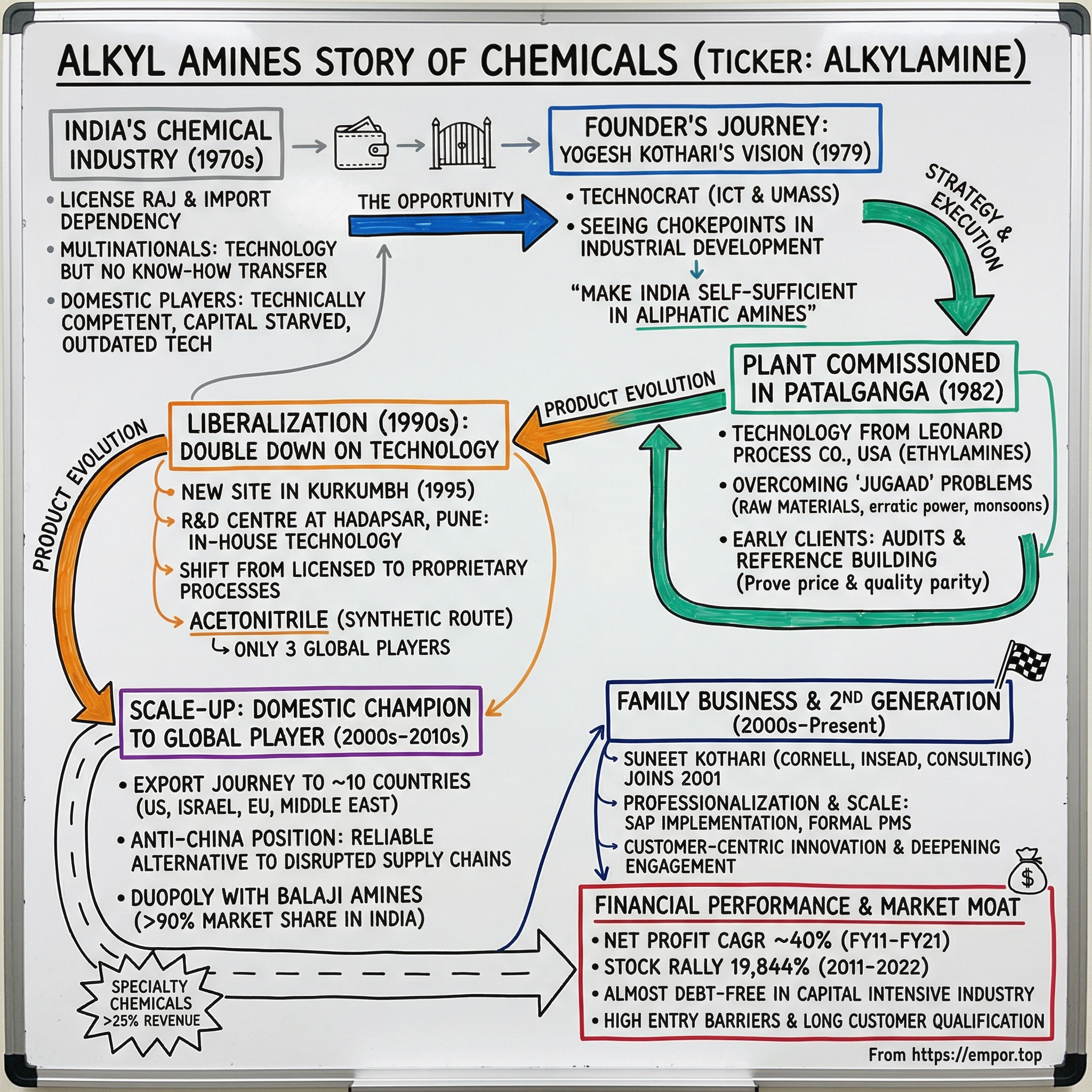
Alkyl Amines Chemicals: India's Specialty Chemical Champion
I. Introduction & Episode Roadmap
On the morning of March 16, 2026, a company that had spent forty-seven years quietly producing industrial chemicals few outside the sector recognize did something unprecedented in its history. Alkyl Amines Chemicals informed the stock exchanges that it was halting production of methylamines, ethylamines, and their derivatives across three of its manufacturing plants. The shutdown was not caused by an industrial accident, a labor strike, or a collapse in demand, but by a sudden disruption in raw material supply: the ammonia had stopped arriving.1
Three weeks earlier, military escalation involving the United States, Israel, and Iran led to the effective closure of the Strait of Hormuz, the twenty-one-mile-wide waterway through which roughly a quarter of global seaborne oil moves alongside the industrial gases vital to India's chemical sector. Between April 2025 and April 2026, ammonia exports from Hormuz-dependent economies dropped 75%, methanol exports fell 80%, and liquefied natural gas exports plummeted 95%.2 For a chemical manufacturer whose entire product tree relies on two primary feedstocks — an alcohol and ammonia — the supply interruption posed an existential challenge, as ammonia costs doubled from approximately ₹50 to over ₹100 per kilogram.3
The operational response proved instructive. Alkyl Amines resumed operations in phases beginning April 24, 2026, raised finished-goods prices to offset the input cost shock, and passed the increases to customers with minimal friction.1 Four months later, for the quarter ended June 2026, the company posted revenue of ₹528 crore — a 30% year-on-year increase — while net profit climbed 91% to ₹94.63 crore. Operating profitability expanded sharply, with EBITDA margin reaching 25.3%, up roughly 640 basis points from the prior-year period.45 Following four years of stagnant performance, earnings moved upward.
That single quarter captures the central tension facing the business. Does the June 2026 performance mark the start of a sustained operational recovery backed by durable competitive advantages, or does it reflect a temporary inventory windfall typical of spread businesses at the onset of a raw-material cost cycle? Executive Director Kirat Patel, who has been with the company since its founding, offered a candid assessment of the dynamics at play: when raw material prices surge, "we quickly react to current raw material prices and change our finished good prices, while we do have contracts for the old or inventory of raw material with us. So there is a widening of margins in the initial stage. Then it settles down."3
Alkyl Amines merits examination on its fundamental operating record. Incorporated in 1979 as an import-substitution initiative in aliphatic amines, the company commissioned its initial ethylamines facility at Patalganga in 1982. It has since expanded to three manufacturing sites, a DSIR-approved research center at Hadapsar in Pune, and a product book covering aliphatic amines, amine derivatives, and specialty chemicals.67 For the fiscal year ended March 2026, the company generated revenue of approximately ₹1,536 crore and a net profit of about ₹180 crore, maintaining a conservative balance sheet with total debt of barely ₹1 crore against shareholders' equity of ₹1,533 crore.8 Promoters hold a 72.04% equity stake with zero shares pledged.9 International sales accounted for 22.66% of turnover across 39 countries.10
Despite these operating metrics, the stock closed at ₹2,083.80 on August 24, 2026, representing a market capitalization of about ₹10,658 crore.11 That level remains nearly 45% below its cycle high of ₹3,758.75 recorded on January 13, 2022.12 More than four years after that peak, long-term shareholders who bought at the top continue to face substantial capital losses. The disconnect between a disciplined operating business and a disappointing long-term investment return serves as a central theme of this analysis.
This study unfolds across four distinct phases. First, the historical context: why India sought domestic amine production capabilities and the technical complexities of aliphatic chemistry. Second, the company's founding and its extended operational grind through the 1980s and 1990s. Third, the acetonitrile era — the product line that drove rapid growth and elevated the company's public profile before creating severe margin volatility. Fourth, the current environment: an ongoing leadership succession vote, a newly active trade-remedy framework, competitive pressure from Chinese producers, and domestic rivals expanding capacity in identical product lines.
Understanding these developments requires starting with a chemistry lesson and a licence.
 Subscribe on LinkedIn
II. The Pre-History: India's Chemical Dependency & License Raj
Picture a formulation chemist in a Mumbai pharmaceutical plant in 1976, filling out an import licence application. The chemical he needs is dimethylamine—a colourless, fish-smelling gas that serves as a fundamental building block in organic synthesis. At the time, no domestic producer of consequence existed. The chemist would submit his paperwork, await an allocation denominated in scarce foreign exchange, and hope the drums arrived before his production schedule collapsed. That was the reality of Indian fine chemistry under the licence-and-quota system: the molecules were not exotic, but access to them was strictly rationed.
Amines, in plain terms, are ammonia molecules with hydrogen atoms replaced by hydrocarbon fragments. In a typical manufacturing process, methanol—wood alcohol—reacts with ammonia over a heated catalyst under pressure to yield monomethylamine, dimethylamine, and trimethylamine simultaneously. The product ratio is managed through temperature, pressure, recycling, and catalyst design. Swapping methanol for ethanol produces ethylamines: mono-, di-, and tri-ethylamine. The core mechanics remain identical: one alcohol, one ammonia feedstock, one catalyst bed, and three co-products generated concurrently whether market demand aligns with all three or not.
This co-product constraint governs the economics of the industry and explains key strategic choices throughout Alkyl Amines' operational history. An amines plant cannot manufacture a single isolated product; it produces a basket, and market demand rarely matches the reactor's natural output ratio. As Executive Director Kirat Patel noted during a November 2025 conference call, explaining why nameplate capacity overstates saleable output: "Sometimes you have triethylamine demand up but monoethylamine demand down. So the capacity can't be met."13 A producer unable to sell one co-product risks holding excess inventory of the other two. To manage this balance, manufacturers build downstream derivative facilities to consume surplus output internally—which is why Alkyl Amines consumes roughly a quarter of its total volume within its own plants rather than selling it externally.3
These dynamics were critical to India in the 1970s because aliphatic amines sit directly upstream from two vital industries: pharmaceuticals and crop protection. Dimethylamine is an essential precursor for metformin, the widely prescribed diabetes treatment. Ethylamines serve as feedstocks for active pharmaceutical ingredients and herbicides. Triethylamine acts as an acid-scavenging base across synthetic chemical reactions, while isopropylamine is required for agrochemicals like glyphosate. While these molecules are standard bulk commodities, they represent operational chokepoints; an interruption in supply halts downstream manufacturing.
In 1979, the global aliphatic amines industry was consolidated and technologically closed. Proprietary catalyst formulations and reactor designs enabling economic, continuous gas-phase amination were held by Western chemical majors and process licensors, protected by patents and trade secrecy. By contrast, Indian chemical manufacturing remained fragmented, batch-oriented, and focused on final-stage processing. The domestic industry performed advanced final synthesis steps effectively but relied structurally on imports for basic raw materials.
This gap presented an obvious market opportunity, yet it entailed significant operational risk. Aliphatic amine production involves high-pressure, high-temperature reactions using flammable, toxic, and corrosive materials. These operations require continuous processing, meaning plants must run at high capacity utilization to avoid severe financial losses. Furthermore, conservative pharmaceutical clients had little incentive to replace established international suppliers like BASF with an unproven domestic start-up in Maharashtra.
Entering the market required navigating construction execution, technology acquisition, and commercial acceptance simultaneously within an economy constrained by capital scarcity and strict import controls on capital equipment. In 1979, Alkyl Amines undertook that challenge.
III. The Founder's Vision: Yogesh Kothari & The Birth of Alkyl (1979–1990s)
Yogesh M. Kothari's education read like a deliberate answer to a question Indian industry was not asking in the 1970s. He trained as a chemical engineer at the Institute of Chemical Technology in Mumbai — then known as UDCT, the institution that supplied a startling share of India's chemical entrepreneurs. He then attended the University of Massachusetts, Lowell, earning both a Master of Science in Chemical Engineering and a Master of Management Science.7 Rather than an MBA added to an engineering degree as a career accelerant, the dual degrees allowed him to study process engineering and financial management as a single discipline.
Kothari founded Alkyl Amines Chemicals in 1979 while still in his twenties.6 The company's mandate was focused: aliphatic amines. Rather than pursuing commodity chemicals broadly under the license-and-quota regime, the business concentrated on a single family of molecules and their derivatives. Over forty-seven years, that strategic focus has remained largely unchanged. The company continues to define its core domain as amines, amine salts, hydroxylamine derivatives, amides, industrial solvents, and adjacent specialty chemicals. Executive Director Kirat Patel noted during a May 2026 investor call that while new R&D projects "may not be amines or amine derivatives, but like the other specialities... there is a broad range of technological capabilities," all remaining "in the technological area of our strengths."313 Specialization was a deliberate policy rather than an accident of history.
Kothari built the business alongside Kirat M. Patel, who joined at the company's inception following a stint as a management consultant. A mechanical engineer from IIT Bombay with a master's in management studies in finance from the Jamnalal Bajaj Institute, Patel became Executive Director in 1996.7 The partnership paired a process chemist with a mechanical engineer who understood finance. This leadership team guided the company for over four decades, establishing an institutional culture that was technically fluent, commercially cautious, and averse to financial leverage.
The company commissioned its first plant at Patalganga in Maharashtra's Raigad district, beginning ethylamines production in 1982.6 In the early 1980s, Patalganga was an undeveloped industrial estate along the Mumbai–Pune corridor, selected primarily for its proximity to the port and target customers rather than an established chemical ecosystem. The facility deployed a continuous, catalytic, gas-phase amination unit: alcohol and ammonia vapor were driven over a fixed catalyst bed under high temperature and pressure, then separated by distillation into three co-products with close boiling points. Beyond maintaining reactor stability, the key engineering hurdle lay in operating a distillation train that could split mono-, di-, and tri-ethylamine at pharmaceutical purity without catalyst fouling or gas leaks.
Commercial adoption proved equally challenging. For pharmaceutical manufacturers, switching raw material vendors required extensive regulatory documentation. Once an incumbent supplier was specified in a drug's regulatory filing, changing vendors triggered mandatory re-qualification, stability testing, and formal amendments — a process taking quarters or years. While this regulatory barrier created customer lock-in for established suppliers, it presented a formidable hurdle for new entrants. Alkyl Amines spent much of the 1980s working to convince pharmaceutical buyers to replace imported inputs with domestic production.
Macroeconomic conditions compounded these operational friction points. Pre-liberalization India featured high interest rates, tight foreign exchange controls for imported spare parts and catalysts, and extended working-capital cycles driven by slow receivables. Because a continuous-process plant must maintain high capacity utilization to remain economically viable, delayed customer payments created severe cash flow pressures. Alkyl Amines managed expansion conservatively: it debottlenecked Patalganga in 1986 and added a second unit there in 1992 before expanding more aggressively following economic liberalization. The company commissioned three multipurpose plants at Kurkumbh in 1996, followed by a primary aliphatic amines unit and a captive hydrogen plant at the same site in 2000.6
The captive hydrogen facility reflected a long-term cost strategy. Hydrogen is an essential input for specific amination and hydrogenation processes, but sourcing it via tube trailers or cylinders is expensive and vulnerable to supply bottlenecks. Building captive hydrogen capacity required significant upfront capital that was viable only with assured production volumes. By constructing its own hydrogen plant in 2000 — and expanding with a second hydrogen facility in 2022 — Alkyl Amines prioritized vertical integration and long-term cost competitiveness over short-term capital preservation.6
By the turn of the millennium, Alkyl Amines had established reliable continuous manufacturing and successfully executed domestic import substitution. The remaining strategic challenge was shifting from process optimization to proprietary product development.
IV. Product Evolution & In-House R&D Breakthroughs (1990s–2010s)
For chemical manufacturers operating under licensed processes, technology licensing eventually shifts from a growth catalyst to an operational ceiling. A company can run a licensed process efficiently, but it can rarely optimize it beyond the licensor's design parameters or adapt it to unpredicted applications. Alkyl Amines reached that constraint in the 1990s, responding by establishing an in-house research center at Hadapsar, on the eastern edge of Pune.
The Hadapsar facility is approved by the Department of Scientific and Industrial Research under India's Ministry of Science and Technology—a designation providing tax incentives while recognizing genuine development work. The center houses organic synthesis and analytical laboratories alongside a pilot plant for scale-up testing. Its mandate targets aliphatic amines and their salts, hydroxylamine derivatives, amides, industrial solvents, and specialty chemicals, with an explicit emphasis on improving yields and reducing cycle times, unit costs, effluent generation, and environmental risks.14
That technical mandate clarifies the nature of the company's research. Rather than novel molecule discovery, the focus is process engineering: developing lower-cost, cleaner, and higher-yielding synthesis routes for established chemical targets. In an industry where competitors supply chemically identical bulk molecules, a two-percentage-point yield improvement directly expands operating margins. Furthermore, given India's strict environmental compliance standards, process routes that generate less effluent accelerate regulatory approvals for capacity expansions.
This operational focus must be weighed against financial disclosures. In the fiscal year ended March 2025, the company recorded research and development expenditures of about ₹8.8 crore against total revenue of roughly ₹1,572 crore—representing well under 1% of sales.8 That budget reflects an applied process development group rather than an innovation-led technology company. The resulting process know-how is real and hard-won, but it remains incremental, operationally embedded, and low-cost to maintain—creating a competitive advantage rooted in accumulated operational practice rather than a defensible capital scale.
Over two decades, this applied research generated product breadth. Alkyl Amines expanded from ethylamines into methylamines, followed by downstream derivatives including amine salts, hydrochlorides, and hydroxylamine derivatives such as diethylhydroxylamine. The company also developed solid-form powder products, commissioning its first dedicated powder plant at Kurkumbh in 2003, followed by additions in 2012, 2017, and 2019.6 Adding four solid-form manufacturing units over sixteen years represented a systematic transition from basic gas-phase chemistry toward higher-value, easier-to-transport, and more differentiated form factors.
Downstream integration supported this expansion. Executive Director Kirat Patel noted during a November 2025 investor call that methylamine, isopropyl, and methyl derivatives collectively account for roughly 30% of total amine output, with domestic peers like Balaji Amines, Rashtriya Chemicals and Fertilizers, and Aarti Drugs operating similar portfolios.13 Captive derivative production serves as an essential balancing mechanism, absorbing surplus co-product volume and stabilizing primary plant operations.
Geographic reach expanded alongside the product book. Alkyl Amines supplies customers across 21 Indian states and 39 countries from its three manufacturing locations, generating 22.66% of turnover from international sales in the fiscal year ended March 2026.10 Maintaining an export share above 20% in hazardous, temperature-sensitive bulk liquids and gases requires specialized packaging, regulatory compliance across multiple jurisdictions, and stringent customer qualifications.
Product breadth has also provided revenue stability across demand cycles. Beyond primary end markets in pharmaceuticals and crop protection, the company supplies specialty amines to dyes and pigments, rubber chemicals, leather processing, water treatment, and textiles.14 Although pharmaceutical and agrochemical applications still account for nearly three-quarters of total sales, these smaller industrial end markets provide ballast during cyclical downturns in agricultural or active pharmaceutical ingredient demand.
However, competitive moats vary significantly across product lines. While domestic ethylamines operate within a concentrated market protected by freight costs and customer switching barriers, exported specialty chemicals face intense competition from global producers and Chinese manufacturers pricing to maintain plant utilization. Management has acknowledged this pricing dynamic, noting that market competition, rather than customer negotiation, dictates prevailing finished-goods prices.3
This setting established the operational foundation for the company's next phase: an acetonitrile expansion that reshaped both market dynamics and financial volatility.
V. The Synthetic Acetonitrile Supercycle & Dahej Capex (2010s–2021)
For most of the modern chemical era, the global supply of acetonitrile—the solvent essential for pharmaceutical analytical testing and drug manufacturing—was not produced as a primary target. Instead, it originated as a secondary by-product.
Acrylonitrile is manufactured in massive quantities for acrylic fibers and ABS plastics used in car dashboards, appliance housings, and synthetic textiles. The production process yields a small secondary stream of crude acetonitrile, which is then purified and sold. This setup creates a supply curve entirely divorced from end-market solvent demand. When automotive and textile manufacturing booms, global markets are flooded with by-product acetonitrile, suppressing prices. Conversely, when acrylonitrile plants slow down, acetonitrile supply contracts sharply regardless of pharmaceutical demand.
This structural mismatch created an opportunity for an on-purpose manufacturing route: reacting acetic acid with ammonia over a high-temperature catalyst to produce acetonitrile directly. While the underlying chemistry was long understood, economic viability required operating a continuous process at pharmaceutical purity while remaining cost-competitive when by-product material was abundant.
Alkyl Amines commissioned its first dedicated acetonitrile plant at Kurkumbh in 2010.6 The underlying chemistry depends strictly on acetic acid rather than ethanol. During a May 2026 investor call, Executive Director Kirat Patel addressed acetonitrile pricing dynamics by observing that "acetic acid has also risen considerably."3 In the same call, Patel clarified that ethylamines rely on a separate feedstock chain, noting that ethylamine prices "have also increased because alcohol has increased."3 Distinguishing between these input chains is critical, as raw material trends govern the margin structure for each product line.
In pharmaceutical applications, chemical purity determines commercial viability. Alkyl Amines specifies its acetonitrile at a minimum 99.9% purity by gas chromatography, keeping water content below 0.05%.15 In high-performance liquid chromatography (HPLC)—where acetonitrile serves as the mobile phase carrying drug samples through testing instruments—any trace impurity registers as a phantom peak, invalidating the analysis. This stringent threshold distinguishes an on-purpose producer with specialized purification technology from secondary redistillers, enabling Alkyl Amines to supply applications ranging from analytical testing and catalyst manufacturing to vitamin and amino-acid synthesis.15
This structural positioning intersected with extreme market dislocation in 2020. As global acrylonitrile plants reduced operations or closed during early pandemic lockdowns, automotive and textile demand slumped, severely choking off by-product acetonitrile supply. Simultaneously, pharmaceutical demand surged driven by therapeutic development, expanded analytical testing, and active pharmaceutical ingredient manufacturing. With supply constrained and demand expanding rapidly, acetonitrile market prices rose dramatically.
The resulting supercycle transformed Alkyl Amines' financial results. For the fiscal year ended March 2021, revenue reached approximately ₹1,242 crore while net profit surged to about ₹295 crore. Operating EBITDA expanded to roughly ₹430 crore, driving operating margins to nearly 35%—well above the 19% level maintained through the late 2010s.8 Over the decade leading into this peak, the stock surged from a split- and bonus-adjusted price of around ₹16 in early January 2012 to a record high of ₹3,758.75 on January 13, 2022, representing an approximate 230-fold increase.12
Management allocated this windfall toward a major capital expenditure program across its primary sites. At the Dahej complex in Gujarat—where methylamines production began in 2018—the company added an amine derivatives unit in 2020, followed by a methylamines expansion and a second acetonitrile plant in 2021.6 Simultaneously at Kurkumbh, Alkyl Amines commissioned a specialty amine unit in 2021, a second hydrogen plant and a diethyl ketone (DEK) facility in 2022, and a large ethylamines plant in 2023.6 Annual capital outlays reached roughly ₹247 crore in the year ended March 2022 and about ₹303 crore in the year ended March 2023, with the latter accounting for nearly 18% of annual revenue in the heaviest investment period in company history.8
This expansion reflected contrasting strategic implications. Positively, management executed organic, cash-flow-funded investments in core product lines at existing facilities without excessive debt. Peak gross borrowings during the construction cycle reached only about ₹85 crore as of March 2023, against an equity base of ₹1,169 crore.8
However, committing substantial capital at the peak of a cyclical price surge left the company exposed as market conditions normalized. As global supply recovered and domestic competitors added capacity, market prices softened. By May 2026, management disclosed that average plant utilization ranged between 60% and 85%, noting that existing ethylamines capacity would satisfy demand for four to five years and acetonitrile capacity for two years without requiring additional investment.3 While this aggressive expansion secured long-term manufacturing headroom, it also burdened the business with elevated depreciation expenses and unabsorbed fixed costs until operational volumes catch up.
VI. Current Management, Governance & Second-Gen Succession (2000s–Present)
As of August 2026, Alkyl Amines shareholders are voting on a pivotal leadership transition. The postal ballot, which opened on August 21, 2026, and runs through September 19, with results scheduled for release by September 22, includes three resolutions that together represent the most significant governance realignment in the company's history.16
The handover
Under the proposed structure, founder Yogesh M. Kothari, who has served as Chairman and Managing Director since founding the business in 1979, transitions to Executive Chairman for a term extending to March 31, 2030. Executive Directors Kirat M. Patel and Suneet Y. Kothari will become Joint Managing Directors starting October 1, 2026, with terms running through December 31, 2029. In addition, Rakesh Goyal is nominated to join the board as Executive Director of Operations for a five-year term beginning April 1, 2027.16
Regulatory thresholds prompted the ballot requirements. Because both Yogesh Kothari and Kirat Patel have passed age seventy, Indian corporate law mandates special shareholder resolutions for their continued executive appointments. A third resolution requires explicit shareholder approval because the combined compensation for Yogesh Kothari and Suneet Kothari exceeds the 5% statutory net-profit ceiling for two managerial personnel. The board has also requested authority to pay non-executive directors a commission of up to 1% of net profits for five years starting April 1, 2027.16
The compensation proposal arrives after a fiscal year in which net profit remained virtually flat following four years of stagnant earnings, creating an obvious focal point for investor scrutiny. However, executive incentives remain overwhelmingly tied to equity value rather than cash compensation: the promoter group holds a 72.04% stake with zero shares pledged.9 Given that concentrated ownership, the ballot outcome is effectively assured, rendering the vote a formal procedure rather than an uncertain contest. Nevertheless, it highlights that minority shareholders possess formal representation but limited structural leverage.
Who actually runs it
The leadership architecture being ratified establishes a formal two-plus-one executive arrangement rather than a single-successor model.
Representing the second generation of family leadership, Suneet Y. Kothari followed a deliberate path into the chemical industry. After earning degrees in chemical engineering, chemistry, and biochemistry at Cornell University and an MBA from INSEAD, he worked as a management consultant at Diamond Technology Partners in Chicago before joining Alkyl Amines in 2001. Over twenty-five years, he has directed business development, marketing, commercial strategy, and plant operations.7 While management consulting might appear distinct from continuous-process engineering, his tenure has coincided with the business expanding from three core amines into a portfolio of roughly one hundred products distributed globally.
Co-Joint Managing Director Kirat Patel represents non-family continuity. Having joined the company at its inception in 1979 and served as an Executive Director for thirty years, Patel has historically fronted every quarterly investor call.7 Founder Yogesh Kothari does not participate in these public forums. This operational arrangement reflects a substantial delegation of commercial and strategic reporting to non-promoter leadership, though it also means the founder-chairman has rarely addressed investor inquiries directly.
Rakesh Goyal brings external operational experience to the board. A chemical engineer from IIT Kanpur with nearly three decades in chemical manufacturing and process design, Goyal held leadership roles at National Peroxide, Jesons Industries, Dow Chemical, Hindustan Unilever, and NOCIL before joining Alkyl Amines as Whole Time Director of Operations in June 2022.7 Chief Financial Officer Kanchan Shinde and Company Secretary Chintamani Thatte round out the senior executive bench.3
The independent board offers substantial industry expertise and governance depth: Chandrashekhar Gupte, former Managing Director of NOCIL; Bhavna Doshi, a chartered accountant who chaired the Accounting Standards Board and served on the ICAI council; Leja Hattiangadi, a chemical engineer with four decades at Tata Consulting Engineers; Ravi Kapoor, former head of Heubach Colour; and Ashwin Ramanathan, formerly a senior partner at AZB & Partners.7 This group provides a balance of chemical process knowledge and financial oversight.
What the governance record actually shows
Beyond board composition, the company's historical operating record reveals three defining governance characteristics.
First, management has consistently avoided balance sheet leverage to fund expansion. Even during its heaviest capital investment phase, borrowings remained modest at roughly ₹85 crore. By March 2026, total debt stood at just ₹1.2 crore—primarily representing lease obligations—against cash and liquid investments of approximately ₹251 crore.8 Dividend distributions have remained conservative, averaging about one-fifth of annual net profit.17
Second, executive communications have generally avoided narrative embellishment. Following flat performance for the year ended March 2026, Patel noted on the annual investor call that management "did begin the year with a little bit of optimism thinking that there will be some growth. However, as you can see from the results, both the top line and the bottom line have more or less remained flat."3 Similarly, after guiding for 10% to 15% volume growth at the start of the fiscal year, management openly acknowledged delivering near-zero growth.13
Third, financial disclosure remains strictly minimal. Alkyl Amines hosts only two earnings calls annually rather than four, and it does not report production volumes in metric tonnes, product-level revenue breakdowns, market share metrics, or plant-by-plant capacity utilization rates. When asked for specific acetonitrile market share figures in November 2025, Patel declined to comment.13 Asked again for volume metrics in May 2026, he reiterated that the company does not reveal tonnage data for individual products or total global output.3 While management defends this opacity as necessary to protect commercial positioning in a concentrated market, it forces external investors to estimate operational performance through realized prices and gross margins, leaving management's market-share claims unverified.
This limited transparency became increasingly relevant as financial growth stalled over the four-year period following the 2022 market peak.
VII. The Post-COVID Normalization & Down-Cycle Drama (2021–Present)
The financial deceleration that followed the peak was stark. Revenue grew from about ₹1,242 crore in the fiscal year ended March 2021 to about ₹1,536 crore in the fiscal year ended March 2026—a compound annual growth rate of roughly 4%. Over the same period, net profit fell from about ₹295 crore to about ₹180 crore.8 Reflecting that operational compression, the stock declined from its peak of ₹3,758 to below ₹1,300 at its 2025 low before staging a partial recovery.1112
The downturn was not caused by an operational failure or asset impairment; rather, it resulted from a sharp compression in industry spreads.
The acetonitrile round trip
The favorable economics of 2020 reversed as global acrylonitrile plants resumed full operations. Secondary by-product acetonitrile returned to global markets in volume, forcing on-purpose manufacturers to compete against material whose marginal cost essentially equaled purification expenses. Realized prices dropped sharply. Executive Director Kirat Patel noted that the company's average acetonitrile price for the fiscal year ended March 2026 averaged roughly ₹140 to ₹150 per kilogram, compared to more than ₹200 per kilogram in the quarter ended June 2026.3 A molecule that had briefly generated outsized profitability settled into a three-year period of normalized pricing.
Compounding this market shift was aggressive export activity from China. Facing domestic overcapacity, Chinese manufacturers exported chemical volumes into India at depressed rates. On a May 2026 investor call, analyst Pankaj Tibrewal of Ikigai Mutual Fund characterized Chinese export pricing as "at times below the cost of production, especially in acetone and ethylamines and methyl chain."3 Management accepted that assessment, with Patel describing Chinese pricing behavior as "quite unfair" and observing that when an exporter prices to clear excess inventory, domestic producers must either match the prevailing rate or sacrifice volume.3
The trade-remedy fight
In response, domestic manufacturers turned to trade policy. Alkyl Amines filed an anti-dumping petition covering acetonitrile alongside industry peers Balaji Amines and Jindal Speciality Chemicals. The Directorate General of Trade Remedies initiated its investigation on March 26, 2024—examining import data from China, Russia, and Taiwan between October 2022 and September 2023—and issued its final recommendation on March 21, 2025.[^18] The recommended five-year duties ranged from $202 to $481 per tonne on Chinese exporters depending on the supplier, alongside $292 per tonne on Russian imports and $233 per tonne on Taiwanese material.18
Implementation revealed the practical limitations of trade protection. The tariffs took effect at the end of June 2025, but buyers accelerated purchasing ahead of the deadline. During a November 2025 investor call, Patel explained that "just before that, there were a lot of imports coming into the country in anticipation... the imports were almost 1.5 to 2 times what they were normally there. Now all that inventory is going through the system."13 Simultaneously, Chinese exporters lowered FOB prices to absorb part of the duty. Asked when financial benefits would materialize, Patel pointed toward the fourth quarter while noting that "prices of course, right now the Chinese are very aggressive all over the place for all chemicals."13
That timeline largely materialized. By May 2026, Patel reported that the company "only got the benefit of that antidumping duty towards the end of the year," as Chinese import volumes eventually declined and export prices adjusted, adding that "it took almost 6 months from July all the way to January — December, January for the pipeline and the aggressive behaviour of the Chinese to change."3 The trade strategy expanded in February 2026 when India imposed a separate anti-dumping duty on monoisopropylamine imports from China.19
These trade remedies demonstrate that tariff protections operate with significant lags. Regulatory duties can prompt anticipatory buying that depresses near-term domestic demand and may be partially offset by foreign exporters adjusting prices, making trade protection a gradual and partial buffer rather than an immediate fix.
The tariff mess and the methylamines glut
Additional commercial headwinds emerged in international markets. During the first half of the fiscal year ended March 2026, U.S. trade policies impacted operations through four distinct channels detailed by Patel in November 2025: reduced direct exports to the United States, lower demand from domestic customers facing U.S. market restrictions, intensified competition across Asia as displaced Chinese material sought alternative markets, and sanctions affecting specific Indian distributors within the supply chain.13 While direct U.S. sales accounted for only about 4% of total exports—representing roughly 1% of total revenue—management noted that the broader indirect impacts could not be precisely quantified.13
Concurrently, domestic market structure grew more competitive. Aarti Drugs commissioned a methylamines facility with an annual capacity of 50,000 to 60,000 tonnes, marking the arrival of the fourth domestic producer and the first new entrant in the segment in thirty to thirty-five years.13 With domestic merchant market demand estimated at 80,000 to 90,000 tonnes annually, total Indian manufacturing capacity expanded beyond 150,000 tonnes.13 Addressing the resulting supply overhang during a May 2026 investor conference, Patel remarked that "it's a bit of a mystery why Aarti went into this industry when there was already overcapacity."3
The playbook, and what it cost
Throughout the down-cycle, management maintained a conservative operational strategy focused on pricing discipline, gross margin protection, project execution, and strict debt avoidance. Summarizing performance for the first half of the fiscal year ended March 2026, Chief Financial Officer Kanchan Shinde stated that "overall contribution is protected. Gross margins are almost stable."13 Financial results reflected this stabilization, with quarterly net profits holding within a range of ₹42 crore to ₹49 crore over eight consecutive quarters.8
This capital discipline preserved balance sheet integrity through a prolonged industry contraction. However, for a manufacturer operating without control over primary raw material input costs or finished goods market prices, maintaining financial stability during a cyclical trough reflects balance sheet resilience rather than a structural competitive moat.
VIII. Core Business Mechanics, Economics & Competitor Benchmarking
To understand why one flat year looks like another, it helps to see the shape of the revenue.
Three buckets, and what each is worth
The company's own sustainability disclosure for the year to March 2026 splits turnover three ways: aliphatic amines at 44.55%, amine derivatives at 30.67%, and specialty chemicals and specialty amines at 24.78%.10 Those proportions have been remarkably stable, and each bucket has a different economic character.
Aliphatic amines — the methylamines and ethylamines — are the volume base. They are protected less by technology than by physics and freight: these are hazardous, low-value-density liquids and gases where the cost of moving a tonne a long distance is material relative to the price of the tonne. Patel put methylamines at roughly ₹100–₹110 a kilogram and ethylamines above ₹200 a kilogram in May 2026.3 The methylamines half of that base is now structurally oversupplied domestically; the ethylamines half is a two-player domestic market where the company claims to be "either the largest or the second largest producer of ethylamines in the world."3
Amine derivatives are where the self-consumption logic pays off. Roughly a quarter of total production never leaves the company, getting converted into salts, hydroxylamine derivatives and solid-form products that carry better margins and travel better.3 This is the bucket that has grown from nothing into nearly a third of revenue, and it is the strategic centre of the business even though it gets less attention than acetonitrile.
Specialty chemicals is the highest-margin, highest-barrier bucket and the one everyone talks about. It is worth stating the scale honestly: management has said no single product exceeds 14% to 20% of the topline, and pointed out that acetonitrile "falls in that range."13 Acetonitrile is important. It is not the company.
Who buys
Roughly 50–60% of sales go to pharmaceuticals and another 15–20% to agrochemicals — about three-quarters of the book in two end markets.3 The remainder spreads across rubber chemicals, water treatment, dyes and pigments, leather, textiles and electronic chemicals.14
Pharmaceutical concentration is a double-edged instrument. It brings the regulatory switching costs that make revenue sticky, and it brings demand that is relatively insensitive to economic cycles. It also means the company's fortunes are hostage to the destocking behaviour of the global generic supply chain, and to whatever trade policy is being applied to Indian pharmaceutical exports in a given year — a mechanism that showed up clearly in the tariff episode. Agrochemicals adds seasonality and monsoon dependence: Patel flagged concern in May 2026 that El Niño conditions could hit agrochemical demand while expecting pharma to hold up.3
The competitive map
Balaji Amines is the reference point, and the comparison is close enough to be genuinely informative. In the year to March 2026, Balaji reported consolidated revenue of about ₹1,454 crore and net profit of about ₹169 crore, against Alkyl's ₹1,536 crore and ₹180 crore.208 Two companies of nearly identical size, in overlapping products, with different postures.
Balaji is the more expansionary. In that same year it commissioned an electronic-grade dimethyl carbonate plant, a monoisopropylamine plant, an 88,000-tonne methylamines plant and a 6 MW solar installation; it has a 100,000-tonne dimethyl ether plant commissioned in the June 2026 quarter, a 5,000-tonne N-methyl morpholine project, a 60-tonne-per-day acetonitrile expansion targeted for the year to March 2027, and a ₹750 crore greenfield project at Chincholi for hydrogen cyanide, sodium cyanide and EDTA.20 Balaji leads in methylamines and dimethylformamide — a product Alkyl Amines has the technology for but pointedly does not make. Asked why in November 2025, Patel's answer was one sentence: "It's not a viable situation at the current moment because the imports are much cheaper."13
That exchange is the cleanest available illustration of the difference between the two companies. One builds into adjacent chemistries and accepts the cycle risk; the other declines to build a plant it could build, because the economics do not clear today. Neither posture is obviously right. Balaji's acetonitrile expansion, if it lands on schedule, will add roughly 18,000–20,000 tonnes to a domestic market Patel sizes at about 30,000 tonnes — into which Alkyl Amines already has 30,000 tonnes of capacity across two plants.3 Asked about it directly, Patel's answer rested entirely on cost position: "we seem to have an edge on the costing and the efficiencies... we suspect that we will be the lowest cost manufacturer in this product for some time to come."3 That is a testable claim, and the next two years will test it.
RCF and Aarti Drugs round out the domestic methylamines field, with Aarti the disruptive newcomer. Smaller domestic acetonitrile activity comes from Deepak Novochem and Jindal, plus what Patel describes as "small, what you might call processors" who purify rather than synthesise.13
The adjacent tier deserves a correction to the standard framing. Indo Amines and Amines & Plasticizers are routinely listed as secondary competitors, and both are real businesses of consequence — Indo Amines at roughly ₹1,160 crore of revenue and ₹79 crore of profit, Amines & Plasticizers at about ₹572 crore of revenue and ₹37 crore of profit.21[^23] But they are not fighting Alkyl Amines for the same tonnes. Indo Amines is built on fatty amines and performance chemicals; Amines & Plasticizers is among the largest Indian producers of ethanolamines and morpholine.21[^23] Those are adjacent amine chemistries with different feedstocks, different reactors and largely different customers. The competitive set that actually determines Alkyl Amines' realisations is narrower than the sector label suggests: Balaji across the board, RCF and Aarti in methylamines, and Chinese exporters in everything that travels.
The global majors — BASF, Eastman, Celanese and their peers — dominate Western markets but are structurally disadvantaged serving India, where freight on hazardous liquids, local regulatory registration and the ability to deliver small lots on short notice all favour the domestic incumbent. The competitor that actually matters is not a Western major. It is the aggregate of Chinese exporters, whose pricing behaviour has been the single largest determinant of Alkyl Amines' margin over the past four years — and whose recent restraint is a policy choice, not a structural change.
IX. Strategic Frameworks: Hamilton Helmer's 7 Powers & Porter's 5 Forces
Evaluating Alkyl Amines through formal strategic frameworks yields a split verdict: real but narrow advantages in two areas, alongside lower structural defense than bullish narratives assume across the rest of the business.
Where the power is real
Switching costs — genuinely high in regulatory positioning. When a pharmaceutical manufacturer registers a drug with regulatory authorities, the filing specifies the source of each chemical input down to the manufacturing plant. Substituting that source requires vendor re-qualification, stability testing, and formal regulatory amendments. Consequently, a customer dissatisfied with pricing does not leave quickly; instead, the customer negotiates. This regulatory mechanism explains the stability of the pharmaceutical customer base through four years of industry headwinds. However, this protection safeguards customer relationships rather than pricing power. Executive Director Kirat Patel noted that while customers absorbed a doubling of ammonia costs because the company's molecules represent "a C item" in their bill of materials, "competition finally sets the price."3 High switching costs secure order volume rather than profit margins.
Cornered resource — narrowly defined in ethylamines. Operating within a concentrated domestic market where Alkyl Amines ranks among the world's largest ethylamines producers—supported by installed capacity built to serve long-term demand—represents a durable competitive position. Empirical evidence supports this framing: when methylamines and acetonitrile earnings faced compression during the first half of the fiscal year ended March 2026, Patel observed that ethylamines were "not that much impacted because ethylamines are largely focused domestically, and the competition here is domestic," adding by May 2026 that in ethylamines "the market has adjusted and the margins have improved."133 This segment represents the company's most defensible asset.
Process power — operational know-how under active challenge. Operating an on-purpose acetonitrile facility for fifteen years builds accumulated process expertise in catalyst longevity, energy integration, and purification yields. Management's claim of maintaining a lowest-cost manufacturing position is plausible given its operating history, but it remains unverified because the company discloses neither unit cost structures nor market share metrics. Furthermore, Balaji Amines' upcoming capacity expansion will test whether this cost advantage is structurally permanent or merely a function of first-mover timing. Given an R&D budget under 1% of annual revenue, these capabilities reflect deep operational refinement rather than proprietary technology.
Where the power is weaker than advertised
Scale economies — modest relative to price-setting competitors. Operating three plants with roughly 200,000 tonnes of total capacity spreads fixed administrative overhead and environmental compliance costs across a broad base.3 However, domestic rival Balaji Amines operates at a comparable scale, while Chinese producers who dictate global marginal prices possess significantly larger capacities. Scale serves as a barrier against smaller domestic entrants rather than protection against the global competitors influencing financial performance.
Branding, network effects, and counter-positioning — absent. Bulk chemical molecules manufactured to standard purity specifications command no meaningful brand premium. The sector exhibits zero network effects and no counter-positioning advantages that competitors cannot replicate.
The five forces, scored on evidence
Supplier power: high and empirically demonstrated. Raw material feedstocks—ammonia, methanol, acetic acid, and ethanol—are globally traded commodities purchased through regional distributors. Because Alkyl Amines consumes a small fraction of global output, it functions as a price taker. The plant shutdowns of March 2026 demonstrated this vulnerability.1 Patel acknowledged that "we depend on distributors and suppliers of this who are mainly connected to the fertilizer plants and importers," while noting that the aliphatic amine sector's monthly ammonia requirement of 10,000 to 15,000 tonnes is modest enough to qualify for government allocation during emergency supply crises.3
Buyer power: moderate and asymmetric across segments. Large generic pharmaceutical buyers face high switching costs but remain price-sensitive. Passing through doubled ammonia costs within a single quarter demonstrated cost-recovery capability, but that passthrough occurred during a global supply shock affecting all chemical producers simultaneously. Exercising pricing power during an isolated, company-specific cost increase remains an unproven scenario.
Threat of substitutes: very low. No alternative chemical structures exist for primary aliphatic amines in established synthetic reaction routes.
Threat of new entrants: low to moderate. Environmental approvals require approximately twelve months, and Patel estimates total project execution from investment decision to plant commissioning at roughly two years.3 Nevertheless, capital barriers have not deterred established entrants: Aarti Drugs successfully commissioned a major methylamines facility, while Balaji Amines expanded acetonitrile capacity. Industrial barriers restrict casual start-ups but do not block determined, well-capitalized domestic chemical producers.
Competitive rivalry: high and the primary structural constraint. Industry rivalry remains the primary determinant of financial outcomes. Domestic methylamines capacity is structurally oversupplied, while global pricing for acetonitrile and specialty lines depends heavily on Chinese export volumes. Addressing analyst inquiries in May 2026 regarding whether China's industrial policy to curb excess capacity would serve as a major earnings catalyst, Patel rejected the thesis: "No, no, it's not that significant. Yes, it does help because you can get 5% more selling price if the Chinese become less aggressive. But they are still present."3
Alkyl Amines maintains a defensible domestic market position in ethylamines, an operational cost edge in acetonitrile, and sticky pharmaceutical customer relationships that preserve product volumes. However, the company lacks structural control over the commodity spreads that drive multi-year earnings cycles.
X. Earnings Call Transcript Analysis & Management Credibility Stress Test
There is a particular sound to an honest earnings call, and Alkyl Amines makes it. There is also a particular sound to a company that would rather not tell you very much, and it makes that sound too. Both are audible in the same transcripts, sometimes in the same answer.
The cadence, and what it says
Start with the format. This company holds two earnings calls a year — one after the September half, one after the March year-end — hosted by Ambit Capital.133 Four-quarter call cadence has been standard for Indian mid-caps for a decade. Half-yearly is a choice, and it compounds the disclosure gaps already noted: no volumes, no product revenue, no market share, no plant-level utilisation. An investor gets two conversations a year with a business whose earnings are driven by monthly commodity spreads.
Within that constraint, the quality of the two conversations is high. The calls are unusually unscripted — Patel's opening remarks in November 2025 ran to two paragraphs before he handed straight to questions — and he answers hostile questions directly rather than routing them into talking points.13
Tracking the narrative across three calls
The useful test of management credibility is not what they say in one call. It is whether the story holds up when you line up several.
On growth targets, they missed and admitted it. In November 2025, Patel said the year would fall short of "our normal 10% to 15% growth, which we normally expect every year."13 In May 2026 he confirmed the outcome without softening: prices down about 1%, volumes down about 1%, "so the combination is about 2% drop."3 He then guided the following year to 5–10% volume growth — a reduced target, framed against Indian GDP growth: "the country will be growing anyway at 5%, 7%, and we grow along with it."3 Lowering your own long-run growth expectation in public is not a comfortable thing to do. It is a point in favour of the disclosure being honest even when it is sparse.
On the anti-dumping duty, the sequencing was called correctly. The November 2025 assessment — that pre-buying had stuffed the channel, that the Chinese would cut prices in response, that benefits would show from the fourth quarter mainly in volume rather than price — matched what actually happened, as confirmed six months later.133 Management understood the mechanism of its own trade win better than the market did.
On the GLP-1 opportunity, they refused the hype. This is the most revealing sequence in the transcripts. HDFC Securities' Nilesh Ghuge asked in November 2025 whether peptide-based diabetes and weight-loss drugs would drive acetonitrile demand. Every incentive pointed toward an enthusiastic yes. Patel said the demand was real but early, that the company had approvals from some manufacturers, and then added: "everybody is talking about it being a very big product, but one doesn't know these things; it takes time."13 Six months later, pressed again, he sized it: "the acetonitrile market is about 30,000 tons or so. And this will be maybe 10% of the whole... It's not a disruption, but it's a great addition."3 A management team that quantifies a hyped opportunity at one-tenth of one product's market is telling you something about its relationship with the truth.
On the recovery, the language shifted — carefully. Asked in May 2026 whether the worst was over, Patel offered "cautious optimism," said "we have seen the worst of times, I think," and then immediately undercut himself: "Of course, in life, you never say that because something always comes along to prove you wrong."3 Two months later the June quarter delivered the best profit in five years. He was right, and he had hedged anyway.
Where the answers get thin
Not everything survives scrutiny. Three areas deserve pressure.
The margin explanation is circular. Management attributes the June-quarter improvement to passing through higher input costs while holding older, cheaper inventory — the classic start-of-cycle windfall it has explicitly described as temporary.3 It also expects margins to settle "to a better level than what it was before February." Those two claims sit uneasily together, and management has offered no mechanism for why the new floor would be higher other than an assertion that petrochemical supply chains will take time to repair. That is a hypothesis, not evidence.
The R&D pipeline is a black box by policy. Patel says the company runs "over a dozen projects" at any time, that development to engineering takes four to five years, and that "out of these dozen, maybe 1 or 2 may survive to commercialization."3 That is a candid hit rate. But the company will not name a product until the plant is running — which means investors cannot assess the pipeline at all, only observe the output years later. The one project currently disclosed is the ₹120 crore Kurkumbh plant, described as an import substitute with no domestic competitor, going into dyes, pigments and electronics, at an expected asset turnover of about 1.5 times.13 Mechanical completion slipped from a February–March 2026 target to end-June 2026, with commercialisation around July.133 A one-quarter slip on a two-year project is unremarkable; the fact that it is the only project we can track at all is not.
The capital allocation stance has quietly turned defensive. Capex guidance for the two years to March 2028 is ₹80–90 crore, plus ₹20–30 crore of maintenance — against ₹303 crore spent in the single year to March 2023.38 Patel's explanation was explicit: "given the volatility just now, we are being a little cautious before going forward with anything major, whether it is INR20 crores or INR50 crores investment or even INR200 crores investment."3 Prudent, certainly. But a company generating meaningful operating cash flow, holding roughly ₹251 crore of cash and investments, with no debt and no announced growth projects beyond one plant, is accumulating capital without a stated plan for it.8 Neither a buyback nor a step-up in dividend has been proposed. That is the sort of gap an activist would name.
The three questions a sceptic should press
On pass-through lag: the company demonstrated it can raise prices within a quarter when the whole industry faces the same shock. The unresolved question is the reverse leg. Patel expects raw materials to fall faster than finished goods, delivering a second temporary margin benefit — but he also expects competition to compress it.3 Watch the gross margin two and three quarters after input costs peak, not one.
On concentration: three-quarters of revenue in pharmaceuticals and agrochemicals means a single destocking cycle in the global generics supply chain reproduces the 2022–2025 experience. Diversification into dyes, pigments and electronics via the new Kurkumbh plant is real but small.
On returns: in the year to March 2021 the company earned roughly ₹401 crore of operating profit on capital employed of about ₹840 crore. In the year to March 2026 it earned roughly ₹245 crore on capital employed of about ₹1,534 crore.8 Capital employed nearly doubled while operating profit fell by roughly 40%. Whatever the June quarter signals, that is the arithmetic the last cycle of capex has to answer for — and it has not answered for it yet.
XI. Playbook: Business & Investing Lessons
Four business and investing lessons emerge from Alkyl Amines' operating history, and two of them challenge conventional assumptions about specialty chemical moats.
The narrow-niche moat is real, and it has a ceiling
Alkyl Amines has maintained a singular operational focus for nearly five decades. Hazardous reaction chemistry deters casual entrants, regulatory filing requirements create customer stickiness, and low per-unit chemical costs mean price pressure comes from industry peers rather than end buyers. That combination has supported long-term operational survival and secured a dominant two-player domestic market position in ethylamines.
However, a narrow niche naturally caps total market scale. India's annual merchant market stands at 80,000 to 90,000 tonnes for methylamines, 30,000 to 35,000 tonnes for ethylamines, and roughly 30,000 tonnes for acetonitrile.13 These addressable volumes do not support compounding revenue growth of 15% annually over an extended horizon. With management recalibrating long-term growth expectations closer to broader GDP rates, investors must size addressable market opportunities based on baseline demand rather than temporary demand spikes.
On-purpose beats by-product — until everyone does it
The strategic decision to build dedicated acetonitrile capacity targeted a structural vulnerability: global supply was historically tied to acrylic fiber and plastic production rather than pharmaceutical solvent demand. When by-product supply contracted during global industrial slowdowns, dedicated on-purpose production generated exceptional margins.
Yet process chemistry insights cannot remain proprietary indefinitely. Rivals can replicate the manufacturing route, making low-cost execution the primary operational barrier. Balaji Amines is adding substantial capacity in the same molecule. As Executive Director Kirat Patel observed, long-term differentiation depends on cost structure: "You have to have the ability to manufacturing at a low cost."3 The strategic lesson is that controlling a market chokepoint generates outsized returns only as long as a producer remains the lowest-cost supplier. Cost leadership is an ongoing operational requirement rather than a static competitive advantage.
Balance-sheet conservatism is insurance, and insurance has a premium
Maintaining virtually zero net debt through an extended industry downturn insulated the business from financial distress, equity dilution, or interrupted capital expenditures. When ammonia costs doubled and supply disruptions forced plant suspensions in March 2026, a liquid balance sheet absorbed the shock without debt covenant pressure.18
However, balance-sheet conservatism carries an opportunity cost. Capital employed nearly doubled over five fiscal years while operating profits contracted, leaving approximately ₹251 crore in cash and liquid investments without a designated growth plan.8 Unlevered risk management protected downside resilience during low points of the cycle, but unallocated capital has weighed on return metrics.
Professionalising a family business is a process, not an event
The governance transition reveals a deliberate structure: the founder's son is being elevated to Joint Managing Director alongside a seasoned non-family executive of equal rank, while an external industry veteran joins as operational head, and public investor communications remain led by non-family leadership.716 This structure distributes executive responsibility across family and non-family management, even as the promoter group retains a 72.04% equity stake and board chairmanship.916
The effectiveness of this dual-executive model will be tested over upcoming capital allocation cycles. Shared leadership reduces reliance on a single decision-maker, but it also carries potential risks of strategic friction or delayed execution. The speed and clarity with which the leadership team evaluates future expansion projects will indicate whether this governance model enhances strategic execution.
XII. Analysis & Bear vs. Bull Case
Evaluating any chemical spread business ultimately turns on a single question: does a margin expansion reflect a durable shift in operating fundamentals or a temporary pricing windfall? The investment thesis for Alkyl Amines rests on this exact balance, tested against operational evidence rather than executive optimism.
The bull case
The operational trough has documented support, and earnings have inflected. After eight consecutive quarters in which net profit remained bounded between ₹42 crore and ₹49 crore, performance shifted in the quarter ended June 2026. Net profit rose to ₹94.63 crore on revenue of ₹528 crore, generating operating EBITDA of approximately ₹134 crore and expanding margins to 25.3%.458 This performance represents a meaningful step change in profitability, materializing one quarter after management indicated margin improvements were expected.
Trade protection has transitioned from administrative approval to active operational support. The anti-dumping duty on acetonitrile is established for a five-year term and, according to management disclosures, began yielding price and market share gains around the start of 2026 once pre-duty inventory cleared.183 The imposition of an anti-dumping duty on monoisopropylamine in February 2026 provided additional trade defense for a second product line.19 These remedies represent defined regulatory protections rather than forward projections.
Chinese export aggression has moderated. Executive disclosures confirm reduced price undercutting and higher Chinese export quotes over consecutive quarters, attributed in part to supply discipline enforced by industrial capacity controls in China.3 If sustained, this shift relieves the primary driver of international margin compression over the preceding four years.
Capital expenditure is complete, creating operating leverage. Existing capacity is positioned to cover demand for four to five years in ethylamines and two years in acetonitrile, while overall plant utilization across the company ranges between 60% and 85%.3 Volume growth can therefore be absorbed on an established fixed-cost foundation without requiring near-term capital outlays. Concurrently, the ₹120 crore Kurkumbh facility—commercializing around July 2026 at an expected 1.5 times asset turnover—introduces a new revenue stream serving dyes, pigments, and electronics outside the main pharmaceutical and agrochemical channels.13
The balance sheet offers structural downside protection. Operating with virtually no total debt against roughly ₹251 crore in cash and liquid investments, the company maintains the financial flexibility to endure prolonged industry down-cycles while leveraged peers face balance-sheet stress.8
The bear case
The margin expansion may reflect a transient inventory effect. The primary risk to the bull narrative comes from management's own description of industry mechanics: operating margins expand during initial raw-material cost spikes because finished-goods prices adjust rapidly while plants consume lower-cost historical inventory, before margins settle back down under competitive pressure.3 The June 2026 quarter fits this pattern, arriving immediately after a major input supply disruption. Evaluating the business requires applying this operational framework consistently rather than treating a single quarter's spread expansion as a permanent structural reset.
Feedstock vulnerability is an operational fact. The March 2026 suspension of operations across three manufacturing plants following the closure of a primary shipping route underscored a structural exposure to imported raw materials that cash reserves cannot neutralize.12 Management's reliance on distributor diversification and the long-term potential of domestic green ammonia within three to five years offers limited near-term protection against supply chain shocks.3
Methylamines oversupply remains a long-term structural drag. Four domestic manufacturers maintain total installed capacity exceeding 150,000 tonnes against an annual merchant market of 80,000 to 90,000 tonnes in the company's largest product category.13 Management has explicitly noted that absorbing this market oversupply will require considerable time.3
The acetonitrile market position faces an upcoming supply challenge. Balaji Amines is constructing a 60-tonne-per-day acetonitrile expansion targeted for completion in the fiscal year ending March 2027 within a domestic market estimated at roughly 30,000 tonnes.203 Alkyl Amines defends its market position through an unquantified cost advantage; if that cost differential is narrower than estimated, domestic pricing in a primary specialty line will face compression as new capacity enters the market.
Asset productivity on previous capital investments remains unproven. Between the fiscal years ended March 2021 and March 2026, capital employed nearly doubled while operating profit fell by approximately 40%.8 Rebuilding return on capital requires converting the ₹550 crore invested during peak construction years into sustained operational output—an outcome dependent on future market utilization rather than historical execution.
Foreign regulatory policy could shift. Management has cautioned that Chinese capacity reductions may not persist across all chemical categories, quantifying the realized pricing benefit at roughly 5%—a modest buffer rather than a structural transformation of global supply.3
The valuation frame
Equity valuations have adjusted to reflect early operational recovery. The stock closed at ₹2,083.80 on August 24, 2026, recovering roughly 72% from its fifty-two-week low of ₹1,212, with its fifty-day moving average of ₹1,851 trading above its two-hundred-day moving average of ₹1,632.11 Market capitalization expanded from approximately ₹6,298 crore at the end of March 2026 to about ₹10,658 crore.811 Despite this rebound, the shares remain about 45% below their record peak of January 13, 2022.12
From an analytical standpoint, prevailing share prices no longer reflect a deep cyclical trough, embedding expectations of continued margin recovery. Institutional holding remains concentrated, with foreign institutional investors holding roughly 3.4% to 3.5% and domestic institutions maintaining a low single-digit percentage against a promoter stake of 72.04% with zero shares pledged.917 This constrained public float accelerates price movements in both directions on moderate trading volume.
The three KPIs that matter
Given limited segment disclosures, monitoring company performance requires tracking three quantifiable indicators derived from financial statements.
One: gross spread stability. Revenue minus material costs expressed as a percentage of top-line sales provides the clearest measure of pricing power. Tracking this metric three to four quarters past an input cost shock will establish whether operating margins have achieved a higher baseline or are reverting toward levels recorded in the fiscal years ended March 2024 and 2025.
Two: acetonitrile pricing spreads relative to acetic acid. Management has cited realized acetonitrile prices averaging ₹140 to ₹150 per kilogram in the fiscal year ended March 2026 before rising above ₹200 per kilogram in mid-2026.3 Tracking the realization spread over acetic acid raw-material costs demonstrates whether trade protection and process efficiencies generate durable economic gains, particularly as competing domestic capacity enters service.
Three: revenue generated per rupee of gross fixed assets. Net property, plant, and equipment stood at roughly ₹1,143 crore as of March 2026, against reported capacity utilization of 60% to 85%.83 Generating sustained top-line growth without adding major asset capacity over the next two years will confirm that previous capital expenditures created durable earning power rather than excess capacity at a cyclical peak.
XIII. Epilogue & "If We Were CEOs"
A viable operational path exists for the company's next decade that does not depend on a windfall from another supply-chain disruption.
Push harder into derivatives and away from base amines. Amine derivatives now account for nearly a third of total revenue, offering higher margins, lower freight sensitivity, and greater product differentiation than the aliphatic amines that still make up the largest share.10 Converting raw methylamines into downstream derivatives rather than selling them into an oversupplied merchant market insulates volume from commodity price wars. Management currently consumes roughly a quarter of its production volume internally.3 Expanding derivative capacity would further shelter finished goods from raw-material volatility.
Formulate an explicit capital allocation policy. Holding approximately ₹251 crore in cash and liquid investments alongside minimal debt, against planned capital outlays of just ₹80 crore to ₹90 crore over the next two years, leaves substantial capital unallocated.83 Management has three main choices: invest in a major expansion project, increase cash returns to shareholders, or acquire external technology. Retaining capital without a declared strategy depresses return on equity during industry down-cycles. Communicating a clear capital deployment framework on upcoming earnings calls would resolve a key point of investor skepticism.
Address single-point feedstock vulnerabilities. The March 2026 plant shutdowns demonstrated that raw material availability represents an operational bottleneck, yet management's primary long-term solution relies on green ammonia becoming commercially viable in three to five years.3 Securing long-term supply agreements, building larger strategic inventories, or establishing domestic sourcing partnerships would narrow operating margins slightly but enhance operational resilience across all three manufacturing facilities.
Use green initiatives for operational de-risking. The company operates three captive solar power plants and monitors green ammonia developments, which management expects to reach commercial parity in three to five years.103 Beyond sustainability metrics, green chemical initiatives offer structural cost advantages. India's expanding bio-ethanol program provides a domestic, agricultural supply of the exact alcohol used in ethylamine production—the segment where the company holds its most defensible market share. Sourcing bio-based ethanol would replace imported petrochemical feedstocks with domestic supply in its highest-margin product line, transforming environmental compliance into supply-chain risk mitigation.
Expand operational disclosure. While keeping proprietary R&D projects confidential protects competitive positioning, moving from semi-annual to quarterly earnings calls and disclosing total sales volume in metric tonnes would significantly improve market visibility. In an industry where realized prices fluctuate by as much as 40% annually, external investors currently cannot separate underlying volume growth from temporary raw-material price inflation. Providing volume metrics would reduce valuation uncertainty and help the market evaluate baseline earning power.
Final reflections
Alkyl Amines has built a specialized position over nearly five decades by focusing exclusively on aliphatic amine chemistry across three manufacturing sites, funded almost entirely through internal cash flows without meaningful equity dilution or balance-sheet leverage. The founding leadership combined process engineering expertise with financial conservatism, establishing a market presence in niche chemical building blocks. The governance transition under shareholder vote in August 2026 formalizes a broader executive structure, dividing leadership roles between second-generation promoter management and experienced professional executives.
Yet past stability does not insulate the company from structural industry headwinds. Operational performance remains dictated by commodity price spreads over which the company has no pricing power, in addressable markets capped at tens of thousands of tonnes. Furthermore, domestic competitors continue to add capacity in identical product lines, while global market dynamics remain heavily influenced by Chinese export strategies. The company's primary operational defenses—a low-cost production structure that management declines to quantify publicly and regulatory switching barriers that protect customer volumes rather than profit margins—offer partial protection against cyclical downturns.
The quarter ended June 2026 delivered a sharp rebound in profitability following four years of stagnant earnings. Whether that performance signals a sustained operational recovery or merely a temporary margin expansion driven by raw-material inventory dynamics remains to be proven over subsequent quarters—a reality that management itself has acknowledged.
References
-
Alkyl Amines Chemicals Restarts Ammonia Production Following Supply Chain Recovery — ScanX, 2026-04-24 ↩↩↩↩↩
-
Strait of Hormuz disruption hits energy, fertilizer and industrial trade — UN News, 2026-08 ↩↩
-
Alkyl Amines Chemicals Limited Q4 and FY26 Earnings Conference Call Transcript — BSE filing, 2026-05-13 (call held 2026-05-06) ↩↩↩↩↩↩↩↩↩↩↩↩↩↩↩↩↩↩↩↩↩↩↩↩↩↩↩↩↩↩↩↩↩↩↩↩↩↩↩↩↩↩↩↩↩↩↩↩↩↩↩↩↩↩↩↩
-
Alkyl Amines Chemicals standalone net profit rises 91.40% in the June 2026 quarter — Business Standard, 2026-08-04 ↩↩
-
Alkyl Amines Q1 Results FY2027: Revenue Rises 30% YoY, PAT Jumps 91% to ₹95 Cr — Sahi, 2026-08-04 ↩↩
-
Financial Results archive (audited annual and quarterly statements) — Alkyl Amines Chemicals Limited ↩↩↩↩↩↩↩↩↩↩↩↩↩↩↩↩↩↩↩↩
-
Alkyl Amines Chemicals Stock Analytics & Shareholding Patterns — Trendlyne ↩↩↩↩
-
Alkyl Amines Chemicals reports 22.66% export contribution in FY 2025-26 — Business Upturn, 2026 ↩↩↩↩↩
-
Alkyl Amines Chemicals Ltd (506767) Stock Financials & Filings — BSE India ↩↩↩↩
-
Alkyl Amines Chemicals Ltd Stock Quote & Corporate Details — Economic Times ↩↩↩↩
-
Alkyl Amines Chemicals Limited 2QFY26 Earnings Conference Call Transcript — Alkyl Amines Chemicals, 2025-11-12 (call held 2025-11-06) ↩↩↩↩↩↩↩↩↩↩↩↩↩↩↩↩↩↩↩↩↩↩↩↩↩↩
-
Acetonitrile — product specifications and applications, Alkyl Amines Chemicals Limited ↩↩
-
Alkyl Amines seeks approval for director re-designations and commission — ScanX, 2026-08 ↩↩↩↩↩
-
Alkyl Amines Chemicals Consolidated Financials & Ratios — Screener.in ↩↩
-
Final finding issued recommending anti-dumping duties on imports of Acetonitrile originating in or exported from China PR, Russia and Taiwan — TPM, 2025-03-21 ↩↩
-
DGTR Imposes Anti-Dumping Duty On Chinese Monoisopropylamine Imports — ScanX, 2026-02-24 ↩↩
-
Balaji Amines schedules 38th AGM on July 10, 2026; reports FY26 consolidated revenue of ₹1,454 crore — ScanX, 2026 ↩↩↩
-
Indo Amines Ltd — consolidated financials and business profile, Screener.in ↩↩
 LinkedIn
 WhatsApp
 Reddit
 Hacker News
 Email
Email Kindle
 RSS Feed
 Spotify
 Apple Podcasts
 Amazon Music
 Audible
 YouTube