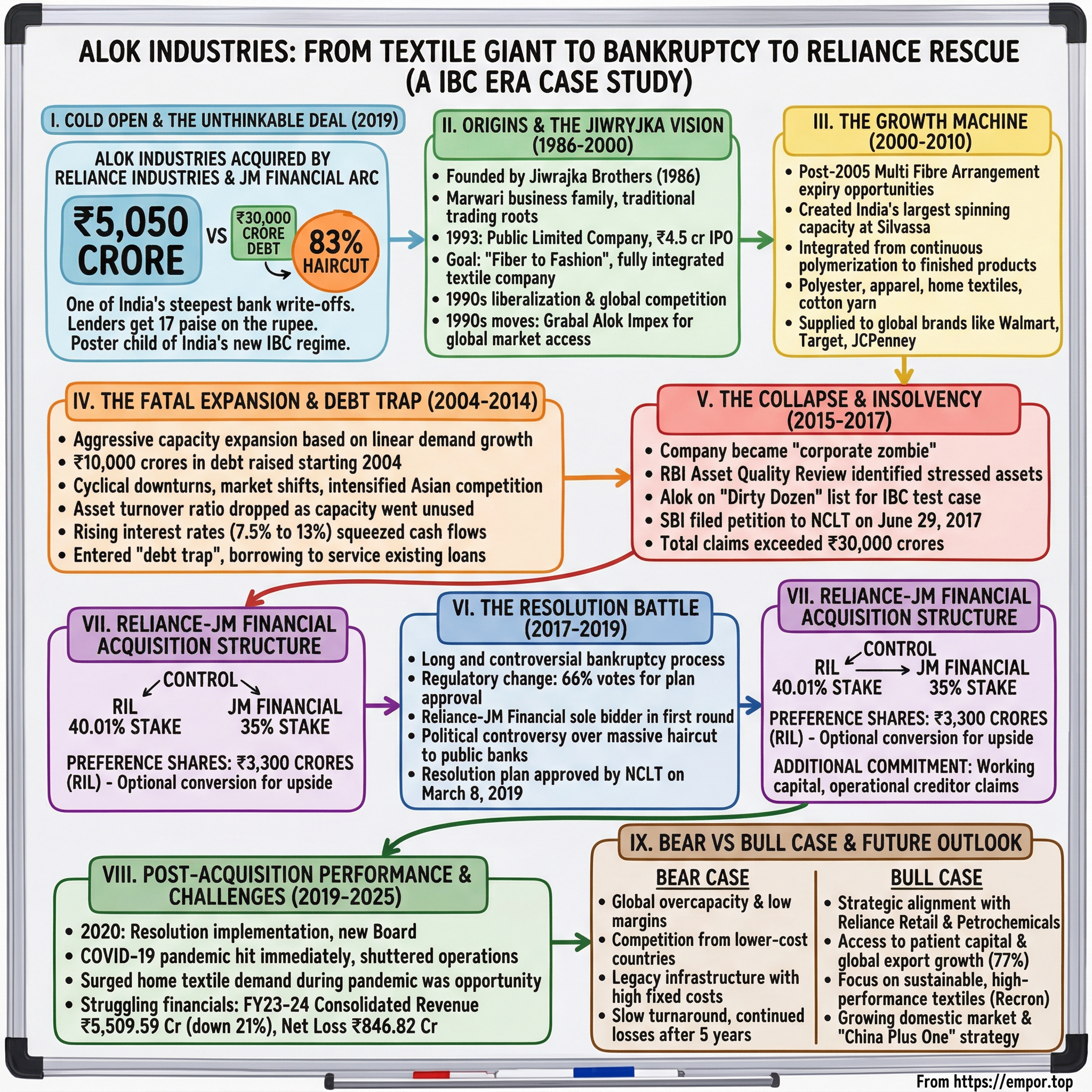
Alok Industries: From Debt-Fueled Giant to Reliance's $4 Billion Turnaround Gamble
I. Cold Open & The 83% Haircut (5-8 min)
On the morning of March 8, 2019, in an Ahmedabad courtroom that resembled a tired government office, a two-member bench of the National Company Law Tribunal read out an order that took less than a minute to pronounce and erased more wealth than most Indian companies will ever create.
The order approved a resolution plan submitted jointly by Reliance Industries Limited and JM Financial Asset Reconstruction Company for a textile manufacturer called Alok Industries.[^1] The price tag attached to the plan was ₹5,050 crore. The debt owed to lenders stood at more than ₹29,000 crore.1 Calculated directly, the outcome made front-page headlines the next morning: a haircut of roughly 83%, imposed on a lending consortium of over two dozen banks led by State Bank of India.
In practical terms, for every hundred rupees of public-sector bank money lent to Alok Industries, about seventeen rupees returned. The remaining eighty-three simply vanished.
What made the moment stranger still was the identity of the winning bidder on the other side of the courtroom. Alok was not a steel plant or a power project. It produced cloth—bedsheets, terry towels, shirting fabric, polyester yarn. Its buyer was Mukesh Ambani's Reliance Industries, a conglomerate known in 2019 for oil refineries, petrochemicals, and a telecom network that had spent the preceding three years offering free mobile data. On its face, Reliance bidding for a bankrupt textile mill looked like a strategic misfit.
It was not. Alok was the sole textile manufacturer on the Reserve Bank of India's list of twelve giant defaulters—the "Dirty Dozen"—identified by an internal advisory committee on June 13, 2017. The selection criteria were clear: total bank exposure above ₹5,000 crore, with at least 60% classified as non-performing as of March 31, 2016. Together, those twelve accounts represented roughly a quarter of the entire Indian banking system's gross bad loans.2 While the list was dominated by steel, power, and infrastructure firms, Alok stood alone as a manufacturer of consumer soft goods.
That anomaly defines the core story. Alok did not collapse because Indian consumers stopped buying bedsheets. It failed because it borrowed like an infrastructure conglomerate to fund capacity expansion for a commodity business—an industry where output prices are dictated by Gujarat cotton crops and Singapore naphtha crackers, and where key buying power rests with global retailers like Walmart.
This account traces three intersecting developments. The first is the growth of a family business from a single texturising machine into India's largest fully integrated textile complex. The second is the mechanics of its downfall—not a single fatal mistake, but a decade-long compounding of leverage, excess capacity, and bloated receivables. The third, and most critical for investors today, is what Reliance acquired and how it has managed the business in the years following the takeover.
An uncomfortable reality undercuts any simple turnaround narrative: for the financial year ended March 31, 2026—seven years after the NCLT order and six years into Reliance's operational control—Alok Industries reported standalone net sales of ₹3,525 crore, operating EBITDA before provisions of ₹80 crore, and a net loss of ₹780 crore.3 Its negative net worth expanded to ₹19,676 crore on a standalone basis, and the company has not posted an annual net profit since its debt resolution.
These losses do not necessarily invalidate the turnaround thesis; they may even reflect its underlying strategy. Nevertheless, any objective analysis must confront this financial baseline and address a central question: is Alok Industries an operating listed company controlled by Reliance, or is it an internal Reliance manufacturing facility operating within a public shell—and does that distinction matter to minority shareholders holding roughly a quarter of the share count?
Answering that requires returning to a small office in Mumbai in 1986, and three brothers whose surname few in business circles then recognized.
 Subscribe on LinkedIn
II. Origins & The Jiwrajka Ambition (1986–2000) (25-30 min)
India in 1986 was not an environment that rewarded industrial ambition; it rewarded proximity to Delhi.
The License Raj was still fully operational. Building a factory required a license specifying permitted products and output volumes. Importing machinery required separate clearances, and expanding capacity beyond licensed limits meant returning to regulators for approval. Textiles, India's oldest organized industry and its largest employer after agriculture, had been constrained by state policy: reservation rules protected the handloom and powerloom sectors by restricting what organized mills could produce, while the Bombay textile strike of 1982–1983 had left the city's traditional mill district a stretch of shuttered composite mills.
Against this backdrop, in March 1986, three brothers—Ashok, Dilip, and Surendra Jiwrajka—incorporated a private limited company in Mumbai to enter textiles.4 The family had trading roots rather than manufacturing experience, and the initial business was modest: texturising. The company inaugurated its first polyester texturising plant in 1989.4
Texturising explains the operational framework the Jiwrajkas built upon. Raw polyester filament emerges from a spinning machine as a smooth, straight, synthetic bundle of threads—strong and cheap, but rigid. Texturising feeds that flat yarn through heat and mechanical twisting so the filaments crimp and separate, producing yarn that is bulkier, softer, and more elastic, mimicking natural fibers on a loom. The process is essentially a conversion margin: a manufacturer buys input yarn at commodity prices, applies energy and capital equipment, and sells processed yarn at a small spread. That margin depends heavily on machine efficiency and high utilization, scaling with installed capacity.
This was the core business the Jiwrajkas mastered first—and it closely mirrors the conversion-focused operations Alok Industries relies on in 2026.
The 1990s provided a structural inflection point. The 1991 balance-of-payments crisis catalyzed economic liberalization: industrial licensing was dismantled for most sectors, capital goods tariffs fell, and a two-stage devaluation of the rupee made Indian textile exports competitive abroad. Simultaneously, global trade rules began shifting. The Multi-Fibre Arrangement, which had governed international textile trade through country-specific quotas since 1974, was scheduled for a ten-year phase-out ending January 1, 2005, under the 1995 WTO Agreement on Textiles and Clothing.
Indian textile manufacturers drew a straightforward conclusion: once quotas expired in 2005, global apparel buyers would consolidate orders with suppliers offering scale, vertical integration, and cost efficiency. The market rewards would accrue to companies that built capacity ahead of the deadline.
Alok expanded rapidly. In 1993, the company converted into a public limited firm and raised ₹4.5 crore through an initial public offering—a sum that underlines how modest its starting base was.4 It listed on both the Bombay Stock Exchange and the National Stock Exchange.5 In 1995, it entered embroidery through a collaboration with the Austrian Grabher Group, importing Schiffli machinery that was largely absent from India at the time. In 1996, it commissioned a knitting plant in Silvassa and crossed ₹100 crore in annual sales for the first time.4
Silvassa offered distinct strategic advantages. Located in the Union Territory of Dadra and Nagar Haveli, the site provided tax incentives, excise concessions, and affordable land, situated roughly 180 kilometers north of Mumbai along the industrial corridor leading to Gujarat's chemical belt. Vapi, forty kilometers further north, was one of India's primary chemical and dyeing centers. Establishing production across Silvassa and Vapi positioned Alok between India's financial capital and its petrochemical supply base while reducing tax overhead.
The strategic model framing this expansion was vertical integration. Conventional Indian textile production was fragmented across separate entities: spinners sold yarn to weavers, who sold unfinished fabric to processors, who sold finished fabric to garment makers, exporters, buying houses, and retailers. Each transition introduced intermediary margins, inventory buffers, quality friction, and scheduling delays. The Jiwrajka thesis posited that an integrated company owning every stage could capture cumulative margins, enforce quality controls across the value chain, and guarantee reliable delivery volumes to global retailers such as Walmart or Marks & Spencer.
While strategically sound, vertical integration is inherently capital-intensive. Adding revenue at the finished-goods stage often required simultaneous capacity additions across four upstream processes. The model operates efficiently when processing capacity runs at full utilization; however, it becomes unforgiving during demand downturns because fixed operating costs persist across all integrated units regardless of throughput.
By 2000, Alok had assembled a spinning, weaving, knitting, and processing network across Silvassa, Navi Mumbai, and Vapi, generating several hundred crore rupees in revenue with plans to expand further before global quotas ended.5 The Jiwrajkas had built a substantial manufacturing enterprise from scratch over fifteen years within a heavily regulated industrial environment.
Then they turned to debt.
III. The Growth Machine & Dual-Engine Expansion (2000–2007) (35-45 min)
Between 2000 and 2004, Alok Industries roughly tripled its revenue.4 The mechanics of that expansion established the template for the decade of aggressive borrowing that ultimately brought the company down.
The expansion ran on two engines simultaneously, revealing how the Jiwrajka brothers managed capital allocation.
The first engine was cotton. Alok integrated backward into spinning—converting raw cotton bales into yarn—and forward into weaving, processing, and finished goods like bedsheets, terry towels, and garments. This served as the company's export driver. India held structural advantages in cotton: abundant domestic crops and lower labor costs for manufacturing finished goods. Meanwhile, global big-box retailers were consolidating vendor networks, shifting orders from hundreds of fragmented suppliers toward a few large, auditable, fully integrated manufacturers.
The second engine was synthetic. Alok constructed a continuous polymerization plant in Silvassa that processed two primary petrochemical inputs—purified terephthalic acid and monoethylene glycol—through a reactor to create molten polyester polymer. The output could be solid chips for sale or extruded directly into filament. From this single facility, Alok produced polyester chips, partially oriented yarn, fully drawn yarn, drawn texturized yarn, and polyester staple fiber.6
While both divisions generated yarn and fed fabric production, their underlying economics operated on opposing cycles. Cotton costs depended on agricultural harvest cycles, domestic minimum support prices, and monsoon weather. Polyester costs tracked global crude oil prices and petrochemical refining spreads for terephthalic acid and monoethylene glycol. When cotton prices rose relative to synthetic alternatives, buyers shifted toward polyester, and vice versa. Owning both divisions theoretically created an operational hedge against commodity price swings.
In practice, however, operating dual supply chains required maintaining two distinct sets of capital-intensive fixed assets. Both divisions needed to maintain high utilization rates to cover their fixed overhead and justify the investment.
During this period, Alok built a major customer network across international retail brands and garment exporters in key manufacturing hubs—including Bangladesh, Vietnam, and Sri Lanka—that handled final assembly for global labels.6 A notable benchmark of this manufacturing scale came in 2013, when Alok fulfilled what it described as its largest single order: two million sheet sets for Walmart.4
Fulfilling an order of that magnitude required massive manufacturing throughput: spinning, weaving, bleaching, dyeing, printing, cutting, stitching, and packaging millions of items to strict specifications and strict delivery timelines. Few textile manufacturers possessed the physical scale to accept such orders. Alok's manufacturing footprint, engineering capacity, and commercial vendor status were real.
Industry recognition followed. In 2006, Alok received a silver TEXPROCIL trophy as India's second-largest home textiles exporter, and in 2008 it won four export awards from the council.4 Revenue grew rapidly, reaching approximately ₹1,800 crore by 2007.4 By 2011, the company's twenty-fifth anniversary, annual revenue surpassed ₹6,300 crore, earning it Recognized Star Trading House status.4 What had taken fifteen years to reach ₹100 crore took five more years to reach ₹1,800 crore, and just four more to cross ₹6,300 crore.
Yet at the height of this revenue expansion, the company began extending beyond its core manufacturing focus.
In 2007, Alok launched a domestic retail brand, H&A, which eventually grew to over 130 stores in India,7 and acquired a 60% stake in Czech textile manufacturer Mileta.4 In 2008, it acquired a stake in UK high-street retail chain Store Twenty One, operating through Grabal Alok (UK) Limited—an entity that at its peak managed roughly 216 apparel and homeware stores across England, Scotland, and Wales.57 Between 2009 and 2010, the company diversified into real estate development, cotton farming, and expanded polymer and terry towel operations.4 In 2012, it completed the merger of its embroidery affiliate, Grabal Alok Impex.4
Within three years, a vertically integrated B2B textile producer had added a domestic retail store network, a European manufacturing subsidiary, a British retail chain with over two hundred leased storefronts, an agricultural enterprise, and a commercial and residential real estate portfolio in Mumbai.5
Management presented strategic rationales for each initiative: retail would capture downstream consumer margins, Mileta offered European fine-fabric manufacturing, Store Twenty One provided a dedicated retail outlet for finished goods, cotton farming secured raw material supplies, and real estate projects monetized land assets. Individually, each project could be defended; collectively, they represented a significant dispersion of capital away from evaluating return on capital in the core manufacturing business.
This rapid, debt-financed expansion into unrelated operations stretched management focus and balance sheet leverage just as external market conditions deteriorated.
Crucially, the post-2005 market dynamics diverged from expectations. When the Multi-Fibre Arrangement quotas expired on January 1, 2005, Chinese textile producers captured the largest share of global market growth, having built manufacturing capacity at a scale and cost efficiency that undercut Indian competitors. Three years later, the 2008 global financial crisis curtailed consumer spending across North America and Europe, dampening demand for imported textiles just as massive global capacity came online.
Alok entered this severe global downturn heavily leveraged, with expanding fixed assets and debt commitments at maximum capacity.
IV. The Fatal Capex Expansion & The Debt Trap (2004–2015) (45-55 min)
Every corporate collapse features key balance-sheet indicators that clarify its trajectory. For Alok Industries, two numbers in the financial statements stand out.
The first is the gross block. As of March 31, 2026, Alok's gross property, plant and equipment stood at ₹17,133 crore.3 That represents the accumulated original cost of the machinery and facilities assembled by the promoters. Against that asset base, standalone net sales in FY26 were ₹3,525 crore. Even accounting for historical inflation and subsequent accounting adjustments, the ratio remains striking: roughly one rupee of annual revenue for every five rupees of gross fixed assets.
The second indicator is an unpaid receivable. Note 35 of Alok's financial statements—a disclosure entry carried forward, unchanged in substance, across seven consecutive annual reports—records that as of June 2017, the company had ₹11,623.94 crore receivable from trading debtors on account of sale of fabric.3
That figure of nearly ₹11,624 crore stood against total annual group revenue of roughly ₹14,000 crore at the time. It represented more than three times the company's entire current annual sales base, owed by trading counterparties for fabric transactions. The entire amount was fully provided against by March 31, 2019—written down to zero.3
Alok never publicly detailed the exact composition of those trading receivables. What it disclosed, and what remains in the accounts today, is that under the approved resolution plan, any recovery against those dues must flow into an escrow account for the benefit of financial creditors—and, in the company's own words, "nothing contained in the resolution plan shall oblige the Resolution Applicants or the Company to take steps for recovery of the Outstanding Trading Dues."3 The financial rights and recovery burdens associated with the ₹11,624 crore of fabric receivables were transferred to the lending banks, with no obligation for the company or its resolution applicants to pursue collection.
That single footnote illuminates how Alok's balance sheet expanded far more clearly than capacity expansion alone.
It also clarifies the trajectory of the top-line numbers. Alok reported a net profit of ₹254 crore on revenues of ₹24,382 crore in FY15.7 Compared to its ₹6,300 crore turnover in 2011, this represented a near-quadrupling of top-line revenue in four years—far outpacing the growth of its physical manufacturing assets. The difference was driven by third-party fabric trading rather than internal manufacturing. Trading activities inflated reported revenue and consumed working capital while generating massive uncollected receivables at thin operating margins. A 1% net profit margin on ₹24,382 crore in sales reflected a high-volume trading intermediary rather than a highly profitable industrial enterprise.
The physical expansion was substantial as well. Over the decade leading up to 2013, management invested approximately ₹10,000 crore in new manufacturing facilities, and by March 2017 total group debt reached roughly ₹25,505 crore.7 The capital allocations across spinning, weaving, polyester, commercial real estate, and overseas retail failed to generate returns on capital that met the company's cost of debt.
The underlying economics were unrelenting. In a commodity textile business, operating margins during strong market cycles typically range between 12% and 15% of sales. For a vertically integrated producer, the fixed asset base often spans two to three times annual turnover, capping pre-financing returns on assets at roughly 5% even in favorable periods. When corporate borrowing costs exceed 13% and debt funds the majority of the asset base, the operating structure becomes unsustainably leveraged. Under those terms, an enterprise requires only time, rather than an external crisis, for debt service to overwhelm cash flow.
Alok's cost of capital rose steadily. Indian corporate borrowing rates increased between 2011 and 2014 during a period of monetary tightening by the Reserve Bank of India, pushing interest expenses higher for leveraged borrowers with declining credit profiles. Concurrently, export demand softened in key customer segments. Regional competitors in Bangladesh and Vietnam gained market share in finished garments due to lower wage structures and preferential tariff access to the European Union, while Chinese manufacturers captured a larger share of global market growth in synthetic fabric and yarn.
This combination created operational stagnation. Integrated production facilities operated below break-even utilization rates, while working capital requirements expanded to fund inventory across multiple production stages alongside trading receivables. Accumulated interest obligations outpaced operating cash generation, forcing the company into official debt restructuring programs.
Alok entered the Corporate Debt Restructuring mechanism and subsequently the Reserve Bank's Strategic Debt Restructuring framework, which allowed lenders to convert debt into equity control. Neither mechanism stabilized the business. These debt restructuring frameworks modified repayment terms without altering underlying operations: lenders extended loan tenors, reduced interest rates, and capitalized unpaid interest while leaving existing management in control of over-capitalized assets in a weak market environment. Restructuring obligations on paper failed to resolve the fundamental gap between operating cash flows and debt service requirements.
The company's international investments also unraveled. Grabal Alok (UK) Limited, the parent entity for the Store Twenty One retail chain, entered liquidation effective July 10, 2017.8 State Bank of India's London branch subsequently won a personal claim against the three Jiwrajka brothers arising from guarantees related to that UK business.7 Domestically, Alok Infrastructure Limited, the wholly owned real-estate subsidiary, recorded accumulated losses of ₹1,498.75 crore, with the parent company carrying its intra-group loan at ₹194.46 crore net of an impairment allowance of ₹1,178.53 crore.3 Statutory auditors continue to treat the recoverability of that loan as a key audit matter seven years after the resolution.3
The diversification into real estate development ultimately resulted in an impairment of roughly ₹1,200 crore in capital that remains reflected in subsequent financial provisions.
By 2016, the financial strain led to public legal proceedings. Small Industries Development Bank of India (SIDBI) filed a winding-up petition against the company.7 Commercial lenders raised public questions regarding potential fund diversion, drawing comparisons to high-profile corporate defaults like Kingfisher Airlines.7 Having pledged the vast majority of their equity stake to secure bank loans, the founding promoters faced complete loss of corporate control.
What lay ahead was the implementation of the Insolvency and Bankruptcy Code, enacted in May 2016, which would soon be applied to India's largest corporate defaulters.
V. The Collapse, "Dirty Dozen", and CIRP Firestorm (2015–2018) (40-50 min)
The Insolvency and Bankruptcy Code received presidential assent on May 28, 2016, and its key provisions became effective in December that year.5 For the first time in independent India, a creditor could take a company away from its owner without the owner's consent, on a statutory clock, and hand it to somebody else.
Indian promoters had never faced that. The prior regime — the Board for Industrial and Financial Reconstruction, the Sick Industrial Companies Act, debt recovery tribunals — had been so slow and so debtor-friendly that "sick company" status was a comfortable place to live. The IBC changed the physics: 180 days, extendable to 270, and if no plan is approved, liquidation.
For most of the first year, the Code was used on small cases. Then, in June 2017, the Reserve Bank pointed it at the largest defaulters in the country and told banks to file. Alok Industries was on the list, and it was the only textile company there.
State Bank of India filed. On July 18, 2017, the Ahmedabad bench admitted the petition and the corporate insolvency resolution process formally began.8 Ajay Joshi was appointed interim resolution professional, and later confirmed as resolution professional.1 From that moment the powers of the board of directors were suspended.8
It is worth pausing on what that means for a working factory. An insolvency professional is a licensed intermediary, usually an accountant or lawyer, whose statutory job is to keep the company running as a going concern while a sale process is conducted. In practice, at a company like Alok, it meant that every supplier had to be persuaded that they would be paid, every bank line had to be renegotiated under moratorium, every customer had to be told that their bedsheet order was still safe, and every one of tens of thousands of workers had to be given a reason to come in the next morning. Alok reported more than 24,000 employees as of FY21, of whom over 11,000 were on temporary or contractual terms.8 These were not abstractions.
Then came the part that made the Alok case notorious in Indian insolvency circles.
When the resolution professional first invited expressions of interest, nobody came. Alok was, by contemporaneous reporting, the only company among the twelve RBI-referred accounts that received no bids at all in the first round.1 Fresh bids had to be called to try to attract more players against what was then described as a roughly ₹29,000 crore default.1
Think about what that says. Here was India's largest integrated textile asset, with world-scale plants and an established export customer base, and in an economy full of textile groups looking to expand — no one wanted it at any price. Distressed buyers are not sentimental; the absence of a bid is a market price signal, and the signal was that the asset's earning power did not justify taking on the operational complexity, let alone the debt.
Eventually the RIL-JMFARC combine put in a plan, dated April 12, 2018.1 And in April 2018, the Committee of Creditors rejected it — the plan reportedly secured about 70% of the vote against the 75% then required.9 Reliance publicly confirmed the rejection.1
Here the story takes a turn that critics have never stopped arguing about. On June 6, 2018, the government promulgated an ordinance amending the IBC. Among its changes: the voting threshold for approving a resolution plan was reduced from 75% to 66%. The NCLT then directed the resolution professional to reconvene the Committee of Creditors and put the same plan — the one already voted on in April — back before the lenders under the new rules.1 On June 21, 2018, the plan was approved with 73.19% of the vote.5
The plan had not changed. The rule had.
The defence of what happened is straightforward: the ordinance was of general application, not written for Alok; a 66% threshold is a legitimate policy choice that prevents a small minority of creditors from forcing liquidation on the majority; and the alternative to the plan was not a better plan, it was a liquidation at a value lenders assessed at roughly ₹4,200 crore.1 On that reading, the extra ₹800-odd crore that the plan delivered over liquidation was a straightforward win, and the haircut simply reflected how much value had already been destroyed years earlier.
The critique is equally straightforward, and it was made loudly at the time. Bank officers' unions publicly attacked lenders for accepting so deep a cut.7 Commentators noted that at roughly an 84% loss, the Alok resolution was the steepest among the early IBC cases — against something like 37% at Bhushan Steel and 60% at Electrosteel Steels — and that a rule change mid-process, in a single-bidder auction, is exactly the fact pattern that makes a recovery look less like a market clearing price and more like a negotiated one.9 Both things can be true: the value really was gone, and the process really did have only one buyer and a threshold that moved.
There was also a fight over who counted as what. GAIL India, which had supplied gas to Alok, went to the tribunal arguing it should be treated as an operational creditor rather than a financial one — a distinction that determines where you sit in the waterfall — and on the eve of the final order the Ahmedabad bench granted it that status, on par with its treatment in the Essar Steel case.1 An employees' trust, meanwhile, wrote to the chairmen of roughly ten banks urging them to reconsider their rejection of the Reliance plan, arguing it would protect the livelihoods of about 18,000 employees.1 The workers were lobbying for the buyer.
Nine months after the creditors voted, the tribunal signed the order. But approval was not the finish line. Between the NCLT order and what the plan called the Closing Date, another eighteen months elapsed, during which the company was run not by a board but by a Monitoring Committee comprising four representatives of the financial creditors, two of the resolution applicants, and the erstwhile resolution professional.8
For three years and two months — July 2017 to September 2020 — Alok Industries had no functioning board of directors.8 What Reliance was about to inherit was not a company that had been paused. It was a company that had been kept alive on a ventilator while lawyers argued about who owned it.
VI. The Acquisition Architecture: Reliance & JM Financial's Playbook (35-45 min)
To understand why Alok Industries operates as it does today—generating roughly ₹3,500 crore in annual sales while burdened by more than ₹24,000 crore in total borrowings—requires examining the underlying mechanics of its resolution plan rather than the headline transaction price. While headlines focused on the overall valuation, the capital structure dictates the financial reality for public shareholders.
That structure begins with the treatment of equity. Under the plan, existing paid-up equity capital was reduced not by extinguishing shares, but by cutting their face value from ₹10 to ₹1. This lowered total share capital from ₹1,377.31 crore to ₹137.73 crore across the existing 137.73 crore shares.8 Most corporate insolvency resolution plans extinguish existing equity entirely, given that shareholders hold residual claims on an insolvent entity. Alok's plan allowed existing public shareholders to retain diluted holdings in the reorganized entity, leaving roughly 9.5 lakh retail shareholders on Alok's register today.10
The outgoing promoters received far stricter terms. The Jiwrajka family's remaining direct holding of 10,827 shares was cancelled without payout, and the family was formally reclassified out of the promoter category.8 Separately, 13.59 crore promoter-pledged shares were invoked by lenders and transferred to the asset reconstruction trust.8 The founders exited without equity interest, with Business Today later reporting that the brothers no longer hold meaningful business assets in India.7
The cash infusion was similarly layered. Rather than a flat ₹250 crore injection, Alok allotted Reliance 83.33 crore equity shares at ₹3 per share alongside 250 crore 9% optionally convertible preference shares at ₹1 face value, totaling ₹499.99 crore.8 Equity comprised half the total, while the remainder took the form of a preference instrument convertible one-for-one into equity within eighteen months of its February 28, 2020 allotment. If unconverted, the instrument becomes redeemable after ten years while accruing a 9% cumulative annual dividend.3 Reliance chose not to convert the preference shares.
That decision held clear capital structure implications. Converting would have expanded Reliance's common equity stake and its share of future residual profits. By letting the conversion window expire, Reliance preserved its capital as a senior, dividend-accruing claim ahead of common equity, prioritizing structural protection over expanded common ownership.
The debt assignment formed the central core of the acquisition architecture. Rather than writing off the remaining obligations entirely, financial creditors assigned ₹22,682.60 crore of debt to JM Financial ARC, which subsequently reassigned ₹5,000 crore of that obligation to Reliance.8 In September 2020, a portion of this debt was converted into equity, with Reliance acquiring 115.32 crore new shares and JM Financial ARC taking 160.14 crore shares. That combined issuance of 275.46 crore shares extinguished ₹5,298.58 crore of assigned debt,811 establishing an equity ownership structure that remains unchanged: Reliance holds 40.01% directly, while JM Financial ARC holds 34.99% as trustee, acting in concert to control a combined 75% stake.1211
The remaining debt after conversion dominates Alok's balance sheet: ₹17,384.02 crore in assigned debt, comprising ₹14,517.44 crore held by JM Financial ARC and ₹2,866.58 crore held directly by Reliance.3
Crucially, under the approved resolution plan, this assigned debt carries zero interest for eight years from the closing date, through September 2028. Beyond that date, "the terms of assigned debt shall be mutually agreed among the Resolution Applicants and the Company."3
For investors, that provision introduces critical long-term uncertainty. Over ₹17,000 crore in interest-free debt remains on the books, with post-2028 terms left entirely to future negotiation between Alok Industries and its controlling resolution applicants. Whether that obligations profile is refinanced, extended, converted, waived, or restored to interest-bearing status rests with the controlling promoters. Minority shareholders lack formal visibility into those potential outcomes, making the upcoming September 2028 timeline a major unquantified variable in the company's valuation.
A notable accounting treatment further affects reported financial results. Standard Indian Accounting Standards (Ind AS) typically require long-dated, interest-free loans to be recognized at fair value, with imputed interest expense recognized in the profit and loss statement over the loan term. Alok does not apply this accounting treatment, citing a legal opinion that the terms of the court-approved resolution plan supersede Ind AS standards, allowing the company to carry the assigned debt at historical cost.3 Statutory auditors include this point as an Emphasis of Matter in annual audit reports without modifying their overall audit opinion.3
Had Alok applied standard Ind AS accounting rules, its reported losses would be substantially higher, as imputed interest charges on ₹17,384.02 crore would flow through the income statement. While the exact unrecorded interest amount is undisclosed, the accounting impact remains clear: carrying the debt at cost presents a disclosed and audited position, yet one that reduces reported net losses relative to standard accounting frameworks.
The balance sheet restructuring in FY21 involved substantial write-downs. Alok recognized an asset impairment loss of ₹8,264.22 crore, partially offset by a ₹4,964.68 crore gain from extinguishing assigned debt and a ₹58.44 crore gain on invoked pledged shares, resulting in a net standalone exceptional charge of ₹3,241.10 crore.8 The consolidated net loss for FY21 reached ₹5,673.32 crore, driving net worth down to negative ₹16,265.37 crore—a sharp reversal from its peak positive net worth of ₹2,995.73 crore in prior years.8 Cumulative impairments against property, plant, and equipment reached ₹7,970.63 crore and remain carried on the balance sheet.3
These balance sheet adjustments reflect a fundamental valuation assessment: asset impairments recognized under the new ownership wrote off roughly half the historical book value of the manufacturing facilities built during the expansion era.
This outcome underscores the strategic rationale behind the acquisition. The primary operational logic lies upstream. Reliance stands as one of the world's largest producers of polyester intermediates, purified terephthalic acid and monoethylene glycol. Alok's manufacturing complex in Silvassa represents a major, fully permitted consumer of these exact raw materials. Through this acquisition, Reliance secured a captive downstream outlet for its petrochemical production at a fraction of the cost required to build a comparable facility. Given India's complex land acquisition and environmental permitting processes, constructing an equivalent greenfield integrated textile hub would require years of capital development.
By contrast, the downstream strategic rationale—positioning Alok primarily as the dedicated manufacturing supplier for Reliance Retail's fashion division—presents a more complex narrative that requires evaluation against disclosed related-party transaction volumes.
Following the resolution approval, Reliance sought to privatize the company by requesting an exemption from standard delisting procedures from the National Company Law Appellate Tribunal (NCLAT). The tribunal impleaded the Securities and Exchange Board of India (SEBI) in the proceedings, while retail investors petitioned against the shortcut, citing a five-year delisting moratorium set by the resolution professional during the bidding process.1 SEBI declined to grant an exemption.1 In November 2019, the NCLAT modified its prior ruling to require that any privatization comply strictly with SEBI's standard reverse book-building framework.131
Reliance ultimately chose not to pursue delisting through the standard process. Alok Industries remains a publicly listed entity, with roughly 22.7% of its equity held by public shareholders and 2.3% held by institutional investors.10 While the reasons for pausing privatization remain undisclosed, the initial attempt highlighted the acquirer's early preference for full corporate control, leaving the public equity listing intact today.
VII. Management, Governance & RIL Operational Turnaround (2020–2026) (40-50 min)
On September 14, 2020, the Monitoring Committee held its closing meeting, reconstituted the board of directors, and dissolved itself.8 After 1,154 days, Alok Industries had a board again.
What it did not have — and what it still does not have in any conventional sense — is a chief executive with a public face. This is the single most important thing to understand about how Alok is governed, and it is almost never discussed.
Look at the board as it stood at the close of FY26. Achuthan Siddharth chairs it as an independent director; Mumtaz Bandukwala and Rahul Dutt are the other independents. Three seats belong to Reliance nominees — Hemant Desai, Anil Kumar Rajbanshi and V. Ramachandran. One belongs to JM Financial ARC's nominee, Nirav Parekh.314 Seven directors, three of them independent, with an independent chairman — a structure the rating agency notes approvingly.12
But there is no managing director and no executive director. Instead, day-to-day affairs are run by a voluntary body the board calls the Managing Committee, whose members as of the FY26 report were V. Ramachandran (a Reliance nominee director), Jinendra Kumar Jain (the chief financial officer) and Rajbir Saini (the Manager).3 The senior team consists of a Manager, a chief operating officer, Biji Chacko, and a CFO.3
"Manager" here is not a casual title. It is a specific statutory role under the Companies Act, used when a company does not appoint a managing director. It is a legitimate structure and Alok has used it since the resolution — Sunil Khandelwal, a long-serving Alok finance executive from the pre-bankruptcy era, held the role earlier in the post-resolution period. But the effect is that operational accountability sits with a committee that includes a promoter nominee director, rather than with a named chief executive answerable to the board.
And the churn in the executive ranks has been unusual. During FY26 alone: the chief financial officer Anil Kumar Mungad ceased on April 29, 2025 and Jinendra Kumar Jain was appointed the following day; the company secretary Hitesh Kanani ceased on May 2, 2025 and Anshul Kumar Jain was appointed on May 5; and the chief executive officer, Harsh Bapna, resigned with effect from January 31, 2026.3 Mungad himself had only been appointed CFO with effect from July 1, 2024. That is three CFOs inside roughly two years, and a CEO departure that, as of this writing, has not been publicly filled.
The statutory auditor also changed. Alok's accounts for FY25 were audited by S R B C & CO LLP; the FY26 accounts were signed by Chaturvedi & Shah LLP.63 Chaturvedi & Shah is a long-standing joint statutory auditor of Reliance Industries itself. There is nothing improper about an audit rotation following the expiry of a firm's statutory term, which is what the FY25 report flagged as due.6 But an investor tracking governance signals should note that the auditor of a listed subsidiary-in-substance moved to a firm deeply embedded with the promoter, at the same time as the CEO left and the finance function turned over.
The board met four times during FY26 — the statutory minimum.3
Now the capital allocation, which is where the promoter's actual behaviour over time can be read, and where the record is unambiguous: Reliance has kept writing cheques.
The largest came on January 2, 2024, when Alok issued 3,300 crore 9% non-convertible redeemable preference shares of ₹1 each to Reliance, raising ₹3,300 crore.3 The instrument is redeemable at par at the company's option at any time within twenty years, and the 9% dividend is cumulative.3 The market's reaction was euphoric — the shares surged roughly 20% on the announcement and gained close to 65% over five sessions.1516 The proceeds went to partial repayment of term loan and working capital.3
Alongside the equity-like money came debt support of a more consequential kind. Alok carries a ₹3,500 crore term loan facility, and the entire term debt is backed by unconditional and irrevocable corporate guarantees from Reliance.12 Alok pays RIL ₹1.75 crore a year in guarantee commission for it.3 That guarantee is why CARE Ratings assigns Alok's bank facilities a CARE AA+ rating with a Stable outlook — a rating that has nothing to do with Alok's own cash generation and everything to do with the parent's balance sheet.12
CARE is refreshingly blunt about this. Its analytical approach is standalone, "notched up" for parent support, and the stated triggers for an upgrade are not operational at all: they are an increase in Reliance's shareholding above 50% with majority board representation, or realisation of synergies.12 The stated triggers for a downgrade are a weakening of Reliance's credit profile, a decline in Reliance's holding, or "change in stance of timely and need-based support by RIL."12 A rating agency has, in effect, written down in public that Alok's creditworthiness is a derivative of Reliance's intentions.
The most consequential operational change came in March 2024, and it is the one that reframes the entire business. Alok moved its polyester business to a job-work model. Reliance now supplies the PTA and MEG, Alok converts them, and Reliance takes the finished product — with Alok recovering its conversion cost plus a margin, plus a fixed rental.1712
This is a genuinely significant restructuring, and it cuts both ways. On the positive side, it removes Alok's exposure to petrochemical price swings and slashes the working capital it must fund — CARE explicitly credits the shift for supporting liquidity in a company that was still burning cash.12 Polyester capacity utilisation improved from 60% in FY24 to 69% in FY25 under the new arrangement.12 On the negative side, Alok has converted its largest business from a manufacturer that earns a spread into a toll processor that earns a fee. The upside from a good polyester cycle now accrues to Reliance. Alok is paid for running machines.
Recall where this company started: texturising, a conversion business. Forty years on, its biggest division is a conversion business again, and the counterparty is its promoter.
The accounting consequence was dramatic and needs to be understood before anyone reads Alok's revenue trend. Reported revenue fell from ₹5,362 crore in FY24 to ₹3,560 crore in FY25 — a 34% collapse.12 Almost none of that was lost business. Under job work, Alok books only the conversion and rental income rather than the gross value of polyester sold.17 The physical output did not shrink by a third; the accounting did.
Which brings us to the profitability question that will not go away, and to how management frames it.
Alok's finance cost in FY26 was ₹600.09 crore.3 Of that, ₹320.77 crore was dividend on preference shares held by Reliance — accrued under Ind AS as a finance cost because the instruments are classified as liabilities, but not actually paid out, because the dividend is cumulative.312 The unpaid, accumulated preference dividend owed to Reliance stood at ₹804.27 crore at March 31, 2026, up from ₹484.77 crore a year earlier.3
So roughly half of Alok's "interest cost" is a non-cash accrual to its own promoter, compounding quietly on the balance sheet at ₹320 crore a year, ranking ahead of the common equity. Depreciation added another ₹258.65 crore.3 Set against operating EBITDA before provisions of ₹80.02 crore, the arithmetic of the loss becomes obvious: the operating business does not come close to covering its non-cash charges, let alone its cash interest.
Management's own preferred framing is disclosed in the MD&A, and it is worth engaging with rather than dismissing. Alok publishes a "quasi net worth" figure, computed by adding back the ₹17,384 crore of interest-free promoter loans and ₹3,544 crore of promoter-subscribed preference shares to reported equity and reserves. On that basis quasi net worth was ₹1,252 crore at March 31, 2026, against ₹2,024 crore a year earlier, and the quasi debt-to-equity ratio deteriorated from 1.70 to 2.75.3
The logic is defensible: promoter money that carries no interest and no fixed repayment date behaves more like equity than debt. But look at what the metric actually shows. On management's own most generous measure of solvency, the cushion shrank by ₹772 crore in a single year — because that is what the annual loss does to it. At the current rate of loss, the quasi net worth that management points to is exhausted in under two years without a further infusion.
That is not a hostile reading. It is management's number, read forward. And it explains why the credit rating is anchored on Reliance's willingness to keep supporting rather than on Alok's own trajectory. The turnaround narrative — plants restarted, supply chains stabilised, product mix upgraded — has real content, and the operating EBITDA line has clawed from deeply negative to modestly positive. But six financial years after the reconstituted board adopted an eight-year business plan focused on utilising existing capacity and upgrading machinery, the company has not produced a year of positive operating profit large enough to matter, and the auditors note that the board has since "made required revisions to the business plan."83 What those revisions were, and how the original targets were missed, has not been disclosed.
VIII. Core Business Mechanics & Competitor Matrix (35-45 min)
A three-hour drive north of Mumbai leads to Silvassa, where Alok Industries operates an industrial estate large enough to house its own school. Forty kilometers further north in Vapi sit its fabric processing and made-ups facilities. Across Silvassa, Dadra and Nagar Haveli, Daman and Diu, and Valsad in Gujarat, the company operates more than ten integrated manufacturing plants.12 This physical asset footprint represents the tangible foundation beneath Alok’s complex capital structure.
Under Ind AS 108, Alok reports its operations as a single business segment—Textiles—leaving the company with no audited segmental profitability disclosures.3 However, voluntary disclosures in its management discussion provide a product-level revenue breakdown that illustrates how its sales mix transformed between fiscal 2024 and fiscal 2026.
In fiscal 2026, on standalone net sales of ₹3,525.30 crore, apparel fabric represented the largest category at 30.52%, followed by polyester at 29.52%, home textiles at 20.17%, spinning at 18.29%, and packaging at 1.50%.3 By comparison, polyester accounted for 51.79% of total sales two years earlier in fiscal 2024.6 This shift did not reflect an operational exit from synthetic fibers, but rather the accounting transition to the Reliance job-work arrangement, which records conversion fees rather than gross polymer sales.
Behind these category totals, detailed product trends highlight a distinct operational divide. In fiscal 2026, apparel woven fabric revenue grew by 31% and knits rose 11%, while finished garments expanded 24% and hemming services increased 35%.3 In contrast, embroidery sales dropped 39%, bath products—primarily terry towels—fell 21%, and bedding declined 5%.3 Domestic fabric processing expanded, while discretionary, export-oriented finished goods contracted.
That divergence was driven largely by external trade headwinds. An escalation in the US reciprocal tariff regime to 50% on Indian textile exports in August 2025 directly burdened Alok’s export book during the second half of fiscal 2026.3 Total export sales fell 15.59% to ₹712.28 crore, while the US share of Alok’s export basket shrank from 46.33% to 38.07%, with direct shipments to the US dropping to ₹271.18 crore.3 Domestic sales offered partial insulation, rising 3.70% to ₹2,813.02 crore over the same period.3
In February 2026, an interim bilateral trade agreement reduced the reciprocal tariff on Indian textiles from 50% to 18% by removing a 25 percentage point penalty imposed over Russian oil purchases.18 While Alok’s annual report acknowledged the rate relief, management cautioned that unresolved policy details surrounding the final bilateral agreement "remains a risk."3
Because direct US exports represented only about 11% of Alok's total revenue in fiscal 2025, the tariff shock proved less catastrophic for Alok than for specialized export peers.12 However, financial comparisons across the sector reveal a deeper structural problem. Among major home textile exporters, Welspun Living saw fiscal 2026 revenue fall from ₹10,545 crore to ₹9,399 crore, with net profit declining from ₹644 crore to ₹213 crore and return on capital employed dropping from 14% to 6%.19 Indo Count reported flat sales of approximately ₹4,140 crore, while net profit dropped from ₹250 crore to ₹127 crore and return on capital employed halved to 8%.20 Vardhman Textiles maintained a 13% operating margin while net profit slipped from ₹887 crore to ₹753 crore.21
While industry peers remained profitable during a difficult export cycle, Alok recorded a consolidated net loss of ₹744 crore in fiscal 2026.22 This performance gap confirms that Alok's persistent losses stem not merely from cyclical market weakness, but from structural debt service and legacy balance sheet overhead.
Physical operational risks have also impacted performance. In fiscal 2025, power disruptions and a tornado at the Silvassa complex caused operational downtime and production losses,12 driving cotton capacity utilization down from 93% to 88%.12 The company received ₹25 crore in insurance settlements during fiscal 2026, recognizing exceptional gains of ₹18.58 crore on the insurance claim and ₹12.21 crore from the sale of damaged assets,3 with a further ₹17.20 crore insurance gain recorded in the June 2026 quarter.23 While insured, the event highlighted the concentration risk of grouping spinning, weaving, knitting, embroidery, and polymerization assets within a single industrial hub.
The underlying economics of Alok's two primary divisions operate under fundamentally different models. The polyester business functions effectively as a contract tolling facility for Reliance Industries, earning a fixed cost-plus conversion fee alongside rental income. This structure eliminates commodity price risk, but caps operational upside to throughput volume and machine uptime. Conversely, the cotton chain operates as a traditional merchant business exposed to raw cotton prices, global fabric demand, and export realization rates. Vertical integration remains central here, as internal consumption absorbs roughly 55% to 60% of Alok’s total yarn output across woven fabrics, knits, bedding, and terry towels.6
Capturing value from that integrated chain requires high plant utilization. However, overall capacity utilization dropped to 52% in fiscal 2024 from 69% in fiscal 2023 under pressure from low-cost Chinese polyester imports.17 From the perspective of competitors like Welspun, Trident, or Indo Count, Alok lacks retail brand equity and direct consumer shelf placement in major export markets. Yet its sheer installed capacity allows it to process massive volume orders whenever working capital is made available, making its idle capacity a persistent influence on industry pricing dynamics.
Alok’s management has repeatedly stated its objective across recent annual reports to "regain a preferred supplier status for big brands and retailers" by winning back lost clients through quality, design capability, and volume scale.3 Ultimately, fulfilling that commitment depends on expanding non-polyester commercial revenue and rebuilding export scale—metrics that have yet to demonstrate a sustained operational recovery.
IX. Primary Evidence & Earnings Call Synthesis (20-30 min)
A fundamental analytical challenge shapes everything an outside investor can evaluate about Alok Industries: the company does not hold earnings conference calls.
Its investor portal provides quarterly financial statements dating back to fiscal 2014, subsidiary filings, half-yearly related-party transaction disclosures, and annual reports.24 What it omits is an investor presentation, an earnings call transcript, or executive commentary accompanying its results.24 Outside analysts have no prepared management remarks to parse and no live question-and-answer sessions to test underlying assumptions.
For an enterprise with a market capitalization of roughly ₹5,700 crore and approximately 9.5 lakh public shareholders, this represents a significant transparency gap.10 While regulatory rules do not mandate quarterly conference calls, the absence of a public forum leaves critical operational questions unanswered. Management has not publicly addressed the specific conversion margins on the Reliance job-work contract, the post-2028 terms contemplated for its assigned debt, the rationale behind recent executive departures, the details of its revised business plan, or the expected timeline for operating earnings to cover cash interest obligations.
Consequently, primary analysis relies on tracking statutory annual reports and quarterly filings across multiple financial cycles, which reveals three distinct patterns in management's narrative consistency.
First, executive commentary remains consistently focused on operations rather than financial structure. Management discussion sections across fiscal 2025 and 2026 prioritize macro industry conditions—global trade flows, national export market share, trade agreements, and tariff policies—before addressing corporate results. The narrative emphasizes product upgrades, sustainable manufacturing, and specialized textiles. In fiscal 2025, disclosures highlighted a 17,600-square-foot flagship showroom opened in New York during the Spring Home Textiles Market, premium Kasturi cotton towels, and Recron Performance Fibre lines developed alongside Reliance.6 By fiscal 2026, focus shifted toward Reliance's Kooltex and Green Gold Recron synthetic technologies alongside a strategic pivot into technical home textiles and specialized yarn blends.3 This sequence illustrates an ongoing effort to reposition Alok as a value-added toll processor leveraging its parent company's synthetic fiber technology.
Second, the annual reports provide detailed reporting on underperforming divisions. Disclosures for fiscal 2025 explicitly acknowledged that embroidery sales fell roughly 16%, apparel garments dropped 27%, home textiles contracted 7%, and cotton yarn spinning declined 18%.6 The fiscal 2026 report directly attributed a 39% drop in embroidery revenue to softening market demand and higher US tariffs across specific lines.3 Furthermore, statutory financial ratio tables—including interest coverage, current ratios, and management's quasi debt-to-equity metric—are published consistently even as performance metrics weaken, reflecting a level of reporting discipline that partially offsets the lack of interactive investor calls.
Third, forward-looking statements remain entirely qualitative and non-binding. Management repeatedly asserts that it is "confident of bringing into its fold, customers who have moved away in the last few years," and remains "fully prepared to meet larger volumes."3 However, the company provides no specific production volume targets, operating margin benchmarks, profitability timelines, or capital expenditure return thresholds. Without measurable forward guidance, external stakeholders cannot benchmark operational progress against management's stated commitments—a notable omission given that the board has already had to revise its original eight-year turnaround roadmap.
Evaluating multi-year financial results reveals a trajectory of operational stabilization without sustained earnings recovery. Re-opened facilities generated consolidated revenue of ₹3,848 crore in fiscal 2021.8 Sales surged to ₹7,310 crore in fiscal 2022, delivering an operating profit of ₹564 crore during a post-pandemic inventory restocking cycle and strong synthetic spreads.10 Revenue contracted to ₹6,989 crore alongside an operating loss in fiscal 2023,10 before the job-work accounting transition and export headwinds reduced reported top-line figures in fiscal 2024 and 2025. By fiscal 2026, consolidated revenue stood at ₹3,715 crore, while net losses narrowed slightly from ₹816.43 crore in the prior year to ₹744.11 crore.1022
Recent quarterly performance highlights the persistence of this trend. For the first quarter ended June 30, 2026—approved by the board on July 16, 2026—Alok reported revenue of ₹993.11 crore, reflecting a 6.5% year-over-year increase, operating EBITDA of ₹59.57 crore, and a consolidated net loss of ₹138.25 crore against ₹171.56 crore a year earlier, inclusive of a ₹17.20 crore insurance recovery gain.23 Operating earnings remain positive but far short of covering recurring financing costs, continuing a pattern of narrowing quarterly net losses on flat-to-modest top-line growth.
X. Strategic Frameworks: 5 Forces & 7 Powers Analysis (25-35 min)
Strip away the balance sheet for a moment and ask a cleaner question: is the underlying business a good one?
Michael Porter's framework gives an unambiguous answer, and it is no.
Rivalry is severe and structurally so. Indian textiles remains one of the world's most fragmented markets. The organized sector competes with tens of thousands of powerlooms and small processors domestically, alongside international rivals in Bangladesh and Vietnam that operated at lower effective tariff rates into the U.S. through fiscal 2026.3 Alok's annual report for fiscal 2026 acknowledges that it faces domestic competition "from organized big players and the unorganized small and fragmented players."3 The industry lacks capacity discipline, consolidation mechanisms, and a clear price leader.
Buyer power is high and getting higher. The company's primary customers—global retailers and garment converters—frequently run reverse auctions, dual-source orders, and switch vendors from one season to the next. Alok's experience during the U.S. tariff shock demonstrates this dynamic: when landed costs rose, buyers shifted orders elsewhere. A supplier with true pricing power would have passed the tariff increase on to clients; instead, Alok absorbed a 21% decline in its bath products business.3
Supplier power is the one force Alok has genuinely neutralised — by giving up the upside. On the synthetic side, Alok neutralized supplier power by ceding operational upside. Purified terephthalic acid and monoethylene glycol are supplied directly by Reliance under the job-work arrangement, eliminating raw material price risk for polyester.12 On the cotton side, however, no such buffer exists. Raw cotton remains an agricultural commodity subject to weather patterns, sowing decisions, and government minimum support prices, while Alok's ability to pass price increases on to buyers is described by its rating agency as limited.17
Substitution is a permanent, moderate churn rather than a threat. Cotton and polyester substitute for one another as their relative prices fluctuate with crude oil trends and harvest yields. Alok's dual manufacturing presence hedges against these shifts, but does so at the cost of maintaining two separate, capital-intensive asset bases—a strategic choice that proves far more viable when debt service is not compounding on both.
Barriers to entry are asymmetric, and this is the most interesting force. Replicating Alok's Silvassa manufacturing hub is practically impossible in today's market. Securing land, environmental permits, effluent treatment approvals, and assembling approximately ₹17,000 crore in gross fixed assets at historical cost creates an insurmountable barrier to building a comparable greenfield megasite in India at a viable return on capital. However, entry barriers protect physical infrastructure rather than profit margins. Downstream activities like garment assembly, embroidery, and fabric trading—where higher value-added margins reside—require far less capital, rendering those segments intensely competitive.
Applying Hamilton Helmer’s 7 Powers framework poses an even more demanding question: does Alok possess any durable strategic advantage that allows it to earn returns above its cost of capital?
Scale economies: real, but only in conversion. Alok achieves low per-unit conversion costs at full capacity utilization, which underpins its operational utility to Reliance. The limitation, reflected in the fiscal 2024 utilization rate of 52%, is that scale economies in fixed-cost manufacturing depend entirely on sustained demand.17 When operating throughput falls below break-even thresholds, massive scale becomes a financial liability.
Cornered resource: partly, and not owned by shareholders. Alok maintains privileged access to Reliance’s raw materials and specialty Recron fibers, alongside corporate guarantees that secure its AA+ credit rating.12 While this represents a tangible resource advantage, it stems from a contractual relationship with its controlling shareholder rather than an independently owned corporate asset. As the rating agency explicitly notes, any change in Reliance's support stance serves as a trigger for a credit downgrade.12 Access held purely at a promoter's discretion lacks the permanence of an owned strategic asset.
Ecosystem power, as commonly asserted, does not survive the evidence. The investment thesis that positions Alok as the core manufacturing engine for Reliance Retail's fashion network is not borne out by reported figures. In fiscal 2026, Alok’s sales of goods to Reliance Retail totaled ₹73.49 crore, down from ₹125.83 crore in fiscal 2025.3 This accounted for approximately 2% of standalone revenue and continued to decline. In contrast, service revenues from Reliance Industries for polyester job work reached ₹940.93 crore over the same period.3 Disclosed figures demonstrate that the relationship centers on upstream toll processing rather than downstream retail integration, leaving the retail synergy narrative largely unfulfilled.
Process power: modest and unproven externally. Reliance has introduced operational disciplines, consolidated enterprise resource planning onto parent data systems, and standardized maintenance schedules across facilities.3 However, process power typically manifests as superior operating margins relative to industry peers. For Alok, that margin comparison moves in the opposite direction: operating EBITDA before provisions stood at 2.27% in fiscal 2026, compared to 8% at Welspun Living and 13% at Vardhman Textiles.31921
Counter-positioning, switching costs and branding: absent. Alok supplies commodity and semi-commodity textiles to institutional buyers. The business lacks switching costs, consumer brand equity, and proprietary business models that competitors cannot replicate.
This strategic synthesis provides a clearer explanation for the past six years than any conventional turnaround narrative. Alok possesses one genuine capability—scale economies in conversion—and one borrowed advantage—access to its parent company's raw materials, distribution, and credit backing. Neither generates superior returns for minority shareholders in a commodity market devoid of pricing power. Ultimately, the economic value generated by the manufacturing assets accrues primarily to the entity supplying the inputs and receiving the finished output.
XI. Playbook: Business & Investing Lessons (25-30 min)
Five key lessons emerge from Alok's corporate trajectory, each offering broader insights that recur across business cycles and restructuring cases.
One: In a commodity business, leverage is not an operational multiplier—it is a countdown. The Jiwrajka brothers built substantial physical assets, but their fundamental error was arithmetic. When an enterprise earns a mid-single-digit return on assets in favorable market conditions while funding expansion at low-double-digit interest rates, the capital structure is inherently unsustainable. The only variable is how quickly market conditions force a debt reckoning. Every additional rupee of debt-funded capacity in a low-margin, cyclical industry shortens the clock by adding fixed debt service to volatile operating cash flows. The critical indicator is not the debt-to-EBITDA ratio during a cyclical peak, but asset turnover—revenue divided by gross fixed assets. When asset turnover falls while capital expenditure climbs, a company is expanding capacity that the market has not demanded.
Two: The Insolvency and Bankruptcy Code created a genuine asset arbitrage, but one accessible primarily to strategic acquirers. Reliance acquired a fully permitted, integrated textile complex representing roughly ₹17,000 crore in gross fixed assets—a manufacturing footprint requiring a decade to build greenfield in India—for a modest cash equity injection alongside restructured, interest-free debt. While that represented a significant discount to replacement cost, the opportunity functioned exclusively for a strategic buyer whose rationale did not depend on the asset generating standalone net profits. A financial investor requiring an exit multiple had to evaluate the textile operation on its independent economics, explaining why no financial bidders submitted proposals during the initial insolvency round.
Three: Replacing bank debt with promoter preference capital restores solvency without ensuring profitability. This represents a crucial technical insight for evaluating restructured corporate balance sheets in India. Alok's default risk has been eliminated; its rated bank facilities carry a CARE AA+ rating and its liquidity is described as adequate.12 However, the mechanism behind this stability—issuing 9% cumulative preference shares classified as financial liabilities under Ind AS—ensures that capital costs continue to accrue as finance charges on the income statement regardless of cash movement. Simultaneously, unpaid dividends compound as a senior claim ahead of common equity. As a result, the company remains operationally stable while continuing to report substantial annual losses—a dual reality where both conditions are factually accurate. When evaluating a restructured enterprise, investors must separate cash interest from accrued preference dividends and assess the long-term claim those accumulated arrears place on future enterprise value.
Four: Strategic value to a parent conglomerate and financial returns for minority shareholders can diverge indefinitely. An asset can deliver substantial strategic utility to a controlling parent while offering minimal economic return to public equity holders. Alok serves a clear operational purpose for Reliance—consuming polyester intermediates, providing low-cost toll processing, and offering manufacturing optionality for its fashion supply chain—without generating net income for the 25% of shareholders outside the controlling alliance of Reliance and JM Financial ARC. No structural mechanism compels those interests to align. Alok has distributed no dividends, executed no share buybacks, and disclosed no timeline for returning capital to public equity holders. In such an ownership structure, minority investors do not function as business owners; they hold an unpriced option on the promoter's long-term corporate strategy.
Five: Unfocused diversification during balance-sheet stress defers financial accountability. A fifth lesson concerns managerial incentives under structural financial strain. Alok's pre-insolvency trajectory was marked by one of the largest uncollected trading receivables in Indian corporate history, a real-estate subsidiary that absorbed over ₹1,000 crore in capital, a UK retail chain that collapsed into liquidation, and a cotton farming venture—all launched while the core textile business was severely over-leveraged. When an enterprise whose primary operations fail to cover their cost of capital funds debt-financed expansion into unrelated sectors, the strategy does not spread risk. It defers operational measurement and obscures declining returns on core manufacturing assets.
XII. Skeptical Stress Test & Material Risk Radar (20-25 min)
Imagine an activist investor building a position in Alok Industries and requesting a meeting with the chairman. What would be on the agenda?
The first item would be the escrow clause. Alok's accounts disclose that ₹11,624 crore of legacy trading receivables, fully written off, would flow to an escrow account for the benefit of financial creditors if recovered — and that neither the resolution applicants nor the company is obliged to pursue recovery.3 The activist's question is simple: has any attempt been made, by anyone, to recover any part of it, and if not, who decided that and on what basis? The economics explain the outcome — the promoter would bear the cost of litigation and the banks would receive the proceeds — but a company that carries a note about ₹11,624 crore for nine consecutive years without a word about effort or outcome invites the question.
The second item would be the 2028 reset. The terms of ₹17,384 crore of assigned debt after September 2028 are to be "mutually agreed" between the company and its two controlling shareholders.3 That is a negotiation in which the promoter sits on both sides of the table, and its outcome — interest-bearing, extended, converted to equity, or partially waived — determines whether the common equity has any residual value at all. A dilutive conversion at a low price would transfer the remaining value to the promoter. A waiver would transfer it to the minority. Nothing in the public record indicates which way this is headed.
The third would be related-party concentration. In FY26, Alok's transactions with the Reliance ecosystem — ₹940.93 crore of job-work services, ₹195.08 crore of goods sales across RIL, Reliance Retail, Reliance Polyester and Metro Cash & Carry, and ₹9.26 crore of rental income — totalled roughly ₹1,145 crore, about a third of standalone revenue, with the single largest line being a cost-plus contract whose margin is not disclosed.3 On the purchase side, Alok bought ₹205.77 crore of goods from RIL and ₹131.86 crore from India Gas Solutions, a Reliance joint venture, the latter up from ₹5.79 crore the prior year.3 Every one of these prices is set between related parties. Alok's audit committee approves them and the company states they are in the ordinary course and at arm's length.3 An activist would want to see the benchmarking.
The fourth would be governance continuity: a vacant CEO seat since January 2026, three CFOs in two years, day-to-day management by a committee including a promoter nominee director, a board meeting four times a year, and an auditor rotation to the promoter's own audit firm. Individually explicable. Collectively, a pattern worth explaining.
The fifth would be the non-core assets. Alok Infrastructure still holds investment properties and inventories whose valuation is a key audit matter, against accumulated losses of ₹1,498.75 crore and a parent loan carried at ₹194.46 crore net of ₹1,178.53 crore of impairment.3 It earned ₹27.28 crore in FY26.3 Alok has been monetising non-core assets — ₹94.14 crore of gains on Mumbai, Pawne and Mahape properties in FY25, ₹30.79 crore in FY26 — and that is sensible.3 But the remaining book value is an unquantified optionality, and the disposals have been funding operating losses rather than reinvestment.
Turning to the risks that could actually change the outcome from here.
Trade policy is the live one. The February 2026 cut to 18% removed the acute pain, but the final bilateral agreement has not been concluded, and Alok's own report names an adverse revision as a risk to export demand and pricing.318 Offsetting this, Bangladesh is scheduled to graduate from Least Developed Country status on November 24, 2026, which removes its duty preferences in several markets, and India has concluded free trade agreements with the UK and is negotiating with the EU.3 Alok's positioning — nearly 45% of exports now to Asia rather than the West — reduces exposure but also implies lower-value business.3
Input costs remain a one-sided exposure. The job-work model insulates polyester. Cotton is unhedged, and roughly 40% of Alok's remaining revenue rides on it.
Concentration risk is dual. Physically, the Silvassa complex; commercially, the Reliance relationship. Neither is diversifiable.
Refinancing risk is transferred, not eliminated. Term loan repayments began in the March 2026 quarter, and ₹218.75 crore fell due within twelve months as of March 31, 2026, against total term debt of ₹3,456.26 crore and working capital limits of ₹300 crore.312 The company's current ratio deteriorated to 0.72 from 1.34, meaning current liabilities of roughly ₹1,702 crore exceeded current assets of ₹1,219 crore.3 Cash and bank balances were about ₹13 crore at September 30, 2025.12 A company with negative working capital, minimal cash, and scheduled amortisation is dependent on its parent's guarantee and continued support — which the auditors and the rating agency both acknowledge explicitly, and which is the stated basis for preparing the accounts on a going-concern footing.312
Execution risk in the transformation is the quiet one. The pivot to technical textiles and value-added blends is the only route to structurally better margins. It requires design capability, customer qualification cycles measured in years, and capex. FY26 capex was modest. Nothing in the disclosures suggests a step-change is funded.
XIII. Bull vs. Bear Case & Key KPIs (20-25 min)
The bear case does not require anything to go wrong. It requires only continuation.
Alok operates in an industry with no pricing power, sells largely undifferentiated products to sophisticated buyers, and carries an asset base whose original cost has already been written down by nearly ₹8,000 crore. Its largest division has been converted into a fee-earning toll processor on its promoter's volumes, capping operational upside. Consolidated net losses have run between ₹744 crore and ₹880 crore in each of the last four financial years.10 Every year of losses deepens an already negative net worth and erodes the quasi-equity cushion management highlights. The preference capital and assigned debt sitting ahead of the common stock total well over ₹20,000 crore of prior claims against a market capitalisation of roughly ₹5,700 crore.1025 Furthermore, the terms of the largest of those claims reset in 2028, through a negotiation in which minority shareholders have no seat at the table.
The bear case does not depend on a recession. It depends only on the calendar.
The bull case, however, rests on three structural legs.
The first is solvency by association. Default risk has been effectively eliminated. The company's debt carries an AA+ rating because Reliance guarantees the term debt and has repeatedly demonstrated a willingness to provide funding — including ₹500 crore at closing, ₹3,300 crore in January 2024, extended credit terms, and corporate guarantees.1215 In a conventional sense, an investor is not underwriting bankruptcy risk.
The second is operating leverage. With gross fixed assets of roughly ₹17,133 crore generating ₹3,525 crore in revenue and ₹80 crore of operating EBITDA, earnings sensitivity to margin shifts is extreme.3 A two-percentage-point improvement in operating margin on the existing revenue base would roughly double EBITDA. A return to fiscal 2022 performance — when consolidated operating profit reached ₹564 crore on ₹7,310 crore of revenue during a post-COVID restocking cycle — would fundamentally alter the financial outlook.10 That year demonstrated that these assets can generate substantial operating profit when volumes and commodity spreads align, though it remains a single profitable year out of six under current control.
The third is structural optionality. Potential catalysts include policy tailwinds from India's production-linked incentive scheme for man-made fibre textiles, Bangladesh's graduation from Least Developed Country status, free trade agreements with the UK and potentially the EU, and the possibility that Reliance eventually simplifies the corporate structure — through a merger, a buy-in, a renewed delisting attempt, or a debt conversion on terms that recognise common equity. None of these actions has been announced, and the delisting route permitted in 2019 was never executed.
The central tension between these cases is not about manufacturing capability. It is about whether promoter and minority shareholder interests will converge, given that no contractual mechanism forces them to do so. The bull case buys an option on Reliance's future strategic choices. The bear case points out that options eventually expire.
What to track. Three primary metrics, all disclosed directly in company filings, provide the essential operational scorecard:
One: Operating EBITDA before provisions. This represents the purest measure of underlying factory earning power. Standalone operating EBITDA stood at ₹96.88 crore in FY24, ₹56.31 crore in FY25, and ₹80.02 crore in FY26.3 Cash interest expenses — total finance costs minus accrued preference dividends — run at approximately ₹280 crore annually. The gap between these figures defines the core financial challenge: until operating EBITDA exceeds cash interest, the business consumes capital each year it operates.
Two: Non-polyester revenue trajectory. Because the polyester division functions under a fixed-fee job-work contract, its turnover reflects tolling volume rather than market competitiveness. The apparel fabric, home textiles, and spinning divisions — which together generated roughly ₹2,432 crore in FY26 — represent the merchant business.3 Sustained revenue growth across these segments, particularly a recovery in export volumes and higher-margin bath and embroidery products, offers the sole empirical evidence of whether the company is regaining preferred supplier status with global buyers.
Three: Management's quasi net worth metric. This measure declined from ₹2,024 crore to ₹1,252 crore in FY26.3 It serves as management's internal benchmark for remaining capital cushion before additional financial support becomes necessary. Tracking this metric measures the timeline toward the next capital restructuring — the terms of which will determine whether common equity holders participate in future enterprise value.
XIV. Epilogue & What to Watch (10-15 min)
Forty years after three brothers began texturising polyester under the License Raj, Alok Industries continues to operate. The plants at Silvassa and Vapi still turn cotton into bedsheets and petrochemical inputs into yarn, employing tens of thousands of workers. In the narrowest sense, the Insolvency and Bankruptcy Code performed as designed: it removed a distressed company from owners unable to service its debt, kept manufacturing facilities operational, preserved jobs, and delivered a higher recovery to creditors than a liquidation would have yielded.
That outcome represents a meaningful institutional shift. Under India's prior restructuring framework, an enterprise of this scale likely would have lingered in judicial proceedings for a decade.
Yet the case highlights what legal resolution can and cannot accomplish. The IBC transferred an asset; it did not create a self-sustaining economic engine. Six years into Reliance's operational control, the business has yet to earn its cost of capital, distribute a dividend, publish quantitative operating targets, or host an interactive earnings call with shareholders. It remains solvent because Reliance guarantees its credit lines, liquid because Reliance provides preference capital, and operationally active because Reliance supplies its raw materials and absorbs its synthetic yarn output. The market values the company's equity at roughly ₹5,700 crore, with shares trading near ₹11.48 as of late August 2026 within a 52-week range of ₹11.11 to ₹19.34.25
Looking ahead, three primary variables will determine the company's ultimate trajectory. First, whether operating EBITDA can rise decisively above cash interest charges—a transition requiring higher plant utilization or a higher-margin product mix that management has yet to detail in a public plan. Second, whether the February 2026 trade relief allows Alok to regain lost export volume with U.S. buyers, or whether those commercial relationships have permanently migrated to producers in Vietnam and Bangladesh. Third, and most critical, how the company restructures its ₹17,384 crore in assigned debt when the interest-free holiday ends in September 2028—the single event that will determine whether Alok Industries functions as a true public enterprise, becomes a wholly owned manufacturing unit of Reliance, or remains somewhere in between.
The founding promoters built a world-scale industrial complex, but over-leveraged the balance sheet to fund capacity that the market could not absorb. Reliance acquired those assets at a price that reflected their limited independent earning power. Everything since has been a structural contest over how enterprise value is allocated between controlling and minority shareholders—a contest with a firm deadline now just two years away.
References
-
Corporate Insolvency Process of Alok Industries — Casebook: Issue 3, Insolvency Professional Agency of the Institute of Cost Accountants of India ↩↩↩↩↩↩↩↩↩↩↩↩↩
-
RBI Internal Advisory Committee recommends reference of 12 accounts for resolution under the Insolvency and Bankruptcy Code — Reserve Bank of India, 2017-06-13 ↩
-
39th Annual Report 2025-26 — Alok Industries Limited ↩↩↩↩↩↩↩↩↩↩↩↩↩↩↩↩↩↩↩↩↩↩↩↩↩↩↩↩↩↩↩↩↩↩↩↩↩↩↩↩↩↩↩↩↩↩↩↩↩↩↩↩↩↩↩↩↩↩↩↩↩↩↩↩↩↩↩
-
Case Study: The Rise, The Fall & The Comeback of Alok Industries — ICSI Institute of Insolvency Professionals, 2021-09 ↩↩↩↩↩↩
-
38th Annual Report 2024-25 — Alok Industries Limited ↩↩↩↩↩↩↩↩
-
India's Fallen Billionaires — Business Today, 2021-07-22 ↩↩↩↩↩↩↩↩↩
-
34th Annual Report 2020-21 — Alok Industries Limited (filed with BSE), 2021-08-26 ↩↩↩↩↩↩↩↩↩↩↩↩↩↩↩↩↩
-
Alok Industries: After Fixing the Resolution Process, Banks Write off 84% of the Loan; No Competitive Bids — Moneylife ↩↩
-
Alok Industries Ltd — consolidated financials, shareholding and key ratios — Screener.in ↩↩↩↩↩↩↩↩↩
-
Alok Industries allots more shares to RIL, JM Financial ARC — The Free Press Journal, 2020-09-11 ↩↩
-
Rating Press Release: Alok Industries Limited — CARE Ratings, 2026-01-09 ↩↩↩↩↩↩↩↩↩↩↩↩↩↩↩↩↩↩↩↩↩↩↩
-
NCLAT modifies NCLT order, allows Reliance to delist Alok Industries — Business Standard, 2019-11-26 ↩
-
Reliance-backed Alok Industries surges 20% after promoter infuses Rs 3,300 crore in preference shares — Mint, 2024-01-02 ↩↩
-
Reliance infuses Rs 3,300 cr in Alok Industries, stock surges 20% — Fortune India, 2024-01-03 ↩
-
Rating Press Release: Alok Industries Limited — CARE Ratings, 2025-05-23 ↩↩↩↩↩
-
US-India strike interim trade deal, cut tariffs to 18% — India Briefing, 2026-02 ↩↩
-
Welspun Living Ltd — consolidated financials and ratios — Screener.in ↩↩
-
Indo Count Industries Ltd — consolidated financials and ratios — Screener.in ↩
-
Vardhman Textiles Ltd — consolidated financials and ratios — Screener.in ↩↩
-
Alok Industries FY26 loss narrows, revenue falls as debt load persists — Whalesbook, 2026-04-16 ↩↩
-
Alok Industries narrows Q1 loss as revenue climbs year-on-year — ScanX, 2026-07 ↩↩
-
Alok Industries Limited (Symbol: ALOKINDS) — quotes, filings and financials — NSE India ↩↩
 LinkedIn
 WhatsApp
 Reddit
 Hacker News
 Email
Email Kindle
 RSS Feed
 Spotify
 Apple Podcasts
 Amazon Music
 Audible
 YouTube