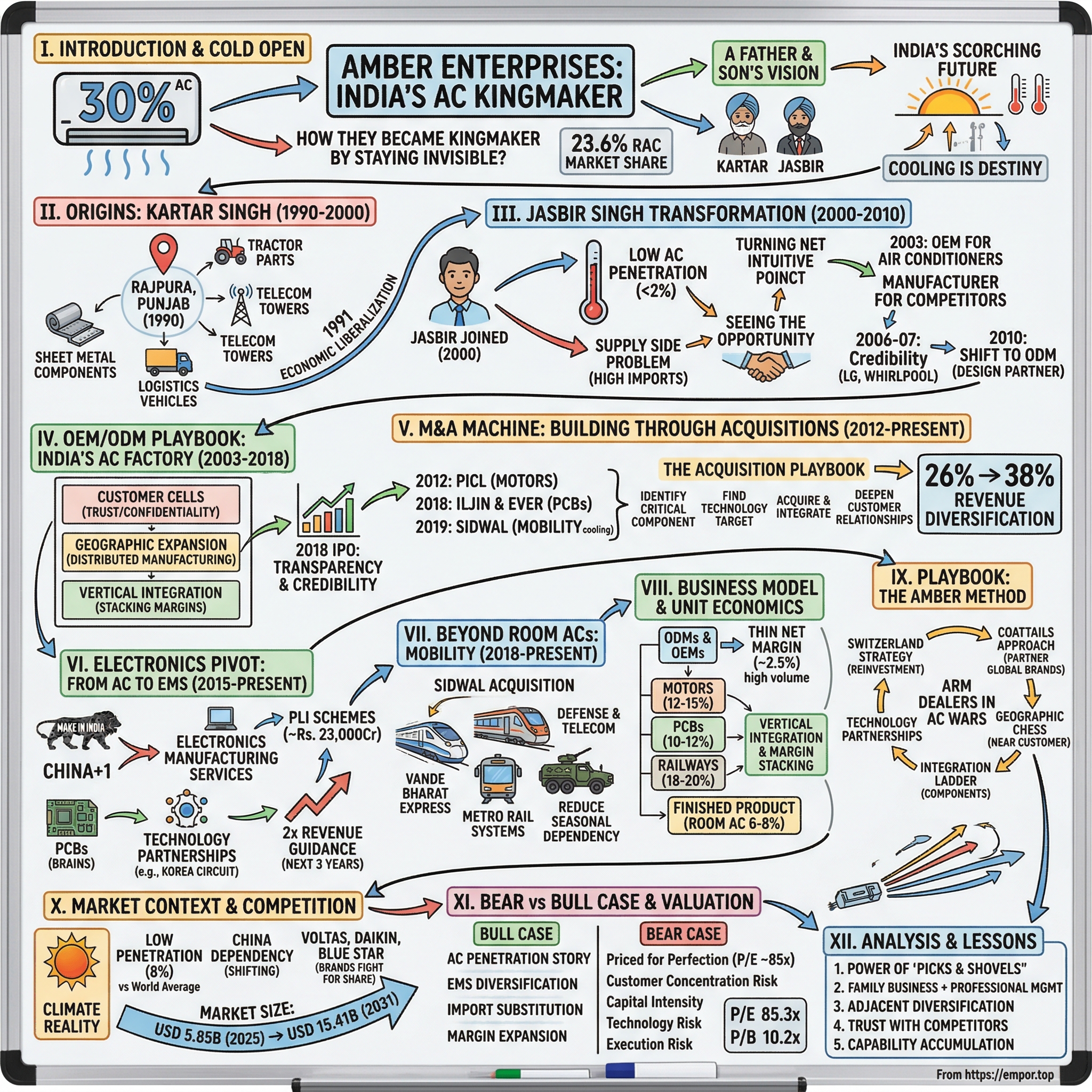
Amber Enterprises: The Air Conditioning Empire Nobody Knows About
I. Introduction & Cold Open
Walk into an electronics showroom in Delhi in the last week of April, when the mercury has already crossed 42°C and the salespeople are working on commission. You will see a wall of air conditioners: Voltas, Blue Star, LG, Panasonic, Daikin, Hitachi, Whirlpool, Godrej. Twelve logos, twelve brand promises, twelve warranty cards.
What you will not see is the name of the company that may have designed, engineered, tooled, stamped, wired and boxed a meaningful share of what is on that wall.
That company is Amber Enterprises India Limited, and its factories sit in places most Indian consumers have never thought about — Rajpura in Punjab, Dehradun, Jhajjar, Greater Noida, Chennai, Pune, Hosur. It has never advertised during an IPL match. It has never sponsored a cricket team. It does not want you to know its name, because the entire logic of its business is that its customers' names are the ones on the box.
At its 2018 IPO, an independent industry study cited in the prospectus put Amber's share of India's room air conditioner OEM/ODM market at 55.4% by volume in fiscal 2017 — meaning that of every AC in India built by a third party rather than by the brand itself, Amber built more than half.1 By 2025, with the outsourced manufacturing market far larger and far more contested, brokerage estimates put Amber's share of total Indian RAC production at 26–27% — roughly every fourth air conditioner sold in the country.2 The number went down because the pond got bigger and other fish arrived. The absolute volumes went up enormously.
This is the "arms dealer" model, and it is worth pausing on why any brand would agree to it. An air conditioner factory is a miserable asset to own. Demand arrives in a violent four-month spike between March and July, is hostage to whether the monsoon comes early, and collapses to near-nothing by September. If you are Voltas or Blue Star, building a plant sized for peak summer means owning idle steel for two-thirds of the year — a permanent drag on your return on capital. Outsourcing converts that fixed cost into a variable one. You keep the brand, the distribution, the service network and the pricing power; someone else absorbs the capacity risk.
That someone else is Amber. And Amber's counter-trade is that it aggregates the seasonal peaks of a dozen brands into one asset base, so a plant that would be 30% utilised serving one customer can run at a far better rate serving six whose order books peak at slightly different moments.
But the story that makes Amber genuinely interesting in 2026 is not the air conditioner story. It is what management did with the cash flows and the credibility that the AC business bought them.
Over the last decade Amber has bolted on an electric motor maker, two printed circuit board assemblers, a railway HVAC specialist, a bare-PCB fabricator, an Israeli industrial automation business, a power-electronics company, and a joint venture with a Korean PCB maker. It has committed thousands of crores to building high-density interconnect circuit boards — the dense, multi-layer boards inside a smartphone — in a country that currently imports roughly 90% of its bare PCBs.2 In June 2026 it announced it would start assembling smartphones for Oppo, OnePlus and Realme.3
Consolidated revenue reached ₹12,186 crore in FY26, up 22%, with the electronics division growing 49%.4 Market capitalisation sat around ₹26,200 crore in August 2026.5
And yet: return on capital employed was roughly 10%.5 Reported profit in the June 2026 quarter fell 97% year on year.6 The stock fell 14% after one quarterly result in November 2025 and 18% after another in May 2026 — the second time on results the company itself described as strong.78
That gap — between a company compounding revenue at 27% over a decade5 and a company earning a return on capital that would embarrass a mid-tier cement plant — is the central tension of this story. It is the question of whether Amber is building an Indian Foxconn or a very large, very busy, very capital-hungry treadmill.
To answer it, we have to start in a small industrial town in Punjab, in a decade when almost no Indian household owned an air conditioner at all.
 Subscribe on LinkedIn
II. Origins: The Kartar Singh Era & Punjab Industrial Roots (1990–2000)
Rajpura is not a place that appears in Indian business mythology. It sits on the Grand Trunk Road in Punjab's Patiala district, an hour and a half from Chandigarh, a town built around a railway junction and a grain market. In the early 1990s its industrial identity was agricultural machinery, small fabrication units, and the supply chains that fed the tractor plants and light commercial vehicle assemblers of North India.
Amber Enterprises was established there in 1990, and the first factory commenced operations in 1994.21 Beyond that, the pre-history is thin. Amber's own investor materials and leadership pages do not narrate a founder story; the prospectus identifies Jasbir Singh and Daljit Singh as the promoters, and the company's public disclosures do not detail the role of the preceding generation.19 It is worth flagging plainly: a great deal of what circulates about Amber's founding years is not traceable to a filing. What is documented is the shape of the business — sheet metal fabrication, precision stamping, tooling — and the industrial context that shaped it.
That context matters more than the personalities anyway, because it explains the company's operating instincts.
Consider what it meant to be a sheet metal supplier in Punjab in 1994. India had liberalised three years earlier. The License Raj — the permit system that had rationed the right to manufacture — was being dismantled. Multinational industrial firms were entering North India for the first time in a generation. And a small fabricator's entire commercial existence depended on being able to hold a tolerance, hit a delivery date, and quote a price that left a margin measured in single-digit percentages.
Sheet metal work is unglamorous in a specific and instructive way. You buy steel, which is a commodity whose price you do not control. You press it into shapes on dies that you must design and maintain yourself. You sell the result to a customer who is bigger than you, who knows exactly what steel costs, and who will therefore benchmark your price against the raw material every year and ask for it to come down. There is no brand. There is no pricing power. There is only cost, quality, and delivery.
Three habits get burned into a company that survives that apprenticeship.
The first is tooling as intellectual property. A stamping die is expensive, slow to build, and enormously determinative of both quality and cost. A firm that builds its own dies in-house controls its own lead times and learns things about part design that a firm buying dies from outside never learns. Amber's IPO prospectus makes a point of its in-house tool room — a detail that reads as trivia until you understand that tooling capability is what later allowed the company to design entire products rather than merely build them.1
The second is working capital paranoia. In a business where operating margins are thin, cash is not made on the income statement; it is made or lost in the gap between paying for steel and being paid for parts. Companies that learn this early tend to build a permanent institutional anxiety about inventory and receivables. Companies that learn it late tend not to survive.
The third — and this one turned out to matter most — is proximity as strategy. Sheet metal parts are bulky and light. Freight cost per rupee of value is punishing. If your customer's assembly line is 500 kilometres away, you are structurally uncompetitive against a supplier who is 50 kilometres away, regardless of how efficient your press shop is. The logical conclusion is that a fabricator's factory footprint must be dictated by its customers' factory footprint. Amber has since built out to roughly 30 manufacturing facilities across nine states — a network whose geography is essentially a map of where its customers assemble things.2
None of this was a strategy in 1994. It was survival. But by the end of the decade, Amber had a competence — high-precision metal forming, done cheaply, near the customer — that was about to become far more valuable, because a product category was forming in India that consisted almost entirely of bent metal wrapped around a compressor.
III. The Jasbir Singh Transformation & The RAC Insight (2000–2010)
Here is the statistic that defined the opportunity: at the time of Amber's IPO, an industry study put India's room air conditioner penetration at roughly 4% of households, against a global average near 30%.1 China's had gone from 54% in 2008 to essentially 100% by 2017.1 India, in other words, was one of the hottest large countries on earth and one of the least air-conditioned.
Someone at Amber worked out, early in the 2000s, that this gap was the whole game.
Jasbir Singh joined the board in 2004 and became Chairman and CEO in 2017.9 He holds a bachelor's degree in industrial production and an MBA — an unusual combination in a promoter-led Indian manufacturer, where the founder is typically either a shop-floor engineer or a trader, rarely both.9 His brother Daljit Singh, an electronics engineer with a master's in information technology, took the Managing Director role, and over time built the customer-acquisition and expansion side of the business.9 By 2018 Jasbir Singh had been named "Man of Appliances" by the Consumer Electronics and Appliances Manufacturers Association, and he has since held industry-body positions including co-chair of FICCI's electronics and white goods committee.910 He was an EY Entrepreneur of the Year finalist in 2025.10
The strategic insight was less about air conditioners than about geometry. A window air conditioner is, physically, a metal box containing a compressor, two heat exchangers, a fan and some controls. A split AC is two metal boxes. Amber already made metal boxes to tolerance for the automotive industry — an industry with quality standards considerably more brutal than consumer durables. Moving from tractor parts to AC casings was not a technological leap. It was a redirection of an existing capability toward a market with a vastly better demand curve.
Tractor components grow when rural incomes grow, which is to say cyclically and slowly. Air conditioner demand in a country at 4% penetration grows when incomes cross a threshold — and once a household crosses it, the purchase is close to irreversible. Nobody who has had an air conditioner through a Delhi summer goes back.
The move from making parts to making products happened in stages, and the sequencing tells you something about how Amber built trust. The prospectus describes it explicitly: the company gained customer confidence "by initially supplying certain components to its customers, and then moving to reliability functional components and eventually to complete RACs."1 Start with a sheet metal panel, which is low-risk to outsource. Graduate to a heat exchanger, which is a functional component where failure means a warranty claim. Only then get handed the entire unit.
That escalator took years, and it is the most underappreciated part of the moat. Each rung required the customer to accept a new category of risk, and each rung was won by not failing on the previous one.
The genuinely important shift, though, was from OEM to ODM — from Original Equipment Manufacturer to Original Design Manufacturer. The distinction is easy to state and hard to achieve. An OEM builds to the customer's blueprint: the brand designs the machine, hands over drawings, and the contract manufacturer executes. An ODM designs the machine itself and offers the finished design to brands, who apply their badge, their energy rating, their marketing and their distribution.
The economics differ enormously. An OEM sells labour and asset utilisation, competes on price, and is replaceable by anyone with equivalent equipment. An ODM sells engineering, gets paid for the design content, and is far harder to replace because the customer does not own the intellectual property in the product it is selling.
Amber built a dedicated R&D centre at Rajpura, recognised by India's Department of Scientific and Industrial Research, staffed to "conceptualize, design, verify and develop" AC models rather than merely manufacture them.1 The models it developed were specifically engineered for Indian conditions — voltage fluctuation that would trip a Japanese-designed compressor, ambient temperatures that make a heat exchanger sized for Europe useless, and dust loads that clog filters designed for temperate climates.
For a global brand entering India, this was a genuinely attractive proposition: buy a proven, locally engineered, locally certified platform off the shelf and be in market in months rather than years. The prospectus notes that Amber added large multinational customers including Daikin and Hitachi in the three years before listing.1 By fiscal 2017 it was serving eight of the top ten RAC brands in India, whose combined share of the market was around 75%.1
That is a striking position. It also contains the seed of the bear case, which we will get to: when your customers collectively are the market, your growth is capped by their growth, and your pricing is disciplined by their purchasing departments.
IV. The OEM/ODM Playbook & The Component Moat (2003–2018)
To understand why Amber's model worked, run the numbers from the brand's side of the table.
Suppose you are a mid-sized Indian AC brand selling 800,000 units a year. Building your own plant capable of that volume means several hundred crore of capital, plus a tool room, plus a design team, plus a supply chain organisation for a hundred component categories. That capital earns nothing for eight months of the year. Worse, it locks you into a technology generation: when the market shifts from fixed-speed to inverter compressors, or when a new energy-efficiency star label arrives, your line needs re-engineering and your depreciation schedule does not care.
Now suppose instead you buy finished units from Amber. Your capital goes into advertising, retail relationships and after-sales service — assets that actually generate brand equity. Your return on invested capital looks dramatically better. And when the star label changes, it is Amber's problem.
This is counter-positioning in the Hamilton Helmer sense, and the interesting thing is that Amber was not counter-positioning against a rival contract manufacturer. It was counter-positioning against the vertically integrated business model itself. An incumbent brand with its own factory could match Amber's cost only by writing off or under-utilising an asset it had already paid for. Rational managers do not do that. They keep the plant running and outsource the increment.
But being the assembler of choice is a fragile place to stand. Assembly is the least defensible step in any manufacturing chain — the value added is low, the capital is generic, and a competitor with a shed and a workforce can undercut you. Amber's answer was to go backwards, deliberately and expensively, into the components that make up the machine.
The company began manufacturing heat exchangers, multi-flow condensers, motors, sheet metal parts, copper tubing, plastic injection moulded parts and printed circuit boards — the functional guts of an air conditioner rather than just its skin.1 By 2025 it addressed roughly 70% of the bill of materials for a room AC in-house, with the notable exceptions being refrigerant, copper tube, aluminium, wiring harnesses and — critically — compressors.2
Why this matters is worth spelling out in plain terms. If you buy every part and merely bolt them together, your gross margin is whatever the market will pay for assembly labour, which is very little. If you make the heat exchanger and the motor and the control board yourself, you capture the margin on each of those sub-assemblies too. The same finished air conditioner generates several times the gross profit, on the same revenue line, because you are selling more of your own value-add inside it.
The second consequence is subtler and arguably more important: it changes who is negotiating with whom. A pure assembler is a price-taker on 100% of its inputs and gets squeezed from both ends. An integrated manufacturer that makes most of the machine has real cost knowledge, real alternatives, and a genuine argument when the customer asks for the annual price reduction.
The third consequence is defensive. Amber's own prospectus lists it candidly: customers "pursue price reduction initiatives" with suppliers, and the business is capital intensive, so profitability depends on spreading fixed costs across volume.1 Backward integration is how a contract manufacturer stops that squeeze from reaching the bone.
Alongside integration came the geographic strategy — factories placed close to customer assembly lines, which the prospectus describes as reducing logistical and operating costs.1 Eleven facilities across seven locations at the time of listing; roughly 30 across nine states by 2025.12 For a bulky, low-value-density product, this is not a nicety. It is a structural cost advantage that an importer, or a distant domestic rival, simply cannot replicate without building the same distributed footprint and eating the same fixed costs.
Then came the capital markets.
Amber's IPO opened on January 17, 2018 and closed on January 19, priced at ₹859 per share at the top of an ₹855–859 band, raising ₹600 crore in total — a fresh issue of about ₹475 crore plus an offer for sale of about ₹125 crore.1 The stated use of fresh proceeds was blunt and unglamorous: repay ₹400 crore of borrowings.1 Amber's debt-to-equity ratio had come down from 1.4 in fiscal 2015 to 1.0 in fiscal 2017, and the IPO was designed to finish that job.1
The market's reaction was emphatic. The issue was subscribed 164.75 times, drawing bids for 81.17 crore shares against 49.27 lakh on offer.11 The stock rose 44% on its debut on January 30, 2018.12 Promoter holding went from 59.02% pre-issue to roughly 44% post-issue.1
For investors, the IPO is the hinge of the whole story. It converted a leveraged, family-controlled component maker into a listed company with a clean balance sheet, a currency for acquisitions, and — crucially — a public track record that management would now have to defend every ninety days. Everything Amber has done since is a bet placed with that currency.
V. The M&A Machine: Programmatic Capital Allocation (2012–Present)
The first deal came six years before the listing, and it set the template.
In November 2012, Amber acquired PICL (India) Private Limited for ₹48.97 crore.13 PICL made fractional horsepower motors — the small electric motors that spin the fans in window units, in the outdoor units of split systems, and in commercial air conditioners.13 It was not a glamorous asset. It was a component Amber was buying from someone else, often ultimately from China, in large quantities, forever.
The logic is the logic of every good vertical integration: buy the thing you will always need, that you understand better than a financial buyer would, and that you can immediately fill with your own volume. A motor plant running at 50% utilisation for its previous owner runs at 85% the day Amber redirects its own demand into it. The purchase multiple stops mattering very quickly.
The second wave was electronic, and it was driven by a technology shift.
Through the 2010s the Indian AC market began migrating from fixed-speed compressors to inverter compressors. In a fixed-speed machine, the compressor is either on or off, like a light switch — it blasts cold air until the room overshoots, shuts down, and restarts. An inverter machine varies compressor speed continuously, like a dimmer, which is quieter, more comfortable, and materially more energy-efficient. Regulators liked it; star-rating rules pushed toward it; consumers paid for it.
But the intelligence in an inverter AC does not live in the metal. It lives on a printed circuit board — the inverter drive that modulates compressor speed. A manufacturer that could not make that board was, in the new architecture, no longer making the most important part of the product.
So Amber bought the capability. In November 2017 it signed an agreement to acquire 70% of IL JIN Electronics (India), completing the purchase on December 28, 2017.14 In March 2018 it added Ever Electronics; the two were later merged into a single entity.15 These were printed circuit board assembly — PCBA — businesses: firms that take a bare circuit board and populate it with chips, resistors, capacitors and connectors.
The results here are the strongest available evidence that Amber can actually operate what it buys. IL JIN generated roughly ₹300 crore of revenue with a 2.8% EBITDA margin when Amber acquired it; by FY25 it was doing about ₹1,460 crore with materially better margins.2 That is close to a fivefold revenue increase over seven years inside a business Amber bought, not built. Integration risk is the standard objection to serial acquirers. On this deal, at least, the objection did not hold.
The third deal changed the company's margin profile.
In March 2019 Amber agreed to acquire 80% of Sidwal Refrigeration Industries, completing the purchase in May 2019; it bought the remaining 20% in September 2020 for approximately ₹60 crore.1617 Sidwal made HVAC systems for rolling stock — Indian Railways mainline coaches, metro cars, defence vehicles, telecom shelters, buses. At the time of the deal it had supplied more than 15,000 HVAC units for mainline coaches and over 2,000 for metro coaches, and carried an order book of roughly ₹200 crore.16
Amber did not disclose a headline consideration or acquisition multiple for the 80% tranche in the announcements available publicly, so claims about the price paid should be treated with care. What is verifiable is the buyout price for the final 20% eighteen months later, which implies an equity value for the whole business of roughly ₹300 crore.17 Against Sidwal's subsequent trajectory — the railway and defence division did ₹535 crore of revenue in FY26 with an order book above ₹2,600 crore4 — that looks, in hindsight, like a very good price.
The fourth and fifth waves are still in progress, and they are far larger and far less proven.
In January 2024, IL JIN signed definitive agreements to acquire a 60% stake in Ascent Circuits, one of India's few bare printed circuit board manufacturers, whose customers include ISRO, BEL and BHEL.18 The distinction between Ascent and IL JIN is the distinction between making the board and populating it — Ascent goes one layer further upstream, into the fabrication of the laminate substrate itself. IL JIN subsequently paid ₹336.75 crore for a further 38.50%, taking its holding to 98.50%.19
In October 2024 came the joint venture with Korea Circuit, structured with IL JIN at 70% and the Korean partner at 30%, targeting high-density interconnect boards, flexible circuits and semiconductor substrates — the top of the PCB technology stack.2021
In March 2024 Amber bought 50% of Resojet for ₹35 crore, entering fully automatic front- and top-loading washing machine manufacturing.22 And then a detail that a sceptical investor should not skip past: on April 10, 2026, Amber acquired the remaining 50% of what had become Amber Resojet for ₹1.74 crore.23 Buying the second half of a business for 5% of what you paid for the first half is not the price signature of a venture that met expectations. Amber has not framed it that way publicly, but the arithmetic speaks.
More recently the group has added Unitronics — an industrial automation business with programmable logic controllers and HMIs, roughly $57 million of revenue and around 30% EBITDA margins, acquired at 40.24% for ₹403 crore and later raised toward 49.66% — and 60% of Power-One Microsystems for ₹262 crore, in battery energy storage, solar inverters and EV chargers.224
Step back and the pattern is clear. Early deals were small, adjacent, and immediately fillable with Amber's own demand — low-risk vertical integration. Recent deals are larger, further from the core, sometimes in businesses with no obvious internal customer, and in at least two cases bought at premium multiples for their margin profile rather than their strategic fit. The first kind of M&A compounds quietly. The second kind is how conglomerates get built — and how they occasionally get taken apart.
VI. Segment Financial Breakdown & Economic Engine
Amber reports three divisions, and they are so different from one another that averaging them produces a number that describes nothing.
Consumer Durables did ₹8,383 crore of revenue in FY26, up 14%.4 This is the room air conditioner business plus its components, plus commercial air conditioning, plus a growing basket of non-AC components — washing machine tubs, refrigerator case liners, parts for ovens and water purifiers. Divisional EBITDA in the June 2026 quarter ran at roughly 7.8% of divisional revenue.25 It is high asset turnover, low margin, and viciously seasonal.
Electronics did ₹3,268 crore, up 49%.4 This is IL JIN, Ever, Ascent Circuits, and the newer power and automation businesses. It is the fastest-growing part of the company and, contrary to the received wisdom that EMS is a low-margin business, it delivered 10.8% divisional EBITDA margin in the June 2026 quarter — better than the consumer durables core.25
Railway Sub-systems & Defence did ₹535 crore, up 19%, with an order book above ₹2,600 crore.4 It is the smallest division and by far the highest quality: long contracts, certification barriers, and customers who cannot switch suppliers on a whim.
Now the economics that actually drive the business, explained without the jargon.
Raw material pass-through. An air conditioner is largely copper, aluminium and plastic resin, and those prices move violently. Amber's contracts are structured so that input cost movements are passed through to customers with a lag — typically re-priced quarterly. This protects the company from being wiped out by a copper spike, but it does two things investors must understand. First, it means Amber's revenue line inflates and deflates with commodity prices in ways that have nothing to do with volume. Second, the lag is real and it hurts. On the June 2026 call, management explained that PCB margins had compressed from around 16% to roughly 12% because copper clad laminate prices had risen, with the pass-through to tier-2 customers running roughly two quarters behind; they expected recovery by the December 2026 quarter assuming no further escalation.25 That is a four-percentage-point margin hole opened by a raw material the company does not price. It is also why Amber committed ₹800 crore to build its own copper clad laminate plant in Mysuru — integrating one layer further to shorten exactly this exposure.2
Working capital and the winter build. Because demand arrives in a four-month burst, an AC manufacturer must build inventory through the winter to be ready for March. That means paying for copper in December and getting paid by the brand in June. If the summer arrives on schedule, this is merely expensive. If it does not, it is dangerous — the inventory sits, the borrowing costs accrue, and the write-down risk is real. In the September 2025 quarter, Amber's Managing Director explicitly cited elevated inventory levels and higher financing costs among the reasons for a quarterly loss.7
Return on capital. This is where the story gets uncomfortable. Amber's ROCE was around 10% in FY26, with return on equity closer to 6%.5 For a business compounding revenue at 27% over ten years, that is a poor conversion rate.5
There are two readings, and honest analysis requires holding both.
The charitable reading is that ROCE is mechanically depressed during a build-out. Amber is carrying the capital cost of PCB plants at Jewar and Hosur, a copper laminate facility at Mysuru, greenfield railway capacity, and a mobile phone assembly line — none of which generated meaningful revenue in FY26. Capital employed is fully on the balance sheet; the earnings it will produce are not. Under this reading, ROCE is a lagging indicator of a company that has front-loaded its investment, and the number normalises as plants fill.
The sceptical reading is that this has been the explanation for several years running, that each time one capex cycle approaches maturity another and larger one is announced, and that a company perpetually in build-out is a company that never has to be judged on returns. Net debt rose from ₹510 crore in March 2026 to ₹1,225 crore by June 2026, and the board authorised raising up to ₹5,000 crore at the IL JIN level.25 Total debt stood at ₹2,702 crore as of March 2026.5 The company pays no dividend.5
Both readings are defensible today. What will settle the argument is not rhetoric but a specific, observable event: the first year in which Amber's capital employed grows more slowly than its operating profit. Until that year arrives, ROCE remains a promise rather than a result.
VII. The Electronics Pivot: EMS, PCBs, and Korea Circuit JV (2015–Present)
On January 2, 2026, in a room containing India's Minister for Electronics, Information Technology and Railways, two step-down subsidiaries of Amber Enterprises — Ascent-K Circuit Private Limited and Shogini Technoarts — received formal approval under the government's Electronics Components Manufacturing Scheme.26 The combined approved investment across the group's entities exceeded ₹4,700 crore, with the Ascent-K Circuit project alone approved at ₹3,215 crore for an advanced PCB facility in the Yamuna Expressway industrial zone near Jewar.[^27]
Six months later, on June 27, 2026, the company broke ground on the site.27
To understand why a sheet metal company from Punjab ended up building semiconductor-adjacent infrastructure in Uttar Pradesh, you have to understand what a printed circuit board actually is, and why India cannot make the good ones.
A PCB is the green board inside every electronic device. At its simplest, it is a sheet of insulating laminate with copper traces etched onto it, connecting components. That is a single-layer board, and anyone can make one. Complexity scales by stacking: a four-layer board sandwiches conductive layers with insulation between them, connected by plated holes. An eight- or twelve-layer board is a three-dimensional wiring maze.
At the top of the stack sits HDI — high-density interconnect. Think of an ordinary PCB as a city with wide roads and a HDI board as the same city rebuilt with tunnels, flyovers and underpasses so that ten times as many vehicles fit in the same footprint. HDI is what makes a smartphone possible: you cannot fit a modern phone's circuitry onto a conventional board at any thickness a person would carry. Semiconductor substrates — the tiny boards a chip is mounted onto — are a further step up again, sitting at the boundary between PCB fabrication and chip packaging.
India makes almost none of this. Roughly 90% of Indian bare PCB demand was met by imports, against a domestic market estimated at about $3.7 billion in FY24 and forecast to reach around $7.3 billion by FY27.2 Every phone, every smart meter, every EV controller assembled in India under "Make in India" contains a board that came from somewhere else — overwhelmingly China.
This is a genuine strategic vulnerability, and the Indian state has responded with money and tariffs: a 30% anti-dumping duty on bare PCBs up to six layers, plus the ECMS incentive and capital subsidy regime, plus state-level support.2 Brokerage analysis suggests Amber may recover roughly 70% of net invested capital in these projects through central and state subsidies over time — though the company must fund the capital upfront and the subsidies arrive later.2
That last clause deserves emphasis. Subsidy-dependent returns carry two distinct risks that a discounted cash flow tends to flatten. The first is timing: cash out now, cash back over years, which is precisely the mechanism depressing ROCE today. The second is political: an incentive scheme is a policy, and policies change with governments, budgets and priorities. ICICI Direct lists "any restraint in government support measures" as a headline risk for exactly this reason.2
The Korea Circuit joint venture is Amber's answer to the other problem, which is that India lacks the process knowledge to make HDI at yield. Fabricating a twelve-layer HDI board involves laser-drilled microvias, sequential lamination and plating chemistry where a defect rate of a few percent destroys the economics. This is not knowledge you acquire by buying equipment. Korea Circuit brings it, holds 30% of the venture, and — importantly — signed an offtake agreement giving the Indian plant visibility on revenue from the Korean partner's existing customers.221 Amber has since added a partnership between Ascent Circuits and Germany's Schweizer Electronic, targeting automotive and industrial boards.28
Bringing a technology partner in as an equity holder with an offtake commitment is meaningfully better structuring than a licensing deal, because it aligns the partner with the plant's yield rather than just its royalty. It does not eliminate execution risk. It does reduce the specific risk of building a world-class plant that nobody buys from.
The commercial ambition is explicit: management has targeted $1 billion of electronics revenue by FY29, with divisional margins expanding from 6.4% toward 11.5–12%.2 Analysts covering the stock in December 2025 assessed the company as on track for that target.29 On the June 2026 call, management reiterated 40%-plus electronics revenue growth for FY27 with double-digit margins.25
Here the evidence is genuinely encouraging. Electronics margin in the June 2026 quarter was 10.8% — already inside the target band, two and a half years early, and achieved while absorbing the copper laminate cost shock.25 Divisional EBITDA more than doubled year on year.25 That is not a promise; that is a reported number.
The unresolved question is mix. Around 58–60% of electronics revenue was tied to consumer segments as of late 2025 — lower margin, more cyclical, and more exposed to the same seasonal demand that drives the AC business.2 The margin expansion thesis requires the industrial, automotive, defence and telecom share to rise. And the Oppo smartphone programme, when it lands, will add enormous volume at what is almost certainly consumer-grade economics. Scale and margin, in this business, pull against each other.
VIII. Mobility & Beyond: Sidwal, Defense, and Commercial Cooling (2019–Present)
There is a particular kind of engineering problem that most consumer manufacturers never encounter, and it is the reason the smallest division in Amber's portfolio is the most interesting one.
An air conditioner in a Vande Bharat coach is not a domestic air conditioner mounted sideways. It runs at 160 kilometres per hour through dust storms, monsoon humidity and 48°C ambient heat. It experiences continuous vibration that would fatigue a domestic unit's mountings within weeks. It must not fail, because a failure strands several hundred passengers in a sealed metal tube. It must be serviceable by railway staff at a depot, on a schedule set by the railway, using parts the railway stocks.
Getting a product like that approved takes years. Railway certification involves prototype builds, field trials across seasons, safety audits and integration testing with the coach builder. Industry practice puts the cycle in the range of three to five years — and the incumbent supplier is selling the whole time you are testing.
That is the asset Amber acquired in Sidwal, and the reason it has proven so durable.
What Amber then did with it is a clean case study in expanding wallet share without expanding the customer list. Sidwal started as an HVAC supplier. Amber extended it into pantry systems, automated doors and gangways — the flexible connectors between coaches — and then, through further acquisitions and collaborations, into driving gears, couplers, pantographs and braking systems.2 The measure that matters: Sidwal's share of the total value of a rail coach rose from about 4% to 16–18% by FY25.2
Read that as a general principle. When you already hold the certifications, the customer relationship and the depot-level service presence, adding a second and third product to the same coach is dramatically cheaper than winning a new customer. The incremental sale carries almost no acquisition cost. This is the same wallet-share logic Amber runs in air conditioners, transplanted into a market with far higher entry barriers.
The expansion continues. A joint venture with Yujin Machinery covers pantographs, driving gear, couplers and brakes, with trial production beginning in late 2025.2 A greenfield Sidwal facility for HVAC, pantry, doors and gangways was slated to start operations around the March 2026 quarter.2 Defence products — including coolers for missile launcher systems — have begun to gain traction.2
The order book above ₹2,600 crore against FY26 divisional revenue of ₹535 crore represents roughly five years of visibility at current run rates.4 For a company whose other divisions live and die by the weather, that is a genuinely different quality of earnings.
Two adjacent expansions round out the picture. Commercial air conditioning — cassette units, tower units, and cooling for data centres, cold chains and commercial buildings — generated about ₹200 crore in FY25 and is a natural extension of the core engineering.2 And washing machines, via Resojet, were the attempt to replicate the RAC ODM playbook in a second appliance category.
The Resojet outcome, discussed earlier, is the cautionary note. The playbook is not automatically portable. Air conditioners suited outsourcing because they are seasonal, capital-intensive, and design-differentiated in ways brands were happy to delegate. Washing machines are less seasonal, and the major brands in India have had domestic manufacturing for longer. The structural gap Amber exploited in ACs was simply narrower there.
The one thing not to over-claim about mobility is its scale. At roughly 4% of group revenue in FY26, this division cannot subsidise anything. Its 20%-plus margins in prior years were real, but June 2026 divisional EBITDA actually fell 26% year on year, and management noted that railway contracts are fixed-price, limiting the ability to recover input cost inflation.25 Guidance for FY27 targets 30–35% revenue growth at 15–16% margins — an explicit acknowledgment that the historical margin level is not the forward expectation.25
Mobility is the highest-quality business Amber owns. It is not big enough to be the thesis.
IX. Competitive Landscape & 7 Powers Analysis
Amber fights on three fronts simultaneously, against three different sets of opponents, and its position is materially stronger on one front than the others.
Front one: room AC contract manufacturing. The named rivals are PG Electroplast, Dixon Technologies and, in components, a scattering of smaller specialists. PG Electroplast is the most direct threat and the most instructive comparison. In a year when the Indian RAC industry contracted 10–15%, PG Electroplast's room AC business grew 27% over the first nine months of FY26 — unambiguous share gain — while guiding to ₹5,700–5,800 crore of full-year sales.30 Amber's consumer durables division grew 14% in FY26 and 8% in the June 2026 quarter.425
That comparison is the single most important competitive data point in this story, and it cuts against the incumbent. Amber remains larger and more integrated. But a challenger growing faster in a shrinking market is taking share from someone, and the pool of someones is small.
Front two: electronics manufacturing services. Here Amber competes with Dixon Technologies, Kaynes Technology, Syrma SGS and Cyient DLM — a set of companies that Indian investors routinely bundle together and that analysts preview as a group.31 Dixon is the scale leader across mobile phones and consumer electronics. Kaynes and Syrma occupy higher-mix, higher-margin industrial and automotive niches. Amber's differentiator is its move upstream into bare board fabrication, which none of the pure PCBA players had matched at comparable scale as of mid-2026.
Front three: its own customers. This is the existential one. Every brand Amber serves could, in principle, build its own plant. Several have partial in-house capacity already. The government's production-linked incentive schemes made that decision cheaper for them, which is an underappreciated irony: the same policy architecture that subsidises Amber's expansion also subsidises its customers' vertical integration.
Run the four Helmer powers that plausibly apply, and be honest about the strength of each.
Scale economies: strong, and improving. Amber buys copper, compressors and steel in volumes that give it terms no sub-scale rival gets. It spreads R&D, tooling and design cost across the largest RAC volume base in India. The 30-plant footprint lets it load-balance across customers whose peaks do not perfectly coincide.2 Its strategic cooperation agreement with GMCC for compressor supply over three years is a scale-derived privilege — securing a scarce input on terms a smaller buyer could not command.2
Counter-positioning: strong, but eroding at the top. The core insight — that a brand cannot match Amber's cost without a capex commitment that damages its own returns — remains true for mid-sized brands. It is weaker for the largest ones, whose volumes now justify their own plants and who can access the same PLI incentives. Counter-positioning works best when the incumbent's rational response is to do nothing. As brand volumes scale, doing nothing becomes less rational.
Switching costs: moderate to high, and asymmetric across the portfolio. Re-qualifying an ODM for a room AC line involves energy-star testing, safety certification, tooling transfer and field validation — a process measured in quarters, not weeks. But it is a cost, not a wall, and a determined customer pays it once. In railways, switching costs are genuinely high: certification cycles measured in years, depot-level service infrastructure, and the integration of doors, gangways and HVAC into a single coach design. In bare PCBs, once qualified for automotive or aerospace applications, requalification is similarly painful.
Process power: moderate, and hardest to verify. Decades of tooling, stamping and heat exchanger design know-how are real and hard to copy quickly. But "we've been doing this a long time" is the weakest form of evidence, and the PG Electroplast share gains suggest the process advantage is not insurmountable.
Run Porter's five forces and the picture is coherent with the financials. Supplier power is high in compressors — India needs roughly 15 million AC compressor units a year against domestic capacity of 7–8 million.32 Buyer power is high and structural: a handful of large brands, sophisticated purchasing, annual price-down expectations. Threat of substitutes is low. Rivalry is intense and intensifying. Barriers to entry are moderate for assembly, high for integrated components, very high for railways and advanced PCBs.
That configuration — powerful buyers, powerful suppliers, intense rivalry — is exactly the industry structure that produces high revenue growth and mediocre returns on capital. Amber's ROCE is not an accident of the capex cycle alone. It is partly the industry doing what this industry does.
Which raises the question of what a regulatory intervention can change. In May 2026 the Department for Promotion of Industry and Internal Trade capped imports of sub-2-tonne AC compressors at 30% of FY25 volumes, and refrigerator compressors at 40%.32 For brands without domestic compressor sourcing, this is a supply crunch arriving at peak season. For Amber, it strengthens the commercial case for domestic compressor manufacturing — a category it does not yet make, and the largest remaining hole in its 70% bill-of-materials coverage.
That gap is the most obvious remaining move on the board.
X. Management Credibility, Capital Allocation & Skeptical Stress Test
The fairest way to assess management is not to grade the strategy but to check whether what they said would happen, happened — and how they behaved when it did not.
On the positive side of the ledger, three things are documented.
First, the IL JIN outcome. A business bought at ₹300 crore of revenue and 2.8% margins reached roughly ₹1,460 crore by FY25 with materially improved profitability.2 Whatever else is true, this management team has demonstrated it can operate an acquired asset, not merely consolidate it.
Second, narrative consistency on electronics. The $1 billion by FY29 target has been repeated across calls, and independent analysts assessed it as on track in December 2025.29 The June 2026 quarter's 10.8% electronics margin sits inside the guided 11.5–12% band's neighbourhood well ahead of schedule.25 Management has not quietly moved the goalposts.
Third, governance hygiene at the basic level. Promoter shares carried no encumbrance in FY26 — no pledging, which in the Indian mid-cap context is a meaningful negative signal when present.33
Now the sceptic's case, which is substantial.
Capital intensity that never ends. The pattern is unmistakable. IPO proceeds went to deleveraging in 2018.1 A ₹400 crore QIP followed in September 2020 at ₹1,780 per share.34 Then Ascent, then Korea Circuit, then Unitronics at ₹403 crore, then Power-One at ₹262 crore, then ₹296 crore into an IL JIN rights issue, then ₹336.75 crore for more of Ascent.23519 Then approved capex of ₹3,200 crore at Jewar, ₹1,000 crore at Hosur, ₹500 crore at Pune, ₹800 crore at Mysuru.252 Then, in June 2026, an enabling resolution to raise up to ₹5,000 crore at the IL JIN level.25 An activist would ask the obvious question: at what point does this company stop consuming capital and start returning it? There is no dividend and no stated policy for one.5
A price signal management has not explained. The Resojet sequence — ₹35 crore for the first half, ₹1.74 crore for the second — is the kind of detail that does not appear in an investor presentation.2223 It is not material to group financials. It is material as evidence about how a new-category bet actually performed against the case made for it.
Customer concentration that Amber does not quantify. The company serves eight of India's top ten RAC brands.1 It does not disclose top-five customer revenue concentration in materials readily available to public investors. Given that its customers collectively command around three-quarters of the Indian RAC market, the concentration is almost certainly high, and the absence of disclosure is itself a data point.1
Weather as an earnings variable. In FY26, extended unseasonal rain across North and Central India during the April–July peak cut RAC industry volumes to an estimated 11.0–11.5 million units from a record 12.5–13.0 million the prior year — a 10–15% decline.36 Amber's September 2025 quarter produced a net loss of ₹32 crore against a ₹21 crore profit a year earlier, on revenue down 2.2% to ₹1,647 crore, with EBITDA margin at 5.5%.7 The stock fell 14% in a day.7 The Managing Director attributed the miss to the RAC slowdown, higher financing costs from the Power-One purchase, elevated inventory, and joint venture losses.7
That explanation is worth grading. It is specific rather than vague, it names the company's own decisions (the acquisition financing, the inventory build) rather than blaming only the monsoon, and it is consistent with what independent industry data showed.36 That is a reasonable standard of candour. What was absent was a stated plan for how the seasonal inventory exposure would be managed differently next cycle.
The market's scepticism is not confined to bad quarters. On May 18, 2026, Amber reported a March quarter with revenue up 10% to ₹4,146 crore, EBITDA up 21% to ₹357 crore, margin expanding from 7.8% to 8.6%, and net profit up 16% to ₹134 crore.8 The stock fell 18%.8 Reporting attributed the reaction to commodity price and currency pressure on margins and to caution following the earnings call.8 When a stock priced at a very high multiple falls on good numbers, the market is repricing the forward story, not the reported one.
Compensation and alignment. Promoter holding stood at 38.09% as of June 2026, with foreign institutions at 20.47% and domestic institutions at 30.54%.5 That is meaningful skin in the game. It is also lower than the roughly 44% immediately post-IPO, reflecting dilution across the QIP and subsequent issuance, plus promoter-group selling — three entities sold Amber shares worth over ₹694 crore around the 2020 QIP.137 Detailed executive compensation structure and performance linkage are set out in the annual report rather than in the quarterly materials, and are not summarised here.
The honest conclusion: this is a competent operating team with a demonstrated integration record, communicating with reasonable specificity, that has chosen an extremely aggressive capital deployment posture. Nothing in the record suggests dishonesty. Everything in the record suggests that the equity story depends on a build-out being completed, filled and earned back — and that shareholders are being asked to fund a great deal of it.
XI. Bull vs Bear Case & Value Drivers
Set the two cases against each other properly, because both are coherent.
The bull case
The penetration arithmetic. Indian RAC penetration sits at 7–8% of households, with the market at roughly 14 million units annually and projected to reach around 30 million by FY30.2 If that path holds even approximately, the addressable volume for Indian AC manufacturing roughly doubles inside five years. Amber, at 26–27% share, participates in that regardless of who wins the brand war.2 Climate reinforces it: heatwave frequency is rising, and an air conditioner in India is completing the transition from luxury to necessity. The GST reduction on sub-2-tonne room ACs from 28% to 18%, effective September 22, 2025, cuts the retail price at exactly the income level where the marginal buyer sits.36
Import substitution as a decade-long tailwind. The bare PCB opportunity is not incremental — it is the creation of a domestic industry where roughly 90% of demand is currently imported, in a market forecast to roughly double to $7.3 billion by FY27.2 Anti-dumping duties, ECMS subsidies and state incentives all point the same way.2 Amber has the approvals, the land, the Korean technology partner and the offtake agreement.[^27]21
Mix shift is already visible in reported numbers. This is the strongest leg. Completely-built-unit AC revenue fell from about 72% of consolidated revenue in FY18 to about 43% in FY25 — the company is measurably less dependent on the lowest-margin activity than it was.2 Electronics margin at 10.8% in the June 2026 quarter, up from a divisional base of 6.4%, is evidence the mix shift translates into profitability, not just diversification.252
Optionality. The Oppo programme targets 8 million smartphone units in year one scaling to 15–16 million in year two, with trial production in the March 2027 quarter and commercial production from the June 2027 quarter.2538 Management has spoken of the group approaching $2 billion in revenue, alongside roughly ₹6,750 crore of investment commitments in Uttar Pradesh.39 Exports, commercial refrigeration and defence each add unquantified upside.
The bear case
Customer insourcing is a live threat, not a theoretical one. The PLI architecture funds brands to build their own capacity. Amber's largest customers are precisely the ones for whom insourcing now makes arithmetic sense.
The core is losing relative ground. PG Electroplast growing its RAC business 27% in nine months of a year the industry shrank 10–15% is not noise.3036 Amber's consumer durables division grew 8% in the June 2026 quarter.25 Market leadership is being contested by a faster-growing challenger, and Amber's response so far has been to diversify away rather than to defend share.
Execution surface area is enormous. Simultaneously: room ACs, commercial ACs, components, washing machines, PCBA, bare PCBs, HDI, semiconductor substrates, copper clad laminate, industrial automation, battery storage and solar inverters, railway subsystems, defence, and smartphones. Each has its own technology curve, customer set and competitive dynamic. The Resojet write-down in all but name is a small, early datapoint on what happens when attention is spread thin.23
The balance sheet is being stretched into a cyclical business. Net debt more than doubled in a single quarter to ₹1,225 crore, total debt was ₹2,702 crore at March 2026, and a ₹5,000 crore fundraising authorisation sits ready.255 Amber carries this leverage into a business whose revenue depends on North Indian rainfall.
Concentrated operational risk is real, not hypothetical. The August 4, 2026 fire at IL JIN's Greater Noida plant — which killed two firefighters and forced management to assess damage to plant, machinery and inventory — produced a ₹123 crore exceptional loss and cut reported quarterly profit by 97%.40256 Assets were insured.40 But the episode is a reminder that a highly concentrated, high-throughput manufacturing footprint has fat-tailed downside that no financial model captures.
Valuation leaves no room. The stock traded on a trailing P/E above 100 in August 2026 against ROCE near 10% and ROE near 6%.5 That combination requires the entire build-out to work roughly on schedule. The two double-digit single-day drawdowns of the preceding ten months show how the market behaves when it doubts the schedule.78
The three KPIs that actually matter
Ignore the rest. Three numbers will tell you whether this thesis is working, and none of them require calculation — the company reports them.
1. Electronics division revenue and EBITDA margin, each quarter. This is the entire re-rating case. The target is $1 billion of revenue by FY29 at 11.5–12% margins.2 Both halves must hold. Revenue growth at collapsing margin means Amber bought scale, not quality. Margin at decelerating growth means the addressable market was smaller than claimed.
2. Consumer durables revenue growth versus reported RAC industry volume growth. Amber must outgrow the industry to defend share. In a bad industry year, outgrowth proves wallet-share gains are real. In a good one, underperformance would confirm that PG Electroplast and others are taking the increment. This is the leading indicator of whether the original moat still functions.
3. Consolidated ROCE trend. Not the level — the direction. The bull case requires a visible inflection as new plants reach utilisation. Every additional year at roughly 10% without that inflection strengthens the argument that this is a growth story that does not convert to shareholder returns.5
The railway order book and net debt are worth watching. But if forced to three, these are the three.
XII. Earnings Call Roadmap & Key Metrics for Investors
Amber's quarterly calls have become the most informative disclosure the company produces, and the recent sequence is unusually revealing when read together rather than individually.
The September 2025 quarter call (November 7, 2025) is the one to read first, because it is the stress test. Revenue fell, the company posted a loss, and the stock dropped 14% the same day.7 What management said matters: the Managing Director attributed the outcome to the RAC industry slowdown driven by unfavourable weather, and — critically — also to higher financing costs from the Power-One stake purchase, elevated inventory, and share of losses from joint ventures.7 Two of those four causes were self-inflicted choices, and management named them. That is a better disclosure standard than the industry norm of blaming the monsoon alone.
The December 2025 quarter call (February 9, 2026) is the recovery call, and it is where the diversification thesis first showed up unambiguously in the numbers. Revenue rose 38% to ₹2,943 crore; EBITDA rose 53% to ₹247 crore; pre-exceptional profit more than doubled to ₹84 crore.41 Electronics revenue grew 79% to ₹845 crore with divisional EBITDA up 157%.41 Read against the prior quarter's loss, the sequence demonstrates something specific: the non-AC businesses can carry the group through a weak AC season. That is the diversification argument surviving its first real test.
The March 2026 quarter call (May 18, 2026) is the most instructive on market psychology. The reported numbers were good on every line.8 The stock fell 18%.8 The gap between the print and the reaction was attributed to commodity and currency pressure on margins and to caution following the call itself.8 The lesson for anyone modelling this company: at these multiples, the forward commentary matters more than the quarter.
The June 2026 quarter call (August 14, 2026) is the current state of play, and it is the densest.25 The financial headline was distorted by the ₹123 crore fire-related exceptional loss.256 Underneath it, the operating business grew EBITDA 28% on 13% revenue growth — margin expansion, not just volume.25
The Q&A is where the useful material sits. Analysts pressed on four things, and the quality of the answers varied.
On PCB pricing mechanics, management was concrete: quarterly price adjustments, with roughly a two-quarter lag for tier-2 suppliers, causing the compression from 16% to about 12% and expected recovery from the December 2026 quarter if copper clad laminate costs stabilise.25 That is a falsifiable statement with a date attached. It should be checked in February 2027.
On margin sustainability, analysts questioned how much of the quarter's electronics performance reflected pre-stocking benefits rather than structural improvement.25 This is the right question, and it remains open.
On the Oppo programme, questioning focused on export opportunity and PLI eligibility.25 Management gave a production schedule — trials in the March 2027 quarter, commercial from June 2027, 8 million units scaling to 15–16 million — but the unit economics of the mobile business were not laid out in comparable detail.25 For a programme of this scale, that is a gap.
On the IL JIN fire recovery, management addressed the disruption and insurance position.2540
Reading the four calls in sequence, management's language has been consistent: the same three-division framework, the same electronics growth target, the same explanation of pass-through mechanics. Guidance has been reiterated rather than quietly revised — 13–15% for consumer durables, 40%-plus for electronics, 30–35% for railway and defence at 15–16% margins.25 The one visible downward reset is railway margins, which were guided to 15–16% against a historical profile in the low twenties, and that reset was stated rather than buried.25
For an investor tracking this company, the highest-value habit is simple: check each quarter whether the guided electronics growth rate and margin band are repeated, revised, or dropped — and whether the December 2026 PCB margin recovery actually arrives.
XIII. Epilogue & Looking Forward
There is a version of the next decade in which Amber Enterprises becomes something India has never had.
In that version, the Jewar plant reaches yield, and Indian smartphones start containing Indian circuit boards. The Hosur multi-layer facility fills. The Mysuru laminate plant closes the copper loop and the pass-through lag that cost four points of PCB margin stops mattering. Oppo's 16 million units arrive and pull a domestic component ecosystem into existence around them. Sidwal's rail order book converts, and the railway division becomes large enough to matter rather than merely to look good. Room AC penetration doubles and Amber holds a quarter of the volume. Capital employed stops growing faster than profit, ROCE inflects into the high teens, and the market stops paying for a story and starts paying for cash flow.
That is the Foxconn path — the anonymous industrial platform that becomes indispensable precisely because nobody outside the industry can name it.
There is another version. In it, the largest customers insource, PG Electroplast and Dixon grind away at the core, the PCB plants take longer and cost more than budgeted, subsidies arrive late or shrink, the smartphone programme delivers volume at margins that dilute the group, and the company spends the decade running very fast to stay in roughly the same place — ₹20,000 crore of revenue, 8% margins, 11% ROCE, and no dividend.
Both paths run through the same set of factories. What separates them is not vision; it is execution and capital discipline, measured quarter by quarter.
What Amber has already proven is not trivial. It proved that an Indian sheet metal fabricator could become a design house — that the value in a manufacturing business migrates to whoever owns the drawings, not whoever owns the press. It proved that backward integration into components, done patiently over fifteen years, converts a commodity assembly business into something with real gross margin. It proved with IL JIN that it can buy a struggling business and make it five times bigger. And it proved, in the December 2025 quarter, that a company can be diversified enough that a failed AC season no longer decides the year.
What it has not yet proven is the thing that matters most to a long-term owner: that all of this converts into returns on the capital deployed to build it. Ten years of 27% revenue growth alongside single-digit-to-low-double-digit ROCE is a strange combination.5 It is the signature of a company that has been consistently right about where to go and has consistently had to pay full price to get there.
The broader lesson, for anyone studying emerging-market industrial businesses, is about the nature of the arms dealer's position. Selling picks and shovels during a gold rush is a wonderful business when the picks are hard to make and the miners are many. It is a much harder business when your customers are four large companies who know exactly what steel costs, when the state subsidises your competitors and your customers alongside you, and when the rush itself depends on the weather.
Amber sits in that harder version. It has navigated it for three decades with a combination of proximity, integration and patient trust-building that is genuinely difficult to replicate. Whether the next decade rewards that with returns rather than merely revenue is, as of August 2026, an open question — and one that three numbers, reported every ninety days, will answer.
References
-
Amber Enterprises India Limited — IPO Note, HDFC Securities Retail Research, 2018-01-16 ↩↩↩↩↩↩↩↩↩↩↩↩↩↩↩↩↩↩↩↩↩↩
-
Amber Enterprises India (AMBEN) — Company Update, ICICI Securities / ICICI Direct Research, 2025-09-08 ↩↩↩↩↩↩↩↩↩↩↩↩↩↩↩↩↩↩↩↩↩↩↩↩↩↩↩↩↩↩↩↩↩↩
-
Amber Enterprises enters manufacturing partnership with Oppo India — Business Standard Capital Market News, 2026-06-19 ↩
-
Amber Enterprises India Limited Annual Consolidated Revenue Surpasses ₹12,000 Crore Milestone (FY26 audited results and presentation) — InvestyWise ↩↩↩↩↩↩↩
-
Amber Enterprises India Ltd — Financial Summary, Ratios and Shareholding — Screener.in ↩↩↩↩↩↩↩↩↩↩↩↩↩
-
Amber Enterprises consolidated net profit falls 97% in Q1 FY27 on exceptional loss — ScanX, 2026-08 ↩↩↩
-
Amber shares tank 14% on weak Q2 results; should you buy, hold or sell? — Business Standard, 2025-11-07 ↩↩↩↩↩↩↩↩
-
Amber Enterprises shares dip 18%: Here's why the stock crashed despite reporting positive Q4 FY26 earnings — Upstox, 2026-05-18 ↩↩↩↩↩↩↩↩
-
Jasbir Singh — Chairman & CEO, Amber Enterprises India, EY Entrepreneur Of The Year 2025 Finalists — EY India ↩↩
-
Amber Enterprises IPO subscribed 164.75 times — Business Standard, 2018-01-19 ↩
-
After a bumper IPO, Amber Enterprises shares rise 44% on stock market debut — Business Standard, 2018-01-30 ↩
-
Amber Enterprises India Limited acquired PICL India Pvt. Ltd. — MarketScreener ↩↩
-
Amber Enterprises India Limited completed the acquisition of 70% stake in Iljin Electronics India Pvt. Ltd. — MarketScreener India ↩
-
Amber Enterprises Completes Merger of Subsidiaries IL JIN Electronics and Ever Electronics — ScanX ↩
-
Amber Enterprises India Limited completed the acquisition of 80% stake in Sidwal Refrigeration Industries Private Limited — MarketScreener ↩↩
-
Amber Enterprises India Limited acquired the remaining 20% stake in Sidwal Refrigeration Industries Private Limited — MarketScreener ↩↩
-
Press Release on Acquisition of Ascent Circuits by ILJIN — Amber Enterprises India Limited, 2024-01-03 ↩
-
Amber Subsidiary Spends ₹336.75 Crore to Boost Ascent Circuits Stake to 98.50% — Sahi ↩↩
-
Amber Group announces JV with Korea Circuit — Business Standard Capital Market News, 2024-10-15 ↩
-
Amber Enterprises, Korea Circuit partner to make PCBs in India — Evertiq, 2024-10 ↩↩↩
-
Amber Enterprises to Acquire 50% Stake in Resojet Pvt. Ltd — Angel One, 2024-03-21 ↩↩
-
Amber Enterprises acquires remaining 50% stake in Amber Resojet for Rs 1.74 crore — Business Upturn, 2026 ↩↩↩
-
Amber Enterprises Subsidiary Increases Unitronics Stake to 49.66% — ScanX ↩
-
Earnings call transcript: Amber Enterprises Q1 FY27 results — Investing.com, 2026-08-14 ↩↩↩↩↩↩↩↩↩↩↩↩↩↩↩↩↩↩↩↩↩↩↩↩↩↩↩↩
-
Intimation under Regulation 30 — Approval received under the Electronics Components Manufacturing Scheme (ECMS) — Amber Enterprises India Limited, 2026-01-02 ↩
-
Amber Enterprises breaks ground for two advanced facilities in Jewar — ScanX, 2026-06 ↩
-
Amber Enterprises' PCB business inks strategic pact with Schweizer Electronic — Business Standard Capital Market News, 2026-06-29 ↩
-
Growth guidance firm for Amber Ent, says BNP Paribas; retains 'Outperform' — Business Standard, 2025-12-17 ↩↩
-
PG Electroplast Q3 FY26 slides: 46% revenue surge amid expansion plans — Investing.com, 2026-02 ↩↩
-
Kaynes Tech, Dixon Tech, Amber, PG Electroplast, Syrma SGS: Q3 preview, target prices — Business Today, 2026-01-08 ↩
-
DPIIT caps AC and refrigerator compressor imports at 30-40% of FY25 volumes — Business Upturn, 2026-05 ↩↩
-
Amber Enterprises confirms no encumbrance on promoter shares in FY26 — ScanX, 2026 ↩
-
Amber Enterprises India raises Rs 400 cr via QIP — Business Standard, 2020-09-11 ↩
-
Amber Enterprises to invest Rs 296.02 crore in IL JIN Electronics through rights issue — Business Upturn ↩
-
AC sales take hit as extended rains dampen demand, volumes may dip 10-15% in FY26: ICRA — The Tribune, 2025-09-24 ↩↩↩↩
-
Three entities sell Amber Enterprises shares worth over Rs 694 cr — Business Standard, 2020-09-11 ↩
-
Amber Enterprises to Manufacture Oppo, OnePlus Phones — Outlook Business, 2026-06 ↩
-
Amber Group Eyes $2 Bn Revenue Milestone Soon; Invests ₹6,750 Cr in UP Projects — Outlook Business ↩
-
Amber Enterprises' subsidiary IL JIN Electronics reports fire at Greater Noida plant — Business Upturn, 2026-08-04 ↩↩↩
-
Amber Enterprises Share Price Rises 5%; Reports 38% Revenue Growth in Q3 FY26 Results — Angel One, 2026-02 ↩↩
 LinkedIn
 WhatsApp
 Reddit
 Hacker News
 Email
Email Kindle
 RSS Feed
 Spotify
 Apple Podcasts
 Amazon Music
 Audible
 YouTube