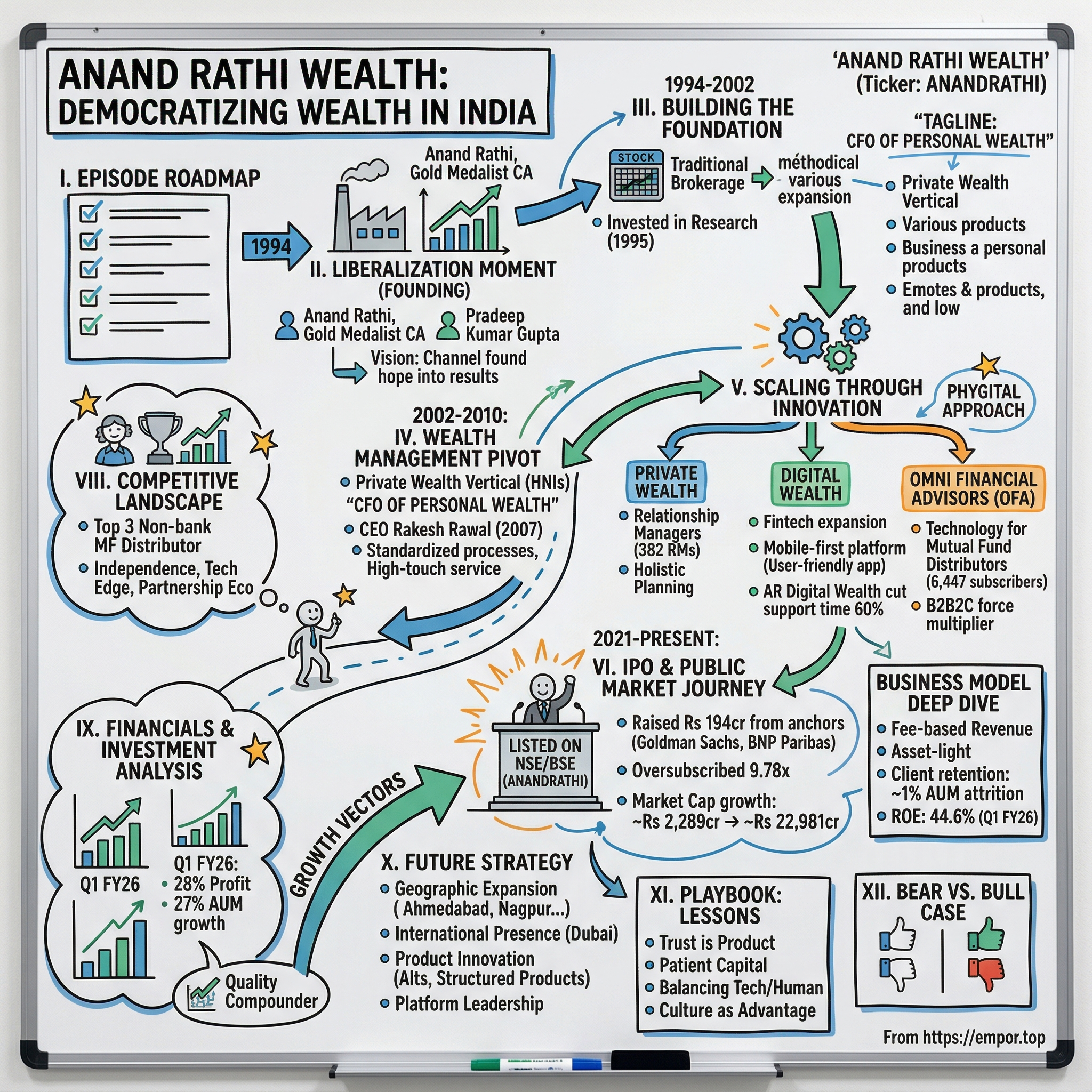
Anand Rathi Wealth: The Capital-Light Engine of Indian Private Wealth
I. Introduction & Episode Roadmap
On the afternoon of July 10, 2026, a conference line opened in Mumbai for what had become one of the most predictable rituals in Indian financial services. Anand Rathi Wealth Limited was reporting its nineteenth quarterly result as a listed company, and Joint Chief Executive Feroze Azeez opened with the number he clearly enjoys most — not revenue, not profit, but the standard deviation of profit.
Across seventeen quarters, he told analysts, the median year-on-year profit growth had been roughly 31.7%, with a standard deviation of about 4.8%.1 It was an unusual flex. Most managements sell you the mean. This one sells you the variance.
The quarter itself carried a genuine milestone. Assets under management crossed ₹1 lakh crore for the first time, closing at ₹1,06,300 crore on June 30, 2026, up 21% year on year, with net inflows of ₹2,743 crore in a choppy market.2 Client families reached 13,941. Relationship managers reached 417. Client attrition, measured as a share of AUM lost, was 0.09% for the quarter. Relationship-manager attrition was zero.1
Here is the story the company tells about itself, and it is a good one. India's post-liberalization wealth needed a manager. Banks and integrated financial conglomerates built asset management companies, alternative investment funds and structured-product factories, then hired relationship managers to sell them.
Anand Rathi Wealth chose the other road: sell nothing you manufacture, standardize the portfolio so it does not depend on any individual's judgment, pay relationship managers to keep assets rather than to churn them, and let compounding do the rest. The financial signature of that choice is unmistakable. Return on equity for FY26 was 46.7% on a balance sheet with total equity of about ₹1,012 crore and non-current borrowings of ₹13.1 crore.3 That is a business that barely consumes capital.
Here is the complication, and it is the reason this story is more interesting than the version in the investor presentation. In FY26, mutual fund distribution — the pure, trail-based, third-party annuity business — produced ₹494 crore of revenue. "Other financial products," overwhelmingly structured products, produced ₹648 crore.3 Roughly 57% of the year's turnover came from structured notes, and the great majority of those notes are issued by Anand Rathi Global Finance Limited, a non-banking finance company inside the same promoter group.4 The revenue on them is booked largely upfront on issuance, not as a trail.
And in July 2026, the board proposed applying to the Securities and Exchange Board of India for permission to sponsor a mutual fund — that is, to build the very asset management company the firm spent a decade telling clients it would never build.1
So the question this article tests is not whether Anand Rathi Wealth has been an excellent operator. The record says it has. The question is what the machine actually is. Is it a conflict-free open-architecture distributor with an annuity revenue stream? Or is it a high-quality advisory franchise wrapped around a group-manufactured structured-product engine, now openly migrating toward manufacturing, priced by the market at roughly seventy-five to eighty times trailing earnings on a market capitalisation of about ₹35,900 crore?5 Those are very different businesses with very different risks, and both descriptions are partly true.
The route from here: the brokerage origins and the founder's own regulatory scar tissue; the 2007 arrival of Rakesh Rawal and the 2012 arrival of Feroze Azeez, whose "Plan B" product became the profit engine; the counter-positioning decision and the conflict it relocated rather than removed; the 2018 regulatory shock that genuinely hurt before it helped; the IPO and an unusually disciplined capital-allocation record; the segment economics, where two of three businesses are rounding errors; the competitive war-game against 360 ONE and Nuvama; the financial mechanics and what management's own guidance record reveals; the 2023 tax shock the firm turned into a share-gain event; and finally the governance, regulatory and valuation stress tests that a skeptical investor would run before accepting the multiple.
 Subscribe on LinkedIn
II. The Liberalization Genesis & Group Roots (1994–2002)
Picture the trading floor of the Bombay Stock Exchange in 1994: a physical ring, open outcry, hand signals, chalk, and the particular chaos of a market that had just been handed a country. India's 1991 reforms had dismantled the licence-permit architecture, and for the first time in a generation, private Indian promoters were generating capital they could not deploy back into a controlled economy. Somebody was going to have to manage that money.
Into that ring, at the age of forty-eight, walked a man who had spent his entire career inside industrial India rather than on top of it. Anand Rathi qualified as a chartered accountant in 1966 with a gold medal and then spent nearly three decades at DCM Limited and the Aditya Birla Group, where he helped drive the Birla group's entry into cement and financial services.6 He was, in other words, a corporate finance man — a builder of businesses, not a floor trader.
Alongside him was Pradeep Kumar Gupta, who had come out of a family textile business, held memberships on the Jaipur Stock Exchange and later the National Stock Exchange, and who built the firm's franchisee and branch network.6 The two are also family: the FY26 annual report records that Anand Rathi is Pradeep Gupta's father-in-law.7 The Anand Rathi Group was founded in 1994 as an institutional and retail equity broker, adding a research desk in 1995 and expanding into derivatives, debt syndication and mutual fund distribution.8
Rathi's ascent inside the market's own institutions was fast. He became president of the Bombay Stock Exchange in 1999, holding the post until 2001, and during that tenure pushed the expansion of BOLT — the BSE's online trading system — and played a role in establishing Central Depository Services and the exchange's Trade Guarantee Fund.6 These were not ceremonial achievements. They were the plumbing that took Indian equities from paper certificates and physical settlement to something an institutional allocator could trust.
Then came the fracture that any honest account of this company has to include. After the sharp market fall of March 2, 2001, SEBI investigated possible manipulation and alleged that Rathi had obtained price-sensitive surveillance information from a junior officer of the BSE's surveillance department; telephone transcripts were cited in the proceedings.
He resigned the presidency on March 7, 2001, and SEBI passed an ex parte interim order on March 12, 2001 restraining him from acting as a director-member of the exchange, with action also directed against associated entities.9 The matter was litigated for years thereafter. It is a quarter-century old, and it did not stop the group from growing. But it is the first entry in a governance file that will matter again in this story, and it is worth holding in mind precisely because the firm's modern pitch is built on trust.
The deeper commercial lesson of the 1994–2002 period was structural, not personal. A brokerage is a beautiful business in a bull market and a brutal one otherwise. Revenue is a function of turnover, turnover is a function of sentiment, and sentiment is not something you can hire for.
Worse, the arrival of the National Stock Exchange and screen-based trading did to Indian broking exactly what it did everywhere else: it collapsed the spread, commoditised execution, and turned a relationship business into a price business. Customer stickiness in broking is close to zero; the client's loyalty runs to the platform, not the person.
So in 2002, quietly and without much fanfare, the group started distributing mutual funds.10 It was a small decision at the time — one more product line in a full-service financial house. But it changed the unit of account from a trade to an asset. A brokerage earns when a client acts. A distributor earns when a client stays. That single shift, from event revenue to balance revenue, is the seed of everything that follows, and it took another five years and one specific hire before anyone inside the firm built a business around it.
III. The HDFC Bank Inflection: Rakesh Rawal & The Wealth Pivot (2002–2012)
The man who eventually built it did not come from broking at all. Rakesh Rawal is a mechanical engineer from IIT Kanpur with a master's in management studies from Mumbai's Jamnalal Bajaj Institute, and his formative years were spent at Hindustan Unilever — a company that teaches process, distribution discipline and the idea that a system should outperform the individual running it — before he moved into private wealth management at Deutsche Bank.3 He joined Anand Rathi Wealth in 2007 as chief executive and started the private wealth business essentially from a standing start.10
The 2007 context matters. Indian private banking at the time was mostly a hunting operation. Foreign private banks skimmed the top of the market with customised pricing; domestic bank wealth desks used their branch networks to push whatever product carried the fattest payout that quarter; and the client experience was defined by the relationship manager's personal salesmanship. It worked, in the sense that it generated fees. It also produced the phenomenon every Indian high-net-worth family recognises — a portfolio that is a museum of whatever was being sold in each of the last fifteen years.
Rawal's response was to industrialise the craft. Rather than let each relationship manager construct portfolios, the firm built a standardised strategic asset allocation and applied it across the book. The stated design goal was not maximum return; it was a target return in the low-to-mid teens with materially less volatility than the index.
The firm's own long-run scorecard, run from April 2014 to March 2026, claims a 14.25% compound annual return for its house strategy against 10.52% for the Nifty 50, with a beta of 0.57 and a Jensen's alpha of 5.48%.3 Take those figures for what they are — a self-reported composite, not an audited GIPS track record — but the shape of the claim is consistent with the strategy: fewer holdings, lower beta, and a deliberate refusal to chase the index up.
The second consequential hire arrived in 2012. Feroze Azeez, a mechanical engineer from the University of Mysore with a postgraduate diploma in derivatives and finance, came in from ABN AMRO Bank N.V. and Religare Macquarie Private Wealth.3 His contribution is recorded in the company's own timeline with unusual candour: he "joined and introduced Structured Products as a 'Plan B' in clients' portfolios."3 Read that again, because it is the most important sentence in the firm's official history. The product that would go on to generate the majority of revenue was conceived not as the main event but as the hedge — the thing that pays when the equity leg does not.
The segment choice was equally deliberate. Rather than chase ultra-high-net-worth families above ₹100 crore, where pricing is negotiated by family offices and fees get squeezed toward institutional levels, the firm aimed at what it calls the ₹5–50 crore investable-surplus band: wealthy enough to need genuine planning, not so wealthy that they employ someone to beat the wealth manager down on price. It is a defensible commercial insight — the value of advice per rupee of fee is highest where the client is sophisticated enough to want it and not so large that they can insource it.
What the period does not support is any narrative of explosive growth. Fifty relationship managers by 2013. AUM of ₹5,000 crore by 2015. One hundred relationship managers by 2016.3 That is thirteen years from the first mutual fund sale to a book smaller than what a single senior team at a global private bank would carry.
The firm's own investor material now makes a virtue of it — "wealth management is not a capital business," reads its opening slide, "it is a credibility marathon," and a relationship manager "cannot handle thousands of clients."3 That is honest. It is also a warning label: this model grows in a straight line, not an exponential one, because the binding constraint is trained human beings.
Which raises the question that would define the next phase. If you cannot scale by hiring faster, and you refuse to scale by acquiring, how do you scale at all? The answer the firm chose was to change what it sold — and, more quietly, who made it.
IV. The Zero-Conflict Moat: Why Anand Rathi Refused to Build an AMC (2012–2018)
Every Indian financial conglomerate of the 2010s ran the same spreadsheet. If you already own the client relationship, why let a third-party asset manager keep the manufacturing margin? Own the fund house, own the alternative investment fund, own the structured-note desk, and the fee that used to leave the building stays inside it. ICICI, Kotak, Edelweiss and IIFL all built some version of this integrated stack, and on paper it is obviously superior: two margins instead of one.
The problem is what it does to the person sitting across from the client. A relationship manager who is paid more for placing the house fund will place the house fund. Not always consciously, not always corruptly — but reliably, at the margin, in the direction of the payout. Every wealth manager in the world knows this and every one of them writes a policy claiming to have solved it.
Anand Rathi Wealth's answer was to remove the temptation rather than police it. The firm did not seek an asset management licence and did not manufacture mutual funds; it positioned itself as an open-architecture selector of third-party schemes. And it took that selection to an extreme most distributors would find commercially painful.
As of the Q1 FY27 call, the firm distributed just fourteen mutual fund schemes out of roughly 924 available in the market — a concentration that management describes with the line "we sell what we buy rather than sell what sells."1 Fourteen schemes is not open architecture in the sense of offering everything; it is open architecture in the sense of owning nothing. There are no new fund offers on the menu, because new fund offers are where distributor economics and client interest diverge most sharply.
The operational corollary was standardisation. The house allocation runs roughly 65% equity mutual funds and 35% structured products, with the mix adjusted by client profile rather than by relationship-manager conviction.4 From an investor's perspective this is the single most underrated feature of the business.
It means a five-year relationship manager can deliver approximately what a fifteen-year relationship manager delivers, because the portfolio is not their invention. That is what makes the hiring model work at all, and it is why the firm's departure metrics look the way they do — when a relationship manager leaves, the client's portfolio does not change, so the reason to follow them out is weaker.
Now the part the "zero-conflict" framing does not cover.
Structured products need a manufacturer. Somebody has to issue the note, warehouse the derivative exposure, and stand behind the payoff. In Anand Rathi Wealth's case, that somebody has mostly been Anand Rathi Global Finance Limited — the group's own non-banking finance company.
In the July 2023 earnings call, chief financial officer Jugal Mantri disclosed that of ₹1,396 crore of gross structured-product issuance in a single quarter, only about ₹143 crore came from third parties; the rest came from the sister concern.11 Three years later the pattern was intact: of roughly ₹2,187 crore of primary structured products distributed in Q1 FY27, about ₹1,875 crore was issued by group entities — an issuer share near 86%.4
So the conflict was not eliminated. It was moved. The firm genuinely does not manufacture the mutual fund half of the portfolio; it substantially does manufacture, within the promoter group, the structured half — and the structured half is the more profitable half.
To management's credit, they have been asked this directly and answered it in public. Pressed by an analyst in 2023 on whether the sister-entity concentration was a risk, Azeez argued the opposite: that the visibility of the exposure was itself the mitigant, because a distributor will not risk its own franchise on paper it does not fully understand, and that the firm had cut two external structured-product issuers in 2016–2018 before those issuers ran into trouble.
He then offered a genuinely clever piece of evidence on arm's-length pricing — that the firm earns more revenue distributing the identical structure when it is issued by Nuvama than when it is issued by the group NBFC.11 If the related-party channel were being used to extract economics, you would expect the reverse.
That is a serious answer. It is not a complete one. Arm's-length pricing addresses whether the distributor is overcharging; it does not address concentration. If the group NBFC ever faces a credit, liquidity or hedging problem, three things break at once for the listed company: clients take losses on notes the firm recommended, the issuance pipeline that supplies the majority of revenue stops, and the equity stake the listed company holds in that NBFC falls in value. Those are not three risks. They are one risk wearing three coats.
By 2018 the private wealth book crossed ₹10,000 crore with about 150 relationship managers.3 The counter-positioning story was working, the product engine was humming, and then the regulator changed the rules of the entire distribution industry overnight.
A plain-English detour: what a structured product actually is
Because so much of this business rests on it, it is worth being precise about what clients are buying. Strip away the terminology and one of these notes is a loan to an issuer, where the interest is replaced by a formula tied to the Nifty 50.
Hold it three or five years; if the index behaves within defined bounds, you receive a pre-specified return, often with leverage on modest index gains; if the index falls through a defined barrier, you take equity-like losses. The issuer manufactures that payoff by holding government securities for the fixed leg and running index derivatives for the market leg.
Two features matter for a public-market investor. First, these particular notes are unlisted and unrated, and the option exposure is largely synthetic — created using Nifty futures, which are leveraged instruments — rather than bought as long-dated listed options; a 2021 critique published around the IPO flagged exactly this as an under-appreciated drawdown risk.12 Second, and more consequentially for the income statement, they are not principal protected. That is a deliberate design choice, and as the next-but-one section shows, it turned out to have enormous tax consequences.
V. The SEBI Upfront Ban & The Great Trail Migration (2018–2021)
On October 22, 2018, SEBI issued the circular that ended an era. Asset management companies were directed to adopt a full trail model of commission across all schemes, with no upfront commission and no upfronting of trail, alongside a broader rationalisation of scheme expense ratios and disclosure.[^13] The intent was straightforward: kill the incentive to churn. A distributor paid 1% on the day of sale is paid to make sales. A distributor paid 0.6% a year for as long as the client stays is paid to keep clients.
The industry reaction was not gratitude. Bank-led distributors, which had been running heavily on upfront economics, faced an immediate hole in the P&L, and equity new fund offers — the classic upfront-commission product — went quiet.13 Anand Rathi Wealth's version of events is that it saw the change coming and welcomed it. That is plausible; the firm's stated regulatory philosophy, articulated on a later call, is to read the regulator's intent rather than react to circulars, and to avoid the products regulators are most likely to come after.11
But the numbers do not let management off quite so lightly, and this is where an independent read diverges from the investor deck. In FY19 the company generated ₹284 crore of revenue and ₹59 crore of profit after tax. Two years later, in FY21, revenue was ₹279 crore and profit was ₹44.6 crore, with the profit-before-tax margin down at 22.5%.3 Revenue went sideways and earnings went backwards across the transition.
Covid contributed — FY21 spanned the crash and the recovery — but the plain reading is that migrating from upfront to trail cost this company real money for roughly two years, and that the annuity engine everyone now admires was paid for with a genuine profit trough.
What the firm did with that trough is the interesting part. Rather than defend near-term earnings by pushing volume, it re-engineered how relationship managers were paid: a fixed base, formula-driven variable compensation weighted toward retained and incremental assets rather than monthly sales, and employee stock options that convert senior producers into shareholders. The firm now claims nineteen years of a consistent incentive payout structure — a striking claim in an industry where comp schemes are rewritten every time the product mix shifts.3
The retention evidence is the strongest single data set in the whole investment case, and it deserves to be handled carefully because the company reports it in an unusually candid way. In FY26, seven relationship managers with average tenure of 7.5 years left in what the company classifies as "regret" attrition — up from two the previous year.
The firm disclosed that it retained 75% of their assets, or 81% adjusting for market movements.3 In Q1 FY27, when three relationship managers departed carrying ₹758 crore of AUM, roughly 90% of those assets stayed, against an industry norm management put at 70–80%.1
Think about what that actually measures. It is a direct test of whether the client is attached to the institution or to the individual — the central question in every people-based service business. Retaining eight or nine rupees in ten when the human relationship walks out of the door is meaningful evidence that the standardised process, not the salesperson, is what the client is buying. It is also, notably, a metric most competitors do not disclose at all.
One more thing happened during this window that the company's timeline slide does not mention. In late December 2018, Anand Rathi Wealth withdrew its first attempt at an initial public offering, having filed a draft prospectus that September, citing difficult market conditions — with reporting at the time indicating the regulator was in no hurry to clear the issue while a group entity remained under investigation in the National Spot Exchange matter.14 In February 2019, SEBI declared Anand Rathi Commodities Limited, part of the promoter group, not "fit and proper" to trade or facilitate trade in commodity derivatives in connection with the roughly ₹5,600 crore NSEL affair.15 The company that eventually listed in 2021 did so having already been turned back once — a useful reminder that the group's regulatory history is a live input to how investors should weigh its governance today, not merely historical colour.
VI. The 2021 IPO & Capital Deployment Masterclass (2021–2023)
The second attempt went considerably better. The offer opened on December 2, 2021 and closed on December 6, priced in a band of ₹530–550 per share and structured entirely as an offer for sale — meaning not a rupee of the proceeds went into the company.16 The day before it opened, the firm allotted 35.25 lakh shares to anchor investors at ₹550, raising ₹193.88 crore from a book that read like a roll-call of domestic institutional money: SBI Mutual Fund, ICICI Prudential, Franklin Templeton, DSP, Kotak, Invesco, Canara Robeco, Nippon India, Abakkus and Quant among them.17 The issue was subscribed 9.78 times.18 Shares listed on December 14, 2021, opening at ₹600 on the NSE, a 9% premium — a debut the press at the time described as tepid.19
The offer-for-sale structure is the first thing a capital-allocation-minded investor should notice. A wealth distributor with no balance sheet needs, no lending book to fund and no factory to build has nothing useful to do with primary capital. Listing here was about currency, liquidity for existing holders and the credibility of public reporting — not about funding growth. Everything the company has done with capital since has been consistent with that.
What followed was one of the cleaner capital-return records among recently listed Indian financials. Dividends climbed every single year: ₹5.5 per share in FY22, ₹6.0 in FY23, ₹7.0 in FY24, ₹10.5 in FY25 and ₹13.0 in FY26, the last of which cost ₹107.93 crore against profit after tax of ₹397 crore.3 In FY25 the company also executed a buyback of ₹164.65 crore. And it has issued bonus shares four times — 32:1 in FY17, 1:2 in FY22, 1:1 in FY25 and 1:1 again in FY27, the latest with a record date of June 3, 2026 and the allotment of 8,30,20,634 shares approved the following day.320
Bonus issues are, strictly, financial theatre — they change nothing about the value of a holding. They are worth mentioning here for two reasons. First, they signal that management is thinking about retail tradability of a stock that has appreciated a great deal. Second, they conspicuously are not equity raises. Across nearly five years as a public company, Anand Rathi Wealth has not issued shares for cash and has not made an acquisition. The March 2025 bonus provided a small case study in market plumbing: the stock fell about 8% on the ex-date as quotes adjusted.21
Now the comparison that gives the strategy its meaning. Take 360 ONE WAM, the former IIFL Wealth. It completed the purchase of L&T Capital Markets from L&T Finance Holdings in April 2020 for cash consideration of ₹230 crore plus the target's cash balance, having announced the deal in August 2019.2223 It had bought Chennai-based Wealth Advisors India for ₹235 crore in 2018, and in June 2024 it acquired the digital investing platform ET Money from Times Internet for ₹365.8 crore.24 Nuvama took the other inorganic route: PAG acquired control of Edelweiss's wealth business in 2021, the wealth arm was demerged, and Nuvama Wealth Management listed in September 2023.25
The results, five years on, are instructive rather than conclusive. For FY26, 360 ONE reported total revenue of ₹3,144 crore and profit after tax of ₹1,225 crore, on AUM of about ₹6.74 lakh crore.26 Nuvama reported consolidated total income of ₹4,650 crore and net profit of ₹1,040 crore.27 Anand Rathi Wealth, on the same year, reported ₹1,253 crore of revenue and ₹397 crore of profit.3 On absolute scale, the acquirers won decisively — they are three to four times larger. On return on equity, the organic model won decisively, because it never bought goodwill and never had to fund a purchase.
Which is the right answer depends entirely on what you think the constraint is. If distribution is a scale game where the biggest platform wins the best product access and the best relationship managers, M&A was correct and Anand Rathi Wealth is a high-quality small player that will eventually be out-resourced.
If it is a trust-and-process game where integrating two cultures destroys the very retention that makes the economics work, then the organic path compounds more reliably. The honest position today is that the evidence supports the second interpretation on quality metrics and the first on scale, and the two have not yet been forced to resolve.
One more capital-markets footnote from the family: the group's brokerage business, Anand Rathi Share and Stock Brokers Limited, ran its own ₹745 crore IPO and listed on September 30, 2025.28 The promoter family has now put two separate group entities into public hands — a fact worth carrying into the governance discussion later, because it multiplies the surfaces on which related-party transactions get negotiated.
VII. Segment Economics & The Core Engine: Private Wealth vs DWM & OFA
Strip the company down to its parts and the picture is stark. Of FY26 operating revenue, private wealth management accounted for roughly 96.4%, or about ₹1,107 crore. Digital wealth management contributed about 3.0%. The Omni Financial Advisors technology platform contributed about 0.7%.4 Anand Rathi Wealth is a private wealth business with two experiments attached.
Inside that private wealth engine, the revenue split is the fact that most defines the risk profile. FY26 revenue from mutual funds — equity and debt — was ₹494.1 crore, up 21.6%. Revenue from "other financial products," essentially structured products, was ₹648.2 crore, up 23.1%. Information-technology-enabled services contributed ₹6.5 crore, and "others," which includes treasury and interest income, jumped to ₹104.3 crore from ₹41.2 crore.3 So roughly 57% of turnover came from structured products.
That mix matters because the two revenue streams have opposite temporal characteristics. Mutual fund trail is a genuine annuity: the firm earns roughly 1.09% annualised on those assets whether or not anybody does anything this quarter.4 Structured product distribution earns a slightly higher rate — around 1.17% annualised equivalent — but it is recognised substantially upfront when a note is issued, not accrued over the note's life.4 Which means a meaningful share of revenue depends on fresh issuance every quarter, not on the existing book.
Management's mitigant is redemption-and-rollover mechanics, and it is a real one. Notes run roughly four years, so a large standing book generates a predictable stream of maturities, and historically 70–80% of maturing money has been redeployed into new notes.11 That converts what looks like transactional revenue into something quasi-recurring — a treadmill that keeps feeding itself as long as clients keep rolling. The vulnerability is that the treadmill has a behavioural dependency the trail book does not: in a bad enough market, or after a bad enough payoff experience, clients can simply decline to roll.
Now the AUM composition. At March 31, 2026, total AUM of ₹93,037 crore broke down as ₹51,509 crore in mutual funds, ₹26,472 crore in structured products and ₹15,056 crore in other assets.3 By product mix the presentation shows equity mutual funds at 51%, structured products at 28%, debt mutual funds at 5% and others at 16%. Because the structured notes are Nifty-linked, the effective equity sensitivity of the book is far higher than the 51% equity mutual fund line suggests — closer to four-fifths of assets carry some equity-market dependency, albeit at a deliberately dampened beta.
The relationship-manager economics reveal a business that is getting more productive, not merely bigger. AUM per relationship manager rose from ₹198 crore in March 2025 to ₹226 crore in March 2026, with clients per manager edging from 31 to 33, while headcount grew from 380 to 401 and then to 417 by June 2026.32 Over a longer window, AUM per manager has roughly doubled from about ₹118 crore in FY22.4 But the distribution is heavily skewed: as of March 2026, 131 relationship managers controlled 75% of assets, while 178 managers accounted for just 10%.3 That is a barbell. It means the firm's earnings rest on roughly a third of its producers, and it means the long tail is either a pipeline of future senior producers or a persistent cost drag — the data alone cannot tell you which.
The client mix contains a quiet tension with the stated strategy. Households in the ₹5–50 crore band held 50.0% of AUM at March 2026, essentially unchanged from 49.3% five years earlier. But clients above ₹50 crore rose from 15.6% to 28.9% of assets, while the ₹50 lakh–₹5 crore cohort fell from 35.1% to 21.0%.3 Management's explanation is that these are the same families graduating upward through portfolio returns and rising wallet share, not a deliberate hunt for ultra-high-net-worth accounts.3 That is credible.
It is also, functionally, drift into the segment the firm originally said it was avoiding because of fee pressure — and the "Platinum" cohort of very large families, around 230 at the Q1 FY27 call versus 211 previously, is explicitly targeted to reach 400–500 within two years.1 Investors should watch blended yield as that mix shifts.
The two non-core segments deserve exactly the space their economics justify. Digital wealth serves the mass affluent with ₹10 lakh to ₹5 crore of financial assets through a phygital model; its AUM grew from ₹1,812 crore to ₹2,218 crore over FY26 and reached ₹2,526 crore by June 2026, with clients rising from 6,087 to 7,106.32 It is growing at over 20%, which is respectable, and it is 2% the size of the core, which is decisive.
Omni Financial Advisors is a business-to-business subscription platform for independent mutual fund distributors: 6,906 distributor subscribers at March 2026, with about ₹1.47 lakh crore of assets tracked on the platform and 24 lakh end clients.3 The subscriber count then slipped fractionally to 6,890 by June.2 The platform's tracked assets grew only about 3% over the year — near-stagnant.
The strategic argument for both is optionality: a feeder pool of tomorrow's high-net-worth clients, and a listening post across India's long-tail distribution network. That argument has now been made for several years without either business inflecting. A skeptical investor is entitled to treat them as free options with no visible strike date, and to underwrite the company purely on private wealth.
VIII. Competitive Landscape, Industry Structure & The 7 Powers
Run the war game properly and Indian wealth management resolves into three armies with incompatible cost structures.
The first is the bank-led wealth desk — Kotak, ICICI, Axis and their peers. Their weapon is the funnel: a branch network, a payroll relationship, a credit card, and therefore a warm introduction to nearly every affluent household in the country at approximately zero customer acquisition cost. Their weakness is that the desk sits inside an institution with quarterly product targets, which is precisely the environment that produces the museum portfolio described earlier, and which historically drives relationship-manager turnover as producers rotate toward whoever is paying best this year.
The second is the independent specialist — 360 ONE, Nuvama, Motilal Oswal's wealth arm. These are the direct competitors, and they are considerably larger. But their business model deliberately spans distribution and manufacturing: 360 ONE explicitly reports a wealth segment and an asset management segment covering mutual funds, alternatives and portfolio management.
Its scale advantage is enormous — AUM reached about ₹7.77 lakh crore by June 30, 2026, with annual-recurring-revenue assets of roughly ₹3.42 lakh crore.29 That gives it product access, research depth and hiring firepower that a ₹1 lakh crore book cannot match.
The third is the fragmented base: registered investment advisers and tens of thousands of independent mutual fund distributors, scale-constrained and increasingly squeezed by compliance cost and fee regulation. This is not a competitor so much as a supply of clients migrating upward — and, incidentally, the customer base of Anand Rathi's own OFA platform.
Porter's five forces, applied honestly. Buyer power is moderate and structurally muted by tax. An Indian client who has held equity funds for years faces capital gains on liquidation, so moving assets is not free even when the client is unhappy — the switching cost is imposed by the tax code, not by the manager. Substitutes are a low-to-moderate threat: direct-plan platforms genuinely disintermediate the self-directed investor, but a family with ₹20 crore across equity, debt, structured notes and succession planning is not solving that on an app. Rivalry is intense but not primarily on price — it is fought over relationship managers, which is why retention economics are the real battlefield. New entrants face a soft barrier: the licence is easy, the trained producer is not.
Supplier power is where the standard framework needs adjusting for this specific company. On the mutual fund side, supplier power is genuinely low and falling: asset managers need large distributors to deliver sticky equity inflows, and Anand Rathi Wealth's share of industry equity net inflows rose from 0.18% in FY20 to 1.85% in FY25 and 2.30% in FY26.32 Rising from a fifth of a percent to over two percent of an entire nation's equity fund inflows in six years is the single most objective evidence of competitive gain in this story — it is share taken from someone.
But on the structured product side, the "supplier" is a related party, so the negotiation is not a market negotiation at all. The pricing may well be fair, as management argues; it is simply not price-discovered in the way the framework assumes.
Hamilton Helmer's 7 Powers, scored.
Counter-positioning was the firm's signature power, and it is the one now in question. The argument was elegant: incumbents could not copy "we manufacture nothing" without cannibalising their own asset management profits. But in July 2026 management confirmed that the board had approved an application to SEBI for an asset management licence.1 Management frames this as backward integration rather than herd behaviour, and its own presentation now states the doctrine explicitly: "Wealth Management Is a Business of Backward Integration — Distribution first → Manufacturing later."3 Whatever the merits, a power premised on refusing to manufacture cannot survive the decision to manufacture. It can be replaced by something else — vertical margin capture — but it is a different power with different, thinner defences.
Switching costs remain the strongest genuine power, supported by the tax friction above and the relationship-manager departure evidence already discussed. Client attrition of 0.54% of AUM for FY26 and 0.09% in Q1 FY27 is extraordinarily low, though investors should note it rose from 0.11% to 0.23% between Q4 FY25 and Q4 FY26 before improving again — the series is not monotonic.3
Process power is real and probably underrated. Standardised allocation, automated portfolio audits that reconcile a prospect's held-away assets, and a model portfolio that any trained manager can deliver together mean the firm's output is institutional rather than artisanal. The company estimates assets under influence — client wealth held elsewhere that it can see and pitch against — at roughly ₹1,85,000 crore, nearly double its own book.3 That is a structured, systematised prospecting engine, not a rolodex.
Scale economies are weak by the company's own admission, since a relationship manager cannot serve thousands of clients. Network economies are essentially absent in the core; the OFA platform is the only place they could theoretically emerge, and its flat asset growth suggests they have not. Cornered resource is absent. Branding is modest — Anand Rathi is a respected name in Indian financial services, but no wealth client pays a premium for the logo the way they might for a global private bank.
Net assessment: one strong power (switching costs), one real and durable one (process), one that management is in the act of dismantling by choice (counter-positioning). That is a good competitive position, not an impregnable one, and it argues for underwriting execution rather than assuming a moat does the work.
IX. Financial Mechanics, RM Unit Economics & Management Credibility
The engine, described mechanically: assets grow from four sources the company lists in order — greater wallet share from existing families, new relationship managers in new cities, new client families, and simple portfolio return compounding into the base.3 Revenue is then a yield on those assets, split between the trail annuity and the issuance-linked structured fee.
Costs are overwhelmingly people. In FY26, employee benefit expenses were ₹529.9 crore of ₹717.3 crore of total costs — about 74% — with all other expenses at ₹187.4 crore.3 Total costs consumed roughly 57% of total revenue, leaving a profit-before-tax margin of 42.8%, up from 41.3% in FY25.
That margin expansion is the operating leverage the model promises: because the cost base is dominated by relationship managers, and because each mature manager carries more assets every year, revenue per employee rises faster than cost per employee. The FY26 evidence supports it. But the same arithmetic sets the ceiling. There is no software substituting for the producer here; when the productivity ramp of the existing cohort is exhausted, growth requires more people, and people take three to five years to mature.
The earnings-quality question. A careful reader of the FY26 results notices two sets of numbers. Reported consolidated revenue was ₹1,253.1 crore and profit after tax ₹397.2 crore. The company's own headline figures were ₹1,198.5 crore and ₹385.7 crore, excluding fair value gains on investments of ₹54.6 crore, employee stock option expenses of ₹39.3 crore and related tax effects of ₹3.8 crore.3 In Q1 FY27 the gap widened dramatically: reported profit was about ₹163 crore, up roughly 73%, while the adjusted figure management emphasised was ₹115.9 crore, up 24%.302 Other income for the quarter was ₹110 crore, of which about ₹96 crore was a mark-to-market gain on the company's holding in Anand Rathi Global Finance, revalued semi-annually by external investment bankers under regulatory obligation, with the remainder interest on surplus cash.1
This deserves to be stated plainly rather than buried. A substantial and growing part of reported profit is an unrealised revaluation of an unlisted, related-party NBFC stake, marked by third-party valuers. The company had subscribed to an ARGFL rights issue of 8,10,000 shares at ₹500 each during FY26.3 Management's practice of stripping these gains out of its own headline is genuinely investor-friendly — most managements would do the opposite.
But screening databases and index-linked buyers see the reported number, and any valuation multiple computed off reported trailing earnings is flattered by a non-cash, non-operating, related-party mark. That is an accounting judgment worth monitoring, not an accusation.
Guidance discipline. Very few Indian mid-caps publish explicit numeric guidance for revenue, profit and AUM a year in advance. Anand Rathi Wealth does, which makes it unusually easy to score. For FY26, the firm guided to ₹1,175 crore of revenue, ₹375 crore of profit and ₹1,00,000 crore of AUM. It delivered ₹1,198 crore and ₹386 crore — beats on both P&L lines — and ₹93,037 crore of AUM, a miss of about 7%.3 The slide carrying this comparison is titled "Outperforming the Guidance." Two of three, with the miss on the metric that drives future revenue, is a partial pass presented as a clean one. It is a small thing, but narrative discipline is exactly what an investor is testing when they read a deck.
To be fair on the other side: the AUM shortfall is explained by markets, not flows. The Nifty fell 14.5% in the March 2026 quarter, and the company still grew profit 24.9% year over year in that quarter — the sixteenth consecutive quarter of growth in a series whose mean is 32.2%, median 33.2% and standard deviation 4.5%.3 Delivering earnings growth through a quarter when the index falls double digits is the strongest evidence available that the revenue base is not simply a leveraged bet on the market. FY27 guidance is ₹1,415 crore of revenue, ₹460 crore of profit and ₹1,20,000 crore of AUM; Q1 delivered 24% and 25% of the first two respectively, which is roughly on pace.1
The people. Rakesh Rawal has run this business since 2007 and Feroze Azeez since 2012 — nineteen and fourteen years respectively, an almost unheard-of leadership tenure in Indian wealth management, where senior producers move every three to four years.3 Group CFO Jugal Mantri, a rank-holding chartered accountant, was among the first to join the group in 1994.3 The founder, aged 79 as of the FY26 report, held 82,76,890 shares directly at March 31, 2026 and draws no remuneration or sitting fees from the listed company.7 The statutory auditor, KKC & Associates LLP, issued an unmodified opinion on FY26 with no qualification, reservation or adverse remark, and no fraud was reported.7
The pattern across calls is consistent: the same framework, the same metrics, the same willingness to answer awkward questions about the sister concern with specifics rather than deflection. That is what credibility looks like in practice. The counterweights — the strategy reversal on manufacturing, the guidance framing, and the legal matter discussed later — are real, and neither cancels the other.
X. The Tax Shock of 2023 & Product Pivot Resilience
For anyone whose revenue depended on structured notes, the Union Budget of February 2023 was supposed to be an extinction event. The Finance Bill introduced Section 50AA, which reclassified gains on market-linked debentures as short-term capital gains regardless of holding period, taxable at the investor's slab rate rather than the 10% long-term rate that had made these instruments attractive to precisely the top-bracket individuals who bought them. The exemption from tax deduction at source on interest from listed debentures was also removed.31
For a top-bracket Indian investor the arithmetic was brutal: an effective tax rate that could exceed 39% where 10% had applied. Analysts covering Anand Rathi Wealth did the obvious sum — structured products were then about 29% of AUM and a majority of revenue — and concluded the distribution yield was about to be gutted.
It did not happen. In fact the opposite happened, and understanding why is the sharpest lesson in this entire story about how regulatory risk actually works.
Feroze Azeez's answer on the July 13, 2023 call was, in effect, that his products had never been market-linked debentures in the first place. His reasoning was definitional. A market-linked debenture, under the new framework, has to be two things at once: a debt security and market-linked.
And SEBI's own circulars — he cited the August 13, 2021 one specifically — provide that an instrument which does not promise the principal in full at maturity is not a debt security. Because Anand Rathi's notes are not capital protected, they fall outside the definition. "Not even one out of 2,700 products was a capital protected listed, rated instrument," he told an analyst. "So I am not into MLD distribution. With this new definition, I have never been."11
He also claimed foresight rather than luck, pointing to a paper the firm published in June 2022 arguing that the favourable tax treatment of listed MLDs was unsustainable and that clients should not buy them on that basis. On the same call he generalised the philosophy: "our regulatory strategy is not to look at what comes as a circular. Read between the lines of what does the regulator want."11
The numbers back the claim of resilience emphatically. Gross structured-product issuance in Q1 FY24 was ₹1,396 crore, up roughly 40% on the preceding quarter, of which only about ₹143 crore came from third parties. Net issuance was ₹358 crore against ₹239 crore in the year-ago quarter.11 For the full year, revenue rose from ₹558.9 crore in FY23 to ₹752.0 crore in FY24, up 34.5%, with profit before tax margin holding at 40.6%.3 An analyst on that call asked the right question — whether the jump was a one-time effect or a structural migration of investors out of listed MLDs into unlisted structures. The subsequent three years suggest the latter: structured product AUM grew from ₹10,974 crore at March 2023 to ₹26,472 crore at March 2026.3
So management's agility was real, and the capital did not flee. But an independent reading has to add the part the company does not emphasise. The reason these products escaped the tax was the same reason a critic would call them riskier: they are not principal protected.
The feature that placed them outside the definition of a debt security is exactly the feature that exposes the client to equity-like loss if the index breaches the barrier. The firm converted a regulatory threat into a share-gain event by sitting on the far side of a definitional line — and definitional lines are the easiest thing in the world for a tax authority or a regulator to redraw.
There is a second, subtler read. Azeez's answer to the analyst who asked whether clients were being pushed into a 30% structured allocation was a story: he manages eight or nine client relationships himself, and the complaint he hears is "why not 40%?"11 Read charitably, that is a manager who still sits in front of clients — a rare and valuable thing.
Read skeptically, a client asking for more of a product that has recently delivered is the oldest signal in finance, and it is the wealth manager's job to say no. The next genuine test of this franchise is not a tax change; it is the first structured-product vintage that breaches its barrier in a real bear market, and how the firm handles the conversation that follows.
XI. Skeptical Investor Stress Test, Regulatory Radar & Governance
Assume you are running the short book. What do you attack?
Attack one: the fee floor is moving. SEBI put out a consultation paper on mutual fund expense ratios on October 28, 2025, and its board approved a comprehensive recasting of the rulebook into the SEBI (Mutual Funds) Regulations, 2026, introducing a Base Expense Ratio that isolates core scheme costs — fund management, distribution, execution and registrar charges — while pushing statutory levies outside it and requiring separate disclosure.32 The practical consequence for distributors, effective from April 2026, is a recalculation of how commissions accrue and are paid, with industry commentary pointing to meaningfully lower payouts for non-registered distributors.33
Management's response on this is quantified and testable: a 0.03 percentage point cut in mutual fund commission translates to roughly ₹14 crore of revenue.4 Against ₹494 crore of FY26 mutual fund revenue and ₹1,253 crore total, that is small — a 1% hit to the group top line.
Their broader argument is that a growing share of a growing market absorbs a basis-point cut, which the market-share trajectory supports. The bear rebuttal is that regulators rarely stop at three basis points, and that fee compression in distribution has been a one-way street in every developed market. This is a slow-burn risk, not an event risk, and it compounds.
Attack two: the related-party concentration. In FY26, the listed company purchased ₹5,577 crore of debentures and securities from Anand Rathi Global Finance, holds roughly 7.9% of that NBFC carried at about ₹217 crore, and sources the overwhelming majority of its structured-product issuance from it.4 The FY26 annual report confirms that material related-party transactions with ARGFL and with Anand Rathi Financial Services required member approval by postal ballot under the listing regulations.7 Meanwhile ARGFL's own metrics moved the wrong way over 9M FY26: on-book gearing at 11.54 times, capital adequacy down to 15.52% from 18.3% in FY25, against a still-benign gross NPA ratio of 0.62%.4
None of that is alarming in isolation. Together it describes a structure in which the listed company's revenue engine, its clients' capital, and a piece of its own book all point at the same counterparty. A short-seller would frame it as a single point of failure dressed as three separate businesses. Management would counter that the group's comfort with its own credit is precisely why it will not distribute paper it does not understand.11 Both are true. The investor's job is to size the exposure, not to resolve the argument.
Attack three: the strategy just reversed. The AMC application is the most significant narrative change since listing. The group already houses entities named Anand Rathi Asset Management Limited and AR Trustee Company Private Limited.7 In March 2026, SEBI took on record the final private placement memorandum for ARWL Nifty Accelerator Series I, a scheme under the Anand Rathi AIF III Trust with the listed company as sponsor.34 And a wholly owned subsidiary, Anand Rathi Wealth (IFSC) Private Limited, received in-principle approval from the International Financial Services Centres Authority on July 16, 2026 to register as a non-retail Fund Management Entity at GIFT City, subject to meeting capital and operational requirements before final registration.35 A UK subsidiary commenced operations in Q1 FY27, and management has referenced Bahrain.236
Manufacturing has, in other words, already begun — through alternative investment funds and an offshore fund-management vehicle — while the mutual fund sponsorship application is pending. Each individual step is defensible. Collectively they mean that the sentence "we do not manufacture, so we have no conflict" will not be available to relationship managers much longer, and the client-trust argument will have to be rebuilt on disclosure rather than on structure.
Attack four: governance and the legal overhang. In 2026, a woman employee filed a first information report at Shivajinagar police station in Pune naming five officials of the company, including chief executive Rakesh Rawal, joint chief executive Feroze Azeez, the head of the NRI business, an executive director and the head of human resources, alleging sexual harassment, intimidation and workplace misconduct, and alleging that she was threatened with loss of employment for pursuing the matter. The company stated that it had advised the employee to approach its internal committee under the POSH framework, that a related matter had been closed by Mumbai Police on March 24, 2026, and that the issue is sub judice before an industrial court; police confirmed an investigation was under way.37
Two observations, offered without prejudging an unresolved matter. First, allegations are not findings, the process is live, and the company has said it will cooperate. Second, the FY26 annual report — covering the year in which the earlier related matter was closed — records that no complaint of sexual harassment was filed, disposed of, or pending beyond ninety days before the internal committee, and that no whistleblower complaints were received.7 Those disclosures and the subsequent public allegations of unaddressed internal complaints do not sit together comfortably.
For a firm whose entire commercial proposition is trust and whose two named executives are also its two most important operating assets, this is a governance and key-person exposure that an investor has to carry explicitly rather than discount.
Attack five: the promoter's own behaviour. Anand Rathi Financial Services, a promoter group entity, sold 14,46,000 shares — 1.74% of capital — in an open market transaction on May 29, 2026, taking its holding to 18.17% of voting capital.38 Total promoter holding stood at 41.37% by June 2026, down from 43.11% in April.538 Promoter group entities have also been actively rearranging pledges: roughly 4.65% of the company's shares were released from a pledge with Yes Bank while about 3.98% were pledged to another lender in May 2026.39 Separately, the founder acquired 2,97,000 shares in August 2026.38 Pledged promoter shares in an Indian mid-cap are a well-worn source of trouble when they are large; here the aggregate remains modest and the transactions look like refinancing rather than distress. It nonetheless belongs on the monitoring list, as does the fact that the entire independent director bench was replaced at once, with three new independent directors taking office on January 12, 2026 following tenure completions.340
Attack six: the market itself. With roughly four-fifths of client assets carrying equity sensitivity, a prolonged bear market hits this company three ways simultaneously: mark-to-market erosion of the AUM base, softer net inflows, and a slower structured-product rollover cycle. The March 2026 quarter offered a partial live test — the index fell 14.5% and profit still grew — but a single quarter is not a cycle.3
XII. Playbook: Key Lessons for Founders, Wealth Managers & Investors
Strip away the specifics of Indian wealth management and five transferable lessons remain — each of them sharper because this company's own record complicates it.
Lesson 1: Distribution economics are better than manufacturing economics, which is exactly why the drift toward manufacturing needs explaining.
An asset manager needs seed capital, regulatory capital, a fund accounting stack, compliance infrastructure and performance that can be benchmarked and punished. A distributor needs people and a process. The return-on-equity gap between the two models in this story is not subtle, and it comes almost entirely from the denominator. But the same logic that makes distribution attractive makes manufacturing tempting once distribution scale exists: if you already control where the money goes, capturing the manufacturing margin looks like free money.
It usually is not, because it converts a business that is judged on service into a business that is judged on quarterly performance tables. Any investor watching a distributor announce backward integration should ask a simple question: does this expand the fee pool, or does it just relocate the conflict the firm previously advertised away?
Lesson 2: Standardising the craft is what makes people-businesses investable.
The default state of wealth management is that the firm is a collection of individual books, each one hostage to the person carrying it. Anand Rathi Wealth's most durable innovation was refusing that structure — a single house allocation, a shared model portfolio, automated audits, and a client experience that survives the departure of the human delivering it. The retention numbers when producers left are the proof, and the proof is the point: the standardisation is not a philosophy, it is a testable claim that this business generated data on.
The cost of that choice is real and should be named. Standardisation means the firm cannot serve clients who want bespoke solutions, and it means the house view is a single point of failure. If the model portfolio is wrong for three years, it is wrong for every client simultaneously.
Lesson 3: Pay for retention and you will get retention — but check what else the pay plan buys.
Fixed salary plus variable tied to net incremental assets and client retention, plus stock options that make senior producers owners, is a design that removes the incentive to churn. It is also a design that makes people expensive and hard to replace, which is why employee cost dominates this P&L. Investors should treat the compensation structure as the true product architecture of a wealth manager; everything else is downstream of it.
Lesson 4: Regulation is a sorting mechanism, not a headwind.
Both of the regulatory shocks in this story — the commission ban and the debenture tax — were widely forecast as existential and both ended up widening the gap between disciplined operators and the rest. The generalisable insight is not "regulation helps incumbents." It is that firms which build their model around what the regulator is trying to achieve, rather than around the current text of the rule, tend to survive rule changes. The counterpoint, equally important: a business whose advantage depends on sitting just outside a definition is one definition away from losing it.
Lesson 5: In a people business, the acquisition is usually the expensive way to buy what you can grow.
Buying a wealth manager means buying relationship managers who can leave, clients who can follow them, and goodwill that cannot be written up if it works but must be written down if it does not. The organic path is slower and produces a smaller company; it also produces no integration risk, no purchase-price accounting and a cleaner balance sheet. Whether the trade was correct depends on whether scale eventually matters more than quality in Indian wealth — a question that is genuinely unresolved and that the next decade will answer.
XIII. The Investment Spine: Bull vs. Bear Case
Myth versus reality
Before the two cases, three consensus statements about this company deserve correction, because the popular version of the story is not quite the actual one.
Myth: it is a pure, conflict-free distributor. Reality: it distributes third-party mutual funds with unusual discipline, and it distributes structured notes overwhelmingly manufactured inside its own promoter group. The conflict was relocated to a place with less regulatory scrutiny, not eliminated. Management defends the pricing as arm's length with a specific, checkable argument, and that defence has substance — but "no manufacturing conflict" is not an accurate description of the business.
Myth: it runs a 100% trail-based annuity model. Reality: the trail annuity applies to roughly the mutual fund half of revenue. The larger half is earned substantially upfront on fresh structured-product issuance, sustained by a rollover cycle rather than by a contractual recurring fee.
Myth: it refuses to build an asset management company. Reality: that was true until 2026. The board has proposed applying to sponsor a mutual fund, alternative investment fund schemes are already being sponsored, and an offshore fund-management entity has in-principle approval. The refusal is now a historical fact rather than a current strategy.
None of these corrections make the business bad. They make it a different business from the one in the elevator pitch, with a different risk profile and a different set of things to monitor.
The bull case
The market opportunity is not the weak link. India's mutual fund industry grew from about ₹23.8 lakh crore of managed assets in March 2019 to roughly ₹82 lakh crore by February 2026, and equity mutual fund assets as a share of GDP remain near 10% against a world average roughly four times higher.3 Household savings are still overwhelmingly parked in deposits, insurance and cash — the company's own analysis puts about 54% of household financial assets in low-return guaranteed instruments and about 8% in cash earning nothing.3 The number of Indian high-net-worth individuals is projected to rise sharply through 2027, and taxpayers declaring income above ₹1 crore grew about 22% annually between FY19 and FY25.3 These are third-party-sourced projections presented by an interested party, so treat the precision sceptically — but the direction is corroborated by the flow data.
Against that backdrop the firm has demonstrated genuine share capture rather than merely riding the market, and it has done so while its clients' portfolios ran at roughly 0.57 beta to the index — evidence that the share gain came from service and process rather than from taking more risk than competitors.
The operating record supports the compounding case: sixteen consecutive quarters of profit growth with a mean above 32% and low dispersion, margin expansion driven by rising assets per producer rather than headcount, near-zero client attrition, and a capital-return policy that has escalated every year without a single equity raise. Management expresses 90–95% confidence in 20–25% annual AUM growth over the next three to four years, sourced from embedded portfolio returns, unused capacity in existing producers, new hires and deeper penetration of existing families.1
The bull's strongest single argument is this: in a quarter when the index fell 14.5%, earnings still grew nearly 25%. That is the closest thing available to a controlled experiment on whether this is an operating business or a leveraged market bet, and the operating business won.
The bear case
The bear does not need the market to fall. Four independent mechanisms can break the case.
Revenue quality. Roughly half the top line depends on fresh structured-product issuance, sourced almost entirely from one related-party balance sheet whose leverage has risen and whose capital adequacy has fallen. That is concentration risk, counterparty risk and disclosure risk in a single instrument. If clients stop rolling, revenue does not decline gently — it steps down.
Fee compression. The recast mutual fund rulebook took effect from April 2026 and is unlikely to be the last intervention. Distribution fees have compressed structurally in every developed market; India's regulator has shown consistent intent in the same direction. Management's quantified impact is small today, but the direction is one-way and the multiple assumes it is not.
Strategy risk. Building an asset management company is a capital-consuming, performance-judged business with a long path to profitability. It also spends the trust asset the firm has accumulated. If the AMC absorbs management attention and capital while private wealth needs both, the change could be dilutive to exactly the metrics the market is paying for.
Key-person and legal risk. Two executives have run this business for the better part of two decades and are, in a real sense, the product. Both are named in an unresolved criminal complaint. The commercial impact so far appears nil — flows, retention and hiring have not visibly moved — but for a franchise sold on trust and safety, a protracted proceeding is a live overhang that cannot be modelled away.
And valuation. The stock traded at about ₹2,164 in late August 2026, giving a market capitalisation near ₹35,900 crore against a 52-week range of ₹1,353.85 to ₹2,230.415 That is roughly seventy-five to eighty times trailing reported earnings — earnings that themselves include a substantial unrealised related-party revaluation. Even against the company's own FY27 profit guidance the multiple stays extreme.1 At that price, a great business and a good outcome are not the same thing: the multiple already assumes many years of compounding at the historical rate, which means execution misses, fee cuts and multiple compression can arrive together.
What an activist would actually push for
A constructive activist would probably not attack the operations, which are excellent. They would attack the presentation and the structure: report the structured-product revenue split with the same prominence as AUM so investors can see the annuity-versus-issuance mix directly; disclose the group-issuer share of issuance every quarter rather than only when an analyst asks; move the fair-value revaluation of the related-party NBFC stake into a clearly separated line rather than letting it flow through headline reported profit; publish the AUM guidance outcome as plainly as the P&L outcome; and articulate, before capital is committed, exactly what the asset management venture will cost and how the conflict it creates will be managed in front of clients.
Each of those is a disclosure decision, not a business change — which is a compliment to the underlying franchise and a criticism of how it is narrated.
XIV. Epilogue & What to Watch
The most revealing artefact this company produces is not its results but its opening slide, which reads: "It is not a capital race — it is a credibility marathon."3 That is not the language of a growth stock. It is the language of a firm that knows its constraint is the number of trained people it can put in front of clients, and that has spent two decades building a process so that those people are interchangeable enough to hire and valuable enough to keep.
Everything worth watching from here follows from that constraint, and from the fact that the firm has just chosen to widen its own definition of what it does.
Three metrics that matter more than the rest
Net new money, reported separately from market movement. AUM is a flattering number because roughly four-fifths of it moves with the index. Net inflows are the only clean read on whether the franchise is winning clients or simply owning a rising market. The FY26 figure of ₹13,457 crore of total net inflows, up 7% on the prior year, against an AUM that grew nearly 21%, tells the real story of how much came from the market and how much from the business.3 Watch the flow line, not the asset line.
The split between mutual fund trail revenue and structured-product distribution revenue. This single ratio determines how much of the earnings stream is annuity and how much is issuance-dependent. Management has said it would like the mix to move toward parity over time. If the mutual fund share rises, revenue quality improves and the business becomes more predictable; if the structured share rises, earnings become more cyclical and more dependent on one related-party issuer, regardless of how fast profit grows in the meantime.
Relationship manager count multiplied by assets per manager. This is the productivity engine expressed as one number, and it is where the growth algorithm either holds or breaks. Rising assets per manager alongside a rising headcount means the model is scaling. A stalling ratio would mean the firm has hit the natural ceiling its own presentation warns about, and that further growth requires hiring faster than a five-year apprenticeship allows.
Two secondary signals are worth keeping in peripheral vision: regret relationship-manager attrition and the share of a departing producer's assets retained, which together measure whether the process is genuinely stronger than the person; and the group-issuer share of structured-product issuance, which measures whether the related-party dependency is deepening or diversifying.
The open questions
Can digital wealth become material, or does it remain a two-percent business with a good story attached? Six years in, the honest answer is that it has not inflected, and the burden of proof now sits with management.
Does the asset management venture create a second engine or a second set of conflicts? It is too early to know, and the firm has not yet disclosed what it will invest or when it expects the business to contribute.
And the largest one: does an advisory franchise built on standardisation and low beta hold together through a genuine bear market, when structured notes deliver their designed downside and clients discover that "Plan B" was never a guarantee? Nothing in the record since 2014 has tested that, because there has not been a prolonged Indian equity bear market in that window.
What Anand Rathi Wealth has proved is that a wealth business can be run as a manufacturing process rather than a collection of personalities, and that doing so produces returns on capital most financial firms cannot approach. What it has not yet proved is that the process survives the two things it has never faced: a long market drawdown, and its own decision to start making the products it once refused to make.
References
-
Earnings call transcript: Anand Rathi Wealth Q1 FY27 — Investing.com, 2026-07-10 ↩↩↩↩↩↩↩↩↩↩↩
-
Anand Rathi Wealth Q1 FY27 PAT Jumps 24% To Rs 116 Crore, AUM Crosses Rs 1 Lakh Crore — The Free Press Journal, 2026-07-10 ↩↩↩↩↩↩↩
-
Investor Presentation, Quarter & Year Ended 31 March 2026 — Anand Rathi Wealth Limited, 2026-04-09 ↩↩↩↩↩↩↩↩↩↩↩↩↩↩↩↩↩↩↩↩↩↩↩↩↩↩↩↩↩↩↩↩↩↩↩↩↩↩↩↩↩↩↩↩
-
Anand Rathi Wealth Stock Analysis: Growth Drivers, Risks & Outlook — Finology Recipe ↩↩↩↩↩↩↩↩↩↩
-
Anand Rathi Wealth Ltd — key ratios, valuation and shareholding, Screener.in ↩↩↩
-
31st Annual Report 2025-26 and Notice of Annual General Meeting — Anand Rathi Wealth Limited (filed with NSE), 2026-04-27 ↩↩↩↩↩↩
-
About Anand Rathi — Our Core Values, History & Business Verticals — Anand Rathi Group ↩
-
Anand Rathi And Ors. vs Securities And Exchange Board Of India — Bombay High Court, 2001-05-02, Indian Kanoon ↩
-
About Anand Rathi Wealth — Our Story, Leadership & Scale — Anand Rathi Wealth Limited ↩↩
-
Q1 FY24 Earnings Conference Call Transcript, 13 July 2023 — Anand Rathi Wealth Limited ↩↩↩↩↩↩↩↩↩
-
Anand Rathi Wealth IPO: Main Income Is from Thinly-regulated Structured Products Plus It Has Governance Issues — Moneylife, 2021-11 ↩
-
Sebi issues framework on total expenses, performance disclosure of MFs — Business Standard, 2018-10-22 ↩
-
Anand Rathi Wealth management arm drops IPO as group firm faces NSEL probe — Business Standard, 2018-12-26 ↩
-
NSEL Scam: SEBI Says Anand Rathi Commodities and Geofin Comtrade are 'Not Fit & Proper' Brokers — Moneylife, 2019-02 ↩
-
Anand Rathi Wealth IPO opens: Should you subscribe to the share sale? — Business Today, 2021-12-02 ↩
-
Ahead of IPO, Anand Rathi Wealth raises Rs 194 cr from anchor investors — Business Standard, 2021-12-01 ↩
-
Anand Rathi Wealth IPO Date, Price, GMP, Review, Details — Chittorgarh ↩
-
Anand Rathi Wealth makes tepid debut, share lists at 9% premium to issue price — Business Today, 2021-12-14 ↩
-
Anand Rathi Wealth Announces 1:1 Bonus Share Issue; Record Date Fixed for 3 June 2026 — Kotak Neo, 2026 ↩
-
Anand Rathi Wealth slips 8%; stock trades ex-date for 1:1 bonus issue — Business Standard, 2025-03-05 ↩
-
IIFL Wealth Management concludes L&T Capital Markets takeover — Private Banker International, 2020-04 ↩
-
360 One acquires Times Internet's ET Money for Rs 366 crore — Storyboard18, 2024-06 ↩
-
PAG acquires controlling stake in Edelweiss Wealth Management — Business Standard, 2021-03-23 ↩
-
360 ONE WAM FY26 Profit Hits Rs 1,225 Cr on 18.6% Revenue Surge — Whalesbook, 2026-04 ↩
-
Nuvama Wealth Posts Rs 1,040 Cr Profit for FY26, Declares Rs 14 Dividend — Whalesbook, 2026 ↩
-
Anand Rathi Share & Stock Brokers Ltd IPO — issue details and listing, Groww, 2025-09 ↩
-
Anand Rathi Wealth Net Profit Surges 73% to Rs 163 Crore in Q1 FY27 — EquityBulls, 2026-07-10 ↩
-
Budget 2023: Taxation of capital gains in case of Market Linked Debentures — Taxguru, 2023-02 ↩
-
SEBI's TER overhaul: What mutual fund investors must know — Value Research ↩
-
SEBI & GST Rules 2026: How Mutual Fund Distributor Commission Income Changes — Wealthy.in ↩
-
Anand Rathi Wealth Secures SEBI Nod for New NIFTY Accelerator AIF Scheme — TipRanks, 2026-03-16 ↩
-
Anand Rathi Wealth receives initial approval to register as fund management entity in GIFT City — ScanX, 2026-07-16 ↩
-
Anand Rathi Wealth Reports Rs 1,253 Cr FY26 Revenue, Rs 397 Cr Profit; 1:1 Bonus Approved — Whalesbook, 2026-04 ↩
-
Anand Rathi Wealth officials booked in Pune over sexual harassment, intimidation complaint — Storyboard18, 2026 ↩
-
Anand Rathi Financial Services reduces stake in Anand Rathi Wealth — ScanX, 2026-05-29 ↩↩↩
-
Anand Rathi Wealth: Promoter Rearranges 4.65% Share Pledge — Whalesbook, 2026-05 ↩
-
Anand Rathi Wealth Announces Planned Exit of Three Independent Directors on Tenure Completion — TipRanks, 2026-01 ↩
 LinkedIn
 WhatsApp
 Reddit
 Hacker News
 Email
Email Kindle
 RSS Feed
 Spotify
 Apple Podcasts
 Amazon Music
 Audible
 YouTube