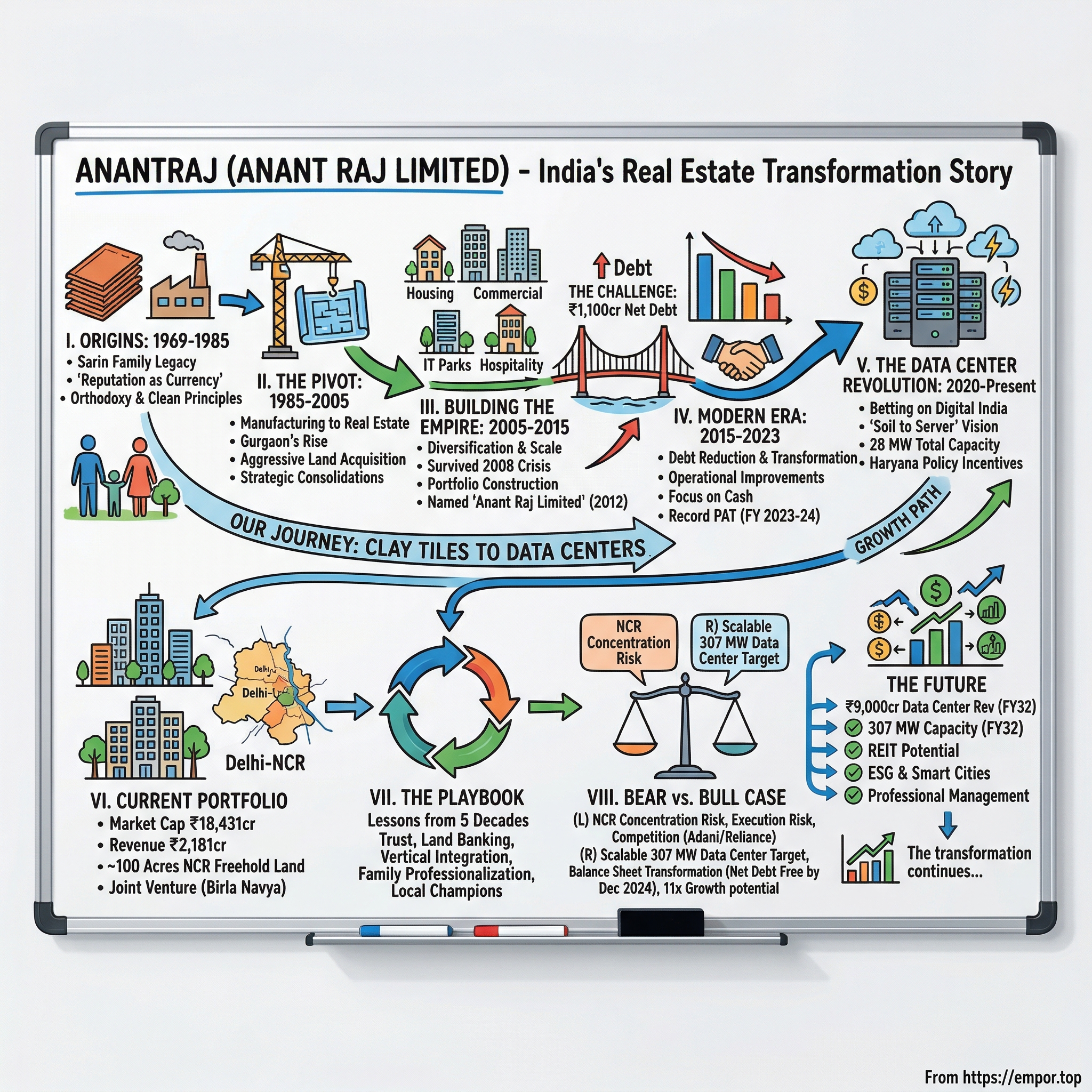
Anant Raj Limited: From Clay Tiles to Soil-to-Server
I. Cold Open & The Hook
On the first and second of August 2025, a convoy of analysts and fund managers drove out of Delhi on the Dwarka Expressway toward Manesar, a dusty industrial township in Haryana better known for car plants and labour disputes than for anything resembling Silicon Valley. They were there for what Anant Raj Limited had branded, with more patriotic flourish than technical precision, "Bharat Built — from soil to server." Inside a building that had been designed two decades earlier as an IT office park and had spent years substantially empty, the company showed off rows of racks, redundant power trains, and cooling infrastructure: 28 megawatts of IT load, built inside a shell that already existed.2
It was an odd sort of homecoming. The building was a monument to one of the company's worst capital-allocation decisions — a speculative bet on India's mid-2000s special economic zone boom that had gone almost nowhere. Now management was inviting the market to look at the same concrete and see a data centre campus.
That inversion is the story. Anant Raj began in 1969 as a contracting and construction group in Delhi, and was incorporated in 1985 under the distinctly unglamorous name Anant Raj Clay Products Limited, making glazed ceramic tiles in Haryana.3 By August 2026 the company carried a market capitalisation of roughly ₹22,000 crore, traded at about 38 times trailing earnings — a premium to the Indian real estate sector's median — and was asking public markets to underwrite a plan to build 357 megawatts of data centre capacity by FY2032 alongside a sovereign cloud platform named after its founder.111
Here is the paradox worth sitting with. Anant Raj's genuine, hard-to-replicate asset is boring: roughly 320 acres of fully paid, litigation-free land in Delhi-NCR, much of it assembled decades ago at prices that no longer exist anywhere in the National Capital Region.1 Its most exciting story is the opposite of boring: colocation, sovereign cloud, AI-ready liquid-cooled racks, and a demerger that will list the digital business separately as Ashok Cloud. The market is being asked to pay for the second thing on the strength of the first.
And the evidence so far is genuinely mixed. On one side: a deleveraging record that management set out publicly and then hit, quarter after quarter, taking consolidated net debt from ₹1,626 crore in FY21 to effectively zero by FY26.1 Revenue has more than doubled in three years and profit after tax has nearly quadrupled.1 On the other side: as of the half-year to September 2025, of the 28 megawatts the company called operational, only 8 megawatts of colocation had actually been handed over to customers, and the cloud business — which carries the overwhelming share of the projected revenue per megawatt — was running on half a megawatt.2 Independent analysts have flagged that the company's own megawatt-and-timeline arithmetic has shifted between disclosures, and that earnings calls have been held only intermittently.8
What follows traces how a tile maker became a land bank, how the land bank became a debt trap, how the debt trap became a turnaround, and whether the turnaround's second act — converting stranded commercial real estate into digital infrastructure — is industrial cleverness or a narrative running ahead of the operating evidence. The mechanics of NCR land banking matter here, because they explain both the company's structural advantage and its structural limit. So does the difference between a megawatt announced, a megawatt built, and a megawatt billing — a distinction that will decide whether this story compounds or disappoints.
It starts, as most Indian family businesses do, with a father, a name, and a decision to build things.
 Subscribe on LinkedIn
II. Pre-Liberalization Foundations: The Tile Maker's Origins (1969–2004)
Delhi in 1969 was a city being invented in public. The Delhi Development Authority, created a dozen years earlier, was throwing up housing colonies on the capital's edges to absorb a population still swollen by Partition and now growing on migration. It was a builder's market in the most literal sense — someone had to pour the concrete — and it was in this environment that Ashok Sarin laid the foundation of what became the Anant Raj Group, naming it after his parents, Lala Anant Ram Sarin and Raj Kumari Sarin.[^4]
The early business was contracting, not development. The group worked on government projects, and the family's own account of its origins highlights construction work associated with DDA housing and the ASIAD Village complex built for the 1982 Asian Games.[^4] This is an important detail for understanding everything that followed, because contracting is a school of a particular kind. You learn how permissions actually get granted, which officials matter, how long an approval really takes versus how long it is supposed to take, and — above all — how to finish a building without running out of cash. Those are unglamorous skills. They are also, in Indian real estate, closer to the source of durable advantage than any brand campaign.
The corporate entity that eventually became the listed company was incorporated in July 1985 as Anant Raj Industries Limited, and by 1989 it had commenced manufacturing glazed ceramic tiles under the "Romano" brand.3 Over the next fifteen years the tile business was steadily expanded — from a few thousand square metres a day in the 1990s to a capacity measured in tens of thousands of tonnes by the mid-2000s.3 It was a real business, with real customers, and it generated real cash.
Why does a construction family choose to make tiles? Partly because, in pre-liberalisation India, manufacturing was where the licences, the land allotments, and the institutional credit lived. A registered manufacturer in Haryana was a legible economic actor: it could acquire industrial land, employ people, secure power connections, and build relationships with a state administration. A pure land speculator was not legible at all. In an economy governed by urban land ceiling legislation, tight limits on how much property an entity could hold, and no foreign capital whatsoever in real estate, the manufacturing licence was less a business plan than an access key.
There is a second, less discussed reason the tile plant mattered: it solved the financing problem. Pre-liberalisation India was a high-interest-rate economy in which corporate borrowing costs regularly ran in the mid-to-high teens, and the banking system was not permitted to lend against land for speculative purposes. A developer could not simply borrow to buy acreage and wait. What a developer could do was run a manufacturing business that threw off operating cash, and quietly use that cash to buy land outright. That is equity-funded land banking by another name, and it is slow — but it produces a balance sheet with no clock on it. Most of Anant Raj's structural advantage forty years later traces back to this unglamorous financing arrangement.
The other inheritance from this era was cultural, and it is the one the family has promoted hardest: an insistence on clean titles. Indian land records are, notoriously, a swamp. Ownership is often established through chains of unregistered agreements, revenue records that contradict registry entries, ancestral claims, and tenancy protections that survive sale. A great many Indian developers of that generation built businesses on optioned or jointly developed land whose title was, at best, arguable — which is precisely why so many projects across the NCR spent the 2010s frozen in litigation. Anant Raj's positioning has been the opposite: buy freehold, pay in full, hold clean. The company still leads its investor materials with the phrase "debt-free land."1
It is worth being precise about what this claim is and is not. It is not a moat in the Porter sense; anyone can buy land outright if they have the money. What it is, is a timing advantage that compounds. Land bought outright in the 1980s and 1990s at agrarian prices, never encumbered, never subject to a landowner's profit share, sits on the balance sheet at historical cost and can be developed whenever the market is ready — with no clock running, no interest accruing on an option premium, and no partner to negotiate with. In a country where the single greatest destroyer of developer equity is carrying cost on land that cannot be built on, that patience is worth something real.
It is also worth being clear-eyed about what this era did not produce. Anant Raj emerged from thirty-five years of operation with no consumer brand, no capital-markets following, no institutional shareholder base, and no experience selling a differentiated product to an end customer. It sold tiles to distributors and construction services to government agencies. Every one of those is a business where the buyer cares about price and delivery and nothing else. The company that entered the 2005 boom was therefore superbly equipped to acquire and hold assets, and almost entirely unequipped to market them — an imbalance that would take another twenty years and a joint venture with a century-old consumer brand to begin correcting.
By 2004 the group had a modest tile business, a contracting heritage, a portfolio of land, and essentially no visibility in public markets. Then the rules of Indian real estate changed overnight, and a company that had spent thirty-five years quietly accumulating dirt suddenly found itself sitting on the most valuable input in the country.
III. The Land Assembly Era & Real Estate Pivot (2005–2008)
In 2005, the Government of India permitted foreign direct investment in construction and townships. The effect on the Indian property market was roughly what you would expect from opening a sluice gate: global private equity, sovereign funds, and offshore development vehicles arrived looking for exposure to a market that had been closed to them, and the only currency that mattered was control of developable land near a major city.
Anant Raj moved fast and, in retrospect, decisively. Effective April 1, 2005, the company entered real estate development and absorbed five group companies — Kalinga Meadows, Sarvodya Builders, B T Estates, Camation Buildcon, and Elegant Buildtech.3 In 2006 it amalgamated three more entities — Grand Meadows, Papillon Estates, and Roseview Estates — and took over Bhasin Resorts.3 In January 2007 it merged twelve further group companies in a single stroke.3
Read that sequence again, because the corporate-actions language conceals what was actually happening. These were not operating businesses being acquired for their operations. They were, in the main, holding vehicles whose principal asset was land parcels across Delhi, Gurugram, Manesar, Rai in Sonipat, and Panchkula. Assembling land in India through dozens of small private companies and then folding them into a listed entity was — and remains — the standard mechanism for converting fragmented, historically cheap holdings into a single institutional-grade land bank. It sidesteps ceiling restrictions, preserves the original acquisition cost basis, and delivers, at the end, one balance sheet an investor can underwrite.
There is a practical reason Indian land gets held this way, and it is worth spelling out because it explains why the company's structure looked so baroque. Agricultural land in Haryana and Delhi could not simply be bought in bulk by a corporation and converted; acquisitions happened parcel by parcel, often from dozens of individual farmers, each transaction registered separately, each requiring its own conversion and licensing steps. Aggregating those parcels inside small private companies — one company per cluster, effectively — kept each transaction small, kept the buyer's identity discreet so that sellers in the same village could not co-ordinate on price, and produced a clean legal container that could later be merged into the listed entity in a single tribunal-approved step. What looks on paper like a company acquiring companies was, in substance, a company harvesting years of patient, fragmented, village-level land purchase and consolidating the result.
Meanwhile the tile business kept expanding right through the pivot, with capacity increased again in FY2006.3 The company did not abandon manufacturing in a single dramatic gesture; it let the cash cow run while the land business was built underneath it. That is a conservative instinct, and it recurs throughout this company's history.
The contrast with the era's marquee names is instructive. DLF Limited and Unitech, the two developers that defined the 2005–2008 boom, pursued scale aggressively and leveraged aggressively to get it, and both would spend the following decade dealing with the consequences. Anant Raj was smaller and slower, and its land came predominantly through outright purchase rather than through joint development agreements — the structure in which a developer builds on someone else's land in exchange for a share of the proceeds. JDAs are capital-light and were the fashion of the age; they are also a permanent tax on project economics and a permanent source of counterparty risk. Anant Raj's choice traded near-term growth for structural margin, and for control.
The distinction between those two models is worth making concrete, because it is the fork in the road that separated the survivors from the casualties of the next decade. Under a joint development agreement, the developer signs up land it does not own, typically paying a modest advance and promising the landowner a share of revenue or built area. The appeal is obvious: you can control ten times the land for the same money. The trap is equally obvious in hindsight. When the market turns, the developer still owes the landowner, still owes its lenders, and cannot walk away from a project it has already pre-sold. Leverage on optioned land is leverage squared. Companies that scaled hardest on that structure in 2006 and 2007 spent the following decade restructuring debt, and some never recovered. Anant Raj's freehold-first approach bought far fewer acres per rupee and looked unambitious at the peak — which is exactly what a genuinely conservative capital allocation policy looks like from inside a boom.
Then, like everyone else in 2007 and 2008, the company reached for the adjacent glamour businesses. It signed joint ventures with international hotel operators — the record names Althoff Hotels and Aitken Spence — and opened the Romano Retreat hotel in April 2008.3 It entered into a joint venture with a Reliance group entity, Sonata Investment, to jointly develop two hotels and an SEZ project. It secured Ministry of Commerce approval to develop a 25-acre IT special economic zone at Rai in Haryana. And in June 2008, Acacia Real Estate, a Bahrain-based development fund, bought a minority stake in subsidiary Anant Raj Projects for ₹216.38 crore.3
That last transaction is the tell. Foreign capital paying meaningful money for a minority position in an Indian developer's project subsidiary is exactly the trade that defined the top of the cycle: global investors buying Indian land exposure at prices that assumed the boom would continue, and Indian developers happily selling them the optionality.
What Anant Raj had built by mid-2008 was, on paper, magnificent: a large freehold land bank in the fastest-growing metropolitan region in India, a hospitality pipeline, an SEZ approval, IT parks under construction, and foreign institutional validation. What it had not built was a customer base for any of it. Every one of those assets — the hotels, the SEZ, the IT parks — depended on a single assumption: that Indian commercial demand would arrive on schedule.
In September 2008, Lehman Brothers filed for bankruptcy, and the schedule was cancelled.
IV. The Post-Crisis Debt Trap & Conglomerate Hangover (2008–2019)
Consider what a half-built IT park does to a balance sheet. The land is paid for. The structure is going up, or is already up. The interest on the construction finance accrues every single month. And the revenue line — the leasing — is zero, because the tenants who were supposed to fill it are multinationals who have just watched the global financial system seize up and have frozen every real estate commitment on their books.
That is the position Anant Raj found itself in from late 2008 onward, and it is why the following decade was, for shareholders, close to a write-off in opportunity cost.
The company kept building, because that is what you do when the assets are half-finished. The Manesar IT Park, roughly 1.8 million square feet, was completed in 2009 and became operational in 2010.3 Phase 1 of the Rai IT SEZ, about 2.1 million square feet, was completed in 2012.3 Phase 1 of the Panchkula IT park followed in 2014.3 The hotels near Delhi airport commenced operations in 2010, and the Moments Mall in Kirti Nagar, some 600,000 square feet, was finished in 2011.3 The company also went down-market into affordable housing, completing the 2,580-unit Anant Raj Aashray project at Neemrana in Rajasthan in 2014.3
The specific failure of the IT parks deserves a beat of its own, because it is the asset that eventually becomes the hero of this story. An IT park is a bet on a very particular customer: a large technology services firm or multinational back office that wants a hundred thousand square feet or more, on a long lease, in a location its employees can commute to. That customer has an enormous amount of choice and almost no urgency. Through the 2010s, India's IT services industry did keep growing — but it consolidated its real estate demand into a handful of established campuses in Bengaluru, Hyderabad, Pune, and Gurugram's Cyber City, where the ecosystem, the talent pool, and the amenities already existed. A well-built office block in Manesar or in Rai, forty-odd kilometres up the Sonipat highway, was not competing on quality. It was competing on geography, and it lost. Meanwhile the SEZ framework that had justified some of this construction lost much of its fiscal appeal as the tax incentives that underpinned it were progressively diluted. The buildings were fine. The demand thesis was wrong.
Look at that list: IT parks, an SEZ, two hotels, a mall, luxury residential, affordable housing in another state, and a legacy tile plant. That is not a strategy; it is a portfolio assembled by saying yes. The generous reading is that a family business was diversifying to survive an unforgiving market. The analytical reading is that capital was being spread across too many businesses, each requiring different skills, different customers, and different cycles — and none reaching the scale where it could earn a decent return. Indian conglomerate real estate of this era failed in exactly this pattern.
The corporate housekeeping followed. Effective October 29, 2012, Anant Raj Industries Limited became Anant Raj Limited, and the tile manufacturing that had funded the group's first three decades was discontinued.3 The renaming signalled a pure-play real estate identity. It did not, by itself, solve anything.
The financial consequence was a decade of capital tied up in assets that generated little. Return on equity through this period sat in low single digits — the company's own disclosures show ROE at roughly 2 percent in FY22 and 5 percent in FY23, and those were already recovery years.1 A developer earning 2 percent on equity is destroying value against almost any cost of capital you care to assume, and the market priced it accordingly: for most of the 2010s the stock traded at a deep discount to any reasonable estimate of the land's worth. That discount was not irrational. Land that cannot be converted into cash on a defined timetable is not an asset in the way investors treat assets; it is a store of value with an indefinite maturity and a negative carry.
It is worth quantifying the cost of that decade in the only way that matters to a long-term owner: compounding. A business earning 2 to 5 percent on equity for ten years does not merely underperform — it converts a decade of the owner's capital into roughly nothing, while an index or even a fixed deposit compounds quietly alongside. The land appreciated, certainly, and that appreciation was real. But it accrued to a balance sheet the market refused to credit, because the market had no evidence the company could turn land into cash on any schedule. The discount to net asset value that Anant Raj carried through the 2010s was not a mispricing waiting to be arbitraged; it was the market's honest assessment that an asset without a monetisation plan is not worth its appraised value. Closing that discount required proving the monetisation, not arguing about the appraisal — a distinction that also applies, with some force, to how the data centre land bank should be valued today.
Then, in 2020, the family did something that shaped everything after. A composite scheme of arrangement — amalgamation and demerger — was sanctioned by the National Company Law Tribunal's Chandigarh bench and took effect in August of that year, splitting the group.3 The demerged entity, Anant Raj Global Limited, was renamed TARC Limited in April 2021 and went its own way under Amar Sarin. Anant Raj Limited retained the Haryana and Delhi assets that would become its future, and the next generation of the family took operational control: Amit Sarin as managing director, Aman Sarin as director and chief executive, and Ashim Sarin as director and chief operating officer.1
The 2020 split matters for two reasons. First, it simplified a company that had spent a decade being complicated — always the precondition for a turnaround. Second, it is a governance data point that any investor evaluating the coming Ashok Cloud demerger should hold in mind: this promoter group has run a listed-entity separation before, and the outcome for the demerged vehicle's minority shareholders has been mixed. Independent commentary on the current scheme has explicitly raised TARC's subsequent record, including a 2022 SEBI action over disclosure lapses, as a reason to scrutinise rather than assume.9
The lesson the family appears to have drawn from the lost decade is narrower and more useful than "diversification is bad." It is that in real estate, the enemy is time. Every year a project sits unsold or unleased, interest compounds against you. By 2020, with a simplified structure, a new generation in operational control, and a residential market in the NCR that was beginning to stir after seven flat years, Anant Raj finally had the chance to run the opposite experiment: monetise fast, pay down everything, and see what the business looked like without a debt load on top of it.
V. The Balance Sheet Deleveraging & Sector 63A Real Estate Boom (2020–2024)
The turnaround did not begin with a bold acquisition or a new business line. It began with a number that management started repeating in public and then refused to stop repeating: net debt.
The trajectory is unusually clean for an Indian developer. Consolidated net debt stood at ₹1,626 crore in FY21. It fell to ₹1,252 crore in FY22, ₹1,010 crore in FY23, then collapsed to ₹306 crore in FY24 and just ₹50 crore in FY25, before the company crossed into net cash in FY26.1 On the November 2025 earnings call, managing director Amit Sarin led with it — the fifth consecutive quarter with net debt below ₹50 crore, which he characterised as effectively a zero-debt company.2
What makes that trajectory analytically interesting is not the destination but the sequencing, because paying down debt in a development business is harder than it sounds. A developer's cash is trapped: money collected from homebuyers on a construction-linked plan is legally and practically earmarked for finishing those buildings, and cannot simply be swept to repay a term loan. To deleverage genuinely, a developer has to generate surplus above project completion costs — which means either selling assets, or selling a product that converts to cash faster than it consumes construction spend. Anant Raj did the second, and the choice of product was the whole trick.
The mechanism was Sector 63A, Gurugram. The company's flagship is a large master-planned township on Golf Course Extension Road, and by FY26 it described roughly 11.41 million square feet of ongoing and planned residential development there.1 The monetisation ran in layers, each targeting a different buyer and a different price point, which is how you extract maximum value from a single land parcel without cannibalising yourself.
Ashok Estate came first: about 20 acres of plotted development with roughly 1.34 million square feet of development area. Plots are the highest-return, lowest-risk product a developer can sell — you build infrastructure, you sell land, the buyer builds the house. The project was sold out and deliveries were completed in what the company described as record time.1
Plotted development is worth pausing on, because it is the single most efficient deleveraging instrument available to a landowner-developer and it is available only to a landowner-developer. The capital cycle is brutally short: lay roads, sewerage, power, and boundary walls across a few hundred crore of spend, sell the plots at close to full land value, and hand over. There is no tower to build, no four-year construction schedule, no risk of cost inflation eating the margin, and — critically — very little of the collected cash is contractually committed to future construction. For a company trying to extinguish ₹1,600 crore of net debt, a product that converts land directly to unencumbered cash within a couple of years is not merely attractive. It is the only realistic path. That Anant Raj led with plots rather than with the glamorous high-rise is the clearest single piece of evidence that the post-2020 management was optimising for balance sheet repair rather than for headlines. The Estate Floors followed, low-rise independent floors aimed at buyers who want a house rather than an apartment. Then The Estate Residences: high-rise luxury group housing, 248 four-bedroom units across 5.43 acres, roughly 0.99 million square feet of saleable area, at an average selling price of about ₹18,000 per square foot.1
That ₹18,000 figure is the single most important number in the real estate half of this business, and it deserves unpacking rather than admiration. Golf Course Extension Road went through a decade in which prices essentially did not move; the post-2021 NCR luxury cycle roughly doubled realisations in the better micro-markets. Because Anant Raj's land in Sector 63A was bought long ago and is fully paid, essentially the entire increase in price per square foot drops toward gross margin. This is what analysts mean when they call it operating leverage on a land bank — but it is worth stating the flip side plainly: that leverage runs in both directions, and the same land bank produced low single-digit returns on equity for a decade when the cycle was against it.
The company also learned to use a partner properly. In 2022 it formed a joint venture with Birla Estates — the real estate arm of the Aditya Birla group — through Avarna Projects LLP, launching Birla Navya on Golf Course Extension Road: 191 residential plots and 764 luxury independent floors planned across four phases, with expected cash flow to Anant Raj of roughly ₹1,000 crore.13 Phase I has been delivered, Phase II occupancy certificates were received and deliveries commenced, and Phase III completion is planned by end-FY28.1
The Birla JV is a genuinely smart piece of positioning, and worth being specific about why. Anant Raj's weakness in luxury residential is brand: DLF has spent forty years making its name shorthand for Gurugram premium, and Anant Raj has not. Birla Estates brought a consumer brand with a century of trust behind it. Anant Raj brought the land. The developer contributing land into a branded JV gives up a share of profit but converts a dormant asset into cash flow at a price point it could not have commanded alone — and does so without spending years and hundreds of crores building brand equity from scratch. That is an honest assessment of a real limitation, addressed with a structure rather than a slogan.
The numbers that came out the other side were the best in the company's history. Consolidated revenue rose from ₹957 crore in FY23 to ₹1,483 crore in FY24 and ₹2,060 crore in FY25; profit after tax went from ₹151 crore to ₹266 crore to ₹426 crore over the same span.1 On the November 2025 call, Amit Sarin made a point of noting that the company had guided to roughly ₹1,800–1,900 crore of topline and ₹370–390 crore of PAT for FY25, and delivered above both.2 Beating your own guidance is a modest achievement in absolute terms. In the context of Indian mid-cap real estate, where guidance is often aspirational and rarely revisited, it is a meaningful credibility deposit.
But the same disclosures contain a caution that the celebratory framing tends to skip. Return on equity, having climbed from about 2 percent in FY22, reached roughly 10 percent in FY25 and stayed at roughly 10 percent in FY26; return on capital employed reached about 9 percent.1 For a business earning better than 21 percent net margins, a 10 percent ROE tells you the balance sheet is heavy and the asset turns are slow — which is exactly what a large land bank carried at cost, plus a fresh equity raise, plus a capital-intensive new business in gestation, will do to a return profile. Deleveraging fixed the survival question. It has not yet fixed the returns question.
With the debt gone and the residential engine running, the obvious next question was what to do with all the commercial concrete the company had built in 2009 and never filled.
VI. Core Business Deep Dive: NCR Real Estate Economics, Land Bank & Competitive Moat
To understand why Anant Raj's land is valuable, you have to understand what an Indian developer actually sells. It is not construction — construction is a commodity service available from any competent contractor. What a developer sells is the right to occupy a specific location, cleared of legal ambiguity and delivered with permissions attached. The three inputs are location, permission, and execution, and the company's own materials name exactly those three as its operating principles.1
Location is where the moat is, and it is worth being precise about its shape. Anant Raj's disclosed marquee land reserves outside its flagship township run to 83.43 acres of fully paid freehold land in prime Delhi-NCR: 4.45 acres at Essapur in West Delhi, 15.16 at Mundela Kalan, 6.59 at Dhansa, 18.72 at Holambi in North Delhi, 24.46 at Bhati in Mehrauli in South Delhi, and 14.05 acres at Rewari.1 Total prime, debt-free land across Delhi-NCR is described as roughly 320 acres, with development visibility management frames at ten to twelve years.6
Land inside the National Capital Territory of Delhi is a different asset class from land in Gurugram. Delhi's developable supply is essentially fixed; the master plan governs what can be built, and large freehold parcels in South and West Delhi in single ownership are extraordinarily scarce. The company started building in the capital only recently — Bel-La Monde in South Delhi, roughly 0.7 million square feet of commercial, service apartment, and hotel space, with Phase 1 targeted for FY28 — described on the November 2025 call as its first development in Delhi after decades of focusing on Haryana.27
Now the honest test of the moat. Myth: Anant Raj's land bank makes it structurally advantaged versus every NCR peer. Reality: it makes it advantaged on cost of land, and only on cost of land. Against DLF, Anant Raj has nothing resembling comparable brand pricing power, no rental annuity portfolio of remotely similar scale, and no presence in the Cyber City and Phase 5 micro-markets that anchor Gurugram's premium. Against Godrej Properties or Prestige Estates, it has no multi-city platform — its residential business is concentrated in a handful of Gurugram sectors plus a small Tirupati affordable-housing project. Against Signature Global or M3M, which have been the aggressive volume launchers in Gurugram this cycle, it launches slowly. Against Macrotech Developers, it has a fraction of the annual pre-sales.
The scale gap is not a matter of opinion. India's 28 large listed developers booked roughly ₹1.95 lakh crore of pre-sales in FY26, up about 17 percent on the prior year, and the league table was led by Godrej Properties at ₹34,171 crore, Prestige Estates at ₹30,024 crore, Macrotech at ₹20,530 crore, and DLF at ₹20,143 crore — with the top five accounting for close to 60 percent of the industry total.12 Anant Raj's entire consolidated revenue across residential, commercial rentals, hospitality, and data centres was ₹2,511.60 crore in the same year.1 Even Signature Global, a Gurugram-focused mid-market specialist that had a difficult year, booked ₹8,250 crore.12 Oberoi Realty, the most margin-obsessed name in the sector, booked ₹5,447 crore.12
Two conclusions follow, and they point in opposite directions. First, this is a small company operating in a consolidating industry where scale is increasingly correlated with land access, brand, and approval throughput — precisely the dynamic that has pushed the top five's share of national pre-sales toward 60 percent. Anant Raj is not participating in that consolidation as an acquirer. Second, and more usefully, the smallness cuts the other way on the digital pivot: a data centre business generating a few hundred crore of revenue would barely register at Godrej or DLF, whereas at Anant Raj it can plausibly reshape the entire company. Investors are not underwriting a diversification here; they are underwriting a transformation, with all the asymmetry that implies in both directions.
What it does have is a cost basis that cannot be recreated. A competitor buying land on Golf Course Extension Road in 2026 pays 2026 prices and must earn a return on that. Anant Raj is developing land that has been on its books for years or decades. That is Hamilton Helmer's cornered resource in its purest form — preferential access to a coveted asset at above-market terms — and it explains the gross margin structure. It also explains the ceiling: a cornered resource is finite. Every acre monetised is an acre that cannot be monetised again, and replacing it means buying at today's prices, which extinguishes the advantage. The company's stated intent to acquire additional land adjacent to its existing holdings, and to grow asset-light through joint development agreements with other landowners, is a direct acknowledgement of this.1
The unit economics on the current pipeline show how the advantage converts to cash. The Estate Apartments, launched in Q1 FY26 with 0.40 million square feet, carries estimated revenue of about ₹750 crore. Luxury Group Housing 2, with 0.90 million square feet of saleable area, carries an estimated ₹2,180 crore. Group Housing 3, at 1.20 million square feet, an estimated ₹2,886 crore.1 Aggregate those and the Sector 63A pipeline alone is a multi-thousand-crore revenue book on land already owned.
But the cash mechanics deserve a closer look than the headline revenue figures, because they reveal how slowly this business actually converts. On the November 2025 call, an analyst from DAM Capital pressed on collections for the first group housing project. The answer: ₹428 crore collected against a booking value of ₹1,850 crore, with ₹168 crore of construction cost spent and ₹322 crore still to be spent.2 That is roughly 23 percent of the booking value in hand against roughly a third of the construction cost incurred. Indian residential development is a construction-linked cash flow business — the buyer pays as the building rises — so this is normal and healthy. It is also a reminder that a ₹1,850 crore booking is not ₹1,850 crore of cash, and that the residential engine funding everything else in this company generates cash over years, not quarters.
The annuity portfolio is the third leg, and it is small: 1.92 million square feet of commercial leasable area, described as fully leased under long-term agreements.1 The company has approvals to increase floor space index on two Delhi hotel properties from 0.15 to 1.75 — a more than tenfold increase in permitted development — with additional developable area of 4.90 lakh square feet already under construction at one and 6.10 lakh square feet planned at the other, and expected additional rentals of ₹55 crore and ₹75 crore per annum respectively once complete.1 Those are not enormous numbers against a ₹2,500 crore group revenue base, but they are the kind of quiet, high-margin optionality that a long-held freehold portfolio throws off periodically.
So: why does Anant Raj win in core real estate? Because it owns its land outright in a market where land is the binding constraint, executes construction in-house, and operates in a state administration it has navigated for fifty years. Why might it lose? Because it is a single-region developer with a modest brand in a segment where brand increasingly sets price, running a launch cadence that depends on approvals it does not control, in a micro-market where a rate shock or a supply surge would hit realisations directly. Both statements are true at once, and both matter more now than they did five years ago — because the residential business has been assigned a second job.
VII. The Digital Infrastructure Pivot: Ashok Cloud & The Data Center Bet (2022–Present)
Here is the insight, and it is a good one.
A data centre is, structurally, a very strange building. It needs floor plates that can carry enormous weight, because racks of servers are dense. It needs ceiling heights and risers for cooling. It needs redundant, high-capacity power — ideally from two independent grid sources. It needs fibre nearby. And it needs to be reasonably close to, but not inside, a major metro. An empty IT office park, built in 2009 to institutional specification for multinational tenants who never came, satisfies a surprising number of those requirements before you spend a rupee.
What a megawatt actually means
Before going further, it helps to translate the industry's vocabulary, because almost every number in this section is expressed in units that are not intuitive.
Data centres are measured in megawatts of "IT load" rather than in square feet, and the reason is that space is not the scarce input — electricity is. A server rack is a metal cabinet roughly the size of a large refrigerator, packed with computers. Each rack draws power continuously, and every watt of power drawn is converted almost entirely into heat, which then has to be removed. So a data centre is best understood not as a building but as a machine for delivering clean, uninterrupted electricity to computers and then carrying the resulting heat away. One megawatt of IT load is, very roughly, enough to run a few hundred densely packed racks — and it is the number that determines revenue, because customers buy power and cooling, not floor area.
"Tier III" is a certification standard describing redundancy. In plain terms, it means the facility is built so that any single component — a generator, a cooling unit, a power path — can be taken offline for maintenance or can fail outright without the customer's servers going dark. That redundancy is expensive, and it is the difference between a building where servers happen to live and a facility a bank or a government department will trust with production workloads. Anant Raj has disclosed TIA Tier III certification for its facilities.1
The last piece of jargon worth decoding is the difference between the two things this company sells, because the entire valuation debate turns on it. Colocation is a landlord business: think of it as renting a serviced garage with guaranteed power, cooling, and security, into which the customer parks their own cars. Cloud is a rental-car business: Anant Raj buys the cars, maintains them, insures them, and rents them out by the hour. The garage has low capital intensity per unit of revenue and modest, stable, rent-like economics. The rental fleet requires far more capital, depreciates, must be refreshed, and lives or dies on utilisation — but it earns dramatically more per square metre of garage.
With that vocabulary in place, the numbers become legible.
The economics of that realisation are stated plainly in the company's own disclosures. Asked on the November 2025 call whether the previously cited figure of roughly ₹50 crore per megawatt to build a data centre still held, Amit Sarin's answer was that because the existing buildings already qualified and had been strengthened and readied, Anant Raj's incremental spend was ₹26 crore per megawatt.2 That is roughly a 48 percent saving on civil and shell capex, plus the time saved not building a structure from scratch — the sort of head start a greenfield competitor cannot buy.
That is the counter-positioning claim, and on the numbers it is real. It is also strictly bounded, and the bound is the most important thing an investor can understand about this story. The advantage applies only to megawatts that fit inside buildings Anant Raj already owns. The company's disclosed roadmap is 50 MW at Manesar, 200 MW at Rai, 57 MW at Panchkula, and 50 MW in Andhra Pradesh, totalling 357 MW.1 At Rai, the building for 100 MW is ready; the additional 100 MW is a greenfield development, with built-to-suit work management said would start in 2028.12 The Andhra project is greenfield on land yet to be built out. Panchkula's expansion has 5.25 acres of greenfield land available.1 Strip out what fits in existing shells and the majority of the 357 MW target is an ordinary construction project competing with everyone else on ordinary terms.
The two businesses hiding inside one segment
The bigger analytical trap is treating "data centre" as one business. It is two, with radically different economics, and the company's own numbers make the gap vivid.
Colocation is the landlord business. You provide the rack, the power, the cooling, the security, and the connectivity; the customer brings their own servers and runs their own software. Management has stated colocation realisations of roughly ₹90 lakh per megawatt per month.2 Critically, Anant Raj reports colocation revenue net of electricity, because power is a pass-through to the customer. A DAM Capital analyst flagged on the call that peers typically gross up power into revenue, and the CFO confirmed Anant Raj will continue to net it.2 That is a defensible accounting choice, and it makes reported revenue per megawatt look lower — but it also means anyone comparing Anant Raj's data centre revenue line to a peer's is not comparing like with like unless they adjust.
Cloud is a fundamentally different animal. Here Anant Raj buys the servers, the storage, the networking, the security appliances, and the software licences, and sells computing capacity as a service — infrastructure-as-a-service, with platform services layered on top. Asked directly for the cloud realisation per megawatt, Amit Sarin said approximately ₹12 crore per megawatt per month.2 Set that against colocation's ₹90 lakh and you get roughly thirteen times the revenue from the same megawatt of power. The capex is higher too — a Nomura analyst on the call put cloud capex at roughly ₹126 crore per megawatt against roughly ₹150 crore of annual revenue, implying a payback of around two years, and management did not dispute the arithmetic.2
Take a moment with that, because it is the entire investment debate compressed into two numbers. Five times the capital for thirteen times the revenue, at a stated 75 percent EBITDA margin, with a two-year payback. If those economics are durable at scale, this is one of the most attractive infrastructure businesses in India. If they are not — if margins compress as the mix shifts, if utilisation lags, if hardware refresh cycles bite, if competition prices the service down — then a large fraction of what the market is paying for evaporates.
The reasons for scepticism are not exotic. First, scale: as of H1 FY26, the cloud business was running on 0.5 megawatts fully handed over.2 Half a megawatt is a pilot, not a proof. Second, the margin: global hyperscalers do not earn 75 percent EBITDA margins on infrastructure-as-a-service at scale, and Anant Raj's stated margin currently reflects a very small, very early book with, by management's own description, pricing roughly 50 percent below market.2 Selling below market while earning 75 percent margins is a claim that requires either an extraordinary cost position or an immature cost base — and depreciation on ₹126 crore per megawatt of hardware is a cost that shows up below EBITDA. Third, the sales question a Nomura analyst asked bluntly: why would a customer pay Anant Raj rather than buy the hardware themselves? Whole-time director and COO Ashim Sarin's answer — that customers do not want the headache, that departments need fractional capacity, that Anant Raj buys licences in bulk and provides managed services — is the correct answer, and it is also the answer every cloud provider on earth gives.2 It is true. It is not differentiated.
Sovereign cloud and the institutional scaffolding
What is at least partially differentiated is the sovereign angle. Ashok Cloud — launched in October 2024 and named for the founder chairman — is positioned as an Indian sovereign cloud: data resident in India, compliant with Indian law, aimed at government and regulated enterprise workloads that legally or politically cannot sit on a foreign hyperscaler.2
The institutional credentials here are real and verifiable. The company disclosed empanelment with the Ministry of Electronics and Information Technology as a sovereign cloud service provider and with BSNL as a data centre service provider.1 Empanelment matters in a specific, unglamorous way: it is what makes a vendor eligible to bid for central and state government workloads at all. It is a gate, not a win — but a gate competitors must also pass. The platform itself was built in association with Orange Business, and the client mix disclosed for H1 FY26 was roughly 75 percent government and 25 percent private in colocation, and 50-50 in cloud.29 Named early clients have included RailTel, TCIL, and CSC; management declined to name others, citing non-disclosure agreements.2
Management's demand argument, delivered on the call in response to a question about whether all 307 megawatts could be filled, rested on a familiar statistic — that India generates a large share of the world's data while housing a tiny share of its capacity — and on India's data localisation direction of travel.2 The directional logic is sound: data localisation requirements do create a structurally protected demand pool that global hyperscalers cannot fully serve. But it is worth noting the asymmetry in the answer. Asked about a specific competitive risk — that large global players in other Indian metros were struggling to fill capacity — management said it could not comment on South India and that North India had no shortage of demand.2 That is an assertion, not evidence. Anant Raj has not disclosed a signed long-term anchor lease with a tier-one hyperscaler.
The company has also built a partnership layer: a tie-up with Spain-based Submer for liquid-cooled, AI-ready data centres, and TIA Tier III certification.1 Liquid cooling matters for a practical reason worth explaining simply: AI chips draw far more power per rack than traditional servers, and air simply cannot carry that heat away efficiently. Without liquid cooling, a facility is limited to conventional workloads. With it, the same floor can host AI training and inference. Whether Anant Raj can actually source scarce AI accelerators at competitive terms against buyers with far deeper pockets is an open question the company has not addressed with specifics.
Scaling, funding, and the demerger
The funding story has, so far, been conservative in a way that is consistent with the deleveraging record. In FY26 the company raised ₹1,099.99 crore through a qualified institutional placement at ₹662 per share, drawing both foreign portfolio and domestic institutional participation.41 Earlier, promoters converted ₹100 crore of share warrants at ₹730 in March 2025, ahead of their September 2026 deadline, with the proceeds going into the data centre business.2 Capital employed in the data centre business stood at roughly ₹700 crore as of H1 FY26.2 Asked directly on the call whether the company should lever up to move faster, Amit Sarin declined, saying real estate remained the backbone and should carry as little debt as possible.2 Refusing free money at the top of a hype cycle is, on its own, a reasonable governance signal.
Then came the structural move. On July 21, 2026, the board approved a composite scheme of arrangement: Anant Raj Cloud Private Limited will be amalgamated into Anant Raj Limited, and the data centre undertaking will then be transferred to Ashok Cloud Private Limited, with shareholders receiving one Ashok Cloud share of ₹2 face value for every Anant Raj share held.5 The stated rationale is independent market recognition and valuation for two businesses with distinct operating profiles.5 The company simultaneously invested ₹74.86 crore into Ashok Cloud via rights issue, taking its paid-up capital to ₹74.91 crore.5 Implementation requires shareholder and creditor approval, both exchanges, SEBI, and NCLT sanction under Sections 230–232 of the Companies Act — a process independent commentary has suggested could run eighteen to twenty-four months.59
Two features of the structure deserve flagging. First, this is not a clean spin-off: Anant Raj retains a controlling stake, and post-scheme promoter holding in Ashok Cloud is disclosed at 79.14 percent against 20.86 percent public, versus 57.42 percent promoter holding in Anant Raj itself.5 Economic exposure for a minority shareholder is roughly preserved — they hold Ashok Cloud shares directly plus their share of the parent's retained stake — but control is concentrated considerably further, and the cross-holding preserves rather than removes the conglomerate structure. Second, the demerged undertaking is small: it represented 8.96 percent of Anant Raj's turnover, ₹145.90 crore out of ₹1,627.72 crore, as at March 31, 2026.5 Investors are being asked to value a listed vehicle whose current operating base is under ₹150 crore of revenue on the strength of a FY32 ambition.
Against India's established colocation operators — Sify, CtrlS, Nxtra by Airtel, STT GDC India, NTT DATA, Yotta, AdaniConneX — Anant Raj is a small, late, regionally concentrated entrant. Independent analysis has placed it in the least-advantaged tier of Indian data centre archetypes, lacking clear differentiation against incumbents with scale, hyperscaler relationships, and existing metro footprints.9 The counter-argument is that Anant Raj is not competing for the same customer: the incumbents fight over Mumbai and Chennai hyperscaler capacity, while Anant Raj is targeting North Indian government and enterprise workloads at a cost basis nobody else has. That is a coherent thesis. It is not yet a demonstrated one.
Which brings the question back to the people making the promises.
VIII. Management Credibility, Governance & Capital Allocation Audit
There is a moment on the November 12, 2025 earnings call that tells you more about this company's investor relations than any presentation slide. An analyst, Gaurav Agarwal of VA Capital, opened not with a question but with a complaint: he was disappointed that there had been no conference call for the last three or four quarters. Amit Sarin's response was that the company had been holding physical earnings meetings in Mumbai with ninety to a hundred attendees each, but conceded that "the concall has a far more reach," and committed to holding a call every second quarter going forward.2 Later in the same call, another participant made the same request, and received the same answer.2
That exchange is worth dwelling on. A company undergoing a significant strategic transformation, asking public markets to underwrite a capital-intensive new business, had gone the better part of a year without a public, recorded, transcribed forum in which any investor could ask a question. The substitute — in-person meetings in one city, by invitation — systematically favours institutional investors over everyone else. Management's fix, a commitment to semi-annual rather than quarterly calls, still leaves Anant Raj disclosing less frequently than most peers of comparable size, and independent analysis published in 2026 noted that no public call had been held since that Q2 FY26 event.8 Governance is not only about fraud; it is also about whether the ordinary shareholder has equal access to management's reasoning.
On alignment, the picture is better. The Sarin family held roughly 60.1 percent of equity as of September 2025, with no promoter pledging disclosed, and promoter holding in Anant Raj is stated at 57.42 percent following the FY26 QIP dilution.75 The family put ₹100 crore of its own money in early, converting warrants ahead of schedule at ₹730 per share, at a moment when the data centre business needed capital.2 The board comprises three Sarins — Amit Sarin as managing director, Aman Sarin as director and CEO, Ashim Sarin as director and COO — alongside four independent directors including Kosaraju Veerayya Chowdary, Kulpreet Sond, Rajesh Tuteja, and Dr. Rajendra Prasad Sharma.1 A further family appointment, Anish Sarin as whole-time director, was effective May 11, 2026.6 A seven-member board with three executive family members, one woman director, and a fourth family executive being added is a concentrated structure by any standard — normal for an Indian promoter company, but not a structure that generates much independent challenge.
Where the track record holds
Give credit where the evidence supports it. The deleveraging commitment was made publicly, tracked publicly, and delivered on schedule. The FY25 revenue and profit guidance was beaten, and management pointed to the specific numbers on the record.2 Credit rating agency Infomerics upgraded the company's long-term rating to IVR A- with a stable outlook and short-term to IVR A2+ during FY26 — an external, independently produced validation of the balance sheet repair that does not depend on management's own framing.1 Approvals in Sector 63A have generally arrived roughly when the company said they would, and delivery timelines on Ashok Estate and The Estate Residences have been met or beaten.1
Where it does not
The data centre narrative has moved. On the same November 2025 call, an analyst from Wallfort PMS pointed out that the Q2 FY25 disclosures had described the full 307 megawatts arriving in "the next four to five years" — implying roughly 2030 — while current materials said FY32, and asked what had caused the two-year slip. Amit Sarin's answer was that it was not a delay, that the company had always meant financial year 2031-32, and that "maybe we said five to six years, but that is what we meant."2 That is not a satisfying answer. When a company's stated horizon moves out by two years and the explanation is that the original wording was imprecise, the appropriate investor response is to increase, not decrease, the discount applied to long-dated targets.
The target itself has also grown while moving out: FY26 materials now reference 357 megawatts by FY32, up from 307, following the Andhra Pradesh MoU.1 Raising a long-dated target while pushing out the date is a combination that should prompt questions rather than enthusiasm.
Then there is the gap between "operational" and "earning." Management describes 28 megawatts as operational — 21 at Manesar, 7 at Panchkula.1 But on the call, the CFO clarified that 8 megawatts of colocation had been fully handed over, with the rest in the handover process, and cloud stood at 0.5 megawatts.2 Management said handover would complete in Q3 FY26 with full revenue captured in Q4.2 Independent analysis has been sharper about this distinction, arguing that a promise of 28 megawatts operational by end-FY25 translated into a far smaller functioning base a year later, and that management has not consistently separated built capacity from contracted, billing capacity.8
The timeline for the next milestone has also drifted. On the November 2025 call, the commitment was 63 megawatts by December 2026.2 By the Q1 FY27 investor presentation, the language had become 63 megawatts by the end of FY27 — March 2027.10 One quarter is not a scandal. But it is the second time the schedule has moved in the same direction, and it is exactly the pattern an investor should be tracking rather than the headline megawatt number.
Second-layer signals
A few smaller items round out the governance picture, none decisive on its own. The FY26 annual report disclosed independent assurance on the Business Responsibility and Sustainability Report from TUV SUD South Asia, and the appointment of cost auditors for FY27 — routine compliance, but the kind that is worth confirming rather than assuming.6 The 41st annual general meeting was held on August 7, 2026 at the registered office in IMT Manesar, with a record date of July 31, 2026 for the recommended final dividend of ₹1 per share on a ₹2 face value.6 Dividend policy has been steadily liberalised as the balance sheet healed: payouts rose from 5 percent of face value in FY21 to 50 percent in FY26.1 The AGM agenda also carried increases in managing-director commissions and the appointment of a further family member as whole-time director on stated monthly remuneration.6 Related-party remuneration escalating in step with profits is normal and legal; it is also the item minority holders in promoter-controlled companies watch most closely, and the direction of travel here is upward.
The workforce numbers are a quieter tell about the transformation's scale. Anant Raj reported 403 permanent employees on a consolidated basis in FY26.6 That is a small organisation to be simultaneously running a multi-thousand-crore residential pipeline, a commercial leasing portfolio, hotels, and a data centre and public cloud business with ambitions to reach 357 megawatts. Cloud, in particular, is a people business — engineers, network operations, security, twenty-four-hour managed services. Building that bench, or contracting it credibly through partners, is an under-discussed execution requirement that does not show up in any megawatt chart.
Finally, the revenue guidance itself deserves scrutiny. Management has pointed to roughly ₹1,200 crore of data centre revenue and, on the call, clarified this would come substantially in FY27 and completely in FY28, from the 63-megawatt base at full occupancy.2 Brokerage estimates have run materially below that figure.9 The longer-dated ambition — roughly ₹9,000 crore of annual data centre and cloud revenue by FY32 — implies building a business more than three times the size of today's entire consolidated company, in a segment the company entered in 2023, within six years.9 That is not impossible. It is, on the evidence available in August 2026, unproven by a very wide margin.
IX. Strategy & Valuation Framework: Helmer's 7 Powers & Porter's 5 Forces
Strip away the narrative and ask the structural question: what, if anything, prevents a competitor from doing to Anant Raj what Anant Raj proposes to do to the Indian data centre market?
Cornered resource — genuinely strong, in one place only. The fully paid freehold land bank in prime Delhi-NCR, assembled at historical cost, cannot be replicated by anyone buying at 2026 prices. It is the source of the residential gross margins, it is the source of the data centre capex advantage, and it is finite. This power is real and it is the single justification for a premium multiple on the real estate business. It is also the one power that depletes with use.
Counter-positioning — real but narrow. Converting existing shells at ₹26 crore per megawatt against roughly ₹50 crore for greenfield is a genuine counter-position: an incumbent data centre developer cannot respond by acquiring twenty-year-old IT parks in Haryana, because those parks are not for sale and, more to the point, most incumbents want capacity in Mumbai and Chennai where the hyperscalers are.2 But counter-positioning requires that the incumbent be unable to respond, and here the incumbents simply do not want this market segment badly enough to fight for it. That is a different and weaker thing than being structurally locked out — and it disappears entirely for the greenfield majority of the 357 megawatt plan.
Switching costs — plausible, unproven. Cloud customers face genuine friction migrating workloads: data egress, re-architecture, re-certification, retraining. Once a government department runs on Ashok Cloud, moving is expensive. But switching costs only matter at scale, and with 0.5 megawatts of cloud handed over as of H1 FY26, there is essentially no installed base yet to be sticky.2
Scale economies — absent. In colocation and cloud, scale is decisive: it drives hardware procurement terms, power purchase leverage, and the ability to serve a hyperscaler's multi-site requirement. Against operators running gigawatt-scale portfolios, Anant Raj at 28 megawatts has no scale advantage whatsoever, and will not have one within this decade on its own plan.
Branding, network economies, process power, cornered talent — not evidenced. The company does not claim them, and the disclosures do not support them.
Now Porter, applied to the two businesses separately because they face different structures.
Rivalry. In NCR residential, intense — DLF, Godrej Properties, M3M, Signature Global, and Macrotech all compete for the same Gurugram buyer, and the luxury launch pipeline is heavy. Anant Raj's protection is micro-market concentration: Golf Course Extension Road has limited supply and the company's chief business officer described this as the segment with the most constrained supply and highest relative demand in Gurugram.2 In data centres, rivalry is intense and capitalised by parties with far deeper resources.
Threat of new entrants. In land, low — you cannot enter a market whose key input is unavailable at any reasonable price. In data centres, high. Global private capital has been flowing into Indian digital infrastructure, and capital, not insight, is the primary barrier.
Buyer power. Residential buyers in a supply-constrained luxury micro-market have limited leverage today, though that is a cyclical condition and not a structural one. In colocation, hyperscalers exert severe pricing power per megawatt — which is precisely the customer Anant Raj has not signed. Government and PSU buyers, which dominate Anant Raj's current colocation mix at 75 percent, are less price-aggressive but come with procurement cycles, payment timelines, and political risk of their own.2
Supplier power. In residential, low — contractors and materials are commodities. In cloud, high and rising. Anant Raj must buy servers, networking, storage, and software licences from a small set of global OEMs, and if it moves seriously into AI infrastructure, it must buy accelerators in a market where allocation is rationed and the buyers ahead of it in the queue are the largest companies on earth. Power is the other supplier chokepoint: 357 megawatts of IT load requires grid capacity, substations, transmission, and long-term power arrangements that management has not detailed publicly in the disclosures reviewed here.
Substitutes. For colocation, the substitute is the enterprise's own on-premise server room; for cloud, it is a global hyperscaler's Indian region. Data localisation policy is what weakens the second substitute, which is why the sovereign positioning is strategically coherent — and why any softening of localisation requirements would be a direct hit to the thesis.
The composite picture: one strong, depleting power in real estate; one real but bounded power in data centres; and, beyond that boundary, a company competing on ordinary terms against better-capitalised specialists.
X. Activist & Skeptical Investor Stress Test: Bull vs. Bear Case
The bear case
The megawatt gap is the whole argument. Everything hinges on the distance between capacity announced, capacity built, and capacity billing. The company's own H1 FY26 disclosure put fully handed-over colocation at 8 megawatts against 28 described as operational, with cloud at 0.5 megawatts.2 Independent analysis has argued the shortfall against earlier promises is larger still, and has quantified the gap between the original 307-megawatt-by-FY28 framing and the current 117-megawatt-by-FY28 guidance as roughly ₹2,000 crore of revenue and ₹1,700 crore of EBITDA relative to earlier expectations.8 Whatever the precise arithmetic, the direction is not in dispute: the near-term capacity plan is materially smaller than what was once implied.
Power and infrastructure are the unglamorous binding constraint. Nothing in the reviewed disclosures details secured power purchase agreements, open-access approvals, substation commitments, or water arrangements for the scale contemplated. A data centre without firm, cheap, redundant power is a warehouse. This is the single most common place where Indian data centre plans slip, and it is under-disclosed here.
The cloud margin claim invites scepticism. Seventy-five percent EBITDA margins on infrastructure-as-a-service, while pricing at roughly half the market, on a base of half a megawatt, is a combination that should not be extrapolated. Independent commentary has argued current margins reflect landlord-stage economics and that capex claims of ₹26 crore per megawatt sit 15 to 25 percent below industry norms.9 Depreciation on ₹126 crore per megawatt of IT hardware, on a refresh cycle measured in years rather than decades, is a real and recurring cost that EBITDA does not capture.
Disclosure quality is a legitimate activist target. Segment reporting has not been provided because the data centre business had not crossed the 10 percent materiality threshold.2 Colocation revenue is reported net of power while peers gross it up.2 Public calls have been infrequent. For a company asking the market to value a business on FY32 projections, the granularity offered on that business is thin.
Single-market cyclicality. The residential business, concentrated in a handful of Gurugram sectors, is the funding source for the entire data centre build. A rate shock, a supply surge on Golf Course Extension Road, or a broader NCR correction would hit collections directly and force a choice between slowing the digital build and re-leveraging a balance sheet management has spent five years clearing.
Demerger friction and structure. NCLT-route schemes are slow, and the Ashok Cloud listing could take eighteen to twenty-four months.9 More substantively, the retained 51 percent parent stake means the conglomerate structure survives the demerger, and any promised re-rating from "pure play" separation is partial by design.5
The valuation carries the burden of proof. At roughly 38 times trailing earnings in August 2026, against a real estate sector median near 33 times, the market is already paying for execution that has not yet been demonstrated.11 Motilal Oswal's own model, even while positive on the story, projected consolidated ROE falling to roughly 7 percent in FY27 before recovering, as fresh equity and capex sit on the balance sheet ahead of the revenue.7 That trough is the honest cost of the transition, and it is not obvious the market has priced it.
The bull case
The balance sheet is genuinely repaired, and it was earned. From ₹1,626 crore of net debt in FY21 to net cash in FY26 is not financial engineering; it is monetisation of land and disciplined refusal to re-lever.1 The external rating upgrade corroborates it.1 When management said on the call that it did not need debt and would not take it, that statement was consistent with five years of behaviour rather than in tension with it.2
The self-funding architecture is the strongest structural feature of the story. Most Indian data centre plays are private-equity-funded platforms burning capital toward a future exit. Anant Raj is funding its build from residential cash flows plus a single equity raise, on a debt-free balance sheet, with a multi-thousand-crore approved pipeline in Sector 63A behind it.1 If the data centre business disappoints, the company does not face a solvency problem — it faces a disappointing return on a few thousand crore of capital. That asymmetry is worth a great deal.
The capex arbitrage on existing shells is verifiable and material. ₹26 crore versus ₹50 crore per megawatt, on capacity that fits inside owned buildings, is not a projection; it is what the company says it has already spent.2 Applied across the Manesar, Panchkula, and ready-building portion of Rai, that is a genuine cost position.
Sovereign positioning has institutional teeth. MeitY empanelment as a sovereign cloud service provider and BSNL data centre provider status are gates that have been cleared, not aspirations.1 PSU relationships, the Orange Business platform partnership, Tier III certification, and the Submer liquid-cooling tie-up form a credible stack for the specific customer this business is targeting.19 State-level MoUs with Haryana for roughly ₹25,000 crore and Andhra Pradesh for ₹4,500 crore provide facilitation for expansion, even though MoUs are commitments to cooperate rather than binding capex.6
The NAV floor is real. Even if the digital ambitions disappoint entirely, roughly 320 acres of fully paid Delhi-NCR land, 1.92 million square feet of fully leased commercial space, hotel assets with tenfold FSI increases already approved, and an approved Sector 63A pipeline provide a substantial asset backstop that most transformation stories lack.1
Cloud optionality is asymmetric. Should the cloud business scale anywhere near the disclosed unit economics, the revenue per megawatt is roughly thirteen times colocation, and management has indicated that moving up the stack from infrastructure-as-a-service to platform services could double revenues again — explicitly excluded from current projections.2 Small probability, very large payoff, funded by someone else's cash flows.
The synthesis
The bull and bear cases are not actually in conflict about the facts. They disagree about which facts get weighted. The bear is right that the operating base is tiny, the disclosures are thin, the timelines have slipped, and the valuation assumes success. The bull is right that the downside is unusually well protected by land and a clean balance sheet, and that the cost position on converted shells is real. What separates them is entirely resolvable by evidence over the next four to six quarters — which is why the KPIs matter more here than the story does.
XI. The Long-Term Investor Playbook & Key Performance Indicators
Most of what will be written about Anant Raj over the next two years will be about megawatts announced and MoUs signed. Almost none of that is information.
The reason is structural. A memorandum of understanding with a state government is an agreement to co-operate; it commits the state to facilitation and commits the company to nothing enforceable. A capacity target for FY32 is a forecast made by people whose job includes sounding confident. A building described as ready is a building. None of these are cash. In a business where the gap between announced capacity and billing capacity has already proven to be wide — 28 megawatts described as operational against 8 megawatts of colocation handed over at the half-year mark — the discipline that matters most is refusing to count anything until it invoices.2
Three things actually determine whether this works.
1. Megawatts handed over and billing — not "operational." This is the single most important number, and the company's own disclosures have shown the gap: 28 megawatts described as operational, 8 megawatts of colocation fully handed over, 0.5 megawatts of cloud.2 What matters is contracted, commissioned, revenue-generating IT load, split between colocation and cloud, tracked quarter over quarter. The near-term checkpoints are explicit: management has committed to 63 megawatts, of which 49 colocation and 14 cloud with roughly 6 running, and separately to 117 megawatts by FY28 with 87 colocation and 36 cloud.2 Watch whether the billing base converges on those numbers or whether the language shifts again from "commissioned" to "operational" to "ready." A company that reports handed-over megawatts plainly, without qualification, is telling you something. One that does not is also telling you something.
2. Data centre revenue per megawatt, and where it comes from. The whole valuation case rests on cloud realisations being roughly thirteen times colocation.2 The way to test that is not to argue about it but to divide reported data centre revenue by the billing megawatt base each quarter and watch the trend, keeping in mind that colocation revenue is reported net of power pass-through.2 The reference points are already on the record: H1 FY26 data centre revenue of ₹58.42 crore, FY26 full-year data centre, infrastructure and allied services revenue of ₹176.49 crore, and Q4 FY26 of ₹74.51 crore.21 If revenue per billing megawatt rises as the cloud mix grows, the thesis is working. If it flattens, the business is a regional colocation landlord with a good cost basis — a decent business, but not the one being priced.
3. Residential collections against net debt. The entire structure depends on residential cash funding the digital build without re-leveraging. The relevant test is collections — cash actually received, not booking value — measured against the net debt line the company has spent five years driving to zero.1 The disclosed reference point of ₹428 crore collected against ₹1,850 crore of group housing booking value, with ₹322 crore of construction cost still to spend, shows how the timing works in practice.2 If net debt starts climbing while the data centre capex accelerates, the promise made repeatedly on the record — that this build is funded from internal accruals and equity, not borrowing — will have been broken, and that would be the most consequential single development in this story.
Notice what is deliberately not on this list. Quarterly revenue and profit growth are poor indicators here, because percentage-of-completion accounting in residential development means reported revenue reflects construction progress on projects sold years ago rather than current demand. Land bank valuation is not on the list either, because the lesson of the 2010s is that appraised land value tells you nothing about a company's ability to convert it. And the share of the market that any Indian data centre forecast assigns to 2030 is not a KPI; it is a slide.
Two capital allocation disciplines are worth holding management to alongside those metrics. First, land acquisition should stay adjacent to existing NCR holdings, where the cost basis and permission knowledge actually compound; the FY26 materials state exactly this intent, and departure from it would be a strategy change deserving explanation.1 Second, data centre capex should stay bounded by real estate operating cash flow and existing equity. Management has articulated both positions clearly and on the record. Whether they hold when the AI infrastructure cycle is loud and competitors are raising is the real test.
XII. Epilogue: What to Watch Next
Three things sit on the near-term calendar, and each is a genuine fork rather than a formality.
The first is the Ashok Cloud scheme itself. Board approval on July 21, 2026 was the beginning, not the end: the scheme requires shareholder and creditor approval, clearance from both exchanges and SEBI, and NCLT sanction, with independent estimates putting final listing eighteen to twenty-four months out.59 Watch the objections that surface during the process, and watch whether the 51 percent retained parent stake draws scrutiny from institutional holders who expected a cleaner separation.
The second is an anchor tenant. As of August 2026 no long-term hyperscaler or marquee sovereign enterprise lease has been publicly announced. A named, disclosed, multi-year anchor commitment for the Manesar or Rai capacity would do more to validate this business than any incremental MoU, because it would convert a demand assertion into a contract. Its continued absence, as capacity commissions, would do the opposite.
The third is the residential launch cadence. Group Housing 2 at 0.90 million square feet awaited RERA registration expected by end of Q1 FY27, Group Housing 3 at 6.38 acres and roughly 1.20 million square feet was in advanced stages of licensing, and Phase V approvals covering a further 9.12 acres of Anant Raj Estate were expected in Q2 FY27.1 These launches are the funding source for everything else, and their timing is the clearest read on whether Haryana approvals continue to move at the pace this company has historically enjoyed.
There is also a broader question hanging over the whole enterprise, and it is worth naming. Anant Raj's most valuable inheritance was patience — the willingness of one generation to hold land for decades without needing it to perform. The data centre pivot is the opposite instinct: a race against a technology cycle, against better-capitalised competitors, and against a self-imposed clock running to FY32. The company is betting that the discipline which produced the land bank can also produce a digital infrastructure business. Those are different games, and the second one does not reward waiting.
The evidence to judge it will arrive, quarter by quarter, in a single unglamorous line item: how many megawatts are actually billing.
References
-
Anant Raj Limited Investor Presentation, Q4 & FY26 — BSE corporate filings, 2026-05-11 ↩↩↩↩↩↩↩↩↩↩↩↩↩↩↩↩↩↩↩↩↩↩↩↩↩↩↩↩↩↩↩↩↩↩↩↩↩↩↩↩↩↩↩↩↩
-
Anant Raj Limited Q2 & H1 FY26 Earnings Conference Call Transcript, November 12, 2025 — BSE corporate filings, 2025-11-19 ↩↩↩↩↩↩↩↩↩↩↩↩↩↩↩↩↩↩↩↩↩↩↩↩↩↩↩↩↩↩↩↩↩↩↩↩↩↩↩↩↩↩↩↩↩↩↩↩↩
-
Anant Raj Ltd — Company Summary and Corporate History — India Infoline ↩↩↩↩↩↩↩↩↩↩↩↩↩↩↩↩↩
-
Anant Raj Q4 Profit Rises 25% To ₹149 Crore, FY26 Revenue Crosses ₹2,500 Crore — Free Press Journal, 2026-05 ↩
-
Anant Raj board approves composite scheme to split data centre business — ScanX, 2026-07-21 ↩↩↩↩↩↩↩↩↩
-
Anant Raj Limited Annual Report FY 2025-26: Financial Performance, Data Centre Expansion and 41st AGM Notice — ScanX, 2026 ↩↩↩↩↩↩↩
-
Anant Raj 2QFY26 Results Update — Motilal Oswal Financial Services, 2025-11-12 ↩↩↩
-
Anant Raj: Big plans, bright future. Execution? Lacking — Value Research Online, 2026 ↩↩↩↩
-
Anant Raj's Data Centre Demerger: Fact or fiction? — First Principles Investing, 2026 ↩↩↩↩↩↩↩↩↩↩
-
Anant Raj Limited: Q1 FY27 Revenue Grows 6.58% to ₹631.4 Cr — InvestyWise, 2026 ↩
-
Anant Raj Ltd. Share Price, Market Capitalisation and Valuation — Value Research Online, 2026-08-25 ↩↩
-
Godrej Properties leads listed realty firms as combined FY26 sales bookings rise 17% to ₹1.95 lakh crore — PropNewsTime, 2026-06 ↩↩↩
 LinkedIn
 WhatsApp
 Reddit
 Hacker News
 Email
Email Kindle
 RSS Feed
 Spotify
 Apple Podcasts
 Amazon Music
 Audible
 YouTube