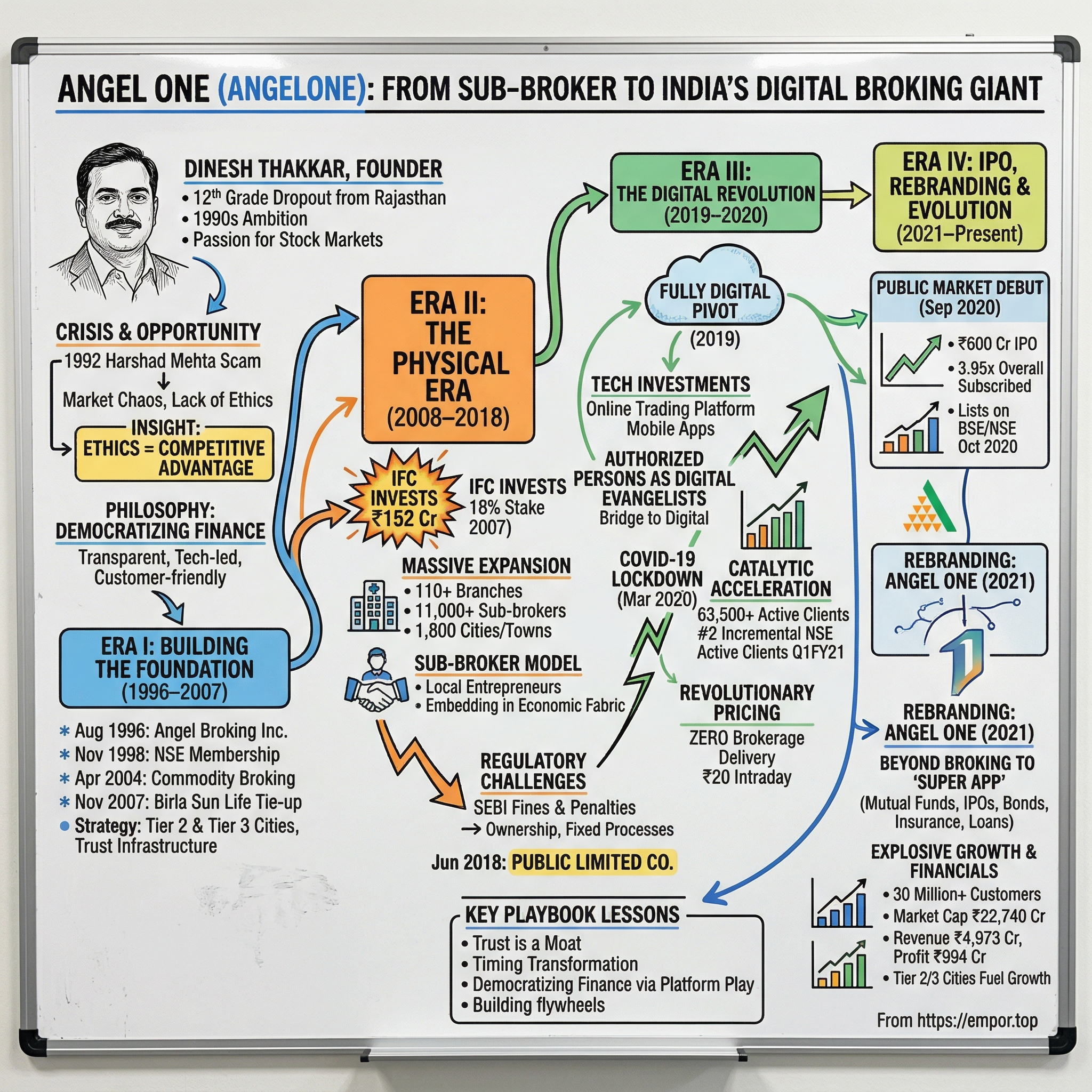
Angel One: From Sub-Broker to India's Digital Broking Giant
I. Introduction & Episode Roadmap
On the morning of January 14, 2025, a man who had spent nearly three decades building one of India's largest retail brokerages got on a conference call and told a room full of analysts to lower their numbers.
The question came from Prayesh Jain of Motilal Oswal, and it was the polite version of the question everyone wanted answered: how bad is this, really? Dinesh Thakkar — Chairman and Managing Director of Angel One, founder, and the person whose name is on the promoter register — did not deflect. He walked through the arithmetic in public. The regulator's crackdown on retail derivatives would cost roughly 13% to 14% of total net income. Bunching monthly expiries into one day per exchange would take another 3% to 4%. "So overall, it would be safe to say that hit appears to be overall, combined everything, true-to-label and all that areas combined together, it would be around 18%," he said. Then he went further than most CEOs would: "For kind of safety purpose, in your model, we can take a revenue hit of 20% one time."1
He was, if anything, optimistic. Six months later, Angel One reported a June 2025 quarter in which consolidated net profit fell 61% year-on-year to ₹114 crore and operating margin collapsed from 37.7% to 21.8%.2 The company that had compounded profits for five straight years had just been cut roughly in half by a regulator's pen.
That is the tension at the centre of this story, and it is why Angel One is worth two hours of anyone's attention.
The hook. A 12th-standard dropout from Bhilwara, Rajasthan, arrived in Bombay, lost his own money to a stock market he found rigged against outsiders, and decided the way to fix it was to become part of it. He founded Angel Broking on August 8, 1996 — four years after the Harshad Mehta scandal had detonated retail trust in Indian equities.3 Over twenty-three years he built a brick-and-mortar empire of branches and franchised sub-brokers reaching deep into small-town India. Then, in 2019, he took the profit engine that empire ran on — percentage-of-turnover commissions — and blew it up on purpose, adopting flat ₹20-per-order pricing before someone else forced him to.4 Today the business he built serves more than 38 million registered users and carries a market capitalisation of roughly ₹27,500 crore.56
The strategic thesis, and what to test. Angel One is usually presented as a textbook case of counter-positioning: the incumbent that self-cannibalised because the disruptor's model was structurally unmatchable for bank-owned rivals earning fat percentage commissions. That part is largely true, and we will show why. But a decade of counter-positioning success does not automatically produce a durable business, and the last two years have exposed exactly where the argument gets thin. Angel One's economics were built on a specific, high-margin, regulator-dependent activity: retail speculation in weekly index options. When SEBI came for that activity in 2024, roughly a fifth of the revenue base went away in a single stroke — not because customers left, but because the regulator changed what customers were permitted to do.
Current stakes. The company that emerges in 2026 looks different from the one that entered 2024. Broking is now about 60% of gross revenue, with the remaining 40% coming from margin lending, distribution, depository fees, wealth management and a fledgling asset-management arm.7 Management frames this as strategic diversification. A skeptic would note that the mix shifted partly because the numerator shrank. Both readings have evidence behind them, and separating them is most of the analytical work in this story.
Episode roadmap. We will move through the sub-broker era and the physical network that defined the first twenty-three years; the existential threat and the 2019 flat-fee pivot; the 2020 IPO and the rebranding to Angel One; management, incentives, ownership and capital allocation, including a promoter stake that has fallen sharply; the core economic engine and its uncomfortable dependence on derivatives; the SEBI regulatory earthquake of 2024–2026, read through the earnings calls where management had to explain itself quarter after quarter; the newer businesses in wealth, credit and asset management and whether any of them is material yet; the competitive landscape against Groww, Zerodha and a set of very well-funded new entrants; the business and investing lessons; and finally the bull and bear cases, with the small number of metrics that actually decide which one is right.
Start where Thakkar started: with a market that was rigged, and a young man who lost money in it.
 Subscribe on LinkedIn
II. The Founder's Origin Story: Dinesh Thakkar & The Sub-Broker Era (1996–2007)
Picture the trading floor of the Bombay Stock Exchange in the early 1990s. No screens. No order books visible to anyone outside the ring. Prices were shouted, hand signals flew, and if you were a retail investor in a small town, you learned what you had paid for a share days later — assuming your broker told you the truth. Settlement was a paper process involving physical share certificates, transfer deeds, and a chain of intermediaries any one of whom could lose your paperwork or your money.
Dinesh Thakkar was born in 1968 in Bhilwara, Rajasthan, a textile town in the Mewar region. His family was in textiles. He completed his 12th standard and did not go further in formal education — a biographical detail that gets recycled endlessly in Indian business media, usually as inspiration, but which is more interesting as context. He did not have a credential to protect. He had no institutional career to lose. When he moved to Bombay and put his own capital into the market, he lost it — to precisely the opacity that defined the system.
The response is the interesting part. He did not leave. He became a sub-broker, starting an entity called Intime Shares in 1992 with ₹5 lakh in capital, offering consultancy and broking services to retail clients.4 That was the year Harshad Mehta's securities scam blew apart the Indian market — a ₹4,000 crore fraud built on fake bank receipts that inflated the Sensex and then destroyed it, wiping out a generation of first-time retail participants and leaving a decade-long trust deficit.
Building a retail broking business in that environment was, commercially speaking, close to insane. Retail investors had just been burned by the market's plumbing and by intermediaries exactly like the one Thakkar had become. Which is why the positioning he chose mattered. Angel Broking was incorporated on August 8, 1996, and the name was chosen deliberately to signal, in the company's own framing, humbleness and a desire to help.4 It was a trust play in a market that had none.
The infrastructure caught up to him. The National Stock Exchange, launched in 1994 with fully electronic screen-based trading, did to Indian equities what the internet did to retail: it made prices visible and settlement enforceable. Angel Capital and Debt Market Ltd. obtained NSE membership in November 1998.[^8] For a firm whose entire pitch was transparency, the arrival of an electronic exchange was less a technology upgrade than a validation of the business model.
The Authorised Person engine
Here is where the real strategic choice of the first era shows up, and it is one that would define the company for two decades — and constrain it for two more years after that.
Indian retail broking in the 2000s faced a distribution problem. The customers were in Nagpur, Surat, Rajkot, Coimbatore, Ludhiana. Bank-owned brokerages solved this by leaning on their parent's branch network, which is why ICICI Direct and HDFC Securities were formidable. Angel had no bank. Building 500 owned branches would have consumed capital the company did not have and produced fixed costs that would kill it in the first bear market — and Indian equity markets deliver bear markets on a reliable schedule.
So Angel franchised. It recruited local financial entrepreneurs — sub-brokers, later formalised by the regulator as "Authorised Persons" — gave them the Angel brand, the trading terminal, the back office, the clearing relationship and the research, and shared the commission. The AP put up the office, brought the relationships, and absorbed the local cost base.
Strategically this was a variable-cost distribution network. Angel converted what would have been fixed overhead into a revenue share that automatically shrank when volumes shrank. It also solved a subtler problem: trust in non-metro India in 2005 was local and personal. A first-time investor in a Tier-3 town would not wire money to a Mumbai firm he had never met, but he would hand a cheque to a man he had known for fifteen years who happened to display an Angel Broking sign. The AP was the trust interface; Angel was the balance sheet and the technology behind it.
Product expansion followed distribution. The commodity broking division opened in April 2004, giving the same AP network a second product to sell into agricultural and bullion-trading towns where commodity speculation was culturally established long before equities were.[^8] Third-party insurance distribution followed in 2007. The pattern — build the pipe, then push more products through it — is exactly the pattern management describes today when it talks about credit and wealth, twenty years later. Whether it works as well the second time is an open question we will return to.
What this era establishes for an investor is a specific competence: Angel has always been better at distribution into non-metro India than at anything else. Not technology, not research, not brand. Distribution. Every subsequent strategic move either leveraged that or fought against it.
By 2007 the company had a national franchise network, three product lines, and no outside capital. That was about to change.
III. The Physical Peak & Incubation of a Digital Blueprint (2008–2018)
In December 2007, with Indian equities at the top of a historic bull market, the International Finance Corporation — the private-sector arm of the World Bank — took a minority position in Angel Broking, investing roughly ₹150 crore that the company deployed into national expansion.48
The timing was almost comically bad. Within nine months Lehman Brothers had failed, global credit had frozen, and the Sensex had lost more than half its value. Retail broking volumes in India cratered. Most brokerages did the sensible thing and retrenched.
Angel did the opposite. It opened 43 branches nationwide during the crisis while competitors contracted.4 Read charitably, this is a founder-led firm taking share when real estate and talent are cheap and rivals are defensive — a genuinely counter-cyclical instinct that recurs in Thakkar's record. Read skeptically, it is a company that had just raised institutional capital and needed somewhere to put it, doubling down on a distribution model whose returns would be structurally challenged within a decade. Both are defensible. What is not in dispute is the result: by the time Angel filed for its IPO, the physical enterprise spanned more than 110 branches and over 11,000 Authorised Persons, with client coverage across roughly 18,000 Indian PIN codes.
The economics of full-service broking, and why they were doomed
It is worth being precise about how this business actually made money, because the fragility is not obvious until you write it down.
Angel charged a percentage of turnover. Cash delivery trades carried commissions in the range of 30 to 50 basis points — meaning a customer buying ₹1 lakh of shares paid ₹300 to ₹500. Sound small? It is roughly fifteen to twenty-five times what the same trade costs today. That revenue was then split with the Authorised Person, who typically kept the larger share.
Three problems compounded. First, revenue per client scaled with the value traded, so a wealthy Mumbai client was worth vastly more than a small-town client executing the same number of trades — which is backwards for a business whose distribution advantage was in small-town India. Second, customer acquisition was expensive and slow: paper account-opening forms, physical KYC verification, in-person signatures, a process measured in days or weeks. Third, and fatally, there was almost no operating leverage. Adding a customer added AP commission cost, back-office cost, and eventually branch cost. Double the customers and you roughly doubled the cost base. The business was a services firm wearing a financial-services costume.
There was also a compliance overhang. Angel Broking faced SEBI scrutiny during the early 2010s, and the broader industry was in the middle of a decade-long regulatory tightening in which the regulator progressively squeezed opacity out of the intermediation chain. For a firm whose founding pitch was transparency this was less threatening than for many peers, but it raised the fixed cost of being a broker — which, again, favoured scale and technology over headcount.
The wave that changed everything
Then, in September 2016, Reliance Jio launched 4G service in India and gave it away. Data prices collapsed by roughly 90% within two years. Smartphone penetration exploded. India went from one of the world's most expensive mobile data markets to the cheapest, essentially overnight.
The consequence for retail broking was not incremental. An entire generation of Indians — young, non-metro, smartphone-native — became reachable through a mobile app for a marketing cost measured in hundreds of rupees rather than the thousands it cost to acquire a client through a branch. Simultaneously, that generation had no intention of visiting a sub-broker's office to sign forms.
By 2018, Angel's management could see the diminishing returns in the physical model directly in the numbers: more branches, more APs, flat-to-declining incremental economics. In June 2018 the company converted to a public limited company, and in September 2018 it filed its draft offer document with SEBI for an IPO seeking roughly ₹600 crore at a valuation of around ₹2,500 crore.9
That IPO would not happen for another two years. In the intervening window, Angel Broking made the decision that defines the company.
IV. The Great Pivot: Cannibalization & Flat-Fee Disruption (2019–2020)
To understand what Angel did in 2019, you have to understand what was being done to it.
Zerodha, founded in Bangalore in 2010 by Nithin Kamath, had spent the decade proving something the entire Indian broking industry had convinced itself was impossible: that retail investors would happily pay a flat fee per order rather than a percentage of value, and that a broker could be wildly profitable at that price with no branches, no sub-brokers, no salespeople and no advertising. Zerodha charged zero on equity delivery and ₹20 per executed order on intraday and derivatives. It was entirely bootstrapped. And it was taking the industry's customers.
Upstox, venture-backed and eventually carrying Ratan Tata and Tiger Global on its cap table, was doing the same thing with a bigger marketing budget. Groww, founded in 2016 by ex-Flipkart executives, was coming at the same customer from the mutual-fund side with an interface so simple it embarrassed everyone else.
The full-service brokers watched their share of new account openings evaporate. And they could not respond — which is the essence of counter-positioning, and worth stating precisely rather than as a slogan. A bank-owned brokerage like ICICI Direct earning, say, 50 basis points on delivery could not move to ₹20 flat, because on a ₹1 lakh trade that is a 96% price cut on its most profitable product. The parent bank's securities arm was a high-margin contributor to group earnings; deliberately destroying it to chase a lower-revenue-per-customer model that might work at scale in five years is not a decision a professional manager inside a large bank can get approved. The incumbents were not stupid. They were structurally trapped.
Angel Broking was trapped too — just differently. Its trap was not a bank parent. It was 11,000 Authorised Persons whose entire livelihood was a share of percentage commissions.
The decision
In April 2019, Angel launched the iTrade Plan: zero brokerage on equity delivery, flat ₹20 per executed order on everything else.10 It applied this across its business — not as a walled-off digital-only sub-brand, but as the pricing of the firm.
Think about what that meant internally. Angel voluntarily reduced the revenue on its highest-margin product to zero and capped everything else at a number that was, for any trade above roughly ₹5,000 in value, a price cut. It did this while carrying the full cost base of 110 branches and a national franchise network built entirely to service the old pricing.
The financial logic depends on a single bet: that flat-fee pricing so massively expands the customer base and the number of orders that the aggregate fee pool grows even as the fee per rupee traded collapses. That bet only pays if the cost of serving each additional customer falls toward zero — which requires the business to become software.
Managing the network revolt
The Authorised Persons did not take this well, and it would be dishonest to pretend the transition was smooth. Angel's answer was to reposition the AP's role rather than eliminate it: from trade-execution agent, where the value added was placing an order the customer could now place himself, to acquisition-and-advisory partner, compensated on the clients he brought and retained rather than on the ticket size of each trade.
Whether this genuinely worked is testable, and the test result is genuinely mixed. The assisted channel survives — as of June 2026, Angel One had roughly 9,800 active Authorised Persons, still around the 10,000 mark it reached a decade earlier.5 But direct business now accounts for the clear majority of net broking revenue, with the assisted channel a minority contributor. The AP network did not die. It also did not grow. It became a legacy asset that management is now trying to re-energise by pushing mutual funds, insurance and loan distribution through it — the same "build the pipe, push more products" instinct from 2004.
Rebuilding the machine
The pricing change was the visible move. The invisible one was harder and mattered more.
A legacy broker's technology stack in 2018 was typically a client-server architecture: a monolithic application, vendor-licensed, sized for a predictable number of terminals, updated a few times a year. It works fine when your users are 11,000 professional sub-brokers with desktop terminals. It falls over when you have millions of retail users on phones all hitting "buy" in the same thirty seconds after a budget announcement.
Angel re-architected onto cloud infrastructure with microservices — the plain-English version being that instead of one giant program where a failure anywhere takes down everything, you build dozens of small independent services that can be scaled, updated and repaired individually. Order placement, risk checks, portfolio display, charting and payments become separate machines that talk to each other. The commercial consequence is that capacity becomes something you rent by the hour on the days that matter rather than something you own year-round for the peak.
Onboarding got the same treatment. Aadhaar-based paperless e-KYC and digital signatures let Angel market "Trade in 1 Hour" — an account opened, verified and funded in under an hour with no human involved.4 For a business whose old bottleneck was physical form collection in 18,000 PIN codes, this was the difference between a distribution network and a download button. Angel also built ARQ, a rule-based advisory engine delivered in-app, which by the early 2020s had been downloaded millions of times.4
COVID
Then the pandemic arrived, and India's retail investing base did something nobody modelled. Lockdowns confined tens of millions of people to their homes with a smartphone, no commute, and in many cases nothing to do. Markets crashed in March 2020 and then rallied for eighteen months. Discount brokerage account openings went vertical across the industry.
Angel's digital client acquisition, which had been a minority of additions before the pivot, became the overwhelming majority. Total consolidated income went from under ₹200 crore in the March 2020 quarter to ₹318 crore in the September 2021 quarter, and the client base grew from 2.69 million in September 2020 to 6.1 million a year later — a 142% increase.4
The honest reading is that Angel got the strategy right and then got extraordinarily lucky on timing. The pivot was correct on its own merits; the pandemic compressed five years of adoption into eighteen months and made a difficult transition look effortless. Investors should hold both thoughts. Management's decision in 2019 was genuinely brave — it destroyed a known profit pool for an unproven one, before the disruption became terminal. But the evidence that the pivot "worked" is contaminated by the single greatest retail-participation boom in Indian market history. The real test of the model came later, in a market the regulator was actively trying to cool.
With a business now growing at a rate no private company could fund internally, the IPO that had been shelved in 2018 came back.
V. The Public Debut & Rebranding to Angel One (2020–2022)
The IPO opened on September 22, 2020 and closed on September 24, at a price band of ₹305 to ₹306 per share, raising ₹600 crore — ₹300 crore of fresh capital and ₹300 crore of secondary sale, with IFC among the selling shareholders.11812 The book was subscribed 3.94 times.
And then the market shrugged. On October 5, 2020, Angel Broking listed at ₹275 against an issue price of ₹306 — a 10% discount on debut.13
This is one of the more instructive moments in the story, because the market's initial verdict was not stupid. It was applying a well-earned prior. Indian broking stocks had historically been treated as high-beta proxies for market sentiment: revenue is a function of turnover, turnover is a function of animal spirits, animal spirits mean-revert, and therefore peak earnings deserve a trough multiple. Every previous listed Indian broker had validated that view.
What the market underweighted was that the cost structure had changed. In the old model, doubling clients roughly doubled costs. In the rebuilt model, the marginal cost of an additional order on cloud infrastructure is close to zero, which means incremental revenue drops through to profit at a very high rate. That works spectacularly in both directions — which the market would eventually see, in 2025, at considerable cost to shareholders. But in 2020 the operating leverage was all upside, and the stock re-rated hard over the following eighteen months as earnings compounded.
From Angel Broking to Angel One
On May 29, 2021, the board approved a new masterbrand, and on August 3 the company unveiled it: Angel One.14 The legal entity kept the old name for a while; the customer-facing brand did not.
Corporate rebrandings are usually cosmetic. This one was a strategy statement, and the word choice tells you what management was trying to do. "Broking" describes a transaction. "One" describes a destination — the single app where a customer does everything financial. The target was explicit: millennials and Gen Z who had opened their first account during COVID and had no relationship with the legacy brand's small-town, sub-broker-led associations.
The Super App followed the brand. Equities, derivatives, commodities, mutual funds, IPO applications, sovereign gold bonds and US equities were pulled into one interface built for high concurrency — which matters more than it sounds. On a volatile trading day, an Indian retail broking platform has to absorb order flow that spikes by an order of magnitude within minutes of a policy announcement. Outages during those windows are the single most brand-destroying event in the business, and every major Indian broker has suffered them.
The market share prize
The measurable outcome of 2020–2022 was share. Angel One vaulted past the bank-owned brokerages — ICICI Direct, HDFC Securities, Kotak Securities — on NSE active clients, and for a period sat second in the industry behind Groww.
It is worth being blunt about how that ranking has since moved, because the outline version of this story and the 2026 reality have diverged. As of March 2026, Groww led with 1.29 crore NSE active clients, followed by Zerodha at 68.93 lakh and Angel One at 67.62 lakh — a gap of roughly 1.3 lakh clients between second and third place.15 Angel One is, on that metric, essentially tied for second and marginally behind. More importantly, the industry itself shrank: total NSE active clients fell 7.1% during FY26, from 4.92 crore to 4.57 crore, with Angel One losing 8.15 lakh active clients and Zerodha losing 9.95 lakh. Groww was the only major player that grew, and it grew by a rounding error.15
That is a different competitive picture than the growth story of 2021, and it frames everything that follows. Angel One's registered user base kept climbing — 38.6 million by June 2026, up 18.8% year-on-year — while its active client count fell.5 Registered users are an acquisition metric. Active clients are an engagement metric. When the two diverge for four consecutive quarters, the question stops being "how fast are you growing" and becomes "what is this user base actually worth."
Before answering that, look at the people making the decisions — because the team running Angel One in 2026 is not the team that ran it through the pivot.
VI. Management, Incentives, Ownership & Capital Allocation
Angel One's leadership page today would be unrecognisable to an investor who last looked in 2021, and the changes are substantive rather than cosmetic.
Dinesh Thakkar, Chairman & Managing Director
Thakkar remains the strategic centre of gravity and the largest single shareholder, holding roughly 18.6% of the company personally.16 His public style, evident across two decades of earnings calls, is unusually direct for an Indian promoter-CEO — the January 2025 exchange where he handed analysts a 20% downside number without being cornered into it is characteristic, not exceptional.
His prepared remarks have also become notably more abstract over time. Compare the specificity of the 2025 regulatory guidance with his opening on the July 2026 call: "We are not simply building a fintech product. We are building a long-term financial ecosystem designed to participate in India's financialization journey for decades to come."5 That is a fine sentence and it is also unfalsifiable. Investors should note the shift in register — from operator giving numbers to chairman giving vision — and ask what work the vision language is doing.
Ambarish Kenghe, Group CEO
The most consequential appointment in the company's recent history. Kenghe joined as Group CEO in March 2025 — the trough quarter of the regulatory shock — from Google, where he was Vice President and General Manager for Google Pay in APAC, and before that Chief Product Officer at Myntra.17
Reading this hire correctly matters. Angel One did not recruit a broking executive. It recruited a consumer-internet product operator who had scaled a payments platform inside India's UPI boom. The signal is that the board concluded the next decade of value creation comes from product, data and cross-sell rather than from trading market share — which is a coherent thesis and also a convenient one for a company whose trading market share had just been capped by regulation.
Kenghe's fingerprints on the calls are distinctive. He talks about AI as an operating input rather than a marketing line, with specifics: roughly 25% of committed code AI-generated as of the March 2026 quarter, more than 50% of development in AI-enabled engineering teams augmented by AI, KYC face-match running above 99% accuracy, and 80% of the wealth subsidiary's codebase AI-generated.1819 He is also willing to say "I don't want to give guidance on that" rather than manufacture a number — on employee headcount, on customer acquisition cost, on mid-quarter volumes. That is a defensible posture, though analysts have visibly tired of it.
Vineet Agrawal, Group CFO
Agrawal is the most quantitatively useful voice on the calls and the one who introduced the concept that now dominates how Angel One reports itself: the normalized EBDAT margin, which strips out items management deems seasonal or one-off — annual increments, fresh ESOP grants, IPL brand spending concentrated in April and May.
In the June 2026 quarter, reported consolidated EBDAT margin was 32.7% while normalized margin was 43.6%, against 44.4% the prior quarter.5 An eleven-point gap between reported and adjusted profitability is large enough that investors should look hard at what is being adjusted out. IPL sponsorship recurs every single year. Employee increments recur every single year. Fresh ESOP grants recur. A cost that happens annually is not an exception; it is a first-quarter cost. Management's guidance range of 45–50% standalone and 40–50% consolidated normalized margin is coherent, but it is a guidance framework built on a metric the company defines itself.5 The reported number for FY26 as a whole is the one that pays dividends.
The promoter stake question
This is where an activist investor would spend their time, and the trend deserves to be stated plainly rather than smoothed over.
Promoter holding at Angel One has gone: 44.55% in March 2021, 44.00% in March 2022, 38.48% in March 2023, 38.21% in March 2024, 35.55% in March 2025, and 28.59% as of June 2026.6 That is a decline of roughly sixteen percentage points in five years, with the sharpest single-year drop occurring after the regulatory shock rather than before it.
Some of the earlier dilution is straightforwardly explained: the company raised ₹1,500 crore through a qualified institutional placement completed in early April 2024, issuing 58.7 lakh shares at a floor price of ₹2,555.01 to fund margin obligations and working capital.20 Institutional issuance dilutes promoters mechanically and is not a governance concern.
But QIP dilution does not account for the full move, and the FY26 leg down is the one that warrants scrutiny. There is no disclosed strategic rationale in the earnings calls for promoter selling, and no analyst on any of the four most recent calls asked about it. That silence is itself notable. The steelman for the company is that a founder who took a business from a ₹5 lakh sub-brokerage to a ₹27,500 crore listed platform is entitled to diversify, and that a 28.6% stake — with Thakkar personally holding 18.6% — is still a substantial economic commitment far above the level at which alignment concerns typically arise. The bear reading is that promoter selling accelerated precisely as the regulatory environment deteriorated and the growth narrative shifted from broking to a set of businesses that are, on the company's own disclosure, still years from breakeven. Investors do not have enough disclosed information to adjudicate between those readings, which is the actual problem.
Capital allocation
The record here is more reassuring than the ownership trend.
Angel One's balance sheet as of March 2026 carried a net worth of ₹61.5 billion, cash and equivalents of ₹165.6 billion, and a period-end client funding book of ₹54.5 billion.18 By June 2026 net worth had risen to ₹64.2 billion, the average client funding book had reached a record ₹61.4 billion and the period-end book ₹71.5 billion, while borrowings actually fell during the quarter despite the funding book growing — the prior quarter's elevated borrowing having been an artefact of the April 1 banking holiday.5
The dominant use of capital is margin trading facility lending — advancing money to clients against their equity holdings. On credit quality, Agrawal disclosed that 83% of client funding exposure sits below ₹1 lakh per client and 85% of the portfolio is less than 30 days old, fully collateralised against client holdings with negligible delinquency.5 That is a granular, short-duration, secured book, and it is genuinely low-risk for the lender in normal conditions. The risk is not credit; it is correlation. Every rupee lent is secured by the same asset class, and a sharp market decline compresses collateral values across the entire book simultaneously while also collapsing the trading revenue that funds the business. It has not broken yet — Agrawal correctly points to past drawdowns where the risk system held — but it has never been tested by a genuine multi-quarter bear market at this book size.
The second use is investment in new businesses, done at a deliberate and disclosed scale. The board approved capital infusions of up to ₹1.5 billion each into the wealth management business and the NBFC platform in April 2026.18 The operating drag from wealth and asset management combined runs about 3% to 3.5% of margin for a full year, and was 4% in the June 2026 quarter.5 Vineet Agrawal's framing — "We are not pursuing growth at the expense of returns" — is supported by the actual numbers here.5 These are contained bets, sized as a few hundred basis points of margin, not a bet-the-company diversification.
The third use is shareholder returns, and the company has been consistent. In FY26 Angel One declared a first interim dividend of ₹23 per share on the pre-split ₹10 face value, alongside a 1:10 stock split announced in January 2026 that took shares outstanding from 90.86 million to 908.55 million, effective February 26, 2026.21 A second interim dividend of ₹1.75 on post-split shares followed, and the board declared ₹1 per share as the first interim dividend of FY27 with a record date of July 21, 2026.5
One number cuts against the "high-quality compounder" framing and deserves stating: return on equity for FY26 was approximately 15.6%, with ROCE of 14.8%.6 That is a long way from the 30%-plus returns this business generated in its peak years. Part is the earnings decline; part is the equity base having been enlarged by the QIP and by retained profits held against a growing funding book. A broker earning mid-teens returns on equity is a decent financial business. It is not the capital-light software compounder the narrative sometimes implies.
Which brings us to how the money is actually made.
VII. The Core Business Engine: Economics, Segments & SEBI Regulatory Shock (2023–Present)
Strip away the platform language and Angel One in 2026 makes money four ways.
Broking. Roughly 60% of gross revenue.5 Customers pay a flat fee per executed order. The critical structural fact — and the one that explains almost everything about the last two years — is the mix within broking. In the December 2024 quarter, F&O contributed about 81% of gross broking revenues, with cash at 12% and commodity at 7%.1 Read that again. Four-fifths of the fee engine came from derivatives.
The mechanism is simple once you see it. A ₹20 flat fee is a rounding error on a large trade and a meaningful cost on a small one, so the model rewards order count, not order size. Nothing on earth generates retail order count like weekly index options, where contracts expire every few days, premiums are small enough that a customer can take a position for a few hundred rupees, and the psychological loop between action and outcome closes in hours. Cash delivery — priced at zero for years — was the funnel. Options were the monetisation.
Interest income. About 32.6% of gross revenue in the June 2026 quarter, growing 2.6% sequentially to ₹4.7 billion.5 Two components: interest on money lent to clients through the margin trading facility, priced at 14.99% following a revision in November 2024, and interest earned on client float and fixed deposits placed as margin with clearing corporations.1 This is the most predictable income the company has, and its growth is why the revenue mix shifted so visibly.
Depository and ancillary fees. Demat maintenance, DP transaction charges. Small, steady, and directly correlated with cash-segment delivery volumes — income from depository operations fell 24% sequentially in the December 2024 quarter purely because cash delivery transactions dropped.1
Distribution. About 3% of revenue: mutual funds, insurance, IPO applications and loan distribution.5 Management devotes a disproportionate share of every earnings call to this 3%, which tells you where they believe the future is and also that it is not the present.
The earthquake, part one: true-to-label
For years, Indian brokers earned a quiet, high-margin income most retail clients never noticed. Exchanges charged transaction fees on a slab basis — the more volume a broker routed, the lower the per-unit fee it paid. Brokers, however, charged clients at the headline rate. The difference between what the client was billed and what the exchange actually charged was pure margin, and because it required no capital, no service and no risk, it fell almost entirely to the bottom line.
SEBI ended it. Effective October 1, 2024, brokers were required to charge clients exactly what exchanges charged them — "true-to-label" pricing.
The impact on Angel One is quantifiable because the company disclosed it directly. Ancillary transaction income, which stood at ₹1.15 billion in the September 2024 quarter, was nil in the December 2024 quarter.1 Gross revenues would have been ₹1.1 billion higher had the income persisted. To offset it, Angel introduced a flat fee on cash delivery orders — ending years of free delivery — and began charging interest on non-cash collateral above ₹50,000 from mid-November 2024, recovering about ₹238 million in the quarter.1 Roughly a fifth of what was lost, recovered in half a quarter.
Thakkar's characterisation of the mitigation as leaving only "1% to 2% difference in terms of what we had estimated" is a defensible reading of an incomplete quarter.1 It is also the kind of framing worth checking against subsequent results, and we will.
The earthquake, part two: the six measures
On October 1, 2024, SEBI announced six measures to curb speculation in index derivatives, aimed at retail investors who — by the regulator's own studies — were losing money in aggregate at a striking rate.22
Three mattered commercially. Contract size rose from a minimum of ₹5 lakh to ₹15 lakh at introduction, with lot sizes set so contract value falls between ₹15 lakh and ₹20 lakh — effectively tripling the minimum capital a retail trader needs to take a single position.2223 Weekly expiries were limited to one benchmark index per exchange, effective November 20, 2024, collapsing what had become a near-daily expiry calendar across NSE and BSE into two events per week industry-wide.23 And upfront collection of option premiums from buyers, plus removal of calendar spread benefits on expiry day and intraday position-limit monitoring, stripped out the leverage that made small-ticket speculation viable.
Each measure independently reduced retail derivative order count. Together they were designed to.
What actually happened
Angel One's aggregate orders fell 13.8% sequentially to nearly 422 million in the December 2024 quarter.1 Gross broking revenue fell 12.5% sequentially to ₹8.2 billion. Reported consolidated EBDAT margin fell 787 basis points quarter-on-quarter to 42%. Profit after tax from continuing operations declined 33.5% sequentially.1
Then it got worse. The measures were phased, and full implementation landed through the March and June 2025 quarters. Average daily orders bottomed at 5.0 million in February 2025.18 The June 2025 quarter produced the number that defined the cycle: revenue down 18.85% year-on-year to ₹1,140.5 crore, EBDAT down 53.6%, margin at 21.8%, and net profit down 61%.2 Gross client acquisition in June 2025 fell 41.5% year-on-year.2
Now grade the guidance. Thakkar told analysts in January 2025 to model roughly an 18% hit, with 20% as a conservative case. FY25 revenue came in at ₹5,239 crore and FY26 at ₹5,138 crore — a decline of about 2%.6 On revenue, the outcome was far better than guided, because the client funding book and interest income grew hard enough to fill most of the hole.
But profit is a different story. FY25 net profit was ₹1,172 crore; FY26 was ₹915 crore — a decline of 22%.6 The revenue that was lost was near-100%-margin exchange-rebate and derivative-fee income. The revenue that replaced it was interest income requiring balance sheet, funding cost and capital. Management's guidance was directionally honest on the top line and understated the operating-leverage damage below it. That is a meaningful distinction, and it is the single best illustration of what this business actually is: not a software platform with incidental financial exposure, but a financial intermediary whose profitability is a levered function of retail trading intensity.
The response
To Angel One's credit, the operational answer was fast and mostly worked. Pricing was recalibrated — a flat fee on cash delivery, charges on non-cash collateral, an MTF rate reset, and a further pricing change implemented mid-quarter in the December 2025 quarter that raised realisation per order.24 The client funding book was pushed hard, growing from an average of ₹40.5 billion in the December 2024 quarter to ₹61.4 billion by June 2026 — a 52% increase over eighteen months in a period when trading activity was falling.15 Costs were taken out: employee headcount fell from 4,139 at the end of FY25 to roughly 3,300 at the end of FY26, a reduction of about 20%, with Agrawal guiding total employee cost including stock options to hold flat at roughly ₹11 billion in FY27.5
By the March 2026 quarter, average daily orders had recovered to 7.4 million, aggregate orders hit 431 million — a six-quarter high — and reported margin was back to 41.7%.1819 Angel One had, on its own terms, absorbed the shock.
The uncomfortable coda is that the recovery in orders did not come with a recovery in active clients, and the June 2026 quarter saw orders fall back to 406 million as derivative volumes moderated across the industry.5 Which raises the question management has been trying to answer for two years: what else is there?
VIII. Hidden & Future Optionalities: Wealth Management, Credit & AMC
On the July 2026 earnings call, Prayesh Jain of Motilal Oswal asked a question he prefaced with an apology: "I ask this every quarter, but not getting these numbers." He wanted revenue and cost for the wealth management business. Vineet Agrawal's answer was that the company does not disclose revenue for wealth management or asset management separately.5
That exchange is the honest starting point for this section. Angel One's new businesses are being discussed on earnings calls with a prominence that far exceeds their disclosed financial contribution, and the primary metric investors are given is assets under management — a stock, not a flow, and not a profit.
Materiality first
The company reports non-broking revenue at roughly 40% of the total, but the overwhelming majority of that is interest income on client funding — an extension of the broking relationship, not a new business.5 Distribution income, which contains credit, mutual funds, insurance and IPO commissions, is about 3% of revenue. Wealth management and asset management contribute no separately disclosed revenue at all, and together consume roughly 300 to 400 basis points of operating margin.5
So: these are options, not engines. The correct analytical posture is to ask what would have to be true for any of them to matter, and what evidence exists so far.
Ionic Wealth — the most credible of the three
Angel One launched its wealth management brand, Ionic Wealth, in the December 2024 quarter, having secured a Portfolio Management Services licence under Angel One Wealth Limited.1 It is run by Srikanth Subramanian as co-founder and CEO — an executive with roughly two decades in Indian private wealth — alongside co-founders Shobhit Mathur and Dharmendra Jain.
The growth is real. AUM reached ₹82.2 billion across 1,600-plus clients in ten cities by December 2025, ₹100.8 billion by March 2026, and ₹134.4 billion by June 2026 — up 165% year-on-year, serving over 2,400 clients.24197 Within that, the ultra-high-net-worth segment accounts for ₹87.3 billion across 263 families, with the wealth-tech tier serving clients between ₹1 crore and ₹50 crore of net worth at ₹32.3 billion.5
Subramanian's framing on the calls is unusually disciplined for a growth business. He repeatedly emphasises that Ionic optimises for annuity-linked AUM rather than transactional revenue, calling out "the temptations of getting AUM which is very high on one-time transactional revenue" as something that undermines a durable franchise.5 Assets under management per relationship manager grew 3x year-on-year, and greater than 45% of the client base sits outside metros.18 Management has been consistent across at least three calls that breakeven is a three-to-four-year proposition from launch.
Where it deserves skepticism: the UHNI business acquires clients through relationship managers who bring their own books from prior employers. That is the industry-standard model — and it means the asset is portable in both directions. The moat is the RM, not the platform, and RMs leave. Subramanian's own answer to a Citi analyst who asked precisely this was candid: "The UHNI business usually works with high-quality RMs bringing in their customers."5 He also volunteered that wealth "is not going to be a winner takes all market" and that India supports "8 to 10 high-quality wealth players" — an unusually honest acknowledgment that this is a good business to be in rather than one where Angel One holds a structural edge.5 The genuinely differentiated claim is the omnichannel wealth-tech tier, where technology substitutes for RM coverage in the ₹1 crore to ₹50 crore segment. That segment sits at ₹32.3 billion and is the one worth watching, because it is the only part that could scale without scaling headcount proportionally.
Credit distribution — real, and currently stumbling
The credit business is asset-light by design. Angel One does not lend from its own balance sheet; it uses proprietary propensity models, probability-of-default scorecards and lender approval engines to match its users to seven partner banks, NBFCs and fintechs, earning a distribution fee.524 Lifetime cumulative disbursements reached ₹27.1 billion by March 2026.18
The strategic logic is strong. Angel One knows things about its users that a cold-start lender does not: income proxies from trading behaviour, asset holdings visible in the demat account, payment consistency. Management sized the embedded opportunity by noting its user base consumes over ₹1 trillion of personal loans annually from the broader market, with only a small fraction ever having taken credit through the platform.18
The execution has not matched the logic. Quarterly disbursals went ₹710 crore, then ₹610 crore, then ₹530 crore — a roughly 30% decline from peak — even as year-on-year comparisons showed 130% growth off a small base.5 Confronted directly on the July 2026 call, Saurabh Agarwal attributed the slide to lenders "calibrating their risk and their pricing on our base over time" and to friction in partner KYC and underwriting funnels.5
That answer is more revealing than it may appear. It says the constraint is not demand from Angel One's users; it is lender appetite for those users. Which is a signal worth sitting with. If partner lenders are tightening on a cohort of retail derivatives traders during a period of weak market returns, an investor should ask whether the credit quality of this base is as attractive as the propensity models imply. Angel One captures the fee and not the credit risk — genuinely good positioning — but a distribution business whose supply of capital depends on partners' risk appetite is not fully in control of its own growth. A loan-against-securities product on Angel One's own NBFC was in limited pilot as of July 2026, with management guiding to broader rollout over two to three quarters.5
The AMC — the weakest link so far
Angel One Asset Management received SEBI approval to launch its mutual fund business in November 2024, and went live with a passive-first strategy: the Angel One Nifty Total Market ETF and Index Fund with an NFO closing February 21, 2025, followed by Nifty 50 index products in May 2025 and India's first smart-beta funds tracking a momentum-quality screen of the Nifty Total Market Index in November 2025.252627
Fifteen months in, AUM stood at ₹6.2 billion as of June 2026 — up 81% year-on-year and 71% sequentially, but from a base so small that percentages flatter it.7 For context, that is roughly one-twentieth of the wealth business's AUM and an immaterial fraction of a domestic mutual fund industry measured in tens of trillions of rupees. Period-end AUM had actually fallen sequentially in the March 2026 quarter to ₹3.6 billion on softer markets and liquid fund redemptions, though folio count rose 28% to over 246,000 across 17,575 PIN codes — evidence the distribution reach is genuine even if the assets are not.18
Prayesh Jain's question on the July 2026 call was the right one and was not really answered: "What has so far not gone right? It has been some time that we have launched the AMC and we have hardly scaled up any AUM." Amit Majumdar's response — that passive businesses take time, that products were only fully rolled out in the final quarter of FY26, and that the company is "looking at how to further expand this portfolio beyond what we are currently doing in passive" — concedes the strategy is being revisited.5 The same call disclosed significant management churn at the AMC, with the business running under an interim CEO.5
An honest assessment: passive asset management is a scale-and-cost game where the incumbent advantage is enormous and the fee pool is thin by design. Angel One's edge — captive distribution to 38 million users — is real but unproven, and the pivot toward active products would put it in direct competition with entrenched AMCs on a dimension where it has no track record.
What this section means for an investor
None of these three is a reason to own the stock today. Collectively they cost 3–4% of operating margin and generate no disclosed profit. Wealth management is the one with demonstrated commercial traction and a management team that talks about unit economics rather than headline growth. Credit has the best structural logic and the worst recent execution. Asset management is, on the evidence, behind plan.
The value of the optionality is real but should be discounted heavily and dated far out: management's own breakeven horizon for wealth is three to four years from a 2025 start.5 Anyone underwriting Angel One today is underwriting the broking and lending engine, with these as free options attached.
Which means the competitive question is unavoidable.
IX. Competitive Landscape & 7 Powers Analysis
India's retail broking market has consolidated into something close to a three-firm race, with a long tail of legacy bank brokers losing share and a set of new entrants with balance sheets large enough to change the game.
The field
Groww is the clear leader and the most uncomfortable competitor. Founded in 2016 by former Flipkart executives, it built its base by making mutual fund investing trivially easy and then converted those users into equity and derivatives traders. Its parent, Billionbrains Garage Ventures, listed in November 2025 after a ₹6,632 crore IPO priced at ₹95–100 per share, debuting at a double-digit premium and subsequently crossing ₹1 trillion in market capitalisation.2829 With 1.29 crore NSE active clients and a 28.2% share as of March 2026, Groww is roughly twice Angel One's size on that metric and was the only major broker to add active clients during a year when the industry lost 35 lakh.15 Its historical weakness has been lower revenue per user — a mutual-fund-first funnel monetises less than a derivatives-first one — but that weakness looks a great deal less relevant in a world where the regulator has capped derivatives intensity.
Zerodha remains the industry's most remarkable financial performer: bootstrapped, never advertised, and for years the most profitable broker in India per employee. Its base skews toward experienced, high-ARPU traders. It lost 9.95 lakh active clients in FY26 — the largest absolute decline of any broker — which is what happens when your user base is concentrated in exactly the cohort SEBI targeted.15 Zerodha's structural advantage is that it has no shareholders demanding growth, which lets it decline gracefully in a way listed competitors cannot.
Angel One sits third by NSE active clients and first among the three on some other measures: a 22.2% retail turnover market share in equity derivatives, 17.4% in cash equity, 20.2% of overall retail equity turnover, and a commanding 52.3% share of retail commodity turnover.7 That last number is worth pausing on. Angel One's dominance in commodities — a legacy of the 2004 commodity division and the small-town AP network that sold into bullion and agricultural trading communities — is the most durable share position the company holds, and it is barely discussed. Its demat account share is 16.7%.7
Bank-owned brokers — ICICI Direct, HDFC Securities, Kotak Securities — retain the advantage of integrated bank accounts and captive customer bases, and have lost share for a decade to firms with better products and lower prices. Their cost structures were built for a different pricing regime.
The new entrants are the genuine strategic risk. Jio Financial Services and BlackRock incorporated Jio BlackRock Broking Private Limited in January 2025 and received SEBI registration as a stockbroker in June 2025.30 This is a competitor with a distribution reach that dwarfs every incumbent, a global asset manager as partner, and no legacy revenue to protect. PhonePe's Share.Market operates from a payments base of comparable scale. Neither has taken meaningful share yet. Both could compete on price without needing broking to be profitable — which is the exact structural condition that let Zerodha destroy the full-service brokers in the first place.
Porter's five forces, briefly
Rivalry is intense and price-based, with the marginal price already at zero for delivery and ₹20 for everything else. There is very little room left to compete downward, which pushes competition toward product breadth and user experience.
Buyer power is high and rising. Switching brokers in India requires opening an account elsewhere and transferring holdings — a process that takes days, not months. The retail customer who complained on the July 2026 earnings call that he had moved his SME shares from Angel One to Zerodha over a stock-restriction policy demonstrated the point live, on a public call, to the Group CEO.5
Supplier power sits with the exchanges and clearing corporations, and true-to-label demonstrated exactly how much of it there is: SEBI removed a broker revenue stream by fiat, and brokers had no recourse.
Threat of substitutes is real and underappreciated — every rupee of household savings routed into a direct mutual fund SIP, a fixed deposit, gold or real estate is a rupee that does not generate broking fees.
Threat of new entry is the highest it has been in a decade, for the reasons above.
The 7 Powers audit
Hamilton Helmer's framework demands that a "power" be both a benefit and a barrier — something that improves economics and that a competitor cannot replicate without unacceptable cost. Applying it strictly to Angel One:
Counter-positioning: earned, then spent. The 2019 flat-fee pivot was textbook counter-positioning, and it worked precisely because bank-owned rivals could not follow without destroying their own profit pools. But counter-positioning is inherently a transitional power. Once every relevant competitor has adopted the new model — as Groww, Zerodha, Upstox and Angel One all have — the power dissipates. Angel One's counter-positioning advantage against ICICI Direct is largely realised. It has no counter-positioning advantage against Groww whatsoever, and Jio BlackRock could counter-position against all of them by treating broking as a loss leader for asset management.
Scale economies: real, but shared. Cloud microservices genuinely mean the marginal cost of an incremental order approaches zero, and the recovery from 21.8% to 43.6% normalized margin in four quarters while headcount fell 20% is direct evidence of operating leverage.25 But every serious competitor has the same architecture. Scale economies that all three leaders possess set a floor under industry margins; they do not differentiate.
Process power: the strongest genuine claim. The hybrid model — 9,800 Authorised Persons providing local, vernacular, high-touch trust alongside a national digital acquisition engine — is difficult to copy, not because the idea is clever but because building a 10,000-partner network takes twenty years of relationships. Groww cannot buy this. It is also, on the evidence, a declining asset: the AP count is flat, direct business dominates net broking revenue, and management is trying to repurpose the channel for mutual fund and loan distribution precisely because its original function has been automated away.5
Cornered resource, switching costs, branding, network economies: not established. There is no proprietary input a competitor cannot obtain. Switching costs are low. Brand matters — Angel One spends heavily on IPL sponsorship, which is why the June quarter's reported margin looks the way it does — but brand in Indian broking has not prevented share shifts. There are no network effects: your trading experience does not improve because other Angel One users exist.
The AI claim. Management increasingly positions AI as the emerging differentiator — a data flywheel where every trade, SIP and loan application generates signals that compound into better product matching.5 The internal productivity evidence is concrete and credible: AI-generated code, automated ticket handling, KYC face-match at scale, and a headcount reduction that did not break the business. The competitive claim is weaker. Groww has more users and comparable engineering. The flywheel argument requires that data advantages compound faster than competitors' data advantages, and there is no disclosed evidence yet that they do.
The fair summary: Angel One has a good competitive position built on distribution reach and cost structure, and one genuinely hard-to-replicate asset in its hybrid assisted network. It does not have an unassailable moat, and the powers that once protected it are the ones that have decayed most.
The best place to test whether management understands this is the earnings calls themselves.
X. Primary Evidence & Earnings Call Synthesis
Read four Angel One earnings calls back to back and you can watch a narrative get rebuilt in real time.
January 2025: the confession
The December 2024 quarter call is the most useful document Angel One has produced, because management was forced to be specific. Thakkar handed analysts an 18% impact estimate and a 20% modelling suggestion without hedging. Agrawal disclosed the exact ancillary income that had vanished and the exact amount recovered through pricing. He also did something rarer: he restated the quarter on a like-for-like basis, showing that gross income would have been approximately ₹13.5 billion versus the ₹12.6 billion reported, converting a 16.6% sequential decline into a 10.9% one.1
That is good disclosure. It is also advocacy — a restatement designed to make the quarter look better — and investors should recognise both things at once. The distinguishing feature of credible management is that they give you the components so you can disagree. Agrawal did.
The prepared remarks contained one piece of pattern-matching that deserves scrutiny because it has since become the company's standard regulatory defence. Thakkar invoked the peak margin regulations of 2020–2021, arguing that clients adapt quickly and that such interventions ultimately drive growth through an expanded client base, enhancing client longevity and lifetime value.1 The analogy is imperfect in an important way. Peak margin rules changed how much leverage a trader could use. The 2024 measures changed the minimum viable position size by 3x and eliminated most of the expiry events that generated order flow. One is a friction; the other removes a category of customer from the market entirely. Management's framing was optimistic, and the FY26 profit decline of 22% suggests the analogy was doing more work than it could bear.
October 2025: the trough, and a credibility test
By the September 2025 quarter, reported EBDAT margin had recovered to 34.5%, up 1,270 basis points from the June quarter's low.31 Gross revenues rose 5.3% sequentially to ₹12 billion.
The most revealing exchange came from Sanketh Godha, who essentially audited management's own promise. Orders per day had been 5.6 million in both the first and second quarters of FY26 — flat. Management had guided that orders per day would rise materially by the fourth quarter, restoring 40–45% operating margins. Godha asked how confident they were.31
Kenghe's answer was to disaggregate the quarter: within the September quarter, daily orders had moved from 5.0 million to 5.8 million month-over-month, so the flat quarterly average concealed an improving trajectory.31 That is a legitimate response and, unusually, it turned out to be correct. Daily orders reached 7.4 million by March 2026 and reported margin hit 41.7%.1819 Management set a specific, falsifiable target under pressure and hit it. That is the strongest single piece of evidence for management credibility in this story.
April 2026: the victory lap, with an asterisk
The March 2026 quarter call was the confident one. Gross revenues up roughly 39% year-on-year, PAT up 83% to ₹3.2 billion, margins back in range.19 Kenghe led with AI adoption metrics rather than trading volumes — a deliberate reframing of what the company is.
Two disclosures cut against the tone. First, other operating expenses included a one-time reimbursement of ₹192 million to clients arising from an external market infrastructure disruption — an operational cost Angel One absorbed on behalf of customers for a failure it did not cause.18 Second, Agrawal flagged incoming RBI directions on banks' capital market exposures, expecting limited operational impact but acknowledging that intraday credit availability from banks may tighten, requiring greater use of bank guarantees.18 Both are the kind of second-order infrastructure and funding risks that a broker running a ₹70 billion-plus funding book must manage continuously and that rarely appear in a bull thesis.
Analysts spent much of that call probing headcount. Vineet Agrawal committed that FY27 employee costs would be roughly flat at ₹11 billion. Kenghe declined to guide on headcount but committed to rising productivity.18 Asked by Gautam Jain whether the 45% margin guidance would be raised once exceeded, Kenghe said investors "should look for higher than 45% margin on broking and distribution" without formally revising the range.18
July 2026: growth cools, and the questions get sharper
The June 2026 quarter delivered a 102% year-on-year profit increase to ₹2.3 billion — and a 27.7% sequential decline from the March quarter's ₹3.2 billion.719 Both facts are true, and which one gets emphasised is a choice. Management led with the year-on-year number.
The analyst questions that quarter were the most pointed in the sequence, and the pattern is worth noting: they were no longer about regulation. They were about execution. Credit disbursals down 30% from peak. Active clients declining. Wealth revenue undisclosed for the nth consecutive quarter. AMC AUM barely moving after fifteen months, with management churn at the top. Distribution revenue falling sequentially. Employee count down 20% year-on-year with no functional breakdown.5
Management's answers followed a consistent structure: acknowledge the short-term number, decline to explain it in detail, reassert the long-term thesis, and ask investors not to read quarterly gyrations. "I won't read too much into the quarterly gyrations, it's a very long-term business," Kenghe said of credit.5 On mid-quarter volumes: "we don't comment on them in the middle of the quarter."5 On CAC: "we don't comment specifically on the CAC itself."5
An investor can read this two ways. The generous reading is that a management team refusing to be dragged into quarterly guidance on a genuinely cyclical business is behaving correctly, and the March 2026 quarter proved they deliver when they do commit. The skeptical reading is that the set of things Angel One declines to disclose — wealth revenue, wealth cost, AMC targets, CAC, headcount by function, promoter selling rationale — has grown steadily as the narrative shifted from broking to platform, and that "long-term" is being asked to carry a lot of weight.
Both readings are consistent with the evidence. What is not defensible is the claim, occasionally implied in management's framing, that the diversification was a proactive strategic choice unrelated to the regulatory shock. The wealth licence, the AMC approval and the credit build all landed in the same quarter that true-to-label wiped out ancillary income.1 Necessity and strategy arrived together.
XI. Playbook: Business & Investing Lessons
Cannibalise yourself on your own schedule, not the disruptor's. The 2019 decision is the durable lesson. Angel One did not wait until flat-fee brokers had taken half the market; it moved while it still had the balance sheet, the brand and the network to absorb the transition. The counterfactual is visible in the same industry: bank-owned brokers that protected their commission pools now hold a fraction of the share they once did. The general principle is that the innovator's dilemma is only a dilemma while the profitable business is still profitable. Once it isn't, you no longer have a choice — you have a restructuring.
Distribution built over decades is slow to build and slow to die. Angel One's Authorised Person network took twenty years to assemble and could not be replicated by a well-funded startup. It also could not be scaled after 2019, and its economic function has been steadily eroded by the technology its owner built. The lesson is that a legacy distribution asset is best understood as a depreciating advantage with a long tail: valuable, real, and not a growth engine.
Beware profits that exist because of a regulatory gap. The exchange fee rebate was, in the plainest terms, margin earned from a disclosure asymmetry between what brokers paid and what clients were told they paid. It was industry practice, legal, and it went to zero on a single date with no negotiation. Any investor examining a financial intermediary should ask which revenue lines would survive a regulator deciding they should be transparent. The ones that would not should be valued at a lower multiple than the ones that would — and in Angel One's case, an entire revenue line that fell straight to the bottom line was capitalised into the share price as if it were permanent.
Operating leverage is symmetric, and equity markets consistently forget the downside. Fixed technology cost plus variable transactional revenue produces spectacular incremental margins in a rising market. The same structure produced a 61% profit decline on an 18.85% revenue decline in a single quarter.2 The mathematics that made Angel One look like a software business on the way up made it look like a cyclical on the way down, and the business never changed. Investors who understood this before June 2025 were positioned very differently from those who learned it afterward.
Financialisation is a genuine multi-decade tailwind and a genuinely poor investment thesis on its own. The structural argument — that Indian household savings will continue migrating from gold and property into financial assets — is almost certainly correct. It is also true of every competitor, every asset manager, every insurer and every bank in India. A tailwind that lifts the entire sector tells you nothing about which company captures the value. Kenghe's own observation that only 5% to 10% of Indian retail wealth sits in equities is accurate and is not a differentiator.5
Regulatory dependency is a business model risk, not a compliance risk. The most important item on Angel One's risk register is not cybersecurity or credit or competition. It is that a single regulator can change what its customers are allowed to do, and has demonstrated both the willingness and the capacity to do so. That risk cannot be hedged, insured or diversified away within broking. It can only be diversified away outside broking — which is precisely what management is attempting, at a cost of 3–4% of margin and a multi-year payback.
XII. Analysis & Bear vs. Bull Case
The three KPIs that matter
Everything else is noise relative to these.
1. Orders per day, and the retail derivatives turnover share that sits behind it. This is the direct measure of the core engine. Angel One publishes monthly order data and quarterly market share. The number to track is not the absolute order count in any quarter but the trend in daily orders alongside the F&O turnover market share — currently 22.2%, stable across the last three quarters.7 If orders decline while share holds, the problem is industry-wide and cyclical. If share erodes, the problem is competitive and structural. Those require completely different conclusions.
2. The average client funding book and what it earns. This is now roughly a third of gross revenue and the most reliable line in the business.5 It compounds independently of trading intensity as long as clients hold equities on margin. Watch the average book — currently ₹61.4 billion — against the interest income it generates and against borrowing costs, because the spread is what matters, not the size.5 Also watch for any deterioration in the disclosed quality metrics: exposure concentration and portfolio age.
3. NSE active clients, in absolute terms and relative to Groww. Registered users flatter the story; active clients tell the truth. Angel One lost 8.15 lakh active clients in FY26 while its registered base grew.157 That divergence is the single most important unresolved question about the business. If active clients stabilise and resume growth, the platform thesis has a foundation. If registered users keep climbing while active clients keep falling, the company is accumulating dormant accounts.
The bull case
The structural argument is that India's equity participation is genuinely early. Demat penetration remains a small fraction of the population, household financial assets remain heavily skewed to deposits, gold and real estate, and each successive cohort of young Indians enters the workforce with a smartphone and a default assumption that investing happens in an app.
The company-specific argument has four legs. First, the regulatory shock has been absorbed and lapped: FY26 revenue was down only 2% against FY25 despite losing an entire high-margin revenue line, and March 2026 delivered a six-quarter high in orders with margins back in the guided range.618 Second, the interest income engine is a genuine structural improvement — a ₹61.4 billion average funding book at 14.99%, secured and short-duration, is a materially more stable earnings base than exchange rebates ever were.51 Third, the cost structure has been permanently reset: 20% fewer employees, flat employee cost guidance, and AI-driven productivity gains that appear to be real rather than rhetorical.518 Fourth, the optionality in wealth, credit and asset management is being funded at contained cost and, in at least one case, is growing at a rate that could make it material within three to four years.7
The valuation context is that the stock trades at roughly 26.6 times trailing earnings with a market capitalisation near ₹27,500 crore, against trailing twelve-month profit of ₹10.3 billion.65 Those earnings are depressed relative to FY25 by a shock the company has arguably already lapped.
The bear case
The regulator is not finished. SEBI has demonstrated across 2024–2026 that it views retail derivative speculation as a policy problem rather than a market outcome. There is no reason to assume the six measures are the last measures. Angel One's F&O revenue remains the largest single contributor to its fee income, and a further tightening would land on a smaller base with less pricing headroom left to recover it — the delivery fee, the collateral charge and the MTF rate reset have all already been used once.
The active client trend is the tell. A business that loses 8.15 lakh active clients in a year while adding registered users is not obviously compounding. If the marginal new user is a dormant account acquired during an IPL campaign, then customer acquisition spend is producing a metric rather than a customer.
The competitive gap is widening at the top. Groww is roughly twice Angel One's size on active clients, grew when the industry shrank, and is now a listed company with public currency and a market capitalisation multiples of Angel One's.1529 Meanwhile Jio BlackRock has a broking licence and a distribution reach that no incumbent can match.30 Angel One is competing on two fronts simultaneously, against one player with more users and another with more capital.
Returns have structurally reset. ROE of 15.6% and ROCE of 14.8% in FY26 are respectable and are not the returns this business earned in its peak years.6 Some of that is cyclical; some is a permanently larger equity base supporting a lending book. An investor should be clear which return level they are underwriting.
The correlation risk in the funding book is unpriced. A sustained bear market would simultaneously compress collateral values across a ₹71.5 billion book, reduce trading revenue, reduce client balances that generate float income, and reduce demand for new margin borrowing — all at once, all in the same direction.5 The risk framework has held through every test to date. It has not been tested by a multi-quarter drawdown at this scale.
The disclosure perimeter is narrowing. No separate revenue or cost for wealth or AMC. No CAC. No headcount by function. No stated rationale for a sixteen-percentage-point decline in promoter holding over five years.56 Each individually is defensible. Collectively, they mean an investor is being asked to take the platform thesis substantially on trust at precisely the moment it is being used to justify the valuation.
The activist's question
If a skeptical investor sat across from this board, the question would not be about strategy. It would be this: the company has spent two years telling shareholders that the future is a diversified platform, has funded that platform, has hired a consumer-internet CEO to build it — and during that same period the founding family's stake fell from 35.55% to 28.59%.6 What does the board know about the value of that platform that would make selling into it rational? Angel One has not been asked that question on a public call. It should be.
The synthesis
Angel One is a well-run financial intermediary with a real distribution advantage, a cost structure that has proven it can flex hard in both directions, and a management team that has, on the specific occasions it committed to a measurable target, delivered. It is not the software compounder its own narrative sometimes suggests, and its most profitable historical revenue line was removed by a regulator who may not be done.
The "why win" argument rests on distribution reach into non-metro India, a rebuilt low-marginal-cost platform, and a lending book that compounds independently of trading. The "why not" argument rests on regulatory dependence that has already materialised once, active clients that are shrinking, competitors that are larger or better capitalised, and new businesses that are years from mattering. Both arguments are supported by evidence. Which one dominates over the next three years will be settled by the three KPIs above and by nothing management says on a call.
XIII. Epilogue & Strategic Outlook
There is a moment on the July 2026 earnings call that captures Angel One better than any metric.
A retail shareholder named Subhash got through the queue and used his question not to ask about margins but to complain, at length, that Angel One restricts trading in a basket of securities that Zerodha, Upstox and Groww do not — and that he had already moved his holdings elsewhere because of it. Ambarish Kenghe, running a company with 38 million users and a ₹27,500 crore market capitalisation, gave out his own email address on a public earnings call and promised someone would reach out that day.5
It is a small thing. It is also the whole business: a firm that has always competed on being reachable, now operating at a scale where reachability is an engineering problem rather than a relationship one, run by an executive imported from Google Pay, with the founder who started it as a sub-broker in 1992 still in the chair.
The journey is genuinely remarkable — from a single desk in Bombay with ₹5 lakh of capital and a market so opaque it destroyed his own savings, to a platform whose orders are counted in hundreds of millions per quarter. That the company chose to detonate its own economics in 2019 rather than defend them is the reason it is still relevant while most of its 1996 contemporaries are not.
What to watch over the next twelve to twenty-four months. Whether the active client base stabilises, which will resolve the divergence between registered and engaged users. Whether Ionic Wealth's omnichannel tier — the segment that can scale without proportional headcount — grows faster than the RM-led ultra-high-net-worth book, which is the test of whether this is a technology business or a private bank. Whether credit disbursals resume growth once lender friction is resolved, or whether partner risk appetite for this cohort proves to be a structural ceiling. Whether the AMC gets a permanent CEO and a strategy that has been articulated rather than gestured at. And whether SEBI's derivatives framework settles or tightens further.
The final takeaway. Angel One's story is usually told as a triumph over digital disruption, and that telling is accurate as far as it goes. The more useful version for an investor is less flattering and more instructive: a company can execute a genuinely courageous strategic pivot, build real technology, take real share, and still find that a meaningful share of its profitability was on loan from a regulatory regime. Reinvention bought Angel One the right to compete. It did not buy immunity. The next chapter is about whether a distribution business that learned to be a technology business can now learn to be a financial platform — and on that question, the evidence so far is early, partial, and genuinely undecided.
References
-
Angel One Limited Q3 FY'25 Earnings Conference Call Transcript — Angel One Limited, 2025-01-14 ↩↩↩↩↩↩↩↩↩↩↩↩↩↩↩
-
Angel One Q1 PAT tanks 61% YoY to Rs 114 cr — Business Standard, 2025-07-17 ↩↩↩↩↩
-
Angel Broking changes with the times — Business India ↩↩↩↩↩↩↩↩
-
Angel One Limited Q1 FY'27 Earnings Conference Call Transcript — Angel One Limited, 2026-07-16 ↩↩↩↩↩↩↩↩↩↩↩↩↩↩↩↩↩↩↩↩↩↩↩↩↩↩↩↩↩↩↩↩↩↩↩↩↩↩↩↩↩↩↩↩↩↩↩↩
-
Angel One Ltd — Financial Summary and Shareholding — Screener.in ↩↩↩↩↩↩↩↩↩↩
-
Angel One Limited Q1 FY27 Business Performance Highlights — Angel One Limited, 2026-07-15 ↩↩↩↩↩↩↩↩↩
-
Angel Broking Files For IPO, IFC To Pare Stake — IPO Central ↩↩
-
Angel Broking files IPO document with Sebi; to value firm at about Rs 25 bn — Business Standard, 2018-09-05 ↩
-
Angel One Brokerage Charges and Pricing Plans — Angel One Limited ↩
-
Angel Broking to launch IPO on September 22, price band fixed at Rs 305-Rs 306 per share — Business Today, 2020-09-18 ↩
-
Angel Broking IPO Date, Price, Review, Details — Chittorgarh ↩
-
Angel Broking slips on debut — Business Standard, 2020-10-05 ↩
-
Board of Angel Broking approves new Masterbrand 'Angel One' — Business Standard, 2021-05-29 ↩
-
Zerodha, Groww, Angel One, Upstox: How active clients changed in past 8 years — Business Today, 2026-04-20 ↩↩↩↩↩↩
-
Angel One appoints former Google Pay VP Ambarish Kenghe as Group CEO — Entrackr ↩
-
Angel One Limited Q4 FY'26 Earnings Conference Call Transcript — Angel One Limited, 2026-04-17 ↩↩↩↩↩↩↩↩↩↩↩↩↩↩↩↩
-
Angel One Limited Q4 FY26 Business Performance Highlights — Angel One Limited, 2026-04-16 ↩↩↩↩↩↩
-
Angel One garners Rs 1,500 cr via QIP to fund working capital requirements — Business Standard, 2024-04-05 ↩
-
Angel One stock split explained: Why broking firm may show 90% fall in some apps today — Business Today, 2026-02-26 ↩
-
Market regulator Sebi rolls out 6 measures to rein in F&O speculation — Business Standard, 2024-10-01 ↩↩
-
SEBI's new rules for index derivatives: Here's what's changing — Z-Connect by Zerodha ↩↩
-
Angel One Limited Q3 FY'26 Earnings Conference Call Transcript — Angel One Limited, 2026-01-16 ↩↩↩
-
Angel One's AMC arm gets Sebi's approval to launch mutual fund business — Business Standard, 2024-11-26 ↩
-
Angel One MF launches two schemes tracking Nifty Total Market Index — Business Standard, 2025-02-12 ↩
-
Angel One AMC launches India's first Smart Beta Funds — Business Today, 2025-11-03 ↩
-
Groww IPO Date, Price, Review, Analysis & Details — Chittorgarh ↩
-
Groww parent mcap tops Rs 1 trillion as shares soar 65% from IPO issue price — Business Standard, 2025-11-17 ↩↩
-
Jio Financial Services-BlackRock joint venture sets up broking unit — Business Standard, 2025-01-21 ↩↩
-
Angel One Limited Q2 FY'26 Earnings Conference Call Transcript — Angel One Limited, 2025-10-16 ↩↩↩
 LinkedIn
 WhatsApp
 Reddit
 Hacker News
 Email
Email Kindle
 RSS Feed
 Spotify
 Apple Podcasts
 Amazon Music
 Audible
 YouTube