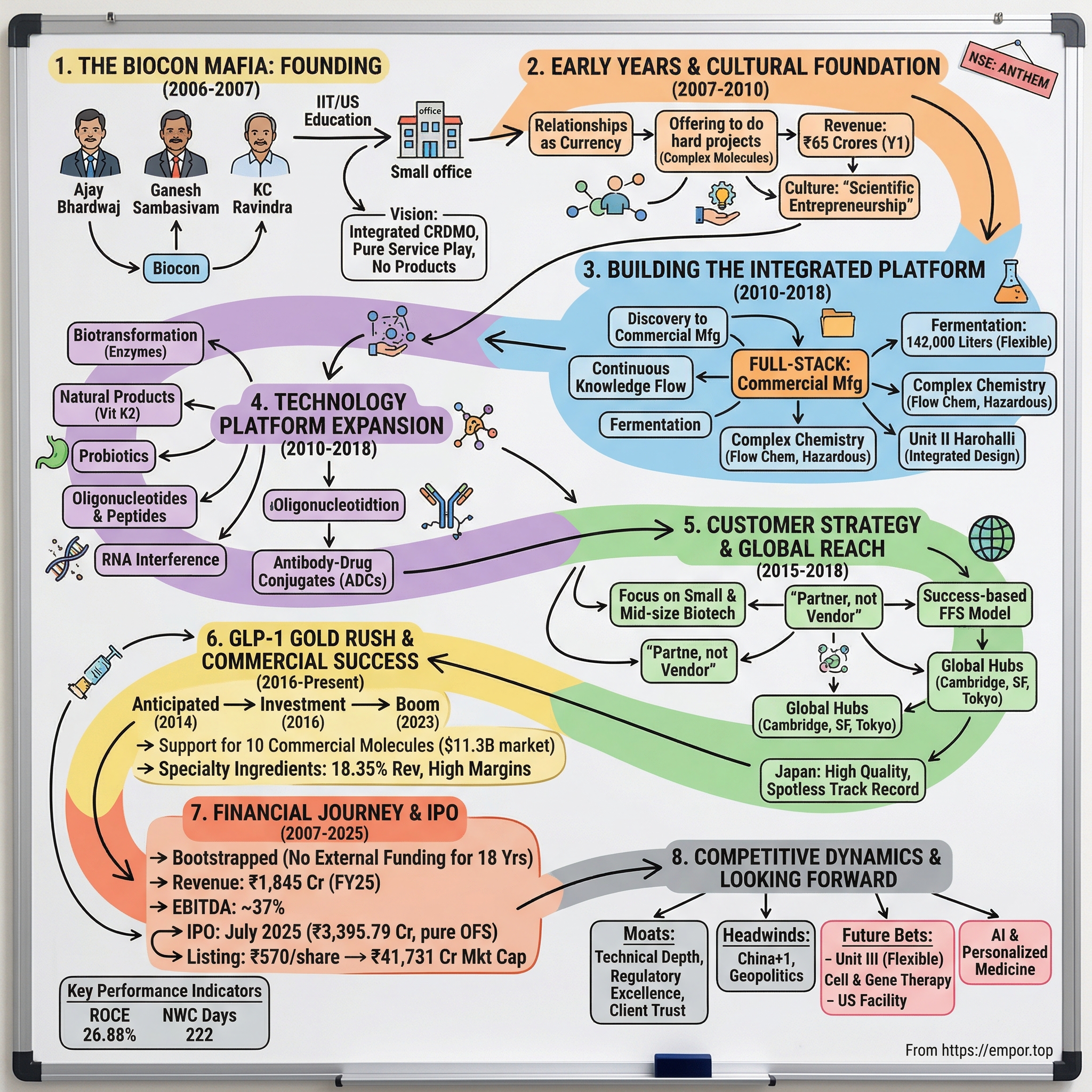
Anthem Biosciences: From Bangalore Startup to India's CRDMO Unicorn
I. Introduction & Cold Open
On the morning of August 5, 2026, a company that had spent a decade being described as India's fastest-growing contract research and manufacturing business reported a quarter in which its revenue fell by nearly a quarter. Anthem Biosciences booked ₹418 crore of revenue in the June 2026 quarter, down 22.6% from a year earlier and down 31.5% from the quarter before it.1 And yet, in the same breath, the company reported an EBITDA margin of 39.6% and a profit-after-tax margin of 27.1%—numbers that would be enviable for a branded pharmaceutical company, let alone a contract manufacturer.2
That single quarter contains the entire investment argument about Anthem Biosciences, compressed into three months. Here is a business whose profitability is structurally extraordinary and whose revenue is structurally unpredictable. Management's explanation on the call was that deliveries had shifted, not disappeared: chairman and chief executive Ajay Bhardwaj told analysts that "underlying demand remains strong, with a higher concentration of scheduled deliveries in the latter half of the year."1 The market's response was to mark the stock down about 3% on the day.2 By late August 2026, the shares traded around ₹875, giving Anthem a market capitalisation of roughly ₹49,300 crore and a trailing price-to-earnings multiple in the mid-eighties.3
Back up a year. Anthem listed on the NSE and BSE on July 21, 2025, at ₹723.05 against an issue price of ₹570—a 26.85% opening premium on an offering that had been subscribed 63.86 times.45 In the financial year ended March 2026, its first as a listed company, it delivered revenue from operations of ₹2,124 crore, up 15.2%, with EBITDA of ₹990 crore and profit after tax of ₹592 crore, up 31.1%.[^6]
So the cold-open question: how did three men who walked out of Biocon in 2006—one chemical engineer, one organic chemist, one plant operations man—build a business that reached ₹1,000 crore of revenue within fourteen years of starting operations, faster than any assessed Indian peer, without ever raising a large venture round, and while earning returns on capital that most Indian pharmaceutical companies cannot match?6
And the harder question that follows: is what they built a durable competitive position, or a very well-run bet on a handful of molecules owned by a handful of customers?
This is the story of a company that took the least glamorous job in the drug industry—doing other people's chemistry—and turned it into one of the highest-margin businesses in Indian pharmaceuticals. It runs through the Biocon of the 1980s, a ₹40 crore all-in personal gamble, a fire in the first year of operations, a decade of building fermentation tanks nobody had asked for yet, a fee model that inverted the industry standard, a customer list so concentrated it is disclosed as a risk factor, the global stampede into GLP-1 obesity drugs, an initial public offering in which the company raised exactly nothing, and a working capital position that is the single loudest objection any sceptic will raise. It ends where it has to end: with the question of whether Anthem can grow into India's Lonza, or whether it is a superbly profitable supplier hostage to five phone numbers.
 Subscribe on LinkedIn
II. The Biocon Mafia: Origins & Pre-Founding Context
In 1986, a young chemical engineer in Delhi read a magazine profile of a small Bangalore enzyme company and, on impulse, wrote a letter to its founder asking for a meeting. The company was Biocon. The founder was Kiran Mazumdar-Shaw. The letter-writer was Ajay Bhardwaj, then a few years out of IIT Delhi via a graduate fellowship at Louisiana State University, working as a project engineer at Max India after returning from the United States in 1984 to be with his fiancée.7
He got the meeting, and then the job. Biocon at that point was not a company anyone joined for the money. Bhardwaj would spend twenty years there, rising through commercial roles into senior management with responsibility for marketing, and watching a business that had been a marginal enzyme exporter become a genuine biotechnology company with sales in the hundreds of millions of dollars across dozens of countries.7 That trajectory is the single most important fact about his education as an operator. He did not learn contract manufacturing in a classroom; he learned it by selling Indian fermentation capability to Western buyers who did not yet believe India could do it.
He left in 2006, at forty-six, after a promotion did not come. His own account of the departure is unsentimental and slightly wry: "When you are with the same company for 20 years you become like the furniture."7 Two children were in university. The prudent move was another senior job at another Indian pharma company. He did the opposite.
The trio
Ajay Bhardwaj, chairman, managing director and chief executive, is the strategist and the commercial engine. His formal credentials—a bachelor's in chemical engineering from IIT Delhi and a master's from Louisiana State University, with more than four decades in life sciences, contract research and pharmaceutical manufacturing—describe a man who can read a plant layout and a term sheet with equal fluency.[^9] What the CV omits is the temperament. His public register is that of a merchant, not a scientist: on earnings calls he talks about customers "riding" growth, about being "paranoid about margins," and about the discipline of building capacity before the demand shows up.[^11]
Dr. Ganesh Sambasivam, co-founder and chief scientific officer, is the chemistry. He holds a bachelor's in chemistry from the University of Madras and a master's and PhD in organic chemistry from the University of Pune, with more than three decades in process research and development, and served as a chief scientific officer before co-founding Anthem.[^9]7 He is the reason Anthem's competitive claims are technical rather than commercial—biotransformation, route design, enzymatic catalysis.
K. Ravindra Chandrappa, co-founder and chief operating officer, is the plant. A chemical engineering graduate of Bangalore University with three decades across Cipla, Hikal and Biocon, he is the person responsible for the unglamorous work on which everything else rests: whether a facility passes a US FDA inspection, whether a batch reproduces at scale, whether the automation actually removes the human from the critical step.[^9] His description of the founding logic is the cleanest statement of Anthem's strategy anyone has offered: "We felt that manufacturing was the thread that we needed to pick and go with."7
Ishaan Bhardwaj, president and the founder's son, joined in 2014 with an engineering degree from Visvesvaraya Technological University and a master's from George Washington University. He started in sales and marketing and now oversees procurement, regulatory affairs, biological R&D, manufacturing and operations.[^9]7 Investors should file this under governance, not nepotism-or-not: a founder-controlled company with a family successor in a line role is a specific structure with specific consequences, and it is worth watching whether his remit continues to expand.
Skin in the game, and what it buys
Post-listing, the founding families still own the overwhelming majority of the company. Forbes, in placing Bhardwaj on its 2026 billionaires list at a net worth of $2.3 billion, put his and Ishaan's combined stake at 53%, with Ganesh Sambasivam at 11.2% and Ravindra Chandrappa at 10.8% — roughly three-quarters of the equity held by four people.7
Concentrated founder ownership is usually sold to investors as alignment. It is more accurate to call it a trade. It buys patience—the willingness to spend ₹1,200 crore on a facility that will not generate revenue for two years—and it buys a bias toward organic reinvestment over financial engineering. It costs minority shareholders influence. There is no activist path here, no realistic prospect of a board fight, and effectively no market for corporate control. When management says the business will be lumpy and asks investors to look through it, there is no mechanism to force a different answer.
What India looked like in 2006
The India that Anthem was founded into was not a place global innovators sent their hardest chemistry. Indian pharma's world-beating competence was generic active pharmaceutical ingredients—making molecules whose patents had expired, at enormous scale and low cost. Contract research existed, but largely as staffing: Western companies rented Indian scientists by the head, on full-time-equivalent contracts, and kept the intellectual property, the process decisions and the commercial manufacturing elsewhere. High-end biology, complex biotransformation and commercial-scale biomanufacturing for novel molecules went to Lonza in Switzerland or, increasingly and cheaply, to 药明康德 WuXi AppTec in China.
The gap Bhardwaj and his co-founders identified was not "India can do chemistry cheaper." Everyone knew that. It was that a small biotech with one promising molecule had to hand that molecule off three separate times—to a CRO for discovery, a CDMO for development, a CMO for commercial supply—and that each handoff destroyed knowledge, added months, and created regulatory risk. If one organisation could carry a molecule from the first synthesis to the commercial batch, the customer would pay for the continuity.
That thesis had a corollary the founders understood viscerally from Biocon: to be credible on the manufacturing end, you had to have fermentation. And fermentation is capital, not talent.
III. The Founding & Early Years: Bootstrapping to Proof of Concept (2006–2010)
Anthem Biosciences was incorporated in Bangalore on June 13, 2006.[^10] The founding capital came from Bhardwaj's own balance sheet: he sold his roughly 1% stake in Biocon and combined the proceeds with a bank loan to put approximately ₹40 crore—about $9 million at the time—into the venture. He has described the decision in terms no investor relations department would have drafted for him: "like these James Bond movies where there's one last bet, and he takes all his coins and goes all in." And more plainly: "It was a huge gamble."7
That framing matters because it explains the capital structure that followed. Anthem was not built on venture money. It did not raise a large growth round until True North acquired a minority stake in April 2021—fifteen years after incorporation and long after the business was profitable.[^10] Everything before that was internal accruals and modest bank debt. The consequence, visible two decades later, is a balance sheet with a net cash position of ₹1,374 crore at March 31, 2026 and total debt that had fallen to 0.2 times operating profit by March 2025.[^6][^10]
The first three years were not a straight line
Operations commenced in 2007 at Bommasandra Industrial Area on the southern edge of Bangalore—Unit I—as an export-oriented unit with chemistry labs, a kilo lab, pilot plants and analytical and discovery research facilities.[^10] The early years produced the standard startup catalogue of near-death experiences: a land deal for the first factory fell through; a fire in 2007 destroyed equipment worth about ₹50 lakh; and then, just as the business was finding its feet, the 2008 global financial crisis dried up new contract awards across the industry.7
The commercial breakthrough came not from a Western pharma giant but from an intermediary. DavosPharma, a New Jersey-based firm, became Anthem's route into the American market. Bhardwaj's assessment of why that was necessary is the most honest sentence in the company's origin story: "There was no way that big pharma was going to trust us. If we screw up, they go under."7 A startup in Bangalore with no track record could not walk into a Boston biotech and ask to make its lead molecule. It could, however, be vouched for by someone the biotech already knew.
That relationship endures, and it endures at a scale that should make investors pay attention. DavosPharma was Anthem's third-largest customer in FY25 at 14.28% of total revenue, acting as intermediary for a set of US customers under either tripartite agreements or direct agreements where Davos invoices and pays.6 Forbes reported that the arrangement covers roughly half of Anthem's US business and that the DavosPharma family holds about 3% of Anthem's equity.7 This is a genuinely unusual structure for a listed company: a material share of revenue flows through a related party that is also a shareholder. It is disclosed, and it has clearly worked. It is also a dependency, and it deserves more scrutiny than it typically receives.
Inverting the fee model
The second early decision was commercial rather than scientific, and it is the one that most cleanly explains why small biotechs chose Anthem over larger names. The industry standard for contract research was the full-time-equivalent model: the customer rents scientists by the month and pays whether or not anything works. Anthem offered milestone-based fee-for-service contracts instead—deliverables, not headcount.7
For a venture-funded biotech with eighteen months of runway, this is not a pricing detail; it is a risk transfer. The CRO is now underwriting execution. For Anthem it was a bet on its own chemistry: if you are confident your team can hit the milestone, selling outcomes is more profitable than selling hours, and it converts a commodity service into something that can carry a margin. It also has a second-order effect that turned out to be the whole business model. A customer who has paid you for outcomes on a molecule at the discovery stage has a strong reason to keep the molecule with you through development, and by the time it reaches a regulatory filing, moving it becomes expensive in a way that has nothing to do with price.
The company reached roughly ₹65 crore of annual revenue within three years of starting operations—a small number in absolute terms, but the proof point that mattered: Western innovators would pay an unknown Indian company for real chemistry, not just for cheap hands.
Culture as a technical decision
The organisational choice that supports all of this is the one investors most often overlook. Anthem was designed so that chemical engineers and molecular biologists work on the same customer projects rather than in separate divisions. That sounds like a poster on a wall. In practice it is the precondition for the thing Anthem later sold as its differentiator: replacing a multi-step chemical synthesis with a single enzymatic step requires someone who understands both the enzyme and the reactor, and most organisations are structured so that person does not exist.
By 2010 Anthem had a business. What it did not yet have was the asset base that would make it hard to compete with. That came next, and it came expensively.
IV. The CRDMO Playbook: Dual NCE/NBE Integration & Fermentation Scale
Walk into the control room at Unit II in Harohalli, about forty kilometres southwest of Bangalore, and what is striking is how few people there are. The site is run through distributed control systems: reactions are executed from screens, parameters are logged automatically, and human intervention in the critical path is minimised by design.6 For a regulated manufacturer this is not an efficiency story so much as a compliance story. Every manual step is a place where a US FDA inspector can find a deviation, and every deviation is a threat to a customer's filing. Automation is how you make quality a property of the plant rather than a property of the shift supervisor.
Both Unit I and Unit II have been inspected by the Indian drug regulator, the US FDA, Japan's PMDA, the EDQM, Brazil's ANVISA and Australia's TGA; Unit II received US FDA approval in June 2023.[^10] That approval is the gate through which commercial supply to the United States passes, and its timing matters—Anthem's revenue growth of 34% in FY24 and 29% in FY25 followed directly from it, along with the ramp of expanded capacity and molecules moving from lab to commercial scale.[^10]
What the two segments actually are
Anthem reports two businesses. The CRDMO segment—contract research, development and manufacturing—contributed ₹1,773 crore, or 83.4% of FY26 revenue.[^6] This is the core: taking a customer's molecule and carrying it from target identification through process development, analytical method validation, clinical-trial batches and, if the drug is approved, commercial supply of the active ingredient or advanced intermediate.
The Specialty Ingredients segment delivered ₹352 crore, or 16.6%.[^6] This is Anthem's own product business, and it is worth understanding as more than a revenue line. It comprises fermentation-derived products the company developed and sells on its own account: enzymes, probiotic strains, nutritional actives, vitamin analogues, active ingredients, and two flagship fermentation products—serratiopeptidase protease, an anti-inflammatory enzyme, and natural vitamin K2 (menaquinone-7), which Anthem produces through a biotransformation process combining chemical synthesis with fermentation.6 In FY25 the segment's largest line was enzymes at ₹124 crore, with serratiopeptidase at ₹42 crore and vitamin K2 at ₹18 crore.6
The strategic function of Specialty Ingredients is that it is a demonstration platform. When a customer asks whether Anthem can run a complex fermentation at commercial scale, the answer is not a slide deck; it is a product on the market. It also fills fermenters between CRDMO campaigns, which matters enormously for a fixed-cost asset.
The dual-platform claim, examined
Anthem's central technical claim is that it operates with real depth on both sides of the modern drug industry: small molecules, or new chemical entities, and biologics, the large molecules that include monoclonal antibodies and recombinant proteins. The industry research commissioned for its offering documents described Anthem as the only Indian CRDMO among assessed peers with strong capability in both.6
This deserves a translation for non-specialists, because it is the crux of the moat argument. Making a small-molecule drug is chemistry: you build a complicated molecule step by step from simpler ones, like assembly. Making a biologic is closer to farming: you engineer a living organism—a bacterium, a yeast, a mammalian cell—to secrete the molecule you want, then grow trillions of them in a tank and purify the product out. The skills barely overlap. The equipment does not overlap at all. Most contract manufacturers pick one, because doing both means running two capital programmes, two regulatory regimes and two talent pools.
The reason Anthem could do both traces directly back to Section II: its founders came out of an organisation that was, at its core, a fermentation company.
The fermentation position
At March 31, 2025, Anthem operated 270 kilolitres of custom synthesis capacity and 142 kilolitres of cGMP fermentation capacity—the largest fermentation capacity among all assessed Indian CRDMOs, and after planned expansion, expected to be more than six times the second-largest player in the country.6
Two things about that number deserve caution. First, the "six times" comparison is drawn from a paid industry report prepared for a share offering; the peer set is "assessed peers," not the universe. Second, and more important, scale is only an advantage when it is used. By the December 2025 quarter, Anthem's fermentation capacity was running at roughly 46–47% utilisation.[^11] Idle stainless steel earns nothing and depreciates on schedule.
The expansion, meanwhile, has moved. Custom synthesis capacity reached 425 kilolitres by March 2026 after Unit II's 130-kilolitre brownfield addition was completed, while fermentation stood at 142 kilolitres.[^6] The planned increase to 182 kilolitres depends on the fermentation block at Unit III—the greenfield facility built under wholly-owned subsidiary NeoAnthem Lifesciences at Harohalli—which was originally guided for completion by the first half of FY26 and had not been commissioned as of the February 2026 call.[^11][^10] Investors tracking Anthem should treat "182 kL" as a plan, not an asset.
The manufacturing footprint as it stands: Unit I at Bommasandra is the small-scale R&D and discovery site, 25 kilolitres of custom synthesis, running at about 75–78% occupancy.[^11]2 Unit II at Harohalli is the workhorse—large-scale custom synthesis, the fermentation block, the high-containment facility for cytotoxic compounds, the continuous flow manufacturing block. Unit III is the newest, home to a 16-kilolitre commercial peptide manufacturing facility, and was running at 30–35% utilisation in the June 2026 quarter, up from roughly 15% a year earlier.2
That utilisation profile is the honest version of the moat. Anthem has built more capability than it currently sells. Whether that is foresight or over-build is precisely what the next three years will decide.
V. Technology Platform Build: RNAi, ADCs, Peptides & Flow Chemistry (2010–2018)
In 2016, Anthem took on a project involving glycolipids as a delivery vehicle for RNA interference therapeutics. RNAi was, at that point, a field with more Nobel-adjacent prestige than commercial success—a beautiful mechanism for silencing genes that had repeatedly failed to get the molecule into the right cell. The customer's molecule was eventually commercialised, and by 2024 it recorded more than $750 million in end-market global sales.6
That project is a fair emblem of how Anthem built its technology stack: not by announcing a platform strategy, but by taking hard jobs from customers early, learning the chemistry on someone else's dime, and then owning the capability when the modality became fashionable.
The modalities, in plain language
RNA interference and oligonucleotides. Conventional drugs block a protein after the body has made it. RNAi intercepts the instruction before the protein exists, silencing the gene's message. Manufacturing these therapeutics requires stitching together long chains of nucleic acids with near-perfect fidelity—solid-phase synthesis on a scale that punishes any impurity. Anthem added a dedicated oligonucleotide laboratory at Unit I in 2023.6
Antibody-drug conjugates. An ADC is a guided missile: a monoclonal antibody that recognises a cancer cell, chemically tethered to a cytotoxic payload potent enough that it could never be given on its own. Building one requires three separate competencies—making an extraordinarily toxic small molecule under containment, making the antibody, and attaching them at a precise site without destroying either. Anthem's Harohalli containment facility is equipped with eleven isolators for this work. At March 31, 2025 it had six early-stage and one late-stage ADC development project; the late-stage ADC was in Phase III as of the February 2026 call, with six to seven early-stage programmes running.6[^11]
Peptides and lipids. Peptides are short protein fragments—harder to make than small molecules, easier than antibodies, and currently the hottest real estate in pharmaceutical manufacturing. Anthem works across solution-phase synthesis, solid-phase peptide synthesis and hybrid approaches. Lipids matter because lipid nanoparticles are how mRNA gets inside a cell; without them, mRNA is a molecule that degrades before it does anything. At March 31, 2025, Anthem had eleven early-phase peptide projects and eight lipid projects.6
Chief financial officer Gawir Baig has dated the peptide effort to lab-scale work around 2012–2014, expanding over a decade into the 16-kilolitre commercial facility at Unit III, with eight to nine innovator peptide programmes in development as of early 2026.[^11] That is a twelve-year lead time between starting the work and having commercial capacity. It is the clearest available illustration of what "building ahead" actually costs.
Biotransformation and flow chemistry: the cost weapons
Two manufacturing technologies do more for Anthem's margin than any modality does for its revenue.
Biotransformation replaces chemical catalysts—often heavy metals, often requiring high temperatures, high pressures and toxic reagents—with enzymes. An enzyme is a molecular machine evolved to perform one transformation with great precision at body temperature. Where a traditional route might need five steps, three solvents and a metal catalyst, an enzymatic route can sometimes collapse the sequence into one step in water. The result is less waste, lower cost, milder conditions and better yields.6 Anthem introduced biotransformation as a manufacturing capability in 2014, among the earliest in India, and it is the technology behind its commercialised vitamin K2.6
Flow chemistry attacks a different problem. Traditional pharmaceutical manufacturing is batch: you fill a large vessel, run the reaction, empty it, clean it, repeat. Flow chemistry runs raw materials continuously through a small reactor. Bhardwaj's own framing captures why this matters for dangerous chemistry: a 20-litre reactor doing the work of a 10,000-litre batch means that if something goes wrong, twenty litres are reacting, not ten thousand.7 Anthem started at lab scale in 2017, introduced it as a manufacturing capability in 2019, and now operates a cGMP continuous flow block at Unit II capable of up to 150 kilograms per day, using silicon carbide and metal microreactors, agitated tube reactors and continuous stirred-tank reactors.6
The investor-relevant point is not that these technologies are clever. It is that they show up in gross margin, and that management has been explicit about the mechanism. On the February 2026 call, Baig attributed the year's material-margin improvement not to pricing but to backward integration: for one large customer product, Anthem had been importing intermediates from China, and it moved that manufacture in-house entirely. "We don't source the intermediate anymore from China. We are completely now backward integrated with the filings, everything taken care of."[^11]
That is a specific, verifiable, non-rhetorical explanation of a margin move—the kind of answer that builds credibility, and a useful contrast with companies that attribute margin expansion to "mix."
The capital allocation choice
The global CDMO industry consolidated through debt-funded acquisition. Anthem did not. Bhardwaj's stated reason is not ideological: "It's very hard for us to, we have looked around for acquiring a good asset, but it's very hard to find really good assets. So we build greenfield a lot."[^11] Management has since said it remains open to acquisitions in India or abroad that make strategic sense.8
The result of two decades of that choice is a balance sheet with essentially no goodwill, no integration debris, and no acquired revenue to explain away. The cost is time: greenfield capacity takes three to four years from decision to qualified output, which means every capacity decision is a forecast made a full drug-development cycle in advance. ICRA, in revising Anthem's outlook to Positive from Stable in June 2025, made the same point in credit language—the debt-funded capex programme was not expected to strain metrics, but "timely commencement and ramp-up of operations at the new facility" would remain a key monitorable.[^10]
Building the platform was the easier half. Selling it to a customer base that would concentrate rather than diversify was the half that defines the risk.
VI. Customer Strategy, Economic Model & Concentration Dynamics
Here is the number that stops most conversations about Anthem Biosciences. In FY25, the company's top five customers accounted for 70.92% of revenue from operations—₹1,308 crore of ₹1,845 crore. The top ten accounted for 77.33%.6
That concentration is not a recent development. In FY23 the top five were 65.80%; in FY24, 65.07%. The trend is upward.6 For most industrial businesses, this would be a warning that the company has stopped winning new customers. Anthem's case is more interesting than that, and both the bull and bear readings deserve a fair hearing.
The customer base, in shape
Since inception in 2007, Anthem has completed more than 8,000 projects for more than 675 customers across more than 44 countries.67 Over the three fiscal years to March 2025 it served 287 customers cumulatively. In FY25 alone, its CRDMO business served 169 customers: 145 small pharmaceutical and emerging biotech companies, sixteen mid-sized firms, and eight large-scale pharmaceutical companies.6 Forbes reported that the client list includes six of the ten largest global drugmakers, among them Pfizer and Novartis, with Bayer named in the offering documents.76
Note the asymmetry. One hundred and forty-five small biotechs generated 1,227 project activities in FY25; eight large pharma customers generated 268.6 The small companies are the pipeline. The large ones are the revenue.
That is the model, stated plainly: Anthem sells cheap, high-touch, milestone-based work to hundreds of early-stage biotechs, most of which will fail, in order to be the incumbent supplier on the handful that succeed. When one of those biotechs is acquired by a large pharmaceutical company—and over the three years to FY25, five of Anthem's biotech customers were acquired for an aggregate deal value of $18.9 billion—the acquirer inherits the supply relationship.6 It is a lottery-ticket portfolio in which Anthem gets paid for printing the tickets.
Why customers stay
The retention data is genuinely strong. Anthem's top ten customers in FY25 had an average relationship length of twelve years, and five of its top six FY25 customers had been among its top fifteen for eight consecutive years, including through mergers and consolidations of those customers. Anthem had not lost a top-ten customer in the three fiscal years to March 2025.6
The mechanism behind that stickiness is regulatory, and it is the most defensible thing about the business. When a drug is approved by the FDA or EMA, the manufacturing site and process are part of the filing. Changing the supplier of a commercial active ingredient means new validation batches, new stability data, a regulatory variation, and the risk of an interruption in supply of a product generating hundreds of millions of dollars a year. A customer will endure a great deal before undertaking that. This is not a moat Anthem invented; it is a moat the regulatory system creates for whoever is holding the molecule when it crosses the approval line. Anthem's skill was engineering its business to be that party as often as possible.
Ten commercialised innovator molecules accounted for 54.40% of FY25 sales.6 By FY26, fourteen commercial molecules contributed 60.8% of revenue, after four went commercial during the year.[^6] Concentration is increasing because commercial supply is scaling faster than early-stage work—which is exactly what the model is designed to produce, and exactly what makes it fragile.
The honest version of the risk
Anthem's own risk disclosures are unusually direct, and worth reading rather than paraphrasing: the loss of one or more key customers could have a material adverse effect, and there is no assurance that customer concentration can be meaningfully reduced.6 ICRA separately flagged high product concentration, with the top five products driving 50–55% of revenues.[^10]
Product concentration is arguably the sharper risk. A customer can be retained; a molecule cannot be argued with. If one of Anthem's top five products loses market share to a competitor drug, faces a safety signal, or simply reaches the end of its lifecycle, the revenue disappears regardless of how good the relationship is. Bhardwaj described the upside version of this dynamic on the February 2026 call—one of Anthem's biggest products started with a single approval and now has six or seven approved indications, "and that's what makes it a blockbuster."[^11] Operating leverage on someone else's clinical success runs both ways.
There is also a subtler dependency embedded in the customer mix. Bhardwaj has been candid that molecules owned by small biotechs often stall commercially after approval, because the biotech is simultaneously negotiating its own sale: "only after big pharma steps in, there is a possibility of a quick ramp-up. But this is not an event that we know fully of and we can't control it also."[^11] Anthem's revenue timing is therefore a function of merger-and-acquisition activity in Western biotech—a variable no amount of operational excellence can manage.
For an investor, the correct posture is neither dismissal nor alarm. The concentration is real, the stickiness is evidenced rather than asserted, and the honest conclusion is that Anthem's revenue base is high-quality and low-diversity at the same time. The company is not fragile because its customers might leave. It is fragile because a small number of molecules must keep selling.
VII. The GLP-1 Gold Rush & Commercial Success
Somewhere around 2021, the pharmaceutical industry discovered that a class of injectable peptides originally developed for type 2 diabetes caused sustained, substantial weight loss. What followed was the largest demand shock in modern pharmaceutical manufacturing. Semaglutide and tirzepatide did not just create new revenue; they created a global shortage of the ability to make peptides at scale, and of the amino acid building blocks that go into them. Forbes cited projections of the global anti-obesity market nearly tripling to $185 billion by 2033 from $66 billion in 2025.7
Anthem did not see this coming. Nobody did. What it had done was spend a decade from 2012 building peptide chemistry, and a decade before that building fermentation—and a GLP-1 molecule needs both. That is the honest version of the "built ahead of the hype" narrative: not prescience about obesity drugs, but a general bet that hard-to-make modalities would be where the value went.
Anthem's actual position
It is important to be precise here, because GLP-1 exposure is the single most over-claimed thing in Indian pharmaceuticals in 2026, and Anthem's management has been notably more restrained than its cheerleaders.
Anthem is not making branded semaglutide for Novo Nordisk. Its position is in the generic wave that opened when semaglutide's Indian patent protection lapsed in March 2025, with expiries also arriving in China, Brazil, Turkey and Canada.7 Anthem's play is to supply the active ingredient to Indian generic manufacturers targeting India and rest-of-world markets. As of the February 2026 call, it had signed up a number of Indian customers, completed validation batches, and prepared but not filed a US Drug Master File—because its customers were focused on rest-of-world launches first.[^11] On the Q1 FY27 call, management indicated it was awaiting CDSCO approval for its semaglutide API, expected within one to two quarters.1
The competitive question is cost, and management's answer is specific rather than promotional. A GLP-1 peptide is made partly by fermentation and partly by synthesis. Baig's claim is that Anthem is the only Indian company completely backward integrated across both halves—"we manufacture the fermentation fragment as well as the synthesis"—which is what would allow it to compete against aggressive Chinese pricing.[^11]
Bhardwaj was asked directly whether Anthem could hold roughly 35% EBITDA margins if API prices collapsed to $100 per gram. His answer: "Absolutely. $100 would be a nice price. It's a dream." And then, revealingly: "I believe we will go lower than that."[^11] That is a management team telling analysts that the price will fall further than the bear case assumes and that it expects to survive it—which is either impressive confidence in its cost position or a hostage to fortune. It is a specific, testable claim, and investors should test it against reported specialty ingredient margins over the next several quarters.
Bhardwaj has also repeatedly tried to widen the frame away from semaglutide: "for us, peptide is more than just GLP-1 Semaglutide," and that while GLP-1 is "a more immediate opportunity," the company is working with innovators on novel peptides as the longer game.[^11] The innovator peptide programmes—eight or nine in development—are where the durable economics would be, because innovator work carries better pricing and longer exclusivity than a crowded generic API.
The rest of the commercial engine
The GLP-1 story has crowded out the fact that Anthem's demonstrated commercial success came from elsewhere. Five of the top six commercialised molecules Anthem manufactured in FY25 were for three large pharmaceutical companies, with a collective end-market sales value of $11.3 billion in 2024—on which Anthem held roughly a 1.2% share of value.6 That last figure is the one worth sitting with. Anthem captures roughly one rupee of every eighty-odd rupees of end-market value on the drugs it helps make. That is the structural reality of contract manufacturing: you are levered to your customer's success, but you are not paid like the owner of it.
The four molecules that went commercial during FY26 have combined peak sales estimates of roughly $10 billion, according to Baig—but he was careful to note these were analyst estimates, and that the revenue impact would be gradual: customers were taking small launch batches, with a full-blown contribution likely "in a couple of years."[^11]
The Specialty Ingredients segment provides a different kind of ballast. It ran a gross margin of roughly 59.7% at the company level in FY25 and generates cash from products Anthem owns rather than rents.6 Its growth drivers, per management, are three: GLP-1 intermediates; probiotics, where Anthem has tied up with a large Indian customer on import substitution; and biosimilars, where a US customer intends to shift manufacture of an approved biosimilar from the United States to Anthem's microbial fermentation trains.[^11]
That last item is quietly the most interesting thing in the segment. A US company moving established commercial biosimilar production to India is the China-plus-one thesis and the cost-arbitrage thesis arriving in the same contract. It is also, notably, a single customer.
VIII. Financial Journey, Capital Allocation & The July 2025 IPO
The most instructive number in Anthem's financial history is not its growth rate. It is FY23, when revenue fell 14.2%, from ₹1,231 crore to ₹1,057 crore.6
Anyone reading the FY23-to-FY25 revenue series—₹1,057 crore, then ₹1,419 crore, then ₹1,845 crore, compounding at 32%—is looking at a recovery measured from a trough.6 That is not a criticism of the company; it is a caution about the base. Anthem's business does not grow smoothly, and the offering-document framing of a 32% two-year CAGR flattered a business that had just contracted.
FY26: the first year in public
FY26 delivered revenue from operations of ₹2,124 crore, up 15.2%. EBITDA came in at ₹990 crore for a 43.4% margin, up 420 basis points. Profit after tax was ₹592 crore, up 31.1%, for a 26.0% margin. Return on equity was 21.7%, post-tax return on capital employed 31.7%, and the company ended the year with a net cash position of ₹1,374 crore.[^6]
Now the footnote that changes the interpretation. Anthem's reported EBITDA includes other income. In FY26 that was ₹156 crore—₹63 crore of forex gains and RoDTEP export incentives, and ₹92 crore of financial and non-operating income—against ₹86 crore in FY25.[^6] Strip other income out and operating EBITDA margin went from 36.4% to 39.2%: an expansion of roughly 280 basis points, not 420. The company discloses all of this clearly in its own presentation footnotes; the point is simply that a third of the headline margin expansion came from treasury income and a favourable rupee rather than from the plant.
The rupee point compounds. Baig confirmed that Anthem does not hedge as a matter of policy: the CRDMO business is entirely export-oriented and dollar-denominated, and currency movement flows straight to other income.[^11] Unhedged dollar exposure has been a tailwind. It is not a permanent one, and investors should mentally separate the operating margin from the currency margin.
The pattern of guidance
Anthem's first year as a listed company also produced its first test of management's guidance discipline, and the record is mixed in a way worth stating plainly.
Entering FY26, management had signalled roughly 20% revenue growth with steady margins. By the February 2026 call, with nine-month revenue growth running at 11–12%, Baig revised the revenue expectation down to "mid-teens around 15% to 16%," while explicitly holding the 20%-plus growth guidance on EBITDA and PAT.[^11] The year finished at 15.2% revenue growth with EBITDA and PAT both up more than 30%.[^6]
So: the revenue promise was missed and revised; the profit promise was made, revised upward in effect, and beaten. Management explained the revenue shortfall specifically—customer destocking driven by trade and funding uncertainty, with customers reducing safety stock days—rather than vaguely.[^11] Bhardwaj's framing was direct: "Otherwise, we were very confident of delivering 20% growth in the topline as well."
That is reasonable conduct: a specific explanation, a timely revision, no blame-shifting, and a delivered bottom line. The countervailing observation is that "customers destocked" is an explanation available every year, and its persistence into Q1 FY27—reframed as "timing shifts in deliveries"—means the same story has now been told for four consecutive quarters of choppy revenue.1 The next two prints are where that explanation is either validated or exhausted.
The offering that raised nothing
The IPO opened on July 14, 2025 and closed on July 16, at a band of ₹540–₹570 per share, for 5.96 crore shares aggregating ₹3,395 crore. It was subscribed 63.86 times overall—182.65 times by qualified institutional buyers, 42.36 times by non-institutional investors, and 5.64 times by retail.5 Shares listed on July 21, 2025 at ₹723.05, a 26.85% premium.4
The structural fact that matters is that it was a 100% offer for sale. Not a rupee reached the company.5 Selling shareholders included promoters Ganesh Sambasivam and K. Ravindra Chandrappa, investor entities Viridity Tone LLP and Portsmouth Technologies LLC, and other holders including Malay J. Barua and Prakash Kariabettan.
An all-OFS listing is a genuine signal, and it cuts two ways. Read positively: the business generates enough cash to fund a ₹1,200 crore expansion without equity, and the founders were sufficiently confident not to take fresh capital at what turned out to be an attractive valuation. Read sceptically: the transaction was a liquidity event for the 2021-vintage private investor and a partial monetisation for two of the three co-founders, priced at 47 times FY25 EV/EBITDA at the upper band, and the buyers of that paper have taken all the operating risk of the expansion cycle without having contributed to it.6 Both readings are correct. Investors should note that the founder-chairman himself was not among the selling shareholders.
Capital allocation since listing has been conservative and, so far, consistent with what management said it would do. The company ended FY26 with net cash of ₹1,374 crore and a debt load small enough to be an afterthought, and it has committed to funding the next expansion cycle largely from accruals. Capex guidance for FY27 is ₹700 crore, roughly half of the ₹1,200 crore Phase I investment in Unit IV, with the balance in FY28.1[^6]
The working capital problem
Now the objection. Anthem's net working capital stood at 222 days in FY25, against roughly 34 days for Syngene International.4
That gap is not a rounding difference; it is a different business model. The components are visible in the FY25 balance sheet: inventory days of 67, up from 45 in FY23; debtor days of 90, having peaked at 127 in FY24; and creditor days of just 23.6 Anthem holds a lot of stock, gets paid slowly, and pays quickly. The cash conversion cycle ran at 134 days in FY25.6
Management's explanation is that custom inventory buffers must be held for global biotech customers, fermentation validation cycles are long, and credit terms are part of securing long-term commercial supply. Some of that is structurally true—a CRDMO holding customer-specific intermediates for molecules with unpredictable order timing genuinely cannot run lean. But three things should be said honestly. First, the peer comparison is not apples-to-apples: Syngene is more weighted toward research services, which carry less inventory than commercial API supply. Second, the working capital intensity is the mirror image of the revenue lumpiness—if deliveries slip a quarter, that inventory sits. Third, the practical consequence for an investor is that reported profit converts to cash more slowly than at an asset-light peer, and any acceleration in growth will absorb cash before it releases it.
The mitigant is the balance sheet. Free cash and liquid investments were around ₹733 crore at March 2025, average working capital facility utilisation was 54.3%, interest coverage was 66.8 times, and total debt to operating profit was 0.2 times.[^10] Anthem can afford its working capital. That is not the same as the working capital being efficient.
IX. Industry Structure & Competitive Benchmarking
Set Anthem next to its two listed Indian peers in the year just ended, and the divergence is stark enough to be worth explaining rather than merely reporting.
Syngene International—Biocon's contract research arm, founded in 1993, and the company against which Anthem is most often measured—reported FY26 revenue of ₹3,739 crore, up 3%, with an operating EBITDA margin of 25% and profit after exceptional items of ₹317 crore. It cited the impact of a single large-molecule biologics client, higher staff costs, foreign exchange losses and the cost of bringing a new biologics facility into operation.9 Sai Life Sciences, the Hyderabad-based small-molecule specialist, had a much better year: FY26 revenue of ₹2,192 crore, up 29%, EBITDA of ₹661 crore at a 30% margin, and profit after tax of ₹355 crore, more than doubled.10
Anthem, on nearly the same revenue base as Sai Life, earned roughly 50% more EBITDA. On roughly 57% of Syngene's revenue, it earned considerably more profit.
The margin gap is not mysterious. It comes from three sources, in descending order of durability. First, mix: Anthem's revenue is weighted toward commercial development and manufacturing—70.8% of FY25 revenue came from development and manufacturing versus 63.2% in FY24—which prices better than research services.[^10] Second, backward integration and process technology, as discussed. Third, other income and an unhedged rupee.
The instructive part is that Syngene's bad year and Anthem's good year had the same root cause in opposite directions: a small number of large customers. Syngene's miss was attributed substantially to one biologics client. Anthem's quarterly volatility comes from a similarly small set. Concentration is not an Anthem quirk; it is the structural condition of the industry, and the only real question is whether a given company's concentration happens to be pointed at growing molecules this year.
On fermentation, the comparison genuinely favours Anthem: Syngene's capability is specialised rather than large-scale, and Sai Life is essentially a small-molecule house. Globally, 药明康德 WuXi AppTec operates at a scale neither approaches—roughly $6.7 billion of revenue in 2025—and 凯莱英 Asymchem at about $1 billion.7 On working capital, the ranking inverts completely, with Anthem the least efficient of the Indian set.
The China question, and what the BIOSECURE Act actually does
The geopolitical tailwind is real, later-arriving, and more heavily discounted into Indian CRDMO valuations than into Indian CRDMO revenue.
The BIOSECURE Act was signed into law on December 18, 2025, as part of the FY2026 National Defense Authorization Act. It does not name companies. Instead it creates two pathways to "biotechnology company of concern" status—one via the Department of Defense's Section 1260H list of Chinese military companies, and one via an Office of Management and Budget designation process. On June 8, 2026, the DoD added WuXi AppTec to the 1260H list, stating that the company is indirectly owned by state asset authorities and indirectly affiliated with China's defence science establishment. WuXi AppTec called the designation "mistaken and baseless" and filed a legal challenge in the US District Court for the District of Columbia.11
Now the part that gets omitted from bullish presentations. The prohibitions restrict federal agencies from procuring from, or contracting with entities that use, a designated company. Medicare and Medicaid agreements fall outside the Act's scope because they are not Federal Acquisition Regulation contracts—which means the vast majority of US pharmaceutical revenue is untouched. The restrictions will not take effect for approximately two to three years: OMB must publish its list by December 2026 and issue guidance within 180 days, after which the FAR Council has a year to write regulations. Existing contracts get a five-year grandfathering period.11
Analysts covering the sector have been appropriately cautious. Elara Capital called the WuXi listing "sentimentally positive" while cautioning that it was premature to expect business to shift, and one industry observer noted that reshoring hundreds of early-stage discovery programmes simultaneously is a different and harder problem than moving late-stage manufacturing. Jefferies projected an 18% compound annual growth rate for Indian CRDMOs through 2030 and sized the China-plus-one opportunity at $700 million to $1.4 billion annually—meaningful, but spread across the entire Indian industry.12
Bhardwaj's own take on the competitive dynamic is the most useful sentence anyone has offered on the subject: "We cannot beat China with scale. We can only beat China with innovation."7
That is a strategically honest statement and an uncomfortable one. It concedes that the cost-and-capacity war is lost and stakes the business on technical differentiation—which is defensible in enzymatic chemistry and complex fermentation, and much less defensible in generic semaglutide API, where the competition is precisely on cost and precisely with China.
Myth versus reality
Three consensus narratives have attached themselves to Anthem since it listed, and each is partly true in a way that misleads.
Myth: Anthem is a GLP-1 story. Reality: it is a story about fourteen commercial molecules, none of which is a GLP-1 drug, plus an unapproved generic semaglutide API programme awaiting an Indian regulatory clearance. The peptide capability is real and was built over a decade; the revenue from obesity drugs is, as of the June 2026 quarter, prospective. An investor buying Anthem for GLP-1 exposure is buying a small, price-competitive, not-yet-commercial slice of a company whose earnings come from somewhere else entirely.
Myth: the BIOSECURE Act redirects Western orders to India starting now. Reality: the law restricts a narrow category of federal contracting, exempts the government healthcare programmes that constitute most US drug spending, and does not bite for years. The mechanism that actually moves business is slower and more mundane—procurement committees at Western pharma companies deciding, over multi-year qualification cycles, that single-country sourcing is a risk they no longer want. That reallocation is real and Anthem should get some of it. It will show up as contract wins disclosed one at a time, not as a step-change in the growth rate.
Myth: a 40%-plus EBITDA margin proves a process moat. Reality: it proves a favourable mix, a genuine backward-integration gain, an unhedged currency tailwind and a government export incentive, in roughly that order of durability. The process advantage is the part that should persist; the other components can reverse without anything going wrong operationally. The cleanest test is whether operating margin excluding other income holds through a period of rupee strength—which has not yet been observed.
The reverse myth, worth stating too. The bearish shorthand—"a lumpy contract manufacturer with five customers and terrible working capital"—understates what is genuinely unusual here. Very few contract manufacturers anywhere earn these returns on capital, and fewer still fund a doubling of capacity out of operating cash while holding net cash on the balance sheet. The concentration is a real risk; it is also the arithmetic consequence of a strategy that worked.
X. Playbook: Strategic & Investing Lessons
1. Own the molecule from the first gram, and the regulator will do your customer retention. The strategically load-bearing insight in Anthem's history is that switching costs in regulated manufacturing are not created by the supplier—they are created by the approval process. Capturing a molecule at discovery, when the customer is small and price-sensitive and the work is cheap, positions you as the named manufacturer when it matters. Twelve-year average relationships with top customers, and no top-ten loss in three years, are the evidence.6 The generalisable lesson: in any industry where a regulator or auditor certifies a process, being the incumbent at the moment of certification is worth more than being the best vendor afterwards.
2. Build capacity before demand, and accept that this is a forecast, not a fact. Bhardwaj's stated philosophy is blunt: "In our business, first we have to build it and then they will come. Our customers want to see that we have the capability as well as the capacity to handle the project. Then only they are interested in giving us the project."[^11] This is correct in a business where qualification takes years—and it is also how capital gets destroyed when the forecast is wrong. The discipline that separates the two is return on capital employed, which is precisely the metric Bhardwaj cited as the check on this philosophy. At 31.7% post-tax ROCE in FY26, the check is passing.[^6] It is worth watching what happens to it as Unit III and Unit IV ramp.
3. Sell outcomes, not hours, when you actually have an edge. The shift from full-time-equivalent staffing to milestone-based fee-for-service was a decision to take execution risk in exchange for margin. It only works if your execution is genuinely better than the customer's alternative. Most services businesses claim this; few price as if they believe it. The corollary is that a company that prices on outcomes is making a falsifiable claim about its own capability—and investors get to check it every quarter in the gross margin.
4. Vertical integration is a margin strategy disguised as a supply chain strategy. Anthem's clearest recent margin gain came from ending Chinese intermediate sourcing for a single product and making it in-house.[^11] The lesson is not "integration good." It is that in a business where input costs are a majority of the cost base, controlling one critical step can be worth more than years of operating leverage—and that it also removes a geopolitical dependency at a moment when customers are paying for exactly that.
5. Organic growth preserves the cap table, but it does not preserve time. Reaching ₹2,000 crore of revenue from ₹40 crore of founder capital, with no goodwill and net cash, is a genuinely rare outcome in Indian pharmaceuticals. The unglamorous cost is that Anthem cannot buy its way into a new modality or geography quickly, and management has admitted it has looked and not found assets worth buying.[^11] For an investor, this means Anthem's growth rate is bounded by its own construction schedule—which is why "when does Unit III fill up" is a more important question than any strategy statement.
XI. Strategic Position, Bull vs. Bear Case & Stress Test
Seven Powers, applied honestly
Hamilton Helmer's framework asks which durable advantages allow a company to earn returns above its cost of capital while competitors cannot copy the position. Anthem plausibly holds two, partially holds a third, and does not hold the rest.
Switching costs are the strongest and best-evidenced. As established, once a molecule is filed with a manufacturing site named, changing supplier costs time, money and supply risk. The evidence is retention rather than assertion.
Process power is real but narrower than management's telling. Anthem's biotransformation and flow chemistry capabilities are genuinely differentiated in the Indian context, and the backward integration of a key intermediate produced a measurable, explained margin gain. But process advantages in chemistry are learnable, and Sai Life's 500-basis-point margin expansion in FY26 demonstrates that peers can improve their own processes materially.10 The honest assessment is that Anthem has a lead, not a lock.
Scale economies apply in fermentation and nowhere else. The 142-kilolitre position is a real barrier for a domestic competitor contemplating entry, because fermentation capacity is expensive, slow to build and slower to qualify. But scale economies only convert to advantage at high utilisation, and Anthem's fermenters were running at 46–47% in late FY26.[^11] Underutilised scale is a cost, not a power.
Anthem has no meaningful branding, no network economies, no counter-positioning against incumbents (its model is legible and copyable), and no cornered resource beyond its founding team—which is a real asset and also a succession question.
Porter's Five Forces
Buyer power: high, and increasing. Top five customers at 71% of revenue is close to a definition of buyer power. It is partially offset by the regulatory switching costs, but the offset is asymmetric—it protects the commercial supply contracts, not the pricing of new work.
Threat of new entrants: low. A credible competitor needs several hundred crore of capital, US FDA-inspected facilities, a decade of compliance history, and a scientific team of the scale Anthem has assembled—more than 1,500 science and engineering staff including 35 PhDs and over 1,100 master's holders as of March 2025.6 That is a high wall.
Supplier power: low and falling, given backward integration and the deliberate removal of Chinese intermediate dependence.
Substitutes: low. The substitute for outsourced manufacturing is in-house manufacturing, and the pharmaceutical industry has spent two decades moving in the other direction.
Rivalry: intense and intensifying. ICRA characterises Anthem as a mid-sized player in a highly competitive industry.[^10] Sai Life is growing faster. Syngene has more capital. Chinese competitors are cheaper and, per Bhardwaj's own assessment, unbeatable on scale. Meanwhile Sai Life has guided to ₹1,100–1,300 crore of capex in FY27, and Anthem to ₹700 crore.101 The industry is adding capacity simultaneously.
The skeptical investor's stress test
If an activist or a short-seller built a case here, these are the five threads they would pull.
Governance and related parties. A 71% promoter holding, the founder's son in an expanding operational role, and 14% of revenue routed through an intermediary whose family also owns roughly 3% of the equity.67 None of this is hidden and none of it is improper. All of it means minority shareholders are along for a ride they cannot steer, and that a material revenue channel is intertwined with a shareholder relationship.
Margin quality. A meaningful share of FY26's headline EBITDA expansion came from other income, including unhedged forex gains and export incentives, on an explicit no-hedging policy.[^6][^11] RoDTEP incentives are a government scheme subject to political revision. This is not aggressive accounting—the disclosure is clear—but it is a quality-of-earnings point that a promotional narrative will skip.
The cash conversion gap. Working capital at 222 days against a peer at 34 is the number a short thesis would lead with, and the fair rebuttal is model difference, not efficiency.4
The capex ramp. ₹1,200 crore into Unit IV Phase I, adding 365 kilolitres of custom synthesis and 100 kilolitres of fermentation, with commissioning targeted at end-FY28—while Unit II runs at 50%, Unit III at 30–35%, and fermentation below half.[^6]2 The bear reads this as building into a demand pause. The bull reads it as the only way to be ready for the next commercial wave. Both concede that ROCE will compress during the build.
The disclosure gap. Anthem does not name its top customers or the molecules driving 60.8% of revenue. This is normal—confidentiality is contractual—but it means the single most important variable in the investment case is unobservable from outside.
The bull case
Fourteen commercial molecules, four of them freshly launched with combined peak sales estimates around $10 billion, ramping over the next two to three years.[^11] A pipeline of more than 100 early-stage programmes and ten late-phase molecules feeding it.1 Semaglutide API approval pending. Capacity in place and largely paid for, which means incremental revenue drops through at high contribution margins. A structural China-plus-one reallocation that has only just become law. Management targeting $1 billion of annual sales within seven years—roughly five times FY26 revenue.7 And a demonstrated ability to expand operating margin through process technology rather than price.
The bear case
Revenue that has now been choppy for four quarters, explained each time by destocking or delivery timing. Five customers and five products carrying the business. A working capital position that converts profit to cash slowly. A large capex programme landing into underutilised existing assets. A generic semaglutide opportunity that will be fought on price against Chinese producers who are structurally cheaper. Wage inflation in a talent market where attrition, though improved to 12.0% in FY25 from 26.3% in FY23, remains a live cost.6 And a valuation in the mid-eighties on trailing earnings that requires the growth to reaccelerate, not merely continue.3
The two or three things actually worth tracking
Ignore the noise and watch these.
First, capacity utilisation at Unit III and on fermentation. This is the single cleanest read on whether Anthem's build-ahead strategy is working. The capital is spent; the question is whether it fills. Management gives these numbers on calls—Unit III at 30–35%, fermentation below 50%—and the trajectory over the next six quarters will tell you more than any revenue print.2[^11]
Second, the number of commercial molecules and their contribution to revenue. Anthem reports both: fourteen molecules at 60.8% of FY26 revenue.[^6] Rising molecule count with rising contribution means the pipeline is converting. Rising contribution with a flat count means concentration is worsening.
Third, operating EBITDA margin excluding other income. Not the headline 43.4%, but the underlying figure. This is where backward integration, operating leverage and peptide pricing will actually show up, stripped of currency and treasury effects.
Revenue growth in any single quarter is close to meaningless in this business, and management has said so repeatedly. These three tell you whether the machine is working.
XII. Looking Forward: Unit III/IV Expansion & The Next Decade
On a thirty-acre parcel at Harohalli, civil work is underway on the facility that will define Anthem's next decade. Unit IV's Phase I represents a ₹1,200 crore investment adding 365 kilolitres of custom synthesis capacity and 100 kilolitres of fermentation—roughly doubling custom synthesis and lifting fermentation by more than two-thirds. Only half the land parcel is being built out in this phase.[^6]1
The composition of that capacity is a statement of where management believes demand is going. Bhardwaj has described the mix as small-molecule expansion for the early-development pipeline that will graduate to commercial scale, more peptide capacity, more large-scale fermentation for projects "being discussed with us," oligonucleotides, and additional high-potency oncology capacity if the peptide programmes progress.[^11] Unit III, meanwhile, was deliberately built with three empty repurposable shells so that new capacity can be fitted out without civil work or disruption—an option worth having in a business where the modality mix shifts faster than buildings can be built.[^11]
The financial shape of the next two years is therefore predictable even if the revenue is not: FY27 capex of about ₹700 crore, the balance in FY28, commissioning targeted at end-FY28, and management's expectation that all units approach near-full capacity within roughly two years.1 Depreciation has already begun to bite—up 50% in FY26 to ₹134 crore as Unit III came online.[^6] Returns on capital will compress before they recover. Investors who mark Anthem down for a falling ROCE in FY27 will be responding to arithmetic, not deterioration.
Two strategic questions sit above the construction schedule.
The first is biosimilars. Anthem is currently running two 200-litre microbial fermentation trains for the US biosimilar transfer, and Bhardwaj has confirmed that mammalian capacity—CHO cell fermentation, partly single-use and partly fixed—is past the design stage and in vendor negotiation.[^11] Mammalian biologics manufacturing is a materially different and more capital-intensive game than microbial, and it is the game Lonza and 药明生物 WuXi Biologics play. Whether Anthem commits seriously here is the biggest unannounced capital allocation decision on its horizon.
The second is artificial intelligence. The outsourcing thesis for AI-designed drugs is that computational platforms will generate more candidate molecules than they can physically make or test, creating demand for a partner who can execute at the bench. Anthem's positioning as that physical execution partner is plausible and has been cited in sell-side initiations, but the company has not disclosed specific AI partnerships or quantified revenue from them, and investors should treat it as optionality rather than a pipeline.
Which leaves the question the whole story points toward: can Anthem become India's Lonza? The gap is instructive. Lonza's scale in mammalian biologics is an order of magnitude beyond anything in India, built over decades and through acquisition. Anthem's ambition—$1 billion of revenue within seven years, or roughly five times FY26—would make it a large Indian CRDMO and a mid-sized global one.7 The realistic destination is not Lonza. It is a specialist that owns a defensible niche in enzymatic chemistry, complex fermentation and peptides, and earns unusually good returns inside it. That is a smaller ambition and a considerably more achievable one.
XIII. Recent News & Earnings Trajectory
The quarterly sequence since listing is the best available data on what this business actually looks like from the outside, and it is not a smooth line.
The first half of FY26 was strong. The June 2025 quarter—the last one reported as a private company and the first disclosed to public shareholders—delivered roughly ₹540 crore of revenue at a 38.1% EBITDA margin and a 24.1% PAT margin, and the September quarter was better still, pushing first-half revenue to ₹1,090 crore, up 26.3%, with the CRDMO business up 32.3% and second-quarter EBITDA margins running above 44%.2 Then the December 2025 quarter broke the pattern—revenue of ₹423 crore, down 15.0% year-on-year, with profit after tax of ₹93 crore and a PAT margin of 20.3%, dragged by a ₹25.4 crore exceptional charge after the government notified four new Labour Codes on November 21, 2025, changing wage definitions and gratuity provisions.[^11] Nine-month revenue growth was 11–12% against a full-year ambition of 20%.
The March 2026 quarter was the reversal management had promised: ₹611 crore of revenue, up 26.4% year-on-year and 44.4% sequentially, the highest revenue quarter in the company's history, at a 48.1% EBITDA margin and a 28.7% PAT margin.[^6] Bhardwaj's message to shareholders acknowledged both halves of the year honestly, noting the 26% quarterly growth alongside 15% for the full year, and framing the achievement as margin expansion delivered alongside slower revenue.[^6] On the Q4 call, management said destocking headwinds had largely resolved, that two direct big-pharma relationships had been added, that capacity was not a constraint, and that it aimed to maintain a growth trajectory similar to its historical 20%—while declining to issue formal FY27 or FY28 guidance.8
Then came the June 2026 quarter, and the pattern reasserted itself. Revenue of ₹418 crore split between ₹341 crore of CRDMO and ₹78 crore of specialty ingredients, with materials consumed down 36.7% year-on-year and employee costs up 9.5%.2 EBITDA margin actually improved 153 basis points and PAT margin 300 basis points, on a much smaller base. Net cash reached ₹1,720 crore, more than double the year-earlier figure.12
Management's operating disclosures on that call were more useful than the headline. Utilisation across the three units was given unit by unit. One new big pharma customer was added in the quarter, with revenue expected in later quarters, and a large biotech customer with a development-stage molecule was acquired by a big pharma company—the acquisition dynamic described in Section VI, playing out in real time. The order book was said to provide visibility into 60% of FY27 revenue. Guidance was reiterated for full-year double-digit growth, EBITDA margin near 40%, PAT margin near 27%, and a normalising tax rate of 25–25.5%.1
Two observations follow. First, the consistency of the margin performance across wildly different revenue levels—39.6% in a quarter with ₹418 crore of revenue, 48.1% in a quarter with ₹611 crore—suggests a cost structure with more variable-cost flexibility than a heavy-asset manufacturer would normally have, which is a genuine and underappreciated strength. Second, "visibility into 60% of FY27" is a disclosure that invites the obvious follow-up about the other 40%, and management's answer remains that CDMO businesses are inherently lumpy.
Sell-side coverage has built steadily since listing, with brokerages initiating through late 2025 and 2026 on a broadly constructive view of the Indian CRDMO sector; Jefferies, for instance, has projected an 18% compound annual growth rate for Indian CRDMOs through 2030.12 Analyst enthusiasm is not evidence, and sector-level growth forecasts have a poor record of surviving contact with individual order books. The more telling signal is what the market has actually done: it has paid up for the margin profile and looked through the revenue volatility, valuing Anthem at a multiple that leaves little room for a second disappointing year.
The stock's own trajectory tells the story of that patience being tested. Listed at ₹723.05, it traded as low as ₹579.15 and as high as ₹904 in the following twelve months, closing at ₹874.70 on August 25, 2026 for a market capitalisation of ₹49,263 crore.3 The shares fell about 3% on the Q1 FY27 print.2
Which returns us to where this began. Anthem Biosciences is a business with an unusually good cost position, an unusually sticky customer base, and unusually little visibility into its own next quarter. The three things that will settle the argument—whether the new capacity fills, whether commercial molecules multiply, and whether the operating margin holds without help from the currency—are all observable, all reported by the company, and all still open.
References
-
Earnings call transcript: Anthem Biosciences Q1 2027 revenue slips as stock falls 2.2% — Investing.com, 2026-08 ↩↩↩↩↩↩↩↩↩↩↩
-
Anthem Biosciences Q1 FY27 slides: margins hold at 40% despite revenue dip — Investing.com, 2026-08 ↩↩↩↩↩↩↩↩↩↩
-
Anthem Biosciences (NSE:ANTHEM) Stock Price & Overview — StockAnalysis.com, 2026-08-25 ↩↩↩
-
Anthem Biosciences Lists at 27% Premium: IPO Analysis — INDmoney, 2025-07-21 ↩↩↩↩
-
Anthem Biosciences IPO ends with 63.86x subscription — ICICI Direct, 2025-07-17 ↩↩↩
-
Anthem Biosciences Ltd. — IPO Note (based on the RHP) — ICICI Direct Research, 2025-07-15 ↩↩↩↩↩↩↩↩↩↩↩↩↩↩↩↩↩↩↩↩↩↩↩↩↩↩↩↩↩↩↩↩↩↩↩
-
Helping Drug Firms Save Time And Money Turned This Indian Entrepreneur Into A Billionaire — Forbes, 2026-06-09 ↩↩↩↩↩↩↩↩↩↩↩↩↩↩↩↩↩↩↩↩↩↩
-
Anthem Biosciences Ltd (NSE:ANTHEM) Q4 2026 Earnings Call Highlights — GuruFocus via Investing.com, 2026-05-20 ↩↩
-
Syngene reports FY26 revenue of Rs 3,739 Cr, up 3%; Q4 revenue at Rs 1,037 Cr — Indian Pharma Post, 2026-04 ↩
-
Sai Life Sciences grows topline by 29% & doubles net profit in FY26 — Sai Life Sciences, 2026-05 ↩↩↩
-
WuXi AppTec's 1260H Listing Brings the BIOSECURE Act Back to Center Stage — FDA Law Blog (Hyman, Phelps & McNamara), 2026-06 ↩↩
-
India's CRDMOs stand to gain from addition of China's WuXi AppTec to Pentagon list — Pharma Manufacturing, 2026-06 ↩↩
 LinkedIn
 WhatsApp
 Reddit
 Hacker News
 Email
Email Kindle
 RSS Feed
 Spotify
 Apple Podcasts
 Amazon Music
 Audible
 YouTube