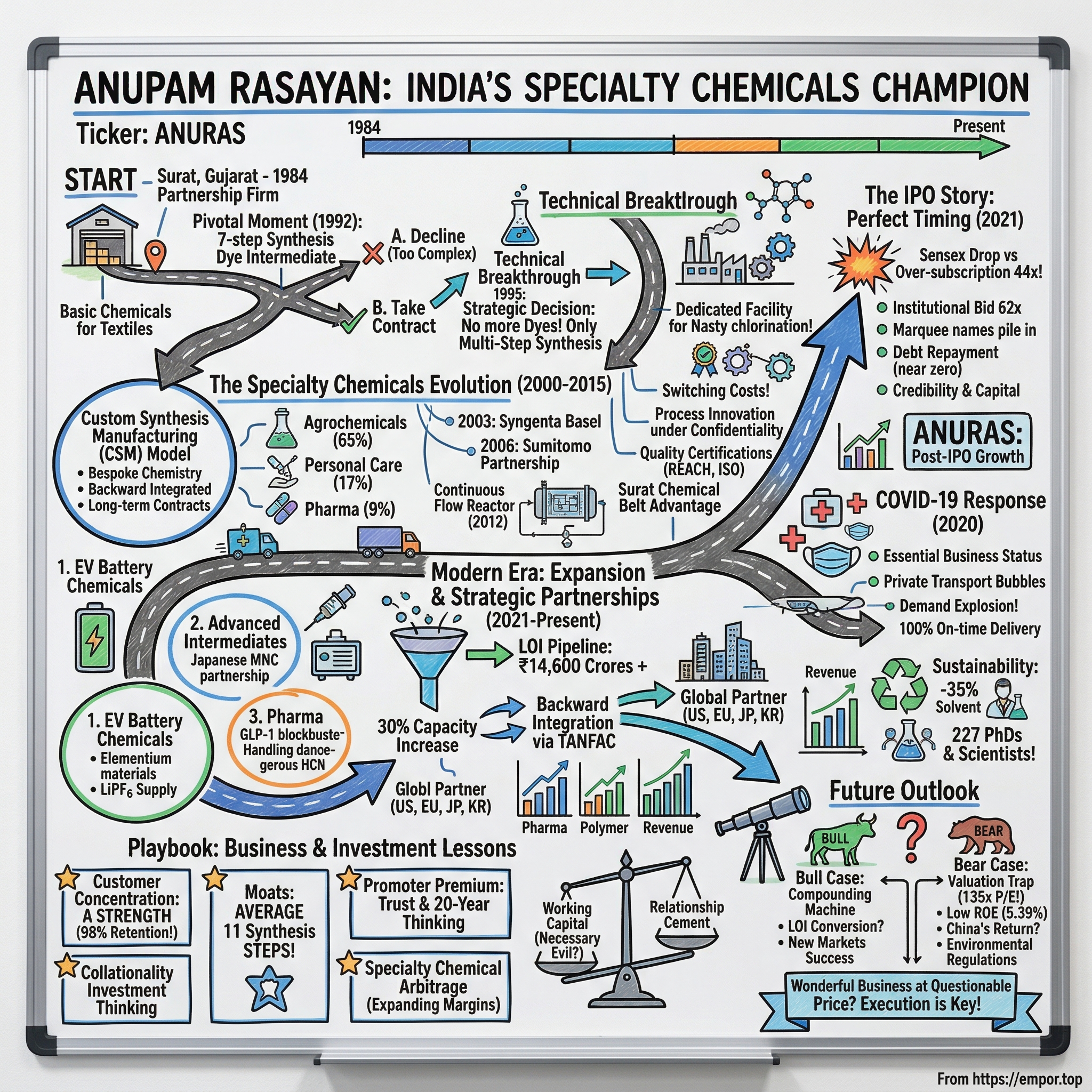
Anupam Rasayan: The Chemistry Moat and India's Specialty Manufacturing Gamble
I. Introduction & Episode Roadmap
There is a particular kind of Indian industrial company that almost nobody outside the industry can describe, yet whose products end up inside the crop-protection sprayer of a soybean farmer in Iowa, the sunscreen bottle of a commuter in Tokyo, and — increasingly — the electrolyte of a lithium-ion cell destined for a European gigafactory. Anupam Rasayan India Limited is one of them. It does not sell a brand. It does not own the molecules it makes. Its customers legally forbid it from naming most of them. And yet, from an industrial estate in Sachin, on the outskirts of Surat in Gujarat, it has spent four decades turning itself into a supplier that a short list of the world's largest agrochemical and pharmaceutical companies find genuinely difficult to replace.
As of late August 2026, the company carries a market capitalisation of roughly ₹14,400 crore, trading around ₹1,265 a share.1 In the financial year ended March 2026 it reported consolidated revenue of ₹2,384 crore and profit after tax of ₹222 crore — a headline revenue jump of 65%.2 Those numbers, as we will see, deserve an asterisk the size of the number itself.
The question this story tries to answer is deceptively simple: how did a 1984 partnership firm making commodity dye and pigment intermediates become one of the trusted Custom Synthesis and Manufacturing partners of Syngenta, 住友化学 Sumitomo Chemical, UPL and their peers — and is the moat that got it there strong enough to justify what public markets are currently paying for it?
Four threads run through everything that follows.
The first is chemistry as an asset-heavy moat. Anupam's advantage is not software or brand. It is the accumulated, largely undocumented, institutional knowledge of how to run dangerous multi-step organic reactions — fluorination above all — at commercial yield without killing anyone or poisoning a river. That knowledge lives in people and in bespoke steel, and it cannot be copied from a patent filing.
The second is the China+1 structural realignment — the slow-motion decision by Western and Japanese innovators to stop being single-sourced out of China. This is the tailwind that lifted every Indian specialty chemicals valuation between 2019 and 2022, and the one that has been repeatedly, painfully re-tested since.
The third is the customer concentration paradox. Anupam's relationships are extraordinarily sticky — and extraordinarily few. In the second quarter of FY25, its top ten customers accounted for 91% of revenue.3 Stickiness and fragility are, in this business model, two descriptions of the same fact.
The fourth is capital allocation reality. This is a company with attractive gross margins and, until very recently, one of the most extended working capital cycles in listed Indian chemicals: gross current assets of 504 days as of March 2026, down from 646 days a year earlier.4 Return on equity in FY26 was 5.5%.1 Any story about Anupam Rasayan that does not sit with that number for a while is not a serious story.
What follows is the deconstruction: how the CSM model actually works, what the Tanfac acquisition bought and what it did not, why the FY26 growth number is more complicated than the press release implies, what management has promised versus delivered across four years of earnings calls, and the three metrics that will tell a long-term investor whether the thesis is working. It begins, as these things usually do, with a small firm in Gujarat trying not to go out of business.
 Subscribe on LinkedIn
II. Origins: Surat, Dyes, and the Pivot to Specialty Chemistry (1984–2010)
Surat is famous for two things: diamonds and textiles. The second of those is what accidentally created a chemical industry. A city that dyes fabric at scale needs dyes, and dyes need intermediates, and intermediates need reactors, effluent treatment, and chemical engineers who understand what happens when you nitrate an aromatic ring at three in the morning. By the 1980s the government had carved out a designated chemicals zone at Sachin, on Surat's southern edge, with the shared effluent infrastructure and clearances that let small units operate legally rather than furtively.5
Into that ecosystem, on 1 April 1984, a partnership firm called Anupam Rasayan was constituted; it was registered under the Indian Partnership Act with the Registrar of Firms at Surat that October.[^6] It was not a specialty chemicals business in any modern sense. It was an import-substitution business — making, domestically and more cheaply, the conventional dye and pigment intermediates that Indian textile processors were otherwise buying from abroad.5 The economics were exactly what you would expect: thin, volatile, and entirely dependent on whether a competitor two industrial plots away had decided to cut price that month.
The firm converted into a public limited company under the name Anupam Rasayan India Limited in September 2003.[^6] But the more consequential turning point came earlier and quieter. In 1997, according to the company's own retelling, a key Indonesian customer walked away — a single-customer shock that forced the partners to confront how exposed a commodity job-shop really is.5 The lesson was not "find another customer." It was "find a business where the customer cannot leave easily."
The pivot nobody had to make
That is a harder decision than it sounds. Commodity dye intermediates in the 2000s were not a disaster; they were merely mediocre. Pivoting to Custom Synthesis and Manufacturing meant deliberately choosing a business with a longer cash cycle, higher capital intensity, brutal qualification hurdles, and revenue that would take years to appear. It meant telling your bankers that you were going to spend money now on a plant for a molecule a Japanese chemical company might, or might not, commercialise in four years.
The pivot was also a bet on a specific reading of the world: that global agrochemical and pharma innovators would keep outsourcing more of their manufacturing, and that they would want a supplier who could develop the process, not merely follow a recipe. Managing Director Anand Desai has been consistent on this distinction for years — the company's pitch is that it designs its own synthetic route to the client's molecule. As he put it in one profile, "Our process, though intended to achieve the same end result as the client's, is uniquely ours."5 Whether that is defensible IP or clever positioning is a question we will test later; what matters here is that it was the strategic axis around which everything after 2003 was organised.
The people who financed the bet
Anupam Rasayan's leadership is unusual for a Gujarat chemicals firm in that its capital and its operations came from very different places.
Anand S. Desai, the Managing Director, is the operating spine — nearly four decades in chemical manufacturing, and the person who owns the customer relationships and the technology roadmap. Mona A. Desai serves as a Whole-time Director and co-promoter with responsibility for administrative and operational infrastructure. Between them they represent the continuity: the same hands on the plant from the dye-intermediate era through to fluorination.
Dr. Kiran C. Patel, the Chairman, arrived from an entirely different universe. Born in Zambia to Indian parents, educated under the British system with diplomas from Cambridge and the University of London, he took his medical degree at Gujarat University, completed an internal medicine residency in New Jersey and a cardiology fellowship affiliated with Columbia, and moved to Tampa, Florida in 1982 to practise cardiology.6 What happened next is the part that matters commercially: he built a physician practice management business, became Chairman of WellCare HMO in 1992, grew it into one of the largest health plans in the United States, and sold his majority interest in 2002 for $200 million.7
Patel is, in other words, not a chemist. He is a capital allocator with a personal balance sheet and an American network, and he chose to point both at a mid-sized Surat chemicals company. By Anupam's own account, he invested roughly $110 million beginning in 2016 — capital that, alongside an earlier 2013 investment from Milan Thakkar, drove annual revenue growth in the 30%-plus range in the years leading up to the public listing.5 For a company whose entire strategy required building plants years before revenue arrived, patient equity from someone who did not need it back next quarter was arguably as important as any chemistry.
Promoter alignment remains high: as of June 2026, promoters held 59.07% of the company.1 That is skin in the game by any reasonable standard, and it cuts both ways — it aligns incentives, and it means minority shareholders are passengers on decisions taken by a concentrated group.
By the end of the 2000s, then, the pieces were assembled: a Sachin site inside a legitimate chemicals zone, a management team that had chosen complexity over volume, and the beginnings of a capital base willing to fund a decade-long qualification cycle. What they had not yet done was prove that a Surat company could pass a Swiss or Japanese multinational's audit. That is the next decade.
III. The CSM Business Model & The Chemistry Moat (2010–2020)
Picture the meeting. A process chemist from a European agrochemical major flies into Surat with a folder containing a molecular structure — a patented active ingredient, or more often an advanced intermediate three steps short of it. The structure is the crown jewel; the company spent perhaps a decade and hundreds of millions of dollars discovering it. What the visitor wants to know is whether a plant in Gujarat can make it, at kilogram scale first, then at tonne scale, at a defined purity, with a defined impurity profile, safely, repeatedly, and at a cost that leaves room for everyone.
That meeting is the entire business.
What "custom synthesis" actually means
The phrase gets used loosely, so it is worth separating three things.
Generic contract manufacturing is toll processing: the customer hands over a route, the manufacturer runs it. The manufacturer is a pair of hands. Margins are thin because anyone with a reactor can be those hands.
Custom synthesis and manufacturing — the model Anupam pursues — is different. The customer brings the target molecule; the manufacturer develops the synthetic route, the catalysts, the solvent recovery, the yield optimisation, and the safety envelope. The intellectual property in the molecule stays with the customer. The intellectual property in the process stays with the manufacturer. That asymmetry is the whole game: the customer can always take their molecule elsewhere, but they cannot take Anupam's route with them, and rebuilding an equivalent route somewhere else costs years.
Contract development and manufacturing (CDMO), a term Anupam has begun using more since 2026, sits adjacent, adding formulation and regulated-market dosage capability.
The reason process ownership translates into pricing durability is regulatory, not commercial. A crop protection product registered with the US Environmental Protection Agency, Europe's ECHA, or Japan's PMDA is registered together with its manufacturing source and impurity profile. Change the intermediate supplier and you have, in the regulator's eyes, potentially changed the product. Re-registration is a multi-year, seven-figure exercise, and during it the innovator's revenue is at risk. This is why validation cycles at Anupam typically run two to five years — pilot-plant audits, sample qualification, regulatory filings, commercial scale-up — and why, once cleared, a supplier is rarely swapped for a few percentage points of price.
Think of it as being written into someone else's building permit. You are not the architect. But moving you out requires re-filing the plans.
Why fluorination is the hard part
Anupam's stated capabilities span chlorination, hydrogenation, nitration, cyanation, photo-chlorination and fluorination — but fluorine is the one that carries the franchise.
Here is the layman's version. Fluorine is the smallest, most electronegative halogen. Slot a fluorine atom into an organic molecule and you change how tightly it binds to its biological target, how quickly the body or the environment metabolises it, and how readily it crosses fatty membranes. In practical terms, a fluorinated agrochemical can be more potent at lower dose; a fluorinated drug can survive longer in the bloodstream. Modern crop protection and modern pharmaceuticals are, structurally, increasingly fluorinated.
The catch is the reagent. Anhydrous hydrofluoric acid is one of the more unforgiving industrial chemicals in commercial use. It attacks glass, penetrates skin without immediately signalling pain, and binds calcium in the body. Handling it at scale means monel and Hastelloy reactors rather than glass-lined steel, dedicated scrubbing and containment, specialised operator training, medical protocols on site, and environmental clearances that regulators do not hand out casually. The capital cost is high; the permission cost is higher.
That combination — expensive metallurgy, scarce clearances, tacit operating knowledge, and a customer base that will not qualify an unproven site — is why fluorination blocks are among the more genuinely defensible assets in Indian chemicals. It is also, as we will see, why Anupam eventually decided it could not afford to buy its hydrofluoric acid from someone else's supply chain.
The revenue engine, and its shape
Through the 2010s the business organised itself into two verticals: life science-related specialty chemicals — agrochemicals, personal care and pharmaceuticals — and other specialty chemicals covering pigments, dyes and polymer additives.[^6]
For most of that decade the mix was overwhelmingly agrochemical. As late as FY24, the split ran roughly 65% agrochemicals, 17% personal care, 9% pharmaceuticals and 9% other specialty chemicals.8 That is not a diversified company; that is an agrochemical intermediates company with three side businesses. It mattered enormously when the agrochemical cycle turned.
Manufacturing sat across six interlinked multi-purpose plants with roughly 27,200 metric tonnes of installed capacity, deliberately built to be reconfigurable rather than dedicated to one molecule — a design choice that trades some efficiency for the flexibility to serve a rotating portfolio of customer products.5
The concentration arithmetic
Now the uncomfortable part. Anupam's disclosed relationships include Syngenta Asia Pacific, 住友化学 Sumitomo Chemical and UPL, with the broader client roster extending to names such as Corteva's predecessor businesses and Adama.[^6] By the company's own account in a 2023 profile, it worked with 71 clients of which 27 were multinationals.5 By June 2026, CRISIL noted 106 clients including 31 multinationals — real broadening, but slower than the customer-count growth implies, because revenue did not spread as fast as logos did.4
In FY20 and the nine months to December 2020, the top ten customers represented 86.65% and 84.01% of revenue from operations respectively.[^6] Four years later, in Q2 FY25, the top ten still delivered 91%.3
Here is what that means analytically. Concentration of this degree converts customer-specific events into company-level events. If a single client's end-product loses a European registration, or goes off-patent and faces a price collapse, or simply enters a destocking cycle, Anupam does not experience a rounding error — it experiences a bad year. The stickiness is real; the diversification is not, or at least was not. Both statements have to be held at once, and the market has historically been much better at pricing the first than the second.
Which brings us to March 2021, when the market decided to price the first with considerable enthusiasm.
IV. The IPO & The China+1 Growth Explosion (2021)
To understand the reception Anupam Rasayan's IPO received, you have to understand what Indian fund managers had been watching for three years.
Beginning in 2017 and accelerating through 2018, the Chinese government prosecuted its 蓝天保卫战 Blue Sky Defence War — a sustained environmental enforcement campaign that shuttered non-compliant chemical plants, forced relocations into designated chemical parks, and idled capacity across Jiangsu, Shandong and Zhejiang. For decades, global chemical procurement had operated on an unspoken assumption: there would always be a Chinese supplier, and they would always be cheaper. Between the enforcement campaign, a series of catastrophic industrial accidents, and then the pandemic-era freezing of logistics, that assumption broke in a way that reached procurement committees rather than just trade journals.
The strategic response acquired a name — China+1 — and a very specific meaning for Indian chemicals: multinationals were not leaving China, but they were, for the first time in a generation, willing to pay to qualify a second source. India had the chemistry graduates, the regulatory alignment with Western norms that China increasingly lacked, and companies that had already spent a decade passing audits.
Indian specialty chemicals stocks re-rated violently. And into that window, in March 2021, Anupam Rasayan went public.
The offer
The IPO opened on 12 March 2021 and closed on 16 March, with a price band of ₹553–555 per share and a total size of ₹760 crore.9 It was subscribed 44.06 times overall — qualified institutional buyers 65.74 times, non-institutional investors 97.42 times, retail 10.77 times.10 The shares listed on the NSE and BSE on 24 March 2021.10
Two things about that subscription profile are worth noting. The non-institutional book — largely leveraged high-net-worth applicants chasing listing pops — was subscribed nearly twice as heavily as the institutional book, and roughly nine times the retail book. That is a signature of momentum demand rather than conviction demand. And the listing itself was underwhelming relative to the frenzy: the stock slid on debut rather than delivering the pop the grey market had implied.11 The gap between how a book is built and how a stock trades on day one is often the first honest data point an IPO produces.
What the money was for
The use of proceeds was, unusually for a growth-narrative IPO, primarily defensive: the dominant application was repayment of borrowings, with the remainder for general corporate purposes.[^6] Anupam had funded its pre-IPO plant build-out with debt, and the listing was in substantial part a deleveraging event — converting interest-bearing capital into permanent capital so that the next capex cycle at Sachin and Jhagadia could be funded from a cleaner balance sheet.
That is a defensible use of public money. It is also worth being precise about what it was not: it was not primarily new growth capital. Investors buying at 44 times subscription were funding the retirement of past capex, and taking the future capex on faith.
The valuation argument
At the offer price, Anupam listed on a trailing earnings multiple far above the Indian market and above most of its established peers — a point made at the time by market commentators who noted that the valuation was lofty even if the CSM model offered genuine comfort on revenue visibility.[^13] The bull argument was straightforward: long-term contracts, regulatory switching costs, a structural sourcing shift, and a company early in its scale curve. The bear argument was equally straightforward: you were paying a premium multiple for a company with 85%-plus revenue in ten customers, an unproven cash conversion record, and a capital cycle that had not yet been tested through a downturn.
The honest assessment, five years later, is that the bear argument had the better of it on the specific question that mattered. The demand thesis was not wrong — the customer relationships held, and the LOI pipeline that followed was real. What the 2021 valuation embedded, and what did not arrive on schedule, was the conversion of that demand into free cash flow. Between FY21 and FY26 the company grew revenue, expanded its chemistry set, and made two acquisitions — while return on equity fell to the mid-single digits.1 Growth without cash conversion is a slower compounding machine than the multiple assumed.
The first move to fix that came less than a year after listing, and it was the most interesting capital allocation decision in the company's history.
V. M&A Benchmark: The Tanfac Industries Acquisition (2022)
Every fluorination company in India shares a vulnerability that does not appear in its investor presentation: it does not make its own hydrofluoric acid. HF is produced from fluorspar, most of which is mined outside India, and for years a meaningful share of India's anhydrous HF requirement was imported — with China a significant origin. A company whose entire moat rests on fluorine chemistry, buying its fluorine from a geography it is being paid to be an alternative to, has a structural contradiction sitting at the top of its bill of materials.
On 1 February 2022, Anupam Rasayan resolved it.
The deal
The company signed a share purchase agreement to acquire a 24.96% stake in Tanfac Industries Limited from Birla Group Holdings, Pilani Investment and Industries Corporation and an individual seller, for approximately ₹148 crore.[^14] Because the acquisition crossed the SEBI takeover threshold and involved a change in control arrangements, it triggered a mandatory open offer for a further 26% of Tanfac at ₹595 per share, managed through a formal letter of offer process.12 Crucially, Anupam simultaneously amended the existing joint venture agreement with the Tamil Nadu Industrial Development Corporation, becoming a co-promoter of Tanfac alongside the state-owned entity — joint control, not merely a financial stake.12
The open offer, when it ran, was barely tendered: Anupam ultimately picked up an incremental 0.83% for about ₹5 crore.13 That tells you something useful. Tanfac's existing public shareholders, offered an exit at ₹595, overwhelmingly declined. They had read the same industrial logic Anupam had, and they wanted to stay for it.
The market's reaction to the announcement was immediate — Anupam's shares rallied around 10% to an all-time high on the news.14 Rarely does an acquirer's stock rise that hard on a deal, and it is usually a sign that the market thinks the buyer got the better of the trade.
Why Tanfac
Tanfac, based at Cuddalore in Tamil Nadu, is one of India's established producers of anhydrous hydrofluoric acid and downstream fluorides, along with aluminium fluoride and sodium silicofluoride, operating alongside a captive sulphuric acid plant.1215 For Anupam, this was not a diversification. It was the acquisition of the single input that its most valuable chemistry could not run without.
The strategic logic has three layers, and only the first is obvious.
The obvious layer is supply security: guaranteed access to HF and potassium fluoride removes the risk that a fluorination block worth hundreds of crores sits idle because a shipment did not clear.4
The second layer is cost and margin architecture. Owning the KSM means the margin on the fluorine step accrues inside the group rather than to a third party, and it means Anupam can quote long-term fixed-price contracts to multinationals with far more confidence about its own input cost. In a business where customers sign three-to-five-year supply agreements, input price certainty is not a nicety.
The third layer, and the most underrated, is permission. Tanfac's HF capacity comes with environmental clearances, a licensed site, and decades of safe operating history. You cannot buy that at any price in a reasonable timeframe; it can only be acquired or inherited.
Did they overpay?
The deal was struck at a low-double-digit multiple of Tanfac's then-trailing earnings — a fraction of what Anupam's own equity was trading at. Mechanically, that made it accretive from day one. But the more interesting test is what happened to the asset afterwards.
By FY26, Tanfac reported record revenue of ₹711 crore, up 27% year-on-year from ₹557 crore, with its sulphuric acid plant running at 101% capacity utilisation and its hydrofluoric acid plant at approximately 95%.16 Its working capital cycle improved by eight days to 91 days, and it delivered return on equity of 19% and return on capital employed of 20%.16
Read that last sentence again against the parent's own single-digit returns, and the acquisition looks less like a bolt-on and more like a rebuke. The asset Anupam bought generates returns roughly three times what its core business generates.
But the FY26 Tanfac numbers also carry a warning. Profit after tax fell to ₹70 crore from ₹88 crore, and operating EBITDA declined to ₹112 crore from ₹129 crore as margins normalised from 23% to 16%.16 That is what happens when a commodity-adjacent fluorides business enjoys an unusually favourable price cycle and then does not. Tanfac is a better business than Anupam's average, but it is not a stable one, and anyone extrapolating its 2024 margins was extrapolating a peak.
The next leg: HFC-32 and battery salts
Tanfac has since committed to roughly ₹495 crore of capital expenditure — ₹405 crore for a 20,000 tonne-per-annum HFC-32 refrigerant facility targeted for commissioning in Q3 FY27, and ₹90 crore for other value-added fluorinated products — with management stating that 65% of the new HFC-32 capacity was already secured under long-term customer contracts.16 Plans for additional solar-grade dilute hydrofluoric acid capacity extend the same logic into photovoltaics.
The energy storage angle runs through fluorine salts. Lithium hexafluorophosphate — LiPF₆ — is the dominant conducting salt in lithium-ion electrolytes, and its cousin KPF₆ sits in adjacent applications. Both are, at root, fluorine chemistry. A group that controls HF and has fluorination know-how has a genuine right to try to enter that value chain. Whether it can compete against entrenched Chinese, Japanese and Korean electrolyte salt producers on cost and purity is an entirely separate question, and one that has not yet been answered with revenue.
Two footnotes on structure that a careful reader should register. First, Anupam has continued to inject capital into Tanfac, subscribing to the majority of a preferential issue priced at ₹2,341 per share — an issue initially sized at ₹173.5 crore and subsequently scaled back — lifting its stake from roughly 24.3% toward 26%.17 Second, in February 2026 Anupam pledged 25,73,081 Tanfac shares, representing 25.80% of that company and valued at approximately ₹1,106 crore, in favour of Axis Trustee Services as security for a $30 million external commercial borrowing.18 The crown jewel of the backward integration story is now encumbered. That is not a scandal — pledging a liquid listed holding for cheap foreign-currency debt is ordinary treasury practice — but it does mean the group's most valuable strategic asset is also its collateral.
Tanfac secured the raw material. What it could not secure was the demand cycle, and the demand cycle was about to turn hard.
VI. Modern Era Headwinds: Agrochemical Destocking & LOI Realities (2022–2025)
In the two years after COVID, every link in the global crop protection chain over-ordered. Distributors who had been caught short in 2020 built inventory buffers. Innovators who had watched container rates spike bought forward. Farmers, enjoying elevated crop prices, sprayed generously. And then interest rates went from near zero to restrictive, and the carrying cost of all that inventory became visible on somebody's income statement.
What followed was one of the sharpest destocking cycles the agrochemical industry has experienced. Channel inventory was liquidated rather than replenished. Chinese producers, sitting on capacity built for a demand curve that had evaporated, dumped basic intermediates at prices that ignored their own cost of production. Realisations across the value chain compressed.
For a company deriving roughly two-thirds of revenue from agrochemical intermediates, this was not a headwind. It was the weather.
The numbers, and what they concealed
Anupam's reported financials tell the story in three acts.
FY23 was the peak of the post-COVID good times: total revenue of ₹1,610.5 crore and consolidated net profit of ₹216.8 crore.19 FY24 brought the first crack — revenue of ₹1,505.3 crore, down 7%, with net profit falling 23% to ₹167.4 crore.19 Notably, gross margins actually expanded during FY24 because raw material prices fell faster than selling prices; the damage was in volume and operating leverage, not in spread.20
FY25 was the trough. Revenue declined again to ₹1,448 crore, and consolidated net profit fell 27% to ₹93.35 crore.21 The second quarter of that year was the low point, described bluntly in market coverage as a dismal outcome.3 From a peak profit of ₹216.8 crore to ₹93.35 crore in two years is a 57% earnings decline — for a company that had listed on a premium multiple explicitly justified by contracted, visible revenue.
That last point deserves emphasis, because it is the central analytical lesson of this period. Long-term supply agreements with multinationals guarantee relationship, not offtake. When the customer's own end market destocks, the contract does not force them to take product. Revenue visibility in CSM is real over a five-year horizon and close to worthless over a four-quarter one — and the 2021 valuation was priced as though the reverse were true.
The LOI pipeline: signal or noise?
Through the downturn, management's consistent response was to point at the order book. Anupam has announced a steady stream of letters of intent with global customers: an LOI worth $183.66 million,22 another with a US multinational for a high-performance specialty chemical in polymer applications with projected sales of $195 million over ten years,23 and in June 2025 an LOI with Germany's E-Lyte Innovations GmbH and FUCHS LUBRICANTS GERMANY GmbH envisaging supply of up to 1,500 tonnes per annum of LiPF₆, with an initial five-year contract term and commercial deliveries potentially beginning in FY27.2425 In August 2026, a further LOI with Spain's BASQUEVOLT, S.A. contemplated a potential ten-year supply arrangement worth roughly $300 million.26
By the Q4 FY26 call, management put the cumulative signed order book at around ₹14,000 crore, and by Q1 FY27 described the cumulative signed LOI pipeline as approximately ₹18,000 crore.2728
Analysts have spent three years pressing on the same nerve: if the pipeline is ₹14,000-18,000 crore, why is quarterly revenue what it is? Management's answer has been consistent and, to be fair, chemically plausible — LOIs mature over three to four years through validation and scale-up, and the correct way to think about the number is annualised. On the Q4 FY26 call, management translated the ₹14,000 crore order book into roughly ₹800–1,700 crore of incremental annual revenue spread over a six-to-seven-year horizon.27
That framing is the honest one, and investors should use it rather than the headline. A ₹14,000 crore number in a press release and ₹800 crore of incremental annual revenue are the same fact expressed at two very different volumes. An LOI is a non-binding statement of intent to negotiate; it is evidence of customer engagement, not of contracted cash flow. The appropriate response is neither to dismiss the pipeline nor to capitalise it — it is to track conversion, quarter by quarter, and to notice that management has never published a conversion rate.
The working capital problem
The more serious criticism during this period was not about the top line. It was about where the cash went.
CRISIL's June 2026 rating rationale lays it out with a candour the company's own presentations do not match. Gross current assets stood at 504 days as of 31 March 2026 — an improvement from 646 days a year earlier — comprising inventory of 310 days (down from 510) and receivables of 148 days.4 Management, on its own calls, has described consolidated working capital days on a pro-forma basis at 215–220 days with standalone Anupam at 240–250 days, and in the FY25 discussion acknowledged a starting point of 409 days before the improvement programme took hold.2729
Strip out the definitional differences and the substance is unambiguous: this business has, for years, tied up more than a year's worth of sales in inventory and receivables. Debtor days of roughly 148 reflect the extended credit terms that global customers extract from suppliers who want the relationship. The inventory number is the more revealing one — carrying 300-plus days of stock is partly the nature of multi-step synthesis with long lead-time raw materials, and partly a symptom of building for volumes that did not arrive on schedule.
The financial consequence is arithmetic. A company can have healthy gross margins and still generate negligible returns if every rupee of incremental sales requires more than a rupee of incremental working capital, while simultaneously funding new plant blocks. That is precisely how you arrive at return on equity of 5.5% and return on capital employed of 7.36%.1 Margin is not the problem. Velocity is.
Management has, to its credit, set explicit and falsifiable targets: a stated path from roughly 250 days toward 220 and then 200, with an ambition of below 200 — around 180 days or lower — by FY27.29 That is a specific, checkable promise, and it is the single most important one the company has made.
Buying growth: Jayhawk and Bliss GVS
Faced with a core business that was cyclically stuck, management chose a decisive path: acquire.
On 9 December 2025, Anupam signed a definitive agreement to acquire 100% of Jayhawk Fine Chemicals, a US specialty chemicals manufacturer, from the CABB Group.30 The transaction completed on 28 February 2026 at a consideration of $150 million, structured through a subsidiary, Doriath S.à r.l., and funded with $109 million of equity via Class B non-voting shares and $41 million of external debt — with Oaktree Capital Management providing $129 million through its affiliate Altis XII Pte. Ltd. and Axis Bank a further $21 million.31
Jayhawk itself is a genuinely interesting asset: established in 1941 and based in Galena, Kansas, it runs multipurpose plants for halogenation, oxidation, nitration and phosphorus chemistry, with approximately 65% of revenue from performance materials serving electronics, energy, aerospace and polymer customers, and the majority of sales in the United States.31 Pro-forma revenue was cited at around $76 million, roughly ₹640–720 crore.27
The strategic case is coherent. It gives Anupam onshore US manufacturing at a moment when American customers in semiconductors, defence and electronics are under political and commercial pressure to source domestically; it adds chemistries the Indian sites do not have; and it opens cross-selling into a customer base Anupam could not previously reach from Gujarat. The financing structure — non-voting equity from a credit-oriented alternative manager rather than dilution of listed shareholders — preserved EPS but introduces an instrument whose terms and eventual exit mechanics ordinary shareholders should want to understand thoroughly.
Then, on 23 May 2026, came the larger and more debatable move: a share purchase agreement to acquire a 43.3% stake in Bliss GVS Pharma Limited at ₹299 per share for ₹1,369.51 crore, with a mandatory open offer for a further 26% at the same price, taking potential ownership to as much as 48.2%.32 The open offer ran from 16 July to 29 July 2026, with payment of consideration scheduled for 12 August 2026.32 Funding was structured as ₹300 crore of debt — via non-convertible debentures — plus a non-controlling, non-voting equity instrument.27 Management expected the transaction to close around mid-September 2026 subject to approvals.28
Bliss GVS is a pharmaceutical formulations company, founded in 1984, exporting suppositories, tablets, capsules and injectables, with plants in Maharashtra and Daman carrying US FDA, EU-GMP and WHO-GMP approvals and annual revenue of roughly ₹927 crore.3227 Management's rationale is capacity arbitrage: Bliss was running at roughly 30% utilisation, and the stated plan is to lift that to 60–70% over the near-to-medium term, with synergies expected over 6–18 months and the deal EPS-accretive from day one.27
Here the skeptical investor has legitimate grounds to push. Anupam is an intermediates and API-adjacent chemistry company. Bliss is a finished-dosage formulations exporter selling into Africa, Asia and regulated markets. These are different businesses with different customers, different regulatory regimes, different sales models and different working capital profiles. "We will fill their idle capacity" is a real thesis, but it is a turnaround thesis executed by a management team that has not yet demonstrated it can fix the working capital cycle of its own core business. Buying a second underutilised asset while the first one still consumes 504 days of gross current assets is a choice that deserves scrutiny rather than applause.
The rating agencies noticed. CRISIL placed Anupam's ₹1,620 crore of bank facilities and ₹160 crore of non-convertible debentures on Rating Watch with Developing Implications on 2 June 2026 following the Bliss announcement, having only recently removed a negative watch imposed during the Jayhawk financing.433 Two watch actions in six months is a reasonable proxy for how much corporate activity has been compressed into a short window.
FY26: reading the headline honestly
Which brings us to the number the company led with. FY26 consolidated revenue of ₹2,384 crore represented 65% growth; EBITDA rose 32% to ₹543 crore at a 23% margin; profit after tax reached ₹222 crore; and operating cash flow came in at ₹334 crore against capital expenditure of ₹315 crore.227
The 65% is largely a consolidation effect. Management's own pro-forma platform arithmetic on the Q4 call breaks the group into Anupam standalone at ₹1,676 crore, Tanfac at ₹711 crore, Jayhawk at ₹722 crore and Bliss at ₹927 crore.27 Against FY25 consolidated revenue of ₹1,448 crore, the standalone chemistry business grew roughly in the mid-teens; the rest of the jump reflects Tanfac being consolidated as a subsidiary and Jayhawk contributing one month and two days of trading.27
That is not an accusation of impropriety — the accounting is correct and the disclosure is available. It is a reminder that "record revenue" and "organic recovery" are different claims, and that FY26's growth rate is not a run rate.
There is also a margin fact worth sitting with: operating margin declined to 22.19% in FY26 from 27.67% in FY25, which CRISIL attributed to limited ability to pass on higher costs.4 The mix shifted toward lower-margin consolidated businesses, and the pricing power that the moat narrative implies did not fully assert itself. Cash conversion did improve — ₹334 crore of operating cash flow against ₹222 crore of profit is a genuinely better ratio than this company has historically delivered — and that is the most encouraging single data point of the year.
The company is now a materially different entity than it was in 2021: three continents, four operating platforms, a credit profile under active review, and a chemistry franchise that still has to prove it can convert an ₹18,000 crore stated pipeline into cash. To judge whether it can, it helps to look at who else is trying.
VII. Competitive Dynamics & Industry Landscape
If you want to understand how hard Anupam's chosen game is, do not compare it to a bad company. Compare it to the company that plays the same game best.
The gold standard, and its own bad year
PI Industries is the reference point for Indian agrochemical CSM. In FY26 it reported revenue of ₹6,713.7 crore and net profit of ₹1,315.1 crore, maintaining an EBITDA margin of around 25% and — the number that matters most — a net cash balance of ₹3,426.5 crore.34 Return on equity came in around 14%, down from historical highs.34
Two observations follow. First, PI is roughly three times Anupam's standalone size, earns a comparable operating margin, and generates roughly two and a half times the return on equity. That gap is not explained by chemistry; it is explained by the balance sheet and the cash cycle. PI funds its growth from operations and sits on net cash; Anupam funds its growth with ₹1,500 crore of gross debt and ₹1,100 crore of net debt.27 Same industry, same tailwind, opposite financial physiology.
Second — and this is the part bulls should sit with — PI's FY26 revenue fell from ₹7,977.8 crore the prior year, and its profit declined too.34 The best-run company in the category could not escape the cycle either. That is useful calibration: Anupam's FY24–FY25 weakness was substantially industry-driven, not idiosyncratic. It also means the recovery, when it comes, will not be a company-specific event.
The fluorine incumbents
Navin Fluorine International delivered a sharp FY26: consolidated profit after tax up 130% to ₹663.56 crore on revenue up 41% to ₹3,379.19 crore, with return on equity around 16.7% and the market awarding it a premium multiple.3536 SRF, the larger and more integrated player with a market capitalisation of roughly ₹76,359 crore, trades at a lower multiple on return on equity in the 13% range.36
The structural point is that Navin and SRF built their fluorine positions from refrigerant gases and industrial fluorochemicals upward — decades of integrated complexes and captive economics. Anupam approached fluorine from the specialty end and bought its integration in 2022. It arrived at a similar destination by a different and later route, and it is smaller in absolute purchasing power and plant-block scale than either.
The comparison that should trouble a shareholder is not Anupam versus PI on growth. It is Anupam versus Navin on the same fluorine chemistry, in the same fiscal year, with Navin more than doubling profit while Anupam's margin compressed by five percentage points. Both operate in India. Both serve fluorinated life-science and performance-material demand. The divergence is a product-mix and execution outcome, not an industry outcome.
At the smaller end, Aether Industries and Clean Science and Technology compete on a different axis — continuous flow chemistry and green catalytic processes rather than scale — targeting niches with high technical intensity and low volume. Anupam's ETFA flow-chemistry launch, discussed below, is a move onto that terrain.
Seven Powers, honestly applied
Process Power — genuine, and the strongest claim. The knowledge required to run hazardous multi-step synthesis at commercial yield accumulates over years and cannot be bought. Evidence: the company has held its largest relationships for more than a decade through a severe cycle, and its client roster expanded to 106 including 31 multinationals by mid-2026.4 Counter-evidence: process power should manifest as pricing power, and FY26's inability to pass through costs suggests it is weaker at the margin than the narrative claims.4
Switching Costs — the most durable power. Regulatory re-registration timelines mean a customer changing intermediate source faces years of work and revenue risk. Evidence: top-ten concentration above 85% persisting across a downturn — customers stayed even while cutting volumes.3[^6]
Cornered Resource — real but partial. Tanfac gives captive HF and KF, a genuine and scarce advantage in India.4 But Tanfac is not exclusive to Anupam — it sells to third parties, is separately listed, jointly controlled with a state agency, and its equity is now pledged against group borrowing.18 "Cornered" overstates it; "privileged access" is fairer.
Scale Economies — developing, and behind. Anupam's standalone gross block of ₹2,500–2,600 crore can support peak revenue of about ₹3,500 crore on management's own estimate.27 That is a ceiling roughly half PI's current revenue. Scale advantage is not yet a power here; it is an aspiration.
Branding, Network Economies, Counter-Positioning, Switching-adjacent scale — largely inapplicable in a B2B custom manufacturing business where the customer owns the brand and the molecule.
Porter's five forces, in plain terms
Buyer power is high, and structurally so. The customers are among the largest chemical companies on earth. They qualify multiple sites, they negotiate annually, and during a destocking cycle they push cost pressure upstream. The 91% top-ten concentration means Anupam sits across the table from a handful of counterparties who each know exactly how much of its revenue they represent.3
Supplier power was high and has been actively reduced. This is the one force Anupam has changed rather than endured, and it is the clearest evidence of strategic competence in the company's history.
Threat of substitutes and Chinese price competition is moderate to high. Chinese overcapacity in basic fluorochemicals and simple intermediates suppresses spot pricing across the board. The insulation is real but partial: complex multi-step molecules with regulatory registrations attached are hard to substitute; simpler intermediates are not.
Threat of new entrants is low. Environmental clearances, consent-to-operate approvals, capital intensity, and multi-year customer validation together mean a new entrant cannot appear inside a decade. This is genuinely protective.
Rivalry is intense but non-commoditised. Indian CSM players rarely compete head-to-head for the same molecule; they compete for a place on the innovator's approved supplier list. The competition is for qualification slots, not for price on identical products — which is why relative execution reputation, safety record and audit history matter more than quoted rates.
The net picture: Anupam's competitive position is real, narrow, and financially under-monetised. The moat protects the revenue. It has not, so far, protected the return on capital. Which raises the question of whether management has been allocating capital toward fixing that, or around it.
VIII. Management Credibility & Skeptical Investor Stress Test
Assessing management is not about whether the strategy sounds good. It is about whether what they said three years ago matches what happened, and whether they explain the gap.
The scorecard
On the positive side of the ledger, three things stand out.
The Tanfac acquisition was well-conceived, well-timed and well-priced, and the asset has since delivered returns well above the parent's.16 Management identified a structural vulnerability and fixed it with capital rather than talking about it — the single best decision in the company's public history.
Deleveraging after the IPO was executed as promised, and the group's capital structure remains within reasonable bounds today: adjusted net worth of ₹3,334 crore, total outside liabilities to adjusted net worth of 0.78 times, adjusted debt to net worth of 0.54 times, and interest coverage of 3.53 times as of March 2026.4 CRISIL characterised liquidity as strong, with expected net cash accrual of ₹280–350 crore in FY27 against debt obligations of ₹40 crore.4 This is not a stretched balance sheet.
And the working capital improvement in FY26 was real: gross current assets down 142 days year-on-year, inventory down 200 days, and operating cash flow exceeding profit for the first time in the company's listed history.427
On the negative side, four things.
First, guidance discipline has been weak. Management repeatedly walked down near-term expectations through FY24 and FY25 as destocking persisted, and the LOI announcements continued at a cadence that was hard to reconcile with reported revenue. Announcing a $195 million ten-year LOI while quarterly revenue declines is not dishonest — but a company that consistently publicises the numerator and never the conversion rate is managing perception as well as chemistry.
Second, the narrative has shifted without a clear accounting. In 2021 the story was Indian agrochemical CSM riding China+1. By 2026 it is a global platform spanning US performance materials, Indian formulations, refrigerants, battery salts and lubricant fluids. Some of that evolution is genuine opportunity capture. Some of it looks like a company that could not make the original story work at the promised return and expanded the story instead.
Third, the pace and complexity of recent M&A. Two watch actions from a rating agency inside six months, an offshore acquisition vehicle in Luxembourg, non-voting Class B equity from Oaktree, non-convertible debentures for Bliss, and a pledge over the Tanfac stake — this is a lot of financial structure for a company whose core operational problem is that it takes too long to turn inventory into cash.41831 Complexity is not fraud, but complexity is a cost: it makes the consolidated accounts harder to read and the true economic ownership of group cash flows harder for a minority shareholder to trace.
Fourth, the returns question has not been answered. Five years after listing, return on equity is 5.5% and return on capital employed is 7.36%.1 India's risk-free rate is comfortably above the latter. A business earning less on its capital than a government bond, however good its chemistry, has not yet demonstrated that its moat is economically productive.
The activist's letter
If a concentrated long-short investor or an activist were to write to the board, the argument would probably run in five paragraphs.
On capital allocation: the company has committed roughly ₹1,370 crore of headline consideration to Bliss GVS plus open-offer obligations, and $150 million to Jayhawk, while its core business generates single-digit returns on equity. Why is the correct use of the next rupee an acquisition rather than releasing the ₹500-plus days of gross current assets locked inside the existing business? Every 50 days of gross current assets released is cash that requires no integration risk, no rating watch, and no new operating capability.
On portfolio complexity: the group now spans custom synthesis in Gujarat, inorganic fluorides in Tamil Nadu under joint control with a state agency, fine chemicals in Kansas held through a Luxembourg vehicle with third-party non-voting equity, and — pending completion — pharmaceutical formulations in Maharashtra and Daman. What is the coherent operating logic that requires all four under one roof, as opposed to a narrative that requires it?
On disclosure: the company publishes cumulative LOI values in the tens of thousands of crores but has never published a historical conversion rate from LOI to commercialised revenue. It also does not disclose named customer concentration. Both are within its discretion; both make it impossible for outside investors to independently test the central claim of the equity story.
On the pledge: the encumbrance of the Tanfac holding for a $30 million borrowing raises a fair question about why the group's cheapest financing requires collateralising its most strategic asset.18
On accountability: the company has now provided explicit working capital targets — sub-200 days, potentially 180 or below by FY27.29 Management should be held to those on a public quarterly basis, with an explanation each time the trajectory slips.
To be fair to the board, there is a coherent defence. The businesses genuinely share fluorine chemistry, customer overlap and manufacturing philosophy; the acquisitions were funded without diluting listed shareholders; the working capital trajectory is improving on the numbers rather than merely in the commentary; and the credit metrics remain conservative. A management team that had lost the plot would not be running a 0.54x debt-to-equity ratio.
The risk radar that actually matters
Not every macro risk applies. Four do.
Customer and product-lifecycle risk is the largest. A single client losing a European registration — the EU has been progressively restrictive on crop protection actives — or a key molecule going off-patent could remove a meaningful slice of revenue with little warning.
Chinese pricing is a persistent, structural pressure on realisations for anything short of the most complex molecules.
Execution and integration risk is elevated and current. Two acquisitions across two continents, closing within seven months of each other, into a company whose operating discipline is the open question.
Forex and trade policy. More than half of revenue comes from exports, with only partial hedging, leaving results exposed to currency movement and to economic downturns in customer geographies.4 The Jayhawk acquisition partially hedges tariff and localisation risk in the US — and simultaneously adds US regulatory, labour and environmental exposure the company has never managed before.
The verdict on management is genuinely mixed, and should be stated as such: strategically imaginative, operationally still unproven on the metric that determines shareholder returns. Which is exactly the tension the bull and bear cases turn on.
IX. Bull vs. Bear Case & 3 Critical KPIs
Why this company wins from here
The bull case does not rest on the moat being real — that much is reasonably established. It rests on the moat finally being monetised.
The diversification is no longer rhetorical. This is the most important change of the last two years and it is measurable. Standalone revenue mix in FY26 stood at agrochemicals 55%, pharmaceuticals 20%, performance materials 18% and personal care 7%.27 Pharmaceutical revenue grew roughly fifteen-fold from ₹21 crore in FY22 to ₹339 crore in FY26, while high-performance materials rose threefold from ₹97 crore to ₹305 crore.27 Compare that to FY24's 65/9/17/9 split and the shift is unmistakable.8 A company that was structurally an agrochemical intermediates supplier is becoming something broader, and the growth is coming from the segments with better secular demand.
The technology claims are producing verifiable output. On 11 June 2026 the company launched commercial production of ethyl trifluoroacetate — ETFA — using its continuous flow chemistry platform, stating it was the first company globally to manufacture the fluorinated building block at commercial scale via flow technology, into a market it sizes at $500–600 million, with launches in the US and Japan among other geographies.37 Flow chemistry, in layman's terms, replaces the giant stirred vat with a continuously running set of narrow tubes: less hazardous material in one place at one time, tighter temperature control, more consistent output. For a company whose product is safe handling of dangerous reagents, this is exactly the right technical direction. A first-mover claim of this kind is checkable and specific — a healthier form of evidence than an LOI.
The platform logic may genuinely work. Management's argument on recent calls is that approaching a multinational as an integrated platform — Indian custom synthesis plus captive fluorides plus US onshore manufacturing plus regulated-market formulations — improves the probability of winning larger, longer mandates than any entity could win alone.27 If true, this is the strongest justification for the acquisition spree. It is also, at this stage, a hypothesis.
Cash conversion has inflected. FY26 was the first year operating cash flow meaningfully exceeded profit, and Q1 FY27 continued the direction: total income of ₹667.5 crore, up 36%, EBITDA up 35% to ₹174.9 crore at a 26% margin.3828 Management guided to standalone EBITDA margins of 24–26%, consolidated margins of 22–24%, organic revenue growth of roughly 25% for FY27, and — critically — maintenance capex of only ₹70–80 crore with the major capex cycle complete.28 A company that has finished building and starts filling is a very different cash flow proposition from one that is still pouring concrete.
Cyclical recovery is optionality, not the base case. If agrochemical destocking has genuinely bottomed, the existing gross block can absorb substantial incremental volume at high incremental margin.
What could break the case
The returns math may simply not close. At a market capitalisation of roughly ₹14,400 crore against FY26 consolidated profit of ₹222 crore, the market is paying somewhere in the region of 60–65 times earnings for a business earning 5.5% on equity.12 For that to be justified, either earnings must multiply quickly or returns on capital must rise sharply. If return on equity stalls in the high single digits, multiple compression toward the sector median is the mechanical consequence — and peers earning 13–17% returns trade at 35–55 times.3436
Working capital may be structural, not fixable. The improvement from 646 to 504 gross current asset days is genuine, but 504 days is still extraordinary.4 If extended receivables are the price of dealing with buyers this large, and if long-lead multi-step inventory is inherent to the chemistry, then the target of sub-200 working capital days may be aspiration rather than plan. Everything about the equity case depends on which it is.
Q1 FY27 contains a warning inside the good news. Profit after tax rose only 6% to ₹51.2 crore despite 36% revenue growth and 35% EBITDA growth, because of higher depreciation from Jayhawk and the enlarged asset base.28 Jayhawk contributed 20–22% of consolidated revenue at 19–20% EBITDA margins — dilutive to group margin — while organic growth excluding Jayhawk was single-digit in a seasonally weak quarter.28 Acquired revenue is arriving faster than acquired profit.
Chinese overcapacity could permanently reset realisations for the simpler end of the portfolio, structurally compressing the blended margin regardless of execution.
Integration could consume the next two years. Bliss GVS is a formulations turnaround requiring capacity utilisation to double. Jayhawk requires cross-selling across two continents. Neither is a capability this management team has demonstrated. If either disappoints, the group carries the debt and the depreciation without the synergy.
Concentration remains the tail risk that nobody can hedge. A regulatory ban, a patent cliff, or a strategic in-sourcing decision at one large customer remains capable of removing a large fraction of profit in a single announcement.
Myth versus reality
Three consensus statements deserve correcting.
Myth: FY26 was a breakout year of 65% growth. Reality: the majority of that increase reflects Tanfac's consolidation and a month of Jayhawk. The standalone chemistry business grew in the mid-teens off a depressed base.27
Myth: the ₹18,000 crore LOI pipeline is an order book. Reality: management's own translation implies roughly ₹800–1,700 crore of incremental annual revenue over six to seven years, and LOIs are non-binding.2728
Myth: Tanfac made Anupam a vertically integrated fluorine champion comparable to the incumbents. Reality: Tanfac secured input supply and delivers strong standalone returns, but Anupam's fluorine scale remains well below SRF's and its FY26 profitability trajectory diverged sharply from Navin Fluorine's.163536
The three KPIs that matter
Everything above can be monitored through three numbers. Not five, not ten — three.
1. Working capital days — specifically gross current assets and receivable days. This is the master variable. It determines return on equity, free cash flow, debt requirement and therefore the sustainable multiple. Management has publicly targeted a path below 200 days.29 Track it every quarter, compare it against the stated target, and treat any quarter of deterioration as significant regardless of what revenue did.
2. Non-agrochemical revenue share. The combined contribution of pharmaceuticals, performance materials and personal care — 45% of standalone revenue in FY26 — is the cleanest single measure of whether the diversification is real and whether the company is escaping the agrochemical cycle rather than merely waiting it out.27 Rising share alongside stable margins is the signal; rising share achieved by dilutive acquired revenue is not the same thing.
3. Consolidated return on capital employed. Not revenue growth, not order book, not EBITDA margin — the blended return on all the capital now deployed across Gujarat, Cuddalore, Kansas and, prospectively, Maharashtra. Against a starting point of 7.36%, this is the number that will reveal whether the platform strategy created value or merely created scale.1
X. Epilogue & Key Takeaways
There is a peculiar honesty to industrial chemistry as a business. You cannot fake a fluorination block. You cannot ship a molecule that fails a customer's impurity specification and hope nobody notices. You cannot obtain an environmental clearance through marketing. Over forty years, a partnership firm in Surat built something that a Swiss agrochemical major and a Japanese chemical conglomerate audited, qualified and kept buying from through a brutal downturn. That is not nothing. In a market full of asset-light narratives, the durable moats often turn out to belong to companies doing boring, hazardous, complicated things that are very hard to start doing.
But the story of Anupam Rasayan is also a lesson that Indian public markets have relearned repeatedly since 2021: a moat and a return on capital are different objects. The company's chemistry protects its revenue. It has not, so far, protected its returns, because the cash that the moat generates keeps getting parked in inventory and receivables and new plant. Gross margin is a statement about what you can charge. Return on equity is a statement about how efficiently you turn capital into cash. Investors who mistook the first for evidence of the second paid a premium for it in 2021 and waited five years for the arithmetic to catch up.
The current chapter is the most consequential the company has attempted. In roughly nine months it added a 1941-vintage American fine chemicals plant, moved to acquire a formulations exporter, consolidated its fluorides affiliate, launched a genuine world-first in flow-chemistry ETFA, and signed battery-materials LOIs with European counterparties. Management has effectively bet that the answer to a low-return core business is a larger, more diversified, more global platform. That may prove right. Platforms with real cross-selling and shared chemistry can earn more than the sum of their parts. It may also prove to be the expensive version of the same mistake — adding underutilised assets to a company that had not yet learned to fully utilise the ones it had.
What separates those two outcomes is not chemistry, and it is not the order book. It is whether the cash cycle continues to shorten. FY26 was the first year it did, materially and verifiably. One year is a data point, not a trend. The next two will tell whether Anupam Rasayan is a specialty manufacturing champion that finally learned capital discipline — or a very good chemistry company that kept buying growth because the returns on the growth it already had were never quite enough.
References
-
Anupam Rasayan India Ltd — Company Financials, Ratios and Shareholding — Screener.in ↩↩↩↩↩↩↩↩
-
Anupam Rasayan delivers record FY26 revenue surge as global expansion gains pace — Indian Chemical News, 2026-05-25 ↩↩↩
-
Anupam Rasayan India reports dismal Q2 outcome — Business Standard, 2024-11-16 ↩↩↩↩↩
-
Anupam Rasayan India Limited — Rating Rationale — CRISIL Ratings, 2026-06-02 ↩↩↩↩↩↩↩↩↩↩↩↩↩↩↩
-
Anupam Rasayan's formula for explosive growth — Business India ↩↩↩↩↩↩↩
-
Dr. Kiran C. Patel, Chairman, Patel Foundation for Global Understanding — U.S. Citizenship and Immigration Services ↩
-
Anupam Rasayan India 9M FY24 total revenue reaches Rs. 1,092.3 Cr — Indian Chemical News ↩↩
-
Anupam Rasayan Rs 760-cr IPO to open on Mar 12; issue price at Rs 553-555 — Business Standard, 2021-03-08 ↩
-
Anupam Rasayan IPO — Date, Price, Subscription and Listing Details — Chittorgarh ↩↩
-
Anupam Rasayan slides on debut — Business Standard, 2021-03-24 ↩
-
Tanfac Industries Limited — Draft Letter of Offer (Open Offer) — SEBI, 2022-02 ↩↩↩
-
Anupam Rasayan India Limited completed the acquisition of 0.83% stake in Tanfac Industries Limited — MarketScreener, 2022-05-06 ↩
-
Anupam Rasayan at all-time high, up 10% on acquiring 24.96% stake in Tanfac — Business Standard, 2022-02-02 ↩
-
TANFAC FY26 revenue rises 27% to ₹711 crore; announces ₹495 crore capex for HFC-32 expansion — ScanX ↩↩↩↩↩↩
-
Tanfac Industries Secures ₹173.5 Crore Capital Injection at ₹2,341/Share From Promoter Anupam Rasayan — Sahi ↩
-
Anupam Rasayan Pledges 25.80% TANFAC Stake for USD 30M ECB — Whalesbook, 2026-02-28 ↩↩↩↩
-
Anupam Rasayan India posts 44.26% drop in its consolidated net profit in Q4 FY23-24 — AgroSpectrum India ↩↩
-
Anupam Rasayan India Limited — Equity Research Update — Business Standard / broker report archive, 2024-05-21 ↩
-
Anupam Rasayan rises after Q4 PAT climbs 44% YoY to Rs 45 cr — Business Standard, 2025-05-26 ↩
-
Chemicals maker Anupam Rasayan India Ltd. signed a letter of intent (LOI) for US$ 183.66 million — IBEF ↩
-
Anupam Rasayan inks $195 mn LOI with US MNC for specialty chemical — AlchemPro ↩
-
Anupam Rasayan signs LoI with E-Lyte Innovations and Fuchs Lubricants Germany for supply of electrolyte salt — Indian Chemical News, 2025-06-12 ↩
-
Anupam Rasayan India Limited — Press Release on Letter of Intent — NSE Corporate Filings, 2025-06-12 ↩
-
Anupam Rasayan signs LoI with BASQUEVOLT, S.A. for the potential long-term supply of a specialty chemical product worth $300 Mn — EquityBulls, 2026 ↩
-
Anupam Rasayan India Ltd (ANURAS) Q4 FY26 Earnings Call Transcript — AlphaStreet, 2026-05 ↩↩↩↩↩↩↩↩↩↩↩↩↩↩↩↩↩↩↩
-
Anupam Rasayan India Ltd (BOM:543275) Q1 FY27 Earnings Call Highlights — GuruFocus via Investing.com, 2026-08 ↩↩↩↩↩↩↩
-
Anupam Rasayan India Ltd. Reports 84% Revenue Growth for 9MFY26 Alongside US Acquisition Update — InvestyWise ↩↩↩↩
-
Anupam Rasayan to acquire US-based Jayhawk Fine Chemicals for $150 million — Indian Chemical News, 2025-12-09 ↩
-
Anupam Rasayan completes $150M acquisition of US-based Jayhawk Fine Chemicals — Indian Chemical News, 2026-02-28 ↩↩↩
-
Anupam Rasayan to acquire up to 43% stake in Bliss GVS Pharma for ₹1,369 cr — Business Standard, 2026-05-24 ↩↩↩
-
CRISIL places Anupam Rasayan's credit ratings on watch — Business Standard, 2026-06-03 ↩
-
P I Industries Ltd — Company Financials and Ratios — Screener.in ↩↩↩↩
-
Navin Fluorine FY26 Profit Soars 130% to ₹663 Cr — Whalesbook Corporate News, 2026 ↩↩
-
Navin Fluorine International vs SRF Limited: Share Price, PE and ROE Compared — Univest ↩↩↩↩
-
Anupam Rasayan becomes first globally to commercialise ETFA production using flow chemistry — Indian Chemical News, 2026-06-11 ↩
-
Anupam Rasayan posts PAT of Rs 512 million for Q1; EBITDA margin remains flat at 26% — Business Standard, 2026-08-17 ↩
 LinkedIn
 WhatsApp
 Reddit
 Hacker News
 Email
Email Kindle
 RSS Feed
 Spotify
 Apple Podcasts
 Amazon Music
 Audible
 YouTube