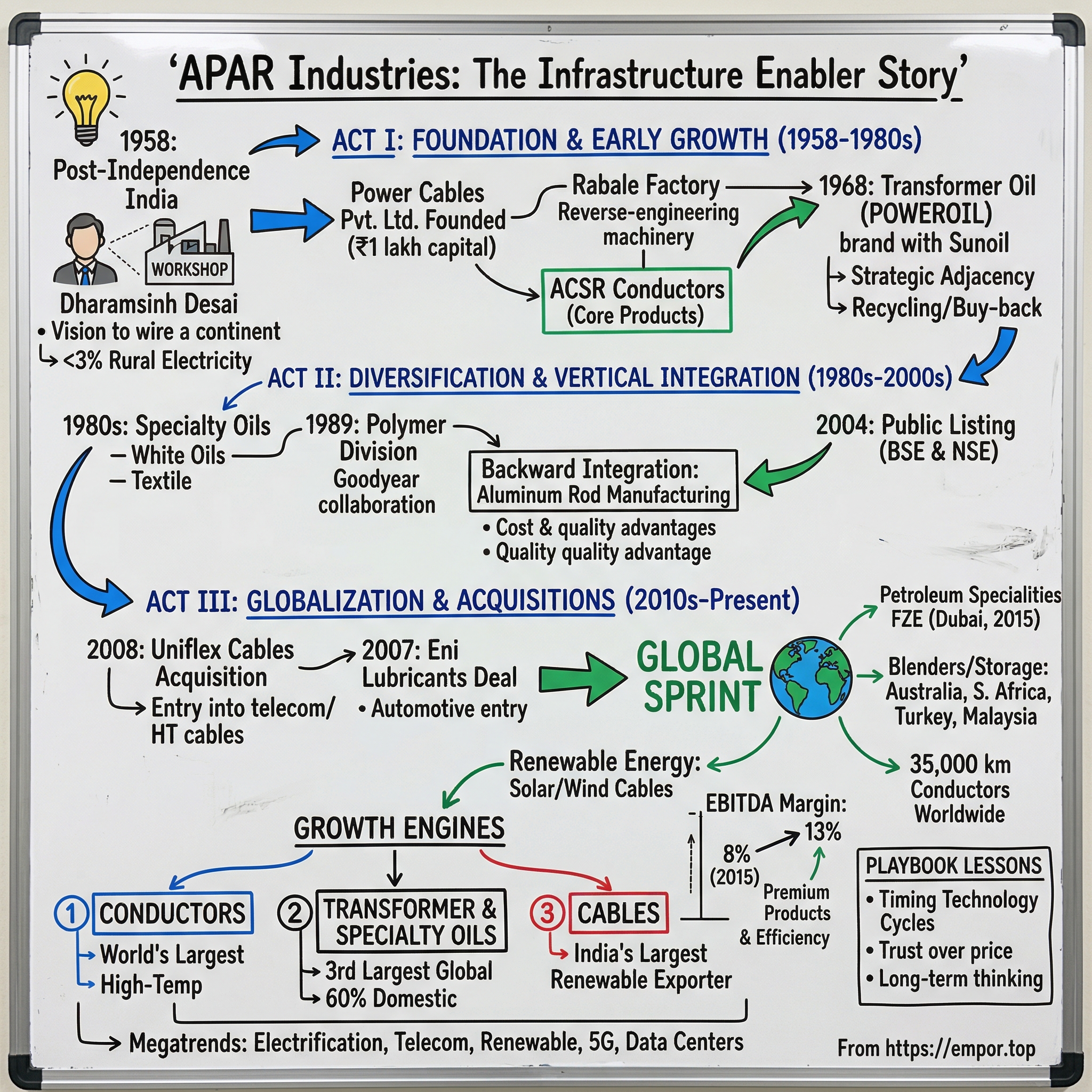
APAR Industries: The Infrastructure Enabler Story
I. Introduction & Episode Roadmap
On the night of August 13, 2026, a committee of APAR Industries directors met for four minutes. The meeting opened at 10:41 p.m. and closed at 10:45 p.m. In that window they approved the allotment of 16,88,618 equity shares at ₹14,805 apiece to a roster of institutions that included ICICI Prudential's mutual funds, HDFC Trustee Company, SBI Contra Fund, Nomura's India fund and the Abu Dhabi Investment Authority. The company raised almost exactly ₹2,500 crore.1213
Four minutes. Two and a half thousand crore. It is worth pausing on how strange that is for a company whose core product is a bare aluminium wire strung between two steel towers.
Because that is, at bottom, what APAR sells. Aluminium conductor. Transformer oil. Insulated cable. Nothing about the product list suggests glamour, and nothing about the founding story suggests global reach: the business was incorporated in January 1958 as Power Cables Private Limited, by a Gujarati engineer-politician named Dharmsinh D. Desai, in an India that had barely begun to electrify.54 Sixty-eight years later, the company runs eleven manufacturing facilities, employs roughly 2,200 people, maintains corporate presence in six countries, and, according to its credit rating agency, sells into more than 140.24
The vital statistics as they stand in late August 2026: FY2026 consolidated revenue of ₹22,902 crore, EBITDA of ₹2,068 crore and profit after tax of ₹977 crore — each an all-time high, on earnings per share of ₹243.21.18 The June 2026 quarter that followed was better still: ₹6,591 crore of revenue, ₹814 crore of EBITDA at a 12.4% margin, and ₹467 crore of net profit, the largest quarterly numbers in the company's history, with quarterly EPS of ₹116.37 against ₹65.45 a year earlier.19
The market has noticed. APAR trades at roughly ₹17,000 a share for a market capitalisation near ₹71,000 crore, on a trailing price-earnings multiple around 59 and about 12.7 times book value.3 That is a technology-company multiple attached to a metals-converting manufacturer, and the gap between those two descriptions is the entire investment question. A business that turns aluminium into wire does not, on any ordinary reading of industrial economics, earn that rating. Either the market is paying for something structural that the product description conceals, or it is extrapolating a cycle. Deciding which requires going considerably deeper than the income statement.
Here is the thesis this article will test rather than assert. APAR is not an EPC contractor and not a utility. It sells the physical components that grid operators must buy, takes no project execution risk, passes metal cost through to customers, and has spent a decade migrating from commodity products toward engineered ones. That is a genuinely attractive structural position. But the same decade has produced an uncomfortable counter-fact: APAR's export revenue peaked in FY2024 at ₹7,301 crore, or 45.2% of sales, and has not recovered since — ₹6,098 crore in FY2025, ₹6,818 crore in FY2026, a 29.8% mix.2 The company that got rerated as a global export champion has, for two consecutive years, grown almost entirely at home.
Both things are true simultaneously. Holding them together is the point.
The roadmap: first, a short account of the founding and the technical pivots that made the company something other than a wire drawer. Second, the current leadership, the ownership structure, and two capital raises three years apart that reveal how management thinks about dilution. Third, the 2008 Uniflex Cables acquisition — a deal that nearly went badly wrong before it went very right, and which is usually told without the wrong part. Fourth, deep dives into the three operating engines: conductors, specialty oils, and cables. Fifth, the emerging product lines that carry real optionality and the ones that are still rounding errors. Sixth, an honest audit of the moat using Helmer's 7 Powers and Porter's framework. Seventh, the risk radar and a skeptic's stress test. Finally, the two or three operating metrics that actually tell you whether the story is working, and the bull and bear cases as they stand today.
Start where the company started: with a man who built a university.
 Subscribe on LinkedIn
II. Succinct Foundations: Founding to Early Diversification (1958–2000s)
Dharmsinh Desai was not primarily a businessman. He was an engineer, a trade unionist and a parliamentarian from Nadiad in Gujarat, and the institution most Gujaratis associate with his name is not a factory but Dharmsinh Desai University, the engineering school he founded in his home town.4 That order of priorities matters, because it explains the culture the company inherited — technically literate, quietly institutional, allergic to flash.
Power Cables Private Limited was incorporated on January 24, 1958.5 The timing was not accidental. India's Second Five-Year Plan had just placed heavy industry and power generation at the centre of national policy, and a country adding transmission capacity from a very low base needed conductors and cable. What it also needed, and could not make, was transformer oil — the insulating and cooling fluid that fills every power transformer on every grid on earth. Without it, a transformer is an expensive metal box. India imported it.
APAR's speciality oils business dates to 1969 and grew into the POWEROIL brand, which the company says has since been used in transformers across more than 125 countries.14 The technical claims that followed are unusually specific for a commodity-sounding product: APAR describes itself as the first company globally to introduce a comprehensive range of iso-paraffinic transformer oils, and the first Indian manufacturer approved for ultra-high-voltage transformers rated at 765 kV AC and above.14
Take a moment on why that second claim carries weight, because the whole oils franchise rests on it. A transformer is a sealed system that a utility expects to run for thirty or forty years with minimal intervention. The oil inside it must not oxidise, must not become corrosive to the copper windings, must carry heat away efficiently and must not conduct electricity even under enormous voltage stress. If it fails, the transformer fails, and a large power transformer failing is not a maintenance event — it is an outage, a fire risk and an eight-figure replacement. The oil is perhaps two to four percent of the transformer's cost and one hundred percent of its failure mode. That asymmetry is the reason transformer manufacturers qualify oil suppliers slowly and change them almost never. APAR spent five decades earning its way onto those approval lists.
A corporate identity assembled in pieces. The history that followed is a sequence of name changes that trace a widening ambition. Power Cables Private Limited became Apar Private Limited in September 1974 and Apar Limited in November 1988 — a business that had outgrown the noun in its own name.
Then came a restructuring that is easy to skip and worth pausing on. In September 1989 a separate entity, Gujarat Apar Polymers Limited, was incorporated in Gujarat. Under a scheme of arrangement sanctioned by the Bombay and Gujarat High Courts in January 1999, Apar Limited's industrial business was amalgamated into that entity with an appointed date of April 1, 1997, and the merged company was renamed Apar Industries Limited on April 19, 1999.5 The legal shell that trades today as APARINDS is therefore the 1989 polymers company, not the 1958 cable company — a detail that matters mainly because it establishes something about this management group very early: they are comfortable using court-supervised schemes of arrangement as a routine tool of corporate design. That same comfort reappears a decade later in far higher-stakes circumstances.
The polymers arm, meanwhile, was modernised around 2000 using process know-how from Goodyear Tire & Rubber of the United States for continuous NBR rubber processing — an early instance of a pattern that recurs throughout this story: APAR would rather license world-class technology than pretend to invent it.11
The listing history is similarly two-staged. The equity has traded on the BSE since April 18, 1991, and on the NSE since July 12, 2004.5 So the company was a listed entity for most of the reform era, but a small and largely ignored one — a cyclical Indian engineering stock that moved with aluminium prices and state electricity board tenders.
How ignored is worth quantifying, because it reframes everything that follows. In FY2015, APAR generated ₹5,108 crore of revenue and ₹49 crore of net profit — earnings per share of ₹12.86, on a revenue base already substantial enough to make the profitability look almost accidental.3 Five years later, in FY2020, revenue had reached ₹7,425 crore and profit ₹135 crore.3 These are the financials of a competent, low-margin, capital-intensive converter: enormous topline, thin residual, returns hostage to the commodity cycle and to whichever state utility was tendering that year.
Set that against FY2024's ₹825 crore of profit and FY2026's ₹977 crore, and the scale of the change becomes clear.2 Revenue roughly quadrupled from FY2015 to FY2026, but profit rose by a factor of twenty. Something happened to the margin structure between those two points that did not happen to the revenue structure — and understanding what that something was, and whether it persists, is the entire remainder of this story. The short version, developed across the sections that follow: the company stopped selling only what utilities specified and started selling what utilities needed but could not easily source, first abroad and then increasingly at home.
What the founding generation actually bequeathed was narrower and more durable than a balance sheet. It was a position on approval lists. By the time the second and third generations took over, APAR was a qualified supplier to Indian utilities and to transformer OEMs, in two product categories where qualification is slow and de-qualification is rare. That is an unglamorous inheritance. It is also the only kind of inheritance that compounds in this industry, and the family that received it turned out to be unusually well equipped to trade on it globally.
III. Modern Management, Governance & Capital Deployment
Kushal Desai's résumé contains a detail that does not belong in a conductor company. He holds a bachelor's degree in electrical engineering from the Moore School at the University of Pennsylvania and a bachelor's in economics from Wharton — conventional enough for an Indian industrial heir.5 But in 1997 he co-founded APAR Infotech, a systems-integration and software business that grew across thirteen countries and reached a NASDAQ listing by 2004, after which he stepped back from it to concentrate on the industrial company.10
That is not a trivial biographical footnote. A person who has run a multi-country software services business has been trained in a specific discipline: measure the unit, not the aggregate. It shows up in how APAR reports. The company does not lead with revenue growth, which in a metals converter is mostly a function of the London Metal Exchange. It leads with EBITDA per metric tonne of conductor and EBITDA per kilolitre of oil — measures deliberately scrubbed of commodity price noise.1 Very few Indian industrials of APAR's vintage voluntarily disclose profitability per physical unit every quarter. It is a small choice that makes the business far easier for an outside investor to hold accountable, and it cuts both ways: when the number falls, everyone sees it.
His brother Chaitanya Desai, Managing Director, holds chemical engineering and economics degrees from the same university and joined APAR in 1993, first running the polymer division through the Goodyear collaboration before taking over conductors.105 He is the operator — metals procurement, plant execution, and, by the company's own account, the lead on its acquisitions and mergers.10 On earnings calls, the division of labour is audible. Kushal handles the macro, the tariff politics, the strategic framing; Chaitanya handles the awkward operational questions. When an analyst pressed in January 2026 on whether volatile copper and aluminium prices would hurt margins, it was Chaitanya who gave the unvarnished answer: the business model is a pass-through, APAR takes no commodity risk itself, but customers who did take that risk and got it wrong "are waiting for the commodity prices to come down in order to go ahead with the deliveries."7 That is a useful answer, because it names the real exposure — not margin, but timing.
The third generation is already in the building. Rishabh Kushal Desai, a Babson College graduate, sits on the board as a non-executive promoter director and previously worked at Ergon Inc.'s refinery before leading APAR's oils subsidiary in the Middle East.510 Placing the heir at a competitor's refinery before handing him the regional oils business is, whatever else it is, a deliberate apprenticeship.
The bench beneath the family. Founder-run Indian industrials frequently fail the succession test because everything routes through one person. APAR's disclosed structure suggests otherwise. Each major division has a professional chief executive: Manish Agarwal, a Harvard alumnus with around 27 years of experience, runs the conductor and telecommunications businesses; Chandrashekhar Shrotri runs cables; V. K. Bajaj, an IIT Kanpur electrical engineer with more than forty years in the cable industry, sits in a business strategy and innovation role; and Suyash Saraogi, another Pennsylvania and Wharton graduate, leads strategy, projects and the company's digital and ESG programmes.10 The board itself is majority independent, with independent directors including a chartered accountant and a CFA charterholder.5
The organisation has scaled to match. APAR employed 1,659 permanent employees as of March 31, 2023; the July 2026 corporate presentation puts headcount at roughly 2,200 across eleven facilities.52 That is a one-third increase in people against a revenue base that grew far faster over the same period — a reasonable proxy for operating leverage in a business where the physical plant, not the payroll, is the constraint.
Ownership and alignment. As of September 30, 2023, the promoter group held 60.64% of the equity, with Kushal Desai personally holding 24.06%.5 After two rounds of institutional issuance, promoter holding stood at 55.42% as of August 2026, against foreign institutions at 11.36% and domestic institutions at 24.88%.3 The family has diluted itself by roughly five percentage points in three years and remains overwhelmingly the largest shareholder. Skin in the game is not in question here; the more interesting question is what they bought with the dilution.
The 2023 raise. In November 2023, with the stock near record levels, APAR executed a qualified institutional placement priced at ₹5,264.00 per equity share, raising gross proceeds of ₹1,000 crore.5 The stated use of proceeds was disarmingly plain: the company intended to deploy ₹982.58 crore of the net proceeds to fund working capital requirements in fiscal 2024.5 Not a greenfield plant. Not an acquisition. Working capital.
That deserves explanation rather than applause, because it reveals the actual physics of this business. APAR buys aluminium, copper and base oil — mostly imported, mostly financed through letter-of-credit-backed supplier acceptances — converts them, and ships to utilities and EPC contractors who pay on their own schedule. When revenue grows 20%, the cash tied up in that cycle grows with it. Working capital rose from ₹2,372 crore in FY2024 to ₹3,253 crore in FY2026, though working capital days actually improved from 53.6 to 51.8 over the same period.2 Equity raised to fund a growing working capital block is not glamorous, but it is honest: it says the constraint on this business is the balance sheet, not the order book.
The 2026 raise. Nearly three years later the company went back, and the arithmetic had changed dramatically. The August 2026 placement priced at ₹14,805 per share — roughly 2.8 times the 2023 price — issuing 16,88,618 shares for ₹2,499.99 crore and taking the share count from 4,01,83,719 to 4,18,72,337.12 Total dilution: about 4.2%.12 The issue opened after market hours on August 10 and closed August 13, with the trading window reopening on August 16.13
The behavioural read matters more than the mechanics. Management has now raised equity twice, both times into strength, both times at a modest share count cost because the price was high. It has not raised equity in a drawdown, and it has not levered the balance sheet to avoid dilution: debt-to-equity stood at 0.10 at both FY2025 and FY2026 year-ends, and CARE Ratings reaffirmed APAR at CARE AA-/Stable with the A1+ short-term rating in August 2025, describing liquidity as strong with roughly ₹896 crore of unencumbered cash and liquid investments against ₹141 crore of term debt repayments due in FY2026.24 For a company whose leverage genuinely lives in ₹4,079 crore of LC-backed acceptances rather than in conventional term debt, that combination — low reported gearing, heavy trade finance, equity topped up at highs — is a coherent and fairly conservative posture.4
The dividend policy fits the same conservative pattern. For FY2026 the board declared a final dividend of ₹60 per share on a face value of ₹10, representing a total outflow of ₹241.01 crore — roughly a quarter of the year's profit.8 At the prevailing share price that works out to a yield of about 0.30%, which is to say the dividend is a signal rather than a return.3 For a business whose growth is constrained by working capital rather than by opportunity, retaining three-quarters of earnings is the defensible choice; investors looking to APAR for income are looking in the wrong place.
There is a governance cost to flag. Because the 2026 fundraise was live during the Q1 FY27 earnings call on July 24, Kushal Desai opened by informing analysts that publicity restrictions barred the company from answering "any questions on guidance, projections, forecasts pertaining to its business and financial performance or questions related to the proposed funding requirements."6 The restriction was legally required and disclosed up front rather than dodged, which is the right way to handle it. But investors should note the pattern: APAR's largest capital-markets actions have coincided with its quietest quarters on forward-looking commentary. The information asymmetry runs in the company's favour at exactly those moments.
On the substance of guidance, the record is better than average. On the January 2026 call, an analyst effectively invited CFO Ramesh Iyer to raise the company's long-standing sustainable conductor guidance of ₹30,000-plus EBITDA per tonne, given how far actual delivery had outrun it. Iyer declined: "We'll continue with the same guidance that we have been giving in the past," adding that macro challenges and domestic competition make tailwinds hard to predict.7 Six months later the company printed ₹53,418 per tonne.1 Management that refuses to ratchet up a target it is comfortably beating is behaving the way long-term owners should want it to behave — though it also means the published guidance now carries almost no information content, and analysts have started to treat it as a floor rather than a forecast.
Which raises the obvious question: where did a conductor business earning ₹53,000 a tonne come from? Part of the answer is a cable company that APAR bought in 2008 and very nearly lost.
IV. The Inflection Point: The 2008 Uniflex Cables Acquisition
By 2007 APAR had a structural gap in the middle of its product line, and its customers could see it.
The company could supply the conductor that carries power across a transmission corridor, and the oil that insulates the transformer at the end of it. What it could not supply was the insulated cable that takes power the last mile — into a substation, a factory, a railway line, a ship. For a business whose entire commercial advantage rested on being an approved, single-source-of-truth vendor to utilities and OEMs, that gap meant handing the customer relationship to someone else at the most valuable moment.
Uniflex Cables Limited was the obvious fix. It made power and telecom cables, it was listed, it had plants and approvals, and it was in trouble. APAR moved in 2008, taking a strategic stake in the company.11 The version of this story told in bullish write-ups stops roughly here, and reports that APAR bought a distressed asset cheaply and turned it around.
The filings tell a longer and considerably less comfortable story.
By March 31, 2010, APAR carried an equity investment of ₹834.37 million in Uniflex Cables.11 By the same date, the entire net worth of Uniflex had been eroded by losses. APAR took a non-cash charge of ₹555.4 million against the investment in its 2009-10 accounts — writing off roughly two-thirds of what it had put in.11 Uniflex's wholly-owned subsidiary, Marine Cables & Wires Private Limited, filed a reference with the Board for Industrial and Financial Reconstruction in October 2009 and was formally declared sick on February 5, 2010. Uniflex itself was declared sick by the BIFR on October 26, 2010.11
That is the part worth sitting with. This was not a clever bottom-fishing trade executed by a buyer with perfect information. It was a strategic acquisition that went wrong for two years, cost real money, and ended up inside India's statutory sick-company process. Any investor evaluating APAR's M&A track record should start from that fact rather than from the outcome.
It is also worth understanding why it went wrong, because the failure mode is generic. A distressed manufacturer typically has three problems stacked on top of one another: an operating problem, a balance-sheet problem, and a working-capital problem. A buyer can fix the first with management and capital. The second requires creditors to agree. The third is what kills acquirers, because a plant restarted without adequate working capital burns cash faster than it earns it, and the losses compound while the restructuring negotiation drags. APAR appears to have bought into the operating thesis and then discovered the financial ones — which is exactly what the ₹55 crore write-down and the subsequent sickness filings describe.11
What happened next is the actual demonstration of capability. Rather than walking away from a written-down investment — which was available and would have been the easy choice — APAR took the resolution route. A draft rehabilitation scheme was framed under BIFR supervision, providing for the amalgamation of Uniflex Cables into APAR Industries at a share exchange ratio of one APAR share for every ten Uniflex shares.11 The scheme was approved by APAR shareholders and moved through the statutory process; the share capital history records the allotment of 24,98,037 equity shares on October 9, 2012, issued for consideration other than cash, "pursuant to the rehabilitation scheme envisaging the amalgamation of erstwhile Uniflex Cables Limited with the Company in the ratio of 1:10."5
Read that allotment as what it was: the final price. APAR absorbed a sick company by issuing about 25 lakh of its own shares — a fraction of a percent of today's equity base — plus the cash it had already sunk and written down. The rehabilitation route also delivered something a straight purchase would not have: a legally supervised restructuring of the target's liabilities, which is precisely the problem that makes distressed Indian manufacturing assets so hard to buy safely.
And then APAR did the boring, decade-long part. It recapitalised the operations, folded the sales effort into its existing utility and OEM relationships, and — critically — chose not to compete where the cable industry actually makes its money in India. More on that strategic decision shortly.
The scoreboard, eighteen years after the initial investment: the cables division generated ₹6,219.51 crore of segment revenue in FY2026, up 25.8% year on year, with segment EBITDA of ₹632.95 crore.2 It overtook specialty oils during FY2026 to become APAR's second-largest business.2 Installed cable capacity reached 9,50,656 km in FY2026 against 6,81,780 km in FY2024 — a 39% expansion in two years.2
The investor lesson is not "distressed acquisitions work." It is narrower and more useful. APAR bought a capability it could not build quickly — plants, product approvals, technical staff — and then spent a decade attaching that capability to a distribution and qualification network it already owned. The value was never in Uniflex's balance sheet, which was worthless. It was in the fit. Buyers who confuse the two get the write-off without the recovery.
Cables became the growth engine. But conductors remained the centre of gravity, and it is there that the interesting margin story of the last three years has played out.
V. Core Segment Deep Dive 1: Conductors — The Grid Modernization Engine
Picture a transmission line built in the American Midwest in 1978. The towers still stand. The right-of-way still exists — and in 2026, acquiring an equivalent right-of-way through developed land would take years of hearings and cost more than the line itself. What has changed is the demand: wind farms upstream, a data centre campus downstream, and a conductor rated for a load profile designed when electricity meant refrigerators and streetlights.
The utility has three options. Build a new line: three to five years of design and construction, plus permitting and land acquisition. Upgrade the voltage on the existing corridor: a 100–200% capacity increase, but two to three years and significant network modification. Or restring the existing towers with a high-temperature, low-sag conductor: a 50–150% capacity increase in eight to twelve months, using the right-of-way you already have.2
That third option — reconductoring — is APAR's structural tailwind, and it is worth understanding physically. An ordinary ACSR conductor is aluminium strands wrapped around a steel core. Push more current through it and it heats up; as it heats, it expands and sags toward the ground, and clearance rules cap how much current you can safely carry. An HTLS conductor replaces the steel core with a composite or high-strength alloy that barely expands with heat, so the line can run far hotter without sagging past its limit. Same towers, same corridor, roughly double the power. It is closer to a software upgrade than a construction project, which is exactly why utilities under permitting pressure like it.
APAR has technology tie-ups with a US company for ACCC composite-core conductors and reports having completed up to 272 reconductoring projects covering up to 7,005 circuit kilometres through FY2026.2 On the Q1 FY27 call, management noted the quarter produced the company's all-time highest reconductoring installations.6
The premiumisation numbers, and what they conceal. Conductor segment revenue grew from ₹8,030.98 crore in FY2024 to ₹12,711.95 crore in FY2026, with volumes rising from 2,06,633 MT to 2,41,788 MT.2 Premium products moved from 44.80% of segment revenue in FY2024 to 45.82% in FY2026, and reached 50.3% in the June 2026 quarter against 43.7% a year earlier.21
But the profitability path was not a straight line, and the deviation is the most instructive thing in this section. EBITDA per tonne was ₹42,141 in FY2024. It fell 13% to ₹36,684 in FY2025. CARE Ratings attributed the drop to subdued US demand, higher freight costs, and intensified competition from Chinese manufacturers in non-US geographies.4 It then recovered to ₹43,013 in FY2026 and jumped to ₹53,418 in Q1 FY27, against ₹43,688 a year earlier.21
Two conclusions follow, and they point in opposite directions.
The bullish one: the FY2025 dip proves the mix shift is doing real work. When Chinese competition compressed conventional conductor pricing and US volumes stalled, the business still earned ₹36,684 a tonne — more than double the company's own historical sense of a commodity conductor's economics, and comfortably above the ₹30,000-plus per tonne management continues to call sustainable.7 Premium product is not a marketing label; it is visible in the trough.
The bearish one: the FY2025 dip also proves the business is not insulated. A single year of soft US demand and Chinese price pressure took thirteen percent out of unit profitability. That is not what a structural moat looks like at full strength.
The volume warning in the most recent quarter. In Q1 FY27, conductor revenue rose 19.9% to ₹3,338 crore while volume fell 6.7% to 53,279 MT.1 The entire revenue increase came from price and mix. Kushal Desai's explanation was specific: a sudden surge in aluminium prices left customers who had not hedged their metal unwilling to issue manufacturing clearance on orders already placed, and since delivery windows in these contracts run 18 to 36 months, "there are some customers who are waiting for prices to come down and then hedge the metal and give manufacturing clearance."6 He characterised the delay as temporary, noting that the orders exist and that project-level penalties limit how long a customer can stall.6
That explanation is plausible and mechanically coherent. It is also, so far, unverified — and it is a claim investors should track rather than accept. Notably, the delays clustered in conventional conductors bound for domestic tariff-based competitive bidding projects, while premium products continued executing.6 That is why the premium mix hit 50.3%: partly genuine mix improvement, partly conventional volume simply not shipping. A mix number that improves because the low-margin half stopped moving is not the same signal as a mix number that improves because the high-margin half accelerated.
The order book, and the export inversion. The conductor pending order book stood at ₹10,190 crore at the end of June 2026, with exports at 56.8% of it, against a total conductor and cable book of roughly ₹9,432 crore a year earlier.14 New orders in the quarter alone were ₹5,245 crore, 65.8% of that from exports, including more than ₹2,800 crore from two overseas utilities — one in the US, one in Europe — with delivery spread over the next several years.16
Now hold that against realised revenue. Conductor export mix was 44.90% of segment revenue in FY2024. It fell to 24.20% in FY2025 and 21.00% in FY2026, with absolute conductor export revenue dropping from ₹3,605.91 crore to ₹2,669.51 crore.2 So the order book is 57% export while the revenue is 21% export. Either the book converts and the export share recovers sharply over the next two years, or it does not — and that single divergence is arguably the most important open question in the entire APAR story.
How the tariff shock actually transmitted. The December 2025 quarter is the cleanest available case study in how external policy reaches this income statement, and it is worth reconstructing because it shows the lag. Consolidated revenue for Q3 FY26 was ₹5,480 crore, up 16.2%, with EBITDA of ₹483 crore at an 8.8% margin and profit after tax of ₹209 crore.7 Underneath that respectable headline, exports fell 11.2% and dropped to 25.6% of revenue from about 33.5% a year earlier, while domestic revenue grew 30%.7 Kushal Desai's account of the sequence was precise: the Section 232 expansion was announced during the quarter, order booking collapsed in Q2 as customers waited for clarity, and the revenue consequence of that booking gap landed in Q3, with order intake recovering by the time the quarter closed.7
The mechanism matters more than the numbers. In a project-goods business with a multi-quarter order-to-delivery cycle, a policy shock does not hit revenue when it is announced — it hits bookings immediately and revenue two quarters later. Investors reading APAR's quarterly prints should therefore treat order inflow, not revenue, as the leading indicator, and should expect any future tariff or trade event to show up in the P&L roughly six months after the headlines.
A capacity question the market has not resolved. APAR expanded conductor capacity from 2,14,438 MT in FY2024 to 2,77,327 MT in FY2026 — nearly 30% more nameplate in two years — while FY2026 volumes reached 2,41,788 MT.2 Net fixed asset turnover fell from 12.28 times in FY2024 to 11.12 in FY2025 and 10.15 in FY2026.2 That declining ratio is the arithmetic signature of capacity added ahead of the revenue to fill it.
There are two readings, and the honest position is that the evidence does not yet distinguish between them. The favourable reading: management is building for a visible multi-year order book and a global grid capex cycle, and utilisation running at 80–90% across categories supports the case that the capacity is genuinely needed.6 The unfavourable reading: asset turns are falling, returns on capital have compressed, and if export conversion disappoints, APAR will own expensive idle capacity in a business where fixed-cost absorption drives margins. The company's own disclosure is what makes this testable — asset turnover and utilisation commentary are both published, and the trend over the next four to six quarters will settle the argument.
Competition. APAR describes itself as India's largest player by conductor sales in FY2026 and one of the leading global aluminium and alloy conductor manufacturers.2 CARE places it among the top three producers of conductors and specialty oils worldwide.4 Domestically it supplies long-standing customers including Kalpataru Projects International, KEC International, Indian Railways and state entities.4 Internationally it faces Chinese state-linked manufacturers — the source of the FY2025 pricing pressure — plus regional specialists.
How APAR wins, where it does, comes down to three concrete things rather than a slogan: utility-specific technical approvals that take years to obtain; the ability to engineer a non-standard conductor for a specific line and ship it on a project schedule; and a metal procurement model that books at LME rates on the day a fixed-price order is received, so the company does not carry directional commodity exposure.4 What it does not have is a cost advantage against Chinese producers in plain ACSR. That is precisely why management keeps pushing the premium mix — not as an ambition, but as a defence.
The conductor business is the growth story. The oils business, this year, was the profit story — for reasons that are considerably less repeatable.
VI. Core Segment Deep Dive 2: Transformer & Specialty Oils
Something extraordinary happened to APAR's oil division in the June 2026 quarter, and any investor reading the headline should immediately be suspicious of it.
Revenue rose 34.7% to ₹1,701 crore. Volume fell 13.7% to 1,29,085 kilolitres. EBITDA rose 214% to ₹329 crore. EBITDA per kilolitre went from ₹7,004 to ₹25,482 — a 264% increase.1 A business that sold significantly less product earned more than three times the profit on each unit it did sell.
The mechanism is inventory accounting meeting a violent commodity cycle. APAR buys base oil, whose price tracks crude and refined gas oil. When ICE gas oil prices move sharply upward, selling prices for oil products follow — but the inventory being sold was purchased at the earlier, lower cost. In Q1 FY27, gas oil rose steeply early in the quarter and fell sharply at the end. APAR sold high-priced product out of low-cost inventory, then took a provision of approximately ₹93–94 crore under accounting standards to mark down what remained.16 Even after that provision, unit profitability tripled.
Management was explicit about the sequence, describing the quarter as one where the company executed all pending orders at the start of the year and then maximised the realisable value of inventory on hand.6 What they did not say, and did not need to, is the corollary: the same mechanism runs in reverse. Historical context confirms it — EBITDA per kilolitre was ₹5,755 in FY2024, ₹6,145 in FY2025 and ₹5,942 in FY2026.2 The normal earning power of this division is around ₹6,000 a kilolitre. Q1 FY27 was more than four times normal. Anyone extrapolating ₹329 crore of quarterly oil EBITDA into a forward estimate is extrapolating a crude oil price path, not a business.
Look one level further down the disclosure and the distortion becomes impossible to miss. APAR publishes a division-wise bridge from EBITDA to profit after tax, and in the June quarter the oils division delivered ₹214 crore of the group's ₹467 crore of net profit — more than the conductor division's ₹147 crore and the cable division's ₹101 crore combined would suggest for a business that is neither the largest by revenue nor the primary growth engine.1 For one quarter, APAR's smallest division by revenue was its largest by profit. No investor should build a forward view on a quarter with that shape, and the company, to its credit, gave readers everything they needed to see it.
Underneath the noise, the real franchise. Strip out the inventory effect and what remains is genuinely good. APAR is India's largest private sector manufacturer of specialty oils by manufacturing capacity as of March 2026, with total installed capacity of about 9.35 lakh kilolitres and a product range exceeding 500 grades.254 Roughly 42% of transformer oil volumes went to overseas markets in FY2026, and the division's export mix was 40.29% of segment revenue.2 The Al Hamriyah plant in Sharjah, commissioned in FY2018, was built specifically to sit at a port near Middle Eastern and East African customers.4
The competitive structure rewards incumbency in a way the conductor business does not. Buyers are transformer OEMs and utilities operating equipment where oil failure is catastrophic. CARE's assessment names the resulting pricing dynamic precisely: APAR cannot always pass on the full raw material increase and generally does so only with a lag, but it mitigates this by concentrating on high-voltage transformer manufacturers and users "where quality plays over price."4 That is a clean statement of a switching-cost moat and its limits in one sentence. At the top of the voltage range, APAR has pricing power. Lower down, it competes on cost like everyone else against Savita Oil Technologies, Gandhar Oil Refinery and the public sector refiners.5
The lubricants sideline. APAR entered a brand and manufacturing alliance with ENI S.p.A. of Italy for automotive lubricants, commencing production of the Agip brand under ENI's licence and technical know-how through a 50:50 joint venture, Apar ChemateK Lubricants Limited.411 That entity, later renamed Apar Lubricants Limited, was amalgamated into APAR under a Gujarat High Court order dated October 23, 2015, effective November 10, 2015.11
Assess this soberly. Automotive lubricants in India is a brutal, brand-driven, distribution-heavy market dominated by players with decades of retail presence. APAR's route in was borrowed brand equity plus its own base oil sourcing scale. The results are respectable but not transformative: auto oil volumes grew 6.6% in Q1 FY27 and industrial lubricant volumes grew 12.1%, both outperforming transformer oil volumes, which fell 6.2% domestically and around 8% globally in the same quarter.16 Retail lubricants is a sensible capacity-absorption strategy that diversifies away from utility capex cycles. It is not, on current evidence, a business that will change APAR's valuation.
The oils division's role in the portfolio is best understood as ballast — steady unit economics, high returns on modest incremental capital, geographic diversification, and periodically, as in Q1 FY27, a windfall or a hit driven by crude. The cables division plays a different role entirely: it is where APAR made its sharpest strategic choice.
VII. Core Segment Deep Dive 3: Cables, Wires & High-Margin Export Niches
Here is the decision that defines APAR's cable business, and it is a decision about what not to do.
India's cable and wire industry has produced some of the country's best-performing industrial stocks over the past decade. Polycab India, KEI Industries, Havells and Finolex Cables have built enormous franchises, largely on the back of domestic building wires and power cables sold through dealer networks into a construction boom. It is a good business with real brand economics — and it is fiercely contested, distribution-intensive, and increasingly crowded as new entrants pile in.
APAR, inheriting the Uniflex assets, chose to go somewhere else almost entirely. Look at the export data from the pre-2024 period and the divergence is stark: in FY2023, exports were 49% of APAR's revenue. The comparable figures were 1% for Finolex Cables, 3% for Havells, 10% for KEI Industries and 10% for Polycab.5 APAR was not playing the same game as its nominal peers. It was running an export-led specialty manufacturer that happened to sit in the same industry classification.
What "specialty" means in practice. The product list reads like a set of answers to specific engineering problems. Elastomeric cables for environments where PVC would fail. Cables for railways and Vande Bharat trainsets, where APAR is described as a key supplier, and for bullet train development.5 Defence, shipbuilding, nuclear power, petrochemicals and metros.4 Renewable energy cables, where the company is one of the largest manufacturers for the domestic renewables segment.2 Optical fibre and submarine cables.5 Major clients include Suzlon Energy, Sterling & Wilson Renewable Energy, the Adani Group, Waaree Renewable Technologies and Larsen & Toubro.4
Two technical capabilities underpin the pricing. The first is electron-beam cross-linking, where APAR operates five e-beam irradiation machines.2 The concept is simpler than it sounds: ordinary cable insulation is a plastic whose molecules slide past one another when heated, which is why a cable has a temperature rating. An electron beam fires high-energy electrons through the insulation, knocking loose bonds that then re-form as permanent cross-links between polymer chains. The material stops behaving like a plastic that melts and starts behaving like a rubber that holds its shape — higher temperature tolerance, better abrasion and chemical resistance, longer life. For a solar farm in Rajasthan or a naval vessel, that difference determines whether the cable is qualified at all. Machines like these are capital-intensive and require process expertise to run at yield, which is a real barrier — though not an insurmountable one for a well-capitalised competitor.
The second is certification. APAR holds 18 UL approvals for cable exports to the United States.2 Underwriters Laboratories certification is the gate through which any cable must pass to be installed in an American building or facility; obtaining it involves sample testing, factory audits and time. Eighteen approvals is a portfolio built over years, not a purchase.
A concentration risk hiding inside the growth. There is a subtlety in that customer list worth drawing out. Suzlon, Sterling & Wilson, Adani and Waaree are all, in different ways, levered to the same thing: the Indian renewable energy build-out. When cable division domestic revenue grows 59.9% in a quarter while exports fall, the growth is not diversified — it is a concentrated bet on one national capex cycle running hot.14 Renewables customers accounted for 6–7% of the FY2026 group customer mix directly, but the exposure runs deeper than that line suggests, because renewable projects also drive demand through the EPC contractors and industrial customers who sit above them.2 That is fine while India adds solar and wind capacity at the projected pace of 230–250 GW of solar and 45–50 GW of wind between FY2027 and FY2031.2 It is a single point of failure if project financing tightens or module economics shift.
The uncomfortable recent numbers. Cables grew revenue impressively — ₹3,858.88 crore in FY2024 to ₹6,219.51 crore in FY2026 — but segment EBITDA margin drifted down over the same span, from 11.35% to 10.18%, with FY2025 at 10.07%.2 CARE attributed the FY2025 decline to a marginal fall in realisations under competitive pressure.4 The export mix, meanwhile, fell from 38.30% in FY2024 to 32.52% in FY2026 and 27.55% in Q1 FY27, when cable exports declined 13.7% year on year even as domestic revenue surged 59.9%.21
So the division that was built to avoid the domestic red ocean has, over the last two years, grown mainly by selling domestically. Management has also been extending into precisely the retail territory it once avoided: the light duty cable business reached 20 states by FY2026 with total sales of ₹384.06 crore.2 That is about 6% of divisional revenue — small enough not to matter yet, large enough to note as a possible drift toward the crowded end of the market.
The US tariff problem, and a genuine strategic win. The Section 232 tariff regime reshaped APAR's American cable business. On the January 2026 call, Kushal Desai explained the asymmetry with unusual candour: the US is largely self-sufficient in copper, so a 50% tariff on copper-based cable exported from India is prohibitive, while the US imports roughly 90% of its aluminium, meaning the tariff hits domestic and imported aluminium products alike and leaves APAR able to compete after a price adjustment.7 Asked directly whether the company could serve US data centres, he was blunt: American data centres largely use copper-based cable, "so we are not able to export very much of copper-based products at the moment until this tariff situation changes. And until it changes, we won't be able to access most of the data center requirements."7
Six months later, that constraint partially broke. On the July 2026 call, management announced that APAR had completed approvals for cables supplied to the US data centres of Meta, Microsoft and Google via major electrical contractors, and had begun receiving orders and participating in RFQs for copper cables across low and medium voltage in PVC, XLPE and rubber varieties — noting the US market is roughly 66% copper and 33% aluminium, and that APAR's US cable exports had until then been mostly aluminium.6
This is worth crediting properly and bounding properly. Crediting: management named a specific blocker on one call and reported clearing it on the next — that is exactly the narrative consistency long-term investors should look for, and it is rarer than it should be. Bounding: an approval is permission to quote, not revenue. Kushal Desai said so himself, declining to size the opportunity and noting only that these customers build data centres of many sizes.6 The cable order book stood at ₹1,925 crore against ₹1,653 crore a year earlier — growing, but management characterised it as largely covering the coming quarter's requirements.16 The tariff differential on copper has not gone away; what changed is that APAR is now an approved brand inside it.
Beyond the three core divisions sit several product lines that are small today but strategically interesting. They deserve proportional, not promotional, treatment.
VIII. Material Optionality: Hidden & Emerging Growth Vectors
A note on method before the list: none of what follows is separately disclosed in APAR's segment reporting. These are product lines embedded within the conductor and cable divisions, and the company does not publish revenue for any of them. When an analyst asked in January 2026 for the share of power cables within the cable business, Kushal Desai's answer was simply that the detailed breakup is not given.7 So these should be weighted as options with unquantified value, not as businesses.
Optical ground wire. OPGW solves a problem that sounds absurd once stated: high-voltage transmission lines need a grounding wire strung above the conductors to intercept lightning strikes, and utilities also need fibre-optic communication along the same corridor. OPGW puts the fibre inside the ground wire. One product, one stringing operation, two functions. APAR manufactures it within the conductor division alongside its turnkey solutions offering, and has developed live-line replacement capability — the ability to swap the earth wire while the line stays energised, which for a utility is the difference between an upgrade and an outage.5
The optionality here is specific. In Q1 FY27, APAR received approval from one of the largest US utilities for 144-count OPGW; Kushal Desai described it as "a very critical approval for the U.S. market" and noted that fibre counts keep rising as data transfer volumes grow.6 The company also cites expansion of OPGW networks replacing conventional earth wire as a structural driver.2 Strategically, OPGW lets APAR sell a higher-value product into a bid it was already competing in, and it makes the company relevant to the telecom side of a utility's capital plan. Revenue contribution: not disclosed.
Medium voltage covered conductors. MVCC is an insulated overhead distribution conductor, and its use case is vivid. Bare distribution lines running through wooded terrain fail when branches touch them — causing outages and, in dry conditions, wildfires. A covered conductor tolerates incidental contact without flashover. Utilities in fire-exposed geographies have been adopting it steadily.
APAR manufactures MVCC in the cables division, and management has repeatedly named it alongside data centres as one of the areas where it sees growth continuing into future years.7 That is a meaningful signal: MVCC gets mentioned in the same breath as renewables, railways and defence when Kushal Desai lists growth drivers, which suggests it is more than a catalogue item. But again, no disclosed revenue, and the addressable market depends on regulatory and utility procurement decisions APAR does not control.
Bio-based ester transformer oils. APAR's flagship product under the POWEROIL TO NE PREMIUM brand is described as an eco-friendly biodegradable transformer oil formulated from renewable plant-based feedstocks, offering good cooling characteristics, high oxidation stability and fire resistance.5
The strategic logic is sound. Mineral transformer oil is flammable, which is why utilities put large transformers behind blast walls and away from buildings. A fire-resistant, biodegradable ester allows transformers to be sited inside urban substations, in basements, near water tables — locations where mineral oil is restricted or prohibited outright. As European environmental standards tighten and urban grid density increases, the addressable market expands. Crucially, ester oils are qualified through the same slow OEM approval process that already favours APAR.
The honest assessment: this is real optionality with a credible path, but ester oils remain a small fraction of a global transformer oil market that is overwhelmingly mineral-based, and the cost premium is the binding constraint. APAR has the product on the shelf. Whether it becomes material depends on regulation moving faster than it has.
What would make any of these material. Optionality is only useful to an investor if it comes with a falsification test, so here are three. For OPGW, the test is whether fibre-count approvals convert into repeat orders from the same US utilities within four to six quarters; a single approval that produces one order is a product win, while a second and third utility following is a franchise. For MVCC, the test is whether management begins disclosing it separately — companies break out product lines when they become large enough to explain, and continued silence is itself information. For ester oils, the test is regulatory: watch whether European or Indian codes begin mandating fire-resistant fluids for indoor and urban substations rather than merely permitting them, because voluntary adoption has been slow for two decades and price is the reason.
Applying those tests keeps a reader honest. None of these three lines is currently large enough to move APAR's earnings, and treating them as though they were is precisely the error that expensive multiples are built on.
A brief second-layer note. The Brazil investment disclosed alongside FY2026 results — an authorisation of up to BRL 550,000 for a subsidiary — is trivially small in financial terms.8 Read it as a beachhead in a Latin American market APAR already exports to, consistent with its six-country corporate footprint spanning India, the UAE, Saudi Arabia, the USA, Singapore and Brazil.2 It signals intent, not capital deployment.
Optionality is pleasant. The harder question is whether APAR's existing advantages are durable enough to be worth the multiple the market currently pays.
IX. Competitive Moats & Helmer's 7 Powers Analysis
Run APAR through Hamilton Helmer's framework honestly and the result is a business with two strong powers, one moderate, one deteriorating, and three absent. That mix matters more than any single label.
Switching costs — strong, and the anchor of the whole thesis. This has been established across the oils and conductors sections and does not need re-arguing, but its boundary should be drawn precisely. The power is real where the customer's cost of failure vastly exceeds the product's price: ultra-high-voltage transformer oil, HTLS conductors specified into a utility's line design, UL-certified specialty cables, e-beam insulated cables in defence and naval applications. The power is weak to non-existent in conventional ACSR conductor sold into a competitive domestic tender and in light duty retail cable. The FY2025 conductor margin compression is the empirical proof of where the boundary sits: Chinese competition could not touch the premium products but did compress the conventional ones.4
Process power — moderate, and partly borrowed. APAR's manufacturing capabilities in alloy metallurgy and e-beam cross-linking are real, but the company is candid that important technology comes from outside — ACCC conductor technology via tie-up with a US company, NBR rubber processing know-how from Goodyear, automotive lubricant technology licensed from ENI.211 Licensing is smart capital allocation. It is not proprietary process power, because a licensor can generally license again. The genuinely proprietary layer is narrower: 500-plus oil grades developed over five decades, the accumulated approval portfolio, and the operational ability to run five e-beam lines and eleven plants at 80–90% utilisation while shipping custom-engineered product to project schedules.26
Scale economies — moderate, and easy to overstate. APAR is among the top three conductor and specialty oil producers globally and India's largest private specialty oils manufacturer by capacity.42 That confers real purchasing scale in aluminium, copper and base oil, and lets the company operate dual manufacturing hubs in India and the UAE. But scale in a metals converter is a weaker power than it looks, because raw material is roughly 79% of the cost base and is largely a pass-through, and because Chinese state-linked competitors operate at scales APAR cannot match.4 Scale here reduces cost volatility more than it creates a durable cost advantage.
Counter-positioning — strong historically, deteriorating currently. APAR's decisive strategic choice was to build export-compliant, certification-heavy capacity for Western grids while domestic peers concentrated on Indian volume. The FY2023 export comparison — 49% versus 1–10% for the cable majors — quantifies just how differently APAR positioned itself.5 Incumbents could not easily follow, because doing so meant accepting lower domestic volume growth to chase slow certification cycles abroad.
But counter-positioning is a claim about the present, not the past, and the present is less flattering. Export revenue has been below its FY2024 peak for two consecutive years.2 Section 232 tariffs have reshaped US access, freight and geopolitics have disrupted shipping, and Chinese competition has intensified in third markets.47 APAR's differentiated position has not been abandoned — the ₹10,190 crore conductor order book at 56.8% exports says the demand exists — but the realised advantage is currently cyclically impaired, and an investor should treat "global export champion" as a thesis under test rather than a settled fact.1
Absent powers. No network economies: a utility buying APAR conductor derives no benefit from other utilities doing the same. No branding power in the Helmer sense — POWEROIL and the Agip licence carry professional recognition, not consumer pricing power. No cornered resource: APAR owns no bauxite, no refinery, no exclusive patent estate that competitors must license.
Porter's five forces, applied concretely.
Buyer power: moderate, and structurally improving. APAR's FY2026 customer mix is genuinely diversified — exports 29–30%, industrial and corporate customers 18–19%, EPC transmission companies 14–15%, OEMs 11–12%, transmission utilities 7–8%, renewables 6–7%, channel sales 4–5%, with state-owned electricity distribution boards at just 2–3%.2 That last figure is the important one. The classic Indian capital goods trap is dependence on state distribution utilities that pay late and squeeze on price. APAR has structurally reduced that exposure. Receivables quality supports the point: 50.4% of FY2026 receivables were secured by various means and 25.4% were from government transmission and sector-specific companies.2
Supplier power: low, but with a timing problem. Aluminium, copper and base oil are exchange-traded or commodity-priced. APAR books metal at LME rates on the day it receives a fixed-price order, eliminating directional exposure.4 The residual risk is not price but customer behaviour — the Q1 FY27 volume decline came from customers who had not hedged and refused delivery clearance.16
Threat of substitutes: genuinely low. There is no alternative to metal conductors and insulated cable for bulk power transmission. Within the category, substitution runs in APAR's favour: HTLS replacing conventional conductor, OPGW replacing plain earth wire, MVCC replacing bare distribution line, ester replacing mineral oil.
Rivalry: high and intensifying in commodity segments, moderate in premium. Chinese conductor manufacturers in non-US export markets, and the well-capitalised Indian cable majors domestically.4
Barriers to entry: high for the specific customer sets, low for the products themselves. Anyone can build a conductor plant. Almost nobody can get on a US utility's approved vendor list for 144-count OPGW inside three years.
How to tell whether the moat is actually holding. Frameworks are only useful if they generate observations rather than adjectives, so it is worth stating what a weakening moat would look like in APAR's disclosures before it appears in the share price. Three signals, in order of sensitivity. First, EBITDA per tonne falling while premium mix stays flat or rises — that combination means APAR is discounting inside its differentiated products, which is where pricing power is supposed to live. Second, premium mix rising while volumes fall, which is what happened in the June quarter and which signals mix improvement by subtraction rather than by winning. Third, the order book's export share converging downward toward realised export revenue, which would indicate that the international pipeline is not being replenished at the rate the current book implies.12
Conversely, the moat is strengthening if unit profitability and volume rise together, if new approvals convert into repeat orders rather than one-off wins, and if the company begins disclosing product lines separately because they have grown large enough to require explanation. None of these tests requires a forecast. All of them are readable in documents APAR already publishes each quarter.
The composite verdict: this is a real moat, concentrated in qualification and switching costs, sized to the premium half of the business and no larger. What the framework does not capture is the risk profile of operating that moat across volatile commodities, contested trade routes and a shifting tariff regime.
X. Strategic Risk Radar & Skeptical Investor Stress Test
In April 2026, the Hamriyah port in Sharjah closed. APAR's UAE oil facility, built precisely because a port location put it next to Middle Eastern and African customers, was reduced to making local deliveries from inventory on hand.6 Vessel movements stalled. Global transformer oil volumes fell about 8% for the quarter.16
That is what geopolitical risk looks like in this business — not an abstraction, but a closed port and a plant that cannot ship. The same quarter brought manpower shortages in May coinciding with holidays and local elections.6 APAR still printed record profits, which says something about resilience. It also says that this company's operating environment is not a spreadsheet.
Commodity and currency. Raw material was 79.30% of total operating income in FY2025, up from 77.57% the prior year.4 The hedging discipline is sound — LME booking on order receipt for fixed-price contracts, forward exchange contracts mostly under one year — but two exposures survive it. First, working capital: when aluminium spikes, the cash required to run the same physical volume rises, which is exactly why equity has been raised twice for working capital rather than plants. Second, the base oil lag in the specialty oils division, where the pass-through is incomplete and delayed and where crude swings can produce, as Q1 FY27 demonstrated in the favourable direction, distortions of several hundred percent in reported unit profitability.41 APAR was historically a net importer, turned net exporter in FY2024, and reverted to net importer in FY2025 as exports fell — meaning even the direction of its currency exposure moves with the business mix.4
Trade policy. Section 232 expanded during APAR's Q3 FY26 to cover roughly 400 additional product categories, capturing most cable and conductor products, and depressing order booking in Q2 with the revenue effect landing in Q3.7 The current position, per management: all bare aluminium products — metal, rod and conductor alike — carry a 50% duty, and a change was made to assess the tariff on the full value of the finished product rather than only its metal content, eliminating the value-add arbitrage that previously existed.6 Chaitanya Desai's read is that the situation has stabilised and customers are paying, because domestic US conductor makers face the same 50% duty on their aluminium input.6 Europe offers a different picture: tariffs of 4% to 7.5%, with management noting on the January 2026 call that an EU trade deal could improve access materially.7
The analytical point: APAR is not tariff-proof, but it is tariff-neutral in aluminium, because the tariff hits the input that its American competitors also import. In copper it is straightforwardly disadvantaged. That distinction determines which parts of the US opportunity are accessible, and it is the single most consequential external variable in the story.
Working capital and financing structure. CARE identifies working capital intensity as the primary rating weakness, driven by order execution delays, competitive pressure, clearance delays and EPC customers' own funding arrangements.4 Non-fund-based limit utilisation ran around 75% in the twelve months to May 2025.4 The leverage picture requires care: reported debt-to-equity of 0.10 looks pristine, but overall gearing including LC acceptances was 1.04x at March 2025, with TOL/TNW at 1.50x.24 CARE's stated downgrade triggers are TOL/TNW deteriorating to 1.75x or above, or PBILDT margin falling below 8% on a sustained basis.4 Both are worth monitoring directly.
The size of the trade-finance machine. One number in the rating rationale deserves more attention than it usually gets. CARE rates ₹1,765.32 crore of long-term bank facilities and ₹8,567.00 crore of combined long-term and short-term facilities — the latter enhanced from ₹8,061.00 crore, the former from ₹1,203.58 crore.4 More than ₹10,000 crore of sanctioned bank lines sit behind a company whose reported balance-sheet debt looks negligible. This is not hidden leverage in any improper sense; it is disclosed, rated, and structurally appropriate for an importer financing raw material through letters of credit. But it does mean APAR's growth is underwritten by continuing access to bank credit at reasonable cost. A rating downgrade would not merely raise interest expense; it would tighten the LC lines that fund the metal, which is a more immediate constraint than most equity investors model.
A second-layer aside on ESG and disclosure. For a company selling into European utilities, where procurement increasingly carries environmental screens, the ratings matter commercially rather than merely reputationally. APAR holds a CareEdge ESG 1 rating, placing it in the agency's leadership category, alongside a CARE score of 76.4 and a CRISIL score of 59 out of 100 — a notable spread between assessors that is itself a caution against treating any single ESG score as informative.23 The underlying operating data is more useful than the grades: Scope 1 emissions rose from 39,329 to 48,222 tCO2e between FY2025 and FY2026 and Scope 2 from 1,22,479 to 1,38,693 tCO2e, while emission intensity per unit of output improved slightly from 0.260 to 0.256 and water intensity improved from 0.53 to 0.48 KL/MT.2 Renewable energy accounted for 6.00% of energy consumed in FY2026 against 5.52% the prior year.2 The honest summary: absolute emissions are growing with volume, intensity is improving modestly, and renewable sourcing remains low. That is a normal profile for a growing metals converter, and it is a latent risk if European buyers tighten supplier carbon thresholds faster than APAR's intensity improves.
Now the skeptic's case, argued properly.
Challenge one: the export story is broken, and the multiple assumes it isn't. Exports were ₹7,301 crore and 45.2% of revenue in FY2024. Two years later they were ₹6,818 crore and 29.8%.2 Conductor exports fell from 44.9% of segment revenue to 21.0%.2 Cable exports fell 13.7% year on year in the latest quarter.1 A stock at 59 times earnings is not priced for a business whose differentiated revenue stream has gone sideways for two years.3 The rebuttal is the order book — ₹10,190 crore at 56.8% exports, ₹5,245 crore of new conductor orders at 65.8% exports, including two overseas utility contracts above ₹2,800 crore.1 That rebuttal is credible but unproven; it converts to revenue over the next few years or it doesn't.
Challenge two: Q1 FY27's quality was low. Of ₹814 crore of quarterly EBITDA, ₹329 crore came from oils at four times normal unit profitability driven by inventory timing.1 Conductor volumes fell. Cable exports fell. Domestic revenue grew 36.8% while exports grew 12.4%.1 A skeptic would argue the record quarter was one part genuine mix improvement and two parts commodity accounting — and that the company chose to raise ₹2,500 crore of equity three weeks after reporting it.12 Management's counter, implicitly, is that it took a ₹93–94 crore provision precisely to avoid overstating, and disclosed the mechanism in detail on the call.16 Both readings are defensible; the disclosure quality is genuinely good, and the earnings quality genuinely isn't.
Challenge three: capital efficiency is drifting. Return on capital employed was 33.10% in FY2024, 24.56% in FY2025 and 24.46% in FY2026; return on equity fell from 27.00% to 19.74% over the same span.2 Capex more than doubled from ₹330.67 crore in FY2024 to ₹736.66 crore in FY2026, and two equity raises have added capital to the denominator.2 The bull explanation is that capacity — conductors from 2,14,438 MT to 2,77,327 MT, cables from 6,81,780 km to 9,50,656 km — has been built ahead of the order book, with capacity utilisation at 80–90% and debottlenecking under way.26 The bear explanation is simpler: mid-20s ROCE on a rising capital base does not obviously justify 12.7 times book.3
Challenge four: guidance discipline versus disclosure gaps. The favourable evidence has been noted — a CFO declining to raise a target he is beating. The unfavourable evidence: the company does not break out power cables within the cable division, does not size OPGW or MVCC, and its two largest capital raises coincided with periods when it was legally restricted from forward-looking commentary.76 None of this is improper. All of it means outside investors are working with less granularity than the segment-level tables suggest.
Challenge five: accounting and provisions. Two provisions in recent quarters warrant tracking rather than alarm: the oil division inventory provision of roughly ₹93–94 crore in Q1 FY27, and a gratuity past-service-cost provision of approximately ₹25 crore in Q3 FY26 arising from India's new labour code, taken as an exceptional loss.167 Both were disclosed with their mechanisms explained. The labour code provision is an industry-wide event, not company-specific.
What survives the stress test is a good business with a genuine moat, a currently impaired export engine, an earnings stream that is noisier than the headline growth suggests, and a valuation that leaves little room for the order book to disappoint. That framing points directly at what to measure.
XI. Investor Playbook & 1–3 Key Operating Metrics
The temptation with APAR is to track revenue growth. Resist it entirely. In a business where raw material is roughly 79% of cost and metal is booked at LME on order receipt, revenue is substantially a proxy for aluminium and crude prices.4 A quarter where revenue rises 29% while conductor volume falls 6.7% makes the point better than any argument.1
Three metrics carry nearly all the signal.
One: EBITDA per metric tonne of conductor, and EBITDA per kilolitre of oil. These are the company's own disclosed unit economics, published every quarter, and they strip out commodity pass-through to reveal what APAR actually earns for converting metal and oil into engineered product.1 The history provides the reference frame: conductors at ₹42,141 per tonne in FY2024, ₹36,684 in FY2025, ₹43,013 in FY2026, against management's stated sustainable level of ₹30,000-plus.27 For oils, the reference frame is roughly ₹6,000 per kilolitre across FY2024–FY2026, with anything dramatically above or below that reflecting inventory timing rather than franchise strength.2 Watch the conductor number for evidence that premiumisation is structural; watch the oil number for evidence of nothing at all except crude, and mentally normalise it back toward ₹6,000 before valuing the business.
Two: export revenue share, alongside the conductor order book and its export composition. This is the metric that tests the entire investment thesis, because the export franchise is what separates APAR from a domestic cable and conductor manufacturer trading at half the multiple. The relevant figures are all disclosed: consolidated export mix (45.20% in FY2024, 32.82% in FY2025, 29.77% in FY2026, 27.5% in Q1 FY27), conductor export mix (44.90%, 24.20%, 21.00%), pending conductor order book (₹10,190 crore) and the export proportion within it (56.8%).21 The single question to ask each quarter: is the gap between a 57%-export order book and a 21%-export revenue line closing? If it is, the thesis is intact and the multiple is defensible. If the order book's export share drifts down toward realised revenue, or if conversion keeps slipping, the export premium is being repriced in real time.
Three: the working capital and leverage pair — working capital days, and total outside liabilities to tangible net worth. Growth in this business is funded by the balance sheet. Working capital days improved from 53.60 in FY2024 to 51.84 in FY2026 even as the absolute block rose from ₹2,372 crore to ₹3,253 crore, which is the healthy pattern: cash conversion holding while scale grows.2 The leverage measure that matters is not reported debt-to-equity, which understates reality by excluding LC acceptances, but TOL/TNW, which stood at 1.50x at March 2025 against CARE's 1.75x downgrade trigger.4 With ₹2,500 crore of fresh equity now on the balance sheet, both metrics should improve near-term; the test is what they look like two years out, once that capital is deployed into working capital and capex.
A deliberate exclusion: do not build a view on premium product mix percentage in isolation. Q1 FY27 showed why — the mix hit 50.3% partly because conventional conductor volumes stopped shipping.16 Mix is only meaningful when read alongside volume and EBITDA per tonne together.
Where to find them, and how often. One practical note, because a metric nobody can locate is not a metric. APAR files an "earnings call update" with both exchanges on the day it reports, and that document — not the press release and not the summary coverage — carries the division-level tables containing EBITDA per tonne, EBITDA per kilolitre, volume, export mix, premium mix, order book and the division-wise bridge from EBITDA down to earnings per share.1 The quarterly transcript, filed roughly a week later, carries the explanations.6 The corporate presentation, updated periodically, carries the multi-year series needed to see trends rather than points.2 A reader who tracks those three documents each quarter has essentially everything an institutional analyst has.
These three metrics, tracked quarterly against the company's own disclosures, will resolve the bull and bear cases faster than any amount of narrative.
XII. Synthesis: Bull vs. Bear Case
Myth versus reality: three consensus claims, checked.
Myth one: APAR is "the world's largest aluminium conductor manufacturer." This claim circulates widely and appears in third-party summaries of the company.3 APAR's own July 2026 corporate presentation is noticeably more careful. It claims to be India's largest player by conductor sales in FY2026 and "one of the leading global aluminium and alloy conductors' manufacturers" — a leadership claim, not a ranking.2 CARE's independent assessment places APAR among the top three producers of conductors and specialty oils globally, which is consistent with the company's own hedged language and inconsistent with the flat superlative.4 The reality is that APAR is unambiguously India's largest and a global top-three player. That is impressive without embellishment, and investors should notice that the company itself declines to make the stronger claim.
Myth two: APAR holds roughly 60% of the Indian transformer oil market. No such share figure appears in the company's disclosures, its placement document or its rating rationale, and the company does not publish domestic transformer oil market share. What is documented is different and narrower: APAR is India's largest private sector specialty oils manufacturer by manufacturing capacity as of March 2026, competing with public sector refiners including BPCL, HPCL and Indian Oil alongside private players such as Savita Oil Technologies and Gandhar Oil Refinery.25 Capacity leadership within the private sector is not the same as a share of the total market that includes the state refiners. Treat the 60% figure as not disclosed.
Myth three: the Uniflex acquisition was a well-timed bargain. This one is contradicted by the filings, as detailed earlier — a two-thirds write-down and a statutory sickness declaration preceded the recovery.11 The durable lesson is the opposite of the myth: the deal worked because APAR refused to abandon a failing investment and had the balance sheet and the customer network to fix it over a decade, not because it bought well.
Why this matters beyond pedantry: each of these three claims, in its inflated form, supports a higher multiple than the documented version does. An investor underwriting APAR should underwrite the documented version.
The bull case.
The demand backdrop is not speculative. The company's own market research, drawn from IEA and CRISIL work, sizes the convergence: global renewable capacity additions of roughly 4,600 GW between 2025 and 2030, nearly double the prior five years; global data centre capacity growing from 97 GW in 2024 to a projected 226 GW by 2030, with AI workloads rising from 15–20% of utilisation to 45–50%; electricity generation supplying data centres growing from 460 TWh in 2024 to over 1,000 TWh by 2030; and electricity's share of global final energy consumption rising from 21% toward 29–55% by 2050 depending on scenario.2 Every one of those trends requires conductors, transformers and cable. In India specifically, installed power capacity is projected to reach 885–895 GW by fiscal 2031, with the RDSS distribution reform allocation of ₹3 lakh crore extended to 2028.2
APAR sells into all of it without carrying project risk. It is not bidding to build transmission lines; it is supplying whoever wins. That is a structurally better position in the value chain than the EPC contractors and developers who take execution, land, financing and delay risk — and it earns higher returns on capital than most of them.
The mix shift is verifiable, not rhetorical. Premium conductors reached 50.3% of segment revenue in the most recent quarter and unit profitability reached a record ₹53,418 per tonne.1 Reconductoring installations hit an all-time high in the same quarter.6 The 144-count OPGW approval from a major US utility and the Meta, Microsoft and Google data centre cable approvals both open product categories previously closed to the company.6
The balance sheet is now unusually strong for a working-capital-intensive manufacturer: ₹2,500 crore of fresh equity raised at 4.2% dilution, an investment-grade rating reaffirmed with strong liquidity, and gearing well within rating triggers.124 Capacity has been expanded ahead of demand across both conductors and cables, with debottlenecking under way at 80–90% utilisation.26
The bear case.
Start with the fact the bull case never mentions: export revenue has not made a new high since FY2024.2 The premium multiple exists because APAR was reframed from an Indian capital goods company into a global export franchise. That reframing is currently unsupported by two years of realised export revenue.
Trade policy is the mechanism, and it is outside management's control. Section 232's 50% aluminium duty applies at every stage of processing, and the assessment base was changed to the full finished product value, removing the value-add arbitrage.6 Copper-based US exports remain largely uneconomic.7 European access is better but tariffed. Any further escalation, or a domestic-content requirement in a major market, hits the highest-margin revenue first.
Competition is intensifying on two fronts simultaneously. Chinese manufacturers pressured conductor pricing in non-US markets severely enough to take 13% out of EBITDA per tonne in a single year.4 Domestically, the cable majors have vastly greater distribution reach, and APAR's own drift toward light duty retail cable — now in 20 states at ₹384 crore — moves it toward their strength rather than away from it.2
Earnings quality in the headline quarter was mixed, as detailed above, and the divisional dependence is uncomfortable: 40% of Q1 FY27 EBITDA came from an oils business whose unit economics were four times normal for reasons that will not repeat and may reverse.12
Returns are compressing while the capital base grows, and the valuation assumes the opposite. ROCE fell roughly nine percentage points from FY2024 to FY2026; the stock trades near 59 times trailing earnings and 12.7 times book.23 For that to work, either margins must expand structurally from here or the order book must convert into a step change in export revenue. Both are plausible. Neither is proven.
Where the frameworks land. Porter's forces are mostly favourable — substitution risk is genuinely low, supplier power is neutralised by hedging, buyer concentration has improved markedly with state distribution boards down to 2–3% of the customer mix.2 Rivalry is the problematic force, and it bites hardest exactly where APAR's Helmer powers are weakest: the conventional, undifferentiated half of the conductor and cable businesses. The company's answer — push mix relentlessly toward products where switching costs are real — is the correct answer. The measurable question is whether mix can shift faster than commodity segments commoditise further.
The neutral verdict. APAR has built something genuinely difficult to replicate: a portfolio of technical approvals with utilities and OEMs across more than 140 countries, in three product categories where qualification takes years and de-qualification almost never happens.4 That is a durable asset and it is the reason the business earns mid-20s returns on capital while converting commodities.
But the moat is narrower than the headline suggests — it protects the premium half of the business, not the whole — and the export engine that justified the rerating has been running below its FY2024 peak for two years. The next twenty-four months will resolve it one way or the other, as a ₹10,190 crore order book weighted 57% toward exports either converts into revenue or does not.1 Investors are being asked to pay a high multiple today for an outcome that remains genuinely uncertain. That is not a criticism of the company. It is a description of the trade.
XIII. Epilogue
In 1958, a Gujarati engineer who would later found a university incorporated a small company to make power cables for a country that had barely begun to electrify.54 In 2026, his grandsons run a business that reported ₹22,902 crore of revenue, ships to more than 140 countries, and can raise ₹2,500 crore from global institutions in a four-minute meeting.8412
The arc is remarkable. What is more instructive is the specific mechanism by which it happened, because it is not the one industrial founders usually reach for.
APAR did not win by being the cheapest. Chinese manufacturers proved in FY2025 that they could undercut it in conventional products, and did.4 It did not win by inventing proprietary technology — it licensed composite core conductor technology from an American company, rubber processing from Goodyear, lubricant technology from ENI.211 It did not win by owning upstream resources; it buys its aluminium and its base oil like everyone else.
It won by accumulating permission. Approval to supply 765 kV transformer oil. Eighteen UL certifications for the American market. Approval from a major US utility for 144-count OPGW. Approval, after years of trying, to quote on data centre cable for three of the largest technology companies on earth.1426 Each one took years, cost relatively little capital, and became almost impossible for a competitor to take away. That is an odd sort of asset — it appears nowhere on the balance sheet, it depreciates only through neglect, and it is the reason a metals converter can earn returns that metals converters generally do not.
The Uniflex episode carries the second lesson, and it is the less comfortable one. APAR's most valuable acquisition went badly wrong before it went right: two-thirds of the investment written off, the target inside India's sick-company process, and a resolution that took until 2012 to complete.115 Eighteen years later that business is APAR's second largest.2 The temptation is to read this as vindication of patience. The more accurate reading is that patience only pays when the acquired capability genuinely fits a distribution network you already own — and that the same patience applied to a poor strategic fit would simply have compounded the loss.
There is a third lesson, aimed at anyone running an industrial business rather than analysing one. APAR's most valuable strategic decisions were all decisions about where not to compete. Not to fight Chinese producers on plain conductor price. Not to chase the domestic building-wire market where the cable majors were strongest. Not to become an EPC contractor and take project risk in exchange for a bigger contract value. Each refusal narrowed the addressable market and raised the quality of what remained. In an industry where the default growth instinct is to bid on everything, the discipline of declining volume is the rarer skill — and it is visible in the FY2023 export comparison, where APAR looked almost nothing like the companies it was benchmarked against.5
Whether that discipline survives is a fair question rather than a rhetorical one. The light duty retail cable line, now in twenty states, sits in precisely the market APAR spent a decade avoiding.2 It is small today. Watching whether it stays small — or whether the pull of domestic volume gradually redirects capital toward the crowded end of the industry — is one of the more revealing things an investor can monitor over the next few years, because it tests the strategy rather than the cycle.
For the investor, the story sits at an unresolved moment. The demand environment is arguably the best in the company's history. The moat is real but bounded. The export engine — the thing that made this a globally interesting business rather than an Indian one — has been stalled at its FY2024 peak for two years, with an order book that says the stall is temporary and a revenue line that has yet to confirm it.
Sixty-eight years in, APAR is still selling permission to a world that needs more electricity than its grid can carry. Whether that remains as valuable tomorrow as it was in the export boom of FY2024 is, right now, an open question — and it will be answered in the conductor order book, one quarter at a time.
References
-
Earnings Call Update for Q1 FY27 — APAR Industries Limited, 2026-07-24 ↩↩↩↩↩↩↩↩↩↩↩↩↩↩↩↩↩↩↩↩↩↩↩↩↩↩↩↩↩↩↩↩↩↩↩
-
APAR Industries Limited Corporate Presentation — July 2026, 2026-07-27 ↩↩↩↩↩↩↩↩↩↩↩↩↩↩↩↩↩↩↩↩↩↩↩↩↩↩↩↩↩↩↩↩↩↩↩↩↩↩↩↩↩↩↩↩↩↩↩↩↩↩↩↩↩↩↩↩↩↩↩↩↩↩↩↩↩↩
-
Apar Industries Ltd share price, key insights and financials — Screener.in ↩↩↩↩↩↩↩↩↩↩
-
Apar Industries Limited (Revised) — Rating rationale, CARE Ratings Ltd, 2025-08-05 ↩↩↩↩↩↩↩↩↩↩↩↩↩↩↩↩↩↩↩↩↩↩↩↩↩↩↩↩↩↩↩↩↩↩↩↩↩↩↩↩↩
-
APAR Industries Limited QIP Placement Document — APAR Industries Limited, 2023-11-29 ↩↩↩↩↩↩↩↩↩↩↩↩↩↩↩↩↩↩↩↩↩↩↩↩↩
-
Q1 FY27 Earnings Conference Call Transcript, July 24, 2026 — APAR Industries Limited, filed 2026-07-31 ↩↩↩↩↩↩↩↩↩↩↩↩↩↩↩↩↩↩↩↩↩↩↩↩↩↩↩↩↩↩↩↩
-
Q3 FY26 Earnings Conference Call Transcript, January 29, 2026 — APAR Industries Limited, filed 2026-02-04 ↩↩↩↩↩↩↩↩↩↩↩↩↩↩↩↩↩
-
Apar Industries FY26 PAT rises 19% to ₹977 crores — ScanX ↩↩↩↩
-
Apar Industries reports strong Q1 performance; revenue surges to ₹65.9bn — ScanX, 2026-07-24 ↩
-
Apar Industries Ltd — Company summary and corporate history, IIFL Capital / India Infoline ↩↩↩↩↩↩↩↩↩↩↩↩↩
-
APAR Industries completes ₹2,500 Cr qualified institutions placement — InvestyWise, 2026-08-13 ↩↩↩↩↩↩
-
Apar Industries raises ₹2,500 crore through qualified institutions placement — Business Upturn, 2026-08 ↩↩
-
High Performance Transformer Oil Solutions — APAR POWEROIL, APAR Industries Limited ↩↩↩
 LinkedIn
 WhatsApp
 Reddit
 Hacker News
 Email
Email Kindle
 RSS Feed
 Spotify
 Apple Podcasts
 Amazon Music
 Audible
 YouTube