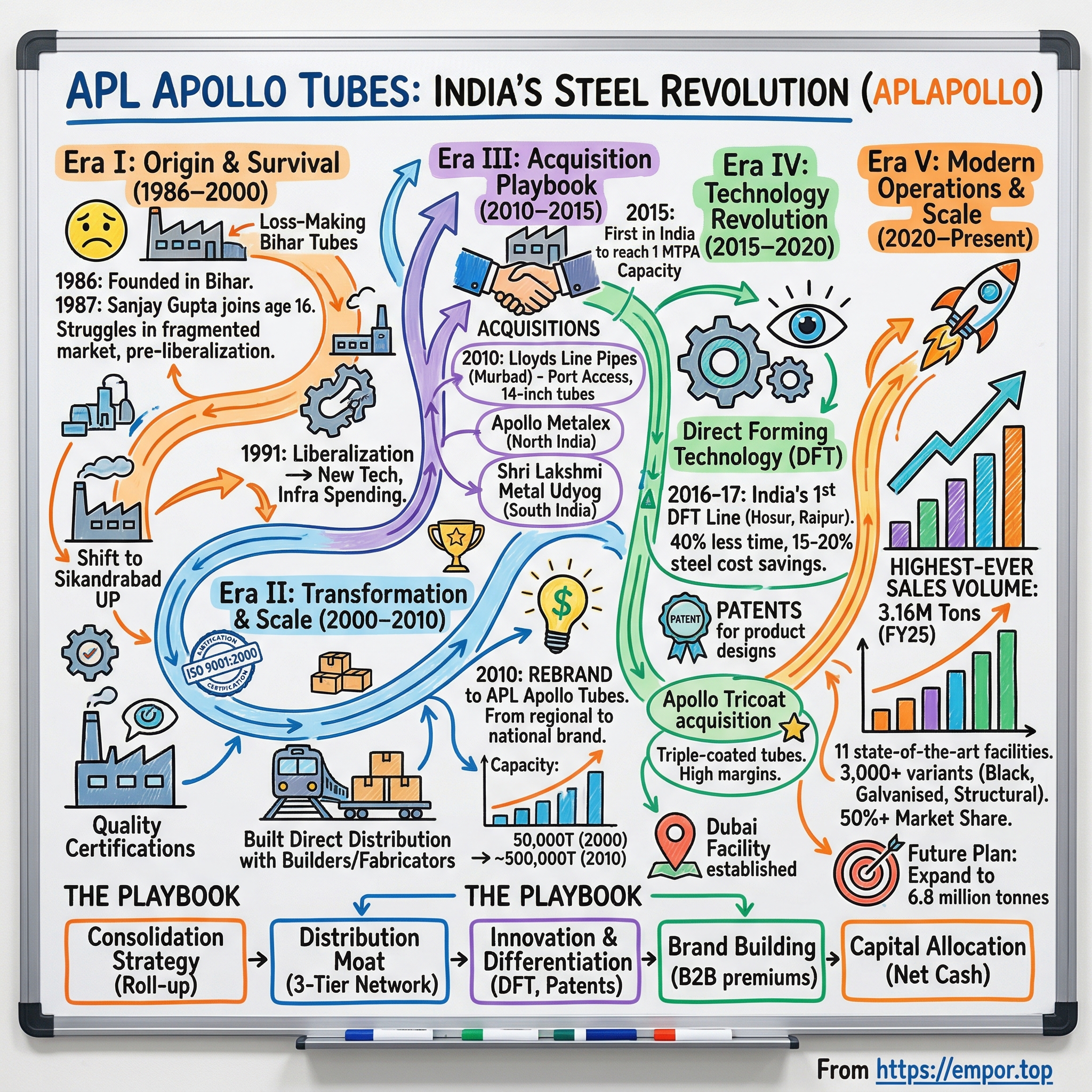
APL Apollo Tubes: India's Steel Revolution
I. Introduction & Episode Roadmap
There is a particular sound that defines an Indian construction site in 2026, and it is not the one most people remember. It is not the wet slap of concrete being poured into shuttering, nor the arrhythmic clang of rebar being tied by hand. It is the short, bright shriek of an angle grinder biting into a hollow steel section — a square tube, galvanised, stamped with a logo, cut to length, and welded into a frame that will hold up a warehouse roof, an airport canopy, or the mezzanine floor of a data centre in Navi Mumbai.
That sound is, in a very literal sense, a business model. Somebody had to decide that square steel tubes should be branded. Somebody had to decide that a fabricator in a tier-3 town should be able to buy a 300x150x8mm section off the shelf on a Tuesday afternoon rather than wait six weeks for a mill to schedule a run. And somebody had to decide — this is the strange part — that the way to sell more steel in a country built on informal credit was to stop extending credit entirely.
The company that made those decisions is APL Apollo Tubes, and as of the quarter ended June 2026 it carried a market capitalisation of roughly ₹59,400 crore against a book value per share of about ₹191 — which is to say the market valued it at more than eleven times the accounting worth of its factories.1 That number is the whole argument in miniature. Nobody pays eleven times book for a steel converter. They pay it for a distribution system that happens to own steel mills.
The premise of this story is a genuinely counterintuitive one. Structural steel tubes are, on any reasonable reading, a commodity. The input is hot-rolled coil, a globally traded product whose price is set in Shanghai and Rotterdam as much as in Raipur. The conversion process — unroll the coil, form it, weld the seam, cut it — is not a secret. There are, by Tata Steel's own count, more than 200 players in the Indian tubes and pipes market.12 And yet one company claims to have taken something close to two-thirds of the organised structural segment, generates a return on capital employed north of 30%, and sits on net cash.16
The explanation the company offers is that it commoditised production and branded the product. The explanation this article will test is somewhat more specific and somewhat less flattering: APL Apollo built a working-capital machine, wrapped it in a brand, and then spent a decade pouring the cash it generated into scale that its fragmented competitors could not match. Whether that machine is a durable moat or a very good run through a very good decade of Indian construction is the question a long-term investor actually has to answer.
Here is the road we will walk. First, the origins — a pipe-trading family that moved from Bihar to Delhi, a sixteen-year-old who skipped college to join his father, and the moment the company decided to stop financing its own dealers. Then the consolidation years, when a series of small, cheap, unglamorous acquisitions turned a regional player into a national one. Then the technology chapter: Direct Forming Technology, the machinery import that changed the unit economics of every product line, and the Apollo Tricoat transaction that raised legitimate governance eyebrows even as it transformed the margin profile. Then the megasite era — Raipur, Dubai, and the bet on heavy structural sections that management believes is the next margin engine.
From there the analysis sharpens. We will map the industry structure through Porter's Five Forces and Hamilton Helmer's 7 Powers, and ask honestly which of those powers APL Apollo actually holds versus which are simply the residue of being early and large. We will audit management's behaviour over multiple earnings cycles — including a September 2024 quarter in which profit collapsed to ₹53.81 crore, and the subsequent recovery — because guidance discipline under stress tells you more than guidance discipline in a boom.15 We will run the activist stress test on valuation, related-party history, and inventory risk. And we will end with the three metrics that, if you own this business, are the only ones you genuinely need to watch.
Let us begin where all of it began: in a trading office in Delhi, with a name borrowed from a state the family had already left.
 Subscribe on LinkedIn
II. The Bihar Origins & The Cash-and-Carry Epiphany (1986–2010)
In 1987, a sixteen-year-old walked out of school and into his father's steel pipe business, and never went back to a classroom. Sanjay Gupta's education, such as it was, took place across sixteen years working beside Sudesh Kumar Gupta in an industry he would later describe with a single dismissive phrase: it was, he said, "totally lala type" — a Hindi shorthand for the family-run, ledger-in-a-cloth-bound-book, handshake-and-hope style of Indian trading that ran on personal relationships and very little else.5
The company itself was incorporated on 24 February 1986 as Bihar Tubes Limited, and the name was already a slight fiction by the time it was registered — the family had shifted its pipe-trading operation from Bihar to Delhi that same year.5 The manufacturing base was a plant at Sikandrabad in Bulandshahr district, Uttar Pradesh, turning out galvanised iron and black pipes: the most basic, most substitutable product in the steel tube universe.5 Bihar Tubes was, at that point, one of the smallest customers on the books of the Steel Authority of India, sitting well below established names like Jindal Pipes in the pecking order for coil allocation.
This matters more than it might seem. In a business where your raw material is 85% of your cost, being a small buyer is not merely inconvenient — it is close to fatal. You pay more for coil than your competitors, you get it later, and you have no leverage when prices move against you. The early years were accordingly grim: capital-starved, loss-making, and structurally disadvantaged in a post-liberalisation market that was rewarding scale and punishing everyone else.
The Death That Changed the Strategy
Sudesh Gupta died in 2002. What his son did next is the first genuine strategic decision in this story, and it set the pattern for everything that followed.
Rather than expand capacity in the products the company already made, Gupta partnered with a Japanese manufacturer to bring pre-galvanised tube technology into India, investing ₹50 million in the equipment.5 The economics of that upgrade were brutal in the best way: line speed went from 20 metres per minute to 150 metres per minute.5 A seven-fold increase in throughput on the same footprint, the same labour, the same overheads.
This is the first appearance of what became the company's governing instinct — that in a commodity conversion business, the winner is not the one with the cleverest product but the one with the lowest cost per tonne of converting flat steel into a shape someone wants. Gupta did not try to escape the commodity. He tried to industrialise it faster than anyone else could.
The Structural Bet
Running underneath was a second conviction, and it was a genuine call on how India would build. Gupta believed that hollow structural sections — square and rectangular steel tubes — would displace round pipes, timber, and reinforced cement concrete in Indian construction the way they already had across Western and East Asian building codes.
The logic was not mystical. A hollow square section is a remarkably efficient structure: it carries load in every direction roughly equally, weighs far less than an equivalent concrete column, arrives on site pre-formed, and can be bolted or welded into place by a two-person crew in an afternoon. Concrete requires shuttering, curing time, water, and weather that cooperates. In a country where construction was about to be dominated by speed — warehouses, factories, metro stations, airports, all on deadline — the physics favoured steel.
But India was decades behind on adoption, and for a mundane reason: the supply chain did not exist. Primary steelmakers concentrated on flat products (hot-rolled coil) and long products (rebar), which they could sell in bulk to industrial buyers. Downstream conversion into structural tube was left to a swarm of small regional roll-formers with inconsistent quality, no branding, and no ability to hold inventory across a range of sizes. If an architect specified an unusual section, the honest answer was often that nobody made it.
Building the Footprint
Between 2008 and 2010 the company started assembling the physical network that would later become the actual moat. It acquired Shri Lakshmi Metal Udyog, a Bengaluru-based operation, for ₹200 million, and separately picked up Metalex for ₹70 million.5 It committed ₹1.25 billion to a greenfield plant at Hosur in Tamil Nadu, opening the southern market.5
The geographic logic here is worth dwelling on, because it is easy to miss. Steel tube is a low-value-density product — you are essentially shipping air wrapped in a thin steel skin. Freight is a punishing share of delivered cost, and a plant 1,500 kilometres from the customer is structurally uncompetitive no matter how efficient it is. Every plant APL Apollo added was, in effect, a defensive wall around a regional market. Competitors could not undercut it there without building their own plant, and the market in any single region was rarely large enough to justify one.
The Epiphany: Stop Lending Money to Your Customers
And then, around 2008–2010, came the decision that made the company what it is.
The industry norm was straightforward and universally accepted: manufacturers extended 45 to 90 days of unsecured credit to their dealers. Everybody did it. It was how the trade worked. It was also, on inspection, a catastrophe. The manufacturer was running a small unregulated bank on the side — financing thousands of small traders, absorbing their default risk, and funding the whole thing with working capital that could otherwise have built plants. Receivables ballooned, bad debts were written off quietly every year, and the balance sheet of a typical Indian pipe manufacturer was permanently fragile.
APL Apollo's answer was to simply stop. Cash before shipment. No credit, no exceptions.
On paper this should have destroyed the business. Dealers had every reason to walk to a competitor who would still fund them. What the company offered instead was a trade: give up the float, and in exchange get inventory availability so reliable and so broad that you can turn your own capital several times faster than you could before. From 2011 the company built out a pan-India warehouse distribution network — the first in the Indian pipes category — which cut order turnaround time from roughly five days to two.5
The arithmetic for a dealer is the part that made it work. A dealer operating on 60-day credit turns their stock perhaps six times a year. A dealer paying cash but able to restock within 48 hours can turn it far more often. The absolute margin per tonne might be identical; the return on the dealer's own capital is not remotely identical. APL Apollo did not persuade its distributors to be generous. It restructured their economics so that cash-and-carry was the more profitable choice.
The effect on the manufacturer's own balance sheet was the mirror image, and it compounds to this day. As ICRA noted in its February 2026 rating rationale, receivable days have run below 10 in recent fiscals, against roughly 30 days before the shift, with net working capital sitting at 0–3% of operating income across the last three years.4 A business that collects before it ships does not need a bank. It funds its own growth.
In July 2010, Bihar Tubes formally became APL Apollo Tubes Limited.5 The name change was cosmetic; the model change underneath it was not. What the company had discovered was that in a commodity industry, the most defensible innovation is not in the product at all. It is in the terms.
Having fixed the balance sheet, the next problem was scale — and the fastest route to scale, it turned out, was to buy it while everyone else was panicking.
III. The Consolidation Playbook: Lloyds, Scale, & The Rebrand (2010–2015)
There is a specific kind of acquisition that almost never makes headlines: the small, distressed, geographically useful plant bought for less than it would cost to build, from a seller who has run out of patience. APL Apollo made a career of them.
The template case came in 2010. Lloyds Line Pipes operated a manufacturing facility at Thane in Maharashtra, and APL Apollo acquired it for ₹400 million — ₹40 crore, all cash.5 For context on what that bought: a greenfield plant of comparable capability had cost the company north of ₹1.25 billion at Hosur two years earlier.5 This was not a synergy story or a strategic premium. It was buying steel-forming capacity at a fraction of replacement cost during a regional downturn, from an owner who wanted out.
The strategic value went beyond the discount. The Thane facility unlocked the ability to make large-diameter tube, a product range the company had not previously served, and it sat close to the Jawaharlal Nehru Port Trust complex near Mumbai — which mattered for both importing hot-rolled coil and, much later, exporting finished sections. One transaction bought capacity, product range, and logistics position simultaneously.
The Pattern Behind the Deals
Look across the acquisitions of this era and a consistent discipline emerges. Shri Lakshmi Metal Udyog at ₹200 million. Metalex at ₹70 million. Lloyds at ₹400 million. These are not transformative bets; they are bolt-ons, each one filling a specific hole in the map or the product catalogue, each bought cheap, each funded without wrecking the balance sheet.
For an investor auditing management capital allocation, this early record is genuinely informative. The temptation in a fragmented consolidating industry is to overpay for the marquee asset and call it strategic. APL Apollo consistently did the opposite: it bought unloved assets in downcycles, integrated them into an existing distribution system that could immediately fill their order books, and let the acquired capacity earn its return through utilisation rather than through a re-rating story.
The limitation of that record, which is worth naming now rather than later, is that buying distressed regional plants at replacement-cost discounts is a strategy with a natural expiry date. Once you are the largest player and the industry is consolidating in your favour, there are no more cheap assets. Growth has to come from greenfield capex at full cost — which is exactly where the company finds itself in 2026, and we will return to what that does to returns.
Freight, Maps, and the Unglamorous Moat
By the middle of the decade the company was operating plants across the north, south, west, and centre of India, and had become the first Indian steel pipe manufacturer to cross one million tonnes per annum of installed capacity.
That milestone is usually reported as a vanity statistic. It is more interesting than that. A multi-plant national footprint in a freight-sensitive product does two things at once. It lowers your own delivered cost in every region — which is a margin story. But it also lets you hold inventory of a far wider range of sizes across the country, because each warehouse is restocked from a plant a few hundred kilometres away rather than a thousand. That is a service story, and service is what the cash-and-carry bargain was built on. The two strategies are not separate; the plant map is what makes the distribution promise credible.
Selling a Brand to a Welder
Then there is the part of this story that other steel companies simply did not attempt: consumer-style branding of an industrial intermediate.
APL Apollo adopted the tagline "Desh Ki Badhti Taqat" — the nation's growing strength — and started marketing steel tube the way a cement or paint company markets to homeowners. It later put its name on Indian Premier League cricket, the single most efficient way to reach the Indian mass market ever devised.
But the sharper insight was about who actually decides which tube gets used. It is not the architect, and usually not the building owner. It is the fabricator — the small workshop, often two to five people, that cuts and welds the sections on site. The fabricator's incentives are practical: he wants a section that is dimensionally consistent so his welds line up, available today so he is not idle tomorrow, and carrying a name the client will accept without argument. APL Apollo built loyalty programmes, ran structural design training, and standardised its SKU catalogue so that specifying "Apollo" became the path of least resistance.
By the time of ICRA's 2026 assessment, that network had grown to more than 800 dealer-distributors and over 50,000 retailers built up across three decades.4 The number to hold onto is not 800; it is 50,000. Distributors can be bought. Fifty thousand small retail and fabrication relationships, each one habituated to a catalogue, cannot be replicated by writing a cheque.
What the company had by 2015, then, was a balance sheet that funded itself, a plant map that made freight work, and a brand that reached the person holding the grinder. What it did not yet have was a cost advantage in the physical act of making the tube. That came next, and it came from a machine.
IV. The Technology Moat: Direct Forming Technology & Apollo Tricoat (2015–2021)
To understand why Direct Forming Technology mattered, you first have to appreciate how absurd the traditional method was once you see it written down.
The conventional electric resistance welded process makes a square tube in the most roundabout way imaginable. You take flat hot-rolled coil. You roll it progressively into a circle. You weld the seam shut. And then — having gone to the trouble of making a perfectly good round pipe — you crush it through another set of rollers to squash it into a square or rectangle.
It works. It has worked for decades. But every single section size requires its own dedicated set of forming tools, and changing from one size to another means physically swapping out the dies. On a traditional line, that changeover consumed close to ten hours.5 Ten hours of a production line producing nothing. Which means the only economically rational way to run such a plant is in long batches of a single size — and long batches of a single size is precisely the opposite of what a distribution business built on carrying 1,500 SKUs actually needs.
The Machine That Made Variety Cheap
Direct Forming Technology solves the problem by skipping the round stage entirely. The flat strip is formed directly into its final square or rectangular profile through a universal set of rolls that can be adjusted rather than replaced. There is no intermediate circle, no crushing step, and — critically — no tooling swap between sizes.
APL Apollo imported the technology and committed roughly ₹1.5 billion to rolling it out across its plants. Changeover time on a DFT line fell from about ten hours to roughly thirty minutes.5
Sit with that for a moment, because the strategic consequence is much larger than the cost saving. A thirty-minute changeover means the marginal cost of producing a different size approaches the marginal cost of producing more of the same size. Product variety, which in every other manufacturing business is a tax, became nearly free. The company could suddenly offer custom sections on demand, hold a far broader catalogue, and serve the odd specification that a regional competitor would decline outright — all while eliminating the intermediate forming step's material waste.
This is where the pieces click together. Cash-and-carry required a promise of availability. Availability required breadth. Breadth required cheap changeovers. DFT made breadth cheap. Each element of the strategy was load-bearing for the next, and a competitor copying any single piece in isolation would find it did not work.
The honest caveat: DFT is imported equipment, not proprietary invention. Anyone with capital can buy the machines, and competitors have. Surya Roshni, for one, has been commissioning three new DFT mills across its Gujarat, Malanpur and Bahadurgarh plants between August and December 2026, explicitly to strengthen its value-added section portfolio.13 Tata Steel has been installing a hollow section universal mill at Jamshedpur using direct forming technology.12 The machine is available to all. What is not available to all is 4.5 million tonnes of it, spread across a national plant map, feeding a distribution network that can absorb the variety it enables. The moat is not the technology; it is the technology at scale inside a system built to use it.
Apollo Tricoat: The Deal That Worked and the Deal That Raised Questions
The other transformative move of this period was messier, and it deserves a careful, neutral telling.
In early 2018, Rahul Gupta — Sanjay Gupta's son — personally acquired a controlling stake in a listed shell-ish entity called Best Steel Logistics and renamed it Apollo TriCoat. The company built a plant near Bengaluru to make triple-coated tube.
The product was genuinely novel for the Indian market. "Tricoat" refers to a stack of three protective layers applied inline: galvanising, a primer, and a clear polymer topcoat. In plain terms, it makes a steel tube that can be used where you would previously have needed painted wood or powder-coated fabrication — door frames, window sections, handrails, staircase treads, furniture, designer tubes. These are not construction commodities. They are building products sold on appearance and finish, at building-product margins.
Then the parent company bought it. In October 2018, Shri Lakshmi Metal Udyog — an APL Apollo subsidiary — entered into an agreement to acquire a 31.4% stake in Apollo TriCoat from Rahul Gupta, and in June 2019 completed the acquisition of a 40.4% holding for approximately ₹1.5 billion. On 27 February 2021, the APL Apollo board approved a scheme of amalgamation folding both Shri Lakshmi Metal Udyog and Apollo Tricoat into the parent, supported by a valuation report from SSPA & Co. and a fairness opinion from Fortress Capital Management Services on the share exchange ratio.78 Minority shareholders of Tricoat received one APL Apollo share for each share held; the scheme's appointed date was 1 April 2021, and it became operative when the NCLT order was filed with the Registrar of Companies on 31 October 2022.
Now the analytical question, stated plainly: a promoter family member incubated a business in his personal capacity and then sold it to the listed company at a profit. That is a related-party structure, and no amount of subsequent operational success makes it not one.
The defence available to management is that the incubation absorbed the risk of an unproven product outside the listed entity, that the acquisition happened only after product-market fit was demonstrated, and that the transaction carried an independent valuation and a merchant banker's fairness opinion. Those are real procedural protections. The counterargument, which a governance-minded investor should hold onto, is that the structure by construction gives the promoter family the upside of successful incubation while the listed company bears the acquisition cost — and that "we only bought it once it worked" also means "the listed shareholders paid for the de-risking."
Both things are true. The record since is that the acquired product line worked and materially lifted the blended margin profile. The record is also that this is exactly the kind of arrangement that has ended badly at other Indian promoter-led companies, and the appropriate posture is continued vigilance rather than either indictment or absolution.
The Shankara Manoeuvre
A smaller, cleverer set of moves ran alongside. In April 2019, APL Apollo bought a tube manufacturing facility in south India from Shankara Building Products for ₹700 million — again, capacity acquired rather than built.5 Then in March 2022, APL Apollo Mart acquired a 9.9% equity stake in Shankara itself for roughly ₹180 crore.9
The logic was distribution, not investment. Shankara operated a large retail network across southern India; an equity position aligned the two companies' interests and helped lock those counters in as an outlet for Apollo product. And once the commercial relationship was established, the equity became optional. On 20 May 2025, APL Apollo Mart disclosed to the exchanges that it had sold 14,85,000 shares representing 6.12% of Shankara's paid-up capital — monetising most of the position while retaining the trade relationship.10
That sequence — buy equity to secure distribution, then sell the equity once the distribution is secured — is a fair signal about how this management thinks about non-core assets. Capital is a tool for locking in commercial position, not a portfolio to be admired. It is a genuinely disciplined pattern, and one of the more concrete pieces of evidence available on capital allocation quality.
By 2021, then, the company had a cost advantage in conversion, a margin ladder in coated products, and a distribution network reinforced by equity. What it needed next was somewhere to put a very large amount of steel.
V. The Megasite Revolution & Heavy Structural Bet: Raipur & Dubai (2021–Present)
Chhattisgarh is not where most consumer-facing Indian companies build things. It is where steel gets made. The state sits in the middle of India's mineral belt, ringed by primary producers, and a tonne of hot-rolled coil there costs less than the same tonne delivered to Delhi or Chennai for one boring reason: it does not have to travel.
APL Apollo had already established a presence at Raipur in 2016 with a ₹1.6 billion facility.5 What it built afterwards was a different order of thing — a megasite, conceived as a single integrated complex rather than another regional plant, running almost entirely on direct-formed lines and designed around the heaviest, most technically demanding products in the catalogue.
The strategic reasoning inverts the earlier plant-map logic in an instructive way. The regional plants exist to be close to customers, because freight on finished tube is expensive. Raipur exists to be close to suppliers, because for the heaviest and most value-added sections, the sophistication of the equipment matters more than the last few hundred kilometres of delivery, and the raw-material freight saving is large enough to fund the difference. It is a deliberate exception to the company's own rule, and the exception is justified by product mix.
By the third quarter of FY26 the site had become, in management's framing, the hub for value-added and heavier products while the regional plants served local demand — with value-added capacity utilisation at Raipur running around 70% and blended realisations at Raipur and Dubai above ₹5,500–6,000 per tonne of EBITDA. ICRA's rating rationale flagged the same point from the credit side: the company's ability to ramp Raipur to optimal utilisation and sustain its value-added mix is a key monitorable, and the 9M FY2026 improvement in operating profit — ₹1,291 crore against ₹764 crore a year earlier — was explicitly attributed in part to Raipur volumes lifting the value-added share.4
That is the honest state of play: Raipur is working, and Raipur is not yet full.
The Heavy Structural Bet
The most consequential thing happening inside that complex is a product category that barely existed in India a decade ago.
Conventional large steel structures — the roof of an airport terminal, the frame of a high-rise, the columns of a data centre — have historically been built from I-beams and plate girders welded together on site into "built-up" sections, or from reinforced concrete. Both are slow. Built-up sections require enormous amounts of skilled welding; concrete requires curing time nobody has.
A heavy hollow structural section replaces both. APL Apollo's range now extends to large-dimension sections up to 1000x1000 mm, alongside colour-coated products and patented building-material profiles.4 Instead of fabricating a column from four plates, you order one.
The financial materiality here is the point. Standard structural tube is a thin-margin conversion business. Heavy sections are engineered products with few domestic suppliers, specified by structural consultants rather than bought on price by traders, and they carry materially higher EBITDA per tonne. Management has told investors it expects the new capacity coming on stream to deliver EBITDA of ₹8,000 per tonne and above, against a company blended figure that only recently crossed ₹5,000.146
An investor should treat that ₹8,000 figure as a target, not a fact. It is a forward claim about a product ramp that has not yet happened at scale. What can be verified is the direction: the blended EBITDA per tonne has been rising, and the company attributes the rise specifically to mix. What cannot yet be verified is whether heavy sections hold their premium once competitors install the same equipment — which, given that the equipment is purchasable, is a question of years rather than decades.
Dubai, and a Lesson in Ramp Risk
The international chapter is more instructive still, precisely because it has been bumpy.
APL Apollo built a 0.3 million tonne ERW pipe plant in Dubai, positioned to serve Gulf infrastructure demand and to export into Western Europe and North America, with a brownfield expansion adding a further 0.2 million tonnes.4 The strategic case is straightforward: a manufacturing base outside India diversifies the demand cycle, earns in dollars, and sidesteps the freight and tariff friction of exporting finished tube from India.
The execution case has been rougher. In the fourth quarter of FY26, management disclosed that Dubai operations were running at roughly 40% capacity utilisation.6 Then in the June 2026 quarter, geopolitical disruption in the UAE cost the company an estimated 25,000 tonnes of volume outright — one of four headwinds management enumerated on the Q1 FY27 call, alongside an Indian energy crisis that hit duct pipe and roofing demand by a further 25,000–30,000 tonnes, competitive pressure on premium sections from cheap secondary steel, and dealers destocking on fears of falling commodity prices.3
That is a useful data point about the nature of this diversification. A Gulf manufacturing base does hedge Indian construction cyclicality. It also imports an entirely new set of risks — regional geopolitics, export-market dumping, and the ordinary difficulty of ramping a plant in a market where you have no distribution history and no fifty thousand fabricators who already know your name. The domestic moat does not travel.
The Expansion Pipeline
The forward capacity plan, as laid out to investors, involves roughly 2 million tonnes from new plants plus 1 million tonnes from debottlenecking existing sites — Gorakhpur at 200,000 tonnes, Siliguri at 300,000 tonnes, a new Malur facility at 1 million tonnes conceived as entirely value-added, and a further 500,000-tonne site in Maharashtra or north Karnataka under consideration, phased from the second half of FY27 through FY28.143 ICRA's assessment puts group capacity on a path to approximately 6.8 MTPA by FY2028 from 4.5 MTPA, with capacities also planned at Kolkata and Bhuj.4
Management has framed this as self-funded: capex of roughly ₹500–600 crore annually, with the pending ₹1,400–1,500 crore for the incremental million tonnes spread over two to two-and-a-half years and financed from internal cash flows.6 The company ended FY26 with net cash exceeding ₹15 billion, operating cash flow around ₹20 billion, and free cash flow near ₹13 billion.6 On the numbers, the funding claim holds.
Apollo Mart: Optionality, Correctly Sized
Alongside all of this sits APL Apollo Mart, a B2B platform for building materials connecting fabricators, architects and dealers. It is worth exactly one paragraph, which is roughly the weight it deserves. It leverages an existing distribution network at low incremental capital, it was also the vehicle used to hold and then partially exit the Shankara stake, and it has not to date been presented as a material earnings driver. Investors should size it as optionality, and should watch it mainly as a governance surface — subsidiary transactions are where complexity tends to accumulate at promoter-led companies.
The physical build-out is therefore substantially settled. What is not settled is whether the competitive position that made it worth building survives the next five years. That requires looking hard at the industry itself.
VI. Industry Structure, Moats, & Helmer's 7 Powers
Start with the size of the prize and the shape of the field, because both are frequently misstated.
The Indian tubes and pipes market is, in Tata Steel's own characterisation, a highly competitive one with over 200 players — and one it expects to more than double over seven years.12 Within that, the structural hollow section segment is where APL Apollo lives, and where it claims dominance. In its FY26 disclosures the company put its market share at 65%, up from 55% a year earlier.6 On the Q1 FY27 call, management framed the objective as maintaining a 60–65% share and expressed indifference to volumes below that threshold.3
A neutral reading requires a caveat here. Market share figures in a sector where more than half the players are unorganised are estimates, and they are estimates produced by the party with the most to gain from a large number. The denominator — whether you count only organised structural sections, or all ERW tube, or include the informal roll-formers — swings the answer materially. What is independently corroborated is the direction and the leadership position: ICRA describes the group as controlling a substantial market share and as one of the largest structural steel tube players globally, with 4.5 MTPA of capacity across 11 Indian plants and one in Dubai.4 Take the leadership as established. Treat the precise percentage as a company estimate.
Who Is Actually Coming
Tata Steel is the most serious competitor, and the most frequently underestimated. Its tubes division runs 1.2 million tonnes of capacity — 700,000 tonnes in-house across Jamshedpur, Khopoli, Sahibabad and Hosur, plus 500,000 tonnes through nine tube manufacturing partners — and it markets hollow sections under the Tata Structura brand. Its stated ambition is 4 million tonnes by FY30, roughly a tripling, and it added 172,000 tonnes in a recent nine-month stretch through new and expanded partners.12 Tata brings a brand that outranks APL Apollo's with institutional buyers, and backward integration into its own coil.
Surya Roshni is the disciplined mid-sized challenger, moving from 1.4 million tonnes toward 1.6 million by end-FY27 and roughly 2 million by FY28–29, adding 2–3 lakh tonnes a year funded from internal accruals, with a south India expansion at Hindupur.13 Its pace is deliberate and its balance sheet unstressed.
Jindal Pipes and the D.P. Jindal group, along with regional players such as Hi-Tech Pipes and Kamdhenu, occupy the rest — generally stronger in round and industrial pipe than in architectural section breadth, and generally competing on price.
The strategic read: APL Apollo's lead is real but it is being contested by well-capitalised entrants who have now watched the playbook for a decade and are copying the visible parts of it. Nobody is going to out-scale APL Apollo by FY28. But Tata at 4 million tonnes would be a genuinely different competitive environment than Tata at 1.2 million.
The 7 Powers, Assessed Honestly
Counter-Positioning is the strongest claim, and it is a real one. Cash-and-carry is not merely a policy APL Apollo adopted; it is a policy incumbents structurally struggled to adopt. A legacy manufacturer whose dealers depend on 60-day credit cannot withdraw it without watching those dealers immediately shift volume to whoever still offers it. The incumbent's rational choice — protect existing volume — is precisely what prevents the switch. That is the textbook shape of counter-positioning.
The honest qualification is that counter-positioning erodes once the new model is proven and the incumbent's own dealers start demanding better service instead of better terms. Seventeen years on, the model is thoroughly proven and thoroughly visible. New entrants building distribution today have no legacy credit book to defend and can adopt cash-and-carry from day one. The power was decisive historically. It is weakening prospectively.
Scale Economies is the power that is strengthening. In conversion, fixed cost per tonne falls with throughput, procurement leverage rises with volume, and the largest domestic buyer of hot-rolled coil negotiates from a position no regional player can match. The evidence shows up in the return profile rather than in a disclosed conversion cost: a reported ROCE of 31.8% and ROE of 25.4% on a business whose product is a commodity is not achievable without a structural cost position.1
Process Power — the DFT roll-out, the patented building-material profiles, the accumulated know-how of running direct-formed lines at scale — is real but, as discussed, rentable. Its durability depends on execution depth rather than exclusivity.
Cornered Resource is better described here as a distribution asset than a resource: 800-plus distributors and more than 50,000 retailers, built over three decades, serving 300-plus towns.42 A fabricator who needs an unusual section immediately has, in practice, very few alternatives. This is the least replicable asset in the company and the one least visible on the balance sheet.
Notably absent from the list: Branding in the Helmer sense (the ability to charge a premium for an affective reason) is partial at best — APL Apollo commands preference, but ICRA explicitly notes that intense competition from organised and unorganised players "moderates the Group's pricing power," leaving it vulnerable to steel price volatility.4 And there is no Switching Cost and no Network Economy worth claiming. Three-and-a-bit powers out of seven is a strong hand. It is not an unassailable one.
Porter, Briefly and Concretely
Supplier power is high in structure but moderated in practice. Hot-rolled coil comes from an oligopoly — JSW, Tata, SAIL, JSPL — and its price is set globally. APL Apollo cannot escape that; it can only be the buyer those suppliers most want to keep, which is worth rebate and allocation advantage but not immunity.
Buyer power is genuinely low, and cash-and-carry is why. A fragmented base of dealers paying upfront has no leverage. This is the single cleanest structural advantage in the business.
Substitutes are the interesting one. Reinforced concrete and built-up steel sections remain the incumbent technologies for most Indian construction, and the substitution trend runs in APL Apollo's favour — but it runs at the speed of Indian construction practice changing, which is slower than presentations imply. Meanwhile a subtler substitution runs the other way: on the Q1 FY27 call, analysts pressed management on a primary-versus-secondary steel price spread of ₹10–12 per kilogram that had compressed premium-section EBITDA toward ₹0–1,000 per tonne, with management hoping the gap narrows to ₹3–5/kg as primary capacity comes on stream.3 Cheap secondary steel is a live substitute at the value-added end, and it is currently biting.
New entrants face a high but not prohibitive barrier. Building 4.5 million tonnes of capacity, 1,500 SKUs, and a fifty-thousand-strong retail habit is a decade-long project. Building 500,000 tonnes in one region and competing on price is not.
Myth Versus Reality
Three consensus narratives deserve testing.
Myth: APL Apollo has pricing power. Reality: it has cost and availability advantage. Its own credit rating agency states that competition moderates its pricing power and leaves it exposed to steel price swings.4 The margin expansion of the last two years came predominantly from mix and operating leverage, not from charging more for the same tube.
Myth: the cash-and-carry moat is permanent. Reality: it was a one-time structural arbitrage against incumbents' legacy credit books. It remains a working-capital advantage — receivables under 10 days is extraordinary — but as a barrier to new competition it is a diminishing asset.
Myth: scale alone guarantees the outcome. Reality: scale guarantees a cost position. It does not guarantee volume growth, which depends on Indian construction demand, and the June 2026 quarter demonstrated that volumes can fall 6% year-on-year even with all the advantages intact.2
The structural picture, then, is of a genuinely advantaged business whose advantages are of differing durability. Which makes the question of who is steering it, and how well they have called their own shots, unusually important.
VII. Current Operations, Management Credibility, & Financial Engine
On 29 October 2025, five people sat down for a conference call hosted by Axis Capital: Sanjay Gupta as Chairman and Managing Director, Rahul Gupta as Director, Deepak Goyal as Director of Operations, Anubhav Gupta as Chief Strategy Officer, and Chetan Khandelwal as Chief Financial Officer. Anubhav Gupta opened by announcing the highest quarterly volume and EBITDA in the company's history.
Twelve months earlier, on the equivalent call, the news had been rather different. In the September 2024 quarter, consolidated net profit had come in at ₹53.81 crore.15 Not a bad quarter — a near-collapse, for a company of this size.
The gap between those two calls is the most useful lens available on this management team, because you learn considerably more about capital allocators from how they narrate a disaster than from how they narrate a record.
What Broke, and What Management Said About It
The FY25 problem was structural to the business model, and it is worth understanding precisely because it will recur.
APL Apollo buys hot-rolled coil, converts it, and sells tube. Between purchase and sale there is a lag — inventory sitting in plants and warehouses, priced at what coil cost when it was bought. When coil prices fall sharply, the company is holding stock worth less than it paid, while simultaneously having to cut selling prices to stay competitive. The result is an immediate compression in realised EBITDA per tonne that has nothing to do with demand, execution, or competitive position. It is a pass-through business with a delay, and the delay is where the pain lives. By the March 2025 quarter the cycle had begun to turn — net profit recovered to ₹293 crore from ₹171 crore in the year-ago quarter — but the damage to the full year had already been done.11
Management's framing of this has been consistent across cycles, which is itself a credibility marker: they describe EBITDA per tonne volatility as steel-price-driven and separable from the volume story, and they have not, in the available record, attributed weak quarters to demand when the cause was inventory. The FY26 response was concrete rather than rhetorical — over the third and fourth quarters the company cut absolute inventory by 30,000–40,000 tonnes, reducing inventory value by roughly ₹250 crore even as steel prices rose.6 That is a specific operational answer to a specific identified problem, which is the behaviour you want to see.
The FY26 Recovery, and What Actually Drove It
The year ended March 2026 was, on the reported numbers, the best in the company's history. Consolidated revenue rose about 11.5% to ₹23,079 crore. Consolidated profit after tax rose 58.9% to ₹1,203.08 crore. EBITDA rose 47.7% to ₹1,913.67 crore. Sales volume grew 11% to 3,491,243 tonnes.61
Read those four numbers together and the story tells itself: volumes grew 11%, revenue grew 11.5%, and profit grew 59%. Almost the entire earnings expansion came from margin, not from selling more tube. EBITDA per tonne crossed ₹5,000 for the year, against ICRA's medium-term expectation of a ₹4,500–5,000 band.64
That is a genuinely important analytical distinction. A business whose profits grow because it sells more units is riding demand. A business whose profits grow because each unit earns more is either improving mix, improving cost, or benefiting from favourable input prices. For APL Apollo in FY26 it was largely the first two — the value-added share rose as Raipur ramped — with a helpful assist from softer raw material prices.4 The mix improvement is durable; the input-price assist is not.
The fourth quarter carried the same signature: revenue of ₹6,269.16 crore, up 13.8%, with EBITDA up 22% to ₹547.52 crore and profit up 20.9% to ₹354.35 crore, at an EBITDA margin of 8.73%.6 The company recommended a final dividend of ₹8.50 per share, and published the year's detail through its investor relations and results disclosures.6[^7]
Two disclosures from that quarter deserve more attention than they generally receive. First, the sales mix: housing at 64%, commercial at 23%, infrastructure at 13%.6 The popular framing of APL Apollo as an infrastructure play is, on the company's own numbers, mostly wrong. This is predominantly a housing and building-construction business. That matters for how an investor should think about the demand cycle — residential and commercial real estate, not government capex, is the swing factor.
Second, the capacity constraint was not demand: domestic plants were running at 80–85% because of energy constraints, with management indicating a potential 15–20% production increase if energy availability normalised.6
The Balance Sheet as Strategy
The financial position is where the cash-and-carry decision of 2008 compounds into something visible.
The company ended FY26 with net cash above ₹15 billion, having generated roughly ₹20 billion of operating cash flow and ₹13 billion of free cash flow.6 Borrowings stood at ₹498 crore against ₹634 crore a year earlier.1 ICRA's February 2026 assessment described a conservative capital structure with negative net debt, interest cover of about 13.8 times in 9M FY2026 against 9 times in FY2025, and total debt to operating profit expected below 0.5 times.4 Reported ROCE was 31.8% and ROE 25.4%.1
For a steel-adjacent manufacturer running an aggressive multi-plant expansion, that is an unusual combination. Most companies in this position would be levered. APL Apollo is funding a three-million-tonne expansion out of operating cash while carrying net cash — which is only possible because it collects before it ships and turns inventory in under 40 days.4 The working capital model is not a footnote to the strategy. It is the financing arm of the strategy.
On the Q4 FY26 call, management noted that residual liabilities of around ₹500 crore were expected to be retired in the first half of FY27 and raised the prospect of returning surplus cash through higher dividends or buybacks.6 That is the correct conversation for a company at this stage, and an investor should watch what actually happens: a company that says it will return cash and then finds a new use for it every year is telling you something.
Guidance Discipline Under Pressure
The June 2026 quarter provided the cleanest available test of management's guidance behaviour.
Volumes came in at 744,823 tonnes, down 6% year-on-year and roughly 20% sequentially — a genuinely poor quarter.23 Management attributed it to four specific, quantified causes rather than vague macro language: the UAE geopolitical disruption costing about 25,000 tonnes, the Indian energy crisis costing 25,000–30,000 tonnes in duct pipes and roofing, competitive pressure on premium sections from secondary steel, and dealer destocking ahead of feared commodity price declines.3
And yet EBITDA rose 10.6% to ₹411.3 crore, profit after tax rose to ₹263.11 crore, and EBITDA per tonne climbed 17.9% to ₹5,522.2 Gross profit per tonne improved by about ₹1,000 sequentially, which management explained as a deliberate choice — in their words, to protect margins rather than chase volume during a period of price uncertainty.3
Crucially, they did not cut FY27 guidance. Volume growth of 15–20%, EBITDA growth above 20%, and an EBITDA per tonne band of ₹5,000–5,500 were all maintained, with a stated Q2 volume target of about one million tonnes against 745,000 in Q1, and July volumes already reported above 300,000 tonnes.36
This is where an investor has to hold two thoughts at once. Reaffirming aggressive full-year guidance after a 6% volume decline is either admirable conviction or the setup for a miss, and only the next two quarters will distinguish them. The specificity is a point in management's favour — quantified headwinds and a named monthly recovery number are falsifiable claims, not excuses. The risk is that hitting 15–20% full-year volume growth after a negative first quarter requires an extremely strong back half, and management's own explanation for that back half leans on improved government infrastructure budget allocation — in a business that, by its own mix disclosure, is 64% housing.26
That tension between what is promised and what has to happen is exactly where the sceptics live.
VIII. The Skeptical Investor Stress Test & Risk Radar
Imagine a short-seller's memo. Not a hatchet job — a serious one, written by someone who has read the filings and is genuinely trying to find the crack. What would it say?
Exhibit A: You Are Paying an FMCG Multiple for a Steel Converter
It would open with the multiple, because that is where the argument is strongest. As of the June 2026 quarter the stock traded around ₹2,139 on a trailing price-to-earnings ratio of roughly 48 times and about 11.2 times book value.1
Global steel fabricators and pipe manufacturers do not trade there. They trade in the low-to-mid teens, because they are cyclical converters with limited pricing power and heavy fixed assets. The bull answer is that APL Apollo is not a steel company but a branded building-materials and distribution business, and should be compared with paints, cement or adhesives.
The sceptic's response is uncomfortable and fair: a business whose own rating agency writes that competition "moderates the Group's pricing power, making it more vulnerable to the volatility in steel prices" is not a branded consumer business.4 It is a very well-run converter with an excellent working capital model. Those are different things, and the gap between the two descriptions is roughly the gap between a 48x multiple and a 20x multiple.
This is not an argument that the shares are mispriced — the market has had a decade to think about it and has consistently paid up for the compounding. It is an argument that the multiple embeds an assumption of continued high growth, and that the downside if growth normalises is not gentle. A move from 20% volume growth to 10% would not just halve the growth rate; it would likely reset the multiple as well, and the two effects multiply.
Exhibit B: The Promoter Owns Less Than He Used To
The shareholding pattern for June 2026 showed promoters at 28.25%, foreign institutional investors at 35.12%, domestic institutions at 18.58%, and public shareholders at 18.04%.1 The promoter stake has declined steadily from 37.47% in March 2017.1
There are benign readings — dilution through growth, estate planning, institutional broadening — and the institutional ownership base is now large and sophisticated enough to act as a governance check in its own right. But a promoter-led Indian company where the promoter holds under 30% and the largest single bloc is foreign institutional money is a specific governance configuration, and it deserves naming. Combined with the Apollo Tricoat incubation history, the sceptic's case is not that anything improper has occurred but that the structure repeatedly places the family's economic interest adjacent to, rather than identical with, the minority shareholder's. Subsidiary-level activity — APL Apollo Mart in particular, given it has held equity stakes and executed secondary market transactions — is the surface to monitor.10
Exhibit C: The Margin Is Borrowed From the Steel Cycle
The third line of attack is the most analytically serious. FY26's earnings expansion came overwhelmingly from EBITDA per tonne, and part of that expansion came from lower raw material prices.4
Falling coil prices help a converter's margin once inventory has repriced downward — you buy cheaper and your selling price lags. Rising coil prices do the reverse. The company demonstrated the downside violently in the September 2024 quarter, when profit fell to ₹53.81 crore.15 The pass-through mechanism operates with a lag of weeks, and in that window the entire quarter's margin can be made or unmade by a commodity the company does not control.
An investor evaluating the durability of ₹5,500 per tonne therefore has to decompose it: how much is mix (durable), how much is scale (durable), and how much is the current direction of steel prices (emphatically not durable)? Management's own position, stated on the Q4 FY26 call, was that ₹5,000–5,500 has a two-year track record and should continue, while sustaining above ₹6,000 remains uncertain.6 That is a reasonably candid answer, and notably more conservative than the ₹8,000-plus figure attached to future value-added capacity.14
The Live Risk Radar
Beyond the memo, four risks are currently material rather than theoretical.
Competitive capacity, arriving on schedule. Tata Steel tripling its tubes division toward 4 million tonnes by FY30 and Surya Roshni marching toward 2 million by FY28–29 are not speculative threats; they are announced, funded programmes.1213 Analysts raised exactly this on the Q1 FY27 call, and management's answer was that it targets a 60–65% share and is untroubled by ceding volume beyond that.3 That is a coherent position, but it is also an admission that share is now something to be defended rather than expanded.
The primary-secondary steel spread. The ₹10–12 per kilogram gap compressing premium-section economics is the single most immediate operational drag, and management's remedy — waiting for primary steel capacity additions to narrow it to ₹3–5/kg — is a hope about someone else's capex schedule, not a plan.3
Chinese overcapacity and export markets. Cheap Chinese finished pipe flowing into GCC and Asian markets directly undercuts the economics of the Dubai plant, which was already running near 40% utilisation in Q4 FY26.6 The export leg of the strategy is the most exposed to trade dynamics the company cannot influence.
Demand concentration in housing. With 64% of volume going into housing, a slowdown in Indian residential construction or a credit tightening for developers would hit harder and faster than a slowdown in government infrastructure spending.6 The infrastructure narrative is comforting; the mix disclosure says the exposure lies elsewhere.
Distributor loyalty under stress. The cash-and-carry model has never been tested through a severe, prolonged demand contraction. In a genuine downturn, a regional competitor offering 60-day credit becomes considerably more attractive to a marginal dealer than it is today. The receivables-under-10-days statistic is the cleanest single indicator of whether that discipline is holding, and it is the number to watch first when demand turns.4
None of these is a thesis-killer on its own. Collectively, they describe a company that has run out of easy wins and now has to execute — which is precisely the moment when the difference between a durable franchise and a well-timed cyclical becomes visible.
IX. Strategic Playbook & Investment Case: Why Win vs. Why Not
Strip away the plants and the tonnages, and what APL Apollo actually built is a set of transferable ideas. Three of them are worth extracting, because they apply well beyond steel tube.
Lesson One: In a Commodity, Innovate on Terms Before Product
Every competitor in Indian steel tube in 2008 was trying to compete on price, quality, or occasionally on a marginally better galvanising line. APL Apollo competed on the terms of trade. It changed who financed the inventory, and in doing so changed the return on capital of every dealer in its network and of the company itself.
The generalisable insight is that in industries where the product is genuinely undifferentiated, the highest-leverage variable is often not the product at all. It is the commercial architecture around it: who holds inventory, who bears credit risk, who waits for whom to pay. Those variables are frequently invisible in industry benchmarking, which is exactly why they are available to be changed.
Lesson Two: Make Variety Cheap, Then Sell Variety
The second idea is subtler and more mechanical. Distribution promises are only as good as the manufacturing flexibility behind them. A company can promise availability across 1,500 SKUs, but if every SKU change costs it ten hours of downtime, the promise is a lie that will be exposed within two quarters.
Direct Forming Technology was not bought because it was fashionable. It was bought because the distribution strategy had created a manufacturing requirement — enormous SKU breadth at low cost — and the machine was the only way to meet it. The lesson for operators is that strategic capex should be traceable to a specific commercial promise. When it is, it compounds. When it is not, it is just capacity.
Lesson Three: Layer the Moats, and Know Which Layer Is Load-Bearing
APL Apollo's advantages arrived in sequence and stack on each other: counter-positioning created the working-capital surplus, the surplus funded scale, scale funded process capability, and process capability made the distribution breadth credible. Remove any one layer and the structure weakens.
The corollary — and this is where investors most often go wrong — is that the layers age at different rates. Counter-positioning was decisive in 2010 and is nearly spent as a barrier today. Scale economies were irrelevant in 2010 and are the primary defence today. Reading the moat as a static list rather than a moving sequence produces the wrong forecast.
Why APL Apollo Wins From Here
The bull case, stated as testable propositions rather than aspirations, rests on three legs.
The first is substitution. Indian construction is genuinely shifting from timber, concrete and built-up steel toward hollow structural sections, for reasons of speed and labour availability that are not going to reverse. If Tata Steel's expectation of the tubes and pipes market more than doubling over seven years is even approximately right, the category grows regardless of who wins it.12 APL Apollo's 65%-claimed share of the organised structural segment means it captures a disproportionate share of that growth by default.6
The second is cost position at scale. A 31.8% ROCE in a commodity conversion business is empirical evidence that the cost advantage is real, not asserted.1 Going from 4.5 MTPA toward roughly 6.8 MTPA by FY2028 extends it, and doing so from internal cash flow rather than debt means the returns are not being manufactured by leverage.46
The third is mix. If the value-added share rises from around 65% of the portfolio toward the 75–80% management targets, and if the new heavy-section capacity earns anywhere near the ₹8,000 per tonne indicated, blended EBITDA per tonne rises materially even at modest volume growth.14 The financial leverage in this business is in the mix line, not the volume line — which is why FY26's 11% volume growth produced 59% profit growth.6
The falsification test for each is specific. Substitution fails if hollow-section adoption stalls in residential construction. Cost position fails if peers reach scale faster than expected — watch Tata's partner-network additions. Mix fails if the primary-secondary steel spread stays at ₹10–12/kg and premium sections keep earning near zero incremental EBITDA.3
Why It May Not Win
The bear case is not that the business is bad. It is that the price assumes it stays exceptional.
The first risk is multiple compression, and it is arithmetic rather than opinion. At roughly 48 times trailing earnings, a large share of the market value rests on growth continuing at recent rates.1 If volume growth settles into the high single digits — which is what a maturing 65%-share player in a competitive market eventually does — the earnings growth and the multiple would likely compress together.
The second is the margin ceiling. There is a limit to what a converter can charge for turning coil into a shape before the customer reverts to concrete, to built-up sections, or to a cheaper regional supplier. Management's own reluctance to underwrite EBITDA per tonne above ₹6,000 suggests they see that ceiling too.6
The third is that the most reliable historical source of outperformance — buying distressed capacity cheaply — is exhausted. Everything from here is greenfield at full cost, which mathematically dilutes incremental returns on capital even when executed well.
The fourth is simply that this remains a business whose input is a globally traded commodity, whose end demand is Indian construction, and whose quarterly results can be dominated by neither. The September 2024 quarter is the proof.15
The Three KPIs That Matter
An investor tracking this company does not need a dashboard. Three numbers, reported quarterly, capture essentially everything.
Sales volume in tonnes. This is the demand signal, stripped of steel price noise. Revenue can rise on price alone; tonnage cannot. It is also the only clean way to verify management's 15–20% growth guidance and the trajectory toward the 8-million-tonne capacity ambition.6 The June 2026 print of 744,823 tonnes and the guided one-million-tonne Q2 give an immediate near-term test.23
EBITDA per tonne. This is the mix-and-cost signal, and the single most informative number the company discloses. It separates a business improving its product portfolio from one merely riding a favourable steel cycle. The relevant reference points are management's own ₹5,000–5,500 band and the recent trend above it.36
Net working capital days — specifically receivable days. This is the discipline signal, and the one most people ignore. Receivables under 10 days is the visible proof that cash-and-carry is intact.4 If that number starts drifting upward, it means the company is quietly extending credit to hold volume — which would indicate that competitive pressure has reached the point where the founding advantage is being traded away. It would be the earliest and clearest warning available.
Everything else — margins, profit, market share estimates — is downstream of those three.
X. Epilogue & The Future of Structural Steel
There is a version of the next decade in which APL Apollo stops being a tube company altogether.
The direction management has signalled points toward pre-engineered buildings and modular steel frames: not selling sections to a fabricator who assembles a structure, but selling the structure. It is the logical extension of everything before it — the same argument for speed over concrete, moved one step up the value chain, and with the same effect on margin per tonne. Whether the company can execute it is a genuinely open question. Selling a component into a distribution network and selling an engineered building system into a project are different businesses with different customers, different sales cycles, and different balance sheet characteristics. Nothing in the cash-and-carry playbook transfers cleanly.
The organisational question runs alongside. Sanjay Gupta, who joined his father's business at sixteen and has run it through every phase of this story, now sits atop a company where professional executives handle strategy, operations, and finance, and where the next generation of the family is already inside the business — Rahul Gupta as a director, Anubhav Gupta as Chief Strategy Officer and the primary voice on investor calls. Succession at Indian promoter companies is where a great many compounding stories have gone quietly wrong. The available evidence here is that institutionalisation is underway and that the founder has been willing to let others speak for the company. The evidence is not yet that the transition is complete.
And then there is the matter of what the steel itself is made of. Green steel — coil produced with hydrogen or electric arc rather than coking coal — will eventually reshape the cost curve for everyone downstream. A converter does not control that transition, but it is exposed to it, both in input cost and in whether its customers begin specifying embodied carbon. It sits on the risk radar as a medium-term factor rather than a current one, and the company's solar integration at Raipur addresses its own operational footprint rather than its supply chain's.
What endures from this story is a proposition that has very little to do with steel. A small, loss-making tube maker with a borrowed state name and a sixteen-year-old heir apparent did not win by making better pipe. It won by rearranging who paid whom and when, by making product variety cheap enough to keep the promise that rearrangement required, and by spending twenty years compounding the cash that discipline threw off into scale nobody else was willing to fund. The physical product remained, throughout, a commodity.
Whether that proposition holds for the next decade is a different question from whether it held for the last one. The counter-positioning that created the company is largely spent. The scale that now defends it is being contested by two well-capitalised competitors with announced plans. The margin that drove FY26's earnings surge is part mix and part steel cycle, and only one of those halves is durable. An investor in 2026 is not buying the story that has already happened; they are buying the assertion that a business built on structural cleverness can keep being structurally clever after the original cleverness has been copied.
The evidence is genuinely mixed, and it will resolve in tonnes, in rupees per tonne, and in receivable days.
References
-
APL Apollo Tubes Ltd — Consolidated Financials, Shareholding and Ratios, Screener.in ↩↩↩↩↩↩↩↩↩↩↩
-
APL Apollo Tubes Q1 FY27 Earnings Presentation & Press Release — InvestyWise, 2026 ↩↩↩↩↩↩
-
Earnings call transcript: APL Apollo Tubes Q1 FY27 results — Investing.com, 2026 ↩↩↩↩↩↩↩↩↩↩↩↩↩
-
APL Apollo group (Apollo Metalex Limited): Ratings reaffirmed, rated amount enhanced — ICRA, 2026-02-26 ↩↩↩↩↩↩↩↩↩↩↩↩↩↩↩↩↩↩↩
-
Pack Leader — APL Apollo Tubes, Outlook Business ↩↩↩↩↩↩↩↩↩↩↩↩↩↩↩
-
APL Apollo Tubes reports FY26 revenue of ₹23,079 crore; Q4 FY26 results and FY27 guidance — ScanX ↩↩↩↩↩↩↩↩↩↩↩↩↩↩↩↩↩↩↩↩↩↩↩↩↩↩
-
Disclosure under Regulation 30 — Approval of Scheme of Amalgamation of Shri Lakshmi Metal Udyog and Apollo Tricoat Tubes with APL Apollo Tubes — APL Apollo exchange filing, 2021-02-27 ↩
-
APL Apollo Tubes Approves Merger of Apollo Tricoat, Shri Lakshmi Metal Udyog — NDTV Profit, 2021-02-27 ↩
-
APL Apollo Mart Acquires 9.9% Stake in Shankara Building Products — Financial Express, 2022-03-22 ↩
-
APL Apollo Mart Limited — Disclosure under Regulation 29(2), SEBI (SAST) Regulations: sale of 6.12% of Shankara Building Products, 2025-05-20 ↩↩
-
APL Apollo Tubes Q4 Results: Net Profit Rises to ₹293 Crore — Business Standard, 2025-05-12 ↩
-
TATA Steel's Tubes Division Aspires to Grow 3x by 2030 — Tube & Pipe India ↩↩↩↩↩↩
-
Surya Roshni Targets 2 Million TPA Steel Capacity by FY29, Plans South India Expansion — Tube & Pipe India ↩↩↩
-
APL Apollo to Add 2 MTPA Capacity Through New Plants, 1 MTPA via Debottlenecking — Tube & Pipe India ↩↩↩↩
-
APL Apollo Tubes Q2 FY26 Profit Surges 460% YoY to ₹301.5 Crore — HDFC Sky, 2025-10-29 ↩↩↩↩
 LinkedIn
 WhatsApp
 Reddit
 Hacker News
 Email
Email Kindle
 RSS Feed
 Spotify
 Apple Podcasts
 Amazon Music
 Audible
 YouTube