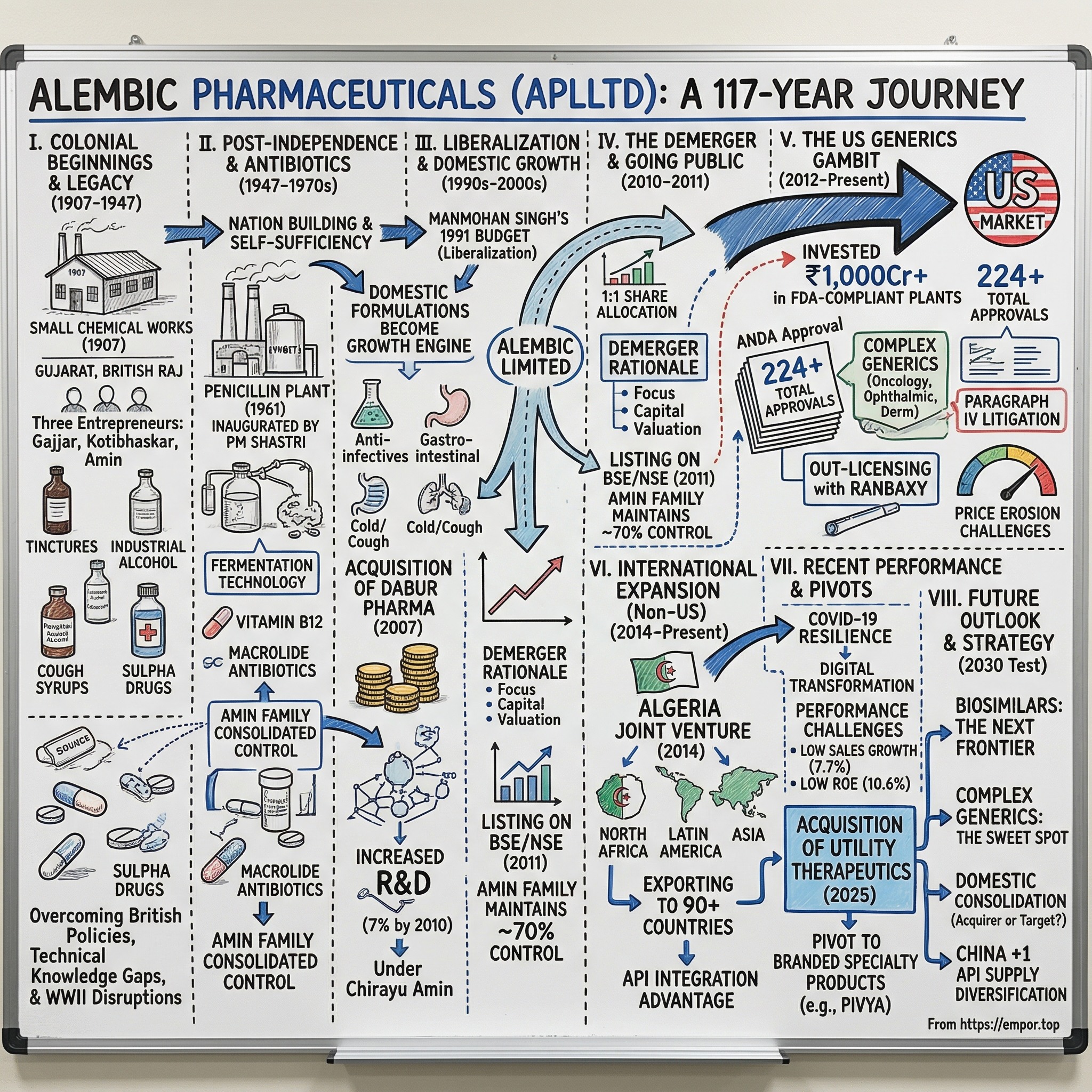
Alembic Pharmaceuticals: From Colonial Tinctures to Global Generics
I. Introduction & Episode Roadmap
On a Tuesday morning in early August 2026, a conference line opened in Mumbai and a familiar voice began reading numbers that, on their face, looked like vindication. Consolidated revenue up 26% year on year to ₹2,150 crore. The United States generics business — the one that had absorbed a decade of capital and delivered a decade of disappointment — up 49%.1 For a company whose shareholders had spent five years watching return on equity sit stubbornly in the low teens, it was the kind of quarter that invites a victory lap.
Pranav Amin did not take one. Pressed by analysts on whether this was the new normal, the managing director of Alembic Pharmaceuticals pointed straight at the asterisk: a single oncology molecule, bosutinib, launched in June with 180-day marketing exclusivity on two strengths, contributing precisely one month of sales. Volumes on it, he said, were "quite small," and once exclusivity lapsed the competitive response "could be quite drastic."2 Strip bosutinib out and US growth was closer to 20–25%. Strip out the roughly ten points of rupee depreciation and the constant-currency number was lower still.
That instinct — to hand the analyst the deflator before the analyst asks for it — is worth holding onto, because it is the central tension in this story. Alembic Pharmaceuticals is a 119-year-old enterprise that has survived the British Raj, Nehruvian licence-permit socialism, the 1991 liberalisation, the 2005 product-patent regime, and the most brutal generic price deflation in modern American pharmaceutical history. It trades on the NSE as APLLTD and on the BSE as scrip 533573, carries a market capitalisation of roughly ₹15,800 crore at a share price near ₹803, and remains 69.9% owned by the Amin family that has run it for four generations.34 It is, by any reasonable definition, an Indian pharmaceutical institution.
It is also a company that spent the better part of a decade building factories the market did not reward, wrote off ₹1,150 crore of half-built capital in a single stroke in early 2023, and has not earned a return on equity above 13% in any of the last five financial years — in an industry where well-run mid-cap peers routinely clear 25%.56
The question this story is built around is therefore not "is Alembic a good company." It plainly is a competent one: it makes complex molecules, it passes most of its FDA inspections, it pays a dividend, it carries modest leverage. The question is sharper and less comfortable. Alembic made an enormous, front-loaded bet on US generics manufacturing at almost exactly the moment US generics economics collapsed. Six years later, is the capital finally turning productive — or is the recent surge a currency-and-exclusivity mirage layered on a business whose structural returns have permanently reset lower?
To answer that, we have to understand five things, and they map to how this episode unfolds.
First, the origin. Alembic did not begin as a pharmaceutical company at all. It began as a chemistry experiment in a princely state, run by a scientist who believed India should make its own molecules rather than import them — a swadeshi impulse encoded into the company's DNA before the word "generic" existed.
Second, the cash engine. Somewhere between penicillin fermentation in the 1960s and the anti-infective brands that still dominate Indian prescription pads today, Alembic built a domestic branded business with genuine doctor mindshare. That business is the reason the company could afford to make an expensive mistake and survive it.
Third, the gambit. Between roughly 2016 and 2021, Alembic committed thousands of crores to sterile injectables, oncology, ophthalmics, and API capacity, and simultaneously pushed research and development spending to nearly 16% of revenue — a level of aggression rare among Indian mid-caps.5 Management was building for a US market it believed would reward complexity.
Fourth, the reckoning. The US market instead consolidated into three purchasing behemoths who bid products down relentlessly. Alembic's ROE fell from the mid-twenties to single digits. New plants sat underutilised, their depreciation and fixed costs hitting the P&L while the revenue to absorb them did not arrive. Management cut R&D by nearly half. The board impaired capital work in progress. This is the part of the story that matters most to anyone assessing whether the people running this company allocate capital well.
Fifth, the pivot. Since 2022 the company has bought out its dermatology joint venture partner, acquired a small UK-based specialty business to obtain a branded FDA-approved antibiotic, commissioned a facility in Indore, and begun launching from the injectable and ophthalmic lines it built. Management now guides to mid-teens revenue growth for FY27 and promises a return toward 20% EBITDA margins over two to three years.72
Along the way we will keep score on the things that decide the outcome: how much of the US recovery is durable versus episodic, whether the domestic business — growing 5% in FY26 against an Indian pharmaceutical market compounding at 7–9% or better — is quietly losing ground, and whether a company that has never sold a branded prescription drug in America can suddenly learn to.89
Let us start where the chemistry did.
 Subscribe on LinkedIn
II. Colonial Beginnings & The Alembic Legacy (1907–1947)
Vadodara at the turn of the twentieth century was an anomaly. Most of British India was administered for extraction; Baroda State, under Maharaja Sayajirao Gaekwad III, was administered for improvement. The Gaekwad spent state money on compulsory primary education, a public library system, a university, and — critically for this story — on technical institutions designed to teach Indians applied science rather than clerical English. It was an unusually fertile place for an industrial chemist to be ambitious.
Tribhuvandas Kalyandas Gajjar was that chemist. Born in 1863, he became the most consequential industrial chemistry figure in western India in his generation: he introduced German synthetic dyes to Indian textile mills, agitated for large-scale domestic alcohol production, and built technical education institutions on the theory that India's economic subordination was, at root, a technological subordination.10 Chemistry, in his framing, was not an academic discipline. It was import substitution with a laboratory attached.
In 1907, Gajjar, together with A. S. Kotibhaskar and Bhailal D. Amin — the latter a Gajjar student, and the ancestor whose surname still sits on the promoter register — established Alembic at Vadodara to manufacture tinctures and alcohol.11 The name itself is a chemist's joke and a chemist's flag: an alembic is the distillation apparatus of medieval alchemy, the vessel in which raw matter is purified into something more valuable. That is, quite literally, the business.
It is worth pausing on how strange the founding proposition was. In 1907, India's pharmacopoeia arrived by ship. Tinctures, tonics, and pharmaceutical alcohol were imported from Britain and Germany at prices set abroad, with quality assured abroad. To manufacture them in Gujarat was to assert that Indians could run fractional distillation to European standard — a technical claim and a political one at the same time. The swadeshi movement that followed the 1905 partition of Bengal gave the assertion a market: buying Indian became, for a segment of the professional classes, a statement.
The commercial reality was harsher than the symbolism. Colonial excise policy treated alcohol primarily as a revenue object, and the regulatory apparatus around industrial spirit was designed for control rather than industrial development. Access to capital was limited to family and community networks. There was no domestic machine-tool base, so equipment was imported and maintained by improvisation. What Alembic built in those decades was less a product portfolio than a competence: the ability to run continuous chemical processes reliably, at scale, in a place with no supporting industrial ecosystem.
By 1940 that competence had been extended into finished dosage forms — cough syrups, vitamins, tonics — which is the moment Alembic stopped being a chemicals firm that sold to others and started being a pharmaceutical brand that sold to doctors and patients.11 The distinction matters enormously to the modern investment case. A chemicals business competes on cost. A branded formulations business competes on physician trust, and physician trust compounds across decades in a way cost advantage never does.
Two inheritances from this period run straight into the 2026 income statement.
The first is manufacturing culture. A company whose founding act was distillation, and whose survival depended on process reliability without a supporting industrial base, tends to develop a particular institutional bias: toward making things itself rather than buying them. Alembic's later decision to build and keep its own active pharmaceutical ingredient capacity, when many peers outsourced to China, is a lineal descendant of that bias. In FY26 the API business generated ₹1,187 crore of revenue on its own account, and it also feeds the formulation plants internally.12
The second is geography. Vadodara became — and remains — the company's centre of gravity. Every one of Alembic's international generics plants sits within a short drive of the original works: Panelav, Karkhadi, Jarod. The registered office is still on Alembic Road. This concentration is an efficiency in normal times and a specific, quantifiable risk in bad ones, a point we will return to when we discuss what a single adverse FDA action could do to this company.
What the colonial era did not produce was scale. Alembic entered independent India as a respectable regional chemical and pharmaceutical works, not a national champion. It would take a change of political economy — and a fermentation tank — to make it one.
III. Post-Independence Modernization & The Antibiotic Era (1947–2000s)
The photograph that Alembic still puts in its investor decks is from 1961: Lal Bahadur Shastri cutting a ribbon at a penicillin plant in Vadodara.11 The company's own timeline labels him prime minister, which is a small anachronism — Shastri was then a senior minister in Nehru's cabinet and would not take the top job until 1964 — but the political symbolism the photograph was meant to carry is entirely accurate. A senior figure of the Congress establishment had travelled to Gujarat to bless a private company for doing what the state considered a national duty: making antibiotics in India.
Understanding why a fermentation tank warranted a cabinet minister requires understanding the economics of the period. Independent India inherited a pharmaceutical market dominated by multinational subsidiaries importing finished product or bulk drug at transfer prices the government could not verify. Antibiotics — the miracle class of the mid-century — were expensive and scarce. The policy answer, articulated across the first three Five Year Plans, was import substitution: build domestic bulk drug capacity, protect it with tariffs and licensing, and in 1970 rewrite patent law to recognise only process patents, not product patents, so that any Indian firm clever enough to invent a different route to a known molecule could legally sell it.
That single legal choice — the Patents Act of 1970 — is the foundation of the entire modern Indian pharmaceutical industry. It converted the country into a laboratory for process chemistry. If you could not patent a molecule, the only way to win was to make it more cheaply than anyone else, which meant Indian firms spent three decades building the deepest applied process-chemistry talent pool in the developing world. Every Indian generics company operating in America today is monetising that inheritance.
Alembic monetised it earlier than most. Penicillin fermentation in 1961 was followed by erythromycin, manufactured in India for the first time by Alembic in 1971, and then in 1972 by the launch of Althrocin — an erythromycin brand that, more than half a century later, still holds an extraordinary 84.2% share of its molecule group.1112 In 2001 the company added Cephalosporin C fermentation.
Here is the thing about fermentation that is easy to miss and important to grasp. Chemical synthesis is cooking: you combine reagents under controlled conditions and get a predictable output. Fermentation is farming: you are cultivating a living organism, feeding it, keeping it happy, and harvesting what it excretes. Yields drift. Contamination is catastrophic. Batch-to-batch reproducibility is genuinely hard. A company that ran fermentation successfully for decades in the 1960s and 1970s accumulated exactly the kind of tacit process knowledge that does not show up on a balance sheet and cannot be bought — and that later made it credible in complex APIs.
But the more durable asset built in this era was commercial, not technical. Anti-infectives are prescribed by general practitioners, and India has an enormous, fragmented population of them. Reaching that population required feet: medical representatives who visit doctors, leave samples, explain data, and — over years — become the familiar face associated with a molecule. Alembic built that field force therapy by therapy, and the brands it created in the process became defaults. Azithral, its azithromycin brand, holds around 30% of its molecule group and ranks first; Roxid, a roxithromycin brand, holds 94%.12 These are not marketing statistics. They are evidence that in Indian branded generics — where the same molecule is available from dozens of manufacturers at similar prices — the doctor's habit is the moat.
Through this period, ownership consolidated under the Amin family. Ramanbhai Amin, and after him his son Chirayu Amin, ran the group with a conservatism that reads as unremarkable until you compare it with the fate of Indian pharmaceutical families who levered up, diversified into unrelated businesses, or sold to multinationals. Alembic stayed in chemistry, stayed in Vadodara, stayed family-controlled, and stayed under-leveraged. That conservatism would later be tested — and, arguably, abandoned for a period — but it defined the culture into which the next generation was born.
By the turn of the millennium, Alembic was a solid, mid-sized, domestically focused Indian pharmaceutical company with an anti-infective franchise, real fermentation capability, and essentially no presence in regulated Western markets. It was profitable and it was small. And the ground beneath it was about to shift twice: once in 1991, when India dismantled the licence raj, and once in 2005, when it accepted product patents as the price of admission to the World Trade Organization.
Both changes pointed in the same direction. The protected domestic pond was about to be connected to the ocean.
IV. Liberalization, Strategic M&A, & The Demerger (2000–2011)
If you had walked into an Indian pharmaceutical boardroom in 2005 and asked what everyone was worried about, the answer would have been the same everywhere: 1 January 2005, the day India's product-patent regime took effect and the process-patent loophole that had built the industry closed for good. From that date, an innovator molecule patented anywhere would be protected in India too. The reverse-engineering machine that had powered thirty-five years of growth had a shelf life, and everyone could see the expiry date.
The industry's response split into three camps. A few firms — Ranbaxy, Dr. Reddy's, Sun — went hard at the American market, filing abbreviated new drug applications and litigating patents in Delaware and New Jersey. Others sold themselves to multinationals. A third group doubled down on the Indian branded market, betting that a country with rising incomes, worsening lifestyle disease, and low insurance penetration would keep paying cash for branded generics for decades.
Alembic, characteristically, did the third thing first and the first thing later.
Buying growth in the domestic market. In February 2007, Alembic agreed to acquire the non-oncology formulations business of Dabur Pharma for ₹159 crore — at the time one of the larger domestic formulation transactions in the Indian sector.13[^14] The purchase brought roughly seventy brands concentrated in cardiology, gastroenterology, gynaecology, and dermatology.
The strategic logic deserves scrutiny rather than applause, because acquisitions of this type are where Indian pharmaceutical companies most often destroy value. Alembic's existing franchise was acute — anti-infectives, cough and cold, the things a patient takes for five days and stops. The Dabur portfolio was chronic — cardiac and metabolic therapies a patient takes for years. Acute revenue is episodic and seasonal; chronic revenue annuitises. Buying a chronic portfolio and pushing it through an existing acute field force is one of the few genuinely accretive moves available in Indian branded pharma, because the incremental cost of a medical representative carrying two more products in the bag is close to zero while the incremental revenue is not.
Did it work? The honest answer is that the integration succeeded operationally and the strategic repositioning it was meant to achieve is still incomplete two decades later. Alembic did launch multiple specialty divisions to address chronic therapies in 2009, and specialty now accounts for roughly half of the domestic branded mix.1112 But the brands that still anchor the domestic business — the ones ranked first in their molecule groups — remain overwhelmingly anti-infectives. The company bought a chronic franchise and became, at best, a company with a chronic franchise attached to an acute identity. That distinction shows up in growth rates, as we will see.
The corporate unbundling. The bigger structural event came next. Alembic Limited, the listed parent, contained a pharmaceutical business and a set of non-pharmaceutical assets including real estate and other interests. Under a scheme of arrangement, the pharmaceutical undertaking was demerged into a new entity, Alembic Pharmaceuticals Limited, with effect from 1 April 2010, with 133,515,914 equity shares of ₹2 each allotted to Alembic Limited's shareholders.[^15]14 Alembic Pharmaceuticals listed on the BSE and NSE on 20 September 2011.
The rationale for demergers is usually described in the language of "unlocking value," which is often a euphemism for nothing at all. Here it was substantive for three specific reasons. First, a pure-play pharmaceutical entity could be valued by pharmaceutical analysts on pharmaceutical multiples, rather than being discounted as a conglomerate with property attached. Second — and this is the part that mattered most for what came next — a standalone pharma company could raise pharma-specific capital: debt against pharma cash flows, equity from healthcare-dedicated funds. Third, it created a clean currency for employee incentives and future acquisitions.
Crucially, the demerger did not dilute family control. The Amin promoter group retained roughly seventy percent of the new entity, and holds 69.9% today.3 This is the structural fact that defines every subsequent decision in this story. Alembic Pharmaceuticals is a listed company with the governance characteristics of a private one: a board that will not be surprised by an activist, a share register on which the float is a minority interest, and a management that answers first to a family and second to the market.
There is a genuine argument on both sides of that arrangement, and we will stress-test it properly in Section IX. The bull framing is alignment — when seventy percent of your net worth sits in one stock, you do not chase quarterly earnings at the expense of the decade. The bear framing is accountability — when seventy percent of the votes are captive, a strategy can persist for years past the point at which external capital would have forced a change.
Passing the baton. The demerger coincided with a generational transition. Chirayu Amin — a science graduate of Maharaja Sayajirao University in Baroda with an MBA from Seton Hall in New Jersey — took the chairmanship of the new entity, and his two sons stepped into operating roles that have not changed since.15 Pranav Amin took the US and international business. Shaunak Amin, who read economics at the University of Massachusetts and worked at Merrill Lynch and HSBC before joining the family firm, took domestic formulations.16
The division of labour is elegant and, in retrospect, revealing. It split the company along the exact fault line that would come to define it: one brother running a rupee-denominated, brand-driven, high-margin, slow-growth business at home; the other running a dollar-denominated, commodity-priced, capital-hungry business abroad. For most of the last fifteen years, Shaunak's business has funded Pranav's.
That was the deal Alembic struck with itself around 2011. The domestic cash engine would bankroll an assault on America. It was a defensible plan. It was also, in timing terms, one of the least fortunate bets an Indian pharmaceutical company could have made.
V. The US Generics Gambit & The Mega-Capex Cycle (2012–2021)
In July 2012, a press release went out from Florida announcing that Breckenridge Pharmaceutical and Alembic Pharmaceuticals had been sued by Pfizer, Wyeth LLC, and Wyeth Pharmaceuticals over a generic version of Pristiq — desvenlafaxine succinate extended-release tablets.17 The complaint alleged infringement of US Patent No. 6,673,838. The two companies had filed their abbreviated new drug application with a Paragraph IV certification on the first possible submission date, positioning them to share the 180-day first-to-file exclusivity that American law grants to whoever is brave enough to challenge a patent and win.
For a company whose export ambitions had been modest a decade earlier, being a named co-defendant in a Pfizer patent suit was a statement of arrival. Paragraph IV litigation is expensive, adversarial, and binary. You are telling a company with a market capitalisation two orders of magnitude larger than yours that its patent is invalid or not infringed, and you are spending real money on American litigators to prove it. The Pristiq case eventually settled on confidential terms with a licence effective before patent expiry — the standard outcome.17
This was the template Alembic ran for the next decade: file, litigate where necessary, partner where useful, launch, repeat.
Building the filing factory. The scale of what followed is genuinely striking. As of 31 March 2026, Alembic had filed 274 ANDAs cumulatively, secured 235 approvals including 19 tentative approvals, and commercialised 178 products in the United States.12 By the June 2026 quarter those figures had moved to 244 approvals and 185 products launched, with 152 drug master files on record with the FDA.1 Only a handful of Indian companies have built a US generic portfolio of that breadth.
But breadth is a means, not an end, and this is where the analysis has to get uncomfortable. An ANDA approval is a licence to compete, not a licence to earn. Its value depends entirely on how many other companies hold the same licence. For a molecule with two approved generics, the economics can be excellent. For one with twelve, the product is a commodity within months of launch. A count of 244 approvals tells you how hard a company has worked. It tells you almost nothing about how much money that work will make.
The capital. From roughly 2016, Alembic converted its filing ambition into concrete and stainless steel. The company built out a general injectable and ophthalmic facility at Karkhadi (F3), an oncology oral solid and oncology injectable complex at Panelav (F2), a general oral solids plant at Jarod (F4), a dermatology facility at Karkhadi (F5), and a third API site at Karkhadi.12
The intensity of that spending is best seen as a share of revenue. In FY2018, capital expenditure ran at roughly 26% of revenue. In FY2019, about 19%. In FY2020, roughly 16%. In FY2021, about 12%.5 For context, a mature pharmaceutical company in steady state spends four to six percent. Alembic spent four to six years' worth of normal capex every year for four consecutive years.
Simultaneously, research and development spending climbed toward the top of the Indian mid-cap range, peaking at 15.8% of sales in FY2022 — a level at which R&D alone consumes more than the entire operating margin of many generic businesses.12 The company was funding complex generic development: injectables, ophthalmics, oncology, and eventually peptides, all of which cost multiples of a simple oral solid to develop.
Two things were being bet at once, and it is important to separate them. The R&D bet was on portfolio complexity — that harder-to-make products would attract fewer competitors and hold price. The capex bet was on capacity ownership — that owning sterile manufacturing would deliver margin and supply security rather than renting it from contract manufacturers. Both bets were intellectually sound. Both were made with front-loaded cash against back-loaded, uncertain returns.
To part-fund it, Alembic went to the equity market in August 2020, raising ₹750 crore through a qualified institutional placement priced at ₹932 per share — a discount to the floor price, roughly 2x subscribed, with Tata Mutual Fund, HDFC Life, Sundaram, Bajaj Allianz Life and IDFC among the larger allottees. Approximately ₹400 crore was earmarked for debt repayment and the balance for API and injectable capacity.18
That placement is worth sitting with, because it is the cleanest available scoreboard on this entire strategy. Institutions bought Alembic at ₹932 in August 2020 to fund injectable and API expansion. Six years later, in August 2026, the shares change hands around ₹803.3 The capital was raised, the plants were built, and the buyers of that paper are still underwater. Whatever the operational merits of the expansion, the market's verdict on its economics has been unambiguous for half a decade.
What the company was building into. And here is the part that no amount of Indian execution could control. While Alembic was pouring foundations in Gujarat, the American generic drug market was being reorganised by its buyers. Three purchasing consortia — Red Oak Sourcing (CVS Health with Cardinal Health), ClarusONE (Walmart with McKesson), and Walgreens Boots Alliance Development — came to control on the order of ninety percent of US generic purchasing volume.19
The mechanism is simple and merciless. When a generic manufacturer wanted to sell in America in 2005, it negotiated with dozens of wholesalers, chains, and hospital groups. By 2018 it negotiated with three. Those three ran frequent competitive bids across their entire generic book, so a product you won at a given price in January could be re-bid in July against a competitor willing to take less. Manufacturers described annual price erosion in the low double digits as normal, with far steeper drops on newly competitive molecules. On Alembic's own February 2023 earnings call, Pranav Amin put numbers to it with unusual bluntness: initial erosion on a newly competitive product around 40%, with routine ongoing erosion around 10%.20
Compound ten percent annual price decline over a product's life and the arithmetic is brutal: a product earning ₹100 of revenue at launch earns ₹59 five years later on identical volume. To grow at all, you must launch new products faster than your existing ones deflate. That is a treadmill, and its speed is set by your customers, not by you.
By FY2021, Alembic's income statement still looked fine — return on equity was 22.6%, helped considerably by a COVID-era surge in demand and pricing across the industry.5 The plants were nearly finished. The R&D pipeline was full. The strategy appeared to be working.
It was the last good year for a long while.
VI. The Capital Allocation Hangover & ROE Collapse (2021–2024)
Boards do not usually announce their mistakes. They let them amortise quietly. So when Alembic's board met in early 2023 and approved an impairment review of capital work in progress across three new Gujarat facilities, concluding that ₹1,150 crore of that asset base should be written off to the profit and loss account of FY2022-23, it was doing something genuinely unusual for an Indian promoter-controlled company.21 It was writing down, in public, more than a thousand crore of the capital it had spent the previous half-decade deploying.
The stock fell roughly five percent on the news. In an important sense, that was the market under-reacting, because the write-off was not an accounting event. It was an admission.
What the numbers actually did. The trajectory of Alembic's return on equity is the single clearest picture of this story. In FY2016 the company earned an ROE of roughly 45% — a figure that reflected a small equity base and an unusually profitable year. Through FY2019 to FY2021 it ran in the low-to-mid twenties. Then: 9.9% in FY2022. 7.8% in FY2023. 12.8% in FY2024. 11.2% in FY2025. 11.9% in FY2026.5
Three forces produced that collapse simultaneously, and understanding their interaction is the analytical core of this entire episode.
The first is the denominator. Every rupee of capex and every rupee of retained earnings enlarged the equity base against which returns are measured. Alembic roughly doubled its invested capital between FY2017 and FY2022.5 Even if profits had held flat, ROE would have halved.
The second is the numerator, and it moved the wrong way. New plants do not arrive free. The moment a facility is commissioned, its depreciation and its fixed operating costs — utilities, quality staff, maintenance, environmental compliance — begin hitting the P&L whether or not products are being made in it. Pranav Amin flagged this explicitly on the February 2023 call, warning that FY2024 would be "a little tougher one because we will have a little bit of a pressure on the profit due to the two new facilities coming up on stream."20 Sterile facilities are particularly punishing here: the fixed cost of maintaining an aseptic environment is nearly the same whether the line runs at 20% or 90% utilisation.
The third is price. The US erosion described above hit exactly as the fixed costs arrived. Alembic was, in effect, adding supply into a market that was simultaneously repricing downward.
Put the three together and you get the textbook definition of a capital-allocation trap: a larger asset base, higher fixed costs, and lower unit economics, all at once.
The R&D reversal. The most telling management behaviour in this period was not the impairment. It was the R&D cut, because it required admitting that a prior strategy had not paid.
On the February 2023 call, HSBC's Damayanti Kerai asked Pranav Amin directly what returns the company was seeing on the R&D invested four or five years earlier. The answer came from then-CFO R. K. Baheti, and it is worth quoting because of how little it hedges: "many of these new launches, which we have done in recent past, except a handful of them, have not been great success because of the price erosion."20 Asked how far R&D would fall, Baheti committed to a "reduction of 15%, 20% from the current cost in the next year."20
They delivered on that, and then some. R&D spending fell from 15.8% of sales in FY2022 to 12.8% in FY2023, then to 7.6% in FY2024 and 7.8% in FY2025 — roughly halving as a share of revenue in two years.12 Absolute spend fell from about ₹840 crore to ₹480 crore over the same window.
This is the sort of decision that separates capital allocators from empire builders, and it deserves credit on its own terms: management looked at a spending programme it had championed, concluded the returns were not there, and cut it hard rather than defending it. Pranav Amin's framing at the time was that high-risk projects were being put "on the back burner" while spending was redirected toward rest-of-world markets that had been compounding at around 10%.20 That reallocation turned out to be correct — the ex-US formulations business grew 20% in FY2026 to ₹1,494 crore.12
But the same decision, viewed from a different angle, is an expensive round trip. The company spent years building a complex-generics R&D engine, discovered the returns did not justify it at that intensity, and dismantled part of it. Then, by FY2026, R&D climbed back to 9.6% of sales — driven in part by what management described as one-off peptide development work and higher filings — and FY2027 guidance sits at ₹750–800 crore.127 Spend up, spend down, spend up again. A skeptic would call that oscillation rather than strategy.
The regulatory overhang. Layered on top was the perpetual anxiety of any Indian exporter to America: the FDA inspection cycle. Alembic's record here is, by the standards of the Indian industry, good — which is a meaningful competitive fact, since peers have lost entire facilities to import alerts. As of the FY2026 disclosure, the company's international generics plants had all been inspected within the prior three years: Panelav F1 in July 2024, Panelav F2's oral solids in March 2024 and its oncology injectables in October 2024, Jarod F4 in November 2024, Karkhadi F5 in March 2023, the Panelav API units in May 2025, and API III at Karkhadi in March 2025.12
The open item is F3. The FDA conducted an unannounced current-good-manufacturing-practice inspection of the Karkhadi injectable facility from 9 to 18 February 2026, closing with a Form 483 carrying two observations. The company stated that none related to data integrity and that it would respond within the stipulated timeline; as of the FY2026 disclosure, the establishment inspection report was still awaited.2212 The stock's reaction was mild, which suggests the market has largely learned to distinguish procedural observations from systemic findings.
A separate and smaller matter surfaced in July 2026, when the FDA issued a warning letter to the clinical investigator associated with a bioequivalence study conducted at Alembic's Vadodara bioequivalence facility, following an inspection in March 2025. The observations concerned the informed consent form used in the study; the company stated they did not involve data integrity or affect data reliability.23 It is not a manufacturing action and should not be inflated into one. It is, however, a reminder that regulatory exposure for a company like this runs across clinical, bioanalytical, and manufacturing domains simultaneously, and that any of the three can produce a headline.
The activist question. Suppose a skeptical long-short investor had built a thesis on Alembic in 2023. What would they have argued?
They would have argued, first, that the company invested pro-cyclically — building capacity into a US market whose buyer structure had already consolidated and whose pricing had already begun deflating, information that was publicly available before the concrete was poured. Second, that the ₹1,150 crore impairment proves the point in the company's own numbers, and that impairing assets is not the same as recovering the cash spent on them. Third, that management's guidance discipline in the depths of the problem was weak: asked directly on the February 2023 call whether R&D savings could offset new facility costs and what that meant for margins, Baheti replied that internal estimates were not "holding valid for more than six months" and that it was "very difficult to make a comment on this — on the EBITDA side."20 That is candour, and candour is preferable to false precision. It is also, from a shareholder's seat, an admission that the company did not know where its own margins were going twelve months out.
Fourth, and most pointedly, they would have noted that the family owns seventy percent of the equity, so there was no realistic external mechanism to force a change of course. The correction, when it came, came from within — which worked here, but is a governance structure that offers no backstop if it does not.
The fair rejoinder is that Alembic did correct. It cut R&D, it impaired the assets, it kept leverage modest, it maintained the dividend, and it did not compound the error by buying growth at high prices. Net debt to EBITDA sat near 1.1x at the end of FY2026 — uncomfortable for a business with volatile cash flows, but nowhere near distress.5 Companies have died of worse strategic errors than this one.
The question that survives into the present is simply whether the assets now start earning. Which brings us to what the business actually looks like today.
VII. Core Business Deep Dive & Segment Economics (2024–Present)
Alembic Pharmaceuticals in FY2026 was a ₹7,345 crore revenue business — up 10% on the year — generating ₹1,177 crore of EBITDA at a 16% margin and ₹675 crore of net profit attributable to shareholders, up 16%.12 Beneath those consolidated numbers sit four quite different businesses with quite different economics, and the consolidated margin is essentially an average of things that should never be averaged.
India branded formulations: the annuity. At ₹2,458 crore in FY2026, the domestic branded business is the largest single segment at roughly a third of revenue.12 It is also the highest-quality one. Alembic ranks 21st in the Indian pharmaceutical market with a 1.2% share, fields more than 5,500 medical representatives across 21 marketing divisions, and reached 136.5 million prescriptions in the twelve months to March 2026 from a prescriber base of about 246,000 doctors — ranking 17th by prescription volume.12 Four flagship brands exceed ₹100 crore of annual sales. Roughly 13% of the portfolio falls under India's National List of Essential Medicines, which caps pricing on those products.
The therapy mix tells you what this business is: anti-infectives at 16%, cough and cold at 9%, gynaecology 13%, cardiology 13%, gastroenterology 10%, anti-diabetics 10%, animal health 16%, and the balance in other categories.12 Specialty accounts for about half of the mix, acute roughly a quarter, and animal health the remainder.
The economics are attractive for a structural reason worth explaining plainly. In America, when a doctor writes a prescription for a molecule, the pharmacist substitutes whichever generic the chain has contracted for — the manufacturer's name is irrelevant to the patient and invisible to the doctor. In India, the doctor writes a brand. The pharmacist dispenses that brand. Switching requires the doctor to change a habit formed over years of detailing visits, sample drops, and clinical familiarity. That is a genuine switching cost, and it is why Indian branded generics earn margins that would be impossible in US retail generics for the identical chemical compound.
But there is a problem, and it is the most important negative in this section. This business grew 5% in FY2026 and 4% in the March quarter.12 In the June 2026 quarter it grew 7%, to ₹642 crore.1 The Indian pharmaceutical market over the same window has been growing faster — ICRA projected 7–9% domestic growth for FY2026, and IQVIA data showed the market accelerating into double digits with moving-annual-total growth of 10.7% by May 2026, increasingly driven by volume rather than price.89
A company growing at 5–7% in a market growing at 8–11% is losing share. Not dramatically, not catastrophically, but persistently. And a company whose entire investment case rests on "the domestic business is the reliable cash engine" cannot afford for that engine to be quietly decelerating relative to its market.
Management has acknowledged this. On the August 2026 call, multiple analysts pressed on the 7% domestic number against market growth, and management attributed the gap to field execution rather than portfolio or pricing, announcing new sales leadership under Ramesh Juneja with an expectation of improvement over "a quarter or two."2 That is a specific, falsifiable claim, and it is exactly the sort of thing an investor should hold management to. If domestic growth is not converging toward market growth by the March 2027 quarter, the explanation will need to change — and "execution" will start to look like a euphemism for structural mix disadvantage in an acute-heavy portfolio.
One bright spot sits inside this segment: animal health. Revenue reached ₹519 crore in FY2026, growing at a 22% compound rate over four years, with market leadership in veterinary haematinics and antibiotics and brands including Sharkoferrol, Moxel and Xceft.12 It is small, it is high-growth, and it is almost entirely ignored in the way this company is discussed.
US generics: the swing factor. At ₹2,206 crore in FY2026, up 13%, the US business is nearly the same size as India but with fundamentally worse economics and dramatically better recent momentum.12 Fifteen products launched in FY2026. Then the June 2026 quarter delivered ₹778 crore, up 49% year on year and 38% sequentially, with seven launches in the quarter and roughly fifteen more planned for the balance of FY2027.1
The composition of that 49% is the whole argument. Roughly ten percentage points came from rupee depreciation — the constant-currency figure was around 37–38%.2 A further chunk came from bosutinib's exclusivity month. Management's own base-business estimate excluding bosutinib was 20–25%.2 So: a genuinely strong underlying number, materially flattered by two effects that do not repeat.
What is durable is the shift in what Alembic sells. The approved portfolio as of March 2026 broke down as 158 oral solids, 31 dermatology, 23 ophthalmic, 21 injectable, and 2 inhalation products.12 The oral solids are the commoditised legacy. The injectables and ophthalmics are the products the mega-capex was built for, and they are the ones with fewer competitors, higher barriers, and better price stability. Every quarter that shifts mix toward the latter improves the quality of this revenue, independent of its growth rate.
Ex-US formulations: the quiet compounder. International markets outside the US generated ₹1,494 crore in FY2026, up 20%, with partnerships active in Europe, Canada, Australia, Brazil, Chile and South Africa, and new subsidiaries established in Thailand, the Philippines and Germany.12 The March quarter actually declined 2% on a high base, and the June quarter grew 17% to ₹383 crore.121
This segment has compounded at roughly 18% over four years with far less capital and far less drama than the US business. It is the clearest evidence that the R&D reallocation decision made in 2023 was the right one — and it is chronically under-discussed relative to its contribution.
API: the foundation. Active pharmaceutical ingredients contributed ₹1,187 crore in FY2026, up 5%, with 149 cumulative US drug master files and supply into more than sixty countries.12 The June quarter jumped 33% to ₹346 crore, prompting management to say full-year API growth would exceed its original 10% guidance.12
Backward integration into APIs does two things. It lowers input cost on internally consumed molecules, and — more importantly since 2020 — it removes dependence on Chinese intermediate supply for critical products. That second benefit is not visible in normal times and is worth a great deal in abnormal ones. The cost is capital: API plants are expensive, and merchant API is a genuinely commoditised business with its own pricing pressure, which is why this segment's growth has been the slowest of the four.
Where the power actually is. Applying Hamilton Helmer's framework honestly to these four businesses produces an uneven picture. Branding power is real and durable, but confined to India — the doctor-habit moat around Azithral and Althrocin is one of the better franchises in Indian mid-cap pharma. Process power, in Helmer's sense of hard-to-replicate operational capability, exists in fermentation, complex injectables, and sterile ophthalmics, though several Indian peers have comparable capability. Scale economies are partial: Alembic is large by Indian mid-cap standards and small next to Sun, Cipla or Teva. Cornered resource and network economies are essentially absent. And switching costs are the sharpest contrast in the whole company: enormous in Indian branded generics, and functionally zero in US retail generics, where the buyer re-bids the contract on a schedule of its own choosing.
That asymmetry is the single most useful lens on Alembic. It owns a genuinely advantaged business in India and competes in a structurally disadvantaged one in America — and has, for the last decade, allocated the majority of its incremental capital to the second.
Which raises the obvious question about the moves it has made since 2022.
VIII. Recent Inflection Points & New Growth Frontiers (2022–2026)
The first move was housekeeping. In April 2016 Alembic had formed Aleor Dermaceuticals as a 60:40 joint venture with Orbicular Pharmaceutical Technologies, targeting global dermatology — creams, gels, ointments, shampoos, lotions, sprays, foams, and products built on microsponge and nanoparticulate delivery platforms.24 On 29 March 2022, Alembic bought out Orbicular's remaining 40% and moved to merge Aleor into the parent, subject to National Company Law Tribunal approval.25
The consideration was not disclosed.
That is worth stating plainly rather than glossing over, because it is a disclosure choice with consequences. Shareholders were asked to fund the purchase of a business they could not value, from a counterparty whose alternatives they could not assess. The strategic logic was defensible — full ownership of a dermatology platform removes JV friction and consolidates the P&L — but a related opacity followed almost immediately: within a year the company took a one-time product write-off of roughly ₹144 crore associated with previously capitalised Aleor development spend, equivalent to about 10% of quarterly sales, and its FY2023 comparative figures in investor materials are still presented "without considering one-time impact of Aleor write off for better comparison."2012 Buying out a partner and then writing down the acquired pipeline within twelve months is not a sequence that inspires confidence in the original valuation work — and without a disclosed price, no outside investor can independently judge how expensive the lesson was.
The specialty pivot. The more interesting move came in July 2025, when Alembic Pharmaceuticals, Inc. — the US subsidiary — acquired UK-based Utility Therapeutics Ltd for approximately $12 million, payable in instalments contingent on milestones.2627
Twelve million dollars is, in the context of a company that once impaired eleven hundred crore of construction in a single quarter, a rounding error. Roughly ₹100 crore. It would be easy to dismiss.
It should not be dismissed, because of what it bought: Pivya (pivmecillinam), approved by the FDA in April 2024 for uncomplicated urinary tract infections, and reported to be the first antibiotic approved in the United States for that indication in roughly two decades.2628
Understanding why this matters requires understanding what Alembic has never been. For fourteen years in America, Alembic has been a supplier. It manufactures a molecule, an intermediary buys it on price, and a pharmacist dispenses it without anyone knowing or caring who made it. There is no salesforce, no brand, no physician relationship, and no pricing power — the customer is a procurement algorithm.
A branded prescription drug inverts every one of those relationships. You employ representatives who call on physicians. You negotiate formulary access with pharmacy benefit managers. You set a price and defend it with clinical data. You own the demand rather than bidding for the order. It is, in structure, far closer to what Shaunak Amin's team does in India every day than to anything Pranav Amin's team has ever done in America.
Management has been careful about how it describes the economics, and the care is itself informative. On the August 2026 call, Pranav Amin characterised the launch as a "soft launch" with "no hardware investment at all" — spending confined to field force and marketing, with product sourced from contract manufacturers rather than Alembic's own plants.2 The financial impact is a dilution of roughly 150 basis points to FY2027 EBITDA margin, with the business expected to approach breakeven by the end of FY2027 and contribute positively from FY2028.21
So the structure of the bet is: small upfront cost, asset-light execution, contained annual burn, and a stated breakeven date the market can hold management to. That is a well-designed option. If Pivya works, Alembic acquires a US commercial platform onto which future branded and specialty products can be layered, and the platform is worth far more than the drug. If it does not, the company has spent roughly ₹100 crore and a couple of years of margin dilution to find out.
The honest counterweight is that building a US specialty commercial organisation is a genuinely different competence, and the graveyard of Indian pharmaceutical companies that tried to move up the American value chain is not empty. Salesforce productivity, payer contracting, and specialty distribution are learned expensively. Antibiotics specifically are a difficult commercial category: stewardship programmes actively discourage use of newer agents, courses are short, and reimbursement is unglamorous. That Pivya addresses a real unmet need — resistant uncomplicated UTIs — is a clinical argument, not automatically a commercial one. As of August 2026, the only public evidence is management's own description of "promising early feedback" and "encouraging" reception.72 That is not evidence. It is a hypothesis awaiting data.
Monetising the concrete. The third strand is the least glamorous and the most financially consequential: actually filling the factories.
The FY2026 fourth-quarter call carried the clearest description yet of where this stands. The Indore facility, commissioned in 2025 and certified by the World Health Organization following a March 2026 audit, was described as fully operational with improved utilisation.712 The F3 ophthalmic line was said to be running at full capacity. But F2 and F3 as a whole remained underutilised pending FDA clearances, creating cost pressure, and contract-manufacturing arrangements were being pursued to absorb spare capacity — with those deals expected to contribute revenue in FY2027.7
Contract manufacturing for third parties is an interesting tell. It is lower-margin than selling your own products, and no company builds a sterile injectable facility hoping to rent it out. Doing so is a rational response to a specific problem: fixed costs are running, approvals are arriving more slowly than planned, and partially absorbing overhead at low margin beats not absorbing it at all. It is pragmatic. It is also an implicit acknowledgement that the original demand assumptions behind these plants have not yet materialised.
Alongside all of this sits a piece of genuine, under-appreciated optionality. Alembic holds a 50% interest in Rhizen Pharmaceuticals, a Switzerland-based new-chemical-entity joint venture formed in 2012. In October 2020, Rhizen licensed tenalisib — a dual PI3K delta and gamma inhibitor for oncology — to Shanghai-based Curon Biopharmaceutical for Greater China, in a deal with an overall stated value of up to $149.5 million plus double-digit royalties.29 Nothing about Alembic's valuation depends on Rhizen. But a genuine NCE programme sitting off to one side is the kind of asset that costs little to hold and occasionally pays for a great deal.
Which leaves the question of the people making these calls.
IX. Management Credibility, Governance, & Incentives
There is a particular kind of Indian promoter-run company where the chairman is the story, the sons are placeholders, and the disclosure exists to satisfy the regulator. Alembic is not that. But it is not a widely-held professional meritocracy either, and the specifics of its governance are worth examining carefully, because with 69.9% of the votes controlled by one family, governance is the mechanism by which minority shareholders' interests either are or are not protected.3
The chairman. Chirayu Amin is the fourth generation of the family to run this business. Educated at Maharaja Sayajirao University in Baroda and at Seton Hall, he has been the constant through the demerger, the listing, the US expansion, the capex cycle, and the correction.15 In a change effective 1 April 2026, approved by shareholders at the fifteenth annual general meeting in August 2025, he took on the role of Executive Chairman for a five-year term, not liable to retire by rotation, having relinquished the chief executive title on 31 March 2026.15
The transition is worth reading precisely. It is not a retirement. It is a formalisation of an arrangement that already existed: the chairman keeps executive authority and board primacy, while the day-to-day chief executive function devolves to the next generation who have run their divisions for fifteen years. For continuity, that is a strength. For anyone hoping the structure would evolve toward a more conventional separation of chair and executive management, it is a signal in the other direction.
The operators. Pranav Amin and Shaunak Amin have each run one half of this company for the better part of two decades — long enough that a track record exists rather than a résumé.
Pranav Amin's record in the US is genuinely mixed and should be described as such. He built a filing machine that produced 274 ANDAs and a US business that has more than doubled since the demerger.12 He also presided over a capital-deployment cycle whose returns have, so far, been poor, and over an R&D programme that his own CFO conceded had produced few commercial successes outside a handful of products.20 What is to his credit is the manner in which he has discussed it. Across earnings calls from 2023 to 2026, his answers on price erosion have been consistently unhelpful to the bull case and consistently accurate: told by an analyst in February 2023 that peers were seeing stabilisation, he replied flatly, "No, no. I said there is still enough erosion, I said nothing has changed."20 Three and a half years later, handed a 49% growth quarter, he immediately volunteered the exclusivity and currency effects that deflated it.2 Managements that talk down their own good quarters are rarer than they should be.
Shaunak Amin's record in India is the inverse: steadier, less dramatic, and currently the subject of the more urgent question. A domestic business that grows below its market for several consecutive periods eventually stops being a story about execution and starts being a story about portfolio. The commitment to fix it through new sales leadership within "a quarter or two" is now on the record and dated.2
The finance function. The most significant personnel change of the last two years received little attention. R. K. Baheti, who had been Director of Finance and CFO — and whose voice dominates the difficult 2023 transcripts — relinquished the CFO role effective 7 July 2025, continuing as an executive director. G. Krishnan, a chartered accountant, company secretary and cost accountant with over two decades of experience who had been chief financial officer of Syngene Scientific Solutions, took the role the same day.30
Bringing in an outside CFO from a professionally managed contract-research organisation, at the exact moment a company is trying to demonstrate capital discipline and re-rate on returns rather than growth, is a defensible signal. Whether it changes anything is a question for the next three years of disclosure quality.
Where the governance friction actually showed. For most of its listed life, Alembic's shareholder votes have been formalities. The sixteenth annual general meeting, held by video conference on 5 August 2026, was not entirely one.
Four ordinary resolutions passed with essentially unanimous support: adoption of the FY2026 financial statements at 100%, the FY2026 dividend at 100%, the re-appointment of Pranav Amin at 99.72%, and cost auditor remuneration at 100%.31 The dividend itself — ₹12 per share, declared on 15 May 2026 with a July record date — represents continuation of a consistent payout record through the entire lean period.32
The special resolution appointing Sujit Jaysukh Bhayani as a non-executive independent director for a five-year term from 18 June 2026 passed with 93.08% in favour. But within the public institutional category, 34.85% of votes cast were against — approximately 1.21 crore votes out of 3.48 crore.31
That is a real signal and deserves neither exaggeration nor dismissal. It did not threaten the outcome; with the promoter block voting in favour, no resolution at this company can be defeated by institutions. But institutional investors and proxy advisers voting against an independent director appointment at a company where independence is the primary protection available to minorities is precisely the sort of thing that recurs and escalates. It belongs on the watch list.
The credibility scorecard. Assessed on behaviour rather than rhetoric, the record reads roughly as follows.
On acknowledging problems, the record is good. Management named price erosion as the culprit repeatedly, cut R&D when returns disappointed, took a large impairment rather than letting a dead asset amortise quietly, and refuses to spin currency-inflated growth.
On guidance discipline, the record is mixed but improving. In 2023 management explicitly declined to forecast margins beyond six months.20 By FY2027 it was giving segment-level growth guidance, a capex range of ₹300–350 crore, an R&D range of ₹750–800 crore, a specific 150-basis-point margin-dilution estimate for the US branded business, and a dated breakeven commitment — and then raised the revenue guidance one quarter in.72 That is meaningfully more accountable disclosure than three years ago.
On capital allocation, the record is poor over the past decade and unproven since. The mega-capex cycle destroyed value on any honest measure. The corrections since — modest capex, restrained R&D, small and asset-light acquisitions, maintained dividend, controlled leverage — are the right corrections. They have not yet produced a return on equity above 13%.
On disclosure, the record has one specific blemish: an undisclosed acquisition price on the Aleor buyout followed by a write-down of the acquired pipeline.
Which is a reasonable place to stop and ask what the whole sequence teaches.
X. Playbook: Business & Investing Lessons
The dual-engine model, and the tax it charges. The structure Alembic adopted — a stable, high-margin domestic branded business funding a volatile, capital-hungry export business — is close to the default template for Indian pharmaceutical mid-caps, and for good reason. Domestic branded generics throw off cash, need modest capital, and grow with the economy. Regulated-market generics offer scale and dollar revenue that a purely domestic company can never reach.
The lesson Alembic's decade teaches is about the tax this structure charges. When you fund an uncertain business with a certain one, you make the consolidated returns a blend that flatters the bad business and disguises the good one. Alembic's 11.9% consolidated ROE in FY2026 is not the return on its Indian branded business, which is far higher, nor the return on its US assets, which is far lower.5 It is an average that describes neither, and it has traded, for five years, at the average. Investors in dual-engine companies should insist on segment-level capital-employed disclosure, and should be suspicious when it is not offered.
Capex timing beats capex quality in commoditising markets. Alembic did not build bad plants. By all available evidence the facilities are technically capable and mostly FDA-compliant. It built good plants at the wrong moment in a market whose price direction had already turned.
This is the most transferable lesson in the whole story. In a commoditising industry, the return on a fixed-asset investment is determined far more by when it is made than by how well. The signals were public before the money was spent: the buying consortia had already consolidated, deflation was already running in double digits, and the FDA had already accelerated approvals to increase competition. A company reading those signals in 2016 could have leased capacity, partnered, or phased its build. Alembic front-loaded. Investors evaluating any capital-intensive expansion should ask a simple question — what does the buyer structure of this end market look like, and is it getting more or less concentrated? — before asking anything about the asset itself.
ANDA counts are a vanity metric. For a decade, Indian pharmaceutical investors treated cumulative filings and approvals as a proxy for future earnings. Alembic's experience shows why that proxy broke. Approval count measures access to competition, not protection from it. The metrics that actually correlate with earnings are the number of competitors per molecule, the share of revenue from limited-competition dosage forms, and the fraction of the portfolio in products that are genuinely hard to make. A company with forty ophthalmic and injectable approvals may be worth more than one with two hundred oral solids.
Cutting a failing programme is a skill, and it is rarer than starting one. The R&D reduction from 15.8% to 7.6% of sales in two years was, in career terms, an unpleasant thing for the executives who had championed the original spend to do.12 They did it anyway, said publicly why, and gave a number they then hit. Investors assessing management quality should weight demonstrated willingness to abandon a strategy at least as heavily as the ability to articulate one.
Concentrated family ownership is a coin with two faces, and both are real. Seventy percent promoter ownership meant Alembic could absorb four years of depressed returns without a proxy fight, a forced sale, or a value-destroying pivot to satisfy quarterly expectations. It also meant nothing external forced the reassessment that eventually came from within, and that a large minority of institutional shareholders can vote against an independent director without affecting the outcome.31 Patient capital and unaccountable capital are the same balance sheet item viewed from different angles. The distinguishing evidence is behavioural: does the family cut when the evidence says cut? Here, eventually, it did.
A century of survival is a fact about the past. Alembic has existed since 1907 and will probably exist in 2107. Longevity in pharmaceuticals reflects the durability of demand for medicine, not the durability of any particular competitive advantage. The tinctures business is gone. The penicillin franchise is gone. The erythromycin brand survives as an artefact of physician habit. Every generation of this company had to earn its returns from scratch, and the current generation's assets — sterile injectable lines, an ophthalmic franchise, a US branded platform — will be equally impermanent. Heritage is a story. It is not a moat.
XI. Analysis & Bear vs. Bull Case
Before arguing either side, it is worth clearing away three narratives that circulate about this company and do not survive contact with the evidence.
Myth one: Alembic is a domestic branded pharma company with a US kicker. It is not, and has not been for years. In FY2026, India branded formulations contributed roughly a third of revenue; US formulations another 30%; ex-US formulations 21%; and API 16%.12 More than two-thirds of the top line is exported. Valuing Alembic on the multiple that Indian domestic-heavy peers command mistakes what the business has become.
Myth two: the capex cycle is behind the company and the assets are now free. The cash is spent, but the assets are not free — they carry depreciation and fixed operating costs every quarter, and the ₹1,150 crore impairment removed only the portion the board judged unrecoverable. As of the FY2026 disclosure, F2 and F3 remained underutilised pending approvals, and contract manufacturing was being used to absorb overhead.7 The capex cycle ended. The absorption problem did not.
Myth three: the June 2026 quarter proves the turnaround. A single quarter containing a 180-day exclusivity launch and roughly ten points of currency tailwind proves that Alembic can capitalise on a good product when it gets one.2 It does not establish a run-rate. Management said as much on the call, which is more than can be said for the commentary that followed it.
With that cleared, the two cases.
The Bull Case
The mix is genuinely improving, and mix is what matters in US generics. The strategic point of the mega-capex was to move Alembic out of oral solids, where anyone with a tablet press competes, and into sterile injectables, ophthalmics and oncology, where the number of qualified competitors per molecule is a fraction of what it is for a tablet. That shift is now visible in the approval base rather than in promises: as of March 2026, ophthalmics, injectables, dermatology and inhalation together accounted for 77 of 235 approvals, and the products launching from those lines are the ones driving current growth.12 Bosutinib is the illustration rather than the exception — an oncology product with genuine exclusivity is exactly the kind of asset a company with tablet-only capability never gets to sell.
The ex-US business is doing quietly what the US business was supposed to do. Compounding around 18% over four years, expanding into Thailand, the Philippines and Germany, and requiring far less capital, the international generics segment is the best evidence that Alembic's development engine produces commercially useful products when it aims them at markets that are not dominated by three buyers.12 It is roughly a fifth of revenue and is rarely priced into the discussion.
Backward integration is worth more than it used to be. Owning API capacity was a cost decision when it was made and has become a resilience decision. The pandemic and subsequent geopolitical friction made single-source dependence on Chinese intermediates a board-level risk for every Western buyer of generic drugs. A supplier that controls its own API for critical molecules can win contracts on grounds other than price — which, in a market where price is otherwise the only variable, is a rare thing to have.
Balance sheet discipline through the worst of it. The company did not lever up to defend earnings, did not cut the dividend, and did not make a large acquisition at the bottom. Net debt to EBITDA around 1.1x, capex guided down to ₹300–350 crore for FY2027, and R&D held to a defined range are the settings of a company trying to convert an asset base into cash rather than expand it further.57
The specialty option is cheap and dated. Whatever one thinks of the odds, a $12 million milestone-based purchase with contract-manufactured supply, a 150-basis-point margin cost, and a stated breakeven by the end of FY2027 is a well-structured way to buy exposure to a business model with genuinely different economics.2
The Bear Case
The domestic engine is losing relative ground. This is the most serious item, and it undercuts the foundation the entire dual-engine structure rests on. A domestic business growing mid-single digits against a market growing high-single to low-double digits is not a cash engine that is compounding — it is one that is slowly shrinking in relative terms while remaining profitable.129 If that persists, the funding source for everything else weakens.
The recovery is currency-flattered. The rupee's depreciation contributed roughly ten percentage points to reported US growth in the June quarter.2 Currency is not a competitive advantage; it is a translation effect that reverses. Investors should mentally deflate every reported export growth number in this story by whatever the rupee did.
The returns problem is arithmetic, not sentiment. To move return on equity from around 12% toward the high teens on today's equity base, Alembic must grow profits substantially faster than it retains earnings — for years.5 Peers demonstrate the gap rather than the impossibility: Torrent Pharmaceuticals and Ajanta Pharma have been earning returns on equity in the mid-twenties.3334 Those are companies with different mixes and different capital histories, but they establish what a well-positioned Indian pharmaceutical business earns. Alembic is running at roughly half of it.
Concentration risk in Gujarat. Every international generics plant sits in one district cluster. A single import alert on F3 or Panelav would not merely dent a segment; it would strand the specific assets the entire recovery thesis depends on, and it would do so at the moment of maximum operating leverage. The pending establishment inspection report for the February 2026 Karkhadi inspection is therefore a live, unresolved item rather than a formality.2212
Specialty is a competence, not a purchase. Buying an approved drug is easy. Building a US field force, winning formulary position against entrenched generics, and defending a branded price in an antibiotic category governed by stewardship protocols is a discipline Alembic has never practised. "Encouraging early feedback" is the weakest form of evidence there is.7
Porter's Five Forces, Applied Honestly
Buyer power — severe in the US, weak in India. Three consortia controlling roughly ninety percent of American generic purchasing is close to the theoretical maximum of buyer power in a fragmented-supplier industry.19 In India, by contrast, the buyer is a fragmented network of hundreds of thousands of independent pharmacies serving prescriptions written by hundreds of thousands of independent doctors. No Indian buyer can demand a price concession from Alembic. This single asymmetry explains most of the margin difference between the two businesses.
Supplier power — moderate and partly neutralised. Key starting materials and intermediates remain concentrated in China for much of the industry. Alembic's API integration reduces this exposure for internally consumed molecules but does not eliminate it; management flagged solvent cost inflation as a live gross-margin headwind in the June 2026 quarter.2
Rivalry — brutal in US generics, disciplined in India. In US retail generics, rivalry is essentially unbounded: any approved manufacturer can bid, and the buyer runs the auction. In Indian branded generics, rivalry is intense but takes the form of competing for physician attention rather than competing on price, which is a far more profitable way to compete.
Threat of new entrants — low in sterile, high in oral solids. Building a US-approvable sterile injectable facility takes years, hundreds of crores, and a successful FDA inspection. Building tablet capacity takes considerably less of all three. Alembic's investment moved it toward the higher-barrier end, which is the correct direction even if the timing was poor.
Substitutes — the structural sleeper. Generic drugs are substitutes by definition, so the conventional analysis is circular. The non-obvious threat is therapeutic displacement: molecules whose entire category shrinks because a better class arrives. Anti-infectives, cough and cold, and older cardiovascular molecules are precisely the categories most exposed to that over a decade.
The Seven Powers Verdict
The uncomfortable conclusion is that Alembic's genuine, durable power — branding built on physician habit — sits in the business receiving the smaller share of incremental capital, while the business receiving the larger share possesses almost none of Helmer's seven powers at all. US generics offers no switching costs, no network effects, no cornered resource, and scale economies that Alembic cannot match against far larger players. What it can build there is process power in hard-to-manufacture dosage forms, which is real but shared with a dozen capable Indian and European competitors, and counter-positioning in specialty branded products, which it has not yet demonstrated.
The bull case, stated in its strongest form, is that the mix shift toward complex products plus a functioning specialty platform gradually converts a power-less US business into a modestly powered one, while India stabilises. The bear case is that the US business remains structurally power-less regardless of dosage form, the returns therefore never recover to peer levels, and the domestic franchise erodes in the background. Both are consistent with everything currently observable. The next two years of operating data — not management commentary — will separate them.
XII. Risk Radar & Strategic KPIs
The risks that matter for this company are unusually concrete. They are not macro abstractions; they are specific, datable events with identifiable mechanisms.
Regulatory and quality compliance. This is the risk that can change the investment case in a single announcement. The mechanism is worth spelling out for readers unfamiliar with it. An FDA inspection ends with either a clean report or a Form 483 listing observations. The agency then issues an establishment inspection report classified as No Action Indicated, Voluntary Action Indicated, or Official Action Indicated. The last of these can escalate to a warning letter and, in severe cases, an import alert that bars products made at that site from entering the United States — regardless of whether the individual product is compliant. For Alembic, the exposure is concentrated: the Karkhadi F3 injectable facility has an open Form 483 from February 2026 with its establishment inspection report awaited, and it happens to be the facility on which the injectable and ophthalmic monetisation thesis most depends.2212 The company's inspection record has been sound and none of the recent observations have involved data integrity, which is the category that destroys companies. But sound records have preceded adverse actions across this industry.
Commercialisation lag and fixed-cost absorption. The second risk is not dramatic; it is corrosive. Every quarter that F2 and F3 run below designed utilisation, their fixed costs are absorbed by fewer units, depressing consolidated margin.7 Approval timing is outside the company's control. Contract manufacturing partially offsets it at low margin. The failure mode here is not a crisis but a slow grind in which the plants are "about to ramp" for several more years and the return on the capital never arrives.
US specialty execution. The third is the newest and the most binary. If Pivya does not gain traction, the ₹100-odd crore is gone and, more importantly, the strategic thesis that Alembic can move up the American value chain loses its only proof point.262
Two second-order items worth watching. First, working capital. Gross debt rose to roughly ₹1,600 crore by the June 2026 quarter, driven by receivables growing alongside revenue; management expects normalisation and a meaningful reduction toward around 1x.2 Rapid export growth funded by receivables is a familiar pattern that is benign when it normalises and a warning sign when it does not. Second, the institutional dissent recorded at the 2026 annual general meeting.31 One vote is noise; a pattern across successive years would signal a governance disagreement that a 69.9% promoter block cannot resolve by simply out-voting it.
Three KPIs that actually decide the outcome.
1. Quarterly US formulations revenue, adjusted for currency and one-off exclusivities. Not the headline growth rate. The question is what the base business does in constant currency once bosutinib's exclusivity lapses and the rupee stops helping. If constant-currency base growth holds in the mid-teens across several quarters without exclusivity contributions, the complex-generics thesis is working. If it reverts to low single digits, the June 2026 quarter was an event rather than an inflection.
2. Consolidated EBITDA margin and return on equity, tracked together. Management has guided to roughly 16% EBITDA margin for FY2027 with core business margins in the high teens offset by specialty dilution, and has spoken of returning toward 20% over two to three years.27 Margin is the near-term signal; return on equity is the verdict. The reason to track both is that margin can improve while returns do not, if the equity base keeps growing faster than profits. The number that would genuinely change this story is a return on equity sustainably above the mid-teens — a level Alembic has not reached since FY2021.5
3. India branded growth versus Indian pharmaceutical market growth. Not absolute domestic growth, which can look acceptable in a strong market. The spread. Management has attributed the recent shortfall to field execution and installed new sales leadership with an expected improvement within a quarter or two.2 That is a dated, testable claim. If the spread closes, the cash engine is intact and the dual-engine model still works. If it does not, the most reliable part of Alembic Pharmaceuticals is quietly becoming less reliable — and everything else in this story is being funded by it.
References
-
Alembic Q1 FY27 slides: US generics surge 49%, revenue up 26% — Investing.com, 2026-08 ↩↩↩↩↩↩↩
-
Earnings call transcript: Alembic Pharmaceuticals lifts FY 2027 growth outlook — Investing.com, 2026-08-04 ↩↩↩↩↩↩↩↩↩↩↩↩↩↩↩↩↩↩↩↩
-
Alembic Pharmaceuticals Latest Shareholding Pattern — Trendlyne, 2026 ↩↩↩↩
-
NSE India Stock Profile: Alembic Pharmaceuticals Limited (APLLTD) — National Stock Exchange of India ↩
-
Alembic Pharmaceuticals Company Profile & Financial Ratios — Moneycontrol ↩↩↩↩↩↩↩↩↩↩↩
-
Alembic Pharmaceuticals Stock Performance & Financial Overview — Trendlyne ↩
-
Alembic Pharmaceuticals Ltd (BOM:533573) Q4 2026 Earnings Call Highlights — GuruFocus via Yahoo Finance, 2026-05 ↩↩↩↩↩↩↩↩↩↩↩
-
Domestic pharma firms expected to post 7-9% revenue growth in FY26: Icra — Business Standard, 2025-09-18 ↩↩
-
India's pharma market gets a lift from rising volumes, not just prices — Business Standard, 2026-06-17 ↩↩↩
-
Tribhuvandas K. Gajjar, the Gujarati chemist who cleaned Queen Victoria's marble statue — ThePrint ↩
-
Alembic Pharmaceuticals Limited Investor Presentation, September 2012 — Alembic Pharmaceuticals ↩↩↩↩↩
-
Investor Presentation Q4 FY26 — Alembic Pharmaceuticals, 2026-05-15 ↩↩↩↩↩↩↩↩↩↩↩↩↩↩↩↩↩↩↩↩↩↩↩↩↩↩↩↩↩↩↩↩↩
-
Alembic buys Dabur's non-oncology business — Business Standard, 2007-02-02 ↩
-
BSE India Corporate Announcements: Alembic Pharmaceuticals Ltd (533573) — BSE India ↩
-
Alembic Pharmaceuticals Confirms Chirayu Amin's Executive Chairman Appointment — ScanX, 2026 ↩↩↩
-
Shaunak Chirayu Amin, Alembic Pharmaceuticals Ltd: Profile and Biography — Bloomberg Markets ↩
-
Breckenridge and Alembic Announce Paragraph IV ANDA Litigation with Pfizer on Desvenlafaxine tablets (Pristiq) — PR Newswire, 2012-07 ↩↩
-
Alembic Pharmaceuticals raises INR 750 crores via QIP, issue subscribed by nearly 2x — PR Newswire, 2020-08 ↩
-
The Big Three Generic Drug Mega-Buyers Drove Double-Digit Deflation in 2018 — Drug Channels, 2019-01 ↩↩
-
Alembic Pharmaceuticals Limited Earnings Conference Call Transcript — Alembic Pharmaceuticals, 2023-02-01 ↩↩↩↩↩↩↩↩↩↩
-
Alembic Pharma slips 5%; board approves Rs 1,150 cr as impairment charges — Business Standard, 2023-03-03 ↩
-
Alembic Pharma slumps after receiving two USFDA observations for Karakhadi facility — Business Standard, 2026-02-19 ↩↩↩
-
Alembic Pharma Discloses USFDA Warning Letter to Investigator at Vadodara Facility — Trade Brains, 2026-07 ↩
-
Alembic Pharma buys out Orbicular's stake in Aleor Dermaceuticals — Business Standard, 2022-03-29 ↩
-
Alembic Pharma fully acquires Aleor Dermaceuticals from JV partner — Business Standard, 2022-03-29 ↩
-
Alembic Pharma acquires UK firm Utility Therapeutics for $12 million — Business Standard, 2025-07-15 ↩↩↩
-
UTILITY Therapeutics Announces Acquisition by Alembic Pharmaceuticals Inc. — BioSpace, 2025-07 ↩
-
Alembic Pharmaceuticals acquires UTILITY Therapeutics — Pharmaceutical Technology, 2025-07 ↩
-
Rhizen Pharmaceuticals and Curon enter into a licensing deal for Tenalisib — Business Standard, 2020-10-13 ↩
-
Alembic Pharma ropes in G Krishnan as CFO — Medical Dialogues, 2025-07 ↩
-
Alembic Pharmaceuticals declares AGM voting results; independent director appointment sees dissent — ScanX, 2026-08-06 ↩↩↩↩
-
Alembic Pharma — APLLTD dividend history and dividend yield — Trendlyne ↩
-
Is Torrent Pharmaceuticals Limited's (NSE:TORNTPHARM) Stock's Recent Performance Backed By Fundamentals? — Simply Wall St ↩
 LinkedIn
 WhatsApp
 Reddit
 Hacker News
 Email
Email Kindle
 RSS Feed
 Spotify
 Apple Podcasts
 Amazon Music
 Audible
 YouTube