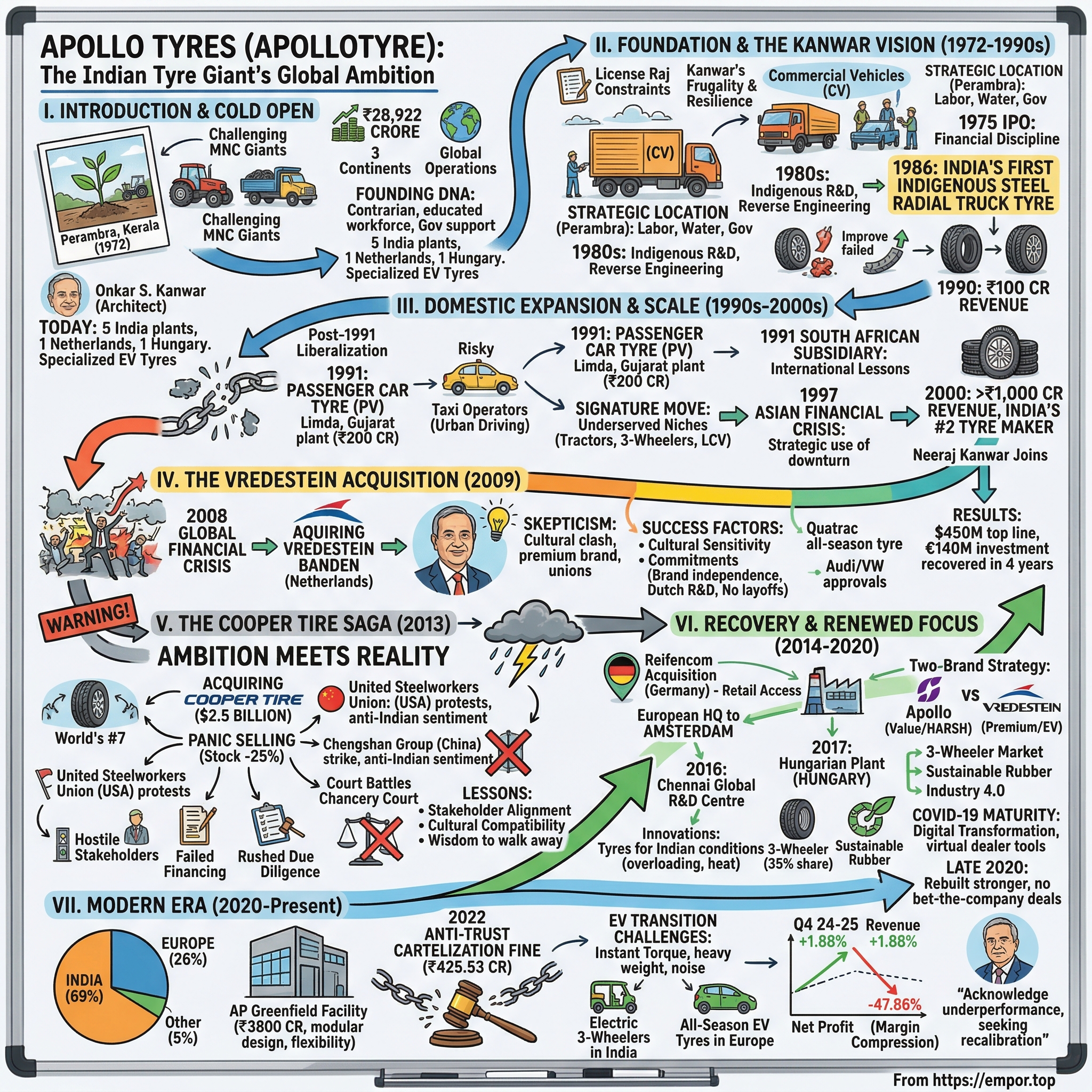
Apollo Tyres: The Indian Tyre Giant's Global Ambition
I. Introduction & Cold Open
On the morning of June 13, 2013, dealing rooms in Mumbai opened to a headline that seemed, at first reading, to contain a typographical error. Apollo Tyres — a family-controlled Indian tyre maker best known for keeping overloaded trucks moving between Kochi and Coimbatore — had agreed to buy Cooper Tire & Rubber Company of Findlay, Ohio, for roughly $2.5 billion in cash.1 Cooper was bigger than Apollo. The financing was almost entirely borrowed. And the acquirer's own market value was a fraction of the cheque it had just written.
The market's verdict was immediate and brutal. Apollo's shares fell about a quarter in a single session, and kept falling: over the following twelve trading days the stock lost 39% of its value.2 There is a particular flavour of humiliation reserved for a company whose shareholders vote, in real time and with their money, that its most ambitious decision is a mistake. Apollo Tyres experienced it in full.
What makes the story worth telling thirteen years later is not the fiasco itself but what happened afterwards. The deal collapsed. The debt was never raised. And the company that emerged over the following decade looks structurally different from the one that walked to the edge of that cliff.
In the year ended March 2026, Apollo Tyres reported consolidated revenue of ₹28,471 crore — roughly $3.2 billion — with operating profit of ₹4,143 crore and a consolidated EBITDA margin of 14.6%.3 Return on capital employed was 13.4%, and consolidated net debt stood at about 0.4 times EBITDA, against 3.2 times in the darkest part of the previous cycle.4 At its August 2026 share price of roughly ₹441, the company carried a market value of about ₹28,000 crore on the National Stock Exchange.5 Two brands, two home markets, seven plants, and a balance sheet that finally looks like it belongs to the business rather than the ambition.
That is the arc. The question this piece exists to answer is whether it constitutes a durable competitive position or merely a well-timed cyclical recovery dressed up as strategy — and the honest answer, as we will see, is that the evidence points in both directions at once.
Five threads run through what follows. First, the License Raj origins, and why a company that started by making tyres for Indian trucks acquired a distribution moat that global giants never fully breached. Second, the 2009 purchase of Vredestein Banden out of a Dutch bankruptcy — the most value-accretive thing Apollo has ever done, and the template for everything since. Third, the Cooper Tire near-death experience, and the uncomfortable possibility that Apollo's best capital allocation decision was one it did not get to make. Fourth, the 2018 shareholder revolt, when minority investors did something almost unheard of in promoter-controlled corporate India: they voted the managing director's reappointment down. And fifth, the business as it actually operates in 2026 — a replacement-market cash machine in India bolted to a European operation that has just amputated its own founding factory.
Begin, as the company did, in Kerala.
 Subscribe on LinkedIn
II. Origins & The License Raj Crucible (1972–1990s)
Kerala in the early 1970s was not where you built a capital-intensive factory if you had a choice. The state had India's most literate workforce, its most organised trade unions, its most reliable monsoon and its least reliable electricity supply. It had almost no heavy industry. What it did have, in abundance, was rubber — the plantations of Kottayam and Kanjirappally supplied the overwhelming majority of India's natural rubber crop.
That was the arbitrage Raunaq Singh saw. A Punjabi industrialist who had built the Raunaq Group out of steel tubes and engineering, Singh incorporated Apollo Tyres as a public limited company in September 1972 — the corporate identity number the company still files under, L25111KL1972PLC002449, encodes both the state and the year.6 The first tyre did not roll off the line at Perambra, in Thrissur district, until 1977.7 Five years from incorporation to first production is a long time by modern standards. Under the License Raj it was ordinary. Every ton of capacity required a government licence; every machine imported required foreign exchange clearance; every expansion was a negotiation with Delhi rather than with customers.
The License Raj is worth pausing on, because Indian industrial history is often told as though it were merely a bureaucratic nuisance. It was more consequential than that. By capping how much any firm could produce, the licensing system converted capacity itself into the scarce asset and made demand largely irrelevant to strategy. Companies did not compete for customers; they competed for permissions. The predictable result was an industry of subscale plants making mediocre products for captive buyers, and a generation of managers whose core skill was regulatory navigation rather than manufacturing excellence.
Into this, in 1980, stepped Onkar Singh Kanwar, Raunaq Singh's son, who took over the running of the company.7 He inherited a plant with a labour problem, a power problem and a product problem, in a state whose politics were institutionally sympathetic to the first of those. The details of the shop-floor conflicts of that era are not comprehensively documented in the public record, and it would be easy to romanticise them. What is documented is the strategic choice that came out of the period, and it turned out to be the most important decision in the company's first thirty years.
Apollo did not go after passenger cars.
What is knowable about Onkar Kanwar as a manager comes less from anecdote than from the pattern of choices attached to his name over four decades, and the pattern is consistent: he has repeatedly chosen the segment nobody fashionable wanted, and then stayed in it long enough for the market to come to him. Trucks before cars. Radials before Indian roads justified them. A distressed European brand before Indian companies were expected to buy European brands. It is a temperament suited to a business where the payback on any decision is measured in a decade — and, as the Cooper episode would later show, a temperament that becomes dangerous when the deals get big enough that a single mistake cannot be absorbed.
That sounds like modesty. It was closer to the opposite. The Indian passenger car market of the 1970s and 1980s was small, protected and dominated by the foreign-affiliated incumbents — Dunlop, Firestone, Goodyear — who had brought their brands, their compounds and their OEM relationships with them. Attacking them would have meant fighting on their terms for a market of a few hundred thousand vehicles a year. Instead Apollo went where the tonnage was: truck and bus bias tyres, the cross-ply workhorses that carried virtually all of India's freight.
Consider what that product actually had to survive. An Indian truck of the period ran on roads that were unpaved for long stretches, at axle loads routinely well beyond design specification, in ambient temperatures that could exceed 45°C, driven by owner-operators for whom tyre life was the difference between profit and loss on a haul. A tyre engineered for German autobahns would have delaminated. Designing for this environment was a genuine engineering discipline — deeper tread, tougher sidewall construction, compounds tuned for heat build-up rather than for grip — and it was a discipline the multinationals had little incentive to master for a market that small.
The commercial vehicle choice did something else that mattered more over time. Truck tyres are sold by weight of experience, not by advertising. A fleet operator running forty vehicles knows, to the rupee, what each brand costs him per kilometre. He buys from a dealer who extends him credit, delivers overnight, and takes his casings back for retreading. Selling into that channel meant building relationships with thousands of small dealers and mechanics across a country with no national logistics infrastructure. It was slow, unglamorous, capital-hungry work — and it produced the single most valuable asset Apollo owns today.
By 1991, when the balance-of-payments crisis forced India to dismantle the licensing system, Apollo had a second plant at Limda in Gujarat and a defensible position in the toughest, least fashionable segment of the market.7 Liberalisation was about to make that position considerably more valuable — and considerably more contested.
III. Scaling Domestic Dominance & The Commercial Vehicle Backbone (1990s–2008)
There is a specific engineering transition that explains more about Indian tyre industry economics between 1995 and 2015 than any amount of macro commentary, and it deserves a plain-English explanation.
A bias-ply, or cross-ply, tyre is built from layers of fabric laid diagonally across the tyre, overlapping each other at an angle. It is cheap, it is easy to make, it is tolerant of abuse, and it is inefficient: the layers rub against each other as the tyre rolls, generating heat, wearing the tread and wasting fuel. A radial tyre lays those fabric cords straight across, from bead to bead, and adds a stiff steel belt under the tread. The sidewall flexes independently of the tread, so the contact patch stays flat on the road. The tyre runs cooler, lasts substantially longer, and burns less diesel.
The catch is that radials are more expensive to make and far less forgiving. A radial's stiff belt does not appreciate potholes, and a radial casing that has been abused is harder to retread. In passenger cars, where the loads are light and the roads relatively better, India radialised quickly through the 1990s. In trucks and buses, radialisation stalled for the better part of two decades — the tyres cost more up front, Indian road quality punished them, and the fleet owner's arithmetic simply did not work.
Then, gradually, it did. The Golden Quadrilateral highway programme and the national highway expansion that followed changed the road surface. Diesel became a larger share of a fleet's operating cost. And the arithmetic flipped: a truck-bus radial (TBR) that costs meaningfully more per unit but delivers more kilometres and better fuel economy becomes the cheaper tyre on a per-kilometre basis.
Apollo committed capital to TBR ahead of that crossover. It was, at the time, a bet with a genuinely uncertain payoff — spending heavily on capacity for a product Indian fleet operators were still refusing to buy. It also happened to be the right bet. Radial capacity for trucks is not something a competitor adds in a hurry; the curing presses, the steel-cord handling, the process control and the tyre-building machinery are specialised and slow to install. Getting there first bought years of advantage. By the first quarter of FY27, management's internal estimate put Apollo's share of the Indian TBR replacement market above 30%, alongside MRF as one of the two leading players in the category.8
That figure carries an important caveat, and it is worth flagging early because it recurs. Indian tyre market share data is not independently published in a timely way. When Apollo's chief financial officer discussed share on the Q4 FY26 call, he said plainly that official data either does not exist or arrives with a significant lag, and that the numbers he was quoting were internal estimates.4 Investors should treat management's share commentary as directional rather than audited.
Alongside the product bet, Apollo kept buying and building capacity. It acquired the Premier Tyres plant at Kalamassery in Kerala in 1995 — a facility that still matters to this story three decades later, because it holds the company's only off-highway tyre capability in India.7 It built a modern radial plant at Oragadam near Chennai in 2010, chosen for Tamil Nadu's automotive cluster and port access.7 And in 2006 it made its first international acquisition, buying Dunlop Tyres in South Africa — a deal that, unlike Vredestein three years later, ended in an exit from South African manufacturing in 2014.7
That South African episode is usually skipped in retellings of Apollo's history. It should not be. It is the earliest data point in a pattern that recurs across four decades: Apollo's international expansions have a wide dispersion of outcomes, and the company has been willing — eventually — to reverse the ones that do not work.
The distribution build-out continued in parallel. It is worth picturing what this actually looked like on the ground, because the phrase "dealer network" flattens something quite specific. A truck tyre dealer in a mandi town in Uttar Pradesh is running a working-capital business, not a retail one: he holds stock he has not paid for, extends credit to fleet operators he has known for years, and needs replacement inventory delivered overnight when a truck is stranded. The manufacturer who funds that inventory, honours warranty claims without argument, trains his fitters and takes back worn casings for retreading is not a supplier — he is a financing partner. That is the relationship Apollo spent thirty years building, one town at a time. Exclusive branded outlets, multi-brand dealers, dedicated truck service centres, retreading facilities. The moat here is not any single relationship but the aggregate: a dealer who has stocked Apollo for fifteen years, whose working capital depends on Apollo's credit terms, whose service bay is fitted for Apollo's product, is not casually converted by a competitor's price promotion. Building an equivalent network from scratch in India is a decade-long project, and no new entrant has managed it.
Then Apollo turned that fleet-earned credibility toward passenger cars and, later, two-wheelers — attacking MRF and CEAT on their own ground.7 By the first quarter of FY27, management estimated its passenger car replacement share at 21% or better.8 The consumer categories are structurally different from trucks: brand advertising matters, dealer relationships matter less, and the buyer is far less able to compute cost-per-kilometre. That difference explains a great deal about how Apollo now spends its marketing budget — a subject we will return to, because it has become one of the more contested items in its capital allocation.
The commercial vehicle backbone gave Apollo cash flow durability. What it did not give the company was scale outside India, or exposure to premium pricing. In 2008, a global financial crisis was about to hand it both, cheap.
IV. The Vredestein Masterstroke: European Distressed M&A (2009)
In the winter of 2008, the tyre factory at Enschede, in the Dutch province of Overijssel near the German border, was an unusually good business owned by an unusually bad parent.
The business was Vredestein Banden B.V., whose lineage traced to a Dutch rubber works acquired by Emile Louis Constant Schiff in 1908 and moved the following year to Loosduinen, where it took the name of the farm on which it stood.9 A century on, Vredestein was not a volume player — it never had been — but it occupied one of the most defensible niches in European tyres: high-performance passenger car tyres, genuinely excellent winter and all-season products, and a specialist agricultural tyre line sold to European farmers who cared about soil compaction.
It also had, improbably for a tyre company, a design signature. From 1999 Vredestein worked with Italdesign, the Turin studio founded by Giorgetto Giugiaro, on the tread pattern and sidewall aesthetics of its performance range — the first collaboration of its kind between a design house and a tyre maker, and the origin of the Sportrac, Ultrac Cento, Ultrac Sessanta and Ultrac Vorti lines.10 It sounds like a gimmick. In a category where the consumer cannot evaluate the product before buying it, a visible marker of craftsmanship is a legitimate pricing tool.
The parent was Amtel-Vredestein N.V., a Russian-controlled group that had acquired Vredestein in 2005 and then collapsed into insolvency as the financial crisis closed off its funding. The Dutch subsidiary was solvent, well-run and suddenly for sale by a seller with no leverage and no time.
Apollo moved in May 2009 and completed the purchase of Vredestein Banden.11 The price was never officially disclosed. Reporting at the time put the enterprise value at around €175 million, with subsequent trade-press accounts noting materially lower figures for the equity consideration, on the assumption that Apollo assumed debt and pension liabilities as part of the transaction.12 The precise number is not in the public domain and should not be asserted as though it were. What is not in dispute is the direction: this was a distressed sale, priced accordingly, of a business with roughly half a billion dollars of European revenue.
The strategic question is why it worked, when so many emerging-market acquisitions of Western brands have not.
Start with what Apollo did not do. It did not rebrand Vredestein as Apollo. It did not move Vredestein's R&D to India. It did not install Indian managers over Dutch engineers. The Dutch operation kept its brand, its technical centre, its European commercial organisation and its premium price position, while Apollo supplied capital and, over time, access to a lower-cost manufacturing base.
This produced the dual-brand architecture that still defines the company: Apollo as the value and mid-market brand across India, and increasingly Europe's price-sensitive segments; Vredestein as the premium European nameplate. The commercial logic is that the two brands can be sold into the same distribution channel without cannibalising each other, because they are not competing for the same buyer. On the Q1 FY27 call, management made the segmentation explicit when discussing Chinese import competition: the Vredestein passenger car range does not compete with Chinese tyres at all, while cheap Chinese product had been taking share at the lower end that Apollo-branded volumes could recapture.8
There is a second, less discussed benefit. Vredestein gave Apollo something no amount of Indian success could have bought: a technical organisation with genuine European homologation experience. Getting a tyre approved onto a German luxury car platform is a multi-year process involving hundreds of test parameters. Apollo has since converted that capability into fresh OEM approvals — the company cited new passenger vehicle approvals from BMW, MINI, Genesis, KIA and Mahindra in the March 2026 quarter alone, along with nominations on multiple EV platforms.48 An Indian tyre maker with no European technical base does not win a BMW fitment. It is not clear it can even get into the room.
So the deal delivered brand, technology, channel access and a second home market, acquired at a cyclical trough. The honest counter-argument, visible only with seventeen years of hindsight, is that Apollo bought a strong brand attached to a cost structure it could not ultimately sustain in Western Europe. The Enschede factory that came with the deal has now been closed. That does not retrospectively make the acquisition a mistake — the brand, the technology and the European market position all survived the factory — but it does complicate the tidy version of the story.
At the time, none of that was visible. What was visible in 2009 was that a mid-sized Indian company had bought a European premium brand for a distressed price and made it work. Four years later, that success would encourage a considerably more dangerous idea.
V. The Cooper Tire Near-Disaster: Ambition Meets Cross-Border Chaos (2013)
The logic, on a slide, was close to irresistible.
Apollo had India. It had Europe. What it lacked was North America — the world's largest premium replacement market — and China, the largest by volume. Cooper Tire & Rubber offered both: a well-known American replacement brand, US manufacturing, and a Chinese joint venture at Rongcheng in Shandong province through a partnership with Chengshan Group. Combining the two would have created roughly $6.6 billion of revenue and the world's seventh-largest tyre manufacturer. For a company whose founding ambition had been to matter beyond Kerala, this was the whole ladder in one step.
The terms announced on June 12, 2013 were $35.00 per Cooper share in cash — a substantial premium to where the stock had been trading — in a transaction valued at approximately $2.5 billion, financed with new debt.1 That last clause is where the trouble started. Apollo was proposing to bolt roughly $2.5 billion of acquisition debt onto a business whose own equity market value was a fraction of that figure, in an industry that was heading into a global demand slowdown. Indian institutional investors, who had watched the company deleverage after the Vredestein purchase, read the slide deck and reached for the sell button.
What followed was a case study in the difference between a financial model and an operating reality — specifically, in the two categories of risk that spreadsheets are worst at capturing: joint venture partners and labour contracts.
The first blow came from China. Cooper's Rongcheng operation was not wholly owned; it was a joint venture in which the local partner had both minority equity and, far more importantly, physical control of the plant. When the deal was announced, workers at the facility struck. Management was locked out. Access to the plant's financial records was blocked. A buyer conducting confirmatory diligence on a $2.5 billion acquisition suddenly could not obtain audited numbers for a significant portion of what it was buying — and the Chinese partner had no obligation, contractual or otherwise, to help.
The second blow came from Ohio. The United Steelworkers, representing Cooper's US plant workforce, filed grievances arguing that the merger violated their collective bargaining agreements. An arbitrator agreed, with the practical result that the collective agreements had to be renegotiated before the deal could close — handing the union effective veto power over the timing and economics of the transaction.
Apollo, facing an asset it could not fully audit and a labour cost it could not fully quantify, did what any rational buyer does: it asked for a price reduction, in the range of $8 to $9 per share. Cooper refused and sued in the Delaware Court of Chancery to force the deal through.
The ruling came on November 8, 2013. Vice Chancellor Sam Glasscock III found that Apollo had used reasonable best efforts in its negotiations with the union and — in a phrase that has since been quoted in a great many M&A seminars — that nothing in Apollo's conduct indicated buyer's remorse.13 Apollo was not in breach. Cooper's attempt to compel completion failed; the Delaware Supreme Court dismissed its appeal the following month, and Chancery ultimately dismissed Cooper's damages case in 2014.14
On December 30, 2013, Cooper Tire formally terminated the merger agreement, stating that it believed Apollo had breached it.151 The world's seventh-largest tyre company was un-invented.
The investment lessons here are not the obvious ones about hubris, and they are worth stating precisely.
First, a controlled asset and a consolidated asset are different things. Cooper consolidated the Chinese JV in its accounts. It did not control the factory gate. Any diligence process that treats accounting consolidation as evidence of operational control is looking at the wrong document.
Second, change-of-control provisions in labour agreements are options written by the seller and exercised by third parties. They cost nothing to issue and can be worth hundreds of millions when triggered. They rarely appear in a merger model.
Third — and this is the uncomfortable one — Apollo's shareholders were right for reasons that had nothing to do with why the deal actually failed. The market punished the stock over leverage. The deal died over a Chinese partner and an American union. Both were correct that the transaction should not happen; neither identified the mechanism. That is worth remembering whenever a market reaction is cited as evidence of analytical insight.
And fourth, the most valuable capital allocation decision in Apollo's history may have been one management did not choose. Had the deal closed in early 2014, Apollo would have entered the subsequent global tyre downturn carrying acquisition debt many multiples of its equity value, with a Chinese asset it could not control and a US labour cost it had not underwritten. The failure was not skill. It was, quite straightforwardly, luck — dressed up afterwards, as such things usually are, in the language of discipline.
What Apollo did with that reprieve is the more interesting question.
VI. The Pivot to Capital Discipline & Global Footprint (2014–2020)
Freed of Cooper, Apollo did something that in hindsight looks less like a pivot to discipline than a change of method: instead of buying scale, it decided to build it.
The centrepiece was in Hungary. On a greenfield site at Gyöngyöshalász, about eighty kilometres east of Budapest, Apollo spent €475 million on a plant that was inaugurated in April 2017 — the first greenfield factory built outside India by an Indian tyre company, and at the time the largest Indian corporate investment in Hungary.[^16]16 At full build, the facility was designed for 5.5 million passenger and light truck tyres and 675,000 heavy commercial vehicle tyres a year.16
The strategic reasoning was a straightforward reading of European cost geography. Enschede was a Western European plant with Western European wages and energy costs, making a full range of products including relatively low-margin sizes. Hungary offered EU market access, EU quality standards and Central European labour costs. The plan was to move the volume production to Hungary and India and leave the Dutch factory doing the high-value, niche work — the specialist agricultural tyres, the Spacemaster spare wheels, the small-batch premium sizes where cost per unit mattered less. Apollo's own milestone timeline records this as the "specialisation of Dutch plant" in 2020.7
Alongside the greenfield, Apollo made a much smaller acquisition that reveals a lot about how it thought about Europe. In November 2015 it bought Reifencom GmbH, a German tyre distributor, for €45.6 million — a business with 37 stores and service centres across Germany, an online presence in six European countries, and turnover of about €147 million in 2014.17 The rationale was channel control: in a market where a growing share of tyre purchases begins with a price comparison online, owning a retail platform gives a manufacturer both shelf space and demand signal.
That is the theory. The results have been thin. On the Q4 FY26 call, Reifencom's quarterly EBITDA margin was described as just under 2%; in the following quarter, on revenue of €43 million, it was about 3%.48 After a decade of ownership, this is a low-single-digit-margin distribution asset inside a group targeting mid-teens consolidated margins. It is not large enough to threaten the group, but it is exactly the kind of holding a sceptical investor would ask management to justify — either it is strategically load-bearing for Vredestein's shelf position, in which case say so and quantify it, or it is a €45 million capital allocation that has not earned its cost of capital.
In India, the ambition was larger still. The foundation stone for a greenfield radial plant in Andhra Pradesh was laid in January 2018, and the first tyre rolled out in June 2020 — Apollo's seventh plant globally and fifth in India.[^19]7 Hungary and Andhra Pradesh together represented the largest simultaneous capital programme in the company's history, executed across two continents, in two currencies, into two markets that both slowed sharply before the capacity arrived.
The financial consequence was predictable and severe. Heavy capital expenditure funded partly by debt, colliding with a global automotive slowdown and then a pandemic, pushed leverage to its worst level in the company's modern history: consolidated net debt of roughly 3.2 times EBITDA, a level management would later use as the reference point for how far the balance sheet had come.4 Return on capital collapsed alongside it, because the denominator — capital employed — had ballooned while the numerator waited for volumes that had not yet materialised.
This is the mechanical trap of greenfield capacity in a cyclical industry, and it deserves stating plainly rather than as an accounting footnote. A tyre plant is a fixed-cost machine. Build it, and depreciation, interest and a full complement of engineers begin immediately; the volume arrives over three to five years. In the interval, reported returns look terrible even if the investment decision was correct. The difficulty for investors is that reported returns look identical whether the investment was correct or not.
In April 2020, at close to the trough, Apollo raised ₹1,080 crore by issuing compulsorily convertible preference shares to Emerald Sage Investment Limited, a Mauritius vehicle of funds managed by Warburg Pincus.18 Private equity capital arriving at that point in a cycle is informative in two directions: it validated that a credible outside investor saw value, and it confirmed that the company needed equity capital because its own balance sheet had reached its limit.
By FY20, in other words, Apollo had a global manufacturing footprint, a premium European brand, a fast-growing Indian franchise — and returns that did not remotely justify the capital consumed. That combination is what makes companies vulnerable to their owners. It was about to make Apollo vulnerable to something rarer in Indian corporate life: an organised revolt by its minority shareholders.
VII. Corporate Governance Crisis & The 2018 Shareholder Revolt
Indian annual general meetings are, as a rule, ceremonial. The promoter family holds a large block, the institutions hold the float, the resolutions pass, and everyone goes home. In September 2018, Apollo Tyres held one that did not follow the script.
The resolution before shareholders was the reappointment of Neeraj Kanwar — Onkar Kanwar's son, the company's vice chairman and managing director, and the executive most closely identified with the Vredestein integration, the European restructuring and the Hungary build — as managing director. It failed.19
The arithmetic is worth understanding because it explains how a promoter-controlled company can lose a vote. Votes cast in favour came to 72.72%, against 27.28%.19 In an ordinary resolution, a comfortable win. But this was a special resolution, requiring votes in favour to exceed those against by a factor of three. At just under 73% for and just over 27% against, the ratio fell short. The promoter block could not carry it alone, and the institutional float — mutual funds and other public institutional shareholders — voted no in sufficient numbers to break the threshold.
The grievance was compensation. Neeraj Kanwar's remuneration had risen 43% to ₹42.8 crore in 2017, from about ₹30 crore the year before.19 Set against the company's earnings trajectory and the state of its balance sheet at the time, this was a difficult number to defend. Indian institutional investors — historically among the most compliant in the world when it came to promoter pay — had spent the preceding few years being pushed by proxy advisers and by the market regulator toward actually exercising their votes. Apollo became the demonstration case.
Management's response is genuinely to the company's credit, and it is worth being specific about why. The easy path in Indian corporate governance is to re-run the resolution with better vote canvassing and change nothing substantive. Apollo did not do that. By November 2018, Onkar Kanwar and Neeraj Kanwar had agreed to a roughly 30% reduction in their own remuneration, effective FY19, and — far more consequentially — accepted a cap on total promoter compensation at 7.5% of profit before tax, replacing the prior arrangement benchmarked against net profit.[^22]20
The switch of denominator matters more than the headline percentage. Profit before tax is a harder number to flatter than net profit, which can be moved by tax accounting; capping pay as a share of PBT ties the promoters' income to operating performance in a way that is difficult to engineer around. Combined with a substantial performance-linked component, this converted promoter pay from a fixed claim on the business into something closer to a variable one.
The revolt's second effect was on strategy, and it is harder to attribute cleanly. From roughly this point onward, Apollo's public financial language changed. Where the company had previously talked in terms of volume growth, capacity and market position, it began articulating explicit return and leverage targets: return on capital employed above 15%, net debt to EBITDA held low, and growth capital expenditure funded from internal accruals rather than borrowing. Whether the shareholder vote caused that shift or merely coincided with a balance sheet that left no alternative is impossible to establish from the outside. Both readings are defensible; the second is probably the more prudent assumption.
There is one governance overhang from this era that remains unresolved and should be flagged. In an order dated August 31, 2018, the Competition Commission of India found five tyre manufacturers and their industry association to have acted in concert on pricing and supply of cross-ply tyres in the replacement market, imposing penalties totalling ₹1,788 crore — of which ₹425.53 crore was assessed against Apollo Tyres.2122 On December 1, 2022, the National Company Law Appellate Tribunal set the penalty aside and remitted the matter to the regulator for fresh consideration of the quantum.23 The final outcome of that remand is not disclosed in the materials reviewed here. It is a contingent liability whose resolution has now been pending for years, and any investor reading the company's financial statements should locate the current disclosure on it rather than assume the NCLAT order closed the matter.
What the 2018 episode ultimately demonstrated is that Apollo's promoters respond to organised pressure — a meaningfully different proposition from the claim that they impose discipline on themselves. That distinction becomes important when we come to assess management credibility against the current capital expenditure cycle.
VIII. The Modern Business Engine & Segment Economics
At the close of business on June 30, 2026, the last tyre came off the line at Enschede. The factory had been making rubber products on that site for more than a century.24 About five hundred people lost their jobs. Apollo's chief financial officer, asked on the Q4 FY26 call when European margins would improve, answered the question and then added, unprompted, that the closure had been "a tough, difficult, emotional decision."4
It is the right place to start an examination of the modern business, because it is the sharpest illustration of how the two halves of Apollo Tyres now work — and how differently they earn.
The shape of the company. In the June 2026 quarter, India accounted for 69% of consolidated revenue, Europe — including the Reifencom distribution business — for 26%, and other geographies for 5%.25 By channel, 79% of consolidated revenue came from the replacement market and 21% from original equipment supply.25 By product, truck and bus tyres were the largest single block at 41% of consolidated revenue, passenger vehicle 36%, farm and off-highway 11%, and light truck 7%.25
That channel mix is the single most important structural fact about the business. Replacement-market tyres are sold to a customer whose vehicle already exists and whose tyres are already worn out. Demand is driven by kilometres driven and by the size of the vehicle parc, not by new vehicle sales — which is why tyre replacement volumes hold up in years when automobile production falls. Pricing is set at the dealer, not negotiated annually with a purchasing department. Gross margins are structurally higher.
OEM supply is close to the mirror image: lower margin, harder negotiations, and a customer with meaningful buying power. Companies do it anyway, and the reason is the "fitment habit." A driver replacing worn tyres tends, absent a strong reason otherwise, to buy the brand that came on the car. OEM supply is best understood as customer acquisition expenditure for the replacement market that follows three to five years later.
How money is actually made and lost. Roughly 57% of Apollo's consolidated revenue in the June 2026 quarter went out again as raw material cost.25 The basket is natural rubber, synthetic rubber, carbon black, steel cord and fabric — and management discloses spot prices for the main inputs each quarter, which is unusually transparent and very useful. In the March 2026 quarter, natural rubber averaged about ₹200 per kilogram, synthetic rubber ₹170, carbon black ₹110 and steel cord ₹155.4 One quarter later, natural rubber had moved to ₹225 and synthetic rubber to ₹250, with an expectation of natural rubber averaging above ₹260 in the September quarter.8
That is what a cost shock looks like in a business where roughly three-fifths of revenue is bought commodity. And it explains the pricing mechanics, which management laid out with unusual precision. As a rule of thumb, Apollo needs a price increase of roughly two-thirds the size of the raw material increase to hold margin — because raw material is not the whole cost base. With input costs up about 17% in the June quarter, the required price increase was in the region of 11-12%; what was actually implemented, staggered through the quarter, was 7-9%; and because it was staggered, only 3-4% flowed into that quarter's realisations.8 Management's stated requirement for the full cycle was 15-16%, against roughly 11% achieved at the time of the call.8
The visible consequence: consolidated EBITDA margin of 11.7% in Q1 FY27, down about 149 basis points year on year, on revenue of ₹7,398 crore that grew 12.8%.2526 Growth of that magnitude with margin going backwards is the signature of a pass-through business caught mid-cycle. India delivered its strongest year-on-year quarterly growth in fourteen quarters — revenue of ₹5,462 crore, up 15.6%, of which about 12 percentage points was volume — while its EBITDA margin fell from 13.6% to 12.0%.258
The analytical read is that Apollo currently has volume momentum and incomplete pricing power. Both halves matter. Demand is genuinely strong: India capacity utilisation was 91% and Europe 94% in the June quarter, and management described struggling to keep up with demand.258 But a company with unambiguous pricing power does not run a five-point gap between the price increase it needs and the one it has taken. What Apollo has is pricing power with a lag — which is a real but distinctly weaker property, and one that cuts favourably when input costs fall. As the CFO noted, the industry has historically recorded its best margins in a falling raw material environment.8
Europe, and the amputation. Apollo announced the proposed Enschede closure in April 2025, filing a request for advice with the plant's Works Council; clearance came in September 2025, and production ceased at the end of June 2026.248 The rationale, as management explained it under direct questioning, was that European revenue had been flat to negative for two years while Dutch salary inflation had run at 12-13% a year against a normal 4-5%, on top of persistently high energy costs — compressing Europe's EBITDA margin from a historical 16%-plus to the low-to-mid teens.4
The financial cost has been substantial. FY26 carried exceptional items of ₹742 crore.3 A non-cash write-off of €43 million was taken against Enschede's fixed assets in the March 2026 quarter alone, and the social plan and associated legal costs represent a cash provision of more than €55 million, largely paid out in FY27.4
The strategic cost is subtler and, for a long-term investor, arguably more important. Truck radial production has moved to India; most passenger car radial production has moved to Hungary, with lower-end 14- and 15-inch sizes moving on to India; Spacemaster spare tyre capacity has been established at Baroda with OEM clearances already obtained.8 But the high-end agricultural tyre line has no home. Apollo's only Indian off-highway capacity sits at Kalamassery, now inside the city of Kochi and constrained in how far it can expand, and Enschede's agricultural output — twenty tonnes a day — is too small to justify a new plant at economic scale.8
So Apollo has resorted to offtake: buying finished high-end agricultural tyres from two external partners, currently covering 20-25% of its agricultural business, with management describing the arrangement as the medium-term plan rather than a bridge.827 Agriculture represented about 12% of European revenue, roughly half of it OEM.4 Some of that OEM business, which management characterised as loss-making, is being consciously allowed to go.4
This is a real strategic retreat, and it should be named as one. Apollo is now a marketer rather than a manufacturer in a premium niche where it competes against Balkrishna Industries — a company whose entire competitive model is owning low-cost, large-scale off-highway manufacturing. Outsourcing a differentiated product to a third party trades margin, control of quality and control of specification for the avoidance of capital expenditure. It may well be the correct trade given the scale economics. It is not a strengthening of the moat.
The immediate arithmetic has been unflattering. European revenue in the June quarter was €147 million, up just 0.5%, with EBITDA of €13 million and a margin of 8.9% against 10.8% a year earlier — depressed by the overlap of running down one plant while ramping another.25 Management put the underlying margin absent overlap costs at around 11%.8
Where the growth capital is going. In February 2026 Apollo announced an investment of about ₹5,810 crore to expand its Andhra Pradesh facility — adding roughly 3.7 million passenger car radials and 1.3 million truck and bus radials of annual capacity by 2029.28 For FY27 the company guided to ₹3,500 crore of capital expenditure, about 80% of it directed at growth and capacity, with close to ₹3,000 crore in India and the balance funding a passenger car tyre expansion in Hungary.4 Consolidated capital expenditure ran at ₹650 crore in the June quarter, and management explicitly guided that leverage would rise modestly and that the company would be a net borrower during FY27.825
The future bets. In the electric vehicle segment, Apollo launched the Amperion range for passenger cars and the WAV range for two-wheelers in India, claiming range improvement of up to 8% through a functionalised resin compound engineered for lower rolling resistance while handling the instant torque of an electric drivetrain — and it was the first Indian tyre to receive a five-star fuel savings label from the Bureau of Energy Efficiency in the passenger vehicle category.2930 In Europe, the Vredestein Quatrac Pro EV went on sale in December 2022 with rolling resistance around 15% below the equivalent conventional product.30
The engineering here is genuinely different, and worth explaining without the jargon. An electric car is heavier than a comparable petrol car because of the battery, and it delivers maximum torque from a standstill, which tears at the tread. It also has no engine noise to mask the sound of rubber on tarmac, so tyre noise becomes the dominant cabin noise. And because every watt spent flexing rubber is a watt not spent moving the car, rolling resistance translates directly into range. So an EV tyre must carry more weight, resist more shearing force, wear more slowly, run quieter and roll more freely — a set of requirements that partly conflict with each other. That is why it is a legitimate technical differentiator rather than a marketing label, and why OEM nominations on EV platforms are a meaningful proof point.
Whether any of this is yet financially material is a different question, and the honest answer is that Apollo does not disclose EV tyre revenue separately. Treat it, for now, as optionality rather than earnings.
Myth versus reality. Three consensus narratives about this company deserve testing against the record.
Myth: Apollo is an Indian company with a European sideline. Reality: Europe is a quarter of revenue and, historically, the higher-margin quarter — Europe's normalised EBITDA margin used to run at 16%-plus while Indian margins sat in the mid-teens.4 The current picture is inverted only because Europe is mid-restructuring and India is mid-boom. Anyone modelling Apollo as an Indian pure-play with a rounding error attached is modelling a different company.
Myth: the dual-brand strategy means Apollo sells the same tyre under two names. Reality: they do not compete for the same customer at all. Management confirmed on the Q1 FY27 call that Vredestein's passenger car range does not compete with Chinese imports, while Apollo-branded volumes do.8 The brands occupy different price tiers with different cost structures, which is the entire point — and also why the European anti-dumping duties help one brand and not the other.
Myth: the Enschede closure was a cost-cutting exercise. Reality: it was a manufacturing footprint decision that also involved abandoning a product capability. The passenger car and truck volumes moved. The high-end agricultural line did not, because Apollo had nowhere economically viable to put it.8 Cost savings are the visible half; a narrowed product portfolio in a premium niche is the half that does not show up in a margin bridge.
IX. The Strategic Playbook: 7 Powers & Porter's 5 Forces
Strip away the narrative and ask the question a competitor's strategy team would ask: what, specifically, stops us from taking Apollo's business?
Hamilton Helmer's 7 Powers Analysis
Scale Economies — real in India, contested in Europe. A modern tyre plant is one of the more brutal fixed-cost structures in manufacturing. Curing presses, mixing lines, tyre-building machines and quality systems represent hundreds of millions of dollars of capital that must be run near flat out to earn a return, which is why capacity utilisation is the metric management quotes first. At 91% in India and 94% in Europe, Apollo is currently operating where the operating leverage works in its favour.25 The Andhra Pradesh expansion pushes further along that curve. But scale here is regional, not global: Apollo's consolidated revenue of roughly $3.2 billion sits against global majors several times larger. Apollo has scale sufficient to compete in its chosen markets, not scale sufficient to set global terms.
Counter-Positioning — genuine, and structurally clever. This is Apollo's most interesting power, and it is the dual-brand architecture. Vredestein occupies the premium European shelf; Apollo occupies value and mid-market. A European premium incumbent cannot respond to Apollo-branded price competition without damaging its own brand equity, and cannot respond to Vredestein without conceding that its premium positioning is soft. Meanwhile Apollo can manufacture Vredestein-adjacent volume in Hungary and India at cost structures its Western European competitors cannot replicate without dismantling their own plants — which is precisely the manoeuvre Apollo has just executed on itself, painfully, at Enschede.
Process Power — asserted, not demonstrated. Compound formulation, mixing discipline and process control genuinely differentiate tyre makers, and Apollo's European OEM approvals are evidence that its technical capability meets a high bar. But process power in Helmer's sense requires an advantage that competitors cannot replicate even knowing it exists, and there is no public evidence that Apollo's manufacturing processes are inaccessible to MRF, CEAT, Michelin or Bridgestone. Treat this as competence rather than power.
Distribution and Switching Costs — the strongest and least replicable. The dealer network is where Apollo's genuine defensibility lives. A tyre dealer's relationship with a manufacturer bundles credit terms, delivery reliability, inventory support, service equipment, warranty handling and training. Switching costs are not contractual; they are operational and financial, and they compound over years. No new entrant has built an equivalent Indian network in the last two decades, and the reason is that it cannot be bought — only accumulated. Note the important asymmetry: this power is strong in India and materially weaker in Europe, where Apollo's own management described itself as a price follower relative to the global majors.4
There is no meaningful network effect in this business — one more Apollo tyre on the road does not make the next Apollo tyre more valuable — and branding, while real in Indian consumer categories, is a mid-strength asset rather than a Michelin-grade one.
Porter's 5 Forces Analysis
Threat of New Entrants — LOW. Capital intensity, multi-year regulatory homologation, OEM qualification cycles measured in years, and an entrenched dealer channel together make greenfield entry into Indian tyres economically unattractive. The realistic threat is not a new entrant but an existing player importing.
Bargaining Power of Suppliers — MEDIUM-HIGH, and currently biting. Natural rubber is an agricultural commodity subject to weather, disease and planting cycles; carbon black and synthetic rubber track crude oil. Apollo sources roughly half its raw materials by import, and management noted that domestic Indian rubber prices track the landed cost of imports closely enough that switching offers limited protection — with rupee depreciation from around ₹88 to the dollar contributing perhaps 7-8 percentage points of the recent basket inflation.8 There is no vertical integration into rubber and no meaningful long-term hedging programme disclosed. The company's principal defence is price increases, taken with a lag.
Bargaining Power of Buyers — SPLIT. In the Indian replacement channel, buyer power is low: fragmented, brand-influenced, dealer-mediated. In OEM supply it is high, and Apollo's own disclosure makes the mechanism visible — some contracts carry formula-based pricing with a one-quarter lag, others require negotiation, and management described those negotiations as "never easy" with automakers facing cost pressure across every component line.8
Threat of Substitutes — LOW. There is no commercial alternative to the pneumatic rubber tyre for road transport. Airless and non-pneumatic designs remain niche. Vehicle electrification changes tyre specifications; it does not remove tyres. If anything, heavier electric vehicles wear tyres faster, which is mildly positive for replacement volumes.
Competitive Rivalry — HIGH, but currently rational. MRF remains the Indian scale leader, with FY26 consolidated revenue of ₹31,149 crore and net profit of ₹2,426 crore — meaningfully larger than Apollo on both counts.31 CEAT and JK Tyre are smaller but aggressive, and Balkrishna Industries dominates the off-highway niche Apollo has just retreated from in Europe. Globally, Michelin, Continental, Bridgestone and Goodyear operate at multiples of Apollo's scale.
The interesting near-term development is that rivalry has become less price-destructive, not more. Asked directly on the Q1 FY27 call whether the industry's unusually steep price increases signalled a structural change, management pointed to two conditions: a cost shock large enough that no player could absorb it, and demand strong enough that capacity was fully utilised across the industry.8 That is an accurate description, and it contains its own warning. Neither condition is permanent. Pricing discipline that rests on full capacity utilisation is discipline on loan, and management said as much — acknowledging that if raw material prices fall significantly against a softer demand backdrop, some downward price correction is possible.8
One force operating in Apollo's favour arrived from Brussels. On July 8, 2026, definitive European Union anti-dumping duties of between 4.3% and 45.3% came into force on Chinese passenger car and light lorry tyres, for an initial five years, with a parallel anti-subsidy investigation due to conclude in December 2026.32 For a European market consuming roughly 330 million such tyres a year, this removes a slice of low-cost supply at exactly the price point Apollo-branded product occupies.32 Management expects a benefit, while noting that Vredestein never competed with Chinese product in the first place.8 Regulatory protection is a real tailwind — and a reminder that it is a policy decision, subject to reversal, rather than an earned advantage.
X. Management Credibility & The Earnings Call Evidence
The most revealing moment on Apollo's August 2026 earnings call was not about margins.
Gaurav Kumar, chief financial officer, opened by announcing his own departure after twenty-two years with the company, explaining that he had decided the time was right "having completed the Enschede project, which I was an integral part of over the last 18 plus months," and adding that he did not yet know what he would do next.8 Later in the call, discussing what would happen to margins when raw material prices eventually fall, he observed — accurately and slightly wistfully — that he would not get the credit for it.8 Neeraj Kanwar was absent from the call because of an urgent commitment.8
Analysts should not over-read a single departure. But a long-tenured CFO leaving immediately after the largest restructuring in the company's recent history, at the start of a major capital expenditure cycle, with no successor named at the time of the announcement, is a governance item worth watching rather than dismissing.26 The successor's appointment, and whether the disclosure discipline and the willingness to give hard numbers survive the transition, is a genuine test.
Because that disclosure discipline is currently one of Apollo's better attributes. On these calls, management gives spot raw material prices by input, quantifies the price increases taken versus needed, gives channel-level volume growth, provides the Reifencom segment's revenue and margin when asked, quantifies overlap costs in Europe, and states plainly when it does not have a number to hand. Asked about pre-buying in the European agricultural market, the CFO said he had not heard from his team and would have to come back — an unfashionable answer, and a credible one.8
The leadership. Onkar S. Kanwar, chairman, is the figure who took an under-resourced Kerala plant in 1980 and turned it into a company with two home markets. Neeraj Kanwar, vice chairman and managing director, is the operator: the executive most associated with the Vredestein integration, the Hungary greenfield, the Cooper attempt, and the European restructuring. The promoter group holds roughly 37% of the equity — enough alignment to matter, not so much as to make institutional oversight ornamental, as the 2018 vote demonstrated.33 The board includes Francesco Gori, a former chief executive of Pirelli Tyre, which is a non-trivial signal about the seriousness of the European technical agenda.7
Testing the narrative against itself. The useful exercise with management credibility is not to evaluate the latest statement but to compare statements across time.
On the deleveraging promise, the record is good and independently verifiable. Consolidated net debt to EBITDA moved from 3.2 times to 0.4 times by March 2026 — from 0.7 times just a year earlier — while free cash flow rose from ₹13 billion in FY25 to ₹20 billion in FY26 and capital expenditure simultaneously increased from ₹8 billion to ₹14 billion.425 Generating more cash while spending more on capacity and still cutting leverage is not rhetoric; it is arithmetic, and it happened.
On the return target, the record is partial. Consolidated ROCE of 13.4% in FY26 was an improvement of about 240 basis points on the prior year but remains below the 15% aspiration, and it was achieved in a year that included both a large one-off deferred tax reversal and substantial restructuring charges.4 Progress, not arrival.
On European margins, there is a discrepancy that deserves attention. On the May 2026 call, asked whether Europe could return to a 16% EBITDA margin over the medium term, management said it believed it would get back to 16% — the earlier normal — and could even surpass it.4 Three months later, asked what margin Europe would target once the transition completed, the answer had become "high teens EBITDA."8 In the same quarter, the actual delivered European margin was 8.9%.25
Escalating a target while the reported number deteriorates is a pattern worth naming. The charitable reading is that the Enschede economics look better from inside the company as the transition completes. The sceptical reading is that when a business is missing badly in the present, the temptation to move the promise further into the future is considerable. There is no way to resolve this from outside; what investors can do is hold the "high teens" statement as a specific, dated, falsifiable claim and check it against reported European margins over the next several quarters. Management has itself supplied the timeline: benefits beginning in the second half of FY27.8
The activist's questions. A sceptical investor examining this company today would press on four things.
First, marketing. In September 2025 Apollo became the lead sponsor of India's men's and women's national cricket teams in a deal reported at around ₹579 crore, running to March 2028.34[^38] The effect on the P&L was immediately visible: advertising and sales promotion spend hit 4% of standalone sales in the March 2026 quarter against a typical 2%, more than ₹100 crore above normal, and management then cut it roughly in half in the following quarter as cost pressures bit.48 Management's defence is that the sponsorship, alongside the GST rate reduction on tyres from 28% to 18% effective September 22, 2025, drove accelerating growth in consumer tyre categories over three quarters.358 That is a plausible claim and a difficult one to isolate, since the tax cut alone lowered retail prices materially. The activist's question is straightforward: what is the measured return on a ₹579 crore commitment, and would the same capital deployed in capacity or debt reduction have earned more?
Second, portfolio complexity. A sub-3%-margin German tyre retailer and an outsourced high-end agricultural tyre line are both small. Both require management attention. Neither has an obvious path to group-level returns.
Third, capital allocation relapse. Having promised discipline, Apollo has committed ₹5,810 crore to Andhra Pradesh and guided to being a net borrower in FY27. Management's answer to the flexibility question was candid — some flexibility exists for FY28, FY27 is largely committed.4 Committing capital at 90%-plus utilisation is defensible; the memory of FY20, when capacity arrived into a downturn, is why the question keeps being asked. Notably, the CFO pushed back directly on the market's earlier scepticism, saying that with hindsight the expansion decisions look beneficial and that "if anything, we are a quarter late than early."8
Fourth, the unresolved competition matter described earlier, whose current status investors should verify in the latest filings rather than infer.
The overall assessment is of a management team that has become substantially more disciplined under pressure, communicates with better-than-average specificity, and is now being tested by the first genuine capital expenditure cycle since it made those promises. The prior deleveraging record earns them the benefit of the doubt. It does not earn them the absence of scrutiny.
XI. Material Risk Radar
Raw material inflation outrunning price recovery. This is the live risk, not a theoretical one. Input costs rose about 17% in the June 2026 quarter with a further 8% sequential increase expected, against implemented price increases of 7-9%.8 Consolidated margin has already given up roughly 150 basis points.25 The mechanism is simple: Apollo buys commodities at spot and sells at prices that move in negotiated steps, and the gap between the two is borne by shareholders. The mitigating factor is symmetry — when the basket falls, the same lag becomes a windfall, and management expects natural rubber to cool from the September quarter as seasonal supply returns.8 The risk is that a sharp deflation coincides with softer demand, forcing price giveback before margin is rebuilt, an outcome management explicitly acknowledged as possible for the March 2027 quarter.8
Currency. Roughly half of Apollo's raw material is imported, and rupee depreciation from around ₹88 to the dollar contributed an estimated 7-8 percentage points of the recent cost increase.8 There is a partial natural hedge — exports and a European business earn hard currency — but transfer pricing rules mean the Indian standalone entity retains only a fixed margin on European sales, so the benefit accrues at group level rather than where the cost is incurred.4 Investors reading standalone Indian numbers will see the cost of a weak rupee without the offset.
European demand and execution. Europe has been flat to negative for two years.4 Apollo has now bet its European margin recovery on the successful completion of a manufacturing transfer across three countries, with the shift from Hungary to India for lower-end sizes still completing into late 2026.8 Transitions of this kind lose revenue when capacity is unavailable at the moment demand appears — which is precisely what happened to truck tyre sales in the March quarter and to European revenue in June.48 Execution risk here is concrete and current.
Geopolitical and logistics disruption. Management has repeatedly attributed volatility in raw materials, energy and freight, and weakness in specific export markets, to conflict in West Asia.48 The company's West Asian export markets are running behind budget, and the US market has been weak with dealer inventories not clearing.8 Apollo's exposure is indirect but persistent: it does not control any of these variables and cannot hedge most of them.
Trade policy in both directions. The new EU duties on Chinese tyres help Apollo in Europe.32 The same logic can be applied against Indian exporters, and India's own anti-dumping protections on imported tyres are a policy choice that could change. Management currently sees no dramatic near-term increase in imports into India, with modest penetration in passenger car tyres and very little in truck.4 That assessment is a snapshot, not a structural guarantee.
Demand sensitivity to the price increases themselves. Asked how fleet operators respond to a 15-16% tyre price increase alongside rising diesel costs, management's answer was grounded in experience: goods that need moving get moved, costs get passed along the chain, but new vehicle purchases get postponed first.4 That implies OEM volumes are the more vulnerable channel in a squeeze — which is the lower-margin channel, but also the feeder for future replacement demand.
Execution risk on the capital programme. The Andhra Pradesh expansion runs to 2029, and Hungary's passenger car expansion begins ramping in the second half of FY27.288 Both were committed at near-full utilisation into visibly strong demand. Both will arrive regardless of what demand looks like when they do.
Key personnel. A twenty-two-year chief financial officer departing at the start of a capital expenditure cycle, with the successor not yet named, is an operational risk in a business where the finance function has been the primary channel of investor communication.826
XII. The Investor Spine: Bull vs. Bear Case
The Bull Case
The capital cycle has turned, and the evidence is in the cash flow statement. The strongest argument for Apollo is not a forecast; it is a track record over the last six years. Leverage fell from 3.2 times EBITDA to 0.4 times, free cash flow rose 54% in a single year to ₹20 billion while capital expenditure simultaneously rose 75% to ₹14 billion, and ROCE improved 240 basis points to 13.4%.425 A business that can self-fund growth while deleveraging is structurally different from one that cannot, and Apollo could not, six years ago.
The Indian demand runway is real and currently observable. This is not a projection. India delivered its fastest growth in fourteen quarters in June 2026, with double-digit volume growth across replacement, OEM and export channels simultaneously, at 91% capacity utilisation, with management reporting difficulty keeping up.825 Behind it sit identifiable drivers: the GST reduction lowering retail prices, an SUV-shifting passenger fleet that raises the average rim size and therefore the average selling price per tyre, and freight growth driving truck tyre replacement.
European margin recovery is a mechanical, not speculative, thesis. The high-cost plant has been closed. The costs have been taken. The overlap costs are, by definition, temporary. Management put the underlying European margin absent overlap at around 11% versus 8.9% reported, and targets high teens once the transition completes.8 If the cost base moves as intended, the margin should follow without requiring a demand recovery — which is a considerably more robust thesis than hoping European car sales improve.
Regulatory tailwinds have arrived at a useful moment. The EU's five-year anti-dumping duties on Chinese tyres remove low-cost competition at the exact price point where Apollo-branded European volume competes, just as Hungarian capacity expands.32
Pricing discipline is holding. Competitors have followed Apollo's price increases in similar magnitude and timing, and the industry has avoided discounting despite the steepest cost push in years.8 Combined with the historical pattern of peak margins during falling raw material cycles, this creates genuine upside optionality if the rubber price rolls over while demand holds.
The Bear Case
Pricing power is incomplete and lagged, not structural. The clearest evidence against a moat narrative is Apollo's own disclosure: it needs 15-16% of price and has taken about 11%.8 A business with genuine pricing power does not run that gap. What Apollo has is the ability to eventually recover costs, provided competitors move too and demand holds — both conditions currently satisfied, neither guaranteed.
The current environment flatters the operating story. Capacity utilisation above 90%, industry-wide pricing discipline, a GST cut boosting retail demand, and rupee weakness helping export competitiveness are all cyclical. Strip them out and the underlying question — whether Apollo earns an adequate return through a full cycle — remains unanswered, because the last full cycle produced single-digit returns on capital.
Europe has been a decade-long disappointment relative to the acquisition thesis. The premium brand was acquired at an attractive price in 2009. Seventeen years later, Apollo has closed the founding factory, outsourced a differentiated agricultural line, absorbed ₹742 crore of exceptional charges in one year, and delivered an 8.9% quarterly EBITDA margin.325 The turnaround may work. But the bear can point out that the "high teens" target has moved up as the reported number has moved down, and that no version of the European thesis has yet been delivered on schedule.
Scale disadvantage against domestic and global peers is not closing. MRF is meaningfully larger and more profitable in India.31 Balkrishna dominates off-highway. Michelin, Bridgestone and Continental operate at multiples of Apollo's scale globally, and Apollo's own management describes itself as a price follower in Europe.4 In a commodity-input, capital-intensive industry, being the number two or three player with a strong niche is a viable position — but it is not one that generates outsized returns through a cycle.
Capital allocation discipline is being tested right now, and the base rate is unkind. ₹5,810 crore committed to Andhra Pradesh, ₹3,500 crore of FY27 capital expenditure, guided net borrowing, a ₹579 crore cricket sponsorship, and a decade-old sub-3%-margin retail asset still on the books.28434 Each is individually defensible. Collectively they describe a company expanding aggressively into strong demand — the same posture that produced FY20.
Governance responsiveness has been reactive. The compensation reset followed a lost vote rather than preceding it.19[^22] The Enschede closure followed two years of margin deterioration. The pattern is of a management that corrects effectively under pressure, which is genuinely valuable — but implies that the pressure has to come from outside.
The synthesis. Apollo Tyres in 2026 is a genuinely improved business: less levered, better disciplined, more transparent, with a defensible Indian distribution position and a premium European brand it has learned to manufacture cheaply. It is also a cyclical, commodity-input manufacturer in the middle of an unusually favourable demand environment and an unusually unfavourable cost environment, running a large capital programme, changing its chief financial officer, and asking investors to believe a European margin promise it has not yet delivered. Both descriptions are accurate simultaneously. The disagreement between bulls and bears is not really about the facts; it is about which set of conditions proves more durable.
XIII. Epilogue & What to Watch
The image worth keeping is the one from the end of June 2026: a factory in Enschede that had been making rubber since before the First World War, going quiet, its equipment written down by €43 million, its high-end agricultural line handed to an offtake partner somewhere on the cusp of Asia and Europe.48 Apollo bought that factory in 2009 as the physical embodiment of its global ambition. Seventeen years later it closed it in the name of capital discipline, and kept the brand.
That is the actual arc of this company — not from Kerala to the world, but from a firm that measured itself in capacity and scale to one that has been forced, repeatedly and usually by outsiders, to measure itself in returns.
Three metrics carry most of the signal from here, and none of them require complex calculation.
Consolidated return on capital employed. Apollo discloses it every quarter. The stated ambition is above 15%; FY26 delivered 13.4%, helped by a one-off tax reversal and hurt by restructuring charges.4 The test is whether ROCE keeps rising through the Andhra Pradesh capital programme rather than falling as capital employed expands ahead of volume — which is exactly what happened last time. This is the single cleanest measure of whether the post-2018 discipline is structural or situational.
European EBITDA margin. Reported quarterly in euros. It was 8.9% in the June 2026 quarter, with management targeting high teens once the transition completes and benefits beginning in the second half of FY27.258 This is a specific, dated, falsifiable promise about the payoff from the most painful decision the company has made in a decade. Either the margin moves toward the target on that timeline, or the European thesis needs rewriting.
The spread between India price realisation and the raw material basket. Management discloses spot input prices and the price increases taken versus needed on every call. Watch the gap close — or fail to. It is the most direct read on whether Apollo's pricing power is genuine or merely lagged, and it will tell you well before the margin line does whether the current cost shock is being recovered or absorbed.
Everything else — the EV tyre launches, the cricket sponsorship, the anti-dumping duties, the offtake partners — is commentary on those three.
References
-
Cooper Tire terminates $2.5 bln sale agreement with India's Apollo — CNBC, 2013-12-30 ↩↩↩
-
Apollo Tyres surges 8% after 39% fall in 12 days — Business Standard, 2013-07-01 ↩
-
Apollo Tyres Limited Q4 FY26 Earnings Conference Call Transcript — Apollo Tyres, 2026-05-15 ↩↩↩↩↩↩↩↩↩↩↩↩↩↩↩↩↩↩↩↩↩↩↩↩↩↩↩↩↩↩
-
Annual Investor Presentation for FY24 — Apollo Tyres, 2024-07-18 ↩↩↩↩↩↩↩↩↩↩
-
Apollo Tyres Limited Q1 FY27 Earnings Conference Call Transcript — Apollo Tyres, 2026-08-11 ↩↩↩↩↩↩↩↩↩↩↩↩↩↩↩↩↩↩↩↩↩↩↩↩↩↩↩↩↩↩↩↩↩↩↩↩↩↩↩↩↩↩↩↩↩↩↩↩↩
-
Apollo Tyres buys Vredestein Banden — Financial Times, 2009-05-19 ↩
-
Apollo does "good business" with Vredestein – purchase price revealed — Tyrepress, 2010-06 ↩
-
Apollo Tyres Comments on Delaware Chancery Court Ruling — Business Wire, 2013-11-08 ↩
-
Cooper Tire's lawsuit against Apollo is dismissed — Modern Tire Dealer, 2014-12-24 ↩
-
Cooper Tire Terminates $2.5 Billion Merger With Apollo Tyres — Reuters, 2013-12-30 ↩
-
Apollo Tyres opens €475 million greenfield Hungarian plant — Tyrepress, 2017-05 ↩↩
-
Apollo Tyres acquires Reifencom GmbH for Euro 45.6 million — Apollo Tyres, 2015-11-16 ↩
-
Warburg Pincus to invest Rs 1,080 crore in Apollo Tyres — Autocar Professional, 2020 ↩
-
Minority shareholders reject re-appointment of Apollo Tyres MD Neeraj Kanwar — Business Today, 2018-09-28 ↩↩↩↩
-
Apollo Tyres' Onkar S Kanwar and Neeraj Kanwar to take pay cut from FY19 — Business Standard, 2018-11-13 ↩
-
Competition Commission of India order on tyre cartelisation — Press Information Bureau, 2022-02-02 ↩
-
CCI imposes penalty of INR 17.88 billion on five tyre manufacturers for cartelisation — Mondaq, 2022 ↩
-
NCLAT remands CCI's penalty order on tyre manufacturers back to regulator — Business Standard, 2022-12-01 ↩
-
Tire plant in Enschede to close after over 100 years of operation — NL Times, 2025-04-26 ↩↩
-
Investor Presentation Q1 FY27 — Apollo Tyres, 2026-08-07 ↩↩↩↩↩↩↩↩↩↩↩↩↩↩↩↩↩
-
Apollo Tyres reports Rs 7,398 crores Q1 revenue — Apollo Tyres, 2026-08-07 ↩↩↩
-
Apollo turns to offtake partners after Enschede agri exit — Tyrepress, 2026-08 ↩
-
Apollo Tyres boosting PCR & TBR capacities — Tyrepress, 2026-02 ↩↩↩
-
Apollo Tyres Launches EV-Specific Tyres for Passenger Cars and Two-Wheelers — Apollo Tyres ↩
-
Apollo Amperion EV tyres claim to enhance range by 8 percent — Autocar India ↩↩
-
MRF consolidated net profit rises 37.56% in the March 2026 quarter — Business Standard, 2026-05-07 ↩↩
-
Commission imposes anti-dumping duties on passenger car and light lorry tyres from China — European Commission, 2026-07-09 ↩↩↩↩
-
Apollo Tyres Financials, Shareholding & Key Ratios — Screener.in ↩
-
BCCI announces Apollo Tyres as new lead sponsor of Team India — BCCI, 2025-09-16 ↩↩
-
New GST Rates on Tyres Across Categories Effective September 22, 2025 — Angel One, 2025-09 ↩
 LinkedIn
 WhatsApp
 Reddit
 Hacker News
 Email
Email Kindle
 RSS Feed
 Spotify
 Apple Podcasts
 Amazon Music
 Audible
 YouTube