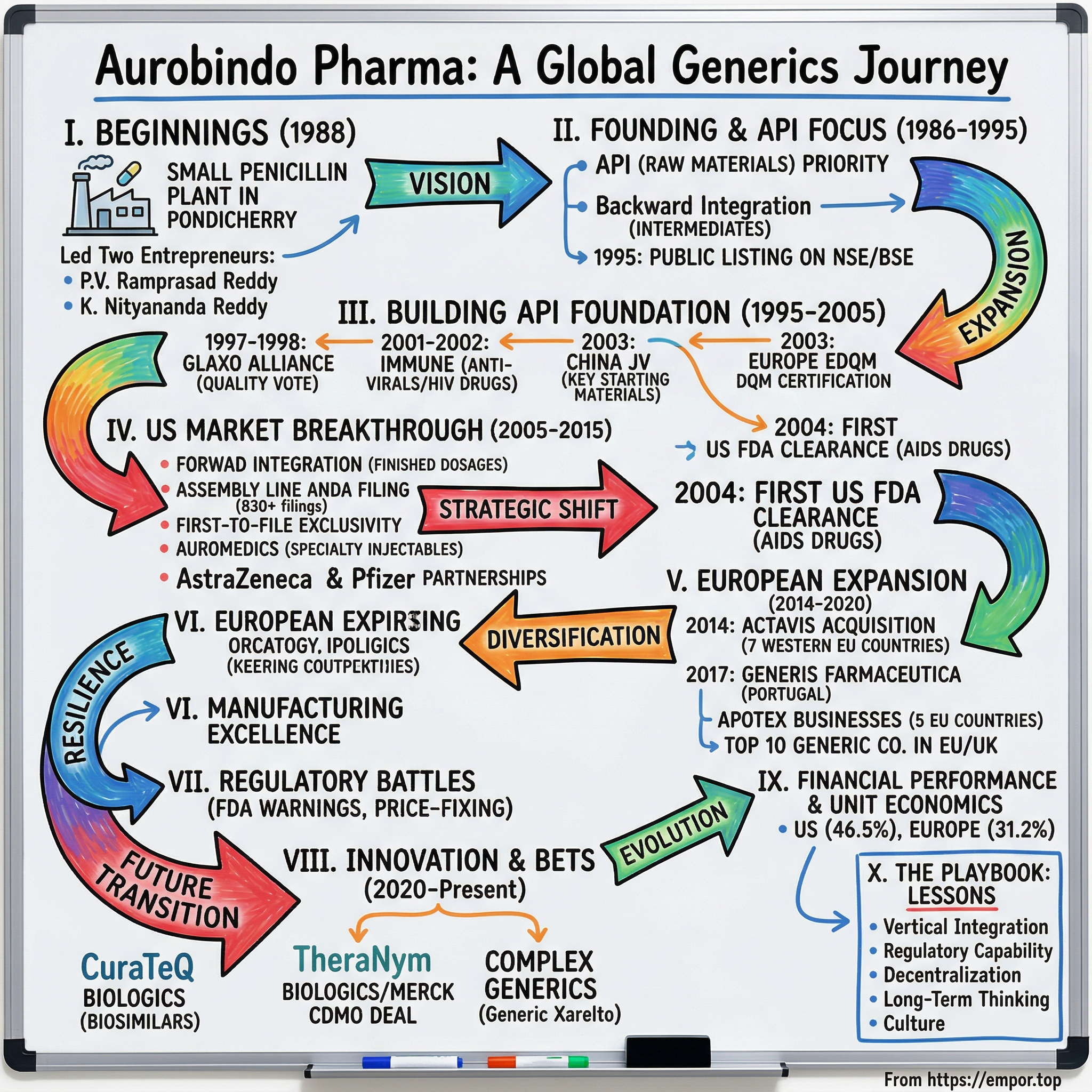
Aurobindo Pharma: The Volume Business That's Trying to Move Up-Market
I. Introduction & Episode Roadmap
Walk into any American pharmacy and look at the little amber bottles lined up behind the counter. The labels say CVS, Walgreens, Rite Aid. Almost none of them say Aurobindo. And yet, as of March 31, 2026, Aurobindo Pharma held 728 final abbreviated new drug application approvals from the US Food and Drug Administration, with another 35 tentative approvals and 125 filings still under review — a cumulative book of 888 US filings addressing a branded market that IQVIA sized at roughly $191.8 billion.1 Those approvals cover cardiovascular drugs, central nervous system drugs, antiretrovirals, oncology injectables, and a long tail of ordinary molecules that ordinary people swallow without ever wondering where they came from.
They came, quite often, from a cluster of plants in Telangana and Andhra Pradesh built by two chemists who started with a single penicillin factory in Pondicherry.
That is the strange asymmetry at the heart of this story. Aurobindo is simultaneously one of the most consequential suppliers of medicine to the United States and one of the least known. It is a company whose product is, by regulatory design, indistinguishable from its competitors' product. Its customers are not patients but a handful of enormously powerful purchasing organisations. Its pricing is not set by brand equity or clinical superiority but by who can make a pill for a fraction of a cent less than the next manufacturer.
Here is where the company sits as of August 2026. Aurobindo's market capitalisation on the NSE is roughly ₹96,000 crore — a little over $10 billion — which makes it the smallest of India's big pharmaceutical names by market value, trailing Sun Pharmaceutical at about ₹4.66 lakh crore, and sitting behind Cipla, Zydus Lifesciences, Lupin and Dr. Reddy's Laboratories, all of which cluster in the ₹1.0–1.2 lakh crore range.2 For the year ended March 31, 2026, Aurobindo reported consolidated revenue of ₹33,653 crore, up 6.1% year on year, with EBITDA of ₹6,856 crore at a 20.4% margin and net profit attributable to owners of ₹3,505 crore — essentially flat against the prior year's ₹3,486 crore.1
Flat profit on growing revenue is the number that frames everything that follows. It is the signature of a business where volume goes up and price comes down, and where the two roughly cancel.
Which brings us to the tension that animates this entire episode. Aurobindo has executed the pure-volume generics playbook about as well as anyone in the world: build the active ingredient yourself, file hundreds of applications, take the low-margin business nobody else wants, and grind. That playbook produced a top-ten global generics company from a standing start in a single Indian factory town. But the playbook is now running into its own arithmetic. US formulation revenue actually declined 2.7% in FY26 to ₹14,408 crore.1 The company's return on equity sits near 10%.3 Management's answer — stated in filing after filing and call after call — is that Aurobindo must move into categories where the barriers to entry are real: biosimilars, sterile injectables, peptides, inhalers, controlled substances.
The question this piece tries to answer is whether that pivot is credible. Not whether management says it will work — they do, consistently — but whether the evidence supports it. And the most uncomfortable evidence is this: the very plants meant to carry Aurobindo up-market are the plants the FDA keeps writing letters about.
So: how did two chemists from a single Pondicherry penicillin plant build a top-ten global generics company, and can they now build something with actual pricing power? We will start with the founding bet, which turns out to be the source of nearly all of Aurobindo's current economics. Then the US machine, the European buying spree, the compliance scars, the vertical-integration engine, the Lannett reshoring move, the biosimilar pivot, management's incentives and credibility, the financials, the industry structure, and finally what could break the case.
 Subscribe on LinkedIn
II. Origins: From a Single Penicillin Plant to a Public Company (1986–2004)
In December 1986, two men who had spent their careers in laboratories rather than boardrooms incorporated a company in Hyderabad. P.V. Ramprasad Reddy handled money and business development. K. Nityananda Reddy handled molecules and manufacturing. Around them they gathered a small group of technical professionals — technocrats, in the Indian corporate idiom of the period — and they made a bet that in retrospect looks obvious and at the time looked like a rounding error.4
The bet was that India's opportunity in pharmaceuticals was not to invent drugs, and not even, initially, to sell finished medicine. It was to make the raw chemical substance — the active pharmaceutical ingredient — cheaper than anyone else on earth.
Commercial operations began in 1988–89 at a single unit in Pondicherry making semi-synthetic penicillins.4 Understand what that meant in context. Semi-synthetic penicillins are the workhorse antibiotics of the twentieth century: amoxicillin, ampicillin, the molecules that turn a life-threatening infection into an inconvenience. They are not glamorous. They are enormously voluminous, priced by the kilogram, and won or lost on process chemistry — how many steps, how much yield, how much solvent recovery. This is a business for people who find yield optimisation genuinely interesting.
Two chemists found it genuinely interesting. Within a few years the company had become one of the largest producers in that segment globally, and had begun replicating the model across adjacent chemistries. A second unit came up at Pashamylaram near Hyderabad in the early 1990s, making bulk drug intermediates — the same industrial logic, applied one rung further up the chain.
Aurobindo listed on Indian exchanges in 1995, and the capital went where the founders' instincts pointed: more chemistry, more scale, more backward integration. Cephalosporins followed penicillins. Antivirals followed cephalosporins. In 2001–02 the company built an antiretroviral franchise aimed at the HIV/AIDS epidemic — a business with brutal economics and enormous social consequence, supplying the global procurement programmes that made triple-therapy affordable in low-income countries. That franchise still exists inside the company today, generating ₹1,384 crore of revenue in FY26 and growing 33.5% that year, a reminder that the founding logic of "make it cheaper than anyone" never actually went away.1
The other milestone from this era barely registers as news but mattered enormously: the first Certificate of Suitability from the European Directorate for the Quality of Medicines. A CEP is, in plain terms, a European regulator's written confirmation that your chemical substance is made to a standard the EU will accept in medicines sold to Europeans. It is the passport out of the low-regulation world. Once you have it for one molecule, the marginal cost of getting it for the next one falls, because the regulator has already inspected your systems, your documentation, your people. Aurobindo has since accumulated 192 such certificates and 4,436 API dossier filings globally.1
Here is why this ancient history is not a hidden-history tangent but the origin of the current investment case. Every advantage Aurobindo claims today traces to a decision made in the late 1980s. The cost position comes from making its own active ingredients rather than buying them. The supply security comes from the same place. The breadth of regulatory approvals — 5,911 formulation filings and 4,436 API dossiers as of March 2026, across US, Europe, South Africa and Canada — is the compounded output of thirty-five years of feeding paperwork into regulatory agencies.1 The company did not stumble into vertical integration as a strategy consultant's idea. It started there and never left.
What it did not build, and this is equally consequential, was a brand. Aurobindo has almost no domestic Indian branded-formulations business of consequence — domestic formulation sales were disclosed at just ₹76 crore in the fourth quarter of FY26, a rounding error against ₹8,853 crore of quarterly revenue.1 Compare that with Sun Pharma, Cipla or Mankind, all of which built franchises where an Indian doctor writes a specific company's name on a prescription pad. Aurobindo made the opposite choice: no doctors, no salesforce armies, no brand equity — just cost.
That choice defined the next chapter. Having built the cheapest chemistry in the world, the obvious question was what to do with it. The answer was to stop selling ingredients to other people's finished-dose businesses and start being the finished-dose business.
III. Building the US Generics Machine (2005–2013)
There is a particular kind of Indian pharmaceutical facility that emerged in the 2000s, and if you have ever visited one you do not forget it. Gowned operators, airlocks, differential pressure gauges on every doorway, batch records in triplicate, and somewhere in the building a room where a US Food and Drug Administration investigator will one day sit for two weeks with a laptop and an appetite for documents. Building one of these costs a fortune. Building a dozen is a strategic commitment.
Aurobindo built a dozen.
The pivot from active-ingredient exporter to US-facing finished-dose player was the single most important strategic decision in the company's history, and the logic was simple arithmetic. Selling API into someone else's tablet captured a thin slice of the value chain. Selling the tablet itself captured a much thicker one — and if you already made the API, your cost per tablet was structurally below a competitor who had to buy it.
The instrument for capturing that value was the abbreviated new drug application. An ANDA is the regulatory filing that says: this generic tablet is bioequivalent to the branded original, made in a facility you have inspected, and should therefore be substitutable at the pharmacy counter. Every ANDA costs money and time. Every approval is an option to launch. And in a market where the price of a molecule collapses as more approvals stack up behind it, the game is to have a lot of options and to be early on as many as possible.
Aurobindo chose breadth. Where some competitors pursued a smaller number of harder, higher-value filings, Aurobindo filed relentlessly across therapy areas. By March 2022 the cumulative US filing count stood at 727; by March 2026 it had reached 888, a pace of roughly forty net new filings a year even in a mature portfolio.1 Look at where those filings sit today and you see the strategy fossilised: 166 in central nervous system, 124 in cardiovascular, 64 in oncology and hormones, 49 in gastroenterology, 30 in antiretrovirals.1 This is not a portfolio built around a thesis about any single disease. It is a portfolio built around the proposition that if you can make anything cheaply, you should make everything.
Why did the model work? Because the two halves fed each other. The backward-integrated API base lowered the cost of goods for every formulation. The formulation volume, in turn, gave the API plants a captive customer that absorbed scale and kept utilisation high. Roughly half of Aurobindo's API requirement is made in-house — a proportion that gives the company both a cost advantage and a supply-security advantage over formulation-only competitors who must buy their key intermediates on the open market, very often from China.
The proof points were not just filings. Aurobindo built supply relationships with large Western pharmaceutical companies who were themselves outsourcing manufacture — the kind of business that only comes when your quality systems and your cost are both acceptable, which is a harder combination than it sounds. And in the early 2010s the company made its first move into specialty injectables through AuroMedics, its US injectables platform.
That last decision deserves more attention than it usually gets, because it was the first admission that the volume-orals model had a ceiling. Sterile injectables are harder. You cannot simply press powder into a tablet; you must fill a sterile product into a sterile container in a sterile environment, and prove that you did. The barriers to entry are correspondingly higher, which is precisely why the margins are better. AuroMedics — later folded into what became the Eugia business — was Aurobindo's earliest signal that it understood commodity oral solids alone would not sustain the company forever.
The scale of the US machine by the mid-2010s made Aurobindo one of the largest suppliers of generic prescriptions in America by volume. But volume in this industry has an uncomfortable property: it does not automatically convert into profit. The US generic market of the 2010s was consolidating on the buy side, with pharmacy benefit managers and group purchasing organisations combining into a handful of buying consortia that could tender an entire molecule to the lowest bidder. Every year, the price of an established generic went down.
Running faster on the same treadmill was not going to work indefinitely. Aurobindo needed a second geography where the pricing dynamics were less punishing — and, conveniently, the 2008 financial crisis and its long European aftermath had produced exactly the kind of distressed sellers a cost-focused Indian buyer could love.
IV. The Acquisition Era: Actavis, Generis, Apotex — Buying Distressed Western Generics (2014–2019)
Picture the boardroom of a Western generics company circa 2013. The business you built in seven European countries is subscale. National reimbursement authorities have been squeezing prices since the sovereign debt crisis. Your parent has decided that Europe is non-core. And a company you may only vaguely have heard of, headquartered in Hyderabad, is willing to take the whole thing off your hands — commercial infrastructure, staff, product registrations, marketing authorisations — for roughly the price of a mid-sized office building.
In 2014, Aurobindo acquired Actavis's commercial operations in France, Italy, Spain, Portugal, Belgium, Germany and the Netherlands for about $40.7 million.5 Read that number twice. Forty million dollars for an instant commercial footprint across the seven largest generic markets in Western Europe: salespeople, tender relationships, national regulatory dossiers, distribution.
This was the template, and Aurobindo ran it repeatedly. In January 2017 the company agreed to buy Generis Farmacêutica in Portugal from the private equity firm Magnum Capital for €135 million, a deal that came with a manufacturing plant at Amadora capable of about 1.2 billion units a year and made Aurobindo the leading generics player in that market.6 In July 2018, a step-down subsidiary agreed to acquire Apotex's commercial businesses in Poland, the Czech Republic, the Netherlands, Spain and Belgium — including a manufacturing site at Leiden — for €74 million.7
Look at the pattern rather than the individual transactions, because the pattern is the strategy. Aurobindo never bought a scarce, high-quality, competitively auctioned asset. It bought things other people had decided they no longer wanted: carve-outs, orphaned subsidiaries, private-equity portfolio companies that had run out of runway. The prices reflected that. Forty million dollars for seven-country coverage is not a valuation; it is a disposal. And critically, Aurobindo was buying commercial assets — registrations and customer relationships — that it could then feed with product from its own low-cost Indian manufacturing base. The acquired European plants were a bonus; the acquired European market access was the point.
Benchmark this against what the rest of the industry was paying in the same window and the discipline stands out. This was the era of Teva paying $40.5 billion for Allergan's generics business, of Novartis restructuring Sandoz, of Sun Pharma paying billions for Ranbaxy. Aurobindo's entire European buildout, across three major transactions, cost roughly a quarter of a billion dollars. The company was, in effect, arbitraging the difference between what Western companies would pay for growth and what distressed sellers would accept for exit.
Then came the deal that did not happen, and it is more instructive than the ones that did.
In September 2018, Aurobindo announced it would acquire Sandoz's US generic oral solids and dermatology businesses — roughly 300 products — for $900 million upfront plus up to $100 million in milestone payments. The stock jumped about 5% on the news.8 The transaction would have made Aurobindo the second-largest dermatology company in the United States across generic and branded products. It was, by an order of magnitude, the largest deal in the company's history.
It never closed. On April 2, 2020, Novartis announced a mutual agreement with Aurobindo Pharma USA to terminate the sale, because clearance from the US Federal Trade Commission had not been obtained within the anticipated timelines.9 The deal had been pending for nineteen months. As recently as that February, Aurobindo's leadership had signalled that approval was a month or two away.
Two things are worth drawing out of that episode, because both recur later. First, Aurobindo's management has a demonstrated tendency to sound more confident about regulatory timelines than the regulators turn out to be — a pattern investors should hold in mind when the same management team gives timelines for FDA filings, plant clearances and biosimilar approvals. Second, US antitrust authorities look hard at generic consolidation, and Aurobindo's scale in US orals is itself now an obstacle to further US scale. That constraint reappeared, in gentler form, in 2026.
What the acquisition era did deliver was diversification, and it was real. Aurobindo became a top-ten generics player across a swathe of European markets and pushed the share of revenue coming from outside India well past 90%. In FY26, Europe crossed the €1 billion annual revenue mark for the first time, generating ₹10,315 crore, up 23.4% year on year while US revenue shrank.10 Buying seven-country distribution for $40 million in 2014 looks, twelve years on, like one of the better capital allocation decisions in Indian pharmaceutical history.
But there was a cost, and it was not financial. Every acquired plant came with its own quality systems, its own documentation culture, its own history. Aurobindo now had dozens of manufacturing sites across multiple continents, assembled from different corporate parents, all of them needing to satisfy the same increasingly assertive regulators. The bill for that complexity arrived in instalments.
V. The Compliance Reckoning: FDA Warning Letters, Recalls, and Price-Fixing Litigation (2016–2025)
A US FDA Form 483 is a plain document. At the end of an inspection, the investigator hands the plant manager a list of observations — things seen, things not documented, things done differently from the written procedure. If the company's response satisfies the agency, the matter ends. If it does not, the facility can be classified "Official Action Indicated", and the next letter arrives on FDA letterhead with the word Warning at the top.
Aurobindo has received a great many of these documents. Understanding whether that is a scale phenomenon or a culture phenomenon is one of the two or three most important analytical questions about this company.
Start with the legal overhang, because it predates the manufacturing problems. In December 2016, a coalition of US state attorneys general filed a civil antitrust complaint alleging a coordinated conspiracy among generic manufacturers to fix prices and allocate markets across a range of medicines. The case caption is State of Connecticut, et al. v. Aurobindo Pharma USA, Inc., et al., No. 3:16-cv-02056-MPS in the District of Connecticut — Aurobindo is not merely a defendant, it is the lead-named defendant of the entire multistate action.11 That litigation has ground on for nearly a decade. As of a filing dated February 2, 2026, the court granted preliminary approval to settlements with two co-defendants, Bausch Health and Lannett Company, while proceedings against the remaining defendants — Aurobindo among them — continued.11 The Connecticut Attorney General announced those settlements as totalling $17.85 million.12 Separately, a Connecticut federal judge has set a February 2027 trial date on the states' claims regarding generic topical drugs.13
Note the irony, because it is not incidental: Lannett settled its share of the price-fixing claims in early 2026, and Aurobindo acquired Lannett later the same year. We will come back to that.
Now the manufacturing record. On June 20, 2019, the FDA issued a warning letter covering Unit XI, Aurobindo's API facility at Pydibhimavaram in Srikakulam district, Andhra Pradesh, following an inspection earlier that year.14 The substance of the citations is worth understanding in lay terms, because it recurs. The agency's complaints were not that the plant made bad medicine. They were that when the plant found something anomalous, it did not chase the anomaly far enough: failure to extend investigations to other batches that might share a defect, widening of acceptance limits on starting materials without evaluating the consequences, and invalidation of failing test results without an adequate scientific rationale.15 Translated: when a test said something was wrong, the system found reasons for the test to be wrong rather than the product. That is a quality-culture finding, not an equipment finding. The company subsequently remediated, and the FDA later closed out the matter.14
Then, in 2019, came valsartan and ranitidine. Trace amounts of probable carcinogens — NDEA and NDMA — were found in blood-pressure and heartburn drugs, triggering waves of recalls that swept across the entire generics industry. Aurobindo was one of many manufacturers affected; this was a chemistry problem endemic to particular synthetic routes rather than a failure unique to any one company. But it damaged the industry's credibility with US regulators and the public at precisely the moment that scrutiny of foreign manufacturing was intensifying.
Here is where the story stops being history. In August 2024, Aurobindo disclosed that its wholly owned subsidiary Eugia Pharma Specialities had received a warning letter for Unit-III at Pashamylaram in Telangana, following an inspection conducted between January 22 and February 2, 2024 that had already resulted in an Official Action Indicated classification.1617 The plant makes sterile injectables. The FDA's citations included operators failing to adequately follow written procedures for aseptic behaviour and interventions on restricted-access barrier filling lines.18 In sterile manufacturing, "aseptic behaviour" means how a human being moves inside a space that must contain no living organisms. It is the single most consequential variable in injectable manufacturing, because a contaminated tablet may fail; a contaminated injection can kill.
The company told exchanges the letter would have no impact on existing US supply.17 The stock fell about 6% anyway.
Then, in April 2025, Aurobindo disclosed that the FDA had issued a Form 483 with 11 observations at the Raleigh, North Carolina facility operated by its subsidiary Aurolife Pharma, following an inspection from March 24 to April 10, 2025.19 That plant makes inhalers and dermatology products. The company characterised the observations as procedural and said it would respond within the required timeline.20
And then the finding that should genuinely trouble anyone underwriting the up-market thesis. Following a fresh inspection of Eugia Unit-III between January 27 and February 6, 2026 — the same facility, roughly two years after the last one — the FDA issued 11 observations and, in June 2026, classified the site Official Action Indicated once again.21 An OAI classification generally means the agency will withhold approval of pending applications from that site until the issues are resolved, a process that typically runs twelve to eighteen months through remediation and re-inspection. Aurobindo again stated there was no impact on financials or operations.
Let us be precise about what this does and does not prove. It does not prove that Aurobindo's medicines are unsafe; no product recall or patient-harm finding has been tied to these classifications. Running twenty-nine-plus facilities under continuous global inspection guarantees some volume of adverse findings, and every large generic manufacturer, Indian or otherwise, collects them. The Pydibhimavaram matter shows the company can remediate to the FDA's satisfaction when it commits to doing so.
But the pattern at Eugia specifically is the problem. Aurobindo's entire argument for a higher valuation multiple rests on migrating from commodity tablets into sterile injectables, biosimilars and inhalation products — categories where the barrier to entry is the quality system. If the barrier that protects your margin is the same barrier you keep tripping over, you cannot claim it as a moat and dismiss it as a footnote in the same breath. A repeat OAI at the flagship injectables site, two years after a warning letter at the same site, is a direct challenge to the credibility of the strategy, not a compliance side-issue.
The reasonable investor position is therefore neither panic nor dismissal. It is to treat FDA inspection outcomes at the injectables and inhalation sites as a leading indicator of whether the value-mix pivot is real — and to note that as of this writing, the indicator is flashing the wrong colour.
Which raises the fair counter-question: if the quality record is patchy, what exactly is Aurobindo good at? The answer is chemistry and cost, and that is worth examining properly.
VI. Manufacturing Scale & the Economics of Vertical Integration
Drive along the coastal highway in East Godavari district, Andhra Pradesh, and somewhere near Kakinada you pass a special economic zone that did not exist a few years ago. Inside it sits a fermentation complex — enormous steel tanks, cooling towers, a dedicated glucose plant — that represents roughly ₹2,400 crore of Aurobindo's capital and a specific bet about the geopolitics of medicine.22
The plant makes Penicillin-G.
To understand why that matters, you need one piece of chemistry explained plainly. Nearly every common antibiotic in the penicillin family — amoxicillin, ampicillin, the cephalosporins — descends from a single fermentation product called Penicillin-G, which is grown in vats by mould, then chemically cleaved into a building block called 6-APA, which is then elaborated into the finished drug substance. Think of it as flour. You can bake a great many different breads, but if you do not control the flour, someone else controls your kitchen.
For roughly two decades, essentially all the world's flour came from China. Chinese fermentation capacity, built at enormous scale with cheap power, drove global Penicillin-G prices so low that Indian producers — Aurobindo included — shut their own fermentation plants and simply bought. That was rational until it was terrifying. When supply chains seized during the pandemic and geopolitical tension made Chinese dependence a strategic liability, the Indian government responded with a Production-Linked Incentive scheme specifically designed to rebuild domestic capacity in key starting materials and APIs.
Aurobindo took the incentive and built. In April 2024, the company commissioned four facilities in Andhra Pradesh through wholly owned subsidiaries: the Penicillin-G plant at the Kakinada SEZ with capacity of 15,000 tonnes a year alongside 180,000 tonnes of glucose, a 6-APA plant with 3,600 tonnes of annual capacity, plus injectables and granulation units.22 On the Q1 FY27 call, management indicated the Pen-G plant was running at a maintained level of roughly 800–900 tonnes and discussed the associated PLI benefits.23
That last detail is the honest one. A 15,000-tonne nameplate running at a few hundred tonnes a quarter is a plant still climbing its learning curve, and fermentation is notoriously unforgiving — yields depend on the biology behaving, and biology does not read the business plan. This is a strategic asset whose economics remain unproven. Whether it earns its ₹2,400 crore depends on sustained utilisation, on the PLI subsidy that partly underwrites it, and on Chinese producers not simply cutting price to reclaim the market. Investors should treat Kakinada as an option on supply-chain security rather than as a margin engine that has already delivered.
The broader integration story is more established. Aurobindo operates more than 29 commercial manufacturing and packaging facilities worldwide, with approvals from the USFDA, UK MHRA, EDQM, Japan's PMDA, Health Canada, South Africa's regulator and Brazil's ANVISA, selling into over 150 countries and supported by nine R&D centres — five in India, four in the United States — staffed by more than 1,500 scientists.24
The breadth of those regulatory approvals is an underappreciated asset, and it is worth being specific about the mechanism rather than waving at "regulatory moat". Each national approval is a sunk cost that a competitor must also incur to compete for the same tender. When a European health system tenders a molecule, only companies with a valid national marketing authorisation can bid. Aurobindo's 4,344 European formulation registrations and 282 Canadian registrations as of March 2026 are, functionally, a very large number of tickets to a very large number of auctions.1 That is not pricing power — it does not let Aurobindo charge more. It is access power: it lets Aurobindo show up everywhere, which in a fragmented tender market is worth real money.
Where does that leave Aurobindo against peers? Sun Pharma is roughly five times its market value and competes on a fundamentally different basis — specialty branded products in the US, a dominant Indian branded franchise, a research pipeline.2 Cipla and Lupin carry stronger domestic brand businesses and, in Lupin's case, a deliberate complex-generics focus. Dr. Reddy's has historically been the most aggressive at first-to-file US opportunities. Globally, Teva, Viatris and Sandoz have scale but carry legacy debt and restructuring burdens.
Aurobindo occupies a distinct position in that set: it is the cost-and-volume operator. It does not win because doctors ask for its name or because it holds a patent. It wins because it can make a molecule cheaply and register it everywhere. The market prices it accordingly — with the lowest market capitalisation of the big Indian names despite a very large revenue base, and a return on equity around 10%, which is a modest return for a company carrying this much manufacturing capital.3
That last figure deserves a plain-English translation, because it is the crux of the bear case. A 10% return on equity means that for every hundred rupees of shareholder capital tied up in plants, inventory and receivables, the business generates about ten rupees of profit a year. That is not destruction of value, but it is not far above what the capital costs in India. It tells you that the vertical integration which delivers a cost advantage has not yet delivered a superior return — because integration is capital-hungry, and the savings largely get competed away in the price of the tablet.
The pandemic did offer a genuine stress test of the model, and Aurobindo's integrated supply chain held up better than the industry average precisely because it was less dependent on external sourcing at the moment external sourcing broke. That is a real datapoint in integration's favour. But an insurance policy that pays out once a decade is not the same as a margin engine that pays out every quarter.
If the cost model alone cannot lift returns, the company needs either better categories or a different geography. In 2025, Aurobindo went after both at once — by buying an American factory.
VII. The Reshoring Move: Acquiring Lannett and the US Manufacturing Bet (2025–2026)
Seymour, Indiana is a town of about twenty thousand people in the southern part of the state, best known outside the region as John Mellencamp's hometown. On its outskirts sits a 425,000 square foot pharmaceutical plant capable of producing roughly 3.6 billion tablets a year.25 For most of the last decade that plant belonged to Lannett Company, a Pennsylvania generics maker founded in 1942 that had spent recent years in serious financial distress.
In 2025, Aurobindo Pharma USA agreed to buy it — and the rest of Lannett — for $250 million on a cash-free, debt-free basis, roughly ₹2,185 crore.25
The price is the first thing worth interrogating. Lannett's trailing revenue was around $306 million with anticipated EBITDA margins near 15%, which puts the transaction at roughly 0.8 times revenue and about 5.5 times EBITDA.26 Set that against the multiples paid in adjacent pharmaceutical-services M&A in the same era — Novo's acquisition of Catalent at roughly 23 times EBITDA, Vista's take-private of Model N at around 25 times — and the gap is not subtle.26
Cheap assets are cheap for reasons. Lannett's reasons included a distressed financial history and a legal one: as established earlier, Lannett was a settling defendant in the multistate generic price-fixing litigation in which Aurobindo remains a defendant. Aurobindo therefore bought, at a distressed multiple, a business carrying exactly the two categories of baggage — financial fragility and antitrust history — that make a buyer's diligence file thick. Whether 5.5 times is a bargain or a fair price for damaged goods is genuinely arguable, and the answer arrives over the next three years, not now.
The strategic case, though, is the most interesting thing Aurobindo has done in a decade, and it turns on two words: tariffs and ADHD.
Start with tariffs. For thirty years the entire logic of Indian generics rested on an implicit assumption: that a pill made in Hyderabad could cross into the United States on essentially the same commercial terms as a pill made in New Jersey. American drug-supply-security policy has been steadily eroding that assumption, with pharmaceutical tariffs moving from a talking point to a live planning variable. If the cost of importing finished doses rises, an Indian manufacturer's structural cost advantage narrows — or, in the worst case, inverts.
A 425,000 square foot American plant is a hedge against that. And crucially, it is an underutilised American plant. On the Q1 FY27 call, Aurobindo Pharma USA's leadership described the Seymour facility as running at about 40% utilisation with a target of reaching a "decent level" within twelve months, and framed the spare capacity as the principal attraction: it lets Aurobindo bring across products from its own portfolio that were previously uncommercialisable in the US.23
That framing is worth pausing on because it reveals the real arithmetic of the deal. Aurobindo did not primarily buy Lannett's revenue. It bought empty American capacity into which it can pour molecules it already owns, converting a fixed-cost problem for the seller into a variable-cost solution for the buyer. If it works, the incremental economics are far better than the headline 5.5x multiple suggests, because the acquired plant's marginal tablet carries no development cost and no new regulatory filing burden.
Then there is ADHD. Lannett's portfolio is weighted toward complex generics and controlled substances, particularly non-opioid attention-deficit/hyperactivity disorder treatments, alongside liquid formulations.25 Aurobindo had no meaningful presence in the ADHD category before this deal. Controlled substances are structurally different from ordinary generics: the US Drug Enforcement Administration allocates annual quotas of the controlled active ingredient among manufacturers, which caps how much anyone can make. A category with a regulatory ceiling on supply behaves very differently from one where any approved manufacturer can flood the market — and the American ADHD medicine shortages of recent years demonstrated exactly how differently.
This is, in other words, the first business Aurobindo has bought where pricing is not purely a race to the bottom. Whether the company can actually harvest that advantage — quota allocations are neither generous nor guaranteed — is unproven, but the strategic direction is coherent.
The regulatory path was not entirely smooth. To satisfy antitrust concerns, the Federal Trade Commission required Aurobindo to divest four overlapping generic products — mycophenolate mofetil, pilocarpine, rabeprazole and niacin extended-release tablets — which went to Quagen Pharmaceuticals.27 Clearance came in June 2026, and the transaction moved into operational integration at the end of that month; the company disclosed cash outflow of about $247 million against the acquisition.2823
Set this deal against the decade that preceded it and the shift is stark. From 2014 to 2018, Aurobindo bought European commercial infrastructure to distribute Indian-made product. In 2025–26, it bought American manufacturing infrastructure to make product locally. The first strategy was about widening the market for a low-cost Indian factory. The second is a partial admission that the low-cost Indian factory may not always be the right place to make things for America.
What could go wrong is not hard to enumerate. Integrating an American plant with its own quality history into a company already managing an OAI classification at its flagship injectables site adds compliance surface area, not less. Synergies described on a call as visible "within nine months" through SG&A rationalisation and procurement leverage are the easiest kind of synergy to promise and among the harder to verify from outside.23 And a 40%-utilised plant is only a bargain if the utilisation actually rises.
Still, Lannett is the clearest signal yet that management understands the old playbook has limits. The larger, more expensive expression of that understanding is the biosimilar business.
VIII. The Pivot to Value: Biosimilars, Injectables, and Complex Generics (2020–Present)
Here is the difference between a generic and a biosimilar, in the simplest terms available.
A generic small-molecule drug is a chemical compound. Aspirin is aspirin — you can specify it exactly, make it in a reactor, and prove it is identical. A biologic is a protein grown inside living cells, and it is enormously more complex: think of it as the difference between manufacturing a bicycle and breeding a racehorse. You cannot make an identical copy of a living system's product. You can only make one so similar that regulators accept it behaves the same in patients — hence "biosimilar", not "generic". Getting there requires cell-line development, bioreactors, purification trains, and clinical trials in actual human beings.
That is why biosimilars have barriers to entry that oral generics do not. It is also why they are expensive, slow, and a genuinely different capability from anything that built Aurobindo.
The strategic logic management states is straightforward and, as far as it goes, correct: commodity oral generics face structural, permanent price erosion, and the only durable defence is to move into categories where a competitor cannot simply file an application and show up. Hence the investment in biosimilars, sterile injectables, peptides, inhalers, depot injections and patches.
The vehicle for biosimilars is CuraTeQ Biologics. As of the FY26 year-end disclosures, CuraTeQ had approvals in regulated markets for pegfilgrastim (Dyrupeg), filgrastim (Zefylti), bevacizumab (Bevqolva) and trastuzumab (Dazublys) across the European Economic Area, the UK and Canada in various combinations, with launches underway in the UK and supplies initiated into France, Portugal and Germany.1 In March 2026, CuraTeQ executed a licensing and distribution agreement with STADA Arzneimittel covering two EMA-approved biosimilars in select EU territories including France and Germany.129 Phase 3 studies for a denosumab biosimilar and for omalizumab — a competitor to Xolair, studied in chronic spontaneous urticaria — met their primary endpoints, with EMA and FDA filings planned during 2026.1 On the Q1 FY27 call, management said three US filings were expected within a quarter and that four approvals had been secured in the EU and UK.23
Now the honest sizing, which management to its credit does not entirely dodge. CuraTeQ's biosimilars business is not yet material to consolidated results. Aurobindo does not disclose it as a reporting segment with its own revenue line, and the leader of the biosimilars business described European commercialisation on the Q1 FY27 call as a "modest, steady, and measured start" reflecting the transition from development to commercial stage.23 That is unusually candid language for an investor call, and it is the right language. Four approved products supplying a handful of European countries through partners does not move a ₹33,653 crore revenue base.
The company's own long-range framing is that a portfolio of fifteen products should sustain CuraTeQ's trajectory through 2030 and beyond, targeting seven to eight marketed products in the EU, UK and Canada and at least three in the US by then.1 Investors should treat that as a statement of ambition backed by real regulatory progress — the approvals and Phase 3 readouts are facts, not slideware — but with essentially no revenue evidence yet attached.
The contract-manufacturing arm, TheraNym Biologics, is even earlier and even more explicitly a long-dated option. TheraNym's relationship with Merck Sharp & Dohme dates to May 2024, and by FY26 the parties had executed an additional product schedule under which TheraNym will build, operate and supply drug substance to MSD, including a dedicated greenfield facility.1 Unit 1 is a 60,000-litre integrated mammalian cell culture facility whose commissioning was to be completed by end-2026; Unit 2 will add another 60,000 litres and is estimated to require about $150–175 million of capital expenditure.1 Management's guidance on the Q1 FY27 call placed Unit 1 revenue beginning in 2028 with steady state from that year, Unit 2 commissioned by end-2029 with revenue from 2031, and a combined 2032 target of $150–200 million at 35–50% EBITDA margins.23
Read those dates carefully. An investor buying Aurobindo today for the CDMO story is underwriting cash flows that begin two years from now and reach the stated ambition six years from now, funded by capital spent in the interim. That can be a perfectly good investment. It is not, however, a claim that can be validated or falsified for several years — which is precisely why it should be sized in a valuation as optionality rather than as earnings.
Eugia sits in an awkward middle position. Sterile injectables and oncology are the categories where Aurobindo has actual commercial scale in a higher-barrier segment today, with 145 ANDAs filed from Eugia Unit-III alone and a substantial injectables and ophthalmics portfolio.1 This is the vertical that is supposed to carry margin expansion in the near term rather than in 2030. And it is precisely the vertical operating under a repeat OAI classification that suspends new approvals from that site.
That is not a coincidence to be smoothed over; it is the central contradiction of the current equity story. The nearer-term, more credible piece of the up-market pivot is impaired by compliance. The compliance-clean pieces — CuraTeQ, TheraNym — are years from mattering financially.
The most defensible near-term margin upside is therefore the least glamorous: complex generics off the existing platform. Products like generic rivaroxaban, complex oral formulations, ophthalmics and inhalation products offer better economics than commodity tablets without requiring Aurobindo to become a biotech company. Gross margin moving from 58.9% in FY25 to 59.9% in FY26, and to 60.4% in the June 2026 quarter, is consistent with mix shift of exactly this kind — modest, grinding, real.123
The pivot, then, is best described as genuine, expensive, early, and partially self-sabotaged. Whether it succeeds depends heavily on the people allocating the capital, which is where we turn next.
IX. Current Management: Incentives, Capital Allocation, and Succession
Forty years after they incorporated a company to make penicillin in Pondicherry, the founders still own it.
As of March 2026, the promoter and promoter group held 30,09,48,721 shares, or 51.82% of Aurobindo Pharma's share capital.30 K. Nityananda Reddy serves as Vice Chairman and Managing Director. P.V. Ramprasad Reddy remains a promoter and, through family entities, the largest economic holder: RPR Sons Advisors Private Limited together with P. Suneela Rani hold 19,45,61,357 shares, about 33.50% of the company.30 That structure traces to January 2017, when Suneela Rani transferred her entire holding — then about 33.56% of the company — into RPR Sons Advisors, a trustee company for a family trust established by Reddy.31
A majority promoter holding is a genuine alignment fact and deserves to be treated as one. When founders own half the equity, they eat their own capital allocation. It also, however, means minority shareholders have essentially no mechanism to force change, and that governance quality depends on the family's judgment rather than on any external check. Both things are true simultaneously.
Succession is the visible unresolved question. Ramprasad Reddy has two sons, Sharath and Rohit, and reporting has indicated succession planning has been in progress for several years without a fully settled public outcome.31 Second-generation family members are already active within the promoter group. For a company whose entire operating identity was built by two founder-operators with deep technical expertise, the transition to a next generation — or to professional management — is a real variable, and one where the disclosure available to outside investors is thin. This is a governance item to monitor, not yet a problem to price.
Now the more testable question: what has this management actually done with capital, and does its record support the guidance it gives?
The capital allocation pattern is consistent and easy to describe. Aurobindo reinvests. It has poured money into backward integration at Kakinada, into biologics capacity at CuraTeQ and TheraNym, and into a long sequence of bolt-on acquisitions — European carve-outs through the 2010s, the Khandelwal Laboratories non-oncology business for about $32 million in FY26, Lannett in 2026, and an agreement to acquire the contract research organisation AAVON BIOCAM with around ₹100 crore of current revenue and an ambition to scale it several-fold.123
Against that, shareholder returns have historically been modest — dividend yield sits well under half a percent — though FY26 brought a change of emphasis.3 On April 6, 2026, the board approved a buyback of up to 54,23,728 shares at ₹1,475 each, totalling ₹800 crore, or roughly 0.93% of paid-up equity, executed through a tender offer that closed at the end of that month.32 Combined with dividends, the Q1 FY27 disclosures showed $65 million of dividends and $85 million of buyback alongside the $247 million Lannett payment, leaving a net cash position of about $42 million as of June 30, 2026.23
An activist would push on three things here, and the pushes are fair.
First, portfolio complexity. Aurobindo now runs commodity orals, APIs, fermentation, injectables, ophthalmics, inhalation, dermatology, antiretrovirals, biosimilars, a biologics CDMO, a CRO, and — as of July 2026 — a captive solar power stake acquired through Swarnaakshu Solar Power.33 Some of that is coherent vertical logic. Some of it looks like a conglomerate accreting adjacencies. When a company earning roughly 10% on equity keeps adding businesses, the burden of proof that each one clears its cost of capital sits with management, and Aurobindo's segment disclosure does not make that easy to verify from outside. Biosimilars, CDMO and the Pen-G complex are not broken out with their own profitability.
Second, the gap between reinvestment and returns. A decade of acquisitions and capital projects has produced revenue growth but not, so far, a step-change in return on capital. The FY26 result — 6.1% revenue growth, 0.5% net profit growth, EBITDA margin down 45 basis points to 20.4% — is the cleanest expression of that problem.1
Third, guidance discipline. For FY27, management has guided to double-digit consolidated revenue growth, EBITDA margin north of 21%, and absolute EBITDA above ₹8,000 crore, reaffirmed on the Q1 FY27 call along with a target quarterly EBITDA run rate of ₹2,200 crore, caveated on clarity around Middle East geopolitics.23 Test that against recent history. FY26 delivered ₹6,856 crore of EBITDA at 20.4%.1 Getting to ₹8,000 crore requires roughly 17% growth in EBITDA in a year when the US business shrank. The first quarter delivered ₹1,924 crore at a 21.0% margin — annualising to about ₹7,700 crore, below the guided figure, meaning the back half of the year has to accelerate.23
Is the guidance therefore implausible? Not necessarily — Lannett was only partially in the base, Europe is compounding at over 20%, and biosimilar supplies are ramping. But it is demanding, and it is worth noting the pattern from earlier in this piece: this is the same management team that told investors FTC approval of the Sandoz transaction was weeks away shortly before the deal collapsed.
On candour about misses, the record is mixed rather than evasive. When Q1 FY26 profit fell 10% year on year to ₹824 crore, the explanation offered was US pricing pressure and API softness — accurate as far as it goes, and consistent with the segment data, but also the kind of catch-all attribution that does not distinguish between market conditions and share loss.34 The more useful signal is that management does not hide the weak parts. Describing biosimilar commercialisation as "modest, steady, and measured" rather than transformational, and putting CDMO revenue explicitly in 2028 rather than implying nearer-term contribution, are both examples of a management team declining an easy exaggeration.23
The credibility test that matters most, though, is the one identified at the end of Section V: is the narrative on Eugia's FDA problems consistent with the pace of the growth messaging? Here there is a genuine gap. The standard corporate formulation — no impact on operations, no impact on financials — has now been used for a warning letter and a subsequent repeat OAI at the same site, while the same disclosures describe injectables as a growth engine. Both statements cannot be equally weighted. A site under OAI cannot get new approvals; that is, definitionally, an impact on future growth from that site.
Numbers ultimately arbitrate these arguments, so let us look at them properly.
X. Financial Performance & Unit Economics
The most revealing thing about Aurobindo's financial statements is not any single line. It is the divergence between two of them.
Revenue has compounded steadily: ₹24,855 crore in FY23, ₹29,002 crore in FY24, ₹31,724 crore in FY25, and ₹33,653 crore in FY26. Profit has not: net profit attributable to owners was ₹3,486 crore in FY25 and ₹3,505 crore in FY26, growth of half a percent.1 Four years of top-line expansion, and the bottom line has been broadly stationary for two.
The explanation lives in the geographic mix, and it is a genuinely interesting story about where the generics business is going.
The United States — long the profit engine of every Indian generics exporter — is shrinking for Aurobindo. FY26 US revenue was ₹14,408 crore, down 2.7% year on year, and by the March 2026 quarter the US had fallen to 40.0% of consolidated revenue from a historically much higher share.1 In dollar terms, quarterly US formulation revenue moved from $470 million in Q4 FY25 to $387 million in Q4 FY26.1 The company attributed the sequential decline to seasonality and lower transient product sales — industry shorthand for one-off opportunities like a competitor's supply failure that temporarily lifts price — and said the base business remained stable.1
That explanation is plausible and partially verifiable: Aurobindo received nine ANDA approvals and launched twelve products in the US in that quarter alone, so the pipeline is still feeding the machine.1 But strip away the framing and the conclusion is uncomfortable: in the world's largest pharmaceutical market, with the industry's broadest approval portfolio, Aurobindo could not grow. That is what structural price erosion looks like when you meet it head-on. New launches replace price lost on old products, and you run to stand still.
Europe is doing the opposite. FY26 European revenue reached ₹10,315 crore, up 23.4%, crossing €1 billion for the first time, with the March quarter alone up 30.2% year on year.110 Why does Europe grow while the US shrinks? Two structural reasons, both traceable to decisions described earlier. Europe is not one market but many, each with its own tender cycle, reimbursement regime and registration requirement — which fragments competition and means a given molecule typically faces fewer well-capitalised bidders than the same molecule in a US national tender. And Aurobindo bought its way into the commercial infrastructure to bid in all of them, cheaply, a decade ago. The European acquisitions of 2014–2018 are, in effect, paying their return now.
Growth Markets — the rest of the world outside the US and Europe — added ₹3,499 crore in FY26, up 10.0%, and accelerated sharply into FY27.1 Antiretrovirals grew 33.5% to ₹1,384 crore.1 The API business, meanwhile, declined 6.4% to ₹4,047 crore, dragged by a 12.1% fall in beta-lactam APIs even as non-beta-lactam APIs grew 8.7%.1 That divergence inside the API segment is worth flagging: beta-lactams are precisely the penicillin-derived antibiotics that the Kakinada complex is designed to supply, and they were the weak half of the segment in FY26.
The margin story is more encouraging than the profit story, and the mechanism matters more than the number. Gross margin — revenue minus cost of materials — rose from 58.9% in FY25 to 59.9% in FY26 and reached 60.4% in the June 2026 quarter.123 That improvement is what mix shift looks like: more Europe, more complex products, more in-house API, less exposure to the most commoditised US tenders. It is evidence, modest but real, that the up-market strategy is doing something.
Below the gross line, though, the improvement gets consumed. Overheads rose 10.1% in FY26 against 6.1% revenue growth, which is why EBITDA margin fell 45 basis points to 20.4% despite the gross margin gain.1 Depreciation climbed 7.8% to ₹1,778 crore — the cost of all that new capacity at Kakinada, CuraTeQ and TheraNym showing up in the profit and loss account before the associated revenue does.1 This is the classic profile of a company in a capital-deployment phase: the assets are on the balance sheet and in the depreciation line, and the returns are somewhere in the future.
The balance sheet, at least, gives management room to keep going. Gross debt stood at ₹7,673 crore as of March 2026 against cash and investments of ₹10,676 crore, leaving net cash of ₹3,002 crore, or about $317 million.1 Finance cost fell to 5.0% from 5.5%. After paying for Lannett and the buyback, the company still reported a net cash position of about $42 million at end-June 2026 with a debt-to-equity ratio of 0.34.23 For a company simultaneously building a Penicillin-G complex, two biologics manufacturing units, and buying an American factory, that is a conservatively financed position — a real point in management's favour, and one that meaningfully reduces the refinancing risk that has crippled leveraged peers like Teva and Viatris.
The first quarter of FY27 showed what happens when acquisition revenue arrives. Revenue rose 16% to ₹9,150 crore, EBITDA reached ₹1,924 crore at 21.0%, and profit after tax rose about 25% to ₹1,032 crore, with the US business up 8.1% to $399 million, Europe up 11% in constant currency to €267 million, and Growth Markets up 38% to ₹1,063 crore.2335
That is a genuinely strong quarter. It is also, and this needs saying plainly, not a clean organic comparison. Lannett contributed for the first time. R&D ran at ₹350 crore, about 4% of sales, down from 4.5% in the prior-year fourth quarter as Phase 3 biosimilar spending rolled off — a tailwind to margins that is real but not repeatable indefinitely.123 And the effective tax rate of 31.9% was flagged as expected to normalise toward 28–29%.23 Investors should therefore separate the acquisition-driven step-up in reported growth from the underlying trajectory, which remains a business where the US drags, Europe carries, and margins improve slowly.
On valuation, Aurobindo trades at roughly 25 times trailing earnings against a book value per share of ₹652.3 Whether that constitutes a discount to Indian pharmaceutical peers is a question the market answers daily, and this piece will not offer a verdict. What is analytically defensible is the reason a discount would exist: a return on equity around 10%, a shrinking US business, an unresolved compliance issue at the flagship growth vertical, and a growth story whose payoffs land in 2028 and beyond. Whether those factors are correctly weighted is the entire debate.
To weigh them properly, it helps to step back from the company and look at the industry it is trapped in.
XI. Industry Structure, Powers, and the Playbook
If you wanted to design the least attractive industry structure in modern business, you could do worse than the US generic drug market.
Run Porter's five forces across it. Buyer power is extraordinary: three pharmacy benefit managers control the overwhelming majority of US prescription volume, and generic purchasing consolidates further into a small number of buying consortia that can tender an entire molecule to a single winner. Supplier power is meaningful and rising, particularly for key starting materials historically concentrated in China. Threat of substitution is total, because that is the legal point of a generic — the pharmacist may substitute any approved equivalent without asking anyone. Threat of new entry is high by design, since the ANDA pathway exists specifically to make entry easy. And rivalry among existing competitors is intense, because the products are legally interchangeable and price is the only variable.
Every one of those forces points the same direction: toward zero economic profit. This is not an Aurobindo problem. It is the reason Teva carries the scars it does, why Viatris was assembled from the wreckage of Mylan and Upjohn, why Novartis spun Sandoz out entirely, and why generic drug pricing in the United States has deflated for the better part of fifteen years.
So where, if anywhere, does Aurobindo have a power in Hamilton Helmer's sense — an advantage that persists because competitors cannot or will not replicate it?
Scale economies are the strongest candidate, and they are real but bounded. Aurobindo's backward integration into APIs lowers unit cost in a way a formulation-only competitor cannot match without spending years and a great deal of capital building fermentation and synthesis capacity. Chinese producers can match the chemistry but face a growing policy headwind in Western markets. Indian formulation-only competitors face the reverse problem. The bound on this power is that the savings are largely competed away in tender pricing — which is exactly what a 10% return on equity is telling us.
Switching costs exist in a weak, technical form. Once a customer qualifies a supplier's product into their supply chain, and once a manufacturer holds a national marketing authorisation, there is friction in changing. But it is friction, not lock-in. A US buying consortium switches suppliers on price at the next tender without sentiment.
Cornered resource applies narrowly and only in the newest business. DEA quota allocations for controlled substances — the ADHD category acquired with Lannett — are genuinely rationed by a government agency, which is the closest thing to a cornered resource in this story. That is one reason the Lannett deal is strategically more interesting than its size suggests.
Counter-positioning — the power that comes from a business model incumbents cannot copy without damaging themselves — is essentially absent. Aurobindo does the same thing as its competitors, more cheaply.
Branding is absent by construction. Network economies do not apply. Process power is the interesting maybe: thirty-five years of chemistry know-how in penicillin derivatives is genuine accumulated capability. But process power requires consistent execution to count as a moat, and the recurring FDA findings at sterile sites argue that Aurobindo's process excellence is stronger in chemistry than in the aseptic disciplines its next decade depends on.
The playbook, distilled: use vertical integration to be the low-cost producer in a commoditised industry; buy distressed and carved-out assets rather than paying full price for growth; use breadth of regulatory approvals as a market-access wedge into fragmented tender markets; accept that running dozens of plants under continuous global inspection will generate regulatory friction, and manage that friction rather than trying to eliminate it.
It is a coherent playbook. It built a $10 billion company from nothing. And it has now taken the company as far as it can go, which is why the final element matters most: the playbook is being asked, for the first time, to do something it was never designed to do.
Biosimilars require clinical development — running trials in patients, generating immunogenicity data, defending a dossier before EMA and FDA scientific committees. Contract manufacturing for a company like MSD requires being audited by a customer whose reputation depends on your quality systems, continuously, with no tolerance for the kind of findings Eugia has collected. Controlled substances require managing a DEA relationship. None of these are volume-manufacturing problems. They are capability problems, and capability is exactly what cannot be bought at a 5.5x EBITDA multiple.
That is the real question in front of Aurobindo, and it resolves into a fairly clean set of arguments on either side.
XII. Bear vs. Bull Case
The Bull Case
The cost position is real and hard to replicate quickly. Making roughly half your own active ingredients, with fermentation capacity onshore in India and a thirty-five-year accumulation of process chemistry, is not something a competitor decides to do in a planning cycle. It requires years and billions of rupees, as Kakinada demonstrates. In an industry where price is the only competitive variable, being structurally cheaper is the closest thing to a durable advantage available.
Geographic diversification is working, measurably. Europe growing 23.4% to over €1 billion while the US declined 2.7% is not a narrative; it is the FY26 segment disclosure.1 A company that a decade ago was a leveraged bet on US generic pricing now derives a rapidly rising share of revenue from a market with more fragmented competition and better volume-price dynamics. Growth Markets accelerating to 38% growth in the June quarter extends the same logic further.23
Lannett is strategically well-conceived and cheaply bought. A 5.5x EBITDA multiple for underutilised American manufacturing capacity, entry into a quota-constrained therapeutic category, and a hedge against pharmaceutical tariffs is a rational use of $250 million by a company holding net cash.26 If utilisation moves from 40% toward normal, the incremental economics improve materially.
The higher-value pipeline has concrete proof points, not just slides. Four biosimilars approved across the EEA, UK and Canada; two Phase 3 programmes meeting primary endpoints; a distribution agreement with an established European generics company; an executed additional product schedule with MSD for biologics contract manufacturing.1 These are verifiable regulatory and commercial events. Companies that fail at biosimilars usually fail before this point.
The launch machine still runs. 728 approved ANDAs and a steady cadence of new approvals and launches — nine approvals and twelve launches in the March quarter alone — generate revenue even if none of the new strategic bets pay off.1 There is a floor under this business.
The balance sheet buys time. Net cash, debt-to-equity of 0.34, and falling finance costs mean Aurobindo can fund a multi-year capability build without the refinancing pressure that has forced peers into distressed asset sales.123
The Bear Case
The compliance record undermines the entire thesis. This is the strongest bear argument and it deserves to be stated bluntly. Aurobindo's plan is to move into categories whose defining characteristic is a high quality bar. Its flagship sterile injectables site received a warning letter in 2024 and was classified Official Action Indicated again in June 2026 after a fresh inspection, and its North Carolina inhalation and dermatology plant received an eleven-observation Form 483 in 2025.172119 An OAI classification typically suspends new approvals from that site for twelve to eighteen months. You cannot simultaneously claim that quality barriers protect your future margins and that quality failures do not affect your business.
US dependence remains large and structurally deflating. The US was still 40% of consolidated revenue in the March 2026 quarter and it declined for the year.1 Aurobindo has no branded franchise, no patent protection and no meaningful differentiation with which to resist PBM and GPO pricing power.
The antitrust tail is unresolved and Aurobindo is the named lead defendant. Nearly ten years after the multistate complaint, the case continues, co-defendants are settling, and a trial date has been set for February 2027 on the topicals claims.1113 The eventual financial outcome is not disclosed and not estimable from public information.
The re-rating story depends on years-out execution. Biosimilars are not a disclosed revenue segment. TheraNym's own guidance places meaningful CDMO revenue in 2028 and its 2032 target at $150–200 million — which, even if achieved, would be under 5% of today's revenue base.23 Anyone paying today for 2032 is taking substantial execution risk on capability the company has not yet demonstrated at scale.
Lannett adds integration and quality surface area. A financially distressed acquired company with its own antitrust settlement history, being integrated by a company already managing an OAI classification, is not a low-risk combination. Promised synergies within nine months are easy to state and hard to audit.23
Returns on capital have not improved despite a decade of reinvestment. Roughly 10% return on equity, flat profit, and rising depreciation from new capacity suggest the company has been converting shareholder capital into revenue rather than into earnings.13
Governance depends on unresolved succession. With 51.82% promoter control and no publicly settled succession outcome, minority investors are underwriting a family's judgment about its own future without a clear view of what that judgment is.3031
Concentration and complexity. From solar power stakes to CROs to biologics CDMO to fermentation to inhalers, the portfolio has broadened faster than the disclosure explaining how each piece earns its cost of capital.
The honest synthesis: this is a well-financed, low-cost, geographically diversified operator with a genuine plan to escape a structurally poor industry, whose plan is impaired at exactly the point where it should be strongest, and whose most credible new businesses will not produce evidence for years.
XIII. Epilogue: What Aurobindo Needs to Prove Next
Thirty-eight years ago, two chemists bet that the way to build a pharmaceutical company in India was to be relentlessly, structurally cheaper at making chemicals than anyone else in the world. They were right. The bet produced a company that supplies medicine to more than 150 countries, holds nearly 6,000 formulation registrations and 4,436 API dossiers globally, and has been consistently profitable through two decades of the most brutal price deflation in modern pharmaceuticals.124
The next two to three years are a referendum on a different proposition entirely: whether the operating discipline that made Aurobindo excellent at high-volume chemistry can be extended into categories where the thing that kills you is not price but quality failure.
Those are genuinely different disciplines. Winning a tender for a commodity tablet rewards cost obsession and process efficiency. Manufacturing a sterile injectable, or a biosimilar antibody, or a controlled substance under DEA quota, rewards documentation obsession, investigation rigour and a culture in which an operator stops the line rather than working around a deviation. The FDA's citations against Aurobindo over the years — investigations not extended to other batches, failing results invalidated without adequate rationale, aseptic procedures not adequately followed — describe an organisation optimised for the first discipline being measured against the second.
Management is not unaware of this. The capital is being spent: a Penicillin-G complex, biologics units at CuraTeQ and TheraNym, an American plant, a biosimilar portfolio through Phase 3. The strategic direction is coherent, the balance sheet supports it, and founder ownership means the people making these decisions bear the consequences. What has not yet been demonstrated is that the capability follows the capital.
Three things will tell investors whether it does, and they are the metrics worth tracking above all others.
First, EBITDA margin trajectory. Management has guided FY27 to a margin north of 21% and absolute EBITDA above ₹8,000 crore, against FY26's 20.4% and ₹6,856 crore.231 Margin is the single cleanest summary of whether mix is genuinely shifting toward higher-value products or whether Europe's growth is simply offsetting US erosion at the same profitability. Watch it quarterly, and watch whether gross margin gains survive the trip down to EBITDA rather than being absorbed by overheads, as they were in FY26.
Second, the combined revenue share of Europe and Growth Markets. This is the diversification progress metric. Europe reached ₹10,315 crore and Growth Markets ₹3,499 crore in FY26 against US revenue of ₹14,408 crore.1 If the non-US businesses keep compounding at double digits while the US stays flat or declines, Aurobindo becomes a structurally different — and less fragile — company within a few years, regardless of what happens to biosimilars.
Third, FDA inspection outcomes at Eugia and the other injectables and inhalation sites. This is the leading indicator for everything else. A successful re-inspection and closeout at Eugia Unit-III would be the strongest possible evidence that the quality capability is being built. Another adverse finding, at that site or a sibling, would suggest the problem is systemic rather than situational — and would make the entire up-market thesis considerably harder to underwrite, because the categories Aurobindo wants to enter are the categories where regulators are least forgiving.
Beyond those three, the watch list is short and specific: whether Lannett's utilisation actually climbs from 40% and whether its integration produces the promised synergies without new compliance findings; whether CuraTeQ's US filings convert to approvals and whether European biosimilar revenue becomes large enough to disclose; whether TheraNym's 2028 revenue start holds; whether the multistate antitrust litigation resolves at a cost that matters; and whether the succession question at the promoter level is settled in a way that is transparent to outside shareholders.
Aurobindo built one of the best cost structures in global generics from a single penicillin plant in Pondicherry. That achievement is not in dispute. The open question — the one that will determine what this company is worth a decade from now — is whether the same discipline that mastered making things cheaply can master making things perfectly.
XIV. Recent News
The three months to August 2026 have been unusually dense with developments, and each connects to a thread already traced above.
Lannett closed. After the FTC cleared the transaction in June 2026 subject to the divestiture of four overlapping products to Quagen Pharmaceuticals, Aurobindo moved the Seymour, Indiana business into full operational integration from the end of that month, with about $247 million of cash paid during the June quarter.272823 It is the largest completed acquisition in the company's history and the first time Aurobindo has owned significant US manufacturing capacity.
A first-quarter result that looked like a step-change. On August 5, 2026, Aurobindo reported Q1 FY27 revenue of ₹9,150 crore, up 16.3%, and profit after tax of ₹1,032 crore, up about 25%, with the shares closing higher on the day.35 On the following day's call, the chief financial officer framed the moment as the point at which "the investments we have made in the past decade are approaching an important inflection point," describing a shift from an investment phase to what he called milestone monetisation.23 That is a claim to test against the margin and compliance metrics above rather than to accept at face value — but it is also the clearest statement yet of how management wants the next few years understood.
A voluntary licence with MSD on HIV prevention. On July 24, 2026, Aurobindo entered a non-exclusive voluntary licensing agreement with MSD to manufacture and supply generic alimatravir, an investigational HIV prevention medicine, across 129 low- and middle-income countries — reportedly agreed before completion of Phase 3 enrolment.33 Strategically, this extends the antiretroviral franchise the company built in the early 2000s and deepens a commercial relationship with MSD that already spans biologics contract manufacturing through TheraNym.
A repeat OAI at Eugia Unit-III. In June 2026, following the January–February inspection, the FDA classified the Pashamylaram sterile injectables site Official Action Indicated for the second time in roughly two years.21 This is the most consequential negative development of the period and the one most directly at odds with the company's growth messaging.
Capital returned to shareholders. The ₹800 crore tender-offer buyback at ₹1,475 per share, approved on April 6, 2026, completed in late April with a record date of April 17.32 Alongside dividends, it marked a modest shift from a company historically characterised by near-total reinvestment.
Ancillary deals. Aurobindo completed the acquisition of a stake in Swarnaakshu Solar Power in July 2026 to source captive renewable energy, and disclosed on the Q1 FY27 call that the AAVON BIOCAM contract research acquisition was expected to close within one to two months.3323
XV. Links & Resources
- Aurobindo Pharma Investor Relations — company filings, presentations and disclosures.36
- Aurobindo Pharma Results, Reports & Presentations — quarterly earnings presentations and results announcements.37
- Aurobindo Pharma Q4 FY26 Earnings Presentation — the source of most segment, filing and balance-sheet data cited above.1
- Q1 FY27 earnings call transcript — management commentary on Lannett integration, biosimilars, TheraNym timelines and FY27 guidance.23
- Eugia — the sterile injectables and oncology business.38
- CuraTeQ — the biosimilars business.39
- US FDA Warning Letter, Aurobindo Pharma Limited (June 20, 2019) — the Pydibhimavaram API facility.14
- Aurobindo's disclosure to stock exchanges on the Eugia Unit-III warning letter (August 2024).16
- Court filing in State of Connecticut, et al. v. Aurobindo Pharma USA, Inc., et al., D. Conn. No. 3:16-cv-02056-MPS.11
References
-
Aurobindo Pharma Limited Earnings Presentation Q4FY26 (PDF) — Aurobindo Pharma, 2026-05 ↩↩↩↩↩↩↩↩↩↩↩↩↩↩↩↩↩↩↩↩↩↩↩↩↩↩↩↩↩↩↩↩↩↩↩↩↩↩↩↩↩↩↩↩↩
-
Aurobindo Pharma Limited — NSE market data and peer quotes, 2026-08-11 ↩↩
-
Aurobindo Pharma Ltd — key financial ratios and balance sheet summary, Screener.in, 2026-08-11 ↩↩↩↩↩
-
Actavis Divests Seven European Countries' Ops To Aurobindo Pharma For $40.7 Million — BioSpace, 2014 ↩
-
Aurobindo takes top generic spot in Portugal with €135M deal for Generis — FiercePharma, 2017-01 ↩
-
Aurobindo takes over Apotex operations in five European countries for 74 million euros — Business Today, 2018-07-15 ↩
-
Aurobindo Pharma gains 5% on acquisition of Sandoz's US business — Business Standard, 2018-09-06 ↩
-
Novartis announces mutual agreement to terminate sale of Sandoz US generic oral solids, dermatology portfolio to Aurobindo — Novartis, 2020-04-02 ↩
-
Aurobindo Pharma Q4 FY26 revenue rises 5.6% to Rs. 8,853 crore — Indian Pharma Post, 2026-05 ↩↩
-
Proposed Order Regarding Plaintiff States' Motion for Preliminary Approval of Settlements with Bausch and Lannett — State of Connecticut et al. v. Aurobindo Pharma USA, Inc. et al., D. Conn. No. 3:16-cv-02056-MPS, filed 2026-02-02 ↩↩↩↩
-
Attorney General Tong Announces Settlements With Lannett and Bausch — Connecticut Office of the Attorney General, 2026 ↩
-
Judge Sets Feb. Trial In States' Generics Price-Fixing Suit — Law360 ↩↩
-
FDA Warning Letter — Aurobindo Pharma Limited (577033), 2019-06-20 ↩↩↩
-
FDA slaps Aurobindo with warning letter on API testing failures, repeated violations — FiercePharma, 2019 ↩
-
Letter to Stock Exchanges on Eugia Unit-III USFDA Warning Letter (PDF) — Aurobindo Pharma, 2024-08-16 ↩↩
-
Aurobindo Pharma arm gets warning letter from USFDA for Telangana unit — Business Standard, 2024-08-16 ↩↩↩
-
FDA rebukes another troubled Eugia production site with a warning letter — FiercePharma, 2024 ↩
-
Aurobindo discloses Form 483 aimed at North Carolina inhaler plant — FiercePharma, 2025-04 ↩↩
-
FDA issues Form 483 to Aurobindo subsidiary following Raleigh facility inspection — Pharma Manufacturing, 2025-04 ↩
-
Aurobindo Pharma's Eugia Unit-III receives OAI classification from USFDA — Business Standard, 2026-06-13 ↩↩↩
-
Aurobindo Pharma commissions 4 plants in Andhra including Pen-G facility — Business Standard, 2024-04-01 ↩↩
-
Earnings call transcript: Aurobindo Pharma posts 16% Q1 FY2027 revenue growth — Investing.com, 2026-08 ↩↩↩↩↩↩↩↩↩↩↩↩↩↩↩↩↩↩↩↩↩↩↩↩↩↩↩
-
About Aurobindo — manufacturing footprint, regulatory approvals and R&D infrastructure ↩↩
-
Aurobindo Pharma Acquires Lannett for Rs 2,185 Cr to Boost U.S. Presence, ADHD Line — Medical Dialogues ↩↩↩
-
Pharmaceutical Services EBITDA Multiples: Aurobindo Acquires Lannett at ~5.5x EBITDA — Scope Research ↩↩↩
-
FTC orders Aurobindo to divest 4 drugs to complete $250M Lannett acquisition — FiercePharma, 2026 ↩↩
-
Aurobindo Pharma receives FTC nod for $250 million acquisition of Lannett Company — Business Standard, 2026-06-22 ↩↩
-
Aurobindo Pharma's CuraTeQ Biologics partners with STADA for EU biosimilar distribution — ScanX, 2026-03 ↩
-
Aurobindo Pharma promoters disclose no new encumbrances as of March 31, 2026 — ScanX, 2026 ↩↩↩
-
Aurobindo Pharma's Reddy transfers holding to trustee company — Business Standard, 2017-02-23 ↩↩↩
-
Aurobindo Pharma Rolls Out ₹800 Cr Buyback Plan at Premium Price of ₹1,475 — Trade Brains, 2026-04 ↩↩
-
Aurobindo Pharma signs voluntary licensing pact with MSD to manufacture alimatravir — Indian Pharma Post, 2026-07-24 ↩↩↩
-
Aurobindo Pharma Q1 PAT falls 10%, API sales, US market revenue — Business Standard, 2025-08-05 ↩
-
Aurobindo Pharma Q1 Results 2027: Revenue Rises 16% YoY, PAT Jumps 25% to ₹1,032 Cr — Sahi, 2026-08-05 ↩↩
 LinkedIn
 WhatsApp
 Reddit
 Hacker News
 Email
Email Kindle
 RSS Feed
 Spotify
 Apple Podcasts
 Amazon Music
 Audible
 YouTube