Axis Bank: The Third-Place Bank Betting Everything on Digital and Citi
I. Introduction & Episode Roadmap
On a Saturday evening in July 2026 — a market holiday, chosen deliberately — Axis Bank's management team dialled into an analyst call and spent the better part of an hour being asked the same question in eight different ways. Not about credit quality. Not about growth. About sixteen basis points.
The bank had just reported a quarter that, on the surface, looked excellent: profit up 23% year on year to ₹7,114 crore, gross non-performing assets down to 1.28%, credit costs cut by three-quarters of a percentage point.1 And yet analyst after analyst — from Autonomous, IIFL, CLSA, HSBC, Citigroup, Kotak — came back to the one line that wouldn't sit still: net interest margin at 3.46%, down 34 basis points from a year earlier, and now sixteen more from the previous quarter.2 Management's answer, repeated with the patience of people who had rehearsed it, was that this was "the cycle bottom."3
Toward the end, one analyst, Piran Engineer of CLSA, tried something else. He asked whether reporting results on a Saturday — which forces analysts to work weekends and keeps most foreign investors off the call — was also a one-off, "like your NIMs." The CFO said no. Saturday reporting would continue, for reasons of data confidentiality and board deliberation.4 It was a small, funny, revealing exchange, and it captures something essential about Axis Bank in 2026: a franchise that is genuinely better run than it was a decade ago, that keeps telling the market to trust the through-cycle number, and that keeps finding new ways to make the market work harder to believe it.
Here is the company as it stands today. Axis Bank is India's third-largest private sector bank, with a balance sheet of roughly ₹18.87 lakh crore and about a 5.3% share of total Indian banking assets.5 It serves around 54 million customers through nearly 6,300 domestic branches and roughly 100,700 employees.6 It is the country's largest UPI payer-side payment service provider by volume, the fourth-largest credit card issuer, and — through its 2023 purchase of Citibank's India consumer business — the acquirer in the largest cross-border banking M&A transaction India has ever seen.7
It is also, by every measure of scale that matters, the smallest of India's big four banks. State Bank of India, HDFC Bank and ICICI Bank are all larger, in some cases by multiples. In credit cards, Axis holds roughly 13.4% of cards in force, behind HDFC Bank at about 22%, SBI Cards at about 18.6% and ICICI Bank at about 16.1%.8 In a three-horse private-banking race, Axis is reliably the third horse.
Which sets up the question this story exists to test: does Axis Bank have a credible, evidence-backed answer to why does this bank win from here, or is "third place" a structural condition rather than a way-station?
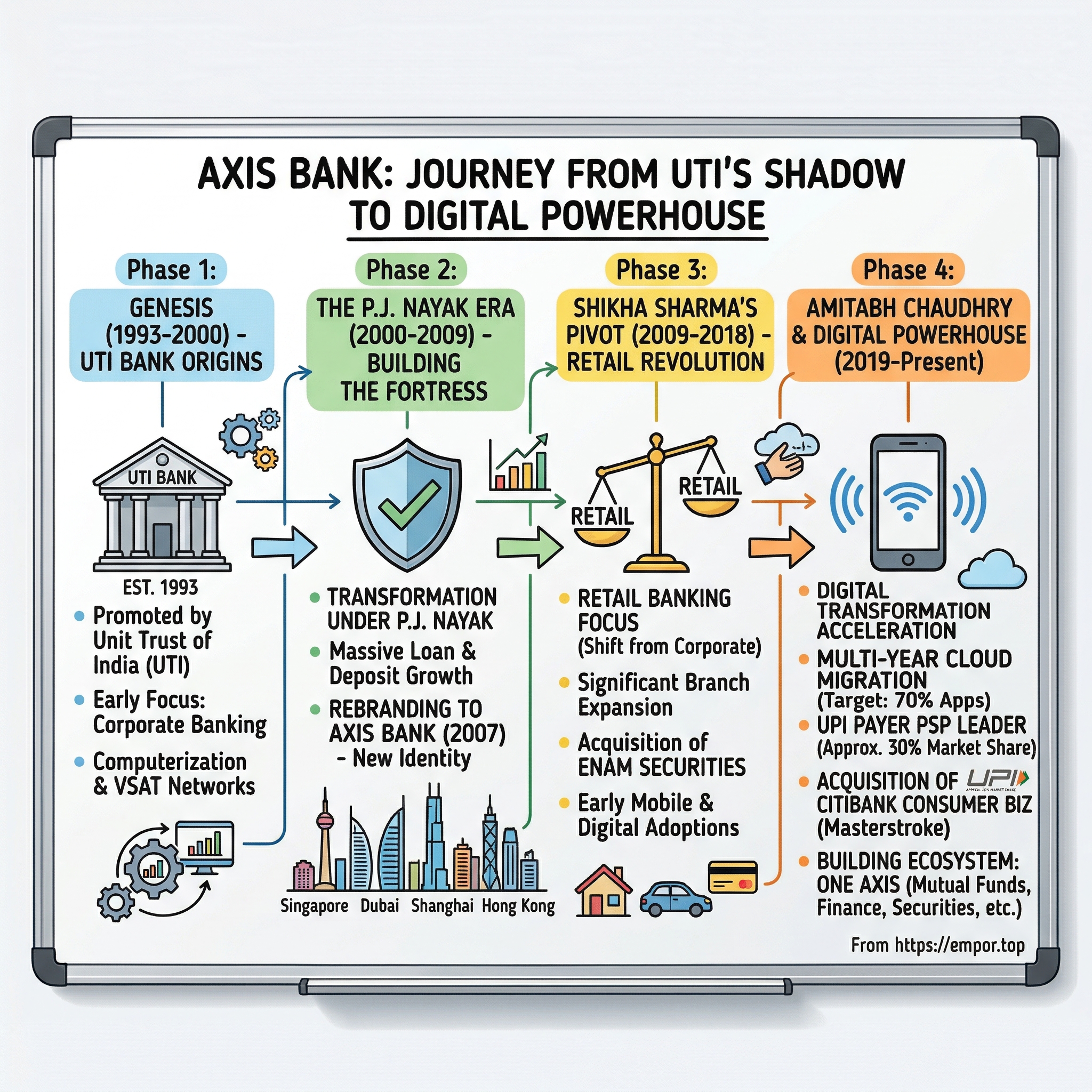
The frame for the next few thousand words is three leadership eras, each of which solved the previous era's problem and manufactured the next one. P.J. Nayak built a real bank out of a government mutual fund's balance sheet and left it corporate-heavy. Shikha Sharma pivoted it to retail and left it with an asset-quality and governance hangover. Amitabh Chaudhry cleaned up the credit book, rebuilt the technology stack, bought Citi's India consumer franchise, and now presides over a bank with pristine asset quality, a comfortable capital position, subsidiaries that actually make money — and a margin that has spent two years drifting away from the number management keeps promising to deliver.
That gap between the promise and the print is where the investment argument now lives.
 Subscribe on LinkedIn
II. Origins: Born Inside a Government Mutual Fund (1993–2000)
To understand why Axis Bank has always been slightly odd — neither a scrappy private-sector startup nor a state-owned behemoth — you have to start with what it was born from.
In 1991, India's balance-of-payments crisis forced open an economy that had been closed since the bank nationalisations of 1969. Among the reforms was a decision by the Reserve Bank of India to license new private banks for the first time in more than two decades. A generation of institutions was born in that window: HDFC Bank, ICICI Bank, IndusInd, and one incorporated on 3 December 1993 under the name UTI Bank.
Its promoter was the Unit Trust of India — not a business house, not a foreign bank, but a state-sponsored mutual fund that at the time was the dominant retail savings vehicle for tens of millions of Indian households, alongside Life Insurance Corporation and the public general insurers. That parentage was a genuine structural head start rather than a competed-for advantage. A new bank's hardest problem is deposits: convincing strangers to hand over money to an institution with no track record. UTI Bank started with an implicit halo from an institution that already held the savings of a very large fraction of India's investing public, plus patient capital from state-linked shareholders who were not going to demand quarterly heroics.
It is worth being precise about what this did and did not confer. It gave the bank credibility, distribution access and cheap equity. It did not give the bank a product advantage, a cost advantage, or a culture. HDFC Bank, which started at roughly the same time with a similarly credible parent, converted its head start into an obsessive operating culture and a deposit franchise that would become the industry benchmark. UTI Bank converted its head start into a balance sheet. That divergence — same starting gun, very different sprint — is the earliest ancestor of the "why is Axis third?" question.
The parentage also left a long tail. UTI itself was restructured after its own crisis, and the government's residual holding was parked in an entity called the Specified Undertaking of the Unit Trust of India (SUUTI). The state remained a shareholder in this "private" bank for nearly three decades, and only exited completely in November 2022, when the government sold its final 1.55% stake through an offer for sale expected to fetch roughly ₹4,000 crore.9 The 1993 origin story did not formally close until the Chaudhry era was well underway.
For a long-term investor in 2026, that is essentially all the 1990s matter for: they explain how the bank got a running start it never fully monetised, and they explain why full privatisation is a recent event rather than an ancient one. The interesting part starts when someone tried to turn the balance sheet into an institution.
III. Becoming a Real Bank: The Nayak Buildout (2000–2009)
P.J. Nayak did not arrive at UTI Bank looking like a commercial banker. He was an economist by training, with a doctorate and a career that ran through the Indian Administrative Service and the finance ministry — a policy person, not a branch-network person. What he brought was something rarer in Indian banking at the time than sales instinct: an institutional builder's willingness to break with the past.
The first thing he had to survive was a deal that never happened. In 2001, UTI Bank and Global Trust Bank announced plans to merge into what would have been India's largest private sector bank. Then the Ketan Parekh stock-manipulation scandal broke, and it emerged that Global Trust Bank's shares had been caught up in it — which made the agreed swap ratio indefensible and the target itself radioactive. The talks collapsed, the regulator never blessed the combination, and Global Trust Bank eventually failed outright, ultimately being merged into Oriental Bank of Commerce in a rescue in 2004.10
Read forward, that non-event is one of the more useful facts in this story. Axis's first attempt at transformative M&A was fast, opportunistic and wrong — and the system stopped it. Two decades later, the bank would attempt the largest cross-border banking acquisition in Indian history and get it approved. The difference was not ambition; it was preparation, counterparty quality, and a regulator's read on whether the acquirer could actually absorb the target.
What Nayak did build in the decade that followed was scale and reach. Deposits compounded rapidly — the bank grew its deposit base far faster than the peer average through the mid-2000s — and the institution began behaving like it had international aspirations. It listed Global Depository Receipts on the London Stock Exchange in 2005, opened its first overseas branch in Singapore in 2006, and followed with Shanghai and a Dubai International Financial Centre presence in 2007. For an Indian private bank barely a decade old, this was a statement of intent: we intend to bank Indian corporates wherever they go.
Why did an Indian bank with no meaningful foreign retail franchise open in Singapore, Shanghai and Dubai in the space of eighteen months? The answer is a specific and, at the time, shrewd read of where Indian corporate demand was heading. Indian companies in the mid-2000s were doing something new: buying assets abroad, raising foreign-currency debt, and running trade flows through Gulf and East Asian corridors. A domestic-only bank could lend to them in rupees at home and then watch a foreign bank capture the dollar loan, the hedging, the trade finance and the cash management. The overseas branches were not a retail expansion; they were a defensive perimeter around existing corporate relationships, and a way to earn fee income on flows that would otherwise have leaked to Citi, Standard Chartered and HSBC.
That instinct — follow the corporate relationship across products and geographies rather than compete on the price of a single loan — is genuinely durable at this bank. It is the same logic management articulates in 2026 under the "One Axis" label, and it is worth noting that it originated two CEOs before the person who now brands it.
The most symbolically loaded act came on 30 July 2007, when UTI Bank formally became Axis Bank. The trigger was mundane and revealing: under the 1993 arrangement, the bank could use the "UTI" brand for free only until the end of 2007, after which it would owe royalties to use a name that several unrelated entities were also using, generating brand confusion. Rather than pay rent on a borrowed identity, Nayak's board bought a new one — a short, phonetically neutral word chosen precisely because it carried no baggage and travelled well internationally.11
That decision reads better in hindsight than it did at the time. Discarding a brand with thirty-five million unitholders' worth of trust behind it was, in the short run, value-destructive. In the long run it forced the bank to earn recognition rather than inherit it — and it removed a permanent, escalating royalty claim on the P&L. It is one of the cleaner examples in Indian banking of management choosing a hard, self-reliant path over a comfortable rented one.
Nayak's exit in 2009 was less clean. He left ahead of what many expected to be a longer tenure, amid publicly reported friction over succession, and the board ultimately recruited from outside the bank. Whatever the internal specifics — and the bank has never disclosed them — the pattern established here matters: at Axis, CEO transitions have tended to be contested, abrupt, and followed by strategic resets rather than continuity.
He handed over a bank that had scale, an international footprint and a wholesale-lending DNA. That last part would turn out to be both the asset his successor inherited and the liability she spent a decade trying to fix.
IV. The Retail Pivot: Shikha Sharma's Decade (2009–2018)
Shikha Sharma arrived from ICICI Prudential Life Insurance, which she had built from scratch, and before that from the ICICI group's corporate-finance machine. She was, by reputation, an institution-builder with a consumer instinct — and she inherited a bank whose loan book was overwhelmingly corporate at exactly the moment when Indian corporate credit was about to become one of the great value-destruction events in the country's financial history.
Her answer was a plan called Vision 2015, and its central mechanic was simple: shift the mix. Retail loans, which were roughly a fifth of the book when she took over in mid-2009, would become close to half of it. She built the branch network aggressively, pushed into home loans, auto loans, personal loans and cards, and used the deposit franchise as the flywheel. By the end of her tenure the retail share had roughly doubled — the single largest structural change to the bank's identity since it was founded.
Along the way she made the acquisition that seeded most of what Axis today calls its subsidiary ecosystem. In 2010, the bank agreed to acquire Enam Securities' investment banking and equities business in an all-stock deal valued at roughly ₹2,067 crore. Enam was one of India's most respected boutique institutional houses, and its integration produced what is now Axis Capital, the bank's equity capital markets arm — a business that, as we will see, has become a small but high-return contributor.
The strategic reasoning behind the mix shift deserves more credit than it usually gets, because it was correct in advance rather than in hindsight. A corporate loan book is lumpy: a handful of large exposures, long tenors, and a loss distribution where one bad infrastructure account can eat a year of segment profit. A retail book is granular: millions of small exposures whose losses are statistically predictable, repriceable, and — crucially — attached to customers who also keep deposits, pay fees and buy insurance. Sharma understood that the second kind of bank is worth a higher multiple than the first, and she spent nine years trying to convert one into the other while the first kind was blowing up underneath her.
For a while, this looked like one of the best strategy stories in Indian financial services. Harvard Business School wrote a case study about her leadership in 2013. She was routinely listed among the most powerful women in global business.
The ending was harder. India's corporate credit cycle turned brutally between 2015 and 2018, and Axis — carrying Nayak-era wholesale exposures to infrastructure, power and metals — was among the worst hit of the large private banks. Bad-loan divergences reported by the RBI's inspections raised questions about how aggressively the bank had been recognising stress. In April 2018, having already been re-nominated by her board for a fourth term, Sharma asked to cut that term short; she stepped down on 31 December 2018.12 The bank has never publicly detailed the regulator's role, but contemporaneous reporting was consistent that the RBI was not comfortable with the reappointment.
Two things carry forward from this era, and only two. First, the retail-first strategy that defines Axis today is Sharma's, not Chaudhry's — he inherited the pivot and industrialised it. Second, and more uncomfortably, this is the second time in this story that the relationship between Axis's leadership and its regulator became a live issue. That is a pattern worth holding onto, because it recurs.
What arrived next was a CEO recruited explicitly to fix credit, controls and technology — in that order.
V. The Chaudhry Reset: Digital-First, Cloud-First (2019–2022)
Amitabh Chaudhry took charge on 1 January 2019, and he was an unusual choice for a bank in credit trouble: he had spent the previous nine years running HDFC Standard Life, an insurance company, and before that had been at Infosys BPO and Credit Suisse. He was not a career lender. He was a distribution-and-systems operator who understood how to sell financial products at scale through technology and third-party channels.
That background explains almost everything about what followed.
His first two years were unglamorous balance-sheet hygiene: raising capital, accelerating provisions, tightening underwriting standards, and — critically — resetting the corporate book so that new lending skewed heavily toward investment-grade borrowers. By 2026 that discipline shows up in a single, checkable number: 91% of the wholesale book is rated A- or better, and management says it has not drifted down the credit spectrum in five quarters.13 That is a real, verifiable outcome, not a slogan.
The more distinctive bet was technology. Chaudhry's framing was that a bank is three things — customer journeys, infrastructure, and employee experience — and that all three had to be rebuilt rather than patched. In plain terms: instead of buying software and bolting it onto a decades-old core system, move the bank's computing onto rented, elastic infrastructure (the cloud), and expose the bank's capabilities as standardised "plugs" (APIs) that other companies' apps can connect into. The analogy that works: Axis was running a factory where every machine had a custom, hand-cut connector; the project was to replace them all with a single standard socket, so anyone — a fintech, a retailer, an employer — could plug in without a bespoke engineering project each time. When Chaudhry arrived, the bank had roughly a handful of such integrations live. As of Q1 FY27, it reports more than 480 deployed APIs.14
The evidence that this produced something real, rather than a deck, sits in two places.
The first is UPI. India's Unified Payments Interface is the public rail on which most of the country's retail payments now run, and banks compete for two distinct roles: the "payer PSP" (the plumbing behind the app a customer actually taps) and the merchant side. Axis has become the largest payer-side PSP by volume, reporting roughly 36% share in Q4 FY26 and about 38% in Q1 FY27, with what it claims are the industry's lowest technical decline rates — that is, the fewest payments that fail because the bank's own systems choked.15 It also runs one of India's largest merchant-acquiring businesses, with about 22.4% terminal share.16 These are checkable against NPCI's published monthly data rather than dependent on the bank's own telling, which is exactly why they are the most credible of Axis's digital claims.
The second is the app. Axis Mobile carries a 4.8 rating on both Google Play and the iOS App Store, with 16 million monthly active users — and, more interestingly, more than 12 million users who are not Axis customers at all.17
Now the analytically honest part. UPI transactions are, for the bank, close to free to process and free to the customer. High payer-PSP share is a cost line that buys data, engagement and habit — not a revenue line. It is genuine evidence of engineering competence and reliability at scale. It is not, by itself, evidence of profitable customer ownership. And because UPI is interoperable by regulatory design, the switching cost it creates is thin: a customer can change the underlying bank account inside the same app in under a minute. Axis discloses no unit economics for its digital franchise — no cost-to-acquire, no cross-sell revenue per digitally-acquired customer, no lifetime value. So "digital-first bank" should be read as a demonstrated capability with an unproven P&L link, and the burden of proof sits with management.
The era closed with the loop from Section II finally snapping shut: the government's exit as a shareholder, and a bank that was for the first time entirely privately owned, entirely responsible for its own strategy — and about to make the biggest bet in its history.
VI. The Citibank Bet: Deal, Integration, and Reality Check (2022–2025)
In April 2021, Citigroup's new chief executive Jane Fraser announced that the bank would exit consumer banking in thirteen markets, India among them. For most of the Indian banking industry, this was interesting news. For Chaudhry, it was a fire alarm.
Citi's India consumer business was not a distressed asset. It was a small, extraordinarily high-quality book: roughly 2.5 million credit card customers skewed heavily to affluent urban India, a wealth-management franchise serving people with genuinely large portfolios, and a deposit base with a cost of funds that most Indian banks could only envy. Citi had spent decades building the aspirational brand in Indian retail banking. Now it was for sale, once, to one buyer.
Axis moved with unusual institutional speed. Management had already stood up a dedicated M&A and strategy function, and the bank commissioned its own market research on the Citi customer base before the formal process was fully underway. On 30 March 2022, Citi announced the agreement to sell its India consumer businesses — cards, wealth management, retail banking, and the consumer business of Citicorp Finance India — to Axis Bank for a headline consideration of approximately ₹12,325 crore, then about $1.6 billion.18 The transaction completed on 1 March 2023, and the migration of customers onto Axis's own core systems was finished by March 2024.19
Was the price right?
The honest answer four years on is: better than it looked, for reasons that had nothing to do with the operating business.
Start with what was paid. The final consideration came in at ₹11,932 crore. Then, in the fourth quarter of FY26, something unusual happened. At the time of the acquisition, Axis had recognised ₹8,714.24 crore of intangibles (excluding goodwill) on the Citi deal and — in a conservative move designed to protect its dividend-paying capacity — written the whole lot off through the profit and loss account immediately, in FY23, while declining to book any deferred tax asset against it. When the income tax authorities completed their regular assessment and allowed tax depreciation on those intangibles, the bank released the benefit: FY26 tax expense fell by ₹2,193.2 crore, comprising a ₹1,129.8 crore reversal of prior-year provisions, ₹265.85 crore of lower current-year tax, and a ₹797.55 crore deferred tax asset. The effective tax rate for FY26 dropped to 17.25%.20 Chaudhry used the media call to make the point explicitly: the adjusted cost of the Citi acquisition was therefore ₹9,739 crore, 18% below the quoted number.21
Investors should hold two thoughts at once here. The tax outcome is real cash economics and it genuinely lowers the deal's effective price. It is also, straightforwardly, a windfall from an accounting election made three years earlier rather than evidence of operating success — and Q4 FY26's headline profit was flattered by it, a fact management disclosed clearly and up front, which counts in its favour.
What did the money actually buy?
Two things, of unequal quality.
The wealth franchise is the clear win. Axis's Burgundy and Burgundy Private platforms absorbed Citi's private-client business and turned Axis into one of India's largest private banks by assets under management. Burgundy Private has been reported to manage on the order of ₹2.5 trillion for more than 15,000 ultra-high-net-worth clients as of late 2025, and the bank has been expanding the proposition into non-metro cities.22 In Q1 FY27, total Burgundy AUM grew 20% year on year and 11% sequentially, with Burgundy Private up 16% and 12% respectively.23 Wealth management is fee income — capital-light, sticky, and structurally attractive in a country minting new millionaires. If any part of the Citi deal compounds, it is this.
The card business is more ambiguous. Axis is now the fourth-largest issuer, adding roughly 0.9 to 1.0 million cards a quarter and holding about 13.4% of cards in force. But it remains fourth, and the gap to HDFC Bank has not closed. Investigative reporting by The Ken documented the difficulty of converting Citi's card customers — people accustomed to a particular service standard and reward economics — into engaged Axis customers rather than dormant plastic.24 The same publication reported significant workplace friction among the roughly 3,200 Citi employees who transferred, describing a culture clash between a global consumer bank's operating norms and Axis's more demanding, target-driven environment.25 Chaudhry responded with what The Ken characterised as a charm offensive aimed at rebuilding internal morale.26
It is worth pausing on why acquiring a bank's customers is so much harder than acquiring its balance sheet. When Axis bought the Citi book, it acquired accounts, receivables and contracts — all of which transfer cleanly. What does not transfer is the reason those customers were there. A Citi cardholder in Mumbai in 2022 was often paying for a bundle: airport lounges that were never crowded, a relationship manager who answered, a rewards currency that converted into international airline miles, and the quiet status of a foreign bank's card in a wallet. Axis could replicate the economics of that bundle, but replicating the feeling of it required its service organisation to operate at a standard it had not previously been built for. Meanwhile the customers had a costless alternative: stop using the card. Cards do not churn with a dramatic account closure; they churn by going quiet in a drawer.
The same asymmetry applied to people. The roughly 3,200 transferring employees came from an organisation with global processes, generous fixed compensation and a consensus-driven culture, into one with a sharper variable-pay structure and steeper targets. Some of that friction is simply the price of any acquisition, and some of it is genuinely the acquirer's operating model working as designed. But in wealth management especially, the employee is the product — and a departing private banker frequently takes the client relationship along.
The disclosure gap
At announcement, Axis talked about cost synergies in the 30–40% range and dozens of identified synergy levers. As of August 2026, the bank has published no audited realised-synergy figure, no post-acquisition ROI, and no customer-retention statistic. When a CNBC journalist asked directly on the Q4 FY26 media call what share of Citi customers had been retained after roughly four years, the CFO's answer was that the business is now fully integrated and Citi customers are no longer tracked separately — with the assurance that, while it was tracked, the book performed better than the assumptions used to value it.27
That answer is defensible on its own terms. Once systems and customers are fully merged, separate tracking genuinely becomes artificial. But it also means the single largest acquisition in the bank's history is now permanently unfalsifiable from the outside. Investors cannot verify the synergy claim, cannot measure attrition, and must take the "performed better than assumptions" statement on trust. For a transaction of this size, that is a material gap between what was promised at announcement and what is measurable at completion — and it is the kind of thing an activist would press hard on.
The deal closed a scale gap. It did not leapfrog anyone. And it landed the bank in a period where the market stopped asking about the acquisition and started asking about something more basic.
VII. The Current Numbers: Growth, Margin Pressure, and a Guidance Problem
Here is the paradox of Axis Bank in mid-2026: almost every line of the income statement and balance sheet is improving, and the one number the market cares most about has been going the wrong way for two years.
Start with the good news, because there is a lot of it. In the June 2026 quarter, total advances grew 19% year on year to about ₹12.6 trillion, deposits grew 18% on a quarterly-average basis, and the cost of deposits fell 35 basis points.28 Operating expenses rose just 5% against that growth, pushing the cost-to-assets ratio down to 2.20% — 21 basis points better than a year earlier and part of a six-quarter downtrend.29 Asset quality is the best it has been in the modern era: gross NPAs at 1.28%, net NPAs at 0.39%, net credit cost at 0.63% versus 1.38% a year earlier, provision coverage at 70%, and total provisions equal to 161% of gross NPAs.30 Capital is comfortable — CAR of 16.67% and CET1 of 14.64% — and management stated flatly that no equity capital is required to fund growth.31
Now the problem. Net interest margin — the spread between what the bank earns on loans and pays on deposits, the core engine of a bank's profitability — came in at 3.46%. A year earlier it was 3.80%. The year before that, above 4%.32 Management's "through-cycle" guidance has been 3.80% throughout, restated on call after call.33
The mechanics matter more than the number. On the Q1 FY27 call, the CFO broke the year-on-year decline into two parts: roughly 19 basis points from the Reserve Bank's repo rate cuts, which reprice floating-rate loans down immediately while deposits reprice slowly — a pure cyclical hit the bank would have taken even with a frozen balance sheet — and roughly 16 basis points from a change in the mix of the balance sheet itself.34
That second piece is a choice, not weather, and it is where the analysis gets interesting. Retail loans grew just 8% year on year while wholesale grew 38% and SME grew 25%.35 Retail, which Chaudhry described on the Q1 FY26 call as "60% of our book," is now 54% of advances.36 Corporate lending is lower-yielding by construction. So the bank has been deliberately trading margin for growth: deploying a strong deposit franchise into high-grade wholesale credit because retail demand hasn't kept pace.
Management defends this explicitly. Asked on the Q1 FY27 call why the bank chased corporate growth if it compressed margins, Chaudhry argued that wholesale returns should be judged on the whole relationship — balances, trade fees, foreign exchange, investment banking, corporate salary accounts — not on lending spread alone, and that on a risk-adjusted return on capital basis wholesale "stands head-to-head" with retail.37 Then the tell: "just to ensure that, somehow, we have to be held against the NIM number, we should drop our growth... it does not make sense to us."38
That is a coherent position, and it may well be the right one for shareholders. But investors should be clear-eyed about what it implies. Management has one hard headline guidance — grow 300 basis points faster than the industry — and one soft structural guidance, the 3.8% margin.39 When the two conflict, growth wins. Pressed for a bridge showing how the missing 34 basis points get recovered, the CFO gave the 16-basis-point mix reversal and then declined to itemise the rest: "we would not want to give you an exact itemized bridge because that flexibility we'd like to retain with ourselves."40 Asked how many quarters it takes for 18% retail disbursement growth to translate into 18% retail book growth, the answer was that the bank does not guide on segment-level growth.41
This is not evasion in the dishonest sense. It is a management team that has decided to guide on one variable and preserve optionality on everything else. But it makes the 3.8% target very difficult for an outside investor to underwrite. The margin has now printed below guidance for eight consecutive quarters. Management has called a bottom. That call is testable within two quarters, and it is the single clearest live test of this team's forecasting credibility.
The provisions question
Two one-time provisions deserve attention because they reveal how the bank handles bad news.
In the September 2025 quarter, net profit fell about 25% to roughly ₹5,557 crore, driven by a ₹1,231 crore one-time provision on two discontinued crop-loan variants, made following an RBI advisory. The bank disclosed that the provision would be written back once loans under the discontinued schemes are repaid or closed by March 2028, and stated that the RBI's annual inspection found no divergence in asset quality or provisioning.42 That is candid disclosure of an ugly quarter, with the mechanism and the reversal path spelled out.
The second is more debatable. In Q4 FY26, Axis voluntarily created an additional ₹2,001 crore standard-asset provision, explicitly described as "prudent and precautionary" and not reflective of any deterioration in the loan book. The stress scenario behind it assumed oil above $150 a barrel for twelve months, inflation at 7.4%, and a 20% currency depreciation — conditions management characterised as excessive but plausible given West Asian geopolitics — and the bank said the provision should cover all of FY27's provisioning requirements.43 Between that charge, the ₹2,193.2 crore tax writeback and a roughly ₹600 crore trading loss, the CFO noted the three items were net neutral to the quarter's P&L.44
The generous read: a conservative bank used a windfall to build a countercyclical buffer, disclosed all three items transparently, and told investors exactly how they offset. The skeptical read: a large discretionary provision created in the same quarter as a large discretionary tax gain gives management a reserve it can release into future earnings under a board-approved framework — smoothing, in other words, dressed as prudence. Both readings are legitimate. Full-year FY26 profit fell about 7% to ₹24,457 crore from ₹26,373 crore, so the buffer was built in a down year, which cuts modestly in management's favour.45
One accounting change ahead deserves a flag: India's banks are transitioning to expected credit loss (ECL) provisioning. Management's assessment is that the day-one hit to net worth will be marginal, but that the industry — Axis included — should expect higher provisions-to-assets in the first year post-transition, because ECL's Stage 1 and Stage 2 buckets will demand more than today's 40 basis points of blanket standard-asset provisioning.46 That is a known, dated, sector-wide earnings headwind rather than a surprise, but it will land.
VIII. Leadership Today: Incentives, Turnover, and Capital Allocation
At the very end of the July 2026 earnings call, after the last analyst question, Chaudhry did something unscripted. He thanked Puneet Sharma — the CFO who had just spent an hour absorbing margin questions — for six years of "yeoman's work," said the bank was sad to lose him, and wished him well in meeting his career aspirations.47
It was a genuinely warm sendoff, and also a data point. Sharma had been the most visible interpreter of Axis's numbers to the market since 2020, and he was leaving mid-cycle, mid-margin-debate. The bank named his successor on the same day: Rajeev Mantri, most recently Executive President and CFO of Bandhan Bank, joining with effect from 28 September 2026.48 Around the same time, the risk seat also changed hands: Anand Viswanathan, an internal appointment who had been running market and liquidity risk, enterprise risk management and model risk, took over as Chief Risk Officer for a three-year term beginning 1 January 2026, succeeding Amit Talgeri.49
So within roughly nine months, Axis Bank changed both its CFO and its CRO — the two roles most responsible for telling investors the truth about a bank. The CRO move was a planned internal succession at the end of a term, which is the healthy version. The CFO departure was voluntary and, from the outside, unforced. Neither is alarming individually. Together, alongside a broader reshuffling of group executives, they mean the leadership layer beneath the CEO in 2027 will be substantially different from the one that made the promises being judged.
Against that, the CEO seat has never been more stable. The RBI approved Chaudhry's reappointment as MD and CEO for a further three-year term in October 2024, extending him through the end of 2027 and making him the longest-serving chief executive of Axis's modern era.50 In an institution whose two previous CEO transitions were contested and abrupt, continuity at the top is worth something — it means the person who bought Citi will still be in the chair when the market renders a verdict on it.
Compensation is structured as cash plus employee stock options, and the board approved a further revision to the remuneration of the MD & CEO and executive directors effective April 2026, subject to the usual regulatory and shareholder approvals disclosed through exchange filings.51 The honest test an investor should apply: is pay tracking delivered outcomes or stated targets? The delivered record over the past two years is genuinely mixed — asset quality, cost efficiency, capital and subsidiary returns have all improved materially, while the margin has missed guidance for eight straight quarters and FY26 earnings declined. A remuneration structure that rewards the first list without penalising the second would be a governance issue; the bank's disclosures do not provide enough granularity on performance conditions for an outsider to judge, which is itself a mild transparency criticism.
Capital allocation: the digestion phase
The more encouraging story is what Axis has not done since 2023. There has been no second transformative acquisition. Capital has gone into three places: organic growth, subsidiary reinvestment, and balance-sheet resilience.
The subsidiary reinvestment is the highest-return of the three. Domestic subsidiaries delivered ₹2,051 crore of profit in FY26, up 16%, at a return on the bank's investment in them of roughly 54%.52 Any capital-allocation review that finds a 50%-plus return on invested capital inside the group should conclude that more, not less, should be routed there — and the bank has been doing exactly that.
The insurance stake is where discipline gets tested. Axis and its subsidiaries raised their combined holding in Axis Max Life Insurance to 19.99% in June 2026 through an additional investment of up to roughly ₹381 crore, and following the RBI's December 2025 clarifications on bank ownership of insurers, the bank is evaluating a move to 30% — a step reported to cost in the region of ₹3,900 crore.53 This is the second time Axis has been here. In April 2020 it agreed to acquire 29% of Max Life to take its holding to 30%, then restructured the transaction in August 2020 to a much smaller stake after the regulator's position became clear.54
On the Q1 FY27 call, executive director Subrat Mohanty was refreshingly plain about the process: there is an opportunity based on the December clarifications, the bank is weighing the pros and cons internally, and it will approach the regulator to see if they are open to the idea — noting that Axis had always wanted a higher stake but the rules previously did not allow it.55 That is what disciplined, regulation-first capital allocation sounds like. It is also a reminder that a meaningful share of Axis's strategic freedom is set in Mumbai's Mint Street, not in its own boardroom.
IX. Industry Structure & Competitive Position
Imagine India's banking market as a room. In one corner sits State Bank of India, so large that its balance sheet is a multiple of every private bank's, with a distribution network no one can replicate and a cost of deposits no one can beat. Near it stands HDFC Bank, which after absorbing its parent mortgage company became a private-sector institution of comparable heft with the industry's most respected deposit franchise. Then ICICI Bank, which spent the last six years executing a near-flawless digital and cross-sell turnaround and now compounds earnings with unusual consistency. And then Axis — third among private banks, fourth overall, holding roughly 5.3% of system assets.56
That ordering is not a detail. It frames every competitive claim Axis makes. When Axis says it is number one in UPI payer-PSP share, that is true and impressive — and it is a share of a rail that generates negligible direct revenue. When it says its focus segments are growing 18% year on year, that is real — and it is growth off a smaller base than the leaders enjoy.
Five forces, honestly applied
Threat of new entry: low, and that is Axis's most reliable protection. You cannot start a bank in India without an RBI licence, and licences for full-service universal banks have been issued sparingly. Capital requirements, priority-sector lending obligations and branch norms all raise the entry cost further. This is a genuine regulatory moat — but it protects every incumbent equally, so it explains why Axis earns acceptable returns, not why it should out-earn HDFC or ICICI.
Supplier power: rising, and this is the sharpest structural pressure on the sector. A bank's raw material is deposits, and Indian savers have alternatives they did not have a decade ago — mutual funds, direct equity, small finance banks paying up for deposits. Axis's cost of funds fell 35 basis points year on year in the June 2026 quarter and its month-end CASA ratio was around 38–40%, among the better outcomes in the large-bank cohort.57 But sustaining low-cost deposits requires either scale, brand or relentless branch-level execution, and the leaders have more of the first two.
Buyer power: rising fast. Digital aggregators and comparison platforms have commoditised the pricing of home loans, personal loans and credit cards. For a mass-affluent Indian borrower in 2026, switching a home loan is a weekend's work. This compresses spread for everyone.
Substitutes / switching costs: weaker than the industry likes to admit. UPI's interoperability, account portability of salary relationships, and instant digital onboarding have all reduced the friction that historically kept customers with their first bank. The stickiest relationships Axis has are wealth management — where advisory relationships and consolidated reporting create genuine inertia — and corporate transaction banking, where cash-management integration into a company's ERP is a real workflow lock-in. Neither is the retail current account.
Rivalry: intense and asymmetric. HDFC Bank competes with scale, ICICI with execution consistency, SBI with cost of funds, and a long tail of NBFCs and fintechs competes for the highest-yielding unsecured slices.
Where the advantage claims survive scrutiny — and where they don't
Applying Hamilton Helmer's framework, Axis has a cornered resource in its regulatory licence and its now-acquired wealth franchise; scale economies in technology spend, where roughly 11% of operating expenses goes to technology and can be amortised over a growing balance sheet;58 and possibly process power in the operating discipline that has taken cost-to-assets down six quarters running. What it does not credibly have is network economies (UPI's are the network's, not the bank's), branding power of the kind that lets HDFC price deposits lower, or counter-positioning — there is no business model here that a larger incumbent cannot copy.
Run the war-game from the other side of the table and the picture sharpens further. If you are HDFC Bank, what is your response to Axis's UPI leadership? Almost certainly nothing — you are not going to fight for share of a rail that costs money to run, and you would rather spend the same engineering budget defending a deposit franchise that funds you more cheaply than anyone. If you are ICICI Bank, what is your response to Axis's SME push? You compete directly, because you have the same analytics capability, a larger balance sheet to absorb SME credit losses, and a distribution base at least as good. If you are SBI, you barely notice — your competitive problem is the government, not Axis.
That thought experiment produces an uncomfortable but useful conclusion: Axis's most visible strengths are in areas its largest competitors have rationally chosen not to contest, and its most valuable growth ambitions are in areas they will contest directly. The two places where the competitive response would be genuinely difficult are private banking for the newly wealthy — where the Citi acquisition gave Axis a book that would take years to build organically — and deep semi-urban distribution, where branch economics reward whoever arrived first. Those, not payments share, are where a durable edge would have to come from.
The sell side reflects exactly this ambivalence, and it is worth presenting both sides because both are recent and specific. In June 2026, Kotak Institutional Equities named HDFC Bank and ICICI Bank as its preferred private-sector exposures and SBI among public banks, arguing that Axis needs a better showing on franchise performance relative to peers to justify a premium valuation.59 Six months earlier, in a note dated 2 December 2025, Nomura took the other side: it argued Indian banks were entering an earnings-led re-rating, that the NIM down-cycle was largely done with sector margins improving roughly 17 basis points between FY26 and FY28, and it ranked Axis Bank as its top pick ahead of ICICI and SBI.60 Nomura reiterated a preference for Axis and ICICI over public-sector banks in April 2026.61
The two views are not actually contradictory. Nomura's case is a cyclical one — margins bottom, credit costs normalise, earnings inflect, and the most operationally geared name re-rates most. Kotak's is a structural one — over a full cycle, has Axis demonstrated it deserves to be valued alongside banks with better franchises? Both can be right on different horizons, and an investor's answer depends on which question they are actually asking.
X. The One Axis Ecosystem & Where Growth Comes From Next
"One Axis" is the bank's name for the idea that a corporate relationship should generate not just a loan but an investment banking mandate, a salary-account book, a wealth relationship with the promoter family and a treasury flow. On the July 2026 call, wholesale banking head Vijay Mulbagal put it about as directly as an executive can: "we are not just in the game of lending here and we are not clearly competing on pricing" — the bank goes after clients where there are reciprocal flows, fees and One Axis opportunities across Burgundy Private and corporate salary, and looks at "composite returns, not just lending returns."62
That sentence is the strategic key to the entire margin debate in Section VII. If it is true, the low-yield corporate growth is a loss leader that pays for itself elsewhere. If it is aspirational, the bank is buying volume with spread. The evidence is partially supportive: corporate salary accounts grew new-to-bank average balances 30% year on year, the existing-to-bank salary book grew 18%, and Axis Capital's profit rose 72% year on year in the June quarter.63 Partially — because none of it is disclosed as a linked, attributable revenue pool.
Sizing the subsidiaries honestly
The domestic subsidiaries contributed ₹546 crore of profit in Q1 FY27, up 21%, against the bank's ₹7,114 crore. That is roughly 7% of group profit.64 Within that: Axis Finance, the NBFC arm, earned ₹244 crore (up 29%) on assets under management of ₹51,592 crore; Axis AMC, the mutual fund business, earned ₹134 crore (up 3%) on ₹3.69 trillion of AUM; Axis Securities earned ₹96 crore serving 7.19 million customers; and Axis Capital earned ₹65 crore.65
These are good businesses — the group return on investment in them runs above 50% — but the arithmetic is unforgiving. Even growing at 20% a year, the subsidiaries would need most of a decade to become a fifth of group profit. Anyone underwriting Axis on a sum-of-the-parts argument built around the subsidiaries is underwriting a second-order value driver. Axis AMC's 3% profit growth on 10% AUM growth is also a small flag: asset management fee margins in India remain under structural pressure from regulatory expense caps and passive competition.
Where the real optionality sits
Bharat Banking. Roughly half of Axis's branch network now sits in rural and semi-urban India, targeting a segment where formal credit penetration remains low and where the priority-sector lending obligations every Indian bank carries can be met profitably rather than grudgingly. Rural loans grew 10% sequentially in Q4 FY26.66 The strategic logic is sound — deposit-rich, competition-light geographies. The verification problem is that Axis discloses branch counts and headline growth rather than segment-level yields, credit costs or return on assets, so the profitability of the push is taken on faith.
SME and mid-corporate. This is the most convincing growth engine in the story. The combined small business banking, SME and mid-corporate book reached ₹2,931 billion at March 2026 — 24% of total loans, up 24% year on year and up 845 basis points as a share of the book over five years.67 SME lending in India has historically been a graveyard for banks that could not underwrite it, which is precisely why digitising it matters: Axis's stated enablers are analytics-driven sourcing and faster credit decisions rather than more relationship managers.68 It also carries risk that the current benign asset-quality print does not yet reflect, because SME books reveal their sins with a lag. Note that the bank sanctioned about ₹5,000 crore under the government's emergency credit guarantee scheme, of which roughly ₹2,400 crore had been disbursed by July 2026, concentrated in manufacturing and trading MSMEs.69
AI, and the honest version of it. Axis introduced quarterly updates on an enterprise AI operating model it calls AXIOM, whose design principle Chaudhry described as building capabilities once, governing them centrally and deploying them many times.70 The disclosed usage is unusually specific for an Indian bank: 34 million documents processed with AI assistance, 1.05 million accounts onboarded with it, 93,000 internal copilot users generating roughly 4 million prompts a month, and a relationship-manager copilot that analysed 2.1 million minutes of customer calls.71 The bank also says it is the first BFSI institution globally certified to ISO 42001 for responsible AI.72 What is disclosed is adoption. What is not disclosed is the financial effect — no headcount avoided, no cost saved, no revenue attributed. The cost-to-assets trend is consistent with efficiency gains, but consistent is not the same as caused.
Blockchain payments. In April 2025, Axis became the first India-headquartered bank live on JPMorgan's Kinexys platform (formerly Onyx), enabling 24/7 programmable dollar clearing for cross-border payments.73 For a customer, the benefit is that a dollar payment can settle on a Sunday instead of waiting for New York to open on Monday. It is a genuine first and useful for corporate treasury clients. It is not a profit driver today, and should be treated as small-scale optionality.
XI. Current Risk Radar
Only the risks with a real mechanism attached are worth an investor's attention. Five qualify.
Regulatory and compliance friction is a pattern, not an incident. In July 2021, the RBI fined Axis ₹5 crore for non-compliance with certain directions.74 In September 2024, it imposed a further ₹1.91 crore penalty following an inspection of the bank's position as at March 2023, citing failures including opening savings accounts for ineligible entities, lapses in issuing unique customer identification codes, and a subsidiary engaged in non-permissible business activities.75 The bank disclosed the action to the exchanges in the ordinary course.76 The rupee amounts are immaterial to a bank earning ₹7,000 crore a quarter — that is not the point. The point is that these are control failures spanning account eligibility, customer identification and subsidiary business scope, recurring across multiple inspection cycles and multiple CEOs. Add the crop-loan provision made on RBI advice and the historic asset-classification divergences of the Sharma era, and the fair conclusion is that Axis has a persistent, low-grade compliance-quality problem rather than bad luck. The tail risk is not the fine; it is a supervisory restriction on a growth business, which is a card the RBI has played against other Indian lenders.
Margin and execution risk is the live one. The mechanism is straightforward: if retail loan growth does not reaccelerate, the mix keeps drifting toward lower-yielding wholesale, and the promised recovery to 3.8% requires either a rate cycle turning or spreads widening — neither of which management controls. Two more quarters below 3.46% would move this from a cyclical story to a credibility story.
Unsecured retail asset quality is improving but unfinished. Indian banks broadly experienced elevated delinquencies in credit cards and personal loans through 2024 and 2025, and Axis — as a top-four card issuer with a meaningful personal-loan book — was exposed. The current numbers are reassuring: gross slippage down 134 basis points year on year, net credit cost down 75.77 The bank has also stopped separately reporting "technical" slippages, having brought net slippages from that pool down from ₹1,861 crore in Q1 FY26 to about ₹218 crore in Q4 FY26.78 That is a legitimate cleanup, but every removal of a disclosure line reduces what outsiders can independently track.
Integration and culture risk has not fully burned off. More than three years after close, the reported friction among transferred Citi staff and the difficulty of converting acquired card customers both suggest that the human half of the acquisition ran harder than the systems half. Attrition of senior relationship managers in wealth management would be the specific thing to watch, because in private banking the client follows the banker.
Ecosystem cybersecurity extends past the bank's own perimeter. On 2 July 2025, Max Financial Services disclosed that Axis Max Life Insurance — the insurer in which Axis holds 19.99% — had received a message from an anonymous individual claiming unauthorised access to customer data, and initiated a forensic investigation.79 The company did not confirm which datasets or systems were affected, or the volume of data involved.80 The instructive detail is that the incident surfaced through an external tip rather than internal detection. Axis Bank's own systems were not implicated, but reputational contagion in an "ecosystem" strategy runs both ways: shared branding means a partner's breach can become the bank's customer-trust problem.
Key-person risk at the very top is lower than at any point in this story, given the CEO's contract runs to the end of 2027. The churn immediately below him is the offsetting concern.
XII. Playbook: Business & Investing Lessons
An inherited advantage is a starting position, not an engine. UTI's brand and capital gave this bank a head start that a pure startup could not buy. Thirty-three years later, the bank that started with less brand equity and the same licence window is more than twice its size. Head starts decay; operating systems compound. When evaluating any financial institution, the question is never what it was given but what it built.
Transformative M&A closes scale gaps fast and proves itself slowly. The Citi acquisition did exactly what it was supposed to do on the balance sheet: it delivered a premium card portfolio and a top-tier wealth franchise in one transaction, at a cost that a favourable tax assessment ultimately reduced by 18%. What it has not delivered is a verifiable number. Once an acquired business is fully integrated, the acquirer loses the ability — and the incentive — to report on it separately. Investors should therefore extract synergy and retention commitments before the integration closes the window, because afterwards the honest answer really is "we don't track that anymore."
Guidance is a balance-sheet item. A management team that misses a stated target for eight consecutive quarters, then declares the trough, is spending credibility it earned elsewhere. Axis's team has genuine credit in the bank: they disclosed the tax windfall, the discretionary provision and the trading loss in the same breath and told analysts the three netted out; they explained the crop-loan provision and its write-back path. That candour is what makes the margin call worth taking seriously at all. But when guidance and growth conflict and growth wins every time, the guidance stops functioning as a forecast and starts functioning as an aspiration — and the market prices it accordingly.
Third place is a different game, not a worse version of the same one. First place in Indian private banking is won on cost of deposits and brand. Second place is won on execution consistency. Third place cannot be won by doing the same things slightly less well. It has to be won in segments where the leaders are structurally weaker — SME underwriting, semi-urban distribution, wealth management for the newly rich — and defended with specialisation rather than scale. Axis's strategy, read charitably, is exactly this. The open question is whether management believes it, or whether it still measures itself against HDFC's balance sheet.
XIII. Bull vs. Bear: The Investment Case Today
The bull case
The bull case is that Axis Bank is a fundamentally repaired institution priced for a cyclical problem that is about to end.
The repair is not rhetorical. Asset quality is at multi-year bests across every metric the bank reports, with provisions covering 161% of gross NPAs and an extra ₹2,001 crore of discretionary buffer sitting on top of that, calibrated to a stress scenario most investors would consider extreme. Capital is ample enough that management has explicitly ruled out needing equity. Costs are falling as a share of assets for six straight quarters, with technology and AI investments plausibly still to yield. The deposit franchise is performing — 18% growth with a 35 basis point reduction in cost of funds is a difficult combination to achieve. Subsidiaries compound at better than 50% return on invested capital. The wealth business acquired from Citi is growing 20% a year in a country where the population of wealthy households is expanding faster than almost anywhere on earth.
Layer on the cyclical argument that Nomura made: if sector margins bottom and recover roughly 17 basis points over FY26–28 while credit costs normalise, the bank most geared to that inflection re-rates most. Axis, with the lowest margin of the large private banks and the largest gap to its own stated target, is arguably that bank. And it enters the recovery with a CEO contracted through end-2027, meaning no leadership discontinuity during the period in which the thesis must prove out.
The bear case
The bear case is that "repaired" and "advantaged" are different things, and Axis has demonstrated the first without the second.
Start with the structural point: this is the smallest of India's big four, in an industry where cost of funds is destiny and scale drives cost of funds. Nothing in the current strategy plausibly closes that gap. The Citi acquisition — the largest capital allocation decision in the bank's history — bought a card business that remains fourth and a wealth business whose contribution is real but not separately quantified, with no published synergy realisation, no retention data, and management's confirmation that the acquired book is no longer tracked separately. The single largest bet cannot be marked to market by an outsider.
Then the operating point: the margin has missed a repeatedly stated target for two years, and management has declined to provide a bridge back to it beyond the 16 basis points attributable to mix. The mix reversal itself requires retail — currently growing at 8% — to reaccelerate sharply while wholesale, currently growing at 38%, decelerates. That is not a small ask, and management explicitly refuses to guide on segment growth. FY26 earnings actually declined 7%.
Then governance: penalties recurring across inspection cycles for control failures, an RBI-advised provision, and both the CFO and CRO seats turning over within nine months at exactly the moment when the market most needs continuity in financial communication. And a large discretionary provision created in the same quarter as a large one-time tax gain, which — however well disclosed — hands management a lever over future reported earnings.
And finally the valuation point, which is Kotak's: if Axis trades at a premium multiple, it must demonstrate franchise quality commensurate with the banks it is being compared to, and on margin, retail growth and disclosure it currently does not.
What would falsify each case
The bull case breaks if margin fails to inflect over the next two quarters, or if retail growth stays stuck in single digits while wholesale carries the book. The bear case breaks if retail disbursement growth — running around 18% — converts to book growth over FY27, dragging mix and margin back up while credit costs stay near current levels. Both are observable within a year, which makes this an unusually testable situation.
The KPIs that actually matter
Three, and only three, are worth tracking closely:
1. Net interest margin against the 3.8% through-cycle target. This is the whole argument in one number: it measures cyclical recovery, mix discipline and management credibility simultaneously. Watch the direction and the pace, quarter by quarter, from the 3.46% trough.
2. Retail loan book growth. Not disbursements — the book. Management has effectively told the market that disbursement growth of around 18% will convert to book growth with a lag. That conversion is the mechanism on which the margin recovery depends. If retail book growth does not climb from 8% toward the mid-teens, the mix problem is structural rather than temporary.
3. Fee income growth, particularly the wealth and granular components. Fee income grew 7% year on year in Q1 FY27, with granular fees at 90% of the total. This is the cleanest available proxy for whether the Citi acquisition and the One Axis strategy are producing revenue that does not consume capital — the one place where Axis could out-earn larger rivals without out-scaling them.
Everything else — subsidiary profits, UPI share, app ratings, AI adoption — is supporting evidence, not thesis.
XIV. Epilogue & What Would Success Look Like
There is a version of this story that ends in 2029 with a straightforward verdict. Margins recovered to 3.8%, retail growth reaccelerated, the wealth franchise Axis bought from Citi compounded into the country's premier private bank, and the SME book proved that analytics-led underwriting can crack a segment that defeated a generation of Indian lenders. In that version, Axis stops being the third-place bank and becomes the specialist — smaller than HDFC and ICICI, but earning a return on equity that makes the size gap irrelevant.
There is another version where the margin bottom turns out to be one of several, retail growth stays structurally slower than the leaders', the Citi customers quietly attrit into other people's wallets, and Axis spends the 2030s where it has spent the 2020s: profitable, well-provisioned, technically excellent, and permanently valued at a discount to the two banks it keeps being compared to.
The through-line across three decades and three chief executives is that Axis has never had a long period in which it simply executed a settled strategy. Nayak built and left. Sharma pivoted and left under a cloud. Chaudhry cleaned up, digitised, and made one enormous acquisition. Each reset was a reasonable answer to the problem the previous era created. None of them has yet produced the thing the bank most conspicuously lacks: a durable, articulable reason why a customer, a depositor or an investor should choose Axis over HDFC Bank or ICICI Bank, stated in terms that can be verified from the outside.
Chaudhry has until December 2027 on his current term to supply it. The near-term test is arithmetic and arrives fast: does the margin bottom where management said it would, and does the SME and Bharat Banking push translate into well-priced growth rather than volume? The longer-term test is slower and more consequential: does the Citibank acquisition ultimately read as a scale-closing masterstroke or an expensive, culturally costly detour? Given that the acquired business is no longer tracked separately, that answer will have to be inferred from fee income, wealth AUM and card economics over the next two to three years rather than read off a disclosure.
For now, the most accurate description of Axis Bank is also the least satisfying one: a much better bank than it was in 2018, in a market where being much better than you were is not the same as being good enough to win.
References
-
Axis Bank Q1 net profit rises 23% to ₹7,114 crore as provisions fall — Business Standard, 2026-07-18 ↩
-
Axis Bank Q1 FY27 slides: profit surges 23% as NIM hits cycle low — Investing.com, 2026-07-18 ↩
-
Axis Bank Limited Q1FY27 Earnings Conference Call Transcript, 2026-07-18 ↩
-
Axis Bank Limited Q1FY27 Earnings Conference Call Transcript, 2026-07-18 ↩
-
Axis Bank Q1 FY27 slides: profit surges 23% as NIM hits cycle low — Investing.com, 2026-07-18 ↩
-
Axis Bank Q1FY27 Press Release (AXIS/CO/CS/250/2026-27), 2026-07-18 ↩
-
Who dominates India's credit card market? HDFC Bank leads cards, SBI Card tops spending — Business Today, 2026-06-27 ↩
-
Govt to exit Axis Bank with 1.55% stake sale, expects to garner Rs 4,000 cr — Business Standard, 2022-11-09 ↩
-
Axis Bank MD & CEO Shikha Sharma retires — Business Standard, 2018-12-31 ↩
-
Axis Bank Limited Q1FY27 Earnings Conference Call Transcript, 2026-07-18 ↩
-
Axis Bank Q1 FY27 slides: profit surges 23% as NIM hits cycle low — Investing.com, 2026-07-18 ↩
-
Axis Bank's Q4 and Annual Results FY26 Media Conference Call Transcript, 2026-04-25 ↩
-
Axis Bank's Q4 and Annual Results FY26 Media Conference Call Transcript, 2026-04-25 ↩
-
Axis Bank Q1 FY27 slides: profit surges 23% as NIM hits cycle low — Investing.com, 2026-07-18 ↩
-
Citi Announces Agreement to Sell Its Consumer Businesses in India to Axis Bank Limited — Businesswire, 2022-03-30 ↩
-
Axis Bank Completes Acquisition of Citibank's Consumer Businesses in India — Axis Bank Press Release, 2023-03 ↩
-
Axis Bank's Q4 and Annual Results FY26 Media Conference Call Transcript, 2026-04-25 ↩
-
Axis Bank's Q4 and Annual Results FY26 Media Conference Call Transcript, 2026-04-25 ↩
-
Axis Bank Eyes to Hire 50 Private Bankers Amid India's Wealth Boom — Angel One ↩
-
Axis Bank Limited Q1FY27 Earnings Conference Call Transcript, 2026-07-18 ↩
-
Axis Bank's US$1.6B Citi deal has a problem: getting Citi's 2.5M credit-card users to switch — The Ken ↩
-
Axis Bank puts Citi employees in the hot seat of a bruising workplace — The Ken ↩
-
Amitabh Chaudhry launches charm offensive at Axis Bank—and employees are buying it — The Ken ↩
-
Axis Bank's Q4 and Annual Results FY26 Media Conference Call Transcript, 2026-04-25 ↩
-
Axis Bank Limited Q1FY27 Earnings Conference Call Transcript, 2026-07-18 ↩
-
Axis Bank Q1 FY27 slides: profit surges 23% as NIM hits cycle low — Investing.com, 2026-07-18 ↩
-
Axis Bank Q1FY27 Press Release (AXIS/CO/CS/250/2026-27), 2026-07-18 ↩
-
Axis Bank Q1 FY27 slides: profit surges 23% as NIM hits cycle low — Investing.com, 2026-07-18 ↩
-
Axis Bank Q1FY26 Earnings Analyst Call Transcript, 2025-07-17 ↩
-
Axis Bank Q1FY26 Earnings Analyst Call Transcript, 2025-07-17 ↩
-
Axis Bank Limited Q1FY27 Earnings Conference Call Transcript, 2026-07-18 ↩
-
Axis Bank Q1 FY27 slides: profit surges 23% as NIM hits cycle low — Investing.com, 2026-07-18 ↩
-
Axis Bank Q1FY26 Earnings Analyst Call Transcript, 2025-07-17 ↩
-
Axis Bank Limited Q1FY27 Earnings Conference Call Transcript, 2026-07-18 ↩
-
Axis Bank Limited Q1FY27 Earnings Conference Call Transcript, 2026-07-18 ↩
-
Axis Bank Limited Q1FY27 Earnings Conference Call Transcript, 2026-07-18 ↩
-
Axis Bank Limited Q1FY27 Earnings Conference Call Transcript, 2026-07-18 ↩
-
Axis Bank Limited Q1FY27 Earnings Conference Call Transcript, 2026-07-18 ↩
-
Axis Bank Q2 profit falls 26% on RBI-advised one-time provisioning — Business Standard, 2025-10-15 ↩
-
Axis Bank's Q4 and Annual Results FY26 Media Conference Call Transcript, 2026-04-25 ↩
-
Axis Bank's Q4 and Annual Results FY26 Media Conference Call Transcript, 2026-04-25 ↩
-
Axis Bank Q4 results: Net profit flat at Rs 7,071 crore; dividend announced — Business Today, 2026-04-25 ↩
-
Axis Bank Limited Q1FY27 Earnings Conference Call Transcript, 2026-07-18 ↩
-
Axis Bank Limited Q1FY27 Earnings Conference Call Transcript, 2026-07-18 ↩
-
Axis Bank Appoints Rajeev Mantri as Chief Financial Officer — Elets BFSI, 2026-07 ↩
-
Axis Bank appoints Anand Viswanathan as chief risk officer — Business Standard, 2025-11-27 ↩
-
RBI approves re-appointment of Amitabh Chaudhry as MD & CEO of Axis Bank for three years — Business Today, 2024-10-25 ↩
-
Axis Bank's Q4 and Annual Results FY26 Media Conference Call Transcript, 2026-04-25 ↩
-
Axis Bank Weighs Raising Max Life Stake To 30%, May Seek RBI Approval — Outlook Business, 2026 ↩
-
Axis Bank to acquire 29% in Max Life, taking its total stake to 30% — Business Standard, 2020-04-28 ↩
-
Axis Bank Limited Q1FY27 Earnings Conference Call Transcript, 2026-07-18 ↩
-
Axis Bank Limited Q1FY27 Earnings Conference Call Transcript, 2026-07-18 ↩
-
Axis Bank Q1 FY27 slides: profit surges 23% as NIM hits cycle low — Investing.com, 2026-07-18 ↩
-
HDFC Bank, ICICI Bank shares top picks; Axis Bank needs better showing to justify premium, says Kotak — Business Today, 2026-06-27 ↩
-
Nomura sees re-rating potential in Indian Banks; Axis, ICICI, SBI top picks — Business Standard, 2025-12-02 ↩
-
Nomura flags 4 risks for PSU bank stocks; prefers Axis Bank, ICICI Bank — Business Standard, 2026-04-09 ↩
-
Axis Bank Limited Q1FY27 Earnings Conference Call Transcript, 2026-07-18 ↩
-
Axis Bank Limited Q1FY27 Earnings Conference Call Transcript, 2026-07-18 ↩
-
Axis Bank Q1 FY27 slides: profit surges 23% as NIM hits cycle low — Investing.com, 2026-07-18 ↩
-
Axis Bank Q1 FY27 slides: profit surges 23% as NIM hits cycle low — Investing.com, 2026-07-18 ↩
-
Axis Bank's Q4 and Annual Results FY26 Media Conference Call Transcript, 2026-04-25 ↩
-
Axis Bank's Q4 and Annual Results FY26 Media Conference Call Transcript, 2026-04-25 ↩
-
Axis Bank Limited Q1FY27 Earnings Conference Call Transcript, 2026-07-18 ↩
-
Axis Bank Limited Q1FY27 Earnings Conference Call Transcript, 2026-07-18 ↩
-
Axis Bank Limited Q1FY27 Earnings Conference Call Transcript, 2026-07-18 ↩
-
Axis Bank Q1 FY27 slides: profit surges 23% as NIM hits cycle low — Investing.com, 2026-07-18 ↩
-
Axis Bank Q1 FY27 slides: profit surges 23% as NIM hits cycle low — Investing.com, 2026-07-18 ↩
-
JPMorgan, Axis partner to boost blockchain-based payments — American Banker, 2025-04-04 ↩
-
RBI fines Axis Bank Rs 5 crore for non-compliance with certain rules — Business Standard, 2021-07-29 ↩
-
RBI imposes penalty amounting to Rs 1.91 crore on Axis Bank Limited for failure to comply with Banking Regulation Act, 1949 and RBI Directions — SCC Times, 2024-09-12 ↩
-
RBI Penalty Disclosure to Exchanges (AXIS/CO/CS/338/2024-25), 2024-09-10 ↩
-
Axis Bank Q1 FY27 slides: profit surges 23% as NIM hits cycle low — Investing.com, 2026-07-18 ↩
-
Axis Bank's Q4 and Annual Results FY26 Media Conference Call Transcript, 2026-04-25 ↩
-
Max Financial's Axis Max Life reports unauthorised access to customer data — Business Standard, 2025-07-03 ↩
-
Max Financial reports cyber threat at unit; initiates security check — Business Standard, 2025-07-02 ↩
 LinkedIn
 WhatsApp
 Reddit
 Hacker News
 Email
Email Kindle
 RSS Feed
 Spotify
 Apple Podcasts
 Amazon Music
 Audible
 YouTube