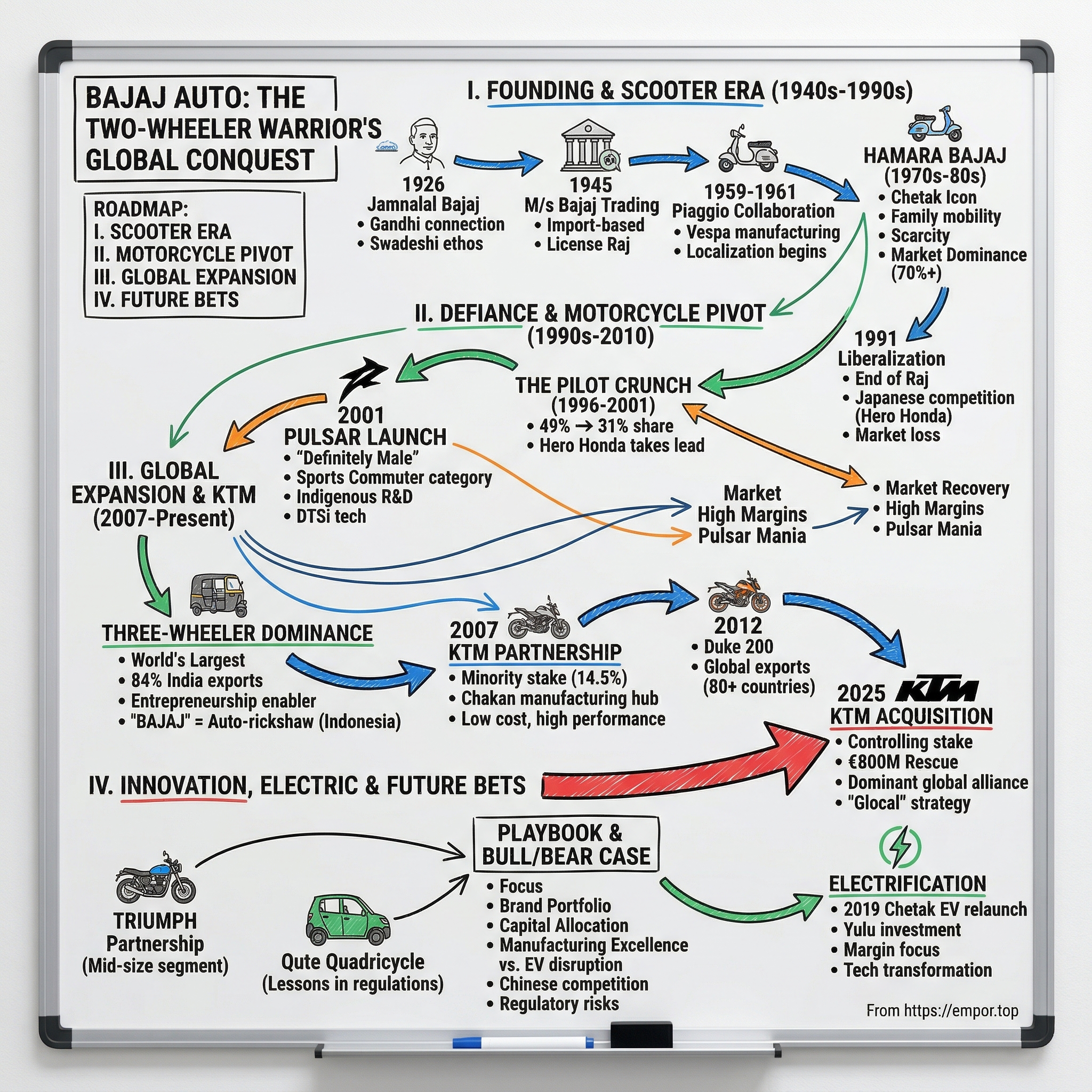
Bajaj Auto: The Two-Wheeler Warrior's Global Conquest
I. Introduction & Episode Roadmap
On 18 November 2025, a set of signatures in Austria quietly ended one of the strangest slow-motion courtships in global manufacturing. An Indian company that had spent eighteen years as a patient, deliberately powerless minority shareholder in a European motorcycle brand finally took the wheel — not by winning an auction, not by outbidding a rival, but by being the only party still standing when the music stopped. Bajaj Auto completed its acquisition of control over the holding company that owned KTM, the orange-liveried Austrian racing marque whose parent had spent the previous twelve months in an Austrian courtroom trying not to die.1
It is worth pausing on how improbable that sentence would have sounded in 1995. Back then, Bajaj Auto was a scooter company. Not a motorcycle company — a scooter company, and a fading one, whose signature product was a geared, tinny, endlessly reliable machine called the Chetak that Indian families waited years to buy. The company had roughly zero presence in Europe, no meaningful premium engineering capability, and was about to spend a decade watching a Japanese-backed rival eat the fastest-growing category in Indian mobility.
Today the picture is unrecognisable. Bajaj Auto carries a market capitalisation of roughly ₹3.16 trillion, with the shares trading around ₹10,139 on the NSE in August 2026.2 In the financial year ended 31 March 2026, standalone revenue reached a record ₹58,732 crore, up 17% year on year, with EBITDA of ₹12,019 crore at a 20.5% margin and profit after tax of ₹9,825 crore.3 On a consolidated basis — which now sweeps in KTM — profit after tax was ₹10,744 crore, up 47% from ₹7,325 crore the prior year, though a chunk of that jump came from acquisition accounting rather than motorcycles being sold.4 Volumes crossed five million units for the first time, beating the previous peak set back in FY19.3
A necessary housekeeping note, because the confusion is endemic: Bajaj Auto is not Bajaj Finance, and it is not Bajaj Finserv. All three descend from the same family and the same original holding structure, which the Bombay High Court sanctioned for demerger on 18 December 2007, splitting the old Bajaj Auto into an automotive business, a financial-services business under Sanjiv Bajaj, and an investment holding company.5 They trade separately, are run by different branches of the family, and have almost nothing to do with each other operationally. This story is about the one that makes motorcycles and three-wheelers.
The throughline worth holding onto is this: Bajaj Auto has, for six decades, preferred to rent capability rather than build it. Piaggio for scooter engineering in 1960. Kawasaki for motorcycle credibility in the 2000s. KTM for premium performance from 2007. Triumph for the modern-classic segment from 2023. It is a partnership machine — a company that repeatedly bought optionality on someone else's technology and brand, then manufactured the result in India at Indian cost. That playbook has produced genuinely remarkable returns on very modest invested capital.
But partnerships have a failure mode, and Bajaj just walked straight into it. When you own 49.9% of something, you get half the economics and none of the control. You cannot stop your partner from over-expanding, over-borrowing, and over-inventorying. And when it all breaks, you are the one holding a stake that is simultaneously too big to walk away from and too small to fix. That is precisely what happened with KTM. The question this piece keeps returning to is whether the €880 million Bajaj committed to end that problem was an opportunistic seizure of a great asset at a distressed price — which is how management tells it — or the expensive resolution of a governance mistake Bajaj made years earlier by taking a large minority position in a business run by someone else.3
We will move through the origin story quickly, because the License Raj years matter mainly for what they taught the family about capital scarcity. We will spend real time on the Pulsar — the product that saved the company and defined its current management's worldview. We will make the case that the least glamorous part of Bajaj, three-wheelers, may be the best business it owns. We will go deep on KTM. We will look hard at the export franchise, which is now genuinely the company's growth engine and its most under-discussed competitive asset. We will examine the domestic electric scooter fight, where Bajaj is a strong number two and not a leader. And we will end by testing what could break the case.
 Subscribe on LinkedIn
II. Origins & the License Raj Inheritance
The Bajaj Group's founding myth does not start in a factory. It starts in the independence movement. Jamnalal Bajaj was a merchant, philanthropist and Congress treasurer close enough to Mahatma Gandhi that Gandhi referred to him as a fifth son. The commercial vehicle for the family's industrial ambitions was incorporated on 29 November 1945, initially as a trader importing two- and three-wheelers rather than making them.6 That distinction matters: Bajaj began as a distributor. Understanding how vehicles actually reach customers in difficult markets was in the company's bones before it ever cut metal.
Manufacturing came with permission. In 1959 the Government of India granted Bajaj a licence to produce two- and three-wheelers, and in 1960 the company entered a technical collaboration with Piaggio of Italy to build Vespa scooters under licence, going public in the same period.67 This is the first instance of the pattern: acquire a proven design from abroad, localise it, sell it into a market nobody else understood as well.
To understand what came next, you have to understand the economics of the License Raj, and they were genuinely bizarre by modern standards. Production was capped by government licence. Demand was not. A Bajaj scooter was therefore not a product you bought; it was an asset you queued for. Waiting periods stretched to a decade in the peak years, and a booking slip for a Bajaj scooter traded at a premium in the secondary market — the vehicle was worth more used than new, because used meant available now.7
Think about what that does to a management team. There is no marketing problem, no pricing problem, no competitive problem. There is only a capacity problem you are legally forbidden from solving. Every rupee of capital has to be squeezed for maximum output because you cannot simply build another plant. Rahul Bajaj, who took over as Managing Director in 1972 after the death of his father Kamalnayan, ran the company inside that constraint for two decades.[^8] The lesson he absorbed — hoard cash, avoid debt, never depend on anyone's balance sheet but your own — has been remarkably durable in the family's DNA, and it explains a great deal about how Bajaj Auto behaves today, including its long-standing allergy to leverage.
The Piaggio arrangement lapsed in the early 1970s, and rather than seek a new foreign partner Bajaj launched its own scooter in 1972: the Chetak, named for the horse that carried Maharana Pratap into battle.7 The Chetak became the vehicle of the Indian middle class for a generation, and the "Hamara Bajaj" advertising campaign — "Our Bajaj" — turned a machine into a statement of national self-sufficiency. It was arguably the most effective piece of brand-building in Indian consumer history, and it worked because the underlying claim was true: this was an Indian company making an Indian product for Indian roads.
Being forced into self-reliance also had a second-order effect that is easy to miss. When the foreign collaboration ended, Bajaj had to develop its own engineering capability at a moment when almost no Indian manufacturer had one. That capability sat idle-ish for years, and then became the platform on which everything after 2000 was built.
It was not a painless separation. Once Bajaj began selling its own scooters into export markets, the design lineage from the Vespa became a legal question rather than an engineering one, and the company found itself defending intellectual-property challenges abroad — an early, unglamorous education in the difference between licensing someone's technology and owning it. That experience is the earliest ancestor of the KTM decision half a century later. A licence expires and leaves you exposed; equity does not. The company has been oscillating between those two postures ever since.
There is a subtler inheritance too, and it explains something about how Bajaj still behaves. A business that spent thirty years unable to satisfy demand never had to learn how to fight for a customer. The Chetak did not need a dealer network that could sell; it needed one that could allocate. When liberalisation arrived and customers acquired choices, Bajaj had to build a commercial muscle it had never used — and the fact that it eventually became world-class at distribution in Africa and Latin America is more remarkable given it started from a standing stop.
Then came the miss. India liberalised through the 1980s and 1990s, and the market Bajaj had defined began shifting under it. Motorcycles — lighter, more fuel-efficient, more aspirational for younger buyers — started taking share from geared scooters. Hero Honda, a joint venture between an Indian bicycle maker and a Japanese engine giant, built its entire franchise on that shift with the promise of extraordinary fuel economy. Bajaj, sitting on a beloved scooter brand and a scooter factory, was slow. By the late 1990s, the company that had once been the default choice of every Indian household was watching its core product become culturally obsolete, and its market position was deteriorating in a category it had never seriously entered.
That is the setup. A company with world-class distribution, real engineering capability, a fortress balance sheet, an iconic brand — and the wrong product. What happens next is the single most consequential episode in Bajaj Auto's modern history, and it was driven by a thirty-something engineer with a chip on his shoulder about consultants.
III. The Pulsar Turnaround & the Motorcycle Pivot (1999–2010)
Picture the internal debate at Bajaj Auto around 1999. Hero Honda had just launched the CBZ, a 156cc motorcycle marketed on performance rather than mileage, and it had worked — proving there was an Indian buyer willing to pay up for a bike that felt fast rather than merely frugal. Bajaj had no answer. It also had a formal alliance with Kawasaki, and an argument that developing a serious in-house performance motorcycle might insult the Japanese partner whose engineering the company had been leaning on.
There was also, reportedly, an outside voice counselling restraint. Accounts of the Pulsar's development consistently describe internal resistance, reservations from McKinsey & Company, and anxiety about the Kawasaki relationship.8 The person who overrode all of it was Rajiv Bajaj — Rahul's son, born in December 1966, a mechanical engineer who graduated first in his class from the University of Pune in 1988 and took a master's in manufacturing systems engineering from the University of Warwick in 1991, then worked his way up through manufacturing and supply chain, R&D and engineering, and finally sales and marketing before becoming Managing Director in 2005.9
Rajiv Bajaj is an unusual industrialist. He is openly dismissive of conventional management theory, has spoken for years about drawing operating principles from homeopathy and yoga — the core idea being specificity: treat the precise condition, do not blanket the patient with everything you have — and translates that into a business doctrine of extreme focus.9 Fewer products. Fewer segments. Deeper differentiation in each. That philosophy is visible in every major decision Bajaj Auto has made in the last twenty years, and it was born in the Pulsar programme.
The Pulsar 150 and 180 launched on 24 November 2001, after roughly 36 months of development and about ₹1 billion of spending — a genuinely large bet for Bajaj at that moment, made against internal consensus.810 What made it work was not one thing but the combination of three.
First, the engineering. In 2003 Bajaj introduced DTS-i — Digital Twin Spark ignition — on the Pulsar.10 The layman's version: a normal petrol engine has one spark plug that lights the fuel-air mixture from one side of the combustion chamber, so the flame has to travel across the whole space. Put two spark plugs in and light it from both sides, and the burn completes faster and more completely. You get more usable power and better fuel efficiency from the same displacement. In a market where buyers had been trained to evaluate motorcycles almost entirely on kilometres per litre, DTS-i let Bajaj make a performance argument without conceding the efficiency argument. That is a rare thing in product marketing — a genuine both-and rather than a trade-off.
Second, the positioning. "Definitely Male" was the tagline, and it landed with unusual force in a market where motorcycles had conventionally been discussed in softer, gentler terms.8 Whether one finds the framing dated today is beside the analytical point: Bajaj successfully attached an identity to a machine, and identity is what allows a manufacturer to charge more than the commodity price for a bundle of steel and rubber.
Third — and this is the part that compounds — the Pulsar did not slot into an existing segment. It created one. Below it sat the 100–125cc commuter market, ruthlessly price-competitive, where Hero was dominant and margins were thin. Above it sat imported or CKD premium bikes at prices almost nobody in India could pay. The Pulsar invented the middle: the sports commuter, an affordable motorcycle that looked and behaved like a performance machine. Bajaj has been the reference brand in that segment ever since, and the segment turned out to travel — it is essentially the same product logic Bajaj now exports to Latin America and Africa.
By the early 2010s the Pulsar was running at scale in the mid-tens of thousands of units per month and had become the company's profit engine, with cumulative production passing five million units by 2012 and ten million by 2018.10 More importantly, it changed what Bajaj Auto was. The company stopped defending the scooter and became a motorcycle company.
The Pulsar was not the only product of that decade, and the second one carries its own lesson. In 2004 Bajaj launched the Discover, a commuter motorcycle built on the same DTS-i engine technology, aimed squarely at the volume segment the Pulsar deliberately sat above.45 It worked spectacularly for a while — the Discover ran at around 120,000 units a month at its peak, making it one of India's best-selling motorcycles — and it became the backbone of the early export push, alongside the Boxer and CT 100, models built primarily for overseas markets. Bajaj had begun exporting at scale to Mexico from 2002, several years before most Indian manufacturers took overseas markets seriously.45
Then Bajaj did something to the Discover that Rajiv Bajaj's own focus doctrine should have prevented: it stretched the brand across 100cc, 125cc and 150cc variants until customers no longer knew what a Discover was, and the franchise decayed before being retired in 2020.45 It is a useful corrective to the founder-genius version of this story. The same management that invented a category with the Pulsar diluted one with the Discover, and the diagnosis in hindsight — brand extension for volume rather than differentiation — is exactly the error the company's stated philosophy warns against.
The 2009 decision to exit scooters entirely was the boldest expression of that philosophy. Bajaj walked away from the product it had been synonymous with for forty years and from the fastest-growing domestic two-wheeler segment of the following decade, on the theory that a motorcycle company should make motorcycles. Honda and TVS built enormous scooter businesses in the space Bajaj vacated. That cost was real, and it took the company more than a decade — until the Chetak was reborn as an electric scooter — to re-enter.
The strategic consequence of the Pulsar era, though, was that Bajaj had proven it could develop a differentiated motorcycle in-house at Indian cost. That capability is the entire basis of everything that follows in this story — the KTM partnership, the Triumph partnership, the export franchise. None of it works if your only skill is assembling someone else's design. The market eventually put a very large number on it: in December 2020, Bajaj Auto became the first two-wheeler manufacturer anywhere in the world to cross a ₹1 trillion market capitalisation.46
Focus, then, is a wonderful discipline when you pick the right thing to focus on, and expensive when you do not. Bajaj's reluctance to fight in the 100cc commuter segment and its long absence from scooters both trace back to the same doctrine that produced the Pulsar. The other thing the Pulsar era proved is that Bajaj could sell a mid-displacement motorcycle profitably to price-sensitive buyers. That skill has an obvious application beyond India — and the least glamorous version of it turns out to be the most profitable business the company owns.
IV. Three-Wheelers: The Quiet Moat
Walk out of an airport in Lagos, Kampala, Lima or Dhaka and count the three-wheeled taxis. A very large share of them will have a Bajaj badge. The auto-rickshaw is invisible to the automotive press, has no fan community, generates no launch-day coverage, and is — by a considerable margin — the most defensible business Bajaj Auto owns.
Start with the numbers, because they are not small. In FY26, Bajaj sold 800,817 three-wheelers, up 20% year on year, with the domestic commercial vehicle business crossing 500,000 units and export commercial vehicles surging 49% to 282,373 units.3[^12] Bajaj is the largest three-wheeler manufacturer in the world and by far the largest exporter of three-wheelers out of India, accounting for a majority of the country's combined motorcycle and three-wheeler export volume.11
Now the more interesting question: why is this business structurally better than motorcycles?
Begin with the buyer. A motorcycle in India is mostly a consumer purchase — discretionary, emotional, financed, and highly sensitive to fuel prices, interest rates and monsoon-driven rural income. A three-wheeler is a capital good. The buyer is a driver or a small fleet operator, and the vehicle is a cash-generating asset that has to run twelve or fourteen hours a day. The purchase decision is not "which one looks best" but "which one has the lowest cost per kilometre over five years, including the cost of the days it is off the road." That reframes the entire competitive contest around durability, fuel efficiency, parts availability and service turnaround time — all of which favour the incumbent with the deepest network.
Layer on regulation. In most Indian cities, operating a three-wheeler taxi requires a permit, and permits are capped. A capped permit regime does something unusual: it limits the total addressable market, which sounds bad, but it also means the fleet turns over on replacement cycles rather than expanding chaotically, and it keeps a flood of new entrants from bidding down the economics. In export markets the barrier is different but equally real — it is the physical network. You cannot sell a commercial vehicle in rural Uganda unless a spare axle can reach the buyer within days.
The result is a business with low rivalry, high switching costs and pricing power, sitting inside a company that is mostly valued as a motorcycle manufacturer. On the Q4 FY26 earnings call, an analyst pushed management on why three-wheelers had become, in his words, the best-performing category in Indian autos post-COVID. Rakesh Sharma's answer was notably specific rather than promotional: expanded road networks connecting smaller towns, growth in inter-town commuting, rising women's mobility, and chronically insufficient public transport. He characterised the demand as "not stoppable," and pointed to the category evolving from small formats into larger 7- and 9-seat vehicles serving shared mobility, which had driven better than 25% industry growth in consecutive quarters.12
That is a demand explanation rooted in infrastructure and demographics rather than in product cycles, which is exactly the kind of driver that persists. It is also testable — if road-network expansion and inter-town commuting are the causes, the volumes should hold up through fuel-price and interest-rate shocks better than motorcycles do. So far they have.
There is a product-architecture point worth understanding here, because it explains the durability. Bajaj's RE platform — the passenger three-wheeler that most people picture when they think "auto-rickshaw" — has been in continuous production and continuous incremental improvement for decades. Unlike a motorcycle, which needs a styling refresh every few years because buyers care how it looks, a commercial three-wheeler can run on essentially the same architecture for a generation, absorbing new engines, new fuels and new emission norms without a clean-sheet redesign. The engineering spend per unit sold is therefore a fraction of what a motorcycle programme requires, and the tooling is amortised many times over. That is the mechanical reason three-wheeler margins exceed motorcycle margins, and it is structural rather than cyclical.
The segment is not risk-free. It is being electrified faster than motorcycles, and electrification in three-wheelers has a specific danger: the drivetrain is simpler, and the low-speed electric rickshaw market in India was for years dominated by hundreds of unbranded assemblers using imported kits. That is the classic disruption setup — a cheaper, worse, good-enough product entering from below. Bajaj's response has been to compete rather than ignore, and the FY26 disclosures show it doubling market share in electric three-wheelers to 35% and launching Riki, an e-rickshaw now operating in over 100 cities.3 Whether a branded manufacturer can hold premium economics against unbranded kit assemblers in the cheapest segment of the market is genuinely unproven, and it deserves to be watched.
The competitive response is also revealing about how Bajaj thinks about disruption. It did not try to match the unbranded assemblers on price. It entered with a branded product carrying a warranty, a service network and financing — the same three-part bundle that won Africa. The bet is that a driver whose income depends on the vehicle will pay more for one that can be repaired, and that assumption has been correct in every market Bajaj has tested it in so far.
The honest summary for investors: three-wheelers give Bajaj an earnings stream that is less cyclical, less contested and more export-levered than the motorcycle business that dominates the narrative. The company does not break out segment-level profitability in enough detail for outsiders to calculate the exact margin gap — that is a disclosure gap worth noting, and one a more demanding shareholder base would have closed years ago — but the combination of permit-limited competition, fleet-buyer switching costs and a 49% export growth rate says most of what needs saying.
Which brings us to the part of the story where Bajaj took its most defensible cash flows and pointed them at the least defensible acquisition it has ever made.
V. KTM: From Minority Bet to Distressed Rescue (2007–2025)
In 2007, Bajaj Auto bought 14.5% of KTM AG.13 At the time it read as a modest, sensible piece of strategic optionality. KTM was an Austrian manufacturer of aggressive, orange, race-derived motorcycles — a genuine engineering brand with racing credibility Bajaj could never manufacture on its own, and access to developed markets in Europe, Japan, Australia and Canada that an Indian commuter-bike maker had no natural route into. Bajaj would get premium engineering exposure and a foothold in rich markets; KTM would get a low-cost manufacturing base and access to Asia. Neither had to give up control.
The proof of concept arrived in 2012, when KTM entered India with the Duke 200 — a small-displacement KTM designed with Bajaj input and built in Bajaj's Chakan plant.1314 It was, by the standards of the Indian market at the time, shockingly good and shockingly affordable. It established that the partnership could produce a globally competitive premium motorcycle at Indian cost, and it gave Bajaj a genuine premium brand to put in its showrooms. In 2017 Bajaj formalised the shift by ending its Kawasaki alliance in India effective 1 April, converting its Probiking premium showrooms into KTM dealerships.15 The company had picked its horse.
The stake kept climbing — to roughly 48% by 2020, and then 49.9%, restructured in 2021 through a share swap into a Dutch and Austrian holding chain that left Bajaj Auto International Holdings BV holding 49.9% of the entity then called Pierer Bajaj AG, which in turn controlled Pierer Mobility AG, which owned KTM AG.1314 Stefan Pierer, the Austrian industrialist who had built KTM from near-collapse in the 1990s, held the other half and ran the business.
Here is the structural problem that nobody flagged loudly enough at the time. Bajaj had committed a large amount of capital to an asset it did not control, run by a partner whose own incentives — build the biggest European motorcycle group possible — were not identical to Bajaj's. Bajaj's board seat did not confer the ability to say no to acquisitions, capacity expansion, or working-capital build. For fifteen years that did not matter, because the business was growing. Then it mattered enormously.
The collapse. It is worth being precise about what "over-expansion" meant, because the generic phrase hides a specific and very common failure. KTM did not simply build too many motorcycles. It had assembled a portfolio: KTM itself, Husqvarna, GasGas, a controlling stake in the Italian marque MV Agusta, the KTM X-Bow sports car, and an entire bicycle business.49 Each acquisition had a plausible logic — shared platforms, shared dealers, shared racing infrastructure — and collectively they consumed capital and management bandwidth in a business whose core product cycle was already capital-hungry. Then European motorcycle demand softened, and the group discovered it had built capacity and inventory against a forecast that did not arrive.
The mechanics of the death spiral are worth spelling out, because they recur across the vehicle industry. A manufacturer builds units, ships them to dealers, and books revenue. If the dealers cannot retail them, inventory sits in the channel while the factory keeps running to absorb fixed costs. The company borrows against receivables and stock. Eventually the lenders look at the age of the inventory, mark it down, and the borrowing base collapses — at which point the company cannot fund the working capital it needs to keep producing. That is what happened, and it is why the inventory number is the one to watch in any motorcycle turnaround.
On 29 November 2024, KTM AG applied to the Ried Regional Court in Austria for judicial restructuring proceedings with self-administration — Austria's version of a debtor-in-possession reorganisation — reporting liabilities of roughly €2.9 billion.1617 The company said it could not cover a financing requirement running into the high hundreds of millions of euros. Production stopped.
The restructuring forced the portfolio back to its core. MV Agusta was sold back to its previous owners, the Sardarov family, reversing a stake that had been built up over 2022–24; the X-Bow sports car programme and the entire bicycle segment were divested.49 This is the part of a distressed restructuring that creates the most value and gets the least credit — a court process gave management the cover to undo acquisitions that internal politics would never have allowed them to unwind voluntarily.
The restructuring plan approved by creditors in early 2025 was brutal and simple: creditors would receive a cash quota of 30% of their claims in a single payment, and to satisfy that KTM AG had to deposit €548 million with the restructuring administrator by 23 May 2025.18 Stefan Pierer handed the chief executive role to Gottfried Neumeister and subsequently resigned from the KTM AG executive board after more than three decades running the company.19
The rescue. Someone had to put up the €548 million. The only party with both the motive and the means was the 49.9% shareholder. Bajaj arranged an equity and debt package totalling €880 million for the restructuring, and on receipt of all regulatory approvals in November 2025 its Dutch subsidiary BAIH BV completed the acquisition of sole control, taking its stake in the holding company from 49.9% to 100%.3 The holding company was renamed Bajaj Auto International Holdings AG; the listed Austrian entity below it, formerly Pierer Mobility AG, was renamed Bajaj Mobility AG. Bajaj's effective economic interest in the listed entity settled at approximately 74.9%.120
Did Bajaj overpay? This is the question worth arguing about, and the answer depends entirely on which counterfactual you use.
The bull framing is straightforward and management-friendly: Bajaj acquired outright control of a genuinely global premium motorcycle brand, its racing operation, its European distribution and its engineering organisation, for less than a billion euros, at a moment when no competing bidder existed and the seller had no alternative. Compare that to what a 49.9% non-controlling stake in a healthy Pierer Mobility would have been worth in 2021 or 2022 and the rescue price looks like a bargain. Tata Motors is the canonical Indian comparison — it bought Jaguar Land Rover in 2008 for $2.3 billion, took years of losses, and eventually generated enormous value from it.
The bear framing is equally coherent, and it starts a step earlier. Bajaj did not walk in as an opportunistic outside buyer. It walked in as a large existing shareholder whose stake had already been substantially impaired, facing a choice between writing that investment down and putting in fresh money to protect it. That is not a value-investing setup; that is the definition of a follow-on decision, and follow-on decisions are where good investors reliably destroy capital. The relevant question is not "was €880 million cheap for control of KTM?" but "was €880 million the best use of that capital given that the previous investment had already failed?" Those are different questions and management has consistently answered only the first one.
There is a second-order governance point here too, and it is uncomfortable. The KTM blow-up is a direct consequence of a structure Bajaj chose: a very large minority position, held for over a decade, in a company controlled by someone else. Bajaj's own annual reports had celebrated that structure for years as capital-efficient. It was capital-efficient right up until it was not, and the cost of unwinding it was €880 million plus the management attention of a company on another continent.
What the numbers actually show. Bajaj Mobility AG's results for calendar 2025 are, on the surface, spectacular and, on inspection, mostly an artefact of the restructuring. Revenue was €1.009 billion on 209,704 units. EBITDA was €874 million, EBIT €748 million, net profit €590 million.20 Those margins would be extraordinary for any motorcycle manufacturer on earth — and they are not real operating margins. Sitting inside them is a restructuring gain of €1,193 million, which is what you book when creditors accept 30 cents on the euro and the discharged debt flows through the income statement.20 Strip that out and 2025 was a heavily loss-making year in which the company shipped roughly half the units it had been capable of shipping.
What is genuinely encouraging is the balance sheet cleanup and the inventory work. Net debt was reduced to €798 million, and inventory came down by 101,153 units — from 248,580 vehicles to 147,427.20 That inventory number is the single most important operational fact in the whole KTM story. Motorcycle manufacturers die of inventory. Clearing more than 100,000 units of unsold product out of the channel is the necessary precondition for the factory to build to demand again rather than to a forecast.
The 2026 evidence so far is directionally positive but early. In the first quarter of calendar 2026, Bajaj Mobility reported revenue of €331.3 million, up 70.2%, on 40,332 motorcycles, up 125.1%. EBITDA turned positive at €5.5 million against a loss of €55.8 million a year earlier. EBIT was still negative at €26.1 million and net income was still a loss of €35.1 million, though both improved sharply.21 In February 2026 KTM AG completed a €550 million unsecured refinancing with a five-year maturity from J.P. Morgan SE, HSBC, DBS and MUFG, allowing repayment of roughly €473 million of restructuring loans — an important vote of confidence from lenders who were under no obligation to extend it.21 CFO Petra Preining framed the positive EBITDA as proof the operational realignment was working; CEO Gottfried Neumeister called the quarter "a noticeable turning point."21 Workforce reduction of around 500 employees and product portfolio streamlining continue.
That is a turnaround in its first innings, not a completed one. A company that has cleared its inventory and refinanced its debt has bought itself the opportunity to become profitable. It has not yet demonstrated that it can sell 300,000-plus motorcycles a year at a positive operating margin, which is what the investment case requires.
The accounting. Investors should be clear-eyed about how KTM entered Bajaj's consolidated numbers. On the Q4 FY26 call, CFO Dinesh Thapar walked through it: KTM contributed a ₹413 crore loss during its restructuring phase, offset by a ₹953 crore fair value gain recognised on remeasuring the pre-existing 49.9% stake at the moment control was acquired.12 That gain is required by accounting standards and is entirely non-cash. It is the accounting system's way of saying "the stake you already owned is now worth more because you control it." It is not earnings. Any reader looking at the 47% consolidated profit growth in FY26 should mentally set aside this item — and note that management, to its credit, disclosed it explicitly rather than burying it.
The control group. The most useful way to test whether Bajaj's partnership playbook still works is to look at the partnership that did not require a bailout. In 2023 Bajaj and Triumph Motorcycles launched a jointly developed 400cc platform, designed with Triumph, manufactured in India by Bajaj, and sold globally. It has been an unambiguous success on its own terms: the 400cc range crossed 50,000 units across 50 countries within a year of launch, and the Indian retail network reached 221 showrooms across 174 cities by the end of FY26.223 In FY26 the combined KTM and Triumph business delivered its best year, with more than 225,000 units and global revenue of roughly ₹5,000 crore, up about 40% year on year, and a record domestic quarter of 43,000 units in Q4, up 43%.12
Triumph is the clean read on the playbook: Bajaj brought manufacturing scale and cost, the partner brought brand and design, and the result found buyers in dozens of markets without either party needing to rescue the other. The difference between Triumph and KTM was not the strategy — it was that in one case Bajaj kept its capital exposure to a manufacturing and licensing relationship, and in the other it put a billion euros of balance sheet behind a partner it could not direct.
The KTM turnaround will now be run largely at arm's length. Rakesh Sharma was explicit on the Q1 FY27 call that "KTM will be run by their management" as a separate entity, while noting that India remains strategically important as a manufacturing base given its cost position.23 That is a defensible structure — you do not want a Pune management team micromanaging Mattighofen — but it also means Bajaj shareholders are now underwriting a European turnaround executed by people they do not employ, which is uncomfortably close to the arrangement that created the problem.
VI. Global Distribution & the China Fight
There is a competitive war that has been running for fifteen years in African and Latin American cities, has almost no coverage in the financial press, and has probably created more shareholder value for Bajaj Auto than anything else in the last decade.
The setup: in the 2000s and 2010s, Chinese two-wheeler manufacturers flooded emerging markets with motorcycles that were dramatically cheaper than anything Indian or Japanese. On price alone, it was not a contest. Roughly 200 Chinese companies were exporting two-wheelers into Africa.24
Then something happened that price lists do not capture. The buyer in Kampala or Lagos is very often not a consumer — he is a boda boda operator, a motorcycle-taxi driver whose bike is his entire income. If the bike is down for a week waiting for a part, he does not earn for a week. The Chinese exporters sold machines; they did not build service networks, spare-parts supply chains, or dealer infrastructure, largely because those things are expensive, slow to build, and generate no revenue for years. Bajaj and TVS did build them — partly because they had learned, in India, that selling a commercial vehicle into a low-income market means selling uptime rather than metal.
The outcome was a rout. Roughly 160 of those Chinese companies ceased operations on the continent, leaving around 40 still active, while the Bajaj Boxer — a deliberately simple, rugged, cheap-to-run motorcycle — captured about 40% market share in Africa.24 Word of mouth among taxi operators, who compare downtime obsessively, did much of the selling.
This is a genuine competitive advantage, and it is worth naming precisely what kind. It is not brand in the luxury sense, and it is not technology. It is a distribution and service network with high fixed costs, long build times, and increasing returns to density — the more dealers you have, the shorter the parts journey, the higher the uptime, the more operators recommend you, the more dealers you can support. That is a real barrier, and it is the reason a Chinese competitor cannot simply undercut the price and win.
The product itself deserves a note, because it is the opposite of what most manufacturers think of as good engineering. The Boxer, along with the CT 100, was designed specifically for export markets rather than adapted from an Indian model.45 It is deliberately simple: a small, low-stressed engine, minimal electronics, generous ground clearance, and a structure that a roadside mechanic with basic tools can repair. In a market where the nearest authorised service centre might be a hundred kilometres away, repairability by a non-specialist is worth more than sophistication. Bajaj arrived at that insight the way most useful insights are arrived at — by having spent decades selling three-wheelers to Indian drivers with the same constraints.
The economics that fall out of this are unusual. A Boxer sells for a fraction of the price of a Western or Japanese motorcycle, yet the business supports company-level margins above 20%. That combination only works because the tooling is fully amortised, the engineering is decades old and reused, the component base is Indian, and the volume is enormous. It is a genuinely hard position to attack, because a new entrant would need all four conditions simultaneously.
The scale it has produced is now central to the company. In FY26 Bajaj exported 2.25 million units in total, up from 1.86 million, and shipped 1,967,810 two-wheelers overseas — up 17.5% and representing 38.0% of all two-wheeler exports out of India.325 Latin America has now overtaken Africa as the largest export region at roughly 35% of shipments, with Africa around 30%.26 The Q4 FY26 call gave useful colour on the ground: Brazil reached the number five market position in April after only three years of presence, built on exclusive stores and brand-led positioning rather than discounting, with capacity stepping up toward 60,000 units annually; Nigeria, which had been running at half capacity, stabilised at over 35,000 units a month supported by 800-plus retail stores, though management flagged sensitivity to a 30% fuel price increase.12
The acceleration in 2026 has been striking. In the June 2026 quarter, Bajaj's exports rose 52%, and the company exported 636,005 two-wheelers against domestic sales of 586,547 — meaning it sold more two-wheelers outside India than inside it.26 In July 2026, total sales rose 30% to 474,677 units, with exports up 39% to 254,485 and domestic up 20% to 220,192.27 Management on the Q4 call set a target of pushing monthly exports beyond 220,000 units from roughly 200,000, despite Middle East disruption.12
The strategic significance is that Bajaj has effectively decoupled a large part of its earnings from the Indian demand cycle. When Indian rural demand weakens or fuel prices spike, roughly half the volume is being sold into a different set of macro conditions. That is real diversification, not the fake kind that comes from entering adjacent product categories. It is the substance behind the company's shift from the "Hamara Bajaj" tagline to "The World's Favourite Indian," a repositioning that reflected exports growing into a very large share of revenue across 70-plus countries.28
Now the risk, and it is live rather than theoretical. Emerging-market exports carry two exposures that are outside management's control. The first is currency and dollar availability. Bajaj sells into countries — Nigeria, Egypt, Argentina, Sri Lanka — that periodically run short of hard currency, devalue, or impose import restrictions. Realisations in rupee terms can deteriorate even when unit volumes hold. Management has flagged this repeatedly, and the Q4 FY26 call noted the rupee at ₹94–95 to the dollar providing a cushion on the other side of the ledger.12
The second is the return of Chinese competition. The Chinese exporters were not beaten on product quality alone; they were beaten because their price advantage was insufficient to overcome a service deficit. If the yuan weakens materially against the dollar, that price advantage widens, and at some point it becomes large enough that a boda boda operator will accept worse uptime for a much cheaper machine. Nothing structurally prevents a well-capitalised Chinese manufacturer from also building a service network — it is expensive and slow, not impossible. Bajaj's moat here is real but it is a lead, not a wall, and leads can be closed.
The counterweight is that this business earns good money. Bajaj's standalone EBITDA margin of 20.5% in FY26 is at the high end of global two-wheeler manufacturing, and it is achieved while selling a large volume of low-priced motorcycles into poor countries.3 That combination — cheap product, difficult markets, twenty-percent margins — is the clearest available evidence that the distribution advantage translates into pricing power rather than just volume.
Which makes the domestic picture, where Bajaj is fighting on less favourable terrain, the more interesting problem.
VII. Current Strategy, Electrification & Domestic Share Fight
In July 2026, Indian consumers bought 204,362 electric two-wheelers in a single month — the first time the market crossed the two-lakh mark, representing 88.3% growth year on year and 11.2% of all two-wheeler sales.29 Electrification in Indian two-wheelers has stopped being a story about subsidies and started being a story about market share.
Bajaj's position in that market is strong and second. In July 2026, Bajaj retailed 45,613 electric two-wheelers for a 22.3% share, growing 121.9% year on year. TVS led with 55,499 units and a record 27.2% share, growing 135.2%. Ather held third with 30,357 units and 14.8%, Hero's Vida fourth at around 22,900 units and 11.2%, and Ola Electric — which was the category leader as recently as early 2025 — fell to 14,106 units and 6.9%, declining 23.5% year on year.2930
Three analytical points fall out of that snapshot.
The first is that Bajaj's electric business is commercially real, not a compliance exercise. On the Q1 FY27 call, management stated that the EV portfolio now carries double-digit EBITDA margins and represents 30% of domestic revenues.23 The FY26 annual disclosures put Chetak revenue above ₹4,000 crore and total EV revenue above ₹8,000 crore, more than 20% of domestic sales, and identified Bajaj as India's largest EV player when three-wheelers are included.3 A profitable electric scooter business at scale is not something most global two-wheeler manufacturers have achieved, and it deserves credit.
The second is that Bajaj is losing the share race to TVS, and losing it while growing fast. Both companies more than doubled volumes year on year; TVS simply doubled from a bigger base and gained more. Bajaj's own explanation is capacity, not demand. On the Q4 FY26 call, Rakesh Sharma disclosed that Chetak capacity stood at 50,000 units a month and that the company was "not able to fulfil the demand," with a substantive capacity increase under study pending localisation work.12 By the Q1 FY27 call, management committed to unlocking capacity "immediately through productivity measures" to reach 60,000 units, with longer-term expansion tied to growing the retail store network toward roughly 1,000 outlets.23 Chetak crossed 100,000 retails in a single quarter for the first time in Q4 FY26, at a 23% share.12
A capacity constraint is a better problem than a demand constraint. It is also, if it persists across multiple quarters while a direct competitor is scaling faster, an execution failure — because capacity is the one thing a company with ₹18,000 crore of surplus cash is fully able to solve. Two consecutive quarters of "we cannot make enough" is a signal about planning, and investors should watch whether the 60,000-unit target is actually hit or slips again.
The third point is Ola's collapse, which is the most important competitive fact in the segment. Ola Electric raised enormous capital, built an integrated factory, sold aggressively on price, and reached category leadership — then lost it, quickly, on service quality and reliability complaints. That is the Indian EV market delivering the same verdict the African market delivered on Chinese motorcycles: in a category where the product is a working asset and the buyer is price-sensitive, after-sales capability decides who survives. Bajaj and TVS both entered late relative to Ola. Both are now ahead of it. Neither did so with a technically superior scooter; both did so with dealer networks that already existed.
The Freedom 125 case. Alongside the electric push, Bajaj launched something genuinely novel on 5 July 2024: the Freedom 125, the world's first mass-market CNG motorcycle. The logic was elegant. CNG was much cheaper than petrol per unit of energy, running-cost savings are what actually drive commuter purchase decisions in India, and Bajaj had decades of CNG experience from three-wheelers. It sold well initially, peaking at 12,167 units in November 2025 on festive demand, and reaching cumulative retails of 87,998 units by early June 2026.31
Then the economics moved. At launch, CNG was around ₹75 per kg against petrol at roughly ₹107 a litre — a gap wide enough to justify the price premium and the range compromise. By May 2026, CNG had risen to ₹86 while petrol in Mumbai sat at ₹111.21, narrowing the gap meaningfully, and monthly sales fell to an all-time low of 1,210 units.3132 From over twelve thousand a month to twelve hundred in six months.
This is a small business in the context of a five-million-unit company, and it should be sized accordingly. But it is analytically useful, because it isolates a specific vulnerability: a product whose entire value proposition rests on a price spread the company does not control is not a product, it is a spread trade. Bajaj engineered the vehicle well. It cannot engineer the price of natural gas. Any future Bajaj innovation pitched primarily on running-cost arbitrage deserves the same scepticism.
The domestic backdrop. The Indian two-wheeler market received a significant policy tailwind when the 56th GST Council cut the rate on motorcycles up to 350cc from 28% to 18% effective 22 September 2025, while raising the rate on bikes above 350cc to 40%.33 Bajaj passed through price cuts of up to ₹20,000 on some models.34 The cut helped the mass market and hurt the premium end, which is a mixed outcome for a company that has been deliberately premiumising.
Meanwhile, the competitive order is being reshuffled. Hero MotoCorp, the long-time volume leader, has been losing ground steadily — its retail share fell from 29.57% in May 2025 to 28.07% in May 2026, and by January 2026 Honda had closed to within a point of it at 25.52% against Hero's 26.56%, with TVS at 19.66% and the Bajaj group at 10.56%.3536 Bajaj's domestic share reflects a deliberate choice: the company does not fight hard in the 100cc commuter segment where Hero and Honda are strongest, concentrating instead on 125cc-and-above where the Pulsar franchise sits.
That choice has costs. On the Q1 FY27 call, analysts pressed management on continued weakness in lower-cc motorcycles despite the GST cut. Management's answer was that economic pressure is hitting lower-income buyers disproportionately while the 150cc-plus segments remain strong.23 That is plausible and consistent with what other manufacturers have reported, but it is also a convenient explanation for a segment Bajaj has chosen not to contest aggressively. The company is, in effect, running a premium-mix strategy domestically while running a volume strategy internationally — a coherent position, but one that leaves it structurally around a tenth of the domestic market rather than a quarter.
The captive finance experiment. One structural change deserves more attention than it has received. For years, Bajaj two-wheeler buyers were financed largely by Bajaj Finance — a related but separately listed company. In January 2024 that changed: Bajaj Auto Credit Limited, incorporated in December 2021 and wholly controlled by the automotive business, took over the captive auto finance book.47 In FY26 its assets under management roughly doubled to ₹18,835 crore, profit after tax rose more than eleven-fold to ₹665 crore, and return on equity reached 23%, with 97% of two-wheeler and 98% of three-wheeler customers current on payments.47 It shows up in Bajaj Auto's consolidated segment reporting as a financing line, which grew 84.6% year on year in Q1 FY27.48
Captive finance is a genuine strategic asset in Indian two-wheelers, where a large majority of purchases are credit-funded. Owning the finance arm lets the manufacturer control approval rates in a downturn rather than depending on a third party's risk appetite, and it captures the interest spread that previously accrued elsewhere. It is also a different risk. A motorcycle company that carries an ₹18,835 crore loan book is running a small NBFC alongside a factory, and NBFC earnings look wonderful right up to the point in the credit cycle when they do not. The portfolio is young — barely two years of seasoning — which means its delinquency statistics have not yet been tested by a genuine downturn in rural incomes. Investors should track credit costs here as a separate line, not as part of the automotive story.
The manufacturing base. Bajaj produces from three main Indian plants — Chakan in Maharashtra, which builds the premium motorcycles including KTM and Triumph, Waluj in Aurangabad, and Pantnagar in Uttarakhand — and has for years described Total Productive Maintenance as its core operating discipline. TPM, in plain terms, is the practice of making machine operators responsible for the routine upkeep of their own equipment rather than waiting for a maintenance department, on the theory that unplanned downtime is the biggest hidden cost in a factory. It is a credible philosophy, widely adopted in Japanese manufacturing, and Bajaj's ability to hold 20%-plus EBITDA margins while selling cheap motorcycles into poor countries is circumstantial evidence that its cost position is genuinely good. But circumstantial is the operative word: Bajaj does not publish plant-level uptime, defect rates, or cost-per-unit trends. The claim should be treated as plausible and unverified, not as a demonstrated moat.
Adjacent bets. Bajaj has also put small amounts of capital into mobility adjacencies, including ₹165 crore invested in Yulu Bikes, India's largest shared electric mobility platform.3 The sums involved are immaterial to earnings. What they signal is a management team hedging against the possibility that urban two-wheeler ownership gives way to shared usage — a scenario that would be genuinely bad for a company that sells vehicles to individuals. Small option-buying of this kind is reasonable capital allocation. It becomes worth worrying about only if the cheques get large without the strategy getting clearer.
Two operating risks worth flagging. First, cost inflation is severe and current. CFO Dinesh Thapar told the Q1 FY27 call that the commodity inflation absorbed in that single quarter exceeded the total of the previous two fiscal years combined, running at roughly 4.5% of revenue, with sharp increases in steel, aluminium, platinum and rhodium.23 The Q4 FY26 guidance had been 3.5–4%, with steel up 15% and aluminium and copper up 35–45%, and management acknowledged having recovered only about 40% of it through pricing while explicitly choosing to protect competitive growth over margin.12 That is a defensible trade-off, disclosed candidly — but it means reported margins in FY27 are being held up partly by a favourable rupee and mix rather than by cost recovery.
Second, cybersecurity stopped being a theoretical risk. On 23 June 2026, at approximately 8:00 AM IST, Bajaj Auto detected a ransomware intrusion affecting systems at both the parent company and its wholly owned subsidiary Bajaj Auto Technology Ltd. The company activated containment protocols, engaged external experts, and notified CERT-In; it did not disclose whether data was compromised or whether a ransom was demanded.3738 On the Q1 FY27 call, management stated that the combination of supply chain disruption, fuel availability issues, geopolitical tension and the ransomware attack had reduced available volumes by 10% to 15% in the quarter — and the company still delivered record results.23 The resilience is genuine. The exposure is also genuine, and manufacturing companies with heavily digitised plants and thin disclosure around IT/OT segregation carry a risk that most investors do not price.
VIII. Current Management: Capital Allocation & Credibility
In July 2026, Bajaj Auto handed roughly ₹10,000 crore back to its shareholders in a single month.23 For a company that had just spent €880 million taking control of a European motorcycle maker, that is an unusual sequence of decisions, and it says a great deal about how this management team thinks.
The mechanics: for FY26 the board approved distributing effectively 100% of standalone profits of ₹9,825 crore, split between a final dividend of ₹150 per share amounting to ₹4,192 crore and a tender-route buyback of up to 4.69 million shares at ₹12,000 per share, totalling ₹5,633 crore.123 On the Q4 FY26 call, Dinesh Thapar tied the scale of the payout explicitly to the centenary of the Bajaj family's presence in India — a piece of framing that is charming and also, one suspects, not the actual capital-allocation rationale.12 The prior year's payout had been a ₹210 per share dividend of roughly ₹5,864 crore.39
The more analytically interesting fact is what the buyback price implies. A tender offer at ₹12,000 per share was struck at a meaningful premium to where the stock has traded through 2026, which is not what a management team does when it believes the shares are expensive.2 Buybacks executed above the prevailing market price transfer value from continuing holders to exiting ones. That is a legitimate structural choice — a tender buyback is more tax-efficient than a dividend for many Indian holders, and the family's own holding entities participate or abstain according to their preferences — but it should not be described as opportunistic repurchase, and Bajaj has not described it as such.
How the KTM rescue was funded. This is where the discipline shows. Bajaj's long-term debt rose from ₹759 crore at end-FY25 to ₹6,210 crore at end-FY26 — an eight-fold increase.4 That sounds alarming until it is set against earnings and equity: debt to EBITDA sits at roughly 0.35 times and net debt to equity at 0.39 times, and the company ended FY26 with surplus cash above ₹18,000 crore and free cash flow above ₹8,000 crore.43 Management indicated on the Q1 FY27 call that after the July payouts, cash would rebuild toward ₹15,000 crore by year-end.23
So Bajaj funded a distressed cross-border acquisition, paid out 100% of a year's profit to shareholders, and still ended the exercise with a balance sheet most manufacturers would envy. That is genuinely impressive capital allocation execution, and it is the direct descendant of the License Raj-era instinct for holding cash and avoiding dependence on lenders. It is also worth noting the structural choice: the acquisition debt sits largely within the KTM entity, refinanced at that level by international banks in February 2026, rather than at Bajaj Auto — meaning Indian shareholders were not diluted and the parent's own leverage stayed modest.21
The people. Rajiv Bajaj has run the company as Managing Director since 2005 and remains the architect of both the Pulsar and the partnership strategy.9 Niraj Bajaj became Chairman in April 2021, succeeding Rahul Bajaj, who stayed on as Chairman Emeritus until his death in February 2022.40 The board also includes Sanjiv Bajaj, who runs the financial services side of the family empire, alongside independent directors including Naushad Forbes, Pradip Shah, Anami Roy, Abhinav Bindra and Vinita Bali.41
The significant recent change came on 6 May 2026, when the board approved re-designating Rakesh Sharma from Executive Director to Joint Managing Director, effective 1 June 2026 through 31 March 2029, subject to shareholder approval.42 Sharma is the architect of the export business that now drives the company's growth. He joined Bajaj Auto in October 2007 as President of International Business, spent over a decade building operations across Africa, Latin America and South and Southeast Asia, became Chief Commercial Officer in July 2018 and Executive Director in January 2019.43 In the new role he retains his existing business responsibilities and adds oversight of Digital & IT and Legal, continuing to report to Rajiv Bajaj.42
Read this carefully. Sharma is not being positioned as a successor to Rajiv Bajaj — the reporting line is unchanged and the title is "Joint," not "Deputy." What it does represent is the elevation of the exports architect at exactly the moment exports became the majority of two-wheeler volume, plus the assignment of Digital & IT to him weeks after a ransomware attack. Both look like deliberate signals. The absence of any disclosed succession plan for Sharma's previous responsibilities, and the absence of any board-level discussion of succession beyond Rajiv Bajaj, remain open governance questions that analysts have not pushed hard on in recent calls.12
Ownership and the activist stress test. The promoter group holds 55.01% of Bajaj Auto, with Bajaj Holdings & Investment Ltd alone holding 9.55 crore shares or 34.19%, against foreign institutional holdings of 8.82% and domestic institutional holdings of 14.47%.44 This is a controlled company. The family's judgment on capital allocation is not subject to meaningful external challenge, and the layered holding structure — an investment company owning a stake in an operating company, all under a family umbrella that also controls a separate financial services group — is exactly the kind of arrangement Western activists dislike. The 2018–19 family settlement, which involved cross-transfers of roughly ₹8,863 crore across 52.8 million shares among the Bajaj branches, resolved a long-running family dispute and is a positive governance data point precisely because it made the arrangements explicit rather than informal.40
Incentives. Executive pay at Bajaj Auto is disclosed but not lavishly explained. The clearest recent data point came alongside the FY26 results: Pradeep Shrivastava was re-appointed as Executive Director for five years from 1 April 2026 at annual remuneration of ₹14.34 crore.50 That is substantial by Indian manufacturing standards without being an outlier for a company of this size and profitability. What the disclosures do not make easy to assess is the split between fixed and genuinely performance-linked pay, or which specific metrics the variable component keys off. For a controlled company where the promoter family holds a majority and executive appointments are effectively board-and-family decisions, the alignment question matters more than it would at a widely held firm — and the current disclosure standard makes it hard for an outside shareholder to answer.
What would a skeptical investor actually press on? Four things. The KTM decision, and specifically management's refusal to characterise the 49.9% stake as a mistake rather than a stepping stone. The recurring capacity constraint in Chetak, which is an execution issue at a cash-rich company. The buyback price relative to the market. And segment disclosure — Bajaj does not give investors enough granularity to independently assess three-wheeler versus motorcycle profitability, or the standalone economics of the electric business beyond a "double-digit EBITDA margin" characterisation.
The credibility verdict. On balance, management's disclosure behaviour has been better than average. The fair value gain on KTM was explicitly quantified and separated rather than folded into headline growth. The commodity inflation figures were given with the honest admission that only 40% had been recovered. The Chetak capacity shortfall was described as an inability to meet demand rather than dressed up. Export market colour on Nigeria and Brazil was specific and included the negatives.
Where the narrative is weakest is on KTM itself. Across the FY26 annual report and the deal commentary, the acquisition is framed as strategic expansion into global premium motorcycling. It is not framed as the resolution of a failed minority-stake structure, which is the more complete account. That is not dishonesty; it is emphasis. But investors evaluating whether this team learns from errors should note that no error has been formally acknowledged.
IX. Playbook: Business & Investing Lessons
Five lessons travel beyond Bajaj Auto.
Partnership over ownership works — until the partner's balance sheet becomes your problem. Bajaj has run this play four times across sixty years, from Piaggio through Kawasaki, KTM and Triumph. The logic is sound: buying a licence to someone else's engineering and brand, then manufacturing at Indian cost, generates returns that building from scratch cannot match. But there is a critical distinction the Bajaj record illuminates. In the Piaggio, Kawasaki and Triumph arrangements, Bajaj's exposure was contractual — a licence, a manufacturing agreement, a distribution deal. If it went wrong, you walk away. In KTM, the exposure was equity, and large. Equity in a business you do not control converts a commercial relationship into an unfunded obligation. The lesson is not "avoid partnerships"; it is that the form of the exposure determines the downside, and a 49.9% stake is the worst of both worlds — full economic participation, zero directive authority.
The most defensible business is often the one nobody writes about. The three-wheeler franchise generates high-margin, export-heavy, regulation-protected earnings from customers who buy on cost-per-kilometre rather than aspiration. It has been growing 20% a year with export volumes up 49%. It receives a fraction of the analytical attention that the electric scooter share table gets each month. Investors who systematically look for the boring, high-return segment hidden inside a company known for something glamorous tend to find mispricings.
Timing is a component of product quality, not separate from it. The Pulsar arrived in 2001, precisely when Indian incomes had risen enough to support aspiration but before any competitor had built a product for it. The Freedom 125 arrived in 2024 with an equally clever product and a value proposition that depended on a fuel-price spread that promptly narrowed. Same company, same engineering culture, same willingness to bet against consensus — wildly different outcomes, driven by whether the underlying market condition was structural or transient. Before crediting a management team for innovation, ask whether the thing making the product attractive is durable.
Manufacturing India-for-the-world is a distinct capital strategy, and it is scarce. Most premium motorcycle brands build in their home markets and export the finished product, carrying home-market cost structures into price-sensitive geographies. Bajaj inverts it: build KTM and Triumph small-displacement platforms in India, sell them globally, and let the cost advantage flow to either margin or price as the market requires. Triumph reaching a large share of its global volume through Indian-built 400cc machines is proof of concept.22 This is why KTM under Bajaj ownership could plausibly be more profitable than KTM under Austrian ownership — not because of better management, but because of where the metal gets bent.
In markets where the product is a livelihood, service beats price — and beats it repeatedly. This is the single most transferable observation in the Bajaj story, because the company has now won the same fight three separate times against three different opponents. It beat Chinese exporters in Africa on parts availability rather than price. It is beating a far better-capitalised Ola Electric in Indian electric scooters on service reliability rather than technology. And it is defending the electric three-wheeler segment against unbranded assemblers with a warranty-plus-finance bundle rather than a cheaper vehicle. The underlying principle is that when the buyer's income depends on the asset working tomorrow, the total cost of ownership calculation includes downtime — and downtime is invisible on a price list. Any investor evaluating a company selling productive assets into low-income markets should weight service infrastructure far above product specification.
There is a corollary worth stating plainly, because it cuts the other way. Service networks are slow, capital-hungry and boring to build, which is why they are durable. They are also legible — a competitor can see exactly what to copy, and copying is a matter of will and money rather than invention. Bajaj's advantage in Africa is not a secret; it is simply expensive to replicate. That makes it a strong moat against undercapitalised opportunists and a weak one against a determined, well-funded entrant with a long time horizon. The distinction matters for how much durability an investor should underwrite.
X. Analysis & Bear vs. Bull Case
Myth versus reality. Before the frameworks, it is worth clearing away three consensus statements about Bajaj Auto that do not survive contact with the disclosures.
Myth: Bajaj is an Indian two-wheeler company. Reality: it is a global exporter that happens to be headquartered in India. In the June 2026 quarter it sold more two-wheelers overseas than domestically, and it holds roughly a tenth of its home market while holding the number one or two position in a long list of foreign ones.2636 Investors who model it against Indian two-wheeler demand are modelling the smaller half of the business.
Myth: KTM was a bargain acquisition. Reality: the price for control was low relative to KTM's pre-crisis worth, but that comparison is the wrong one. Bajaj was already a 49.9% owner whose stake had been badly impaired, and the alternative to funding the rescue was writing that investment off. The 2025 profits that make the deal look immediately accretive were produced by a €1,193 million restructuring gain, not by selling motorcycles.20 The honest verdict is that the outcome is unknown, and it depends entirely on operating performance over the next several years.
Myth: Bajaj lost the electric scooter race. Reality: it is a profitable, scaled number two in a market growing at 88% a year, with electric mobility now contributing 30% of domestic revenue at double-digit segment margins — a position most global manufacturers would trade for.2329 The legitimate criticism is narrower and more specific: it has been supply-constrained for consecutive quarters while sitting on a very large cash pile, and a direct competitor has used that window to extend its lead.
The five forces, segment by segment. Bajaj is not one business, and applying a single competitive framework to it produces mush. Split it.
Domestic ICE motorcycles. Rivalry is intense — Hero, Honda, TVS and Royal Enfield all compete hard, share is shifting every month, and the GST reset changed relative pricing across displacement bands. Buyer power is high because the product is comparable and financing is commoditised. Supplier power is currently elevated given steel, aluminium and precious-metal inflation. Substitutes are real and growing: electric two-wheelers now take 11% of the market.29 Barriers to entry are moderate. This is a decent business, not a great one, and Bajaj holds roughly a tenth of it.36
Three-wheelers. Rivalry is low. Buyer switching costs are high because fleet operators optimise for uptime and parts availability. Regulatory permits constrain new supply. Substitutes exist in the form of unbranded electric rickshaws, which is the one genuine threat. This is the best business in the portfolio.
Electric two-wheelers. Rivalry is rising fast and the share order changes quarterly. Barriers are lower than in ICE because the drivetrain is simpler — but, critically, the distribution barrier is identical, which is exactly why Ola's capital advantage did not survive contact with service reality. Bajaj's position is strong but contested, and being second at 22.3% behind TVS at 27.2% is a real gap.29
Premium and export motorcycles. Now that Bajaj controls KTM outright, it competes directly with Honda, Yamaha, BMW Motorrad, Royal Enfield and Harley-Davidson in a segment where brand and racing heritage matter enormously. Bajaj has bought a credible brand rather than built one — which is faster, but means the asset's value depends on stewardship it has not yet demonstrated.
Through Helmer's Seven Powers. Bajaj clearly holds cornered resource in the KTM and Triumph brand relationships — nobody else can build a KTM. It holds scale economies in three-wheelers, where its global volume leadership spreads engineering and tooling costs across a base no competitor matches. It holds something close to a counter-positioning advantage in exports: Chinese rivals cannot easily replicate the dealer-and-service network without abandoning the low-cost, low-investment model that defines them. Branding power is real in India for Pulsar and internationally for Boxer. What Bajaj does not have is network economies, meaningful switching costs in consumer motorcycles, or verifiable process power in the Toyota sense.
How it stacks up against the peer set. The Indian two-wheeler industry now sorts into four distinct strategies, and comparing them clarifies what Bajaj actually is. Hero MotoCorp is the volume-and-distribution player, dominant in the commuter segment with the deepest rural dealer network in the country — and it is the one visibly losing ground, with retail share falling roughly 150 basis points in a single year and executives departing.35 TVS Motor is the closest thing Bajaj has to a mirror image: a diversified two- and three-wheeler manufacturer with a serious export business and, critically, the leading electric scooter franchise. TVS is beating Bajaj in EVs and trailing it in three-wheelers and premium motorcycles. Honda's Indian subsidiary is the quiet accumulator, gaining commuter and scooter share largely by being competent and patient. And Eicher's Royal Enfield occupies a category of one — the highest-margin two-wheeler business in India, built on a single brand with genuine cultural weight, and the closest domestic analogue to what Bajaj hopes KTM becomes.
The instructive comparison is Royal Enfield, because it is the counterfactual to Bajaj's entire partnership strategy. Eicher did not license a Western brand; it took a moribund Indian one, invested in it for fifteen years, and built a global premium franchise organically. It took far longer and required far more patience than buying into KTM, but Eicher owns the outcome outright and did not have to underwrite anyone else's insolvency. Bajaj chose speed and optionality; Eicher chose ownership and time. Both approaches have produced excellent returns. The current test is whether Bajaj's version survives the part where the partner fails.
The bull case. Bajaj enters FY27 with genuine momentum on three separate fronts. Exports are compounding at rates that decouple the company from Indian demand, with Q1 FY27 overseas shipments up 52% and July volumes up 39%.2627 The three-wheeler business is growing 20% a year in a protected niche. The EV business has reached profitability at scale, contributing 30% of domestic revenue at double-digit EBITDA margins.23 KTM has been recapitalised, de-stocked, refinanced, and has turned EBITDA-positive.21 And the combined KTM-Triumph premium business is growing 40% a year toward ₹5,000 crore of global revenue.12 If KTM merely returns to its pre-crisis operating level, Bajaj will own three-quarters of the economics of an asset it previously owned half of and could not steer.
The bear case. Start with what has to go right. KTM's 2025 profitability was manufactured by a €1,193 million restructuring gain, and its first quarter of 2026 was still loss-making at the EBIT line.2021 The turnaround is being run by a management team Bajaj does not employ, on another continent, in a European motorcycle market that has not recovered. Domestically, Bajaj's share is roughly a tenth and it has chosen not to contest the largest segment. Its EV position is second and the gap to TVS widened in July even as both doubled. Its most innovative recent product collapsed by 90% within six months of peak. Commodity inflation is running above 4% of revenue with only partial recovery. Its export markets carry currency and dollar-availability risk it cannot hedge away, and the Chinese competitive threat in Africa is dormant rather than dead. And it just paid out an entire year's profit while carrying an eight-fold increase in long-term debt — a combination that is comfortable at current cash generation and would become uncomfortable quickly if it fell.
There is also a concentration-of-attention risk that does not show up in any ratio. Rajiv Bajaj's core philosophy is focus. Bajaj Auto now runs an Indian motorcycle business, an Indian three-wheeler business, an Indian EV business, a 70-plus-country export operation, a Triumph manufacturing partnership, and a controlled European motorcycle group in the middle of a restructuring. That is not focus. Management has answered this by keeping KTM operationally separate, which is the right structural choice and also an acknowledgement that the parent cannot run it.23
The three KPIs that matter. Most metrics for this company are noise. Three are not.
First, the domestic-versus-export volume mix and its growth rates, tracked separately. This is the single most informative number Bajaj publishes monthly. Exports crossing domestic two-wheeler volume in the June 2026 quarter was a structural milestone. If exports keep compounding at 30-40% while domestic grows in the teens, the earnings quality of the business improves materially — less monsoon sensitivity, more geographic diversification. If export growth decelerates sharply while domestic stays soft, the entire recent re-rating loses its foundation.
Second, Chetak's monthly share of the electric two-wheeler market relative to TVS. Not the absolute volume — both companies are growing fast in an exploding category, so volume growth flatters everyone. The share gap is the signal. Bajaj at 22.3% against TVS at 27.2% in July tells you the capacity constraint is costing real position. Closing that gap would validate management's "demand exceeds supply" framing; a widening gap would suggest the problem is competitiveness, not capacity.
Third, Bajaj Mobility AG's standalone EBITDA excluding restructuring items. The 2025 headline numbers are unusable. What matters is whether the Austrian business can generate positive operating cash flow from selling motorcycles, at what volume, and by when. Bajaj Mobility reports separately as a listed Austrian entity, so this is observable quarterly. It is the cleanest available test of whether €880 million was well spent.
XI. Epilogue & What to Watch
There is a photograph worth imagining that nobody took. Somewhere in Mattighofen, Austria, in early 2025, an Austrian court-appointed restructuring administrator counted €548 million into escrow — money that had travelled from a company in Pune whose founder was a treasurer of the Indian National Congress and a confidant of Gandhi.18 Eight decades after Jamnalal Bajaj's family started importing foreign vehicles into India, the capital flow reversed.
Whether that reversal creates value is the open question of the next three years, and it will be answered in specific, observable ways.
The first is KTM's operating performance stripped of accounting effects. The setup is now genuinely clean: inventory down by more than 100,000 units, debt refinanced on five-year terms by four international banks, headcount reduced, portfolio streamlined, EBITDA positive for the first time since the crisis.2021 Management under Gottfried Neumeister has called the start of 2026 a turning point. The evidence supports "stabilised." It does not yet support "turned around." The distinction will become visible over the next four to six quarters, and the failure mode to watch for is the one that killed the company the first time — building to a forecast rather than to demand, and letting inventory creep back up.
The second is whether Chetak can close the gap to TVS or settles into a durable second position. Both outcomes are survivable; they are not equally valuable. A durable number two in a market growing at 88% a year is a fine business. But the Indian electric two-wheeler market is likely to consolidate around two or three brands with real service networks, and position in that endgame matters. The immediate test is whether the promised move from 50,000 to 60,000 units a month of capacity actually happens on schedule, and what follows it.
The third is succession, which is the quietest and possibly the most consequential. Rajiv Bajaj has run this company for two decades and his imprint is on every strategic decision in it — the focus doctrine, the partnership preference, the premium mix, the aversion to the commuter segment. Rakesh Sharma's elevation to Joint Managing Director deepens the bench and rewards the executive who built the export franchise, but it is explicitly not a handover.42 For a controlled company where the family's judgment is the governance mechanism, the absence of a visible succession plan is a risk that compounds quietly and then surfaces all at once.
The fourth is whether the export franchise holds through a currency cycle. Bajaj's overseas business has been the growth engine, and it has been growing into a favourable rupee and recovering emerging-market demand. It has not recently been tested by a simultaneous dollar shortage across Africa and Latin America combined with a materially cheaper yuan. That test will come.
What makes Bajaj Auto genuinely interesting as a business story is that it has done the hard thing more than once. It rebuilt itself around a product nobody internally wanted to build. It won a distribution war on a continent most manufacturers ignored. It built a profitable electric business while a better-capitalised startup burned through billions and lost the lead. Those are not accidents, and they are not marketing.
But the company is now doing something it has never done before: deploying its own balance sheet to fix a business on another continent that it does not operate. The signature Bajaj move has always been to take a small position in someone else's capability and let Indian manufacturing economics do the compounding. This time it took the whole thing, at the bottom of the partner's cycle, with borrowed money. The move is defensible. It is also, on the evidence available in August 2026, unproven — and the difference between those two words is where the next several years of this story will be written.
XII. Recent News
XIII. Links & References
References
-
Bajaj Auto completes acquisition of KTM — Autocar India, November 2025 ↩↩
-
Bajaj Auto Annual Report 2025-26 — Directors' Report ↩↩↩↩↩↩↩↩↩↩↩↩↩
-
Bajaj Auto Hits Record ₹58,732 Cr FY26 Revenue, Profit Surges 21% With KTM Boost — Whalesbook ↩↩↩
-
Bajaj Auto Limited — Company History, Company-Histories.com ↩↩↩
-
Bajaj Pulsar Completes 20 Years — All Pulsar Variants Launched Till Date, RushLane ↩↩↩
-
Bajaj Auto Ltd — Company overview and key insights, Screener.in ↩
-
Bajaj Auto Limited (BAJAJ-AUTO) Q4 FY26 Earnings Call Transcript — AlphaStreet ↩↩↩↩↩↩↩↩↩↩↩↩↩
-
The Bajaj Auto and KTM Collaboration Story and Result — CarBike360 ↩↩↩
-
Bajaj and Kawasaki officially end alliance from April 1, 2017 — Autocar India ↩
-
KTM Parent Company Pierer Mobility Declares Itself Insolvent — Racer X, 2024-11-26 ↩
-
KTM enters self-administration, debts of over $3 billion — Cycle News, 2024-12 ↩
-
PIERER Mobility AG (KTM) Restructuring Plan Approved — Racer X, 2025-02-26 ↩↩
-
Bajaj Mobility AG confirms revenue and earnings for 2025 and publishes the annual report 2025 — WebDisclosure, 2026-03-26 ↩↩↩↩↩↩↩
-
Bajaj Mobility AG Reports Strong Q1 2026 Performance with 70.2% Revenue Growth and Positive EBITDA — ScanX ↩↩↩↩↩↩↩
-
50,000 Triumph 400cc motorcycles sold across 50 countries within one year of launch — Bajaj Auto Press Release ↩↩
-
Earnings call transcript: Bajaj Auto posts record Q1 growth — Investing.com ↩↩↩↩↩↩↩↩↩↩↩
-
How Bajaj and TVS Overtook Chinese Two-Wheeler Brands in Africa — CarBlogIndia ↩↩
-
Two-Wheeler Exports from India — FY2026 Snapshot, AutoPunditz ↩
-
Latin America, Africa power strong Q1 recovery in two-wheeler exports — Business Standard, 2026-07-02 ↩↩↩↩
-
Bajaj Auto July sales: Exports surge 39%, domestic sales rise 20% — Business Standard, 2026-08-03 ↩↩
-
Electric Two-Wheeler Sales July 2026: TVS, Bajaj, Ather, Ola, Vida — BikeAdvice ↩↩↩↩↩
-
TVS posts record monthly EV sales as electric 2W segment hits new peak — Autocar India ↩
-
Rising CNG prices drop Bajaj Freedom sales to all-time low — Autocar India ↩↩
-
Bajaj Freedom 125 Sales Fall Amidst CNG Price Rise — Autocar Professional ↩
-
GST Reform: Bikes up to 350cc to Attract 18% GST, Big Bikes Above 350cc to Face 40% GST — Angel One ↩
-
GST cut relief: Two-wheeler prices may decline by as much as ₹24,500 — Business Standard, 2025-09-12 ↩
-
Two-Wheeler Retail Sales May 2026: Market grows 7.5% YoY — AutoPunditz ↩↩
-
Hero MotoCorp in crisis? Market share drops as rivals rapidly close the gap — Business Standard, 2025-02-14 ↩↩↩
-
Indian auto giant Bajaj Auto hit by ransomware incident — The Record, Recorded Future News ↩
-
Bajaj Auto security incident: ransomware attack impacts IT systems — UpGuard, 2026-06-24 ↩
-
Obituary: When Corporate India Rode On Hamara Rahul Bajaj — Outlook Business ↩↩
-
Bajaj Auto promotes Rakesh Sharma as the Joint Managing Director — Autocar India ↩↩↩
-
Bajaj Auto Elevates Rakesh Sharma to Joint Managing Director — Autocar Professional ↩
-
Bajaj Auto — History, Subsidiaries, Acquisitions & Products, Bajaj Broking ↩↩↩↩
-
Bajaj Auto is world's first two-wheeler maker to cross Rs 1 trn market cap — Business Standard, 2021-01-01 ↩
-
Bajaj Auto Q1 FY27 Results: PAT Jumps 46%, Revenue Up 65% — Sahi ↩
-
Bajaj Mobility reports strong second-half, sees 60% retail sales growth — Powersports Business, 2026-03-31 ↩↩
-
Bajaj Auto Reports Record FY26 Performance; Announces Q4 Conference Call — ScanX ↩
 LinkedIn
 WhatsApp
 Reddit
 Hacker News
 Email
Email Kindle
 RSS Feed
 Spotify
 Apple Podcasts
 Amazon Music
 Audible
 YouTube