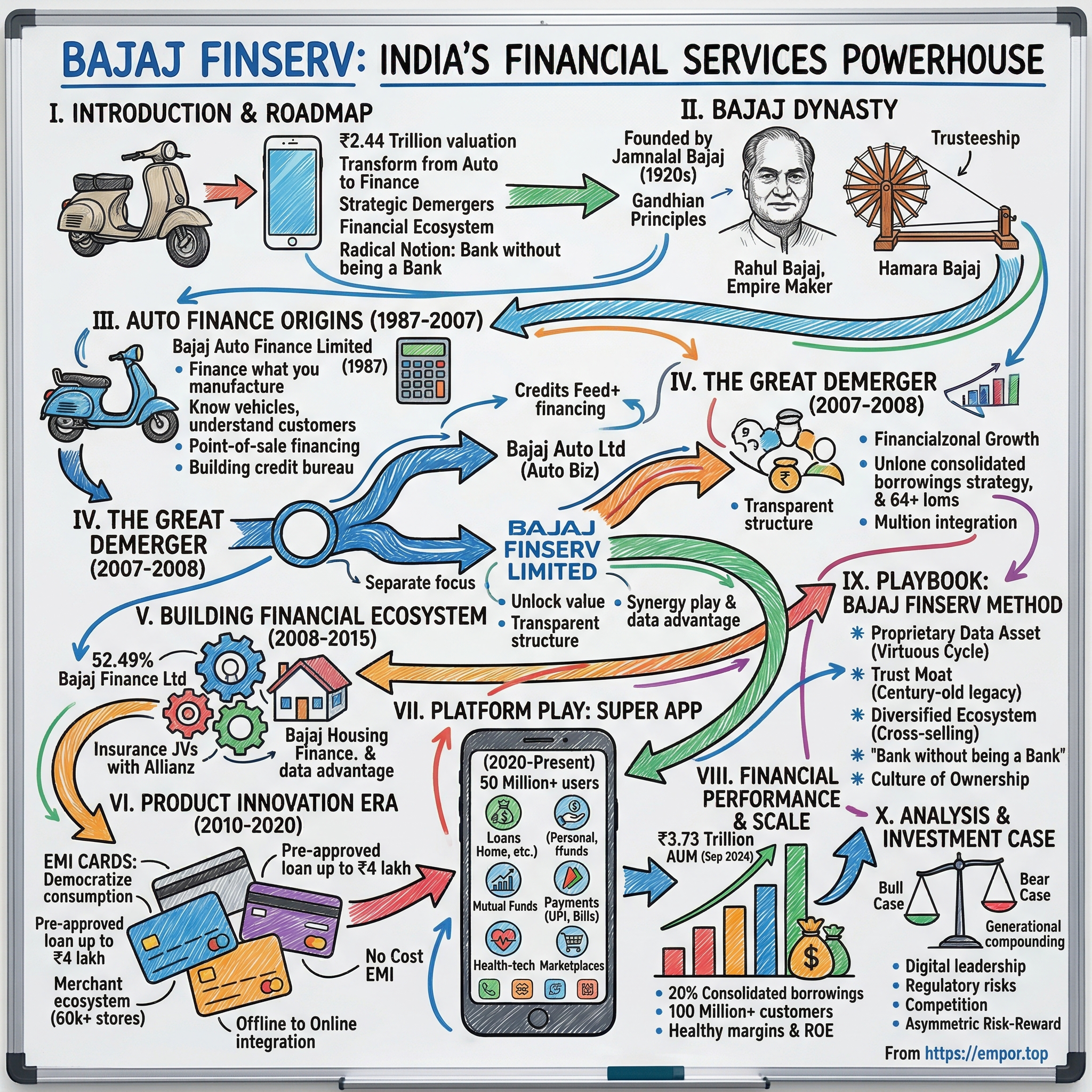
Bajaj Finserv: Can You Build a Bank Without Being a Bank?
I. Introduction & Episode Roadmap
Drive to Akurdi, on the industrial edge of Pune, and you will find the physical heart of the House of Bajaj: a sprawl of factory sheds, a corporate campus, and the ghosts of a scooter that an entire generation of Indians waited years to own. What you will not find is a branch of Bajaj Finserv. There are no tellers, no queue tokens, no fixed-deposit posters in the window. Bajaj Finserv does not lend money. It does not underwrite a single motor policy. It does not manage a rupee of anybody's mutual fund savings.
And yet, as of early August 2026, the market valued it at roughly ₹3.2 trillion.1
That is the puzzle worth two hours of your attention. Bajaj Finserv is a holding company — a legal container that owns pieces of other companies. Its largest asset, Bajaj Finance, is itself listed, and here is the part that trips up almost everyone encountering these tickers for the first time: the subsidiary is worth roughly twice the parent. Bajaj Finance (BAJFINANCE) carried a market capitalisation of about ₹6.9 trillion in early August 2026, against Bajaj Finserv's ₹3.2 trillion.2 Bajaj Finserv (BAJAJFINSV) owns 51.32% of it.3 Do the arithmetic and something strange falls out: that single stake, marked at market, is worth more than the entire parent company. Everything else Bajaj Finserv owns — two of India's largest private insurers, a listed housing financier, an asset manager, a health-tech venture, a digital marketplace — is being valued by the market at something between zero and negative.
That is either an enormous mispricing or an entirely rational verdict on what holding companies are worth. This episode is about which.
The portfolio itself is genuinely formidable. Through Bajaj Finance, the group runs India's largest retail non-bank lender, with assets under management of ₹5,46,944 crore as of 30 June 2026 and a customer franchise of 124.43 million people.4 Through Bajaj Life Insurance and Bajaj General Insurance — until recently Bajaj Allianz — it operates two top-five private insurers.5 Through Bajaj Housing Finance, in which Bajaj Finance holds 86.70%, it runs a ₹1.5 trillion mortgage book.36 It has an asset manager, a healthcare venture, a broking arm, and board approval, granted on 31 July 2026, to build a reinsurance company from scratch.7
Three questions frame everything that follows. First: how did a company incorporated in 1987 for the narrow purpose of financing Bajaj scooters become the anchor of India's largest diversified financial group? Second: why did the Bajaj family just spend roughly ₹24,180 crore — about $2.8 billion — buying out the German partner it had spent 24 years building two insurers alongside, and what does the structure of that purchase reveal about who the family works for?8 Third, and hardest: can a conglomerate of financial conglomerates out-compete both India's banks and Reliance's Jio Financial Services — a rival that, in a twist worthy of a screenwriter, is now building its insurance business with the exact partner Bajaj just paid to remove?9
Start where the money started.
 Subscribe on LinkedIn
II. Origins: From Gandhi's Freedom Struggle to the House of Bajaj
Every Indian business dynasty has a founding myth. The Bajaj myth is unusual in that it is largely true and largely political. Jamnalal Bajaj built his trading and manufacturing interests in the 1920s while simultaneously serving as treasurer of the Indian National Congress, funding the independence movement and hosting Mahatma Gandhi at his Wardha ashram. Gandhi called him his fifth son. That is not marketing copy invented by a brand consultant in 2015; it is the reason the group still writes about "trusteeship" in its shareholder communications, and it is the reason a hundred-year-old Bajaj brand mark still functions as collateral in Indian small towns where a lender's name is the only credit bureau that matters.
The industrial chapter belonged to Rahul Bajaj. He took over the group in 1968 at the age of thirty, a Harvard MBA returning to a licence-permit economy, and over the following decades grew Bajaj Auto's turnover from ₹7.2 crore to roughly ₹12,000 crore.10 The Bajaj Chetak scooter became the object of a waiting list that ran, at its worst, to a decade. "Hamara Bajaj" — our Bajaj — was not an advertising line so much as a demographic fact. For most of the twentieth century, the House of Bajaj meant two-wheelers, and financial services were an afterthought bolted onto the side of a manufacturing business.
The afterthought had its own incorporation date: 25 March 1987, when Bajaj Auto Finance Limited was registered for the entirely unromantic purpose of financing the parent's own two- and three-wheelers.11 Think about what that business actually was. A customer walked into a Bajaj dealership, could not pay cash for a scooter, and the captive finance arm wrote a small ticket loan against a vehicle it could identify, value, and repossess. It was a distribution appendage, not a franchise. For its first decade and a half it stayed that way.
Two things about this history matter for the investment question today, and both are double-edged.
The first is credibility. When Sanjiv Bajaj stands up in 2026 and asks the market to trust that a ₹24,180 crore cash transaction was disciplined capital allocation rather than a family whim, the asset he is drawing on is a century of the group not blowing itself up. In Indian financial services — a sector that has produced IL&FS, DHFL, Yes Bank, and a long tail of NBFCs that discovered their asset quality was fictional — an unbroken record of not detonating is worth real money in funding costs and regulatory latitude.
The second is that reputational capital is not the same as analytical proof. A family that underwrote conservatively for forty years can still overpay for an asset, and a brand that opens doors in Nashik does not tell you whether a personal loan written in 2026 will be repaid in 2029. The interesting question is not whether the Bajajs are trustworthy people. It is whether the specific decisions of the last five years hold up under the same scrutiny you would apply to a first-generation founder with no ancestral goodwill at all.
Which brings us to the decision that created Bajaj Finserv in the first place — and to the moment a father split his life's work between two sons.
III. The Demerger: Splitting Auto from Finance (2007–2008)
By the mid-2000s, Bajaj Auto had become an awkward animal. Inside one listed entity sat a motorcycle manufacturer competing with Hero Honda, an insurance joint venture with a German giant, a consumer lender, a wind-energy portfolio, and a large pile of investible cash. Analysts covering auto stocks were being asked to value insurance float. Analysts covering financials were being asked to have a view on 125cc engine displacement. Nobody was doing either well, and the conglomerate was almost certainly being priced at the lowest common denominator of its parts.
Rahul Bajaj's answer was structural surgery. The board approved a scheme of arrangement on 17 May 2007; shareholders and creditors approved it on 18 August 2007; the High Court of Bombay sanctioned it by order dated 18 December 2007; and the scheme took effect on 20 February 2008.12 Bajaj Finserv Limited had been incorporated on 30 April 2007 to receive the financial services businesses — the insurance joint ventures, the consumer finance arm, the wind-energy assets, and a slug of cash.13 Bajaj Auto Limited took the vehicles. Bajaj Holdings and Investment Limited was left as the residual investment vehicle holding large stakes in both.
The elegance was not only financial. Rahul Bajaj had two sons. Rajiv, the elder, an engineer who had spent years arguing with his father about product philosophy, took the auto business. Sanjiv, the younger, took financial services.14 Indian corporate history is littered with succession disputes that consumed decades and destroyed value — the Ambani split of 2005 being the most public. The Bajaj family pre-empted the fight by drawing the line before anyone had to. Each son got a listed company, a distinct industry, a separate scoreboard, and no reason to litigate over the other's.
What happened next is the strongest available evidence that structural clarity creates value in India. In 2008, the financial services piece was the junior sibling — a lender with roughly ₹2,500 crore of assets under management and ₹21 crore of annual profit.3 Two decades later, Bajaj Finserv and Bajaj Finance together are worth several multiples of Bajaj Auto. The market did not reward diversification; it rewarded legibility. Once each business had its own investor base, its own comparables, and its own cost of capital, capital flowed to the one compounding fastest.
There is a subtler lesson here that the group has since institutionalised. The 2007 demerger was not primarily about strategy — nothing operational changed on 21 February 2008 — it was about disclosure architecture. Separating the businesses forced each to report its own metrics, defend its own returns, and compete for capital on its own numbers. Managements that are made legible tend to behave better.
Bajaj has now run this playbook a second time, with the Bajaj Housing Finance listing in 2024, and has signalled a third and fourth run with the prospective insurance IPOs. It is worth naming it plainly, because it is the single most repeatable thing this group does: demerge or list a subsidiary, let the public market assign it a standalone multiple, and hope the parent captures some of the uplift.
The obvious objection — and we will return to it in the sum-of-the-parts discussion — is that this playbook has an internal contradiction. Every successful listing creates a new, visible, directly purchasable stake. If an investor can buy Bajaj Finance and Bajaj Housing Finance shares outright, the reason to own the parent that owns them shrinks rather than grows. The playbook that unlocked value in 2008 may be the same mechanism widening the parent's discount in 2026.
But that argument only bites if the underlying assets are worth owning. So let's go look at the one that matters most.
IV. Bajaj Finance: The Crown Jewel — Building India's Largest Consumer NBFC (2008–2020)
Picture an electronics shop in a district town in Uttar Pradesh around 2012. A schoolteacher wants a ₹22,000 refrigerator. She has perhaps ₹6,000. Her bank has never offered her a credit card, because her income is partly informal and her credit file is thin. In a properly functioning consumer credit market she is a perfectly good borrower — she has a salary, a fixed address, and every social incentive to repay. In the Indian market of 2012 she was, to the banking system, essentially invisible.
Bajaj Finance built a ₹5.5 trillion business by walking into that shop and making her visible.
The structural gap NBFCs were built to fill
To understand why a non-bank could beat banks at this, you need one piece of plumbing. A bank funds itself with current and savings deposits, on which it pays very little — often nothing. An NBFC cannot take those deposits. It borrows from money markets, banks, and (with a licence) fixed deposits, and it pays market rates. As of 31 December 2025, Bajaj Finance's cost of funds was 7.45%, and its borrowing mix was 51% money markets, 28% banks, 17% deposits and 4% external commercial borrowings.3 A large private bank funds a meaningful share of its book at a fraction of that.
So the NBFC starts every race carrying weight. It can only win in segments where the bank's cost advantage is outweighed by something else — speed, distribution, or willingness to underwrite customers the bank's models reject. Consumer durable finance in small-town India was exactly that segment: ticket sizes too small for a bank's cost structure, decision times measured in minutes rather than days, and physical presence required in places where branch economics do not work.
The EMI Card and the mechanics of a flywheel
The product innovation that made this scalable was the EMI Network Card. Strip away the marketing and it is a pre-approved credit line, issued to a customer already known to Bajaj, usable instantly at partner merchants to convert a purchase into equated monthly instalments. The "zero-cost EMI" construct — where the merchant or manufacturer subsidises the interest to close the sale — made it feel free to the customer while the lender still earned.15
The genius was not the card. It was what the card did to acquisition costs. A first loan is expensive to originate: you must find the customer, verify them, price unknown risk. Every subsequent loan to that same customer is dramatically cheaper, and — critically — better underwritten, because you now have repayment behaviour rather than a credit-bureau inference. Bajaj Finance turned a ₹22,000 refrigerator loan into a permanent relationship, then sold that relationship personal loans, gold loans, co-branded credit cards, insurance, fixed deposits, and eventually mortgages.
The numbers describe an extraordinary compounding machine. Between FY08 and FY25, the customer franchise went from 0.8 million to 101.8 million — a 33% annual compounding rate sustained for seventeen years. Assets under management grew from ₹2,500 crore to ₹4,16,700 crore, a 35% CAGR. Profit after tax went from ₹21 crore to ₹16,779 crore.3 By Q1 FY27, the franchise had reached 124.43 million customers across 4,073 physical locations and roughly 249,750 active distribution points, with 5.10 million new customers added in a single quarter.4
Here is what those figures actually tell you, stated plainly. The distribution network is not a moat because it is large; it is a moat because of what it costs to replicate. A competitor can raise capital in an afternoon and hire underwriters in a quarter. Building relationships with a quarter of a million merchants across four thousand towns, and keeping them, took Bajaj fifteen years and cannot be compressed with money alone. That is the most defensible claim the company makes.
The weaker claim — and it is worth separating them — is that the data is a moat. Bajaj has years of transaction history on 124 million customers. But India also has functioning credit bureaus, account aggregator infrastructure, and UPI transaction trails that any well-capitalised entrant can access. The proprietary edge in data is narrower than the proprietary edge in physical distribution, and management's own framing of the business as an AI-first "FINAI" company, unveiled at its investor day on 10 December 2024, implicitly concedes that the technology layer must be continuously rebuilt rather than harvested.16
Discipline, and the one time it was tested
For most of the last decade, the headline that defended the story was asset quality. Bajaj Finance ran net NPAs below 1% almost continuously from FY11 onward, with the ratio at 0.44% in FY25.3 For an unsecured-heavy consumer lender, that is genuinely unusual.
The stress test arrived in 2020. When India imposed one of the world's strictest lockdowns, a lender whose entire model depended on people walking into shops to buy things lost its origination engine overnight, and its borrowers — precisely the informally employed, thin-file customers the model was built to serve — lost income. The damage shows up cleanly in the long-run data: loan losses as a share of average assets jumped from 1.55% in FY19 to 3.10% in FY20 and 4.14% in FY21, while return on equity collapsed from 22.5% to 12.8%.3
The right reading of that episode is neither "the model broke" nor "the model was fine." Losses roughly tripled at the peak, which is what a cyclical unsecured book does in a genuine shock. But the company remained profitable throughout, did not require rescue capital on distressed terms, and had returns back above 22% by FY23. That is a real, multi-cycle data point — one of very few in Indian consumer lending — and it is the strongest empirical support the "quality growth" narrative has.
Where it sits in the pecking order
Scale needs context. Against pure-play NBFC peers — Cholamandalam, Muthoot Finance in gold, SBI Cards in co-brand plastic — Bajaj Finance is comfortably the largest and the most diversified, with a lending mix as of December 2025 spread across urban consumer (31%), mortgages (32%), MSME (14%), commercial (13%) and rural (10%).3 Against the banking system it is still a fraction of HDFC Bank's retail book. Bajaj Finance is the largest player in a segment banks historically under-served, not a challenger to the banking system's core.
That distinction mattered less when banks ignored the segment. It matters a great deal now that they don't — and it mattered enormously in November 2023, when the regulator walked in the front door.
V. Regulatory Reckoning and the Fintech Squeeze (2023–2024)
On 15 November 2023, the Reserve Bank of India ordered Bajaj Finance to immediately stop sanctioning and disbursing loans under two products: "eCOM" and the digital "Insta EMI Card."17 The stated concern was non-compliance with the RBI's digital lending guidelines — specifically, the failure to issue Key Fact Statements to borrowers, alongside deficiencies in how EMI cards were issued to new customers.17
A Key Fact Statement is, in essence, a one-page plain-language disclosure telling a borrower what the loan actually costs — the all-in annualised rate, the fees, the total repayment. The RBI had mandated it precisely because digital lending journeys are designed to be frictionless, and frictionless journeys are very good at helping people agree to things they have not read. The violation was not an accounting fraud or a hidden credit hole. It was a consumer-protection failure at the exact point where Bajaj's core competitive advantage — speed of decisioning — meets the regulator's core concern.
That is what made it serious. The RBI was not questioning the balance sheet; it was questioning whether the growth machine's velocity had outrun its compliance architecture.
The company moved. Restrictions were lifted with immediate effect on 2 May 2024, after what the RBI described as remedial measures, with Bajaj Finance stating it "remains committed to ensure adherence and compliance of regulatory guidelines."17 Roughly five and a half months of restriction on two digital products, in a business with dozens of product lines, was a survivable inconvenience — and considerably shorter than the fourteen-plus months HDFC Bank spent under credit-card sourcing curbs from 2020.17
But the honest analytical read has two parts. The favourable part: management fixed it fast, disclosed it, and the regulator was satisfied. The unfavourable part: the fix was to a specific documented deficiency, and the underlying tension — a business whose promise is instant credit, operating under a regulator increasingly focused on how instant credit is sold — has not been resolved by anything. It has only been managed. Regulatory risk at Bajaj Finance is demonstrated rather than theoretical, and that changes how a long-term investor should weight it.
The other thing that happened in the same twelve months
While Bajaj was remediating, Jio Financial Services was being built. Demerged from Reliance Industries and listed in 2023, JFS arrived with a parent's balance sheet, a telecom customer base measured in hundreds of millions, and no legacy book to protect.
Three years on, the scoreboard is more nuanced than the headlines suggested. Jio Credit, the NBFC arm, reported assets under management of ₹30,667 crore for the quarter ended June 2026, up 163% year on year, with disbursements up 173% to ₹11,252 crore.18 Growth rates like that are what an entrant produces from a small base. In absolute terms, Jio Credit's entire book is roughly 5.6% of Bajaj Finance's. The existential threat has not arrived on schedule.
What has arrived is a structural change in the competitive field. The RBI granted Airtel Money an NBFC licence on 13 February 2026, and MobiKwik, Flipkart and Amazon have all entered NBFC lending in the preceding year, whether by licence or acquisition.18 The point is not that any one of them will out-lend Bajaj. It is that consumer credit distribution is migrating toward whoever already owns the customer's daily digital attention — and Bajaj, for all its 249,750 merchant touchpoints, does not own a telecom network, a payments rail, or an e-commerce checkout.
Bajaj's answer was to rent one. On 20 January 2025, Bharti Airtel and Bajaj Finance announced a strategic partnership to distribute Bajaj's retail financial products through the Airtel Thanks app and, later, Airtel's retail stores — combining Airtel's 375 million customers and 1.2 million-strong distribution network with Bajaj's 27 product lines, 5,000-plus branches and 70,000 field agents.[^19] The initial products were gold loans, business loans, a co-branded Insta EMI card and personal loans, with roughly ten products planned within the calendar year.[^19]
Strategically, this is a sensible hedge and an implicit admission. Bajaj has the products and the underwriting; Airtel has the daily attention. But partnerships are rentals, not ownership. Airtel's own NBFC licence, granted thirteen months after the partnership was announced, is a reminder that today's distribution partner is tomorrow's competitor — and that Bajaj holds the weaker structural position in that relationship, because customer attention is scarcer than credit underwriting.
Management's own language shifted in this period toward "quality over speed." The generous interpretation is genuine recalibration by a lender that has seen a cycle. The skeptical interpretation is that a company whose long-term guidance corridor calls for 25–27% AUM growth, but which guided to 22–24% for FY27, has found a virtuous frame for a slower algorithm.319 Both can be true. The way to tell them apart is not rhetoric; it is whether credit costs stay inside the corridor while growth moderates — which, so far, they have.
If lending is the engine, though, insurance is where the group just made its biggest bet in two decades. And that bet is where the governance questions live.
VI. The Insurance Engine and the Allianz Divorce (2001–2026)
In 2001, India opened insurance to private capital and required foreign players to enter through joint ventures with local partners. Allianz SE, one of the largest insurers on earth, chose Bajaj. The logic was clean and mutually flattering: Allianz brought underwriting technology, actuarial depth and global reinsurance relationships; Bajaj brought a hundred-year-old brand and a distribution network into towns that Munich had never heard of. Two companies were born — Bajaj Allianz Life Insurance and Bajaj Allianz General Insurance — and over 24 years both became top-five private players in their markets.
How to read an insurer, in ninety seconds
Two businesses share a name and almost nothing else.
General insurance — motor, health, property — is a one-year contract repriced annually. It is judged on the combined ratio: claims plus expenses divided by premium earned. Below 100% means the underwriting itself made money; above 100% means the company lost money on insurance and is relying on investment income from float. Life insurance is a multi-decade contract, so annual profit is close to meaningless. It is judged on Value of New Business (VNB) — the present value of expected future profit from policies sold this year — and the VNB margin, that value as a percentage of premium written.
This distinction explains the single most confusing thing about Bajaj Finserv's reported numbers: the life insurer can post a collapsing profit and an excellent quarter simultaneously.
That is precisely what happened in Q1 FY27. Bajaj Life Insurance reported profit after tax of ₹51 crore, down 70.2% year on year, primarily on lower capital gains — while its VNB rose 86.6% to ₹271 crore and its new business margin expanded 480 basis points to 15.9%, absorbing a 290 basis point GST headwind along the way.5 Gross written premium grew 35.1% to ₹7,399 crore.5 On the same call, life CEO Tarun Chugh pointed to group protection business up 95% year on year.5 By the metric that measures long-term value creation, it was one of the better quarters the company has printed. By the metric that flows into the parent's headline profit, it looked like a disaster.
The general insurer had the opposite problem: honest numbers, harder truth. Gross written premium grew 11.3% to ₹5,789 crore, but profit fell 27.6% to ₹478 crore, and the combined ratio deteriorated to 104.7% from 103.6%.5 Management attributed this to soft pricing, particularly in motor, and described a deliberate tactical retreat from underpriced business — with CEO Tapan Singhel framing the discipline as selecting "businesses where the losses are better compared to other places."5
A combined ratio above 100% for a company of this scale is not a crisis; the Indian motor market is periodically brutal and most players cycle through underwriting losses. But it is a plain statement that this business is not currently earning money on the insurance itself. Investors being asked to value the insurance arms at a premium should hold that fact next to the promise.
Scale-wise, the general insurer is the stronger asset: second-largest private non-life player, with FY26 gross written premium of ₹23,326 crore and profit of ₹1,942 crore, against ICICI Lombard as the larger private competitor.2021 The life insurer ranked fifth by new business premium in FY26 at ₹14,600 crore, well behind SBI Life's ₹42,550 crore and HDFC Life's ₹36,646 crore — both of which enjoy the structural gift Bajaj does not have: a captive bank branch network to sell through.22
The divorce, and who paid for it
In October 2024, Bajaj Finserv disclosed that Allianz was actively considering exiting.23 On 18 March 2025, the terms landed: Allianz's 26% in each insurer would be acquired for ₹24,180 crore.8
Read the split of that purchase carefully, because it is the single most important governance fact in this story. Of the 26%, Bajaj Finserv — the listed company that public shareholders own — took approximately 1.01% in each. Bajaj Holdings & Investment Limited took approximately 19.95%. Jamnalal Sons Private Limited, the family's private vehicle, took approximately 5.04%.8
Then the endgame. The first major tranche of 23% completed on 8 January 2026, ending the joint venture arrangements and generating roughly €2.1 billion for Allianz, on which it expected an IFRS gain of about €1.1 billion.24 The final 3% was extinguished through a buyback by the insurers themselves on 12 March 2026 — which, by shrinking the share count, lifted Bajaj Finserv's holding from 75.01% to 77.33% without Finserv writing another cheque.25 The insurance companies were rebranded Bajaj Life Insurance and Bajaj General Insurance from October 2025, under a campaign built on the line "100% Bajaj."26
So here is the activist's question, and it deserves to be asked without hostility. The Bajaj group bought out its foreign partner for ₹24,180 crore. The overwhelming majority of that stake — roughly 25 of the 26 percentage points — went to family-controlled vehicles rather than to the listed company whose shareholders are told they own an insurance franchise. Bajaj Finserv's economic interest rose from 74% to 77.33%, most of that gain arriving free via the buyback.253
Two defensible readings exist. The charitable one: Bajaj Finserv did not have ₹24,180 crore of spare capital, the group did, and loading that much cash outflow onto the listed entity would have hammered its balance sheet for a marginal ownership gain. The uncharitable one: when a genuinely attractive asset came up for sale from a captive seller at a negotiated price, the family took the lion's share for its private vehicles and left the public company with scraps — and public shareholders are now being asked to applaud a "100% Bajaj" outcome in which their own vehicle owns 77%.
The financing added a further wrinkle. On 6 June 2025, Jamnalal Sons and Bajaj Holdings sold a combined 1.94% of Bajaj Finserv — about 31 million shares at a floor of ₹1,880, a 3.3% discount — raising roughly ₹5,828 crore.27 The promoters partly funded the purchase of insurance stakes for their private vehicles by selling down the listed company they were simultaneously asking the market to re-rate. Bajaj Holdings did buy Bajaj Finserv shares back in April 2026, which softens the signal.28 But the sequence is exactly the kind of thing a skeptical investor should log rather than wave through.
On valuation, ₹24,180 crore for 26% implies roughly ₹93,000 crore for the two insurers combined. Whether that was fair is genuinely arguable — bilateral negotiations with a departing partner have no clean comparable — and the honest answer is that the market will price it only when the insurers list. Which is precisely why the listing plan matters so much, and why the group's third demerger rehearsal is worth studying.
VII. Bajaj Housing Finance: Unlocking Value Through Listing (2024)
Sometimes a regulator does a company a favour by forcing it to do something it should have done anyway.
The RBI's scale-based regulatory framework designated certain large NBFCs as "upper layer" entities and required them to list within three years. Bajaj Housing Finance was one. So a mandatory compliance exercise became a live experiment in a question the group had been circling for years: what does the public market actually pay for a clean, well-underwritten Bajaj lending business when it can buy it directly?
The answer was emphatic to the point of absurdity. The IPO, which raised ₹6,560 crore through a ₹3,560 crore fresh issue and a ₹3,000 crore offer for sale by Bajaj Finance, opened on 9 September 2024 at a price band of ₹66–70 and was subscribed 63.61 times.29 It listed on 16 September 2024 at ₹150 against the ₹70 issue price — a 114% first-day gain.29 The company had filed its draft papers with SEBI only months earlier.30
A doubling on listing day is not a compliment to the pricing process; it is evidence that the shares were placed materially below what the market would bear. But the strategic signal was unambiguous. Investors would pay a very full price for a standalone, transparent, pure-play Bajaj lender — and were paying nothing like it for the same asset buried inside a holding company.
The business underneath has continued to perform, quietly. In Q1 FY27, assets under management grew 24.3% to ₹1,49,624 crore, profit rose 22.6% to ₹715 crore, disbursements jumped 33.2% to ₹19,509 crore, and gross NPAs sat at 0.29%.5 Return on equity was 12.5% annualised — roughly 800 basis points below Bajaj Finance's 20.4%.54
That gap is the whole point of the asset, and it is worth stating clearly rather than treating as a flaw. A prime mortgage against a house at a modest spread is a fundamentally lower-risk, lower-return business than an unsecured personal loan. Bajaj Housing Finance is a ballast asset: it lengthens the group's duration, diversifies away from unsecured consumer credit, and dilutes blended returns. It competes in the most crowded pool in Indian lending — against a merged HDFC Bank, LIC Housing Finance, PNB Housing and every bank with a home loan desk — where the marginal lender is almost always a bank with cheaper deposits. Growing a mortgage book at 24% in that environment while holding NPAs at 0.29% is a real operating achievement; earning bank-like returns on it is not something anyone should expect.
The listing also created a structural asymmetry that recurs throughout this story: Bajaj Finance holds 86.70% of it, so Bajaj Finserv's interest is a 51.32% claim on an 86.70% claim.3 Every layer between a public shareholder and an operating asset is a layer the market discounts. The group has now built three of them.
VIII. The Optionality Businesses: Asset Management, Health, and Bajaj Markets
The remaining pieces of the portfolio deserve exactly as much space as their economics justify, which is not much — a discipline the group's own press coverage does not always observe.
Bajaj Finserv Asset Management launched mutual fund operations in March 2023, entering an industry where scale is destiny and the incumbents have thirty-year head starts. Assets under management reached ₹31,444 crore in Q1 FY27, up 25.7%.5 Management has targeted ₹1 lakh crore within three years.5 Against SBI Mutual Fund and HDFC Mutual Fund, both managing multiples of that, this is a rounding error today. The genuine optionality is distribution: a fund house with access to 124 million existing lending customers has a customer-acquisition advantage no independent AMC can buy. Whether that converts is unproven — cross-selling a systematic investment plan to a consumer-durable borrower is a materially harder sale than cross-selling another loan.
Bajaj Finserv Health is the healthcare-fintech bet, integrating insurance, financing and care access, and now including Vidal Healthcare Services as a wholly owned subsidiary.3 It processed roughly six million transactions in Q1 FY27.5 Management guided on the Q1 FY27 call to quarterly break-even around Q3–Q4 of FY28 — meaning it will consume capital for roughly two more years before it stops being a drag.5 The strategic logic is sound: healthcare is the largest single driver of household financial distress in India, sitting at the exact intersection of lending and insurance. The execution evidence is not yet there.
Bajaj Finserv Direct, which operates the Bajaj Markets platform, is the group's super-app layer — 80.1% held by Bajaj Finserv with 19.9% via Bajaj Finance — with quarterly break-even guided to Q3–Q4 FY27 and direct operating revenue of ₹107 crore in Q1 FY27.35
Here a note of scepticism is warranted, and it is not company-specific. Indian fintech's super-app graveyard is well populated: Paytm built enormous engagement and struggled for years to convert it into durable profit; PhonePe dominates payments volume while monetisation remains the perennial question. The pattern is that owning a customer's app screen is not the same as owning their financial wallet share. The bar for Bajaj Markets should therefore be evidence of incremental originations that would not otherwise have happened — not app downloads, not monthly active users. That evidence has not been disclosed in a form that permits verification.
Taken together, these three are call options funded by the cash-generative core, sized at a level where failure would be embarrassing rather than material. That is a defensible way to run a portfolio. It becomes indefensible only if the options stop being options and start being subsidies — which is precisely what the break-even guidance is there to prevent, and precisely what investors should hold management to.
Which brings us to the arithmetic of the whole structure.
IX. Financial Architecture: Reading a Holding Company
There is a specific moment in every quarterly Bajaj Finserv results release where a reader's brain trips. Q1 FY27 is a perfect example: consolidated total income of ₹42,037 crore, up 19.1%; consolidated profit after tax of ₹6,297 crore, up 18.2%; and profit attributable to owners of ₹3,132 crore, up 12.3%.531
Two profit figures, half the money missing between them, and a growth rate six percentage points lower on the one that counts.
That gap is the holding company, made visible. Bajaj Finserv consolidates 100% of Bajaj Finance's revenue and profit into its own accounts because it controls the company — but it owns only 51.32% of it.3 The other 48.68% belongs to Bajaj Finance's own shareholders and is stripped out as minority interest. The same is true down every branch: 86.70% of Bajaj Housing Finance sits inside Bajaj Finance, so Bajaj Finserv's true economic claim on a housing-finance rupee is roughly 44 paise. When Bajaj Finance grows profit faster than the group average — as it did in Q1 FY27, up 27.6% — most of that outperformance accrues to minorities.
This is why consolidated growth rates flatter Bajaj Finserv and attributable growth rates deflate it, and why a comparison of consolidated PAT against the sum of subsidiary PATs is one of the most useful sanity checks an investor can run on this structure.
Where the value actually is
For the full year FY26, Bajaj Finserv reported consolidated total income of ₹1,50,530 crore, up 13%, and profit attributable to owners of ₹9,801 crore, up 10% from ₹8,872 crore in FY25.32 By revenue contribution in Q1 FY27, Bajaj Finance accounted for roughly 55% of the group total, life insurance 24% and general insurance 21%.5
But revenue share understates the concentration of value. Run the sum-of-the-parts. Bajaj Finserv's 51.32% of Bajaj Finance, marked against Bajaj Finance's roughly ₹6.9 trillion market capitalisation, is worth on the order of ₹3.5 trillion.23 Bajaj Finserv's entire market capitalisation was approximately ₹3.2 trillion.1
The stake alone exceeds the parent. Everything else — a 77.33% interest in two top-five insurers, an indirect claim on a listed mortgage lender, an asset manager, a health venture, a marketplace, and a fresh reinsurance licence application — is being assigned a negative number by the market.
Why the discount exists, and whether it can close
Indian holding companies routinely trade at 25–50% discounts to net asset value, and sometimes far wider. The mechanisms are well understood and mostly rational.
The first is tax and friction. A holding company cannot costlessly convert a stake into cash for shareholders; selling triggers capital gains, and dividends upstream may be taxed at multiple levels. Net asset value is therefore never fully accessible.
The second is control without cash flow. A minority shareholder in Bajaj Finserv has no ability to force a subsidiary to pay a dividend, sell an asset, or return capital. They own an economic claim on decisions somebody else makes.
The third, and most important here, is redundancy. When both the parent and the crown-jewel subsidiary are listed, an investor who wants exposure to Bajaj Finance can simply buy Bajaj Finance. The only reason to own the parent instead is if the non-Finance assets are worth more than the discount — a bet on insurance, essentially, wrapped in a structure that makes it hard to value.
Sanjiv Bajaj's answer to the discount has been consistent: increase ownership, simplify governance, and list the subsidiaries so the market prices them explicitly. That is a coherent theory. But note the tension. Full insurance ownership does genuinely remove joint-venture veto friction — Allianz's consent was previously required for major decisions, including a listing. Yet listing the insurers would convert them into directly purchasable stocks, reproducing exactly the redundancy problem that Bajaj Finance and Bajaj Housing Finance already create. The restructuring may reveal value without transferring it to the parent's shareholders.
The current print offers a snapshot of a group executing well operationally while this structural question stays unresolved. Lending is compounding at a mid-twenties rate with gross NPAs near multi-year lows at 0.96%. The life insurer is producing its strongest new-business value in years. The general insurer is underwriting at a loss. And the parent's attributable profit is growing at roughly half the rate of its main subsidiary's.45
The person responsible for closing that gap has been in the chair since the beginning.
X. Management: Sanjiv Bajaj's Playbook
Sanjiv Bajaj occupies one of the most concentrated capital-allocation seats in Indian business. He is Chairman and Managing Director of Bajaj Finserv, and he chairs Bajaj Finance, Bajaj Housing Finance, both insurance companies and the asset manager.33 There is no meaningful capital decision anywhere in this group that does not cross his desk.
That concentration cuts both ways. It enables genuine cross-group allocation — moving capital from the cash-generative lender toward the sub-scale AMC, or funding an insurance buyout across three entities — of a kind that federated structures manage badly. It also means there is no independent check inside the group on the chairman's judgment, and the family holds roughly 58.7% of Bajaj Finserv as of June 2026.34 High alignment and low accountability are the same fact viewed from two angles.
The operating layer has its own gravitational centre. Rajeev Jain took over Bajaj Finance in 2007, cleaned up the legacy book, absorbed the losses, and rebuilt it around consumer and retail lending.15 His voice on earnings calls is a genre unto itself: micro-level, deliberately unglamorous, allergic to macro commentary. On the Q1 FY27 call he called it an "excellent quarter" across every metric — and then declined to raise guidance, saying "one swallow doesn't make a summer" and that he would wait another quarter.19 Asked about competitive pressure, he dismissed the framing: "competitive intensity is a way of life for every line of business."19
There is a specific credibility test buried in that exchange. A management team that beats a quarter and immediately raises full-year guidance is optimising for the stock. One that beats and holds is optimising for the guidance's own credibility. Bajaj Finance has consistently done the latter, and has published explicit long-term corridors — AUM growth 25–27%, profit growth 23–24%, GNPA 1.2–1.4%, NNPA 0.4–0.5%, ROA 4.3–4.7%, ROE 19–21% — that make it easy to catch them missing.3 Publishing falsifiable targets is itself a governance signal; most Indian financials do not.
Where the record is less flattering
Three items belong in the ledger against.
The Q3 FY26 presentation. In the December 2025 quarter, Bajaj Finance took a ₹1,406 crore accelerated expected-credit-loss provision after introducing a minimum loss-given-default floor across businesses, plus a ₹265 crore one-time charge from India's new labour codes. Reported profit fell 6% to ₹4,066 crore; excluding those items it rose 23% to ₹5,317 crore.335 The company's investor presentation led with the pre-charge figures, headlining the executive summary as results "before accelerated ECL provision & one-time charge."3 The provision itself looks genuinely prudent — raising loss assumptions when nothing has gone wrong is the opposite of earnings management, and several brokerages read it that way.35 But leading a results deck with the number that excludes the bad news is a presentational choice worth noticing, especially from a company that sells discipline.
The insurance IPO reversal. In November 2017, Sanjiv Bajaj told the press there was no IPO in the offing for the Bajaj Allianz insurance companies.36 In 2026, listing them is the group's headline value-unlock catalyst, with boards evaluating over a one-to-two-year horizon and Sanjiv Bajaj describing a four-to-five-year window while noting FY27 is too early.37 Circumstances genuinely changed — Allianz's exit removed a partner whose consent mattered. But a nine-year reversal on a strategic question deserves to be described as a reversal, not retconned as a plan.
Target-setting precision. In July 2025, the group set a target of 250 million customers within four years.38 In December 2025, its 2026–2030 long-range strategy targeted over 220 million active customers, from over 100 million then, alongside consolidated net profit of ₹21,000–24,000 crore implying an 18–22% CAGR, with Bajaj Finance aiming to lift retail market share to 3.6–4% from 2.8%.37 The two customer targets are not obviously reconcilable without knowing whether "active" and "total" are being measured the same way — and the group has not always spelled out the difference. Sanjiv Bajaj framed the strategic upside plainly: completing the Allianz buyout and becoming a fully Bajaj-owned company "will enable us to look at how we can put excess capital to use."37
The stress test
Put yourself in the seat of a skeptical allocator in March 2025. Bajaj Finserv trades at a substantial discount to the value of its listed stakes. The group has roughly ₹24,180 crore of deployable capital. Option A: buy out a joint-venture partner at a negotiated price in a bilateral deal with no market test. Option B: buy back the group's own listed equity at a discount to its own transparently observable net asset value.
Option B is the textbook answer, and it is not obviously available at scale — buybacks of that size run into promoter-holding ceilings and would not have removed the joint-venture governance constraint. Option A bought strategic freedom that Option B could not.
But note what the structure of Option A actually delivered to the listed company's shareholders: a rise in economic interest from 74% to 77.33%, most of it arriving via a buyback rather than a purchase, while the family's private vehicles absorbed roughly 25 percentage points.825 The strategic freedom is real and the governance friction is genuinely gone. Whether Bajaj Finserv's public shareholders got proportionate value for the group's largest capital deployment in two decades is a question the eventual insurance IPO pricing will answer, and not before.
XI. Industry Structure, Moats, and Competitive Position
War-game the position properly, and the picture that emerges is of a very strong operator in a structurally deteriorating industry.
Porter's five forces, applied to Indian consumer NBFC lending
Rivalry: intensifying, and the most important force. Banks that ignored small-ticket consumer credit for two decades now want it. Jio Financial is building an integrated fintech-NBFC at Reliance scale. Airtel Money, MobiKwik, Flipkart and Amazon have all obtained lending capability within roughly the last year.18 Credit is a commodity; the differentiators are cost of funds, distribution, and underwriting. Two of those three are moving against Bajaj.
Buyer power: high and rising. A borrower comparing an unsecured personal loan on three apps faces essentially zero switching cost. There is no loyalty in a commoditised product priced in basis points. Bajaj's counter is the pre-approved, instantly available line offered to a customer already inside the franchise — convenience as a substitute for stickiness. It works, but it is a behavioural moat, not a contractual one.
Supplier power: moderate, and structural. For a lender, the supplier is capital. Bajaj funds at 7.45% against banks that fund a large share of their books far cheaper.3 Its deposit licence helps — the deposit book reached ₹71,037 crore, or 17% of consolidated borrowings, by December 2025 — but 17% is not a banking franchise.3 This disadvantage does not go away with scale; it goes away only with a bank licence.
New entrants: barriers lower than they were. Capital is abundant, licences are obtainable, and credit bureaus plus account aggregator infrastructure have partially commoditised the data advantage. What has not commoditised is physical distribution across four thousand towns and merchant relationships built over fifteen years.
Substitutes and regulation. Formally, the substitute for credit is savings — a weak force in a young, aspirational, under-penetrated market. Informally, the sixth force in India is the RBI, and it acts like one: digital lending rules, KYC norms, scale-based regulation and the November 2023 order all demonstrate a regulator willing to intervene directly in product design and growth.
The 7 Powers question
Of Hamilton Helmer's seven durable advantages, Bajaj Finance can credibly claim two and a half.
Scale economies are real and measurable. Operating expenses as a share of net total income fell from 58.1% in FY08 to 33.2% in FY25, with management guiding to a further 25–40 basis point improvement in FY27.319 Spreading a fixed technology and collections platform across 124 million customers is a genuine cost advantage, and it is the mechanism behind the "lowest-cost financial service provider" ambition.
Process power — the accumulated organisational capability to underwrite thin-file consumers at speed without blowing up — has the strongest evidence behind it: seventeen years of sub-1% net NPAs through a pandemic. This is the kind of advantage that resides in thousands of small decisions and cannot be bought.
Branding is the half. The Bajaj name genuinely lowers acquisition friction in Tier 3 India in a way a new entrant's does not. But brand in lending mostly reduces customer suspicion; it does not command a price premium, because nobody pays extra interest for a nicer logo.
What Bajaj Finance does not have is equally instructive. There are no network effects: one more Bajaj borrower does not make the product better for existing borrowers. There is no switching cost in the software sense — no data lock-in, no integration pain. There is no counter-positioning, because Bajaj is now the incumbent that entrants counter-position against, which is precisely how Bajaj itself beat the banks in 2010. And there is no cornered resource.
Where the "why it wins" case is weakest
Three things, stated without hedging.
First, unsecured lending economics compress when better-funded competitors chase the same borrower. Bajaj's own FY27 guidance of 22–24% AUM growth sits below its published long-term corridor of 25–27%.319 That is the growth algorithm moderating in real time.
Second, the insurance businesses are sub-scale relative to bank-owned peers with captive bancassurance. SBI Life and HDFC Life sell through thousands of bank branches whose customers arrive already trusting the institution. Bajaj must build affiliate-style distribution to compete — which is more expensive per policy and harder to defend.
Third, the group's most valuable structural advantage, physical distribution, is depreciating at an unknown rate. Every year that Indian financial services shifts further toward app-based origination, the strategic value of a merchant counter in a district town declines relative to a screen a customer looks at forty times a day. Bajaj has responded by renting attention through Airtel and by pushing app-led originations — with 24.02 million app downloads in Q1 FY27 alone and roughly 20% of personal loan disbursements now driven by AI and digital channels.419 That is adaptation, and it appears to be working. It is not the same as owning the channel.
Myth versus reality
Three consensus beliefs deserve fact-checking.
Myth: Bajaj Finserv is a diversified financial services company. Reality: it is a Bajaj Finance holding vehicle with insurance attached. One stake exceeds the parent's entire market value.123
Myth: Jio Financial is eating Bajaj Finance's lunch. Reality: not yet in the numbers. Jio Credit's ₹30,667 crore book is roughly 5.6% of Bajaj Finance's, and Bajaj added ₹36,969 crore of AUM in a single quarter — more than Jio Credit's entire balance sheet.418 The threat is to future pricing and future share, not to current scale.
Myth: buying out Allianz made Bajaj Finserv the 100% owner of two insurers. Reality: the group holds 100%; the listed company holds 77.33%, with the balance in family vehicles.25
XII. Bull Case, Bear Case, and What to Watch
The bull case
The bull case does not require heroic assumptions, which is its main strength.
The core asset compounds. Bajaj Finance has grown assets under management at a 35% annual rate over seventeen years and profit at 48%, through demonetisation, a shadow-banking credit crisis, a pandemic and a regulatory order.3 It added a record ₹36,969 crore of AUM in the June 2026 quarter alone while gross NPAs improved to 0.96% and return on equity reached 20.4%.4 Growth and credit quality moving in the right direction simultaneously is uncommon in lending and is the single most persuasive fact in the file.
The insurance path is now clear. With joint-venture governance removed, both insurers can be listed on the group's timetable rather than a partner's. If the Bajaj Housing Finance listing is any guide, public markets pay generously for clean Bajaj assets.
Distribution keeps deepening. Roughly 250,000 active distribution points, 4,073 locations and a 124-million customer franchise still growing by five million a quarter constitute an asset that money alone cannot buy at speed.4
And management has skin in the game and a habit of publishing falsifiable targets — a combination that at minimum makes the story auditable.
The bear case
The bear case is not that anything breaks. It is that several things grind.
Unsecured lending economics compress structurally as banks, Jio Financial, telcos and e-commerce platforms all chase the same borrower with cheaper capital. Bajaj's funding disadvantage is permanent absent a bank licence.
Regulatory risk is demonstrated rather than hypothetical, and the fastest-growing, highest-margin part of the business is precisely the part the regulator watches most closely.
The holding-company discount may be structural rather than fixable. Two decades of restructuring have not closed it, and every new listing arguably widens it by creating another directly purchasable alternative to the parent.
The Allianz buyout is a very large, very recent, and largely irreversible capital deployment whose payoff — successful insurance IPOs at attractive multiples — is entirely unproven. And the general insurer's combined ratio above 100% is a reminder that the asset being valued is not currently earning money from underwriting.5
Then there is the risk nobody models: the succession seat. Sanjiv Bajaj chairs everything. There is no publicly disclosed succession plan for that role, and the concentration that makes group-level allocation possible is also a single point of failure.
The Berkshire comparison, handled carefully
The obvious analogy is Berkshire Hathaway — insurance float funding everything else. It is worth invoking mainly to show where it breaks.
Berkshire's model works because well-underwritten insurance generates float at negative cost: policyholders hand over money years before claims are paid, and if the combined ratio is below 100%, the insurer is paid to hold it. Bajaj's general insurer is running above 100%, meaning its float currently carries a cost, not a credit.5
More fundamentally, the direction of capital is reversed. At Berkshire, insurance funds the rest. At Bajaj, lending generates the profit that funds the insurance ambitions, the asset manager, the health venture and the reinsurance plan. That is a different machine with different failure modes — chiefly that it depends on one cyclical, credit-exposed business staying healthy, whereas Berkshire's float is structurally less correlated to a consumer credit cycle. The frame is useful for thinking about capital flowing from a cash engine to call options. It should not be extended further.
What to actually track
Three metrics, no more.
One: Bajaj Finance's AUM growth alongside its credit costs. These must be read as a pair, never separately. AUM growth alone can always be bought by loosening underwriting; credit costs alone can always be flattered by not lending. The published corridors — 25–27% AUM growth, GNPA 1.2–1.4%, loan losses running around 1.5% of average assets — make it easy to see when growth is being purchased with risk.34 If growth accelerates while loan losses climb, the quality narrative is over.
Two: Bajaj Life's VNB margin and Bajaj General's combined ratio. These are the only honest measures of whether the insurance businesses are creating value, and they are the numbers on which any IPO will be priced. Reported insurance profit is noise; these are signal.
Three: consolidated attributable profit growth versus subsidiary profit growth. This is the holding company's own scorecard. When Bajaj Finance grows profit 27.6% and Bajaj Finserv's attributable profit grows 12.3%, that gap measures exactly how much of the group's success reaches the parent's shareholders.5 Watching it narrow or widen over several years is the most direct test of whether the holdco structure is working for the people who own it.
XIII. What's Next: Insurance IPOs, Digital Banking, and the Next Decade
Four things sit on the horizon, in descending order of how much they matter.
The insurance listings are the main event. Boards are evaluating, the process is expected to take one to two years, and management has indicated FY27 is too early while describing a roughly four-to-five-year window.37 Everything about the Allianz transaction ultimately gets marked to market here. If the insurers list at multiples comparable to HDFC Life or ICICI Lombard, the ₹24,180 crore purchase will look like disciplined opportunism and the sum-of-the-parts argument gets a hard number. If they list at a discount — plausible for a life insurer ranked fifth by new business premium and a general insurer underwriting above 100% — the transaction will look like the family paid a strategic premium to remove a partner.522 Note also who Bajaj will be pitching against: Allianz is now building general, health and life insurance in India with Jio Financial through a 50:50 joint venture announced on 22 April 2026, having already launched Allianz Jio Reinsurance, which received IRDAI approval on 12 March 2026 and commenced operations that month.939 The partner Bajaj paid to exit took its capital, its underwriting technology and its India ambition straight to Bajaj's most formidable competitor.
Reinsurance is the newest and least-tested move. Bajaj Finserv's board approved entry into reinsurance through a wholly owned subsidiary on 31 July 2026, subject to IRDAI approval, with phase one focused on domestic business; capital requirements were not disclosed.75 India's reinsurance market has long been dominated by state-owned GIC Re, and private entry is a genuine opening. It is also a capital-intensive, expertise-scarce, long-tail business being entered by a group that has just lost the global reinsurance relationship it enjoyed for 24 years. This is the first move in a decade that reads as diversification for its own sake, and it deserves close scrutiny rather than benefit of the doubt.
The banking question remains open. Every structural disadvantage in Bajaj Finance's model traces back to one thing: it cannot take current and savings deposits. A bank licence, or a regulatory pathway converting large NBFCs into banks, would compress that gap. The RBI has been persistently cautious about corporate-owned banks, and no such pathway currently exists for a group of this shape. Treat it as unpriced optionality rather than a plan.
And the super-app has to prove itself. Bajaj Finserv Direct guiding to quarterly break-even in Q3–Q4 FY27 is the near-term checkpoint.5 Break-even would establish it as a self-funding channel. It would not, by itself, establish that it is a platform.
Underneath all of it sits the governance template. The sibling split — Rajiv at Auto, Sanjiv at Finserv, each with a separate listed vehicle and a separate scoreboard — is now studied by other Indian family conglomerates precisely because it avoided the litigation that has consumed comparable houses. Rahul Bajaj died on 12 February 2022 at 83, having seen both halves of his split succeed.10 The unanswered question is what happens at the next generational handover, when the assets are larger, the family tree wider, and there is no obvious second business to hand to a second child.
XIV. Epilogue & Lessons
Three things travel beyond this company.
The demerger playbook is real, repeatable, and self-limiting. Bajaj has now run it three times — the 2007 split, the 2024 housing finance listing, the prospective insurance IPOs — and each time the market has paid more for the legible piece than it paid for the same asset inside a conglomerate. The lesson for conglomerate investors is that structural clarity has measurable value. The caveat is the trap Bajaj is now in: once you have listed the crown jewel, you have given investors a way to own it without owning you. Value unlocked is not the same as value captured.
Distribution and underwriting discipline are genuine multi-decade moats, and they erode gradually. Seventeen years of 35% asset growth with sub-1% net NPAs is not luck; it is process power built one collections decision at a time. But moats of this type do not fail catastrophically — they thin. Each year, a little more origination moves to a screen owned by somebody else, and a little more of the underwriting edge becomes available to anyone with a bureau feed and a data science team. Nothing about Bajaj Finance's current numbers suggests the moat has failed. Everything about the competitive landscape suggests it is being narrowed.
Strong subsidiaries do not guarantee a strong parent. This is the uncomfortable lesson of holding-company investing, and Bajaj Finserv is one of the cleanest illustrations available anywhere. An investor can be entirely right that Bajaj Finance is an excellent business and entirely wrong about what owning 51.32% of it through a listed intermediary is worth.
Which returns us to the question in the title. Bajaj has built something that does most of what a bank does — lends, insures, manages savings, takes deposits — without a banking licence, and has done it profitably for two decades. But it does so carrying a permanent funding disadvantage, under a regulator that has shown it will intervene directly, against competitors who own the customer's screen.
The real test is not whether Bajaj Finance keeps compounding. It largely has, through every stress the Indian financial system has produced this century. The test is whether Sanjiv Bajaj can demonstrate that the parent is worth more than the sum of stakes an investor could otherwise assemble directly — that centralised allocation across lending, insurance, asset management and health creates something that the pieces, held separately, would not.
Two decades of restructuring have not yet produced that proof. The insurance IPOs are the next opportunity to find it.
References
-
Bajaj Finserv Ltd — Screener.in company page (financials, shareholding, filings index) ↩↩↩
-
Bajaj Finance (NSE:BAJFINANCE) Market Cap & Net Worth — StockAnalysis ↩↩↩
-
Bajaj Finance Q3 FY26 Investor Presentation — Bajaj Finance, 2026-02-03 ↩↩↩↩↩↩↩↩↩↩↩↩↩↩↩↩↩↩↩↩↩↩↩↩↩
-
Bajaj Finance Q1 FY27 slides: 28% profit surge, ROE tops 20% — Investing.com, 2026-07-24 ↩↩↩↩↩↩↩↩↩
-
Bajaj Finserv Q1 FY2027 slides: lending drives 19% revenue growth — Investing.com, 2026-07-31 ↩↩↩↩↩↩↩↩↩↩↩↩↩↩↩↩↩↩↩↩↩↩
-
Q1 2027 Bajaj Housing Finance Ltd Earnings Call Transcript — GuruFocus, 2026-07 ↩
-
Bajaj Finserv enters reinsurance; third private player in one year — Business Standard, 2026-07-31 ↩↩
-
Bajaj Finserv to buy Allianz's 26% stake in Bajaj Allianz Life and General Insurance for ₹24,000 crore — Bajaj Group, 2025-03-18 ↩↩↩↩
-
Jio Financial Services and Allianz to form 50:50 primary insurance joint venture — Allianz, 2026-04-22 ↩↩
-
Industrialist Rahul Bajaj passes away at the age of 83 — Business Today, 2022-02-12 ↩↩
-
Bajaj Finserv Investor Relations — Shareholders Information & Listing ↩
-
Bombay High Court approves Bajaj Auto demerger — DNA India ↩
-
How Bajaj Finance came up with an innovative strategy to expand its customer base — Business Today, 2024-04-03 ↩↩
-
Bajaj Finance Investor Day: Shares gain as mgt eyes becoming FINAI by FY29 — Business Standard, 2024-12-11 ↩
-
RBI lifts restrictions on Bajaj Finance's eCOM, Insta EMI Card with immediate effect — Business Today, 2024-05-02 ↩↩↩↩
-
Jio Financial Q1: NBFC arm sees 173% rise in loan disbursements, payments bank users near 4 million mark — MediaNama, 2026-07 ↩↩↩↩
-
Earnings call transcript: Bajaj Finance posts strong Q1 rebound — Investing.com, 2026-07-24 ↩↩↩↩↩↩
-
Bajaj Finserv FY26 Revenue ₹150,530 Cr; Acquires 26% Stake in Insurers — Whalesbook ↩
-
Non-life insurers' premium grows 6.2% to ₹3.08 trillion in FY25 — Business Standard, 2025-04-09 ↩
-
LIC, SBI and HDFC: Top three life insurers in terms of new business premium — Cafemutual ↩↩
-
Allianz actively considering exiting insurance JVs: Bajaj Finserv — Business Standard, 2024-10-22 ↩
-
Completion of divestment of first major tranche in Bajaj Joint Ventures — Allianz, 2026-01-08 ↩
-
Bajaj Finserv Completes Acquisition of Remaining 3% Stake from Allianz SE — ScanX, 2026-03-12 ↩↩↩↩
-
Bajaj Finserv rebrands insurance units following Allianz SE acquisition — Business Standard, 2025-10-07 ↩
-
Bajaj Finserv promoters divest 1.94% stake in ₹5,828 crore block deal — Business Standard, 2025-06-05 ↩
-
Bajaj Holdings & Investment acquires 20.90 lakh equity shares in Bajaj Finserv — Business Standard, 2026-04-28 ↩
-
Bajaj Housing Finance ₹6,560 crore IPO: price band, issue size, listing date — Outlook Business ↩↩
-
Bajaj Housing Finance files papers with SEBI for ₹7,000 crore IPO — Business Standard, 2024-06-08 ↩
-
Bajaj Finserv Q1 result: Profit rises 12% to ₹3,132 cr, total income up 19% — Business Standard, 2026-07-31 ↩
-
Bajaj Finserv Board Approves Record FY26 Results, Announces Special Dividend — ScanX, 2026-04-30 ↩
-
Bajaj Finance Q3FY26 results: Net profit declines 6% to ₹4,066 crore — Business Standard, 2026-02-03 ↩↩
-
No IPO for Bajaj Allianz general, life insurance companies: Sanjiv Bajaj — Business Standard, 2017-11-05 ↩
-
Bajaj Finserv targets a 22% profit CAGR, double customers in 5 years — Business Standard, 2025-12-07 ↩↩↩↩
-
Bajaj Finserv sets new target of 250 million customers within four years — Business Standard, 2025-07-01 ↩
-
Allianz Jio Reinsurance Limited commences operations — Allianz, 2026-03-26 ↩
 LinkedIn
 WhatsApp
 Reddit
 Hacker News
 Email
Email Kindle
 RSS Feed
 Spotify
 Apple Podcasts
 Amazon Music
 Audible
 YouTube