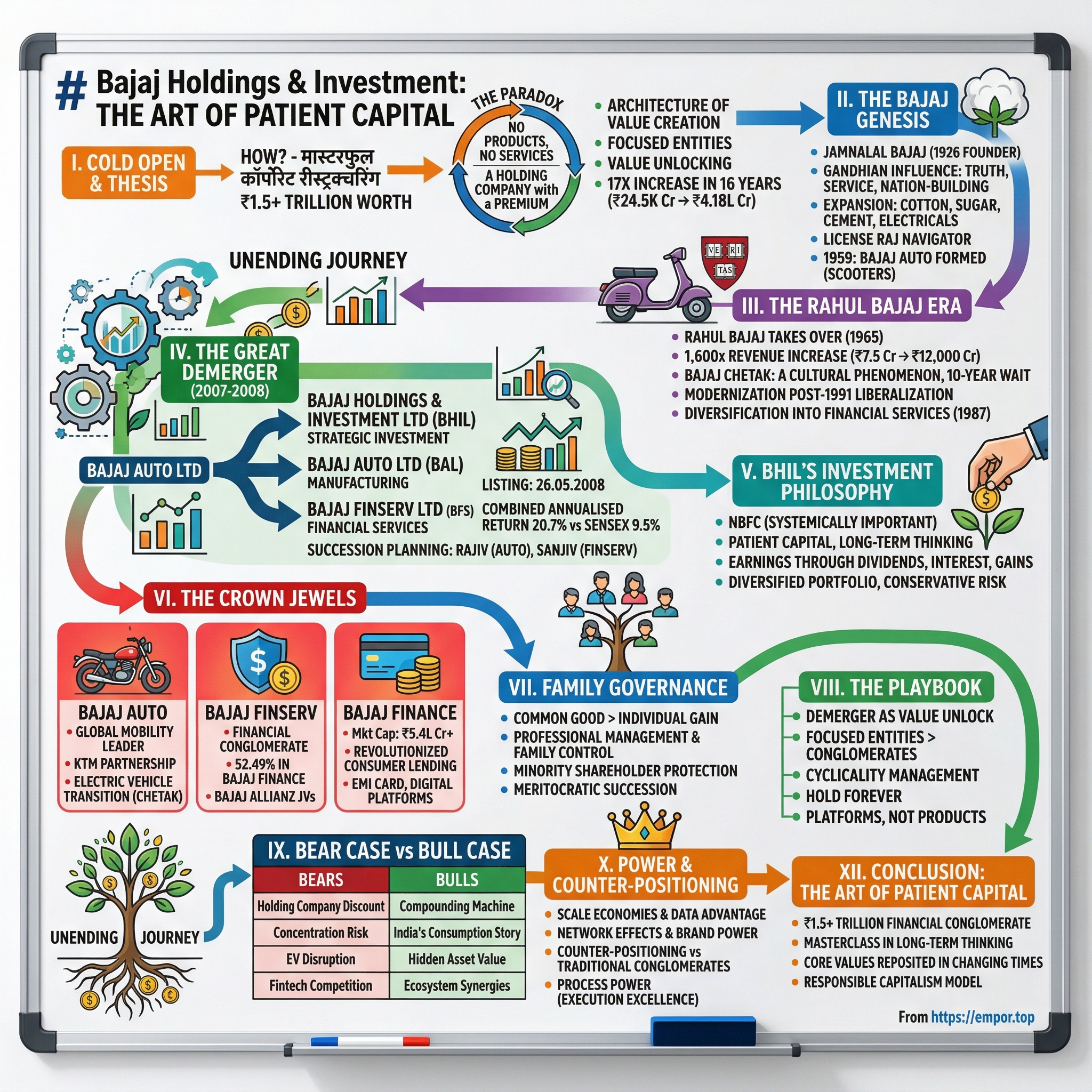
Bajaj Holdings & Investment: The Discount That Won't Close
I. Cold Open & Episode Thesis
There is a particular kind of arithmetic problem that shows up on Indian trading screens and never resolves.
On August 10, 2026, Bajaj Holdings & Investment closed at ₹11,407 a share, giving the company a market capitalisation of roughly ₹1.25 lakh crore.1 That same week, the two operating companies whose shares sit on BHIL's balance sheet were worth ₹3.19 lakh crore (Bajaj Auto) and ₹3.24 lakh crore (Bajaj Finserv) respectively.23 BHIL owns 34.21% of the first and 38.48% of the second.4 Multiply, add, and you get a look-through stake value comfortably north of ₹2.3 lakh crore — before counting BHIL's 51% of Maharashtra Scooters, before counting a treasury book of bonds and equities, and before counting the roughly ₹16,333 crore BHIL spent in January 2026 buying 17.56% of each of the group's two newly independent insurance companies.5
So the market looks at an entity holding assets worth well over ₹2.3 lakh crore and prices it at ₹1.25 lakh crore. Screener's own summary puts BHIL's book value at ₹6,573 per share against that ₹11,407 price — but book value is carried at historical cost, which is precisely why it understates the problem rather than solving it.6 Depending on how you handle the group's reciprocal cross-holdings, the discount to sum-of-parts sits somewhere between 40% and the high forties. One independent analysis, adjusting for the shares each Bajaj entity effectively holds in the others and treating them as treasury stock, pegged BHIL at a 40% discount to SOTP in late 2025 — with its own subsidiary, Maharashtra Scooters, trading at 54%.4
This is not a temporary dislocation. It is a structural feature that has persisted for the better part of two decades, through bull markets and bear markets, through the demerger that created the company and every strategic event since.
Which sets up the actual question this story is about — and it is not "is Bajaj a good group?" The operating companies are, by most measures, excellent. Bajaj Finance is India's largest non-bank lender by a wide margin. Bajaj Auto is one of the world's most profitable two-wheeler manufacturers and now controls KTM. The question is narrower and harder: what is a holding company actually for, and has the Bajaj family solved that problem or merely inherited a structure that concentrates control while diluting per-share value for everyone outside the family?
Because a holding company can be one of two things. It can be a capital allocator — an entity that takes cash flows from mature assets and redeploys them into better uses, buys back its own stock when it trades below intrinsic value, and treats the discount as an opportunity. That is the Berkshire Hathaway model. Or it can be a control vehicle — a legal box whose function is to keep voting power inside a family across generations, where the discount is not a bug but a load-bearing feature, because a persistently cheap holdco is a cheaper way to hold control than owning the operating companies directly.
BHIL has spent eighteen years behaving much more like the second than the first. And the eighteen months ending mid-2026 gave it two of the largest capital-allocation decisions in the group's history to prove otherwise.
The first was insurance. In March 2025 the group agreed to buy out Allianz SE's 26% stakes in the two insurance joint ventures it had co-owned since 2001, for around ₹24,180 crore.7 The first and larger tranche — 23% of each insurer — closed on January 8, 2026 for roughly ₹21,390 crore, or about €2.1 billion.8 The second was motorcycles. Bajaj Auto, whose Austrian partner KTM had collapsed into insolvency with over €2 billion of debt, wrote the cheques that kept KTM alive, then took control of the whole structure — and by early 2026 the company once called Pierer Mobility AG had been renamed Bajaj Mobility AG.9
Two transformational events. Roughly ₹40,000 crore of group capital committed. And BHIL's own stock barely registered either.
That non-reaction is the puzzle worth unpacking. Over the next few sections we will trace how a 1926 cotton and sugar trading house became a three-headed conglomerate; what BHIL is legally and mechanically (a regulated NBFC, not a passive trust); why the single largest source of BHIL's economic value is a company it does not own a single share of; how the insurance buyout was financed and by whom; whether the KTM rescue was strategic genius or the kind of deal only an incumbent partner would accept; and finally, why the discount refuses to close and what would actually have to change for it to.
Three themes run through all of it: patient capital versus trapped capital, family control versus minority returns, and the asterisk that sits next to every sum-of-the-parts thesis in India.
Start with the founding, because the control instinct is older than the structure.
 Subscribe on LinkedIn
II. Origins, Compressed: From Jamnalal Bajaj to the 2008 Demerger
In 1926, a 37-year-old trader from Wardha set up a business in Bombay. What made Jamnalal Bajaj unusual was not the trading house — Bombay had plenty — but who he had become by then. He was Mahatma Gandhi's adopted fifth son, a financier of the freedom movement, a man who had surrendered a British-conferred title in protest. He also articulated an idea that every Bajaj annual report has quoted ever since: that a businessman is a trustee of wealth rather than its owner.
It is a genuinely appealing philosophy and, as we will see, a genuinely convenient one. Trusteeship implies stewardship across generations. It also implies that the steward should not be dislodged.
The trading house passed to Kamalnayan Bajaj, who industrialised it, and then in 1965 to Rahul Bajaj, a Harvard MBA who took over Bajaj Auto at 27 and ran it for four decades. Rahul Bajaj's era produced the single most recognisable artefact in Indian consumer history: the Chetak scooter. Under the License Raj, Bajaj Auto could not simply expand capacity to meet demand — production was rationed by government permit. So demand piled up into a waiting list that ran, at its peak, to a decade. Customers paid deposits and waited years. A Chetak booking became a tradeable asset, sometimes changing hands at a premium to the scooter itself.
This matters for the modern story in a specific way. A generation of Bajaj management learned to run a business where the binding constraint was supply, not competition, and where the strategic question was permits rather than product. When liberalisation arrived in 1991 and Japanese motorcycle technology came with it, that muscle memory was a liability. Rahul Bajaj is remembered for his opposition to sudden liberalisation — he was a founding voice of the so-called Bombay Club of industrialists who wanted a slower opening — but the more useful fact is what the company actually did. It re-tooled. Bajaj Auto pivoted from scooters to motorcycles, painfully and not always gracefully, and eventually found its winning position not in domestic entry-level volume but in exports and in premium partnerships. That pivot is the direct ancestor of everything in Section VI.
The other seed was planted in 1987, quietly, as Bajaj Auto Finance — a captive lender set up to help customers buy two-wheelers. Nobody at the time would have guessed that the financing arm would eventually be worth more than double the manufacturer that spawned it.
By the mid-2000s the group had a structural problem. One listed company, Bajaj Auto Ltd, contained a fast-growing consumer lending business, an insurance joint venture with Allianz, a manufacturing business, and a very large pile of investments and surplus cash accumulated over decades of scooter monopoly profits. Analysts could not value it. The businesses needed different capital structures, different regulators, and different managers — and the third generation of the family, Rajiv and Sanjiv Bajaj, needed different sandboxes.
The answer was a three-way demerger, approved by the Bombay High Court in December 2007 and effective through 2008. Bajaj Auto Ltd was split into: Bajaj Auto (the manufacturing business), Bajaj Finserv (the financial services holding entity, housing the lending and insurance arms), and Bajaj Holdings & Investment — the residual entity, which retained the demerged company's investment portfolio, surplus cash, wind farms, real estate, and, critically, cross-holdings in the two new listed companies.6
The thesis sold to shareholders was the standard one for such splits: separate the businesses, let each be valued on its own merits, and the sum will exceed the whole. And for Bajaj Auto and Bajaj Finserv, that broadly worked. Bajaj Finance in particular went on to become one of the great compounding stories in Indian equities.
For BHIL, the thesis inverted. Instead of unlocking value, the demerger created a permanent vessel for it. Every rupee of value in Bajaj Auto and Bajaj Finserv now had two possible routes to a public shareholder: directly, by buying those stocks, or indirectly, by buying BHIL. Rational investors chose the direct route, priced BHIL at a discount, and the discount became self-reinforcing — precisely because it was never in the controlling family's interest to close it.
What the demerger did accomplish, elegantly, was to put the family's control blocks in one place, under one board, with promoter shareholding in that entity at a comfortable 51.46%.6 Which brings us to what BHIL actually is.
III. What BHIL Actually Is Today: The Mechanics of a Regulated Holding Company
Here is a useful thought experiment. Imagine you inherited a portfolio worth ₹2.3 lakh crore, consisting mostly of two stock positions you are never going to sell, plus a bond portfolio. Now imagine that to hold it, you had to register with the central bank, maintain capital adequacy, file quarterly results, appoint independent directors, hold an AGM, and publish a business responsibility and sustainability report. You would be, roughly, Bajaj Holdings & Investment.
BHIL is registered with the Reserve Bank of India as a non-banking financial company — specifically a systemically important, non-deposit-taking NBFC in the Investment and Credit Company category.6 This is not a technicality. It means BHIL carries the compliance overhead of a regulated financial institution while performing almost none of the functions of one. It does not lend to the public in any meaningful way. It does not take deposits. It holds shares and bonds. The regulatory wrapper is a cost centre, and one of the several small frictions that help keep the discount wide.
The balance sheet, in three buckets.
The first and overwhelmingly dominant bucket is the strategic block: 34.21% of Bajaj Auto, 38.48% of Bajaj Finserv, and 51% of Maharashtra Scooters — the small listed entity that itself holds slivers of the group (roughly 3.05% of Bajaj Finance, 2.37% of Bajaj Finserv, 2.46% of Bajaj Auto, and, in a neat circularity, 3.04% of BHIL itself).4 These stakes are not investments in the ordinary sense. They are the family's control blocks, and they are not for sale.
The second bucket, which is new and analytically important, is direct insurance ownership. In January 2026 BHIL bought 1,93,56,005 shares of Bajaj General Insurance at ₹4,808.24 each and 2,64,64,600 shares of Bajaj Life Insurance at ₹2,654.12 each — 17.56% of each company, for a combined ₹16,333 crore.5 We will return to this in Section V, because who paid for the Allianz exit turns out to be one of the more revealing facts in this whole story.
The third bucket is the financial investment portfolio: government and corporate bonds, mutual funds, and a scatter of legacy equity holdings. Among them are minority positions in Bajaj Electricals, in Mukand (the group's steel business), and in Hercules Hoists. These are worth mentioning once and then setting aside. They are historical residue, immaterial to the investment case, and their main function in the story is as evidence that BHIL has never been a systematic portfolio investor — it has been a place where things accumulate.
How BHIL earns money — and why its P&L is nearly meaningless.
BHIL's standalone income is dividends received from Bajaj Auto and Bajaj Finserv, plus interest and capital gains on the treasury book. That is essentially it. The lumpiness this produces is extreme, and the June 2026 quarter is a perfect specimen.
On a standalone basis, BHIL reported profit after tax of ₹344 crore in Q1 FY27, against ₹194 crore a year earlier. The driver was dividend income of ₹348.41 crore versus ₹22.77 crore in the corresponding quarter — a nearly fifteen-fold jump that reflects nothing about business performance and everything about when Bajaj Auto and Bajaj Finserv happened to schedule their dividend record dates.10
On a consolidated basis, which pulls in BHIL's equity-accounted share of the profits of Bajaj Auto and Bajaj Finserv, the quarter looked bad: consolidated PAT of about ₹2,706 crore, down 22.4% year on year.11 The headline is misleading. The comparable quarter of FY26 contained a one-off gain of roughly ₹1,522 crore from a block-deal sale of Bajaj Finserv shares. Strip that out, and underlying consolidated profit grew about 28%.12 Total consolidated income, meanwhile, rose 24.2% to ₹419.32 crore — a figure so small relative to the ₹2,706 crore profit that it should immediately tell you the "income statement" here is a formality.11
The full-year picture carried the same signature. FY26 consolidated PAT rose 48% to ₹9,637 crore, and standalone PAT jumped from ₹1,291 crore to ₹4,708 crore — the latter driven substantially by gains on selling Bajaj Finserv shares.13 BHIL's best standalone year in history was, in other words, largely a year in which it sold part of its crown jewel.
The analytical takeaway is blunt: BHIL's reported earnings are an accounting artefact of dividend timing and asset sales, and any valuation exercise that starts from BHIL's P&L is starting in the wrong place. The P/E ratio of 14.5 that screens on BHIL is not a valuation of a business; it is a number generated by dividing one nearly arbitrary figure by another.6 Valuing BHIL means valuing Bajaj Auto, valuing Bajaj Finserv, applying ownership percentages, adding the insurance stakes and treasury, and then — the entire game — explaining and forecasting the gap.
So let us go value the underlying. And the largest single piece of it is a company BHIL does not own directly at all.
IV. The Crown Jewel Beneath the Crown Jewel: Bajaj Finserv → Bajaj Finance
Follow the ownership chain carefully, because it is the heart of the structure.
BHIL owns 38.48% of Bajaj Finserv. Bajaj Finserv, in turn, owns 51.32% of Bajaj Finance, which as of August 10, 2026 carried a market capitalisation of about ₹6.86 lakh crore — more than twice Bajaj Finserv's own ₹3.24 lakh crore.143 Do the multiplication: BHIL's economic interest in Bajaj Finance is roughly 20% — about ₹1.35 lakh crore of look-through value, which by itself exceeds BHIL's entire market capitalisation.
Think about what that means. The single largest source of BHIL's value is a company in which it holds no shares whatsoever, reached through an intermediary that itself trades at a holding-company discount. A discount stacked on a discount. Bajaj Finserv trades below the value of its stake in Bajaj Finance alone, and BHIL trades below the value of its stake in Bajaj Finserv. Every layer takes a haircut, and the family's control passes cleanly through all of them.
What Bajaj Finance actually does.
The business began as a captive two-wheeler lender and grew into something more interesting: a customer-acquisition machine that monetises the same customer repeatedly. The mechanism is worth explaining in plain terms because it is the core of the moat argument.
Bajaj Finance's classic entry point is consumer durables financing — the zero-interest EMI offer at the electronics store when someone buys a television or a phone. Economically this is a thin, low-margin, high-volume product, subsidised partly by the manufacturer and retailer. Bajaj Finance does it anyway, at enormous scale, because the loan is not the point. The point is the customer relationship, the repayment data, and permission to come back. Having lent someone ₹40,000 for a refrigerator and watched them repay on time, Bajaj Finance knows something no credit bureau file fully captures — and it can then offer a personal loan, a co-branded credit card, a fixed deposit, insurance, a gold loan, a mortgage.
The June 2026 quarter shows the machine running at full tilt. Bajaj Finance added 5.10 million new customers and booked 16.13 million new loans in three months. Assets under management grew 24% year on year to ₹5,46,944 crore, including a record quarterly addition of ₹36,969 crore. Profit after tax rose 28% to ₹6,081 crore, and return on equity crossed 20% — 20.4% against 19.0% a year earlier.15
The composition of that book is where the story has changed most, and where the "consumer durables lender" caricature breaks down. Mortgages are now the single largest segment at ₹1,73,624 crore, roughly 32% of AUM. Urban personal loans are about 20%. MSME lending is 9%. Gold loans grew 112% to ₹21,152 crore across 1,701 dedicated branches, and commercial vehicle and tractor finance doubled to ₹4,355 crore.15 Bajaj Finance has been deliberately shifting mix toward secured lending — a defensive move, and a sensible one given what has been happening in Indian unsecured credit.
Scale, in context.
Bajaj Finance's ₹5.47 lakh crore book makes the peer comparison almost unfair. Cholamandalam Investment and Finance, one of the most respected NBFCs in the country, ended FY26 with AUM of ₹2,42,630 crore and PAT of ₹5,220 crore.16 HDB Financial Services, HDFC Bank's retail lending arm, closed FY26 at ₹1,18,733 crore AUM and ₹2,544 crore PAT.17 Bajaj Finance is more than double the first and more than four times the second — and its quarterly profit alone now exceeds HDB's annual profit.
Scale in lending is not automatically an advantage; plenty of large lenders have grown themselves into disasters. What makes it an advantage here is specific and testable: distribution reach (physical presence in tens of thousands of retail points), a proprietary repayment dataset built from tens of millions of small loans, and a funding cost advantage that comes from being a AAA-rated borrower with a diversified liability book. Capital adequacy stood at 20.9% in Q1 FY27 — comfortable headroom, and a reminder that Bajaj Finance's capital story today is about deployment discipline rather than the small rights issues of a decade ago.18
The asset-quality test.
This is where a skeptical investor should press hardest, because the numbers look almost too clean. As of June 30, 2026, gross NPAs stood at 0.96% of AUM (improved from 1.03%) and net NPAs at 0.39% (from 0.50%). Annualised loan losses fell to 1.54% of average assets from 1.87%; excluding a ₹296 crore prudential macro-economic provision, the figure was 1.31%. Provision coverage was 60%.15
Set that against the backdrop. India's microfinance and unsecured retail credit complex went through a genuine stress cycle from 2024 into 2026, driven by borrower overleveraging — the same customer taking loans from four or five lenders simultaneously. Sector gross NPAs for NBFC-MFIs stood at 5.4% in March 2025 and 4.9% by June 2025, and while CareEdge projected improvement to roughly 3.6% by the end of FY2026, ICRA's February 2026 assessment described a sector where credit costs remained elevated through the first nine months of FY26 even as they declined quarter on quarter, with profitability recovery expected only in FY2027.19
So: a sector running gross NPAs in the 4-5% range, and Bajaj Finance running under 1%. Is that superior underwriting or a different customer?
Honestly, it is mostly the second — and that is not a criticism, it is a description of strategy. Bajaj Finance is not a microfinance lender. Its core customer is urban and semi-urban, salaried or self-employed with documented income, buying a consumer durable or a house or a vehicle. Nearly a third of the book is now mortgages, which structurally run near-zero NPAs (Bajaj Housing Finance reported gross NPAs of 0.29%).18 Comparing Bajaj Finance's headline NPA to an MFI sector average is comparing different risks.
The honest reading is that Bajaj Finance's underwriting looks genuinely good and its mix is genuinely more favourable, and that management has been deliberately steering mix toward the favourable end while the cycle was ugly. That is competent risk management rather than magic. What would falsify the "superior underwriting" claim is a period in which Bajaj Finance's unsecured book — still north of ₹1 lakh crore in urban personal loans alone — deteriorates faster than peers when the cycle turns again. That has not happened yet. It has also not yet been properly tested, because the last two years of stress hit a customer segment Bajaj Finance largely does not serve.
Management's own posture on this has been notably unheroic, which is a point in its favour. On the Q1 FY27 disclosures, having just printed record growth, 20%+ ROE and improving credit costs, the company left its long-term guidance unchanged: AUM growth of 23-25%, profit growth of 23-24%, gross NPAs below 1.4%, ROA of 4.3-4.7%, ROE of 19-21%.15 A management team inclined to overpromise would have raised the bar after a quarter like that. Not raising it, and continuing to carry a macro-economic provision overlay, is consistent behaviour rather than promotional behaviour — and consistency across cycles is most of what management credibility actually is.
One genuinely new element deserves flagging with appropriate skepticism. Bajaj Finance has been aggressively marketing an AI transformation it brands "FINAI," and the Q1 FY27 disclosures quantified it: the dedicated AI team grew 115% to 230 people, AI-generated loan offers rose 252% to 0.4 million, and disbursements attributed to AI-led initiatives reached ₹2,551 crore, up 235%.15 Those growth rates are impressive and the absolute numbers are tiny — ₹2,551 crore against ₹36,969 crore of quarterly AUM addition is under 7%. For now, FINAI is a credible experiment with real disclosure attached, not yet a competitive advantage. The useful thing is that the company is publishing hard numbers rather than adjectives, which makes the claim falsifiable over the next several quarters.
The genuine competitive threat is not fintech. It is banks. Bajaj Finance funds itself in wholesale markets; banks fund themselves with current and savings account deposits that cost a fraction as much. Every time a large private bank decides to push into unsecured retail lending, Bajaj Finance faces a competitor with a structurally cheaper liability. Bajaj Finance's answer has been speed, distribution and cross-sell rather than price — which works until it doesn't, and which is the single most important thing to watch in the funding-cost cycle ahead.
Which brings us to the other half of Bajaj Finserv — the half that, until January 2026, the family did not fully own.
V. Full Control: The Allianz Insurance Buyout (2025-2026)
Some partnerships end in acrimony. This one ended with both sides politely explaining that they had simply come to want different things — and then Allianz walked directly across the street to Reliance.
The relationship dated to 2001, when Allianz SE took 26% stakes in two newly formed Indian insurers alongside Bajaj, at a time when India's foreign ownership cap in insurance sat at exactly 26%. For nearly a quarter of a century the arrangement worked: Allianz contributed underwriting expertise, actuarial capability and global brand credibility; Bajaj contributed distribution and the Indian market. Bajaj Allianz Life and Bajaj Allianz General became two of the larger private insurers in the country.
Then the cap moved. India progressively raised foreign ownership limits, and the strategic logic of a 26% minority stake in someone else's franchise weakened considerably. If you can own 74%, or eventually 100%, of an Indian insurer, why hold a quarter of one you do not control?
The mechanics.
Transaction documents were signed in March 2025. The announced structure had Bajaj Finserv and group entities acquiring Allianz's full 26% in each insurer for approximately ₹24,180 crore.7 The market's first reaction was not applause: Bajaj Finserv's stock fell nearly 2% on March 18, 2025, to an intraday low of ₹1,836.15, on a day the broader market rose about 1%.20
The larger tranche — 23% of each company — completed on January 8, 2026, for gross consideration of roughly €2.1 billion, or ₹21,390 crore, ending the joint venture arrangements on that date.8 The insurers were renamed, dropping "Allianz" for plain Bajaj General Insurance and Bajaj Life Insurance. A separate small piece, Allianz's remaining 50% of Bajaj Financial Distributors, changed hands for ₹12.50 crore on January 16, 2026.21 Allianz's residual 3% was slated to be mopped up through a buyback process, with completion expected in the second quarter of calendar 2026.8 For Allianz, the exit produced an expected non-operating IFRS gain of about €1.1 billion recognised in its Q1 2026 results and roughly five percentage points of Solvency II ratio relief.8
Who actually paid — and this is the part worth slowing down on.
The natural assumption is that Bajaj Finserv, the entity that ended up with control, wrote the cheque. It did not, mostly.
Bajaj Finserv itself invested approximately ₹939.29 crore to lift its direct holding to 75.01% in each insurer.18 Bajaj Holdings & Investment invested ₹16,333 crore for 17.56% of each.5 The balance came from Jamnalal Sons, the unlisted family holding entity. Collectively the group reached about 97% of each company.18
Read those numbers again. BHIL — the entity with a persistent 40%+ discount, 51.46% promoter-owned and 48.5% owned by everyone else — supplied roughly three-quarters of the cash for a transaction whose control benefit accrued to Bajaj Finserv, in which BHIL holds 38.48%. BHIL's minority shareholders funded the majority of a control acquisition and received in exchange a non-controlling economic stake in two unlisted insurance companies, valued at cost, with no market price, no liquidity, and no dividend history to speak of.
There is a defensible version of this. Regulatory ownership caps and Insurance Act shareholding rules constrain how much any single entity can hold; spreading the acquisition across group entities may have been the cleanest structure available. BHIL had the balance sheet capacity and, in a sense, this is exactly what a holding company should do with idle capital — buy quality assets. And the insurance stakes are real assets, not related-party transfers at inflated prices to a family entity.
There is also a less flattering version, and an activist would press it hard. BHIL converted ₹16,333 crore of the most liquid, most transparent asset class available — listed shares of Bajaj Finserv, sold into the market — into an illiquid unlisted minority position. In June 2025, promoter entities Jamnalal Sons and BHIL sold 1.79% of Bajaj Finserv, 28.6 million shares at ₹1,925.20 apiece, raising ₹5,505 crore in a block deal that market participants read as pre-funding for exactly this purchase.22 So the sequence was: sell listed Finserv shares at a market price, use the proceeds to buy unlisted insurance shares at a negotiated price, and thereby increase the share of BHIL's NAV that is opaque and unmarked. For a company already trading at a 40% discount because investors distrust its ability to convert NAV into cash, this is the opposite of discount-narrowing behaviour. It widens the very information gap that causes the discount.
(A footnote-worthy oddity in the same window: in April 2026 BHIL bought 20,90,050 Bajaj Finserv shares for ₹370.53 crore — from its own wholly-owned subsidiary, Bajaj Auto Holding Ltd.23 Intra-group share shuffles like this produce headlines about BHIL "raising its stake" that mean nothing economically.)
Did they overpay?
Kotak Institutional Equities read the transaction as valuing Bajaj Life Insurance at about ₹40,000 crore and Bajaj General Insurance at about ₹53,000 crore — and noted that the life valuation represented roughly a 28% discount to Kotak's own fair value estimate.20 That is a striking finding: on at least one credible third-party assessment, the group bought the life business cheap. Kotak nonetheless downgraded Bajaj Finserv from Buy to Add, reflecting the capital intensity of the purchase rather than the price of the asset.20
Compared with listed Indian insurance peers — HDFC Life, SBI Life, ICICI Prudential Life on embedded-value multiples, ICICI Lombard on price-to-book — the implied multiples on Bajaj Life do not look like a stretched control premium. General insurance is harder to judge, and the ₹53,000 crore implied value for a business whose combined ratio has been running above 100% is where a bear should focus. On the Q1 FY27 disclosures, Bajaj General's underwriting loss widened to ₹130 crore from ₹116 crore, with a combined ratio of 104.7% — management attributing it to elevated health loss ratios and soft pricing in a competitive market.18 A combined ratio above 100 means the company pays out more in claims and expenses than it collects in premium and depends on investment income to make a profit. That is common in Indian general insurance and not alarming in itself, but it is not the profile of an asset you want to have paid a premium for.
The life business, by contrast, has been performing: net value of new business rose 59% to ₹405 crore in Q3 FY26 and 87% to ₹271 crore in Q1 FY27, with new business margins expanding to 15.9%.1824 Value of new business is the insurance industry's closest equivalent to same-store sales — it measures the present value of profits from policies sold this period, so growth means the company is writing genuinely more profitable business rather than just more of it.
Why Allianz left, and what it chose instead.
This is the most revealing beat in the section. Allianz did not exit India. It exited Bajaj.
In July 2025, Allianz announced a 50:50 domestic reinsurance joint venture with Jio Financial Services, Reliance's financial arm. Allianz Jio Reinsurance Limited began operations in March 2026.25 Then in April 2026 the two went further, agreeing a 50:50 primary insurance joint venture covering general and health insurance.26 Allianz's own statement on completing the Bajaj exit was explicit that India "remains an important growth market" and that proceeds would be redeployed partly into the new Indian ventures.8
A global insurer with 25 years of Indian operating experience chose a green-field 50:50 partnership with a first-time insurance operator over a minority stake in an established, profitable franchise. The most plausible reading is about control and economics, not about India: 50% of a new venture with equal governance rights beats 26% of a mature business where your partner decides everything. But it is also a real competitive signal for the Bajaj insurers. Reliance brings a distribution base measured in hundreds of millions of telecom and retail customers, and Allianz brings the underwriting engine. The Bajaj insurance businesses just acquired full control and, in the same eighteen months, acquired a formidable new competitor built partly out of their former partner.
What full ownership actually buys.
The genuine gains are real but unglamorous: no profit-sharing with a minority partner, unified capital allocation, faster product decisions, no need to negotiate strategy with Munich, and — notably — the freedom to build a reinsurance business of their own, which the Bajaj Finserv board approved during FY27.18 The genuine cost is symmetrical: the group now carries 100% of the underwriting risk with no foreign partner as technical backstop or capital co-sponsor, at a moment when Indian general insurance pricing is soft and health loss ratios are elevated. Add the transition to Ind AS accounting for insurers effective April 1, 2027, which will change how reserves are calculated and reported, and the next two years will produce insurance disclosures that are genuinely hard to compare with the past.18
Meanwhile, on the other side of the group, an even bolder bet was playing out — and this one involved an Austrian bankruptcy court.
VI. Bajaj Auto: Two-Wheelers, Exports, and the EV Scramble
In late 2024, in a courtroom in Ried im Innkreis, Austria, one of motorcycling's most romantic brands was being taken apart by accountants.
KTM AG — the orange bikes, the Dakar wins, the MotoGP team, the "Ready to Race" tagline — had been growing on debt through a soft European powersports market, and the arithmetic finally collapsed. The parent group entered insolvency proceedings carrying more than €2 billion of debt. An Austrian court approved a restructuring plan requiring the company to pay 30% of the total owed to some 2,500 creditors — about €548 million — by a hard deadline of May 23, 2025.9 Miss the date and KTM would likely have been liquidated.
Bajaj Auto had been KTM's partner since 2007, building smaller-displacement KTM and Husqvarna models at Chakan and distributing them across emerging markets. It also held, through Bajaj Auto International Holdings B.V. in the Netherlands, a large minority economic interest in the structure. It was, in short, the one party with both the motive and the balance sheet to act.
The rescue, and its structure.
Days before the deadline, Bajaj Auto's Dutch subsidiary signed a €566 million one-year unsecured financing facility arranged by JP Morgan, DBS Bank and Citigroup — borrowing at the holding-company level to fund the rescue rather than draining Bajaj Auto's Indian balance sheet.27 The money went in as a €450 million loan to KTM AG and €150 million to Pierer Mobility AG.28
Then came the clever part. On May 22, 2025, Bajaj Auto B.V. entered into a call option agreement with Pierer Industrie AG, giving Bajaj the right to acquire Pierer Industrie's 50.1% of Pierer Bajaj AG — the entity that controlled Pierer Mobility, which controlled KTM — at any point up to the end of May 2026.28 Bajaj had put in the money that saved the company and simultaneously bought an option on control, exercisable at its discretion, over the following twelve months.
Bajaj did not wait. Having secured regulatory approvals, Bajaj Auto B.V. exercised the options and closed on November 18, 2025, acquiring all 50,100 shares of Pierer Bajaj AG.29 The resulting structure: Bajaj Auto International Holdings owns 100% of the intermediate holding company and, through it, approximately 74.9% of the listed Austrian entity that owns KTM, Husqvarna, GASGAS and WP Suspension.29 By early 2026 the names had changed to match reality — Pierer Bajaj AG became Bajaj Auto International Holdings AG, and Pierer Mobility AG became Bajaj Mobility AG.9 Stefan Pierer, who built KTM over three decades, had stepped down from the executive board in June 2025.28
The "did they overpay" test.
This is where the outline's question deserves a genuine answer rather than a shrug, and the answer is more favourable to Bajaj than one might expect.
The equity itself was almost free. The reported consideration for the option exercises was small — €24.31 million for the final tranche of Pierer Industrie shares, and €26.34 million for an earlier block of 26,000 shares initiated in June 2025.29 Bajaj did not pay a control premium for KTM's equity in any conventional sense. It paid by providing rescue financing, and the equity came attached.
And the financing largely came back. On March 4, 2026, KTM AG completed its restructuring by raising a €550 million five-year unsecured loan from an international banking consortium at what was described as a low-to-mid single-digit interest rate, with market-standard restrictions on dividend distributions during the loan term. That facility explicitly replaced the €450 million shareholder loan Bajaj had provided in May 2025.30 In other words: Bajaj bridged KTM through the insolvency deadline, took control, restored the business to the point where a syndicate of international banks would lend it €550 million unsecured, and got its bridge loan repaid.
That is a genuinely good outcome, and it is worth stating plainly rather than hedging. A purely financial distressed-asset buyer could not have executed it, because a financial buyer would not have had a decade of operating integration, a manufacturing base capable of producing KTM-badged bikes profitably, or the credibility with Austrian courts and creditors that came from being the existing partner. The strategic relationship was the edge. Bajaj Auto's FY26 accounts recorded a one-time fair-value gain on the acquisition when KTM moved from associate to subsidiary accounting — a technical entry, but one that reflects the market's implicit view that Bajaj acquired the asset below fair value.31
The caveats are real. KTM's operating recovery is one year old, European powersports demand remains soft, and the €550 million loan carries dividend restrictions — meaning cash cannot easily be pulled out of Austria for a while. The KTM and Triumph portfolio together delivered global revenue of about ₹5,000 crore in FY26, up 40% year on year, reaching over 2.25 lakh riders.31 That is meaningful but modest against Bajaj Auto's ₹58,732 crore of FY26 revenue.31 The bet is on the brand and the premium motorcycle platform, not on near-term earnings.
The Indian competitive picture.
Bajaj Auto's domestic position is best understood by what it has chosen not to fight for. Hero MotoCorp remains the volume leader in the entry-level commuter motorcycle segment, and Honda Motorcycle & Scooter India dominates automatic scooters. TVS Motor competes across both. Royal Enfield, under Eicher Motors, owns the mid-capacity premium leisure segment.
Bajaj Auto has positioned itself elsewhere: exports (where it is India's largest two-wheeler exporter), three-wheelers and small commercial vehicles (where it crossed 8 lakh units for the first time in FY26), premium motorcycles through Pulsar, KTM and Triumph, and now electric.31 FY26 produced record results across the board — revenue of ₹58,732 crore, standalone PAT of ₹9,825 crore, consolidated PAT up 47% to ₹10,744 crore, volumes above 5 million units, free cash flow above ₹8,000 crore (up 30%), and surplus funds exceeding ₹18,000 crore.31 Q4 FY26 alone delivered revenue of ₹16,006 crore, up 32%, at a 20.8% EBITDA margin.32
The EV scramble, sized honestly.
The Chetak name came back as an electric scooter in January 2020, and by June 27, 2026 it had crossed 8 lakh cumulative units — making Bajaj the third Indian e2W manufacturer to reach that mark, after Ola Electric and TVS.33 The trajectory has been steep: 2,79,685 units in calendar 2025 (up 39%), then 2,11,356 units in the first six months of 2026 alone, holding roughly 22% of the electric two-wheeler market.33
July 2026 gives a clean snapshot of a market that has genuinely arrived. Total e2W sales hit an all-time high of 2,04,362 units, up 88% year on year, and accounted for 11.2% of all two-wheeler sales in India. TVS led with 55,499 units and 27.2% share; Bajaj was second with 45,613 units, up 122%; Ather sold 30,357; Hero's Vida 22,900; and Ola Electric — which held 24% share in January 2025 — fell to 14,106 units, down 23.5% year on year.34
The competitive conclusion here is specific and it favours Bajaj. Two incumbent ICE manufacturers, TVS and Bajaj, now hold roughly half the electric two-wheeler market between them, while the EV-native pioneer that defined the category has collapsed from category leader to fifth place. That is not what disruption theory predicts. What it suggests is that in Indian two-wheelers, the binding constraints are dealer networks, service reach, manufacturing quality and financing availability — exactly the assets incumbents already own — rather than software or battery innovation. Ather, growing 70% and holding roughly 15%, is the counter-example proving a well-executed native player can survive; Ola is the counter-example proving that scale without service is not durable.
Size it properly, though. FY26 EV revenues exceeded ₹4,000 crore — under 7% of Bajaj Auto's total.31 Electric is strategic to the core and growing fast; it is not yet the business. ICE two-wheelers, three-wheelers and exports still carry the overwhelming majority of revenue and nearly all the profit.
The capital allocation tell.
On May 6, 2026, alongside record Q4 results, Bajaj Auto declared a final dividend of ₹150 per share and simultaneously authorised a buyback of up to 46.94 lakh shares at ₹12,000 each, for up to ₹5,633 crore.32 The dividend was a sharp cut from the ₹210 per share paid for FY25 — on consolidated profits that were 47% higher.3235 Dividend payout ratio fell from roughly 80% of consolidated profit to roughly 40%.
Read alone, that is a dividend cut on record profits, which normally signals trouble. Read together with the buyback, it is something different: total shareholder return of roughly ₹9,800 crore against ₹10,744 crore of consolidated profit — approximately full distribution, just delivered through a different instrument.3231 Buying back at ₹12,000 when the stock traded around ₹10,000-11,000 is a premium tender, which is how Indian buybacks typically work and which functions as a tax-efficient return of capital rather than a signal about undervaluation.
What it does tell you is that management wanted the flexibility of a lower recurring dividend commitment while EV capex and the KTM/Bajaj Mobility consolidation were absorbing capital. A dividend is a promise; a buyback is a one-off. Shifting the mix toward one-offs during a heavy investment phase is coherent capital allocation. The test is whether the payout ratio recovers once KTM stabilises, or whether ₹150 becomes the new normal while surplus funds keep building.
And note the asymmetry that runs through this whole section: Bajaj Auto buys back its own shares. So, effectively, does Bajaj Finserv through its capital actions. BHIL does not. Which raises the question of who exactly is making these decisions, and for whom.
VII. Current Management, Incentives, and Capital Allocation Credibility
Look at the boardrooms of the Bajaj group and you notice something: the same three cousins keep appearing, in different chairs.
Sanjiv Bajaj is Managing Director and Chief Executive Officer of Bajaj Holdings & Investment, a position he has held since 2012.36 He is simultaneously Chairman and Managing Director of Bajaj Finserv and Chairman of both insurance companies. Rahul Bajaj's younger son, trained at Pune's University and then Harvard Business School, he was the architect of the 2007-08 demerger and then of Bajaj Finserv's build-out into the financial services conglomerate it became. His public persona is that of the systems thinker of the family — the one who talks about process, governance frameworks and long-duration compounding, and who served as CII president in 2022-23.
His accountability now is unusually direct. He runs the holding company that put up ₹16,333 crore for the insurance buyout, he chairs the entity that gained control, and he chairs both insurers whose standalone performance will determine whether that capital was well spent. There is no Allianz to defer to and no operating partner to share the blame with. If Bajaj General's combined ratio stays above 100% for several more years, or if the Allianz-Jio venture takes share in health insurance, the answer to "who decided this" is unambiguous.
Niraj Bajaj was added as Vice Chairman of BHIL in 2025 — a newly created position.36 A Harvard Business School graduate, he is also Chairman of Bajaj Auto and Chairman and Managing Director of Mukand, the group's steel business. The timing is worth noting without over-reading: a fresh formal board role at the holding company in the same window as the KTM rescue and the Allianz buyout. It may be succession planning, it may be a strengthening of family oversight at the holdco level during a period of large capital deployment, or both. The company's public materials do not spell out the rationale, and it would be inventing evidence to claim otherwise.
Rajiv Bajaj is the operating architect. Sanjiv's elder brother, an engineer by training with a master's in manufacturing systems from Warwick, he has run Bajaj Auto's product and strategy since the late 1990s and is responsible for the pivot that defines the company: abandoning the fight for entry-level scooter volume, building the Pulsar brand, going deep into exports, and cultivating the KTM relationship from a licensing arrangement into eventual ownership. He is also the group's most quotable executive — reliably contrarian on Indian EV policy and subsidy design, openly skeptical of hype cycles, and blunt in a way that Indian corporate India rarely is. His public commentary is useful primary material precisely because it is not media-trained. Rakesh Sharma, the long-serving executive director who has run the international business, was elevated to Joint Managing Director in FY26 — a rare senior non-family elevation worth watching as a signal about professionalisation.36
Assessing the record, with evidence.
Promoter shareholding is 51.46% at BHIL and 55.01% at Bajaj Auto.637 These are working majorities, not marginal ones. No outside party can force an outcome at either company.
On execution against prior promises, the group's record is genuinely good. Bajaj Finance has hit or beaten its long-term guidance ranges across cycles and, as noted, declined to raise the bar after a record quarter. Bajaj Auto's exports and premiumisation strategy, articulated over a decade ago, has delivered. The KTM rescue did what management said it would do — stabilise the business, take control, and get the bridge financing refinanced out by banks within ten months.30 That is a promise kept on a hard deadline, and it deserves credit.
On disclosure quality, the picture is mixed and worth being specific about. Bajaj Finance's quarterly disclosure is genuinely detailed — segment-level AUM, credit costs with and without overlays, even quantified AI metrics that invite scrutiny. Bajaj Finserv's calls address the general insurance underwriting loss directly rather than burying it. But BHIL's own disclosure is thin. There is no published sum-of-parts NAV statement from the company, no articulated capital allocation policy at the holdco level, and no explanation on the public record of why BHIL rather than Bajaj Finserv bore three-quarters of the insurance acquisition cost. A shareholder trying to understand BHIL's strategy has to reconstruct it from exchange filings about individual transactions.
That gap matters, and it is where the assertion-versus-evidence test lands hardest. On the operating companies, management explains itself with numbers. On the holding company — the entity whose shares BHIL's minority investors actually own — the record shows capital being deployed with limited public reasoning attached. The FY26 dividend at BHIL was ₹130 per share, including a ₹50 special centenary payout marking the group's hundredth year, with a record date of June 30, 2026.13 A ₹50 one-off tied to an anniversary is not a capital allocation framework; it is a gesture.
The most concrete test available: BHIL's standalone profit hit a record ₹4,708 crore in FY26, partly from selling Bajaj Finserv shares, and its Q1 FY27 dividend receipts jumped fifteen-fold.1310 With that cash, and with its own stock trading at a 40%+ discount to NAV, BHIL bought unlisted insurance shares. It did not repurchase a single share of itself. That is a revealed preference, and it is the most informative fact in this section.
Which leads directly to the question of what the structure is optimising for.
VIII. Family Governance and the Succession Question
The trusteeship language is still there. Every governance document in the group traces back to Jamnalal Bajaj's idea that wealth is held in trust for society rather than owned outright — and to be fair, the group's philanthropic record, the Jamnalal Bajaj Foundation, and its reputation for clean dealing in an environment where that is not universal all give the claim substance. Bajaj is not a group associated with expropriation, tunnelling, or the sort of related-party engineering that has destroyed value elsewhere in Indian markets.
But trusteeship is a claim about intent, not about structure. And structurally, what the Bajaj architecture accomplishes is the durable concentration of control in a family that owns roughly half of the top holding company.
Consider the board arithmetic. Sanjiv Bajaj runs BHIL and chairs Bajaj Finserv and both insurers. Niraj Bajaj is Vice Chairman of BHIL and Chairman of Bajaj Auto. Rajiv Bajaj is Vice Chairman of BHIL and the operating force at Bajaj Auto. Three cousins occupy the senior chairs at every material entity in the group simultaneously. Independent directors are present and, by public record, substantive — BHIL's FY26 AGM reappointed Dr. Arindam Bhattacharya as an independent director for a second five-year term.13 But independent directors at a company with 51.46% promoter ownership have advisory influence, not decisive power.
The insurance buyout illustrates the mechanism cleanly. Capital moved from BHIL (listed, 48.5% publicly owned), from Jamnalal Sons (unlisted, entirely family), and from Bajaj Finserv (listed, majority family-controlled) into two unlisted insurance companies now 97% owned inside the family perimeter.185 Every step was legal, disclosed, and arguably strategically sound. And the net effect was to move a large quantum of value from the marked, liquid, publicly priced part of the structure into the unmarked, illiquid, family-controlled part.
The cross-holdings compound this. Maharashtra Scooters, 51% owned by BHIL, holds 3.04% of BHIL.4 BHIL holds 38.48% of Bajaj Finserv, which holds shares in group entities, some of which hold shares back. These reciprocal loops mean that a given rupee of underlying economic value can be counted through multiple layers, and that the family's effective voting control substantially exceeds its economic ownership. That is not unique to Bajaj — it is the standard Indian promoter architecture — but it is the reason no outside investor can meaningfully pressure the structure.
On succession, the honest position is that the group has not published a plan and it would be speculation to construct one. The third generation is in charge. The fourth is not yet visible in senior operating roles at the listed entities. Niraj Bajaj's 2025 appointment as BHIL Vice Chairman is the only recent structural change at the holdco board, and its purpose has not been publicly explained.
The governance question to carry forward is not "is this group honest?" — the evidence says yes. It is: in a structure where the controlling family's interests and minority shareholders' interests diverge on exactly one issue — whether the holding company discount should close — which set of interests does the architecture serve?
Time to quantify that discount properly.
IX. The Holding Company Discount: Why It Won't Close
Here is the calculation, done carefully.
BHIL's market capitalisation stood at roughly ₹1.25-1.29 lakh crore in early August 2026.16 Against that:
Its 34.21% of Bajaj Auto, at a ₹3.19 lakh crore market capitalisation, is worth about ₹1.09 lakh crore.24 Its 38.48% of Bajaj Finserv, at ₹3.24 lakh crore, is worth about ₹1.25 lakh crore.34 Those two positions alone come to roughly ₹2.34 lakh crore — nearly twice BHIL's entire market value. Add 51% of Maharashtra Scooters, whose own book value was ₹28,462 per share against a traded price of ₹12,647 as of June 30, 2026.38 Add the ₹16,333 crore of insurance stakes at cost.5 Add the treasury book of bonds and financial investments.
On a raw basis the discount sits in the mid-forties. Adjusting rigorously for reciprocal cross-holdings — treating the shares each group entity effectively holds in the others as treasury stock, which avoids double-counting — brings BHIL closer to a 40% discount, with Maharashtra Scooters at 54%.4
This is not an outlier. It is the Indian norm. Holding companies across the Tata, Bajaj, Godrej and other promoter groups have historically traded at discounts ranging from 40% to 80% of sum-of-parts, against something closer to 20% for comparable structures in developed markets.4 The gap between 20% and 45% is the price of the specific Indian frictions, and they are worth naming individually because each one is a potential catalyst if it changes.
One: there is no clean distribution route. If BHIL wanted to hand its Bajaj Auto shares directly to its own shareholders, the transaction would face capital gains treatment and dividend distribution consequences that make it economically unattractive. Until relatively recent SEBI reforms, the procedural path for a holding company to distribute underlying securities to shareholders was cumbersome enough to be effectively unavailable.4 Tax friction is the single largest structural component of the discount, and it is not something management can fix.
Two: no buyback at the holdco level. This one management absolutely can fix, and has not. BHIL has never run a meaningful self-tender or open-market repurchase programme, despite trading at a persistent discount to a NAV composed largely of liquid, publicly traded securities. The mechanics would be straightforward: sell a slice of Bajaj Finserv at market, buy back BHIL stock at a 40% discount to NAV, and every remaining shareholder — including the family — becomes wealthier per share. BHIL demonstrated in FY26 that it is entirely willing to sell Bajaj Finserv shares.13 It chose to buy unlisted insurance stakes with the proceeds instead. That is a choice, not a constraint.
Three: regulatory overhead. The NBFC-ICC registration brings capital and governance obligations that a pure holding vehicle would not otherwise carry, and Maharashtra Scooters, holding over 90% of its net assets in group investments, sits in the awkward category of an unregistered Core Investment Company under RBI norms.4 Regulatory complexity is a modest, real contributor.
Four — and this is the big one: the promoter has no incentive to close it. A wide discount means the family maintains control over Bajaj Auto and Bajaj Finserv at the lowest possible cost of capital. Closing the discount would primarily transfer value to minority shareholders. Nothing about the family's position improves if BHIL trades at NAV. There is no takeover threat, because 51.46% promoter ownership makes one impossible. There is no activist threat, for reasons we come to below. There is no financing pressure, because BHIL carries almost no debt.6 Absent any of those forces, the rational response to a 40% discount is to do nothing, and doing nothing is exactly what has happened for eighteen years.
The Berkshire comparison, handled carefully.
Berkshire Hathaway is the obvious reference point and it is instructive mainly by contrast. Berkshire is also a diversified holding vehicle whose value derives from stakes in other businesses, and it has at times traded below intrinsic value. The difference is behavioural, not structural. Berkshire actively redeploys insurance float into new investments, wholly acquires operating businesses, and — since 2018, when the buyback policy was loosened — repurchases its own shares whenever management judges them to be below intrinsic value. The repurchase mechanism is what caps the discount: any gap wide enough becomes a self-correcting opportunity.
BHIL has the raw material for the same mechanism. It has liquid assets, no leverage, and a persistent discount. What it does not have is a management team that treats its own share price as a capital allocation variable. On the evidence of FY26 and Q1 FY27 — record dividend receipts, record standalone profit, ₹16,333 crore deployed into unlisted assets, zero shares repurchased — BHIL's posture toward its own valuation is passive by design.13510
The activist stress test.
Suppose a well-capitalised activist built a position in BHIL. What would they demand?
A holdco-level buyback or self-tender, funded by trimming the Bajaj Finserv stake — the cleanest available value-unlock, and one the company has already proven it can execute mechanically. A special dividend distributing the FY26-27 dividend income windfall rather than recycling it into unlisted stakes. A published sum-of-parts NAV disclosure on a quarterly basis, so the discount is measured in the company's own filings rather than by outside analysts. Possibly a further demerger separating the financial investment portfolio from the strategic control blocks. Possibly a listing of the insurance businesses, which would mark BHIL's ₹16,333 crore of insurance stakes to market and remove one source of opacity.
Why has none of this happened? Three reasons, in descending order of importance. First, arithmetic: at 51.46% promoter ownership, an activist cannot win a vote, and the entire activist playbook depends on the credible threat of winning votes. Second, float: while BHIL's public shareholding is substantial on paper — mutual funds around 6.2%, foreign institutions around 10.3%, retail around 31% — the practical daily liquidity in a stock of this size is thin, making it expensive to build a position large enough to matter.37 Third, culture: Indian institutional investors have historically treated holdco discounts as permanent facts of nature and simply bought the operating companies instead. There is no established playbook and no precedent of success to point to.
There are two things that could change this at the margins. SEBI introduced special call auctions in 2024 specifically to improve price discovery in illiquid holding company stocks, and reforms have made distribution mechanisms somewhat less cumbersome.4 Neither is a catalyst by itself. But if a peer Indian holding company were to run a large, successful self-tender and see its discount narrow durably, the template would exist — and templates are how these things start.
Until then, the honest analytical position is that the discount is a permanent feature to be priced, not a temporary anomaly to be arbitraged. Which means the actual investment question about BHIL is not "when does the gap close" but "does a stable 40-45% discount on a portfolio of good compounding assets produce an acceptable outcome?"
X. Bull Case vs. Bear Case
The bear case, stated properly.
Start with the structural argument, because it is the strongest. The discount is not a mispricing; it is a correct assessment of a permanent frictional loss. If it never closes, then owning BHIL is owning a leveraged-to-nothing claim on Bajaj Auto and Bajaj Finserv, minus a regulatory cost layer, minus the risk that capital gets deployed in ways minority shareholders would not choose. The FY26 insurance purchase demonstrates that this last risk is not hypothetical: BHIL converted liquid listed securities into an unmarked minority stake, and the market's response was indifference.522
Second, BHIL is a call option on two other management teams' capital allocation discipline, exercised at 34% and 38% ownership — enough for board influence, not enough for control. BHIL cannot direct Bajaj Auto's KTM commitment or Bajaj Finserv's insurance strategy. It absorbs the consequences either way.
Third, the asset-quality question at Bajaj Finance remains genuinely open. Sub-1% gross NPAs are excellent, and the mix shift toward mortgages and gold loans is prudent.15 But the unsecured book is still enormous in absolute terms, and the sector-wide overleveraging cycle that produced 4-5% gross NPAs at NBFC-MFIs has not fully worked through.19 Bajaj Finance's advantage in this cycle has been customer selection rather than a proven ability to underwrite the marginal borrower better than anyone else. If banks continue pushing into unsecured retail with cheaper funding, the marginal Bajaj Finance customer may become progressively worse without the reported numbers immediately showing it. Credit deterioration is a lagging indicator by construction.
Fourth, KTM. The rescue worked and the bridge loan was refinanced out, but Bajaj Auto now consolidates a European powersports manufacturer with soft end-markets, a five-year bank loan carrying dividend restrictions, and one year of post-insolvency operating history.30 Consolidation means KTM's volatility is now Bajaj Auto's volatility. A second European downturn would land directly on the P&L rather than on an associate line.
Fifth, EV competition. Chetak's ~22% share is a real achievement, but TVS is ahead at 27.2% and growing faster, and the market is expanding at 88% year on year — which means share is being contested at high velocity.34 Losing the second position, or facing margin compression as the segment normalises from subsidy-supported to market pricing, would undercut the clearest current proof point of Bajaj Auto's ability to defend its franchise.
Finally, insurance. Full ownership means full risk. Bajaj General is running a combined ratio above 100%, health loss ratios are elevated, pricing is soft, the Allianz-Jio venture is arriving with Reliance-scale distribution, and Ind AS transition from April 2027 will make the numbers harder to compare just as the group needs them to look good.1826
The bull case, stated properly.
The insurance buyout removes a structural drag that had existed for 25 years. Twenty-six percent of the profits of two growing insurers previously accrued to a partner. Now they do not. In a market where insurance penetration remains among the lowest of any large economy, owning 100% of two established franchises with existing distribution is a genuinely long-duration asset — and the transaction was struck at a valuation that at least one major domestic broker assessed as below fair value for the life business.20
Bajaj Finance's compounding record is the second pillar, and it is not a narrative — it is arithmetic. Twenty-four percent AUM growth to ₹5.47 lakh crore, 28% profit growth, ROE above 20%, improving credit costs, 20.9% capital adequacy, and a book that is now a third mortgages.1518 Whatever the debate about whether the underwriting edge is durable, the current combination of growth, returns and asset quality is rare at this scale anywhere in the world. And Bajaj Finance is more than double its nearest listed NBFC peer.16
Third, Bajaj Auto's own execution. Record FY26 across revenue, profit, volumes and free cash flow; ₹18,000 crore of surplus funds; a KTM rescue that recovered its own bridge financing; a second-place electric position built from scratch against native EV entrants.313034 This is a manufacturer that keeps demonstrating it can enter a segment late and take a defensible position.
Fourth, and specific to BHIL: option value. A holdco discount that has persisted for eighteen years could persist for another eighteen. It could also narrow on any of several triggers — an insurance listing that marks the unlisted stakes to market, a BHIL-level buyback, a further demerger, a change in tax treatment for distributions, or simply a change in how Indian institutional investors price these structures. None of those is predictable. All of them are free options attached to a portfolio that is compounding regardless.
The synthesis is uncomfortable but clear: BHIL offers exposure to two genuinely good businesses at a persistent discount, with almost no mechanism to realise the discount and a controlling shareholder with no interest in creating one. Whether that is attractive depends entirely on whether an investor is buying the underlying compounding or the discount narrowing. The evidence strongly supports the first thesis and offers almost nothing for the second.
XI. Power, Positioning, and What to Watch
Apply Porter's five forces to the Bajaj group and something interesting happens: the framework works well at the operating companies and almost dissolves at BHIL.
Bajaj Finance. Buyer power is weak — a retail borrower has no leverage over a lender, and the loan is a commodity from the borrower's side. Supplier power is the real vulnerability, because Bajaj Finance's supplier is capital, and its suppliers are bond markets and banks that will happily fund the competition. Threat of new entrants is moderate: fintech lenders have proliferated but few have survived a credit cycle at scale, and RBI licensing is a genuine barrier. Rivalry is intense and intensifying as private banks push into unsecured retail with deposit-funded balance sheets. Substitutes are the sharpest force — a bank credit card, a UPI-linked credit line, or a merchant's own BNPL offering all substitute directly for a Bajaj Finance consumer durable loan.
Bajaj Auto. Supplier power is low given a deep Indian auto component base. Buyer power is moderate and rising as EV price transparency improves. The dealer and service network is the genuine barrier: a two-wheeler buyer in a tier-three Indian town needs somewhere to get it serviced, and building 3,000 service points takes years and capital that EV-native entrants have generally not spent. Ola Electric's collapse from 24% to 6% share is the clearest empirical evidence that this force is real rather than theoretical.34
Applying Seven Powers to BHIL itself is where the analysis gets honest. Run the list: scale economies — no, BHIL has no operations. Network economies — no. Counter-positioning — no. Switching costs — no. Branding — no. Cornered resource — partially, in the sense that the control blocks in Bajaj Auto and Bajaj Finserv are genuinely unobtainable by any other party. Process power — no.
BHIL has one power, and it is not an operating advantage: it is structural control. The cross-holding architecture, combined with 51.46% promoter ownership, functions as an absolute barrier against any external party attempting to consolidate, break up, or unlock the group.6 In Helmer's framework this is closest to a cornered resource — the family has cornered the only asset that matters here, which is voting control over two large listed companies. But note what a cornered resource does: it generates persistent excess returns for its holder. The holder in this case is the promoter group, and the "excess return" is control obtained at a 40% discount to fair value. Minority shareholders of BHIL are not the beneficiaries of this power; they are, in a precise sense, the source of it.
That is the sharpest way to state the whole thesis. BHIL's only durable competitive advantage is one that accrues to its controlling shareholder rather than to its shareholders generally.
Three things to watch, and only three.
1. Bajaj Finance's gross and net NPA trajectory, and the loan-loss ratio, through FY27 and FY28. This is the single most important number in the entire BHIL look-through, because Bajaj Finance is the largest source of value and credit quality is what kills lenders. Watch it against management's own stated ceilings of 1.4% gross and 0.5% net, and watch the loan-loss ratio both including and excluding macro-economic overlay provisions — the gap between those two figures tells you how much of the reported improvement is real versus reserve release.15
2. Bajaj General Insurance's combined ratio. Now that the group owns 100% of the economics, the general insurer's underwriting discipline is a direct, unhedged claim on group profits. A combined ratio above 100% means the business is not making money on insurance itself. Watch whether it moves below 100% over the next four to six quarters, and watch it specifically against the entry of the Allianz-Jio general and health venture.1826
3. Whether BHIL ever repurchases its own shares. Not a financial metric — a behavioural one. This is the cleanest available test of whether the holding company is a capital allocator or a control vehicle. Everything in Section IX turns on it, and eighteen years of evidence points one way.
A note on what not to over-watch: Chetak's monthly market share is a genuinely useful operating indicator for Bajaj Auto's competitive health, but at under 7% of Bajaj Auto revenue and roughly 2% of BHIL's look-through value, monthly e2W registration data does not move the investment case.31 Track it as a signal about incumbent defensibility, not as a driver.
XII. What Would You Do?
Four questions that a board with genuine independence would have to answer.
Should BHIL buy back its own stock? The arithmetic says yes, emphatically. Selling ₹5,000 crore of Bajaj Finserv shares at market and using the proceeds to repurchase BHIL shares at a 40%+ discount to NAV is immediately and mechanically accretive to NAV per share for every remaining holder — including the family, whose ownership percentage would rise without spending a rupee. The counter-arguments are weak: BHIL's Finserv stake is large enough that trimming a few percent would not threaten control, and the company has already demonstrated willingness to sell Finserv shares when it wanted cash for something else.13 The real reason it has not happened is that nobody with the power to do it needs it to happen.
Is a further demerger a realistic value-unlock? Splitting the treasury and financial investment portfolio away from the strategic control blocks has surface appeal — it would create one entity that is a straightforward investment fund and another that is a pure control vehicle. But the honest assessment is that this mostly relocates the problem. The control-block entity would still trade at a discount, because the reasons for that discount (no distribution route, no buyback, promoter indifference) would travel with it. The one genuinely useful version of a restructuring would be listing the insurance businesses, which would mark BHIL's ₹16,333 crore insurance position to a public price and eliminate one real source of opacity.5
How should the family have thought about the KTM option? They already answered, decisively, by exercising early in November 2025 rather than waiting out the option to May 2026.29 With hindsight the decision looks right — the refinancing in March 2026 validated the operating recovery and returned the bridge capital.30 The interesting forward question is different: having taken control of a European brand portfolio, does Bajaj now run KTM as a financial holding or integrate it deeply into its Indian manufacturing and product architecture? The second creates far more value and carries far more execution risk. Nothing in the public record yet indicates which path management has chosen.
Does full insurance ownership change the case for listing? Yes, and this is arguably the most consequential open decision in the group. With Allianz gone there is no partner veto to navigate. Listing Bajaj Life and Bajaj General would establish market prices for assets that currently sit at cost on two listed balance sheets, provide a currency for future insurance acquisitions, and give BHIL's shareholders a marked value for their ₹16,333 crore position rather than a historical number in a footnote. It would also expose those businesses — particularly the general insurer with its 104.7% combined ratio — to quarterly public scrutiny.18 The group has not indicated a timeline. If it ever does, it would be the single most discount-relevant announcement BHIL could make.
XIII. Recent News & Developments
The eighteen months to August 2026 were the busiest stretch in the group's post-demerger history, and the sequence matters.
The Allianz exit completed and the group consolidated insurance. The 23% tranche closed January 8, 2026 for roughly ₹21,390 crore, ending a 25-year joint venture, with Bajaj Finserv at 75.01% of each insurer and the group at about 97%.818 BHIL's own contribution was ₹16,333 crore for 17.56% of each company.5 Allianz's remaining 3% was to be retired via buyback during the second quarter of calendar 2026, and Allianz simultaneously stood up its Indian alternative: Allianz Jio Reinsurance began operations in March 2026, followed by an April 2026 agreement with Jio Financial Services for a 50:50 general and health insurance venture.82526
KTM became Bajaj Mobility. Bajaj Auto exercised its call options and closed on November 18, 2025, well ahead of the May 2026 deadline, taking 100% of the intermediate holding company and about 74.9% of the listed Austrian entity — which was subsequently renamed Bajaj Mobility AG.299 KTM AG then completed its financial restructuring on March 4, 2026 with a €550 million five-year unsecured bank loan replacing Bajaj's €450 million shareholder loan.30
Bajaj Auto reset its capital allocation mix. Q4 FY26 results on May 6, 2026 came with a ₹150 per share dividend — down from ₹210 for FY25 — and a ₹5,633 crore buyback at ₹12,000 per share, alongside record FY26 revenue of ₹58,732 crore and consolidated PAT of ₹10,744 crore.323135
BHIL posted record results and a centenary dividend. FY26 consolidated PAT rose 48% to ₹9,637 crore and standalone PAT to ₹4,708 crore; the AGM cleared a ₹130 per share final dividend including a ₹50 special centenary component, with a June 30, 2026 record date, and reappointed directors including a second five-year term for independent director Dr. Arindam Bhattacharya.13 Q1 FY27 then produced the dividend-income spike — ₹348.41 crore against ₹22.77 crore — that lifted standalone PAT to ₹344 crore, while consolidated PAT of ₹2,706 crore was down 22% purely on the prior year's block-deal gain.101112
Bajaj Finance kept compounding, and the credit cycle kept improving. June 2026 quarter AUM of ₹5,46,944 crore, PAT of ₹6,081 crore, gross NPAs at 0.96%, loan losses down to 1.54%, ROE above 20%, and unchanged long-term guidance.15 Across the sector, ICRA's February 2026 assessment pointed to NBFC-MFI asset quality stabilising and profitability recovering in FY2027 after an elevated-credit-cost FY2026 — the read-across worth monitoring for Bajaj Finance's unsecured book through the coming year.19
And BHIL's stock did roughly nothing about any of it. At ₹11,407 on August 10, 2026, against a 52-week range of ₹8,588 to ₹14,763, the holding company remained where it has been for eighteen years: worth substantially less than the sum of what it owns, held by a family that has no reason to change that, and priced by a market that has stopped expecting them to.1
References
-
Bajaj Holdings & Investment Ltd Share Price Today – Live NSE/BSE — INDmoney ↩↩↩
-
BAJAJ-AUTO Share Price Today: Bajaj Auto NSE — Tickertape ↩↩
-
BAJAJFINSV Share Price Live: Bajaj Finserv NSE Today — Tickertape ↩↩↩
-
Maharashtra Scooters: a consortium of great businesses at a discount — Gymkhana Partners, 2025-11-15 ↩↩↩↩↩↩↩↩↩↩↩
-
Bajaj Holdings Acquires 17.56% Stake in Bajaj General & Life Insurance — Prysm ↩↩↩↩↩↩↩↩↩
-
Bajaj Holdings & Investment Ltd — share price, key insights and shareholding — Screener ↩↩↩↩↩↩↩↩↩
-
Bajaj Finserv to buy Allianz's 26% stake in Bajaj Allianz Life and General Insurance for Rs 24,000 crore — Bajaj Group, 2025-03-18 ↩↩
-
Completion of divestment of first major tranche in Bajaj Joint Ventures — Allianz, 2026-01-08 ↩↩↩↩↩↩↩
-
KTM AG completes financial restructuring with 550 million euro loan — Autocar India, 2026-03-04 ↩↩↩↩
-
Bajaj Holdings & Investment Limited Announces Unaudited Q1 FY27 Financial Results — EquityBulls ↩↩↩↩
-
Bajaj Holdings & Investment consolidated net profit declines 22.37% in the June 2026 quarter — Business Standard, 2026-07-31 ↩↩↩
-
Bajaj Holdings Q1 Results: Consolidated PAT Up 28% YoY to ₹2,706 Crore — ScanX ↩↩
-
Bajaj Holdings Reports Record Profits and Centenary Dividend — InvestyWise ↩↩↩↩↩↩↩↩
-
Bajaj Finance Q1 FY27 slides: 28% profit surge, ROE tops 20% — Investing.com ↩↩↩↩↩↩↩↩↩
-
Cholamandalam Investment FY26 PAT Rises 23% to ₹5,220 Cr — ScanX ↩↩
-
HDB Financial Services Schedules 19th AGM on June 25, 2026; Reports Strong FY 2025-26 Performance — ScanX ↩
-
Bajaj Finserv Q3 FY26 Consolidated PAT at ₹2,229 Crore; Acquires Full Control of Insurance Subsidiaries — PSU Connect ↩↩↩↩↩↩↩↩↩↩↩↩↩↩
-
Non-banking Financial Companies – Microfinance Institutions, research summary — ICRA, February 2026 ↩↩↩
-
How does Bajaj Finserv's 26% stake buy from Allianz impact shareholders? — StockGro ↩↩↩↩
-
Bajaj Finserv Acquires Remaining 50% Stake In BFDL For ₹12.50 Crores — ScanX ↩
-
Bajaj Finserv's promoters divest 1.79% stake, raise Rs 5,505 crore — Business Standard, 2025-06-06 ↩↩
-
Bajaj Holdings & Investment acquires 20.90 lakh equity shares in Bajaj Finserv — Business Standard, 2026-04-28 ↩
-
Bajaj Finserv Ltd (BOM:532978) Q1 2027 Earnings Call Highlights — Yahoo Finance ↩
-
Allianz Jio Reinsurance Limited commences operations — Allianz, 2026-03-26 ↩↩
-
Jio Financial Services and Allianz to form 50:50 primary insurance joint venture — Allianz, 2026-04-22 ↩↩↩↩
-
Bajaj comes to KTM's rescue with major investment, restructuring plan moves forward — Powersports Business, 2025-05-21 ↩
-
KTM: Bajaj Becomes Main Investor, Takes Control Of Pierer Mobility — Roadracing World ↩↩↩
-
PIERER Mobility AG: Bajaj acquires sole control — TradingView News, 2025-11-18 ↩↩↩↩↩
-
KTM AG Secures EUR 550 Million Unsecured Loan as Business Rebounds — TipRanks ↩↩↩↩↩↩
-
Bajaj Auto Reports Record FY26 Performance; Revenue at ₹58,732 Crores, PAT at ₹9,825 Crores — ScanX ↩↩↩↩↩↩↩↩↩↩
-
Bajaj Auto Q4 profit jumps 34%; announces up to Rs 5,633 crore buyback, Rs 150 dividend — Business Today, 2026-05-06 ↩↩↩↩↩
-
Bajaj Chetak electric scooter sales cross 8 lakh milestone — Autocar India, 2026-06-27 ↩↩
-
Electric Two-Wheeler Sales July 2026: TVS, Bajaj, Ather, Ola, Vida — BikeAdvice ↩↩↩↩
-
Bajaj Auto Slashes Dividend Despite Record Profits, Signaling Shift — Whalesbook ↩↩
-
Bajaj Holdings & Investment Ltd Board of Directors — BlinkX ↩↩↩
-
Bajaj Holdings & Investment Shareholding Pattern 2026 — Choice ↩↩
-
Maharashtra Scooters Stock Trades at 55% Discount to Bajaj Holdings Value — Whalesbook ↩
 LinkedIn
 WhatsApp
 Reddit
 Hacker News
 Email
Email Kindle
 RSS Feed
 Spotify
 Apple Podcasts
 Amazon Music
 Audible
 YouTube