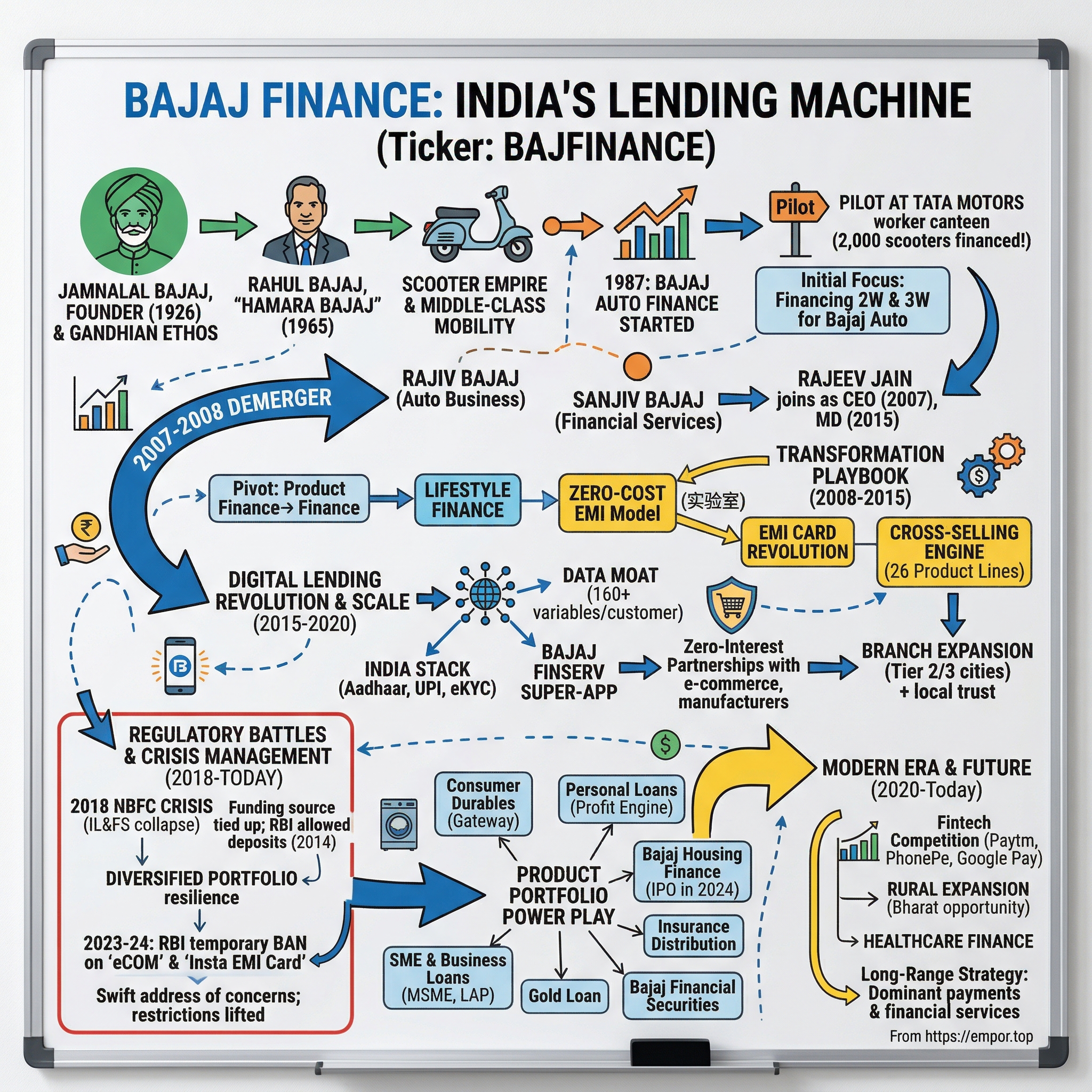
Bajaj Finance: India's Lending Machine
I. Introduction & Episode Roadmap
On the morning of Friday, August 7, 2026, traders in Mumbai opened their screens to a single line of regulatory text that erased tens of thousands of crores of market value before lunch. The Reserve Bank of India had published a draft amendment to its NBFC Directions proposing that non-bank finance companies be "permitted to offer only term loan products and shall not offer any revolving credit products," with an exemption carved out only for NBFCs specifically authorised to issue credit cards.1 For most of India's shadow-banking sector, this was a technical footnote. For one company, it landed on the exact spot where its business model lives.
Bajaj Finance shares fell roughly 5–6% that day, wiping out about ₹33,000 crore of market capitalisation and dragging the wider Bajaj complex down by an estimated ₹55,000 crore.2 Four days earlier, the stock had touched a record high.3 Jefferies estimated the actual earnings hit at 1–1.5%; Bernstein warned that forcing revolving-credit customers onto term structures could surface borrower stress that had until now been quietly refinanced away.4 Both could be right. What the episode demonstrated with unusual clarity is the central tension in this story: a company whose operating machine is extraordinary, and whose valuation leaves almost no room for the machine to be regulated, out-competed, or simply slowed down.
Here is the scale of the thing. As of June 30, 2026, Bajaj Finance carried consolidated assets under management of ₹5.47 lakh crore — about ₹5.47 trillion — and a customer franchise of 124.43 million people, roughly one in every eleven Indians.5 In the June 2026 quarter alone it added 5.1 million new customers and booked 16.13 million new loans, delivered a return on equity of 20.4% and a return on assets of 4.7%, and reported gross non-performing assets of 0.96%.5 Those return metrics would be respectable for a boutique lender managing a few billion dollars. At ₹5.47 trillion of assets, sustained for over a decade, they are close to unprecedented in consumer finance anywhere in the world.
The market has noticed. In mid-July 2026 the stock traded at roughly 35 times earnings and 6.15 times book value — a valuation that would be aggressive for a fast-growing software company and is genuinely extraordinary for a lender, an industry where book value is the whole product and leverage amplifies every mistake.6 Most global banks trade between 0.7 and 2 times book. Bajaj Finance trades where it does because investors have concluded, over fifteen years of evidence, that its book compounds faster and breaks less often than anyone else's.
So the central question of this story is not "is Bajaj Finance a good company." It plainly is. The question is harder and more useful: how did the financing arm of a scooter manufacturer become the institution that out-executes India's largest banks in consumer lending — and is that advantage structural or circumstantial? A wholesale-funded non-bank should, in theory, lose to a deposit-funded bank on the single most important input in lending, which is the price of money. Bajaj Finance has lost that battle on cost and won the war on returns anyway. Understanding exactly how it did that — and where the mechanism is now fraying — is the whole exercise.
A second question runs underneath. Between November 2023 and November 2025, this company absorbed a regulatory ban on its two flagship digital products, a system-wide capital penalty on unsecured lending, a retreat from the conventional credit card business, a credit cycle that pushed loss rates to their highest level in years, a managing director who lasted four months, and a guidance cut that knocked 7% off the stock in a session. Every one of those is defensible in isolation. Together they raise a fair question: is this a durable competitive advantage compounding through noise, or a very good growth story now meeting the natural limits of easy credit expansion, priced as though those limits do not exist?
This piece traces the answer chronologically — the captive origins, the pivot that mattered, the crisis that proved the funding model, the machine as it operates today, the capital allocation record, the regulatory reckoning, the governance wobble, and the stress test still in progress. It goes deep on the EMI Card, because that instrument is the load-bearing wall of the entire structure and is widely misunderstood. It does not attempt to value the stock, and it treats management's characterisations of its own moat as claims to be tested rather than facts to be repeated.
Start where the company started: not with a lending strategy, but with a scooter.
 Subscribe on LinkedIn
II. Origins: From Two-Wheeler Financier to Independent NBFC (1987–2008)
In 1987, the aspirational object in an Indian middle-class household was not a car. It was a Bajaj Chetak scooter, and the waiting list to buy one ran, at its worst, close to a decade. Bajaj Auto sold every unit it could make into a market that had been rationed for a generation by the licence-permit system. The constraint on the business was manufacturing capacity, not demand — and certainly not the customer's ability to pay, because customers who had queued for years had generally saved for years too.
Bajaj Auto Finance Limited was incorporated into that world as a captive: an arm whose job was to make it marginally easier for a buyer to take delivery of a Bajaj two-wheeler or three-wheeler. It was, in the most literal sense, a sales-support function with a balance sheet. There was no independent credit franchise, no proprietary distribution, no ambition beyond moving metal. For roughly two decades, that is essentially what it remained.
The wider Bajaj story around it was considerably grander. The group traced to Jamnalal Bajaj, the industrialist and freedom-movement financier whom Mahatma Gandhi referred to as a fifth son — a lineage that gave the family an unusual standing in Indian business, part commercial and part moral. His grandson Rahul Bajaj ran Bajaj Auto through the licence era and into liberalisation, becoming one of India's most quotable industrialists and, famously, one of the loudest defenders of protected domestic industry before adapting to the competition he had argued against. That is a rich story. It is not this one. What matters here is the institutional inheritance: a family group with deep capital, long time horizons, unusual credibility with Indian savers and lenders, and — as the 2000s progressed — three sons of the next generation who could not all run the same company.
Why NBFCs existed at all
The more important context is structural, and it explains why a company like Bajaj Finance could exist in the first place. Through the 1990s and well into the 2000s, Indian banks were largely uninterested in unsecured consumer credit for the mass market. Part of this was regulatory: priority-sector lending requirements pushed a mandated share of bank credit toward agriculture, small enterprise, and weaker sections, which absorbed both capital and organisational attention. Part of it was practical. There was no reliable credit bureau covering the mass market, no national digital identity, and no cheap way to verify that a shopkeeper in Nashik earning cash income could service a ₹25,000 loan. Underwriting such a customer meant sending a human being to look at them, and bank cost structures could not support that at small ticket sizes.
That left a genuine gap in the market, and non-banking financial companies filled it. NBFCs could not take demand deposits, which meant they funded themselves in the wholesale market — bank borrowings, non-convertible debentures, commercial paper — at prices structurally above what a bank paid for current and savings accounts. In exchange they got lighter regulation, freedom from priority-sector obligations, and permission to build businesses banks found uneconomic. The bargain was explicit: pay more for money, charge more for loans, and go where the banks will not. Every strategic decision Bajaj Finance has made in the last eighteen years is downstream of that bargain.
The demerger that created the opening
The unlock arrived not as strategy but as family arithmetic. Between 2007 and 2008, the Bajaj group executed a demerger that split the old Bajaj Auto Limited into three listed entities: a new Bajaj Auto Limited holding the vehicle business, Bajaj Finserv Limited holding the financial services businesses including the insurance joint ventures and the finance company, and Bajaj Holdings & Investment retaining surplus cash and investments.7 Rahul Bajaj's elder son Rajiv took the auto business; his younger son Sanjiv took financial services.
It is worth being honest about the motivation. The demerger was at least as much about giving two capable brothers separate arenas as it was about strategic clarity. But the second-order effect was profound. For the first time, the financing business sat under a holding company whose entire reason to exist was financial services, run by an executive whose career depended on that business succeeding on its own terms rather than on how many scooters it helped sell. A captive finance arm optimises for the parent's product. An independent lender optimises for risk-adjusted return on equity. Those are different companies.
The freedom arrived at an awkward moment. The finance business Sanjiv Bajaj inherited was small, concentrated in a declining product category — India's scooter market was being eaten by motorcycles, and Bajaj Auto's own share was under pressure — and structurally unremarkable. The global financial crisis was about to arrive. What the business needed was not incremental improvement to two-wheeler financing. It needed to be rebuilt around a completely different question: not "how do we help sell Bajaj vehicles," but "what does an Indian consumer want to buy on credit, and how do we be there at the moment they decide?"
Answering that required someone who had spent a career watching Indian consumers borrow. In 2007, Sanjiv Bajaj hired him.
III. Rajeev Jain's Playbook: Building the Lifestyle Finance Machine (2008–2015)
Rajeev Jain joined the Bajaj group in September 2007 to run its finance company, and by most accounts the job he was handed looked less like a growth opportunity than a turnaround.8 He arrived from consumer finance rather than banking — a career built at AIG, American Express, and GE Capital's Indian consumer operations, institutions that treated retail lending as an industrial process rather than a relationship. That distinction matters enormously to everything that followed. A banker underwrites a borrower. A consumer-finance operator underwrites a portfolio, prices for expected loss, and obsesses about acquisition cost per account. Jain came in thinking in the second language.
Forbes India, profiling him a decade later, captured the operating temperament: relentless on metrics, uninterested in ceremony, and driven by a conviction that scale in Indian retail credit would come from getting to the customer earlier than anyone else rather than from pricing more aggressively.9 That conviction produced the single most consequential strategic decision in the company's history.
From product finance to lifestyle finance
The insight was deceptively simple. Financing a scooter is a bet on one manufacturer's product cycle. Financing whatever an Indian household aspires to buy next — a refrigerator, a washing machine, a flat-screen television, later a smartphone — is a bet on Indian consumption itself. The addressable market is orders of magnitude larger, the ticket sizes are smaller and therefore individually less risky, and critically, the purchase happens in a physical store where a lender can physically be present at the moment of decision.
So Bajaj Finance went to the stores. Not to a few flagship outlets, but to tens of thousands of consumer-durable retailers, mobile-phone dealers, and electronics chains across urban and semi-urban India, placing staff and point-of-sale systems inside them. By March 2025 that network had reached over 232,000 active distribution points, including more than 49,400 urban consumer-durable stores, 62,700 rural ones, and 46,250 digital-product stores.10 The company also expanded its own geographic footprint from 3,504 locations in March 2022 to 4,263 by March 2025, weighted toward rural India, which accounted for 2,681 of those locations.10
Understand what that physical presence actually buys, because it is not primarily about lending. It is about acquiring a customer at negative marginal cost. When a shopper walks into an electronics store intending to buy a television, the retailer wants the sale, the manufacturer wants the volume, and the customer wants a lower monthly outflow. Bajaj Finance can satisfy all three simultaneously — and gets paid by all three.
The EMI Card, explained properly
The instrument that made this work is the EMI Card, later relaunched as the Insta EMI Card, and it is routinely and incorrectly described as a credit card. It is not one. A credit card is a revolving payment instrument issued under a bank's card licence, accepted anywhere on the Visa or Mastercard rails, carrying a revolving balance at punitive interest. The EMI Card is a pre-approved loan limit, tied to a proprietary merchant network, that converts a purchase into a fixed-tenure instalment loan at the point of sale — typically advertised to the customer as "no-cost EMI."
The mechanics of "no cost" are where the business model lives. There is, of course, a cost; it is simply not paid visibly by the borrower. In a typical zero-cost EMI transaction the financier charges interest on the loan in the normal way, and the manufacturer or retailer pays a subvention that offsets it — either as an explicit cash subsidy to the lender or as a discount off the invoice price, with the customer paying the sticker price in instalments. Bajaj Finance also earns processing fees, and in some structures earns the spread between what the customer pays and what it remits to the merchant.[^11] The lender's revenue therefore comes from three pockets — the borrower, the merchant, and the brand — while the borrower experiences the product as free.
Why would a manufacturer pay for that? Because subvention is cheaper than a price cut. A television brand that wants to move inventory can drop the retail price by 10%, which is permanent, visible, and resets the customer's price expectation forever. Or it can fund an EMI scheme that costs it a similar amount but is framed as a financing offer, is temporary, and converts a ₹40,000 decision into a ₹3,500-a-month decision — which measurably expands the pool of buyers. From the brand's perspective it is a promotional expense. From Bajaj Finance's perspective it is a customer acquired, credit-assessed, KYC-verified, and onboarded, with someone else paying the acquisition cost.
That is the wedge. And the wedge scales: EMI cards in force reached 58.9 million by March 2025, up 44% in a single year.11 Whether that base is genuinely defensible is a question Section V takes up seriously, because the number itself proves distribution reach, not durability.
The flywheel: why cross-sell is the actual business
Here is the part that is easy to miss and impossible to overstate. Consumer-durable financing, on its own, is a mediocre business. Ticket sizes are tiny, tenures are short — often six to twelve months — and the yields, after subvention economics and operating costs, are thin. If that were the whole company, Bajaj Finance would earn a return on equity in the low teens like everyone else.
The consumer-durable loan is not the product. It is the customer acquisition channel. What Bajaj Finance actually monetises is what happens next: a customer who has been onboarded, whose income has been assessed, whose repayment behaviour on a small loan has been observed for six months, and who can now be offered a personal loan, a two-wheeler loan, a fixed deposit, an insurance policy, or a business loan at a marginal acquisition cost approaching zero. The first loan pays for the relationship. Every subsequent product is nearly pure margin.
The company publishes the metric it uses to track this. As of March 2025, average products per customer stood at 6.05 across lending, distribution of third-party products, deposits, and payments — up from 5.42 three years earlier.12 More revealing is the cross-sell funnel it discloses: of 101.82 million total customers at March 2025, 83.77 million passed its credit-segment filter, 80.86 million sat in the overall cross-sell franchise, 72.60 million were non-delinquent, and 64.45 million — 63.3% of the total — qualified as the actual addressable cross-sell base.12 That funnel disclosure is unusually candid for an Indian lender, and it quietly concedes something important: roughly a third of the customer franchise is not currently monetisable.
Two honest caveats belong here, because the flywheel is the bull case and it deserves scrutiny. First, "products per customer" is a company-defined metric, measured over the customer's lifetime including closed products, and counting a payments product like a UPI handle or FASTag alongside a personal loan. The lending component of that 6.05 was 2.48 — and it has drifted down from 2.53 in FY22.12 The headline number rose because payments and distribution products rose. That is a materially different claim than "we are lending more to each customer," and investors reading the headline metric as evidence of deepening credit relationships are reading it wrong.
Second, cost efficiency is real but not magic. Operating expenses ran at 33.1% of net total income in the March 2025 quarter, improved from 34.0% a year earlier.13 For a lender operating tens of thousands of physical touchpoints, a cost-to-income ratio in the low thirties is genuinely strong. On the October 2024 call Jain claimed flatly, "we are the most efficient. You would know that as you benchmark us across peers."14 That claim is directionally supportable against most NBFC peers, though large private banks with cheap deposit funding operate at comparable or better ratios with a fundamentally different cost base — which is the structural asymmetry this story keeps returning to.
The early technology bet
The last piece of the 2008–2015 build was unglamorous and decisive: Bajaj Finance treated underwriting as a statistical problem years before most Indian lenders did. Scorecards, automated decisioning, and progressively digital onboarding replaced the branch-manager judgment that still dominated Indian credit. In a market where a competitor's loan officer needed days to approve a ₹30,000 durable loan, approving it in minutes at the point of sale was not a marginal improvement — it was the difference between capturing the sale and losing it.
None of this made the company safe. It made it fast. And speed in lending is a double-edged instrument, as the next decade would demonstrate — first when the entire NBFC funding market seized up, and later when the company's own growth engine outran its compliance function.
IV. Scaling Through Crisis: Digital, Data, and IL&FS (2015–2020)
In September 2018, an obscure infrastructure lender missed a payment on commercial paper, and India's shadow-banking system discovered it had been standing on a trapdoor.
Infrastructure Leasing & Financial Services — IL&FS — was a systemically embedded financier of roads, tunnels and power projects, held triple-A ratings, and was part-owned by state institutions. When it began defaulting on obligations in September 2018, the ratings agencies downgraded it from investment grade to default in a matter of weeks, and the entire premise of NBFC funding came under suspicion.15 The premise was this: non-banks had been borrowing short in the commercial paper market — often from mutual funds — and lending long. That maturity mismatch is fine until the day the short-term lenders decline to roll over. In October 2018, they declined.
What followed separated the sector permanently. Dewan Housing Finance, Reliance Capital and Infrastructure Leasing's peers found the funding window shut; DHFL's stock collapsed and the company ultimately failed, and the crisis rolled into 2019 and 2020 taking further casualties with it.15 Bajaj Finance did not merely survive; it borrowed more. In the first three weeks of October 2018, the company and its housing subsidiary raised over ₹5,395 crore in the money markets and ₹2,900 crore from banks — at rates 50 to 60 basis points above pre-crisis levels, but raised nonetheless.9 The willingness of markets to fund a non-bank at a modest premium, in the exact month that non-bank funding was presumed broken, was the most consequential vote of confidence in the company's history.
That said, survival was not the same as immunity. Bajaj Finance's own stock fell roughly 20% during the panic, to ₹2,349, even as peers fell far further — Indiabulls Housing lost about 38% and DHFL about 62.5%.9 It is a useful reminder for anyone holding a premium-multiple financial: in a systemic scare, the market repricing is indiscriminate first and discriminating later.
Why it survived: boring answers beat clever ones
The instinct is to attribute survival to superior underwriting. The evidence points somewhere less romantic. Bajaj Finance survived October 2018 because of balance-sheet architecture, not credit genius: deliberately diversified funding across bank lines, debentures, commercial paper, retail deposits and external borrowings rather than dependence on any single channel; a liability profile managed against asset tenures rather than optimised for the cheapest available money; and a loan book spread across more than thirty products so that no single segment's failure could threaten solvency.
The lesson is one that recurs throughout financial history and is forgotten with equal regularity: in lending, the balance sheet is the strategy. A lender can be brilliant on the asset side for a decade and be destroyed in three weeks by the liability side. Bajaj Finance's most valuable decision in the 2015–2018 period was the boring one — paying up for funding diversity in good times so that funding existed in bad ones. That discipline persists today, and it is worth noting where it has drifted: deposits funded 20% of consolidated borrowings at March 2025 but only 15% by June 2026, meaning the company's most stable funding source has been shrinking as a share of the mix even as the balance sheet has grown.135 Retail deposits are the closest thing an NBFC has to a bank's current-account franchise. Their declining share is a small but genuine signal worth watching.
India Stack: the public infrastructure that changed the unit economics
Running alongside the crisis was a quieter revolution that mattered more to long-run economics. Between 2016 and 2020, India built public digital infrastructure — the Aadhaar biometric identity system enabling electronic KYC, the Unified Payments Interface enabling free real-time payments, and the account aggregator framework enabling consented data sharing — collectively known as India Stack.
For a consumer lender, this changed the arithmetic of the business at its root. Verifying a new customer's identity had been a paper process costing hundreds of rupees and taking days; e-KYC compressed it to seconds and near-zero marginal cost. Assessing income had meant collecting physical bank statements; digital rails made cash flows observable. Collecting a small EMI had meant a physical mandate; UPI made it an automated pull.
Every lender in India got this infrastructure at the same time and for free. So the interesting question is not whether Bajaj Finance benefited — everyone did — but why it converted the benefit better. The honest answer is timing and organisational shape. The company had already built the distribution network and the decisioning infrastructure that these rails plugged into, and it had no legacy core-banking system to retrofit. Large banks with thirty-year-old technology stacks and branch-centric operating models could adopt the same rails but could not restructure their cost base around them at the same speed. Bajaj Finance's advantage here was less "better technology" than "no institutional antibodies."
The data-moat claim, tested
This is where marketing language and verifiable fact diverge, and investors should hold the line carefully. Bajaj Finance and its admirers have long cited proprietary underwriting sophistication — the frequently repeated claim of scoring across 160-plus variables — as evidence of a data moat. That specific claim is not independently verifiable, and it should be treated as positioning rather than proof. Variable counts are not a competitive advantage; every serious lender has access to bureau data, and the marginal predictive power of additional variables decays quickly.
What is verifiable is outcomes, and outcomes were genuinely strong for a long period. What is also verifiable is that the same underwriting apparatus did not prevent the FY25–FY26 credit deterioration described in Section IX, which arrived in rural microfinance, unsecured MSME lending, and — with real irony — the legacy two- and three-wheeler book. A durable data moat should show up as differentially better loss experience through a cycle, not merely low absolute NPAs in a benign one. On that test the evidence remains incomplete.
One genuinely useful underwriting insight did surface publicly, and it is the kind of thing that suggests real analytical work. On the October 2024 earnings call, Jain described finding that customers holding three or more live unsecured loans showed markedly higher default propensity and lower collection efficiency, and said the company was tightening norms for those cohorts across all products — noting that the share of new personal-loan customers arriving with three-plus existing loans had been cut from 13% to 8–9%.14 That is a concrete, falsifiable statement about portfolio construction, and it is worth more than any variable count.
COVID, briefly
The pandemic arrived as an asset-quality shock with no historical analogue. India imposed a national lockdown in March 2020 and the RBI permitted borrowers to defer instalments; at the peak Bajaj Finance had a substantial share of its book under moratorium, reducing to 15.5% by the June 2020 quarter.16 Management responded by front-loading provisions rather than waiting for defaults to emerge, taking ₹1,450 crore of additional COVID provisions in the June 2020 quarter alone, bringing pandemic-related provisioning to ₹2,350 crore at that point, against internal scenario planning that had contemplated FY21 credit costs of ₹5,400–5,700 crore.17
The outcome was better than the scenarios, helped considerably by policy support, and the stock recovered ferociously. For today's investor, though, COVID is the less instructive stress test — it was an exogenous shock with a policy backstop. The FY25–FY26 credit cycle, which arrived with no lockdown, no moratorium and no excuse, is the more revealing episode, and it belongs later in the story.
By 2020, then, the machine was fully assembled: merchant distribution, the EMI card rail, cross-sell, digital origination on public infrastructure, and a funding structure that had been stress-tested in public. What it did with that machine over the following six years is where the investment case is actually decided.
V. The Core Engine Today: Segments, Competition, and Unit Economics (2020–Present)
Picture the balance sheet as a physical thing. If Bajaj Finance's ₹5.47 lakh crore of assets were a building, the ground floor and the load-bearing structure would be mortgages — not consumer durables. That is the first thing most people get wrong about this company.
What the company actually is now
As of the June 2026 quarter, mortgages stood at ₹1.74 lakh crore, 31.7% of consolidated AUM and growing 27% year-on-year — comfortably the largest single block.5 Urban personal loans followed at ₹1.10 lakh crore, about 20%. Loan against securities had reached ₹36,564 crore, growing 34%. Urban consumer finance — the durables business that acquires the customer — grew 38% but remains a fraction of the book at ₹45,220 crore.5
The comparison with the prior year is instructive. At March 2025, consolidated AUM of roughly ₹4.17 lakh crore broke down as mortgages 31.1%, urban B2C loans 21.0%, SME lending 12.1%, urban sales finance 7.0%, commercial lending 6.7%, loan against securities 6.1%, rural B2C 5.2%, two- and three-wheeler finance 4.2%, car loans 2.9%, gold loans 2.0%, and rural sales finance 1.9%.18 So the shape has been stable at the top and volatile at the edges — which is exactly where the story is.
The strategic reading: consumer durables is the front door, not the house. It generates enormous customer volume at small ticket sizes and modest standalone profitability, then hands those customers to personal loans, mortgages, and SME lending, which carry the balance sheet. Anyone modelling Bajaj Finance as a consumer-durables lender is modelling the wrong company; anyone assuming the durables business could be shut down without consequence is missing that it is the acquisition engine for everything else.
The segments that are moving, and the ones that are not
Three developments in the current book deserve specific attention.
Mortgages, via Bajaj Housing Finance, are now the growth engine and the competitive battleground. BHFL's AUM reached ₹1.50 lakh crore in the June 2026 quarter, up 24%, with gross NPAs of just 0.29% — pristine asset quality reflecting a book weighted toward salaried home loans, lease rental discounting and developer finance.5 But mortgage lending in India is a scale-and-funding-cost business, and it is where deposit-funded banks compete hardest. In November 2025 management itself flagged intensifying mortgage competition as one of two reasons for cutting full-year growth guidance.19 That is not an analyst's hypothesis; it is the company's own admission that the fastest-scaling large segment is getting harder. The structural issue is unavoidable: a home loan is a commodity product where the lowest cost of funds wins, and BHFL's return on equity of 12.5% in the June 2026 quarter — respectable, but far below the parent's 20.4% — reflects exactly that.5
Unsecured MSME lending has gone from growth driver to problem child. The MSME book stood at ₹51,320 crore in the June 2026 quarter, 9.4% of AUM, and grew just 2% year-on-year — effectively flat, and deliberately so.5 Management cut MSME volumes by roughly 25% starting in mid-2025 in response to rising losses and told analysts on the July 2026 call that the segment should return to growth by the December 2026 quarter.20 A segment that goes from double-digit expansion to a deliberate freeze inside twelve months is a real datapoint about how quickly unsecured small-business credit can turn in India.
Gold loans and car loans are genuine optionality, sized honestly. Gold loans grew 81% in FY25 and then an extraordinary 112% in the June 2026 quarter to ₹21,152 crore — but that is still under 4% of AUM.185 Car loans grew 68% in FY25 off a similarly small base.18 Management is expanding gold-loan branches aggressively, targeting 2,700–2,800 outlets against 1,701 at the June 2026 quarter, adding roughly 110 branches a month.520 Gold lending is attractive precisely because it is secured by a liquid asset, which is what a lender wants after a credit scare. It is also a fiercely contested market with entrenched specialists, and at current scale it cannot move consolidated returns for several years. Call it real optionality, not a second engine.
The war game: who can actually hurt this company
HDFC Bank is the structurally dangerous competitor, and the reason is simple arithmetic. Bajaj Finance's cost of funds was 7.99% in the March 2025 quarter, and management has guided to a range roughly around the mid-7s with a slight upward bias into FY27.1320 A large deposit-funded private bank funds a meaningful share of its book at current-account and savings-account rates a few percentage points lower. That gap is not an execution failure; it is the price of not having a banking licence, and no amount of operational excellence closes it. Where a bank chooses to compete directly — prime mortgages, salaried personal loans, large-ticket secured lending — it can price Bajaj Finance out. Where it chooses not to compete, because the ticket sizes are small and the operating model is alien to a branch bank, Bajaj Finance keeps the field.
HDB Financial Services, HDFC Bank's own NBFC arm, listed in July 2025, which put a directly comparable public valuation on a bank-owned non-bank for the first time.21 Its existence is a reminder that the largest banks understand the NBFC opportunity perfectly well and have chosen to address it through subsidiaries with access to parental credibility.
Shriram Finance and Cholamandalam Investment and Finance compete from different ground — commercial vehicles, used vehicles, loan against property, rural India — with deep, decades-old collection infrastructure in exactly the semi-urban geographies Bajaj Finance has been expanding into. They are not going to take the EMI Card business. They are entirely capable of making rural and vehicle lending less profitable for everyone.
Fintechs and digital originators are the most misunderstood threat. The narrative that they would disintermediate incumbents has largely not played out, because RBI's digital-lending rules made the originate-and-sell model considerably harder and because funding for unprofitable lending evaporated. What they have done is compress margins in the most digitally-native segments and raise customer expectations about speed. That is a slow tax, not an extinction event.
Porter's Five Forces, applied to Indian consumer and SME credit
Threat of new entrants: low at scale, high at the margin. Building what Bajaj Finance has — 232,000-plus distribution points, an EMI card base approaching 60 million, a national collections apparatus, and an investment-grade funding profile — takes fifteen years and enormous capital. But entering a slice is easy, and slices are where margins get taken.
Supplier power: moderate and cyclical, and it is the RBI. The "supplier" is wholesale funding, and its price is set by monetary policy and credit spreads, not negotiation. When policy tightens, Bajaj Finance's input cost rises with a lag it cannot control.
Buyer power: rising, and structurally so. Digital comparison of loan offers is commoditising credit at the margin. This is the force most likely to be underestimated over a decade.
Threat of substitutes: rising in a specific, live way. Embedded credit from e-commerce platforms and the payments ecosystem substitutes for point-of-sale lending. And regulation itself can be a substitute-forcing mechanism: if flexi and revolving structures are prohibited, customers do not stop borrowing — they borrow in a form that carries less yield.
Rivalry: intensifying precisely where the company most needs to grow. Mortgages and SME are the two segments large enough to move a ₹5.47 lakh crore balance sheet, and they are the two where management has publicly acknowledged pressure.
The 7 Powers lens: what is actually durable
Applying Hamilton Helmer's framework honestly produces a mixed verdict rather than a triumphant one.
The strongest claim is counter-positioning combined with process power. Bajaj Finance built a merchant-embedded origination model that banks structurally did not want: too many touchpoints, too small a ticket, too much field operations, too little relationship prestige. By the time it became obviously valuable, replicating it required a bank to build an operating model incompatible with its own cost structure and culture. That is textbook counter-positioning. Layered on top is genuine process power — fifteen years of accumulated routines in merchant onboarding, point-of-sale underwriting, and small-ticket collections that cannot be bought, only built.
Switching costs exist but are weaker than the cross-sell narrative implies. A customer with a Bajaj EMI Card, a personal loan, a fixed deposit and an insurance policy faces real friction in leaving. But nothing prevents them borrowing elsewhere simultaneously — indeed, Jain's own three-plus-loans finding proves customers do exactly that. These are convenience costs, not lock-in.
Scale economies are real in funding and technology: a larger balance sheet borrows cheaper and amortises AI and platform investment across more accounts. The company is now spending heavily here, with 230 people in a dedicated AI unit and voice-and-text bots that disbursed ₹2,551 crore in the June 2026 quarter against a full-year target of ₹11,000–12,000 crore.520 Whether this becomes durable advantage or simply a cost every competitor must also incur is genuinely unresolved — most technology investments in financial services end up as table stakes.
Network economies are the weakest claim, and the company does not really make it. A merchant network is a distribution asset with real barriers, but a new customer's EMI Card is not more valuable because other customers hold one.
Why it wins from here, and what would falsify that
The evidence-based bull mechanism is this: Bajaj Finance sits inside merchant ecosystems that banks have not prioritised, converts that presence into low-cost customer acquisition, and monetises the relationship across multiple products — and it has done so through the IL&FS funding freeze, a pandemic, and a regulatory ban without a solvency event. The June 2026 quarter's numbers are consistent with a machine still working: record AUM addition of about ₹37,000 crore, loan losses down to 1.31% of average assets excluding a ₹296 crore macro-economic overlay from 1.87% a year earlier, and operating expenses at 33.4% of net total income.520
The falsification tests are equally clear. The funding-cost gap to banks is permanent and widens in tightening cycles. Growth increasingly requires either taking more credit risk in unsecured and MSME lending — precisely where losses appeared — or competing in mortgages where a wholesale-funded lender's structural disadvantage is most exposed. And the regulator has now demonstrated three separate times in three years that it can rewrite the product rules on which the model depends.
That last point deserves its own section. But first, the question of how this company deploys the capital it earns — which turns out to be the least-discussed and most quietly impressive part of the story.
VI. Bajaj Housing Finance and Capital Deployment: Build, Not Buy
There is a particular kind of Indian financial-services story that ends badly, and it usually starts with an acquisition. A lender with a high multiple buys a lender with a low multiple, promises synergies, discovers the acquired loan book was underprovisioned, and spends three years explaining the write-downs. The NBFC and housing-finance sector has produced a steady supply of these.
Bajaj Finance's capital allocation record is notable primarily for its absence of this genre. There is no material history of large acquisitions. The mortgage business was built, not bought. The gold-loan branch network is being constructed branch by branch. The securities business was grown organically. Even the company's stated technology ambitions have been pursued through internal build and small minority stakes rather than acquisition — in April 2025 it agreed to acquire a 12% stake in a cybersecurity company for roughly ₹61 crore, a rounding error on a balance sheet of this size and a reasonable illustration of the scale at which the company is willing to buy anything at all.13
This matters more than it sounds. Every rupee of retained earnings deployed into organic growth at 20% returns compounds; every rupee spent on an overpriced acquisition is destroyed once and defended forever. There is genuinely no history of overpaying for acquisitions to benchmark here, and rather than force a comparison that does not exist, the honest analytical statement is that this company has avoided the single most common way lenders destroy shareholder value. That is a real, if unglamorous, form of discipline.
The QIP: raising capital before you need it
In October 2023, Bajaj Finance's board approved raising ₹10,000 crore — ₹8,800 crore through a qualified institutional placement at a floor price of ₹7,250 per share, plus ₹1,200 crore via a preferential allotment of warrants to parent Bajaj Finserv.22 Bajaj Finserv exercised those warrants in March 2025, paying the remaining 75% of the consideration and receiving 1.55 million shares.13
The timing is what deserves credit. The raise was completed weeks before the RBI's November 2023 actions on unsecured lending and before the credit cycle turned. Capital raised into strength is cheap; capital raised into stress is expensive or unavailable, as the entire NBFC sector learned in 2018. Management did not, as far as public disclosure shows, claim prescience about what was coming. But the behaviour — raising equity when the stock was strong and capital adequacy was already comfortable rather than waiting until it was needed — is the behaviour of an operator who has internalised that a lender's real product is its ability to keep lending. Capital adequacy of 21.93% at March 2025 and 20.90% at June 2026, against regulatory minimums far below, reflects a deliberately over-capitalised posture.135
The counter-argument a skeptical investor should press: equity raised at 6 times book is dilutive to book value per share regardless of timing, and a company earning 20% returns on equity with 4.9 times leverage arguably did not need external capital at all. Repeated equity issuance by a high-ROE lender is worth watching, because it can indicate either prudence or an inability to fund growth from retained earnings. The evidence here leans toward prudence — but it is a legitimate question to keep asking.
The Bajaj Housing Finance IPO: partly a choice, mostly a mandate
In September 2024, Bajaj Housing Finance completed an initial public offering of ₹6,560 crore at a price band of ₹66–70 per share, comprising a fresh issue and an offer for sale by the parent.23 The stock listed on September 16, 2024 at ₹150 — more than double the offer price.24
The conventional reading is that this was a triumph of pricing and demand. The more useful reading requires two corrections.
First, this was substantially a compliance event. Under the RBI's scale-based regulation framework, NBFCs classified in the "upper layer" are required to list within a specified window, and Bajaj Housing Finance's filing was explicitly framed as being in line with those norms for upper-layer NBFCs.25 The IPO was not primarily a discretionary decision to monetise a subsidiary at an attractive valuation; it was a regulatory obligation the company executed well. Crediting management for strategic brilliance on a mandated listing overstates the case.
Second, a listing-day double is not unambiguously good news for the selling shareholder. A stock that lists at more than twice its offer price is, by definition, a stock that was offered too cheaply. The difference between ₹70 and ₹150 on the shares sold represents value transferred from Bajaj Finance's existing shareholders to IPO allottees. Underpricing is standard practice — issuers accept it to ensure a successful listing and reward anchor investors — but investors should file the pop under "money left on the table," not "vindication of value." The subsequent record is the more honest scorecard, and it is mixed: BHFL has compounded AUM at over 24% but earns a return on equity around 12.5%, meaning it consumes capital faster than it generates it and remains dependent on the parent.5 Management has signalled it will dilute its holding from 86.7% toward 75% over time, which is itself a regulatory requirement rather than a strategic choice.20
The parent did book a one-time gain from the listing and returned part of it directly to shareholders via a special interim dividend, alongside a regular final dividend for FY25 representing 18.88% of standalone profit excluding the exceptional gain.13 In April 2025 the board also approved a 1:2 stock split and a 4:1 bonus issue — corporate actions that change nothing economically but do improve retail accessibility, which for a company with this shareholder base is a marketing decision as much as a financial one.13
What the capital record actually shows
Strip away the narrative and the pattern is consistent: grow organically, hold more capital than required, raise equity from a position of strength, avoid acquisitions, return a modest share of profits and reinvest the rest. For a lender compounding at these rates, retaining capital is defensible — the reinvestment opportunity genuinely exists. The discipline question is whether it stays defensible if returns compress. A company earning 20% on equity should retain everything; a company earning 13% should not. The next few years of return on equity will determine which conversation shareholders should be having.
Capital discipline, however, did not protect the company from the one risk it could not raise equity against: the regulator deciding it had broken the rules.
VII. The Regulatory Reckoning: RBI's Digital Lending Ban and the Risk-Weight Shock (2023–2024)
On November 15, 2023, the Reserve Bank of India directed Bajaj Finance to cease all sanctions and disbursals under two products: 'eCOM' and the 'Insta EMI Card'.26 Read that again with the context of Section III in mind. The regulator had just switched off the company's flagship digital origination products — including the modern incarnation of the very instrument around which the entire acquisition and cross-sell machine was constructed.
The stated cause was not credit risk, capital adequacy, or governance in the abstract. It was the non-issuance of Key Fact Statements to borrowers under those two products, and deficiencies in the KFS content for other digital loans.26 A Key Fact Statement is a plain-language summary telling a borrower what they are actually paying — interest rate, fees, annualised cost, tenure — mandated under RBI's digital lending guidelines. It is a consumer-protection basic.
This distinction matters enormously for how an investor should read the episode. A liquidity problem is bad luck; a credit problem is bad judgment; a failure to give customers a document telling them what their loan costs is a process and compliance failure in the company's own signature product. It happened at a company celebrated for operational rigour, in the product line most central to its identity, at a moment when it was originating millions of loans a quarter. The most plausible reading is uncomfortable and worth stating plainly: growth velocity outran the compliance function.
The restrictions ran roughly five and a half months. The RBI lifted them with immediate effect on May 2, 2024, after the company undertook remedial measures.26 Both products resumed.
What the ban actually cost, and what it revealed
The direct financial damage was contained — Bajaj Finance has more than thirty product lines, and origination shifted to alternative channels. But three second-order costs are more instructive than the arithmetic.
It cost the company its regulatory halo. Bajaj Finance had been, for years, the NBFC that regulators pointed to approvingly. An RBI action naming it specifically ended that, and once a supervisor has taken enforcement action against an institution, subsequent scrutiny is more intense, not less.
It exposed key-product concentration risk. When a regulator can switch off two products and materially disrupt origination, the "thirty-plus products" diversification argument is weaker than it appears. Diversification of the loan book is not the same as diversification of the acquisition funnel.
And it demonstrated that the company's greatest structural strength — being embedded in digital and merchant channels banks ignored — sits in exactly the area the regulator watches most closely. Digital lending is where RBI has concentrated its consumer-protection energy for five years. Bajaj Finance's moat and its regulatory exposure are the same asset.
The risk-weight shock: this one was not the company's fault
The day after the product ban, on November 16, 2023, the RBI raised risk weights on unsecured consumer credit — personal loans and credit cards — from 100% to 125%, and simultaneously increased risk weights on bank lending to NBFCs.27 This was an industry-wide macroprudential action targeting what the central bank saw as unsustainably fast growth in unsecured retail credit.
The mechanism is worth explaining plainly, because it is where regulation meets return on equity. A risk weight determines how much capital a lender must hold against a loan. Raising it from 100% to 125% means every ₹100 of unsecured lending now consumes 25% more capital. Since return on equity is profit divided by equity, forcing more equity behind the same loan mechanically reduces the return — unless the lender raises pricing, which competition may not permit. The double blow was that the parallel increase on bank exposure to NBFCs raised the price at which banks would lend to companies like Bajaj Finance. The regulator squeezed both the asset side and the liability side in one action.
For a company with a large unsecured book, this was a genuine industry headwind rather than a company-specific failure — and it should be assessed differently from the product ban. The RBI partially reversed course in February 2025, restoring lower risk weights on bank credit to NBFCs, which eased funding costs somewhat.28 But the episode established a precedent that has proved durable: unsecured consumer credit in India is now a policy variable, not merely a market.
The credit card retreat, and the narrative it kills
In late November 2024, Bajaj Finance and RBL Bank mutually agreed to stop issuing new co-branded credit cards, ending an eight-year partnership that began in 2016 and had been renewed in 2021; the company simultaneously wound down its arrangement with DBS Bank India, launched in June 2022.29 At the time, RBL had about 5.17 million credit cards outstanding, of which roughly 3.4 million were Bajaj co-brands — a substantial portfolio to walk away from.29
The trigger was regulatory. RBI restricted co-brand partners to sourcing cards and providing access to goods and services, and specifically did not permit the co-brand partner to handle collections — an activity in which Bajaj Finance had built genuine capability over years.29 Stripped of collections, the economics no longer justified the partnership.
This deserves emphasis because it corrects a widely-held misreading. Bajaj Finance is not, and after 2024 will not be, a challenger to HDFC Bank or ICICI Bank in conventional credit cards. It entered that business through partnerships, found the regulatory structure incompatible with its operating model, and exited. Its card-like product remains the proprietary EMI Card — which, as established, is a merchant-network instalment instrument rather than a general-purpose revolving card. Whether that is a weakness or a strength depends on the question. On breadth of acceptance, it is a weakness. On defensibility and unit economics, it is arguably a strength — which is precisely why the August 2026 draft on revolving credit, and its explicit exemption for card-issuing NBFCs, lands where it does. Having exited cards, the company does not sit inside the exemption.
How management explained it
Testing candour requires the transcripts. On the October 2024 call — eleven months after the ban and five months after it was lifted — Jain addressed the episode only when an analyst raised regulatory matters in a broader question. His answer was procedural rather than confessional: he described building compliance capacity "from very little" to roughly 250 people across three lines of defence over the preceding two and a half years, and said that "when the embargo happened, we embarked on a proactive integrated compliance framework and did a periodical review and created a self-corrective regulatory compliance framework."14 He notably declined to comment further on regulatory matters when pressed.
That is a defensible corporate answer, and building out three lines of defence is the substantively correct remedy. It is also, on the evidence of the transcript, a framing that emphasises the fix rather than the failure — the word "embargo" does more work than "we did not give our customers the disclosure document the rules required." Investors evaluating management candour should note that the specific compliance lapse was never dwelt on publicly in the way the operational recovery was. That is not evasion, but it is not full ownership either.
Which brings the story to the person doing the explaining, and to the strangest four months in the company's corporate history.
VIII. Current Management: Rajeev Jain, the Four-Month MD, and Governance
On March 20, 2025, Bajaj Finance announced what looked like a model succession. Anup Kumar Saha, a long-serving insider who had been Deputy Managing Director, would become Managing Director effective April 1, 2025. Rajeev Jain, after roughly eighteen years running the company, would move up to Vice Chairman.30 The company simultaneously elevated three executives to Deputy CEO roles reporting to Saha — a deliberate signal of institutional depth beneath the new MD.13
On July 21, 2025, Saha resigned. The stated reason was personal.31 He had been Managing Director for slightly under four months. The board immediately redesignated Jain as Vice Chairman and Managing Director, with a term running through March 31, 2028.31 Press reporting at the time noted that Saha had been among the candidates under consideration for the chief executive role at IndusInd Bank.32
For a company whose entire investment case rests on operational excellence, this was a remarkable sequence.
The man himself
Jain is now approaching two decades running Bajaj Finance, and he is the person whose track record most directly underwrites the bull case. The architecture described in Sections III through V — the merchant network, the card rail, the cross-sell funnel, the funding diversification that survived 2018 — is substantially his design. On calls he is direct, occasionally blunt, prone to metaphor, and unusually willing to describe portfolio problems in operational rather than macroeconomic terms. Discussing rural lending in October 2024, he framed the recovery as a credit lifecycle: "there comes a time in any credit business where you cut all the bad cholesterol and you have to build the good business. We are 18 months into it."14 On the July 2026 call, after a quarter that beat on nearly every metric, he declined to raise full-year guidance with the line, "One swallow doesn't make a summer. We'll wait for one more quarter."20
That instinct — refusing to raise guidance on a strong quarter — is a genuine mark of guidance discipline, and it should be weighed in his favour. It is also worth holding alongside the record in Section IX, where guidance moved the other way more than once.
Compensation and incentive alignment
Jain's FY25 remuneration was approximately ₹102 crore, the second consecutive year above ₹100 crore, making him the highest-paid executive among Nifty 50 companies that had reported at that point. Roughly ₹80 crore of that came from stock options rather than cash.33
The alignment question is genuinely two-sided. On one hand, an executive paid overwhelmingly in equity-linked instruments has incentives tied to shareholder outcomes rather than to reported profit or asset growth. On the other, options are asymmetric: they pay handsomely if the share price rises and cost nothing if it falls. That is a structurally different exposure from an executive holding a large block of shares purchased with their own capital, whose downside is real. Jain's direct shareholding is modest as a percentage of the company. An activist would note that ₹102 crore for one executive is roughly 0.6% of FY25 consolidated profit, that option-heavy packages at a company trading at 6 times book are effectively a leveraged bet on multiple expansion, and that this is a compensation structure which rewards continued growth at a moment when growth is precisely what management should be willing to sacrifice for credit quality.
The succession stumble as a governance signal
The Saha episode deserves real weight, and not because executives never leave. They do, constantly, and IndusInd Bank was conducting a high-profile leadership search. The issue is what the sequence reveals about the process.
A managing director appointed in March and gone by July means one of a small number of things: the board did not adequately assess the candidate's commitment before handing him the top job; the candidate's circumstances changed in an unusually short window; or the working arrangement between a newly-elevated MD and a Vice Chairman who had run the company for eighteen years proved unworkable. The company's public explanation cites personal reasons and nothing further; the board has not disclosed a fuller account in filings or on calls. That absence is itself information. For a company that discloses its cross-sell funnel in five tiers, the silence on a failed CEO transition is conspicuous.
The consequence is concrete: Bajaj Finance's succession plan today is that Rajeev Jain runs the company until March 2028. The three Deputy CEOs remain in place, but the person who was supposed to be the answer is gone, and the announced solution was to reappoint the incumbent. Key-person risk at this company is not a theoretical governance checkbox. It has now been demonstrated empirically.
Promoter control and the minority shareholder
Sanjiv Bajaj serves as Chairman of Bajaj Finance while also serving as Chairman and Managing Director of Bajaj Finserv, the promoter and holding company.34 The Bajaj family's control runs through a cascading holding structure — Bajaj Holdings and Bajaj Finserv above Bajaj Finance, which in turn controls Bajaj Housing Finance and Bajaj Financial Securities.
Promoter-controlled structures cut both ways for minority investors. The benefit is genuine long-termism: no quarterly pressure to sell the business, patient capital, and a family whose reputation is bound to the institution's conduct. Bajaj Finserv's willingness to inject ₹1,200 crore via warrants alongside the 2023 institutional raise is evidence of a promoter putting capital in rather than extracting it. The cost is equally genuine: the chairman of the company is the managing director of its controlling shareholder, which places the person responsible for board oversight on both sides of the relationship. Related-party transactions, capital allocation between group entities, and decisions about subsidiary listings all occur inside a structure where independence is a matter of practice rather than architecture.
No activist investor is currently targeting Bajaj Finance, and there is no public evidence of a governance scandal. But the skeptical case is straightforward and worth stating in full: this is a family-controlled board that just ran a four-month failed CEO transition without explanation, pays its managing director more than any Nifty 50 peer in options at a valuation of 6 times book, exercises control through a holding-company cascade, and operates in an industry where the regulator has taken enforcement action against it within the last three years. Every individual element has a reasonable answer. The pattern is worth pricing.
Governance questions become urgent when performance stumbles. Between FY25 and FY26, it did.
IX. The 2024–2026 Stress Test: MSME, Rural, and the Guidance Cut
On November 10, 2025, Bajaj Finance reported a quarter that was, by most measures, fine. Consolidated net profit rose about 22% to ₹4,875 crore; net interest income grew 22% to ₹10,785 crore.19 Then management cut its full-year AUM growth guidance from 24–25% to 22–23%, and the stock fell 6.72% to ₹1,012.50.19 Over the session it dropped more than 7%.35
Two percentage points of guidance. Seven percent of market value. That ratio is the most honest single statistic about what investors are actually paying for.
How the cycle turned
The deterioration built over roughly eighteen months. Credit costs rose from around 1.6% of average assets in FY24 to roughly 2.2% in FY25, and the composition of that increase is more revealing than the level.36 Rural business-to-consumer lending and microfinance were early sources of stress, as they were across the Indian microfinance industry, which experienced a broad delinquency cycle in this period. Unsecured MSME lending followed.
But the most striking concentration was in the legacy captive book. At March 2025, two- and three-wheeler finance was down to 4.2% of consolidated AUM and shrinking 12% year-on-year — and it carried gross NPAs of 5.03%, against 0.96% for the consolidated book, with net NPAs of 2.78% and provision coverage of only 46%.1837 The company's founding business had become, proportionally, its worst-performing asset, and management put it into deliberate run-off.
There is a second layer to that story that most coverage misses. Bajaj Finance did not simply choose to exit two-wheeler financing — it partly lost the business to its own extended family. In September 2022, Bajaj Auto established its own captive financing unit, Bajaj Auto Credit Limited, which commenced operations in the March 2024 quarter. Jain disclosed the consequence on the October 2024 call with unusual specificity: Bajaj Finance had financed 864,000 two-wheelers and 199,000 three-wheelers for Bajaj Auto in FY24; in the first half of FY25 that fell to 217,000 and 55,000 respectively, with the balance booked by Bajaj Auto's own captive.14 The company responded by building non-Bajaj two-wheeler financing to roughly 35,000 accounts a month and projected that this would fully replace the lost volume by FY27.14
Strip the sentiment out and this is a clean illustration of why captive finance arms are fragile assets: the parent can always take the business back. The disclosure also reflects well on management's willingness to volunteer inconvenient detail unprompted — Jain raised it as an unsolicited "additional update," not in response to a question.
The November 2025 call: what analysts got
The guidance cut was attributed to two causes: MSME stress and intensifying mortgage competition.19 Management cut unsecured MSME volumes by roughly 25%, guided SME growth down to 10–12%, said MSME growth should bottom in the first quarter of the following financial year, and indicated credit costs would run at the higher end of its 1.85–1.95% range with improvement expected from the next financial year.19 Gross NPAs rose to 1.24% from 1.03% the prior quarter.19
Compare the tone against the equivalent call thirteen months earlier, because that comparison is the real test of guidance discipline. In October 2024, Jain had described credit costs as having "hopefully peaked," guided FY25 net loan losses to 2.0–2.05% against an earlier stated FY25 corridor of 1.75–1.85%, and projected a return toward 185–195 basis points.14 Chief Financial Officer Sandeep Jain had said margins would benefit from rate cuts flowing through with a one-to-two-quarter lag, and Rajeev Jain had stated that cost of funds "is peaked."14
The scorecard on those statements is mixed and should be read carefully. Credit costs had not peaked in the sense implied — they remained elevated through FY25 and the company subsequently reported a full-year loan-loss ratio around 2.3% including a one-time expected-credit-loss model refresh, or roughly 2.0% adjusted.13 The original FY25 corridor of 1.75–1.85% was missed and openly revised. Cost of funds did decline, so that call proved right. And the 185–195 basis point normalisation Jain projected for the following year became a guided 1.85–1.95% range that management then described as likely to land at the top end.19
The pattern that emerges is not one of misleading investors. Management revised guidance openly, quantified the misses, and named the segments. The pattern is one of persistent optimism at the turn — repeatedly signalling that the worst had passed slightly before it had. That is an extremely common failure mode among lenders, because credit deterioration is observed with a lag and management sees improving early vintages before the seasoned book catches up. But for an investor paying a premium multiple explicitly for management credibility, the tendency should be priced.
To management's credit, the answers on the November 2025 call were specific rather than atmospheric: a named percentage cut to MSME volumes, a revised SME growth range, a stated quarter for the trough, and a credit-cost range with an acknowledged skew. Vague reassurance would have been "we remain confident in the medium-term opportunity." That is not what analysts got.
The rebound, and how to read it
The June 2026 quarter was, on its face, a comprehensive answer to the skeptics. AUM grew 24% year-on-year with a record quarterly addition; profit rose 27–28%; net interest income grew 23% to ₹12,571 crore; return on equity climbed back to 20.4% from 19.0%; and gross NPAs fell to 0.96% from 1.03% a year earlier.538 Consumer finance grew 38% in urban and 49% in rural markets — though management usefully disaggregated the urban figure as roughly 20% organic volume growth and 20% from higher product prices, which is the kind of detail that separates real demand from inflation.20
Three cautions belong against that. The loan-loss improvement to 1.31% of average assets was struck before a ₹296 crore macro-economic provision overlay; including it, the ratio was closer to 1.54%, still a large improvement but a smaller one.520 MSME grew just 2%, meaning the segment that caused the problem has not yet demonstrated it can grow safely again. And management explicitly declined to raise FY27 guidance of 23–25% AUM growth on the strength of the quarter.20 When the operator closest to the data says one quarter is not a trend, external observers should probably agree.
The risks that actually matter, mechanically
Refinancing and cost-of-funds risk. A wholesale-funded lender must continuously roll over borrowings. In a stable or easing rate environment this is unremarkable; in a volatile one it compresses margins with a lag, and in a systemic one it becomes existential, as 2018 demonstrated. The declining share of retail deposits in the funding mix modestly increases this sensitivity.
Regulatory risk, which is now the dominant variable. The RBI has intervened in this company's business model three times in under three years: the 2023 product ban, the 2023 unsecured risk-weight increase, and the 2026 draft on revolving credit. The mechanism of harm is not fines; it is the forced redesign of products around which distribution and pricing were built.
Execution risk in a two-directional strategy. Management is simultaneously de-risking MSME and rural lending while committing to 23–25% AUM growth and a gold-loan branch build-out of over a thousand new locations. Those are not contradictory, but they consume management attention in opposite directions, and the growth has to come from somewhere — currently mortgages, loan against securities and consumer finance, two of which are the most competitive markets the company operates in.
Competitive risk in mortgages specifically. Bajaj Housing Finance is competing against bank mortgage books funded at materially lower cost, in a product where differentiation is minimal. Management has already conceded the pressure once.
X. Playbook: Business & Investing Lessons
Strip the narrative back and this story yields five transferable lessons, each of which generalises well beyond Indian consumer finance.
Acquisition channels can be worth more than the products sold through them. The consumer-durables loan is a low-margin, short-tenure, small-ticket product that most lenders would rationally deprioritise. Bajaj Finance kept it because it is not a product — it is a customer-acquisition system that someone else partly pays for, delivering a credit-assessed, KYC-verified individual at the exact moment they have demonstrated both willingness to borrow and capacity to repay. The generalisable insight: when evaluating any business, separate the profit engine from the acquisition engine, because they are frequently different, and destroying the low-margin one to improve reported margins is a classic way to break a compounder.
Distribution in a fragmented market is a slower-decaying moat than technology. India has millions of small retailers, no dominant national chain in most consumer categories, and enormous geographic heterogeneity. In that environment, physically being present in hundreds of thousands of touchpoints is a genuine barrier — expensive to build, tedious to operate, and impossible to acquire quickly. Technology advantages in financial services tend to be copied within a product cycle; physical and contractual distribution takes a decade. When assessing a claimed moat, ask which category it falls into.
The liability side of a lender is the strategy, and it has a hard ceiling. Bajaj Finance's cost of funds sits structurally above a deposit-funded bank's, and no amount of operational excellence closes it. The company's response — accept the disadvantage, then avoid segments where price is the only variable and dominate segments where presence and speed matter more — is the correct strategic answer to an unwinnable input-cost battle. But it constrains the addressable market permanently, and it explains why the company's growth increasingly runs into either commodity competition or higher credit risk.
Raise capital when you can, not when you must. The 2023 equity raise ahead of a regulatory tightening and a credit cycle is the clearest single example of capital discipline in the record. The corollary, equally important, is what did not happen: no large acquisitions, no roll-up of a distressed peer at a seemingly attractive price, no diversification into adjacent financial businesses requiring capabilities the company lacked. The most valuable capital allocation decisions are frequently the deals not done, and they are invisible in every performance metric.
Execution concentrated in one person is a risk factor, however good that person is. Bajaj Finance's record is substantially one operator's record. The 2025 succession attempt failed within four months and the resolution was to reappoint the incumbent through 2028. For any investor holding a founder- or operator-dependent business at a premium multiple, the practical test is not whether the leader is excellent — it is whether the organisation has demonstrated it can produce a credible successor. On the only public evidence available, this one has not yet.
XI. Analysis: Bull vs. Bear Case & Valuation
The bull case, stated at its strongest
India's consumer and small-business credit markets remain structurally underpenetrated relative to comparable economies, and formalisation continues to expand the addressable pool of borrowers with verifiable income. Into that market, Bajaj Finance brings a distribution position that took fifteen years and hundreds of thousands of merchant relationships to assemble, an origination model embedded at the point of purchase, and a customer base of 124 million that generates continuous cross-sell opportunity at near-zero incremental acquisition cost.
The multi-cycle evidence is real and not easily dismissed. The company funded itself through the 2018 NBFC freeze when peers failed, provisioned proactively through the pandemic, absorbed a five-and-a-half-month ban on its flagship digital products without a solvency event, and delivered a return on equity above 20% in the June 2026 quarter after a genuine credit deterioration. Bajaj Housing Finance provides a second, secured growth vehicle in a market — Indian housing credit — with decades of runway. And the AI programme, whatever one makes of the disclosure enthusiasm, is producing measurable operating results: self-service penetration of 71% via bots and 32 million documents processed with AI in the June 2026 quarter, against a stated target of improving the operating expense ratio by 25–40 basis points.520 For a business where cost-to-income is the second-most-important lever after credit cost, that is not decoration.
The bear case, stated at its strongest
Start with valuation, because it is the bear case's foundation. At roughly 35 times earnings and 6.15 times book in mid-July 2026, Bajaj Finance trades at a multiple that requires the current growth and return profile to persist for many years.6 For context, most large global lenders trade between 0.7 and 2 times book, and even India's premium private banks trade at a substantial discount to this. A P/B of 6 on a lender earning 20% on equity implies the market is capitalising that return at roughly 3.3 times — which only works if 20% returns are sustainable at a much larger asset base, in a more competitive market, under tighter regulation.
Then stack the operational evidence against that requirement. Credit costs rose materially in FY25 and management's own guidance was revised downward twice. The segment mix increasingly depends on mortgages, where the structural funding disadvantage is most exposed and where management has already conceded competitive pressure. Unsecured MSME lending — the higher-yielding growth avenue — is in deliberate contraction. The regulator has intervened three times in three years, and the August 2026 draft targets a product structure representing an estimated 14% of the portfolio carrying roughly 50 basis points of incremental yield.4 Governance shows a family-controlled board that fumbled a CEO transition and pays its returning managing director more than any Nifty 50 peer, largely in options.
The synthesis a skeptic would offer: this is an excellent operating company whose share price already reflects excellence, whose growth increasingly requires either commodity competition or elevated credit risk, and whose regulatory environment has become adversarial rather than benign.
Myth versus reality
Myth: Bajaj Finance is a credit card company taking on the big private banks. Reality: it exited co-branded credit cards entirely in late 2024 after RBI restricted co-brand partners' roles. Its card product is a merchant-network instalment instrument, and it now sits outside the card-issuer exemption in the RBI's August 2026 revolving-credit draft.
Myth: the data moat is the core advantage. Reality: the verifiable advantages are physical and contractual — merchant distribution, an EMI card base of nearly 60 million, and collections infrastructure. Underwriting sophistication is claimed rather than demonstrated to be differentially superior, and the FY25 credit deterioration is evidence against a strong version of the claim.
Myth: cross-sell is deepening. Reality: total products per customer rose to 6.05 by March 2025, but the lending component drifted down from 2.53 in FY22 to 2.48.12 The improvement came from payments and third-party distribution — genuine engagement, but not the same as more credit per customer.
Myth: the Bajaj Housing Finance listing pop proved value creation. Reality: it proved the offer was underpriced. BHFL's returns remain well below the parent's, and the listing itself was substantially driven by an RBI mandate.
Peer comparison, honestly framed
Against HDFC Bank, the trade-off is stark: the bank has a vastly lower cost of funds, a deposit franchise Bajaj Finance cannot replicate, and far greater balance-sheet scale, but grows more slowly and earns a lower return on equity. Bajaj Finance's premium multiple is, in effect, the market paying for the growth differential — which makes any sustained convergence in growth rates the single most dangerous scenario for the stock.
Against NBFC peers such as Cholamandalam and Shriram Finance, Bajaj Finance's distinction is product diversity, cross-sell depth, and customer-franchise scale rather than superior asset quality in any single line. Those peers operate deep, hard-won franchises in vehicle and used-vehicle finance where Bajaj Finance is a challenger rather than an incumbent — its car loan book, despite 68% growth in FY25, remains small. HDB Financial Services, listed since July 2025, now provides a public market benchmark for a bank-owned NBFC.21
Applying the frameworks from Section V at the portfolio level: the counter-positioning power is real but ageing — banks have now had a decade to observe the model, and HDB's listing shows they are addressing it structurally. The process power in small-ticket origination and collections remains the most durable asset. Scale economics in funding are real but capped by the licence constraint. And the force intensifying fastest is rivalry, in the two segments large enough to matter.
Should it become a bank?
The question follows logically from everything above: a banking licence would grant access to current and savings deposits and largely dissolve the funding-cost disadvantage. It is not a free trade. A bank operates under cash reserve ratio and statutory liquidity ratio requirements that sterilise a portion of deposits into low-yielding assets, faces priority-sector lending obligations that direct a mandated share of credit, and accepts far heavier supervision — which is precisely the regime a company with a recent enforcement action might find constraining. Universal bank licensing in India is also granted rarely and on the regulator's timetable.
Management has not signalled meaningful intent to pursue a licence in public materials, and the strategic direction communicated on recent calls — branch-led gold lending, AI-driven cost reduction, deposit growth within the NBFC framework — is consistent with optimising the current structure rather than changing it.20 Treat the banking-licence thesis as speculative optionality, not a plan. Meanwhile the deposit franchise it can build has been shrinking as a share of borrowings, which is the more immediately relevant fact.
Net framing
The genuine analytical question is not whether Bajaj Finance is well-run. Eighteen years of evidence say it is. The question is whether a company of this size, in this market, under this regulatory regime, can sustain the growth and returns embedded in a 6-times-book valuation while simultaneously de-risking two of its higher-yielding segments and defending its largest one against better-funded competitors. The June 2026 quarter was a strong data point for the optimists. The November 2025 guidance cut and the August 2026 regulatory draft are strong data points for the skeptics. Both sets of evidence are recent, and the disagreement between them is the entire investment debate.
XII. Epilogue & What to Watch
A useful way to hold this company in mind: it is a fifteen-year-old distribution machine attached to a balance sheet, operating in a market that is growing quickly and being regulated more tightly each year, run by one exceptional operator whose succession plan failed in public.
Three metrics carry most of the information about whether the story is intact. Everything else is commentary.
AUM growth against stated guidance. This is the credibility test, not the growth test. Management has guided FY27 consolidated AUM growth of 23–25% and declined to raise it after a strong first quarter.520 What matters is not whether growth lands at 23% or 25%, but whether the company delivers inside its own range without revising it downward mid-year, as happened in FY26. A premium multiple is a payment for management's word being reliable. Each guidance revision is a partial refund demand.
Credit cost trajectory in MSME and rural. Loan losses as a share of average assets, watched specifically for whether the MSME book resumes growth without a corresponding rise in losses. Management has indicated MSME should return to growth by the December 2026 quarter.20 Growth returning with stable losses would be strong evidence the de-risking worked. Growth returning with rising losses would suggest the company can only grow that segment by loosening standards — a materially different business.
Products per customer, read correctly. The flywheel thesis requires deepening relationships. But the metric must be read at the lending sub-component, not the headline, since the headline has been flattered by payments and third-party products while lending products per customer have edged down.12 If lending intensity per customer resumes rising alongside franchise growth, the cross-sell engine is genuinely compounding. If the franchise grows while lending per customer falls, the company is acquiring customers faster than it can monetise them — impressive, but a different and less valuable business.
Two structural questions sit behind those metrics.
What a credible succession would look like. After the 2025 stumble, a convincing transition would require a successor named well in advance of Jain's March 2028 term end, given genuine operating authority in a defined perimeter before the handover, with the board disclosing the process rather than only the outcome. The three Deputy CEO appointments provide the raw material. Whether the board uses it, and whether it explains itself this time, is the test.
Where Bajaj Housing Finance goes. The mortgage subsidiary is the largest block of the consolidated book and the one facing the most direct bank competition, and it must dilute the parent's stake toward 75% under regulatory requirement.20 Watch whether its returns rise toward the parent's as it scales, or whether mortgage competition holds them near current levels. The second outcome would mean the consolidated return on equity faces gradual downward pressure from mix alone — a slow, unglamorous form of value erosion that shows up in the multiple long before it shows up in the headlines.
The final framing is this. Bajaj Finance has an execution record that is genuinely rare in global consumer finance, and it is now being tested simultaneously on three fronts it has never faced together: credit quality in the segments it needs for growth, competitive intensity in the segments large enough to matter, and institutional depth beneath a leader who was supposed to have handed over by now. None of those is fatal. All three are real. The next two to three years of guidance discipline will determine whether the market's extraordinary confidence in this company's ability to compound was foresight or extrapolation.
XIII. Recent News
August 7, 2026 — RBI draft would bar most NBFCs from revolving credit. The Reserve Bank released a draft amendment to the RBI (Non-Banking Financial Company) Directions, 2025, proposing that NBFCs offer only term loan products, with revolving credit permitted solely for NBFCs authorised to issue credit cards.1 Bajaj Finance shares fell about 5–6%, erasing roughly ₹33,000 crore of market value, with the wider Bajaj group down an estimated ₹55,000 crore.2 Estimates of exposure varied: roughly 15% of consolidated AUM and about 20% of standalone AUM were linked to affected products, with Jefferies putting flexi loans at about 14% of the portfolio and roughly 50 basis points of incremental yield while estimating only a 1–1.5% earnings-per-share impact; Bernstein cautioned that withdrawing revolving structures could reveal previously masked borrower stress.4 The RBI invited industry feedback, reported as running to August 28, 2026.4
August 3, 2026 — Stock at a record high. Days before the regulatory draft, Bajaj Finance had been the largest contributor to a rise in market capitalisation among India's most-valued companies, having touched a record high.3
July 30, 2026 — Q1 FY27 results and call. Consolidated AUM reached ₹5,46,944 crore on a record quarterly addition of ₹36,969 crore; profit after tax rose 28% to ₹6,081 crore, with profit attributable to shareholders of ₹5,986 crore, up 27%; net interest income grew 23% to ₹12,571 crore; return on equity was 20.4%; gross NPAs were 0.96% and net NPAs 0.39%.538 Management retained FY27 guidance of 23–25% AUM growth and 23–24% profit growth, and flagged two new business lines planned for January–February 2027.20
Ongoing — MSME normalisation and gold-loan build-out. The MSME book grew just 2% year-on-year in the June 2026 quarter following volume cuts, with management guiding a return to growth by the December 2026 quarter; the gold-loan network is being expanded from 1,701 branches toward a target of 2,700–2,800.520
Ongoing — Bajaj Housing Finance stake dilution. Management has indicated the parent's 86.7% holding in Bajaj Housing Finance will be reduced toward 75% to meet regulatory requirements.20
XIV. Links & Resources
Primary investor materials, regulatory filings and the earnings-call transcripts referenced throughout this article are listed in full in the References section below. The most useful starting points for readers tracking this company directly are the company's investor relations page for quarterly results and presentations39, the FY2024-25 annual report36, the pre-ban FY2023-24 annual report as a baseline40, NSE corporate filings41, and the SEBI filing archive for the Bajaj Housing Finance offer documents23. For management tone and guidance discipline over time, the Q2 FY25 earnings-call transcript14 and the Q1 FY27 call20 make the most instructive pair.
References
-
RBI proposes ban on revolving credit by most NBFCs; only term loans to be allowed — Business Today, 2026-08-07 ↩↩
-
Bajaj Finance's 5% crash erodes ₹33K cr from m-cap. What's behind the fall? — Business Standard, 2026-08-07 ↩↩
-
M-cap of 9 most valued firms jumps ₹2.51 trn; Bajaj Finance biggest winner — Business Standard, 2026-08-02 ↩↩
-
RBI's draft revolving credit curbs may dent NBFCs' flexi-credit business — Business Standard, 2026-08-07 ↩↩↩↩
-
Bajaj Finance Q1 FY27 slides: record growth, 28% profit jump — Investing.com, 2026-07-30 ↩↩↩↩↩↩↩↩↩↩↩↩↩↩↩↩↩↩↩↩
-
Bajaj Finance Ltd valuation metrics and price attractiveness — MarketsMojo, 2026 ↩↩
-
Bajaj Auto demerger — scheme of arrangement announcement (PDF), Bajaj Auto Limited ↩
-
Rajeev Jain: Making size count at Bajaj Finance — Forbes India, 2018 ↩↩↩
-
Bajaj Finance Q4 FY25 International Investor Presentation (PDF), 2025-04-29 — geographic presence and distribution reach ↩↩
-
Bajaj Finance Q4 FY25 International Investor Presentation (PDF) — business segment wise AUM and EMI Card cards-in-force ↩
-
Bajaj Finance Q4 FY25 International Investor Presentation (PDF) — customer franchise funnel and Product Per Customer ↩↩↩↩↩
-
Bajaj Finance Q4 FY25 International Investor Presentation (PDF) — lead financial indicators, corporate actions and additional updates ↩↩↩↩↩↩↩↩↩↩
-
Bajaj Finance Limited Q2 FY25 Earnings Conference Call transcript (PDF), 2024-10-22 ↩↩↩↩↩↩↩↩↩
-
A timeline of the crisis that brought India's shadow banking sector to its knees — Quartz ↩↩
-
AUM under moratorium for Bajaj Finance reduces to 15.5% in Q1 of FY21 — Business Standard, 2020-07-06 ↩
-
Bajaj Finance Limited Q1 FY21 Investor Presentation (PDF), 2020-07-21 ↩
-
Bajaj Finance Q4 FY25 International Investor Presentation (PDF) — business segment wise AUM, consolidated and mortgages ↩↩↩↩
-
Bajaj Finance tumbles after cutting FY26 AUM guidance; Q2 PAT jumps 22% YoY — Business Standard, 2025-11-11 ↩↩↩↩↩↩↩
-
Bajaj Finance Q1 FY27 earnings call transcript — Investing.com, 2026-07-30 ↩↩↩↩↩↩↩↩↩↩↩↩↩↩↩↩↩↩↩
-
HDB Financial shares list at 13% premium on BSE — Business Standard, 2025-07-02 ↩↩
-
Bajaj Finance to raise ₹10,000 crore via QIP, preferential issue — Business Standard, 2023-10-05 ↩
-
Bajaj Housing Finance Limited — Red Herring Prospectus, SEBI, 2024-08 ↩↩
-
Bajaj Housing Finance more than doubles on debut — Business Standard, 2024-09-16 ↩
-
Bajaj Housing Finance files papers with SEBI for IPO; move in line with RBI norms for upper-layer NBFCs — Business Today, 2024-06-08 ↩
-
RBI lifts restrictions on Bajaj Finance's eCOM, Insta EMI Card with immediate effect — Business Today, 2024-05-02 ↩↩↩
-
RBI tightens norms, increases risk weights for personal loans, credit cards — Business Standard, 2023-11-16 ↩
-
RBI reduces risk weights for bank credit to NBFCs — Business Standard, 2025-02-25 ↩
-
RBL Bank and Bajaj Finance end co-branded credit cards partnership — Business Standard, 2024-11-29 ↩↩↩
-
Bajaj Finance names Anup Kumar Saha as MD; Rajeev Jain becomes Vice Chairman — Business Standard, 2025-03-20 ↩
-
Bajaj Finance MD Anup Kumar Saha resigns, Rajeev Jain reappointed as MD till 2028 — Business Today, 2025-07-21 ↩↩
-
Bajaj Finance MD Anup Saha resigns: what this means for the NBFC — Business Standard, 2025-07-22 ↩
-
Bajaj Finance's Rajeev Jain is Nifty50's highest-paid executive for FY25 — NewsBytes ↩
-
Bajaj Finance shares plummet over 7% as it cuts growth forecast for FY26 — Business Standard, 2025-11-11 ↩
-
Bajaj Finance Q4 FY25 International Investor Presentation (PDF) — provisioning coverage and stagewise ECL, consolidated ↩
-
Bajaj Finance Q1 PAT climbs 27% YoY to ₹5,986 cr; AUM tops ₹5.46 lakh crore — Business Standard, 2026-07-30 ↩↩
 LinkedIn
 WhatsApp
 Reddit
 Hacker News
 Email
Email Kindle
 RSS Feed
 Spotify
 Apple Podcasts
 Amazon Music
 Audible
 YouTube